
Devore J.L., Berk K.N. Modern Mathematical Statistics with Applications
Подождите немного. Документ загружается.

The fact that t curves were all centered at zero allowed us to tabulate t-curve
tail areas in a relatively compact way, with the left margin giving values ranging from
0.0 to 4.0 on the horizontal t scale and various columns displaying corresponding
upper-tail areas for various df’s. The rightward movement of chi-squared curves as df
increases necessitates a somewhat different type of tabulation. The left margin of
Appendix Table A.10 displays various upper-tail areas: .100, .095, .090, ... ,.005,
and .001. Each column of the table is for a different value of df, and the entries are
values on the horizontal chi-squared axis that capture these corresponding tail areas.
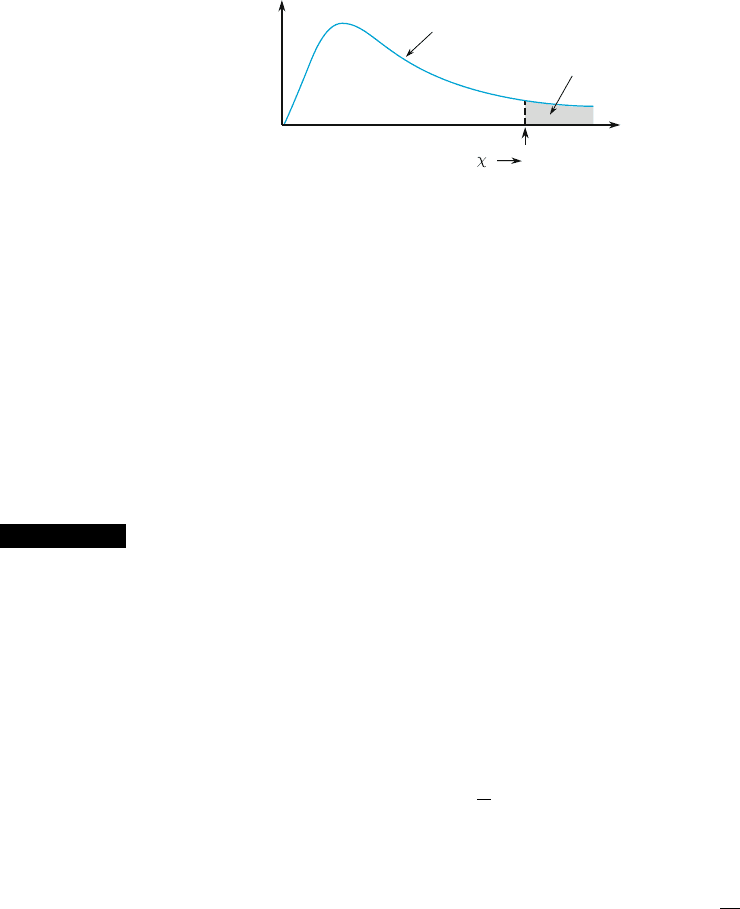
For example, moving down to tail area .085 and across to the 4 df column, we see that
the area to the right of 8.18 under the 4 df chi-squared curve is .085 (see Figure 13.2).
To capture this same upper-tail area under the 10 df curve, we must go out to
16.54. In the 2 df column, the top row shows that if the calculated value of the chi-
squared variable is smaller than 4.60, the captured tail area (the P-val ue) exceeds
.10. Similarly, the bottom row in this column indicates that if the calculated value
exceeds 13.81, the tail area is smaller than .001 (P-value < .001).
x
2
When the p
i
’s Are Functions of Other Parameters
Frequently the p
i
’s are hypothesized to depend o n a smaller number of parameters
y
1
, ... , y
m
(m < k). Then a specific hypothesis involving the y
i
’s yields specific
p
i0
’s, which are then used in the w
2
test.
Example 13.2 In a well-known genetics article (“The Progeny in Generations F
12
to F
17
of a Cross
Between a Yellow-Wrinkled and a Green-Round Seeded Pea,” J. Genet.,1923:
255–331), the early statistician G. U. Yule analyzed data resulting from crossing
garden peas. The dominant alleles in the experiment were Y ¼ yellow color and
R ¼ round shape, resulting in the double dominant YR. Yule examined 269 four-
seed pods resulting from a dihybrid cross and counted the number of YR seeds in
each pod. Letting X denote the number of YR’s in a randomly selected pod, possible
X values are 0, 1, 2, 3, 4, which we identify with cells 1, 2, 3, 4, and 5 of a rectangular
table (so, for example, a pod with X ¼ 4 yields an observed count in cell 5).
The hypothesis that the Mendelian laws are operative and that genotypes of
individual seeds within a pod are independent of one another implies that X has a
binomial distribution with n ¼ 4 and y ¼
9
16
. We thus wish to test H
0
: p
1
¼ p
10
, ...,
p
5
¼ p
50
, where
p
i
0
¼ Pði 1YR
0
s among 4 seeds when H
0
is trueÞ
¼
4
i 1
y
i1
ð1 yÞ
4ði1Þ
i ¼ 1; 2; 3; 4; 5; y ¼
9
16
Shaded area = .085
Chi-squared curve for 4 df
8.18
Calculated
2
Figure 13.2 A P-value for an upper-tailed chi-squared test
728
CHAPTER 13 Goodness-of-Fit Tests and Categorical Data Analysis
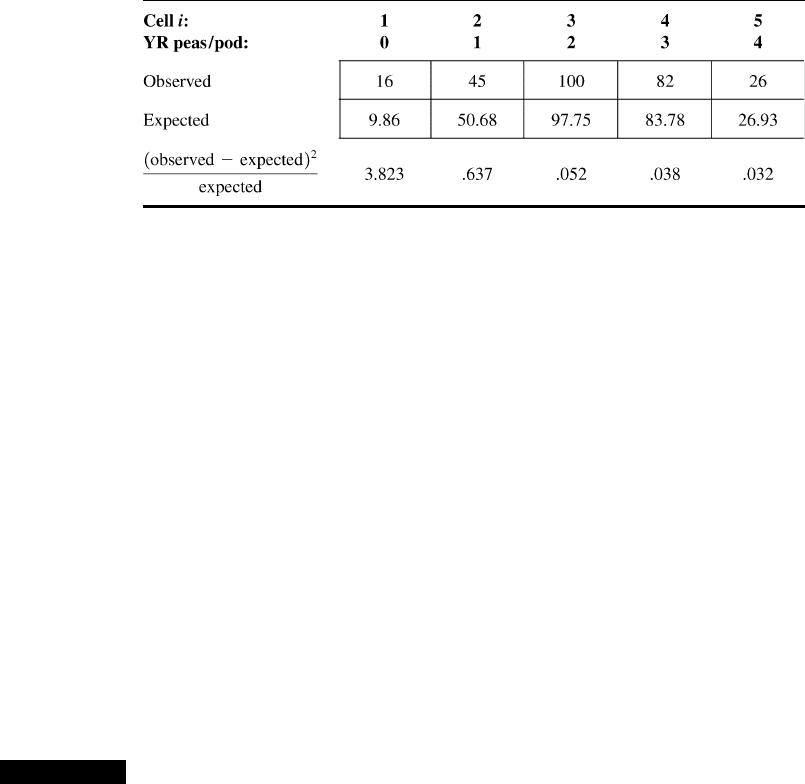
Yule’s data and the computations are in Table 13.3 with expected cell counts
np
i0
¼ 269p
i0
.
Thus w
2
¼ 3.823 + · · · + .032 ¼ 4.582. Since w
2
:01;k1
¼ w
2
:01;4
¼ 13:277,
H
0
is not rejected at level .01. Appendix Table A.10 shows that because
4.582 < 7.77, the P-value for the test exceeds .10. H
0
should not be rejected at
any reasonable significance level. ■
x
2
When the Underlying Distribution Is Continuous
We have so far assumed that the k categories are naturally defined in the context of
the experiment under consideration. The w
2
test can also be used to test whether a
sample comes from a specific underlying continuous distribution. Let X denote the
variable being sampled and suppose the hypothesized pdf of X is f
0
(x). As in the
construction of a frequency distribution in Chapter 1, subdivide the measurement
scale of X into k intervals [a
0
, a
1
), [a
1
, a
2
), ...,[a
k–1
, a
k
), where the interval [a
i–1,
a
i
)
includes the value a
i–1
but not a
i.
The cell probabilities specified by H
0
are then
p
i0
¼ Pða
i1
X < a
i
Þ¼
ð
a
i
a
i1
f
0
ðxÞdx
The cells should be chosen so that np
i0
5 for i ¼ 1, ... , k. Often they are
selected so that the np
i0
’s are equal.
Example 13.3 To see whether the time of onset of labor among expectant mothers is uniformly
distributed throughout a 24 h day, we can divide a day into k periods, each of length
24/k. The null hypothesis states that f(x) is the uniform pdf on the interval [0, 24], so
that p
i0
¼ 1/k. The article “The Hour of Birth” (Brit. J. Prevent. Social Med., 1953:
43–59) reports on 1186 onset times, which were categorized into k ¼ 24 1-hour
intervals beginning at midnight, resulting in cell counts of 52, 73, 89, 88, 68, 47, 58,
47, 48, 53, 47, 34, 21, 31, 40, 24, 37, 31, 47, 34, 36, 44, 78, and 59. Each expected
cell count is 1186 1/24 ¼ 49.42, and the resulting value of w
2
is 162.77. Since
w
2
:01;23
¼ 41:637, the computed value is highly significant, and the null hypothesis
is resoundingly rejected. Generally speaking, it appea rs that labor is much more
likely to commence very late at night than during normal waking hours.
■
For testing whether a sample comes from a specific normal distribution, the
fundamental parameters are y
1
¼ m and y
2
¼ s, and each p
i0
will be a function of
these parameters.
Table 13.3 Observed and expected cell counts for Example 13.2
13.1 Goodness-of-Fit Tests When Category Probabilities Are Completely Specified 729
Example 13.4 The developers of a new standardized exam want it to satisfy the following criteria:
(1) actual time taken to complete the test is normally distributed, (2) m ¼ 100 min,
and (3) exactly 90% of all students will finish within a 2 h period. In the pilot testing
of the standardized test, 120 students are given the test, and their completion times
are recorded. For a chi-squared test of normally distributed completion time it is
decided that k ¼ 8 intervals should be used. The criteria imply that the 90th
percentile of the completion time distribution is m + 1.28s ¼ 2h¼ 120 min.
Since m ¼ 100, this implies that s ¼ 15.63.
The eight intervals that divide the standard normal scale into eight equally
likely segments are [0, .32), [.32, .675), [.675, 1.15), [1.15, 1), and their
four counterparts on the other side of 0. For m ¼ 100 and s ¼ 15.63, these
intervals become [100, 105), [105, 110.55), [110.55, 117.97), and [117.97, 1).
Thus p
i
0
¼
1
8
¼ :125 ði ¼ 1; ...; 8Þ, from which each expected cell count is
np
i0
¼ 120(.125) ¼ 15. The observed cell counts were 21, 17, 12, 16, 10, 15, 19,
and 10, resulting in a w
2
of 7.73. Since w
2
:10;7
¼ 12:017 and 7.73 is not 12.017,
there is no evidence for concluding that the criteria have not been met. ■
Exercises Section 13.1 (1–11)
1. What conclusion would be appropriate for an
upper-tailed chi-squared test in each of the follow-
ing situations?
a. a ¼ .05, df ¼ 4, w
2
¼ 12.25
b. a ¼ .01, df ¼ 3, w
2
¼ 8.54
c. a ¼ .10, df ¼ 2, w
2
¼ 4.36
d. a ¼ .01, k ¼ 6, w
2
¼ 10.20
2. Say as much as you can about the P-value for an
upper-tailed chi-squared test in each of the follow-
ing situations:
a. w
2
¼ 7.5, df ¼ 2
b. w
2
¼ 13.0, df ¼ 6
c. w
2
¼ 18.0, df ¼ 9
d. w
2
¼ 21.3, k ¼ 5
e. w
2
¼ 5.0, k ¼ 4
3. A statistics department at a large university main-
tains a tutoring center for students in its introduc-
tory service courses. The center has been staffed
with the expectation that 40% of its clients would
be from the business statistics course, 30% from
engineering statistics, 20% from the statistics
course for social science students, and the other
10% from the course for agriculture students.
A random sample of n ¼ 120 clients revealed
52, 38, 21, and 9 from the four courses. Does
this data suggest that the percentages on which
staffing was based are not correct? State and test
the relevant hypotheses using a ¼ .05.
4. It is hypothesized that when homing pigeons are
disoriented in a certain manner, they will exhibit
no preference for any direction of flight after
takeoff (so that the direction X should be uni-
formly distributed on the interval from 0
to
360
). To test this, 120 pigeons are disoriented,
let loose, and the direction of flight of each is
recorded; the resulting data follows. Use the chi-
squared test at level .10 to see whether the data
supports the hypothesis.
Direction 0– < 45
45– < 90
90– < 135
Frequency 12 16 17
Direction 135– < 180
180– < 225
225– < 270
Frequency 15 13 20
Direction 270– < 315
315– < 360
Frequency 17 10
5. An information retrieval system has ten storage
locations. Information has been stored with the
expectation that the long-run proportion of
requests for location i is given by the expression
p
i
¼ (5.5 – | i – 5.5| )/30. A sample of 200 retrieval
requests gave the following frequencies for loca-
tions 1–10, respectively: 4, 15, 23, 25, 38, 31, 32,
14, 10, and 8. Use a chi-squared test at significance
level .10 to decide whether the data is consistent
with the a priori proportions (use the P-value
approach).
6. Sorghum is an important cereal crop whose qual-
ity and appearance could be affected by the pres-
ence of pigments in the pericarp (the walls of the
730 CHAPTER 13 Goodness-of-Fit Tests and Categorical Data Analysis
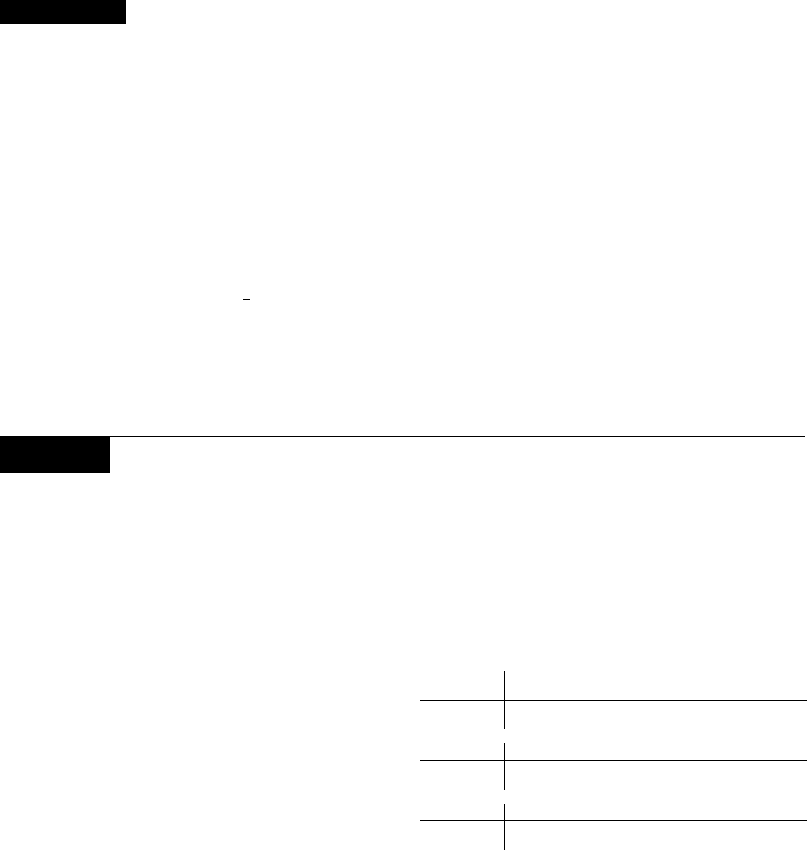
plant ovary). The article “A Genetic and Biochem-
ical Study on Pericarp Pigments in a Cross
Between Two Cultivars of Grain Sorghum, Sor-
ghum Bicolor” (Heredity, 1976: 413–416) reports
on an experiment that involved an initial cross
between CK60 sorghum (an American variety
with white seeds) and Abu Taima (an Ethiopian
variety with yellow seeds) to produce plants with
red seeds and then a self-cross of the red-seeded
plants. According to genetic theory, this F
2
cross
should produce plants with red, yellow, or white
seeds in the ratio 9:3:4. The data from
the experiment follows; does the data confirm or
contradict the genetic theory? Test at level .05
using the P-value approach.
Seed Color Red Yellow White
Observed Frequency 195 73 100
7. Criminologists have long debated whether there is
a relationship between weather conditions and the
incidence of violent crime. The author of the arti-
cle “Is There a Season for Homicide?” (Criminol-
ogy, 1988: 287–296) classified 1361 homicides
according to season, resulting in the accompany-
ing data. Test the null hypothesis of equal propor-
tions using a ¼ .01 by using the chi-squared table
to say as much as possible about the P-value.
Winter Spring Summer Fall
328 334 372 327
8. The article “Psychiatric and Alcoholic Admissions
Do Not Occur Disproportionately Close to
Patients’ Birthdays” (Psych. Rep., 1992: 944–946)
focuses on the existence of any relationship
between date of patient admission for treatment of
alcoholism and patient’s birthday. Assuming a 365-
day year (i.e., excluding leap year), in the absence
of any relation, a patient’s admission date is equally
likely to be any one of the 365 possible days. The
investigators established four different admission
categories: (1) within 7 days of birthday, (2)
between 8 and 30 days, inclusive, from the birth-
day, (3) between 31 and 90 days, inclusive, from
the birthday, and (4) more than 90 days from the
birthday. A sample of 200 patients gave observed
frequencies of 11, 24, 69, and 96 for categories 1, 2,
3, and 4, respectively. State and test the relevant
hypotheses using a significance level of .01.
9. The response time of a computer system to a
request for a certain type of information is
hypothesized to have an exponential distribution
with parameter l ¼ 1 [so if X ¼ response time,
the pdf of X under H
0
is f
0
(x) ¼ e
–x
for x 0].
a. If you had observed X
1
, X
2
, ..., X
n
and wanted
to use the chi-squared test with five class inter-
vals having equal probability under H
0
, what
would be the resulting class intervals?
b. Carry out the chi-squared test using the follow-
ing data resulting from a random sample of 40
response times:
.10 .99 1.14 1.26 3.24 .12 .26 .80
.79 1.16 1.76 .41 .59 .27 2.22 .66
.71 2.21 .68 .43 .11 .46 .69 .38
.91 .55 .81 2.51 2.77 .16 1.11 .02
2.13 .19 1.21 1.13 2.93 2.14 .34 .44
10. a. Show that another expression for the chi-
squared statistic is
w
2
¼
X
k
i¼1
N
2
i
np
i0
n
Why is it more efficient to compute w
2
using
this formula?
b. When the null hypothesis is H
0
: p
1
¼ p
2
¼
¼ p
k
¼ 1/k (i.e., p
i0
¼ 1/k for all i), how does
the formula of part (a) simplify? Use the sim-
plified expression to calculate w
2
for the
pigeon/direction data in Exercise 4.
11. a. Having obtained a random sample from a
population, you wish to use a chi-squared
test to decide whether the population dis-
tribution is standard normal. If you base the
test on six class intervals having equal pro-
bability under H
0
, what should the class
intervals be?
b. If you wish to use a chi-squared test to test H
0
:
the population distribution is normal with
m ¼ .5, s ¼ .002 and the test is to be based
on six equiprobable (under H
0
) class intervals,
what should these intervals be?
c. Use the chi-squared test with the intervals of
part (b) to decide, based on the following 45
bolt diameters, whether bolt diameter is a nor-
mally distributed variable with m ¼ .5 in., s
¼ .002 in.
.4974 .4976 .4991 .5014 .5008 .4993
.4994 .5010 .4997 .4993 .5013 .5000
.5017 .4984 .4967 .5028 .4975 .5013
.4972 .5047 .5069 .4977 .4961 .4987
.4990 .4974 .5008 .5000 .4967 .4977
.4992 .5007 .4975 .4998 .5000 .5008
.5021 .4959 .5015 .5012 .5056 .4991
.5006 .4987 .4968
13.1 Goodness-of-Fit Tests When Category Probabilities Are Completely Specified 731

13.2
Goodness-of-Fit Tests for Composite
Hypotheses
In the previous section, we presented a goodness-of-fit test based on a w
2
statistic
for deciding between H
0
: p
1
¼ p
10
, ..., p
k
¼ p
k0
and the alternative H
a
stating that
H
0
is not true. The null hypothesis was a simpl e hypothesis in the sense that each p
i0
was a specified number, so that the expected cell counts when H
0
was true were
uniquely determined numbers.
In many situations, there are k naturally occurring categories, but H
0
states
only that the p
i
’s are functions of other parameters y
1
, ... , y
m
without specifying
the values of these y’s. For example, a population may be in equilibrium with
respect to proportions of the three genotypes AA, Aa, and aa. With p
1
, p
2
, and p
3
denoting these proportions (probabilities), one may wish to test
H
0
: p
1
¼ y
2
; p
2
¼ 2yð1 yÞ; p
3
¼ð1 y Þ
2
ð13:1Þ
where y represents the proportion of gene A in the population. This hypothesis is
composite because knowing that H
0
is true does not uniquely determine the cell
probabilities and expected cell counts but only their general form. To carry out a
w
2
test, the unknown y
i
’s must first be estimated.
Similarly, we may be interested in testing to see whether a sample came from
a particular family of distributions without specifying any particular member of the
family. To use the w
2
test to see whether the distri bution is Poisson, for example, the
parameter l must be estimated. In addition, because there are actually an infinite
number of possible values of a Poisson variable, these valu es must be grouped so
that there are a finite number of cells. If H
0
states that the underlying distribution
is normal, use of a w
2
test must be preceded by a choice of cells and estimation of
m and s.
x
2
When Parameters Are Estimated
As before, k will denote the number of categories or cells and p
i
will denote the
probability of an observation falling in the ith cell. The null hypothesis now states
that each p
i
is a function of a small number of parameters y
1
, ... , y
m
with the y
i
’s
otherwise unspecified:
H
0
: p
1
¼ p
1
ðuÞ; ...; p
k
¼ p
k
ðuÞ where u ¼ðy
1
; ...; y
m
Þ
H
a
: the hypothesis H
0
is not true
ð13:2Þ
For example, for H
0
of (13.1), m ¼ 1 (there is only one y), p
1
(y) ¼ y
2
, p
2
(y) ¼
2y(1 – y), and p
3
(y) ¼ (1 – y)
2
.
In the case k ¼ 2, there is really only a single rv, N
1
(since N
1
+N
2
¼ n),
which has a binomial distribution. The joint probability that N
1
¼ n
1
and N
2
¼ n
2
is then
PðN
1
¼ n
1
; N
2
¼ n
2
Þ¼
n
n
1
p
n
1
1
p
n
2
2
/ p
n
1
1
p
n
2
2
732 CHAPTER 13 Goodness-of-Fit Tests and Categorical Data Analysis
where p
1
+p
2
¼ 1 and n
1
+n
2
¼ n. For general k, the joint distribution of N
1
, ...,
N
k
is the multinomial distribution (Section 5.1)with
PðN
1
¼ n
1
; :::; N
k
¼ n
k
Þ/p
n
1
1
p
n
2
2
p
n
k
k
ð13:3Þ
When H
0
is true, (13.3) becomes
PðN
1
¼ n
1
; :::; N
k
¼ n
k
Þ/½p
1
ðuÞ
n
1
½p
k
ðuÞ
n
k
ð13:4Þ
To apply a chi-squared test, y ¼ (y
1
, ... , y
m
) must be estimated.
METHOD OF
ESTIMATION
Let n
1
, n
2
, ..., n
k
denote the observed values of N
1
, ..., N
k
. Then
^
y
1
; ...;
^
y
m
are those values of the y
i
’s that maximize (13.4), that is, the maximum
likelihood estimators (Section 7.2).
Example 13.5 In humans there is a blood group, the MN group, that is composed of individuals
having one of the three blood types M, MN, and N. Type is determined by two alleles,
and there is no dominance, so the three possible genotypes give rise to three pheno-
types. A population consisting of individuals in the MN group is in equilibrium if
PðMÞ¼p
1
¼ y
2
PðMNÞ¼p
2
¼ 2yð1 yÞ
PðNÞ¼p
3
¼ð1 yÞ
2
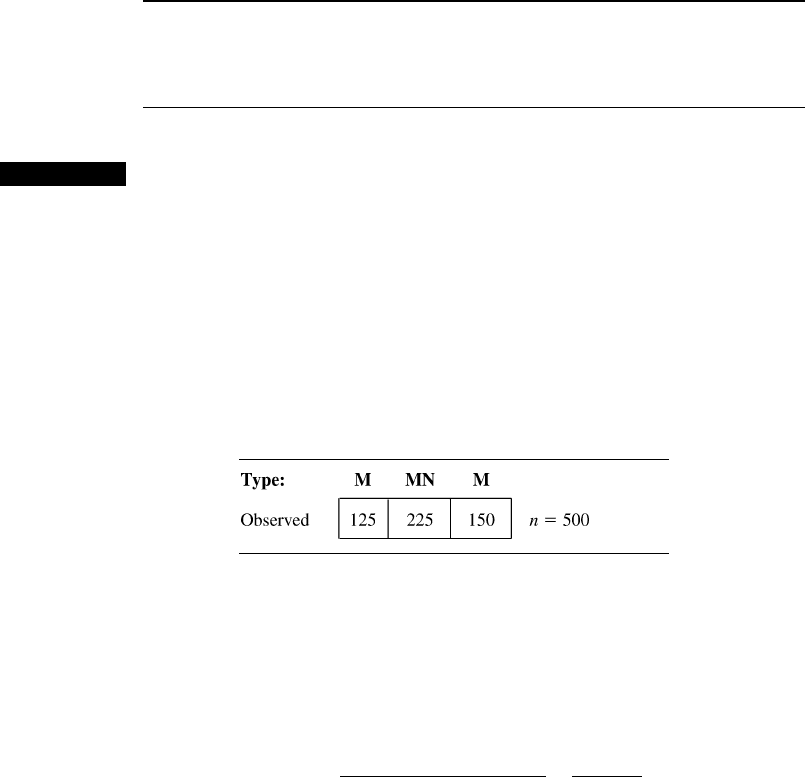
for some y. Suppose a sample from such a population yielded the results shown in
Table 13.4.
Then
½p
1
ðyÞ
n
1
½p
2
ðyÞ
n
2
½p
3
ðyÞ
n
3
¼½y
2
n
1
½2yð1 yÞ
n
2
½ð1 yÞ
2
n
3
¼ 2
n
2
y
2n
1
þn
2
ð1 yÞ
n
2
þ2n
3
Maximizing this with respect to y (or, equivalently, max imizing the natural loga-
rithm of this quantity, which is easier to differentiate) yields
^
y ¼
2n
1
þ n
2
½ð2n
1
þ n
2
Þþðn
2
þ 2n
3
Þ
¼
2n
1
þ n
2
2n
With n
1
¼ 125 and n
2
¼ 225,
^
y ¼ 475=1000 ¼ :475. ■
Once u ¼ (y
1
, ..., y
m
) has been estimated by
^
u ¼ð
^
y
1
; ...;
^
y
m
Þ, the estimated
expected cell counts are the np
i
ð
^
uÞ’s. These are now used in place of the np
i0
’s of
Section 13.1 to specify a w
2
statistic.
Table 13.4 Observed counts for Example 13.5
13.2 Goodness-of-Fit Tests for Composite Hypotheses 733

THEOREM
Under general “regularity” conditions on y
1
, ..., y
m
and the p
i
(u)’s, if y
1
, ...,
y
m
are estimated by the method of maximum likelihood as described previ-
ously and n is large,
w
2
¼
X
all cells
ðobserved estimated expectedÞ
2
expected
¼
X
k
i¼1
½N
i
np
i
ð
^
uÞ
2
np
i
ð
^
uÞ
has approximately a chi-squared distribution with k –1–m df when H
0
of
(13.2) is true. An approximately level a test of H
0
versus H
a
is then to reject
H
0
if w
2
w
2
a;k1m
. In practice, the test can be used if np
i
ð
^
uÞ5 for every i.
Notice that the number of degrees of freedom is reduced by the number of y
i
’s
estimated.
Example 13.6
(Example 13.5
continued)
With
^
y ¼ :475 and n ¼ 500, the estimated expected cell counts are
np
1
ð
^
yÞ¼500ð
^
yÞ
2
¼112:81, np
2
ð
^
yÞ¼ 500ðÞ2ðÞ:475ðÞð1:475Þ¼ 249:38, and
np
3
ð
^
yÞ¼500 112:81 249:38 ¼137:81. Then
w
2
¼
ð125 112:81Þ
2
112:81
þ
ð225 249:38Þ
2
249:38
þ
ð150 137:81Þ
2
137:81
¼ 4:78
Since w
2
:05;k1m
¼ w
2
:05;311
¼ w
2
:05;1
¼ 3:843 and 4.78 3.843, H
0
is rejected.
Appendix Table A.10 shows that P-value .029.
■
Example 13.7 Consider a series of games between two teams, I and II, that terminates as soon as
one team has won four games (with no possibility of a tie). A simple proba bility
model for such a series assumes that outcomes of successive games are independent
and that the probability of team I winning any particular game is a constant y.We
arbitrarily designate I the better team, so that y .5. Any particular series can then
terminate after 4, 5, 6, or 7 games. Let p
1
(y), p
2
(y), p
3
(y), p
4
(y) denote the
probability of termination in 4, 5, 6, and 7 games, respectively. Then
p
1
ðyÞ¼PðI wins in 4 gamesÞþPðII wins in 4 gamesÞ
¼ y
4
þ 1 yðÞ
4
p
2
ðyÞ¼PðI wins 3 of the first 4 and the fifthÞ
þ PðI loses 3 of the first 4 and the fifthÞ
¼
4
3
y
3
ð1 yÞy þ
4
1
yð1 yÞ
3
ð1 yÞ
¼ 4y 1 yðÞy
3
þ 1 yðÞ
3
hi
p
3
ðyÞ¼10y
2
ð1 yÞ
2
½y
2
þð1 yÞ
2
p
4
ðyÞ¼20y
3
ð1 yÞ
3
The article “Seven-Game Series in Sports” by Groeneveld and Meeden
(Math. Mag., 1975: 187–192) tested the fit of this model to results of National
734 CHAPTER 13 Goodness-of-Fit Tests and Categorical Data Analysis
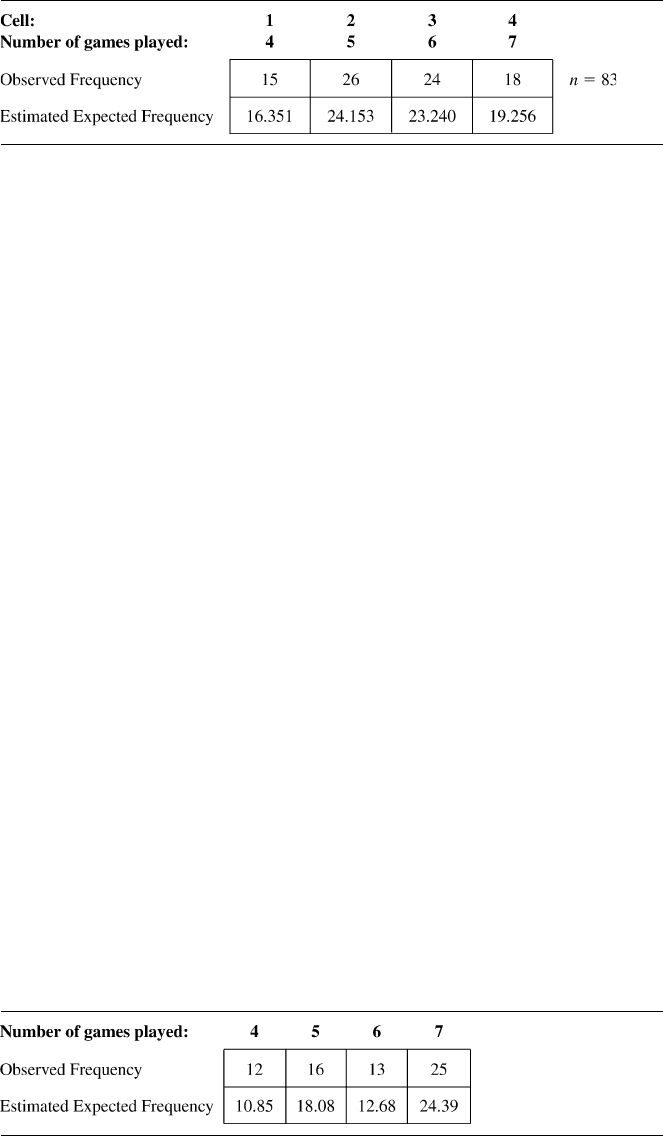
Hockey League playoffs during the period 1943–1967 (when league membership
was stable). The data appears in Table 13.5 .
The estimated expected cell counts are 83p
i
ð
^
yÞ, where
^
y is the value of y that
maximizes
y
4
þ 1 yðÞ
4
no
15
4y 1 yðÞy
3
þ 1 yðÞ
3
hino
26
10y
2
1 yðÞ
2
y
2
þ 1 yðÞ
2
hino
24
20y
3
1 yðÞ
3
no
18
ð13:5Þ
Standard calculus methods fail to yield a nice formula for the maximizing value
^
y,
so it must be computed using numerical methods. The result is
^
y ¼ :654, from which
p
i
ð
^
yÞ and the estimated expected cell counts are computed. The computed value of
w
2
is .360, and (since k –1–m ¼ 4–1–1¼ 2) w
2
:10;2
¼ 4:605. There is thus no
reason to reject the simple model as applied to NHL playoff series.
The cited article also considered World Series data for the period 1903–1973.
For the simple model, w
2
¼ 5.97, so the model does not seem appropriate. The
suggested reason for this is that for the simple model
Pðseries lasts six games jseries lasts at least six games Þ:5 ð13:6Þ
whereas of the 38 series that actually lasted at least six games, only 13 lasted
exactly six. The following alternative model is then introduced:
p
1
ðy
1
; y
2
Þ¼y
4
1
þð1 y
1
Þ
4
p
2
ðy
1
; y
2
Þ¼4y
1
ð1 y
1
Þ½y
3
1
þð1 y
1
Þ
3
p
3
ðy
1
; y
2
Þ¼10y
2
1
1 y
1
ðÞ
2
y
2
p
4
ðy
1;
y
2
Þ¼10y
2
1
ð1 y
1
Þ
2
ð1 y
2
Þ
The first two p
i
’s are identical to the simple model, whereas y
2
is the conditional
probability of (13.6) (which can now be any number between zero and one).
The values of
^
y
1
and
^
y
2
that maximize the expression analogous to expression
(13.5) are determined numerically as
^
y
1
¼ :614,
^
y
2
¼ :342. A summary appears in
Table 13.6,andw
2
¼ .384. Two parameters are estimated, so df ¼ k–1–m ¼ 1
with w
2
:10;1
¼ 2:706, indicating a good fit of the data to this new model.
Table 13.6 Observed and expected counts for the more complex model
■
Table 13.5 Observed and expected counts for the simple model
13.2 Goodness-of-Fit Tests for Composite Hypotheses 735
One of the regularity conditions on the y
i
’s in the theorem is that they be
functionally independent of one another. That is, no sing le y
i
can be determ ined
from the values of other y
i
’s, so that m is the number of functionally independent
parameters estimat ed. A general rule of thumb for degrees of freedom in a chi-
squared test is the following.
w
2
df ¼
number of freely
determined cell counts
number of independent
parameters estimated
This rule will be used in connection with several different chi-squared tests in the
next section.
Goodness of Fit for Discrete Distributions
Many experiments involve observing a random sample X
1
, X
2
, ..., X
n
from some
discrete distribution. One may then wish to investigate whether the underlying
distribution is a member of a particular family, such as the Poisson or negative
binomial family. In the case of both a Poisson and a negative binomial distribution,
the set of possible values is infinite, so the values must be grouped into k subsets
before a chi-squared test can be used. Th e groupings should be done so that the
expected frequency in each cell (group) is at least 5. The last cell will then
correspond to X values of c, c +1,c +2,... for some value c.
This grouping can considerably complicate the computation of the
^
y
i
’s and
estimated expected cell counts. This is because the theorem requires that the
^
y
i
’s be
obtained from the cell counts N
1
, ..., N
k
rather than the sample values X
1
, ..., X
n
.
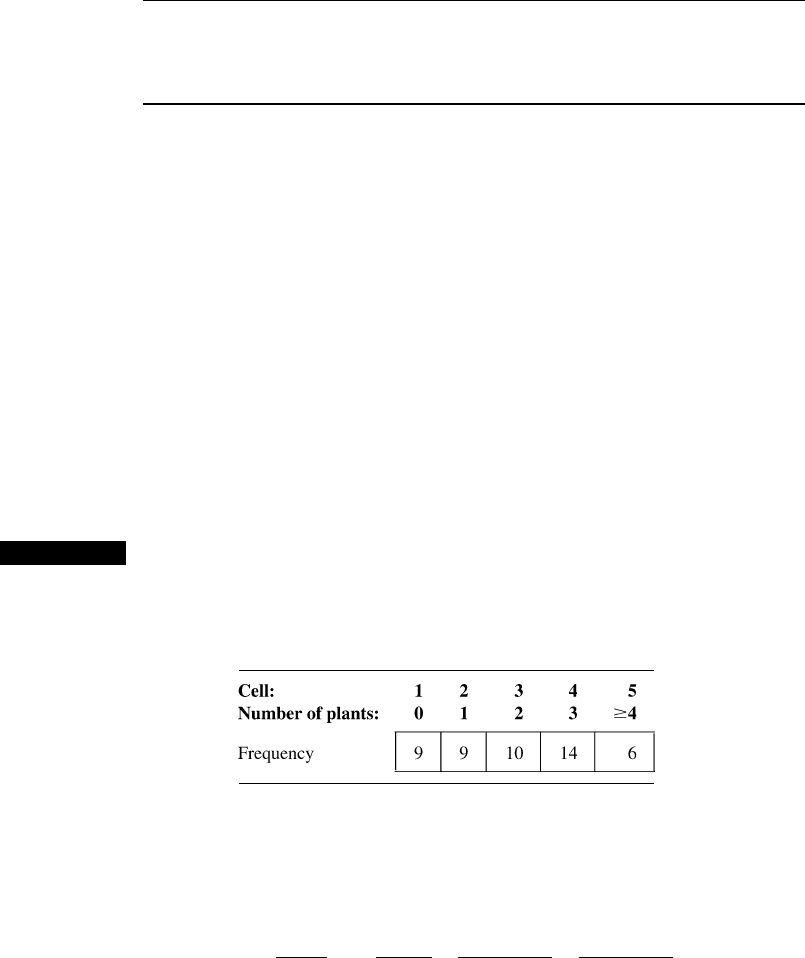
Example 13.8 Table 13.7 presents count data on the number of Larrea divaricata plants found in
each of 48 sampling quadrats, as reported in the article “Some Sampling Character-
istics of Plants and Arthropods of the Arizona Desert” (Ecology, 1962: 567–571).
The author fit a Poisson distribution to the data. Let l denote the Po isson
parameter and suppose for the moment that the six counts in cell 5 were actually 4,
4, 5, 5, 6, 6. Then denoting sample values by x
1
, ..., x
48
, nine of the x
i
’s were 0, nine
were 1, and so on. The likelihood of the observed sample is
e
l
l
x
1
x
1
!
e
l
l
x
48
x
48
!
¼
e
48l
l
Sx
i
x
1
!x
48
!
¼
e
48l
l
101
x
1
!x
48
!
The value of l for which this is maximized is
^
l ¼ x
i
=n ¼ 101=48 ¼ 2:10 (the value
reported in the article).
Table 13.7 Observed counts for Example 13.8
736 CHAPTER 13 Goodness-of-Fit Tests and Categorical Data Analysis

However, the
^
l require d for w
2
is obtained by maximizing Expression (13.4)
rather than the likelihood of the full sample. The cell probabilities are
p
i
ðlÞ¼
e
l
l
i1
ði 1Þ!
i ¼ 1; 2; 3; 4
p
5
ðlÞ¼1
X
3
i¼0
e
l
l
i
i!
so the right-hand side of (13.4) becomes
e
l
l
0
0!
9
e
l
l
1
1!
9
e
l
l
2
2!
10
e
l
l
3
3!
14
1
X
3
i¼0
e
l
l
i
i!
"#
6
ð13:7Þ
There is no nice formula for
^
l, the maximizing value of l in this latter expression,
so it must be obtained numerically. ■
Because the parameter estimates are usually much more difficult to compute
from the grouped data than from the full sample, they are often computed usin g this
latter method. When these “full” estimators are used in the chi-squared statistic, the
distribution of the statistic is altered and a level a test is no longer specified by the
critical value w
2
a;k1m
THEOREM
Let
^
y
1
; ...;
^
y
m
be the maximum likelihood estimators of y
1
, ..., y
m
based on
the full sample X
1
, ..., X
n
, and let w
2
denote the statistic based on these
estimators. Then the critical value c
a
that specifies a level a upper-tailed test
satisfies
w
2
a;k1m
c
a
w
2
a;k1
ð13:8Þ
The test procedure implied by this theorem is the following:
If w
2
w
2
a;k1
; reject H
0
:
If w
2
w
2
a;k1m
; do not reject H
0
: ð13:9Þ
If w
2
a;k1m
< w
2
< w
2
a;k1
; withhold judgment:
13.2 Goodness-of-Fit Tests for Composite Hypotheses 737