
Dixon R.M.W., Aikhenvald Alexandra Y. The Amazonian Languages (Cambridge Language Surveys)
Подождите немного. Документ загружается.

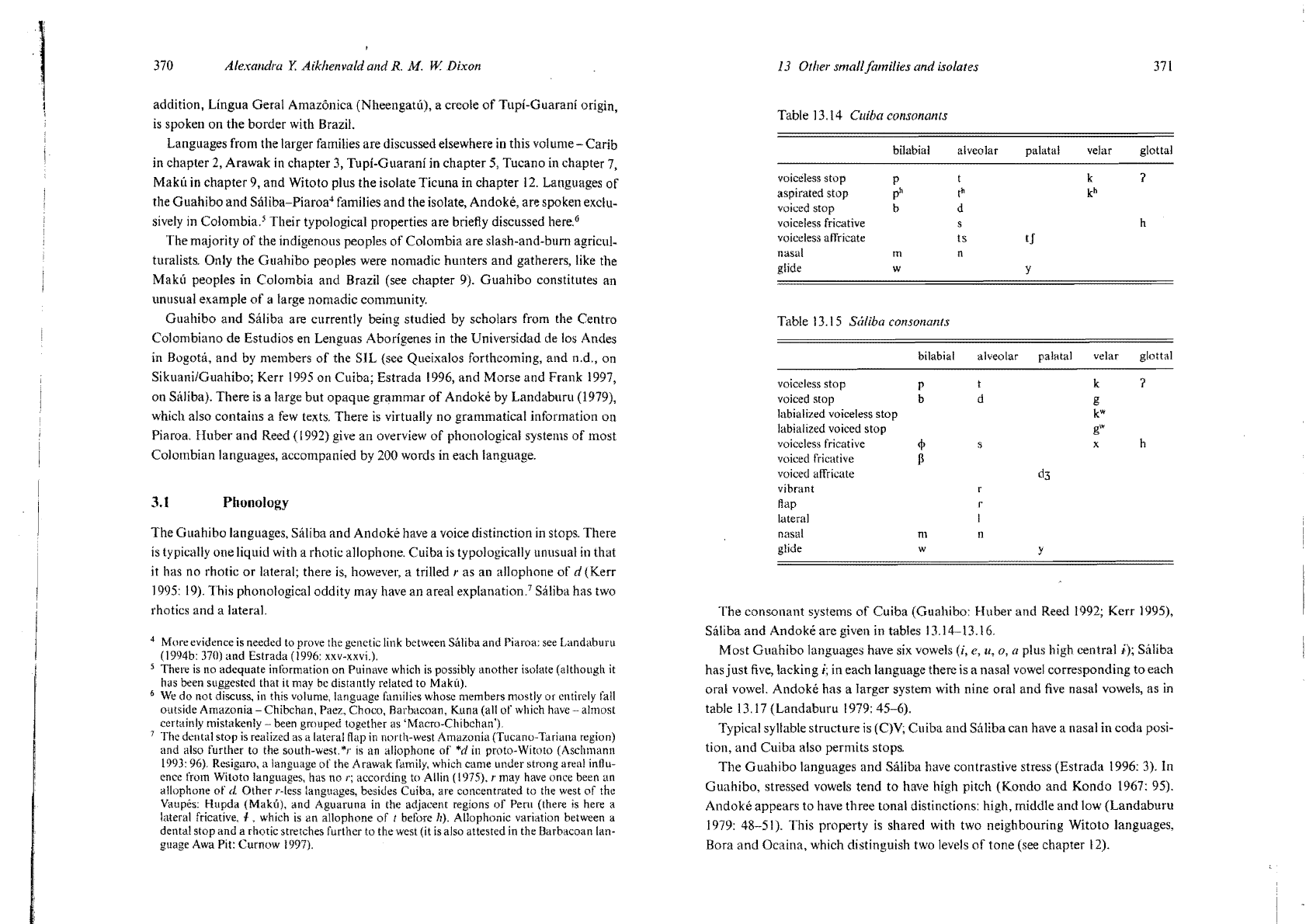
354
355
AleXCllldra
Y.
Aik/¡envald and R.
M.
W.
Dixon
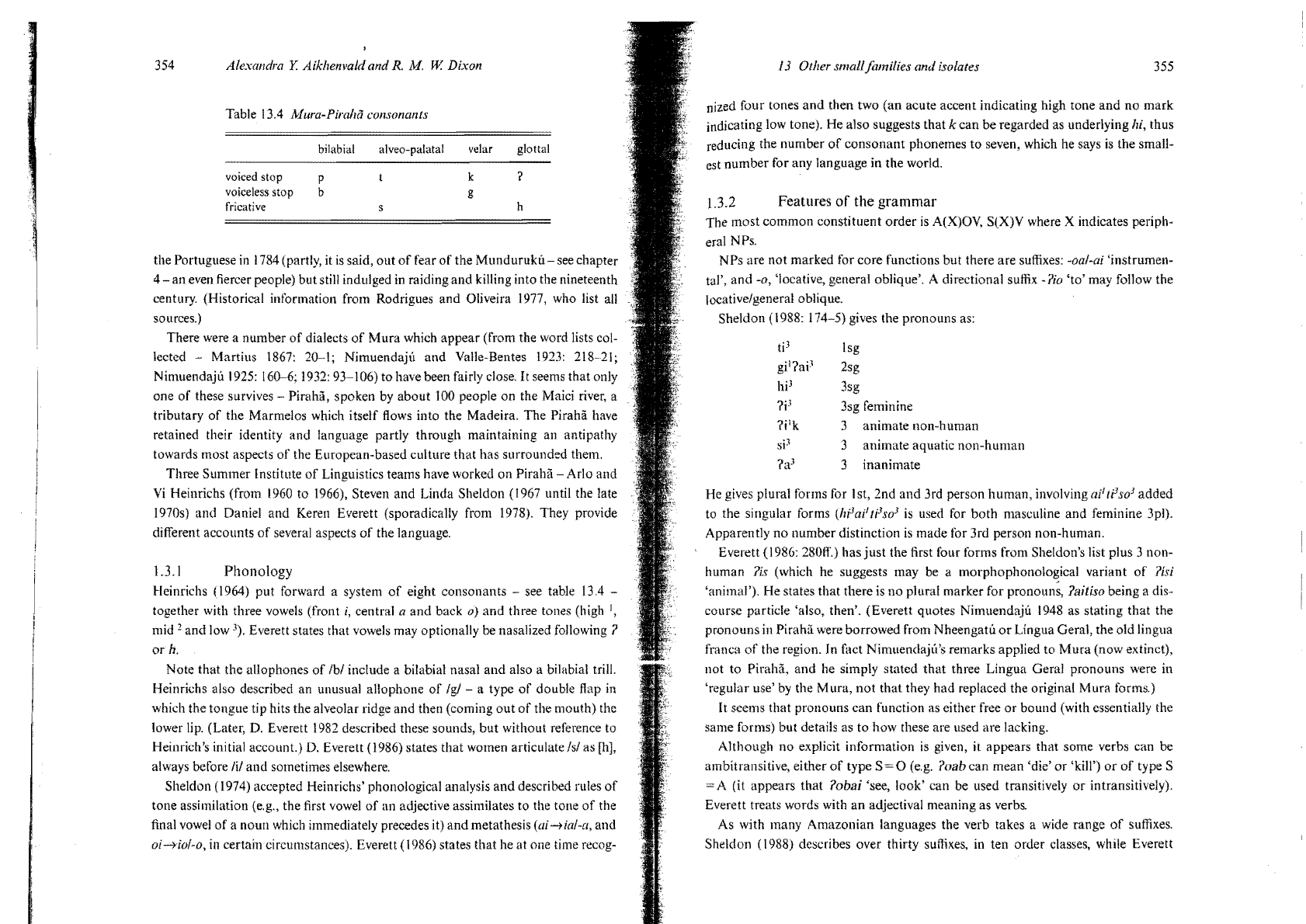
Table 13.4
Mura-PirahiJ.
cOllsonants
bilabial
alveo-palatal velar glottal
voiced stop
voiceless
stop
fricative
p
b
k
g
?
h
the Portuguese
in
1784
(partly, it
is
said, out
of
fear
of
the
Mundurukú
- see chapter
4
-an
even fiercer people) but still indulged
in
raidíng
and
killing ínto the nineteenth
century. (Historícal information from Rodrigues
and
01íveira
1977,
who list
all
sources.)
There were a number
of
dialects
of
Mura
which appear (from the word lists col-
lectcd - Martius
1867:
20-1; Nímuendajú
and
Valle-Bentes
1923:
218-21;
Nimuendajú
1925:
1932:
93-106)
to
have been fairly close.
It
seems that only
one
of
these slIrvives Piraha, spoken by abollt 100 people
00
the Maici river, a
tributary
of
the Marmelos which itself flows into the Madeira.
The
Piraha have
retained their identity and language partly through maintaining an antipathy
towards most aspects
of
the ElIropean-based culture
that
has sllrrollnded them.
Three Summer Institute
of
Lioguisties teams have worked on Piraha - Arlo and
Vi
Heinrichs (from
1960
to 1966), Steven
and
Linda Sheldon (1967 until the late
1970s)
and
Daniel
and
Keren Everett (sporadically from 1978). They provide
different accounts
of
several aspects
of
the language.
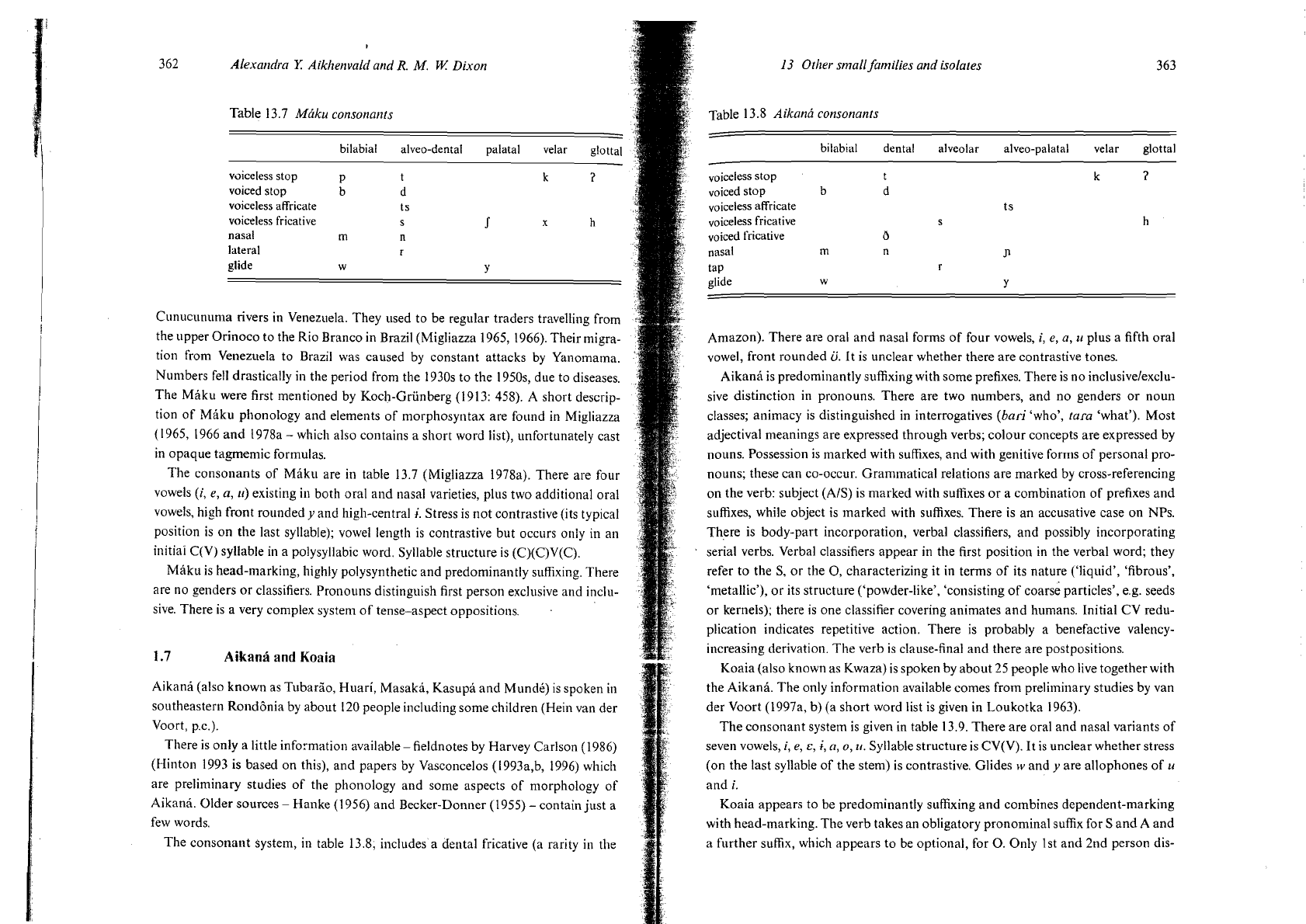
1.3.1
Phonology
Heinrichs (I964) put forward a system
of
eight consonants - see table
13.4
together with three vowels (front
i,
central
a
and
back
o)
and
three tones (high
1,
mid
2
and low
3).
Everett states that vowels may optionally be nasalized following
7
or
h.
Note
that
the allophones
of
Ibt
include a bilabial nasal
and
also a bilabial trill.
Heinrichs also described an un usual al!ophone
of
Ig/
-
a type
of
double flap
in
which the tongue tip hits the alveolar ridge
and
then (eoming
out
of
the mouth) the
lower tip. (Later, D. Everett
1982
described these sounds,
but
without referenee to
Heinrich's initial aecounL)
D.
Everett (1986) states
that
women artieulate
Isl
as
always befo
re
til
and
sometimes elsewhere.
Sheldon (1974) accepted Heinrichs' phonological analysis
and
described rules
of
tone assimílation (e.g., the first
vowel
of
an adjective assimilates to the tone
of
the
final vowel
of
a noutl which immediately precedes it)
and
metathesis
(ai-~ia/-a,
anel
in certain cireumstancest Everett (1986) sta tes that he
al
one time recog-
J
3
Other
smallfamilies
and
isolates
nized four tones
and
then two (an acute accent indieating tone
and
no
mark
indicating low tone). He also suggests
that
k
can
be
regarded as llnderlying
hi,
thus
reducing the number
of
consonant
phonemes
to
seven, which he says is the small-
est number for any language in the world.
1.3.2 Features
of
the grammar
The
most
common
constituent
order
is
A(X)OV, S(X)V where X indicates periph-
eral NPs.
NPs are not marked for core functions
but
there
are
suffixes:
-oa/-ai
'instrumen-
tal',
and
-o,
'Iocative, oblique'. A directional suffix
-río
'to'
may follow the
locative/general oblique.
Sheldon (1988: 174-5) gives the prono
un
s as:
tP
Isg
gil?aP
hP
?¡J
feminine
?j!k
3 anímate non-human
si>
3
anímate aQuatíc non-human
í'a
J
3
ínanimate
He gives plural forms for 1 st, 2nd
and
3rd person human,
ai
1
trso
3
added
to the singular forms
(/¡¡3
a
i
l
tiJso
J
is
used ror
both
masculine
and
feminine
Apparently no l1umber distinction
is
made for 3rd person non-human.
Everett (1986:
280ft) has
just
the first four forms from She1don's list plus
3
non-
human
lis
he suggests may be a
morphophonolo~ical
variant
of
?isi
He states that there
is
110
plural marker for pronoulls,
raitíso
being a dis-
course particle 'also, then'. (Everett quotes Nimuendajú
1948
as stating
that
the
pronouns in Pirah¡¡ were borrowed from Nheengatú
or
Língua Geral, the old
franca
of
the In raet Nimuendajú's remarks applied to
Mura
(now
not to Piraha,
and
he simply stated
that
three Língua Geral pronouns were in
'regular use'
by
the Mura,
not
that they had replaced the original
Mura
forms.)
Ir
seems that pronouns
can
function as either free
or
bound (with essentialIy the
same forms) but details as
to
how these are llsed are lacking.
no
explicit information
is
gíven,
it
appears that some verbs can be
ambitransitive, either
of
type S
=
O (e.g.
roab
can mean 'die'
or
'kili')
or
of
type S
=
A (jI appears thal
70bai
'see, look' can be used
Everett treats words with an adjectival as verbs.
As with many Amazonian languages the verb takes a wide range
of
suffixes.
Sheldon (1988) describes over thirty suffixes,
in
ten order
c1asses,
while Everett
356
357
Alexalldra
Y.
Aikhenvald
and
R
M.
W
Dixon
has nineteen
order
classes.
There
is
no
tense markil1g
but
Everett Iists the
fol-
lowing aspects: perfective, imperfective, telic, atelic, cOl1tinuative, iterative .and
ingressive.
Other
suffixes refer to distance (proximatelremote), certainty, desire and
frustrated initiation
or
termination
of
an
action. Although neither
author
uses the
term, there also appears to be an optional system
of
evidentials: 'observation',
'hearsay'
and
'deduction'.
Everett sta tes that there are no valency-changing delÍvations
and
no
formal
marking forcausative (one must use a periphrastic construction with the verb
7ibíib
'arder, cause
to
do'),
reciprocal
or
reflexive (one
just
says
'1
hit me'
or
'he
hit him'
which
is
ambiguous between the
'he'
and
'him'
being coreferential'
or
not). He
describes verb compounding (involving directional verbs) which may be a
type
of
verb serialization. And there are several copula verbs:
7aagá
'to
havelto be',
7iigá
'to
belto
have temporarily'
and
xai
'to
be/to
do'.
There
is
no
formal marking
fol'
possession. One simply apposes possessor
01'
without a
prono
un)
and
possessed, e.g.
Paítá hi 7ító/¡oi
'Paitá
he testicles'
foc
'Paitá's testicles'.
The
nominalizer
-sai
(whích replaces aspect marking
on
the verb)
is
widelv used.
It
can form a
noun
from a complete c1ause, e.g.:
gahió
pi-ó ?abaip-i-sai
aeroplane
water-LOC
Sit-EPENTHETIC-NMLZR
'hydroplane' (lit. 'sitting-on-water
A complement c1allse from
may be translated with a
-sai
nominalized
c1allse (this is a typical Amazonian
e.g.:
hi
ob-áa?áí kahaí kai-sai
see/know-INTENSIFIER
arrow
make-NMLZR
'He
really knows how
to
make
arrows:
(21)
ti
?og-í-baí gi?ai kahaí kai-sai
lsg
want-PROX-INTENSIFIER
2sg arrow make-NMLzR
'{
really líke
yOllr
arrow-making'
OR
'1
really líke you to make
arrows.'
Temporal c1auses are marked by a suffix
-sol-oo
'when, during, after'.
Negation
is
marked by verbal suffixes
-sahai
'don't'
and
-hiab
'not'.
The
¡atter also
has a free form,
hiaba,
used
foc
negating NPs
and
nominalized clauses. There is a
coordinator
piáíi
'and,
al so' (generally used with two c1auses
that
have the same
verb) and also
hoagá
'but'.
In a relative clause the argument in common with the main c1ause must be in a
core (subject
or
object) funetion. Everett states that a relative elause can be marked
13 Otl!er small families
and
isolates
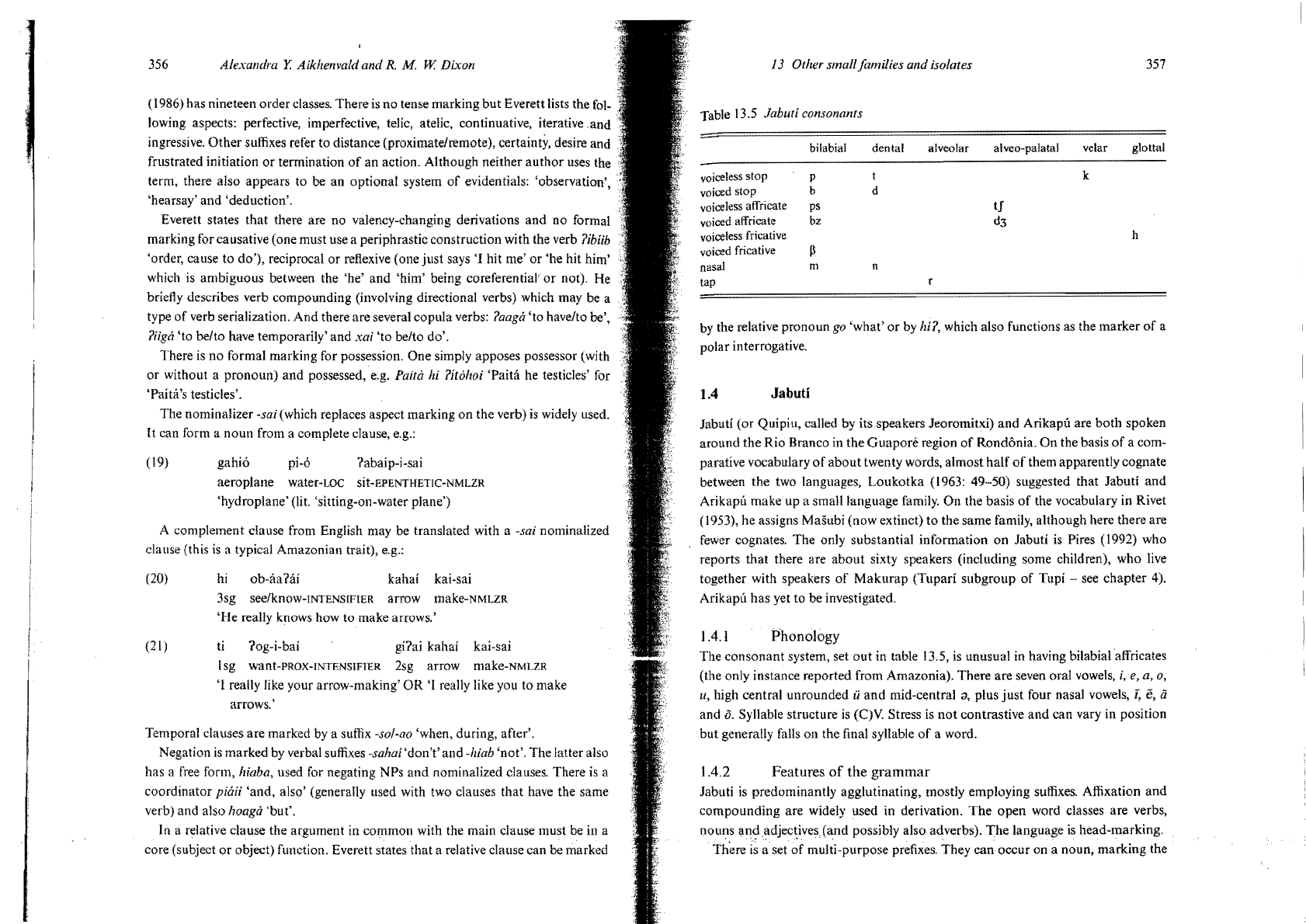
Table 13.5
Jabmí consonants
bilabial dental
alveolar
alveo-palatal velar
glottal
voiceless
stop
P
t
k
voiced
stop
b d
voiceless affricate
ps
tJ
voiced affricate
bz
d3
voiceless fricative
h
voiced fricative
p
nasal
ro
n
tap
by
the relative prono un
go
'what'
or
by
hí?,
whích al so functions as the
marker
of
a
ínterrogative.
1.4
Jabutí
Jabutí (or Quipiu, called
by
its
speakers Jeoromitxi)
and
Arikapú are
both
spoken
around
the
Río
Branco in the
Guaporé
region
of
Rondónia.
On
the basis
of
a com-
parative vocabnlary
of
abont
twenty words, almost
half
of
them apparently cognate
between
the
two languages, Loukotka (1963:
49-50)
suggested that Jabutí
and
Aríkapú make up a
smalllanguage
family.
On
the basis
of
the vocabnlary in Rivet
(1953), he assiglls Masubi (now extinct)
to
the same fami/y, although hefe there
are
fewer cognates.
The
only substantial informatíon
on
Jabutí is Pires (1992) who
reports that there are
about
sixty speakers (including sorne children), who live
together with speakers
of
Makurap
(Tuparí
subgroup
of
Tupí see
chapter
4).
Arikapú
has
yet
to
be investigated.
1.4.1
Phonology
The
consonant
system, set
out
in table 13.5, is unusual in having bilabial affricates
(the only instance reported from Amazonia). There
are
seven oral vowels,
i,
e,
a,
0,
u,
high central unrounded
ü
and
mid-central
<1,
plus
just
four nasal vowels,
í,
é,
ii
and
o.
Syllable structnre is (C)V. Stress
is
not
contrastive
and
can
vary in positíon
but generally falls on the final syllable
of
a word.
1.4.2
Features
of
the grammar
Jabutí is predominantly agglutinatillg, mostly employing suffixes. Affixation
and
compounding
are widely used in derivatíon.
The
open
word classes are verbs,
nouns
an<i.adjec~ives(and
possibly also adverbs).
The
language
is
head-marking.
There is a set
of
multí-purpose prefixes.
They
ca~
occur
on a noun,
marking
the
359
358
Alexandra
Y.
Aikhenvald and
R.
M.
W.
DixolI
possessor; on a postposition, marking lhe postpositional argument; on an intransi_
tive verb, marking the
S;
or
on
a transitíve verb, marking the
O.
A number distinc-
for 1st person:
is
0,
1
pi
is
/¡j-,
2nd person
is
(l-,
while 3rd person
is
i-
or
e-
wíth nouns, postpositions
and
transitive verbs,
but
@
with intransitive verbs
(here falling together with Isg). Free pronouns are Isg
hií,
Ipl
hirii,
2
aje
and 3
na.
Interestingly,
a
transítive verb must be preceded eíther by an
NP
(which can be a
free pronoun) in O function,
or
by
a
pronominal prefix marking
O.
In contrast,
every transítive verb bears a pronominal prefix índicating its A, whether
or
not
there
is
an explicit
NP
in
A funetion. A postposition
is
either preceded by an
NP,
or
takes
a pronominal prefix, e.g.
a-pak;:J
'with you',
a-ri
'[or you'.
Post-verbal particles mark negation, tense, aspect
and
(at least with intransitive
verbs) eausative.
The constituent order
is
basically
SV,
AOV;
A and S can be moved into post-
verbal position but O always immcdiately precedes the
verbo
Within an
NP
a
demonstrative precedes
and
an adjective follows the head. An adjective can fune-
tion as
NP
head
and
must then take the 3rd person prefix
j-
(unlike nouns, verbs
and
stpositions, adjeetives eannot take 1st
and
2nd person prefixes).
As
in many
other
Amazonian langllages, nominalizations are employed where
olher languages would have complement
or
adverbial
c1auses.
In the following exam-
pIes,
from Pires (1992:
132,
87), Ihe post-verbal particle
;:J
marks the nominalization.
(22)
hÜ
A
[a-hihi
;:¡
10
tohe
lsg 2sg0-kill
NMLZR
want
'1
wanl
lo
be your murderer.'
'1
want lo murder you')
(23)
hU
0-jenona
[a-rllkühil;:¡
s
lag IsgS-arrive 2S-leave
NMLZR
'1
as
you left.'
It
is
likely
that
Jablltí originally had no nllmbers. In the contaet situation
'one'
is
given as
l/id
(we have no information abont
its
original meaning). For 'two'
ia
used, involving Ihe vcrb root
-ha
'be
equal'
and
the reflexive-Iype
prefixje-.
For 'more
than two' the phrase
hono
10
may be
Hsed,
líterally 'know nOI',
Le.
'can't say how
.
(Of
cour~e,
Porlugllese numbers are now used
as
loan8, in addition.)
t.5
Cbapacura
family
Languages
of
the Chapacura (Txapaeuran) language family, one
of
the smallest in
southem
Amazonia, are spoken in the Guaporé valley
and
along the tributaries
of
the Madeira r¡ver, in the west
of
the state
of
Rondonia
and
in the aouth
of
the state
of
Amazonas (Brazil),
and
in
adjacent regions
of
Bolivia.
13
Otller smallfamilies and iso/ates
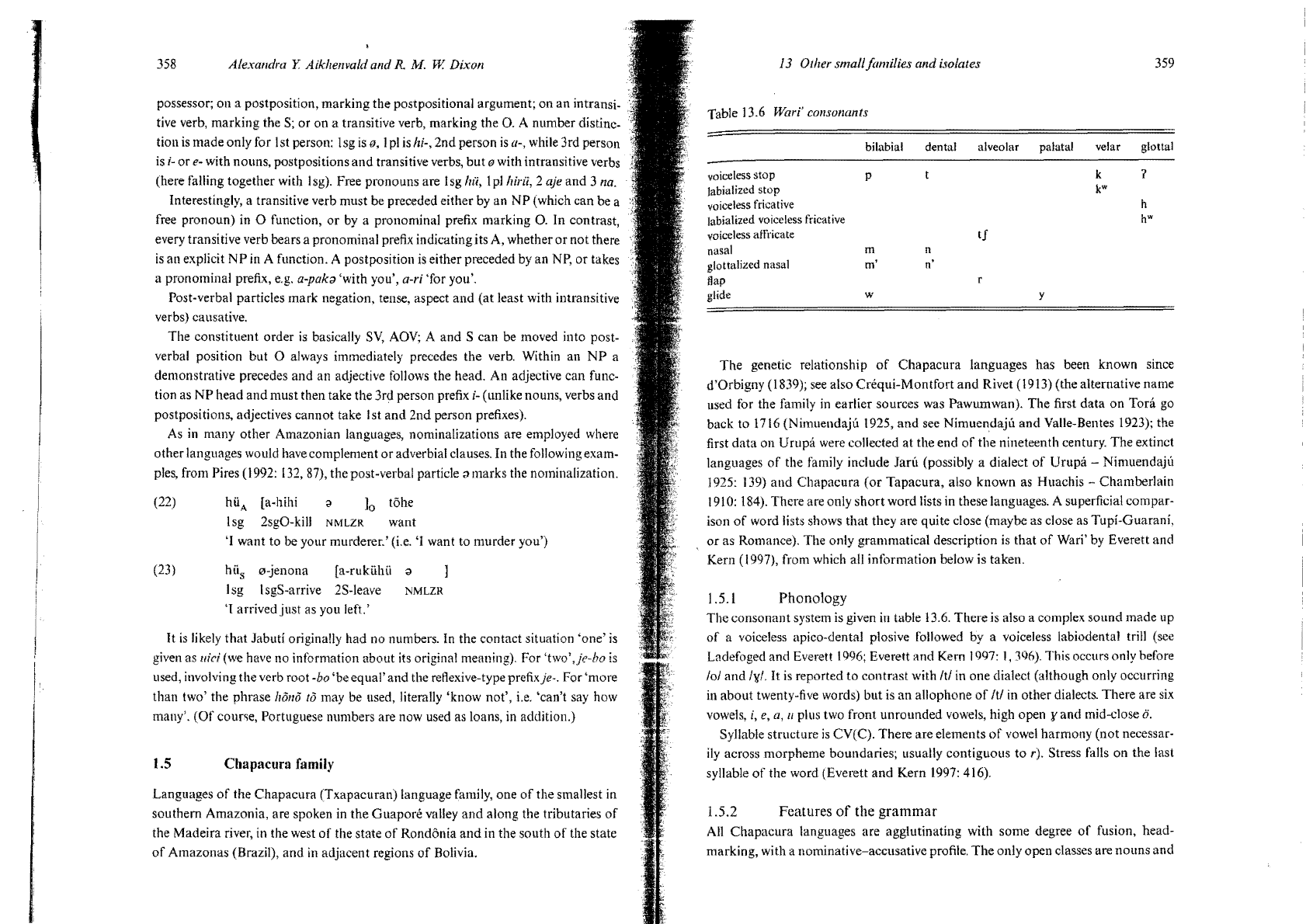
Table 13.6
Wari'
cOl1sonants
bilabial dental
alveolar palatal
velar
glottal
voiceless
stop p
k
1
labialized
stop
k
W
voiceless
fricative
h
labialized
voiceless
fricative
h
W
voiceless
atfricate
tf
nasal
m
n
glottalized nasal
m'
n'
Ilap
w y
The
genetic relationship
of
Chapacura
languages has been known since
d'Orbigny (1839);
see
also Créqui-Montfort
and
Rivet (1913) (Ihe alternative name
used for the family
in
earlier
sOLlrccs
was Pawumwan). The first data
on
Torá go
back to 1716 (Nimuendajú 1925,
and
see Nímuendajú
and
Valle~Bentes
1923); the
first
data
on
Urupá were collected
at
the end
of
the nineteenth century.
The
extinct
languages
of
the family inc1ude
Jarú
(possibly a dialect
of
Urupá - Nimuendajú
1925: 139)
and
Chapacllra
(or
Tapacura, also known as Huachis - Chamberlain
1910: 184). There are only 8hort word
Iists
in these languages. A superficial compar-
¡son
of
word lists shows that they are quite
c10se
(maybe as
c10se
as
or
as Romance). The only grammatical description
i8
that
of
Wari' bv Everett amI
Kern (1997), from which all information below is taken.
1.5.1
Phonology
The consonan! system
is
given in table 13.6. There is al80 a complex sound made up
of
a voiceless ¡¡pico-dental plosive followed by a voiceless labiodental Irill (sce
Ladefoged and Everett 1996; Everett and Kern 1997: 1,396). This occurs
on1y
hefore
101
and
IV/.
lt
i5
reported
lO
contrast with
{tI
in one dialect (although only occurring
in about
words)
but
is
an
allophone
of
It/
in other dialects. There are
six
vowels,
i,
e,
a,
11
plus two front unrounded vowels, high open
yand
mid-c1ose
o .
Syllable structure
i5
CV(C). There are elements
of
vowel harmony (not necessar-
íly
aeross morpheme bOLlndaries; lIsually contíguous to
r).
Stress falls on the last
syllable
of
the word (Everett
and
Kern 1997: 416).
l.5.2
Features
of
tlle
grammar
AH
Chapacura
are agglutinating with sorne
of
fusion, head-
marking, with a nominative-accusative profile.
The
open classes are nouns
and
361
1
360 Alexandra
Y.
Aikhenvald and
R.
M. W Dixon
!'
q
verbs; modifiers seem
to
be a slIbclass
of
nOllns. There are
no
core case markers.
A/S
and
O are cross-referenced through verbal inflectional markers (verbal enc\itics
which contain reference to tense, aspect
and
mood). Cross-referencing
is
obligatory
with definite objects,
and
optional with indefinite objects. Objects are
not
cross-ref-
erenced when fronted to sentence-inítial position in relative c1auses, information
qllestions
and
clefted sentences.
In Warí', gender assignment
is
predominantly semantic with a certain degree
of
opacity (which
is
characteristic
of
languages
of
southern Amazonia).
It
goes along
the following lines:
• feminine:
human
females, collective nouns, mixed groups
of
female
and
maJe individuals;
• masculine: human males, animals
and
culturally significant objects
phenomena, insects, fish, etc.);
• neuter: most inanimate objects, newly introdllced objects/animalsí
plants; loans, nominalizations, mixed grollps
of
neuter
and
maseuline
objects.
Typically for
an
Amazonian language, gender
is
not marked
on
the head noun.
Gender
agreement
is
marked
on
modifiers, possessed forms,
and
through verbal
cross-referencing (Everett
and
Kern 1997: 294-300).
A
set
of
bound
pronominal
clitics cross-referenee the person, number
and
possessor (if third person), e.g.
capija-in
woo'
(mouth-3neut basket)
'rim
of
the basket';
capija-con
wom
(mouth-
3mase cOUon)
'hem
of
the skirt';
capija-cam narima'
(mouth-3fem woman)
'woman's
mouth';
wijima-in xirim
(smallness-3neut house) 'small house' (lit.
'the
house's smallness').
The
possessor
is
the head
of
an
NF.
There is
one
multi-purpose
preposition which cross-references the person, number
and
gender
of
its argument.
Pronouns distinguish three persons,
and
three genders ror 3rd persono There
is
singular/plural distinction in 1st
and
2nd person
and
in
3sg.masc
and
3sg.fem
but
not
in 3sg.neut.
1
pI
distinguishes inclusive
and
exclusive.
AH
these oppositions are
maintained in reflexive/reciprocal pronouns.
Verbs distinguish realis
and
irrealis,
marked
with inflectional
c1itics
which are
portmanteau
with person, number, gender, tense, aspect
and
mood. Tense distinc-
tions are: recent past, past/present
and
future. Irrealis forms are also used as imper-
atives. Realis forms are used in prohibition. Clausal negation can be achieved either
with the negative main verb
'0111
'not
exist', taking a complement
c1ause,
or
by a
postverbal modifier
'a/ara
or
ma'.
Double negative meaning results in an emphatic
positive reading.
There
are a few aspeetual particles; serial verbs are used to express
habitual aspecto lterative aspect
is
marked by total reduplication
of
the verb root
(Everett
and
Kern 1997: 323-8).
Some verbs have suppletive forms used when the S
or
O argument
is
plural, while
13 O/her smal/ families and
iso
lates
other verbs mark plural
(of
S
or
O) by partial reduplication
of
the inHial CV
and
infixation
of
ora
(1997: 337-9).
There
i8
no
morphological eausative mechanism.
There
appears
to
be
an
(imper-
sonal) passive; any verb can
~
passivizedlintransitivized.
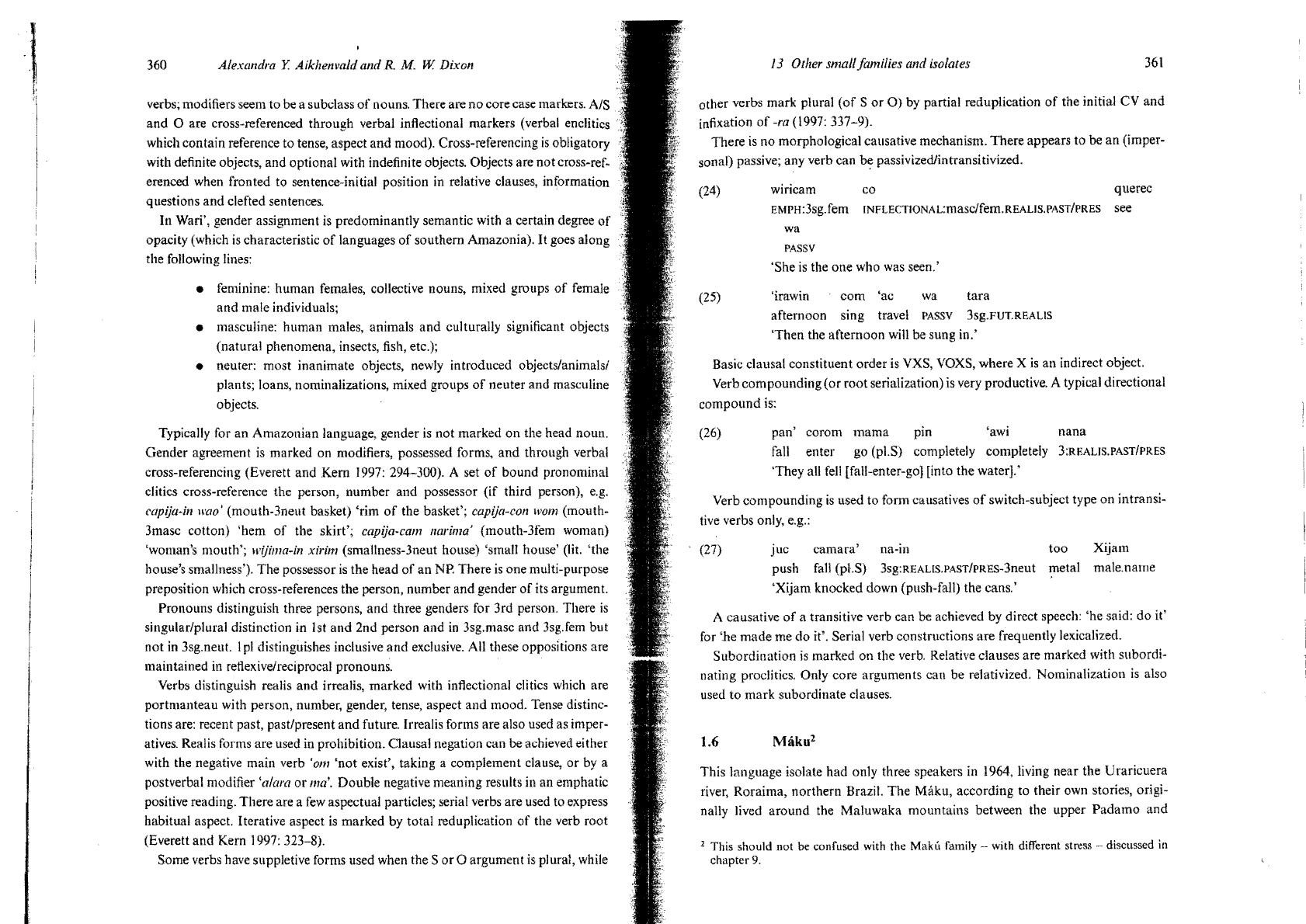
(24)
wirícam
eo
querec
EMPH:3sg.fem
INFLECTIONAL:masc/fem.REALIs.PAST/pRES
see
wa
PASSV
'She
is
the
one
who was seen.'
(25)
'irawin
com
'ae
wa
tara
afternoon sing travel
PASSV
3sg.FUT.REALlS
'Then
the afternoon
wi1l
be
sung in.'
Basic c1amal constitllent
order
i8
VXS, VOXS, where X
is
an
indirect object.
Verb
compounding
(or
rool
serialization)
is
very productive. A typical directional
compound
is:
(26)
pan'
corom
mama
pin 'awi
nana
fall enter go (pl.s) completely completely
3:REALIS.PAST/PRES
'They all fell [faH-enter-gol tinto the water}.'
Verb
eompounding
is
used to form eausatives
of
switch-subject type on intransi-
tive verbs onlv. e.g.:
(27)
juc
camara'
na-in
too
Xijam
push fall (pt.S)
3sg:REALlS.PAST/pREs-3neut
metal male.name
'Xijam knocked down (push-fall) the cans.'
A causative
of
a transitive verb can be aehieved by direct speech:
'he
said:
do
it'
for
'be
made
me
do
it'. Serial verb constructions are frequently lexicalized.
Subordination
is
marked on tbe
verbo
Relative clauses are marked with subordi-
nating proclities. Only eore arguments can be relativized. Nominalization
i8
also
used
to
mark
subordinate c1auses.
1.6
Máku
2
This language isolate
had
only three speakers
in
1964, living near the Uraricuera
river, Roraima, northern Brazil.
The
Máku, aecording to their own stories, origi-
nally lived
around
the Maluwaka
mountains
between the upper
Padamo
and
l
This should not
be
confused with the Mak
ú
family
-
with different stress - disctlssed
in
chapter 9.
362
1.7
A/exandra
Y.
Aikhenva/d and
R.
M.
W Dixon
Table 13.7
Máku consonants
bilabial
alveo-dental
palatal
velar
glottal
voiceless
stop
p
t
k
?
voiced
stop
b
d
voiceless
affricate
ts
voiceless
fricative
J
x
h
nasal
m
n
lateral
glide
w y
Cunucunuma rivers
in
Venezuela. They used to be regular traders travelling from
the upper Orinoco to the Rio Branco
in
Brazil (Migliazza 1965, 1966). Their migra-
tion from Venezuela to Brazil
was
caused
by
constant attacks
by
Yanomama.
N umbers
fell
drastically
in
the period from the 1930s to the l 950s, due to diseases.
The
Máku
were first mentioned by Koch-Grünberg (1913: 458). A short descrip-
tion
of
Máku
phonology
and
elements
of
morphosyntax are found
in
Migliazza
(1965,
1966
and
l 978a - which also contains a short word list), unfortunately cast
in
opaque tagmemic formulas.
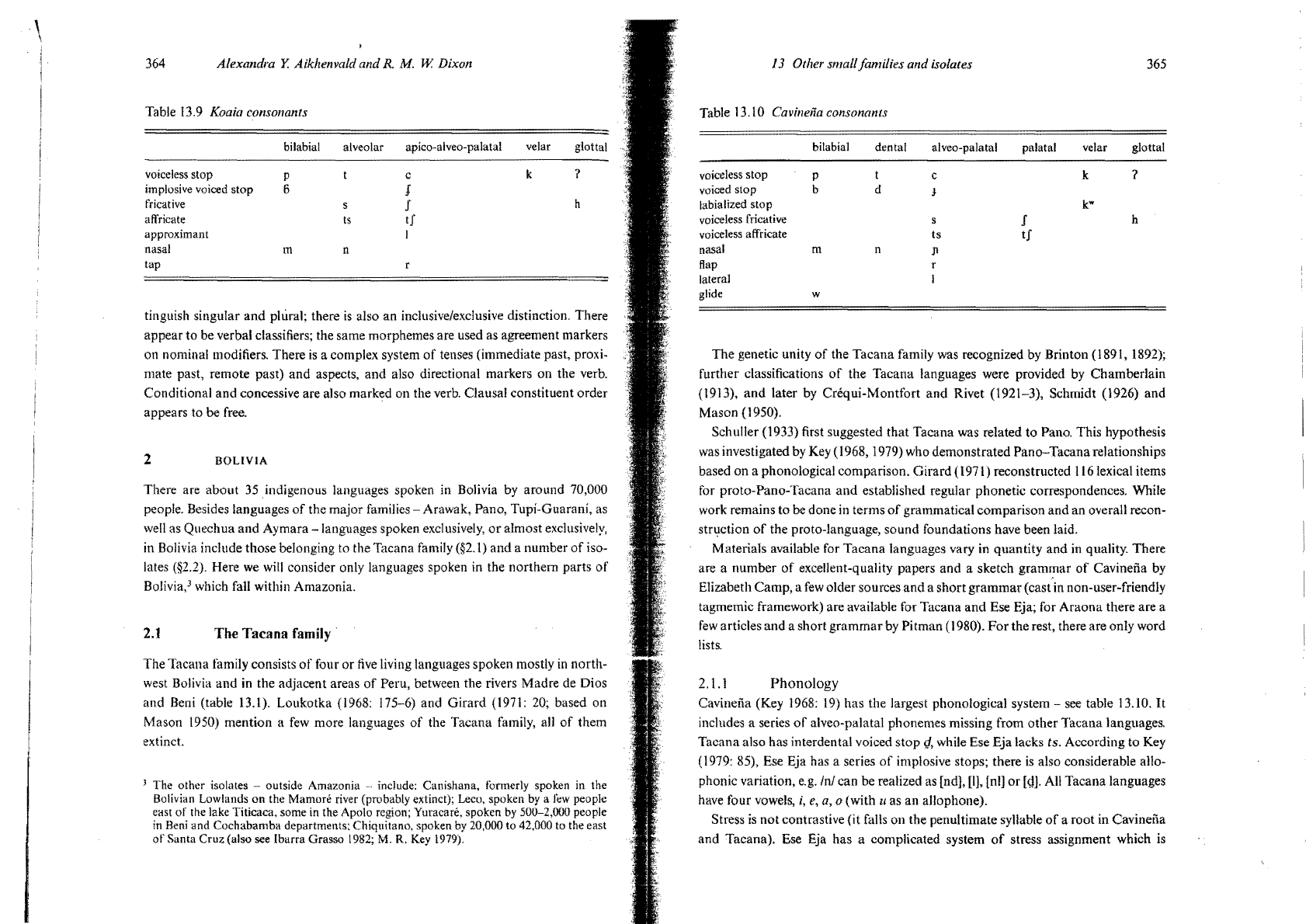
The consonants
of
Máku
are
in
table 13.7 (Migliazza 1978a). There are four
vowels
(i,
e,
a,
11)
existing
in
both oral
and
nasal varieties, plus two additional oral
vowels, high front rounded
y
and high-central
i.
Stress
is
not
contrastive (its typical
position
is
on
the last syllable); vowel length
is
contrastive
but
occurs only in an
initiaí C(V) syllable
in
a polysyllabic word. Syllable structure
is
(C)(C)V(C).
Máku
is
head-marking, highly polysynthetic
and
predominantIy suffixing. There
are no genders
or
classifiers. Pronouns distinguish first person exclusive and inclu-
sive.
There
is
a very complex system
of
tense-aspect oppositions.
Aikaná
and
Koaia
Aikaná (also known
as
Tubarao, Huarí, Masaká, Kasupá
and
M undé)
is
spoken
in
southeastern Rond6nia
by
about
120
people including sorne children (Hein van der
Voort, p.c.).
There
is
only a little
info~mation
available - fieldnotes by Harvey CarIson (1986)
(Hinton
1993
is
based on this),
and
papers by Vasconcelos (1993a,b,
1996)
which
are preliminary studies
of
the phonology
and
some aspects
of
morphology
of
Aikaná. Older sources - Hanke (1956)
and
Becker-Donner (1955) - contain just a
few
words.
The
consonant
system,
in
table 13.8,
includesa
dental fricative (a rarity
in
the
13 Other smallfamilies and iso/ates
363
Table 13.8
Aikaná consonants
bilabial
dental
alveolar alveo-palatal
velar
glottal
voiceless
stop
t
k
?
voiced
stop
b
d
voiceless
affricate
ts
voiceless
fricative
h
voiced
fricative
Ó
nasal
m n
J1
tap
glide
w y
Amazon). There are oral
and
nasal forms
of
four vowels,
i,
e,
a,
ti
plus a fifth oral
vowel, front rounded
ü.
It
is
unclear whether there are contrastive tones.
Aikaná
is
predominantIy suffixing with some prefixes. There
is
no
inclusive/exclu-
sive distinction
in
pronouns. There are two numbers,
and
no genders
or
noun
c1asses;
animacy
is
distinguished
in
interrogatives
(bari
'who',
tara
'what'). Most
adjectival meanings are expressed through verbs; colour concepts are expressed by
nouns. Possession
is
marked with suffixes,
and
with genitive forms
of
personal pro-
nouns; these can co-occur. Grammatical relations are marked
by
cross-referencing
on the verb: subject (A/S)
is
marked with suffixes
or
a combination
of
prefixes
and
suffixes, while object
is
marked with suffixes. There
is
an accusative case on NPs.
There
is
body-part incorporation, verbal classifiers,
and
possibly incorporating
serial verbs. Verbal classifiers appear
in
the first position
in
the verbal word; they
refer to the
S,
or
the O, characterizing it
in
terms
of
its nature ('Iiquid', 'fibrous',
'metallic'),
or
its structure ('powder-like', 'consisting
of
coarse particles', e.g. seeds
or
kernels); there
is
one classifier covering animates
and
humans. Initial CV redu-
plication indicates repetitive action. There
is
probably a benefactive valency-
increasing derivation.
The
verb
is
clause-final
and
there are postpositions.
Koaia (also known as Kwaza)
is
spoken by
about
25
people who
Iive
together with
the Aikaná.
The
only information available comes from preliminary studies by van
der Voort (l997a, b) (a
short
word list
is
given in
Loukotka
1963).
The
consonant
system
is
given
in
table 13.9. There are oral and nasal variants
of
seven vowels,
i,
e,
e,
i,
a,
o,
l/.
Syllable structure
is
CV(V).
It
is
unclear whether stress
(on the last sylIable
of
the stem)
is
contrastive. Glides
IV
and
y
are alIophones
of
u
and
i.
Koaia appears to be predominantIy suffixing
and
combines dependent-marking
with head-marking. The verb takes an obligatory pronominal suffix for S
and
A
and
a further suffix, which appears to
be
optional, for
O.
Only 1st
and
2nd person dis-
364
365
Alexalldra
Y.
A ikhenvald and
R.
M.
W
Dixoll
Table 13.9
Koaia
COIISOllallts
bilabial alveolar
apico-a Iveo-palatal
velar
glottal
voiceless
stop
p
e
k
?
implosive voiced stop
6
J
fricative
s
J
h
alfricate
ts
tI
approximant
nasal
m n
tap
tinguish
and
plúral;
there
is al
so
an
inclusive/exclusive distinction.
There
appear
to
be verbal c1assifiers; the
same
morphemes
are
used
as
agreement
markers
on
nominalmodifiers.
There
is a
complex
system
of
tenses
(immediate
past,
proxi-
mate
past,
remote
past)
and
aspects,
and
also directional
markers
on
the
verbo
Conditional
and
concessive
are
also
marked
on
the
verbo
Clausal
constituent
order
appears
to
be
free.
2
BOLIVIA
There
are
aboll! 35
indigenous
languages
spoken
in Bolivia
by
arollnd
70,000
people. Besides
languages
of
the
major
families -
Arawak,
Pano,
Tupí-Guaraní,
as
weIl as
Quechua
and
Aymara
-languages
spoken
exclusívely,
or
almos!
exclusively,
in Bolivia
include
those
belonging
to the
Tacana
family
(§2.1)
and
a l1umber
of
iso-
lates
(§2.2).
Here
we
will cOl1sider only languages
spoken
in the
northern
parts
of
Bolivia,3 which
faH
withín
Amazonia.
2.1
Tbe
Tacana
family
.
The
Tacana
family
consists
01'
four
or
five languages
spoken
mostly in
north-
west Bolivia
and
in
the
adjacent
areas
of
Peru,
between
the
rivers
Madre
de
Dios
and
Beni (table 13.1).
Loukotka
(1968: 175-6)
and
Girard
(1971: 20;
based
on
Masan
1950)
mentíon
a few
more
languages
of
the
Tacana
family, all
of
them
extinct.
J
The othcr isolates oulside Amazonia ¡nelude: Canishana, lormerly spoken
in
Ihe
Bolivian Lowlands on the Mamoré river (probably extincl);
Leco,
spoken
by
a
few
people
cast of
¡he
lake Titicaca. sorne
in
¡he Apolo region; Yuracaré, spoken
by
500-2,000
people
in
Beni
and Cochabamba departments: Chiquitano, spoken
by
20,000 to
42,000
lo the easl
01'
Santa Cruz (also see ¡barra Grasso
1982;
M.
R.
Key
13
Ot/¡er
small famílies and isolates
Table 13.10
Cavineña
consonallts
bilabial dental
alveo-palalal palatal
velar
glottal
voiceless stop
p
t
e
k
'/
voiced stop b
d
}
labialized stop
k
w
voiceless rricative
s
I
h
voiceless alfricate
ts
tI
nasal
m n
J1
flap
r
lateral
I
glide
w
The
genetic unity
of
the
Tacana
family was recognized
by
Brinton
(1891, 1892);
further
classifications
of
lhe
Tacana
languages
were
provided
by
Chamberlain
and
later
by
Créquí-Montfort
and
Rívet
(1921-3),
Schmidt
(1926)
and
Mason
(1950).
Schutler
(1933) first
suggested
that
Tacana
was
related
to
Pano.
Thís
hypothesis
was investigated
by
Key (1968, 1979)
who
demonstrated
Pano-
Tacana
relationships
based
on
a
phonological
comparison.
Girard
(1971)
reconstructed
1161exical items
for
proto-Pano-Tacana
and
established
regular
phonetic
correspondences.
While
work
remains
to
be
done
in
terms
of
grammatica!
comparison
and
an
overall recon-
str\iction
of
the
proto-language,
sound
foundations
have been laid.
Materials
avaílable for
Tacana
languages
vary
in
quantity
and
in quality.
There
are
a
number
of
excellent-quality
papers
and
a
sketch
gramIImr
of
Cavineña
by
Elizabeth
Camp,
a few
older
sources
and
a
short
grammar
(cast
in non-user-friendly
tagmemic
framework)
are
available for
Tacana
and
Ese
Eja;
for
Araona
there
are
a
few articles
and
a
short
grammar
by
Pitman
(1980).
Forthe
rest, there
are
only
word
Iists.
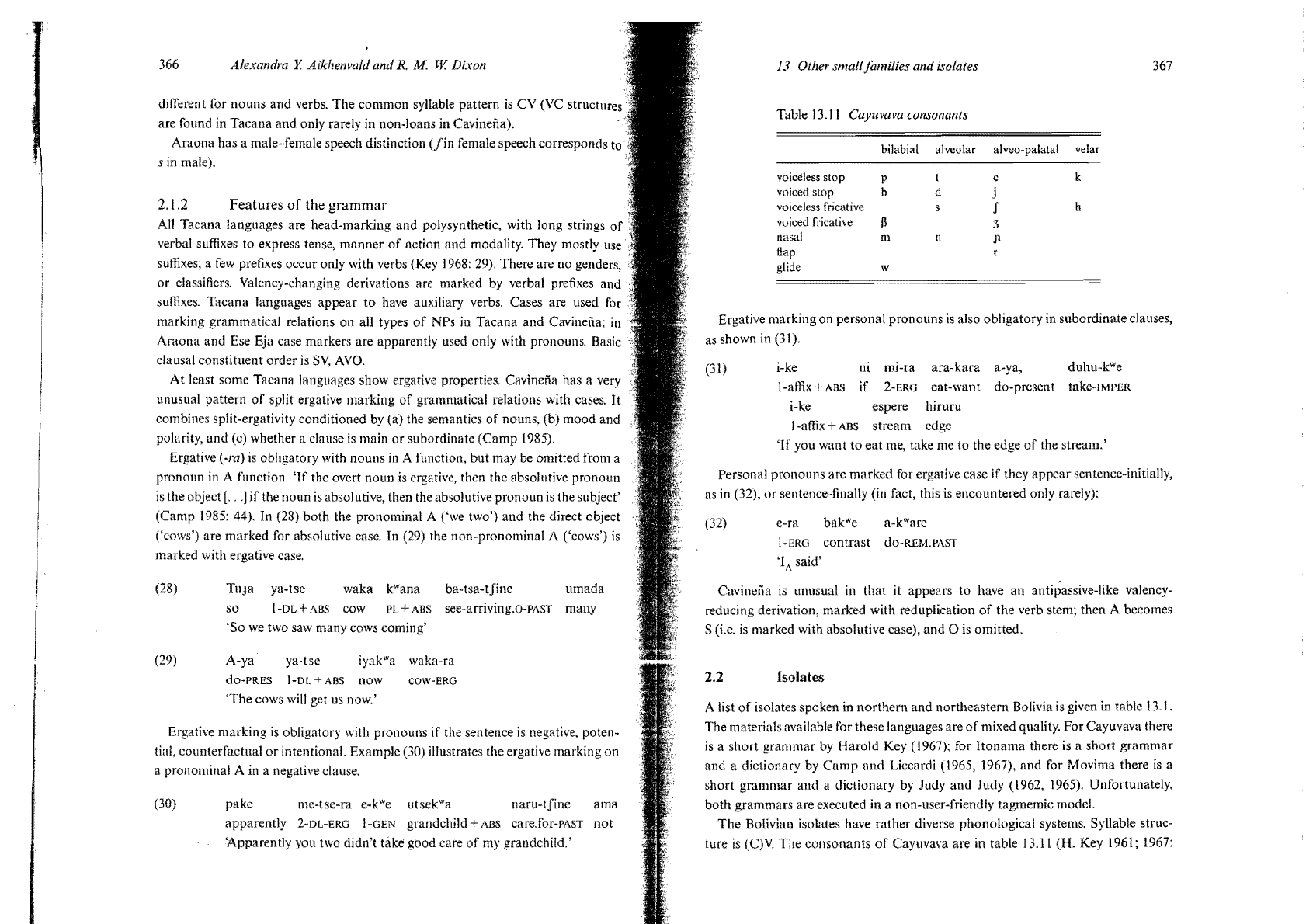
2.1.1
Phonology
Cavineña
(Key
1968:
has
the
largest
phonological
system - see
table
13.10.
It
inc1udes a series
of
alveo-palatal
phonemes
from
other
Tacana
languages.
Tacana
'lIso
has
interdental
voiced
stop
g,
while Ese
Eja
lacks
ts.
According
to
Key
(1979: 85), Ese
Eja
has a series
of
implosive
stops;
there
is
also
considerable
allo-
variation,
e.g./n/
can
be
realized
as
[nd},
[I},
[nI]
or
[<;1).
AH
Tacana
languages
have
four
vowels, i,
e,
a,
o
(with
¡¡
as
an
allophone).
Stress is
not
contrastive
(it
faBs
011
the
penultimate
syllable
of
a
root
in
Cavineña
and
Tacana).
Ese Eja
has
a
complicated
system
of
stress
assignment
which
ís
367
366
Alexandra
Y.
A ik/¡envald and
R,
M
W.
Dixon
(32)
2.2
Ergative marking on personal
pronouns
is
al
so obligatory in subordinate clauses,
as shown
in
(31).
i-ke ni mi-ra
ara-kara
a-ya,
dllhu-kwe
different for
nouns
and verbs,
The
common
syllable pattern
is
CV (VC structures
are found in
Tacana
and
only rarely in non-loans in Cavineña).
Araona
has
a male-female speech distinction
(fin
female speech corresponds to
s
in male).
2.1,2 Features
of
the grammar
AH
Tacana languages are head-marking
and
polysynthetic, with long strings
of
verbal suffixes to express tense,
manner
of
action and modality. They mostly use
a
few
prefixes occur only with verbs (Key
1968:
29). There are no genders,
or
c!assifiers. Valency-changing derivations are marked by verbal prefixes and
suffixes.
Tacana
languages
appear
lo
have auxiliary verbs. Cases are used ror
arllmmMi,-,,1
relations on
aU
types
of
NPs in Tacana and Cavineña; in
Araona
and Ese Eja case markers are
used with pronouns. Basic
clausal cOllstituent order
is
SV,
AVO.
At
leasl sorne Tacana languages show properties. Cavineña has a very
ullusual pattern
of
split ergative marking
of
grammatical relatiolls with cases.
It
combines split-ergativity conditioned by (a) the semantics
of
nouns, (b)
mood
and
polarity,
and
(c) whether a c!ause
is
main
or
subordinate
(Camp
1985).
Ergative
(-ra)
is
obligatory with nouns
in
A function,
but
may be omitted from a
pronoun in A fUllction.
'If
the overt
nOlltl
is
ergative, then the absolutive pronoull
is
the object
[.
,
.]
ir
the 1l0lln is absolutive, then the absolutive pronoun
is
lhe subject'
1985: 44). In (28)
both
the pronominal A ('we two')
and
the direct object
are
marked
ror absolutive case. In (29) the non-pronominal A ('cows')
is
marked with enzatlve case.
(28)
TUJa ya-tse waka
kWana
umada
so
I-DL+ABS
COW
PL+AIIS
many
'SO
we two saw many cows coming'
(29)
A-ya
ya-lse
iyakWa
waka-ra
dO-PRES
l-DL
+
ABS
now
COW-ERG
'The
cows
wiU
get
liS
now.'
is
obligatory with pronouns
ir
the sentence
is
negative, poten-
counterfactual
or
intentional. Example
(30)
illustrates the ergative markíng
on
a
Ain
a
clause.
(30)
pake
me-tse-fa
e-kwe
utsekWa
ama
apparently
2-DL-ERG
¡-GEN
+
ABS
careJor-PAsT
not
'Apparently you two didn't táke good care
of
my
13 Other small famiJies and iso/ates
Table
13.11
Cayuvava consonants
bilabial alveolar alveo-palata! velar
voiceless
stop
p
I
e
k
voiced stop
b
d
j
voiceless frícative
J
h
voiced fricative
IJ
3
nasal
m n
Jl
flap
g!ide
w
l-atTIx+ABs
ir
2-ERG
eat-want
do-present
take-IMPER
i-ke espere hiruru
I-affix +
ABS
stream
edge
'11'
you want
to
eat
me, take me to
the
edge
or
the stream.'
Personal pronouns are
marked
fol'
ergative case
ir
they
appear
senten<,,,,-ín
as in (32),
01'
sentenee-finally (in faet, this
is
encountered only rarely):
e-ra
bakwe a-kware
I-ERG
contrast
dO-REM,PAST
'lA
said'
Cavineña is unllslIal in
that
it appears to have
an
antipassive-like valency-
rprl""'ng derivation, marked with redllplication
of
the verb stem; then A beco mes
is
marked with absolutive case),
and
O is omitted.
Isolates
A list
of
isolates spoken in
northern
and
northeastern Bolivia ís given in table 13.1.
The
materials available ror these languages are
of
mixed quality.
For
Cayuvava there
is
a
short
grammar
by
Harold
Key (1967); for
ltonama
there
ig
a
short
grarnrnar
and a dictionary by
Camp
and
Liceardi (1965, 1967),
and
ror Movima there
is
a
short
grammar
and
a dictionary by Judy
and
Judy (1962, 1965), Unfortunately,
both
grammars
are executed in a non-user-friendly tagmemic model.
The
Bolivian isolates have
rather
diverse phonological systems. Syllable struc-
ture
is
(CW
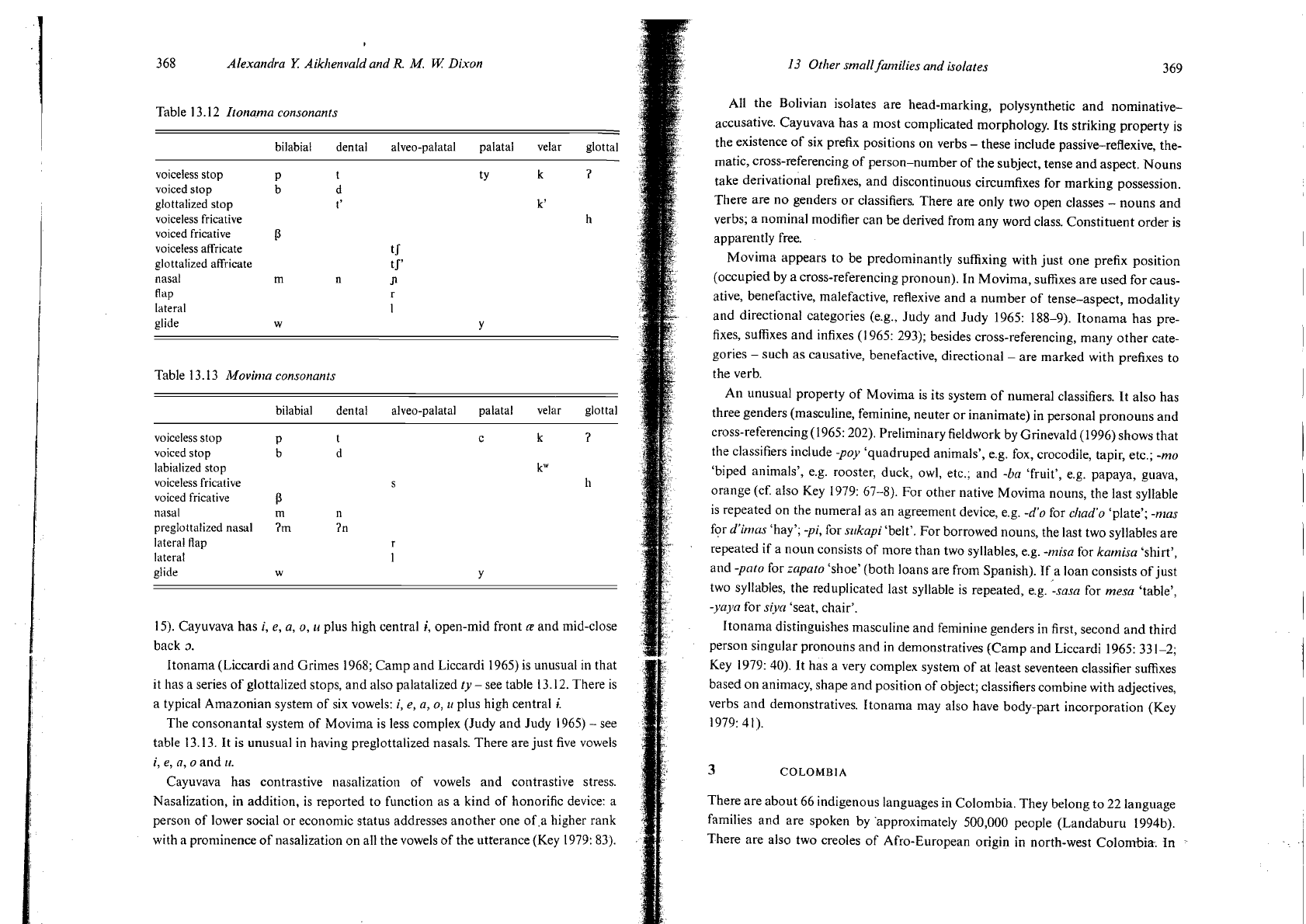
The
consonants
of
Cayuvava are in table
13.11
(H. Key 1961; 1967:
368 Alexandra
Y.
Aikhenvald and R. M. W Dixon
Table 13.12 Itonama consonants
bilabial
dental
alveo-palatal palatal
velar
glottal
voiceless
stop p
t
ty
k
1
voiced
stop
b d
glottalized stop
t'
k'
voiceless
fricative
h
voiced
fricative
(3
voiceless
affricate
tJ
glottalized
affriC'dte
tI'
nasal
m n
J1
flap
lateral
glide
w
y
Table 13.13 Movima consonants
bilabial
dental alveo-palatal
palatal
velar
glottal
voiceless
stop p
t
e
k
1
voiced
stop
b d
labialized
stop
k
w
voiceless
fricative
h
voiced
fricative
(3
nasal
m n
preglottalized nasal
1m
1n
lateral
flap
lateral
glide
w
y
15).
Cayuvava has
i,
e,
a,
o,
ti
plus high central
i,
open-mid front
a
and
mid-c1ose
back
;J.
Itonama (Liccardi
and
Grimes 1968;
Camp
and
Liccardi 1965)
is
unusual
in
that
it has a series
of
glottalized stops,
and
also palatalized
Iy
-
see table 13.12. There
is
a typical Amazonian system
of
six vowels:
i,
e,
a,
o,
ti
plus high central
i.
The consonan tal system
of
Movima
is
less complex (Judy
and
Judy
1965)
- see
table 13.13.
It
is
unusual in having preglottalized nasals. There are just
five
vowels
i,
e,
a,
o
and
1/.
Cayuvava has contrastive nasalization
of
vowels
and
contrastive stress.
Nasalization, in addition,
is
reported to function as a kind
of
honorific device: a
person
of
lower social
or
economic status addresses
another
one oCa higher rank
with a prominence
of
nasalization on all the vowels
of
the utterance (Key
1979:
83).
13 Olher smallfamilies and isolates
369
AII
the Bolivian isolates are head-marking, polysynthetic
and
nominative-
accusative. Cayuvava has a most complicated morphology. Its striking property
is
the existence
of
six prefix positions on verbs - these include passive-reflexive, the-
matic, cross-referencing
of
person-number
of
the subject, tense
and
aspecto
Nouns
take derivational prefixes,
and
discontinuous circumfixes for marking possession.
There are no genders
or
c1assifiers. There are only two open
c1asses
-
nouns
and
verbs; a nominal modifier can be derived from any word
c1ass.
Constituent order
is
apparently free.
Movima
appears to be predominantly suffixing with
just
one prefix position
(occupied by a cross-referencing pronoun). In Movima, suffixes are used for caus-
ative, benefactive, malefactive, reflexive
and
a
number
of
tense-aspect, modality
and
directional categories (e.g., Judy
and
Judy 1965: 188-9).
Itonama
has pre-
fixes, suffixes
and
infixes (1965: 293); besides cross-referencing,
many
other
cate-
gories - such as causative, benefactive, directional - are marked with prefixes to
the
verbo
An unusual property
of
Movima
is
its system
of
numeral c1assifiers.
It
also has
three genders (masculine, feminine, neuter
or
inanimate)
in
personal pronouns
and
cross-referencing (1965: 202). Preliminary fieldwork by Grinevald (1996) shows that
the c1assifiers incIude -poy
'quadruped
animals', e.g. fox, crocodile, tapir, etc.; -mo
'biped animals',
e.g.
rooster, duck, owl, etc.;
and
-ha 'fruit', e.g. papaya, guaYa,
orange
(cf.
also
Key
1979:
67-8). For other native Movima nouns, the last syllable
is
repeated on the numeral as an agreement device, e.g. -d'o for chad'o 'plate'; -mas
for d'imas 'hay'; -pi, for sl/kapi 'belt'.
For
borrowed nouns, the last two syllables are
repeated
if
a
noun
consists
of
more than two syllables, e.g. -misa for kamisa 'shirt',
and
-palo for zapato 'shoe' (both loans are from Spanish).
Ifa
loan consists
of
just
two syllables, the reduplicated last syllable
is
repeated,
e.g.
-sasa for mesa 'table',
-yaya for siya 'seat, chair'.
Itonama
distinguishes masculine
and
feminine genders
in
first, second
and
third
person singular pronouns
and
in
demonstratives
(Camp
and Liccardi 1965: 331-2;
Key
1979:
40).
It
has a very complex system
of
at least seventeen cIassifier suffixes
based
on
animacy, shape
and
position
of
object; c1assifiers combine with adjectives,
verbs
and
demonstratives.
Itonama
may
al
so have body-part incorporation (Key
1979:
41).
3
COLOMBIA
There are about 66 indigenous languages in Colombia. They belong to 22 language
families and are spoken by 'approximately 500,000 people (Landaburu 1994b).
There are also two creoles
of
Afro-European origin
in
north-west Colombia.
In
-
j
371
370 Alexandra
Y.
Aikhenvald and R. M. W Dixon
1
1
addition, Língua Geral Amazónica (Nheengatú), a creole
of
Tupí-Guaraní
1
is
spoken on the border with Brazil.
Languages from the largor
familie5
are discussed elsewhere
in
Ihis volume - Carib
in chapter
2,
Arawak
in
chapter
3,
Tupí-Guaraní in chapter
5,
Tucano in chapter
7,
Makú
in
chapter
9,
and Witoto plus the isolate Ticuna in chapter
12.
Languages
of
the Guahibo and Sáliba-Piaroa
4
ramilies and the ¡solate, Andoké, are spoken exclu-
sively
in
Colombia.
5
Their typological properties are briefiy discussed
here.
6
The majority
of
the indigenou$ peoples
of
Colombia are slash-and-bum agrieu!-
turalists. Only the Guahibo peoples were nomadic hunters and gatherers,
like
the
Makú peoples
in
Colombia and Brazil
(see
chapter
9).
Guahibo constitutes
an
unusllal example
of
a large nomadie eommunity.
Guahibo and Sáliba are currently being studied
by
scholars from the Centro
Colombiano de Estudios en Lenguas Aborígenes
in
the Universidad
de
los
Andes
members
of
the SIL (see Queixalos forthcoming, and n.d., on
Kerr
1995
on Cuiba; Estrada
1996,
and Morse and Frank
1997,
on
::saliDa).
There
i5
a large but opaque grammar
of
Andoké
by
Landaburu (1979),
which also contains a
few
texls. There
is
virtually no grammatical information on
Piaroa. Huber and Reed (1992) give an overview
of
phonological systems
of
most
Colombia n languages,
~""mnn"
200
words in each
mnIJH"ºE
3.1
Phonology
The Guahibo languages, Sáliba and Andoké have a voice distinction
in
stops. There
is
typically one liquid with a rhotic allophone. Cuiba
is
it
has no rhotic
or
lateral; thefe
is,
however, a trilled
r
as ao allophone
of
d
(Kerr
1995:
19).
This phonological oddity may have an areal explanation.
7
Sáliba has two
rhatics and
a
lateral.
4
More
evidence
is
needed
lo
prove
Ihe
gcnclic
link
bclwecn
Sáliba
and
Piaroa:
see
Landaburu
(1994b: 370)
and
Estrada
(1996: xxv-xxvi.).
5
There
is
no
adcquate
inforrnation
on
Puinavc
which
i5
possibly
anolher
isolate
(although
il
b,¡s
becn
suggeslcd
Ihat
il
rnay
be
distantly
relatcd
to
Makú).
Ó
We
do
no!
discuss,
in
Ihis
volume,
language
families
whosc
members
moslly
or
cntirely
I'all
outside
Amazonia
-
Chibchan,
Paez,
Choco,
Aarbacoan,
Kuna
(all
01'
which
havc
certainly
mistakenly
been
grnuped
together
as
'Macro-Chibchan').
)
The
dental
stop
is
realized
as a
lateral
flap
in
north-west
Amazonia
(Tucano-Tariana
region)
and
also
further
to
the
south-west.
*1'
is
ao
allophone
of
*d
in
proto-
Witoto
(Aschmann
1993: 96).
Resigaro,
a
language
01'
the
Arawak
I'amily.
whích
carne
under
slrong
areal
intlu-
ence
from
Witoto
languages,
has
no
1";
according
lo
Allin
(1975),
/"
may
have
once
been
an
allophone
01'
el
Olher
r-Iess
languages,
besides
Cuiba,
are
concentrated
to
the
west
of
the
in
lhe
•
H"'~"
is
an
of
t
dental
stop
and
a rhotic
stretches
guage
Awa
Pit:
Curnow
1997).
almost
regions
01'
Peru
(there
is
here
a
h).
Allophoníc
varialion
between
a
lo
lhe
west
(il
is
also
attested
in
the
Barbacoan
lan-
13
Other smallfamilies and isolates
Table 13.14
Cuiba consonants
bilabial
alveolar
palatal
velar
glottal
voiceless
stop
aspírated stop
voÍced
stop
p
ph
b
¡b
d
k
k
h
?
voiceless
fricative
s
h
voiceless
affricate
ts
tJ
nasal
m
n
glide
w
y
Table
13.15
Sáliba consonanls
bilabial
alveolar
pahttal
velar
glottal
voiceless
stop
voiced
stop
labialized
voiceless
stop
labialízed
voiced
stop
voiceless
fricative
voiced
fricative
voiced
affricate
vibrant
flap
lateral
nasal
glide
p
t k
?
b d
g
k
w
g"
<P
x h
f3
d3
m
11
w
y
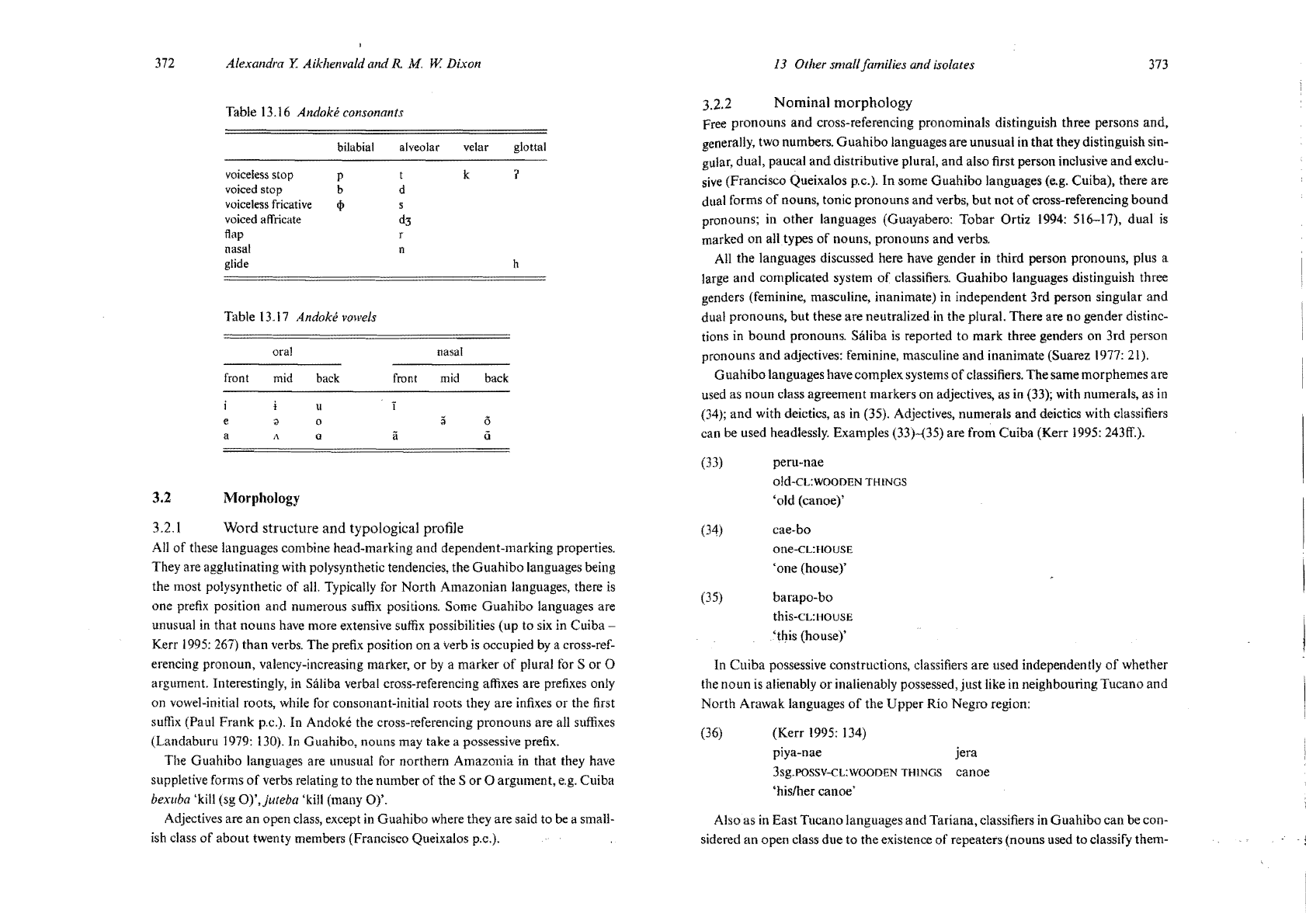
The consonant systems
of
Cuiba (Guahibo: Huber and Reed
1992;
Kerr 1995),
Sáliba and Andoké are given
in
tables 13.14-13.16.
Most Guahíbo languages have
six
vowels
(i,
e,
11,
o, a
plus central
i);
Sáliba
has just
five,
lacking
i;
in each language there
is
a nasal
vowel
corresponding to each
oral vowel. Andoké has a larger system with nine oral and
five
nasal vowels, as
in
table 13.17 (Landaburu
1979:
45-6).
Typical syllable structure
is
(C)V;
Cuiba and Sáliba can
have
a nasal in coda
lion, and Cuiba also permits stops.
The Guahibo languages and Sáliba have contrastive stress (Estrada
1996: 3).
In
Guahibo, stressed vowels tend to have high pitch (Kondo and Kondo
1967: 95).
Andoké appears to have three tonal distinctions: high, middlc and low (Landaburu
1979:
48-51).
This property
is
shared with two neighbouring Witoto languages,
Bora
and
Ocaina, which distinguish two
levels
of
tone
(see
chapter
12).
372
Alexandra
Y.
Aikhellvald
and
R M.
W.
DixoII
Table 13.16
Andoké cOIIsonants
bilabial alveolar velar glottal
voiceless stop
p
t
k
1
voiced stop
b
d
voiceless fricative
4>
s
voiced affricate
d3
flap
r
nasal n
glide
h
Table 13.17
Andoké vowels
oral
nasal
fronl
mid
back
fronl mid back
u
e
;;>
o
;í
o
a
i\
o
¡¡
Q
3.2
Morphology
3.2.1
Word structure and typological profile
All
of
these languages combine head-marking and dependent-marking properties.
They are agglutinating with polysynthetic tendencies, the
Guahibo
languages being
the most polysynthetic
of
al!. Typícally
fOf
North
Amazonian
languages, there
1S
one
prefix position
and
numerous suffix positions. Some
Guahibo
langllages are
unllsual in that
nOlll1S
have more extensive sllffix possibilities
(up
to six in
Cuiba-
Kerr 1995: 267)
than
verbs.
The
prefix position on a verb
is
occupied by a cross-ref-
erencing
pronoun,
valency-increasing marker,
or
by
a
marker
of
plural tor S
Of
O
argument. Interestingly, in Sáliba verbal cross-referencing affixes are prefixes only
on vowel-initial roots, while
fOf
consonant-initial rools they are infixes
or
the first
suffix (Paul
Frank
p.c.).
In Andoké the cross-referencing pronouns are all suffixes
(Landaburu 1979:
130). In
Guahibo, nouns may take a possessive prefix.
The
Guahibo
languages are unusual for northern
Amazonia
in that they have
suppletive
fOTms
of
verbs
to the number
of
the
S
or
O argument, e.g. Cuiba
bexuba
'kili
(sg
O)'
,jl/teba
'kili
O)'.
Adjectives are
an
open cJass, except in
Guahibo
where they are said to be a smal!-
ish cJass
of
about
twenty members (Francisco Queixalos p.c.).
13 Other small farnilies
and
isolates
373
3.2.2 Nominal morphology
Free
pronouns
and
cross-referencing pronominals distinguish three persons
and,
generally, two numbers.
Guahibo
languages
are
unusual in that they distinguish sin-
dual, paueal
and
distributive plural,
and
also first person inclusive
and
exclu-
sive (Francisco Queixalos p.c.).
In
some
Guahibo
languages (e.g. Cuiba), there are
dual [orms
of
nouns, tonic
pronouns
and
verbs,
but
not
of
cross-referencing
bound
pronouns; in
other
languages (Guayabero:
Tobar
Ortiz 1994: 516-17), dual is
marked on
alltypes
of
nouns, pronouns
and
verbs.
AIl
the
languages discussed here have gender in third person pronouns, plus a
large
and
complicated system
oC
c\assifiers.
Guahibo
languages distinguish three
genders (feminine, masculine, inanimate) in independent 3rd person singular
and
dual pronouns,
but
these are
neutralizedin
the plural. There are no gender distinc-
tions in
bound
pronouns. Sáliba
i8
reported to
mark
three genders on
3rd
person
pronouns
and
adjectives: feminine, masculine
and
inanimate (Suarez 1977: 21).
Guahibo
languages have complex systems
of
classifiers.
The
same morphemes are
used as
noun
class agreement markers on adjectives, as in (33); with numerals,
as
in
(34);
and
with deictics, as in (35). Adjectives, numerals
and
deictics with c1assifiers
can be used headlessly. Examples (3.3)-(35) are from
Cuiba
(Kerr 1995: 243ff.).
(33)
peru-nae
old-Cl:WOODEN
THlNGS
'old
(canoe)'
cae-bo
one-Cl:HOUSE
'one
(house)'
(35)
barapo-bo
this-Cl:llOUSE
'this
(house)'
In
Cuiba
possessive constructions, classifiers are used independently
of
whether
the
noun
ís alienably
01'
inalienably possessed,just like in neighbouring
Tucano
and
NOfth Arawak languages
of
the
Upper
Río Negro regian:
(Kerr
1995: 134)
piya-nae
jera
3sg.POSSV-Cl:WOODEN
THINGS
canoe
'hislher
canoe'
Also
as
in East
Tucano
languages
anc\
Tariana, classifiers in
Guahibo
can
be con-
sidered
an
open class due to the existence
of
repeaters
(nouns
used to cIassify them-
!