
Dixon R.M.W., Aikhenvald Alexandra Y. The Amazonian Languages (Cambridge Language Surveys)
Подождите немного. Документ загружается.

375
374
Alexandra
Y.
Alkhenvald
and
R M.
W.
Dixan
selves); however, only
po:¡ses,sed
nouns
can
be used as repeaters
tsacam
of)',
-nexa
(1995:
132).
Sálíba also
has
a system
of
at least
classifiers.
The
same set
of
morphemes
goes on llumbers, adjectives, demonstratives, possessíves
and
even interrogative pro-
nouns. Sorne classes distinguísh a singular
and
a plural
formo
lnterestingly, numbers
'one'
and
'two'
al so have dilferent forms for anímate
and
inanimate referents
(Estrada
1996:
106-7).
In
Guahibo
languages
and
in
Sáliba (Paul
Frank
p.c.), the classifier suffixes used
with nouns have
an
índividuating effect: a noun is unmarked for
number
ir
used
without a classifier.
If
a classífier
is
added, the
noun
has a singulative reading and
can additionally
be
marked for number, e.g.
Cuiba
(Kerr
1995:
154)
'wíld fruít',
tsacóma-ru
(fruit-CL:FRUIT) '(one) wild fruit',
tsacama-ru-n
CL:FRUIT-PL)
'(severa!) wild fruits'. This individuating elfect
of
no
un classifiers
is rcminiscent
of
Tucano languages
and
Tariana
of
the Vaupés area,
and
of
Resigaro
and
Witoto-Bora.
It
may be
an
areal [eature
of
a region embracing north-
eastern Peru, south-central Colombia
and
north-westem Brazil.
Andoké al50 has a complex agreement system. Verbal cross-referencing markers
have tluee noull c1asses. Class
3
divides into t'our subclasses cross-referenced
011
the
verb
in
the same way, but marked dilferently on pronollns
and
IlOlln
modifiers.
The
class assignment
is
far from semantically transparent.
The
classes are:
(i) Class I includes inanimate objects, mostly artifacts,
but
also so me
animals, sorne mythical beings, and
(ii) Class 2 includes mainly long
amI
hard
(iii)
Class
3
includes most animates
and
al so rollnd
and
hollow objects.
Within this
c1ass,
the following subdivisions
are
made:
Class 3a contains
round
amI hollow objects;
Class
3b
cOl1tains rnascllline animates;
Class 3c contains feminine animates;
C1ass 3d contains animate collectives.
Gllahibo,
Sáliba
and
Andoké
have an unllsually large nllmber
of
oblique cases
compared to
other
Amazonian languages (such as Tucano). There
is
one 'mullí-
purpose' obligue case
Cuiba
-tilo
'Iocative, directional, comitative',
01'
Andoké
-a
'Iocative, indirect object marker'),
and
a nurnber
of
other
cases with more spe-
cific meanings, e.g.
Cuiba
-xae
'because
or',
-xaeba
'because
of
'purpose',
-yainwlI
'for
fear
0['
(Kerr
1995:
107,
170);
Andoké
-/l/á
'comitative,
instrumental',
-tá
'privative',
-t;;J;;J
'benefactive',
-aka
'malefactive (to the detriment
1979: 166-7): Sáliba
-di 'dative', -da 'ablative-allative', -na 'jnes-
sive',
-gi
'comitative',
1996:
92-5).
13 Other
small
families
and
isolates
3.2.3 Grammatical relations
Grammatical relations
are
marked
by cross-referencing. Only
Guahibo
languages
have some traces
of
split ergativity,
of
an active-stative type.
In
Cuiba, verbs divide
lnto
five conjugations which take different tense markers
and
show different vocalic altemations (Kerr
1995:
311f.).
Dilferent cross-referencing
suffixes are used for in positive
and
negative c1auses (Guayabero -
Tobar
Ortiz
1994:
521-2;
Cuiba Kerr
1995:
31). Another set
of
cross-referencing suffixes is used
for the majority
of
stative
So
verbs (Kerr
1995:
59-60).
A special set
of
prefixes are
used for
O,
and
also ror
So
of
some verbs which refer to physical states, e.g. Cuiba:
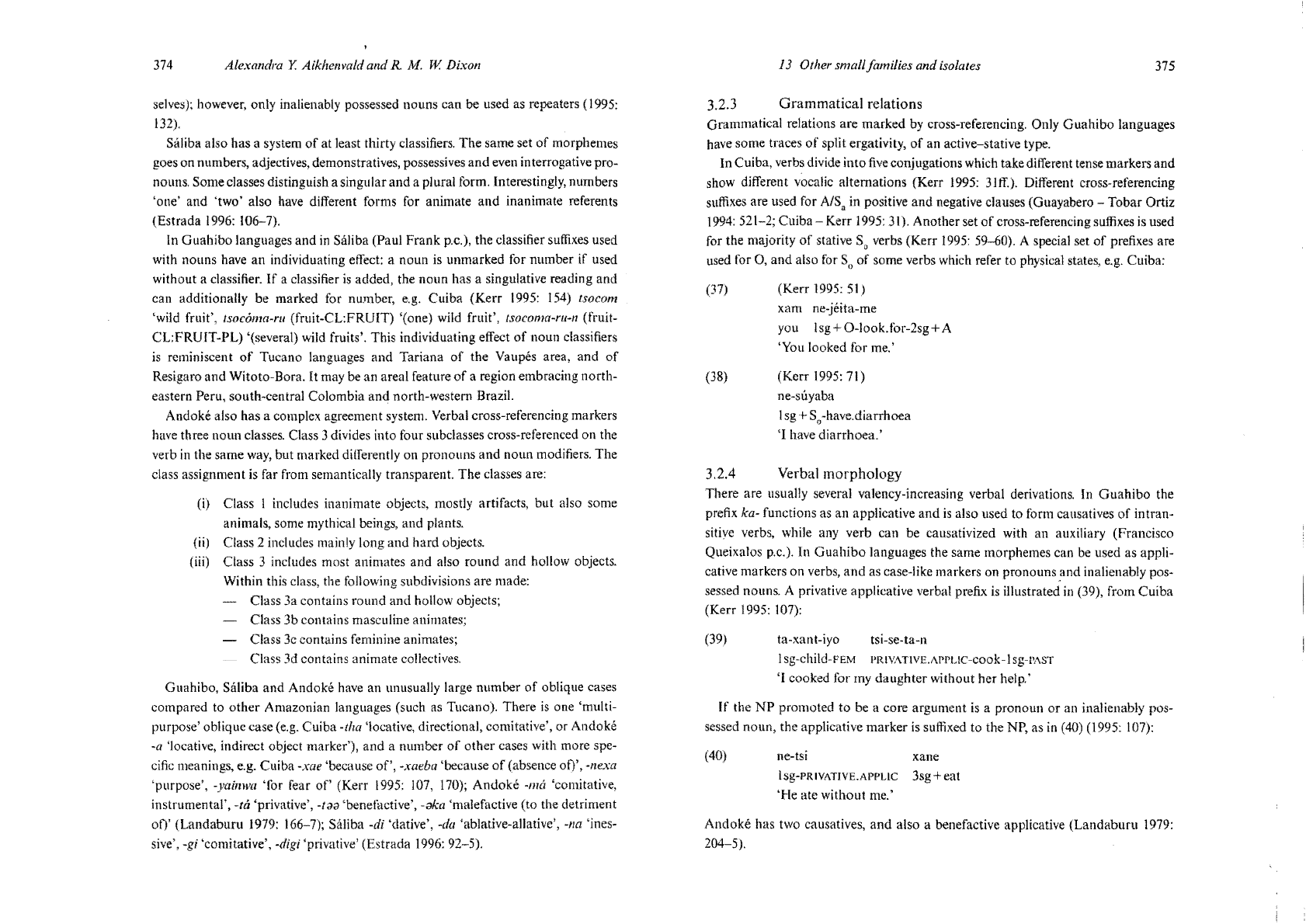
(Kerr
1995:
51)
xarn ne-jéita-me
you
Isg+0-look.f'or-2sg+A
'You looked for me.'
(38)
(Kcrr
1995:
71)
ne-súyaba
Isg + SQ-have.diarrhoea
'1
have
diarrhoea.'
3.2.4
Verbal
There
are
several valency-increasing verbal derivations. In
Guahibo
the
ka-
functions as
an
applicative
and
is
al
so
used to torm causatives
of
intran-
verbs, whiJe any verb can be cansativized with an auxiliary (Francisco
Queixalos p.c.).
In
Guahibo
languages the same morphemes can
be
used as appli-
cative markcrs on verbs,
and
as case-like markers on pronouns and inalienably pos-
ses sed
nou11S.
A privative applicative verbal prefix
is
iIIustrated
in
(39), from
Cuiba
(Kerr
1995:
107):
(39)
ta-xant-iyo
tsi-se-la-n
'1
cooked for rny
If
lhe
NP
to
be a core argument
is
a prono un
or
an
marker
is
suffixed to the NP, as in
ne-tsi xane
lsg-PRIVATIVE.APPLlC
3sg + eat
'He
ate without me.'
Andoké
has two causatives,
and
also a benefactive applicative
(Landaburu
1979:
204-5).
377
376 Alexandra
Y.
Aikhenl'ald ami R M.
W.
Dixan
There are al so a number
of
valency-decreasing derivations; Guahibo has passive,
middle, alld a curious derivation whereby the addressee
of
a ditransitive verb
becomes
an
oblique, if human (Francisco Queíxalos p.c.). In Cuiba the
reftexive-reciprocal derivation can also
be
used to emphasize the identity
of
the
agent, similar to English
self
in
1 did
il
myself.
Andoké appears to have just one
general intransitivizer (Landaburu
1979:
Al!
the ianguages have rich systems
of
mood
and
modality, as
well
as directional
suffixes on verbs. Guahibo languages have a restricted system
of
evidentiality
(reported
vs
non-reported).
Guahibo ianguages have unusual incorporation pattems. Typically for
Amazonian languages
(e.g.
Weir
1990, on Nadeb), only inalienably possessed
nOUIlS
can be incorporated. Cuiba has two patterns
of
noun incorporation:
(i)
inalienably possessed nouns,
in
S function, can be infixed into verbs
of
physical state (Kerr
1995:
104),
e.g.
atane
'hurt',
a-cabe-tane
'his hand
hurts'.
(ii) with other verbs, an NP in
S,
O
or
an oblique function can be incorpo-
rated (but not infixed) into a
verbo
Typically for Amazonian languages,
incorporated nouns are preposed to the verbal root. Unlike most other
Amazonian languages but
like
Nadeb
(Makú
family) Cuiba
permits incorporation
of
more than oue (up lo three) arguments (Kerr
1995:
278-9); here incorporation does not
alTect
the transitivity
of
a
verb, e.g. (41) and (42). However,
in
Guahibo no
un
incorporation
is
a
valency-reducing derivation (Francisco Queíxalos
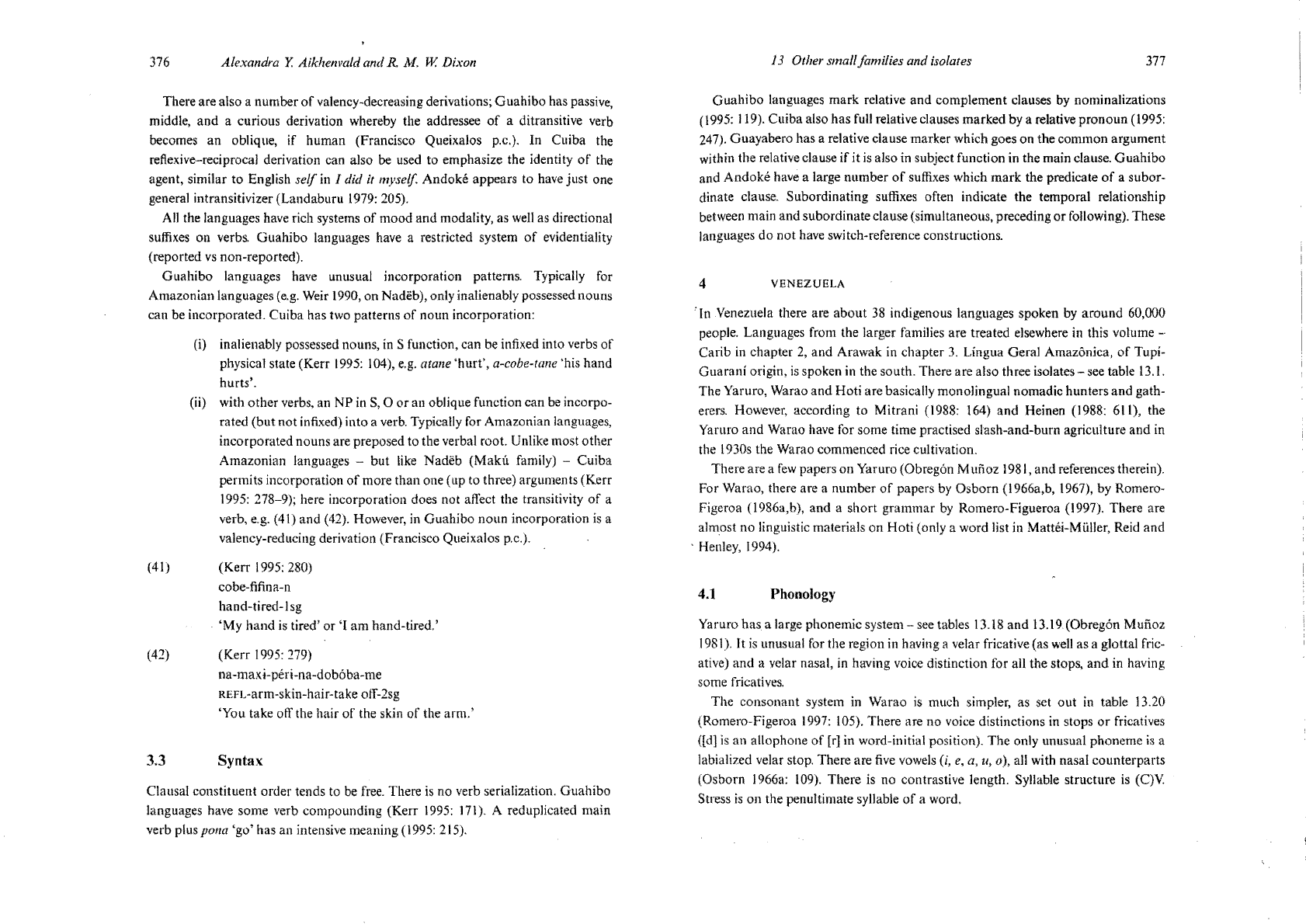
(41) (Kerr
1995:
cobe-fifina-n
hand-tired-I
sg
. 'My hand
is
tired' or
'1
am hand-tired.'
(42) (Kerr
1995:
279)
na-maxi-péri-na-dobóba-me
REFL-arm-skin-hair-take
otT-2sg
'You take off lhe hair
01'
the skin
of
the arm.'
3,3 Syntax
Clausal constituent order tends to be
free.
There
is
no verb serialization. Guahibo
languages have some verb compounding (Kerr
1995:
171). A reduplicated main
verb plus
pona
'go'
has an intensive meaning (1995: 215).
13 Other small families and
iso
lates
Guahibo languages mark relative
and
complement clauses by nominalizations
(1995: 119). Cuiba
al
so has
full
relative clauses marked by a relative pronoun (1995:
247).
Guayabero has a relative clause marker which goes on the common argument
within lhe relative clause
if
it
is
al
so in subject function in the main clause. Guahibo
and Andoké have a large llumber
of
suffixes which mark the predicate
of
a subor-
dínate clause. Subordinating suffixes often indicate the temporal relatiollship
between maín and subordinate clause (simultaneous, preceding
or
followlng). These
languages do not have switch-reference constructions.
4
VENEZUELA
'In
Venezuela there are about
38
indigenous languages spoken by around 60,000
people. Languages from lhe families are treated elsewhere in this volume
_.
Carib
in
chapter
2,
and Arawak
in
chapter
3.
Língua Geral Amazónica,
of
Guaraní origin,
is
spoken in the south. There are also three isolates -
see
table 13.1.
The Yaruro, Warao
and
Hoti are basically monolingual nomadic hunters and gath-
erers. However, according to Mitrani (1988: 164) and Heinen (1988: 611), the
Yaruro
and
Warao have
fol'
sorne time practised slash-and-burn agriculture and
in
the 1930s the Warao commenced rice cultivation.
There are a
few
papers on Yaruro (Obregón Muñoz 1981, and references therein).
For Warao, there are a number
of
papers
by
Osborn
(1
966a,b, 1967), by Romero-
Figeroa (l986a,b), and a short grammar
by
Romero-Figueroa (1997). There are
no linguistic materials on Hoti (only a word list
in
Mattéi-Müller, Reid and
. Henley,
4,)
Phonology
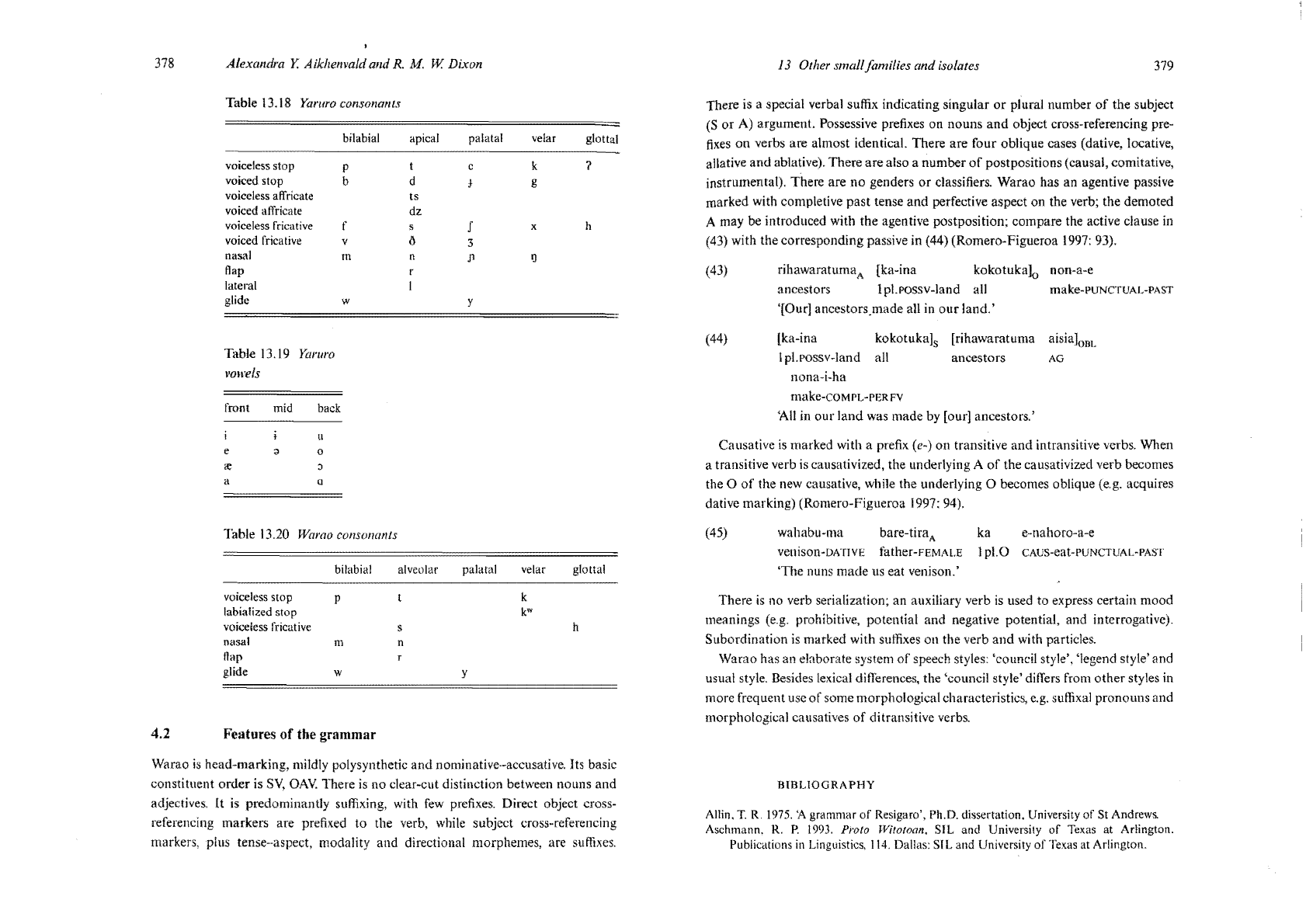
Yaruro
hasa
large phonemic system -
see
tables
13-18
and
13.19.
(Obregón Muñoz
981).
It
is
unusual for the regíon in having a velar fricative (as
well
as a glottal fric-
and a velar nasal,
in
havíng voiee distinction for all the stops,
and
in having
sorne fricatives.
The consonant system
in
Warao
is
much simpler, as set out
in
table 13.20
(Romero-Figeroa
1997:
105). There are no voice distinctions
in
stops
or
fricatives
is
an al1ophone
of
[r]
in word-initial position). The only
un
usual phoneme
is
a
labialized velar stop. There are
five
vowels
(i,
e,
a, u,
all
with nasal counterparts
(Osborn I 966a:
109).
There
is
no contrastive length. Syllable structure
is
(C)V
Stress
is
011
the oenultimate syllable
of
a word.
comitative,
378
Alexandra
Y.
Aikhenvald and
R.
M
W.
DLwn
13
Olher
small jamilies and
iso
lates
379
Table 13.18
Yaruro
consonan/s
There is a special verbal suffix indicating
singular
or
plural
number
of
the
subject
(S
or
A)
argument.
Possessive prefixes
on
nouns
and
object cross-referencing pre-
bilabial apical palatal
velar
glottal
fixes
on
verbs
are
almost
identical.
There
are
four
oblique cases (dative, locative,
voiceless stop
p
I
e k
?
allative
and
ablative).
There
are
al so a
number
of
h"othM;t;
voiced stop
b d
j.
g
instrumental).
There
are
no
genders
or
classifiers.
Warao
has
an
voiccless affricate
ts
with completive
past
tense
and
perfective
aspect
on
the
voiced affricate
dz
A
may
be introduced with
the
agentive
postposition;
compare
the active clause in
voiceless fricative
J
x
h
voiced fricative
v
1)
with
the
corresponding
passive
in
(44)
(Romero-Figueroa
1997:
93).
nasal
m n
11
l)
flap
3
kokotuka]o
non-a-e
lateral
ancestors lpl.POssv-land all make-puNCTuAL-PAST
glide
w
y
'[Our]
ancestors.made
all in
our
land.'
[ka-ina kokotuka]s
[rihawaratuma
aisialoBL
Table 13.19
Yaruro
l pl.possv-land alI
ancestors
AG
vowels
nona-i-ha
make-COMPL-PER
FV
fmnl
mid back
'All
in
our
land
was
made
by tour] ancestors.'
u
Causative
is
marked with a prefix
(e-)
on
transitive
and
intransitive verbs.
When
e
;¡
o
a transitive verb
is
causativized,
the
underlying
A
of
the
causativized
verb
becomes
a
a
a:
:l
the
001'
the
new callsative, while
the
underiying O becomes oblique (e.g
...
_.~
....
__
dativc
marking)
(Romero-Figueroa
1997:
94).
(45)
wahabu-ma
bare-tíra
A
ka
e-nahoro-a-e
vellison-DATlVE father-FEMALE l pl.O
CAus-eat-PUNC'UAL-PAST
bilabial alveolar palatal velar glollal
Table 13.20 Warao
consu/lanls
'The
nuns
made
us
eat
venison.'
voiceless stop
p k
There
is
no
verb serialization;
an
verb
is llsed
to
express
certain
mood
labialized stop
k
w
potential,
and
interrogative).
voiceless fricative
h
n(lsal
m
n
Subordinatíon
is rnarked with suffixes
011
the
verb
and
wíth particles.
flap
Warao
has
an elaborate system
of
'council style', 'Iegend style'
and
glide
w
y
Besídes lexical ditTerences, the 'council style' dilTers from
other
styles in
use
of
sorne
morphological
characteristics,
C.g.
suffixal
pronouns
and
!.HlUlU511,;<t1
causatives
of
ditransitive verbs.
4.2 Features
of
the grammar
Warao
is
head-marking,
mildly polysynthetic
and
nominative-accusative. Its basic
constituent
order
is
SV,
OAY.
There
is
no
c1ear-cut distinctiol1 between
nouns
and
BlBLlOGRA
PHY
It
is
predominantly
suffixing, with few prefixes. Direct object cross-
Al1in.
T.
R.
1975.
'A
grammar
of
Resig(lro', Ph.D. dissertation, University
01'
SI
Andrews.
markers
are
prefixed
to
the
verb, while subject cross-referencing
Aschmann.
R.
P.
1993.
Proto Witotoan, SIL and Universily
of
Texas
at Arlington.
tense--aspect,
and
directional morphemes, are suffixes.
Publications
in
Linguistics,
114.
Dallas: SIL and Univcrsity of
Texas
at
Arlington.
381
Alexandra
Y.
Aik/¡envald and
R.
M.
W.
Di.;wll
380
Becker-Donner,
E.
1955. 'Notizen über einige Stiimme
an
den rechten Zuflüssen des Rio
Guaporé',
Archiv j¡lr ViJlkerkunde, 10.275-343.
Borgman, D. M. 1974.
'Deep
and
surface case in
Sanuma',
Linguislícs, 132.5-18.
1990.
'Sanuma'.
pp. 17-248
of
Handbook
of
Amazonian languages,
vol.
I1,
ed. D.
Derbyshire
and
G.
K.
Pullum. Berlin:
Mouton
de Gruyter.
Borgman, D. M.
and
Cue,
S.
L.
1963. 'Sentence
and
c1ause types in Central Waica (Shiriana)',
!JAL,29.222-9.
Borgman.
D.
M.,
Cue
S.
L.,
Albright, S., Seeley, M.
and
Grimes.
J.
1965.
'The
Waican lan-
guages',
Antlwopological Linguistics,
7.1-4.
Brinton, D. G. 1891.
Tire
American race.
New York: Hodges Publisher.
1892. 'Studies in
South
American native languages',
Proceedíngs
of
¡he American
Plrílosophícal Society, 30.45-105.
Camp,
E.
1982. 'Referentes
de
movimiento y ubicación en el discurso narrativo en Cavineña',
Rerista Latinoamericana de Estudios EtnolingüfSIÍCOs, 2,81-122.
1985. 'Split crgativity in Cavineña',
IJAL,
51.38-58.
Camp,
E.
and
Liccardi, M. 1965.
'!tonama',
pp. 223-383
of
Gmmáticas estruc(lImles de
lenguas bolivianas,
vol.
III.
ed. E. Matteson. Riberalta: Instituto Lingüístico de Verano.
¡
967.
Itonama: Castellano
e
Ing/és,
Vocabulários Bolivianos,
6.
Riberalta: Instituto
Lingüístico de Verano.
1989.
Diccionário COI'inella-Caslellano, Caslell(//IO-Cavineña con bosquejo de la gmmálica
Carinel1a.
Dalias, Tex.: SIL.
Carlson, H. 1986.
'The
Aikana phonology ¡¡nd morphology'. Ms.
Chagnon, N. 1992.
YallomamiJ.
4th edition.
Fort
Worth, Philadelphia: Harcourt Brace College
Publishers.
Chmnberlain, A.
F.
1910.
'Sur
quelqlles familles linguistiques peu connlles ou presque ineon-
llues de I'Amérique dll
Sud"
Joumal
de la Société des Américanistes de París,
n.
S.,
7.179~202.
1913. 'Linguistic stocks
of
South
American Indians with distribution
map',
American
Alllhropologisl,15.236-47.
Créqui-Montfort,
G.
de
and
Rivet,
P
1913. 'Linguistique bolivienne.
La
famille linguistiquc
capacura:
Joumal
de la Société des Amél'icanistes de París,
n. s., 10.119--71.
1921-3.
'La
famille linguistique
Takana',
Jaumal
de la Société des Américanisles
de
Paris,
n.
s.,
13.91-102,281-309; 14.141-82; 15.121-67.
Curnow,
1'.
1.
1997.
'A
grammar
of
Awa
Pit
(Cuaiquer): an indigenous language
of
south-
wcstern
Colombia',
Ph.D. thesis, Australian Natíonal University.
d'Orbigny, A.
D.
1839.
'Nation
Chapacura',
pp. 288-90
of
L'homme
américain
de
/'Amériqul!
méridionale, cOllsidéré
SOIlS
ses mpports physiologiqul!s el morallx.
2
vals. París.
Estrada.
H.
R. 1996.
La
lengua Sáliba.
Santate
de Bogotá: Colcultura.
Everett, D. 1982. 'Phonetie rarilies in Pirahil.',
Joumol
of
fhe International Plronelic
Associatiol1, 12.94-6.
1986.
'Piraha',
pp. 200-325
of
Handbook
of
Amazollia/l langt/tlges,
vol.
1,
ed.
D.
C.
Derbyshire
and
G. K. Pullum. Berlin:
Mouton
de
Gruyter.
Everett, D.
L.
and
Kern,
B.
1997.
Wari': tite Pacaas Novas
/lIl1g!lage
of
Westem Brazíl.
London: Routledge.
Girard,
V.
1971.
Proto-Takanan phonology.
University
of
California Publications in
Línguistics, 70. Berkeley
and
Los Angeles: University
of
California Press.
Gomez, G.
G.
1990.
'The
Shiriana dialect
of
Yanam
(Northern
Brazil)', Ph.D. thesis,
Columbía
University.
Grimes,
B.
F.
(ed.) 1988,
E/hn%gue:
languages
of
lhe
\Vor/d.
!1 th edition. Dalias: Wyclilfe
Bible Translators, Ine.
13
Other small Jamilies alld isolates
Gríneva1d, C. 1996.
'Noun
classification', paper presented
at
Third
Australian Línguistíc
Institute,
Canberra,
July 1996.
Guirardello, R. 1992. 'Aspectos
da
morfossintaxe
da
Hngua Trumai (isolada) e
de
seu sistema
de
marcacao
de caso',
MA
thesis, Universidade
Estadual
de
Campinas.
forthcoming.
'Trumai
reference
grammar',
Ph.D. thesis, Rice University, HOllsten,
Texas.
Hanke,
W.
1956.
'Beobachtungen
über
den
Stamm
der
Huan
(Rio
Corumbiara),
Brasilien',
Archiv
far
ViJlkerkunde, 11.67-82.
Heinen,
H.
D.
1988.
'Los
Warao',
pp. 585-692
of
Los
Aborigenes
de
Venezuela,
vol.
n.
Caracas:
Fundación
La
Salle.
Heinrichs, A.
L.
1964.
'Os
fonemas do Mura-Piraha',
Boletím do Museu Paraense Emilio
Goeldi,
21.1-9.
Hinton.
L.
(ed.) 1993. (ms.) 'Aikana modules: a class
report
based
on
ñeld
notes
of
Harvey
Carlson'.
Berkeley: University
of
California.
Huber, R.
Q.
and
Rced, R.
B.
1992.
Comparative vocabuJary: se/ected
IVords
in
índigenol/s lan-
guages
of
Colombia.
Santat'é
de
Bogotá: Asociación
Instituto
Lingüístico
de
Verano.
¡barra
Grasso,
D. E
..
1982.
Lenguas illdigenas de Bolivia.
Cochabamba:
Universidad Mayor de
San
Simon.
Judy,
R.
and
Judy,
1.
E.
1962.
Movima y Castellano,
Vocabulários Bolivianos,
1.
Cochabamba,
Bolivia:
Instituto
Lingüístico de Verano.
1965.
'Movima',
pp. 131-222
of
Gmmáticas estfllclurales de lenguas bolivianas,
vol.
¡!l,
ed.
E.
Malteson. Riberalta;
Instituto
Lingüistico de Verano.
Kerr,
1.
1995.
Gramática pedagógica del cuiba-wámonae.
Bogotá: Asociación
Instituto
Lingüístico de Verano.
Key,
H. 1961.
'Phonotactics
of
Cayuvava',
IJAL,
27.143-50.
1967. Morphology
of
Cayuval'a.
The
Hague;
Mouten.
Key,
M.
R. 1968.
Comparative Tacanaphonology.
The
Hague;
Mouton.
1979.
T/¡e
grouping
of
Soutb American Indian languages.
Tübingen:
Gunter
Narr
Verlag.
Koch-Grünberg,
T.
1913. 'Abschluss meiner Reise
durch
Nordbrasilien
zum
Orinoco, mít
besonderer Berücksichtigung der von mir beslIchten Indianerstamme',
Zeitschrift
für
Ethnologie,
45.448-74.
Kondo,
V.
and
Kondo, R. 1967.
'Guahibo
phonemes',
fltonemic
Systems
of
Colombian
Languages.
SIL
Publications
iJl
Linguistics
and
Related
Fields, 14.89-98.
Ladeloged,
P.
and
Everett, D.
L.
1996.
'The
status
of
phonetic
rarities',
Language,
72.794-800.
Landaburu.
1.
1979.
La
langue des Andoke. Amazonie cnlnmbienne.
Paris; Centre
National
de
la Recherche Scientifique.
1994a.
'Deux
types
de
prédication, avec
ou
saos sujet: quelques ilIustrations colombiennes',
pp.
(,39
..
63
of
I.andabllrtl 1 994b.
Landaburu,
J.
(ed.) I 994b.
Estnt/uras sintácticas de la predicación: lenguas Amerindias
de
Colombia. Bulletill de 1'/lIstitut Frallrais d'Etudes Andines,
23:
3.
Liccardi,
M.
and
Grimes,
1.
1968.
'Itonama
intonation
and
phonemes',
Lingllistícs, 38.36-41.
Lizot,
1.
1988.
'Los
Yanomami', pp. 479-584
of
Los
aborigenes de Venezuela,
vol.lI.
Caracas:
Fundación
La
Salle.
ms. Noul'ellu diclíonnaire de la langue ya/lomami,
1970. DicciolU!río YaniJmami-Espal1ol.
Caracas: Universidad Central
de
Venezuela.
1996.
IntrodllcíólI a
/a
lellgua yanomami.
Caracas: Vicariato Apostólico de
Puerto
Ayacucho.
Loukotka,
C. 1950.
'La
paren té des langues
du
bassin
de
la
Madeira',
Linglla Posnaniensis,
2.123--44.
1963.
'Documents
et vocabulaires inédits
de
langues
et
de
dialectes sud-américains',
Joumal
(le
la
Sociéli
des Américanistes,
n.
s.
52.7-60.
382
Alexandra
Y.
Aik/¡envald {/nd
R.
M.
W.
Dixon
1968.
Classificatioll
of
SOl/tI¡
American
Indian
languages.
Los Angeles: Latin American
Center,
UCLA.
Martius, K.
F.
P.
von. 1867.
ZUI'
Sprachenkullde:
Wortersammlllng
Brasilianischer
Spraclren.
Glussaria
linguarum
Brasiliensillm.
Glossarios
de
diversas
Iillgoas
e
dialectos.
que
fallao
os
Indios
do
império
de
Brazil,
Beitrage
zur
Erhllographie
I/nd
Sprachenkullde
St7damerikas.
zlIIna{
Brasiliells,
vol.
!l.
Leipzig: Friedrich Fleischer.
Mason,1.
A.
1950.
'The
languages
of
South
American Indians', pp. 57-317
of
Handbook
of
Soutlt
American
Indians,
vol. VI. ed.
1.
H. Steward. Bureau
of
American Ethnology,
Bulletin 143. Washington.
D.e..
Smithsonian Institution.
Mattéi-Müller, M .. Reid,
H.
and
Henley,
P.
1994.
'Cultural
and
linguistic affinities
of
the
R)r-
aging peoples
of
Northern Amazonia: a new perspective'. Ms.
Migliazza,
E.
e.
1965.
Fonología
Mákll, Boletim
do
MIIseu
Paraense
Emílio
Goe/di,
Antropologia,
25.
1966.
Esbor;:o
silllático
de
um
corpus
da
lEngua
Máku, Boletim
do
Muse/(
Paraense
Emílío
Goe/di.
Antropologia,
32.
1972.
'Yanomama
grammar
and
intellígibility', Ph.D. thesis,
Indiana
University.
1978a.
'Makú,
Sapé
and
Uruak
languages: current
status
and
basic lexicon"
Al1fltrupological
Linguisfics, 20.133-40.
1978b.
'Yanomama
diglossia', pp. 561·-80
of
Approaches
lo
language,
ed.
W.
McCormack
and
S.
Wurm.
The
Hague:
Mouton.
1985. 'Languages
of
the
Orinoco-Amazon
region: current status', pp. 17-139
of
Somlr
American
IndiO/llangllages:
I'etrospect
(lI1d
prospect,
ed.
H.
M. Klein
and
L.
Stark. Allstin:
U niversity
of
Texas Press.
Migliazza,
E.
C.
and
Grimes,
J.
1961. 'Shiriana phonology',
Anthropological Linguistics,
3.31-41.
Mitrani,
P.
1988.
'Los
Pumé (Yaruro)', pp. 147-214
of
Los Aborigenes
de
~111!:wela,
vol.
II.
CaraC¡ls:
Fundación
La Salle.
Monod-Becquelin, A. 1975.
La
pl'atiqul!
lillgllistique
des
lndiens
Trumai.
Paris: Centre
National
de
la Rechcl'che Scientífique.
1976. 'C1asses verbales et constrllction ergative en Trumai'.
Amel'india, 1.117-43.
Morse,
N.
L.
and
Frank,
P.
S.
1997.
Lo más importante
es
vil'irenpaz: Los
sálibas
de
los
Llallos
Orientales
de
Colombia.
San taré
de
Bogotá: Editorial Alberto Llevas Camargo.
Nimuendajú,
e.
1925. 'As tribus
do
Alto
Madeira',
Joumal
de
la
Société
des
Amél'ícanistes
de
Paris,
n.
s,
17.137-72.
1932. 'Wortlisten aus Amazonicn"
Joumal
de
la
Société
des
Américanistes
de
Paris,
24.93-119.
1948.
'The
Mura
and
Piraha',
pp. 255-69
01'
Handbook
ofSouth
American
fndialls,
vol.
m,
ed.
1.
H.
Steward. Bureau
01'
American Ethnology, Bulletin 143. Washington,
D.C.:
Smithsonian Institution.
Nimllcndajú.
e.
and
Valle-Beotes, E.
H.
do. 1923.
'Documcnts
sur
quelques lallgues peu
conllues de I'Amazone',
JOl/mal
de
la
Sacié
té
des
Américanistes
de
París,
n.
s.,
15.215-22.
Obregón Muñoz, H. 1981.
'En
torno
al
alfabeto de las lenguas indígenas
de
Venezuela
a
propósito de la reducción del pumé a la escritura',
Revista Latinoamericana
de
ESllldios
ElIlolingiíísticos, 1.25-46.
Osborn, H. A.
I
966a.
'Warao
1:
phonology
and
morphophonemics',
IJAL,
32.108··23.
1966b.
'Warao
II:
nOllns. relationals
and
demonstnllives',
IJAL. 32.253-61.
1967. 'Warao: verbs
and
sllffi)(cs',
IJAL, 33.46-64.
Ottaviano,1.
and
Ottaviano,
1.
B.
1965.
'Tacana'.
pp. 309-417
of
Gramáticas
estructurales
de
lenguas
bolivianas,
vol.
I1I,
ed
E.
Matteson. Riberalta:
Instituto
Lingüístico de Verano.
Pires
N. N.
1992.
'Estudo
da
gramática
da
língua Jeoromitxi (Jabuti): aspectos sintáticos das
cláusulas matrizes',
MA
thesís, Universidade Estadllal de Campinas.
13 Ot/¡er
and
isolates
383
Pitman,
D.
1980.
Bosquejo
de
la gramática Araolla.
Notas
Lingüísticas, 9.
Cochabamba:
Instituto
Lingüístico de Verano.
Queixalos,
P.
forthcoming.
Grammaire
Sikuani (CoIQmbie).
n.d.
Diccionario Sikuani-Español. Lenguas aborigenes
de
Colombia.
Diccionarios.
Universidad de los Andes,
Santafé
de
Bogotá,
Colombia.
Ramirez,
H.
1992.
lniciaftlo
el
lEngua
yanomami.
Manaus:
Belvedere.
1993.
Hapa te
pe
re
kuonawei - milologia yanomami.
Manaus: Inspetoria Salesiana
da
Amazonia.
1994. 'Le parler
yanomami
des
Xamatauterí',
Ph.D. thesis, Université de Provence.
Rívet,
P.
1953.
'La
langue
Masubí',
JOl/mal
de
la
Société
des
Américanistes
de
Paris,
42.119-25.
Rodrigues, A.
D.
1986.
Línguas
brasileiras.
Para
o conhecimellto
das
líllguas
indígenas.
Sao
Paulo: Edic;oes Loyola.
Rodrigues,
1.
and
Oliveira, A. E. de.
J977.
'AIguns aspectos
da
ergologia
Mura-Piraha',
Boletim
do
Museu
Paraense
Emílio
Goeldi,
65.1--47.
Romero-Fígueroa, A. 1986a. 'Subjectíve
andobjective
relative clauses
in
Warao',
loumal
01
the
Atlantic
Provinces
Linguistic Association, 8.94-111.
1986b.
'Warao
comparatives',
SIl/dies
in
Langllage, 10.97-108.
1997.
A
reference
grammal'
01
Warao,
Uncom
Studies in Native American Linguistics.
Munich:
Lincom
Europa.
Schmidt,
W.
1926.
Die
Spraclrlal11i1ienlllld
Sprachenkreise
del'
Erde.
Heidelberg:
Carl
Winter.
Schllller, R. 1933.
'The
language
of
the
Tacana
lndians
(Bolivia)',
Anthropos, 28.99-116,
463-84.
Sheldon,
S.
N.
1974. 'Sorne
morphophonemic
and
tone perturbatíon rules in
Mura-Pirahii',
UAL,40.279-82.
1988.
'Os
suf1xos verbais Múra-Pimh1i', pp. 147-75
of
Série Língiiístíca,
9, vol. 2, ed.
J.
E.
Grimes. Brasília: SIL.
Shoemaker,1. M.
and
Shoemaker,
N.
K.
1965.
'Ese'ejja"
pp.
181·
306
of
Gramáticas estl'llctll-
rales
de
lenguas
bolMallas,
vol.
m,
ed.
E.
Matteson. R¡beralta: Instituto Lingüístico
de
Venmo.
SltlÍnen, K. von den. 1886.
DI/reh
zelltral-Brasilien. ExpeditíolJ
ZUI'
Elj()rsclulIlg
des
Schingu
im
Jahre
1884.
Leipzig:
F.
A. Brockhaus.
Sllarez, M. M. 1977.
La lengua Saliva.
Caracas:
Centro
de
Lenguas Indígenas, Instituto de
Investigaciones Históricas. Universidad Católica
Andrés
Bello. .
Tobar
Ortiz,
N.
1994. 'Relación y determinación en el predicado guayabero', pp. 509-36
of
Landaburll 1994b.
Tovar, A.
and
De
Tovar,
e.
L.
1984.
Catálogo
de
las
lenguas
de
América
del
Sw:
Madrid:
Editorial Gredos.
Tracy.
F.
V.
1966.
'The
phOtl01ngy
and
0utline
grammar
of
the
Aikamtheli dialeet
nf
Shiriana,
With notes on otller dialects" MA thesis, University
of
Pennsylvania.
Vasconcclos, L 1993a.
'Marcador
de transitividade
em
Aikana',
papel'
al
Workshop
011
Grammatica1 Categories, Campinas, Universidade Estadllal
de
Campinas.
I993b.
'The
Aikana
phollology: a preliminary analysís'. Ms.
1996. 'Algllmas considera¡;oes sobre a morfologia
aikana',
Bole/im
da
Associar;:tlo
Brasileira
de
Lingüística, 19.71-8.
Voort,
H.
van der.
I
997a. 'Enkele problemen in de analyse
van
het Kwaza
(Koaiá)',
a seminar
al
lhe Institute for
Functional
Research into Language
and
Language Use, Amsterdam.
I 997b. jAlguns aspectos
da
Língua Koaiá, presentemente denominada Kwaza',
Boletim
da
Assdcia,tlo
Brasileira
de
Lingüística, 20.35-54.
Weir, E. M. H. 1990.
'Incorporation
in
Nadcb',
pp. 321--66
of
Amazonianlínguistics.
SlIIdies
;11
l.owland
SOlllh
American Indian/angllages, ed.
Dorís
L.
Payne. Austin: University
of
Texas Press.
14
-,~p~ri
•
RoO
I
~
i
I
l.,
\
...
,
'''.
./
{/
qi'
COLOMBIA
J\\.
(
',--
.
.
_._._._._._._)
20
Ml
tlIl
IlOkm
I ,
----.J
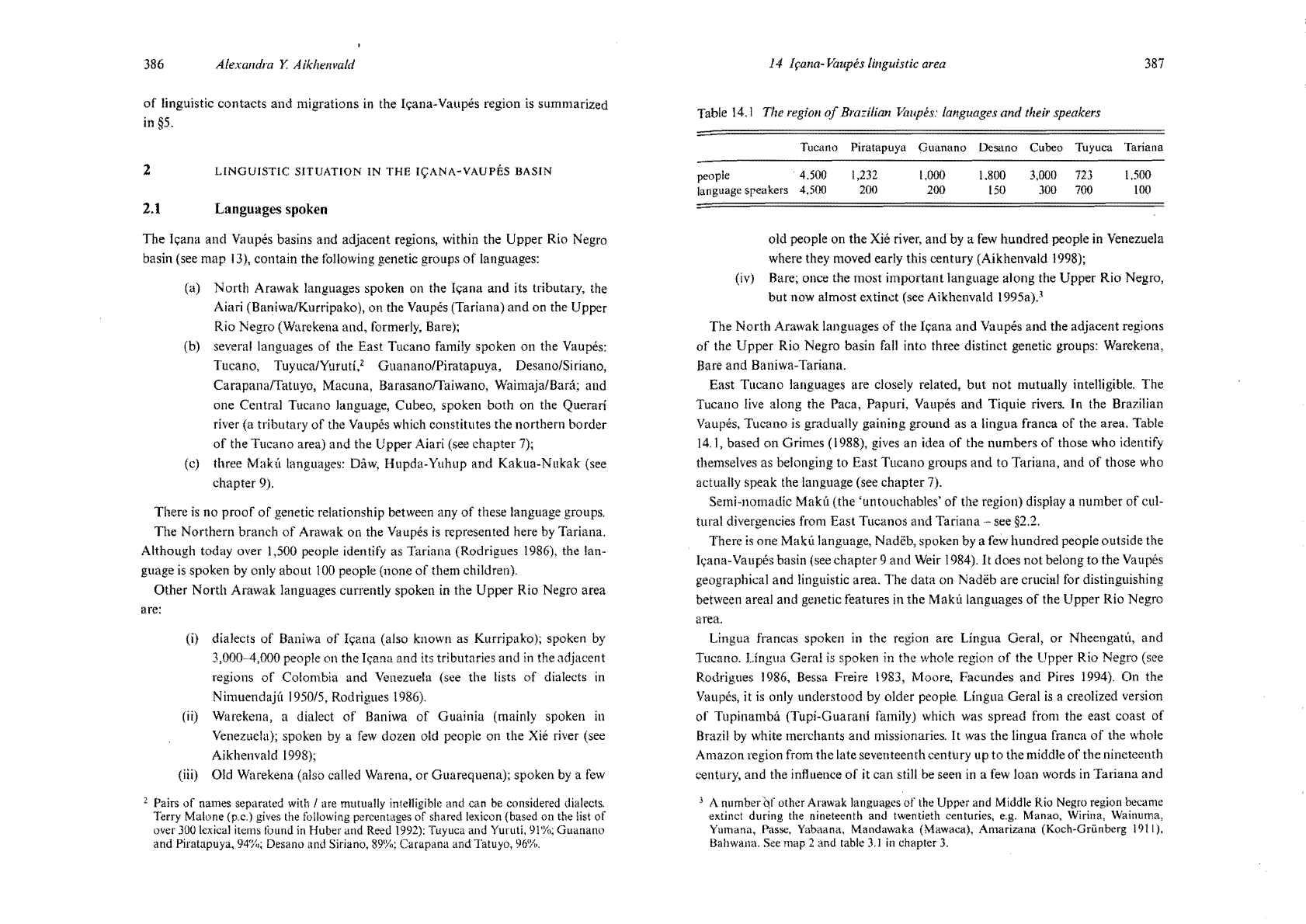
Map
\3
Languages in the I<;ana-Vaupés Basin with approxírnate locations
Afea! diffusion and language
contact in the I.;ana-Vaupés basin,
north-west Amazonia
ALEXANDRA
y.
AIKHENVALD
AREAL
DIFFUSION
IN
NORTH-WEST
AMAZONIA
l
To
define a area, a convincing number
01'
diagnostic traits must be estab-
lished which
will
this area from others,
and
which can be proved not to
be
genetically inherited. Distinguishing areal diffusion from genetically inherited
phenomena is particlllarly
for Amazonian languages
_.
see
chapter
1
aboye.
The region around the Upper Rio Negro (the major northern tributary
01'
the
Amazon) contains a multiplicity
of
langllages. Within the
Rio Negro area,
the. combined Vaupés and
I¡yana
river basíns constitute a well-defined linguistic
. area; and within this the Vaupés basill
is
a
c1ear
Iinguistic sub-area (Aikhenvald
1 996a).
I 8hall here consider the Vaupés-Iyana basin in north-west Amazonia as an
example
of
a Iinguistic area, which displays a convincing number
of
structural fea-
tures shared
by
languages
of
three genetically unrelated families North Arawak,
East Tucano and Makú. These features are not found in Arawak and Makú Jan-
guages spoken outside the area,
and
thus can be considered
as
diagnostic for area!
dilfusion. In some cases
we
are able to establish the direction
of
diffusion.
The languages spoken
in
the Iyana and Vaupés region are described in
together with the cultural setting and language attitudes. In
thi8
section I also
present historical evidence and arguments
in
favour
of
shared cultural patterns.
Linguistic characteristics
of
the Vaupés - due to the intensive areal convergence
in the context
of
obligatory multilingualism - are described
in
§3.
Properties
shared
by
the1anguages
of
the
I¡yana-
Vaupés area are discussed
in
The history
I
1 arn very grateflil to Janet Barnes
ahd
Terry Malone for their cornrnents.
387
Alexandra
Y.
Aik/¡ellvald
386
of
linguistic
contacts
and
migrations in the I<;ana-Vaupés region
is
summarized
in
§5.
2
L1NGUISTIC
SITUATION
IN
THIl
I~ANA-VAUPÉS
BASIN
2.1
Languages spoken
The
I¡;:ana
and
regíons, within the
Upper
Río Negro
basin (see
map
13),
contain the genetic groups
of
languages:
North
Arawak languages spoken on the
I¡;:ana
ami
its tributary, the
Aiari (Baniwa/Kurripako),
on
the Vaupés (Tariana)
and
on the Upper
Rio Negro (Warekena
and,
formerly, Bare);
(b) several languages
of
the East Tucano family spoken on the Vaupés:
Tucano, Tuyuca/Yurutí,2 Gnanano/Piratapnya, Desano/Siriano,
Carapana/Tatuyo, Macuna, BarasanolTaiwano, Waimaja/Bará; aud
one Central Tueano language, Cnbeo, spoken
both
on
the Querari
fiver (a tributary
of
the Vaupés which cOllstitutes the l10rthern border
of
the Tucallo area) and the Upper Aiari (see
(e) three
Makú
languages: Daw, Hupda-Yuhup and
Kakua-Nukak
(see
There
is
no
proor
of
genetie relationship between any
of
these language groups.
The
Northern braneh
of
Arawak on the Vaupés
is
represented here by Tariana.
today over 1,500 people identify as Tariana (Rodrigues the lan-
guage
is
spoken by only about 100 people (none
of
them children).
Other
North
Arawak languages
spoken in lhe
Rio Negro area
are:
dialects
of
Baniwa
of
I¡;:ana
(al so knowll as Kurripako); spoken by
3,000-4,000
011
the
I¡;:ana
and its tributaries
and
in
the adjacent
regions
of
Colombia
and
Venezuela the lists
of
dialecls in
1950/5, 1986).
(ii)
a dialeet
of
Baniwa
of
Guainia
(mainly spoken
in
Venezuela); spoken by a
few
dozen old peoplc on the Xié river (see
Aikhenvald (998);
Old Warekena called Warena,
01'
Guarequena);
by
a
few
2
Pairs
of
names separated with
I
are mutually intelligible and can be considered dialects.
Terry Malone (p.c.) gives lhe following percentages
of
sharcd lexicon (based on the lis!
of
over 300 Icxical items lound
in
Huber
and
Reed 1992): Tuyuca and Yuruti, 9 1
'X,;
Guanano
and
Piratapuya, 94%; Desano
and
Siria no,
89'X,;
Campana
and
Tatuyo,
96%,.
14
h~ana-
Vaupés
linguistic
area
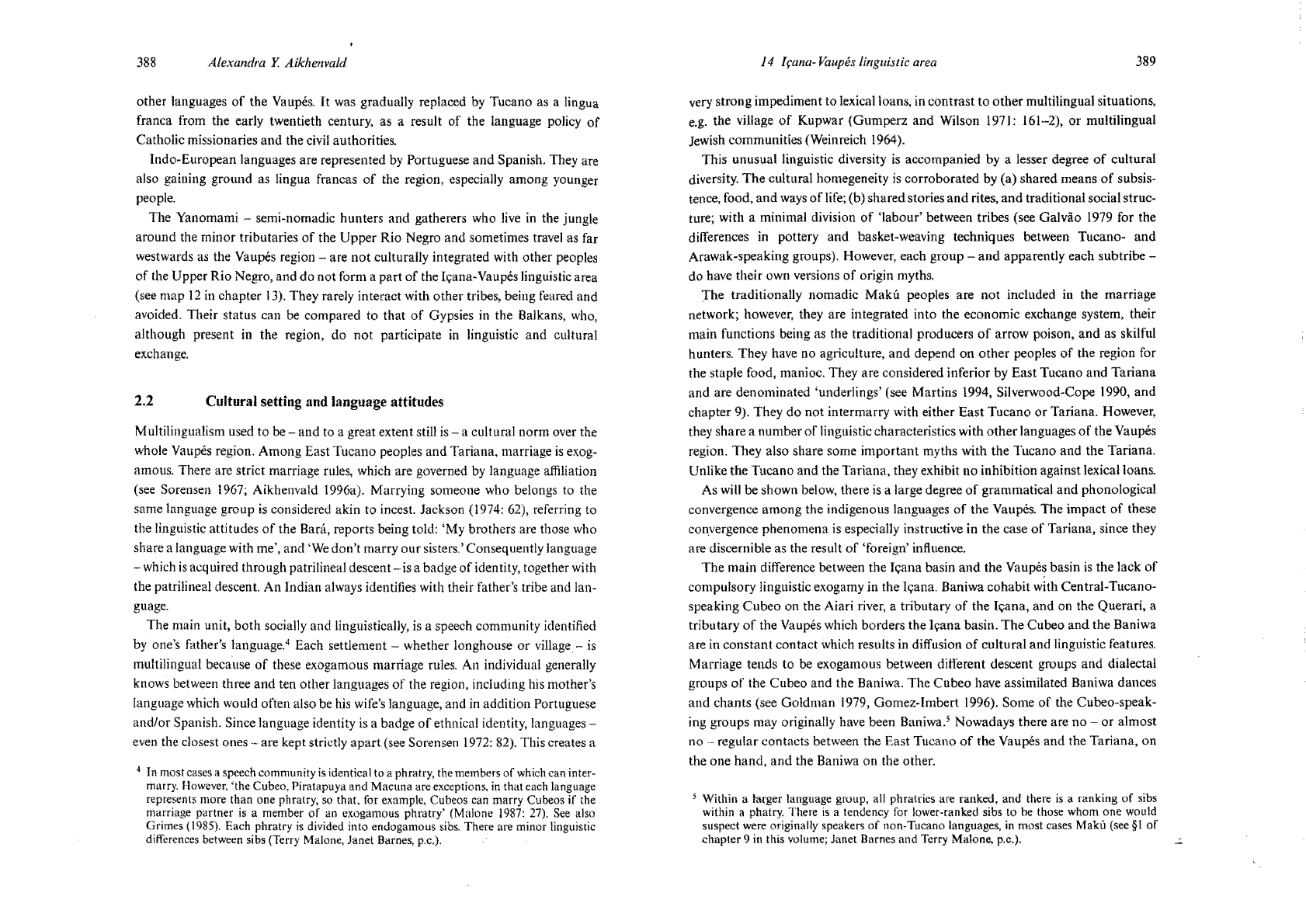
Table
14.1
Tlle
regioll
o/
Brazilian
Vaupés:
/anguages
and
fheir
speakers
-
Tucano Piratapuya
Guanano
Desano
Cubeo
Tuyuea
Tariana
people
4.500
1,232
1,000
1.800
3,000
723
1,500
language speakers 4.500
200
200
150
300 700
100
old
people
on
the
Xié river,
and
by a
few
hundred
people in Venezuela
where they moved early this century (Aikhenvald 1998);
(ív)
Bare; once the
most
important
language along the Upper Rio Negro,
but
now almost extinct (see Aikhenvald 1995a),3
The
North
Arawak languages
of
the I¡;ana
and
and the adjaccnt
of
the
Upper
Rio Negro basin
faH
into three distinct genetic groups: Warekena,
Bare
and
Baniwa-Tariana.
East
Tucano
languages are closely
but
not
mutually intellígible.
The
Tucano live along the Paca, Papuri, Vaupés
and
Tiquie rivers. In the Brazilian
Vaupés,
Tucano
is gradually gainíng ground as a lingua franca
of
the area. Table
14.1, based
011
Grímes (1988), gives an idea
of
the numbers
of
those who identify
themselves as belonging to
East
Tucano
groups
and
to
Tariana, and
of
those who
speak lhe language
chapter
7).
Sell1i-nomadic
Makú
'untouchables'
of
the region) display a
number
of
eul-
tural divergencies from East Tucanos
and
Tariana
see
§2.2.
There
is
one
Makú
language, Nadeb, spoken by a few hundred people outside the
I~ana-
Vaupés basin (see
chapter
9
and Weir 1984).
It
does
not
belong
to
the Vaupés
geographical and linguistic area.
The
data
on Nadeb are crucial for distinguishing
between areal and genetic features in the
Makú
languages
of
the Upper Rio Negro
area.
Lingua francas spoken in the are Língua Geral,
or
Nheengatú,
and
Tucano. Língua Geral
is
SPOken
in the whole regia n
01'
the Upper Rio Negro
Rodrigues 1986, Bessa Freire
1983,
Moore, Facundes
and
Pires 1994). On the
it
is
only understood by older people. Língua Geral
is
a creolízed version
of
Tupinambá
(Tupí-Guaraní family) which was spread from the east eoast
of
Brazil by white merchants
and
missionaries. It was the lingua franca
of
the whole
Amazon
fram the late seventeenth eentury up to
the
middle
of
the nineteenth
eentury,
and
the influence
of
it
can
still be seen
in
a
few
loan words in
Taríana
and
3
A nllmber
qf
other Arawak langllages
01'
the Upper
and
Middle Rio
extinct during Ihe nineteenth and twentieth centuries, e.g. M,lnao, Wirina, Wainuma,
Yumana,
Passe,
Yabaana, Mandawaka (Mawaca), Amarizana (Koch-Grünberg
1911),
Bahwanl\. See map 2
and
table
3.1
in
chapler
3.
389
388
Alexandra
Y.
Aikhellvald
other languages
of
the Vaupés.
It
was gradually replaced by Tucano as a
franca from the early twentieth century,
as
a result
of
the language policy
of
Catholic missionaries
and
the civil authorities.
Indo-European langllages are represented by Portuguese
and
Spanísh.
Theyare
al
so gaining ground as linglla francas
of
the region, especíal1y among younger
pea
pIe.
The Yanomami - semi-nomadic hunters
and
gatherers who live in the
around the minor tríbutaries
of
the
Upper
Río Negro and sometimes travel as far
westwards
as
tbe Vaupés regíon - are
not
culturally integrated with other peoples
of
the U pper Río Negro, and
do
not form a
part
of
the I(fana-Vaupés linguistic area
map
12
in
chapter
13).
They rarely interact with other tri bes, being feared and
avoided. TIleir status can be compared to that
of
Gypsíes in the Balkans, who,
although present in the region,
do
not
participate in
and
cultural
exchange.
2.2
Cultural
setting
and
language
attitudes
Multilingualism used to be
and
to a great extent stm is a cultural norm over the
whole Vaupés region. Among East Tucano peoples
and
Tariana, marriage
is
exog-
amous. There are strict marriage rules, which are governed by language affiliation
(see Sorensen 1967; Aikhenvald 1 996a). Marrying someone who belongs to the
same language group
is
considered akin
to
inccst. Jackson (1974: 62), referring to
the linguistic attitudes
of
the Bará, reports being told:
'My
brothers are those who
share a language with me', and 'We don't marry
our
sisters: Conseqllently language
- whieh
is
acquired throllgh patrilineal deseent -
is
a badge
of
identity, together with
the patrilineal descent. An Indian always identifies with their father's tribe and lan-
guage.
The main unit,
both
social1y and Iinguistically, is a speech community identified
by one's father's language.
4
Each settlement - whether longhollse
or
village
is
multilingual beca use
of
these exogamous marriage rules. An individual generally
knows between three
and
ten other languages
oí"
the region, including his mother's
Ianguage which would often also be
his
wife's language, and in addition Portuguese
Since language identity is a badge
of
ethnical identity, languages
even the closest ones
--
are kept strietly
apart
(see Sorensell 1972: 82). This creates a
4
In
most
c¡¡ses
¡¡
speech
community
is
identical
to
a phratry,
the
members
of
which
can
in
ter-
marry_
However.
'the
Cubeo.
Piratapuya and Macuna
are
exceplions.
in
that
each
language
represents
more
than
one
phratry,
so
that,
for
example,
Cubeos
can
marry
Cubeos
if
the
marriage partner
is
a
member
of
ao
exogamous
phratry' (Malooe
1987:
27).
See
also
Grimes
(1985).
Each
phratry
is
divided
into endogamous
sibs.
There
are
minor
linguistic
differcnces
between
sibs
(Terry
Malone,
Janet
Barnes,
p_c.).
14
[fana-
Vaupés
Unguis/ic area
very strong impedirnent to lexicalloans, in contrast
lO
other
rnultilingual situations,
e.g. the village
of
Kupwar (Gumperz
and
Wilson 1971: 161-2),
or
multilingual
Jewish communities (Weinreich 1964).
This unusua! linguistic diversity
is
accompanied by a lesser degree
of
cultural
diversity.
The
cultural homegeneity is corroborated by (a) shared means
of
subsis-
tence, food,
and
ways
of
lite; (b) shared stories
and
rites,
and
traditional social stroc-
ture; with a mínimal division
of
'Jabour' between tribes (see Galviio
1979
for the
differences in pottery
and
basket-weaving techniques between Tucano-
and
Arawak-speaking groups). However, each group -
and
apparent1y each
subtribe-
do have their own versions
of
origin myths.
The
traditionally nomadic
Makú
peoples are not inc1uded in the marriage
network; however, they are integrated into the economic exchange system, their
main fUllctions being as the traditionaJ producers
of
arrow poison,
and
as skilful
hunters. They have no agriculture,
and
depend
on
other
peoples
of
the regíon for
the staple food, manioc. They are considered inferior by East Tucano
and
Tariana
and
are
denominated 'underlings' (see Martíns 1994, Silverwood-Cope 1990,
and
chapter
They
do
not intermarry with either
East
Tucano
or
Tariana. However,
they share a number
of
linguistic characteristics with
other
languages
of
the Vaupés
They also share sorne
important
with the Tucano
and
the Tariana.
Unlike the Tucano
and
the Tariana, they exhibít no inhibition against lexicalloans.
As
will
be shown below, there
is
a large degree
of
grammatical
and
phonological
convergence among the indigenous languages
of
the Vaupés.
Tbe
impact
of
these
convergence phenomena is especially instructive in the case
of
Tariana, sinee they
, are discernible as the result
of
'foreign' influence.
The
main difference between the I(fana basin
and
the Vaupés basin is the lack
of
compulsory Iínguistic exogamy in the I(fana. Baniwa cohabit with Central-Tucano-
speaking
Cubeo
on the Aiari river, a tributary
of
the l(fana,
and
on the Querarí, a
tributary
of
the Vaupés which borders the Icana basin.
The
Cubeo
and
the Baniwa
are in
constant
contacl which results in diffusion
of
cultural
and
Iinguistic features.
Marriage tellds to be exogamous between difierent descent groups
and
dialectal
groups
of
the ClIbeo
and
the Baniwa.
The
ClIbeo have assimílated Baniwa dances
and
chants (see
Goldman
1979, Gomez-Imbert 1996). Some
of
the Cubeo-speak-
groups may original1y have been Baniwa.
5
Nowadays there are
no
-
or
almost
no regular contacts between the East Tucano
of
lhe Vaupés
and
the Tariana,
on
the one hand,
and
the Baniwa
on
the olher.
5
Within a
iat:ger
language
gl'OUp,
all
phratrics
are
ranked, and
there
is
a ranking of
sibs
within
a
phatry.
There
is
a tendency
roc
lower-ranked sibs
to
be
those
whom
one
would
suspect
were
original!y
speakers
of non·Tucano
languages,
in
most
cases
Makú
(see
§l of
chapter 9
in
this
volume;
Janet
Barnes
and
Terry
Malone.
p.c.).
391
390
Alexafldra
Y.
Aikhenvald
However, the Baniwa share a number
of
cultural sirniJarities with the indigenous
groups
of
the Vaupés which
may
be índicatíve
of
older contacts and
of
dilfusion.
These similarities include the strueture
of
the kinship system (descríbed
in
Oliveira
1975, Galvao 1979), patrilineal deseent,
and
the hierarchical organization
of
deseent
groups. There are also a number
of
traditions and myths shared by the Baniwa and
the Tueano,
e.g.
the myth
of
a woman going to the 'beyond' with the help
of
an
agouti
(e.
Hugh-Jones
1979);
stories about Ihe cunning turlle and Ihe tapir; the story
of
the
evil
spirit's son who turned into a deer; the cult
of
the magíc flule, JUfupary
(S.
O.
Hugh-Jones
1979);
burial
of
the dead inside the house; infanticide
of
twins;
and the festival
of
Dabukuri - an olfering accompanied by drínking manioc beer and
ritual dances
(cf.
Reichel-Dolmatolf
1986).
There are also a number
of
Iingllistie
fea-
tures shared
by
Baniwa, Tariana and East Tucano langllages but not found in other
North Arawak languages. These
will
be
considered
in
2.3 Historienl evidenee
Historícal and traditional evidence shows that neither the Tucano nor the Tariana
cOllstitute the autochthollOllS population
of
the Vallpés.
According to Nimuendajú (1982), the original inhabitants
01'
the Vaupés area
were Makú tribes,
and
East Tucano tri bes then entered the area fram the
west.
The
Tariana are the most recent arrivals. They probably carne into the Vaupés basin
from a tributary
of
the I"ana river probably the Aiari (around the end
of
the
six-
teenth centllry according to Brüzzi
1977,
Koch-Grlinberg
1911
and Nimuendajú
1982).
This description
of
the origin
of
the Tariana
is
reflected
in
their
according to which all
of
them originated from a 'hole' at the waterfall
of
Apui, on
the Aiari river, where at the time they lived together with the Baniwa, and with the
Cubeo.
Numerous stories about the wars between the Tariana and the Guanano, and
between the Tariana and the Desano, provide rich ethnohistorical eyidence for the
Tariana invasion
of
the Vaupés (see Briizzi
1977).
The Desano, as the inhabitai1ts
of
the main rivers, were among the first to have sulfered from the invasion
of
the
Tarialla. 1
was
told by
my
teachers
of
Tariana that, as the result
of
the Desanos'
defeat, they were designated the 'younger brothers'
of
the Tariana, and this
is
why
the Tariana do not marry them.
We
can reconstruct the following hístorical scenario for the Iinguistic situation in
the Vaupés during the past
500
years.
(i)
Before
1500:
East Tucano tribes moved fram the west into the Vaupés area,
which
was
previously inhabited
by
Makú tribes
(cf.
chapter
9).
The East Tucano
established domillance oyer the Makú. The soread
01'
Tucano-speaking peoples to
14
1 rana-
Vaupés
Unguis
t
ic
area
the I"ana basín may llave occurred at about the same time. According to the oral
tradition
of
the Cubeo (Gomez-Imbert 1996), they came to. the Querarí from the
I"ana tributaries a
few
hundred years ago, chased by Baniwa-speaking tribes. Sorne
of
the Cubeo speakers on the Querarí are descendants
of
Arawak-speaking tribes.
It
is
hard to establish the exact age
of
Baniwa-Cubeo contacts in the
¡"ana
basin;
however,
it
was sufficiently long ago to promote Ihe areal dilfusion discussed below.
The
Baniwa
of
I"ana were
at
tbis time living together with the Tariana in the
I"ana basin.
(ii)
Around
1600:
the Tariana moved fram the tributaries
of
the
Ic;ana
river-
thus
splitting from the Baniwa
of
Ic;ana - to the Vaupés region, in which Tucano tribes
were already established. This marked the beginning
of
contact between East
Tucano and Tariana.
(iii)
Around 1750-80: the first contacts with Portuguese too k place, which started
the spread
of
Linglla Geral as a lingua franca.
(iv)
Around
1900;
Tucano started to gain ground as a língua franca
of
the area,
with sorne Tariana settlements beginning to use mainly Tucano (see Koch-
Grünberg
1911).
This tendency increased with the establishment
of
permanent
Salesian missions
in
the Vaupés
in
1 and resulted in the growing endangerment
of
indigenous languages other than Tucano
in
the Vaupés regían,
and
the growing
obsolescence
of
Língua Geral.
The
main conseqllence
of
the spread
of
Tucano
in
the Brazilian Vaupés is the
gradual undermining
of
the identification between language and tribe. Language
has gradually ceased to be an emblem
of
tribal identity, and the majority
of
lan-
guages other than Tucano have become endangered. Tlle discrepancy between the
number
of
those who belong to a tribe
and
those who actuaJly' speak the language
(see table 14.1)
is
particularly marked
in
the case
of
Tariana. The spread
of
Tucano
ís
al
so leading to the gradual disappearance
of
one
of
the most fascinating multi-
areas
of
the world,
and
the areal phenomena associated with it.
This does not seem to be the case
in
the Colombia n Vaupés. Tucano, however,
ís
also the prestige language there; when the Tucano are present, speakers
of
other
use Tucano.
The
language which seems to be disrupting the Tucano
sociolinguistic sítuation there
is
Spanish (Ardila
1989;
Terry Malone p.c.).
3
THE
VAUPÉS
REGlO
N AS A
LINGUISTIC
AREA
3.1 Ceneralobservations
Here
we
consider the properties
of
languages
in the Vaupés regían which
characteríze jt as a area.
393
392
Alexandra
Y.
Aikhenvald
As pointed out by Thomason and Kaufman (1988: 96lf.), a long-term multilat-
eral Sprachbund seems to promote gradual isomorphislIl in all aspects
of
the struc-
ture
of
languages except for the phonologícal shape
of
morphemes. A famous
example
of
the same surface structure
for
sevecallanguages spoken in the same lin-
guístic area comes from Indo-Aryan and Dravidian languages
of
Kupwar
(Gumperz and Wilson 1971). In the case
of
numerous multilaterallínguistic areas,
such as the Balkans (Thomason and Kaufman 1988: 97), the direction
of
dilfusion
is
easily established.
In
the case
of
the Vaupés, it can also be established
foc
certain
features. The following characteristics
of
the Vaupés as a línguistic area should be
borne
in
mind:
• the faet that there are several East Tucano languages
and
only one
Arawak language has provoked,
byand
unilateral ditTusion pat-
terns: fmm East Tueano into the Arawak language, Tariana;6
• there
is
a recent tendency
of
Tucano to develop domination over other
languages, hence the destruction
of
multilingualism in the communíty;
• language identification and the perceived link between tribe and lan-
guage drastically Iimit the extent
of
lexical borrowing;
• while considering areal dílfusion patterns and structural convergence
between the languages
of
the area, one has to take ¡nto consideration
langllage obsolescence phenomena for some languages.
The Vaupés linguistic area (for sorne
usefl.ll
cOllllllents see Brüzzi 1967,
1977)
has
multilaterallllllltilingualism characterized by Iinguistic diversity
and
a comparative
lack
of
cultural diversity.
As
already mentioned, the languages belong
to
three
genetically unrelated families
North
Arawak, Tucano and Makú - and their
speakers do
not
accept language-mixing. However, people tend to identify the lan-
guage with its forms and the prohibitioll on 'Ianguage mixing' only relates to forms,
not to grammatical categories
or
structural patterns. As a result there
is
a great
degree
of
dilfusion
of
structural patterns but little borrowing
of
actual forllls.
The idea that the Vaupés region constitutes a lingllistic area was first suggested
6
There are a
few
examples
of
Arawak influence on East Tucano languages. Carapana
(Metzger
1981:
151
fr.)
and
Tatuyo (EIsa Gomez-Imbert p.c.) have an attributive prefix
ka-
which displays striking símílarily lo Ihe relalive-attributive prefix
kl/-
in Tariana
and
Baniwa
of
19ana.
The
'foreignness'
of
Ihis prefix
in
Carapana
and
Tatuyo
is
confirmed
by
Ihe generally suffixing character
of
Tucano languages. Tanimuca-Retuama (Retuarií), a
West Tucano language spoken
in
Colombia, apparently lost
ilS
complicated system
01"
clas-
sifiers, switch-reference markers aud evidentials
on
Ihe verb, under the areal iufluence
of
another North Arawak language, YlIcuna, which has only a gender opposition (Gomez-
Imbert
(996).
It
also acquired prefixes, possibly under Arawak influence. Accordillg to
Terry Malone (p.c.), Ihe speakers
of
Tanimuca
cOllld
originally have
!:leen
a North Arawak
group who switched to a Tllcano language (see 'lIso chapter
7).
14
J(:ana-
Vaupés
linguistic
area
by Sorensen (1967), with reference
to
the Colombian side, where only East Tucano
langl.lages are spoken. Sorensen pointed
out
the existence
of
a bundle
of
morpho-
syntactical isoglosses which constitute an East Tucano 'profile'
of
language (1972:
82-3). However, whether this East Tucano pmfile
is
due to areal dilfusion patterns
or to the common genetic origin
of
East Tucano languages remains a problem
which goes beyond the scope
of
the present discussion. (The solution
of
this
problem would involve a full reconstruction
of
proto-East-Tucano
and
comparison
of
it
with proto-West-Tucano and proto-Tucano.)
The
important dilference between the Brazilian Vaupés region
and
the
Colombian Vaupés region from the point
of
view
of
areal dilfl.lsion phenomena
is
the fact that a non-East-TlIcano language, Tariana,
is
still spoken
in
Brazil. Thus,
lhe East-Tucano-like features in Tariana (aud also, North-Arawak-like features
in
East Tucano) enable
us
to establish a direction
of
dilfusion in the area.
For the analysis
1
will
use the following kinds
of
data:
• my own field data on Tariana and on
other
North
Arawak languages
of
the wider region (Baniwa
of
Ivana, Warekena
of
Xié, Bare); proto-
Arawak reconstruction
and
internal reconstruction (see Payne
1991;
Aikhenvald
I
994a,
b,
1995a, 1996a, b, in prep.);
• a number
of
descriptions
of
East Tucano languages (not all
of
egual
guality), and my own field data, and also sorne data
on
proto-Tucano
reconstruction and descriptions
of
Bast Tucano and
West
Tucano tan-
guages whieh
do
not participate in tbe Brazilian Vaupés as a Iinguistic
area, as
wel1
as the
data
on proto-West-Tucano.
The analysis
of
areal and inherited features
of
Tariana includes a fair
amount
of
internal reconstructíon, and synchronic comparison with Baniwa
of
I<;ana
and East
Tucano languages. A comparison
of
Tariana with geographically
c10se
and
geneti-
cally related North Arawak languages
is
extremely useful, especially
if
we
are able
to determine which properties Tariana sbares with East Tucano languages, and
whích are shared by other North Arawak languages,
but
absent from Tariana (also
see Aikhenvald 1 996a, on innovations
and
language attrition phenomena in
Contact between Tucano and
Makú
languages (Daw, Hupda,
in
the
Vaupés appears
to
be mllch older than contact between Tllcano and Tariana see
§2.3. Note that one would expect mainly unilateral dilfusion patterns fram East
Tucano to Makú, since a fair proportion
of
Makú know
at
least one East Tucano
language,
or
more, but East Tucano peoples seldom bave competence
in
a
Makú
languagé.
To
establish areal dilfusion patterns in the Makú languages spoken in the Vaupés