
Dixon R.M.W., Aikhenvald Alexandra Y. The Amazonian Languages (Cambridge Language Surveys)
Подождите немного. Документ загружается.

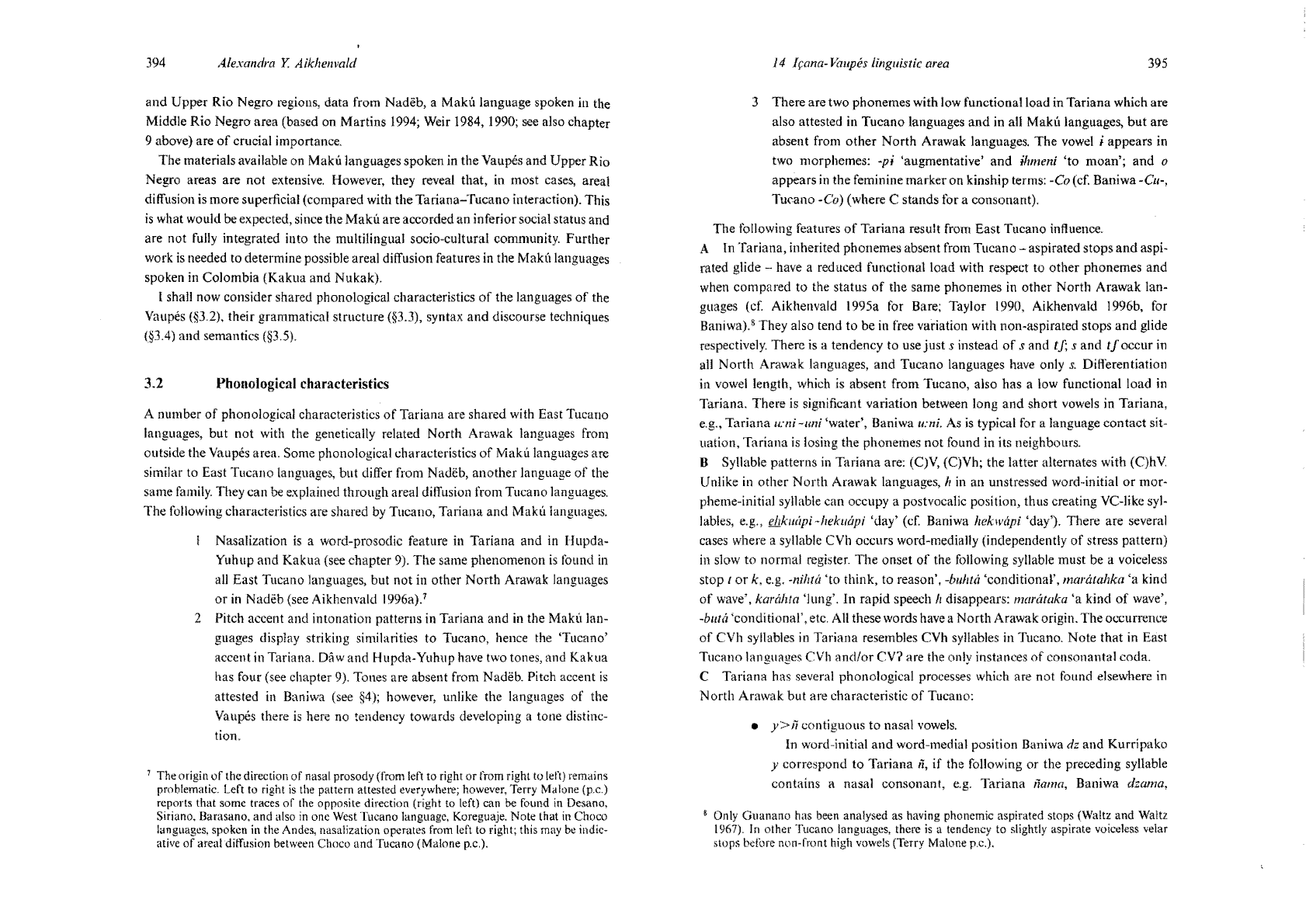
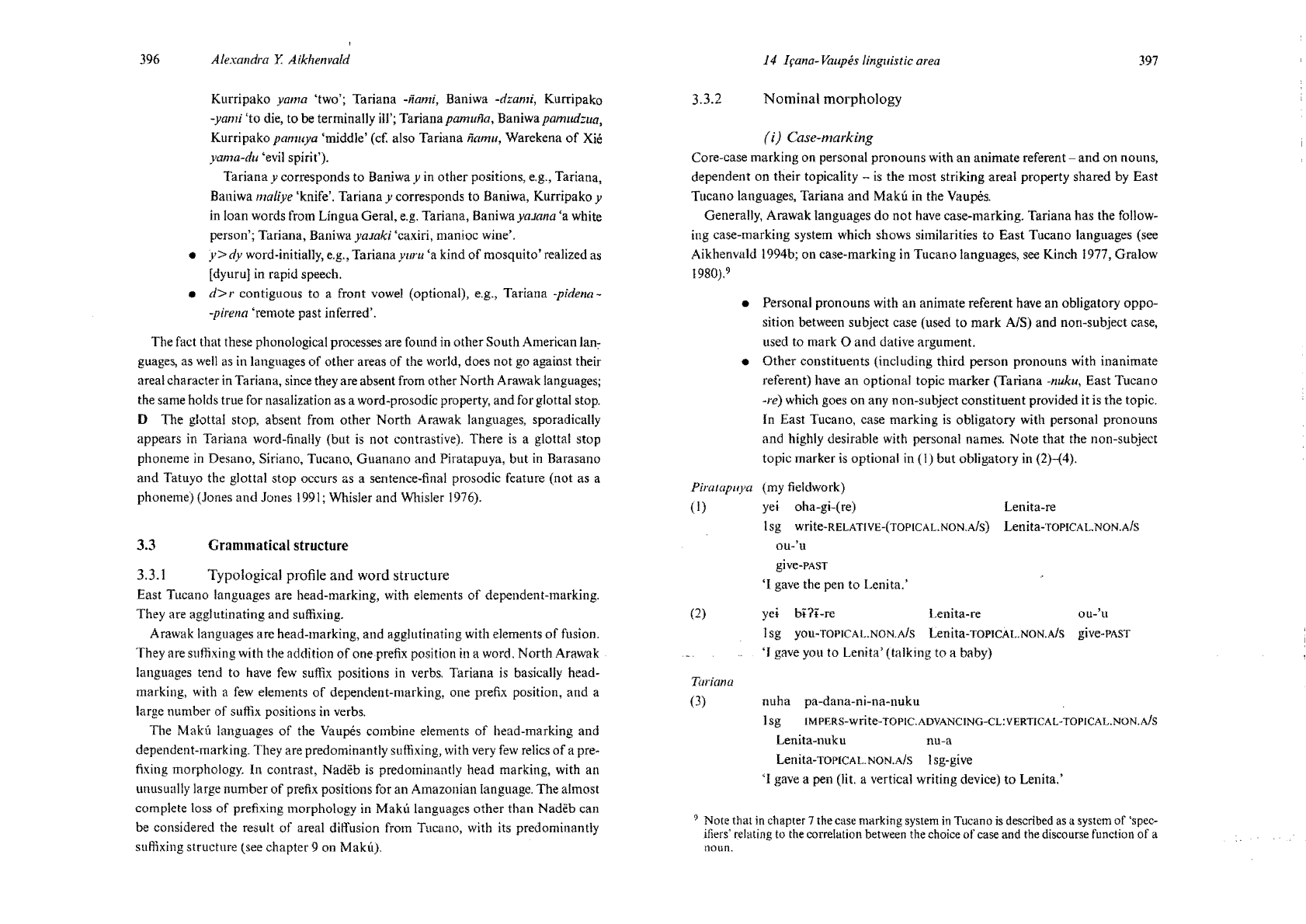
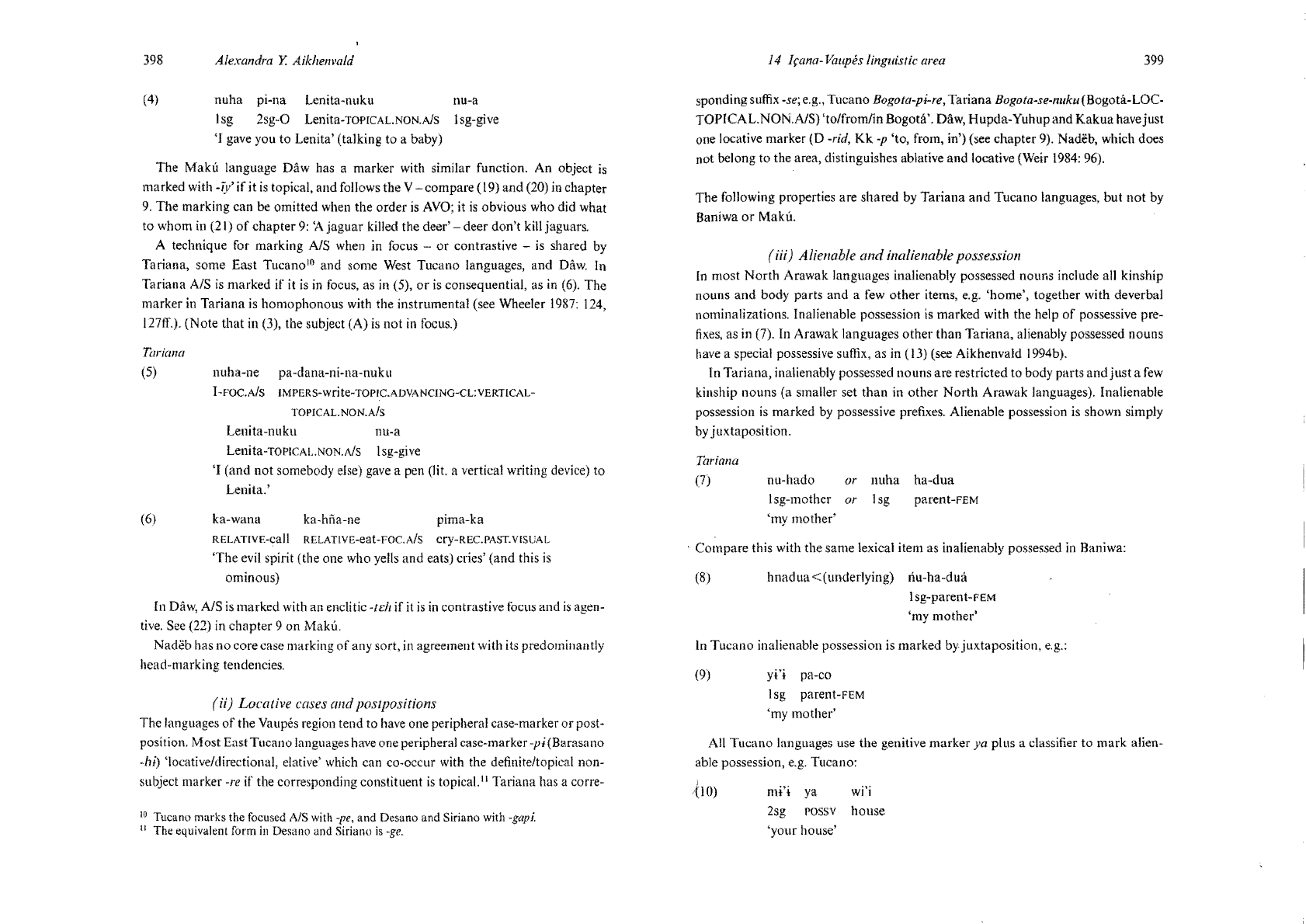
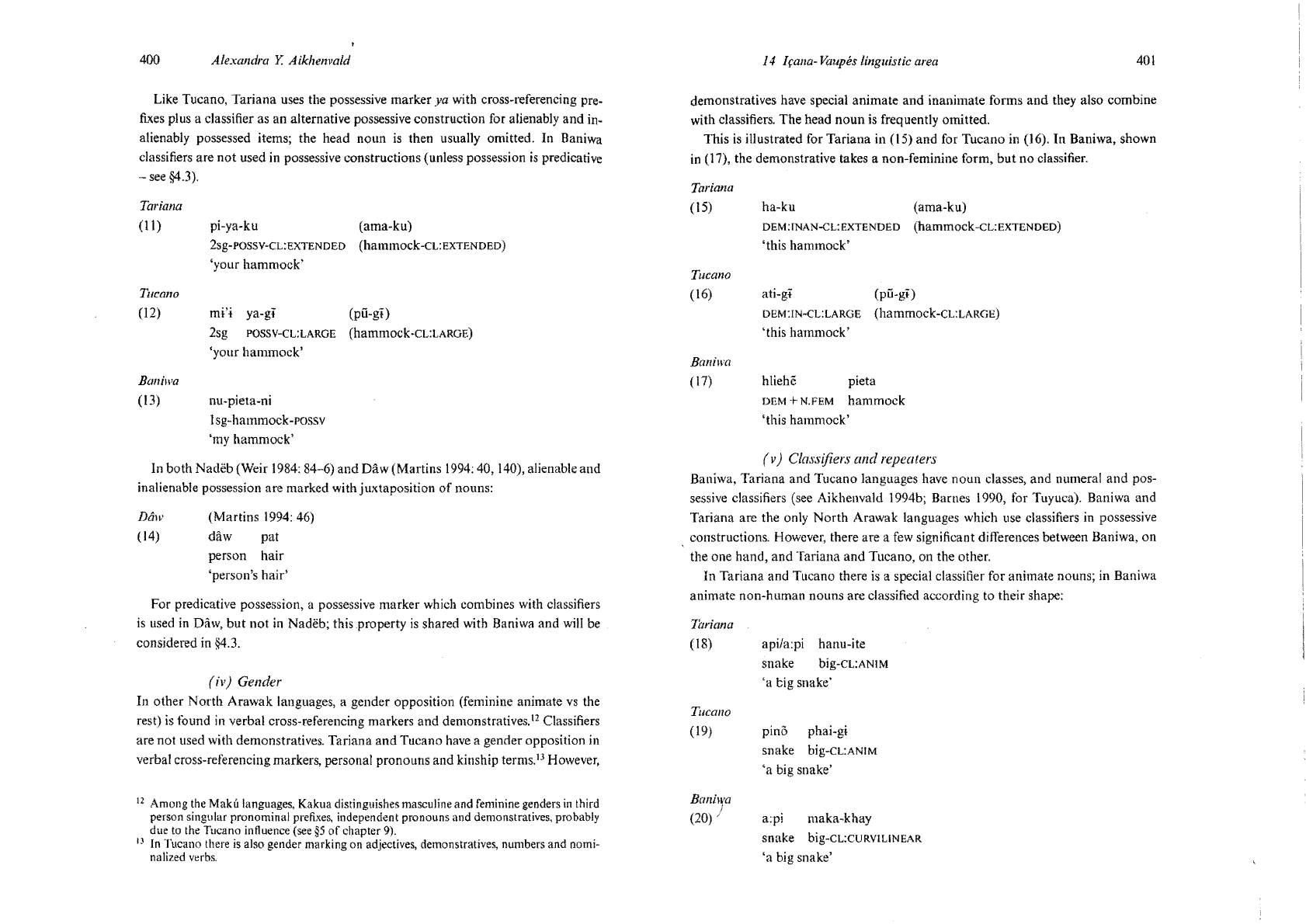
394
395
Alexandra
Y.
Aikhenvald
and
Upper Río Negro regions, data from Nadeb, a
Makú
language spoken in the
Middle Río
Negro
area
(based on
Martins
1994; Weir 1984, 1990; see also chapter
9 aboye) are
of
crucial importance.
The
materials available on
Makú
languages spoken in the
and
Upper
Río
Negro areas
are
no! extensive. However, they reveal
that,
in mosl cases, areal
diffusion is more superficial (compared with the
Tariana-Tucano
interaction). This
i5
what would be expected, since rhe
Makú
are accorded
an
inferior social status and
are no! fully integrated into the multiJingual socio-cultural community.
Further
work
is
needed to determine possible areal diffusion featmes in the
Makú
languages
spoken in Colombia
(Kakua
and
Nukak).
1
shall now consider shared phonological characteristics
of
the languages
of
the
their ammatlcal structure (§3.3), syntax
and
discourse techniques
3.2 Phonological characteristics
A number
of
phonological characteristics
of
Tariana are shared with East Tucano
languages,
but
not
with the genetical\y related
North
Arawak languages from
outside the Vaupés area. Sorne phonological eharaeteristics
of
Makú
languages are
similar to East Tucano languages,
but
differ from Nadeb,
another
langllage
of
the
can
be explained through areal diffusion from Tucano languages.
The
characteristics are shared by Tucano,
Tanana
and
Makú
langllages.
rn_nmmrlí
...
feature in
Tariana
and
in
The
same phenomenon
i5
lound in
aU
East Tucano languages,
but
not
in other
North
Arawak
or
in Nadeb (see Aikhenvald 1996a),1
2 Pitch accent
anel
intonation patterns in Tariana and in the
Makú
lan-
guages display striking similarities
to
Tucano, hence the 'Tllcano'
accent in Tariana.
Dftw
and HlIpda-Yuhup have two tones,
flnd
Kakua
has four (see chapter 9). Tones are absent from Nadeb. Pitch accent
is
attested in Baniwa (see
~4);
however, unlike the languages
of
the
there
is
here no tendencv towards developing a tone distinc-
lion.
1
The origin
of
Ihe direction
of
nasal prosody (frorn left lo righ!
or
from
problernatic. Left to right
is
the pattcrn attested everywhere; however, Terry Malone (p.c.)
reporls that sorne traces
of
Ihe opposite direction (righ! 10 left) can be found
in
Desano,
Siriano, Barasano, and also
in
one West Tucano langllagc, Koreguaje. Note that
in
Choco
langllages, spokcn
in
the Andes, nasalization operales frorn left to right; this
muy
be indic-
ative
of
areal dilfllsion belween Choco und Tucano (Malone p.c.).
14 Ir;ana-
Vaupés
IlllfllllStíC
area
3 There are two phonemes with low
functionalload
in Tariana which are
also attested in
Tucano
languages
and
in all
Makú
languages,
but
are
absent from
other
North
Arawak languages.
The
vowel
i
appears in
two morphemes:
-pi
'augmentative'
and
ihmeni
'to
moan';
and
o
appears in
the
feminine
marker
on kinship terms:
-Co
(cf. Baniwa -Cl/-,
Tueano
-Col
(where C stands for a consonant).
The
foIlowing features
of
Tariana
result from
East
Tucano inftuence.
A
In
Tariana,
inherited phonemes absent from
Tueano
rated glide - have a redueed funetional load with respect
to
other
phonemes
and
when
compared
to the status
of
the
same phonemes in other
North
Arawak
lan-
guages (ef. Aikhenvald 1995a for Bare; Taylor 1990, Aikhenvald
1
996b, for
Baniwa).8 They also tend to
be
in free variation with non-aspirated stops
and
glide
respectively. There
is
a tendency to use
just
s
instead
of
s
and
tJ;
s
and
tJ
occur in
a11
North
Arawak languages,
and
Tucano languages have only
s.
DHferentiation
in vowel length, which ís absent from Tucano, also
has
a low functional
load
in
Tariana.
There
is variation between long
and
short
vowels in Tariana,
e.g.,
Tariana
u:ni
-uni
'water', Baniwa
l/:ni.
As
is
typical for a language
contact
sit-
ualion,
Tariana
is
losing Ihe phonemes
not
found in its neighbol
B Syllable patterns in
Tariana
are: (C)V, (C)Vh; the latter alternates with
Unlike in
other
North
Arawak languages,
h
in an unstressed word-initial
or
mor-
pheme-initial syllable can occupy a postvocalic position, thus creating VC-like syl-
lables, e.g.,
ehkutÍpi
-ltekuápi
'day'
(cf. Baniwa
hekwápi
'clay'). There are several
cases where a syllable CVh occurs word-medial1y (inclependently
01'
stress pattern)
in slow
to
normal
The
onset
01'
the following syl1able must be a voiceless
stop
1
01'
k,
e.g.
-nihtá
'to
think, to reason',
-lmhtá
'conditional',
mal'átahka
'a
kind
of
wave',
kal'áhta .
In
rapid
speech
h
disappears:
mal'átaka
'a
kind
of
wave',
-bUIÓ
'conditional',
etc.
AH
these words have a
North
Arawak origino
The
occurrence
of
CVh syllables
in
Tariana resembles CVh svllables in TlIcano.
Note
that
in East
Tucano
languages CVh amI/or
CV?
are the instances
of
consonan tal coda.
e
Tariana
has several phonological processes which are
not
found elsewhere in
North
Armvak but are characteristic
of
Tucano:
• contiguo
liS
to nasal vowels.
In word-initial
and
word-medial position Baniwa
dz
and
Kurrípako
y
correspond
to
Tariana
/1,
if
Ihe following
01'
the precedillg syllable
contains a nasal
consonant,
e.g.
Tariana
flama,
Baniwa
dzama,
Guanano
has been analysed
as
having phonernic
(Waltz and
Wa1tz
[n other Tucano languagcs, thcre
is
a tendencv to voiceless velar
stllps before non-fronl high vowels (Terry Malone
396
Alexandra
Y.
Aikhellvald
Kurripako yama 'two'; Tariana -ñami, Baniwa
-dzami,
Kurripako
-yami
'to
die, to be terminally
iIl';
Tariana pamuña, Baniwa
pamudzua,
Kurripako
pamuya
'middle'
(ef.
also Tariana
ñamu,
Warekena
of
Xié
yama-du 'evil spirit').
Tariana
y
eorresponds to Baniwa
y
in other positions, e.g., Tariana,
Baniwa
maliye
'knife'. Tariana
y
corresponds to Baniwa, Kurripako
y
in loan words rrom
Geral, e.g. Tariana, Baniwa
yaIana
'a
white
person'; Tariana, Baniwa
yaJaki
'eaxiri, manioe wine'.
•
y>
dy
word-initially, e.g., Tariana
ylll'lI
'a
kind
of
mosquito' realized
as
in rapid speech.
• d>
/'
contiguous to a front vowel (optional), e.g., Tariana
-pidena-
-pirella
'remote past inferred'.
The fact that these phonological processes are found
in
otller South American
guages, as
well
as
in
languages
of
other areas
of
the world, does not go against their
areal character in Tariana, since they are absent from other North Arawak languages;
the same holds true
fOf
nasalizatíon as a word-prosodic property,
and
fol'
glottal stop.
D
The
glottal stop, absent from other NOfth Arawak languages, sporadically
appears in Tariana word-finally (but
i8
not eontrastive). There
is
a glottal stop
phoneme
in
Desano, Siriano, Tucano,
Guanano
and
Piratapuya,
but
in
Harasano
and
Tatuyo the glottal
stop
occurs as a sentenee-final prosodic feature (not as a
phoneme) (lones
and
Jones 1991; WhisJer
and
Whisler
3.3
Grammatical
structure
3.3.1
Typological profile and word structure
East TltCano langllages are head-marking, with elements
of
dependent-marking.
They are agglutinating
and
suffixing.
Arawak langllage5 are head-marking, and agglutinating with elements
of
fusiono
They are suffixing with the addition
of
oneprefix position
in
a word. North Arawak
languages tend to have
few
suffix positions in verbs. Tariana
i5
basically head-
marking, with a
few
elements
of
dependent-marking, one prefix positíon, and a
large nllmber
of
suftlx
positions in verbs.
The Makú langllages
of
the Vallpés combine elements
of
head-marking and
dependent-marking.
are predominantly sutlixing, with very
few
relics
of
a pre-
fixing morphology.
In
contrast, Nadeb
is
predominantly head with an
UI1USlllllly
large
number
of
prefix positions for an Amazonian langllage.
The
almost
complete loss
of
prefixing morphology in
Makú
languagc5
other
than Nadeb ean
be considered the result
of
areal diffllsion from Tucallo, with its predominantly
sllffixing structure (see ehapter 9 on Makú).
14 ¡rana-
Vaupés
area
397
3.3.2
Nominal morphology
Case-marking
Core-case marking on personal pronouns with
an
animate referent -
and
on
nouns,
dependent
on
their topieality
i5
the most striking areal property shared by East
Tueano languages, Tariana
and
Makú
ín the Vaupés.
Generally, Arawak langllages
do
not
have case-marking. Tariana has the follow-
ing case-marking system which shows similarities to
East
Tueano languages (see
Aikhenvald 1994b;
on
ease-marking in Tucano languages, see Kinch 1977, Gralow
• Personal pronouns wíth an anímate referent have an obligatory
oppo-
sition between subject ease (used
to
mark
A/S)
and non-subject ease,
used to mark O
and
dative argument.
•
Other
eonstituents (including third person pronouns with inanimate
referent) have
an
optional
marker
(Tariana
-nuku,
East Tueano
-re)
which goes
on
any non-subject eonstituent provided it is the topie.
In East Tucano, case marking
is
obligatory with personal pronouns
and highly desirable with personal names.
Note
that the non-subjeet
topie marker is optíonal in (1) but obligatory in (2)-(4).
Pira/apuya
(my fieldwork)
yei oha-gi-(re) Lenita-re
lsg
write-RELATIVE-(TOPICAL.NON.A/s)
Lenita-TOPICAL.NON.A/s
ou-'u
give-PAsT
'{
gave the pen
to
Lenita.'
(2)
yet
bin-re
Lenita-re
ou-'u
1
sg
YOll-TOI'ICAL.NON.A/s
Lenita-TOPICAL.NON.A/s
give-PAsT
" gave you to Lenita'
to
a
baby)
TarÍana
(3)
nuha pa-dana-ni-na-nuku
IMPERS-wri
te-
TOPIe.
ADVANCING-CL:VERTICAL-
TOPICAL.
NON.AlS
Lenita-nuku nu-a
Lenita-TOPICAL.
NON.A/s
1 sg-give
'1
gave a pen (lit. a vertical writing device) to Lenita.'
".
9
Note
that
in
7
Ihe
case
marking
system
in
Tucano
is
described
as
a
systcm
of
1l1ers'
relating
lo correlatíon between Ihe choice
of
case
and
Ihe discourse functíon
01
a
noun.
399
398 Alexandra
Y.
Aikhenvald
(4)
nuha
pi-na Lenita-nuku
nu-a
2sg-0
Leníta-
TOPICAL.NON.AlS
Isg-give
'1
gave you to Lenita' (talking to a baby)
The
Makú
language
Dáw
has a marker with similar function.
An
object
is
marked with
-~v'
ir
it
is
topical,
and
follows the V
-compare
(19)
and
(20)
in chapter
9.
The
marking can
be
omitted when the
order
ís
AVO;
it
is
obvious who did what
to whom
in
(21)
of
chapter
9:
'A
jaguar
killed the deer' deer
don't
kili jaguars.
A technique for marking
A/S
when in focus
or
contrastive -
is
shared
Tariana, sorne East Tucano
1o
and some West Tucano languages, aud Daw. In
Tariana
A/S
is
marked
ir
it is
in
focus, as in
(5),
or
is
consequential, as
in
(6).
The
marker in
Tariana
is homophonous with the instrumental (see Wheeler
1987:
124,
(Note
that in
(3),
the subject (A)
is
not
in
focus.)
Ta/'icllla
(5)
nuha-ne pa-c1ana-ni-na-nuku
I-FOC.A/s
IMPERs-write-TOPIC.ADVANCING-CL:VERTICAL-
TOPlCAL.
NON.A/s
Lenita-nuku Bu-a
Lenita-TOPICAL.NON.Als
lsg-give
'1
(and
not
sornebody
el
se) gave a pen
(lit.
a vertical writing device) to
Len ita.'
(6)
ka-wana
ka-hña-ne
RELATlVF.-call
RELATlVE-eat-Foc.A/s
cry-REC.PAH.VISUAL
'The
evil (the one who yells and eats) cries'
(and
this
is
orninous)
In Dáw, AlS is markcd with an cnc\itic
-[Eh
ir
it
is
in
contrastive focus
and
is
agen-
tive.
See
(22) in
chapter
9 on Makú.
N adeb has
no
core case
of
any sort, in agreement with its
tendencies.
(ií)
Locative cases and postpositíons
The langllages
of
the Vallpés regíon tend to have one peripheral case-marker
or
post-
positían. Most East Tucano languages have one perípheral case-rnarker
-pi
(Barasano
-fu)
'Iocative/directional, elative' which can co-occur with the definiteltopical
110n-
slIbject marker
-re
if the corresponding constituent
is
topica!.!1 Tariana has a corre-
10
Tucanll marks the focused AlS with
-pe,
and
Desano
and
Siriano with
-gapi.
The equivalen! form
in
Desano and Sirianll
is
-ge.
14 Ifana-Vaupés linguistic area
sponding suffix
-se;
e.g., Tucano
Bogota-pi-re,
Tariana
Bogota-se-nuku
(Bogotá-LOC-
TOPICAL.NON.A/S) 'to/fromlin Bogotá'. Daw, Hupda-Yuhup and
Kakua
havejust
one locative marker
(D
Kk
-p
'to, from, in') (see chapter 9). Nadeb, which does
not belong to the area, distinguishes ablative and locative (Weir
1984:
96).
The following properties are
shared
by
Tariana
and
Tucano
languages, but
not
Baniwa
or
Makú.
(¡ii)
Alienable and
íl1alienable
possessio!l
In
most
North
Arawak languages inalienably possessed nouns inclllcle
al!
kinship
nOlll1S
and
body
parts
and
a few
other
¡tems, e.g.
'home',
together with deverbal
nominalizations. Inalienable possession is marked with the help
of
possessive pre-
fhes, as in
(7).
In Arawak lallguages
other
than
Tariana,
alienably possessed nouns
have a special possessive suffix, as in
(13)
(see Aikhenvald 1994b).
In Tariana, inalíenably nOllns are restricted to
bocly
parts
and
just
a
few
kinship nouns (a smaller set
than
in
other
North
Arawak Janguages). Inalienable
possession
is
marked by possessive Alienable possession
is
ShOWIl
by juxtaposition.
Tariana
nu-hado
or
nuha
ha-dua
lsg-mother
or
1
sg parent-FEM
'my
mother'
,
Compare
this with the same lexical item
as
inalienably
in
Baniwa:
(8)
hnadua
«underlying)
nu-ha-duá
l sg-parent-PEM
'my
mother'
In
Tucano
inalienable possessioll
is
marked byjllxtaposition, e.g.:
(9)
pa-co
1 sg parent-FEM
'rny
mother'
Al! Tucano languages use the genitive rnarker
ya
plus a classifier to
mark
alien-
able possession, e.g. Tucano:
/(l0)
mi'i: ya wi'i
2sg
possv
hOllse
'your
hOllse'
401
400 Alexandra
Y.
Aikhenvald
Like Tucano,
Tariana
uses the possessive
marker
ya
with cross-referencing pre-
fixes plus a c1assifier
as
an
alternative possessive construction
foc
alienably
and
in-
alienably possessed items; the
head
noun
is then usually omitted.
In
Baniwa
c1assifiers are
not
used in possessive
constructions
(unless possession
is
predicative
see
§4.3).
Tariana
(11)
pi-ya-ku
(ama-k
u)
2sg-POSSV-CL:EXTENDED
(hammock-CL:EXTENDED)
'your
hammock'
TI/calla
(12)
mi'i
ya-gi
(píl-gt)
2sg
POSSV-CL:LARGE
(hammock-cL:LARGE)
'your
hammock'
Baniwa
(13)
nu-pieta-ni
Isg-hammock-POssv
hammock'
In
both
Nae!eb (Weir 1984: 84-6)
and
Daw
(Martins
1994: 40, alienable
ane!
inalienable possessíon
are
marked
withjuxtaposition
of
Ilouns:
Dáw
(Martins
1994: 46)
(14)
daw
pat
person
haír
'person's
hair'
For
predicative possession, a possessive
marker
which combines wíth c1assifiers
is used in Diiw,
but
not
in Nadeb;
thisproperty
is
shared with Baniwa ancl will
be
considered in §4.3.
Gender
In
other
North
Arawak
languages, a
gender
opposition (feminine
anímate
vs
the
rest)
is
tound
in
verbal cross-referencing markers
and
demonstratívesY Classifiers
are
not
used with demonstratives.
Tariana
ancl
Tucano
have a
gender
opposition in
verbal cross-referencing markers, personal
pronouns
and
kinship terms.
13
However,
12
Among the Makú languages, Kakua distinguishes masculine and feminine genders
in
third
on singular pronominal prefixes, independen! pronouns and demonstratives, probably
to lhe Tucano inlluence (see
§5
of
chapter 9).
n
In
Tucano there is also gender marking on adjectives, demonstratives, numbers and nomi-
nalized verbs.
14
[rana-
Vaupés
línguistic
area
demonstratives have special
animate
and
inanimate
forms
and
they also
combine
with classifiers.
The
head
noun
is frequently omitted.
This
is iIIustrated for
Tariana
in
and
for
Tucano
in (16).
In
Baniwa, shown
in
(17),
the
demonstrative takes a non-feminine form,
but
no
c1assifier.
Tariana
(15)
ha-ku
(ama-k
u)
DEM:INAN-CL:EXTENDED
(hammock-cL:EXTENDED)
'this
hammock'
Tucano
(16)
ati-gt
(pú-gt)
DEM:IN-CL:LARGE
(hammock-cL:LARGE)
'this
hammock'
BanÍlva
hliehé
pieta
DEM
+
N.FEM
hammock
'this
hammock'
(v)
Classifiers
and
repealers
Baniwa,
Tariana
and
Tucano
languages have
noun
c1asses,
and
numeral
and
pos-
sessive classifiers (see Aikhenvald
1
994b; Barnes 1990, for Tuyuca). Baniwa
and
Taríana
are
the
only
North
Arawak languages which use classifters in possessive
COl1structiol1s. However, there
are
a few significant dífferences between Baniwa,
on
the
one
hand,
and
Tariana
and
Tucano,
on
the other.
In
Tariana
and
Tucano there
is
a
spedal
classifier for
animate
nouns; in Baniwa
animate
non-human
nouns
are classifted according
to
their shape:
ladana
(18) apifa:pi hanu-ite
snake
big-CL:ANIM
'a
big snake'
TlICClIlO
pino
snake
big-CL:ANIM
'a
big snake'
(20)
maka-khay
snake
big-CL:CURVILlNEAR
'a
big snake'
14 lrana-Vaupés linguistic area
403
402
Alexandra
Y.
Aikhenvald
alia-dapana-pidana
hiku
c\assifier for unc\assifiable items (see Aikhenvald 1996b). Tariana
and
Tucano lan-
Baniwa has a c\osed, albeit large set
of
forty-four c\assifiers, inc\uding a residual
EXIST-CL:HABITAT-REM.PAST.INFERRED
appear
diha-dapana-se-pidana
naha
about any noun with an inanimate referent can be used to
mark
agreement to c\as-
guages have very large sets
of
c\assifiers which can be considered
'open'
since
just
he-CL:HABITAT-LOC-REM.PAST.INFERRED
they
sify the same no un (this phenomenon is known as 'repeaters' - see Aikhenvald
matra-dapana-se kahwi na-ka:-niki
forthcoming: chapter
lO).
Tariana and Tucano use 'repeaters' for otherwise unclas-
good-CL:HABITAT-LOC
wake up 3pl +
gO-SEQ-COMPL
sifiable nouns.
'After he had asked like this, the same night
ª
good house appeared,
In
East Tucano
and
Tariana, 'repeaters' (i.e. c\assifiers which look segmentally
in which there was everything, they woke up in this (house), a
identical to the
noun)
lose their stress, whereas the corresponding independent
beautiful one.'
noun
will
always retain its stress (Barnes 1996 for Tuyuca; Ramirez 1997 for
Classifiers are widely used in
anaphoric
and
discourse-backgrounding functions.
Tucano).
The
head noun
is
often omitted in Tucano
and
Tariana
(it
is
omitted from just
Tariana
before the second occurrence
of
hiku
in (25». This does
not
happen in Baniwa.
(21)
panísi hanú-panisi However, c1assifier systems in Baniwa and
Tucano-
Tariana still display a number
house
big-cL:HOUSE
of
shared properties not found in
other
neighbouring
North
Arawak languages.
We
'a
big house'
sha11
return to these in §4.4.
Tariana
and Tucano have
portmanteau
plural + c1assifier morphemes, absent
Tl/cano
from
North
Arawak.
(22)
wi'í phai-rí-wi'i
house
big-sG.MASC-CL:HOUSE
(vi) Plural and plural agreement
'a
big house'
Tariana - unlike other N
orth
Arawak languages -
and
Tucano distinguish between
Baniwa
animate and inanimate plural. Plural agreement is obligatory in a
noun
phrase. In
(23)
pánt.i maka-dáJi
both
Tariana and East Tucano languages, inanimate plural morphemes are
not
used
house
big-CL:ROUND
for less
than
four objects.
There
are many suppletive plural forms, especially for
'a
big (round) house, a big burrow'
kinship nouns.
'Repeaters' can be used as
'ad
hoc'
classifiers
in
Tariana
and
Tucano (see
3.3.3
Grammatical
reIations
Aikhenvald 1994a, for discussion).
The
use
of
a 'repeater' in Tariana
is
i11ustrated
The
marking
of
grammatical relations
is
uniform among the languages
of
the
in (24).
Panisi
'house'
is used as an agreement marker on the adjective
matJa
'good',
Vaupés.
as an indicator
of
the special importance
of
the newly introduced referent 'house'.
TlIcano languages have straightforward nominative-accusative patterns in cross-
Otherwise, a c\assifier
-dapana
'habitat' would be used, as in (25).
referencing and case-marking (see
§2
of
chapter 1 aboye).
Tariana has lost the proto-Arawak morphological split-ergativity, which
is
Tariana
marked with cross-referencing affixes in Baniwa
of
Iyana
and
Warekena (for further
good-house-PREs.NON.VISUAL
house Isg-want
(24)
nuhua
mat
[a-panisi-mha panisi mi-na
discussion
01'
cross-referencing affixes
and
enc1itics in Baniwa
of
Iyana, Warekena,
"'1
want a really good house" [the man said to the magic ring].'
Bare amI Tariana see Aikhenvald 1995b). In these languages:
prefixes cross-reference A (in a transitive c\ause) and
S.
(in
an
active
(25)
kayu
diha
di-sata-ka diha depita
~I
~
in
transitive);
hiku-pidana panisi mat [a-dapana thuya
so he
3sg.n.fem-ask-sEQ
he
night+ADV
suffixes and enclitics cross-reference O in a transitive c1ause
and
So
(in
appear-REM.PAST.INFERRED
house
gOOd-CL:HABITAT
all
a stative intransitive).
405
404
Alexandra
Y.
Aikhenvald
Tariana has
no
cross-referencing enclitics,
but
it
has acquired a nominativc-
accusative case-marking pattern under areal pressure from Tucano.
One
of
the striking differences between Nadeb
and
the
Makú
languages
of
the
Vaupés
(Daw
and
Hupda)
lies
in the marking
of
grammatical relations.
Nadeb
has
one
of
the most complicated ergative-type systems in the world (Dixon
1994:
134,
178,
233;
and
chapter
9
aboye).
Daw
and
Hupda
are consistently nominative-
accllsative (see
§2
of
chapter
9).
This may be accounted for
by
areal pressure from the predominantly suffixing
East Tllcano languages. Unlike Nadeb, Daw
and
HlIpda have strong verb-final ten-
dencies. East Tllcano langllages and Tariana are also predominantly verb-final. This
drift towards AOV/SV typology due to areal diffusion may have led to the
105S
of
constituent
order
beíng llsed to mark grammatical relations (as
it
do es
in
Nadeb).
Daw
and Hllpda have acquired accllsative patterns
of
case-marking which are
similar to East TlIcano,
and
to Tariana.
3.3.4
Verbal
morphology and predicate structure
Verb
serializafiol1
Among the langllages
of
the Vaupés basin, Tariana
and
TlIcano have a typologi-
lIUllSllal
combination
of
verb serialization and verb compollnding. Serial verb
constructions can consist
of
a sequence
of
two
or
more verbs. Verb compollnding
reslIlts in the creation
of
aspect- aud valency-changing markers (Aikhenvald
ms.
Gomez-Imbert
1988).
The Makú languages
of
the Upper Río Negro have productive verb compound-
which reslIlts in the creatíon
of
various aspect markers. This property
i8
shared
with Eas! TlIcano
and
Tariana, bu! no! with the genetically related Nadeb.
It
is
also
the means whereby
Makú
languages are gaining 'new' morphology to make
up
for
Ihe prefixal morphology they
1051
lInder areal pressure from East Tucano
type languages.
The
following features are shared just bv East Tucano
and
Tariana.
Unlike
other
North
Arawak languages, Tariana
i5
like East Tucano in
distinguishing eyewitness
and
non-eyewitness evidentiality, immediate
and
distant fllture, recen! and remote past, conditional mood and
several imperatives.
(2) Tucallo
and
Tariana have suffixal negation, a negative copula,
and
special negative words
'1
do not know', 'there
is
nothing'.
TlIcano langllages have a nllmber
of
compound verbal forms which
consist
01'
a participial form
of
the main verb
and
an auxiliary. In
relaxed speech
by
younger people
in
Tariana, serial verb constructions
14 Irana-Vaupés linguistle area
are replaced by a sequence 'relatíve form
of
the main verb plus allxil-
iary-like stance verb', following the Tucano pattern
of
a 'participial
form
of
the maín verb plus auxiliary' (Sorensen 1972)
3.4
Syntax
and
discourse
techniques
The most striking feature
of
syntactic organizatíon
of
the langllages
of
the Vallpés
is a strong verb-final tendency. This is foulld in East Tucano, Tariana
and
in
Makú.
Other
North
Arawak langllages show a verb-medial tendency; Nadeb
i8
predomi-
nantly verb-initial (with constituent
order
used
to
mark grammatical relations: see
§
l
O
of
chapter
9).
The
following properties are shared
by
Tariana
and
Tucano, but
not
by
Makú.
(1)
Tariana
and
Tucano have long chains
of
juxtaposed
c1allses,
and
use relative
verbal forms eparticiples') to
mark
the predicate
of
a subordinate c\ause.
Other
Nortb
Arawak languages prefer sequencing verbal elidcs (similar to medial verbs in
Papllan languages;
el'.
Aikhenvald 1995a,
1998,
on
sequencing
c1itics
in Bare
and
Warekena). Tariana
stillmakes
limited use
of
a sequential c\itic
-ka,
to
mark
the
predicate
of
a complem
elause (and tbis is used most often
in
narratives told
old speakers).14
Tariana combines both 'Tllcano-like' and 'North-Arawak-
Iike' strategies
01'
complementation.
(2)
Tariana - unlike other
North
Arawak langllages -
and
Tucano have a complex
system
of
switch-reference. This
is
iIlustrated in (26)
and
(27)
from Tariana.
In
(26),
-lIisaH'a
is
used to mark dill'erent slIbjects,
and
in
(27)
-sita
marks the same slIbject.
diha
kuisi-se di-wa
so-3sg.n.fem-do-AFTER:DS he
shore-Loc 3sg.n.tem-enter
di-a-pidana
di-wa di-a
3sg.n.fem-go-REM.PAST.INFERRED
3sg.nJem-enter 3sg.n.fem-go
'After he (the man) did this, he (the otter) came
IIp
on
the shore
and
entered (water)
and
dived away.'
(27)
duhua
du-mara-pidana du-nll-sÍta
she
3sg.fem-float-REM.PAST.INFERRED
3sg.fem-cOme-AFTER:SS
du-nu-ka
duma
3sg.fem-come-DEcL 3sg.fem + look.for
dhewi-nuku
3sg.n.fem
piP-TOPICAL.NON.Afs
'After she floated downstream, she carne to look for tbe pip
a
peachpalm [ruit).'
.14
A subordinating enclitic -ka
is
al.so
in
four Easl Tucano languages (Carapana,
Tatuyo, Wairnaja and Yurllti);
it
is
not
whether
or
nol il was soread
bv
contact.
407
406 Alexandra
1:
Aikhenvald
(3)
Other
North
Arawak languages Iike
most
other
South
American Indian la n-
guages - avoid sentences with two
fuI!
NPs, especially when
one
of
them is a free
pronolln. Free
pronouns
are mainly restricted to emphatic function. Tariana, simi-
larly
tO
East
Tucano
languages, makes wide use
of
personal pronouns, as in
(26)
and
(27).
(4)
Unlike
other
North
Arawak languages, Tariana
and
Tucano tend to use a
'resuming' phrase:
'so
he/she/they did'
at
the
end
of
every paragraph: Tucano
tojo
lI'ee-gi(so
do-3sg.masc), Tariana
kay
di-ni
(so 3sg.nJem-do)
'then,
thus, and
so'
[lit.
'so
he did') are lIsed to
point
out a consequence,
or
the result
of
an
actíon.
3.5 Semantics
Tariana has undergone a nllmber
of
lcxical shifts undcr East Tucano influence. In
Tariana, one
word
-
keri -
is
used to refer to
both
'sun'
and
'moon',
similar
to
muhipií
Tucano.
Othcr
North
Arawak languages have two distinct words for
e.g. Baniwa
of
I((ana
ke3i
'moon',
kanllli
'sun'. Tariana
iri
'blood'
has acquired the
rubber, plastic) under the inflllence
of
East TlIcano
di.
15
.u.lguages have different words for
'blood'
and
, e,g.
Baníwa
of
l!;ana
iri
'blood',
d:::eka
'sap, rubber, plastic' Aikhenvald 1996a).
Daw
and
HlIpda-Yuhllp also llsejust one term for
'moon,
slIn'; whereas
Nadeb
has
two different words (see chaoter 9
on
4
PROPERTlES
SHARED
BY
LANGUAGliS
OF
THE
¡yANA
AND
VAUPÉS
REGION
We
can now ¡ook at the larger area consisting
of
the I((ana
and
the Vaupés basins.
Besides cultural similarities widespread across this area, there are a l1umber
of
lin-
guistic properties shared by Baniwa
and
the languages
of
the Vaupés discussed
aboye, but absent from other
North
Arawak langllages. Table
14,2
summarizes these
properties. Only one
of
these properties - pitch accent -
is
al so shared by the
Makú
languages
of
the region,
4.1
Pitch accent
Pitch accent
(a
low-high distinction)
is
a
property
of
al!
the
ltillguagt::s
in the
Vaupés.
It
is
also found in Baniwa and
but
is
15
Distinct
words
lor 'blood'
and
'sap'
are
lound
in
West
Tucano
languages Siona,
Secoya
and
Koreguajc,
und
in
Central Tucano Tanimuca-Retuama
¡lnd
in
Cubeo.
14
I(:ana-
Vaupés
linguistic area
Table
14,2
Properties shared
by
languages
01
the
I(:aJw-
Vaupés
North
Arawak
languages outside
Vaupés
I~ana
this area
Propcrties shared
Eas!
Tueano
Tariana
Daw.
Hupda
Baniwa
Warekena,
Bare
pitch
accent
yes
yes
yes
yes
no
topic-advancing
verbal
derivation
yes yes
no
yes
no
possessive
c1assifiers
yes
yes
no
yes
(with
possessive
predicates)
no
-ya-
lo
which
c1assifiers
are
yes
yes
no
yes
no
attached
classifiers
with
demonstratives
yes
yes
no
no no
several
typcs
of
c1assifiers
yes
yes
yes
yes
no
absent from Warekena
and
Bare,
North
Arawak languages spoken outside the area
(Aikhenvald
1995a,
1998).
4.2
Topic-advuncing verbal derivation
Tariana
and
Baniwa have
an
argument-manipulating derivatíon which creates
an
alternative construction type.
Thefe
is
no difference
in
transitivity value
or
gram-
matical reiations; it is jusI
that
a different argument is focused
011
ill
the basie
and
alternative constructíon types (Di!lon and Aikhenvald
1997:
914).
This derívation,
marked wíth suffix
-ni
on
the verb, has the following properties.
(i)
The
ni-derivation marks the advancement
of
any Iloll-subject topical
consti~ent
to
subject; this constituent
cannot
take a non-subject case
marker
(-na
for prolloum;
-nuku
ror everythillg else).
The
original A/S.
is
always cross-referenced on the predicate; the full
NP
is often omitted.
The
ni-derivation
can
be formed
on
intransitive active
(Sa)
verbs
and
transitive verbs (transitivity
is
maintained),
but
not
011
stative prefix-
less
(S
o)
verbs,
409
408
Alexandra
Y.
AikheJlvald
(iv)
The
verb ineludes a elassificr suffix which cross-references
just
the
NP
moved
into
surface subject slot.
Other
argument
NPs
(besides the original subject
and
the
NP
pro-
moted
into
the surfaee subjeet slot) are maintained.
The
main
discourse function
of
topic
advancement
is
to
mark
a con-
stituent
which
is
more topical
than
the ullderlying subject.
Example (28)
is
a plain tran5itive c1ause;
the
verb
is
underlined.
(28) m¡-nj-se-ka
ha-puna-nuku
pi-na
lsg-make-REs-DECL
DEM:!NAN-CL:STRETCH-
TOPICAL.NON.AlS
25g-0
'1
made
this road for you.'
Tapie
advancement
of
a direct object
is
illustrated in (29),
and
that
of
a
loeative
in (30).
(29)
ha-puna
nu-ni-ni-puna-se-ka
DEM:INAN-CL:STRETCII
lsg-make-TOp¡c.ADVANCING-CL:STRETCH-
RES-DECL
pi-na
25g-0
'This
road
was made by me for you.'
(30)
kuphe
hipa-ni-puna
fish 2pl
+
take-ToPlc.ADYANCING-CL:ROAD
'(It
is) the place where you get fish.'
The
advanced eonstitllent has
five
of
the six criterial properties
of
'subject':
(i) equi-NP deletion; (ji) subject position in constituent order: AOV
ISV;
(jii) pronom-
inalization; (iv) agreement in elassifier;(y) case-marking. Cross-referencing
is
the
only subject property retained by
theoriginal
subject, e.g.
lsg
in (29).
Tucano
has a similar
'foc"lls~changing'
derivation marked with a suffix
-/Io(
')
(West
1980: 59; Terry
Malone
p.c.
IÓ
).
The
Sllfl1X
precedes the negative
-ti
and
tense-aspecl
morphemes.
This
derÍvalion applies
lO
lransitiye
and
lO
intransitive verbs.
In
East
Tllcano languages grammatical subjects
are
expected
to
be
topical; in the
rare
cases
where a non-subject
(most
often, the object) is
more
topical
than
Ihe subject, the
-110
derivation
must
be
used (Terry
Malone
p.c.).
The
constituent
advanced
lo
subject by a
-no
derivation triggers subject agreement in gender/number
on
the verb,
and
cannot
be
marked
by the case
morpheme
-re
'definite/topical llon-subjeet'.
16
Similar derivations are round
in
other East Tucano languages (Terry Malone p.c.).
14 lrana-Vaupés linguistíc area
Example (31) iIIustrates
an
inlransitive c1ause; in (32)
the
-no
derivation
has
been
applied, with a locative
constituent
being advanced
to
subject.
(31)
el
Bogotá-pi-re
siha-wI
he
Bogotá-LOC-TOPICAL.NON.Als
travel-3sg.masc
'He
went
to
Bogotá.'
(32)
Bogotá
sija-no' -wI
Bogotá
travel-TOPIC.ADYANC1NG-3sg.INAN
'Bogotá
was where
he
went.'
(lit.
'Bogotá
was gone
to')
The
foJlowing examples iIlustrate
-110
with a transitive
verbo
Example
(33)
is a
plain transitive c1ause.
The
direct
object
is more topical
than
the
subject in (34),
and
then the
-no
derivation has
to
be
used.
(33)
na
wa'i-re
ba'a-wa
they
fish-TOPICAL.NON.A/s
eat-3pl
'They
ate fish.'
(34)
(West 1980: 59)
wa'i
ba'a-no'-wt
fish
eat-ToPIC.ADVANC1NG-3sg.INAN
'The
fish was
eaten.'
The
agent
is
frequently
omitted,
but
can
be
retained,
as
in:
. (35)
topi
diakh'¡
mahsa
ba'a-no-wt
beans
only people
eat-TOPIC.ADVANCING-3sg.INAN
'Only
beans
are
eaten by people.'
4.3
Po~sessive
classifiers
and
-ya-
possessive
marker
Tueano
and
Tariana
use possessive
marker
-ya-
with c1assifiers
to
forro possessive
constructions
(§3.3).
In
Tucano, these
are
restricted
to
alienable possession (see (10)
aboye). Possessive
constructions
marked
with
-ya-
are
found in
Tariana,
where
can
be used with
both
alienably
and
inalienably possessed nouns.
Example
(11)
aboye shows
an
alienably possessed
noun;
(36) exemplifies
an
inalienably possessed
one:
(36)
m¡-ya-da (nuhwida)
I
sg-POSSV-CL:ROUND
(1
sg
+
head-cL:ROUND)
'my
(head)'
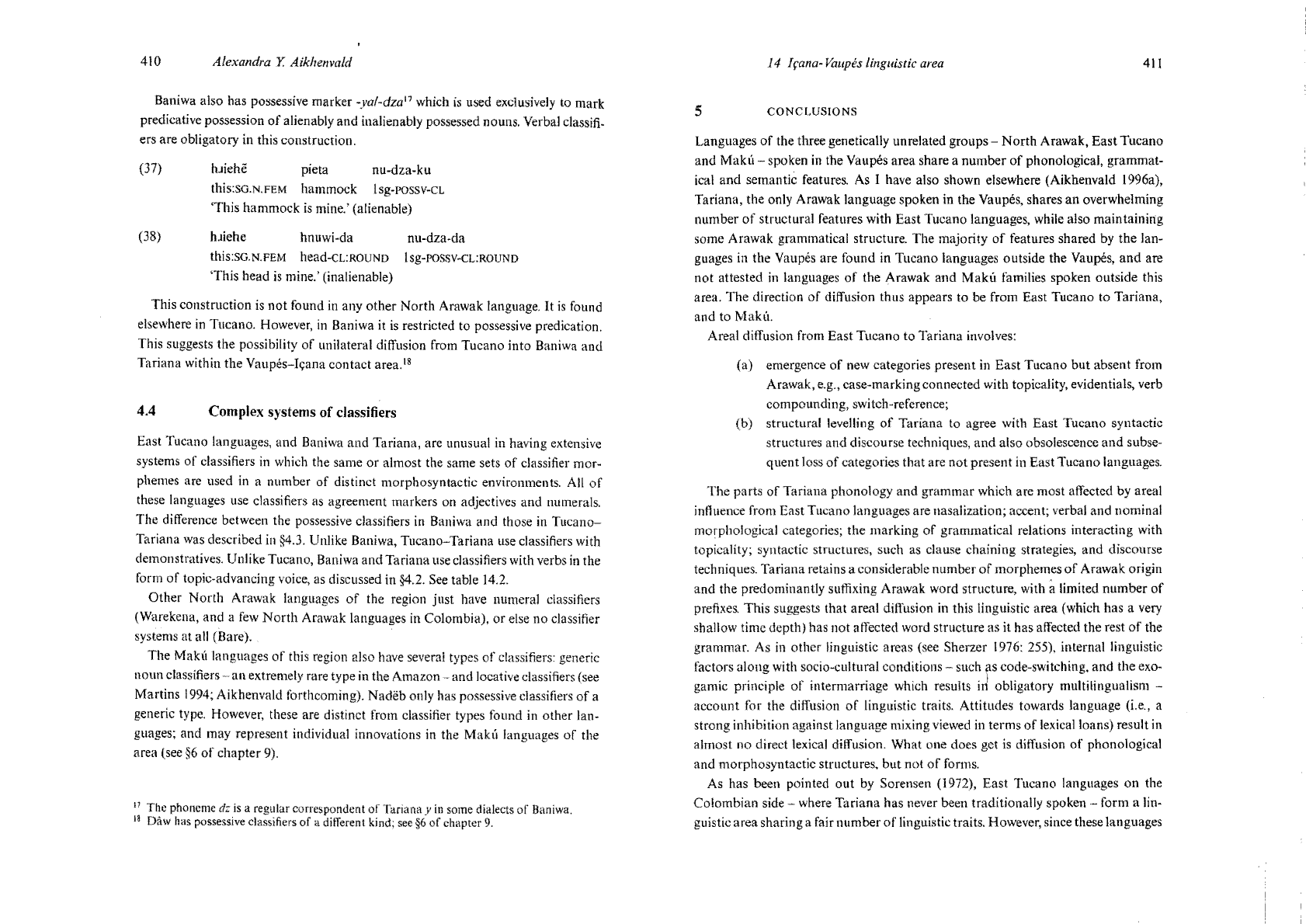
411
410
Alexandra
Y.
Aikhenvald
Baniwa also has possessive marker
-yal-dza
I7
which
is
used exclusively to mark
'edícative possession
of
alienably and inalienably possessed nouns. Verbal classifi-
ers are obligatofY in this construction.
hliehi! pieta nu-dza-ku
this:sG.N.FEM
hammock
Isg-POSSY-CL
'This hammock
is
mine.' (alienable)
hliehe
hnuwi-da
nu-dza-da
this:SG.N.FEM
head-cL:ROUND
I
sg-POSSY-CL:ROUND
'This head
is
mine.' (inalienable)
This construction
is
not
found
in
any
other
North Arawak language.
lt
is
found
elsewhere
in
Tucano. However,
in
Baniwa it
is
restricted to possessive predication.
This suggests the possibility
of
unilateral diffusion from Tucano into Baniwa aud
Tariana wíthin the Vaupés-I¡;ana contact area.
18
4.4
Complex systems
of
c1assifiers
East
Tuc<lno
languages, and Baniwa and Taríana, are unusual in having extensive
systems
of
classifiers
in
which the same or almost the same sets
of
classifier mor-
phemes are llsed
in
a number
of
distínct morphosyntactic environments.
AH
of
these languages use classifiers as agreement markers on adjectives and numerals.
The difference between the possessive c1assifiers
in
Baniwa and Ihose
in
Tucano-
Tariana was described
in
§4.3. Unlike Baniwa,
Tucano-
Tariana use c1assifiers with
demonslratives. Unlike TlIcano, Baniwa and Tariana use c1assifiers with verbs
in
Ihe
form
of
lopic-advancing voice, as discussed in §4.2. See lable 14.2.
Other
North
Arawak languages
of
the region just have numeral classifiers
(Warekena, and a
few
North
Arawak languages in Colombia), or else
no
classifier
systems at
all
(BaTe).
The Makú
of
this regíon also have several types
01'
classifiers:
noun classífiers -
an
extremely rare type in the Amazon and
IQcatíve
classifiers (see
Martins 1994; Aikhenvald forthcoming).
Nadeb
only has possessive classifiers
of
a
generic type. However, these are distinct from classifier types found in other lan-
gllages; and may represent individual innovations in the Makú languages
of
the
area (see
§6
01'
chapler
I'nrr~",nt1,lpt1t
of
Taríana
in
sorne dialects
of
Baníwa.
kínd;
see
of
chapter
9.
14 Irana- Vaupés linguistic
a/'ea
5
CONCLUSIONS
Languages
of
the three genetically unrelated groups -
North
Arawak, East Tucano
and
Makú
- spoken
in
the Vaupés area share a number
of
phonological, grammat-
ical
and
sernantic features. As 1 have also shown elsewhere (Aikhellvald 1 996a),
Tariana, the only Arawak language spoken in the Vaupés, shares an overwhelming
nurnber
of
structural features with East Tucano languages, while also mailltainirig
sorne Arawak grammatical structure. The majority
of
features shared by
the
lan-
guages
in
the Vaupés are
fOUlld
in TlIcano languages outside the Vaupés,
and
are
not attested
in
languages
of
the Arawak and
Makú
families spoken outside this
area.
The
direction
of
diffllsion thus appears to be from East Tucano
to
Tariana,
and to Makú.
Areal diffusion from East Tucano to Tariana involves:
(a) emergence
of
new categories present
in
East Tucano
but
absent from
Arawak, e.g., case-marking connected with topicality, evidentials, verb
compounding, switch-refcrence;
structural levelling
of
Taríana to agree with East Tucano syntactic
structures and discourse techniques,
and
also obsolescence
and
subse-
quent
1088
of
that are
not
present in East Tucano languages.
The
parts
of
Taríana and gramrnar which are most affectcd by areal
influence from East Tucano languages are
accent; verbal
and
nominal
categories; the
.n.,~Ir;~a
grammaucal relations interactilll! with
syJltactic structures, such as clause chaining strategies,
and
diseourse
Tariana retains a considerable number
of
morphemes
of
Arawak ofigin
v,
....
",,,.,,
Arawak word structure, with
á
limited number ol'
This
suggesl~
that areal di/rusíon
in
this Iínguistic area (which has a very
shallow timc depth) has
not
atTected word structure as it has affected the rest
of
the
grammar. As
in
otller linguistic areas (see Sherzer 1976: 255), internal linguistic
with socio-cultural conditiolls such
¡lS
code-switching,
and
the exo-
of
intermarríage which results
id
obligatory multilingualism -
account for the diffusion
01'
linguistic traits. Attitudes towards language (i.e., a
strong inhibition against language mixing viewed in terms
of
lexicalloans) result
in
almost no direct lexical dilfusion. What one does get
is
diffusion
01'
phonological
and morpllosyntactic structures,
but
not
of
forms.
As has been pointed out by Sorensen (1972), East Tucano languages
on
the
Colombian side - where Tariana has never been tradilionally spoken form a lin-
guistic area sharing a rair number
of
linguistic traits. However, since these languages
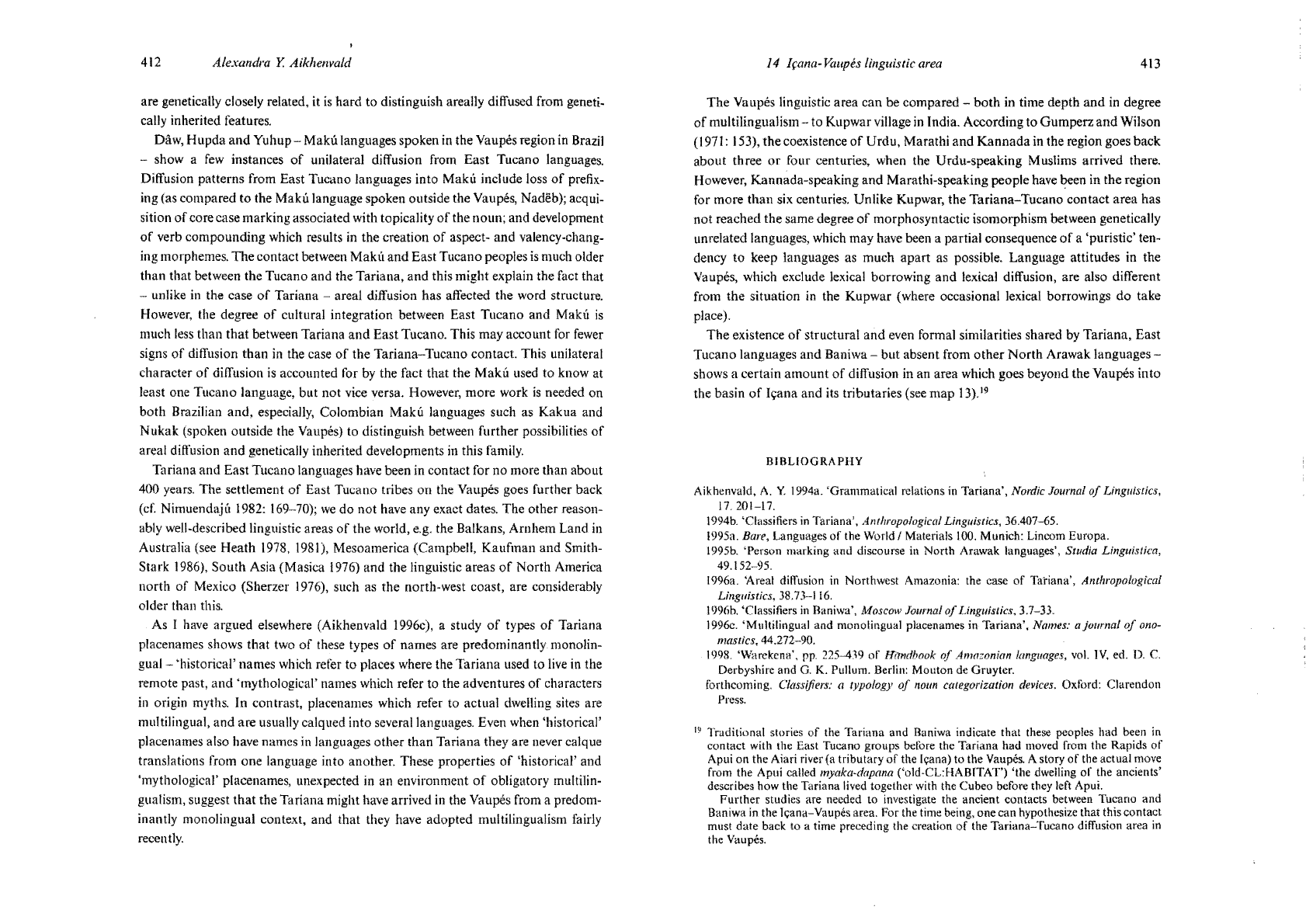
413
,
,
412 Alexandra
Y.
Aikhenvald
~
j
are genetically c10sely related, it
is
hard
to distinguish areally diffused from geneti-
calIy ínherited features.
Daw,
Hupda
and
Makú
languages spoken in the Vaupés regíon in Brazil
show a
few
instances
of
unilateral diffusion from
East
Tucano languages.
Diffusion patterns from East Tucaoo languages ioto Makú include
1055
of
prefix-
ing (as compared to the
Makú
language spoken outside the Vaupés, Nadeb); acqui-
sition
of
core case marking associated with topicality
of
the noun; and development
of
verb
compounding
which results in the creation
of
aspect-
and
valency-chaog-
ing morphemes.
The
cootact between
Makú
and
East Tucano peoples is much older
than
that between
the
Tucano
and
the Tariana,
and
this might explain the fac! that
- unlike in the case
of
Tariana areal diffusion has affected the word structure.
However, the degree
of
cultural integration between
East
Tucano
and
Makú
is
much less
than
that
between Tariana
and
East Tucano. This may account for fewer
signs
of
diffusion
than
in the case
of
the
Tariana-
Tucano contacto This unilateral
character
of
diffusion
is
accounted for by the fact that the
Makú
used to know at
least one
Tucano
langllage, but
not
vice versa. However,
more
work
is
needed on
both
Brazilian
and,
especially, Colombian
Makú
languages such as Kakua and
Nukak
(spoken outside the Vaupés} to dístinguish between further possibilities
of
areal diffusion
and
genetically inherited developments in this family.
Tariana
and
East
Tucano
languages have been in contact for
no
more than about
400
years.
The
sett1ement
of
East Tueano tribes
OH
the Vaupés goes further back
(eL
Nimuendajú 1982: 169-70);
we
do
not
have any exact dates.
The
other
reaSOll-
well-descríbed linguistic areas
of
the world, e.g. the Balkans, Aruhem Land in
Australia (see Heath 1978, 1981), Mesoamerica (Campbell,
Kaufman
and
Smith-
Stark 1986),
South
Asia (Masica 1976) and the lingllistic areas
of
North
America
north
of
Mexico (Sherzer 1976), such
as
lhe north-west coast, are cOl1siderably
older Ihan
t11i8.
As
J
have argued elsewhere (Aikhenvald
1
996c), a study
of
types
of
Tariana
placenames shows
that
two
of
these types
of
names are predominantly monolil1-
gual - 'historical' names which refer to places where lhe
Tariana
used to live in the
remote past,
and
'mytho10gical' llames which refer to the adventures
of
chllracters
in origin myths.
In
contrast, placenames which refer to actual dwelling sites are
multilingual,
and
are llsually calqued into severallanguages. Eveu when 'historical'
placen ames also have names
in
Jaugllages
other
than
Tariana are Ilever calque
translations from
one
language iuto another. These properties
of
'historical' and
'mythologícal' placenames, unexpected in
au
environment
of
obligatory multilin-
gualism, suggest
that
the Tariana might have arrived in the Vaupés from a predom-
inantly mouolingual context, and that they have
adopted
mllltilingualism fairly
recently.
14
Ifana-
Vaupés
Iinguistic
area
The
Vaupés linguistic area
can
be compared
both
in time depth
and
in degree
of
multilingualism - to Kupwar village in India. According
lo
Gumperz
and
Wilson
(1971: 153),
the
coexistence
of
Urdu,
Marathi
and
Kannada
in the region goes
back
abont three
or
four centuries, when the Urdu-speaking Muslims arrived
theTe.
However, Kannada-speaking
and
Marathi-speaking people have been in the region
for more
than
six centuries. Unlike Kupwar, the
Tariana-Tucano
contact
area
has
not
reaehed the same degree
of
morphosyntactic isomorphism between genetically
unrelated langllages, which may have been a partial consequence
of
a 'puristic' ten-
deucy
to
keep languages as much
apart
as possible. Langllage attitudes in the
Vaupés, which exclude lexical borrowing
and
lexical diffusion, are also different
from
the
situatíon
in
the Kupwar (where occasional lexical borrowings
do
take
place).
The
existence
of
structural
aud
even formal similarities shared by Tariana, East
Tucano
langllages
and
Baniwa -
but
absent from
otber
North
Arawak
languages-
shows a certain
amount
of
diffusioIl in an area which goes beyond the Vaupés
into
the basin
of
I<;ana
and
its tributaries (see
map
19
BIBLlOGRAPHY
Aikhenvald, A.
Y.
1994a. 'Grammatical relations
in
Tariana',
Nordic Joumal
of
Língl/ístics,
17.201-17.
1994b. 'Classifiers
in
Tariana',
Anthropological Lingllistics,
36.407-65.
1995a.
Bare,
Languages
of
the World / Materials
100.
Munieh: Lineom Europa.
1 995b. 'Person marking aml discourse in
North
Arawak languages',
SIl/dio Linguistica,
49.152-95.
1996a. 'Areal diffusion
in
Northwest Amazonia: the case
of
Tariana',
Allthropological
Linguístics,
38.73-116.
1996h. 'Classifiers
in
Raniw,l',
Moscow Joumal
of
Unguistics,
3.7-33.
1996c. 'Multilingllal and monolingual placenames in Tariana'.
Names:
ajol/mal
of
ono-
mastics, 44.272-90.
1998. 'Warekena', pp.
225-439
01'
Handbook
of
Amazonian languages,
vol.
IV,
ed.
D.
C.
Derbyshire and
G.
K.
Pullum. Berlin: Mouton de Grllyter.
forthcoming.
Classijiers: a typology
of
noun categorization devices.
Oxford: Clarendon
Press.
19
Traditional slories
of
the Tariana
and
Baniwa indieate that these pcoples
had
been
in
contact with the East TlIcano groups berore the Tariana had moved from the Rapids
01'
Aplli
on
lhe Aiari river (a tributary
of
lhe
[<;!ana)
to the Vallpés. A story
of
the actual move
from the Apui called
myaka·dapana
('old-CL:HABITAT)
'the
dwellinl1.
01'
the ancients'
describes how
the
Tariana lived together with the Cubeo before ¡hey
Further
studies are necded
lo
investigate the anclent eontacts bctwecn Tucano and
Baniwa
in
the
T<;!ana-Vaupés
area. For lhe time being,
oneean
hypolhcsize tha!
thiseontact
musl
date
back
lO
a time preceding the creation
of
the
Tariana-
Tucano diffusion arca
in
lhe Vaupés.