
Enns R.H. Computer Algebra Recipes for Mathematical Physics
Подождите немного. Документ загружается.


168 CHAPTER 4. LINEAR PDES OF PHYSICS
The solution must vanish at the perimeter, so the Bessel functions J
p
(kr)must
be zero at r = a.Thus,ka must equal the mth zero of J
p
,withm =1, 2, ....
The allowed k values are now entered.
>
k:=BesselJZeros(p,m)/a:
The parameter values a = 1 and c = 1 are given. To match the initial angular
dependence, we must have p= 2, i.e., only the Bessel function J
2
will be present
in the solution. The radial portion of the initial shape is entered in f.The
form of the Bessel functions is given in g.
>
a:=1: c:=1: p:=2: f:=r*(1-rˆ2/aˆ2)/20; g:=BesselJ(p,k*r);
f :=
r (−r
2
+1)
20
g := BesselJ(2, BesselJZeros(2,m) r)
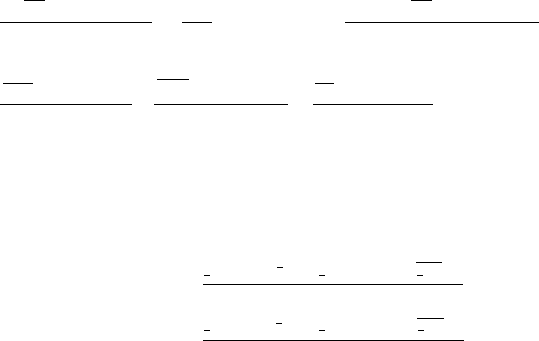
The messy constants are removed from U4 with the following select command.
>
U[2,m]:=select(has,U4,{cos,sin,BesselJ});
U
2,m
:= cos(BesselJZeros(2,m) t)sin(2θ) BesselJ(2, BesselJZeros(2,m) r)
Making use of orthogonality and noting that the weight function for the Bessel
functions is r,themth coefficient is given by A
2,m
=
a
0
frgdr/
a
0
rg
2
dr.
>
A[2,m]:=int(f*r*g,r=0..a)/int(r*gˆ2,r=0..a):
Thefirst4termsoftheseriessolutionU are now displayed in decimal form.
>
U:=evalf(sum(A[2,m]*U[2,m],m=1..4));
U := 0.04223579864 cos(5.135622302 t)sin(2.θ) BesselJ(2., 5.135622302 r)
+0.002159293112 cos(8.417244140 t)sin(2.θ) BesselJ(2., 8.417244140 r)
+0.005912588156 cos(11.61984117 t)sin(2.θ)BesselJ(2., 11.61984117 r)
+0.001008506062 cos(14.79595178 t)sin(2.θ) BesselJ(2., 14.79595178 r)
For animation purposes, we convert from polar coordinates to Cartesian coordi-
nates, setting r =
x
2
+ y
2
and using the trig identity sin(2 θ)=2 sinθ cos θ =
2 xy/r
2
. Note that a floating point evaluation is used in entering the latter so
that the substitution will actually occur. This is necessary because a floating
point evaluation was used in expressing U.
>
r:=sqrt(xˆ2+yˆ2): sin(evalf(2*theta)):=2*x*y/rˆ2:
The solution is then expressed as the piecewise function UU =U for r<aand
0forr>a.
>
UU:=evalf(piecewise(r<a,U,r>a,0)):
To animate UU , a functional operator gr is created to make a 3-dimensional
plot of the drumhead shape on the ith time step, the stepsize being 0.1 s.
>
gr:=i->plot3d(eval(UU,t=0.1*i),x=-a..a,y=-a..a,
style=patchcontour,shading=zhue):
Then using the sequence command, the profiles on 20 consecutive time steps are
displayed. The insequence=true option is included to produce the animation.
>
display([seq(gr(i),i=1..20)],insequence=true,axes=framed);
If you wish to see the drumhead animation, execute the recipe on your computer,
then click on the computer plot and on the start arrow in the tool bar.
4.3. BEYOND CARTESIAN COORDINATES 169
4.3.4 The Cannon Ball
The sound of a kiss is not so loud as that of a cannon,
but its echo lasts a great deal longer.
Oliver Wendell Holmes Sr., American writer, physician, (1809–94)
In the re-enactment of a Civil war battle, a cannon is fired and a hot spheri-
cal iron cannon ball plunges into an icy lake whose temperature is very close
to freezing (0
◦
C). If the cannon ball has a radius R = 20 cm and is initially
100
◦
C throughout on entering the lake, determine the temperature distribu-
tion inside the cooling cannon ball as a function of time. Plot the temperature
distribution in 1 minute intervals up to 15 minutes. What is the temperature
at the center of the cannon ball 15 minutes after plunging into the lake? For
iron, K/(ρC)=0.185 in cgs units, where K is the thermal conductivity, ρ the
density, and C the specific heat.
After loading the plots and VectorCalculus packages,
>
restart: with(plots): with(VectorCalculus):
the heat diffusion equation ∇
2
T =(1/a
2
)(∂T/∂t), with T the temperature and
a
2
≡ K/(ρC), is entered in spherical polar coordinates (r, θ, φ). r is the radial
distance from the center of the cannon ball, θ is the angle that the radial vector
makes with the z-axis, and φ is the angle that the projection of the radial vector
into the x-y plane makes with the x-axis.
>
pde:=expand(Laplacian(T(r,theta,phi,t),’spherical’))
[r,theta,phi]=diff(T(r,theta,phi,t),t)/aˆ2;
pde :=
2(
∂
∂r
T (r, θ, φ, t))
r
+(
∂
2
∂r
2
T (r, θ, φ, t)) +
cos(θ)(
∂
∂θ
T (r, θ, φ, t))
r
2
sin(θ)
+
∂
2
∂θ
2
T (r, θ, φ, t)
r
2
+
∂
2
∂φ
2
T (r, θ, φ, t)
r
2
sin(θ)
2
=
∂
∂t
T (r, θ, φ, t)
a
2
Since the initial temperature of the cannon ball is uniform throughout, the so-
lution will have no angular dependence. Assuming that T (r, θ, φ, t)=R(r) F (t),
the heat flow equation pde is analytically solved using the pdsolve command.
>
sol:=pdsolve(pde,HINT=R(r)*F(t),INTEGRATE,build);
sol := T (r, θ, φ, t)=
C3 e
(a
2
c
1
t)
C1 sinh(
√
c
1
r)
r
+
C3 e
(a
2
c
1
t)
C2 cosh(
√
c
1
r)
r
The hyperbolic sine (sinh) term remains finite at the origin (r =0), but the cosh
term diverges to ∞ and must be removed from the rhs of sol.
>
T1:=remove(has,rhs(sol),cosh);

170 CHAPTER 4. LINEAR PDES OF PHYSICS
T1 :=
C3 e
(a
2
c
1
t)
C1 sinh(
√
c
1
r)
r
The separation constant
c
1
is replaced with −k
2
in T1 and the result simplified
with the symbolic option.
>
T2:=simplify(subs(_c[1]=-kˆ2,T1),symbolic);
T2 :=
C3 e
(−a
2
k
2
t)
C1 sin(kr) I
r
It should be noted that the term sin(kr)/r is ([AS72]) just the zeroth order
spherical Bessel function of the first kind.
3
Making use of the select command,
the coefficient combination
C3 C1 I in T2 is replaced with the symbol A.
>
T3:=A*select(has,T2,{exp,sin,r});
T3 :=
Ae
(−a
2
k
2
t)
sin(kr)
r
Taking the radius of the cannon ball to be R, the surface of the ball is held at
0 degrees, so sin(kR) = 0, and therefore k = nπ/R,withn =1, 2, ....Entering
this result, the nth normal mode of the temperature is displayed in T4 .
>
k:=n*Pi/R: T4:=T3;
T4 :=
Ae
(−
a
2
n
2
π
2
t
R
2
)
sin(
nπr
R
)
r
The initial temperature is 100
◦
throughout the cannon ball. Noting that the
weight function ([AS72]) for the spherical Bessel functions is r
2
, orthogonality
leads to the following expression for the coefficients:
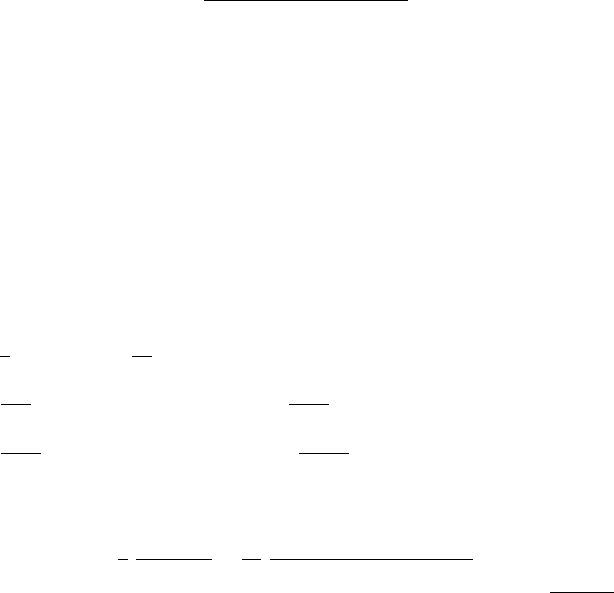
A=
R
0
r
2
100 (sin(kr)/r) dr/
R
0
r
2
(sin(kr)/r)
2
dr.
A is now calculated, assuming that n is an integer.
>
A:=int(rˆ2*100*sin(k*r)/r,r=0..R)/int(rˆ2*(sin(k*r)/r)ˆ2,
r=0..R) assuming n::integer;
A :=
200 (−1)
(1+n)
R
nπ
The formal series representation of the temperature distribution T inside the
cannon ball is now completely determined. Retaining 200 terms in the series,
T has the following structure.
>
T:=Sum(T4,n=1..200);
T :=
200
n=1
⎛
⎜
⎝
200 (−1)
(1+n)
Re
(−
a
2
n
2
π
2
t
R
2
)
sin(
nπr
R
)
nπr
⎞
⎟
⎠
3
The spherical Bessel functions j
n
of the first kind are related to the “ordinary” Bessel
functions by the relation j
n
(x) ≡
(π/2x)J
n+1/2
(x).
4.3. BEYOND CARTESIAN COORDINATES 171
Taking R =20 and a =
√
0.185, T is now evaluated, but not displayed.
>
T:=eval(value(T),{R=20,a=sqrt(0.185)}):
An arrow operator gr is formed to plot T at 60 s (1 min) intervals.
>
gr:=i->plot(eval(T,t=i*60),r=0..20,numpoints=1000):
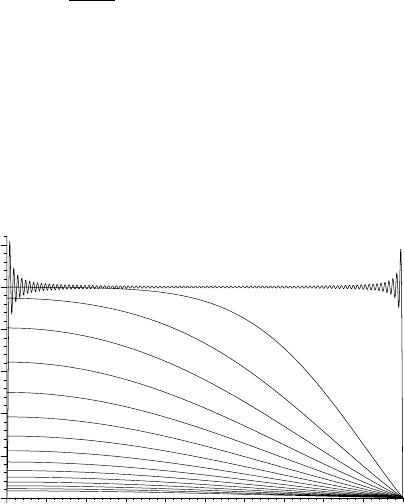
Using gr and the sequence command, the temperature T is displayed as a
function of radius r in Figure 4.13 at t = 0 (top curve), t = 1 min (next lowest
curve), etc, to t= 15 minutes (bottom curve).
>
display(seq(gr(i),i=0..15),labels=["r","T"]);
0
50
100
T
10
r
20
Figure 4.13: Time evolution of the temperature T inside the cannon ball.
The “ringing” in the initial temperature distribution is, of course, the Gibb’s
phenomenon due to the initial step function temperature profile. Taking the
limit of T as r → 0, the temperature at the center of the sphere at 15 minutes,
or 900 seconds, is calculated and found to be about 3.3
◦
C.
>
Tcenter:=eval(limit(T,r=0),t=900);
Tcenter := 3.287377363
4.3.5 Variation on a Split-sphere Potential
Would you convey my compliments to the purist who reads your
proofs and tell him or her ... that when I split an infinitive, God damn
it, I split it so it will stay split.
Raymond Chandler, American writer of detective fiction, (1888–1959)
The following recipe is based on a simple variation of a standard problem in
electrostatics. The objective is to completely determine the potential V inside
and outside a hollow sphere of unit radius with a specified piecewise potential
on the spherical surface. With θ measured from the positive z-axis (point-
ing vertically upwards), the spherical surface between θ = 0 and 45
◦
has the

172 CHAPTER 4. LINEAR PDES OF PHYSICS
constant potential V0, the intermediate section between 45
◦
and 135
◦
has a
variable potential given by
√
2 cos(θ) V0 , and the lower portion between 135
◦
and 180
◦
held at −V0 . Keeping the first 6 non-zero terms in V and taking
V0 = 1, plot the equipotentials corresponding to V =0.8, 0.6, ..., −0.6, −0.8.
After loading the necessary library packages, Laplace’s equation is entered in
spherical coordinates, the origin taken at the center of the sphere. By symmetry,
V must be independent of the azimuthal
4
angle φ, i.e., V = V (r, θ).
>
restart: with(plots): with(VectorCalculus):
>
pde:=expand(Laplacian(V(r,theta),’spherical’
[r,theta,phi]))=0;
pde :=
2(
∂
∂r
V(r, θ))
r
+(
∂
2
∂r
2
V(r, θ)) +
cos(θ)(
∂
∂θ
V(r, θ))
r
2
sin(θ)
+
∂
2
∂θ
2
V(r, θ)
r
2
=0
Then pde is analytically solved, assuming that V (r, θ)=R(r)Θ(θ), the result
involving Legendre functions.
>
V:=rhs(pdsolve(pde,HINT=R(r)*Theta(theta),INTEGRATE,build));
V :=
C3 LegendreP(−
1
2
+
1
2
√
1+4 c
1
,cos(θ)) C1 r
(1/2
√
1+4 c
1
)
√
r
+ ···
The separation constant c
1
is replaced in V with −1/4+(n +1/2)
2
and the
result simplified with the symbolic option and then expanded.
>
V:=expand(simplify(subs(_c[1]=-1/4+(n+1/2)ˆ2,V),symbolic));
V :=
C3 LegendreP(n, cos(θ)) C1 r
n
+
C3 LegendreP(n, cos(θ)) C2
rr
n
+ C4 LegendreQ(n, cos(θ)) C1 r
n
+
C4 LegendreQ(n, cos(θ)) C2
rr
n
V is expressed in terms of the Legendre functions of the first (P
n
(cos θ)) and
second (Q
n
(cos θ)) kinds. The Q
n
diverge at the end points of the θ range and
must be rejected. The redundant constant
C3 in the P
n
terms is set equal to
1and
C1and C2 are replaced with the symbols A and B.
>
V:=subs({LegendreQ(n,cos(theta))=0,_C3=1,_C1=A,_C2=B},V);
V := LegendreP(n, cos(θ)) Ar
n
+
LegendreP(n, cos(θ)) B
rr
n
For the inside (r<1) solution Vin, we set B =0 in V so that Vin doesn’t
diverge at the origin. For r>1, we take A= 0 so that Vout → 0asr →∞.
>
Vin:=subs(B=0,V); Vout:=subs(A=0,V);
Vin := LegendreP(n, cos(θ)) Ar
n
4
The angle between the projection of the radius vector into the x-y (horizontal) plane and
the x-axis.
4.3. BEYOND CARTESIAN COORDINATES 173
Vout :=
LegendreP(n, cos(θ)) B
rr
n
Setting u=cosθ, the angular distributions in each region are entered.
>
f1:=-V0: f2:=sqrt(2)*u*V0: f3:=V0:
Making use of orthogonality of the P
n
(u),thecoefficientsintheseriesrepre-
sentation of the solution are evaluated using A
n
=((2 n +1)/2)
1
−1
fP
n
(u) du.
An operator AA is introduced to evaluate the coefficients for a given n value.
>
AA:=n->((2*n+1)/2)*(int(f1*LegendreP(n,u),u=-1..-1/sqrt(2))
+int(f2*LegendreP(n,u),u=-1/sqrt(2)..1/sqrt(2))
+int(f3*LegendreP(n,u),u=1/sqrt(2)..1)):
Then, employing AA(n), the inside and outside solutions are determined, the
series being terminated at n= 12.
>
VIN:=sum(eval(Vin,A=AA(n)),n=0..12);
VIN :=
5
4
cos(θ)V0 r −
7
32
LegendreP(3, cos(θ))V0 r
3
−
11
128
LegendreP(5, cos(θ))V0 r
5
+
85
2048
LegendreP(7, cos(θ))V0 r
7
+
323
8192
LegendreP(9, cos(θ))V0 r
9
−
1219
65536
LegendreP(11, cos(θ))V0 r
11
>
VOUT:=sum(eval(Vout,B=AA(n)),n=0..12);
VOUT :=
5
4
cos(θ)V0
r
2
−
7
32
LegendreP(3, cos(θ))V0
r
4
+ ···
The equipotentials will now be plotted in the x-z plane, by setting r =
√
x
2
+ z
2
and cos θ =z/r. We also set V 0=1.
>
r:=sqrt(xˆ2+zˆ2): cos(theta):=z/r: V0:=1.0:
A piecewise potential function VPW is formed with V = VIN for r<1and
VOUT for r>1.
>
VPW:=piecewise(r<1,VIN,r>1,VOUT):
Loading the plottools package, a blue circle of radius 1 centered on the origin
is produced in c to represent the spherical surface (a circle in 2 dimensions).
>
with(plottools): c:=circle([0,0],1,color=blue,thickness=2):
The contourplot command is used in cp to plot the requested equipotentials.
>
cp:=contourplot(VPW,x=-3..3,z=-4..4,contours=
[seq(0.8-0.2*i,i=0..8)],grid=[60,60],thickness=2,color=red):
The graphs c and cp are now displayed together with constrained scaling,
>
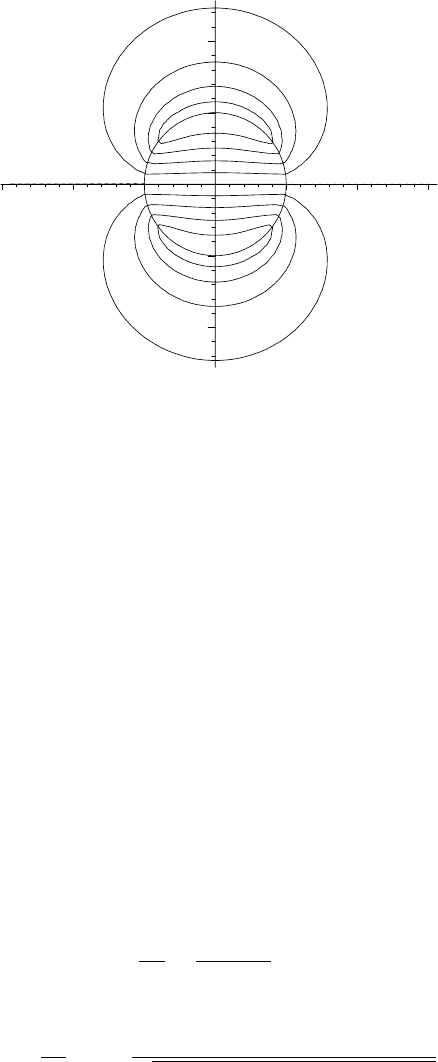
display({c,cp},scaling=constrained);
the resulting picture being shown in Figure 4.14.
174 CHAPTER 4. LINEAR PDES OF PHYSICS
–2
2
z
–3
x
3
Figure 4.14: Equipotentials for the split-sphere in the x-z plane.
The 3-dimensional equipotential surfaces are obtained by mentally rotating the
picture about the z-axis. The recipe is easily adjusted to handle other variations
on the angular distribution and can even be modified to handle cylindrical
geometry.
4.3.6 Another Poisson Recipe
Every man is a potential genius until he does something.
Sir Herbert Beerbohm Tree, English actor-manager, (1853–1917)
In magnetostatics, the vector potential
A(
R )atapoint
R, associated with
a current density
J in free space, satisfies the vector Poisson equation, [Gri99]
∇
2
A = −µ
0
J, (4.9)
where µ
0
is the permeability of free space. Equation (4.9) is three scalar Poisson
equations, one for each Cartesian component, e.g., ∇
2
A
x
=−µ
0
J
x
. In any other
curvilinear coordinate system, the unit vectors are functions of position. Thus,
e.g., in spherical polar coordinates it is not true that ∇
2
A
r
=−µ
0
J
r
.
Assuming that
J → 0 at infinity, the solution of Eq. (4.9) is given by,
A(
R )=
µ
0
4 π
J(
R
1
)
|
R −
R
1
|
dv
1
, (4.10)
again representing three 3-dimensional integrals, e.g.,
A
x
(x, y, z)=
µ
0
4 π
J
x
(x
1
,y
1
,z
1
) dx
1
dy
1
dz
1
(x − x
1
)
2
+(y − y
1
)
2
+(z − z
1
)
2
.

4.3. BEYOND CARTESIAN COORDINATES 175
If you want to calculate the integrals in Equation (4.10) in other curvilinear
coordinates, you must first express
J in terms of its Cartesian components.
Once
A is determined, the magnetic field is then given by
B = ∇×
A.Asa
representative example, consider the following magnetostatic problem.
A uniformly charged solid sphere of radius a carries a total charge Q and
is spinning with angular velocity ω about the vertical z-axis. Determine the
magnetic vector potential
A inside and outside the sphere and then calculate
the magnetic field
B in both regions. Plot
B/(µ
0
Qω)fora=1.
Taking the origin at the sphere’s center, we let
R (r, θ, φ) be the location
of the “observation” point P inside or outside the sphere and
R1(r1 , θ1, φ1)
be the location of a current density “source” point P
1
inside the sphere. The
polar angles θ and θ1 are measured from the z-axis and the azimuthal angles φ
and φ1 from the projection of the radius vector into the (horizontal) x-y plane
with the x-axis. To ensure a later simplification, it is assumed that r>0.
>
restart: with(plots): with(VectorCalculus): assume(r>0):
Since the charge is uniformly distributed in the sphere, the charge density ρ is
equal to the total charge Q divided by the volume 4 πa
3
/3 of the sphere. At a
radial distance r1 and angle θ1withthez-axis, the source point P
1
has a linear
velocity r1 sin(θ1) ω. So the current density magnitude J is equal to ρ times
the linear velocity, the entered form of ρ being automatically substituted. The
corresponding vector
J points in the
ˆ
φ direction for every P
1
.
>
rho:=Q/((4*Pi*aˆ3)/3); J:=rho*r1*sin(theta1)*omega;
ρ :=
3 Q
4 πa
3
J :=
3
4
Q r1 sin(θ1) ω
πa
3
Without loss of generality, let’s take the observation point P to be in the x-z
plane, so that φ=0. The position vector
R of P is now entered, being expressed
in terms of the Cartesian unit vectors along the x and z axes.
>
R:=<r*sin(theta),0,r*cos(theta)>;
R := r sin(θ)e
x
+ r cos(θ)e
z
The position vector
R1 of the source point P
1
is also entered.
>
R1:=<r1*sin(theta1)*cos(phi1),r1*sin(theta1)*sin(phi1),
r1*cos(theta1)>;
R1 := r1 sin(θ1) cos(φ1) e
x
+ r1 sin(θ1) sin(φ1) e
y
+ r1 cos(θ1) e
z
To calculate
A, let’s first evaluate 1/(|
R−
R1|)=1/
(
R −
R1) · (
R −
R1). This
is done in f using the DotProduct command, the result then being simplified
with the symbolic option.
>
f:=simplify(1/sqrt(DotProduct(R-R1,R-R1)),symbolic);
f :=
1
r
2
− 2 r sin(θ) r1 sin(θ1) cos(φ1) + r1
2
− 2 r cos(θ) r1 cos(θ1)
We could attempt to evaluate the integral in
A directly, but it is more instructive
to Taylor expand f about a specified value of r1, out to some given order, and

176 CHAPTER 4. LINEAR PDES OF PHYSICS
see what the various orders contribute to the overall answer. This approach
is equivalent to the multipole expansion discussed in standard electromagnetic
texts such as Griffiths [Gri99]. So, a functional operator T is formed to Taylor
expand f to order n about a specified point r1 =d.Theconvert( ,polynom)
command is included to remove the order of term which would otherwise appear.
>
T:=(n,d)->convert(taylor(f,r1=d,n),polynom):
The current density vector can be resolved into the Cartesian components
J
x
= J sin(φ1), J
y
= J cos(φ1), and J
z
= 0. At the observation point (cho-
sen in the x-z plane), the J
x
contribution to
A will add up to zero, but the J
y
contribution will not. But since, our choice of observation point in the x-z plane
was arbitrary and there is complete rotational symmetry about the z-axis, the
resultant component J
y
will yield the φ component of
A. A functional operator
A is created to perform the volume integration in (4.10) using J
y
and the Taylor
expansion of f and taking spherical polar coordinates. The volume element is
r1
2
sin(θ1) dθ1 dφ1 dr1 . The angular coordinate θ1 ranges from 0 to π, while
φ1 varies from 0 to 2π. The order n, the radial distance d about which Taylor
expansion is taking place, and the lower and upper limits, d1andd2, of the r1
integration must be specified. Again the result is simplified.
>
A:=(n,d,d1,d2)->simplify((mu[0]/(4*Pi))*int(int(int(T(n,d)
*J*cos(phi1)*r1ˆ2*sin(theta1),theta1=0..Pi),r1=d1..d2),
phi1=0..2*Pi),symbolic):
First, let’s take the observation point P to be outside the sphere, i.e., r>a.
Since r1 ≤ a,thenr1 /r < 1 and we can Taylor expand f about r1 =d=0. The
limits of the r1 integration are d1=0 and d2=a. Making uses of the operator
A with the above arguments, the vector potential is evaluated in Out to order
n= 1, 2, and 3 and the result assigned.
>
Out:=seq(A||n=A(n,0,0,a),n=1..3); assign(Out):
Out := A1 =0, A2 =
1
20
µ
0
sin(θ) a
2
Qω
πr
2
, A3 =
1
20
µ
0
sin(θ) a
2
Qω
πr
2
For n = 1, the so-called monopole contribution A1 to the vector potential is 0,
a well-known general result. For n = 2, there is a non-zero dipole contribution
A2 .Forn = 3 (and higher), there is no additional contribution to the vector
potential, indicating that outside the sphere the vector potential (and hence,
the magnetic field) is that of a “pure” magnetic dipole. The vector potential
Aout outside the sphere is now expressed in spherical polar coordinates, having
only a φ component.
>
Aout:=VectorField(<0,0,A2>,’spherical’[r,theta,phi]);
Aout :=
1
20
µ
0
sin(θ) a
2
Qω
πr
2
e
φ
Now, consider P to be inside the sphere, i.e., r<a.Forr1 <r, we can again
Taylor expand f about r1 = 0, the integration being from r1 =0 to r. But for
r1 >r, f is Taylor expanded about r1 =∞,ther1 integration being from r to
a. Adding the two contributions,
A inside the sphere is calculated for n =1, 2,

4.3. BEYOND CARTESIAN COORDINATES 177
and 3. No further contribution occurs for higher n values.
>
In:=seq(AA||n=A(n,0,0,r)+A(n,infinity,r,a),n=1..3);
assign(In):
In := AA1 =0, AA2 =
1
20
µ
0
sin(θ) Qωr
3
πa
3
,
AA3 =
1
20
µ
0
sin(θ) Qωr
3
πa
3
−
1
8
µ
0
Qωrsin(θ)(−a
2
+ r
2
)
πa
3
In terms of spherical polar coordinates, the vector potential Ain inside the
sphere takes the following form.
>
Ain:=VectorField(<0,0,AA||3>,’spherical’[r,theta,phi]);
Ain := (
1
20
µ
0
sin(θ) Qωr
3
πa
3
−
1
8
µ
0
Qωrsin(θ)(−a
2
+ r
2
)
πa
3
) e
φ
Using Curl, the magnetic field is calculated outside and inside the sphere.
>
Bout:=Curl(Aout); Bin:=simplify(Curl(Ain));
Bout :=
1
10
µ
0
a
2
Qωcos(θ)
r
3
π
e
r
+
1
20
sin(θ) µ
0
a
2
Qω
r
3
π
e
θ
Bin := −
1
20
cos(θ) µ
0
Qω(3 r
2
− 5 a
2
)
πa
3
e
r
+
1
20
sin(θ) µ
0
Qω(6 r
2
− 5 a
2
)
πa
3
e
θ
To plot
B/(µ
0
Qω), the MapToBasis command is used to convert the normalized
magnetic field to Cartesian coordinates.
>
F:=u->MapToBasis(u/(mu[0]*Q*omega),’cartesian’[x,y,z]):
Taking a = 1, we will plot the magnetic field in the x-z plane. To accomplish
this, let’s set r =
√
x
2
+ z
2
and form an operator G to evaluate the magnetic
field for y =0.
>
a:=1: r:=sqrt(xˆ2+zˆ2): G:=B->simplify(eval(F(B),y=0)):
The magnetic field inside and outside the sphere then takes the following forms,
expressed in Cartesian coordinates.
>
Bin2:=G(Bin); Bout2:=G(Bout);
Bin2 :=
3 xz
20 π
e
x
−
6 x
2
+3z
2
− 5
20 π
e
z
Bout2 :=
3 zx
20 (x
2
+ z
2
)
(5/2)
π
e
x
−
−2 z
2
+ x
2
20 (x
2
+ z
2
)
(5/2)
π
e
z
The complete magnetic field
B is formed with the piecewise operator PW, taking
the nth component of Bin2 and Bout2 for r<aand r>a, respectively.
>
PW:=n->piecewise(r<a,Bin2[n],r>a,Bout2[n]):
The x and z components of
B are obtained by taking n=1 and 3 in PW.
>
B[1]:=PW(1): B[3]:=PW(3):
In c, a blue circle of radius a is plotted to represent the spherical surface.
>
c:=plot(a,theta=0..2*Pi,coords=polar,color=blue,thickness=2):
The fieldplot command is used in fp to plot the magnetic field as thick red
arrows, the grid density being taken to be 10 × 10.