
Enns R.H. Computer Algebra Recipes for Mathematical Physics
Подождите немного. Документ загружается.

208 CHAPTER 5. COMPLEX VARIABLES
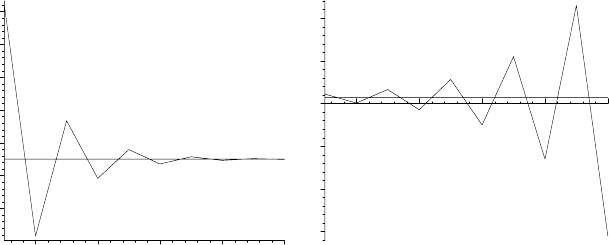
According to the convergence criterion given above, the Laurent expansion
should converge for z = Z = 3 and diverge for z =7. Entering P(3) yields
the plot on the left of Figure 5.6, while P(7) generates the plot on the right.
>
P(3); P(7);
0.36
0.38
0.4
f
0.42
24
6
810
N
–2
0
f
2
246810
N
Figure 5.6: Left plot: Convergence for z =Z = 3; Right: Divergence for z =7.
The Laurent expansion clearly converges to the exact f value for z = 3 and
diverges for z =7.”
5.5 Conformal Mapping
The relation ω = f(z) describes a mapping of points in the complex z-plane
into corresponding points in the ω-plane. If f(z) is a single-valued function of
z = x + iy, each point in the z-plane maps into a single point in the ω-plane.
If f(z) is a multi-valued function with n branches, each point in the z-plane
maps into n points in the ω-plane. For example, ω =z
1/2
has two branches with
each point in the z-plane producing two points in the ω-plane. The mapping
from the z-plane can be made one to one by introducing a branch cut in the
z-plane and restricting our attention to a single branch of the function, usually
referred to as the principal branch.Forω = f(z)=z
1/2
, the principal branch
is traditionally obtained by introducing a branch cut along the negative x-axis
and restricting the polar angle θ to the range −π<θ<π. The principal branch
of z
1/2
maps only into the u>0halfoftheω-plane, i.e., the polar angle in this
plane is restricted to the range −π/2 <θ<π/2.
If f(z) is analytic (and df/dz =0)atapointz
0
in the z-plane, the angle be-
tween two curves intersecting at z
0
is not changed on transforming to the corre-
sponding point ω
0
in the ω-plane, even though the shapes of the two curves will
generally change. Transformations which have this angle-preserving property
are called conformal transformations or conformal mapping. The orthogonality
of the equipotential and field lines in potential problems is preserved under a

5.5. CONFORMAL MAPPING 209
conformal mapping. It is not surprising therefore that a solution of Laplace’s
equation in one plane remains a solution in the other.
Conformal mapping may be used for solving 2-dimensional potential prob-
lems. Suppose that we are given a potential problem with a somewhat compli-
cated boundary condition. We then try to transform the problem to a new plane
where the boundary configuration is simpler. On solving this simpler situation,
we can transform the results back to the original plane, thus determining the
field and potential configuration for the original problem.
Many important conformal mappings, such as in the following recipe, can
be discovered by experimenting with different mathematical forms.
5.5.1 Field Around a Semi-infinite Plate
If all the ways I have been along were marked on a map and joined
up with a line, it might represent a minotaur.
Pablo Picasso, Spanish artist, (1881–1973)
In this recipe, I will use the mapping ω =
√
z to determine the equipoten-
tials and electric field (represented by field lines and by vectors) in the vicinity
of a thin semi-infinite grounded (held at zero potential) conducting plate. The
problem can be treated as 2-dimensional with the cross-section of the plate as
schematically shown in Figure 5.7.
semi-infinite plate
infinity -->
0
<-- -infinity
Figure 5.7: Cross-section of the thin semi-infinite plate.
The VectorCalculus package is loaded, because the Gradient command will
be used to calculate the electric field vector
E = −∇u,withu the potential.
>
restart: with(plots): with(VectorCalculus):
The given mapping function is entered.
>
w:=sqrt(z);
w :=
√
z
Before solving the problem, it is instructive to see the effect of the trans-
formation w = u + iv=
√
z =
√
x + iy on the grid lines x = c
1
, y = c
2
,where
c
1
and c
2
are real constants. Forming the inverse transformation z = w
2
and
separating into real and imaginary parts, we have x = u
2
−v
2
and y =2uv.A
grid line x = c
1
is mapped into that portion of the hyperbola u
2
− v
2
= c
1
for
which u>0, while y =c
2
is mapped into a branch of the rectangular hyperbola
2 uv=c
2
, the branch depending on whether c
2
is positive or negative.
210 CHAPTER 5. COMPLEX VARIABLES
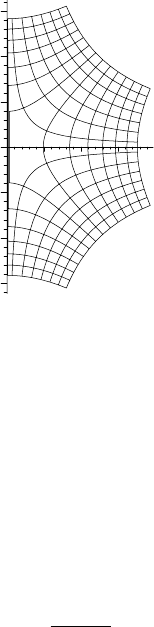
A graphical confirmation of the transformation of grid lines from the z-
plane to the ω-plane can be generated by applying the following conformal
command to the grid lines in a particular region of the z-plane , e.g., the region
−2 ≤ x ≤ 2, −2 ≤ y ≤ 2.
>
conformal(w,z=-2-2*I..2+2*I,grid=[14,14],numxy=[100,100],
color=[red,blue],scaling=constrained,labels=["u","v"]);
The grid option is used to specify the number of grid lines in both the x
and y directions, the default being 11 × 11. The option numxy=[m,n],with
m = 100 and n = 100 here, is employed to specify the number of points to be
plotted in each grid line, with m points in the x direction and n points in the
y direction. The default is 15 points in each direction. The transformed curves
corresponding to constant x will be colored red, while those corresponding to
constant y are colored blue. The scaling is constrained and labels u, v, added.
The rectangular region −2 ≤ x ≤ 2, −2 ≤ y ≤ 2inthez-plane maps into
thecurvedgridregionintheω-plane shown in Figure 5.8.
–1.5
0
1.5
v
1.5
u
Figure 5.8: Rectangular grid in z-plane maps into curved grid in ω-plane.
As expected, the curves y = c
2
for c
2
> 0 map into the rectangular hyperboli
in the first quadrant (u>0, v>0) of the w-plane, while those for c
2
< 0
map into rectangular hyperboli in the fourth quadrant (u>0, v<0). The
x = c
1
lines map into the hyperbolic curves in the figure which intersect the
rectangular hyperboli. The 90
◦
angle between grid lines is preserved by the
conformal transformation.
Now, let’s tackle the problem of the semi-infinite grounded conducting plate.
Setting z =x + iy, ω takes the following form,
>
z:=x+I*y: w:=w;
w :=
√
x + yI
which can be split into real and imaginary parts by applying the complex eval-
uation (evalc) command.

5.5. CONFORMAL MAPPING 211
>
w2a:=evalc(w) assuming y>0; w2b:=evalc(w) assuming y<0;
w2a :=
2
x
2
+ y
2
+2x
2
+
1
2
I
2
x
2
+ y
2
− 2 x
w2b :=
2
x
2
+ y
2
+2x
2
−
1
2
I
2
x
2
+ y
2
− 2 x
w2a shows the form of ω for y>0, while w2b applies when y<0. The potential
u relevant to our problem is obtained by removing the imaginary part from w2a.
>
u:=remove(has,w2a,I);
u :=
2
x
2
+ y
2
+2x
2
The electric field lines for y>0andy<0 are obtained in v2a and v2b by
selecting the imaginary parts of w2a and w2b, respectively, and dividing by i.
>
v2a:=select(has,w2a,I)/I: v2b:=select(has,w2b,I)/I:
The electric field vector
E = −∇u is calculated in Cartesian coordinates.
>
E:=-Gradient(u,’cartesian’[x,y]);
E := −
2 x
x
2
+ y
2
+2
4
2
x
2
+ y
2
+2x
e
x
−
y
2
2
x
2
+ y
2
+2x
x
2
+ y
2
e
y
Now, let’s plot the results. A thick blue line is plotted between (−2, 0) and
(0, 0) to represent a portion of the semi-infinite plate.
>
gr1:=plot([[-2,0],[0,0]],style=line,color=blue,thickness=4):
The fieldplot command is used to plot the electric field vector
E, the vectors
being represented by thick red arrows.
>
gr2:=fieldplot([E[1],E[2]],x=-2..2,y=-2..2,arrows=THICK,
grid=[10,10],color=red):
A functional operator G is formed to produce a contour plot of any input function
V ,thecolorC of the curves to be specified. The range is taken to be x = −2
to2andy = −2 to 2. The contours are chosen to be V =0, 0.2, 0.4, ..., 2.
>
G:=(V,C)->contourplot(V,x=-2..2,y=-2..2,contours=
[seq(0.2*n,n=0..10)],grid=[60,60],color=C):
Using G, the equipotentials (u =const.) and electric field lines are plotted
together, along with the plate, using the display command.
>
display({gr1,G(u,green),G(v2a,red),G(v2b,red)});
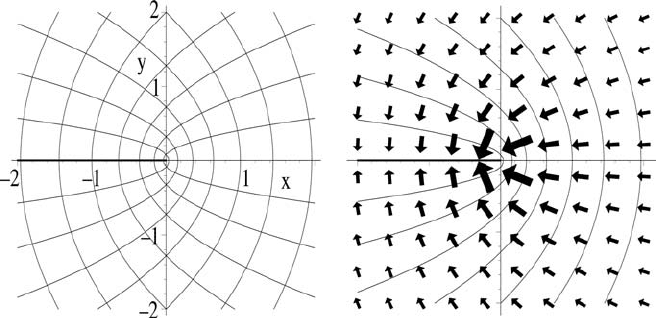
On the computer screen, the equipotentials are colored green and the electric
field lines red. The corresponding black and white version is shown on the left
of Figure 5.9.
The semi-infinite plate is represented by the thick horizontal line between
x=−2 and 0. The equipotentials are the family of parabolas opening to the left,
the closest one to the plate being for φ =0.2, the next furthest one for φ =0.4,
212 CHAPTER 5. COMPLEX VARIABLES
and so on. The electric field lines are the family of parabolas opening to the
right. Naturally, they intersect the equipotential at right angles. This includes
the plate which is the zero equipotential. The electric field lines terminate on
the surface charge on the plate.
Figure 5.9: Equipotentials and (a) field lines (left plot), (b) field vectors (right).
The field lines convey the sense of the electric field but do not indicate how the
field strength varies with distance from the plate. To this end, the following
display command is used to superimpose the equipotentials and the electric
field (
E) vectors.
>
display({gr1,gr2,G(u,green)});
It can be seen from the resulting picture shown on the right of Figure 5.9 that
the electric field is strongest near the edge of the plate, i.e., near the tip of the
thick line in the figure.
5.5.2 A Clever Transformation
We are obliged to regard many of our original minds as crazy at least
until we have become as clever as they are.
G. C. Lichtenberg, German physicist, philosopher, (1742–99)
An infinitely long conducting cylinder of unit radius, with its axis horizon-
tal, has its upper-half held at the potential Φ = +V and its lower-half held
at Φ = −V , the two halves being separated by an infinitesimally thin layer of
insulation. What are the equipotentials and electric field inside the cylinder?
The fact that this problem is 2-dimensional in nature, and has a certain
symmetry to it, allows us to solve it rather easily by using a conformal trans-
formation approach. Loading some needed library packages,
>
restart: with(plots): with(VectorCalculus):

5.5. CONFORMAL MAPPING 213
the complex variable z = x + iy is entered. As will be seen, the mapping
w = ln((1 + z)/(1 − z)), which is inputted, will transform the original circular
boundary value problem into a planar boundary value problem which can be
solved by inspection.
>
z:=x+I*y: w:=ln((1+z)/(1-z));
w := ln(
x + yI+1
−x − yI+1
)
The complex function w = u + iv is split into real and imaginary parts with
the complex evaluation command, and u and v separately extracted with the
remove and select commands, respectively.
>
w:=simplify(evalc(w));
w :=
1
2
ln(
x
2
+2x+1+y
2
x
2
−2 x+1+y
2
)+arctan(
2 y
x
2
−2 x+1+y
2
, −
x
2
−1+y
2
x
2
−2 x+1+y
2
) I
>
u:=remove(has,w,I); v:=select(has,w,I)/I;
u :=
1
2
ln(
x
2
+2x +1+y
2
x
2
− 2 x +1+y
2
)
v := arctan(
2 y
x
2
− 2 x +1+y
2
, −
x
2
− 1+y
2
x
2
− 2 x +1+y
2
)
Recognizing that the first argument of the arctangent in v is the numerator
and the second argument the denominator, v is expressed in a more familiar
mathematical form by using the operand (op) command.
>
v:=arctan(op(1,v)/op(2,v));
v := −arctan(
2 y
x
2
− 1+y
2
)
Since v satisfies Laplace’s equation, it can be taken as the potential. To see
how the potential on the circular boundary transforms under the action of w,
let’s make the algebraic substitution y
2
=1− x
2
in w.
>
w2:=algsubs(yˆ2=1-xˆ2,w);
w2 :=
1
2
ln(
2 x +2
−2 x +2
) + arctan(
2 y
−2 x +2
, 0) I
The result w2 is simplified in w3a, assuming that y>0andx<1, and in w3b,
assuming that y<0andx<1.
>
w3a:=simplify(w2) assuming y>0,x<1;
w3a := −
1
2
ln(−x +1)+
1
2
ln(x +1)+
1
2
Iπ
>
w3b:=simplify(w2) assuming y<0,x<1;
w3b := −
1
2
ln(−x +1)+
1
2
ln(x +1)−
1
2
Iπ
The select command is used to extract the imaginary parts of w3a and w3b
which are then divided by i in v2a and v2b, respectively.
>
v2a:=select(has,w3a,I)/I; v2b:=select(has,w3b,I)/I;
214 CHAPTER 5. COMPLEX VARIABLES
v2a :=
π
2
v2b := −
π
2
The upper (lower) surface of the split cylinder, which is at the potential +V
(−V ), maps into the infinite plane v2a =+π/2(v2b = −π/2). The region
inside the split cylinder maps into the region between these infinite planes.
The potential problem in the w plane is easily solved. By inspection, the
equipotentials must be parallel planes lying between v =+π/2and−π/2, v =0
(the u-axis) corresponding to the zero potential. Analytically, the potential
must be given by Φ = (2 v/π)V ,sincev = π/2 generates the equipotential
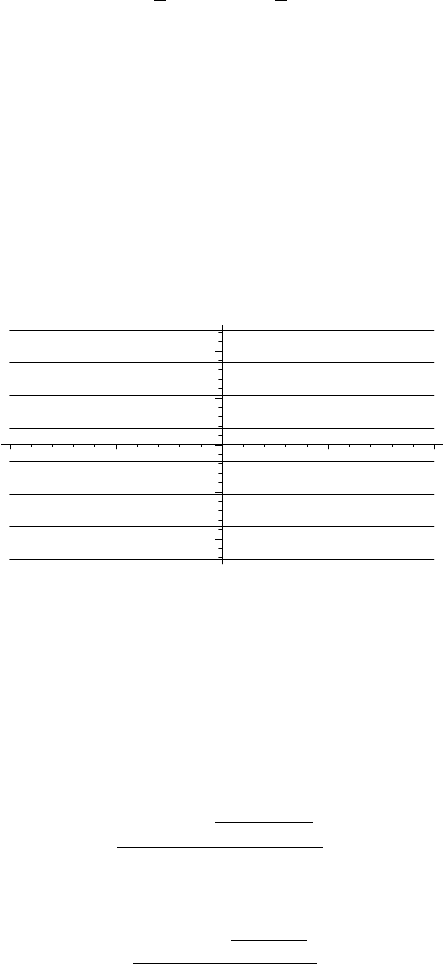
Φ=V , and so on. A picture of the equipotentials in the w plane are generated
for V =1 with the contourplot command.
>
contourplot(2*Y/Pi,X=-2..2,Y=v2b..v2a);
–1
1
Y
–2 2
X
Figure 5.10: Planar equipotentials in the w-plane.
Entering Φ = 2 Vv/π generates the potential in terms of x and y, i.e., in the
z-plane. It can be converted to polar form if so desired, as in Φ2.
>
Phi:=2*V*v/Pi;
Φ:=−
2 V arctan(
2 y
x
2
− 1+y
2
)
π
>
Phi2:=simplify(subs({x=r*cos(theta),y=r*sin(theta)},Phi));
Φ2 := −
2 V arctan(
2 r sin(θ)
−1+r
2
)
π
The electric field expression follows on calculating
E = −∇Φ.
>
E:=-Gradient(Phi,’cartesian’[x,y]);
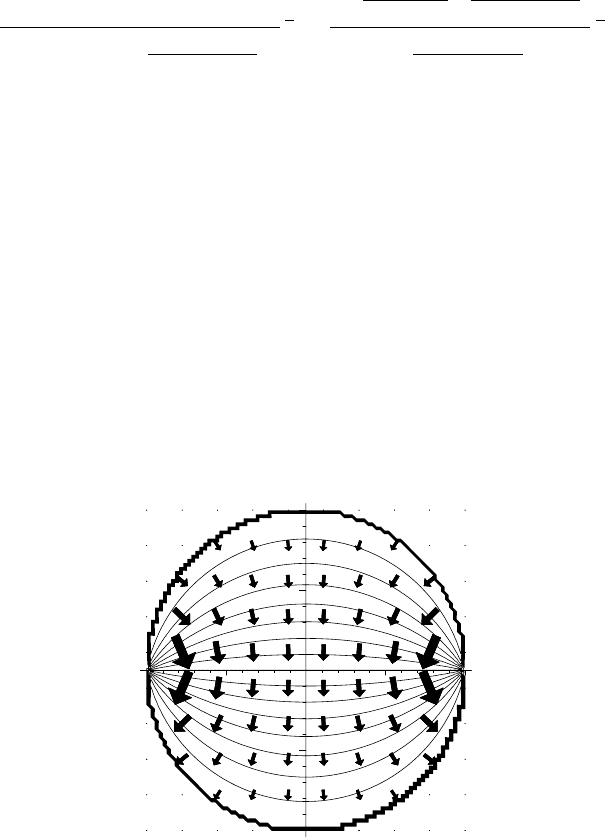
5.5. CONFORMAL MAPPING 215
E := −
8Vyx
(x
2
−1+y
2
)
2
(1+
4 y
2
(x
2
−1+y
2
)
2
)π
e
x
+
2V(
2
x
2
−1+y
2
−
4 y
2
(x
2
−1+y
2
)
2
)
(1+
4 y
2
(x
2
−1+y
2
)
2
)π
e
y
A normalized piecewise potential function is formed, made up of Φ/V inside
the unit circle and zero outside.
>
pot:=piecewise(xˆ2+yˆ2<1,Phi/V,xˆ2+yˆ2>1,0);
The x and y components of the normalized electric field are also put into a
similar piecewise form in E1 and E2 .
>
E1:=piecewise(xˆ2+yˆ2<1,E[1]/V,xˆ2+yˆ2>1,0):
>
E2:=piecewise(xˆ2+yˆ2<1,E[2]/V,xˆ2+yˆ2>1,0):
The normalized equipotentials are plotted with the contourplot command.
>
cp:=contourplot(pot,x=-1..1,y=-1..1,grid=[80,80],
contours=15):
The normalized electric field vectors are plotted using the fieldplot command.
>
fp:=fieldplot([E1,E2],x=-1..1,y=-1..1,grid=[10,10],
arrows=THICK,color=red):
The two graphs, cp and fp, are superimposed to produce Figure 5.11.
>
display({cp,fp},scaling=constrained);
–1
1
y
–1 1
x
Figure 5.11: Equipotentials and electric field vectors for the split cylinder.
Although this split cylinder problem was easily solved using a conformal trans-
formation, it should be noted that this approach is limited in its usefulness,
being applicable to two-dimensional potential problems of relatively simple ge-
ometry or symmetry.
216 CHAPTER 5. COMPLEX VARIABLES
5.5.3 Schwarz–Christoffel Transformation
Physical concepts are free creations of the human mind, and are not,
however it may seem, uniquely determined by the external world.
Albert Einstein, German-American physicist, Evolution of Physics, 1938
To this point, the conformal transformations have been drawn out of “thin air”.
A systematic approach for obtaining many specific transformations is to apply
the general Schwarz–Christoffel transformation which can be used to transform
the inside
1
of a closed polygon in the z = x + iy plane into the upper half of
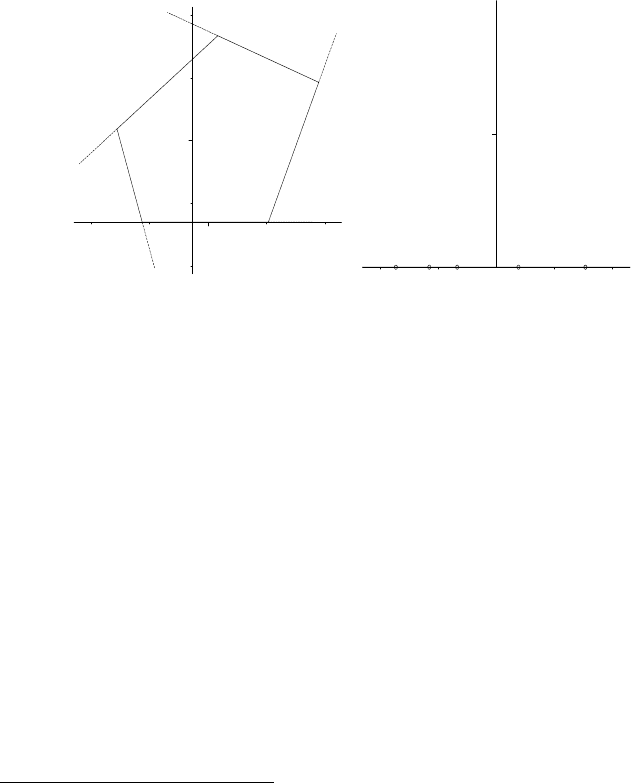
the w =u + iv plane. Referring to Figure 5.12, the vertices of the polygon are
a0
a4
a3
a2
a1
z Plane
Inside
α0
α4
α3
α2
α1
y
y
x
w Plane
InsideInside
b4b3b2b1b0
v
u
Figure 5.12: Schwarz–Christoffel transformation.
labeled a0, a1,..., the corresponding exterior angles α0, α1,..., and the trans-
forms of the vertices to the w plane b0, b1,.... Traversing the exterior of the
polygon in a counterclockwise sense, so that the interior of the polygon is to the
left, angles which correspond to turning further to the left are taken as positive,
while turns to the right are regarded as negative.
The Schwarz–Christoffel (S-C) transformation which maps the interior of
the polygon in the z plane onto the upper-half of the w plane and the boundary
of the polygon onto the real (u) axis is given by
z = A
(w − b0)
−α0/π
(w − b1)
−α1/π
···(w − bn)
−αn/π
dw + B, (5.10)
where A and B are arbitrary complex constants. Note the following facts:
• Any three of the points b0, b1,...,bn may be chosen at will. We can place
b0 at infinity which removes the first factor in (5.10).
• A and B are adjusted to fix the polygon size, orientation, and position.
• Infinite open polygons are regarded as limiting cases of closed polygons.
1
The method can be extended to map the outside of the polygon, see, e.g., [MF53].
5.5. CONFORMAL MAPPING 217
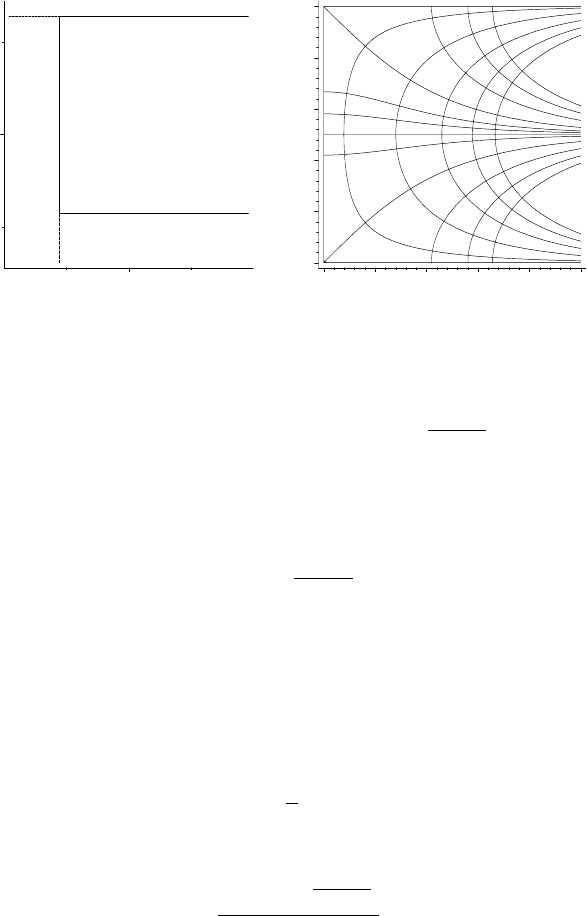
As a simple example, let’s determine the S-C transformation which maps
the interior of the semi-infinite rectangular strip shown on the left of Figure 5.13
into the upper-half of the w plane. Then, this transformation will be used to
plot the equipotentials and lines of force inside a straight slit, with the same
geometry, cut in an infinite conducting sheet.
a0 ---> infinityStrip
a2 = 0
a1 = ih
α2 = π/2
α1 = π/2
y
x
0
y
1
0
x
1
Figure 5.13: Geometry (left) and equipotentials and field lines (right) for strip.
The infinite strip can be regarded as the limit of a triangle with vertices a0 →∞,
a1 = ih, and a2 = 0. The exterior angles then are α0=π, α1=π/2, and
α2=π/2. Choosing b0 = ∞,b1=−1, and b2 = 1, the S-C transformation is
given by z =A
(w +1)
−1/2
(w − 1)
−1/2
dw + B =
(1/
√
w
2
− 1) dw + B.
After loading the plots package, needed for the contour plot,
>
restart: with(plots):
the integral in the S-C transformation is explicitly carried out.
>
Z:=A*int(1/sqrt(wˆ2-1ˆ2),w)+B;
Z := A ln(w +
√
w
2
− 1) + B
Now, when z = a2 = 0, then w = b2 = 1. Similarly, when z =a1=ih,then
w =b1=−1. These two boundary conditions are entered,
>
bc1:=eval(Z,w=1)=0; bc2:=eval(Z,w=-1)=I*h;
bc1 := B =0 bc2 := AπI + B = hI
and solved for the constants A and B.
>
sol:=solve({bc1,bc2},{A,B});
sol := {A =
h
π
,B=0}
On assigning the solution, the S-C transformation is given by Z.
>
assign(sol): Z:=Z;
Z :=
h ln(w +
√
w
2
− 1)
π