
Enns R.H. Computer Algebra Recipes for Mathematical Physics
Подождите немного. Документ загружается.

198 CHAPTER 5. COMPLEX VARIABLES
The value of the integral follows on multiplying r by 2 πi and applying the
complex evaluation command to simplify the answer to a real number.
>
V:=evalc(2*Pi*I*r);
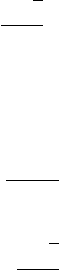
V :=
π
√
2
2
As a check, we can directly evaluate the integral using Maple’s int command.
This is done in the next two command lines, the resulting number being the
same as that obtained above using contour integration.
>
I1:=Int(integrand,z=-infinity..infinity);
I1 :=
∞
−∞
1
1+z
4
dz
>
check:=value(I1);
check :=
π
√
2
2
If the semi-circular contour had been chosen to be in the lower-half z-plane,
exactly the same answer would be generated using the poles below the real
axis, provided that the result is multiplied by −1 to take into account that the
contour then is taken in a clockwise sense, rather than counterclockwise.
5.3.2 Poles on the Contour
There are many paths to the top of the mountain,
but the view is always the same.
Chinese Proverb
In the previous example, the poles of the integrand were either definitely inside
or outside the path chosen for the contour integration. Suppose that we want
to evaluate the integral I =
∞
−∞
cos(x) dx/(a
2
− x
2
)witha real. The infinite
limits suggest a semi-circular contour C in the complex z-plane with the flat
portiononthereal(x) axis. But the integrand has two simple poles lying right
on C at x = ±a. To apply Cauchy’s residue theorem, the poles must be def-
initely inside or outside the chosen contour. So what do we do? A standard
approach is to “indent” the contour in the vicinity of each pole, taking a small
semi-circular “detour” around the pole which either puts the pole inside or out-
side the contour. Then one performs the contour integration using the residue
theorem, and afterwards lets the radii of the small semi-circles go to zero. As
an illustration of this method, let’s evaluate the above integral I.
The plottools library package is again loaded so the various semi-circles can
be drawn for the indented contour.
>
restart: with(plots): with(plottools):
Instead of tackling I directly, let’s consider the integral
C
e
iz
dz/(a
2
−z
2
), with
z the complex variable. At the end of the calculation the real integral I can be
5.3. DEFINITE INTEGRALS 199
obtained by taking the real and imaginary parts. The integrand of the complex
closed contour integral is now entered.
>
integrand:=exp(I*z)/(aˆ2-zˆ2);
integrand :=
e
(zI)
a
2
− z
2
The integrand’s poles can be extracted by applying the discontinuity command.
>
pole:=discont(integrand,z);
pole := {a, −a}
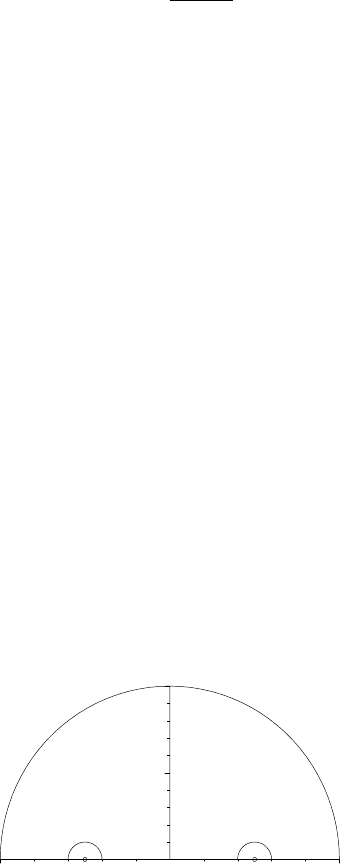
To draw the indented semi-circular contour, let’s take the poles to be at ±1by
setting a = 1. The small semi-circle around each pole is given a radius r =0.2,
and the larger semi-circle which completes the path is given a radius R =2.
>
R:=2: r:=0.2: a:=1:
An operator A is formed to draw a thick red semi-circle of arbitrary radius r
around a specified point (x, 0) on the real axis.
>
A:=(x,r)->arc([x,0],r,0..Pi,color=red,thickness=2):
Using A, a large semi-circle of radius R centered on the origin is produced in
A1, and a small semi-circle of radius r around each pole in A2 and A3.
>
A1:=A(0,R): A2:=A(pole[1],r): A3:=A(pole[2],r):
In B, a thick red line is drawn along the real axis between, x= −R and −a −r,
between −a + r and a −r, and between a + r and R.
>
B:=plot([[[-R,0],[-a-r,0]],[[-a+r,0],[a-r,0]],
[[a+r,0],[R,0]]],style=line,color=red,thickness=2):
In C, the two poles are plotted as size 16 blue circles.
>
C:=pointplot([[pole[1],0],[pole[2],0]],symbol=circle,
symbolsize=16,color=blue):
The graphs are superimposed, generating the full contour shown in Figure 5.4.
>
display({A1,A2,A3,B,C},scaling=constrained,
view=[-R..R,0..R],tickmarks=[2,2],labels=["x","y"]);
0
1
2
y
–2 2
x
Figure 5.4: Semi-circular contour indented around the two poles on the x-axis.

200 CHAPTER 5. COMPLEX VARIABLES
Note that I have chosen to indent the small semi-circles around each pole in
such a way that both poles lie outside the contour C. So the line integral around
C will yield zero, since no poles lie inside C. I could just as well have chosen
to indent the small semi-circles in such a way that both poles were inside the
contour, or even so that one pole was inside and the other outside. As you may
verify, the final answer is the same, irrespective of the choice of indentation.
The quantities a and r are now unassigned. On each small semi-circle, the
complex variable will be written as Z =re
iθ
.
>
a:=’a’: r:=’r’: Z:=r*exp(I*theta):
For our choice of C, starting at the point (−R, 0) the complete counterclockwise
contour integral will be as follows:
+
C
e
iz
dz
(a
2
− z
2
)
=0 =
−a−r
−R
e
ix
dx
(a
2
− x
2
)
+
0
π
e
i(−a+Z)
iZ dθ
(a
2
− (−a + Z)
2
)
+
a−r
−a+r
e
ix
dx
(a
2
− x
2
)
+
0
π
e
i(a+Z)
iZ dθ
(a
2
− (a + Z)
2
)
+
R
a+r
e
ix
dx
(a
2
− x
2
)
+
π
0
e
iRe
iθ
iRe
iθ
dθ
(a
2
− (Re
iθ
)
2
)
.
In the limit that R →∞and r → 0, the sum of the first, third, and fifth
integrals on the right-hand side of 0 will yield
∞
−∞
e
ix
dx/(a
2
− x
2
). Taking
the real part will produce the original integral
∞
−∞
cos(x) dx/(a
2
− x
2
), whose
value we are trying to determine.
Let’s look at the last integral on the right-hand side, which is written as
π
0
e
iR cos θ−R sin θ
iRe
iθ
dθ
(a
2
− R
2
e
2iθ
)
.
Since the large semi-circle is in the upper-half z-plane, sin θ>0. Therefore,
as R →∞, the integrand → 0 and the integral contribution is zero. Finally,
we have to evaluate the second and fourth integrals on the right-hand side. A
function F is formed for substituting z = ±a + Z into the integrand.
>
F:=n->subs(z=pole[n]+Z,integrand):
Thefirstpoleextractedwas+a (the ordering varies from one run to the next),
so F(1) is used to form the fourth integral and simplify it.
>
I1:=simplify(Int(F(1)*I*Z,theta=Pi..0));
I1 := −I
0
π
e
((a+re
(θI)
) I)
2 a + re
(θI)
dθ
Taking the limit of I1 at r =0 completes the evaluation of the integral in I1b.
>
I1b:=limit(I1,r=0);
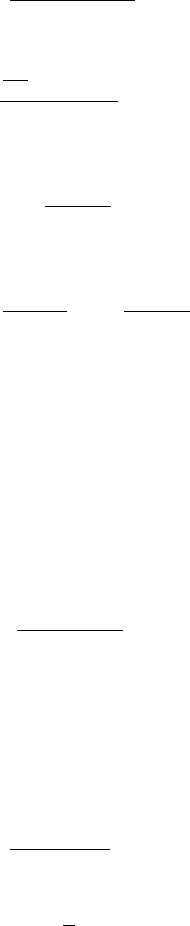
I1b :=
1
2
Ie
(aI)
π
a
Using F(2), the second integral is similarly formed in I2 and evaluated in I2b.
5.3. DEFINITE INTEGRALS 201
>
I2:=simplify(Int(F(2)*I*Z,theta=Pi..0));
I2 := −I
0
π
e
((−a+re
(θI)
) I)
−2 a + re
(θI)
dθ
>
I2b:=limit(I2,r=0);
I2b :=
−1
2
Ie
(−Ia)
π
a
The two integral terms are added and simplified assuming that a is real.
>
terms:=simplify(I1b+I2b) assuming a::real;
terms := −
π sin(a)
a
The answer to the original real integral is just minus the above output.
>
answer:=Int(cos(x)/(aˆ2-xˆ2),x=-infinity..infinity)=-terms;
answer :=
∞
−∞
cos(x)
a
2
− x
2
dx =
π sin(a)
a
5.3.3 An Angular Integral
Science is an integral part of culture. ... It’s one of the glories of
the human intellectual tradition.
Stephen Jay Gould, American scientist, (b. 1941)
Integrals whose integrands are rational functions of cos θ and sin θ in the range
of integration can be evaluated by making the transformation z =e
iθ
.Ifθ varies
from0to2π, the integration in the complex z-plane will be counter-clockwise
around a circle of unit radius. As an example, consider
J =
2π
0
sin
2
θdθ
(5 + 4 cos θ)
.
For variety, let’s load the Student[Calculus1] package, which contains two useful
commands, Integrand and Roots, which haven’t been used yet.
>
restart: with(Student[Calculus1]):
The integral J is now entered and, as a check on the contour integration, eval-
uated directly with the value command.
>
J:=Int(sin(theta)ˆ2/(5+4*cos(theta)),theta=0..2*Pi);
J :=
2 π
0
sin(θ)
2
5 + 4 cos(θ)
dθ
>
check:=value(J);
check :=
π
4
A contour integration should yield the value π/4forJ. To carry out this
integration, note that sin θ =(e
iθ
− e
−iθ
)/(2i)=(z − 1/z)/(2i)andcosθ =
(e
iθ
+ e
−iθ
)/2=(z +1/z)/2. These two transformations are entered.
202 CHAPTER 5. COMPLEX VARIABLES
>
sin(theta):=(z-1/z)/(2*I); cos(theta):=(z+1/z)/2;
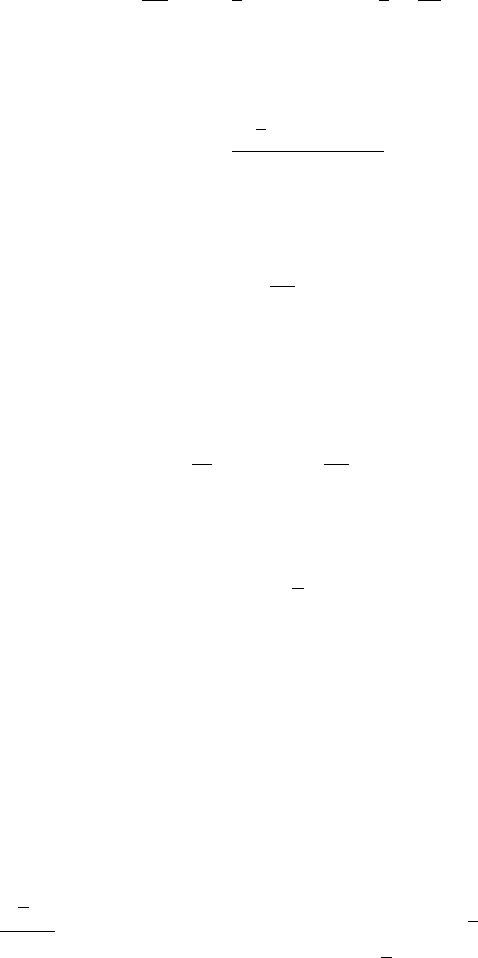
sin(θ):=
−1
2
I (z −
1
z
) cos(θ):=
z
2
+
1
2 z
Using the Integrand command to extract the integrand of J and using the fact
that dθ = dz/(iz), the integrand of the contour integral is as follows.
>
integrand:=simplify(Integrand(J)/(I*z));
integrand :=
1
4
I (z
2
− 1)
2
z
2
(5 z +2z
2
+2)
The Roots command is used to determine the zeros of the reciprocal of the
integrand, and thus the poles of the integrand.
>
R:=Roots(1/integrand);
R := [−2,
−1
2
, 0]
There are three poles, viz., two simple poles at z = −2andz = −1/2anda
second order pole at z =0. Since the contour C is a unit circle in the z-plane,
the pole at z = −2 will not contribute to the answer since it’s outside C.The
residue of the integrand at the two poles inside C is calculated in r1 and r2 .
>
r1:=residue(integrand,z=R[2]); r2:=residue(integrand,z=R[3]);
r1 :=
3
16
I r2 :=
−5
16
I
By Cauchy’s residue theorem, the value of the integral J is just 2 πi times the
sum of the two residues. The answer is π/4 as expected.
>
answer:=2*Pi*I*(r1+r2);
answer :=
π
4
5.3.4 A Branch Cut
Trust everybody, but cut the cards.
Finley Peter Dunne, American journalist, (1867–1936)
Cauchy’s residue theorem is built on the assumption that the integrand f(z)
in the contour integral
C
f(z) dz is a single-valued function. What if f(z)is
multi-valued with more than one mathematical branch? The answer is to choose
a contour which keeps f(z) on a single branch. Typically, a line is drawn in
the complex z-plane, called a branch cut, which the contour is not permitted to
cross in order to keep f(z) single-valued. Section 5.5 will elaborate on this.
To see how the procedure is implemented for a specific integral, consider
J =
∞
0
√
xdx
1+x
2
. The corresponding complex integral is
C
(
√
z/(1 + z
2
)) dz,
which has a double-valued integrand because of the
√
z factor. The branch cut
will be taken from z = 0 (the branch point) to −∞ along the negative x-axis.
(The branch cut could be taken in any direction from z =0 to ∞.) The contour
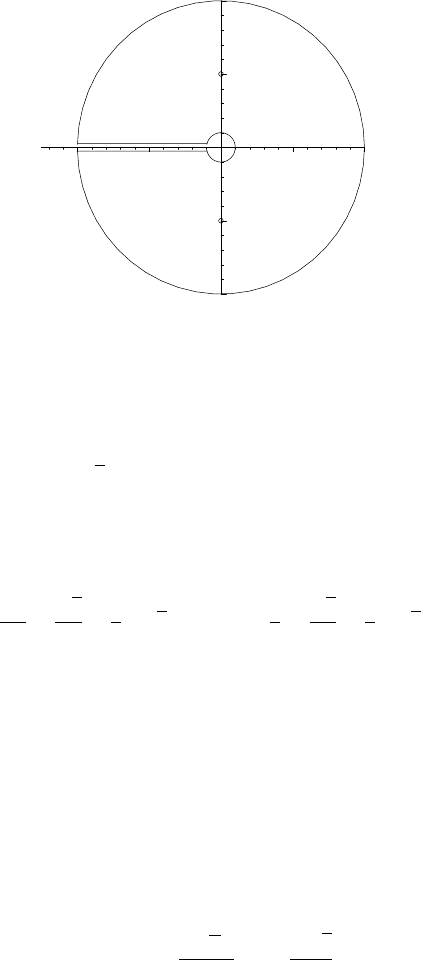
5.3. DEFINITE INTEGRALS 203
C is chosen to consist of an inner circle of radius and an outer circle of radius
R (both centered on the origin) joined by horizontal lines a distance η above
and below the branch cut. Ultimately, we let both and η → 0andR →∞.
In order to draw the circular arcs in C, the plottools library package is first
loaded. The complex integrand is then entered.
>
restart: with(plots): with(plottools):
>
integrand:=sqrt(z)/(1+zˆ2);
integrand :=
√
z
1+z
2
Before drawing C, let’s use the singular command to extract the singularities
of the integrand, needed for the application of Cauchy’s residue theorem.
>
pole:=singular(integrand);
pole := {z = I}, {z = −I}
There are two singular points at z = i and z =−i, corresponding to the locations
of two simple poles. The operand command, op, is now used to separately obtain
the locations, z1 and z2 , of the two poles.
>
z1:=op([1,2],pole[1]); z2:=op([1,2],pole[2]);
z1 := I z2 := −I
The pole locations may be converted into polar form.
>
z1_polar:=convert(z1,polar); z2_polar:=convert(z2,polar);
z1
polar := polar(1,
π
2
) z2
polar := polar(1, −
π
2
)
The poles lie on a circle of radius 1 at the polar angles θ=+π/2and−π/2. To
schematically draw the contour, let’s set R =2, =0.2, and η =0.05.
>
R:=2: epsilon:=0.2: eta:=0.05:
Thick red circular arcs of radius and R, respectively, are drawn in A1 and A2.
>
A1:=arc([0,0],epsilon,Pi-0.2..-Pi+0.2,color=red,thickness=2):
>
A2:=arc([0,0],R,Pi-0.02..-Pi+0.02,color=red,thickness=2):
A thick blue line is drawn along the real axis between x = −R − 0.5 and the
origin to represent the branch cut.
>
B:=plot([[-R-0.5,0],[0,0]],style=line,color=blue,thickness=3):
Red lines are drawn between (−R,η), (−,η) and between (−R,−η), (−,−η).
>
B2:=plot([[[-R,eta],[-epsilon,eta]],[[-R,-eta],
[-epsilon,-eta]]],style=line,color=red,thickness=2):
The two poles are represented by size 16 blue circles,
>
C:=plot({[0,z1/I],[0,z2/I]},style=point,symbol=circle,
symbolsize=16,color=blue):
and the textplot command is used to add labels to the figure.
>
tp:=textplot([[-1.9,-.15,"a"],[-1.9,.15,"b"],[-.25,.15,"c"],
[-.25,-.15,"d"],[-2.3,.1,"cut"]]):
The six plots are superimposed, the resulting picture being shown in Figure 5.5.
204 CHAPTER 5. COMPLEX VARIABLES
>
display({A1,A2,B,B2,C,tp},scaling=constrained,
view=[-R-0.5..R,-R..R],labels=["x","y"]);
cut
d
c
b
a
–1
1
y
–1 1
x
Figure 5.5: Closed contour around branch cut (stretching from z =0 to −∞).
The complete contour C consists of four legs, viz., a → b, b → c, c → d,and
d → a. Traversing C counter-clockwise, in the limit that η → 0, the increase of
2 π in θ in going from a to b is canceled out by the −2 π contribution in going
from c to d. Since the net angular change is zero, f (z) remains single-valued.
Multi-valuedness of f(z)=
√
z/(1+z
2
) only occurs if the net change in θ exceeds
2 π.Sincef(z) is single-valued, Cauchy’s residue theorem can be applied. The
poles lie inside C, so the line integral around C will yield a non-zero result.
Let’s calculate the residues of the integrand at the two poles.
>
r1:=residue(integrand,z=z1); r2:=residue(integrand,z=z2);
r1 :=
−1
2
I (
√
2
2
+
1
2
I
√
2) r2 :=
1
2
I (
√
2
2
−
1
2
I
√
2)
Now let’s look at each contribution to the line integral in the limit that η → 0.
(a) The integral I
a→b
=
π
−π
(iR
3/2
e
3iθ/2
/(1 + R
2
e
2iθ
)) dθ → 0asR →∞.
(b) I
b→c
=
R
(r
1/2
e
3πi/2
/(1 + r
2
e
2πi
)) dr → iJ as → 0andR →∞.
(c) I
c→d
=
−π
π
(i
3/2
e
3iθ/2
/(1 +
2
e
2iθ
)) dθ → 0as → 0.
(d) I
d→a
=
R
(r
1/2
e
−3πi/2
/(1 + r
2
e
−2πi
)) dr → iJ as → 0andR →∞.
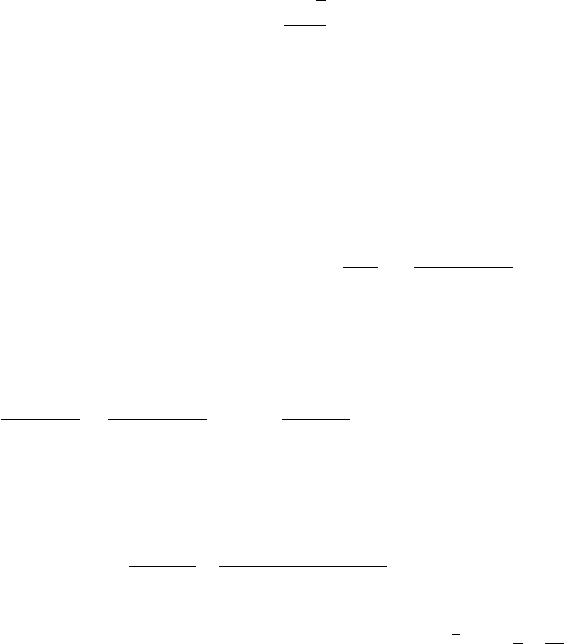
Since these four contributions add up to 2 iJ, the original integral must equal
2 πi times the sum of the two residues divided by 2 i.
>
answer:=Int(sqrt(x)/(1+xˆ2),x=0..infinity)
=evalc(2*Pi*I*(r1+r2)/(2*I));
answer :=
∞
0
√
x
1+x
2
dx =
π
√
2
2
As a check, we apply the value command to the left-hand side of answer,
5.4. LAURENT EXPANSION 205
>
check:=value(lhs(answer));
check :=
π
√
2
2
obtaining exactly the same result as in the contour integration.
5.4 Laurent Expansion
Using Cauchy’s integral formula, one can prove Laurent’s theorem:Ifg(z)is
regular in an annular region R between two concentric circles with center z
0
,
then g(z) may be represented in R by a Laurent expansion
g(z)=
∞
n=−∞
a
n
(z − z
0
)
n
, with a
n
=
1
2 πi
+
C
g(z) dz
(z − z
0
)
n+1
, (5.7)
C being any simple closed path encircling z
0
counter-clockwise within R.
If g(z) has a finite number of terms with negative exponents, it’s behavior is
dominated as z approaches z
0
by the term with the largest negative exponent.
If, e.g., it has the form
g(z)=
a
−n
(z − z
0
)
n
+
a
−(n−1)
(z − z
0
)
n−1
+ ···+
a
−1
(z − z
0
)
+ a
0
+ a
1
(z −z
0
)+···, (5.8)
then it has a pole of order n at z = z
0
. Note that if g(z) in (5.8) is multiplied
by (z − z
0
)
n
, the result then differentiated n − 1 times and z set equal to z
0
,
then the coefficient a
−1
is just the residue of the nth order pole, i.e.,
a
−1
=
1
(n − 1)!
d
n−1
[(z − z
0
)
n
g(z)]
dz
n−1
z = z
0
. (5.9)
If g(z) has an infinite number of terms with negative exponents, it is said to
have an essential singularity at z =z
0
. For example, g(z)=e
1
z
=1+
1
z
+
1
z
2
+ ···
has an essential singularity at z =0.
Instead of doing the contour integrations in (5.7), the coefficients a
n
can
often be more easily obtained by considering the Taylor series of (z −z
0
)
n
g(z).
5.4.1 Ms. Curious Meets Mr. Laurent
Isn’t life a series of images that change as they repeat themselves?
Andy Warhol, American pop artist, (1928–87)
Jennifer has posed the following question for her complex variables class:
Keeping 10 terms, determine the Laurent expansion of f =cos(z) e
z−2z
2
/z
2
about z = 0. Identify the singularity and give the region of convergence of the
series. Determine the residue of f at the singularity from the series. Confirm
the value of the residue by alternate means.
Here is the solution presented by Ms. Curious, expressed in her own words.

206 CHAPTER 5. COMPLEX VARIABLES
“The number N of terms to be retained in the series is set equal to 10.
>
restart: N:=10:
Since the numerator remains finite there, clearly f has a second-order pole at
z = 0. To obtain the Laurent series about this singularity, I will enter the
coefficient of 1/z
2
in G.
>
G:=cos(z)*exp(z-2*zˆ2);
G := cos(z) e
(z−2 z
2
)
Then G is Taylor expanded in powers of z to order N , and the order of term
removedwiththeconvert(g,polynom) command.
>
g:=taylor(G,z,N);
>
g:=convert(g,polynom);
g := 1+z − 2 z
2
−
7
3
z
3
+
11
6
z
4
+
79
30
z
5
− z
6
−
1217
630
z
7
+
841
2520
z
8
+
23617
22680
z
9
The Laurent expansion follows on dividing g by z
2
and expanding the result.
>
LS:=expand(g/zˆ2);
LS :=
1
z
2
+
1
z
− 2 −
7 z
3
+
11 z
2
6
+
79 z
3
30
− z
4
−
1217 z
5
630
+
841 z
6
2520
+
23617 z
7
22680
The Laurent expansion LS converges for all values of z = 0. By inspecting
the series and recalling that the residue is the coefficient of the 1/z term, the
residue of f at z = 0 is 1. It should be noted that the Laurent series can also
be obtained by loading the numapprox library package, applying the laurent
command to G/z
2
as in check1 , and removing the order of term as in LSb.
>
with(numapprox):
>
check1:=laurent(G/zˆ2,z=0,N);
>
LSb:=convert(check1,polynom);
LSb :=
1
z
2
+
1
z
− 2 −
7 z
3
+
11 z
2
6
+
79 z
3
30
− z
4
−
1217 z
5
630
+
841 z
6
2520
+
23617 z
7
22680
The residue of f(z)atz = 0 can also be obtained by differentiating z
2
f or G
once (since the singularity is a pole of order 2) with respect to z, evaluating the
result at z =0, and dividing by 1!
>
r1:=eval(diff(G,z),z=0)/1!;
r1 := 1
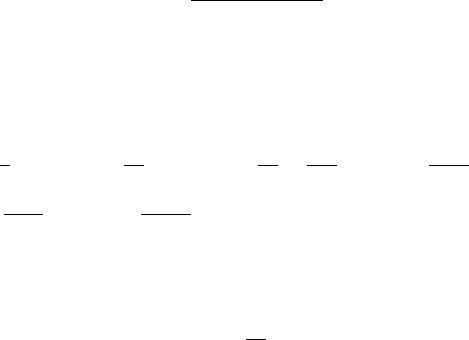
An even simpler method of determining the residue of f = G/z
2
at z =0 is to
use the residue command.”
>
r1b:=residue(G/zˆ2,z=0);
r1b := 1
5.4. LAURENT EXPANSION 207
5.4.2 Converge or Diverge?
I shall be telling this with a sigh, Somewhere ages and ages hence:
Two roads diverged in a wood, and I –
I took the one less traveled by, And that has made all the difference.
Robert Frost, American poet, The Road Not Taken (1874-1963)
Jennifer has given a second quiz question on the Laurent expansion.
Find the Laurent series for f = z
2
/((z − 1)
2
(z +3) aboutz =1. Determine
the residue and the region of convergence. Confirm the latter by creating plots
for different z values which show convergence and divergence.
Again, Ms. Curious will present her recipe for solving this problem.
“The numapprox package is loaded so that the laurent command can be
used. The given function f is then entered. It has a second order pole at z =1
and a first order pole at z =−3.
>
restart: with(plots): with(numapprox):
>
f:=zˆ2/((z-1)ˆ2*(z+3));
f :=
z
2
(z − 1)
2
(z +3)
An arrow operator L is formed for calculating the Laurent expansion of f
about z =1 to terms of order (z −1)
N
. For example, for N =5, the Laurent
series has the explicit form given in LS.
>
L:=N->laurent(f,z=1,N): LS:=L(5);
LS :=
1
4
(z − 1)
−2
+
7
16
(z − 1)
−1
+
9
64
−
9
256
(z − 1) +
9
1024
(z − 1)
2
−
9
4096
(z − 1)
3
+
9
16384
(z − 1)
4
+O((z −1)
5
)
By examining the (z −1)
−1
term, I can see that the residue is 7/16. This may
be confirmed by applying the residue command to f at z =1.
>
r:=residue(f,z=1);
r :=
7
16
The region of convergence for the Laurent series is 0 < |z −1| < 4. To test this
condition for some specified value Z of z, I first create a functional operator
gr1 which plots the Laurent expansion evaluated at z = Z over the range N =1
to 10, connecting consecutive plotting points with a thick blue straight line.
>
gr1:=Z->plot([seq([N,eval(convert(L(N),polynom),z=Z)],
N=1..10)],color=blue,thickness=2):
A second operator gr2 evaluates f at z = Z and plots a horizontal line at the
calculated value over the same range of N.
>
gr2:=Z->plot(eval(f,z=Z),N=1..10,thickness=2):
A third operator P superimposes gr1(Z) and gr2(Z) for a specified Z value.
>
P:=Z->display({gr1(Z),gr2(Z)},labels=["N","f"]):