
Enns R.H. Computer Algebra Recipes for Mathematical Physics
Подождите немного. Документ загружается.

178 CHAPTER 4. LINEAR PDES OF PHYSICS
>
fp:=fieldplot([B[1],B[3]],x=-1.1..1.1,z=-1.1..1.1,
arrows=THICK,grid=[10,10],color=red):
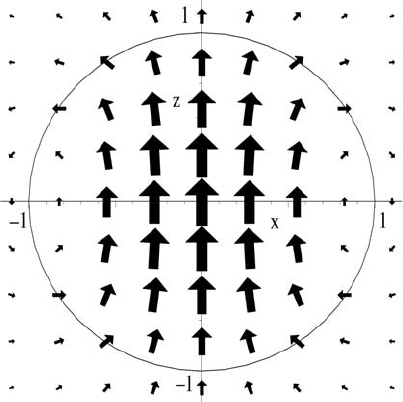
The two graphs are superimposed with the display command to produce Fig-
ure 4.15. The picture should be mentally rotated around the z-axis to obtain
the 3-dimensional magnetic field of the rotating uniformly charged sphere.
>
display({c,fp});
Figure 4.15: Magnetic field of rotating charged sphere in x-z plane.
Along the spin axis, the magnetic field points vertically upwards, having max-
imum strength at the center of the sphere. The magnetic field rapidly drops
in strength outside the sphere. The arrows form curved paths which leave the
top of the sphere and loop back on the outside to re-enter the sphere at the
bottom. The magnetic field behavior is characteristic of a dipole field.
4.4 Supplementary Recipes
04-S01: General Solutions
Consider a second order linear PDE of the general form (a, b, c are constants
and the subscripts denote derivatives),
aψ
xx
+ bψ
xy
+ cψ
yy
=0.
(a) By assuming a solution of the form ψ = f(x+ ry)wheref is arbitrary, show
that the general solution of the PDE is ψ = f(x + r
1
y)+g(x + r
2
y)where

4.4 SUPPLEMENTARY RECIPES 179
r
1
and r
2
are distinct roots of the quadratic equation cr
2
+ br+ a =0.
Determine the two roots. If r
2
= r
1
, show that the general solution is
ψ = f(x + r
1
y)+yg(x + r
1
y), where f and g are arbitrary functions.
(b) Making use of (a), find the general solutions of the following PDEs. In
each case, confirm the solution by solving the PDE directly with pdsolve.
(i) ψ
xy
−ψ
yy
=0;(ii) ψ
xx
+ ψ
xy
−2 ψ
yy
=0;(iii) ψ
xx
−2 ψ
xy
+ ψ
yy
=0.
04-S02: Balalaika Blues
While trying to create music with a small balalaika, Justine plucks one of the
strings which is initially at rest. If the string is fixed at x= 0 and L and has an
initial transverse profile ψ(x, 0) =hx
3
sin(3 πx/2L)(L −x)
2
/L
5
, determine the
subsequent displacement ψ(x, t) of the string using a Fourier series approach.
Taking L =20 cm, h =30 cm, and wave speed c= 1 cm/s, animate the motion of
the string. Leave the scaling unconstrained for better viewing of the vibrations.
04-S03: Damped Oscillations
If damping (damping coefficient R) is included, the transverse vibrations of a
light, homogeneous, string under tension are governed by
∂
2
ψ
∂x
2
=
1
c
2
∂
2
ψ
∂t
2
+
2R
c
2
∂ψ
∂t
.
Consider a horizontal string of length L fixed at x = 0 and L. If it is initially
at rest and is given the initial shape f(x)=hx(x − L), use the separation of
variables method to determine ψ(x, t)fort>0. Taking L =2 m, h =0.1m
−1
,
speed c=5 m/s, and R=1 s
−1
, animate the motion of the string over the time
interval t =0 to 10 s. You should observe underdamped oscillations. Show that
overdamping occurs for R =10 s
−1
.
04-S04: Kids Will Be Kids
Consider a very long uniform clothesline under sufficient tension T to keep it
horizontal, with Justine’s recently washed soccer jersey (mass m) attached with
a single clothes peg to the middle of the line at x =0. In an unsuccessful attempt
to dump her sister’s jersey onto the ground, Gabrielle shakes the clothesline in
such a way that a plane wave with amplitude A and phase velocity c = ω/k is
incident from x<0. Show that reflection and transmission occur at x = 0 and
that the energy reflection coefficient R =sin
2
(θ) and transmission coefficient
Tr=cos
2
(θ), where θ = arctan(mω
2
/2kT). Determine the phase angle changes
for the reflected and transmitted waves in terms of θ.
04-S05: Energy of a Vibrating String
For a finite horizontal string, with linear density (x) and under tension T ,
stretched between x=x
1
and x
2
, the kinetic energy for small transverse vibra-
tions is KE=(1/2)
x
2
x
1
(x)(∂ψ/∂t)
2
dx. If the ends of the string are either fixed
(ψ =0) or free (ψ
=0), the potential energy is PE=(1/2)
x
2
x
1
T (∂ψ/∂x)
2
dx.

180 CHAPTER 4. LINEAR PDES OF PHYSICS
Consider a horizontal string of constant density and under tension T fixed
at x = 0 and L.Ifattimet = 0, the string is given the initial triangular profile
f(x)=2hx/L for 0 ≤ x ≤ L, f (x)=2h (L − x)/L for L/2 ≤ x ≤ L,andis
released from rest, calculate explicit analytic expressions for the kinetic energy,
potential energy, and total energy. What fraction of the total energy is in
the fundamental (lowest) frequency? first harmonic (next highest frequency)?
second harmonic? Plot the kinetic and potential energies divided by the total
energy as a function of time for L= 1 m and wave velocity c=
T/=1 m/s.
04-S06: Vibrations of a Tapered String
A horizontal tapered string fixed at x=0 and L has a linear density =a(1+bx).
Determine the normal modes for transverse oscillations of the string. Identify
the functions which occur in the analytic solution. If L=1 m, a=1/1000 kg/m,
b=2 m
−1
, and the tension T =1 N, determine the three lowest eigenfrequencies.
Animate the fundamental mode over one period, taking 50 frames.
04-S07: Green Function for Forced Vibrations
A stretched (tension T ) string fixed at x = 0 and L is subjected to forced
vibrations by an external force per unit length f(x, t)=Fδ(x − ζ) e
−iωt
with
the force amplitude F = T and 0 <ζ<L. Solve this Green function problem
and show that the Green function (spatial part) is
G=
sin[k(L − ζ)] sin(kx)
k sin(kL)
,x≤ ζ, G=
sin[k(L − x)] sin(kζ)
k sin(kL)
,x≥ ζ,
where k = ω/v, v being the wave velocity. G has singularities at certain values
of k. Determine these values. Explain, in physical terms, the origin of these
singularities and how in real life, they would be “removed”.
04-S08: Plane-wave Propagation in a 5-Piece String
Consider an infinitely long string which has a linear density
1
= 1 in region
1(x<0), density
2
= 4 in region 2 (0 <x<L), density
3
= 1 in region 3
(L<x<2L), density
4
= 4 in region 4 (2L<x<3L), and density
5
=1in
region 5 (x>3L). For a plane wave of incident amplitude 1, frequency ω,and
wave number K, coming from x = −∞:
(a) Derive the energy transmission coefficient T into region 5 and simplify
the result as much as possible.
(b) Show that T + R =1,whereR is the energy reflection coefficient.
(c) Plot R and T in the same graph as a function of KLup to KL=6. At
what values of KLis there 100% transmission? Discuss your answer.
04-S09: Transverse Vibrations of a Whirling String
Derive the wave equation for transverse vibrations of a light string of length L
pivoted at one end and whirling in a horizontal plane about that pivot with an
angular velocity ν. Determine the normal modes of oscillation of the whirling
string and the five lowest allowed frequencies. Animate the mode with the
second lowest frequency, taking L=1 m and ν =1 s
−1
.

4.4 SUPPLEMENTARY RECIPES 181
04-S10: Newton Would Think That This Recipe Is Cool
Newton’s law of cooling says that the heat flux (amount of heat crossing a unit
area per unit time) across a surface is proportional to the temperature difference
T
S
− T
0
between the surface (temperature T
S
) and the surrounding medium
(temperature T
0
). Explicitly this gives the boundary condition ˆn ·∇T |
S
=
−h(T
S
− T
0
), where ˆn is the outward unit normal to the surface and h is the
heat exchange coefficient. Consider an infinitely long uniform bar of rectangular
cross-section with axis along the z direction. The two opposite faces at y =0 and
y = b are held at the temperatures T = 0 and T = A, while the other two faces
at x=±a radiate heat according to Newton’s cooling law into the surrounding
medium which is held at T
0
=0. Derive the solution which takes the form
T (x, y)=
∞
n=1
C
n
sinh(g
n
y/a) cos(g
n
x/a),
where the coefficients C
n
remain to be identified and g
n
are the positive roots of
the transcendental equation g tan(g)=ah. Taking a=1, b=0.5, h=1, A=100,
solve the transcendental equation and plot the isotherms inside the bar.
04-S11: Locomotive on a Bridge
As a model of the motion of a locomotive across a railway bridge, consider a
periodically vibrating point load A sin(ωt) moving with constant velocity V
along a horizontal, uniform, rectangular steel beam of density ρ, cross-sectional
area S, and length L. The beam is fixed at x=0 and L anditisassumedthat
at time t = 0 the beam is at rest and the locomotive is at x = 0. The equation
of motion for transverse vibrations (amplitude ψ) of the beam is given by
a
4
∂
4
ψ
∂t
4
+
∂
2
ψ
∂t
2
=
q(x, t)
,
with q(x, t)=A sin(ωt) δ(x − Vt). Here = ρS is the linear density of the
beam and a =(κ
2
Y/ρ)
1/4
with κ the radius of gyration of the beam and
Y its Young’s modulus. Assuming a Fourier series of the form ψ(x, t)=
∞
n=1
b
n
(t)sin(nπx/L), determine the transverse vibrations of the beam. Tak-
ing ρ = 7800 kg/m
3
, Y =2.1 × 10
11
N/m
2
, S =1 m
2
, κ =0.5m,A =5× 10
4
N,
ω =1 s
−1
, L = 1000 m, and V = 1 m/s, animate the motion of the beam with
the motion of the locomotive along the beam superimposed. Keep 20 terms in
the series solution and use 100 frames in the animation. To see the oscillations,
unconstrained scaling should be used.
04-S12: The Temperature Switch
The temperature at the ends x = 0 and x = 100 of a rod (insulated on its
sides) 100 cm long is held at 0
◦
and 100
◦
, respectively, until steady-state is
achieved. Then, at the instant t = 0, the temperature of the two ends is
interchanged. Determine the resultant temperature distribution T (x, t). If
a =
K/ρC =10/π cm/s
1/2
,whereK is the thermal conductivity of the rod,
ρ is its density, and C the specific heat, animate the temperature distribution.
What is the temperature at x = 20 cm after 25 seconds?

182 CHAPTER 4. LINEAR PDES OF PHYSICS
04-S13: Telegraph Equation Revisited
For an audio-frequency submarine cable [SR66], the telegraph equation applies
with the leakage constant G =0 and the self inductance (per unit length) L=0.
As shown in recipe 04-2-1, in this case the telegraph equation reduces to a
1-dimensional diffusion equation for the potential V with a diffusion constant
d =1/(RC). Consider a submarine cable = 1000 km in length, and let the
voltage at the source (at x = 0), under steady-state conditions be 1200 volts
and at the receiving end (at x = ) be 1100 volts. At time t = 0, the receiving
end is grounded, so that its voltage is reduced to zero, but the potential at the
source is maintained at its constant value of 1200 volts. If R= 2 ohms/km and
C =3× 10
−7
farad/km, determine the current and voltage in the line after the
grounding of the receiving end and animate the results.
04-S14: Another “Trampoline” Example
A “trampoline” consists of a uniform, light, horizontal, stretched, rectangular
membrane with edges of length a and 2a. The edges at x=0,aare fixed, while
those at y =0, 2a are free. Using the separation of variables method, determine
the trampoline’s subsequent motion if it has the initial shape f =2x h/a for
0 ≤ x ≤ a/2andf =2h (a − x)/a for a/2 ≤ x ≤ a and is released from rest.
Taking h =1/5m,a =2 m, and c= 2 m/s, animate the motion of the membrane
overthetimeintervalt=0 to 5 seconds taking 100 frames.
04-S15: An Electrostatic Poisson Problem
The faces of a rectangular box, 0 ≤ x ≤ a,0≤ y ≤ b,0≤ z ≤ c are held at
the potential φ = 0 and the interior is filled with charge with a charge density
ρ= A sin(πx/a)sin(πz/c)[y (y −b)] Coulombs/meter
3
. Using the electrostatic
Poisson equation ∇
2
φ= −ρ/
0
,where
0
is the permittivity of free space, deter-
mine the potential at an arbitrary point inside the box. Taking A=10
−9
C/m
5
,
a = b = c = 1 m, and
0
=8.85 × 10
−12
Farads/meter, determine the potential
Φ (in volts) at the center of the box. Plot the equipotentials Φ/10, 2 Φ/10,...,
9Φ/10 in the mid-plane x=a/2.
04-S16: SHE Does Not Want to Separate
Demonstrate that the scalar Helmholtz equation (SHE) does not separate in
bispherical coordinates even with the modified assumption that was successful
for Laplace’s equation in recipe 04-3-1.
04-S17: WE Can Separate
A 2-dimensional curvilinear coordinate system (u, v) can be defined through
the equations x=
√
uv, y =(u − v)/2, where the range of u, v is from 0 to ∞.
(a) Plot the contours in the x-y plane corresponding to holding u and v
constant. Show that this curvilinear coordinate system is orthogonal.
(b) Calculate the scale factors and the wave equation (WE) for this system.
(c) Show that WE is separable. Identify the separated ODEs and solutions.
4.4 SUPPLEMENTARY RECIPES 183
04-S18: The Stark Effect
A hydrogenic atom consists of an electron of charge −e and mass m moving in
the attractive Coulomb field of a nucleus (atomic number Z)ofchargeZeand
mass M .IfZ = 1, one has the hydrogen atom, Z =2 corresponds to the He
+
ion,
Z = 3 to the Li
++
ion, and so on. The time-independent Schr¨odinger equation
for the wave function ψ then takes the form ∇
2
ψ +(2m/¯h
2
)[E + Ze
2
/r] ψ =0,
where ¯h is Planck’s constant divided by 2 π, E is the total energy, and r the
radial distance of the electron from the nucleus. When a hydrogenic atom is
placed in an external electric field, the energy levels are found to shift. This
phenomenon is referred to as the Stark effect. If the electric field (magnitude
E
0
)isorientedinthepositivez direction, a potential energy term −eE
0
z must
be added to the hydrogenic atom problem. Show that the time-independent
Schr¨odinger equation is still separable in parabolic (or paraboloidal) coordinates
(ζ, η, φ) which are related to Cartesian coordinates by the relations x=ζη cos φ,
y = ζη sin φ,andz =(η
2
− ζ
2
)/2, with 0 ≤ ζ<∞,0≤ η<∞,0≤ φ ≤ 2 π.
04-S19: Annular Temperature Distribution
An annular region, of inner radius r = 10 cm and outer radius 20 cm, has
its inner boundary maintained at the temperature (in degrees Celsius) T =
20 cos θ and the outer boundary held at T =30sinθ. Determine the steady-
state temperature distribution in the annular region and plot the isotherms
corresponding to −30, −20, −15,..., 0, 5, 10,..., 30 degrees.
04-S20: Split-boundary Temperature Problem
A thin circular plate of radius 1 m, whose two faces are insulated, has half of its
circular boundary kept at the constant temperature T 1 and the other half at
the constant temperature T 2. Find the steady-state temperature distribution
in the plate. Taking T 1 = 300 degrees Celsius and T 2 = 200 degrees Celsius,
plot the isotherms in 5 degree increments.
04-S21: Fluid Flow Around a Sphere
A solid sphere of radius a is placed in a fluid which was flowing uniformly with
speed V
0
in the z direction. The velocity potential U for the fluid in the region
outside the sphere satisfies Laplace’s equation in spherical polar coordinates
and the velocity field is given by v = −∇U. If the sphere is assumed to be rigid,
the normal component of v must vanish at the surface of the sphere. Determine
the velocity field for the fluid outside the sphere and plot the velocity vectors.
Take a=1 m and V
0
=1 m/s.
04-S22: Sound of Music?
Some musically inclined people like to sing in the shower stall when taking their
shower. In this problem, the shower stall is empty without the water running
and consists of a completely enclosed hollow vertical metal cylinder of radius a
and height h with (approximately) rigid walls. The speed of sound for the air
inside the cylinder is c. By solving the scalar Helmholtz equation for the spatial
part of the velocity potential, determine the allowed normal modes inside the
cylinder. For rigid walls, the normal component of the fluid velocity (or the
184 CHAPTER 4. LINEAR PDES OF PHYSICS
normal derivative of the potential) must vanish at each wall. Taking a =1.83
m, h =3.04 m, and c = 344 m/s, determine the three lowest eigenfrequencies.
By either consulting a musically inclined friend or a music reference book, or
going to the Internet, find the closest musical notes on the equal-tempered scale
to these eigenfrequencies.

Chapter 5
Complex Variables
5.1 Introduction
Let z = x + iy be a complex variable,withi ≡
√
−1andx and y real. For
given values of x and y, z is represented by a point in the complex z-plane (the
Argand plane)withx and y its coordinates on the real and imaginary axes,
respectively. In polar form, z canbewrittenasz = re
iθ
= r cos θ + ir sin θ,
with r=
x
2
+ y
2
the radial distance (called the modulus)ofz from the origin
and θ = arctan(y/x) the angle (called the argument) with the real axis . The
argument is not unique. If one writes it as θ + n(2 π), where 0 ≤ θ ≤ 2 π and
n== 0 , ±1, ..., then θ is called the principal argument.
A complex function of z is of the general form ω = f (z)=u(x, y)+iv(x, y),
with f specified and u and v real. If, e.g., f(z)=z
2
,thenω =(x + iy)
2
=
x
2
−y
2
+2ixy,sou= x
2
−y
2
and v=2xy. f(z)issingle-valued in a region R
if for each z in R thereisonlyonevalueofω. Otherwise, f (z)ismulti-valued.
An example of the latter is f(z)=z
1/2
= r
1/2
e
iθ/2
. For a single-valued f(z),
increasing θ from0to2π yields the same value of the function. However, for
our example, f(z)=r
1/2
for θ = 0, but f(z)=r
1/2
e
iπ
= −r
1/2
for θ =2π.
One must increase θ by 4 π (2 revolutions around the origin) to regain +r
1/2
.
f(z)=z
1/2
is said to have two branches and the origin is called a branch point.
f(z)isanalytic at a point z if a unique derivative exists there, independent
of how z is approached. A necessary and sufficient condition for ω=f(z)tobe
regular (single-valued and analytic) in R is that u and v satisfy the Cauchy–
Riemann (C-R) conditions,
∂u
∂x
=
∂v
∂y
,
∂v
∂x
= −
∂u
∂y
, (5.1)
provided that the partial derivatives exist and are continuous in R. Assuming
the second derivatives exist, differentiating (5.1) with respect to x and y yields
∇
2
u =
∂
2
u
∂x
2
+
∂
2
u
∂y
2
=0, ∇
2
v =
∂
2
v
∂x
2
+
∂
2
v
∂y
2
=0, (5.2)
so u and v satisfy Laplace’s equation and thus represent possible real potentials.
186 CHAPTER 5. COMPLEX VARIABLES
5.1.1 Jennifer Tests Basics
There’s a basic rule which runs through all kinds of music, kind of
an unwritten rule. I don’t know what it is. But I’ve got it.
Ron Wood, British rock musician, Independent (London, 10 Sept. 1992)
As a test of the basic ideas presented in the introduction, Jennifer has pre-
pared the following quiz for her complex variables class:
Consider the single-valued, analytic, function
ω = u + iv=f(z)=z
2
e
z
2
− 5cos
3
z, where z =x + iy.
(a) Determine u and v. Confirm that the Cauchy–Riemann conditions are
satisfied and that u and v satisfy Laplace’s equation.
(b) Form a new function F =f(z) z
= U + iV,wherez
=x −iy. Show that
U and V do not satisfy the C-R conditions, so F is non-analytic.
Ms. Curious, who is currently in Jennifer’s class, has kindly supplied us with
her solution to this quiz. I will let her explain it to you in her own words.
“I will begin by assuming that x and y are real, to simplify later results, and
then enter the complex variable z = x + iy. On inputting the given complex
function f, z is automatically substituted.
>
restart: assume(x::real,y::real):
>
z:=x+I*y: f:=zˆ2*exp(zˆ2)-5*cos(z)ˆ3;
f := (x + yI)
2
e
((x+yI)
2
)
− 5 cos(x + yI)
3
Although I could grind out the forms of u and v by hand, it’s simpler to apply
the complex evaluation command to f, which splits it into real and imaginary
parts, and then extract u and v by taking the real and imaginary parts.
>
f:=evalc(f); u:=Re(f); v:=Im(f);
u := (x
2
− y
2
) e
(x
2
−y
2
)
cos(2 xy) − 2 xye
(x
2
−y
2
)
sin(2 xy)
− 5 cos(x)
3
cosh(y)
3
+ 15 cos(x)cosh(y)sin(x)
2
sinh(y)
2
v := 2 xye
(x
2
−y
2
)
cos(2 xy)+(x
2
− y
2
) e
(x
2
−y
2
)
sin(2 xy)
+ 15 cos(x)
2
cosh(y)
2
sin(x) sinh(y) − 5sin(x)
3
sinh(y)
3
I will check the C-R conditions using two different approaches. For the first,
∂u/∂x is calculated in ux and ∂v/∂y in vy (output suppressed). Forming ux −vy
in CR1 , and simplifying, yields 0, confirming the first C-R condition.
>
ux:=diff(u,x); vy:=diff(v,y): CR1:=simplify(ux-vy);
ux := 2 xe
(x
2
−y
2
)
cos(2 xy)+2(x
2
− y
2
) xe
(x
2
−y
2
)
cos(2 xy)
− 2(x
2
− y
2
) e
(x
2
−y
2
)
sin(2 xy) y − 2 ye
(x
2
−y
2
)
sin(2 xy)
− 4 x
2
ye
(x
2
−y
2
)
sin(2 xy) − 4 xy
2
e
(x
2
−y
2
)
cos(2 xy)
+ 15 cos(x)
2
cosh(y)
3
sin(x) − 15 sin(x)
3
cosh(y) sinh(y)
2
+ 30 cos(x)
2
cosh(y)sin(x) sinh(y)
2

5.1. INTRODUCTION 187
CR1 := 0
For the second C-R condition, the “is” command is used to ask whether
∂v/∂x = −∂u/∂y, or not. The possible answers are either true or fail. As can
be seen in CR2, the answer is true, thus confirming the second C-R condition.
>
CR2:=is(diff(v,x)=-diff(u,y));
CR2 := true
To answer the last part of (a), I form an operator L which will calculate the
two-dimension Laplacian of an input function w and simplify the result.
>
L:=w->simplify(diff(w,x,x)+diff(w,y,y));
L := w → simplify((
∂
2
∂x
2
w)+(
∂
2
∂y
2
w))
Applying L to u and v confirms that ∇
2
u= 0 and ∇
2
v =0.
>
Lu:=L(u); Lv:=L(v);
Lu := 0 Lv := 0
For part (b), the function F = fz
is formed and the real and imaginary parts
of F extracted in U and V , respectively.
>
F:=f*conjugate(z): U:=Re(F); V:=Im(F);
U := e
(x
2
−y
2
)
cos(2 xy) x
3
+ xy
2
e
(x
2
−y
2
)
cos(2 xy) − x
2
ye
(x
2
−y
2
)
sin(2 xy)
− e
(x
2
−y
2
)
sin(2 xy) y
3
−5 x cos(x)
3
cosh(y)
3
+15x cos(x)cosh(y)sin(x)
2
sinh(y)
2
+15y cos(x)
2
cosh(y)
2
sin(x) sinh(y) − 5 y sin(x)
3
sinh(y)
3
V := e
(x
2
−y
2
)
cos(2 xy) y
3
+ x
2
ye
(x
2
−y
2
)
cos(2 xy)+xy
2
e
(x
2
−y
2
)
sin(2 xy)
+ e
(x
2
−y
2
)
sin(2 xy) x
3
+5y cos(x)
3
cosh(y)
3
−15 y cos(x)cosh(y)sin(x)
2
sinh(y)
2
+15x cos(x)
2
cosh(y)
2
sin(x) sinh(y) − 5 x sin(x)
3
sinh(y)
3
The combination ∂U/∂x − ∂V /∂y is calculated in CR1b and simplified. The
answer is non-zero for arbitrary (you can check it for specific values, if you
desire) values of x and y, so the first C-R condition isn’t satisfied.
>
CR1b:=simplify(diff(U,x)-diff(V,y));
CR1b := 30 cos(x)cosh(y)
3
− 30 cos(x)cosh(y) − 40 cos(x)
3
cosh(y)
3
+ 30 cos(x)
3
cosh(y) − 4 xye
((x−y)(x+y))
sin(2 xy)
+2x
2
e
((x−y)(x+y))
cos(2 xy) − 2 y
2
e
((x−y)(x+y))
cos(2 xy)
The second C-R condition, calculated in CR2b, fails when the “is ” command
is applied.
>
CR2b:=is(diff(V,x)=-diff(U,y));
CR2b := FAIL
The above failures imply that the single-valued function F is non-analytic.”