
Enns R.H. Computer Algebra Recipes for Mathematical Physics
Подождите немного. Документ загружается.

218 CHAPTER 5. COMPLEX VARIABLES
w(z) may be obtained by setting Z = z, solving for ω, and simplifying.
>
w:=simplify(solve(Z=z,w),symbolic);
w :=
1
2
(1 + e
(
2 zπ
h
)
) e
(−
zπ
h
)
Converting w to trig form and applying the combine command with the trig
option, yields the final simplified form of w.
>
w:=combine(convert(w,trig),trig);
w := cosh(
zπ
h
)
To determine the equipotentials and electric field lines in the strip, let’s enter
z =x + iy and set h=1 for plotting purposes. Then, w= u + iv is expressed in
terms of real and imaginary parts
>
z:=x+I*y: h:=1: w:=evalc(w);
w := cosh(πx) cos(πy) + sinh(πx)sin(πy) I
and the forms of u and v extracted,
>
u:=remove(has,w,I); v:=select(has,w,I)/I;
u := cosh(πx) cos(πy) v := sinh(πx)sin(πy)
In the w plane, the equipotentials v =const. are clearly parallel to the real
axis and the field lines u =const. perpendicular to this axis. In the z plane,
the equipotential and field lines can be obtained by using the contourplot
command, and selecting some fixed values for the contours. A function operator
cp is created to perform this task, where V will be taken to be u and v and the
color C chosen to be blue and red, respectively.
>
cp:=(V,C)->contourplot(V,x=0..1,y=0..1,
[contours=seq(n,n=-4..4),-1/4,-1/2,1/4,-1/2],
grid=[100,100],color=C,thickness=2):
Using the operator cp in the following display command produces the picture
shown on the right of Figure 5.13. The conducting sheet is an equipotential so
the electric field lines in the strip intersect the edges of the sheet perpendicularly
as expected, as well as all other equipotential curves.
>
display({cp(u,blue),cp(v,red)},axes=frame);
5.6 Supplementary Recipes
05-S01: Roots
Determine all the roots of z
1/9
,wherez =(1+
√
3 i). Plot the roots and z in the
same figure, superimposing them on circles centered on the origin of radii |z|
and |z|
1/9
, respectively. What is the value in radians of the principal argument?
05-S02: Fluid Flow Around a Cylinder
Consider the complex function w = u + iv=V
0
(z + a
2
/z), with z = x + iy.
(a) Determine u and v and demonstrate that they satisfy both Cauchy–
Riemann conditions and Laplace’s equation.

5.6 SUPPLEMENTARY RECIPES 219
(b) Graphically show that v may be used to represent the streamlines outside
and perpendicular to an infinitely long rigid cylinder of radius a. Take
V
0
=a =1.
(c) By calculating
V = −∇u, show that the fluid velocity components are
given by V
x
= V
0
(−r
2
+ a
2
cos(2 θ))/r
2
and V
y
= V
0
a
2
sin(2 θ)/r
2
,where
r is the radial distance from the center of the cylinder and θ is the angle
with respect to the x-axis.
(d) Calculate the fluid speed V and show that V =0 at r = a and θ =0,π.
These two points are called stagnation points.
05-S03: Constructing f(z)
If 5 x
4
y −10 x
2
y
3
+ y
5
+2a
2
xy/((x
2
−y
2
)
2
+4x
2
y
2
) is the imaginary part of
an analytic function f(z =x + iy), determine f(z).
05-S04: Analytic or Non-analytic?
Consider the function f(z)=z
2
e
z
cos(z
∗
). Determine whether f is analytic or
non-analytic by (a) applying the Cauchy–Riemann conditions, (b) performing
the contour integral of f(z) along the two paths y
1
= x and y
2
= x
2
between
z =0 and z =1 +i.
05-S05: A Contour Integral
Evaluate the integral J =
∞
−∞
((x
2
− x +2)/(x
4
+10x
2
+ 9)) dx using contour
integration. Confirm your answer by evaluating J with the int command.
05-S06: A Higher-order Pole
Evaluate the integral J =
∞
−∞
(x
2
/(x
2
+ a
2
)
3
) dx,witha>0, using contour
integration. Confirm your answer by evaluating J with the int command.
05-S07: Another Angular Integral
Evaluate the integral J =
π
0
(cos
2
(3 θ)/(5 −4 cos(θ)) dθ using contour integra-
tion. Confirm your answer by evaluating J with the int command.
05-S08: A Removable Singularity
Evaluate the integral J =
∞
0
(sin x/x) dx using contour integration and con-
firm your answer by evaluating J with the int command. The corresponding
complex integrand sin z/z has a singularity at z = 0. Because the integrand is
finite as z → 0, the singularity is called a removable singularity.
05-S09: Another Contour Integral
Evaluate the integral J =
∞
0
((x
4
+3x
2
− 2)/(x
6
+ 1)) dx using contour inte-
gration and check the value by using the int command.
05-S10: Fluid Flow & Electric Field Around a Plate
Consider the function w = u + iv=
√
z
2
− 1, with z =x + iy.
220 CHAPTER 5. COMPLEX VARIABLES
(a) By creating a suitable figure in the x-y plane, show that the constant u
curves represent the streamlines for fluid flow around an infinitely long
plate of finite width, lying between x=−1 and +1, inserted perpendicular
to a previously uniform fluid flow in the y direction. Include the plate
and the equipotentials in your figure.
(b) Taking u to represent the equipotentials, create a plot showing the electric
field vectors and equipotentials around a thin infinite conducting plate of
finite width, lying between x=−1and+1.
05-S11: Another Branch Cut
By taking a branch cut along the negative real axis from the branch point
x=0 to x=−∞, evaluate the integral J =
∞
0
(x
1/3
/(1 + x
4
)) dx using contour
integration. Check your answer with the int command.
05-S12: Laurent Expansion
Determine the singularities of the function f =cos(πz) e
−z
3
/(z
2
(z − 1)
5
). De-
termine the Laurent series about each singularity, keeping eight terms in each
expansion. Calculate the residue of f at each singular point.
05-S13: Capacitor Edge Effects
In elementary treatments of the parallel-plate capacitor, it is assumed that the
two plates are infinitely large so that “edge effects” can be ignored. Using the
conformal command, show that the conformal transformation w =z + e
z
when
applied to the region −7 <x<2, −π<y<πproduces the equipotentials
and electric field lines near one edge of a finite parallel-plate capacitor. Suggest
another physical problem to which this transformation applies.
Chapter 6
Integral Transforms
Applications of the Fourier, Laplace, and Hankel transforms and their inverses
are illustrated in this chapter. The integral transform (inttrans) library pack-
age plays the key role in enabling us to perform these transforms. In some
cases, assumptions must be provided about the nature of the parameters (e.g.,
whether they are positive) in order for the transforms to be explicitly done.
6.1 Fourier Transforms
Using the Euler identity e
iθ
=cosθ + i sin θ,wherei=
√
−1, the Fourier series
representation (2.8) of the function f(x), defined over the interval −L ≤ x ≤ L,
may be expressed in the complex Fourier series form
f(x)=
∞
n=−∞
c
n
e
inπx/L
, where c
n
=
1
2L
L
−L
f(x) e
−inπx/L
dx. (6.1)
Setting k
n
=nπ/L and ∆k
n
≡ k
n+1
− k
n
=π/L, Eq. (6.1) may be written as
f(x)=
1
2π
∞
k
n
=−∞
∆k
n
,
L
−L
f(y) e
−ik
n
y
dy
-
e
ik
n
x
. (6.2)
In the limit that L →∞, i.e., the interval becomes infinite, Eq. (6.2) yields
f(x)=
1
2π
∞
−∞
∞
−∞
f(y) e
ik (x−y)
dy dk, (6.3)
which is known as Fourier’s integral theorem. From (6.3), it follows that if
F (k)=
1
√
2π
∞
−∞
f(x) e
−ikx
dx, then f(x)=
1
√
2π
∞
−∞
F (k) e
ikx
dk. (6.4)
The function F (k) is called the Fourier transform of f(x), while f(x)isthe
inverse Fourier transform of F(k). It should be noted that the factor 1/(2π)
in (6.3) has been split symmetrically here. This fairly standard convention
differs from that used in Maple’s fourier and invfourier commands, where
the factor is split asymmetrically, with 1 in the Fourier transform and 1/(2π)
in the inverse. Since, in solving most problems of physical interest, usually

222 CHAPTER 6. INTEGRAL TRANSFORMS
both the Fourier transform and its inverse are performed, this numerical factor
splitting issue normally need not concern us.
If f(x) is an even function, Equation (6.4) yields
F
c
(k)=
2
π
∞
0
f(x) cos(kx) dx, f(x)=
2
π
∞
0
F
c
(k) cos(kx) dk. (6.5)
F
c
(k)andf(x) are the Fourier cosine transforms of each other. On the other
hand, if f(x) is an odd function one obtains the Fourier sine transforms,
F
s
(k)=
2
π
∞
0
f(x)sin(kx) dx, f(x)=
2
π
∞
0
F
s
(k)sin(kx) dk. (6.6)
The Fourier sine and cosine transforms are useful for solving problems involving
semi-infinite domains, while the “full” Fourier transforms (6.4) can be applied
to situations involving infinite domains.
Some of the more important properties
1
of Fourier transforms are as follows:
• If the Fourier transform of f(x) (denoted by F[f (x)]) is F (k), then
F
d
n
f(x)
dx
n
=(ik)
n
F (k),
provided that f(x)anditsfirst(n − 1) derivatives vanish at x =±∞.
• The function
C(x)=
1
√
2π
∞
−∞
f(x − y) g(y) dy
is called the convolution of the functions f and g (often denoted fg)
over the interval −∞ to ∞.IfF (k)andG(k) are the Fourier transforms
of f(x)andg(x), respectively, the convolution theorem is
C(x)=
1
√
2π
∞
−∞
F (k) G(k) e
ikx
dk.
Alternately, the theorem may be stated as follows: F(fg)=F(f) F(g).
• If one sets x =0 in the convolution theorem, the Parseval relation
∞
−∞
f(−y) g(y) dy =
∞
−∞
F (k) G(k) dk
results. Another Parseval relation is
∞
−∞
f(y) g
(y) dy =
∞
−∞
F (k) G
(k) dk.
If g = f, this last result yields Parseval’s theorem,
∞
−∞
|f(y)|
2
dy =
∞
−∞
|F (k)|
2
dk.
1
Similar properties hold for the sine and cosine transforms.
6.1. FOURIER TRANSFORMS 223
6.1.1 Some Fourier Transform Shapes
Spoon feeding in the long run teaches us nothing
but the shape of the spoon.
E. M. Forster, British novelist, (1879–1970)
In this recipe, the Fourier transforms of some common f(x) are examined.
Calculate the Fourier transform F (k) of the following functions, using the
symmetric factor convention:
(a) f1 = Ae
−a
2
x
2
; (b) f2 = Ae
−a |x|
; (c) f3 = A for |x| <a, 0for|x| >a.
Plot the f(x) and their transforms for a= A= 1. Confirm Parseval’s theorem.
The inttrans library package contains the Fourier transform command,
fourier, so is loaded. To accomplish the transforms, the assumption that both
a and A arepositiveisentered.
>
restart: with(inttrans): assume(a>0,A>0):
A functional operator F is formed to take the Fourier transform of an arbitrary
function f and simplify the result. The result is divided by
√
2π to agree with
the symmetric factor convention.
>
F:=f->simplify(fourier(f,x,k)/sqrt(2*Pi)):
The Gaussian function f1 is entered, and its Fourier transform F1 calculated
using the operator F. The transform is a Gaussian profile centered on k =0.
>
f1:=A*exp(-aˆ2*xˆ2); F1:=F(f1);
f1 := Ae
(−a
2
x
2
)
F1 :=
1
2
Ae
(−
k
2
4 a
2
)
√
2
a
The symmetric exponentially decaying function f2 is entered and its transform
calculated. The resulting profile F2 is a Lorentzian line shape centered on k=0.
>
f2:=A*exp(-a*abs(x)); F2:=F(f2);
f2 := Ae
(−a |x|)
F2 :=
Aa
√
2
(a
2
+ k
2
)
√
π
Making use of the Heaviside command, the rectangular profile f3 is entered,
and its transform F3 determined.
>
f3:=A*Heaviside(x+a)-A*Heaviside(x-a); F3:=F(f3);
f3 := A Heaviside(x + a) −A Heaviside(x −a)
F3 :=
A sin(ak)
√
2
k
√
π
To plot each function and its transform, an arrow operator G is introduced to
evaluate an arbitrary function FF at a=1, A =1.
>
G:=FF->eval(FF,{a=1,A=1}):
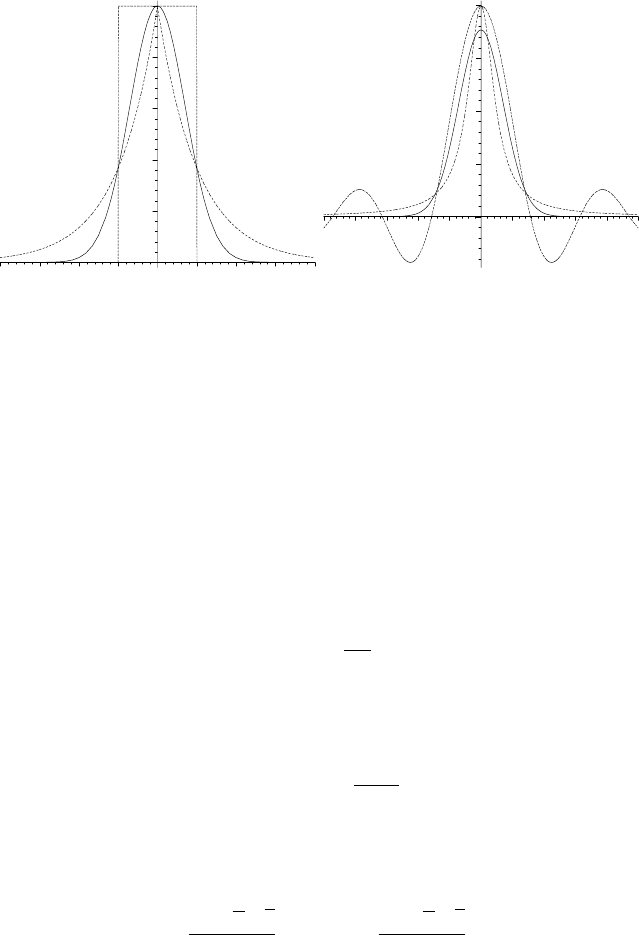
Making use of G, the three given functions f1 , f2,andf3 are plotted together,
the curves being given different colors and line styles. The resulting picture is
shown on the left of Figure 6.1.
224 CHAPTER 6. INTEGRAL TRANSFORMS
>
plot([G(f1),G(f2),G(f3)],x=-4..4,color=[red,blue,green],
linestyle=[1,2,3],thickness=2,labels=["x","f"]);
0
f
1
–4
x
4
F
0.8
–8
x
8
Figure 6.1: Left: the three f(x). Right: Corresponding Fourier transforms.
The three Fourier transforms F1 , F2,andF3 are plotted with matching colors
and line styles and shown on the right of the figure.
>
plot([G(F1),G(F2),G(F3)],k=-10..10,color=[red,blue,green],
linestyle=[1,2,3],thickness=2,labels=["x","F"]);
The oscillatory curve is the transform of the rectangle f3 , the shorter smooth
curve the transform of the Gaussian f1 , and the taller smooth curve is the
transform F2 . The correspondence is more evident on the computer screen.
Using the complex conjugate (conjugate) command, an operator L is formed
to calculate the left-hand side of Parseval’s theorem for a given function f.
>
L:=f->int(f*conjugate(f),x=-infinity..infinity);
L := f →
∞
−∞
f
(f) dx
Similarly, an operator R is created to calculate the right-hand side of Parseval’s
theorem for a specified Fourier transform FT .
>
R:=FT->int(FT*conjugate(FT),k=-infinity..infinity);
R := FT →
∞
−∞
FT
(FT ) dk
Using L and R, Parseval’s theorem is now confirmed for the function f1 and its
transform F1 , the results L1 and R1 being identical.
>
L1:=L(f1); R1:=R(F1);
L1 :=
A
2
√
π
√
2
2 a
R1 :=
A
2
√
π
√
2
2 a
It is left as an exercise for you to confirm that Parseval’s theorem holds for the
other two cases.
6.1. FOURIER TRANSFORMS 225
6.1.2 A Northern Weenie Roast
Wedding: the point at which a man stops toasting a woman
and begins roasting her.
Helen Rowland, American journalist, A Guide to Men,“Syncopations” (1922)
While visiting his inlaws in Northern Ontario over the Christmas holidays,
Russell went snowmobiling with his family. After a few hours, feeling slightly
cold and hungry, they stopped at one of the warming huts along the track and
soon had a roaring fire going in the fireplace. Using some long thin steel rods
which had been conveniently leaning against the outer wall of the hut, they
satisfied their hunger by roasting weenies in the fire.
Idealizing the cooking situation, let’s calculate and animate the temperature
distribution inside a thin insulated semi-infinite (0 ≤ x ≤∞) steel rod which
has the x=0 end held at a fixed temperature T 0 and whose interior is initially
at 0 degrees Celsius. For steel, the thermal conductivity K =46 W/(m K
◦
), the
density ρ=8 × 10
3
kg/m
3
, and the specific heat C =500 J/(kg K
◦
).
The plots and integral transform packages are loaded, the former needed for
the animation, the latter for the Fourier sine (fouriersin) command.
>
restart: with(plots): with(inttrans):
The one-dimensional heat diffusion equation is entered in de, T(x, t)being
the temperature at a distance x from the hot end of the rod at time t.The
parameter a =
K/(ρC).
>
de:=diff(T(x,t),t)=aˆ2*diff(T(x,t),x,x);
de :=
∂
∂t
T(x, t)=a
2
(
∂
2
∂x
2
T(x, t))
Since the temperature is specified at x = 0, i.e., T (0,t)=T 0, we will solve the
diffusion equation by first taking the Fourier sine transform of de, yielding the
time-dependent ODE shown in the output of eq .
>
eq:=fouriersin(de,x,k);
eq :=
∂
∂t
fouriersin(T(x, t),x,k)=
a
2
k (
√
2T(0,t) − k fouriersin(T(x, t),x,k)
√
π)
√
π
The notation is simplified by replacing fouriersin(T(x, t),x,k)withF(k, t).
>
eq2:=subs(fouriersin(T(x,t),x,k)=F(k,t),eq);
eq2 :=
∂
∂t
F(k, t)=
a
2
k (
√
2T(0,t) − k F(k, t)
√
π)
√
π
The boundary condition T (0,t)=T0 is substituted into eq2 .
>
eq3:=subs(T(0,t)=T0,eq2);
eq3 :=
∂
∂t
F(k, t)=
a
2
k (
√
2 T0 − k F(k, t)
√
π)
√
π

226 CHAPTER 6. INTEGRAL TRANSFORMS
Then, the ODE eq3 is analytically solved for F(k, t).
>
eq4:=dsolve(eq3,F(k,t));
eq4 := F(k, t)=
√
2 T0
k
√
π
+ e
(−a
2
k
2
t)
F1(k)
Since T (x, 0) = 0 for x>0, then F (k, 0)= 0. So, the arbitrary function
F1(k)
is determined by evaluating the right-hand side of eq4 at time t=0, setting the
result equal to 0, and solving for
F1(k).
>
_F1(k):=solve(eval(rhs(eq4),t=0),_F1(k));
F1(k):=−
√
2 T0
k
√
π
F1(k) is automatically substituted into eq4 , the result being labeled eq5 .
>
eq5:=eq4;
eq5 := F(k, t)=
√
2 T0
k
√
π
−
e
(−a
2
k
2
t)
√
2 T0
k
√
π
The temperature distribution inside the rod at arbitrary time t ≥ 0 follows on
applying the following Fourier sine command to the right-hand side of eq5 ,and
simplifying with the symbolic option.
>
T:=simplify(fouriersin(rhs(eq5),k,x),symbolic);
T := −T0 (−1+erf(
x
2 a
√
t
))
The temperature T is expressed in terms of the error function. As a partial check
on our calculation, note that for x>0andt =0, T(x, 0) = T0 (1 − erf(∞)) =
T0 (1 − 1) = 0 as it should. The thermal conductivity (K), density (ρ), and
specific heat (C) values for steel are now entered and the diffusion coefficient
a =
K/(ρC) calculated. In the MKS system, a has the units m/s
1/2
.For
convenience, a is converted to CGS units by multiplying by 100, since 1 m =
100 cm. The units of a are then cm/s
1/2
, the distance x being expressed in cm.
>
K:=46: rho:=8*10ˆ3: C:=500: a:=100*sqrt(K/(rho*C));
a :=
√
46
20
The normalized temperature distribution T/T0 is given in TT,
>
TT:=T/T0;
TT := 1 −erf(
5 x
√
46
23
√
t
)
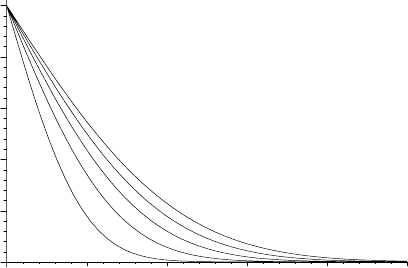
which is plotted at 60 second (1 minute) time intervals up to 5 minutes.
>
plot([seq(eval(TT,t=60*i),i=1..5)],x=0..25,thickness=2,
labels=["x","T/T0"]);
The resulting time evolution of the temperature inside the rod is shown in
Figure 6.2, the curve furthest to the left corresponding to 1 minute, the curve
furthest to the right to 5 minutes. Even at 5 minutes the temperature at x =25
cm is a tiny fraction of the temperature at the hot end.
6.1. FOURIER TRANSFORMS 227
0
0.2
0.4
0.6
0.8
1
T/T0
5
10
15
20
25
x
Figure 6.2: Normalized temperature distribution inside rod at different times.
Clearly, the semi-infinite approximation to the long rod is not too bad. The nor-
malized temperature distribution is now animated over the same time interval,
100 frames being used.
>
animate(TT,x=0..25,t=0..300,frames=100,thickness=2,
labels=["x","T/T0"]);
You will have to execute the recipe on your computer to see the animation.
6.1.3 Turn Off the Boob Tube and Concentrate
Television’s perfect. You turn a few knobs, a few of those mechanical
adjustments at which the higher apes are so proficient, and lean back
and drain your mind of all thought. And there you are watching the
bubbles in the primeval ooze. You don’t have to concentrate. You
don’t have to react. You don’t have to remember. You don’t miss
your brain because you don’t need it.
Raymond Chandler, American novelist, (1888–1959)
Since you are reading this book, you have turned your back (at least tem-
porarily) on watching TV. Having your undivided attention, I would like you
to concentrate on the following example involving the Fourier cosine transform.
Consider a thin semi-infinite (0 ≤ x ≤∞) hollow tube, closed at the x =0
end, containing water. A drop of blue ink is injected at the point x = x0 > 0
at time t = 0. Suppose that the drop has an initial concentration profile given
approximately by C(x, 0) =f(x)=Aδ(x−x0). If the diffusion constant of ink in
water is d, determine the concentration of ink for arbitrary time t ≥ 0. At what
time T is the concentration of ink at x = 0 a maximum? Taking the nominal
values A =1, d =1, and x0 = 10, evaluate T and animate the concentration
profile C(x, t) and plot C(0,t) over a time interval up to 2T .