
Faddeev L.D., Yakubovskii O.A. Lectures on Quantum Mechanics for Mathematics Students
Подождите немного. Документ загружается.

78 L. D. Faddeev and 0. A. YakubovskiT
freedom in a potential field has the form
z
H(P, 4) =
2m
+
V (q).
Corresponding to this Hamiltonian function is the Schr" inger oper-
ator
H=
P
+ V(Q).
For a free particle V = 0. We begin with a study of this simplest
problem in quantum mechanics. Let us find the spectrum of the
Schrodinger operator
(1)
_ P2
The equation for the eigenvectors has the form
P2
(2)
or, in the coordinate representation,
h2
d2,0
'
E .
(3)
2m dx2 -
It is convenient to use a system of units in which h = 1 and m = 1/2.
Then for E > 0 the equation (2) takes the form
(4)
0
11
+ k
2,0
=01 k
2
=Ej k>O.
The last equation has two linearly independent solutions
--
1
2
fikx
(5)
bf k (x)
e
=
21r
We see that to each value E > 0 there correspond two eigenfunctions
of the operator H. For E < 0 the equation (3) does not have so-
lutions bounded on the whole real axis. Thus, the spectrum of the
Schrodinger operator (1) is continuous and positive and has multi-
plicity two.
The functions (5) are at the same time the eigenfunctions of the
momentum operator P = -i that correspond to the eigenvalues
±k. We note that the functions (5) do not belong to L2 (R) and,
§ 15. One-dimensional problems of quantum mechanics
79
therefore, are not eigenfunctions in the ordinary sense. For subse-
quent formulas it is convenient to assume that -- oo < k <
k = ± VEK Then both the solutions (5) have the form
(s)
,W,/ 1 fkx
k (x - (i;) 8
The normalizing factor in (6) was chosen so that
(7)
JR
Ok(x) 'Ok-(X) dX =a(k - k').
oo and
The solutions of (2) in the momentum representation are obtained
just as simply. For m = 1, (2) has the form
(s)
p2b=k2i',
and its solutions are the functions
(9)
Ok(P) = 8(p - k),
k =fem.
The normalization of the functions (9) is chosen the same as for the
functions (6):
JR
=
Jo(-.
k) b(p - k') ap = a(k - k').
To explain the physical meaning of the eigenfunctions Ok, we
construct a solution of the nonstationary Schrodinger equation for a
free particle
dip (t)
= HO(t)
dt
under the initial conditions
,0(0) holl = 1.
This problem is simplest to solve in the momentum representation
ft (p, 0
= p2o(p,
t),
10 (A 0) _ 0 (P)
Ji(p)l2dp
= 1.
Obviously,
0(p, t) = SP(p)
a-$Pat.
80
L. D. Faddeev and 0. A. Yakubovskri
In the coordinate representation the same state is described by
the function
(10)
1
2 -pZt) -2t
(x, t)
= (27r) JR W(P) e"
dP = JR (k) ?Gk(x) e
A.
It is easy to verify that the normalization of the function *(x, t) does
not depend on the time:
JR
jjp(X7 t) 12dX =
I
I P (P) 12dp = 1.
The formula (10) can be regarded also as a decomposition of the
solution O(x, t) of the Schrodinger equation with respect to stationary
states, that is, as a generalization of the formula (9.13) to the case of
a continuous spectrum. The role of the coefficients c is played here
by the function p(k).
The state described by the functions O(x, t) or O(p, t) has the
simplest physical meaning in the case when cp(p) is nonzero in some
small neighborhood of the point po. States of this type are generally
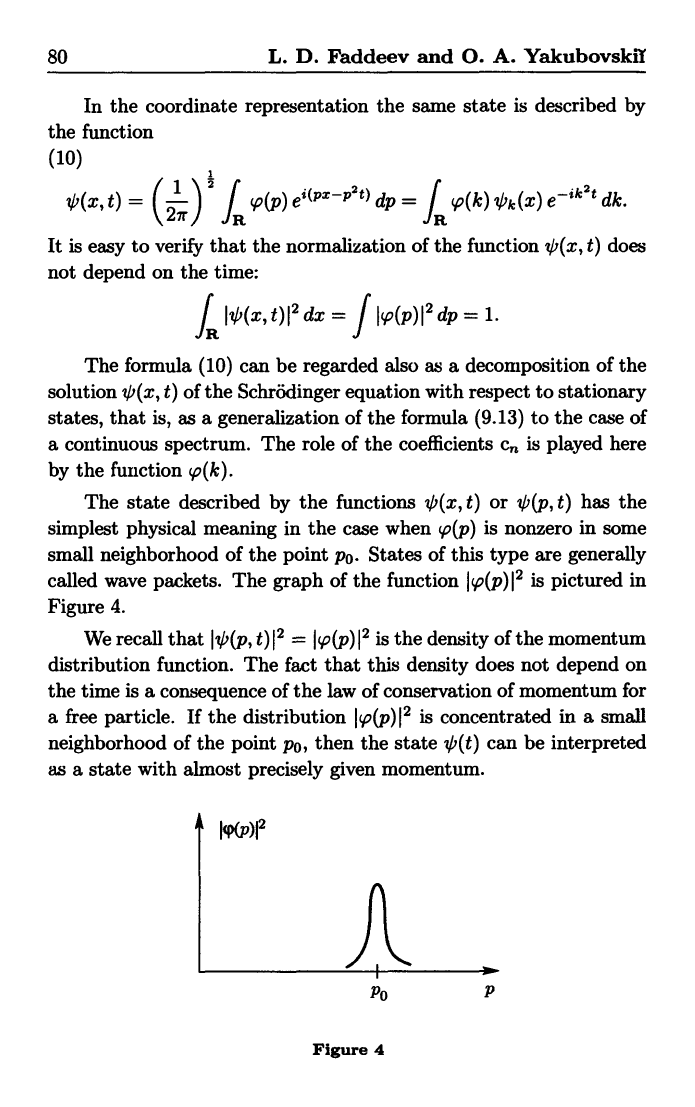
called wave packets. The graph of the function Icp(p)12 is pictured in
Figure 4.
We recall that I lp (p, t) 12 = I cp(p) 12 is the density of the momentum
distribution function. The fact that this density does not depend on
the time is a consequence of the law of conservation of momentum for
a free particle. If the distribution
IW(p)12 is concentrated in a small
neighborhood of the point po, then the state fi(t) can be interpreted
as a state with almost precisely given momentum.
All
10-
PO
p
Figure 4
§ 15. One.dimensional problems of quantum mechanics
81
The function kt'(x, t)12 is the density of the coordinate distribu-
tion function. Let us trace its evolution in time. First of all it follows
from the Riemann- Lebesgue theorem 23 that
(x, t) ---* 0 as Itl --> 00
for smooth ap(p), and therefore the integral fn
(x, t) 12 dx over any
finite region f of the real axis tends to zero.
This means that as
Itt --* oo, the particle leaves any finite region; that is, the motion is
infinite.
In order to follow more closely the motion of the particle for large
Jt, we use the stationary phase method. This method can be used to
compute integrals of the form
(11)
b
I (N) _
F(x) esNf (x) dx
a
asymptotically as N -+ oo. For the case of smooth functions f (x)
and F (x) and when there is a single point i in (a, b), where
,f (x) is
stationary (f(X) = 0, f"() 0), we have the formula
(12)
2
IN=
F xex
iN +sn"
0 (h).
(NI;)
}
4We
rewrite the expression for 0(x, t) in the form
I
z
x t = (i-)
d
0(')
rJRV (p)
p
The upper sign in the exponential corresponds to t > 0 and the lower
to t < 0. We find the asymptotics of b(x, t) as t --* ±oo from the
formula (12). Then the stationarity is found from the condition
x
PP) = T 2p + Ft = 0,
from which p = 2t
. Further,
f " (p) =::F22 and as t -* ±o,c
x t =
x 1
2
eix(x,t)
0
(13)
t(, )`;P
+
it-
(21tj
where x is a real function whose form is not important for what
follows.
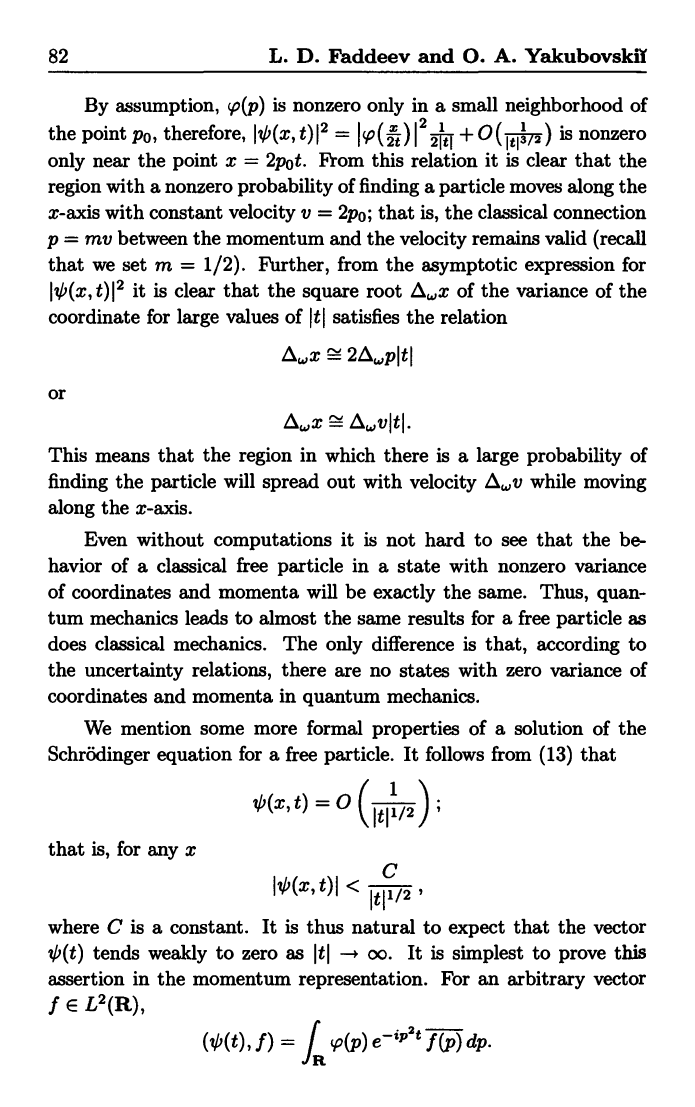
23This theorem asserts that f
°o f(x)e'
dx - 0 as N --r oo if the function f (x)
is piecewise continuous and absolutely integrable on the whole axis -oo < x < oo
82
L. D. Faddeev and 0. A. Yakubovskii
By assumption, ap(p) is nonzero only in a small neighborhood of
the point po, therefore, 1,0 (x, t) 12 =
I p(it)12
2
t +O( -It 1-3 , is nonzero
only near the point x = 2pot. From this relation it is clear that the
region with a nonzero probability of finding a particle moves along the
x-axis with constant velocity v = 2po; that is, the classical connection
p = my between the momentum and the velocity remains valid (recall
that we set m = 1/2). Further, from the asymptotic expression for
I lli(x,t)12 it is clear that the square root D,,,x of the variance of the
coordinate for large values of ItI satisfies the relation
Owx = 20wPltl
or
A"X A"VItj.
This means that the region in which there is a laxge probability of
finding the particle will spread out with velocity A,, v while moving
along the x-axis.
Even without computations it is not hard to see that the be-
havior of a classical free particle in a state with nonzero variance
of coordinates and momenta will be exactly the same. Thus, quan-
tum mechanics leads to almost the same results for a free particle as
does classical mechanics. The only difference is that, according to
the uncertainty relations, there are no states with zero variance of
coordinates and momenta in quantum mechanics.
We mention some more formal properties of a solution of the
Schrodinger equation for a free particle. It follows from (13) that
xt
0 1
(j )
Itj1/2
that is, for any x
kt'(x,t)i <
jji/2'
where C is a constant. It is thus natural to expect that the vector
sli(t) tends weakly to zero as ItI --> oo.
It is simplest to prove this
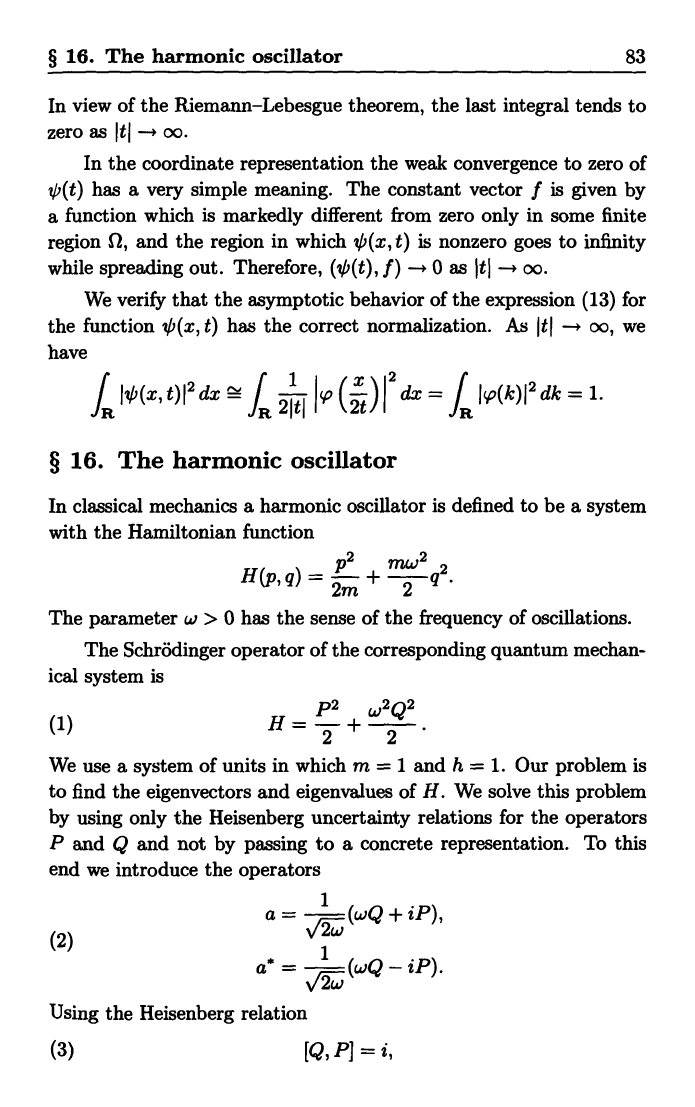
assertion in the momentum representation. For an arbitrary vector
f E L2 (R),
(b(t),f) =
JR
§ 16. The harmonic oscillator
83
In view of the Riemann-Lebesgue theorem, the last integral tends to
zero as ItI -> oo.
In the coordinate representation the weak convergence to zero of
ip(t) has a very simple meaning. The constant vector f is given by
a function which is markedly different from zero only in some finite
region SZ, and the region in which O(x, t) is nonzero goes to infinity
while spreading out. Therefore, (i/.'(t), f) --+ 0 as It I
--+ oo.
We verify that the asymptotic behavior of the expression (13) for
the function 0 (x, t) has the correct normalization. As ItI -+ oo, we
have
JR
I'P(x, t)
12 dX
N f
t
21tj
I
0 (X)
2tI2
- JR
Ico(k)i2dk=l.
§ 16. The harmonic oscillator
In classical mechanics a harmonic oscillator is defined to be a system
with the Hamiltonian function
H(Pj 9') =
2m + 2 g2
The parameter w > 0 has the sense of the
freq2
uency of oscillations.
The Schrodinger operator of the corresponding quantum mechan-
ical system is
PZ w2Q2
(1)
H = 2 +
2
We use a system of units in which m = 1 and h = 1. Our problem is
to find the eigenvectors and eigenvalues of H. We solve this problem
by using only the Heisenberg uncertainty relations for the operators
P and Q and not by passing to a concrete representation. To this
end we introduce the operators
(2)
a =
1
(WQ + ip),
a*
=
1
(WQ - ip).
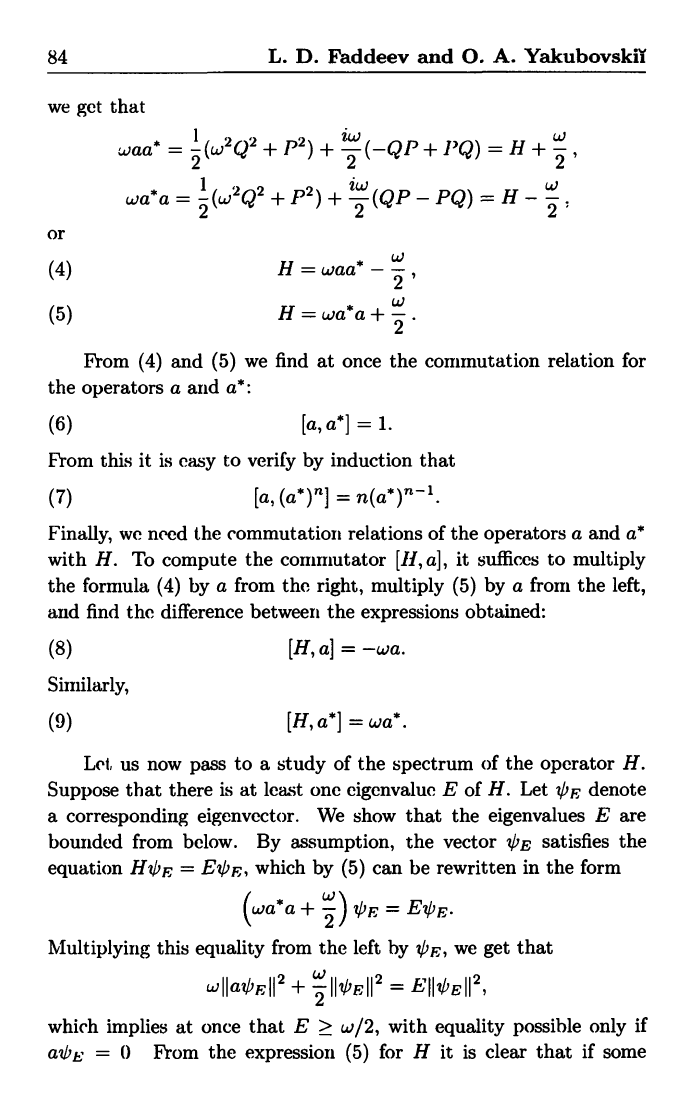
Using the Heisenberg relation
(3)
[Qj P]
= ij
84
L. D. Faddeev and 0. A. Yakubovskii
we get that
waa*=
wl Q2 + P2+aw
( 2
(-QP+I>Q)=H+-
2
2
wa*a = -GO 2Q2 + P2) +
2w
(QP
- PQ) =
H --
`IO
2
2 2
or
(4)
(5)
H = waa* 2
W
H=wa*a+
2
.
From (4) and (5) we find at once the commutation relation for
the operators a and a*:
(6)
[a,a*] = 1.
From this it is easy to verify by induction that
(7)
[n, (a*)n]=n (m
)^-1.
Finally, we need the commutation relations of the operators a and a*
with H. To compute the co mutator [H, a], it suffices to multiply
the formula (4) by a from the right, multiply (5) by a from the left,
and find the difference between the expressions obtained:
[I-I, a] = -wa.
(9)
[H, a*] = wa*.
Let, us now pass to a study of the spectrum of the operator H.
Suppose that there is at least one eigcnvalue E of H. Let 'E denote
a corresponding eigenvector. We show that the eigenvalues E are
bounded from below. By assumption, the vector
'OE satisfies the
equation H F = Ei/ , which by (5) can be rewritten in the form
wa*a +') OF = EV)E.
Multiplying this equality from the left by 'OE, we get that
wllalFll2+w
IIh/,E 112 =EII 112,
2
which implies at once that E > w/2, with equality possible only if
aibE = 0
From the expression (5) for H it is clear that if some
§ 16. The harmonic oscillator
85
vector
satisfies the condition a = 0, then it is an eigenvector of H
corresponding to the eigenvalue w/2.
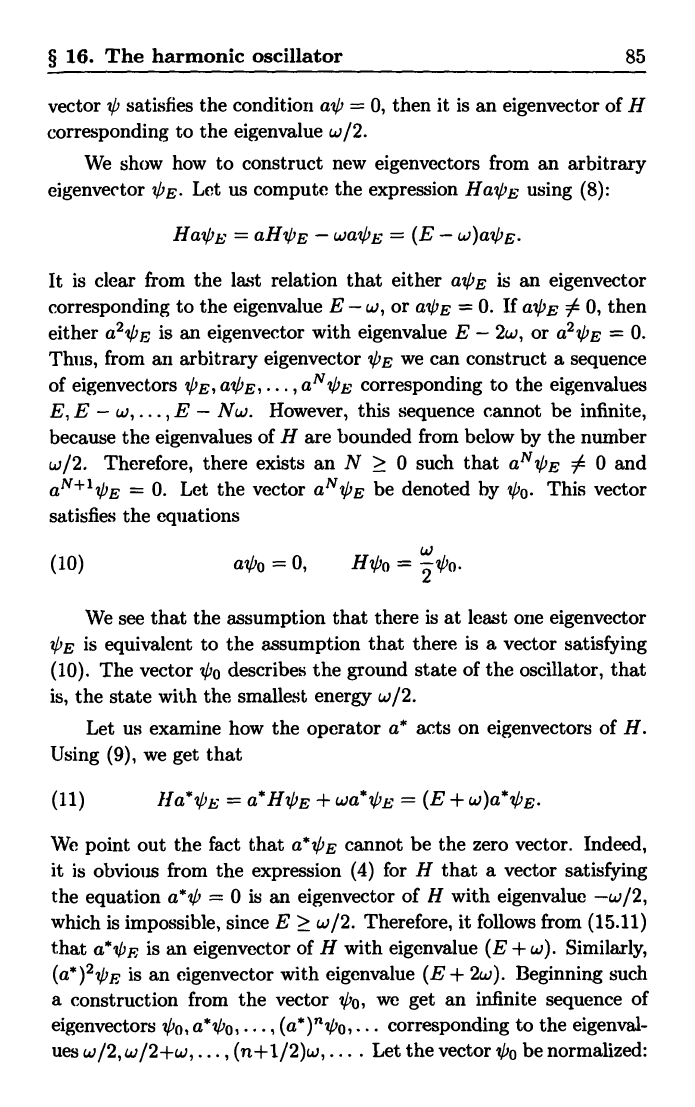
We show how to construct new eigenvectors from an arbitrary
eigenvector 1E. Let us compute the expression HaE using (8):
Haz/iE= aH?/iE - wa'OE =(E - w)aViE.
It is clear from the last relation that either aE is an eigenvector
corresponding to the eigenvalue E -- w, or aIPE = 0. If a'E
0, then
either a2 ,0,F is an eigenvector with eigenvalue E -- 2w, or a2 E = 0.
Thus, from an arbitrary eigenvector bE we can construct a sequence
of eigenvectors ?PE, aE, ... , aNuE corresponding to the eigenvalues
E, E -- w, ... , E -- Nw. However, this sequence cannot be infinite,
because the eigenvalues of H are bounded from below by the number
w/2. Therefore, there exists an N > 0 such that aN E 54 0 and
aN+ 1 V)E = 0. Let the vector a N uE be denoted by 00. This vector
satisfies the equations
w
(10)
ado = 0,
HV)o = 2 V)o
We see that the assumption that there is at least one eigenvector
bE is equivalent to the assumption that there is a vector satisfying
(10). The vector iU describes the ground state of the oscillator, that
is, the state with the smallest energy w/2.
Let us examine how the operator a* acts on eigenvectors of H.
Using (9), we get that
(11) Ha*tE = a*HbE + wa* bE = (E + w)a* bE
We point out the fact that a*bE cannot be the zero vector. Indeed,
it is obvious from the expression (4) for H that a vector satisfying
the equation a*
= 0 is an eigenvector of H with eigenvalue --w/2,
which is impossible, since E > w12. Therefore, it follows from (15.11)
that a*uE is an eigenvector of H with eigenvalue (E + w). Similarly,
(a*)2pE is an eigenvector with eigenvalue (E + 2w). Beginning such
a construction from the vector 00, we get an infinite sequence of
eigenvectors Oo, a *o
, ... ,
(a*)?z1/.'o,... corresponding to the eigenval-
Ues w/2, w12 +w, ... , (n+ 112)w I .... Let the vector 00 be normalized:
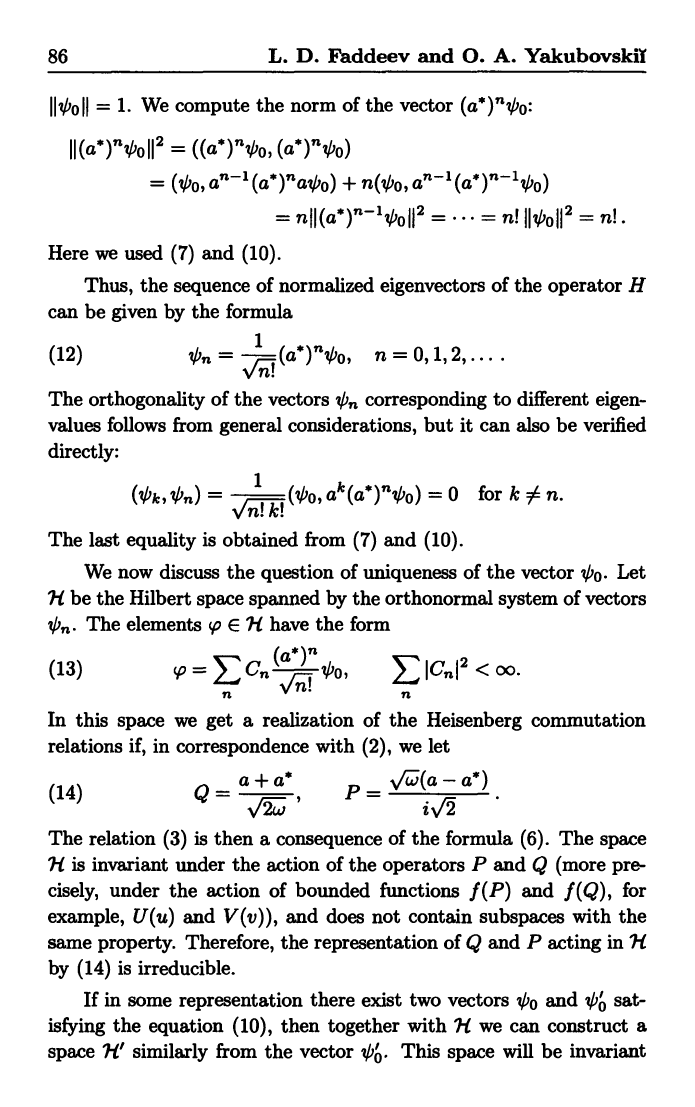
86
L. D. Faddeev and 0. A. YakubovskiT
I
II = 1. We compute the norm of the vector (a*)flt,o:
11(a
*)nO0112
= ((a*
)noo, (a* )nOO)
(bo,a1_l(a*)nabo)
+ n(V)o,
(a*
Here we used (7) and (10).
Thus, the sequence of normalized eigenvectors of the operator H
can be given by the formula
(12)
On
(a*)noo,
n = 07 1127
The orthogonality of the vectors on corresponding to different eigen-
values follows from general considerations, but it can also be verified
directly:
(Ok, fin)
(0o, ak(a')"'+Po) = 0
for k # n.
The last equality is obtained from (7) and (10).
We now discuss the question of uniqueness of the vector Rio. Let
?{ be the Hilbert space spanned by the orthonormal system of vectors
On. The elements cp E 7-l have the form
In
n! E jCnj2 < 00.
(13)
O=i:C
(a
n 7= jpO I
In this space we get a realization of the Heisenberg commutation
relations if, in correspondence with (2), we let
(14)
Q =
a+a*
P
Vrw(a - a*)
of
The relation (3) is then a consequence of the formula (6). The space
?[ is invariant under the action of the operators P and Q (more pre-
cisely, under the action of bounded functions f (P) and f (Q), for
example, U(u) and V(v)), and does not contain subspaces with the
same property. Therefore, the representation of Q and P acting in W
by (14) is irreducible.
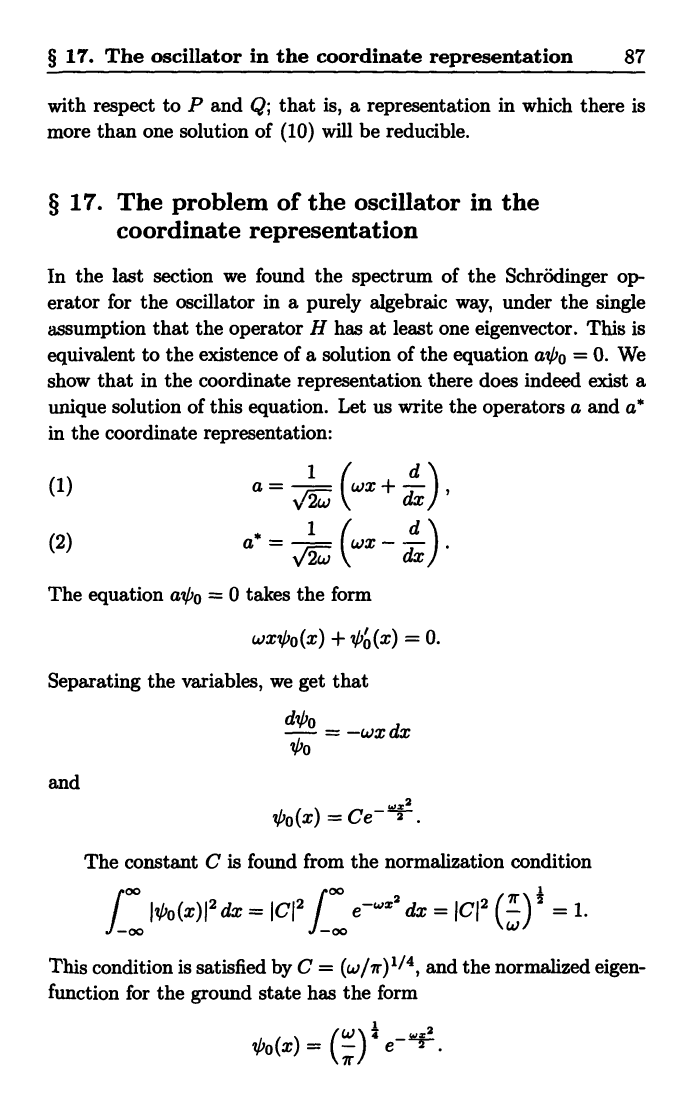
If in some representation there exist two vectors 00 and 00' sat-
isfying the equation (10), then together with W we can construct a
space ?{' similarly from the vector 0o. This space will be invariant
§ 17. The oscillator in the coordinate representation
87
with respect to P and Q; that is, a representation in which there is
more than one solution of (10) will be reducible.
§ 17. The problem of the oscillator in the
coordinate representation
In the last section we found the spectrum of the Schr"finger op-
erator for the oscillator in a purely algebraic way, under the single
assumption that the operator H has at least one eigenvector. This is
equivalent to the existence of a solution of the equation ado = 0. We
show that in the coordinate representation there does indeed exist a
unique solution of this equation. Let us write the operators a and a*
in the coordinate representation:
72= w-
(
(2) a WX
w=
( )
The equation ado = 0 takes the form
wx'00(x) + Rio (x) = 0.
Separating the variables, we get that
dV'o - --wx dx
00
and
by (x) = C'e
The constant C is found from the normalization condition
f
00
00
1= IC12
f--
e "s'
dx = IC12
00
This condition is satisfied by C = (w/ir)'/4, and the normalized eigen
function for the ground state has the form
or:a
fo(x)
4
= () e s