
Faddeev L.D., Yakubovskii O.A. Lectures on Quantum Mechanics for Mathematics Students
Подождите немного. Документ загружается.

88
L. D. Faddeev and 0. A. Yakubovskii
The eigenfunctions din (x) for the excited states are found by the
formula (16.12) using (2):
n
' (2w) - 1 d WX
(W) 2
On (X) = -
UjX -
dx
e
2
7r
Vn-1
Obviously, these functions have the form
2
,On (x) = Pn (x) e-"
4
-1
where Pn (x) is an nth-degree polynomial.
It can be shown that
Pn(x) =
w--x), where
is the nth Chebyshev-Hermite poly-
nomial. It is known that the system of functions H e'
-t2
is Com-
plete in L2(R). This assertion follows in general from the irreducibil-
ity of the coordinate representation and results in the preceding sec-
tion.
The function
is the density of the coordinate distribution
function in the nth state of the oscillator. It is interesting to compare
this distribution with the corresponding classical distribution. The
solution of the classical problem of an oscillator has the form
(3)
x(t) = A sin(wt + W)
7
where A is the amplitude of oscillation and Sp is the initial phase. The
energy of the oscillations can be computed from the formula
_ x2 w2 x
2
2
E=
+ 2
and is equal to w2A2/2. The corresponding density of the coordinate
distribution function has the form
(4)
F(x) = 6(x - x(t)).
It is clear that a stationary state of a quantum oscillator can under
no conditions pass into a classical pure state given by the formula
(3). It is natural to assume that the limit of a quantum state will be
a classical mixed state that is a convex combination of solutions (3)
with random phases cp. For such a state the density of the coordinate
§ 17. The oscillator in the coordinate representation
89
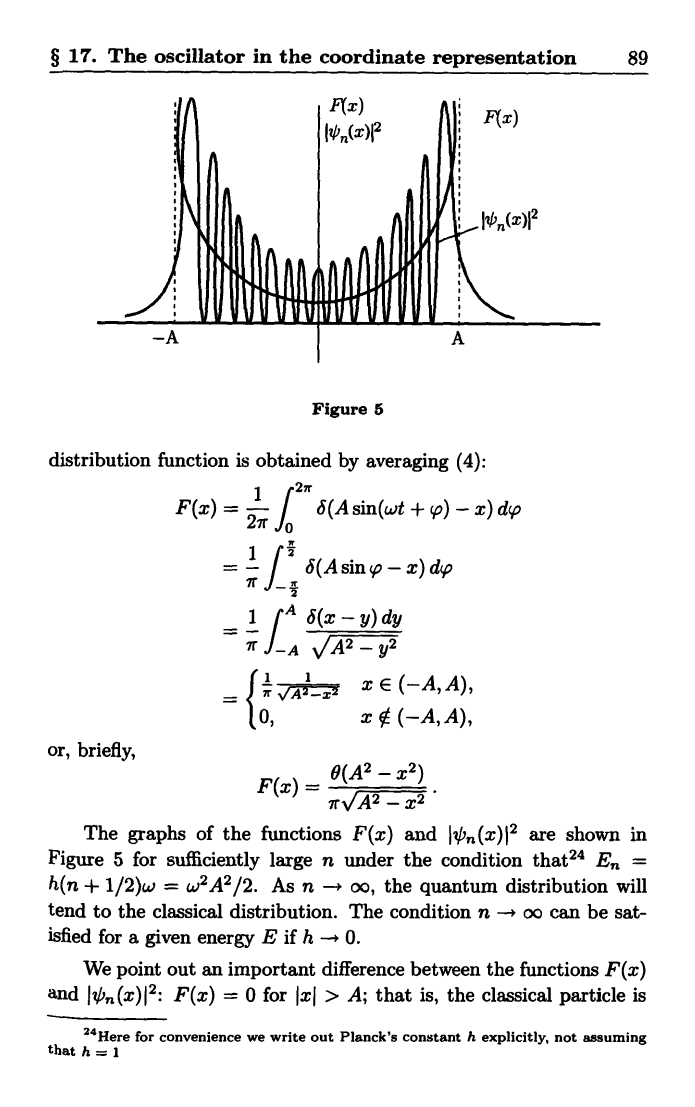
Figure 5
distribution function is obtained by averaging (4):
27r
F(x) =
2-7r
S(Asin(wt + gyp) - x) dcp
0
0,
x
(-A, A),A}o,
x
,
or, briefly,
F(x) =
O(A 2 - X2)
r A2 - x2
The graphs of the functions F(x) and k1'(x)I2 are shown in
Figure 5 for sufficiently large n under the condition that24 En
=
h(n + 112)w = w2A2/2. As n -+ oo, the quantum distribution will
tend to the classical distribution. The condition n --+ oo can be sat-
isfied for a given energy E if h --+ 0.
We point out an important difference between the functions F(x)
and
F(x) = 0 for IxI > A; that is, the classical particle is
24Here for convenience we write out Planck's constant h explicitly, not assuming
that h = 1
90
L. D. Faddeev and 0. A. YakubovskiY
always between -A and A (in the classically allowed region), while
the function 17kn(x)12 does not vanish for Jxj > A. This means that
the quantum particle can be observed with finite probability in the
classically forbidden region. For an arbitrary potential V (x) this re-
gion is determined by the condition that the total energy E is < V (x),
which corresponds to negative values of the classical kinetic energy.
§ 18. Representation of the states of a
one-dimensional particle in the sequence
space 12
According to the results in § 16, any vector W E W can be expanded
in a series of eigenvectors of the energy operator of the harmonic
oscillator:
_
(a*)
001
1:
'Cl2
Cnn n
< 00.
Each vector p E 7I is uniquely determined by the coefficient se-
quence {C}, that is,
O H
If ik +-+ {B}, then
(a) = 1: BnCn
n
in view of the orthonormality of the system of vectors
(a*)n
On =
00-
ri
Let us consider how the operators act in such a representation.
For this it suffices to construct the operators a and a*. Suppose that
5O
{C} and acp {C}. We must express Cm in terms of C, .
§ 18. Representation for a one-dimensional particle 91
This can be done as follows:
(1)
acp = al: C
1Po
n
n
nlasln-1
l
J
0
Cn
Y
76!
* n--1
n
E n G-rn
lu' 1
n
V(" n-- - ---1) i I P 0
vrn- -+1 Cn+1
(a*)n
00 -
The calculation used the relations [a, (a*)f] = n (a *) n and at'c = = 0,
and the last equality is obtained by the change n --+ n + 1 of the
summation index. It is clear from (1) that
(2)
Similarly,
n
Therefore, if a`V -> {C;;}, then
(3)
Cn = Vn-Cn-l-
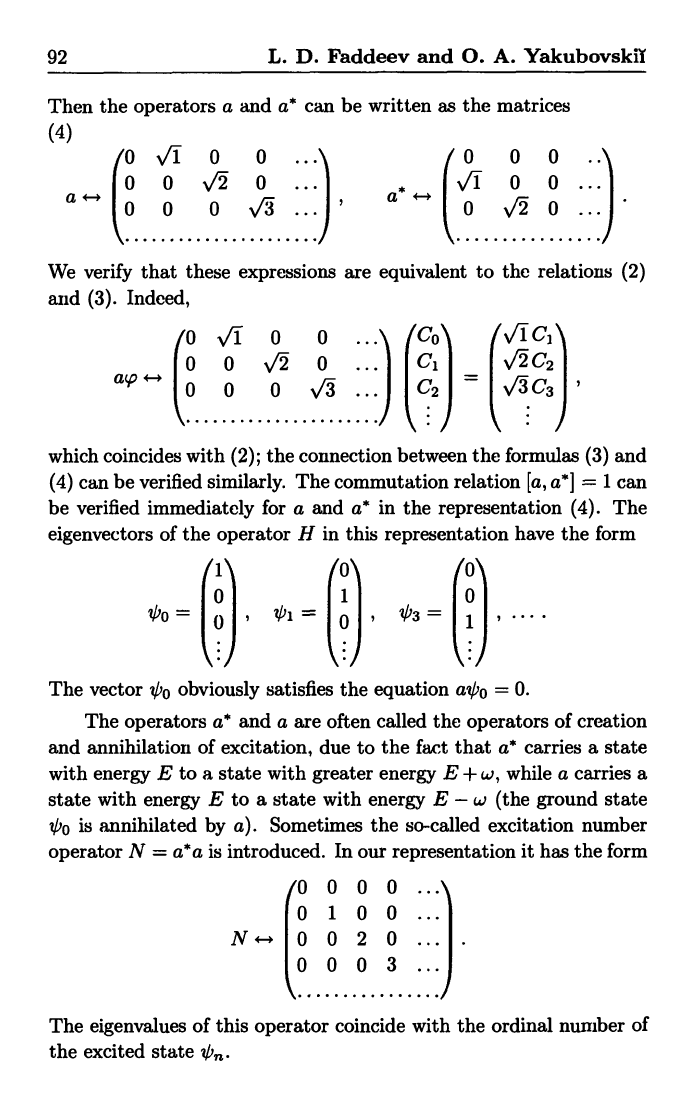
The formulas (2) and (3) become especially intuitive in matrix
notation. Let us write the sequence {C} as a column:
Co
Cl
cp H C2
Cn= Vn-+1 Cn.
a*
n
n
E (a
In
cn
!00
n
- Cn
/a*)ntl
00
nt
* n+l
n
1: Vn-+l Cn
u
00
n
Y
(a*)n
'LCn-1
Tn !
92
L. D. Faddeev and 0. A. YakubovskiI
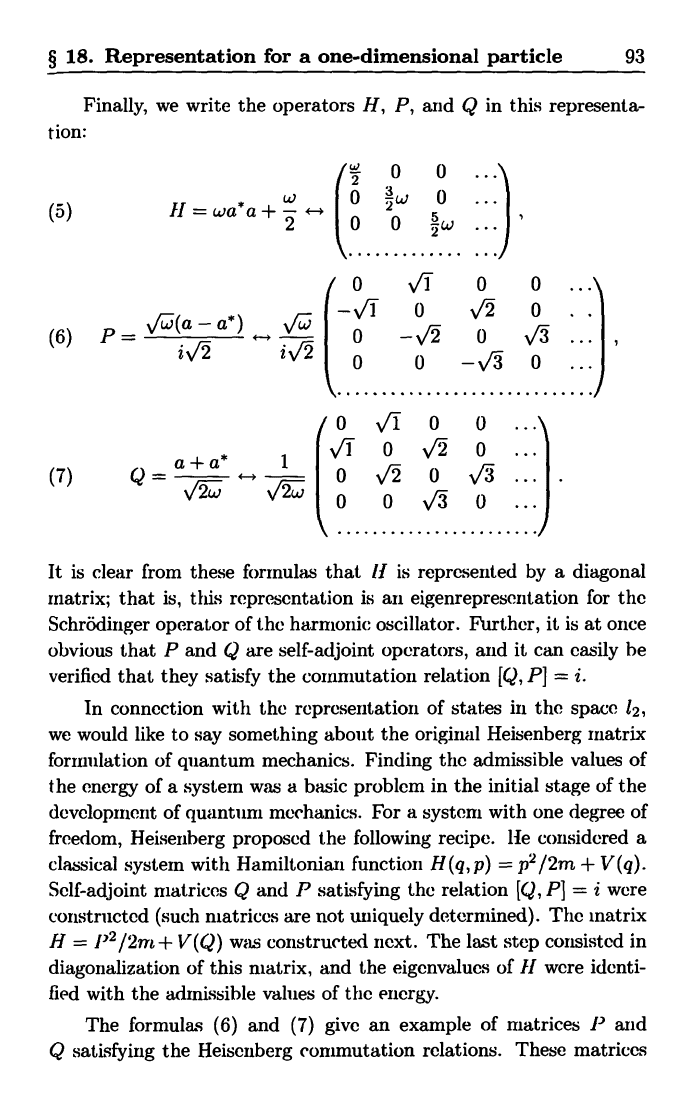
Then the operators a and a* can be written as the matrices
(4)
aH
o
vfi- 0
0
0
0
o
0 0
0
0 0
0
0
0
0
................
. .
. . .
. . . . .
. .
. . .
:::
...
. . . .
. .
a*
0
0
0
f 0
0 ..
0 ,./2 0 ..
................
................
We verify that these expressions are equivalent to the relations (2)
and (3). Indeed,
0 f 0 0
...
Co
f/Tci
0 0 f2-
0 Ci
f Ca
a`p 0
0
0
... C2
vf3-Cs
which coincides with (2); the connection between the formulas (3) and
(4) can be verified similarly. The commutation relation [a, a*] = 1 can
be verified immediately for a and a* in the representation (4). The
eigenvectors of the operator H in this representation have the form
1
0 0
0
1
0
0- of -
o
,3= 1
,
....
The vector b0 obviously satisfies the equation abo = 0.
The operators a* and a are often called the operators of creation
and annihilation of excitation, due to the fact that a* carries a state
with energy E to a state with greater energy E + w, while a carries a
state with energy E to a state with energy E -- w (the ground state
o is annihilated by a). Sometimes the so-called excitation number
operator N = a*a is introduced. In our representation it has the form
N+-+
0
0 0 0
...
0
1
0 0
...
0 0
2
0
...
0 0 0
3
...
The eigenvalues of this operator coincide with the ordinal number of
the excited state, on.
§ 18. Representation for a one-dimensional particle
93
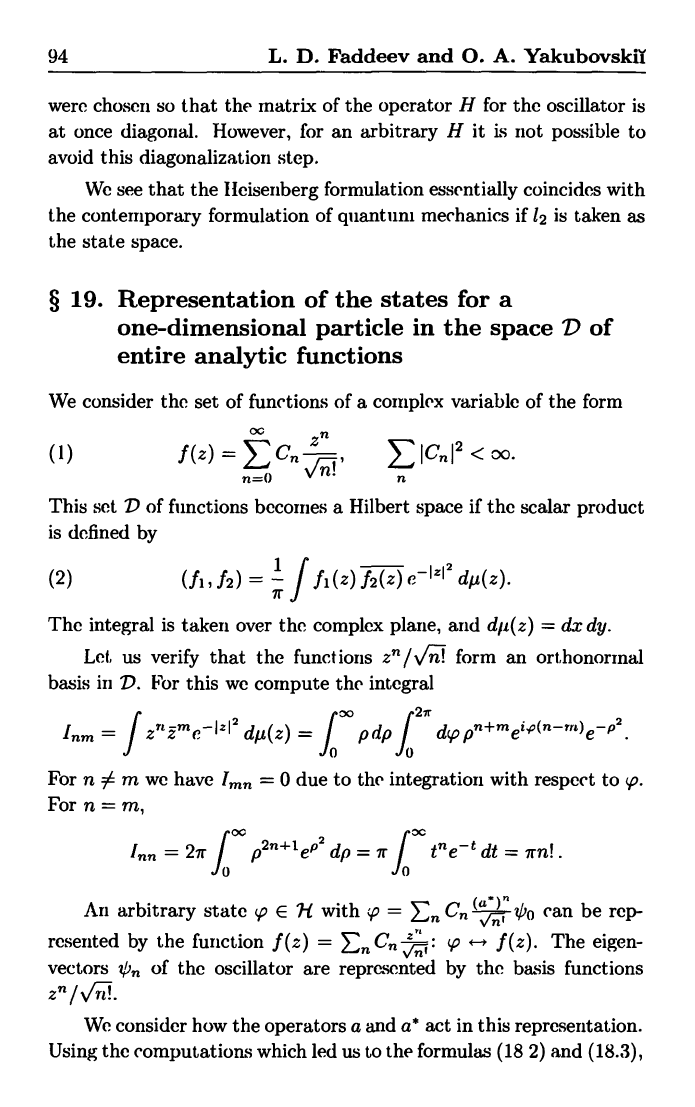
Finally, we write the operators H, P, and Q in this representa-
tion:
0 0
...
(5)
H=wa*a+wH
O 2
0
...
2 0
0 Zw
...
............. ...
(6) P =
VW--(a - a*)
if
M
C) -
0 V-1 0 0
...
\/ _1 o
z
o
...
0 \52 0 \F3
...
0
0
v/3-- 0
.......................
.......................
It is clear from these formulas that II is represented by a diagonal
matrix; that is, this representation is an eigenrepresentation for the
Schr"finger operator of the harmonic. oscillator. Further, it is at once
obvious that P and Q are self-adjoint operators, and it can easily be
verified that they satisfy the commutation relation [Q, P] = = i.
In connection with the representation of states in the space 12,
we would like to say something about the original Heisenberg matrix
formulation of quantum mechanics. Finding the admissible values of
the energy of a system was a basic problem in the initial stage of the
development of quantum mechanics. For a system with one degree of
freedom, Heisenberg proposed the following recipe. lie considered a
classical system with Hamiltonian function H (q, p) = pl /2m + V (q) .
Self-adjoint matrices Q and P satisfying the relation [Q, P] = i were
constructed (such matrices are not uniquely determined) . The matrix
H = 1i2/2ni + V (Q) was constructed next. The last step consisted in
diagonalization of this matrix, and the eigenvalues of II were identi-
fied with the admissible values of the energy.
The formulas (6) and (7) give an example of matrices P and
Q satisfying the Heisenberg commutation relations. These matrices
H
fO VfY
n o
...
\A_O_
-vfl- 0 %/2- 0
V2_
0 \/2'- 0 v/3--
0
0 \/3- 0
a+a*
1
94 L. D. Faddeev and 0. A. Yakubovskii
were chosen so that the matrix of the operator H for the oscillator is
at once diagonal. However, for an arbitrary H it is riot possible to
avoid this diagonalization step.
We see that the Heisenberg formulation essentially coincides with
the contemporary formulation of quantum mechanics if 12 is taken as
the state space.
19. Representation of the states for a
one-dimensional particle in the space V of
entire analytic functions
We consider the set of functions of a complex variable of the form
(1)
00
f (Z) = 1: Cn
zn
This set V of functions becomes a Hilbert space if the scalar product
is defined by
(2)
(11,12)
ffl(z)ieI2d,L(z).
7r
The integral is taken over the complex plane, and dp (z) = dx d y.
Let, us verify that the functions zn / n! form an orthonorrnal
basis in D. For this we compute the integral
2
ao
21r
'nm =
T'n-lz1
d(z) =
fpdpfdpn+me(n_m)e_P2.
For n m we have I,nn = 0 due to the integration with respect to Sp.
For n = m,
oc
I
x
Inn = 27r
p2n+leP2
dp =7r
the-t dt = 7rn!.
U
U
An arbitrary state p E fl with = En Cn
n, Oo can be rep-
resented by the function f (z) = En Cn LL :
cp f (z)
. The eigen
vectors On of the oscillator are represented by the basis functions
zn /
rt!.
We consider how the operators a and a* act in this representation.
Using the computations which led us to the formulas (18 2) and (18.3),
§ 20. The general case of one-dimensional motion
95
we can write the vectors aco and a* P in the form
n(a*)n-1
- E
,
* p
(a*)n+l
a;p Cn
o
a = 1: Cn
*0
n
n
ni
These vectors are represented by the functions
nzn-1
d
acp >Cn
=
f (z),
Vn-!
dz
n
zn+ 1
E Cn
= Z f (z);
n
n.
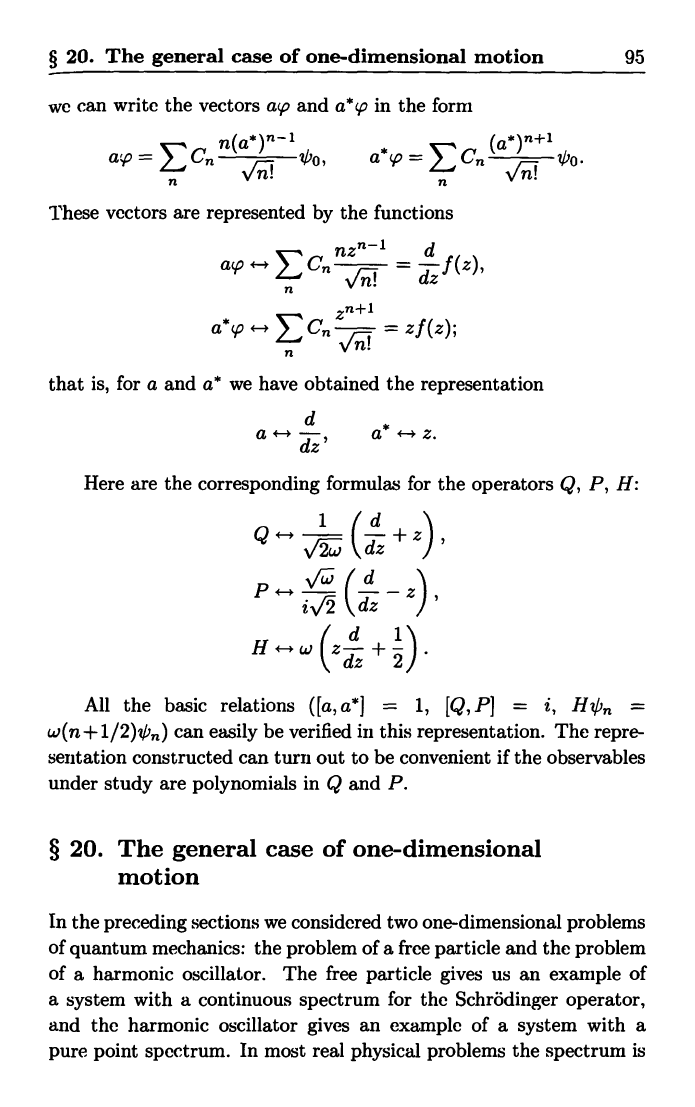
that is, for a and a* we have obtained the representation
aH
d
-,
a* +z.
Here are the corresponding formulas for the operators Q, P, H:
1 d
+z
Q
H
2wdz
'
r-
d
P+-+
i v/2- \ dx - z/
HHw zd1
dz
+
2
All the basic relations ([a, a*] = 1, [Q, P] = i, H1,z
w (n + 1/2) in) can easily be verified in this representation. The repre-
sentation constructed can turn out to be convenient if the observables
under study are polynomials in Q and P.
§ 20. The general case of one-dimensional
motion
In the preceding sections we considered two one-dimensional problems
of quantum mechanics: the problem of a free particle and the problem
of a harmonic oscillator. The free particle gives us an example of
a system with a continuous spectrum for the Schrodinger operator,
and the harmonic oscillator gives an example of a system with a
pure point spectrum. In most real physical problems the spectrum is
96
L. D. Faddeev and 0. A. YakubovskiI
more complicated. Let us consider the problem of the spectrum of a
Schrodinger operator
ll=-d-
d
+V(x)
with very general assumptions about the potential.
The forces acting on the particle usually are appreciably different
from zero in some finite region on the x-axis and tend to zero as
IxI --+ oo; therefore, it is most common to encounter potentials V(x)
that tend to constant values as x --+ ±oo. For simplicity we confine
ourselves to the case when the potential is exactly equal to constants
for x < -a and x > a. By the arbitrariness in the definition of a
potential, we can always take one of these constants equal to zero.
We consider Schr6dinger equations
(1)
0it+FO-= V(x)
ik
under the condition that V (x) is a continuous function on the real
axis with V (x) = 0 for x < -a and V (x) = Vo for x > a.
For
definiteness we assume that Vo > 0. The graph of the potential is
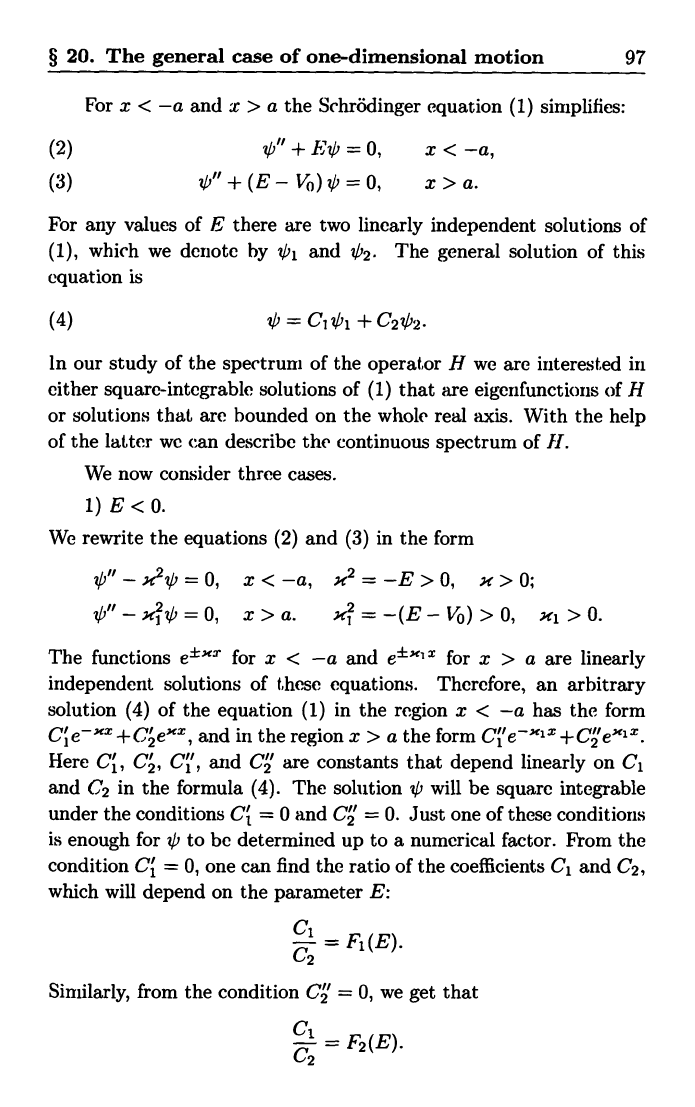
pictured in Figure 6.
Figure 6
§ 20. The general case of one-dimensional motion
97
(2)
(3)
For x < -a and x > a the Schr"finger equation (1) simplifies:
b"+EV) =0,
x<-a,
+(E--Vo)ip =0,
x>a.
For any values of E there are two linearly independent solutions of
(1), which we denote by 01 and 02. The general solution of this
equation is
(4)
V) = C101 + C202-
In our study of the spectrum of the operator H we are interested in
either square-integrable solutions of (1) that are eigenfunctions of H
or solutions that are bounded on the whole real axis. With the help
of the latter we can describe the continuous spectrum of 11.
We now consider three cases.
1)E<0.
We rewrite the equations (2) and (3) in the form
0" -- x2ip = 0,
x < -a,
x2 = --E > 0,
x > 0;
0"-xiV)=0, x>a.
x? =--(E-Vo)>O, xl>0.
The functions
for x < -a and ell, x for x > a are linearly
independent solutions of these equations.
Therefore, an arbitrary
solution (4) of the equation (1) in the region x < -a has the form
C' e - x + C2 e"
, and in the region x > a the form C1' e - xlX + C2e xl X .
Here Ci, C2, Ci', and C2 are constants that depend linearly on Cl
and C, 2 in the formula (4). The solution i will be square integrable
under the conditions C' = 0 and C2 = = 0. Just one of these conditions
is enough for 0 to be determined up to a numerical factor. From the
condition Cl = 0, one can find the ratio of the coefficients CI and C2,
which will depend on the parameter E:
Cl
= F, (E).
C2
Similarly, from the condition C2 = 0, we get that
ZT- = F2(E).2