
Faddeev L.D., Yakubovskii O.A. Lectures on Quantum Mechanics for Mathematics Students
Подождите немного. Документ загружается.

68
L. D. Faddeev and 0. A. Yakubovskii
Of course, the relations (13) do not depend on the representation. We
note further the formulas
U(ui) U(u2) = U(ui + U2),
V(vi) V(v2) = V(vi + v2);
that is. the sets of operators U(u) and 11(v) form groups: demote
these groups by U and V
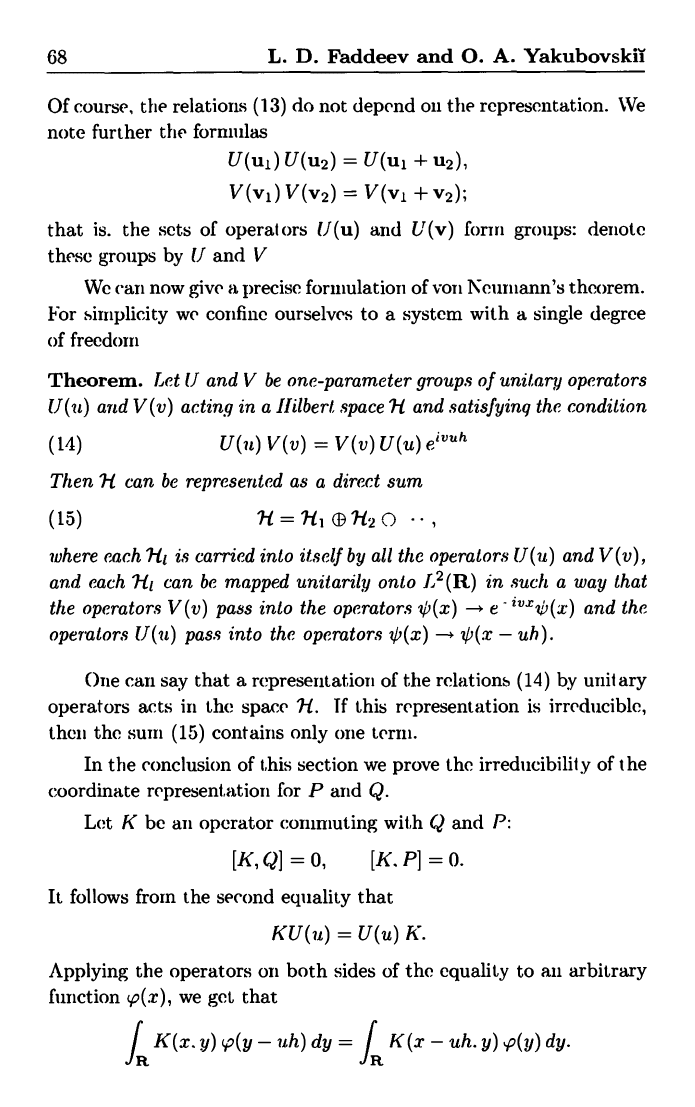
We can now give a precise formulation of von Neumann's theorem.
For simplicity we confine ourselves to a system with a single degree
of freedom
Theorem. Let (I and V be one-parameter groups of unitary operators
U(u) and V(v) acting in a Ililberl, space H and satisfyinq the. condition
(14) U(u) V (V) = v(V) U(11) P.ivuh
Then 7-l can be represented as a direct sum
(15) f=7-l, mW2O ..,
where each 7-ij is carried into itself by all the operators U(u) and V (v),
and each li can be mapped unitarily onto 112 (R) in such a way that
the operators V (v) pass into the operators i(x)
e - ivXj(x) and the
operators U(u) pass into the operators O(x)
-+(x - uh).
One can say that a representations of the relations (14) by unit ary
operators acts in the space W. If this representation is irreducible,
they i the sum (15) contains only one term.
In the conclusion of this section we prove the irreducibility of the
coordinate represent,atioii for P and Q.
Let K be an operator commuting with Q and P:
[K, Q] = 0,
[K. P] = 0.
It follows from the second equality that
KU(u) = U(u) K.
Applying the operators on both sides of the equality to an arbitrary
function cp(x), we get that
ih) dy =
JR
K(x - uh. y) (y) dy.
JR
§ 14. Interconnection between quantum and classical
69
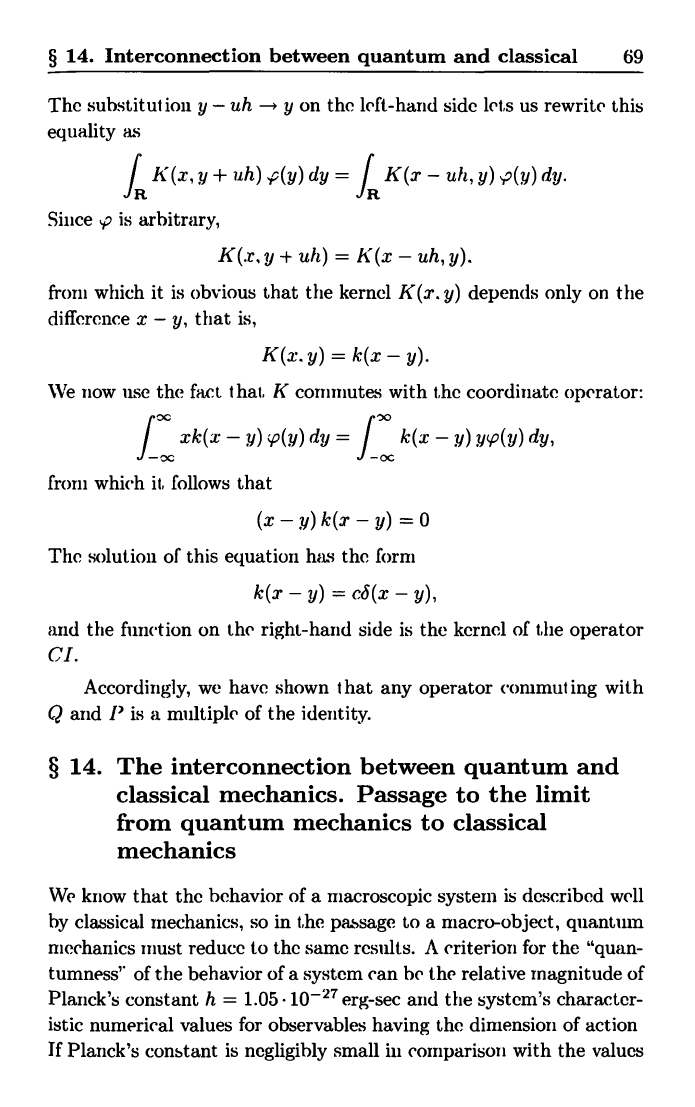
The substitution y --- uh y on the left-hand side lets us rewrite this
equality as
JR
K (x, y + uh),r(y) dy =
J
K(x - uh,J) ,?(?/) dy.
R
Since p is arbitrary,
K(.x,y+uh) = K(x-uh,y)
from which it is obvious that the kernel K(x. y) depends only on the
difference x -- y, that is,
K(x. y) = k(x
- y).
We now use the fact t hat, K commutes with the coordinate operator:
x
00
xk(x - y) (y) dy =
- y) y(y) dy,
-x
t:k(x
from which it, follows that
(x-y)k(x-y) =0
The solution of this equation has the. form
k(x
- y) =
c.S(x-y),
and the function on the right-hand side is the kernel of the operator
C,I.
Accordingly, we have shown 1 hat any operator commuting with
Q and P is a multiple of the identity.
§ 14. The interconnection between quantum and
classical mechanics. Passage to the limit
from quantum mechanics to classical
mechanics
We know that the behavior of a macroscopic system is described well
by classical xrrechanics, so in the passage to a macro-object, quantum
mechanics must reduce to the same results. A criterion for the "quan-
tumness" of the behavior of a system can be the relative magnitude of
Planck's constant h = 1.05.10-27 erg-sec and the system's character-
istic numerical values for observables having the dimension of action
If Planck's constant is negligibly small in comparison with the values
70
L. D. Faddeev and 0. A. Yakubovskii
of such observables, then the system should have a classical behavior.
The passage from quantum mechanics to classical mechanics can be
described formally as the passage to the limit as h - 0.18 Of course,
under such a passage to the limit, the methods for describing the
mechanical systems remain different, (operators acting in a Hilbert
space cannot be transformed into functions on phase space), but the
physical results of quantum mechanics as h - 0 must coincide with
the classical results.
We again consider a system with one degree of freedom. Our
presentation will be conducted according to the following scheme.
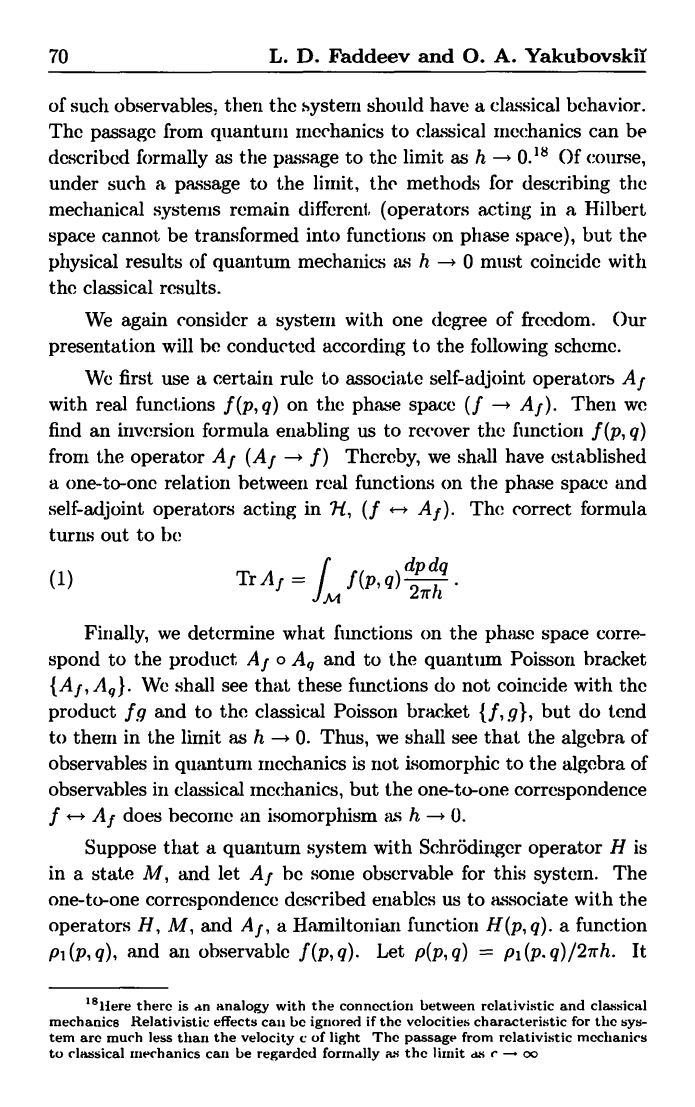
We first use a certain rule to associate self-adjoint operators A f
with real functions f (p, q) on the phase space (f - A1). Then we
find an inversion formula enabling us to recover the function f (p, q)
from the operator A f (Af -+ f) Thereby, we shall have established
a one-to-one relation between real functions on the phase space and
self-adjoint operators acting in fl, (f H A f).
They correct formula
turns out to be
1 TrA = dpdq
()
f
JM f (p, q)
27rh
Finally, we determine what functions on the phase space corre-
spond to the product A f o A. and to the quantum Poisson bracket
(Aj, Aq } . We shall see that these functions do not coincide
with the
product fg and to the classical Poisson bracket {f, g }, but do tend
to them in the limit as h -* 0. Thus, we shall see that the algebra of
observables in quantum mechanics is not isomorphic to the algebra of
observables in classical mechanics, but the one-to-one correspondence
f Af does become an isomorphism as h - 0.
Suppose that a quantum system with Schrodiuger operator H is
in a state M, and let A f be some observable for this system. The
one-to-one correspondence described enables us to associate with the
operators H, M, and A f, a Hamiltonian function H(p, q). a function
pi (p, q), and an observable f (p, q).
Let p(p, q) = pi (p. q)/2irh. It
18Here there is an analogy with the connection between relativistic and classical
mechanics Relativistic effects can be ignored if the velocities characteristic for the sys-
tem are much less than the velocity c of light The passage from relativistic mechanics
to classical mechanics can be regarded formally as the limit as r - no
§ 14. Interconnection between quantum and classical
71
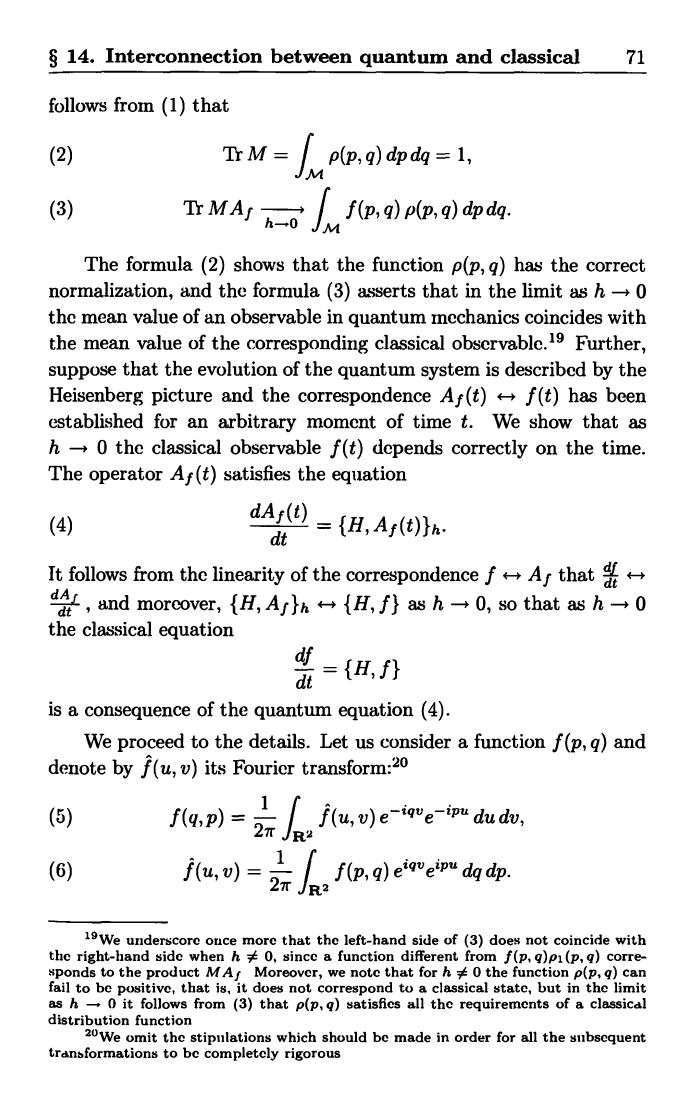
follows from (1) that
(2)
ly M = f P(P, 9) dp d9' = 1,
(3)
TrMA f
h ---*O
ff(mq)P(Pq)dPdq.
.tit
The formula (2) shows that the function p(p, q) has the correct
normalization, and the formula (3) asserts that in the limit as h - 0
the mean value of an observable in quantum mechanics coincides with
the mean value of the corresponding classical observable.I9 Further,
suppose that the evolution of the quantum system is described by the
Heisenberg picture and the correspondence A f (t) f (t) has been
established for an arbitrary moment of time t.
We show that as
h - 0 the classical observable f (t) depends correctly on the time.
The operator A f (t) satisfies the equation
(4)
dA f (t)
= {H,Af(t)}h.
Ih-
dt
It follows from the linearity of the correspondence f H A f that !YL
t
H
d, and moreover, {H, A f } H {H, f I ash --+ 0, so that as h
0
the classical equation
is a consequence of the quantum equation (4).
We proceed to the details. Let us consider a function f (p, q) and
denote by f (u, v) its Fourier transform:2°
(5)
f (q, p) = f (u, v)
e-`agVe-iPu
du dv,
27r W
1
f(u,v)
=
f (p, q)
dqdp.
27r
R,2
19We underscore
once more that the left-hand side of (3) does not coincide with
the right-hand side when h 0, since a function different from f (p, q)p1(p, q) corre-
sponds to the product MA f
Moreover, we note that for h 0 0 the function p(p, q) can
fail to be positive, that is, it does not correspond to a classical state, but in the limit
as h - 0 it follows from (3) that p(p, q) satisfies all the requirements of a classical
distribution function
20 We omit the stipulations which should be made in order for all the subsequent
transformations to be completely rigorous
72
L. D. Faddeev and 0. A. Yakubovskii
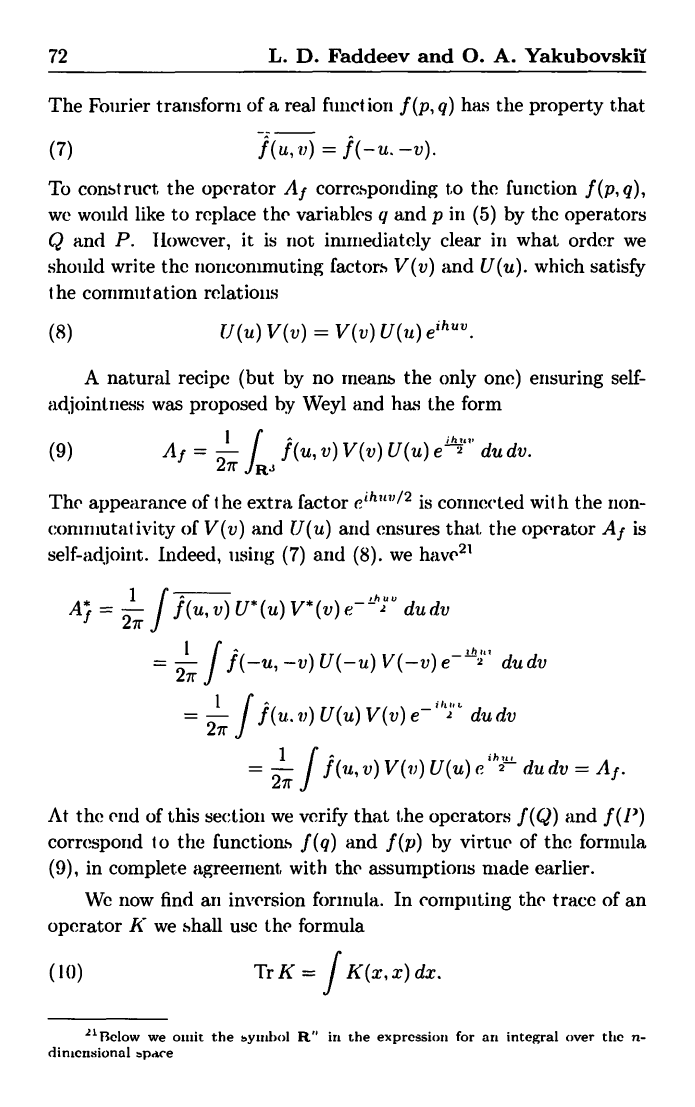
The Fourier transform of a real funct ion f (p, q) has the property that
(7)
WN ^
f(u,v) = f(-u.-v).
To construct the operator Af corresponding to the function f (p, q),
we would like to replace the variables q and p iii (5) by the operators
Q and P. However, it is riot ininiediately clear in what order we
should write the rioncommuting factors V(v) and U(u). which satisfy
the commutation relations
(8)
ihuv
U(U) V(V) = V(V) U(U) e
A natural recipe (but by no rrieans the only one) ensuring self-
adjointriess was proposed by Weyl and has the form
(
z'
du dv.9) = 1
27r
f(u, v)V (v)U(u)e f
h2
.
R
The appearance of t he extra factor e`h",'/2 is connected with the non-
c:onimutat ivity of V (v) and U(u) and ensures that, the operator Af is
self-adjoirit. Indeed, using (7) and (8). we have21
*f
27r
f
= I
^ u v U* u V * v e- '
hte
du dv
1
-
1h III
=
27r
f (-u, _v) U(-u) V (-v)
e--2
du dv
1
0111L
f (u. v) U(u) V (v) e- du dv
27r
1
fJ(uv)=
V(?)) U(u) e 2 dudv = Af.
At the end of this section we verify that the operators f (Q) and f (P)
correspond to the functions f (q) and f (p) by virtue of the formula
(9), in complete agreement with the assumptions made earlier.
We now find an inversion formula. In computing the trace of an
operator k we shall use the formula
(10)
TrK = fK(xx)dx.
21 F3clow
we omit the bymbol R" in the expression for an integral over the n-
dinicrisional apace
§ 14. Interconnection between quantum and classical
73
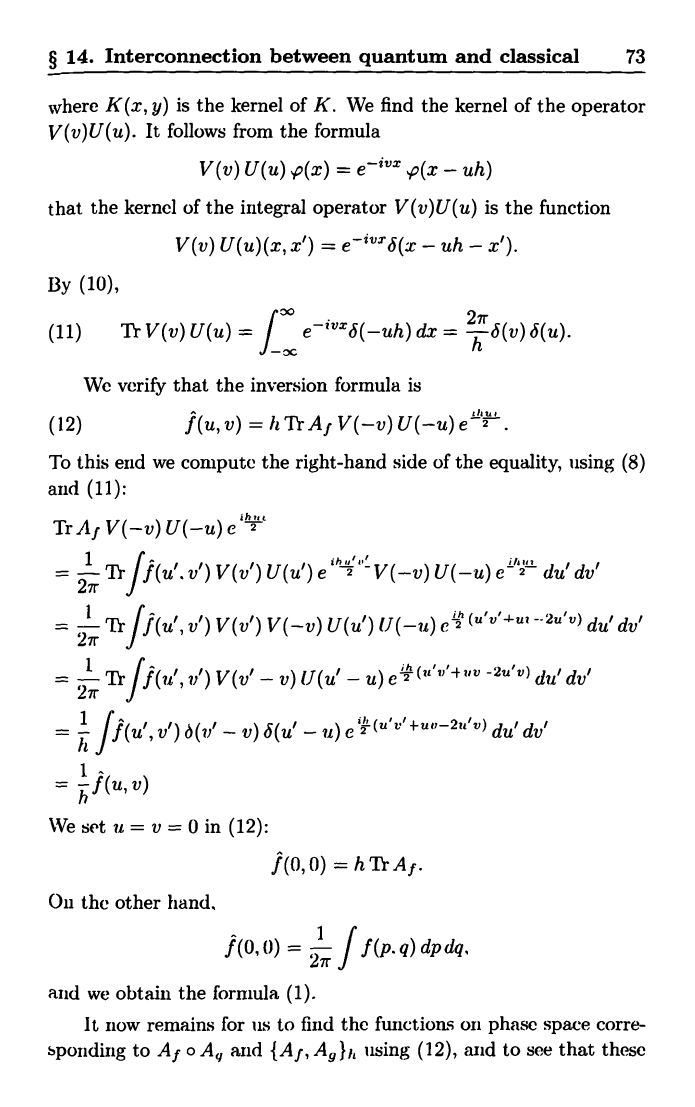
where K(x, y) is the kernel of K. We find the kernel of the operator
V(v)U(u). It follows from the formula
V (v) U(u),p(x) = e-"'x p(x - uh)
that the kernel of the integral operator V(v)U(u) is the function
V (v) U(u)(x, x') = e-ivX8(x - uh - x').
By (lo),
00
11
Tr V M U u
e-ivx J -uh dx
=
27r6v
u.
J-x
We verify that the inversion formula is
(12)
J(u,v) = hTrAfV(--v)U(--u)etj2+ .
To this end we compute the right-hand side of the equality, using (8)
and (11):
Tr A f V (-v) U(-u) e
i`'2"
=
27r
Jf(u,.v,)v(v,)u(u')e',,v(-v)u(_u)eu,du l
Tr f(u , v) V (VI) V (_V) U(u) U(-U} e 2
(v)
du dv'
2ir
Jfu',
r
I
I'41'-22t'V)
I
I
2zrv)V(v --v)U(u -u)e
du, dv
1
r
I
I
ff(u',
v
)b(I) --v}S(u ---n)c du dv
1-
-- h f (u, v)
We set u=v_=0in(12):
f (07 0) = h Tr Af
UU the other hand,
/(0,0) = d d ,
f(p
q) q
27r
and we obtain the formula (1).
It now remains for us to find the functions on phase space corre-
sponding to A f o A,, and {Aj, Ay } h using (12), and to see that these
74
L. D. Faddeev and 0. A. Yakubovskii
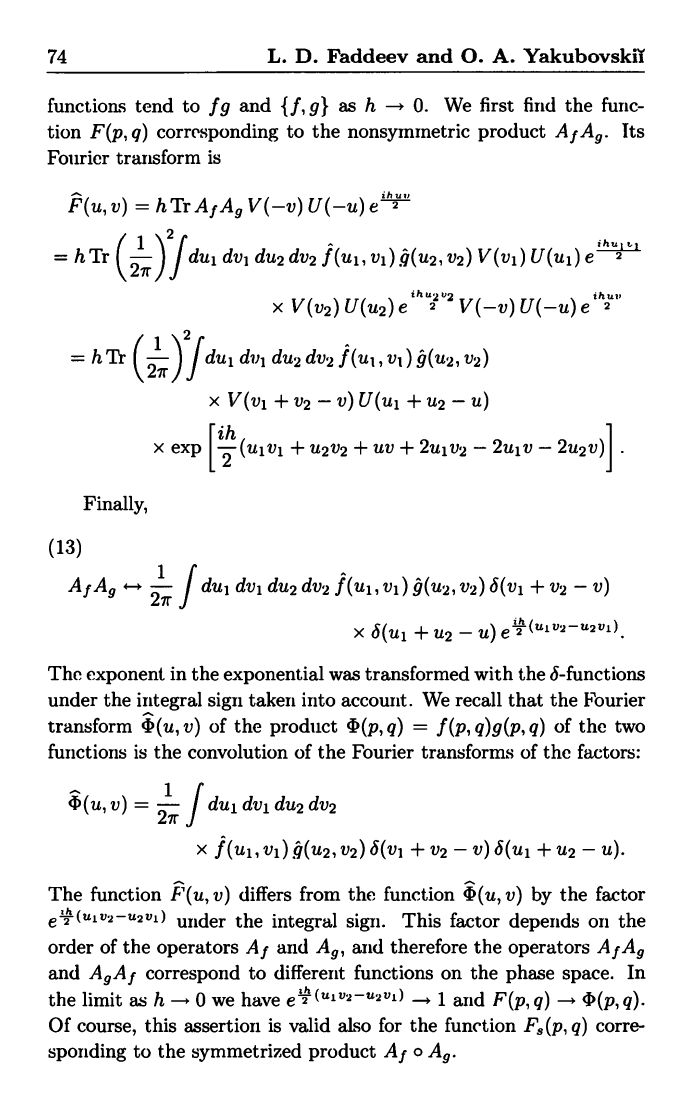
functions tend to f g and {f, g} as h -* 0. We first find the func-
tion F (p, q) corresponding to the nonsymxnetric product A f A9 . Its
Fourier transform is
P(u,v) = h Tr A fA9 V (-v) U(-u) e i`'2"
1
2
f(ui,
ihut z1
= hTr
--
dul dvl du2 dv2
v1),q(u2,v2) V(vi) U(ui) e 2
x V (V2) U(u2) e
th 2 2 V(-v) U(-u) e th2
2
h Tr
(±-)
27r
fdul dv, du2 dv2 J(u1
, vi) (u2, vz)
x V (V1 + v2 - v) U(ul + uz - u)
x exp
[!(u1v1
+ u2v2 + uv + 2ulv2- 2uly - 2u2v)
Finally,
(13)
AfAg H 2 dul dvl due dvi f (ul, vl) (u2,v2)6(vi + vz - v)
x 5(u1 + U2 - u)
e2tulv2-u2v1)
The exponent in the exponential was transformed with the o-functions
under the integral sign taken into account. We recall that the Fourier
transform 4 (u, v) of the product (p, q) = f (p, q)g(p, q) of the two
functions is the convolution of the Fourier transforms of the factors:
(u,
v) =
27f f dul dvl dug dv2
x f (u1, v1) .9(u2, V2) a(v1 + V2 - v) 6(ul + U2 - u).
The function F(u, v) differs from the function 4 (u, v) by the factor
e
2 (ul v2
-u2 vi) under the integral sign. This factor depends on the
order of the operators A f and Ag, and therefore the operators A fA9
and A9 A f correspond to different functions on the phase space. In
the limit as h - 0 we have e 2 (uiv2-u2v1)
1 and F(p, q) - 4(p, q).
Of course, this assertion is valid also for the function Fs (p, q) corre-
sponding to the symmetrized product Af o A9.
§ 14. Interconnection between quantum and classical
75
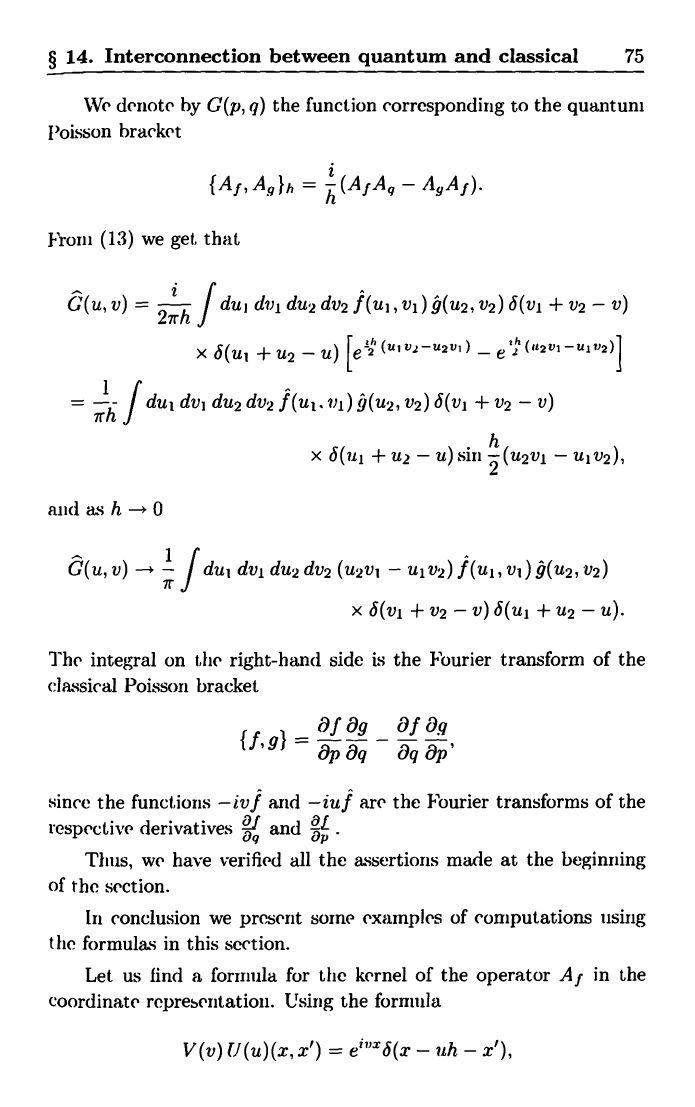
We denote by G(p, q) the function corresponding to the quantum
Poisson bracket
Af, A., 1,
(Af Aq - AgAf)-
From (13) we get, that
(u,
v) 27rh
f dug dvl dul dv2 f(ui
, vi) Xu2,
v2) b(vi + V2 - v)
X b(u1 + u2 - u) a
2? (ul V2-u2v1) -
eh («2v1-u1v2)
ah
f
dut A, du2 dvz .f (ul. V1) ,(U1, v2) a(v, + v2 - v)
x Oui + u2 - u) Sill' (U2V1 - ul v2),
andaash-f0
., A
G(u, v) - -
dul dv1 dul dv2 (U2V1 -- ui v2) f (U1, v1) g(u2, V2)
7r
f
X Ovl + v2 - v) a(u, + u2 - u).
The integral on the right-hand side is the Fourier transform of the
classical Poisson bracket
{f,g} =
afa9
-
Of 'N
ap aq
q,
A
since the functions -iv f and -iu f are the Fourier transforms of the
respective derivatives
and "f
aq
OP
Thus, we have verified all the assertions made at the beginning
of the section.
In conclusion we present some examples of computations using
the formulas in this section.
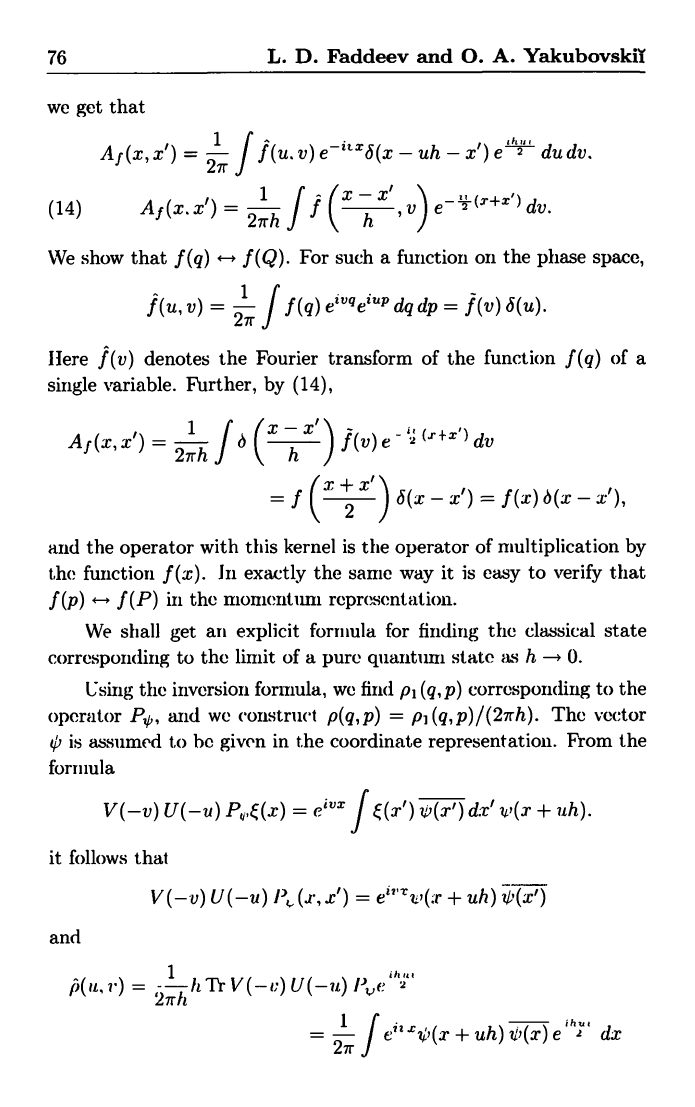
Let us find a formula for the kernel of the operator A f in the
coordinate representation. Using the formula
V (v) U (u) (x, xf) = eivx6(x - uh - x'),
76
L. D. Faddeev and 0. A. Yakubovskii
we get that
A f (x, x') =
f(u.v)e_itxo(x
- uh - x') e
2 du dv.
2-r
(14)
A f(x. x') =
f x - x
, v
e- 2
dv.
27rh
h
We show that f (q) H f (Q). For such a function on the phase space,
1
f(u,v)=
27r
f (q) e ivq
eiUP dq dp =
f (V) 6(u).
Here f (v) denotes the Fourier transform of the function f (q) of a
single variable. Further, by (14),
A f (x, x') =
27rh
h
f(v)e'dv
;+x'
= f
6(x - X') _ f(x) b(x - X'),
2
and the operator with this kernel is the operator of multiplication by
the function f (x). In exactly the same way it is easy to verify that
f (p) f (P) in the momentum representation.
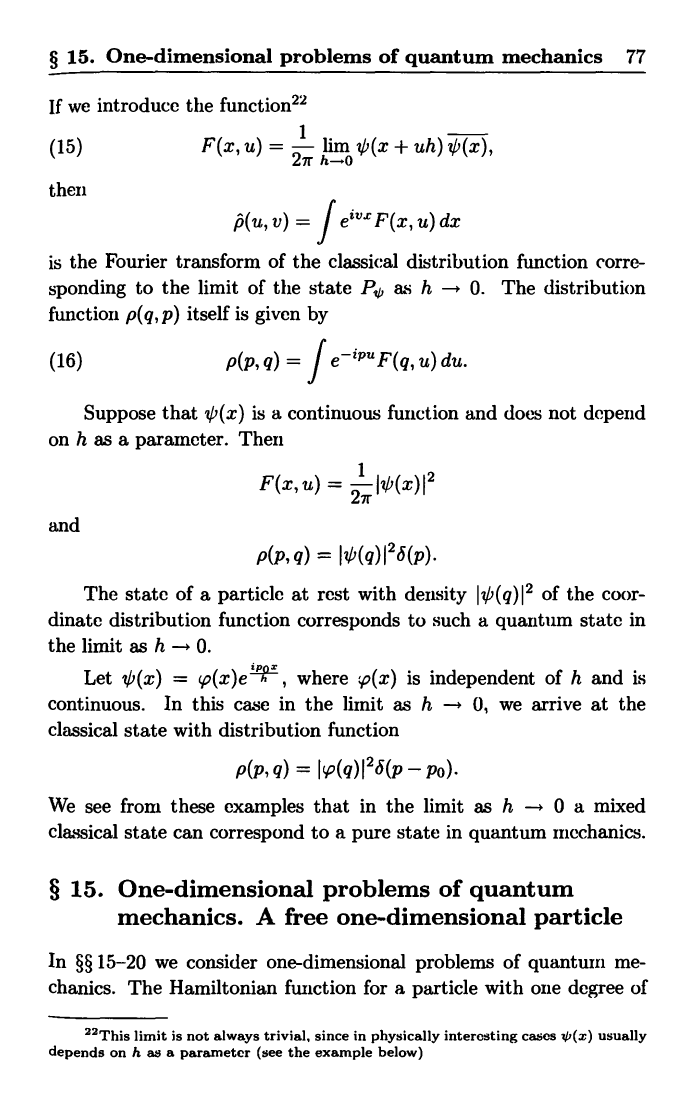
We shall get an explicit formriula, for finding the classical state
corresponding to the limit of a pure quantum state as h - 0.
Using the inversion formula, we find pl (q, p) corresponding to the
operator P1k, and we construct p(q, p) = p1 (q, p)/(27rh). The vector
i' is assumed to he given in the coordinate representation. From the
formula
V (-V)
U(-u) e?VX
f (x') v)(x') d r' ,4'(x + uh).
it follows that
V (-v) U(-u) 131, (x, x') = eit,r2,7(x + uh) V., (x')
and
1
ill «:
1(it,r) _
hTrV(-r;) U(-u) 1
f'
z
27Th
1
zz.c
thus
e l'(x + uh) v(x) e
2
dx
27r
§ 15. One-dimensional problems of quantum mechanics
77
If we introduce the function22
(15)
F(x, u) =
h
m
V'(x + uh) G(x),
then
p(u, v) = f ezvx F(x, u) dx
is the Fourier transform of the classical distribution function corre-
sponding to the limit of the state P.0 as h -> 0. The distribution
function p(q, p) itself is given by
(16) p(p, q) = J e-iPUF(q, u) du.
Suppose that 0(x) is a continuous function and does not depend
on h as a parameter. Then
F(x, u) =
2 I(x)I2
and
p(p, q) = 1,0(q) I26(p)
The state of a particle at rest with density
J
1 2 of the coor-
dinate distribution function corresponds to such a quantum state in
the limit
ipox
Let O (x) = SP (x) e
, where p
(x) is independent of h and is
continuous.
In this case in the limit as h --p 0, we arrive at the
classical state with distribution function
p(p, q) = J12a(p - po).
We see from these examples that in the limit as h - 0 a mixed
classical state can correspond to a pure state in quantum mechanics.
15. One-dimensional problems of quantum
mechanics. A free one-dimensional particle
In §§ 15-20 we consider one-dimensional problems of quantum me-
chanics. The Hamiltonian function for a particle with one degree of
22This limit is not always trivial, since in physically interesting cases i/ (x) usually
depends on h as a parameter (see the example below)