
Faddeev L.D., Yakubovskii O.A. Lectures on Quantum Mechanics for Mathematics Students
Подождите немного. Документ загружается.

98
L. D. Faddeev and 0. A. Yakubovskii
A square-integrable solution 0 will exist only for values of E such
that
F1(E) = F2(E).
The roots of this algebraic equation, if they exist, are the eigenvalues
of the operator H. From the foregoing it is natural to expect the
presence of a simple point spectrum for E < 0.
2)0<E< VO.
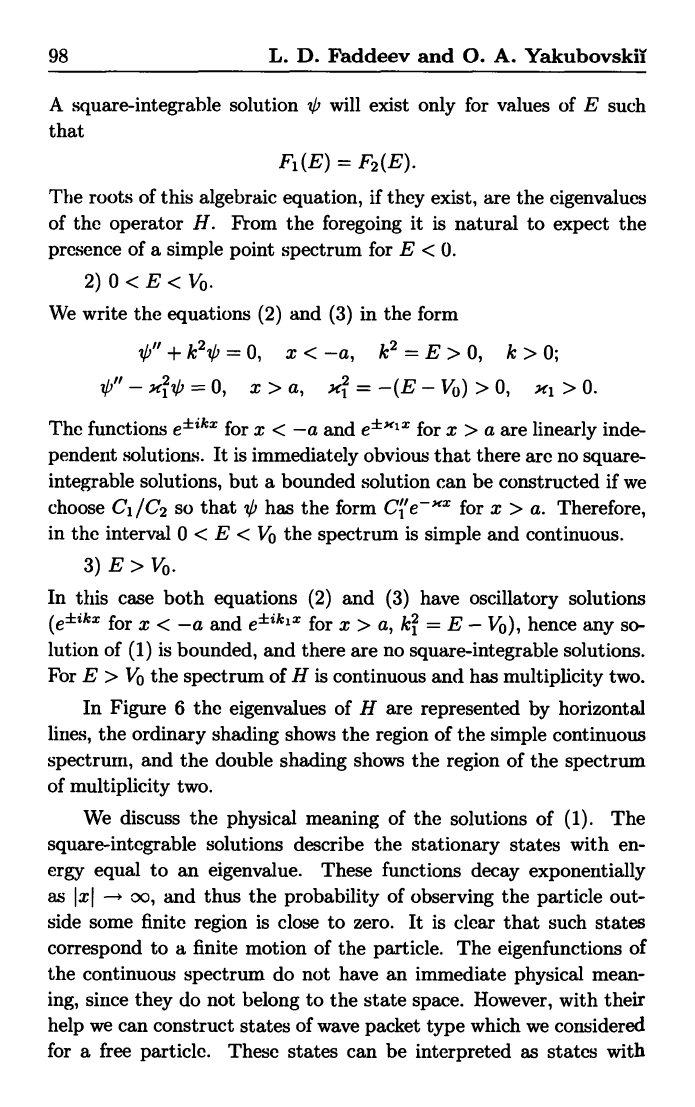
We write the equations (2) and (3) in the form
"+k21p =0, x< --a, k 2=E>0, k>0;
7P"-xj,0=0,
x>a, 4=-(E-V0)>O, x1>0.
The functions e±i
for x < -a and efx1x for x > a are linearly inde-
pendent solutions. It is immediately obvious that there are no square-
integrable solutions, but a bounded solution can be constructed if we
choose C1 /C2 so that 0 has the form C1 e-xx for x > a. Therefore,
in the interval 0 < E < VO the spectrum is simple and continuous.
3) E > Vo.
In this case both equations (2) and (3) have oscillatory solutions
±ikx for
x < -a and
e+ 1x for
x > a, k1 = E - VO), hence any so-
lution of (1) is bounded, and there are no square-integrable solutions.
For E > VO the spectrum of H is continuous and has multiplicity two.
In Figure 6 the eigenvalues of H are represented by horizontal
lines, the ordinary shading shows the region of the simple continuous
spectrum, and the double shading shows the region of the spectrum
of multiplicity two.
We discuss the physical meaning of the solutions of (1).
The
square-integrable solutions describe the stationary states with en-
ergy equal to an eigenvalue. These functions decay exponentially
as lxi -* oo, and thus the probability of observing the particle out-
side some finite region is close to zero.
It is clear that such states
correspond to a finite motion of the particle. The eigenfunctions of
the continuous spectrum do not have an immediate physical mean-
ing, since they do not belong to the state space. However, with their
help we can construct states of wave packet type which we considered
for a free particle.
These states can be interpreted as states with
§ 20. The general case of one-dimensional motion
99
almost given energy. A study of the evolution of such states shows
that they describe a particle that goes to infinity (infinite motion) as
It) --+ oo We shall return to this question when we study the theory
of scattering.
In classical mechanics, as in quantum mechanics, the motion is
finite for E < 0 and infiinite for E > 0. For 0 < E < V0 the particle
can go to infinity in one direction, and for E, > VO in two directions.
We direct attention to the fact that the multiplicity of the continuous
spectrum coincides with the number of directions in which the particle
can go to infinity.
In the example of a particle in a one-dimensional potential well
we consider the question of the classical limit of quantum stationary
states For the computation of the limit (14.15) it is convenient to
use the asymptotic form of the solution of the Schrodinger equation
as h -* 0. Methods for constructing asymptotic solutions of the
Schrodinger equation as h --+ 0 are called quasi-classical methods.
We use one such method: the Wentzel Kraxners--Brillouin (WKB)
method.
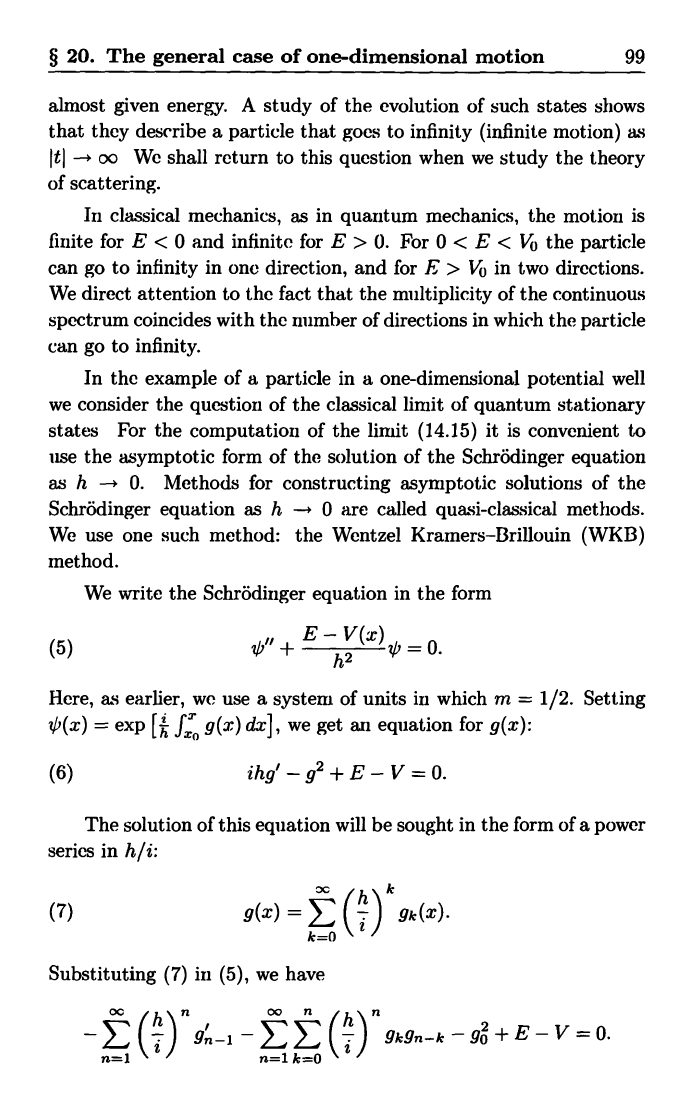
We write the Schrodinger equation in the form
(s)
E --- V(x)
- 0.
Here, as earlier, we use a system of units in which m = 1/2. Setting
(x} = exp h fem. g(x) dx], we get an equation for g(x):
(6)
ihgf -
9
2
+ E - V = 0.
The solution of this equation will be sought in the form of a power
series in h/i:
(7)
k=l
o
Substituting (7) in (5), we have
00
h
n
oo n
n
-E -7 9n -I EE --
9k9n -
90
n=1
(t)
n=1 k=O
2
9(X) = E (2 ) A (X)-
100
L. D. Faddeev and 0. A. Yakubovskii
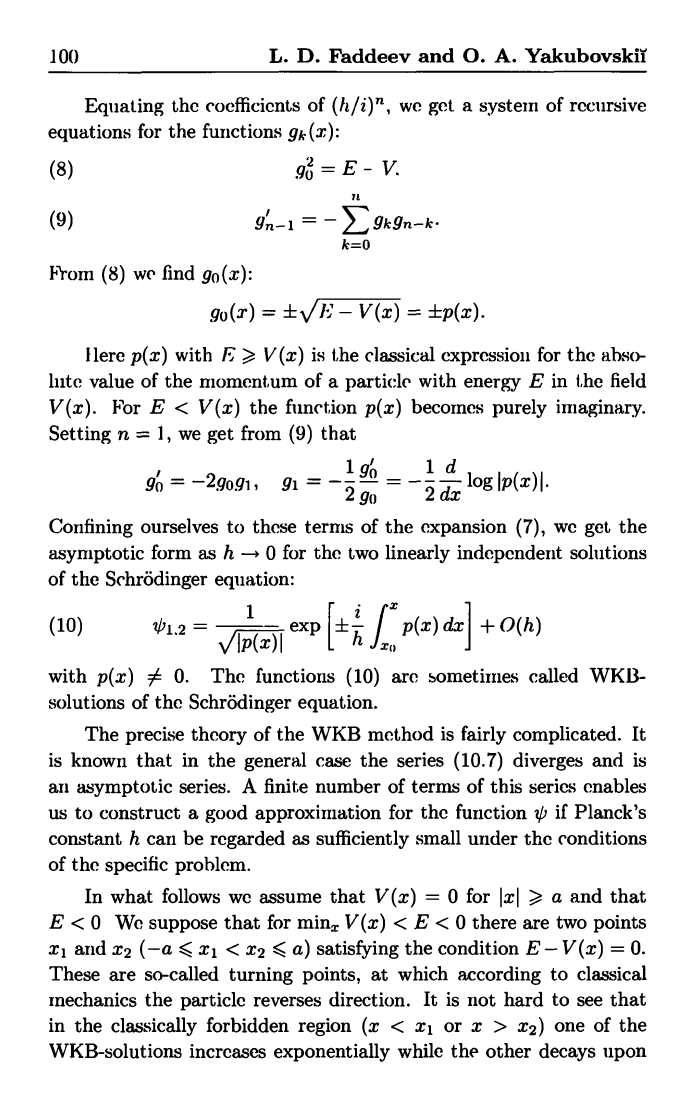
Equating the coefficients of (h/i )', we get a system of recursive
equations for the functions 9k (X):
(8)
g02= E - V.
(y)
9n-1 =
>29k9n-k.
k=0
From (8) we find go(x):
go W V -(X) = ±P(X) -
1 sere p(x) with E > V (x) is the classical expression for the abso-
lutes value of the momentum of a particle with energy E in the field
V (x).
For E < V (x) the function p(x) becomes purely imaginary.
Setting n = 1, we get from (9) that
' = --2 =
-1 g-
_ -1 d to
x .
9'a .90.91, g3
2 9()
2 dx g
1p(
) I
Confining ourselves to these terms of the expansion (7), we get the
asymptotic form as h --40 for the. two linearly independent solutions
of the Schrodinger equation:
r x
(10)
*i.z =
lp(x) I
exp I f Z
f
p(x)
+ O(h)
h o
with p(x)
0.
The functions (10) are sometimes called WKB-
solutions of the Schrodinger equation.
The precise theory of the WKB method is fairly complicated. It
is known that in the general case the series (10.7) diverges and is
an asymptotic series. A finite number of terms of this series enables
us to construct a good approximation for the function V) if Planck's
constant h can be regarded as sufficiently small under the conditions
of the specific problem.
In what follows we assume that V (x) = 0 for I x i > a and that
E < 0 We suppose that for min,, V (x) < E < 0 there are two points
x 1 and x2 (-a < x i < X2,< a) satisfying the condition E --- V (x) = 0.
These are so-called turning points, at which according to classical
mechanics the particle reverses direction. It is not hard to see that
in the classically forbidden region (x < x 1 or x > x2) one of the
WKB-solutions increases exponentially while the other decays upon
§ 20. The general case of one-dimensional motion
101
going farther from the turning point into the depth of the forbidden
region. For j > a, the WKB-solutions coincide with the exact so-
lutions and have the form efxx, where E = --x`2. We recall that
the eigenfunctioris of the discrete spectrum of H decrease exponen-
tially as x --- ±oo. As h - 0, an eigcnfunction must coincide in
the allowed region with some linear combination Cl ip1 + C22 of the
WKB-solutions. The construction of such a linear combination is a
fairly complicated problem since the WKB-solutions become mean-
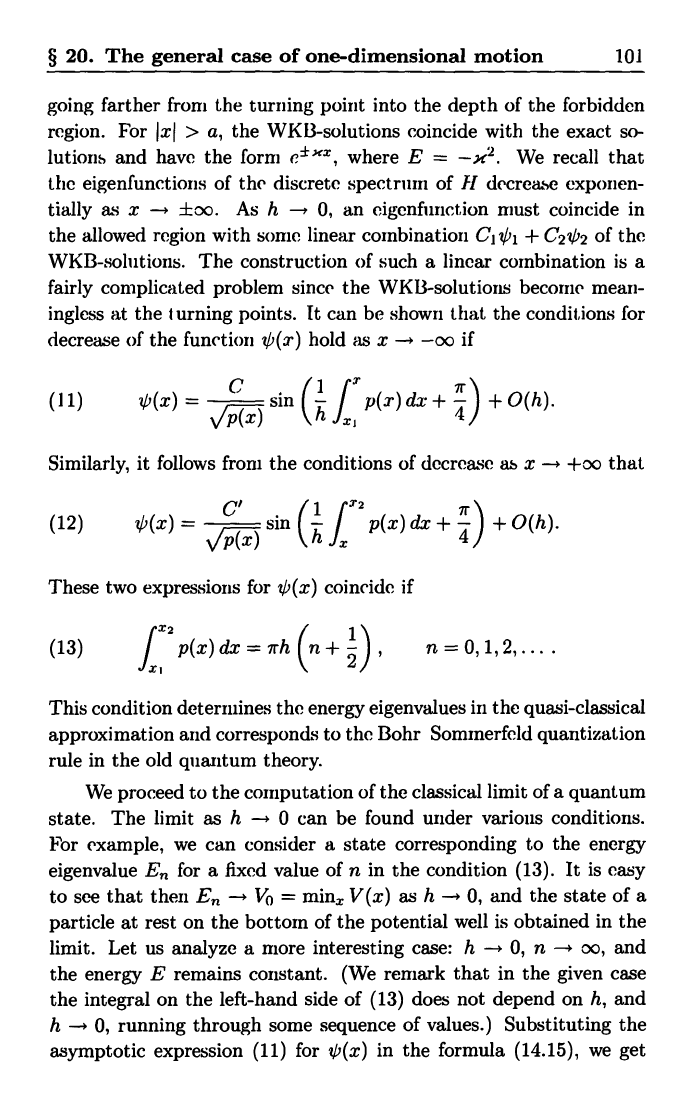
ingless at the turning points. It can be shown that the conditions for
decrease of the function O(x) hold as x --+ --oo if
(11)
O(X) _
C sin
h
fX
,
p(x) dx +
+ O(h).
p(x)
Similarly, it follows from the conditions of decrease as x --> +oo that
+ O(h).
(12) fi(x) = C
sin (hf4)
These two expressions for O(x) coincide if
X2
(13)
xdx=-rh
n+1 n=012...
X,
This condition determines the energy eigenvalues in the quasi-classical
approximation and corresponds to the Bohr Sommerfeld quantization
rule in the old quantum theory.
We proceed to the computation of the classical limit of a quantum
state. The limit as h --+ 0 can be found under various conditions.
For example, we can consider a state corresponding to the energy
eigenvalue En for a fixed value of n in the condition (13). It is easy
to see that then En --+ Va = minx V (x) as h -- 0, and the state of a
particle at rest on the bottom of the potential well is obtained in the
limit. Let us analyze a more interesting case: h -. 0, n -+ oo, and
the energy E remains constant. (We remark that in the given case
the integral on the left-hand side of (13) does not depend on h, and
h -+ 0, running through some sequence of values.) Substituting the
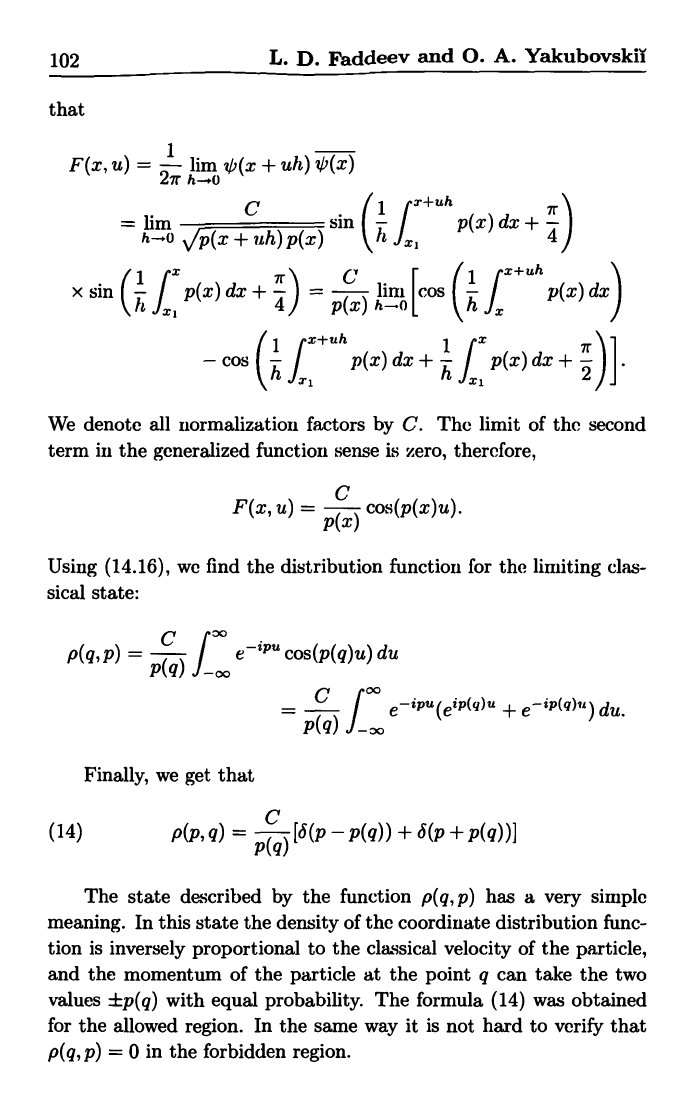
asymptotic expression (11) for O (x) in the formula (14.15), we get
102
that
L. D. Faddeev and 0. A. YakubovskiI
F(x'
u)
27r
n m G(x +
ufa) (X)
Cv
(1'x+h
m
(x + uh) p(er)
sin ji
1
p(x) dx +
4
+uh
1
fx
/1
x C
1cosx sin I p(x)
dx + )
p(x)
him
Lh J
p(x) dx
- cos
1
J ztuh
p(x)
+ h f
x
p(x)
+ 2 J
1
We denote all normalization factors by C. The limit of the second
term in the generalized function sense is zero, therefore,
F(x, u)
C
coti(p(x)u).
(X)
Using (14.16), we find the distribution function for the limiting clas-
sical state:
C
00
p(q,p) =
p(q)
f__oo
e-sue
Cos(P(9)u) du
Finally, we get that
C °°
e-ipu(eip(q)u
+
e-ip(4')u) du.
p(q)
(14)
P(R 4)
-
PC )
[a(p -
P(4)) + b(P + p(4'))]
The state described by the function p(q, p) has a very simple
meaning. In this state the density of the coordinate distribution func-
tion is inversely proportional to the classical velocity of the particle,
and the momentum of the particle at the point q can take the two
values ±p(q) with equal probability. The formula (14) was obtained
for the allowed region. In the same way it is not hard to verify that
p(q, p) = 0 in the forbidden region.
§ 21. Three-dimensional quantum problems
103
§ 21. Three-dimensional problems in quantum
mechanics. A three-dimensional free
particle
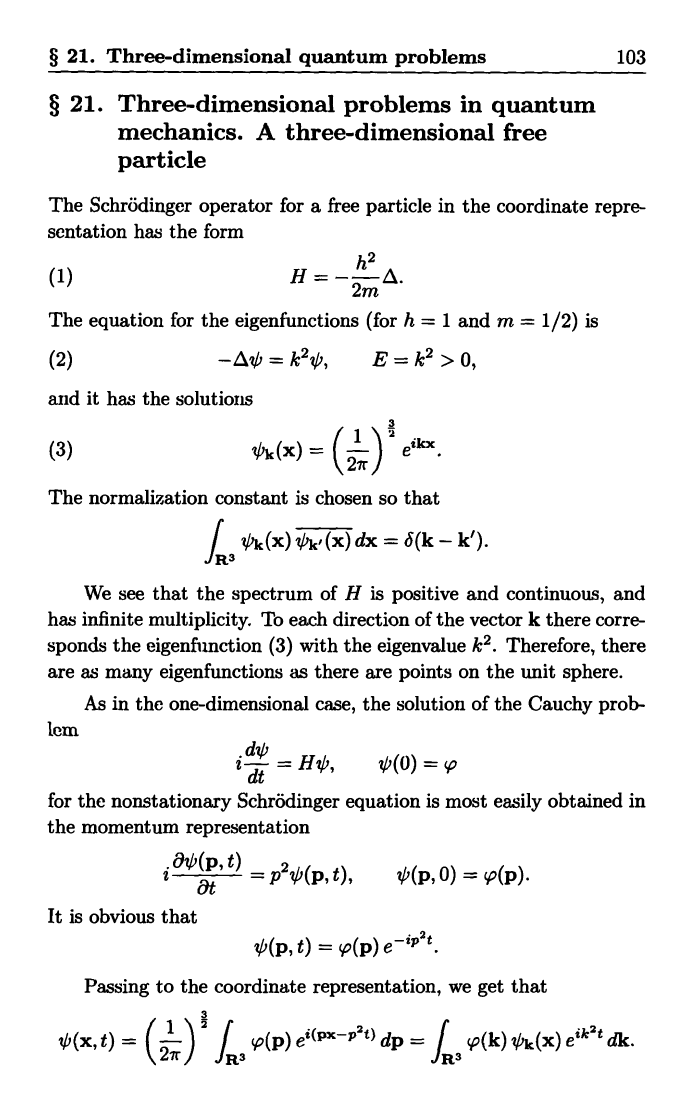
The Schrodinger operator for a free particle in the coordinate repre-
sentation has the form
h2
H
2m
A.
The equation for the eigenfunctions (for h = 1 and m = 1/2) is
(2)
-AO = k 201 E=k
2 > 01
and it has the solutions
(3)
fi(x) =
eikx
The normalization constant is chosen so that
fi(x) Oki (x) dx = a(k -- k').
j3
We see that the spectrum of H is positive and continuous, and
has infinite multiplicity. To each direction of the vector k there corre-
sponds the eigenfiunction (3) with the eigenvalue k2. Therefore, there
are as many eigenfunctions as there are points on the unit sphere.
As in the one-dimensional case, the solution of the Cauchy prob-
Iem
i
dt
=HAG,
(0)=
for the nonstationary Schrodinger equation is most easily obtained in
the momentum representation
80(P, t)
8t
= P2O(P, t),
'0 (P, 0) = O(P)
It is obvious that
i(P,t) =
w(P)e_
2t.
Passing to the coordinate representation, we get that
3
2
2 Z
x t)
eitpX_P t) d
(k)
k x
eik t
A.
R
fR
104 L. D. Faddeev and 0. A. YakubovskiI
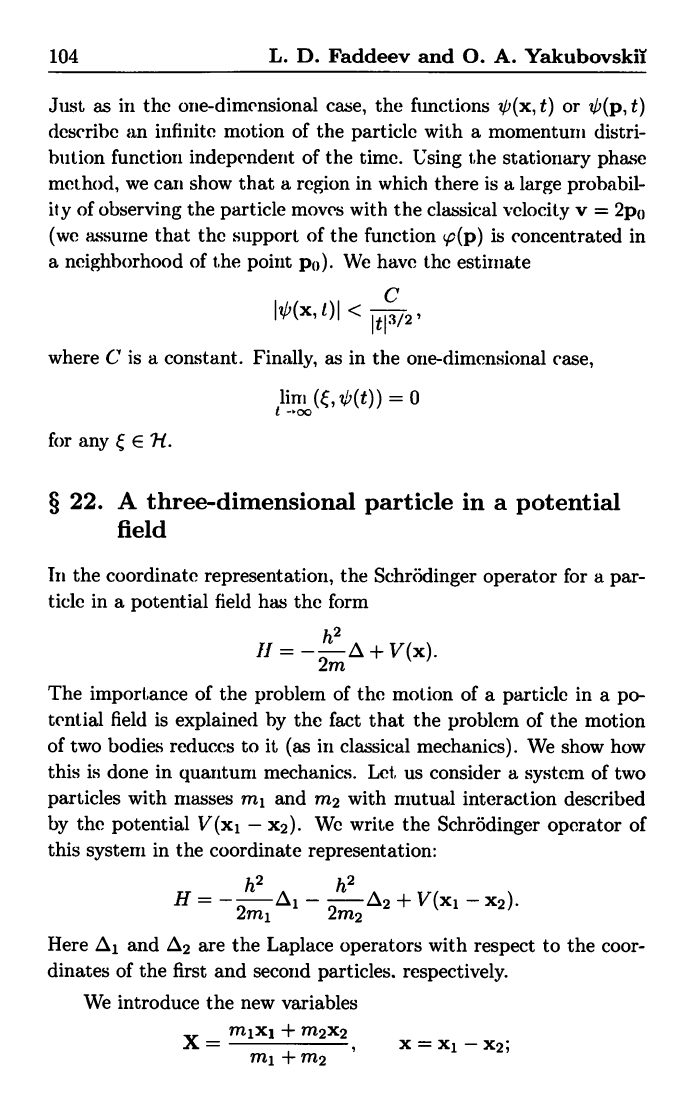
Just as in the one-dimensional case, the functions p(x, t) or b(p, t)
describe an infinite motion of the particle with a momentum distri-
bution function independent of the time. Using the stationary phase
method, we can show that a region in which there is a large probabil-
ity of observing the particle moves with the classical velocity v = 2p{
(we assume that the support of the function p(p) is concentrated in
a neighborhood of the point p}) . We have the estimate
kL'(x,t)I <
C
It13/2
where C is a constant. Finally, as in the one-dimensional case,
lim
0
t
b, 00
for any
E 1I.
22. A three-dimensional particle in a potential
field
In the coordinate representation, the Schrodinger operator for a par-
ticle in a potential field has the form
h
A+V(x).
The importance of the problem of the motion of a particle in a po-
tential field is explained by the fact that the problem of the motion
of two bodies reduces to it (as in classical mechanics). We show how
this is done in quantum mechanics. Let, us consider a system of two
particles with masses m1 and m2 with mutual interaction described
by the potential V (x 1 - X2)- We write the Schrodinger operator of
this system in the coordinate representation:
h2 h2
H =
-
Al
- 2m
02
+ V (XI - X2)-
2m,
2
Here 01 and A2 are the Laplace operators with respect to the coor-
dinates of the first and second particles, respectively.
We introduce the new variables
mlxl + m2x2
X=
,
x=x1 -x2;
m1+m2
§ 22. A three-dimensional particle in a potential field
105
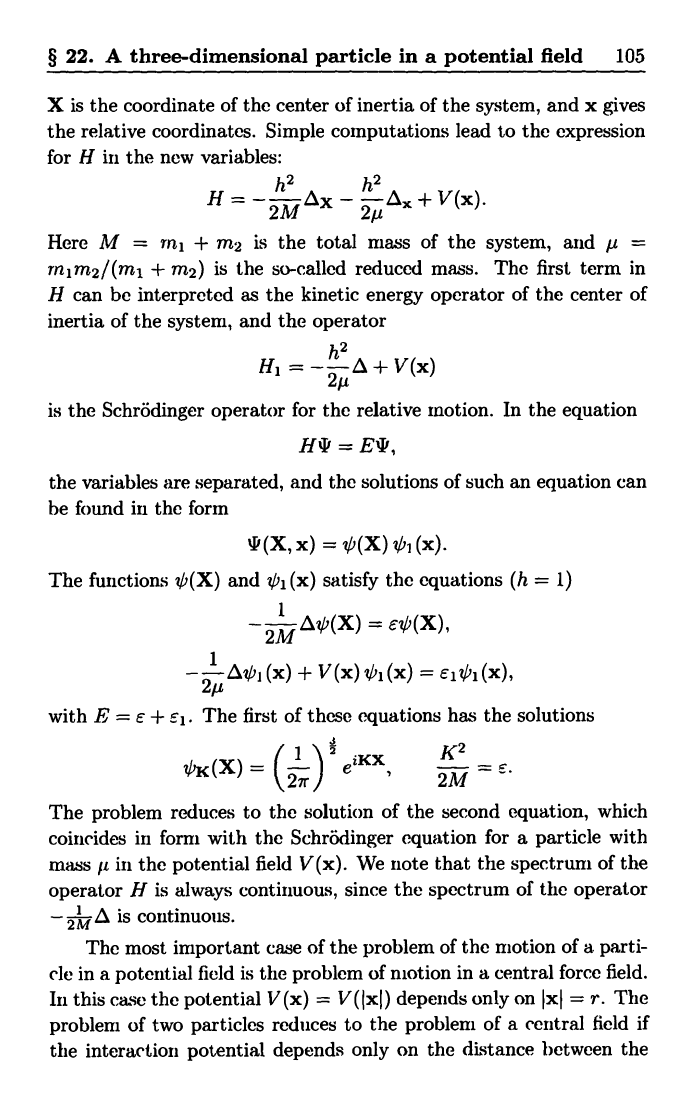
X is the coordinate of the center of inertia of the system, and x gives
the relative coordinates. Simple computations lead to the expression
for H in the new variables:
h2
h2
H -- --
YM
x --
2
A, + V (x)
.
Here M = rnl + m2 is the total mass of the system, and ji
rn 1 m2 / (m 1 + m2) is the so-called reduced mass. The first term in
H can be interpreted as the kinetic energy operator of the center of
inertia of the system, and the operator
H1
h2
2
A+V(x)
is the Schrodinger operator for the relative motion. In the equation
H4' =ET,
the variables are separated, and the solutions of such an equation can
be found in the form
P (Xj X) = 7P (X)?Pl (X) -
The function.5 O(X) and 01(x) satisfy the equations (h = 1)
- ZM OlV (X) _ 160 (X)
i
Alp, (x + V(X)'Oj x1 = 61 01 x1
2/u
with E = e + 61. The first of these equations has the solutions
2
X
1
eixx
K
_ .
27r
2M
The problem reduces to the solution of the second equation, which
coincides in form with the Schrodinger equation for a particle with
mass It in the potential field V (x). We note that the spectrum of the
operator H is always continuous, since the spectrum of the operator
-- 2 'A is continuous.
The most important case of the problem of the motion of a parti-
cle in a potential field is the problem of motion in a central force field.
In this case the potential V (x) = V (jx1) depends only on lx} = r. The
problem of two particles reduces to the problem of a central field if
the interaction potential depends only on the distance between the
106
L. D. Faddeev and 0. A. Yakubovskii
particles. Before proceeding to this problem, we study properties of
the angular momentum and some questions in the theory of represen-
tations of the rotation group. This will enable us to explicitly take
into account the spherical symmetry of the problem.
§ 23. Angular momentum
In quantum mechanics the operators of the projections of the angular
momentum are defined by the formulas
L 1 = Q2P3 - Q3 P2,
(1)
L2 = Q3P1 - Q1P3,
L3 = Q1 P2
- Q2P1
We introduce one more observable, called the square of the an-
gular momentum:
(Z)
L2 = L, + L2 + L3.
Let us find the commutation relations for the operators L1, L2 ,
L3, and L2. Using the Heisenberg relations [Qj, Pk] = iSjk and the
properties of the commutators, we get that
[L1, L2] = [Q2P3 - Q3P2, Q3P1 Q1P3]
= Q2P1 [P37 Q3] + Q1P2[Q3, P3]
= i(Q1P2 -- Q2P1)
= iL3.
Thus, the operators L1, L2, L3 satisfy the following commutation
relations:
(3)
[L1,L2] = iL3,
[L2, L3] = iL1
[L3, L1] = iL2.
It is not hard to verify that all the operators L1, L2, L3 commute
with L2:
(4)
[LjI L
2] = 01
1,2,3.
§ 23. Angular momentum
107
Indeed,
[Li, L 21 = [L1, Li + Lz + L3]
= [Lil L2] + [L1, Ls)
[L1, L2] L2 + L2[L1, L2] + [L1, L3]L3 + L3[L1, L3]
iL3L2 + iL2L3 -- iL2L3 -- iL3L2 = 0.
The properties of the commutators and the formulas (3) were used in
the computation.
It follows from the commutation relations (3) and (4) that the
projections of the angular momentum are not simultaneously mea-
surable quantities. The square of the angular momentum and one of
its projections can be simultaneously measured.
We write out the operators of the projections of the angular mo-
mentum in the coordinate representation:
C l
Ll
=i
a
a
X2
8x
X3
a
- xl
2
3l
C l
L2
-Z xl
a
ax -x3
a
8x
lI
C a l
L3 - i x2
ax,
-XI
a
ax
It is not hard to see that the operators L1, L2, L3 act only on
the angle variables of the function O(x). Indeed, if the function
depends only on r, then
L3'0(r) = i x2 axl - x,
a2 (xi + x2 + x3)
= io'(xi + xi + x3)(x2 2x, - xl 2x2) = 0.
For what follows, it turns out to be useful to have the formula
(5)