
Faddeev L.D., Yakubovskii O.A. Lectures on Quantum Mechanics for Mathematics Students
Подождите немного. Документ загружается.

108
L. D. Faddeev and 0. A. YakubovskiT
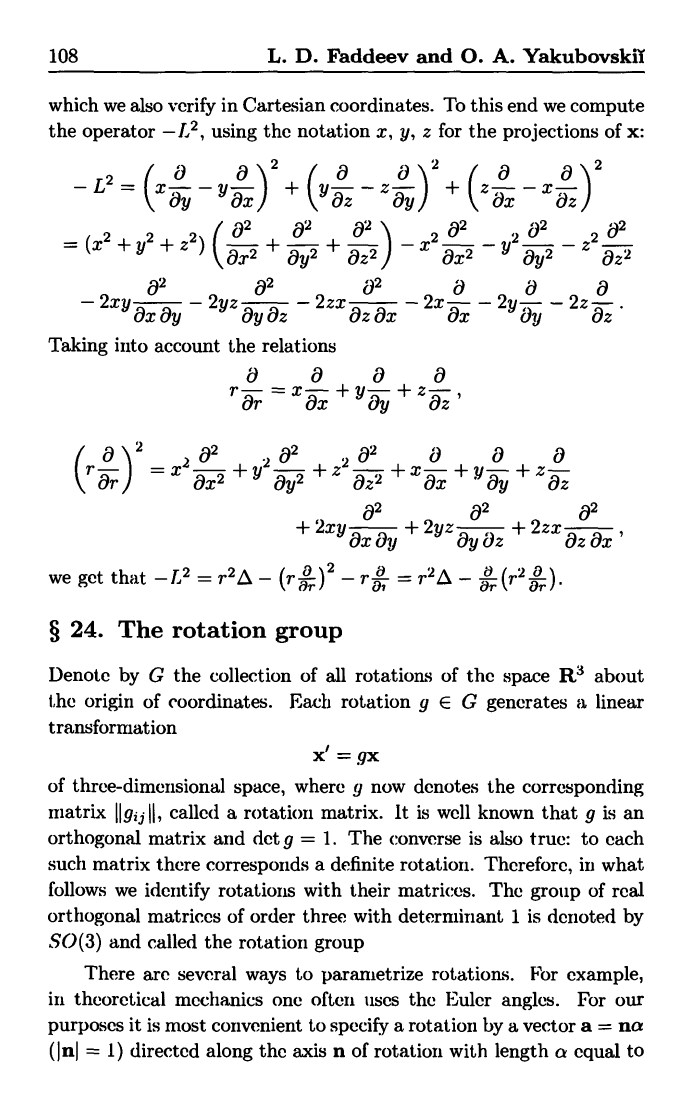
which we also verify in Cartesian coordinates. To this end we compute
the operator - J12, using the notation x, y, z for the projections of x:
2
a
a 2
a a z a
a 2
-L = x19
-yax
+ yaz - za+ zax -x192
2
2 2 192
192
492
2
82
2
192 2
Z
a19z2
= (x +y +z)
+ ay2 +
a2
-x
2
_y`
2 -z
2
a ay
192 _ 192
192 d
d
a
- 2xy a2yz a az -
2zx
az ax -
2x
19x -
2y
a
_ 2z
az .
J
Taking into account the relations
a a
19
a
rar -xax+yay +zaz,
19
2
2192
2192
19`2
a 19
a
V
rar
-x
axe
+y
a 2
+Z2
1922
+xax
+ya
y
+zaz
,92
192
192
+
xy
+ yz
+ 2zx
19X (9y
ay az
192
ax
J
we get that - T.2 = r2 A - (r)2
i9r 07
-r9 =r 2A
-
dT
(r2
c0 ).
§ 24. The rotation group
Denote by G the collection of all rotations of the space R3 about
the origin of coordinates. Each rotation g E G generates a linear
transformation
x'=gx
of three-dimensional space, where g now denotes the corresponding
matrix IIgig 1 1
, called a rotation matrix. It is well known that g is an
orthogonal matrix and det g = 1. The converse is
also true: to each
such matrix there corresponds a definite rotation. Therefore, in what
follows we identify rotations with their matrices. The group of real
orthogonal matrices of order three with determinant 1 is denoted by
SO(3) and called the rotation group
There are several ways to parametrize rotations. For example,
in theoretical mechanics one often uses the ruler angles.
For our
purposes it is most convenient to specify a rotation by a vector a = na
(j n J = 1) directed along the axis n of rotation with length a equal to
§ 24. The rotation group
109
the angle of rotation. Here it is assumed that the direction of rotation
and the direction of the vector a form a right-hand screw and that
i he angle a of rotation does not exceed ir (0 < a < ir). If we start the
,vectors a from a single point, then their endpoints fill a ball of radius
Tr. Different rotations correspond to different interior points of this
ball, and diametrically opposite points of the boundary correspond
to the same rotations.
Thus, the rotation group is topologically equivalent to a hall with
opposite points identified.
We shall establish a connection between the rotation group and
the Lie algebra of skew-symmetric matrices of order three.
A matrix A is said to be skew-symmetric if the transposed matrix
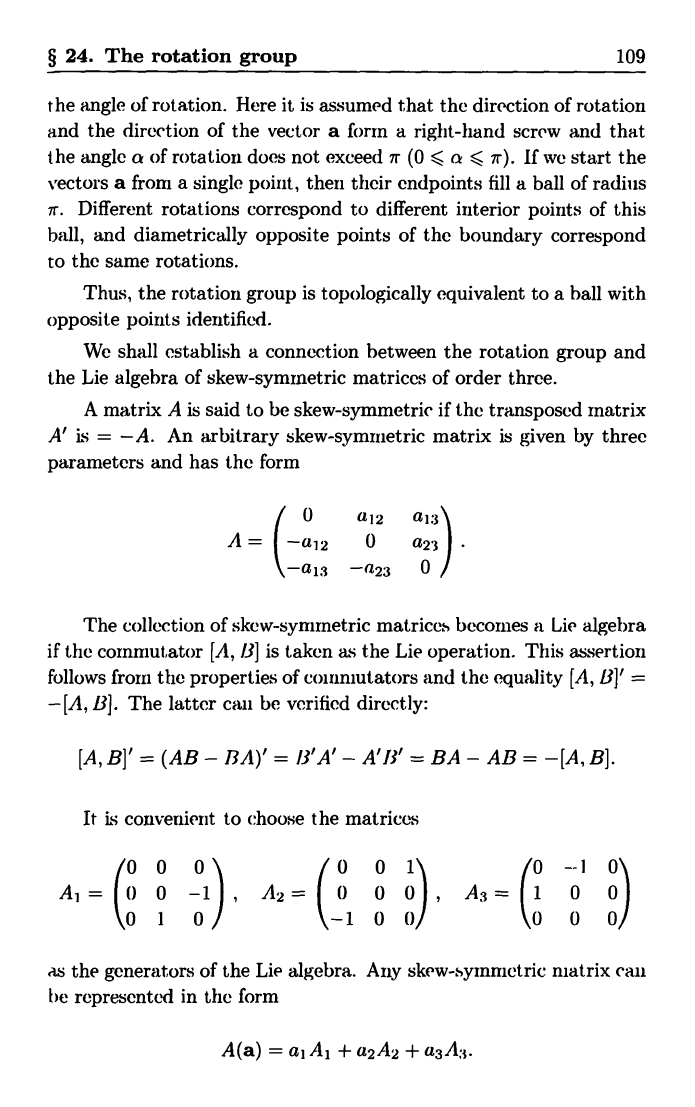
A' is = -A. An arbitrary skew-symmetric matrix is given by three
parameters and has the form
0
a12
a13
A=
--a12
0
(123
(-a13
-a23 0
The collection of skew-symmetric matrices becomes a Lie algebra
if the commutator [A, 13] is taken as the Lie operation. This assertion
follows from the properties of commu t ators and the equality [A, f3]' =
-[A, B]. The latter can be verified directly:
[A, B]'= (AB-BA)'= 13'A'-A'B' =BA- AB = -[A, B].
It is convenient to choose the matrices
0 0 0 U 0
1
0--1
0
A,=
0 0 -1
ill =
0 0
U
A3 =
1 0
0
0
1
0 \-i 0
0
U 0
0
as the generators of the Lie algebra. Any skew-symmetric matrix can
be represented in the form
A(a) = a, Al + a2A2 + a3A:;.
110
L. D. Faddeev and 0. A. YakubovskiT
A3:
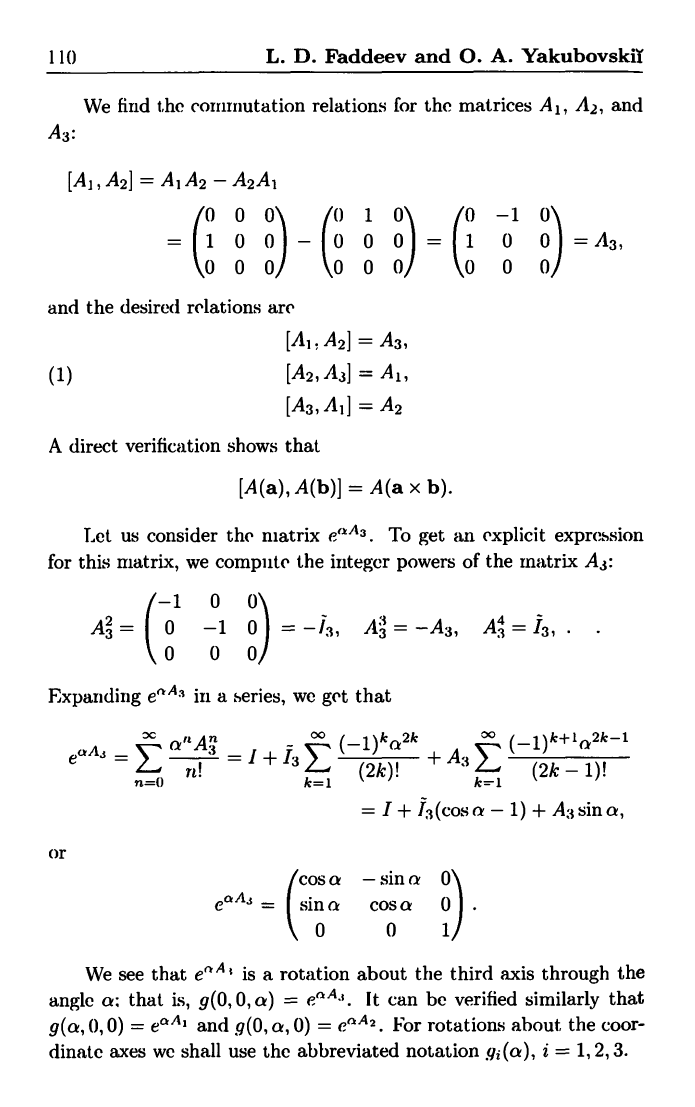
We find the comirlutation relations for the matrices A1, A2, and
[A, ,As]= AIA2 - A2A1
0
0
0
0
1
0
0 -1
U
=
1
0 0- U 0 0= 1 0 0= A3,
U
0
0
0
0
0
U
0
0
and the desired relations are
(1)
A direct verification shows that
[A(a), A(b)] = A(a x b).
Let us consider the matrix eI A3 . To get an explicit expression
for this matrix, we compute the integer powers of the matrix A3:
-1 0
0
A2=
0
-1
0
---13,
A3 =-A3,
A4=I3,
3
3
3
0 0 0
Expanding e'7 A3 in a series, we get that
A -
x arcA;
0O (1)k2k
(-1}k+1c2k-1
e
3
-
E `
= I + I>
(2k)
43
(2k-i)!
n=O
k=1
k=-1
= I+I3(cosa - 1)+A3sina,
or
cos a - since 0
e, A3 - = Sin cx
Cos a
0
0
0 1
We see that e'A, is a rotation about the third axis through the
angle a; that is, g(0, 0, a) =
It can be verified similarly that
g(a, 0, 0) = e°A' and g(0, a, 0) = C,A2. F o r rotations about the coor-
dinate axes we shall use the abbreviated notation g (a), i = 1, 2, 3.
§ 25. Representations of the rotation group 111
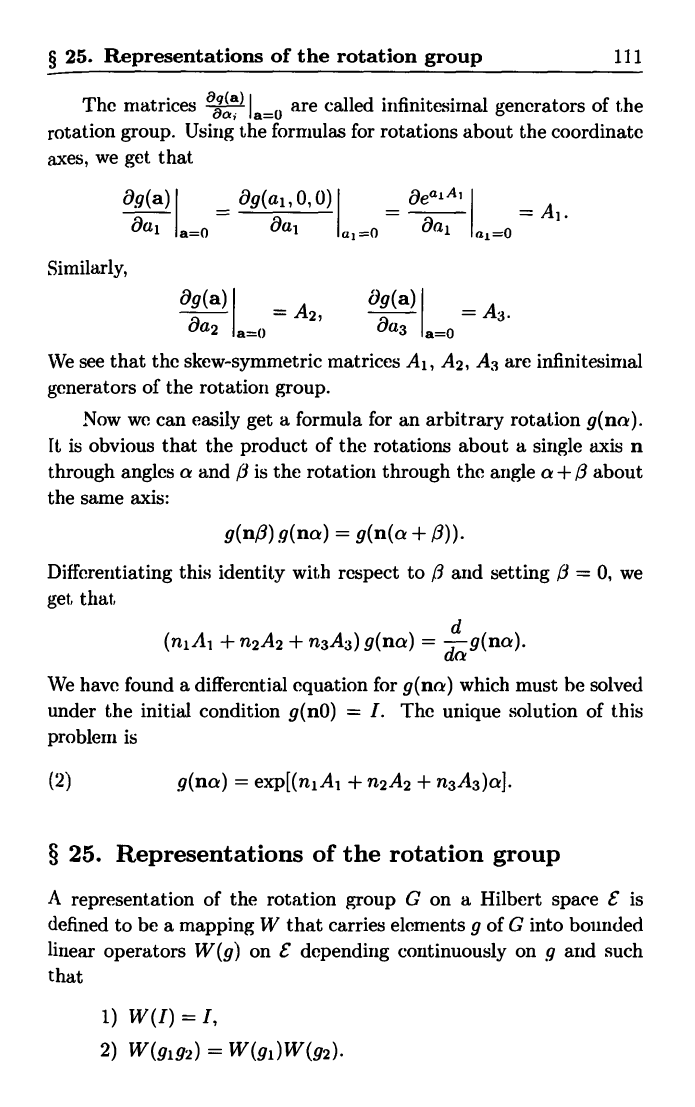
The matrices
8q(a)
are called infinitesimal generators of the
8a;
LO
rotation group. Using the formulas for rotations about the coordinate
axes, we get that
ag(al
, 0,
0)
a=n
sal
ae°`1 A,
a, =0
0a1
a1=0
= Al .
Similarly,
ag(a)
8a2
A2
a=0
Og(a)
= A3-
(9a3
a=o
We see that the skew-symmetric matrices A1, A2, As are infinitesimal
generators of the rotation group.
Now we can easily get a formula for an arbitrary rotation g(na).
It is obvious that the product of the rotations about a single axis n
through angles a and f3 is the rotation through the angle a +,3 about
the same axis:
g(nj3) g(na) = g(n(a +,3)).
Differentiating this identity with respect to /3 and setting /3 = 0, we
get, that,
+ n A+ n A
na) =
d
g(na).
(niA 1
22 3
3} g(
di
We have found a differential equation for g(na) which must be solved
under the initial condition g(nO) = I. The unique solution of this
problem is
(2)
.9(na) = eXP[(niAi + n2Aa + nsAs)a].
§ 25. Representations of the rotation group
A representation of the rotation group G on a Hilbert space E is
defined to be a mapping W that carries elements g of G into bounded
linear operators W (g) on E depending continuously on g and such
that
1) W(I) = I,
2) W(9i92) =W(9i)W(9a)
112 L. D. Faddeev and 0. A. Yakubovskii
In the first condition the first I denotes the identity rotation, and the
second denotes the identity operator on C.
It follows at once from
the conditions 1) and 2) that
W(g-1)=W-1(g).
A representation is said to be unitary if the operators W (g) are
unitary; that is, W *(g) = W -'(g).
In group theory it is proved that any representation of the rota-
tion group is equivalent to some unitary representation, and therefore
we can confine ourselves to the study of unitary representations.
We recall the two equivalent definitions of an irreducible repre-
sentation:
1) A representation is said to be irreducible if there are no
operators other than those of the form C1 that commute
with all the operators W (g) :
2) A representation is said to be irreducible if 6 does not have
a proper nontrivial subspace 6 invariant under the action
of the operators W (g).
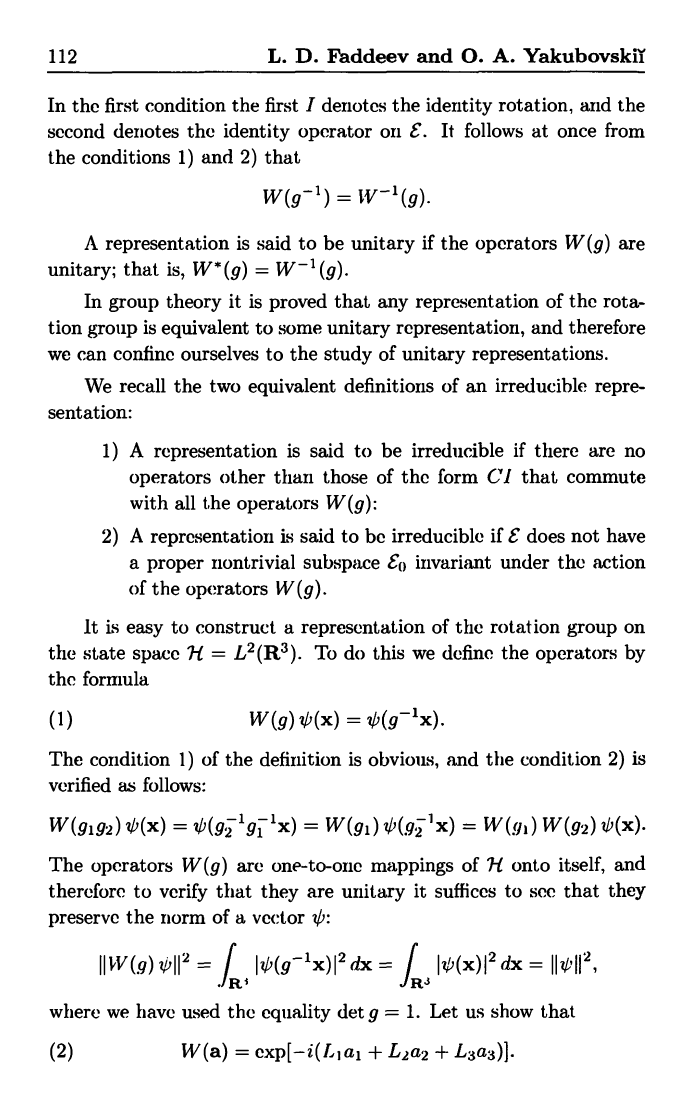
It is easy to construct a representation of the rotation group on
the state space ' = L2 (W). To do this we define the operators by
the formula
(1)
W(g) OX = 0(g-'X).
The condition 1) of the definition is obvious, and the condition 2) is
verified as follows:
W (9192)
(92 '911 x) = W(91) /' (.9 ' x) = W (91) W (92) zb (x).
The operators W (g) are one--to-one mappings of 1-1 onto itself, and
therefore to verify that they are unitary it suffices to see that they
preserve the norm of a vector ':
IIW(g)II2 =
1,0(g-IX)12dX
= I= IIV9112,
R3
JRJ
where we have used the equality det g = 1. Let us show that
(2)
W (a) = exp[-i(I,i al + Lla2 + L3a3)]-
§ 25. Representations of the rotation group 113
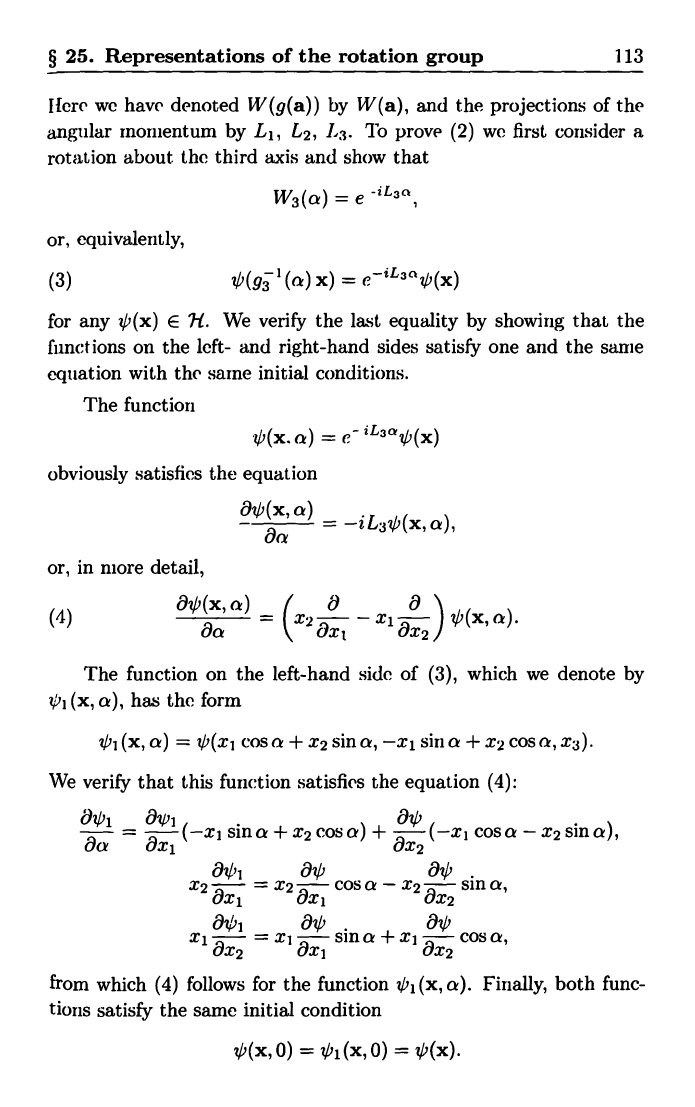
If ere we have denoted W(g(a)) by W (a), and the. projections of the
angular momentum by L1, L2, L3- To prove (2) we first consider a
rotation about the third axis and show that
W3((-t) = e
-iL3CY'
or, equivalently,
(3)
b(93 1(a) X) =
e_iL3a'0 (X)
for any fi(x) E R. We verify the last equality by showing that the
functions on the left- and right-hand sides satisfy one and the same
equation with the same initial conditions.
The function
'0(X, a) -- e- iL30t v)(X)
obviously satisfies the equation
80(x,a)
as
- -iL30(x,a),
or, in more detail,
(4)
a)
2 - X1
1P (x, a) -
aa
(X
ax,
aX2
)
The function on the left-hand side of (3), which we denote by
ip (x, a), has the form
01 (x, a) ='(x1 cos a + X2 sin a, -x1 sin a + x2 cos a, x3).
We verify that this function satisfies the equation (4):
O,1 a 1 a
(--xi sin a + x2 cos a) +
(--x1 cos a- x2 sin a),
as
Ox1 Ox2
x2 =
8x1
x2
8x1
cos a - x2
axe
sin a,
x
1901
= x
8-
sin a+ x
0
cos a
1Ox2
iax1 iax2
from which (4) follows for the function 01(x, a). Finally, both func-
tions satisfy the same initial condition
0(XI 0) = *I (XI 0) = *(x) -
114
L. D. Faddeev and 0. A. Yakubovskii
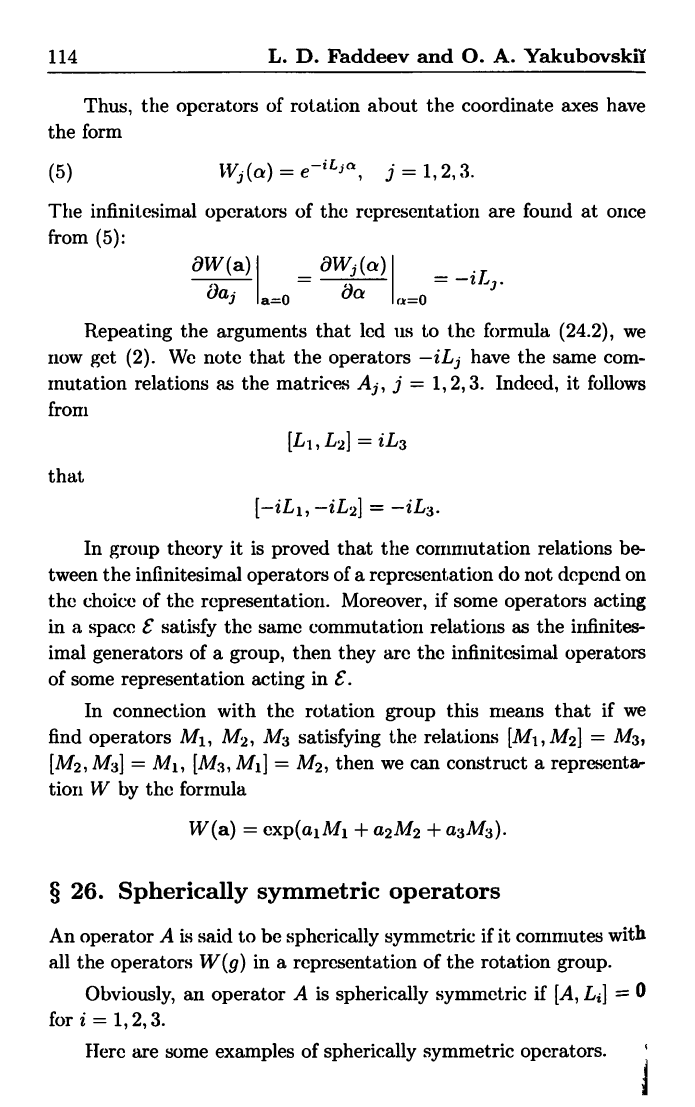
Thus, the operators of rotation about the coordinate axes have
the form
(s)
Wj(a) =
e-iLjcx,
j=1, 213-
The infinitesimal operators of the representation are found at once
from (5):
8W (a)
Oaf
aWj(a)
a=O
da
(=0
= --iL3 .
Repeating the arguments that led us to the formula (24.2), we
now get (2). We note that the operators - i Li have the same com-
mutation relations as the matrices A3 , j = 1,2,3. Indeed, it follows
from
[L1
,
L2] = iL3
that
[= --iL3.
In group theory it is proved that the commutation relations be-
tween the infinitesimal operators of a representation do not depend on
the choice of the representation. Moreover, if some operators acting
in a space E satisfy the same commutation relations as the infinites-
imal generators of a group, then they are the infinitesimal operators
of some representation acting in E.
In connection with the rotation group this means that if we
find operators M1, M2, M3 satisfying the relations [M1, M2] = M3,
[M2, M3] = M1, [M3, M1] = M2, then we can construct a representar
tion W by the formula
W(a) = exp(a1M1 +a2M2 +a3M3)-
§ 26. Spherically symmetric operators
An operator A is said to be spherically symmetric if it commutes with
all the operators W (g) in a representation of the rotation group.
Obviously, an operator A is spherically symmetric if [A, La] = 0
fori=1,2,3.
Here are some examples of spherically symmetric operators.
§ 26. Spherically symmetric operators
115
1) The operator of multiplication by a function f (r). Indeed, we
have seen that the angular momentum operators act only on the angle
variables. Therefore, L i f (r) * (x) = f (r) L i iI (x) for any '0 E R.
2) The operator L2. The spherical symmetry of this operator
follows from the relations [L2, Li] = 0 obtained earlier for i = 1, 2, 3
3) The kinetic energy operator T = -(1/2m)A. The spherical
symmetry of this operator is clear at once in the momentum repre-
sentation, where it is the operator of multiplication by the function
p'2 / (2m). In the momentum representation the angular momentum
operators Li have exactly the same form as in the coordinate repre-
sentation.
4) The Schrocliuger operator
H_ --
10+ V(r)
2m
for a particle in a central field, as a sum of two spherically symmetric
operators.
We direct attention to the fact that the very existence of spher-
ically symmetric operators different from CI implies the reducibility
of the representation of the rotation group constructed on the state
space H.
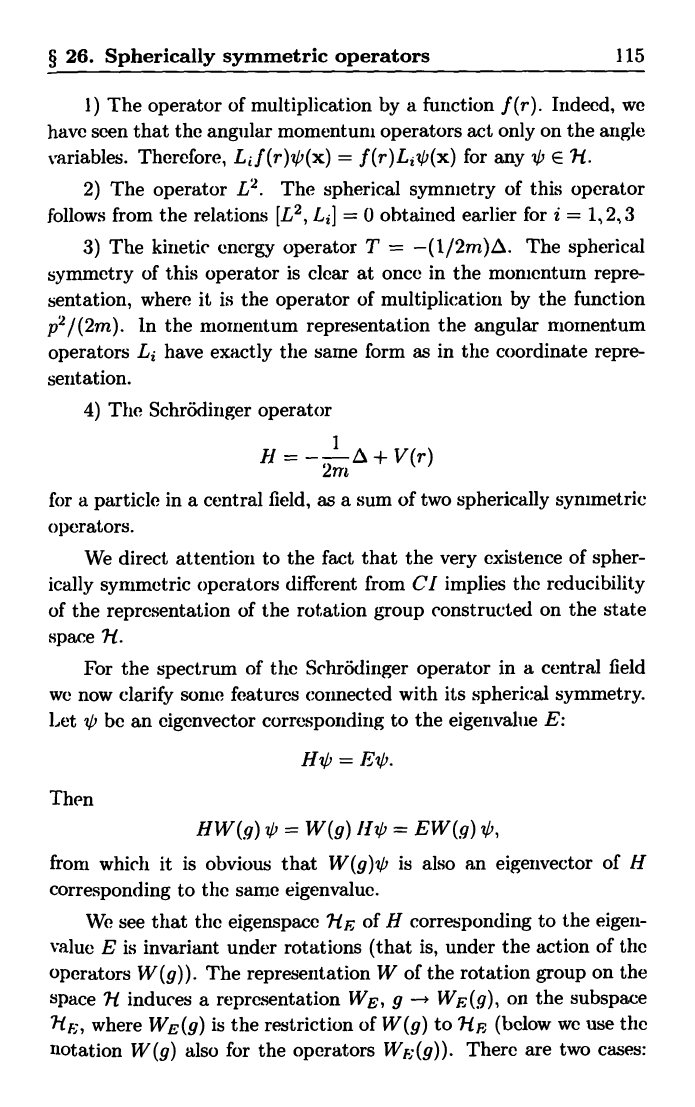
For the spectrum of the Schrodinger operator in a central field
we now clarify some features connected with its spherical symmetry.
Let 0 be an eigenvector corresponding to the eigenvalue E:
H = E.
Then
HW(g) ?P = W(g) H = EW(g)1,
from which it is obvious that W (g)
is also an eigenvector of H
corresponding to the same eigenvalue.
We see that the eigenspace HF of H corresponding to the eigen-
value E is invariant under rotations (that is, under the action of the
operators W (g)) . The representation W of the rotation group on the
space h induces a representation WE, g --+ WF (g), on the subspace
7Y
E,
where WE (g) is the restriction of W (g) to HF (below we use the
flotation W (g) also for the operators W,; (g)). There are two cases:
116
L. D. Faddeev and 0. A. Yakubovskii
either the representation induced on HE is irreducible, or R F, con-
tairis subspaces of smaller diniensiori that are invariant under tiW(g),
and then this representation will be equivalent to a direct suns of
irreducible represenitations.2'
We see also that the multiplicity of our eigenvalue of a spherically
symmetric Schrodinger operator is always no less than the dimen-
sion of some irreducible representation of the rotation group, and it
coincides with this dimension in the first case mentioned.
In physics the appearance of multiple eigenvalues of energy is
called degeneracy, and such energy levels are said to be degenerate.
If on each of the eigenspaces the induced representation is irreducible,
then one says that the operator II does not have accidental degen-
eracies. In this case the multiplicity of the spectrum is completely
explained by the chosen symmetry of the problem. In the presence
of accidental degeneracies there may exist, a richer symmetry group
of the Schrodinger equation. This is the case for the Schrodinger op-
erator for the hydrogen atom, which, as we shall see, has accidental
degeneracies with respect to the rotation group.
We remark that for a spherically symmetric operator H with pure
point spectrum there are eigenvalues with arbitrarily large rrlultiplic-
ity. Indeed, in this case 7-1 can be represented in the form
`l =
"'E1 ®nE2
a...
On the other hand,
fl=Rl.®7-12e ,
where the N,, are subspaces on which irreducible representations of
the rotation group act. In studying such representations in § 30 we
shall see that among the 7-1, there are subspaces of arbitrarily large
dimension. But for any ln, at least one of the intersections 7-1,, n HE,,
25 Here
we use a well-known theorem in group theory
if g - W (g) is a unitary
representation of the rotation group on a Hilbert space E, then there exist finite-
dimensional subspaces El, e2,
that are invariant with respect to W (g) and such
that the representation W is irreducible on each of them. they are pairwise orthogonal,
and they have sum E, that is, E = El ®E2 9
§ 27. Representation by 2 x 2 unitary matrices
117
is nonernpty, and then it contains l-(
entirely, so that the eigenvalue
Ek has multiplicity not less than the dimension of 7n .26
If the system does not have accidental degeneracies, then the
cigenvalues of H can be classified with the help of irreducible rep-
resentations of G in the sense that each eigenspace H E is also an
eigenspace of the corresponding representation. Therefore, the prob-
lent of finding all the irreducible representations of the rotation group
is important. We dwell on this question in the following sections.
In concluding this section we remark that such a relatively simple
quantum mechanics problem as the problem of motion in a central
field could be solved in general without invoking group theory. Our
goal with this example is to show how group theory can be used
in solving quantum mechanics problems. The xnicroworld (atoms,
molecules, crystal lattices) is very rich in diverse forms of symmetry.
The theory of group representations makes it possible to take these
symmetry properties into account, explicitly from the very beginning,
and it is often the case that one can obtain important results for very
complex systems only by using an approach based on group theory.
§ 27. Representation of rotations by 2 x 2
unitary matrices
We shall construct a representation of the rotation group G acting in
the space C2. To this end we introduce three self-adjoint matrices
26A
very Simple example of a spherically symmetric operator with pure point
spec trump is the Sehrodiriger operator
f f =
Pj 4 P2 4- P2
+
,02
1
1 ± -2 ±
3
)
2 2
or, in the coordinate representation,
'
Fl=_
l
A+
2
r2
The problem of separation of variables reduces to the one-dimensional case, and for
the eigenval ues one obtains the formula
En1n2n3 = n1 + n2 + TL3 +
3),
ni, n2. n3 = 0. 1, 2,
2
To each triple of numbers n1, n2, n3 there corresponds an eigenvector 'Pn 1 n2 n3
It is
clear that the multiplicity of the eigenvalues E grows unboundedly as E ---> oo