
Faddeev L.D., Yakubovskii O.A. Lectures on Quantum Mechanics for Mathematics Students
Подождите немного. Документ загружается.

118
L. D. Faddeev and 0. A. Yakubovski i
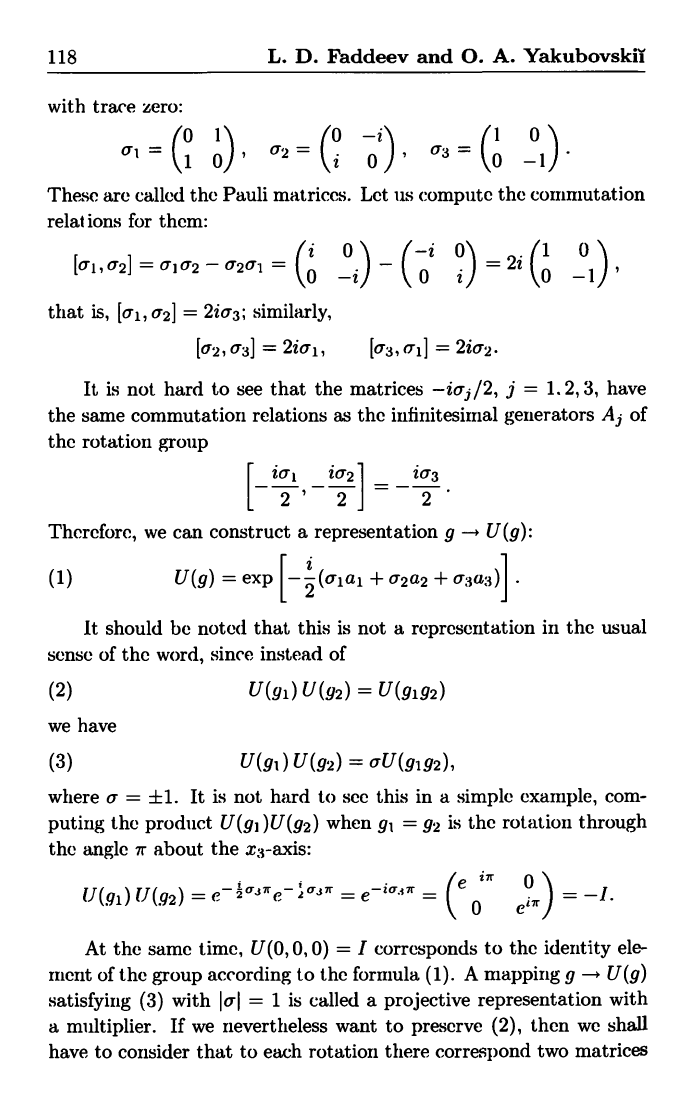
with trace zero:
0 1
_ 0 -i
1
0
of _
1 0'
2
i
0'
3--'
0
-1
These are called the Pauli matrices. Let us compute the commutation
relations for them:
_U
- 0' O =
2 0
-
_2
0
=2i
1
0
[a1o2]
1
0
-i
0
i
0
-1
that is, [a', o-2] = 2io3; similarly,
[o, (73] = 2icr1, [Q3, (71] = 2io2.
It is not hard to see that the matrices --iaa /2, j = 1. 2, 3, have
the same commutation relations as the infinitesimal generators Aj of
the rotation group
2Q1
192
2Qg
2'
2
2
Therefore, we can construct a representation g --+ U(g):
(t)
U(g) = exp [_(o-iai
2 + 2a2 + Q3as)J .
It should be noted that this is not a representation in the usual
sense of the word, since instead of
(2)
we have
(3)
U(91) U(92) = i1(9192)
U(91) U(92) = aU(9192),
where a = ± 1. It is not hard to see this in a simple example, com-
puting the product U (gl) U (g2) when gi = g2 is the rotation through
the angle 7r about the x3-axis:
U(.9,) U(.92)
e e; e
0
i
At the same time, U(0, 0, 0) = I corresponds to the identity ele-
ment of the group according to the formula (1). A mapping g - U(g)
satisfying (3) with J
= 1 is called a projective representation with
a multiplier. If we nevertheless want to preserve (2), then we shall
have to consider that to each rotation there correspond two matrices
§ 27. Representation by 2 x 2 unitary matrices
119
U differing in sign.
In physics such representations are said to be
two-to-one. These representations play as important a role in quan-
tum mechanics as the usual representations. In what follows we shall
not stress this, distinction. We remark further that the appearance of
such representations is explained by the fact that the rotation group
is not simply connected.
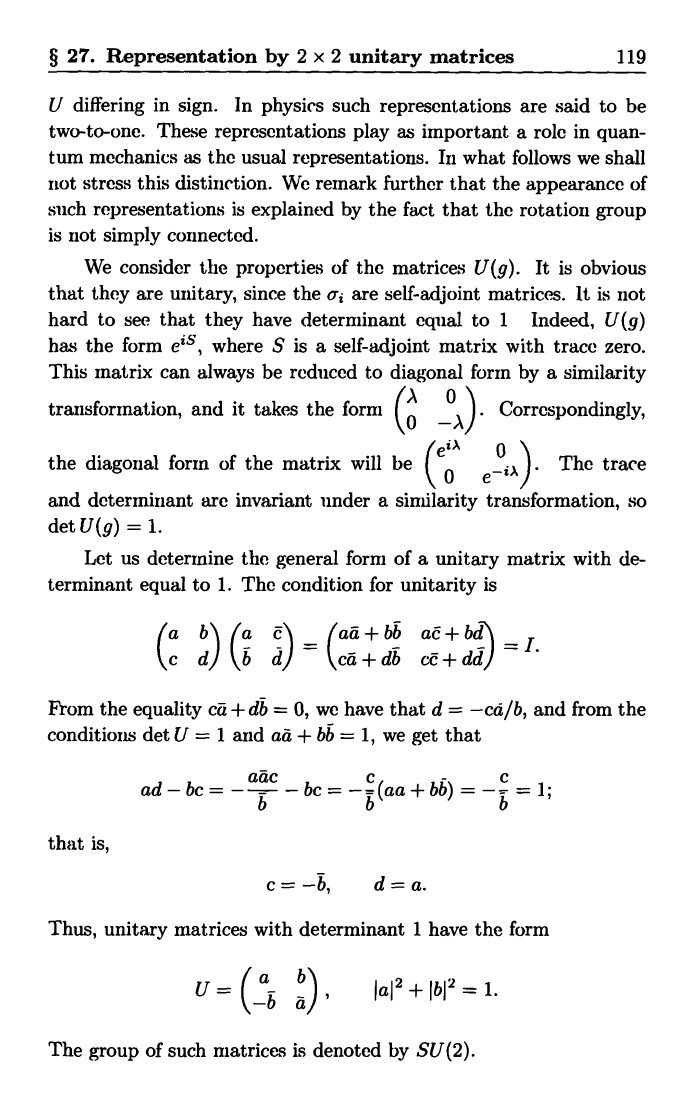
We consider the properties of the matrices U (g).
It is obvious
that they are unitary, since the of are self-adjoint matrices. It is not
hard to see that they have determinant equal to 1
Indeed, U(g)
has the form eis, where S is a self-adjoint matrix with trace zero.
This matrix can always be reduced to diagonal form by a similarity
transformation, and it takes the form
0
.
Correspondingly,
0 _
eza 0
the diagonal form of the matrix will be
0
e)
_ i.X
.
The trace
and determinant are invariant under a similarity transformation, so
det U (g) = 1.
Let us determine the general form of a unitary matrix with de-
terminant equal to 1. The condition for unitarity is
a
b) (a
c + bb a+ bd _
(c d) (b d) -
(a
ca + db
cc + ddJ
From the equality cu + db = 0, we have that d = -cd/b, and from the
conditions det U = I and ad + bb = 1, we get that
ad - be = - ab - be = - b (aa + bb) _ - b = 1;
that is,
c= --b, d =a.
Thus, unitary matrices with determinant 1 have the form
U=
(-6
a bJ,
ja12-FJb12=1.
a
The group of such matrices is denoted by SU(2).
120 L. D. Faddeev and 0. A. YakubovskiI
§ 28. Representation of the rotation group on a
space of entire analytic functions of two
complex variables
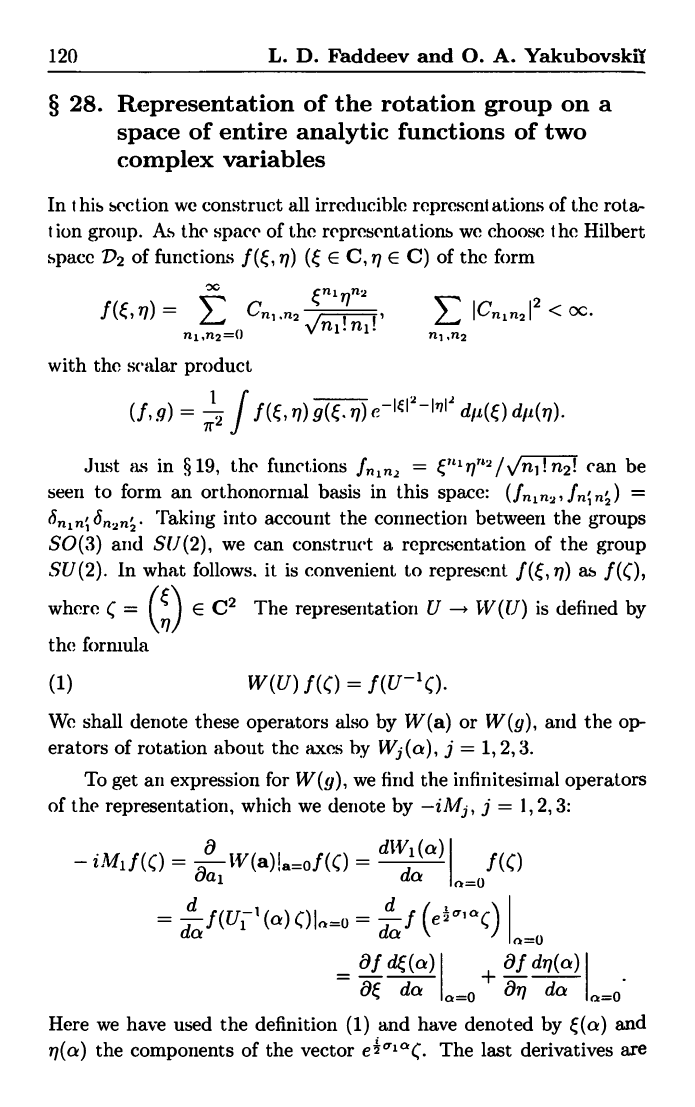
In t his section we construct all irreducible represent ations of the rotes
t ion group. As the space of the representations we choose t he Hilbert
space D2 of functions f E C,'q E C) of the form
ni n2
f
= C n C
2
< oc .
f
q)
1 M2
nin2
r
nl,n2=() ni! ni.
nl,n2
with the scalar product
(f,.9) =
2
f
r1}
r)) e212
dlL(r!)
Just as in 19, the functions f n1 n2 =
,t i ??Tb2 //nj ! n2!
can be
seen to form an orthonormal basis in this space: (f12, fn' n2) _
6nin; Sn2n2. Taking into account the connection between the groups
SO (3) and SU (2), we can construct a representation of the group
SU(2). In what follows, it is convenient to represent f
rz) as f ('),
where
=
E C2 The representation U -* W(U) is defined by
the formula
(1)
W (U) f ((') = f (U-10-
We. shall denote these operators also by W (a) or W (g), and the op-
erators of rotation about the axes by Wj (a), j = 1, 213.
To get an expression for W (g), we find the infinitesimal operators
of the representation, which we denote by -i Mj, j = 1, 2, 3:
a
Wai
=dWl(a)
(),a=of
if (()
f
da8a1
daf (Ui-
I
(a) 010=0
n=o
d
(ei)a
f
da
o=
a f 4 (a)
a f drl(a)
-
a
da 4-0 + a
da
n=o
Here we have used the definition (1) and have denoted by
(a) and
ii(a) the components of the vector e 2' a (. The last derivatives are
§ 28. Representation of the rotation group
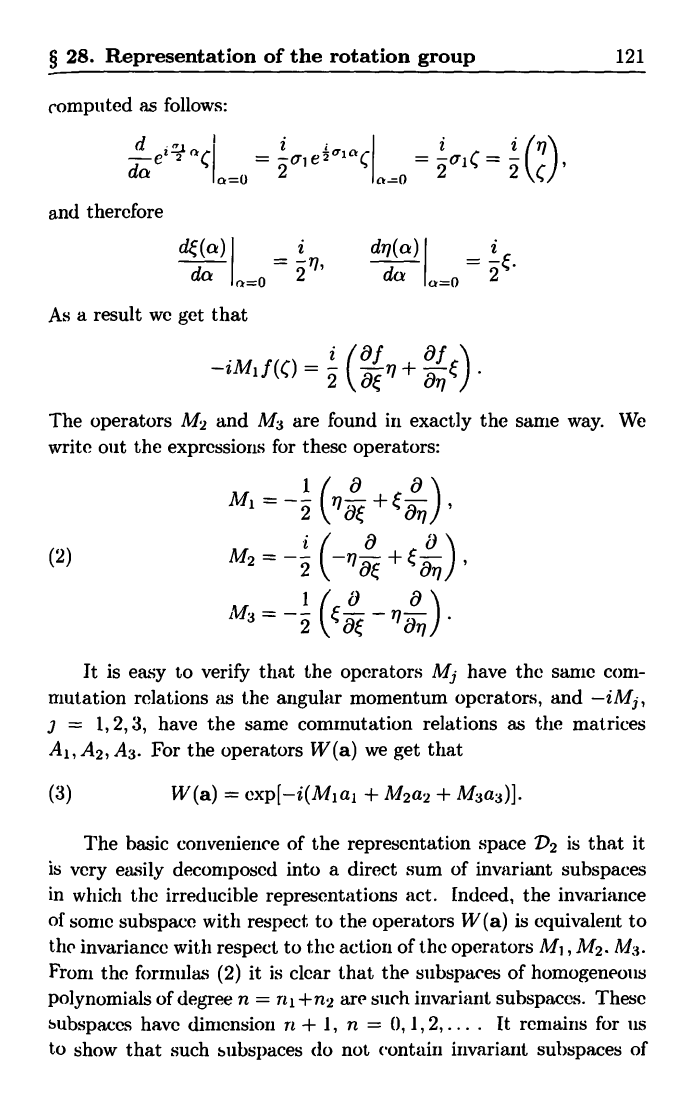
computed as follows:
d
i l0
1
doe e
a-0
and therefore
2a, e2°10c
2
ct=0
i
77,
dI(a
da
JQ=0
2
da
2 77
2 2(()'
As a result we get that
i
of of
-iMi f (0 =
2 (T
n+
a
The operators M2 and M3 are found in exactly the same way.
write out the expressions for these operators:
(2)
2
(77 d
+ a
}
M,
77
M=_i
2 2
na + a
a
a
M32 77
077)
121
We
It is easy to verify that the operators Mj have the same com-
mutation relations as the angular momentum operators, and -iMM,
j = 1,2,3, have the same commutation relations as the matrices
A2 ,
A2, A3. For the operators W (a) we get that
(3)
W(a) = exp[-i(Mial + M2a2 + M3a3)]
The basic convenience of the representation space D2 is that it
is very easily decomposed into a direct sum of invariant subspaces
in which the irreducible representations act. Indeed, the invariance
of some subspace with respect to the operators W (a) is equivalent to
the invariance with respect to the action of the operators MI, M2. Ltd3.
From the formulas (2) it is clear that the subspaces of homogeneous
polynomials of degree n = nl +n2 are such invariant subspaces. These
subspaces have dimension n + 1, n = 0, 1, 2, ....
It remains for its
to show that such subspaces do not contain invariant subspaces of
122
L. D. Faddeev and 0. A. Yakubovskil
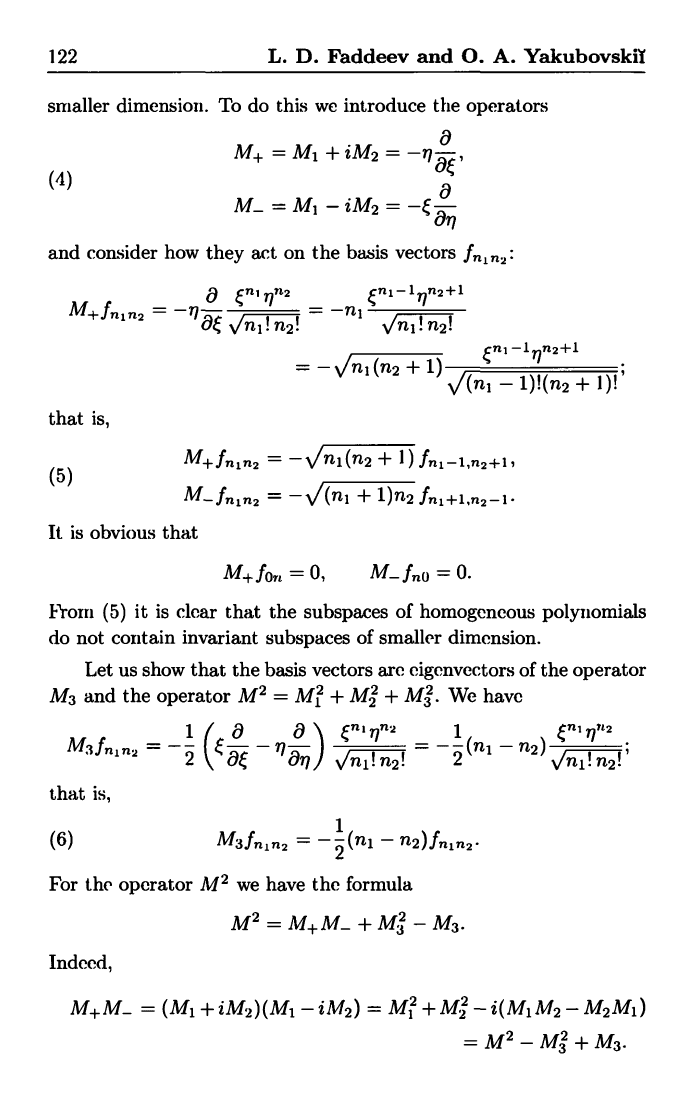
smaller dimension. To do this we introduce the operators
/AI
=-
a
M =M
iM2
M- = M -iM =
--
and consider how they act on the basis vectors fn1
n2 :
a Cnj It2
M+fnin2 =
-nl
o 1f .n21
n lf .n2I .
.
ns-lnn2tl
\/n- -(n
/(ni - 1)!(n2 -F 1)!
that is,
(5)
M+fnin2 = -
nl(n2 + 1) fni-1,n2+1,
M_ fnin2 =
-
(n1 + 1)n2 fnl+l,n2-1
It is obvious that
M+fort = 01
M fnu = 0.
From (5) it is clear that the subspaces of homogeneous polynomials
do not contain invariant subspaces of smaller dimension.
Let us show that the basis vectors are eigenvectors of the operator
M3 and the operator MI = Mi + M2 + M32. We have
nt r1712
M3
--
-1
a
fin'
n2
=
-1(1
n -n2)
fnln2
a
a
%/-n--j!
. n2, .
2
Vn n2.
2
that is,
(6)
-{n1 - n .
1n2
2
2)fn1n2
For the operator M2 we have the formula
M2=M+M_+M3 -M3.
Indeed,
M+ M- =
(M1+iML)(Ml-iM2) = M12 +M.2 -i(M1M2-M2M1)
=M2-M2
+M3.
§ 29. Uniqueness of the representations D3
123
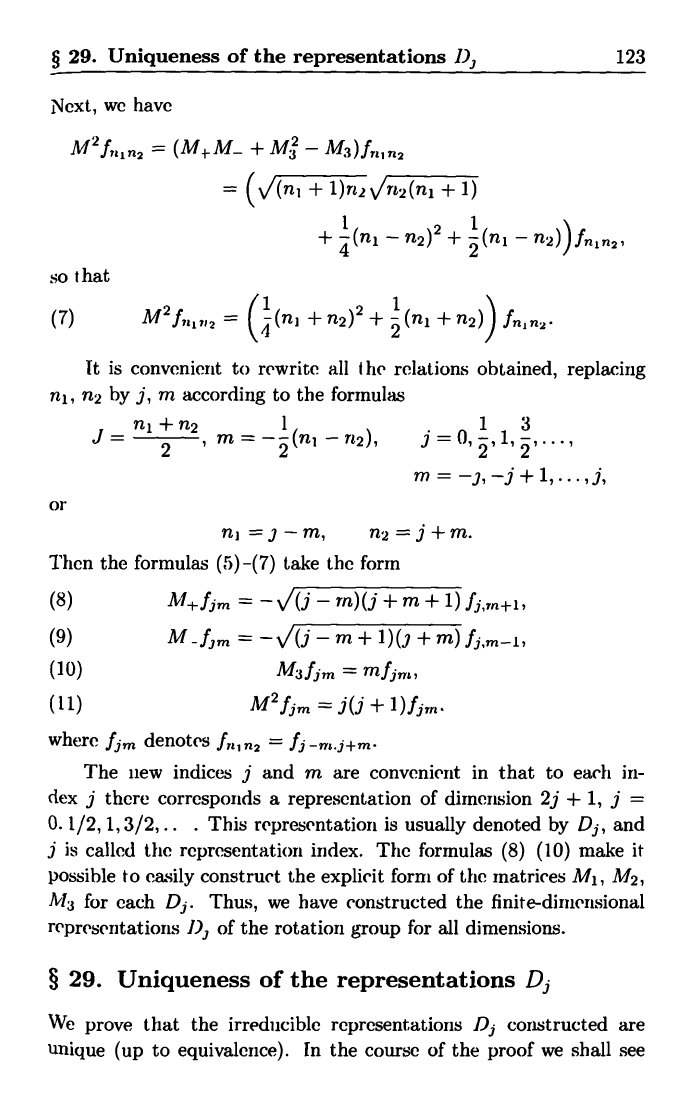
Next, we have
M 2 f,,1
n2 = (M4-M- +
M3 -
3) frt, rt 2
-- (v"ni + 1)n2
n2 (n, + 1)
V
+
1
(n, -- n2)2 +
2(nI -
n2)fnin21
so that
(7)
M2 f
n1 712
=
((ni
+ n2)2 -F'
2 (nl + n2) J fni
nz.
It is convenient to rewrite all the relations obtained, replacing
ni, n2 by j, m according to the formulas
ni+n2
m_- (ni -
n=0113...
2
2
2 2
m=-3,-j+1,...,j,
or
n j =j - m,
n2 = j + m.
Then the formulas (5) -(7) take the form
(8)
M+fjm = -
(j - rn) Cj + m + 1) fj,rn+i
(9) M _ f m = --
(j - m + 1 } (, + m} f j,m-i
(10)
M3,fj9n = mf jrri,
(11
M2fjm = . (j + 1)fjrri
where f j,, denotes f
ra, n2 = f j -rra,j+m.
The new indices j and m are convenient in that to each in-
dex j there corresponds a representation of dimension 2j + 1, j =
0. 1/2,113/21
..
. This representation is usually denoted by D,, and
j is called the representation index. The formulas (8) (10) make it
possible to easily construct the explicit form of the matrices MI, M2,
M3 for each Dj. Thus, we have constructed the finite-dirnerisional
representations 1). of the rotation group for all dimensions.
§ 29. Uniqueness of the representations Dj
We prove that the irreducible representations Dj constructed are
unique (up to equivalence). In the course of the proof we shall see
124
L. D. Faddeev and 0. A. Yakubovskil
to what extent the spectrum of the angular momentum operators
is determined by their commutation relations, and how an arbitrary
representation of the rotation group is decomposed into irreducible
representations.
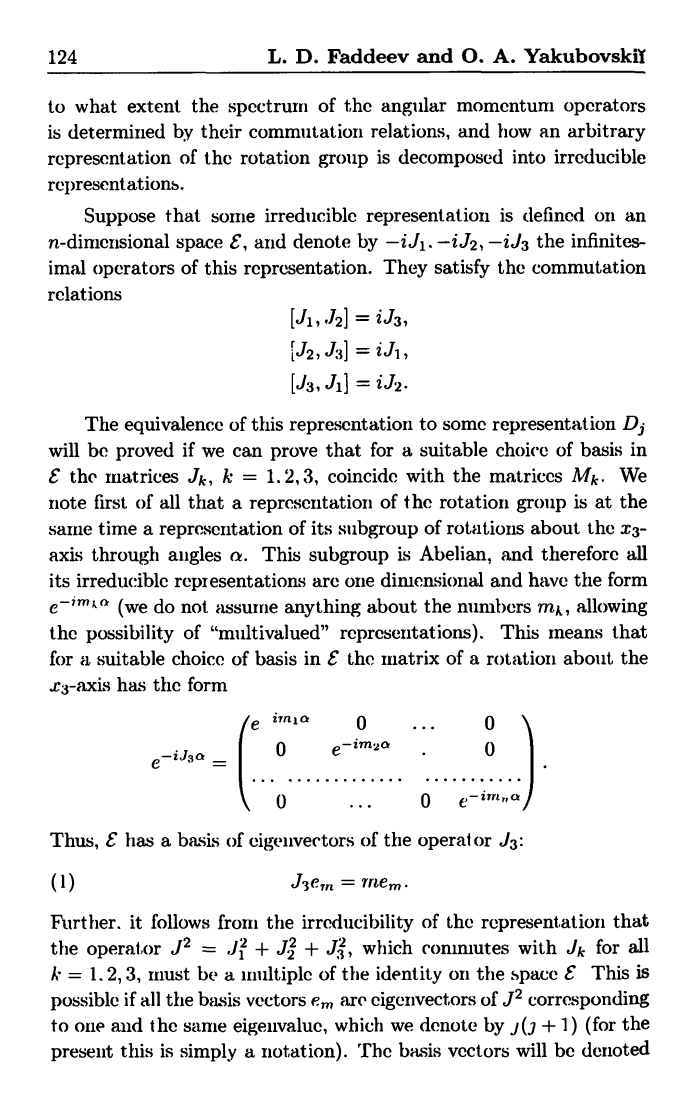
Suppose that some irreducible representation is defined on an
n-dimensional space E, and denote by - i Jr . --- i J2 , - i J3 the infinites-
imal operators of this representation. They satisfy the commutation
relations
[Ji, J2] = ieJ31
iJ2, Jai] = iJ1
[J3,Ji] = 2J<2.
The equivalence of this representation to some representation Dj
will be proved if we can prove that for a suitable choice of basis in
E the matrices Jk, k = 1. 2, 3, coincide with the matrices Mk . We
note first of all that a representation of the rotation group is at the
same time a representation of its subgroup of rotations about the x3-
axis through angles a. This subgroup is Abel i an, and therefore all
its irreducible repiesentations are one dimensional and have the form
e-'rn a (we do not assume anything about the numbers mk, allowing
the possibility of "multivalued" representations). This means that
for a suitable choice of basis in E the matrix of a rotation about the
x3-axis has the form
e-iha =
e irnla
l
0 ... 0
0
e-im2
0
.........
..........
0
... 0
e- im"Q
Thus, E has a basis of eigenvectors of the operator J3:
J3erra = Trtem .
Further. it follows from the irreducibility of the representation that
the operator J2 = '12 + J22+ J,21, which commutes with Jk for all
k = 1.2, 3, must be a multiple of the identity on the space E This is
possible if all the basis vectors e, are eigexivectors of J2 corresponding
to one and the same eigenvalue, which we denote by j (j + 1) (for the
present this is simply a notation). The basis vectors will be denoted
§ 29. Uniqueness of the representations D.
125
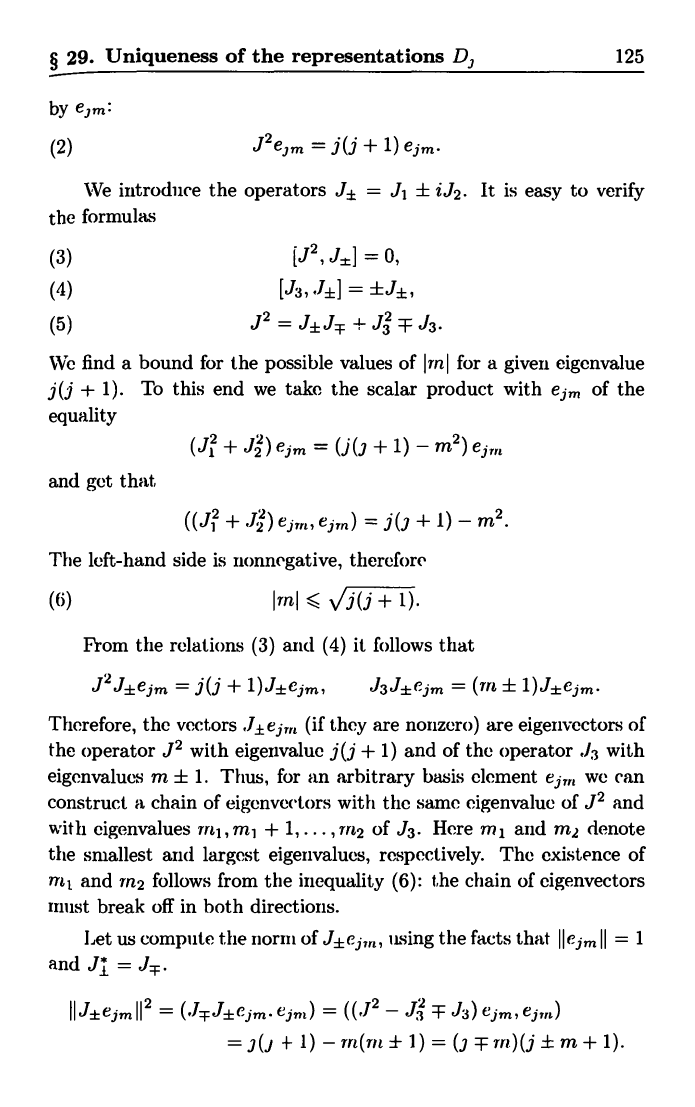
by elm
(2)
J2ejm =X(.7 + 1) e)m
We introduce the operators JJ = J1 ± i J2 . It is easy to verify
the formulas
(3)
(4)
(5)
[J2, jam]
-- o,
[J3, J±] = ±J±,
J2=J±J::F +J3
j3.
We find a bound for the possible values of 17,nl for a given eigenvalue
j (j + 1).
To this end we take the scalar product with e j m of the
equality
(J,2 + J2) elm
= (J(1 + 1) -
m2)
and get that
((J? + Jl) ejrr1, ejrn) = j(3 + 1)
-m2.
The left-hand side is nonnegative, therefore
(6)
lmi < /j(j + 1).
From the relations (3) and (4) it follows that
+1)Jfe J3Jte
=(rn±1)JCjj(j
m t m
Therefore, the vectors J± e j,, (if they are nonzero) are eigenvectors of
the operator J2 with eigenvalue j (j + 1) and of the operator .13 with
eigenvalues m ± 1. Thus, for an arbitrary basis element e7 r, we can
construct a chain of eigenvectors with the same eigenvalue of J2 and
with eigenvalues ml, m] + 1, ... , 7,n2 of J3. Here m 1 and m2 denote
the smallest and largest eigenvalues, respectively. The existence of
nil and rn 2 follows from the inequality (6): the chain of eigenvectors
innst break off in both directions.
Let us compute the norm of J± e j,n, using the facts that ikjm 11 = 1
and J-L = JT.
iiJ±C,m
112
= (JTJ±ejm.
(('12
- 3 T J3) ejm, ejm)
_ j(j + 1) -rn(rat+1)= (.j
rn)(j±m+1).
126 L. D. Faddeev and 0. A. Yakubovskij
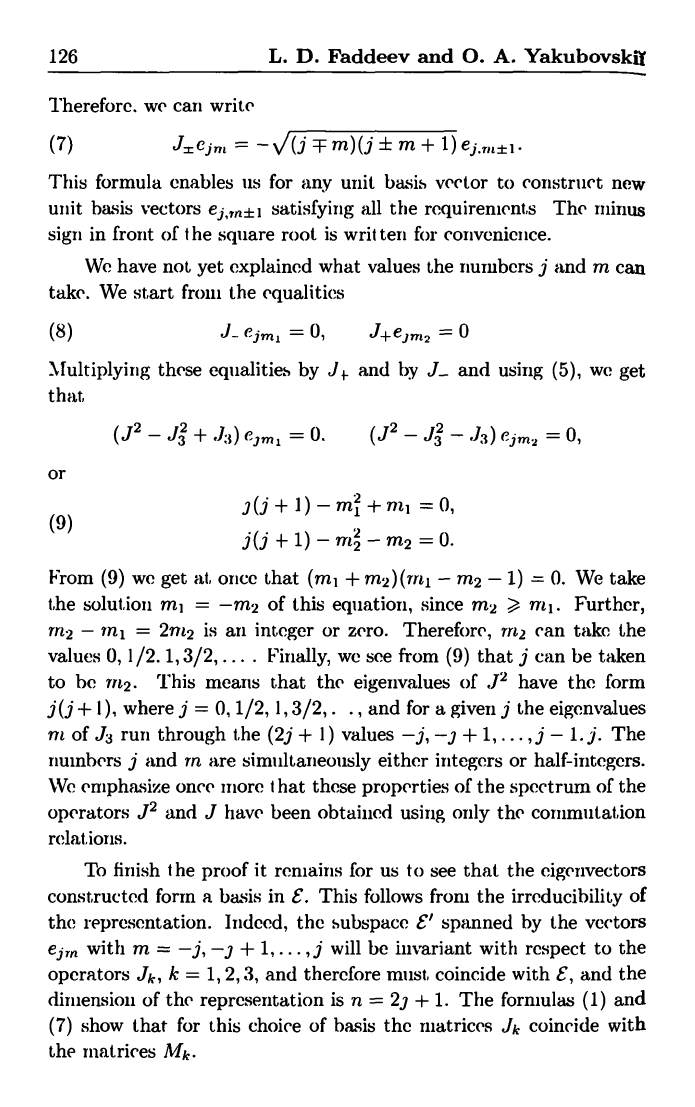
Therefore. we can write
(7)
J=e.in = -
(j T m) (j ± m + 1) ej.r1at
This formula enables us for any unit basis vector to construct new
unit basis vectors e j,7 ± 1 satisfying all the requirements The minus
sign in front of the square root is writ ten for convenience.
We have not yet explained what values the numbers j and m can
take. We start from the equalities
(8)
J_ ejmi = 0,
J+ejr2 = 0
Multiplying these equalities by J +. and by J_ and using (5), we get
that,
(J2J+J3)jmi=0.
(J2-JJ.3)jm2=0,
3
or
J(j + 1) _ M2 + mi = 0,
.
j(j +1) -rn -m2 =0
From (9) we get at, once that (mi + M2) (MI - m2
- 1) = 0. We take
the solution ml = -m2 of this equation, since m2 > rnl. Further,
rn2 - rn z = 2rn2 is an integer or zero. Therefore, rrm2 can take the
values 0, 1/2. 1, 3/2, .... Finally, we see from (0) that j can be taken
to be m2. This means that the eigenvalues of 'I 2 have the form
j (j + 1), where j = 0, 1/2, 1, 3/2, .
. ,
and for a given j the eigenvalues
m of J3 ruri through the (2j + 1) values -j, + 1, ... , j - 1. j. The
riuinbers j and in are simultaneously either integers or half-integers.
We emphasize once more that these properties of the spectrum of the
operators J2 and J have been obtained using only the commutation
relations.
To finish the proof it remains for us to see that the eigerivectors
constructed form a basis in £. This follows from the irreducibility of
the representation. Indeed, the subspace E` spanned by the vectors
e37 n with m = -j, -j + 1,. .. , j will be invariant with respect to the
operators Jk, k = 1, 2, 3, and therefore must, coincide with e, and the
dimension of the representation is n = 2j + 1. The formulas (1) and
(7) show that for this choice of basis the matrices Jk coincide with
the matrices Mk.
30. Representations of the rotation group on LZ(S2) 127
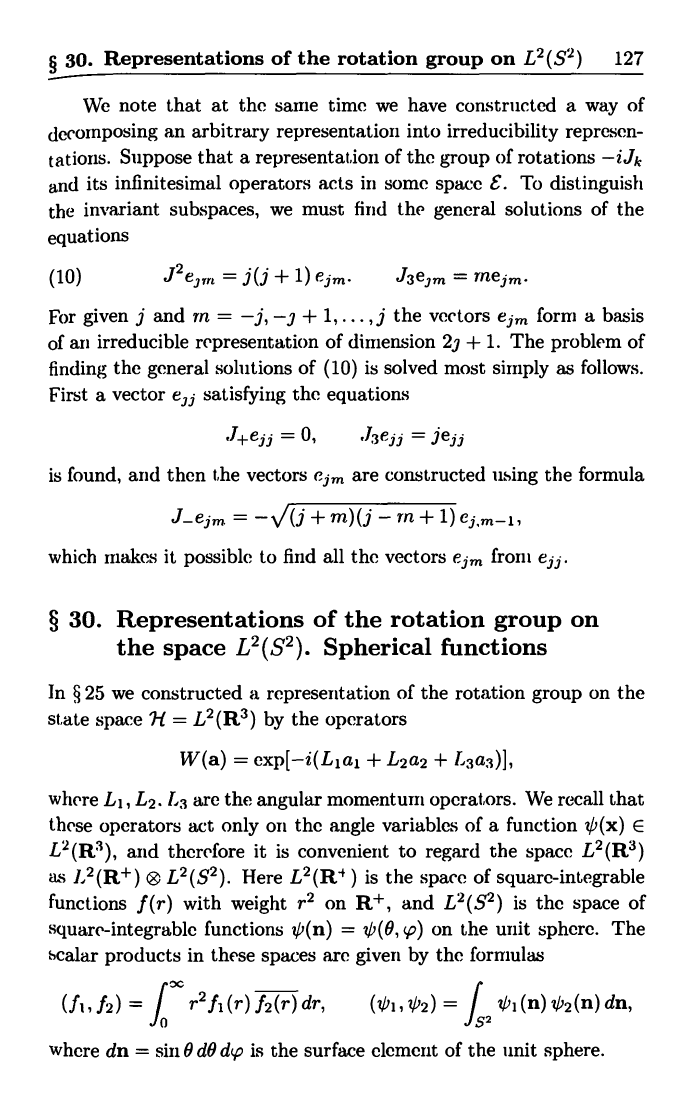
We note that at the same time we have constructed a way of
decomposing an arbitrary representation into irreducibility represen-
tations. Suppose that a representation of the group of rotations -iJk
and its infinitesimal operators acts in some space e. To distinguish
the invariant subspaces, we must find the general solutions of the
equations
(10) J2e.rn
+ 1) ejm.
J3e3m = mejm.
F o r given j and rn = -j, --3 + 1, ... , j the vectors ejm form a basis
of an irreducible representation of dimension 23 + 1. The problem of
finding the general solutions of (10) is solved most simply as follows.
First a vector e. ,j satisfying the equations
J+ejj = 0,
J3ej.j = jejj
is found, and then the vectors a j m are constructed using the formula
J_ejn = --
(j + m}(j -- rn + 1) ej,m-1,
which makes it possible to find all the vectors e j,,, frorri e j j .
§ 30. Representations of the rotation group on
the space L2(S2). Spherical functions
In § 25 we constructed a representation of the rotation group on the
state space f = L2 (R3) by the operators
W (a) = exp[--i(L1a1 + L2a2 + ,3a3)]
where L1, L2.13 are the angular momentum operators. We recall that
these operators act only on the angle variables of a function (x) E
L2 (R3)
, and
therefore it is convenient to regard the space L2 (R3)
a s 1,2 (R+) ® L2 (S2) . Here L2 (R4) is the space of square-integrable
functions f (r) with weight r2 on R+, and L2(S2) is the space of
square-integrable functions i(n) = 0(0, co) on the unit sphere. The
scalar products in these spaces are given by the formulas
x
fr2fm(r)Jdr,
f V), (n) GZ (n) dn,
2
where do = sin 0 dO dcp is the surface element of the unit sphere.