
Faddeev L.D., Yakubovskii O.A. Lectures on Quantum Mechanics for Mathematics Students
Подождите немного. Документ загружается.

128
L. D. Faddeev and 0. A. YakubovskiT
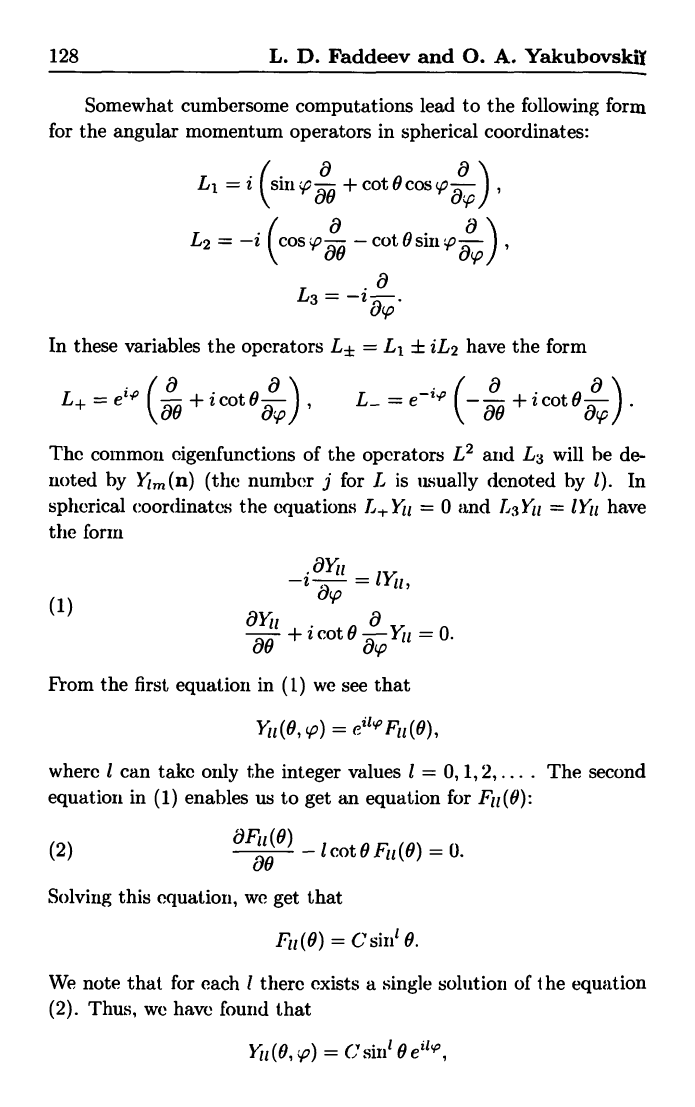
Somewhat cumbersome computations lead to the following form
for the angular momentum operators in spherical coordinates:
Lt
got e Cos
0a
I
,
L2 = -i
cos O To
cot ©sixl
d
00
}
a
L3
Ow
In these variables the operators L± = L1 ± iL2 have the form
8
L = ei-P
i cot B
L_ = e--
i Cot o
The common eigenfunctions of the operators L2 and L3 will he de-
noted by l
m
(n) (the number j for L is usually denoted by 1). In
spherical coordinates the equations L, Y11 = 0 and 13 Y11= l Y11 have
the form
ni
OY/I
-i-
=lY
tt,
SP
aYl
+
iCoto
y =0.
80
From the first equation in (1) we see that
Yt (0, P) =
Fat (0),
where 1 can take only the integer values l = 0, 1, 2, .... The second
equation in (1) enables us to get an equation for F411(0):
(2)
OF,, (e)
- i cot e F11 (e) - v.
ae
Solving this equation, we get that
F11(0) = C since 0.
We note that for each 1 there exists a single solution of the equation
(2). Thus, we have found that
Y1(0, co) = C
sin1 0
ei10
,
§ 30. Representations of the rotation group on L' (S2) 129
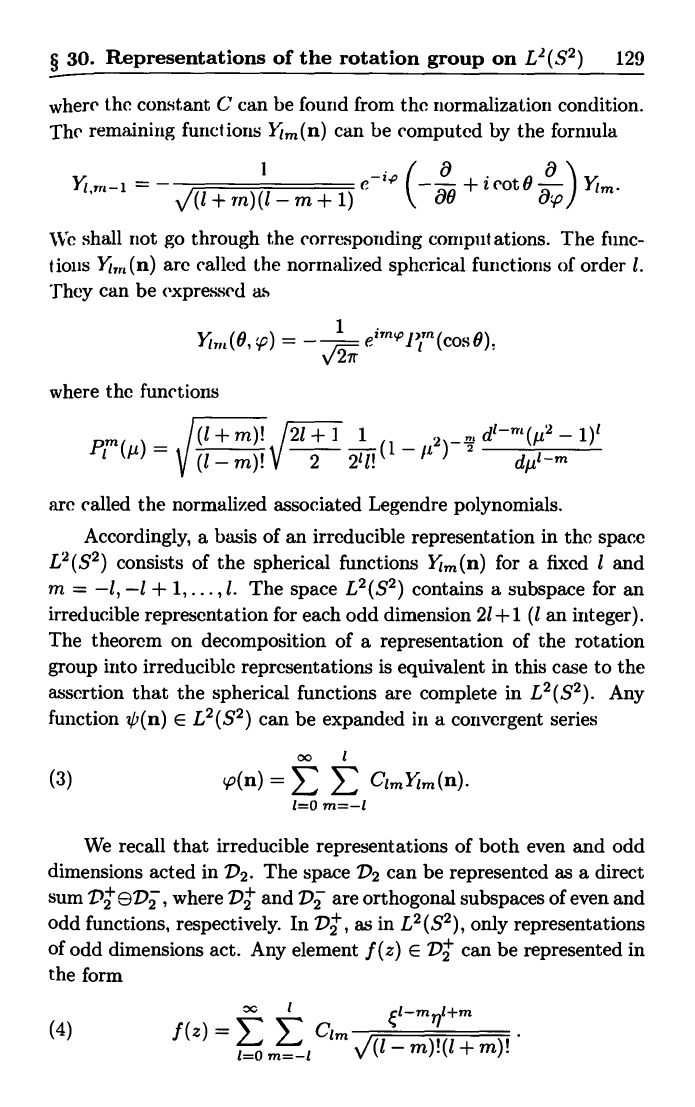
where the constant C can be found from the normalization condition.
The remaining functions Ym (n) can be computed by the formula
Y -- -
rl-i42
(-570-+
19
icote
a
V(1 + rn)(l-m+1)
a,
tm
We shall riot go through the corresponding comput ations. The funs--
t ions Yrra (n) are called the normalized spherical functions of order 1.
They can be expressed as
1
irnSp
Yrrm (e1
) _ -
e
1u1rn(cos O)
2ir
where the functions
P1, (A) -
(l_m)!{2
]
1 z 1)1
11! 1-
)
dot -"d
are called the normalized associated Legendre polynomials.
Accordingly, a basis of an irreducible representation in the space
L2(S2) consists of the spherical functions Ym (n) for a fixed 1 and
m = -1, -1 + 1, ... -, 1The space L2 (S2) contains a subspace for an
irreducible representation for each odd dimension 21 + 1 (1 an integer).
The theorem on decomposition of a representation of the rotation
group into irreducible representations is equivalent in this case to the
assertion that the spherical functions are complete in L2 (S2)
.
Any
function 0(n) E L2(S2) can be expanded in a convergent series
00
1
(3)
(n)= E 1: CimYm (n).
1=0 m=-l
We recall that irreducible representations of both even and odd
dimensions acted in D2. The space D2 can be represented as a direct
sum D2 eV2 , where D2 and D2 are orthogonal subspaces of even and
odd functions, respectively. In E)2+, as in L2 (S2), only representations
of odd dimensions act. Any element f (z) E D2 can be represented in
the form
00
1
l-mil+m
(4)
f (Z) = E E C1M-
1=0 M=-1
V(1 - M)! (I + M)!
130
L. D. Faddeev and 0. A. Yakubovskjr
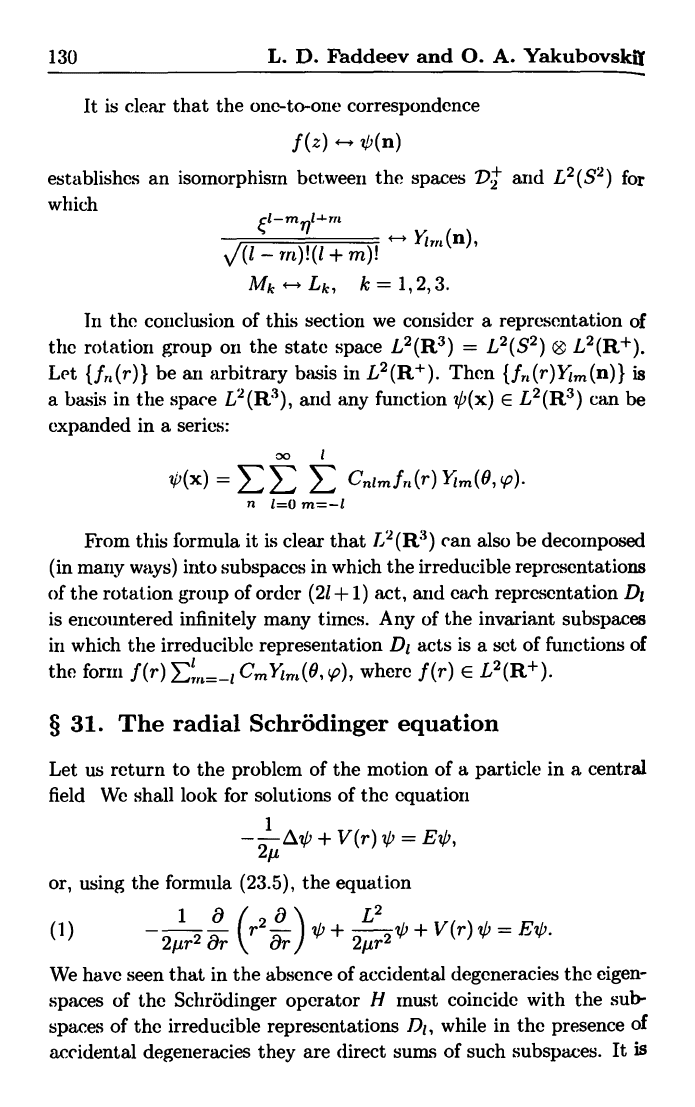
It is clear that the one-to-one correspondence
f(z)
V) (n)
establishes an isomorphism between the spaces Di and L2 (S2) for
which
l l
rrt n)
(l -- rrt)!(l + m)}
.
MkHLk, k=1,2,3.
In the conclusion of this section we consider a representation of
the rotation group on the state space L2 (R3) = L2 (S2) 0 L2 (R+).
Lot {f,L(r)} be an arbitrary basis in L2 (R+). Then {fit(r)Yirn(n)} is
a basis in the space L2 (R,"), and any function b (x) e L2 (R3) can be
expanded in a series:
00 1
V(x) = 1: E 1: Cnlmfrt(r) Yim(0, o)
n l=O m=-l
From this formula it is clear that 12 (R3) can also be decomposed
(in many ways) into subspaces in which the irreducible representations
of the rotation group of order (21+1) act, and each representation DI
is encountered infinitely many times. Any of the invariant subspaces
in which the irreducible representation Dl acts is a set of functions of
the form f (r) Elrt=-1 C Yl., (0, o), where f (r) E L2(R+).
§ 31. The radial Schrodinger equation
Let us return to the problem of the motion of a particle in a central
field We shall look for solutions of the equation
--
I D
+ V(r) 0 = E01
or, using the formula (23.5), the equation
1
a 2 8 L2
(1)
2 r2
r ar
0+
2 r2
+
V (r) 0= F.
u
ar
We have seen that in the absence of accidental degeneracies the eigen-
spaces of the Schrodinger operator H must coincide with the sub-
spaces of the irreducible representations D1, while in the presence
of
accidental degeneracies they are direct sums of such subspaces. It is
§ 31. The radial Schrodinger equation
131
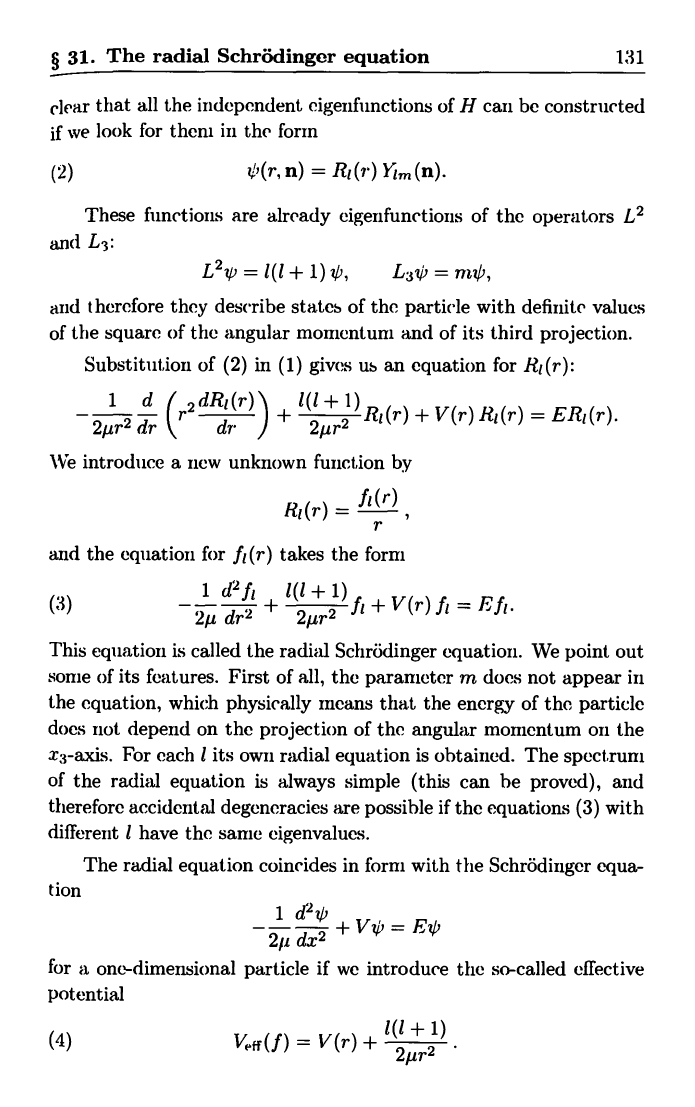
clear that all the independent eigenfunctions of H can be constructed
if we look for them in the form
(2)
/'(r, n) = Ri (r) Ym (n).
These functions are already eigenfunctions of the operators L2
and L3:
L2TP =l(l+l)b, L3ip="IV),
and therefore they describe states of the particle with definite values
of the square of the angular momentum and of its third projection.
Substitution of (2) in (1) gives us an equation for Ri (r):
1
d (r2)
dR1(r)
1(1 + 1 )
R r
V r R r= ER r.
2 r2 dr
dr + 2 r2
, (
) + ()
t ()
I (
}
We introduce a new unknown function by
R1 r
=fa(r)
r
and the equation for fa (r) takes the form
_ 1 d2.fi 1(1+1)
(3)
Z
dr2 + 2 r2
fl
+ V (r)
fl = Et fl.
This equation is called the radial Schrodinger equation. We point out
some of its features. First of all, the parameter m does not appear in
the equation, which physically means that the energy of the particle
does not depend on the projection of the angular momentum on the
x3-axis. For each 1 its own radial equation is obtained. The spectrum
of the radial equation is always simple (this can be proved), and
therefore accidental degeneracies are possible if the equations (3) with
different 1 have the same eigenvalues.
The radial equation coincides in form with the Schrodinger equa-
tion
1 d`2 /
,i dx2
+VVY = F,
2l
for a one-dimensional particle if we introduce the so-called effective
potential
Veff Y V M +
a
132 L. D. Faddeev and 0. A. Yakubovskij
Figure 7
However, there is one essential difference. The function p(x) is defined
on R while f (r) is defined on R+, and hence the radial equation is
equivalent to the one-dimensional Schrodinger equation for the prob-
lem with the potential V (x) under the condition that V (x) = oo for
x < 0.
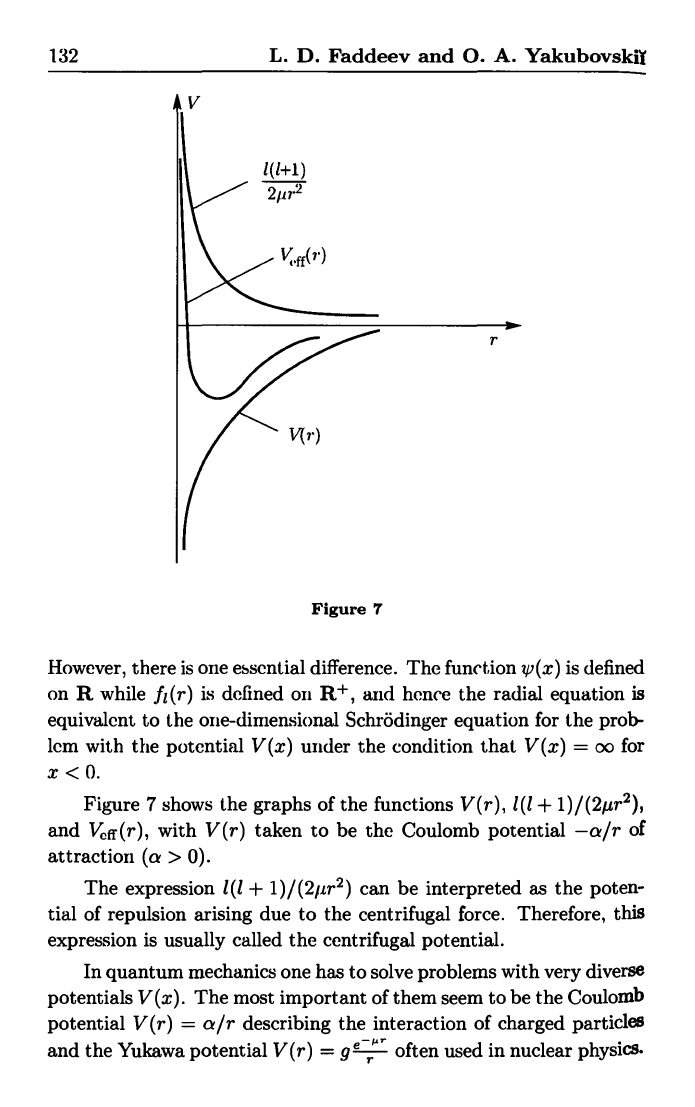
Figure 7 shows the graphs of the functions V (r), 1(1 + 1) / (2/ tr2 ),
and V0 ff (r), with V (r) taken to be the Coulomb potential -a/r of
attraction (a > 0).
The expression 1(1 + 1) / (2i,ir2) can be interpreted as the poten-
tial of repulsion arising due to the centrifugal force. Therefore, this
expression is usually called the centrifugal potential.
In quantum mechanics one has to solve problems with very diverse
potentials V (x). The most important of them seem to be the Coulomb
potential V (r) = a/r describing the interaction of charged particles
and the Yukawa potential V (r) = g e r
r
often used in nuclear physics.
§ 31. The radial Schrodinger equation
133
One usually considers potentials that are less singuar than 1/r 2_e
as r - 0 (e > 0). In dependence on their behavior as r --* oc, decay-
ing potentials (V(r) --+ 0) are divided into the short-range potentials,
which satisfy V (r) = o( 1l r24c ) for some e > 0, arid the long range
potentials, which do not satisfy t his condition The Yukawa potential
is a short,-range potential, while the Coulomb potential is a long-range
potential. The spectrum of the radial Schrodinger operator
(2
t(l + 1)
1
dr2 +
r2
+
V ( r )
(p=)
2
is well known for a very broad class of potentials.
In the case of
an increasing potential with V (r) - oo as r --+ oc, the spectrum
is a pure point, spectrum arid is simple
In the case of a decaying
potential the interval 0 < E < oc is filled by the continuous spectrum,
and the negative spectrum is discrete. For a short-range potential
the positive spectrum is simple and continuous, while the negative
spectrum consists of a finite number of eigenvalues.
We shall give some simple arguments enabling us to understand
the basic features of the spectrum of H1. To this end we consider how
the solutions of the radial equation behave as r - 0 and r --p oo. If as
r -+ oo we ignore the term Veff in the radial equation, then it reduces
to
1
+F;fi=0.
2p
For E > 0 this equation has the two linearly independent solutions
e -ikr said eik'", where
k2
= 2 jiE > 0 and k > 0.
For E < 0 the
linearly independent solutions have the form e-"' and e". where
x2=--2pE>0and x>0.
In the case r --- 0, we can hope to get the correct behavior of the
solutions of the radial equation if in this equation we leave the most
singular
r {2i ,'
f j of the terms linear in fl, so that
fill
-
aft + i)
fi = o.
r2
This equation has the two linearly independent solutions r`l and
rl--i
134 L. D. Faddeev and 0. A. Yakubovskil
Let us now consider what conditions should reasonably he im-
posed on the solutions of the radial equation. We are interested in
the solutions V) (x) =
f`
} Y
rn
(n) of the Schrtidiiiger equation. The
functions b(x) must be continuous in R3 and either square-integrable
or bounded on the whole space. In the first case they are eigenfunc-
tions in the usual sense of the word, and in the second case they can
be used to describe the continuous spectrum.
The continuity of bb(x) implies the condition fl (0) = 0. Therefore,
only solutions of the radial equation that behave like Crl+1 as r - 0
are of interest.
This condition determines fl(r) up to a numerical
factor. Next, for E < 0 we must, find a solution f (r) that behaves
like Ce x" as r - oo (otherwise, the solution will be unbounded).
For arbitrary negative E these conditions turn out to be incompatible.
Those values of E for which we can construct a solution having the
correct behavior at zero and at infinity are precisely the eigenvalues.
For any E > 0 the solution fl (r) is bounded, and thus it suffices
that it have the correct behavior at zero. The spectrum is continuous
for E > 0.
The eigenfunctions of the discrete spectrum describe a particle
localized in a neighborhood of the center of force; that is, they cor-
respond to a finite motion. The eigenfunctions of the continuous
spectrum can be used to describe the states in which the motion of
the particle is infinite.
The eigenfunctions of the discrete spectrum of the radial equation
will be denoted by fkl (r), where k indexes the eigenvalues Ekl of the
equation for a given 1
Hlfkl = Eklfkl
The eigenfunctions of the continuous spectrum corresponding to
the energy E will he denoted by f hl :
Hl f F,l = Ef EI.
For a broad class of potentials it has been proved that the system
{ f kl
, f r, t
} of functions is complete for each 1 = 0, 1, 2,.
..
. This means
§ 31. The radial Schrodinger equation
1 35
that an arbitrary function27 f (r) E L2 (0, c) has a representation
oc
f (r) =
Ck f kl (r) +
C(E) IE1(r) dE,
k c
where
Ck = fx
f (r) .fki (r) dr,
C(E) = f .f (r) .fFt (r) dr.
v
o
Let us return to the three-dimensional problem. The functions of
the discrete spectrum have the form
x `
f kt (r)
n
ktrra ( }
r
lira }
and the multiplicity of the eigenvalue Eki is equal to 21 + I (in the
absence of accidental degeneracies).
For the eigenfunctions of the
continuous spectrum we have
fEt(r)()
Et7n
The multiplicity of the continuous spectrum is infinite, since for any
E > 0 there are solutions of the radial equations for all l and, more-
over, m = -l,--1+
1,...,1.
The parameters k, 1, and m that determine the eigenfunctions
of the point spectrum are called the radial, orbital, and magnetic
quantum numbers, respectively.
These names go back to the old
Bohr-Soxnnmerfeld quantum theory, in which a definite classical orbit
(or several such orbits) corresponded to each admissible value of the
energy. The numbers k and 1 determined the size and shape of the
orbit, and the number m determined the orientation of the plane of
the orbit in space. The number m plays an essential role in magnetic
phenomena, which explains its name.
The completeness of the system {fkz
, f El
} of functions in L2 (0, oc)
implies the completeness of the system {'kjm(X), LE1m (x) } in L2 (R3) .
For brevity of notation we consider the case when the point spec-
trum of the operator H is absent. In this case an arbitrary function
27L2(0, oc) denotes the space of square-integrable functions (without the weight
7 2) on R+ If f E
L2(0,00), then H = f /r E L2 (R-"')
136 L. D. Faddeev and 0. A. YakubovskiI
Z;' (x) E L2 (R3) can be represented in the form
x I
x
VI(x) _ 1:
Cim(fE) ,O Fim(x) dE.
1-0 m--l U
I t is clear that p is determined by the sequence {C'im(E)} of
functions, and therefore we get the representation
H {Clrn(E)}
in the space of sequences of functions. In this space the scalar product
is given by
cc t
x
(1,i/'2)= E
Ctrn C(" dE.
1=0 m=-l
1(0)
17n
From the fact that JBam (x) is an eigenfunctiori of the operators H,
L2, and L3, it follows easily that these operators act as follows in the
representation constructed:
IICim(E) = ECjm(E),
(5)
L2CIm(E) =1(l + 1) Cim(E),
L3Cim(E) = mCim(E).
Therefore, this representation is an eigenrepresentation for the three
commuting operators H, L2, and L3. (The equation (5) should not
be confused with the equations for the eigenvectors.)
§ 32. The hydrogen atom. The alkali metal
atoms
The hydrogen atom is a bound state of a positively charged nucleus
with charge e and an electron with charge -e (e > 0 is the absolute
value of the charge of an electron). Therefore, the potential V (,r) has
the form
e2
V(r) = --.
We consider the problem of motion in the field
V(r) Zee
.
r
§ 32. The hydrogen atom. The alkali metal atoms
137
Such a potential corresponds to a hydrogen atom with Z = 1 and
to the hydrogen-like ions He+, Li+-, ... with Z = 2,3,. ..
In the
coordinate representation the Schrodinger operator has the form
H
1
it
Zee
=-
-
,
2/4
r
where It = m M/ (m + M) is the reduced mass, and m and M are
the masses of the electron and nucleus, respectively. We shall solve
the problem in the so-called atomic system of units in which h = 1,
A = 1, and
e2 = 1. Then the radial Schrodinger equation takes the
form
_1
"r
1(1+1)
ft () + 2
f1--f1=Ef1.
We are interested in the discrete spectrum, so we consider the
case E < 0. It is convenient to use the notation -2E = x2. Then
1
"
2Z -ly+1)
-2 =0.
()
fit
+
r
fl
r2
ft
f t
The arguments in the previous section about the behavior of a
solution as r -+ 0 and r -* oo suggest that it is convenient to look for
a solution in the form
(2)
fft (r) = rt+1e-x' At (r).
If we can find Al (r) representable by a convergent power series,
(3)
00
A,(r) = >ajr'
i=u
with a0
0 and such that f j (r) satisfies (1), then the correct behavior
of ft (r) as r
0 will also be ensured Of course, the behavior of ft (r)
as r -- oo depends on the asyxnptotics of the function At (r) as r --+ oo.
It is convenient to make the substitution of (2) into the equation
(1) in two steps. Introducing the function g by
f=e-xrg,
f , =
e-X' (x2q
- 2xg' + y"),
we have
2Z
-
1(1 +1)
=0.
9
r
9
r2
,9