
Faddeev L.D., Yakubovskii O.A. Lectures on Quantum Mechanics for Mathematics Students
Подождите немного. Документ загружается.

138
L. D. Faddeev and 0. A. Yakubovski
Further. setting
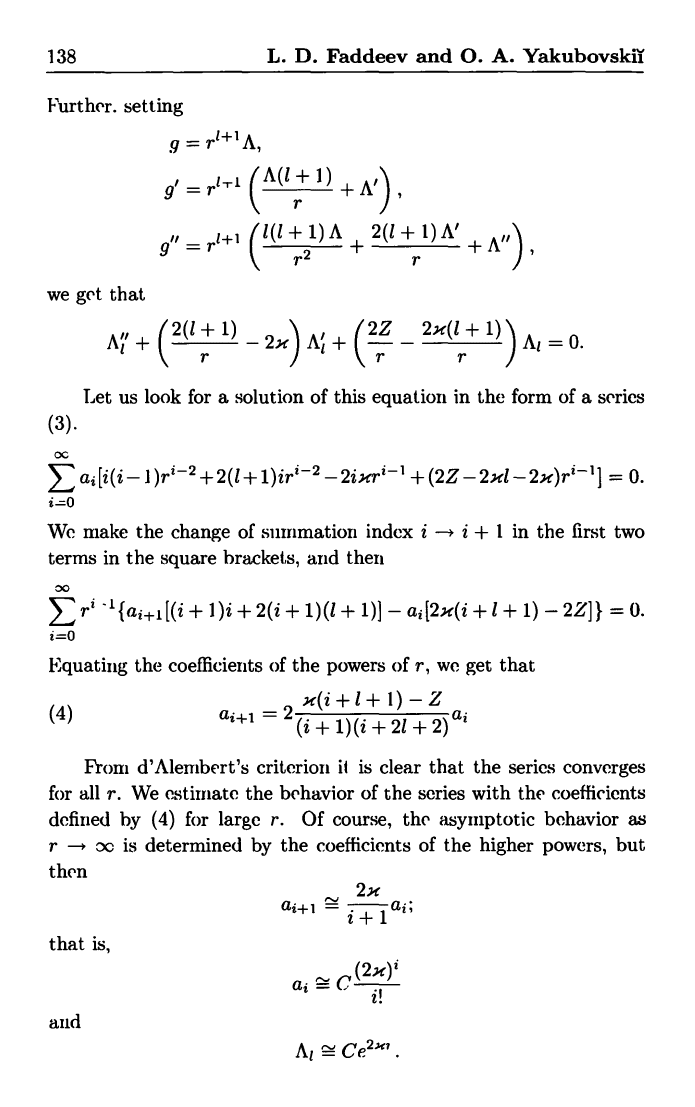
g =
r1+1 A,
tr1
A(l+1)
+A'
=r
g
1+1
r
l(1 + 1) A 2(1
+ 1) A'
'=
g
r
+
+ A
r2 r
we get that
n + 2(1+1)
_ 2x I A' +
r2Z
_
2x(l + 1)1
Al = 0.
r / `r r
Let us look for a solution of this equation in the form of a series
(3).
aa[i(i- l )ri-2+2(l+l)ira-2 -2ixr'-1 0.
i=O
We make the change of summation index i --> i + I in the first two
terms in the square brackets, and then
00
E ri {ai+1 [(i + 1)i + 2(i + 1) (1 + 1)] - ai [2x(i + l + 1) -- 2Z] } = 0.
z=O
Equating the coefficients of the powers of r, we get that
(4)
1 ) ( i 2 1 +
= 2
1)
From d'Alembert's criterion it
is clear that the series converges
for all r. We estimate the behavior of the series with the coefficients
defined by (4) for large r.
Of course, the asymptotic behavior as
r -p oc is determined by the coefficients of the higher powers, but
then
2x
ai+1
+
1 ai;
that is,
and
(2x)z
ai
ti C
it
2
Al
Ce
.
=
§ 32. The hydrogen atom. The alkali metal atoms
139
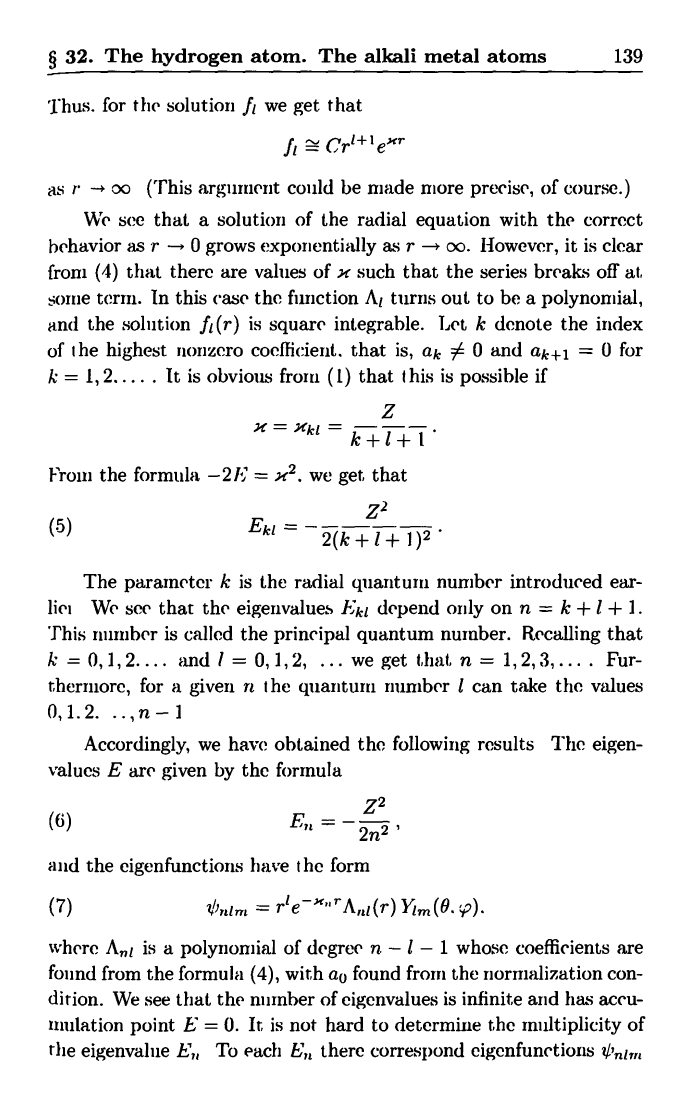
Thus. for the solution f we get that
fl
Cri+lexr
as to _+ 30 (This argurzient could be made more precise, of course.)
We see that a solution of the radial equation with the correct
behavior as r - 0 grows exponentially as r -+ oo. However, it is clear
from. (4) that there are values of x such that the series breaks off at,
some term. In this case the function Al turns out to be a polynomial,
and the solution fl (r) is square integrable. Let k denote the index
of the highest nonzero coefficient. that is, ak 34 0 and ak+1 = 0 for
k = 1, 2..... It is obvious from (I) that t his is possible if
z
x= xk t =
k+7_471-
.
From the formula -2E = x2 . we get that
Z
(5)
Ekl _
-2(k + l +1 ) 2
The parameter k is the radial quantumn number introduced ear-
liei We see that the eigenvalues Eki depend only on n = k + 1 + 1.
This number is called the principal quantum number. Recalling that
k = 0, 1, 2.... and l = 0, 1, 2,
... we get
that, n -- 1, 2, 3, .... Fur-
rherruore, for a given n the quantumn number l can take the values
0, 1.2. ..,n - 1
Accordingly, we have obtained the, following results The eigen-
values E are given by the formula
Z2
(6)
Eit
2n2
and the eigenfunctions have the form
(7)
Ortlrrt =
rte-x"''A.t(r) Ym(O.
).
where Ar1 1
is a polynomial of degree n. -- I - 1 whose coefficients are
found from the formula (4), with ae found from the normalization con-
dition. We see that the number of eigenvalues is infinite and has accu-
mulation point E = 0. It is not hard to determine the multiplicity of
the eigenvalire E,, To each E,, there correspond eigenfunctions
140
L. D. Faddeev and 0. A. Yakubovskii
differing by the quantum numbers 1 and m, with 1 = 0. 11 2..... n - 1
and m = -1,
-t -- 1,. .. ,1. For the multiplicity q we have
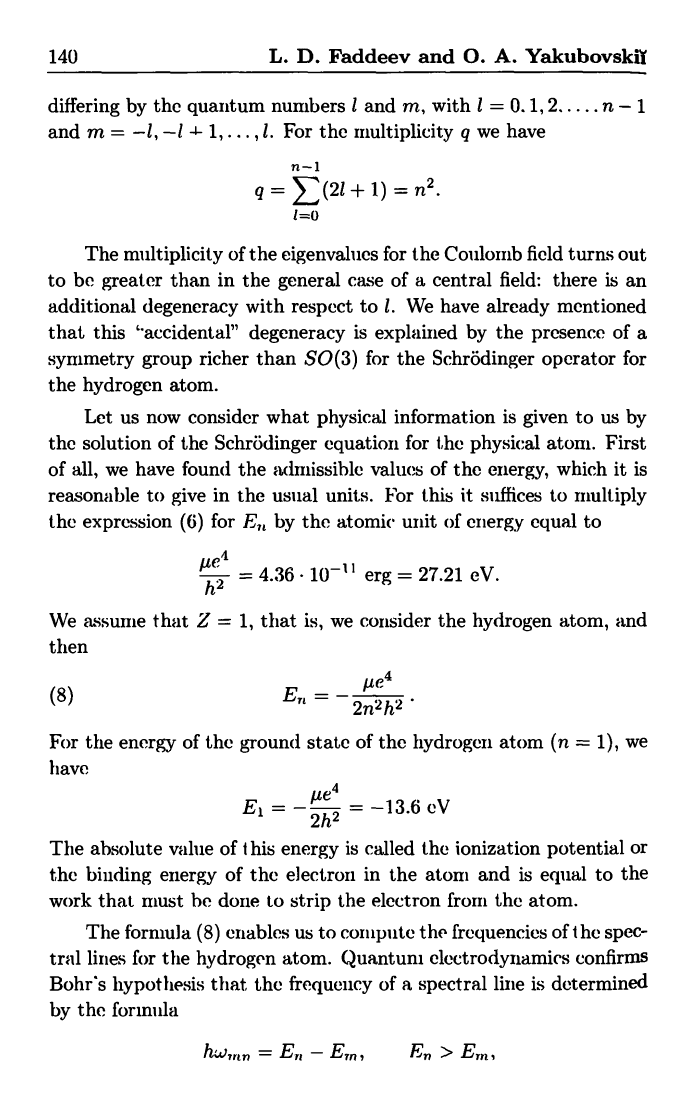
n-1
2
q=j:(21+1)=n
t=v
The multiplicity of the eigenvalues for the Coulomb field turns out
to be greater than in the general case of a central field: there is an
additional degeneracy with respect to 1. We have already mentioned
that this "accidental" degeneracy is explained by the presence of a
symmetry group richer than SO(3) for the Schrodinger operator for
the hydrogen atom.
Let us now consider what physical information is given to us by
the solution of the Schrodinger equation for the physical atom. First
of all, we have found the admissible values of the energy, which it is
reasonable to give in the usual units. For this it suffices to multiply
the expression (6) for F,t by the atomic unit of energy equal to
= 4.36. 10erg = 27.21 eV.
h2
We assume that Z = 1, that is, we consider the hydrogen atom, and
then
(s)
le4
Ert = -2n2h2 .
For the energy of the ground state of the hydrogen atom (n = 1), we
have
El = 2h2
_ -13.6 eV
The absolute value of I his energy is called the ionization potential or
the binding energy of the electron in the atom and is equal to the
work that must he done to strip the electron from the atom.
The formula (8) enables us to compute the frequencies of t he spec-
tral lines for the hydrogen atom. Quantum electrodynamics confirms
Bohr's hypothesis that, the frequency of a spectral line is determined
by the formula
hwrrt n = Err - Ern
7
Fn > Err, 1
§ 32. The hydrogen atom. The alkali metal atoms
141
and moreover, there is absorption of a quantum of light if the atom
passes from a state with less energy to a state with greater energy,
and emission of a quantum for the reverse transition. 28
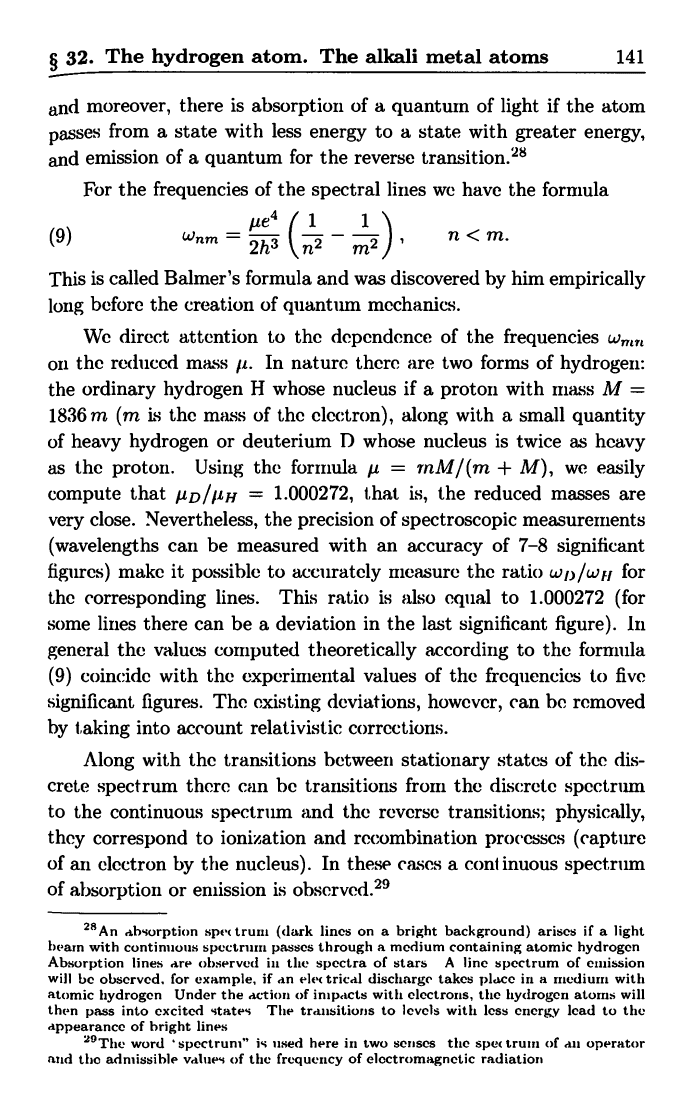
For the frequencies of the spectral lines we have the formula
jie4
1 1
(9)
Wnm =
2h3 rte
m2
n < m.
This is called Balmer's formula and was discovered by him empirically
long before the creation of quantum mechanics.
We direct attention to the dependence of the frequencies
on the reduced mass p. In nature there are two forms of hydrogen:
the ordinary hydrogen H whose nucleus if a proton with mass M =
1836 m (m is the mass of the electron), along with a small quantity
of heavy hydrogen or deuterium D whose nucleus is twice as heavy
as the proton. Using the formula it = rnM/(m + M), we easily
compute that /2D11LH = 1.000272, that is, the reduced masses are
very close. Nevertheless, the precision of spectroscopic measurements
(wavelengths can be measured with an accuracy of 7-8 significant
figures) make it possible to accurately measure the ratio W D /W H for
the corresponding lines. This ratio is also equal to 1.000272 (for
some lines there can be a deviation in the last significant figure). In
general the values computed theoretically according to the formula
(9) coincide with the experimental values of the frequencies to five
significant figures. The existing deviations, however, can be removed
by taking into account relativistic corrections.
Along with the transitions between stationary states of the dis-
crete spectrum there can be transitions from the discrete spectrum
to the continuous spectrum and the reverse transitions; physically,
they correspond to ionization and recombination processes (capture
of an electron by the nucleus). In these cases a continuous spectrum
of absorption or emission is observed.29
28An absorption spectrum (dark lines on a bright background) arises if a light
beam with continuous spectrum passes through a medium containing atomic hydrogen
Absorption lines are observed in the spectra of stars A line spectrum of emission
will be observed, for example, if an cbs trical discharge takes place in a medium with
atomic Hydrogen Under the action of impacts with electrons, the hydrogen atoms will
then pass into excited states The transitions to levels with less energy lead to the
appearance of bright lines
29Tlie word `spectrum" is used here in two senses the spec trump of an operator
and the admissible values of the frequency of electromagnetic radiation
142 L. D. Faddeev and 0. A. Yakubovsk j
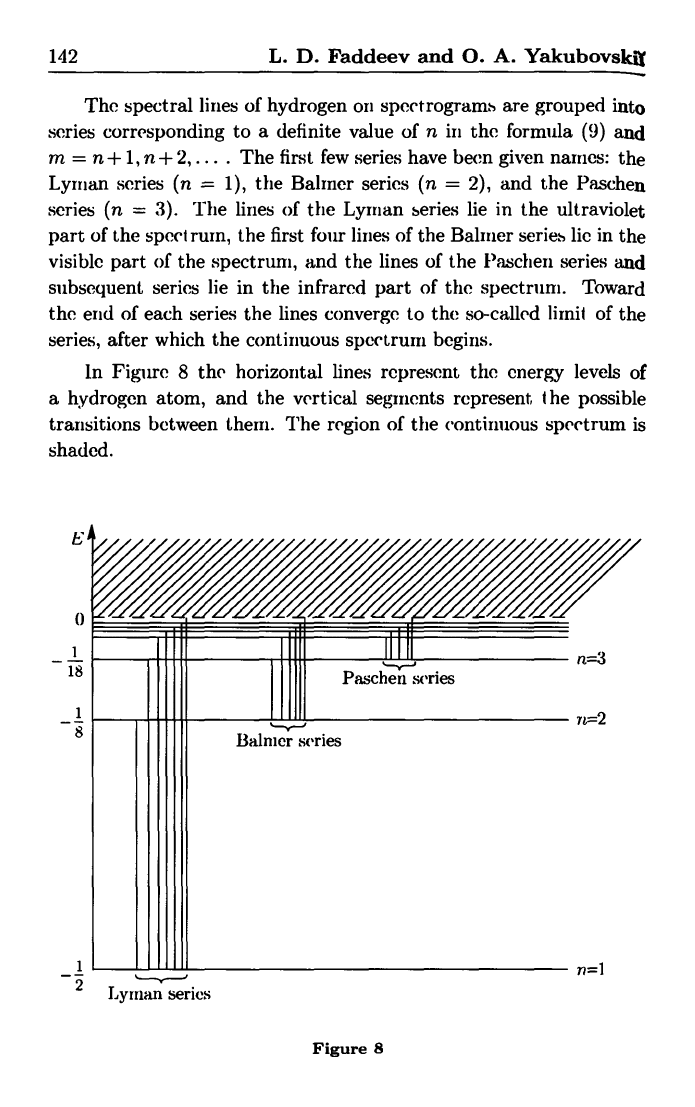
The spectral lines of hydrogen on spectrograms are grouped into
series corresponding to a definite value of n in the formula (9) and
m = n + 1, n + 2,.
-
.The first few series have been given names: the
Lymian series (n = 1), the Balmer series (n = 2), and the Paschen
series (n = 3). The lines of the Lyman series lie in the ultraviolet
part of the spect ruin, the first four lines of the Balmier series lie in the
visible part of the spectrum, and the lines of the Paschen series and
subsequent series lie in the infrared part of the spectruni. Toward
the end of each series the lines converge to the so-called limit of the
series, after which the continuous spectrum begins.
In Figure 8 the horizontal lines represent the energy levels of
a hydrogen atom, and the vertical segments represent the possible
transitions between there. The region of the continuous spectrum is
shaded.
9E
18
1
_2 `-V--
Lyman series
Paschen s
Balmer series
eries
n--3
n=2
n=1
Figure 8
§ 32. The hydrogen atom. The alkali metal atoms 143
Figure 9
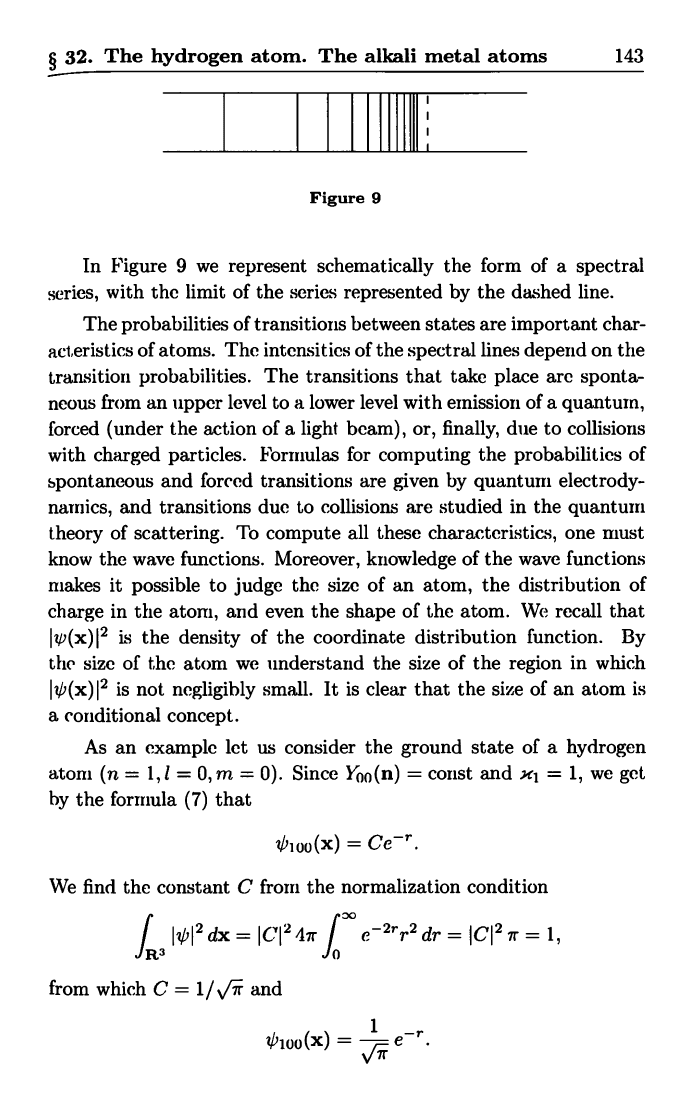
In Figure 9 we represent schematically the form of a spectral
series, with the limit of the series represented by the dashed line.
The probabilities of transitions between states are important char-
acteristics of atoms. The intensities of the spectral lines depend on the
transition probabilities. The transitions that take place are sponta-
neous from an upper level to a lower level with emission of a quantum,
forced (under the action of a light beam), or, finally, due to collisions
with charged particles. Formulas for computing the probabilities of
spontaneous and forced transitions are given by quantum electrody-
namics, and transitions due to collisions are studied in the quantum
theory of scattering. To compute all these characteristics, one must
know the wave functions. Moreover, knowledge of the wave functions
makes it possible to judge the size of an atom, the distribution of
charge in the atom, and even the shape of the atom. We recall that
I is the density of the coordinate distribution function. By
the size of the atom we understand the size of the region in which
k'(x)I2 is not negligibly small. It is clear that the size of an atom is
a conditional concept.
As an example let us consider the ground state of a hydrogen
atom (n = 1,1 = 0, m = 0). Since Yoo(n) = const and x, = 1, we get
by the formula (7) that
P]OUX = CC-r.
We find the constant C from the normalization condition
30
,012 dx
= IC12 47r
e-2rr2
dr = IC12 7r =1,
JR3
(l
from which C = 1 / f and
1
V)lUU(X) =
OF
8-r.
144
L. D. Faddeev and 0. A. Yakubovskil
Figure 10
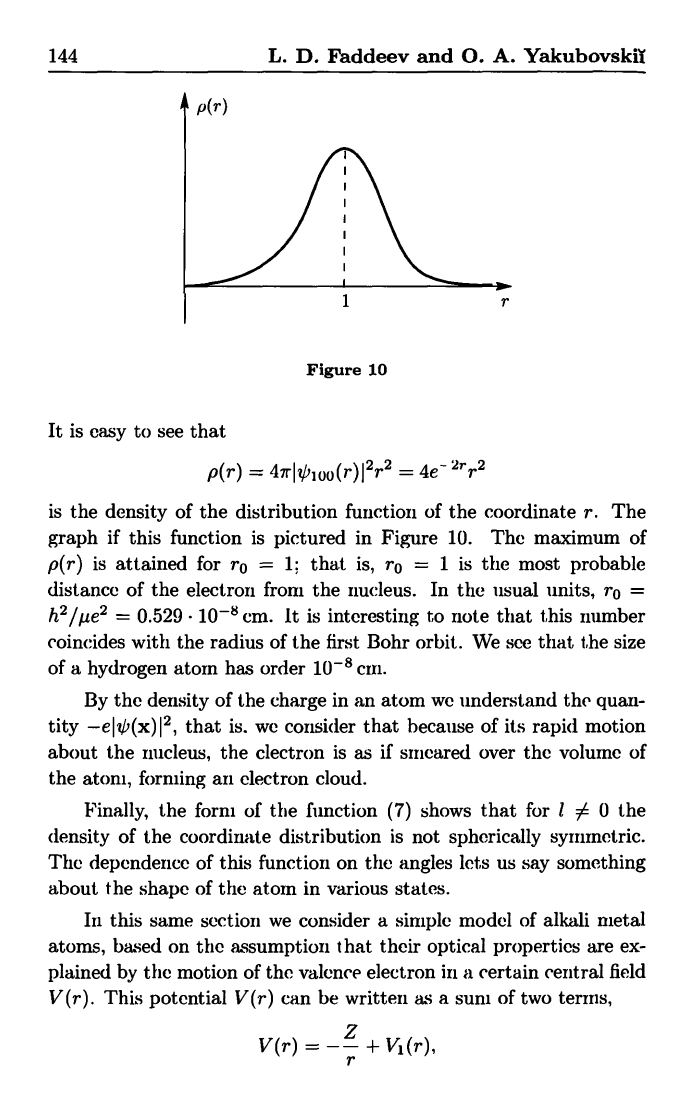
It is easy to see that
p(r) =
4irIb100(r)12r2
= 4e'
2rr2
is the density of the distribution function of the coordinate r. The
graph if this function is pictured in Figure 10. The maximum of
p(r) is attained for ro = 1; that is, r0 = 1 is the most probable
distance of the electron from the nucleus. In the usual units, ro =
h2lpe2 = 0.529. 10-8 cm. It is interesting to note that this number
coincides with the radius of the first Bohr orbit. We see that the size
of a hydrogen atom has order 10-8 cm.
By the density of the charge in an atom we understand the quan-
tity -- e b (x) 2, that is. we consider that because of its rapid motion
about the nucleus, the electron is as if smeared over the volume of
the atone, forming an electron cloud.
Finally, the form of the function (7) shows that for 1 34 0 the
density of the coordinate distribution is not spherically symmetric.
The dependence of this function on the angles lets us say something
about the shape of the atom in various states.
In this same section we consider a simple model of alkali metal
atoms, based on the assumption t hat their optical properties are ex-
plained by the motion of the valence electron in a certain central field
V (r) . This potential V (r) can be written as a suns of two terms,
V(r)
=-Z +V r ,
r
§ 32. The hydrogen atom. The alkali metal atoms
145
where the first term describes the interaction of the electron with the
nucleus, and Vl (r} can be interpreted as the potential of the inter-
action of the electron with the negative charge of the other electrons
distributed over the volume of the atom. The reasonableness of such
a model for atoms of the alkali metals becomes clear only after we
become acquainted with the properties of complex atoms and the
_l lend eleev periodic table.
We know very little about the potential V (r), but nevertheless
we can assert that
V(r) -
1
1 forr --+oc
r
and
L
V (r)
- -- for r -* 0.
r
The first condition follows from the obvious fact that when the valence
elect ron is removed to infinity, it finds itself in the field of an ion
with a single positive charge. The second condition follows from the
continuity of the potential Vl (r) of the volume distribution of charges.
As a model potential we choose
(10) V(r)
21
a>0.
Despite the fact that this potential has the correct behavior at infin-
ity, its behavior at zero is different from that of the "true" potential.
At the same time, the model potential correctly reflects the fact that
upon approach to the nucleus the field becomes stronger than the
Coulomb field -1 /r. We assume that the parameter a is small (in
what sense is indicated below). The numerical values of this parame-
ter for the different alkali metal atoms is most reasonably chosen from.
a comparison of the results of computations of the energy levels with
those found experimentally.
The radial equation for such a potential is very simple to solve.
Indeed, it has the form
11
2 2a
_l(1+1}
x2
+
r
fr +
r2
f,
r2
.fi
.f i - 0.
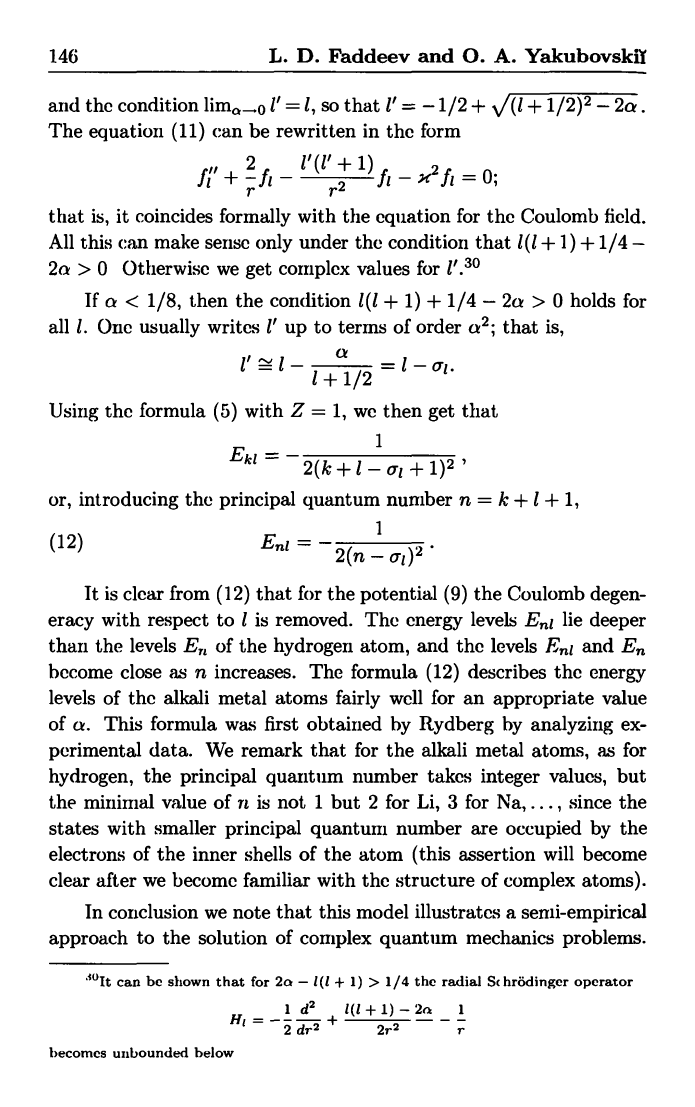
We introduce the number 1' satisfying the equation
l'(l'+1)+2a-l(1+1) =0
146 L. D. Faddeev and 0. A. YakubovskiI
and the condition lima--.o 1'= 1, so that 1' = --1/2 + /fl1/2)2 --- 2a.
The equation (11) can be rewritten in the form
, 2 _ 11(11 +1) _x2 =0
fit
+
r
,ft
r2
.ft
.ft
that is, it coincides formally with the equation for the Coulomb field.
All this can make sense only under the condition that 1(1 + 1) + 1 /4 --
2a > 0 Otherwise we get complex values for 11.30
If a < 1/8, then the condition 1(1 + 1) + 1 /4 -- 2a > 0 holds for
all 1. One usually writes 1' up to terms of order a2; that is,
a
1+1/2
Using the formula (5) with Z = 1, we then get that
1
Ekl _
2(k + 1 -
a.+1)2 1
or, introducing the principal quantum number n = k + 1 + 1,
F_. - -
I
nt
2
2(n--aj)It
is clear from (12) that for the potential (9) the Coulomb degen-
eracy with respect to 1 is removed. The energy levels Ent lie deeper
than the levels E7 of the hydrogen atom, and the levels Ent and En
become close as n increases. The formula (12) describes the energy
levels of the alkali metal atoms fairly well for an appropriate value
of a. This formula was first obtained by Rydberg by analyzing ex-
perimental data. We remark that for the alkali metal atoms, as for
hydrogen, the principal quantum number takes integer values, but
the minimal value of n is not 1 but 2 f o r Li, 3 f o r Na, ... , since the
states with smaller principal quantum number are occupied by the
electrons of the inner shells of the atom (this assertion will become
clear after we become familiar with the structure of complex atoms).
In conclusion we note that this model illustrates a semi-empirical
approach to the solution of complex quantum mechanics problems.
'ieit can be shown that for 2c, - 1(1 + 1) > 1/4 the radial Sc hrodinger operator
H
1 d2 1(t+1)-2Q
-
1
2 dr2 + 2r2
r
becomes unbounded below
§ 33. Perturbation theory
147
Such an approach consists in the following: instead of solving the
problem in the exact formulation, one uses physical considerations to
construct a simplified model of the system. The Schri dinger operator
for the model problem usually depends on parameters which are just
as difficult to find theoretically as it is to solve the problem in full
scope. Therefore, the parameters are found by comparing the results
of computations of the model problem with experimental data.
§ 33. Perturbation theory
In quantum mechanics there are relatively few interesting problems
that admit the construction of exact solutions. Therefore, approxima-
tion methods play an important role. Approximation theories often
turn out to be more valuable for understanding physical phenomena
than exact numerical solutions of the corresponding equations. The
main approximation methods in quantum mechanics are based on
perturbation theory and the variational principle.
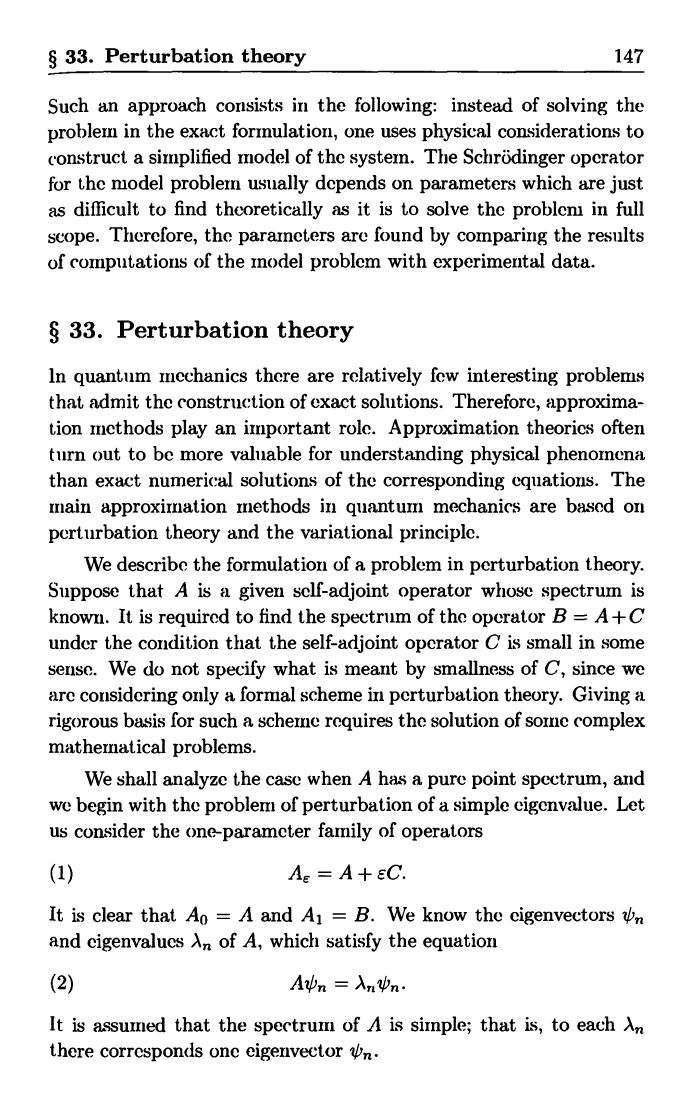
We describe the formulation of a problem in perturbation theory.
Suppose that A is a given self-adjoint operator whose spectrum is
known. It is required to find the spectrum of the operator B = A+ C
under the condition that the self-adjoint operator C is small in some
sense. We do not specify what is meant by smallness of C, since we
are considering only a formal scheme in perturbation theory. Giving a
rigorous basis for such a scheme requires the solution of some complex
mathematical problems.
We shall analyze the case when A has a pure point spectrum, and
we begin with the problem of perturbation of a simple eigenvalue. Let
us consider the one-parameter family of operators
(1)
Ae = A+eC.
It is clear that A o = A and A 1 = B. We know the cigenvectors V)n
and eigenvalues A,, of A, which satisfy the equation
(2)
Ann =ArY)n
I t is assumed that the spectrum of A is simple; that is, to each An
there corresponds one eigenvector V)n.