
Faddeev L.D., Yakubovskii O.A. Lectures on Quantum Mechanics for Mathematics Students
Подождите немного. Документ загружается.

158 L. D. Faddeev and 0. A. Yakubovskii
if a and b are elementary particles, and a many-body problem if a
and b are compound particles. We recall that the two-body problem
can be reduced to the problem of the niotion of a particle in the field
of a fixed force center by separating out the motion of the center of
inertia. This is the simplest problem of scattering theory.
In scattering by a force center, a particle can change only its di-
rection of motion due to the law of conservation of energy. In ibis case
one speaks of elastic scattering. More complex processes are possible
when compound particles collide. For example. when an electron col-
lides with a hydrogen atom, elastic scattering is possible (the state
of the atone does not change), scattering with excitation is possible
(the electron t rannsfers part, of its energy to the atorri, which then
passes into a new state), and finally, ionization of the atom by the
electron is possible Each such process is called a scattering channel.
Scatt Bring of a particle by a force center is single-channel scattering,
while scat tering of compound particles is usually nrnult ichannel scat-
tering. If, however, the colliding particles a and b are in the ground
state and the energy of their relative motion is less than the energy
of excitation, then the scattering is single channel.
The basic characteristic of the diverse scattering processes mea-
sured in experiments is their cross-section, which we define below.
Some set of possible results of scattering is called a scattering pro-
cess. The following are processes in this sense:
1) Elastic scattering into a solid angle element do constructed
about the direction n;
2) Elastic scattering at an arbitrary angle;
3) Scattering into a solid angle do with excit ation of the target
from the ith level to the kth level:
4) Scattering with ionization of the target;
5) A process consisting in scattering in general taking place. and
so on.
The probability N of some scattering process of a by b depends
on a certain quantity characterizing the accuracy of using particles
a to "shoot" a particle b.
To introduce such a characterization of
the state of an impinging particle a, we construct the plane passing
§ 36. Scattering of a one-dimensional particle
159
through the point where the scatterer b is located and perpendicular
to the momentum of a. The probability dW of a crossing an area
element dS of this plane is proportional to dS: that is, dW = I dS.
It is clear that the probability N will be proportional to the quantity
I computed at the point where the scatterer is located.``'
It now seems natural to define the cross-section a by
N_
l'
For the five processes listed above, the cross-sections have the
following names: 1) the differential cross-section of elastic scattering;
2) the total cross-section of elastic scattering. 3) the differential cross-
section of excitation; 4) the ionization cross-section: 5) the total cross-
section The concept of cross-section becomes especially intuitive
if we assume that there is complete deterniinisrri of the scat tering
results. In the case of such determinism. the scattering result would
be determined by the point of the transverse cross-section of the beam
through which the particle would pass in the absence of the scatterer.
To the scattering process would then correspond sonic region in the
plane of the transverse cross-section, and the cross-section would be
equal to the area of this region.
There are two problems in scattering theory: from known inter-
action potentials between the particles determine the cross-sections of
the various processes (the direct problem), and from the known cross-
section obtain information about the interaction of the particles (the
inverse problem).
In these lectures we confine ourselves to a study of the direct
problerri of scattering of a particle by a potential center, beginning
with the simplest one-dimensional case.
§ 36. Scattering of a one-dimensional particle by
a potential barrier
We structure the exposition of this problem according to the following
plan First we formulate the so-called stationary scattering problem.
35Here the scatterer b is assumed to be distant, since I characterizes the state of
a freely moving particle a
160 L. D. Faddeev and 0. A. Yakubovskj
For this we study the solutions of an equation Hb = Eik of a certain
special form. The physical meaning of such solutions will be explained
later, after we have used them to construct solutions of the nonsta-
tionary (or time-dependent) Schrodinger equation i dt = H'41
For
simplicity we employ a system of units in which h = 1 and m = 1/2.
In the coordinate representation, the Schrodinger operator has
the form
(1)
H
d 2
+ V W.
dX2
We take the function V (x) to be compactly supported (V(x) = 0 for
1x1 > a) and piecewise continuous.
Let us denote the regions x < -a, x > a, and -a < x < a of the
real axis by 1, 11, and 111, respectively. The scattering problem is a
problem of infinite motion of a particle. Such snot ion is possible for
E > 0, and we know that for E > 0 the spectrum of the Schrodinger
operator is continuous. From a mathematical point, of view, scat-
tering problems are problems about the continuous spectrum of the
Schrodinger operator.
The stationary Schrodinger equation with the form
(2)
--W"+V(,r)yP=k2v,
E=k2. k>0,
on the whole real axis simplifies in the regions I and II:
(3)
W' + k2b = 0.
The equation (3) has the two linearly independent solutions eikz
and a-ikx. The solutions of (2) on the whole axis can be constructed
by sewing together the solutions in the regions I III. In doing this,
we must use the conditions of continuity of the solutions and their
first derivatives at the points
-a and a. This imposes four conditions
on the six arbitrary constants appearing in the expressions for the
general solutions in the regions I III. The fifth condition for these
constants is the normalization condition Therefore, we can construct
§ 36. Scattering of a one-dimensional particle
161
linearly independent solutions of (2) with the form
36
(4)
I
II
V), (k, x),
eikx + A(k) e-ikx.
B(k) eikx
iP2 (k. x),
D(k) e-ikx,
a-ik2'
+
C(k) eika'.
in regions I and If.
For example, in constructing lpi we use the
ai bit rariness of one of the constants to get that the coefficient of
(I-
ikx is equal
to zero in the region 11. We then choose the coefficient
of eikx to be equal to 1 in the region I, thereby determining the
normalization of the function 'l
.
The coefficients A and B are found
from the conditions for sewing together, along with the constants m
and n. where mcpl + n'P2 is the general solution of (2) in the region
III.
It is not hard to see that the conditions for sewing together
lead to a nonhoiriogeneous linear system of equations for A, B, m,
and n with determinant that is rionzero if c1 and cp2 are linearly
independent. The solution *2 is constructed similarly. The linear
independence of 'I and /2 follows from the fact that the Wronskian
of these solutions is not zero.
Let us determine the properties of the coefficients A, B, C, , and
D. For this we note that the Wronskian W (W1 ,'p2) = ;pi p2 -'p1 Cpl of
the solutions Pi and 'p2 of (2) does not depend on x. Indeed, suppose
t hat V, and V2 satisfy (2). Then
dpi -(V-12) i -=0, Sp2-(V-k2)Sp2=0.
Multiplying the first equation by 'P2 and the second by 'p1 and sub-
tracting one from the other. we get that
d
-'' =0.
dx
,F cp2}
Using this property, we can equate the Wronskian for any pair
of solutions in the regions I and H. Choosing (i1,'2), (fir,
1).
(ii'2. i'2), and ('i,1P2) as such pairs successively, and using the equal-
ities W
(e-ikx, eikx) = 2ik and Me
±ikx,efikx)
= 0, we arrive at the
361f the potential is not compactly supported but decreases sufficiently rapidly as
x1 - 0o, then these expressions for 01 and 02 in I and II should he regarded as the
asymptotics of 'i and W2 as x - tx We shall not study this case
162
L. D. Faddeev and 0. A. Yakubovsk j
following relations between the coefficients A, B. C, and D:
(5) 13=D,
(6)
JA12
+
1B12
= 1,
(7) 1B2 + ICI2 = 1,
(8)
At --BC-=0.
(}nor example, W (/11,1) = -2ik(1 - AA) in I and W(1 , 01)
-2ikBB in H. Equating these expressions, we get (6).)
The relations (5) (8) show that the matrix S consisting of the
coefficients A, B = D, and C, that is,
A B
S
B C
'
is symmetric and unitary. This matrix is called the scattering matrix
or simply the S-matrix. We shall see below that all the physically
interesting results can be obtained if the S-matrix is known, and
therefore the computation of its elements is the main problem in one-
dimensional scattering theory.
Let us consider the question of normalization of the functions
01 (k. x) and '02(k, x). We have the formulas
(9)
V), (ki - x)V)2( k2, X)dx = 01
ki > 01
k2 > 01
00
(10) i1,2 (ki , x) b1.2 (k2,
x) dx
= 27r6(ki - k2),
that is, the same relations hold as for the functions ei kr and e -
ikX
and the normalization does not depend on the formal of the potential
V (x)
The integrals in the formulas (9) and (10) are understood in
the principal value sense. Let us verify (10) for the function,01. The
remaining two relations are verified in the same way. Substitution of
i11 (k1, x) and -01 (k2, x) in (2) leads to the equalities
(11) p'(k1, x) + k20(k1, x) = V(x) '(k1, x),
(12) 011(k2, x) +k22 '(k2, x) =V (x) ib(k2, x).
(For brevity we do not write the index 1 in the notation of the so-
lution ?)1 .)
Multiplying (11) by '(k2, x) and (12) by O(kl, x) and
§ 36. Scattering of a one-dimensional particle 163
subtracting the first from the second, we get that
d
W (?p (k Zx), V) (k2, X))= (k1 2- k2 ? )
1
w
(/ki> ,r) V(
2 X)-
C x
this equality, we have
integrating
v 1
(13) f
Vi(ki, x) (ka, x)
= 2 2
W
x), G(ka
nr
k1 - k2
N
-N
We are interested in the limit as N -+ oo of the integral on the
left-hand side of (13) in the sense of generalized functions. It is clear
already from (13) that this limit depends only on the form of the
solutions in the regions I and 11 (for the case of infinite potentials it
depends only on the asymptotics of the solutions as x -* ±oo).
After simple computations we get that
N
V (k1, x)
(k2,x) dx
-N
2
A
A
+ 13 k1
k2
e`(k, -k2)N
-
e-z(k' - k2)1V
k _
(ki) (k2)
(
) 13 (
))
1
2
2
[A(k2) e-i(ki
+k2)N +A(k1) et(k1
+k2)Nj
k1 + k2
By the Rienlaun-Lebesgue theorem, the second terns tends to zero (in
the sense of generalized functions). The similar kissertion is not true
for the first term, since it is singular for k1 = k2. The singular part
of this term does not change if we replace A(k2) and B(k2) by A(k1)
and B(kl ), respectively.37 Using (6), we have
2
*1(kt, x) i11(k2, x) dx =
k;
siri(k1 - k2) N + F(k1, k2. N),
-N
1 -k2
where
lim F(ki , k2, N) = 0.
Finally, using the well-known formula
lim
sin Nx
= rrb(x)
,
N--oc
x
'?For this it suffices that A (k) and B(k) be differentiable functions of k, which
can he proved
164 L. D. Faddeev and 0. A. YakubovskiT
we get that
v
lim
(ki, x) 01(k2. x) dx = 27rb(k1 - k2),
N-'3c -N
which coincides with (10).
§ 37. Physical meaning of the solutions V), and IP2
To clarify the physical meaning of the solutions i, and 02, we use
them to construct solutions of the nonstat ionary Schrodingcr equation
dt
For this equation we consider the solution
x
(xj t)
-
21f
J
C(k) V), (k. x)
e-£k2l A
constructed from the function im (k. x). The function C(k) is assumed
to be rionzero only in a small neighborhood of the point ko. In this
case. of (x, t) has the simplest physical meaning. Moreover, we assume
that,
00
IJ
and then it, follows from (36.10) that,
f_:l(x,t12dx=1,
that is, the solution Pi (x, t) has the correct normalization. Using the
concentration of the function C(k) in a neighborhood of ko and the
continuity of time functions A(k) and I3(k), we can write approximate
expressions3s for the function 5P1 (x, t) in the regions I and 11:
T :
cp1(x, t)
p (x, t) + A(ko) SP- (x, t)
II.,1(x, t) ,.' B(ko)+(x, t),
where
(2)
0--- (X, t)
C k
eikzt
dk
J°°
38These expressions can be regarded as having any desired degree of accuracy if
the interval Lk inside which C, (k) is nonzero is sufficiently small However, we cannot
pass to the limit, replacing C(k) by a 6-function, because we do not get a square-
integrahle solution of the Schrodinger equation
§ 37. Physical meaning of the solutions W1 and '02
165
The functions (pf (x, t) are normalized solutions of the Schrodinger
equation for a free particle, and were studied39 in § 15. In the same
section we constructed asymptotic expressions for these solutions as
t - ±x:
^T
t =
1
C;' ± e'x + 0
(') 2t
t
/2 -It I
where x is a real function whose form is not important for us. From
this expression it is clear that for Itl --+ oc the functions cp j (x, t) are
nonzero only in a neighborhood of the points x = ±2k0t. Therefore,
p4 describes the state of a free particle moving from left to right with
velocity40 v = 2k0}, and :p_ describes a particle having the oppositely
directed velocity (recall that m = 1/2)
It is now easy to see what properties the solution Ppn (x, t) has as
t
±oc. Suppose that, t -oc. Then in the regions I and 11 we
have
I:
y,1 (x, t) = cps (x, t),
II: P1 (x. t) = Q,
since as t -*-ocwehavecp_(x,!)=0forx<-a andpp-(x.t)=0
for x > a. Similarly, as t -- +oc
1: p (x, t) = A(kc) _ (x t),
If: ,(x,t) = B(ko)
+(x,t).
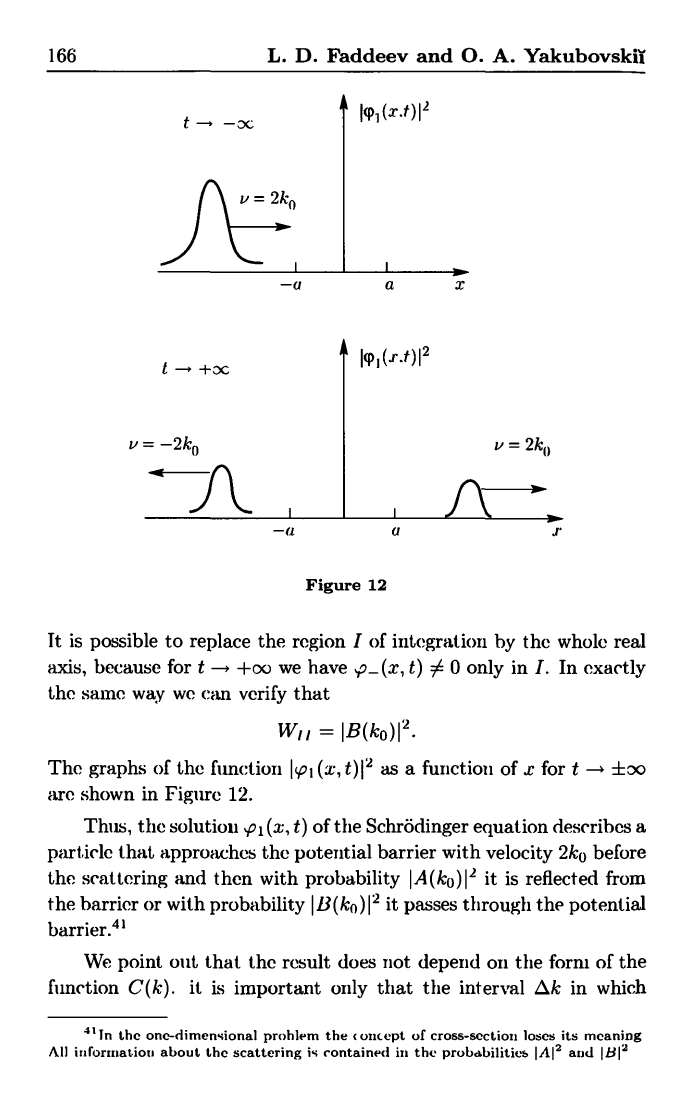
We see that long before the scattering (t --+ -oc) the probability
is 1 that the particle is to the left of the barrier and is moving toward
the barrier with velocity 2k0.
Let us compute the probabilities W1 and W11 of observing the
particle as t -, +oc in the regions I and II, respectively. We have
Wi =
f
I
= II
00
= I1
= iA(ko)i2.
39There is
an inessential difference in the notation Here it is more convenient
for us to take k > 0 and to write out the sign of the momentum in the exponential
etikx explicitly
Moreover, the integration in (2) can be extended to the whole real
axis, since C(k) 0 for k < 0
40More precisely, the region in which there is
a nonzero of finding the particle
moves with velocity 2k0
166
L. D. Faddeev and 0. A. Yakubovskii
t -"X
t - +3c
v= -2k0
(pl (x.t) I2
I
-a a x
(p
I(.r.t)I2
v = 2k0
1
-a
Figure 12
It is possible to replace the region I of integration by the whole real
axis, because for t -* +o0 we have 9_ (x, t)
0 only in I. In exactly
the same way we can verify that
W11 = IThe
graphs of the function
(x, t) (2 as a function of x for t ±oo
are shown in Figure 12.
Thus, the solution yp, (x, t) of the Schrodinger equation describes a
particle that approaches the potential barrier with velocity 2ko before
the scattering and then with probability I
it is reflected from
the barrier or with probability 1112 it passes through the potential
barrier. 41
We point out that the result does not depend on the form of the
function C(k).
it is important only that the interval ok in which
41 to the one-dimensional problem the concept of cross-section loses its meaning
All information about the scattering is contained in the probabilities IA12 and Bill
§ 38. Scattering by a rectangular barrier
1 67
C(k) is nonzero be small. Physically, this requirement is understand-
able if we want to experimentally determine the dependence of, say,
the reflection coefficient J
on k: we must use particles in a state
with variance of k as small as possible (states with zero variance do
not exist). In concrete computations of the reflection and transmis-
sion coefficients IA(k)12 and IB(k)12, it is not necessary to solve the
nonstationary Schrodinger equation; it suffices to find the solution
'1(k, x) .
We remark that the solution ;02 (x, 1), which can be con-
structed from the function 2(k, x), has the same meaning, except
that the particle is approaching the barrier from the right.
Let us recall the properties of the scattering matrix S. The equal-
ity B = D leads to equality of the probabilities of passing through the
harrier in opposite directions and, as can be shown, is a consequence
of the invariance of the Schrodinger equation with respect to time
reversal. The equalities
IAl2 + 1B12 = 1,
IB12 +
IC12
= 1
express the law of conservation of probability Indeed, the normal-
ization of the solutions o 1(x, t) and c02 (x, t) does not depend on the
tune, and as t ----> oo we have
xf
lira
J
l'j(x,t)l2dx = I+ I= 1.
coo
00
§ 38. Scattering by a rectangular barrier
We consider the concrete problem of scattering of a one-dimensional
particle by a rectangular potential barrier. Let
Vol
lxla,Vo>O,
V(x) =
0,
lxl>a.
In this case the equation Hb = k2?k has the following form in the
regions I -III:
(1)
I and II:
1V'
+ k2 =
0,
III:
" + a2 = 0,
where a =
k -- Vo (for definiteness we assume that a > 0 for
k2-Vo>Oand--is>Ofork2-Vo <0).