
Faddeev L.D., Yakubovskii O.A. Lectures on Quantum Mechanics for Mathematics Students
Подождите немного. Документ загружается.

168 L. D. Faddeev and 0. A. YakubovskiT
We construct a solution 11(k x). In the regions I -III this solu-
tion has the form
(2)
1. eikx +
Ae-ika-
(3) If:
Beik' .
III: meickx + ne z`Yx .
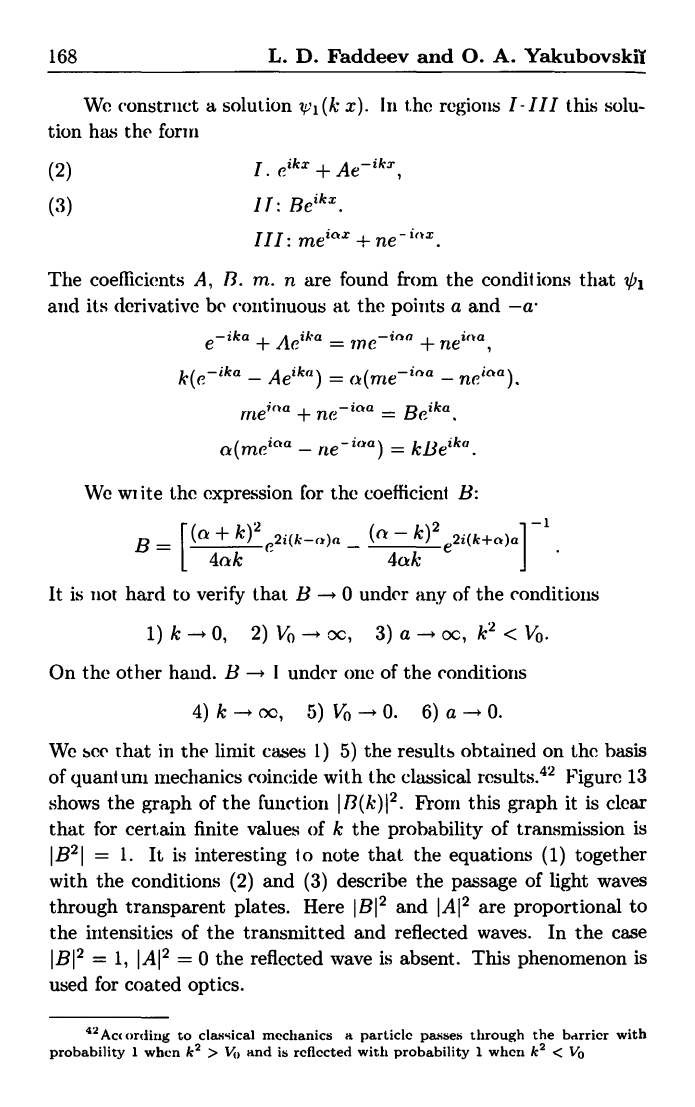
The coefficients A, B. m. n are found from the conditions that Sb1
and its derivative be continuous at the points a and -a
e-ika +
APika
=
In(,-ina +
rtei(tia
(e-ika
- Aeika) _
a(rne-iara
-
neictia).
k
rne? +
ne,,-icva = Beika
ce(mezCYa - rte - 2`xa) =
kBeika
.
We wi ite the expression for the coefficient B:
/
-1
f(a + k)2
2i(k-(x)a
-
(a -
k)2
4ak
e
4ok
e
It is not hard to verify that B -* 0 under any of the conditions
1) k-0,
2) Vooc,
3) a - oc, k2 <Vo.
On the other hand. B -* I under one of the conditions
4) k -+oc, 5) V0--+ 0.
6) a-40.
We see that in the limit cases 1) 5) the results obtained on the basis
of quant um mechanics coincide with the classical results.42 Figure 13
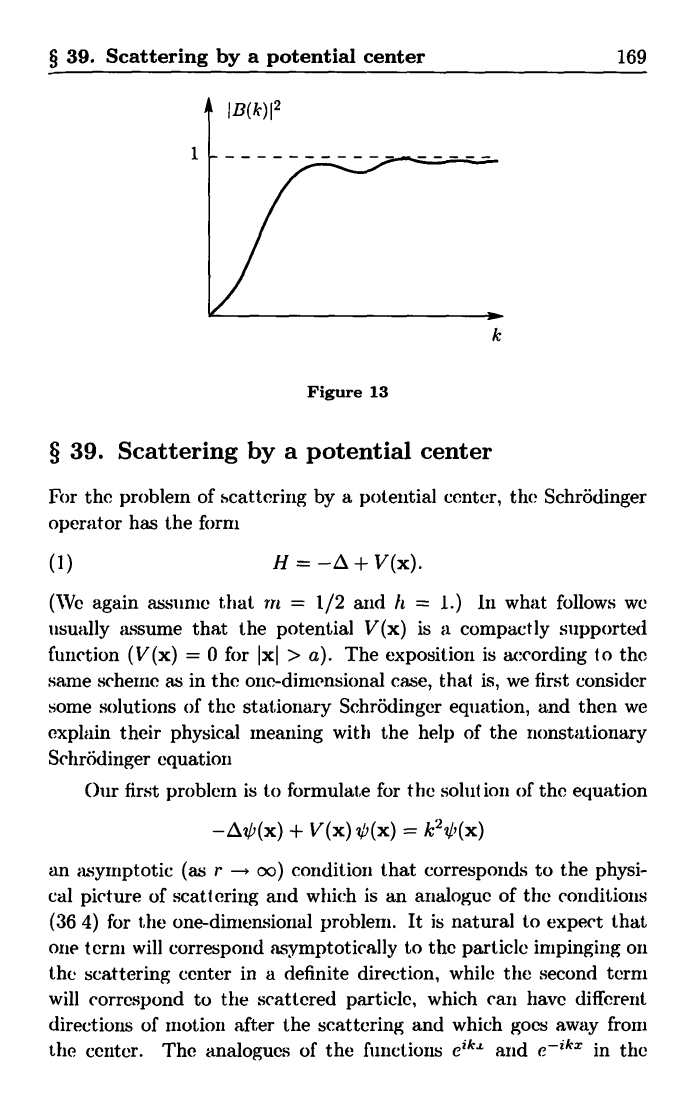
shows the graph of the function I B(k)12. From this graph it is clear
that for certain finite values of k the probability of transmission is
lB2l = 1. It is interesting to note that the equations (1) together
with the conditions (2) and (3) describe the passage of light waves
through transparent plates. Here I B 12 and J 2 are proportional to
the intensities of the transmitted and reflected waves. In the case
I B 1 2 = 1, lAl2 = 0 the reflected wave is absent. This phenomenon is
used for coated optics.
42 According to classical mechanics a particle passes through the harrier with
probability I when k2 > V0 and is reflected with probability 1 when k2 < V0
§ 39. Scattering by a potential center
1
IB(k)12
------------ ---
-
k
Figure 13
§ 39. Scattering by a potential center
169
For the problem of scattering by a potential center, the Schrodinger
operator has the form
(1)
H_-0+V(x).
(We again assume that in = 1/2 and It = 1.) In what follows we
usually assume that the potential V (x) is a compactly supported
function (V(x) = 0 for lxi > a). The exposition is according to the
same scheme as in the one-dimensional case, that is, we first consider
some solutions of the stationary Schrodinger equation, and then we
explain their physical meaning with the help of the nonstationary
Schrcidinger equation
Our first problem is to formulate for the solut ion of the equation
-AO(x) + V (x) i' (x) = k2/'(x)
an asymptotic (as r - oo) condition that corresponds to the physi-
cal picture of scattering and which is an analogue of the conditions
(36 4) for the one-dimensional problem. It is natural to expect that
one terni will correspond asymptotically to the particle impinging on
the scattering center in a definite direction, while the second terra
will correspond to the scattered particle, which can have different
directions of motion after the scattering and which goes away from
the center.
The analogues of the functions eik.c and a-ik, in the
170 L. D. Faddeev and 0. A. YakubovskiT
three-dimensional case are the functions eik' /r and e-ikr/r. There-
fore, it is reasonable to assume that the terms (e - i kr /r) b (n + w) and
(ei kr /r) S(k, n, w) correspond to the particle before and after scat-
t eying. We use t he following notation: k is the momentum of the
impinging particle. w = k/k. n = x/r, S(n - no) is the s-function on
the unit sphere, defined by the equality
f(n)h(n--no)dn = f(no),
dn=sin0dOdV;.
S2
and S(k, n, w) is a certain function which will be shown to contain all
information about t he scattering process and which must be found in
solving the problem We shall see t hat S(k, n, w) is the kernel of a
certain unitary operator S, which is called the scattering operator
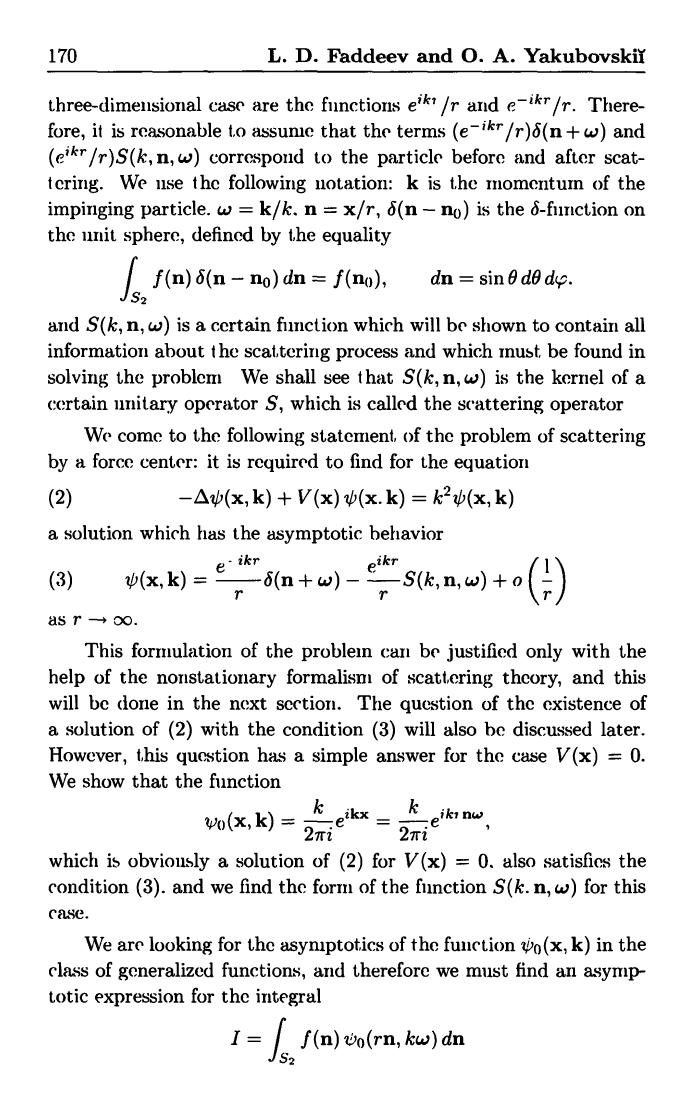
We come to the following statement of the problem of scattering
by a force center: it is required to find for the equation
(2) -A(x, k) + V(x) i(x. k)
=
k2V)(x, k)
a solution which has the asymptotic behavior
e- ikr ,ikr i
(3)
V1 (x, k) =
r
S(n + w)
r
S(k, n, w) + o
-
r
asr -moo.
This formulation of the problem caxi be justified only with the
help of the nonstationary formalism of scattering theory, and this
will be done in the next section. The question of the existence of
a solution of (2) with the condition (3) will also be discussed later.
However, this question has a simple answer for the case V (x) = 0.
We show that the function
x k) =
k eikx
=
k
ei kr nw
vc (
2iri 2iri
which is obviously a solution of (2) for V (x) = 0. also satisfies the
condition (3). and we find the form of the function S(k. n, w) for this
case.
We are looking for the asynnptotics of the function ip0 (x, k) in the
class of generalized functions, and therefore we must find an asymp-
totic expression for the integral
I= f(n)
(n),Oo(rn,J
2
§ 39. Scattering by a potential center
171
as r -> oc, where f (n) is a smoot h function. Using the explicit form
of
(x, k) and introducing a spherical coordinate system wit Ii polar
axis directed along the vector w, we have
27H
j27r
I = d f (Cob B.
) eikr cos a sin 9 dO
U
k
2i
f
1
dp
dr1 f (rl,
V) eikr,.
2ir2
Integrating by parts, we get that
k
2-/r
1
d,^ -- f
(rl, ) eik"I
27ri ilr
k
r I l
21ri
f27
djp
di f' (77, V)
eikr7j.
ikr
I ntegradrig by parts again, we easily see that the second term has
order 0(1/r 2), and hence
2i
I
d(p (eikl f(w) _
eikr f(-w))
+ 0
f r2
e-ikr
eiki
r
f(-w) -
r
f (w} + n
r2
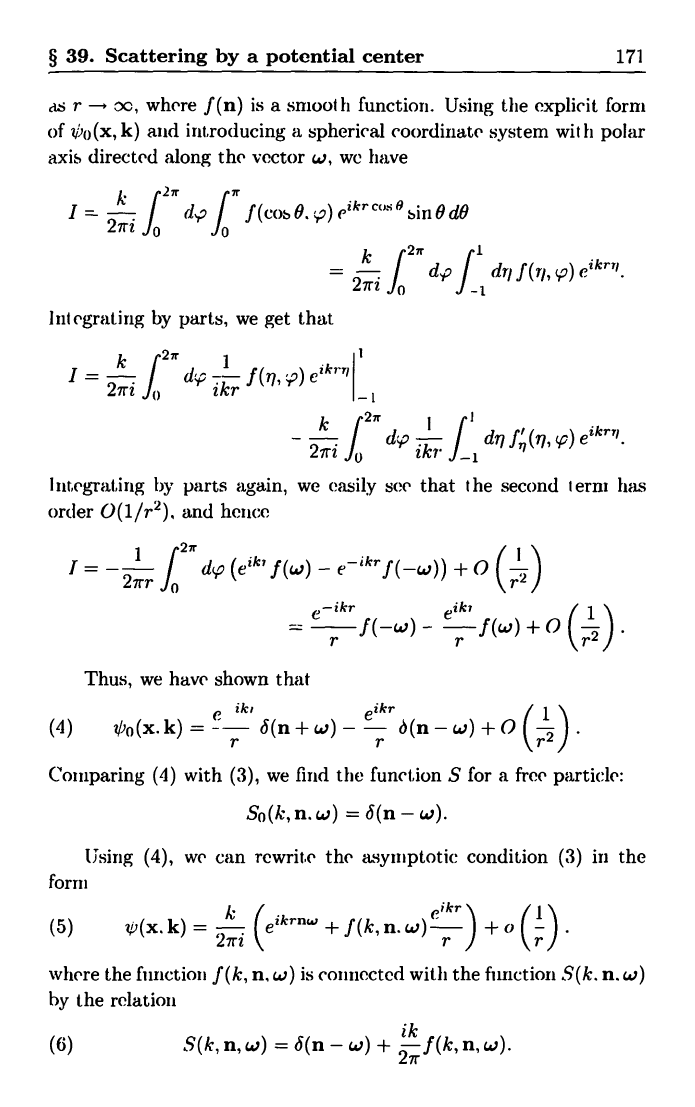
Thus, we have shown that
e
iki
eikr
(4)
V)o(x. k) = -
o(n + w) -
b(n - w) + 0
2
r
r
r2
Comparing (4) with (3), we find the function S for a free particcle:
SO(k, n. w) = 6(n - w).
Using (4), we can rewrite the asymptotic condition (3) in the
forma
k
ikr
(i).
(5) (x. k) =
eik+ f(k,
n. )+ o
2 ri r
r
where the function f (k, n, (A;) is connected with the function S(k. n. W)
by the relation
(6) S(k, n, w =bn - w+knw.
172 L. D. Faddeev and 0. A. Yakubovskii
The function ,f (k, n. w) is called the scattering amplitude. Obviously,
f (k, n, w) = 0 for V (x) = 0. We shall see that the scattering cross-
section is most simply expressed in terms of this function.
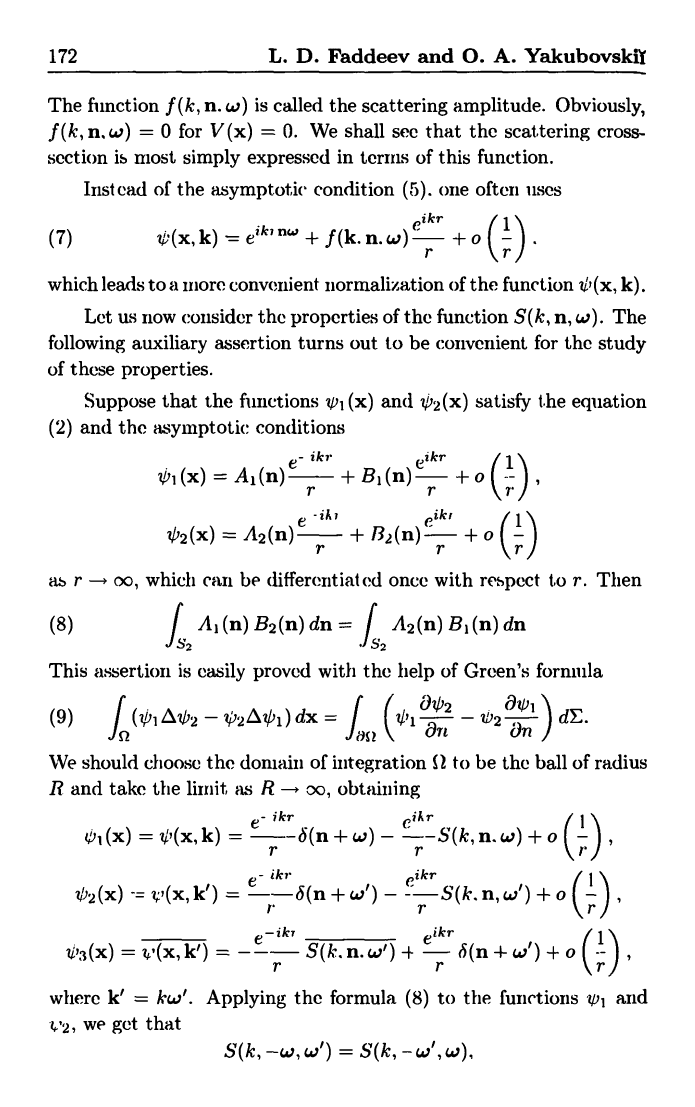
Instead of the asymptotic condition (5). one often
uses
eikr
1
(7)
(x, k) - eik7 nw + f(k. n.
w)
-+0 -
.
r
(r)
which leads to a more convenient normalization of the function zit(x, k).
Let us now consider the properties of the function S (k, n, W). The
following auxiliary assertion turns out to be convenient for the study
of these properties.
Suppose that the functions '1 (x) and IP2 (x) satisfy the equation
(2) and the asymptotic conditions
e-
ikr
e2kr
. ,
(x) = A, (n)
r
+ B1(n)
r
+o
e
A
V)2(x) = A2(n)
1,r
+
0 (r)
as r --+ coo, which can be differential end once with respect to r. Then
(8)
fAi(n)B2(n)dn=
A2 (n) B1(n) do
S2
fS2
2
This assertion is easily proved with the help of Green's formula
- ' dX
t
-
d.
(9)
z
i) 1
j(11b2
Z
st
We should choose the domain of integration sl to be the ball of radius
R and take the limit as R - oo, obtaining
e- ikr ,ikr
l
c'i (x) = /'(x, k) = -b(n + w) -
-S(k, n. w) + o
r
r
j'2(x)-= '(x,k')=
e- ikr
,ikr
l
b(n+w') -
S(k.n,w')+o - ,
I,, r
-ikr
eikr
1
1 (x,k} - --
S(k.n.w/)+
bt(n+w')+o ,
r
r
where k' = kw'. Applying the formula (8) to the functions vI and
'V2, we get that
S(k, --w, w') = S(k, - w', w),
§ 39. Scattering by a potential center
173
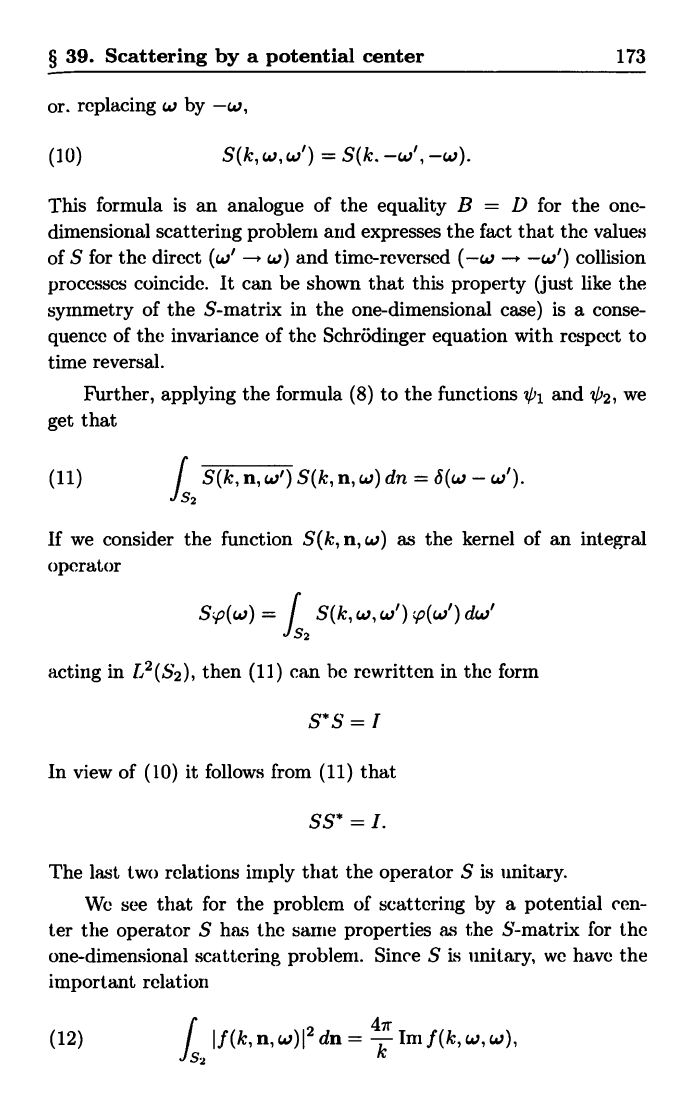
or. replacing w by -w,
(10)
S(k, w, w') = S(k. -w', -w).
This formula is an analogue of the equality B = D for the one-
dimensional scattering problem and expresses the fact that the values
of S for the direct (w' w) and time-reversed (-w ---+ --w') collision
processes coincide. It can be shown that this property (just like the
symmetry of the S-matrix in the one-dimensional case) is a conse-
quence of the invariance of the Schrodinger equation with respect to
time reversal.
Further, applying the formula (8) to the functions ipx and 1/12, we
get that
(11) f S(k, n, w') S(k, n, w) do = 8(w - w').
2
If we consider the function S (k, n, w) as the kernel of an integral
operator
S;p(w) =
S(k, w, w') ;p(w') dw'
S2
acting in L2 (S2), then (11) can be rewritten in the form
SE`S = I
In view of (10) it follows from (11) that
SS* = I.
The last two relations imply that the operator S is unitary.
We see that for the problem of scattering by a potential cen-
ter the operator S has the same properties as the S-matrix for the
one-dimensional scattering problem. Since S is unitary, we have the
important relation
(k,n,w)I2dn= 4k Imf(k7 w,),
(12)
152 If
174
L. D. Faddeev and 0. A. Yakubovskii
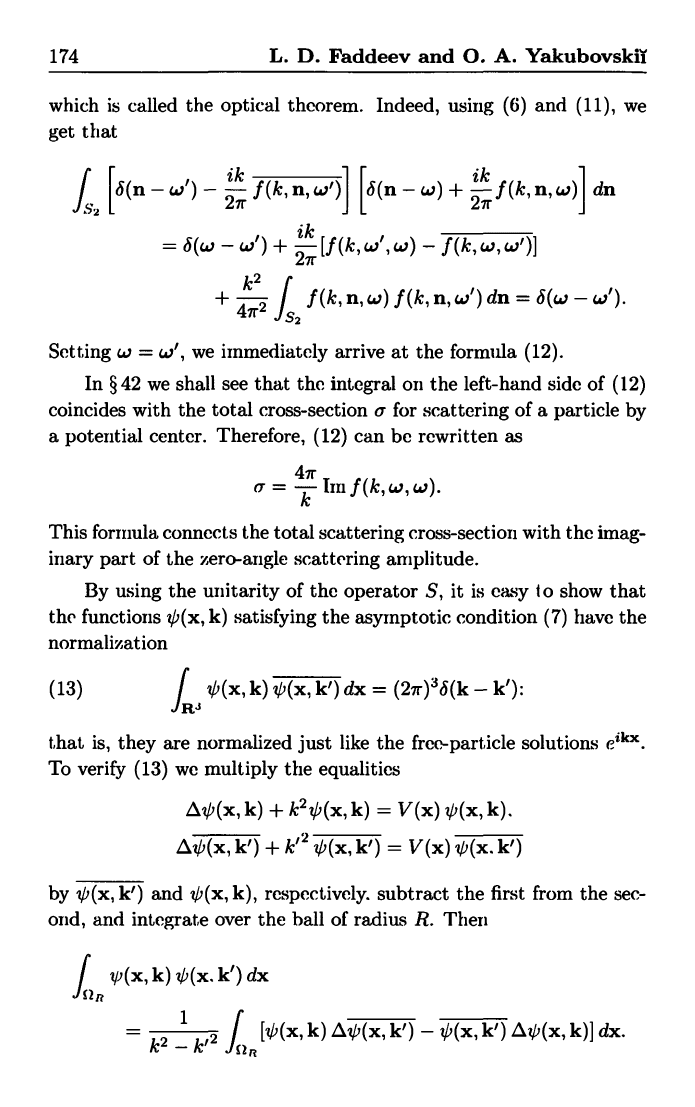
which is called the optical theorem. Indeed, using (6) and (11), we
get that
S z
LS(n - w') -
21r
f
(k' n, [(n - w) +
2
f (k, n, w)J do
= 8(w - w') + 2 [f (k, w , w) - f (k, w, w')]
2 r
+ k2J f(k,n,w)f(k,n,w')dn=S(w-w').
4'rs2
Setting w = w', we immediately arrive at the formula (12).
In § 42 we shall see that the integral on the left-hand side of (12)
coincides with the total cross-section a for scattering of a particle by
a potential center. Therefore, (12) can be rewritten as
4rr
cr=
Tinf(k,w,w).
T
This formula connects the total scattering cross-section with the imag-
inary part of the zero-angle scattering amplitude.
By using the unitarity of the operator S, it is easy to show that
the functions
(x, k) satisfying the asymptotic condition (7) have the
normalization
(13)k(x,k) (x, k') dx = (27r)sb(k - k'):
IR3
that is, they are normalized just like the free-particle solutions
eakx.
To verify (13) we multiply the equalities
o1(x, k) + k2L(x, k) = V(x) O(x, k).
o(x, k') + k'2 7P (x, k') = V(x) iP(x, k')
by 0 (x, k') and i (x, k), respectively, subtract the first from the sec-
ond, and integrate over the ball of radius R. Then
J
y)(x, k) (x. k') dx
S2R
k2
k12
R
1
[(x, k
xk' "'' xk' O xk dx.
§ 40. Motion of wave packets in a central force field
175
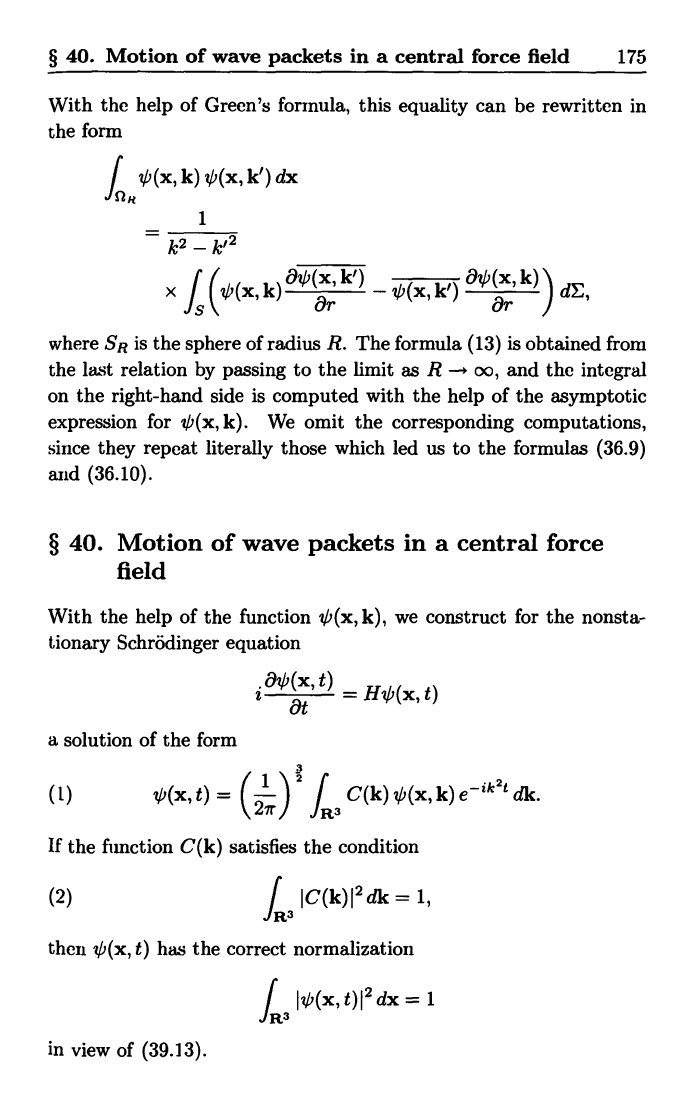
With the help of Green's formula, this equality can be rewritten in
the form
O(x, kb(x,k')dx
fb(x,
1
k2 - k'a
j(ii(x,k)k')
igr 49r
where SR is the sphere of radius R. The formula (13) is obtained from
the last relation by passing to the limit as R -+ oo, and the integral
on the right-hand side is computed with the help of the asymptotic
expression for O(x, k). We omit the corresponding computations,
since they repeat literally those which led us to the formulas (36.9)
and (36.10).
§ 40. Motion of wave packets in a central force
field
With the help of the function O(x, k), we construct for the nonsta
tionary Schrodinger equation
iab(x't)
= H x t
a solution of the form
1)
(x,t)
=
1 2
C(k) V)(x, k)
e-tk2t
A.
C21r) .R,3
If the function C(k) satisfies the condition
(2)
1R3
then O(x, t) has the correct normalization
J3 Iib(x,t)I2dx = 1
in view of (39.]3).
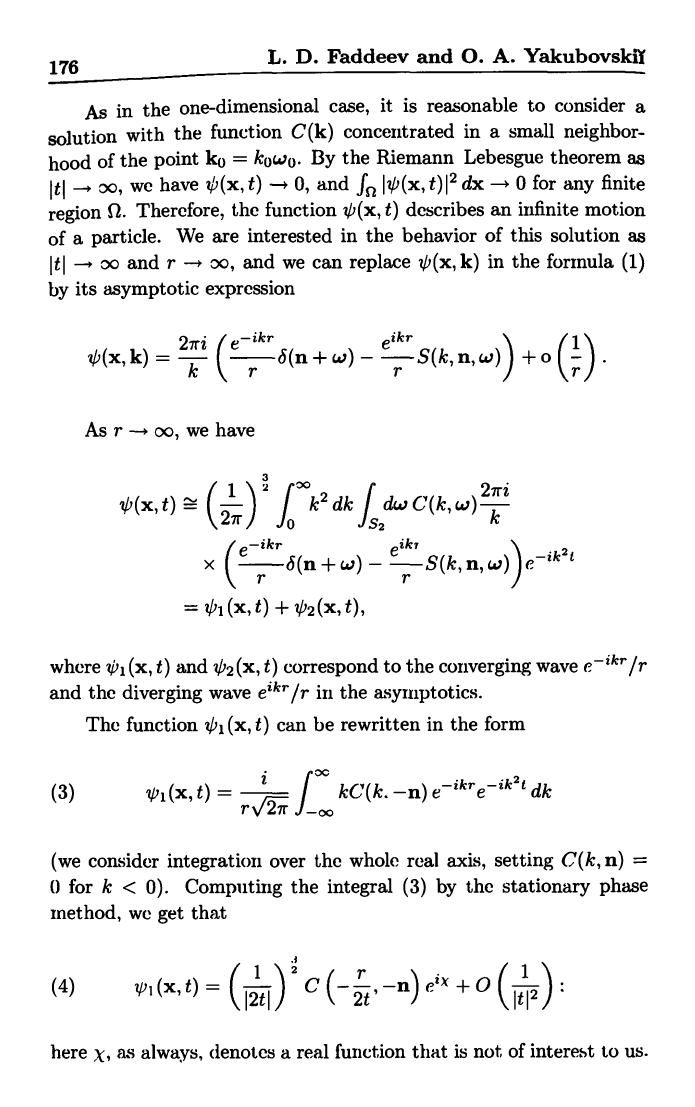
176
L. D. Faddeev and D. A. YakubovskiI
As in the
one-dimensional case, it is reasonable to consider a
solution with the
function C (k) concentrated in a small neighbor-
hood of the point ko = kowo. By the Riemann
Lebesgue theorem as
fj
(x, t) 2 dx
0 for any finite
- oo, we have V
)(x, t) --+ 0, and f
region Q. Therefore, the function P (x, t) describes an infinite motion
of a particle. We are interested in the behavior of this solution as
It I
--+ oo and r --- oo, and we can replace ' (x, k) in the formula (1)
by its asymptotic expression
tai /e-ikT
eikr \ /1\
I r f .
(x, k) _
k
w) - r S(k, n, w)) +o
Asr ---+oo,wehave
3
1
2 00
2
7ra
x t
kdk dwC k w
o s2
f -ikr
ikr
x
e
(-5(n+') _
e
S(k, n, w) a-ik2t
r
r
= V11 (X, t) + 02 (X, 0,
where '1(x, t) and2 (x, t) correspond to the converging wave e-ikr/r
and the diverging wave eikr /r in the asymptotic..
The function 01(x, t) can be rewritten in the form
(3)
x t=
i
x
kC(k. -n)
e-i1CTe-ik
2
t dk
r 2i -o o
(we consider integration over the whole real axis, setting C(k, n) =
0 for k < 0). Computing the integral (3) by the stationary phase
Ynethod, we get that
(4)
1
(X, t)
-
C
\-2t,-n) etx +0
\ItJ2/
here x, as always, denotes a real function that is not of interest to us.
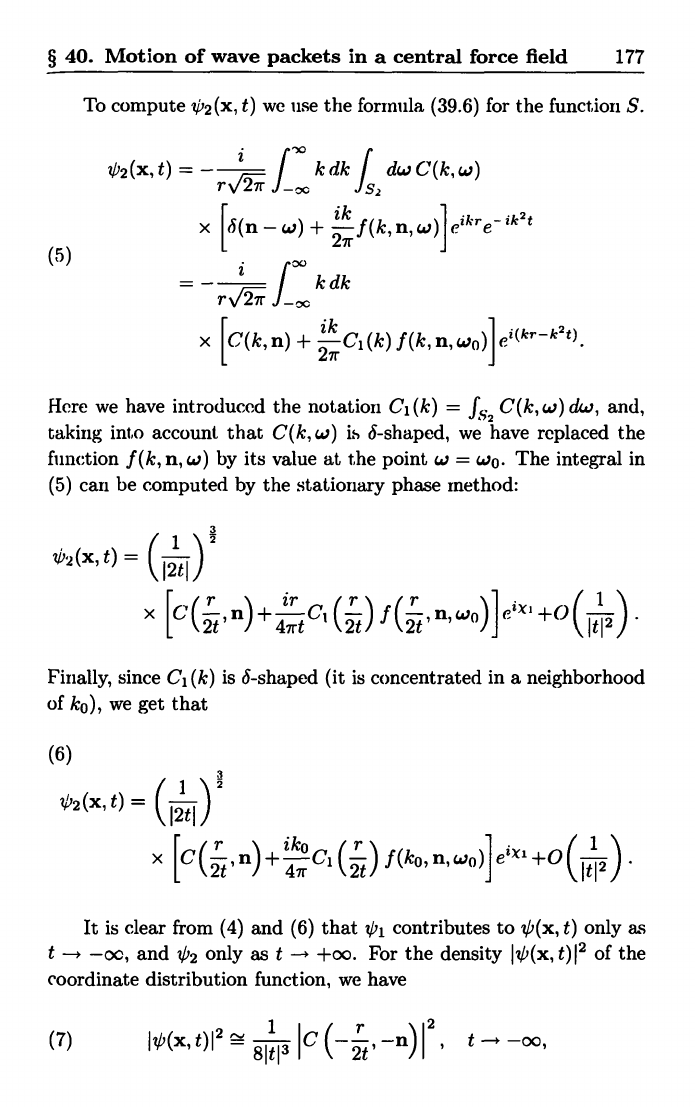
§ 40. Motion of wave packets in a central force field
177
To compute 12 (x, Owe use the formula (39.6) for the function S.
02(x,t) = - Z
J
11)0
kdkJ
r 2 x SZ
(5)
x
[S(n-
w+
ik
f k n, w
eikre- ik2t
0"
k A
r
V"2--,-7 r
_o c
Here we have introduced the notation C, (k) = fC(k, w) dw, and,
taking into account that C(k, w) is S-shaped, we have replaced the
function f (k, n, w) by its value at the point w = wo. The integral in
(5) can be computed by the stationary phase method:
1p2(x, t) _
x [Gry\2t'nl+47rtC,
2t/
f
(2t'n'w0)Je`x,+0(
ItI2/
x I Qk, n) + :Cl (k) .f (k, n, wo) Ct(kr-k2t)
L
Finally, since C1 (k) is S-shaped (it is concentrated in a neighborhood
of ko), we get that
(6)
V;2 (Xi 0 =
3
2
x [+
4
Cl
\ 2t /
f
(ko, n, WO)
e'xj .+-p I
\P /
It is clear from (4) and (6) that 01 contributes to 0 (x, t) only as
t - -oc, and 02 only as t --> +oo. For the density Ii/'(x, t)2 of the
coordinate distribution function, we have
r l 2
(7)
1b(x,t)I2 ='
81t13
IC
\
2t'
-n/ 1
t --> -oo,
1