
Faddeev L.D., Yakubovskii O.A. Lectures on Quantum Mechanics for Mathematics Students
Подождите немного. Документ загружается.

188 L. D. Faddeev and 0. A. Yakubovskii
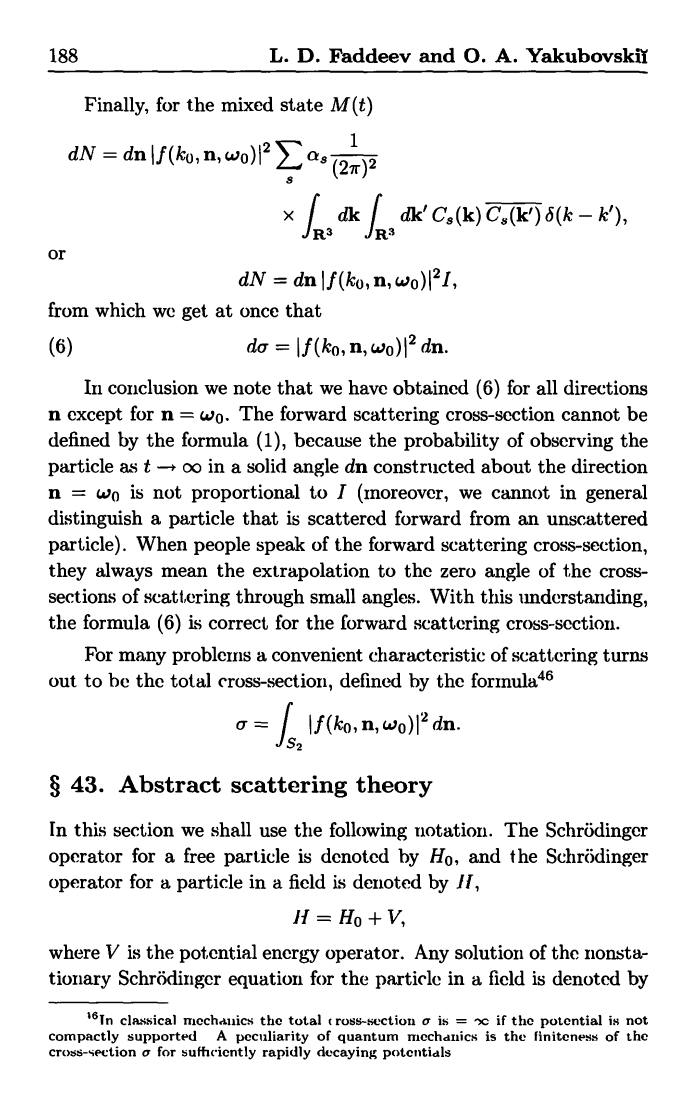
Finally, for the mixed state M(t)
dN = do I f (1o, n, wo)I2
as
(27r)2
1
x dk
dk'C8(k)C8(k')o(k-k'),
R3
JRs
or
dN =
dnIf(ko,n,wo)12I,
from which we get at once that
(6) do = If(ko,n,wo)f2dn.
In conclusion we note that we have obtained (6) for all directions
n except for n = wo. The forward scattering cross-section cannot be
defined by the formula (1), because the probability of observing the
particle as t -+ oo in a solid angle do constructed about the direction
n = wo is not proportional to I (moreover, we cannot in general
distinguish a particle that is scattered forward from an unscattered
particle). When people speak of the forward scattering cross-section,
they always mean the extrapolation to the zero angle of the cross-
sections of scattering through small angles. With this understanding,
the formula (6) is correct for the forward scattering cross-section.
For many problems a convenient characteristic of scattering turns
out to be the total cross-section, defined by the formnula46
or = fS I.f(1o,n,O)Ildn.
2
§ 43. Abstract scattering theory
In this section we shall use the following notation. The Schrodinger
operator for a free particle is denoted by Ho, and the Schr6dinger
operator for a particle in a field is denoted by 11,
11 = Ho + V,
where V is the potential energy operator. Any solution of the nonsta-
tionary Schrcidinger equation for the particle in a field is denoted by
'6Tn classical mechanics the total (ross-section a is = x if the potential is not
compactly supported
A peculiarity of quantum mechanics is the finiteness of the
cross-section a for sufficiently rapidly decaying potentials
§ 43. Abstract scattering theory
189
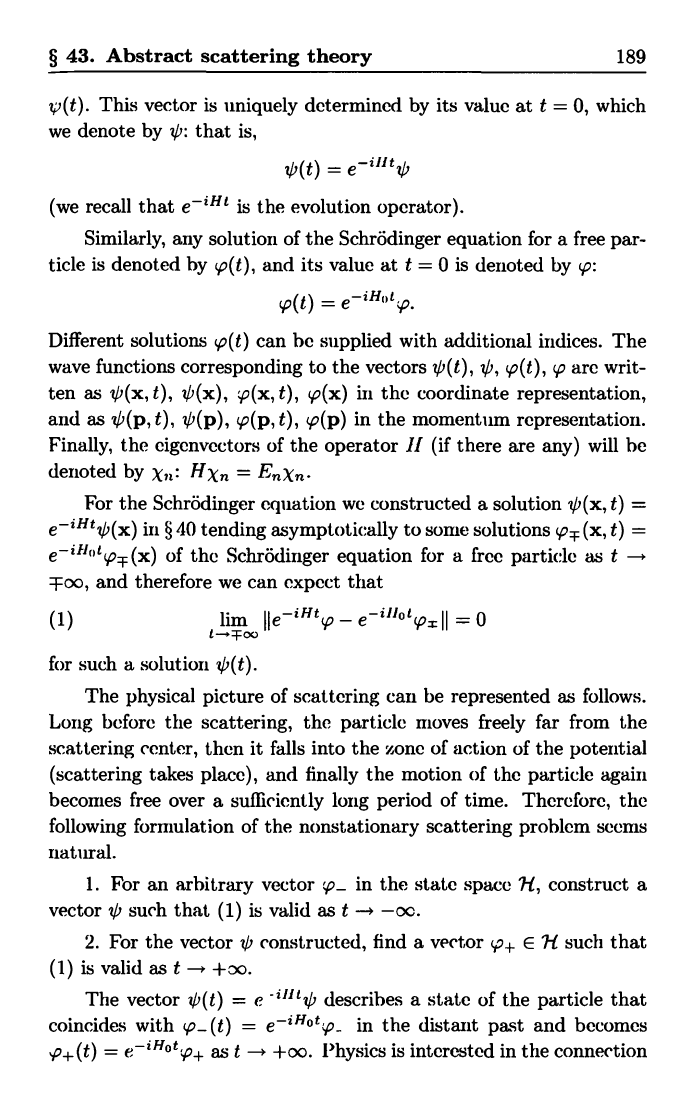
p(t). This vector is uniquely determined by its value at t = 0, which
we denote by 0: that is,
iP (t) =
e-'11ti
(we recall that a-'HI is the evolution operator).
Similarly, any solution of the Schrodinger equation for a free par-
ticle is denoted by Sp(t), and its value at t = 0 is denoted by cp:
sp(t} = e-iHo ti0-
Different solutions (p (t) can he supplied with additional indices. The
wave functions corresponding to the vectors
(t),
, p(t)
, So are writ-
ten as 0(x, t), b(x), ;p (x, t), cp(x) in the coordinate representation,
and as
(p, t), /(p), cp(p, t), W(p) in the momentum representation.
Finally, the eigenvectors of the operator 11 (if there are any) will be
denoted by X,,: HXn = FnXn.
For the Schrodinger equation we constructed a solution 0 (x, t) =
e-iHti'(x) in § 40 tending asymptotically to some solutions Spy (x, t) _
e-
iHo t
cps (x) of the Schrodinger equation for a free particle as t
moo, and therefore we can expect that
(1}
lim
IIe-i?tcp -e-iftotcp II = 0
for such a solution 0(t).
The physical picture of scattering can be represented as follows.
Long before the scattering, the particle moves freely far from the
scattering center, then it falls into the zone of action of the potential
(scattering takes place), and finally the motion of the particle again
becomes free over a sufficiently long period of time. Therefore, the
following formulation of the nonstationary scattering problem seems
natural.
1. For an arbitrary vector ;p- in the state space f, construct a
vector 0 such that (1) is valid as t --' -oc.
2. For the vector 0 constructed, find a vector + e 1 such that
(1) is validast -+oo.
The vector V )(t) = e '1110 describes a state of the particle that
coincides with cp _(t) = e - i Ho t p
_ in the distant past and becomes
p+ (t) = e -
z Ho t
o+ as t -* +oo. Physics is interested in the connection
190
L. D. Faddeev and 0. A. Yakubovskii
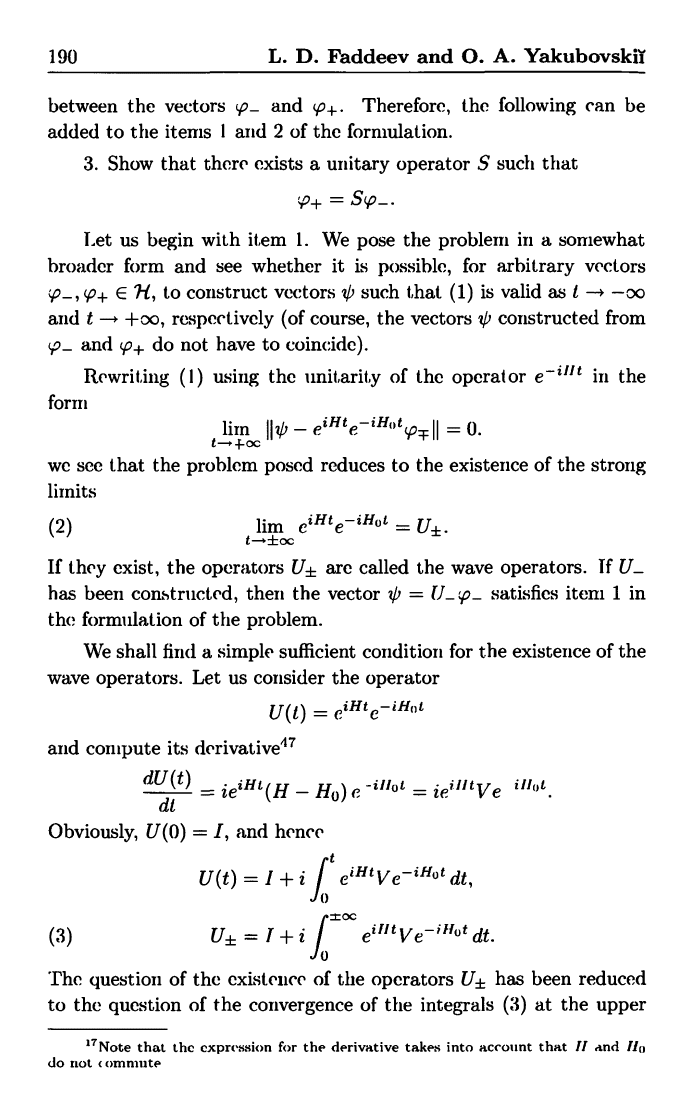
between the vectors cp_ and Sp+.
Therefore, the following can be
added to the items I arid 2 of the formulation.
3. Show that there exists a unitary operator S such that
+ =
S`p-.
Let us begin with item I. We pose the problem in a somewhat
broader form and see whether it is possible, for arbitrary vectors
W_, W+ E fl, to construct vectors 0 such that
(1) is valid as t --+ --00
arid t - +00, respectively (of course, the vectors
constructed from
(p_ and W+ do not have to coincide).
Rewriting (1) using the unitarity of the operator e-"" in the
form
urn I_ete_iH0tpII = 0-
t- ++0C
we see that the problem posed reduces to the existence of the strong
limits
(2)
lim
Ud.
t>±oc
If they exist, the operators UU are called the wave operators. If U_
has been constructed, then the vector
= U_ p_ satisfies item 1 in
the formulation of the problem.
We shall find a simple sufficient condition for the existence of the
wave operators. Let us consider the operator
U(t) =
c,iHt e-Wo t
arid compute its derivative'7
dU(t)
iHt -illnt
Hit
ill(It
dt
= ae kn - no) e
= ze
v e
° .
Obviously, U (O) = I, and hence
t
U(t) = I + i dt,
=oc
(3)
U ± = J + i
eilltVe-itb0t dt.
u
The question of the existence of the operators UU has been reduced
to the question of the convergence of the integrals (3) at the upper
17 Note that the expression for the derivative takes into account that II and II()
do not (commute
§ 43. Abstract scattering theory
191
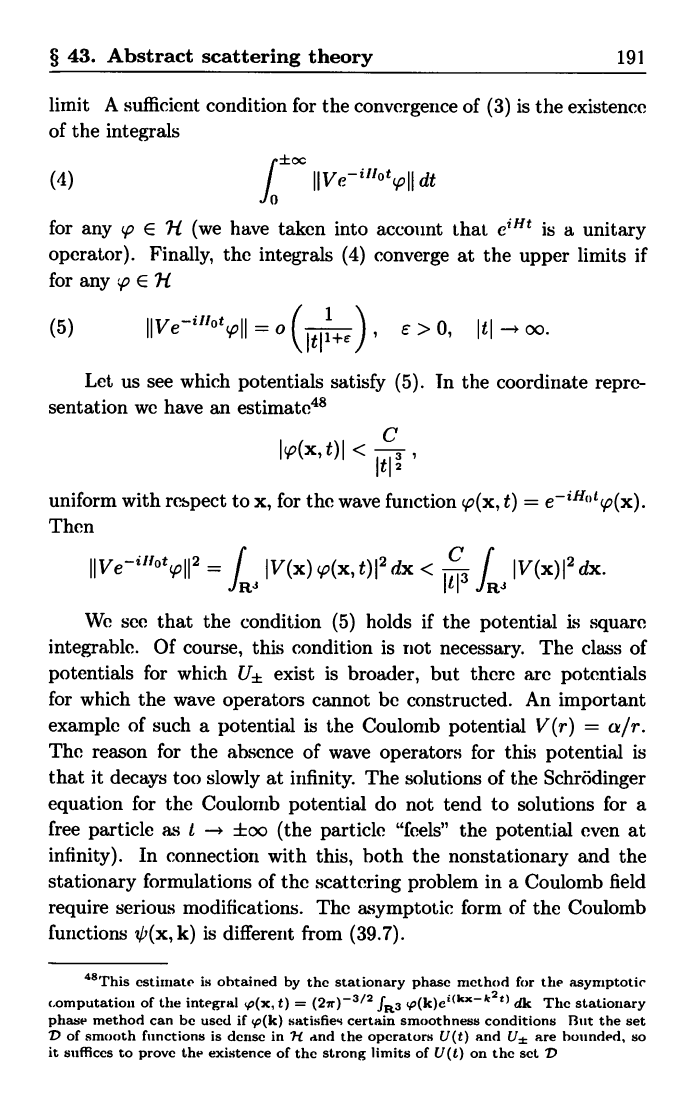
limit A sufficient condition for the convergence of (3) is the existence
of the integrals
(4)
In
toe
iIVe_10t coil dt
for any Sp E N (we have taken into account that ei Ht is a unitary
operator). Finally, the integrals (4) converge at the upper limits if
for any yo EN
(5)
I= ° (1t1i+F)
1
e > 0,
iti-oo.
Let us see which potentials satisfy (5). In the coordinate repre-
sentation we have an estimate48
C
k<
ItI3
2
uniform with respect to x, for the wave function cp(x, t) =
e-iH{cOx).
Then
iiVe_i0twii2
= JR I v(X)
(X, t)
RIV(X)I2dx.
3
We see that the condition (5) holds if the potential is square
integrable. Of course, this condition is not necessary. The class of
potentials for which UU exist is broader, but there axe potentials
for which the wave operators cannot be constructed. An important
example of such a potential is the Coulomb potential V (r) = a/r.
The reason for the absence of wave operators for this potential is
that it decays too slowly at infinity. The solutions of the Schriidinger
equation for the Coulomb potential do not tend to solutions for a
free particle as t --+ ±oo (the particle "feels" the potential even at
infinity).
In connection with this, both the nonstationary and the
stationary formulations of the scattering problem in a Coulomb field
require serious modifications. The asymptotic form of the Coulomb
functions '(x, k) is different from (39.7).
48'This estimate is obtained by the stationary phase method for the asymptotic
computation of the integral p(x, t) = (27r) -3/2 fR3
cp(k)et(kx-k2t)
dk The stationary
phase method can be used if W(k) satisfies certain smoothness conditions But the set
V of smooth functions is dense in 7-l and the operators U(t) and Ut are hounded, so
it suffices to prove the existence of the strong limits of U(t) on the set V
192
L. D. Faddeev and 0. A. YakubovskiI
Let us return to our study of potentials for which the wave op-
erators UU exist, and discuss item 2. We can ask whether for any
vector '0 E 7 there are vectors p+ and ;p- such that (1) is valid as
t-*±00.
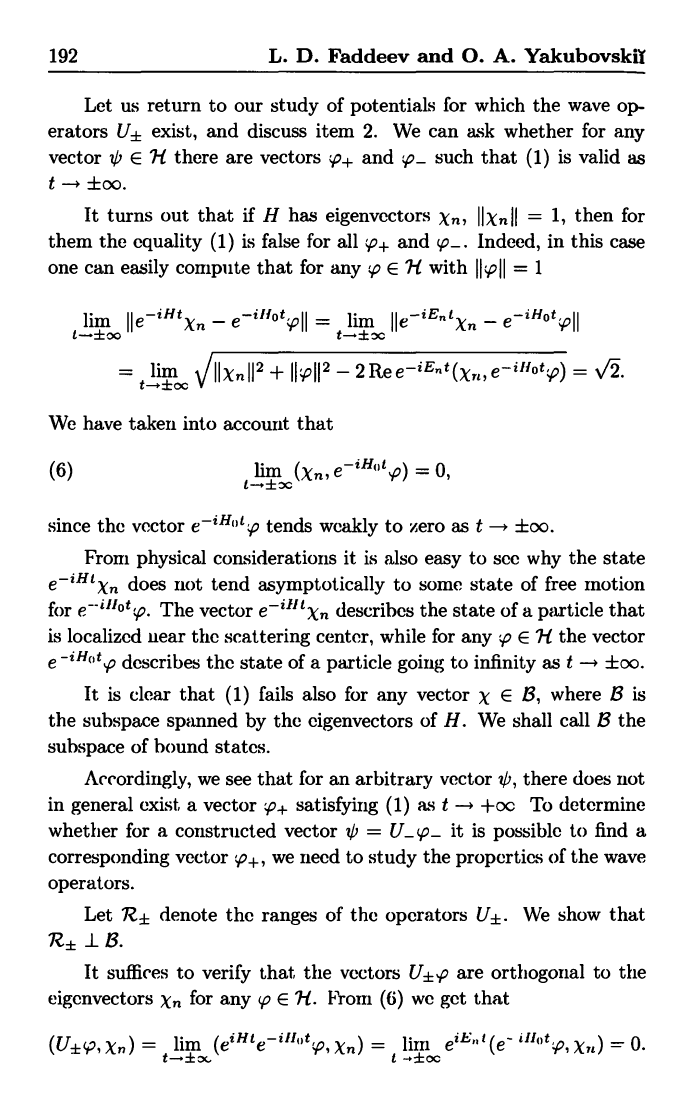
It turns out that if H has eigenvectors Xn, llXnH = 1, then for
them the equality (1) is false for all o+ and V- . Indeed, in this case
one can easily compute that for any ;p E 7 with
1
lim lle_tXn _ e-ilfot.pll = lim
lie -iEntXn --
t--.±oo
lim
VIIXn 112 + 11;0112 - 2 Re a-iEnt
V2.
t->±oc
We have taken into account that
(s)
lim (Xn,
e'Hot
0) = 0,
t-+fx
since the vector a-iHot.p tends weakly to zero as t - ±oo.
From physical considerations it is also easy to see why the state
e - i H t Xn does not tend asymptotically to some state of free motion
for e-"illot;o. The vector e-iHtXn describes the state of a particle that
is localized near the scattering center, while for any ;p E 7-1 the vector
e - i Ho, t
describes the state of a particle going to infinity as t - ±oo.
It is clear that (1) fails also for any vector X E B, where B is
the subspace spanned by the eigenvectors of H. We shall call B the
subspace of bound states.
Accordingly, we see that for an arbitrary vector 0, there does not
in general exist a vector ;p+ satisfying (1) as t ---i +oc To determine
whether for a constructed vector V) = U_ p_ it is possible to find a
corresponding vector ;p+, we need to study the properties of the wave
operators.
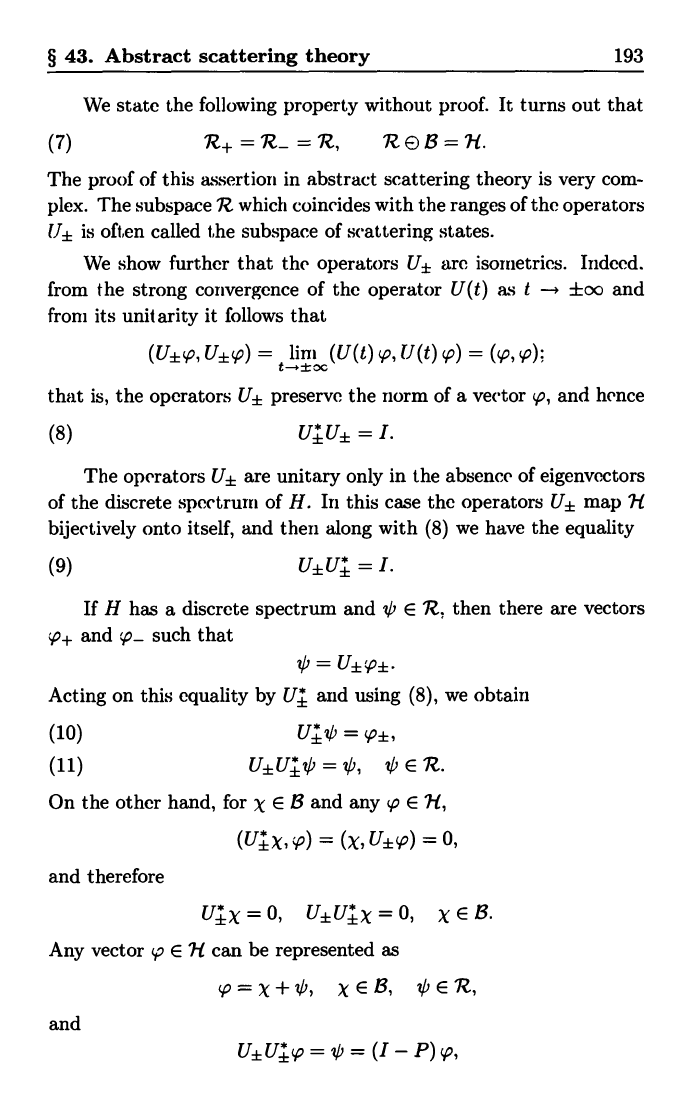
Let R± denote the ranges of the operators U±. We show that
Rf18.
It suffices to verify that the vectors U± ,p are orthogonal to the
eigenvectors X,, for any p E R. From (6) we get that
(U± V, Xn) = lim (euhute_uhbot'p, Xn) = lixxi
eiL' t (e` Wot701 X71) =0-
t- +±O
t -+f oc
1
1
§ 43. Abstract scattering theory
193
We state the following property without proof. It turns out that
(7)
1Z+=R_=R, R©S=N.
The proof of this assertion in abstract scattering theory is very com-
plex. The subspace R which coincides with the ranges of the operators
U± is often called the subspace of scattering states.
We show further that the operators Uf are. isoxrmetries. Indeed.
from the strong convergence of the operator U (t) as t
--* ±oo and
from its unit arity it follows that
(Ucp, U±V) =
t
limx(U(t) W, U(t) c0) = (V, SP):
that is, the operators UU preserve the norm of a vector cp, and hence
(8)
UU UU = I.
The operators UU are unitary only in the absence of eigenvectors
of the discrete spectrum of H. In this case the operators UU map 1-1
bijectively onto itself, and then along with (8) we have the equality
(9)
U± U; = I.
If H has a discrete spectrum and
E R, then there are vectors
p+ and ;p_ such that
0 = U±±.
Acting on this equality by UU and using (8), we obtain
(10)
U10 = cp±,
(11)
UUUj =b,
I' E R.
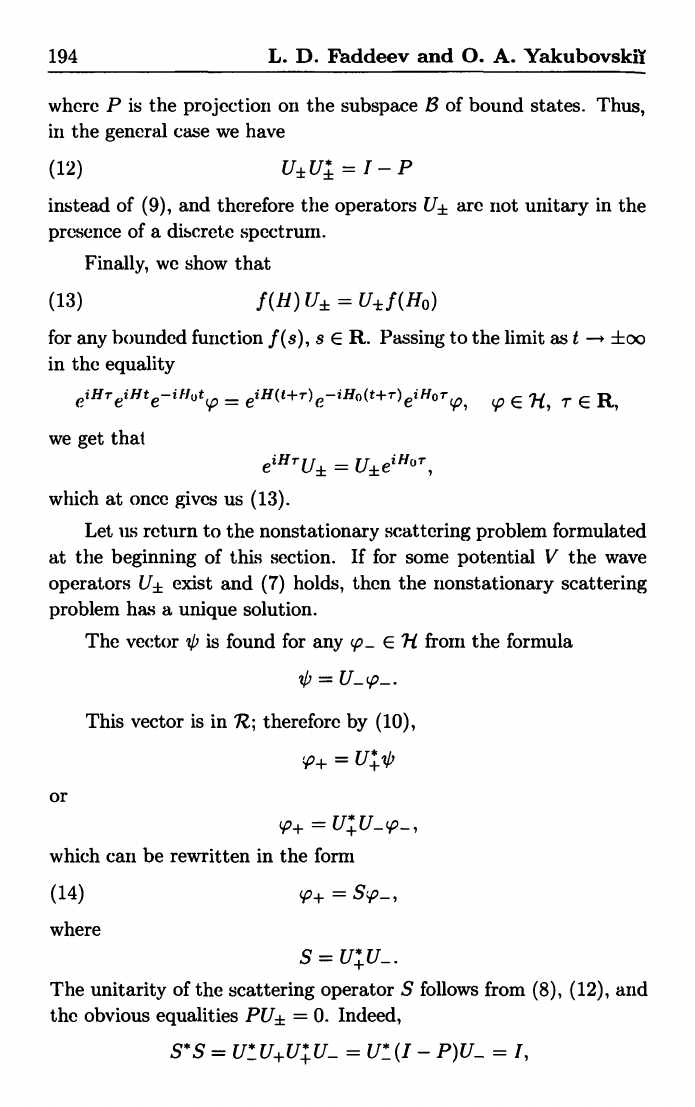
On the other hand, for x E 8 and any cp E H,
(Uy,cp)
= (x,U±ca) = 0,
and therefore
UUx=0, UUUUx=O, XEB.
Any vector V E H can be represented as
Sp=X+,0, XEB, ER,
and
V) = (I - P) 01
194 L. D. Faddeev and 0. A. YakubovskiI
where P is the projection on the subspace B of bound states. Thus,
in the general case we have
(12)
UUUU - I - P
instead of (9), and therefore the operators UU are not unitary in the
presence of a discrete spectrum.
Finally, we show that
(13) f(H)UU = U+f(HO)
for any hounded function f (s), s E R. Passing to the limit as t --+ ±oo
in the equality
eiHreiHte-iH0tSp
=
eiH(t+r)e_ Ho(t+r)eiHorSp,
'p E 1, T E R,
we get that
e
iHr
U± = U±e
iHUr
which at once gives us (13).
Let us return to the nonstationary scattering problem formulated
at the beginning of this section. If for some potential V the wave
operators UU exist and (7) holds, then the nonstationary scattering
problem has a unique solution.
The vector 0 is found for any Sp
- E
1-1 from the formula
'0=U_cp-.
This vector is in R; therefore by (10),
P+=U+10
or
0+ = U+ U- O - ,
which can be rewritten in the form
(14)
where
0+ = S'p-
S=U+U-.
The unitarity of the scattering operator S follows from (8), (12), and
the obvious equalities PUf = 0. Indeed,
S*S= U-**U+U+U- = U* (I - P) U- = I,
§ 43. Abstract scattering theory
195
and similarly
SS* = I.
Further, it follows from (13) that
(15)
S f (11o) = f (Ho) S.
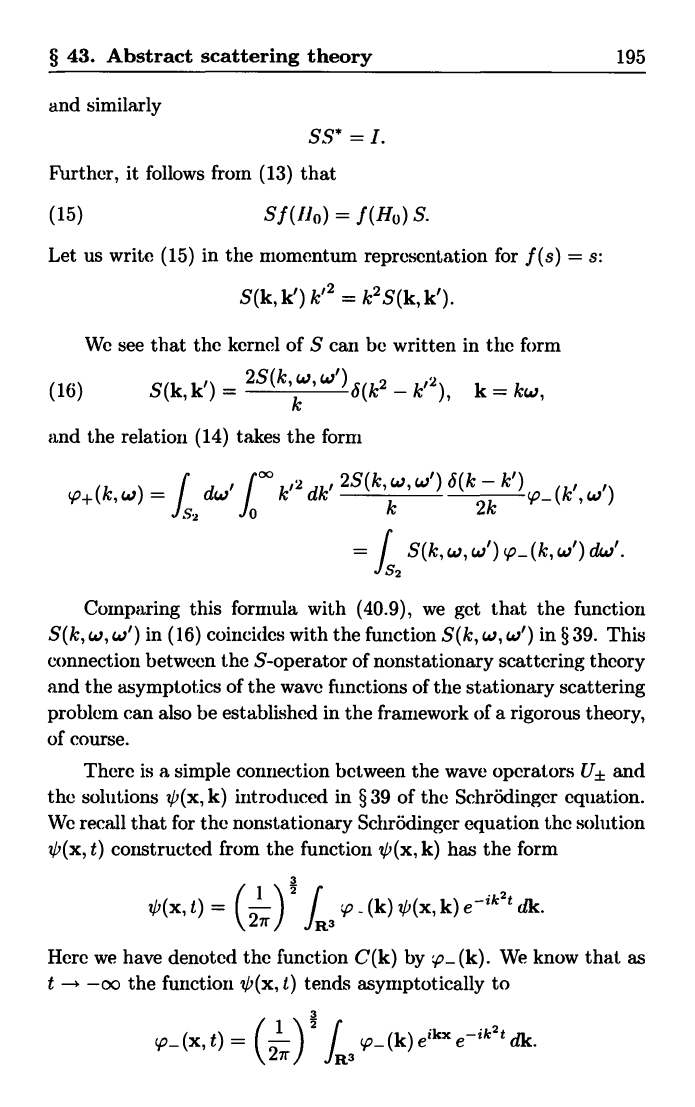
Let us write (15) in the momentum representation for f (s) = s:
S(k,k') k'2 = k2S(k,k').
We see that the kernel of S can be written in the form
(16)
Skk'
=2S(k,w,w')Sk2-k'2
k=kw
and the relation (14) takes the form
k'2dk'
2S(k,w,w') 6(k - k')
k
k w =
dw'
P( )
SP
( )
.s2
j
SS(k, w, w') cp_ (k, w') dw'.
1S2
o
mparing this formula with (40.9), we get that the function
S(k, w, w') in (16) coincides with the function S(k, w, w') in § 39. This
connection between the S-operator of nonstationary scattering theory
and the asymptotics of the wave functions of the stationary scattering
problem can also be established in the framework of a rigorous theory,
of course.
There is a simple connection between the wave operators UU and
the solutions
(x, k) introduced in § 39 of the Schrodinger equation.
We recall that for the nonstationary Schrodinger equation the solution
(x, t) constructed from the function
(x, k) has the form
3
(x,t)
2
-- 1 _
(k)
(x, k
e-ik2t
dk.
JR3
Here we have denoted the function C(k) by ;p_ (k). We know that as
t -oo the function (x, t) tends asymptotically to
3
1 _
k eikx
a-ik2t
dk.
- x t =
2
Sp
(
, )
(27r
R3
Sp (
)
196 L. D. Faddeev and 0. A. Yakubovskii
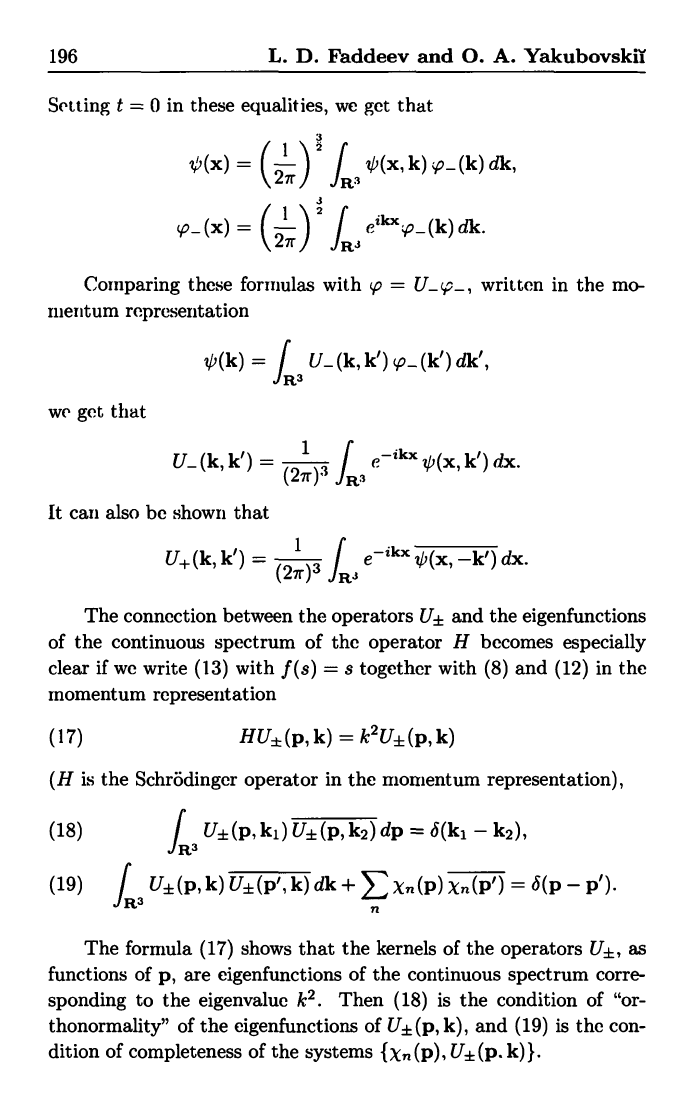
Setting t = 0 in these equalities, we get that
3
x = 1
2
k _dk
(
)
27r
(x, ) (k)
JR3''
2
p_ (x) _
A.
27r
JR3
Comparing these formulas with p = U_p_, written in the mo-
mentum representation
V)(k) -
U- (k, k') p- (k') dk' I
JR3
we get that
U_ (k, k') =
1
e-ikx
(x, k') dx.
(27r)3
JR
It can also be shown that
The connection between the operators Uf and the eigenfunctions
of the continuous spectrum of the operator H becomes especially
clear if we write (13) with f (s) = s together with (8) and (12) in the
momentum representation
(17) HUt (p, k) = k2Uf (p, k)
(H is the Schrodinger operator in the momentum representation),
(18)
f
-k2),
(19)
fR3 U(P,k)U(P',k) A +Xn(P)Xn(P')=b(P-P')
n
The formula (17) shows that the kernels of the operators UU, as
functions of p, are eigenfunctions of the continuous spectrum corre-
sponding to the eigenvalue k2. Then (18) is the condition of "or-
thonormality" of the eigenfunctions of UU (p, k), and (19) is the con-
dition of completeness of the systems {Xn(p), UU (p. k)}.
§ 44. Properties of commuting operators 197
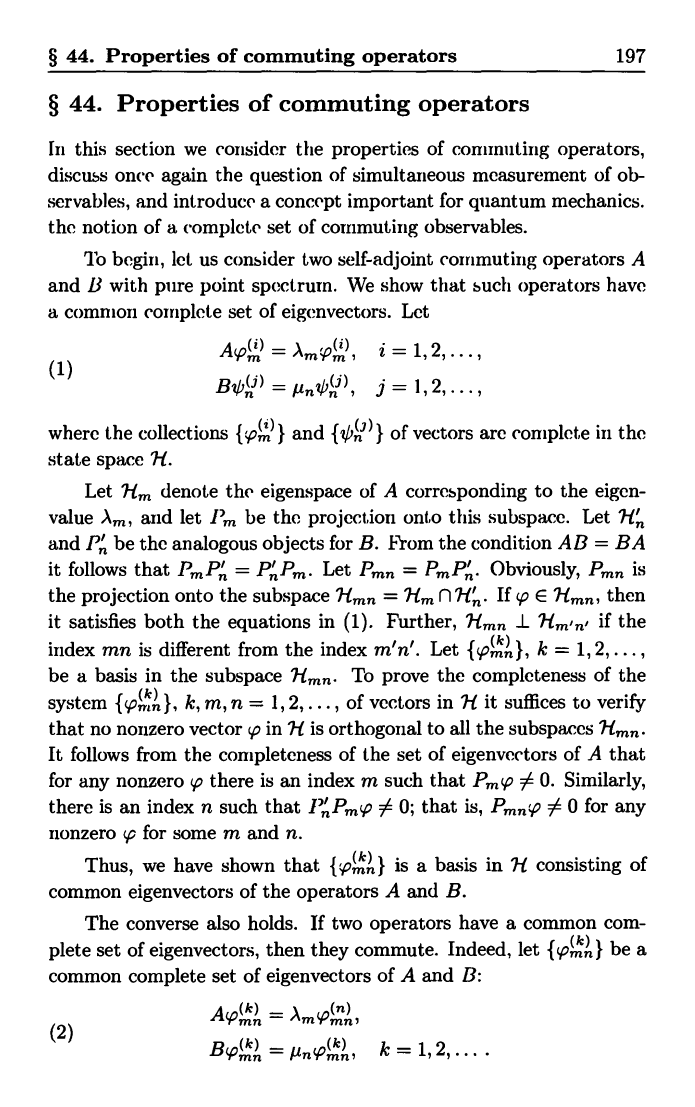
§ 44. Properties of commuting operators
In this section we consider the properties of commuting operators,
discuss once again the question of simultaneous measurement of ob-
servables, and introduce a concept important for quantum mechanics.
the notion of a complete set of commuting observables.
To begin, let us consider two self--ad joint commuting operators A
and 13 with pure point spectrum. We show that such operators have
a common complete set of eigenvectors. Let
(1)
ASp{m) _ Am;p{,n},
i = 1, 2, .-. ,
B j = 1, 2, ... ,
where the collections {'P} and {t4f} of vectors are complete in the
state space H.
Let Nm denote the eigenspace of A corresponding to the eigen-
value Am, and let P m be the projection onto this subspace. Let V
and P,, be the analogous objects for B. From the condition AB = BA
it follows that PmPn' = PnPm. Let Pmn = PmPP. Obviously, Pmn is
the projection onto the subspace flmn = Nm f1 Nn. If SO E Nmn, then
it satisfies both the equations in (1). Further, Nmn _.L Nm' n, if the
index mn is different from the index m'n'. Let {p}, k = 1,2,...,
be a basis in the subspace fmn. To prove the completeness of the
system f W n
1,9 k,
m, n = 1, 2, ... , of vectors in H it suffices to verify
that no nonzero vector SP in N is orthogonal to all the subspaces Nmn.
It follows from the completeness of the set of eigenvectors of A that
for any nonzero 'P there is an index m such that PmSp 34 0. Similarly,
there is an index n such that R' PmW
0; that is, Pmn;p 34 0 for any
nonzero Sp for some m and n.
Thus, we have shown that {4} is a basis in h consisting of
common eigenvectors of the operators A and B.
The converse also holds. If two operators have a common com-
plete set of eigenvectors, then they commute. Indeed, let {'P} be a
common complete set of eigenvectors of A and B:
Acp{mn
=
AmS'(mn,
(2)
k)
=
._ tn'P
k)
k = 1, 2, ...
.