
Faddeev L.D., Yakubovskii O.A. Lectures on Quantum Mechanics for Mathematics Students
Подождите немного. Документ загружается.

178
L. D. Faddeev and 0. A. Yakubovskj
(g)
I/'(x,t)I2 -
81t13
1IC(2tr,n)
IZ
-
ko
ImCl ()c(j-,n)f(ko,n,wo)
+ 41r2
I Cl
\2tl
I
If(ko,n,)o)I2],
t --> +oo.
Z
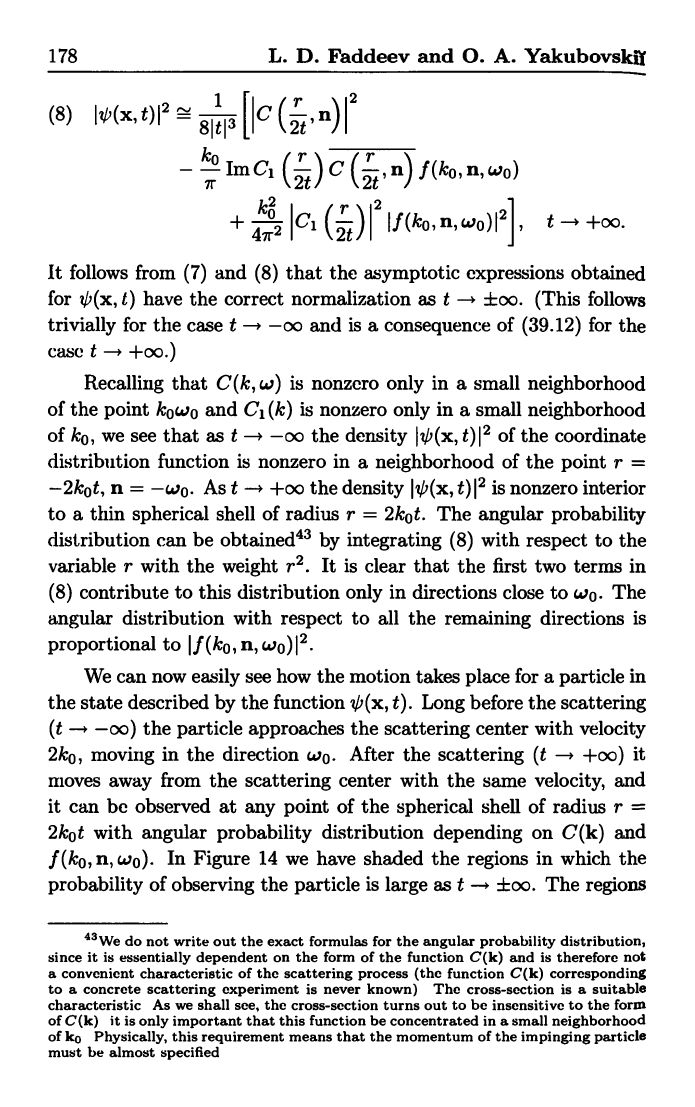
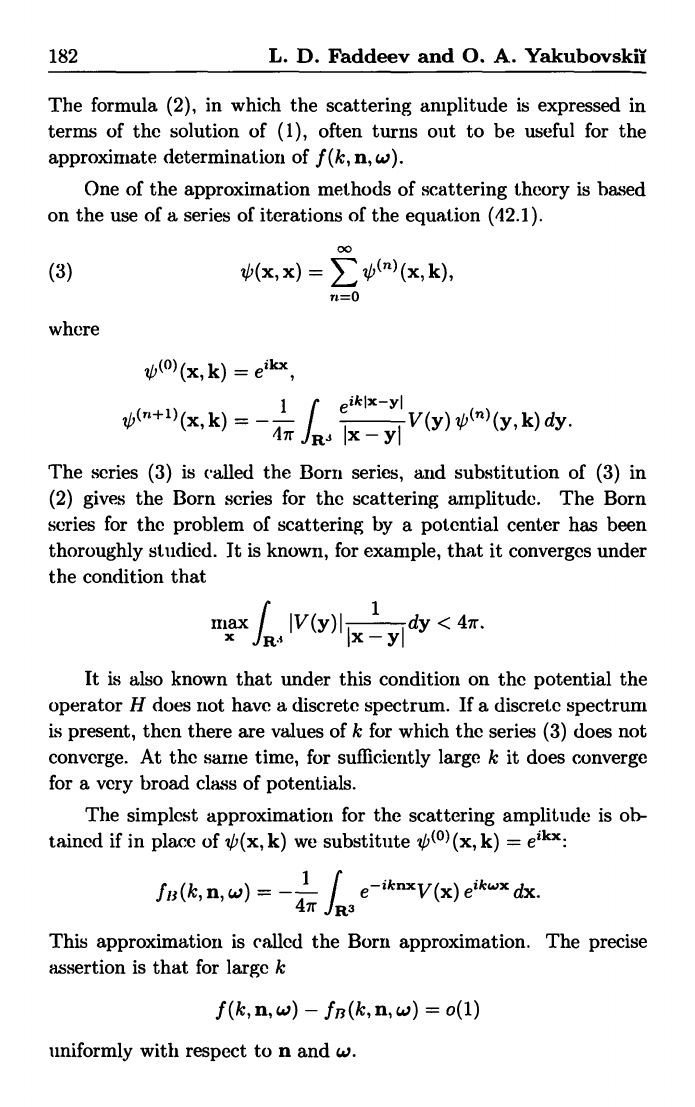
It follows from (7) and (8) that the asymptotic expressions obtained
for
(x, t) have the correct normalization as t --+ ±oo. (This follows
trivially for the case t - -oo and is a consequence of (39.12) for the
case t -' +oo.)
Recalling that C(k, w) is nonzero only in a small neighborhood
of the point k0w0 and Cl (k) is nonzero only in a small neighborhood
of k0, we see that as t -* -oo the density IV) (x, t)12 of the coordinate
distribution function is nonzero in a neighborhood of the point r =
- 2 k0 t, n = -WO. As t --+ +oo the density
1,0 (x, t) 12 is
nonzero interior
to a thin spherical shell of radius r = 2k0 t. The angular probability
distribution can be obtained43 by integrating (8) with respect to the
variable r with the weight r2 .
It is clear that the first two terms in
(8) contribute to this distribution only in directions close to WO. The
angular distribution with respect to all the remaining directions is
proportional to If (ko, n,
wo)12.
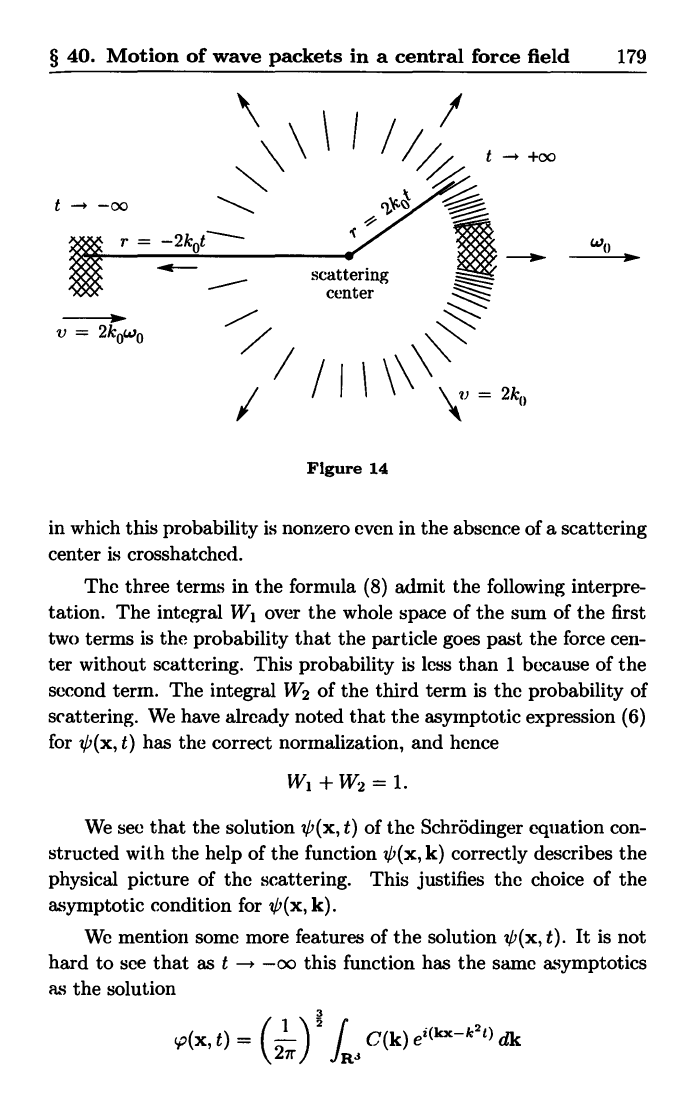
We can now easily see how the motion takes place for a particle in
the state described by the function(x, t). Long before the scattering
(t --+ -oo) the particle approaches the scattering center with velocity
2k0, moving in the direction w0. After the scattering (t - +00) it
moves away from the scattering center with the same velocity, and
it can be observed at any point of the spherical shell of radius r
2kot with angular probability distribution depending on C(k) and
f (k0, n, wo). In Figure 14 we have shaded the regions in which the
probability of observing the particle is large as t --p ±oo. The regions
43 We do not write out the exact formulas for the angular probability distribution,
since it is essentially dependent on the form of the function C(k) and is therefore not
a convenient characteristic of the scattering process (the function C(k) corresponding
to a concrete scattering experiment is never known) The cross-section is a suitable
characteristic As we shall see, the cross-section turns out to be insensitive to the form
of C(k) it is only important that this function be concentrated in a small neighborhood
of ko Physically, this requirement means that the momentum of the impinging particle
must be almost specified
§ 40. Motion of wave packets in a central force field
179
t -+ --oo
r = -- 2k0C
v = 2kow0
Figure 14
w{)
in which this probability is nonzero even in the absence of a scattering
center is crosshatched.
The three terms in the formula (8) admit the following interpre-
tation. The integral Wl over the whole space of the sum of the first
two terms is the probability that the particle goes past the force cen-
ter without scattering. This probability is less than 1 because of the
second term. The integral W2 of the third term is the probability of
scattering. We have already noted that the asymptotic expression (6)
for 4 (x, t) has the correct normalization, and hence
W1+W2=1.
We see that the solution i&(x, t) of the Schrodinger equation con-
structed with the help of the function O(x, k) correctly describes the
physical picture of the scattering. This justifies the choice of the
asymptotic condition for ip(x, k) .
We mention some more features of the solution iP(x, t). It is not
hard to see that as t -p -oo this function has the same asymptotics
as the solution
3
(x, t)
2
=
1
C(k)
ei(kx-k2t)
dk
JR
I /
I
scattering
center
/ /
/ I
I
\\\
\v=2k()
t -4 +00
180
L. D. Faddeev and 0. A. Yakubovskii
of the Schrodinger equation for a free particle. (Here C(k) is the same
function as in the integral (1).) Indeed, the diverging waves eikr /r
do not contribute to the asymptotics as t --+ -oo. and the coefficients
of e -ikr/r in the asymptotic expression for the functions ekx and
7'(x, k) coincide.
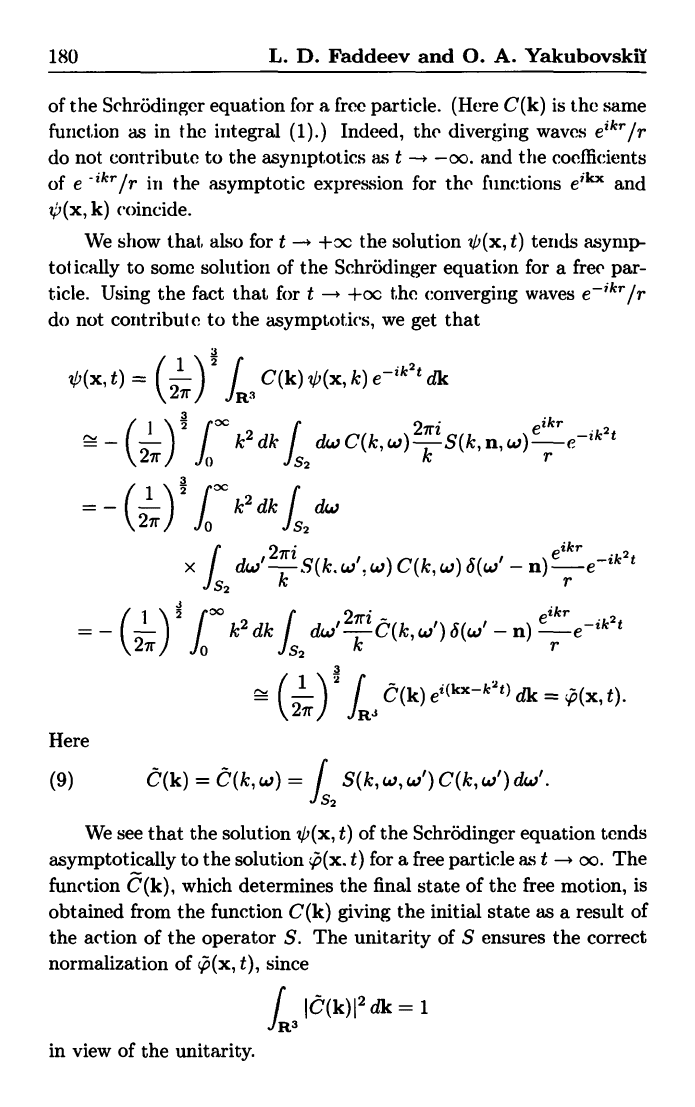
We show that, also for t -* +oc the solution V )(x, t) tends asymp-
tot ically to some solution of the Schrodinger equation for a free par-
ticle. Using the fact that for t
+oc the converging waves
a-ikl/r
do not contribute to the asymptotics, we get that
3
V/ (Xj t=
(1)2
C k x k
e-ik2t
k
f
3
1
2
x
k
2
dk d W C w)
27ri
S(k, n, w)
eikr
_ik2t
--
-
e
JO
s2
r
3
2
Joy k2
A
Js
dw
x
27ri
S k.
k
S2
2kT
w', W) C(k,w) S(w' - n)
e
e_ik2t
r
_ - I
1
1
2 00
fo
k2 dk I
2'ri
C(k, w') S(w'
- n)
\2r/
sz
k
e-ik2t
r
3
l
O(k) ei(kx-k2t) dk = AX, t).
2ir
J
3
Here
(9) C(k) = O(k,
') =
S(k,w,w') C(k,w') dw'.
S2
We see that the solution i'(x, t) of the Schrodinger equation tends
asymptotically to the solution yp(x. t) for a free particle as t - oo. The
function C(k), which determines the final state of the free motion, is
obtained from the function C(k) giving the initial state as a result of
the action of the operator S. The unitarity of S ensures the correct
normalization of
(x, t), since
fR3
IO(k)I2dk= 1
in view of the unitarily.
41. The integral equation of scattering theory
181
41. The integral equation of scattering theory
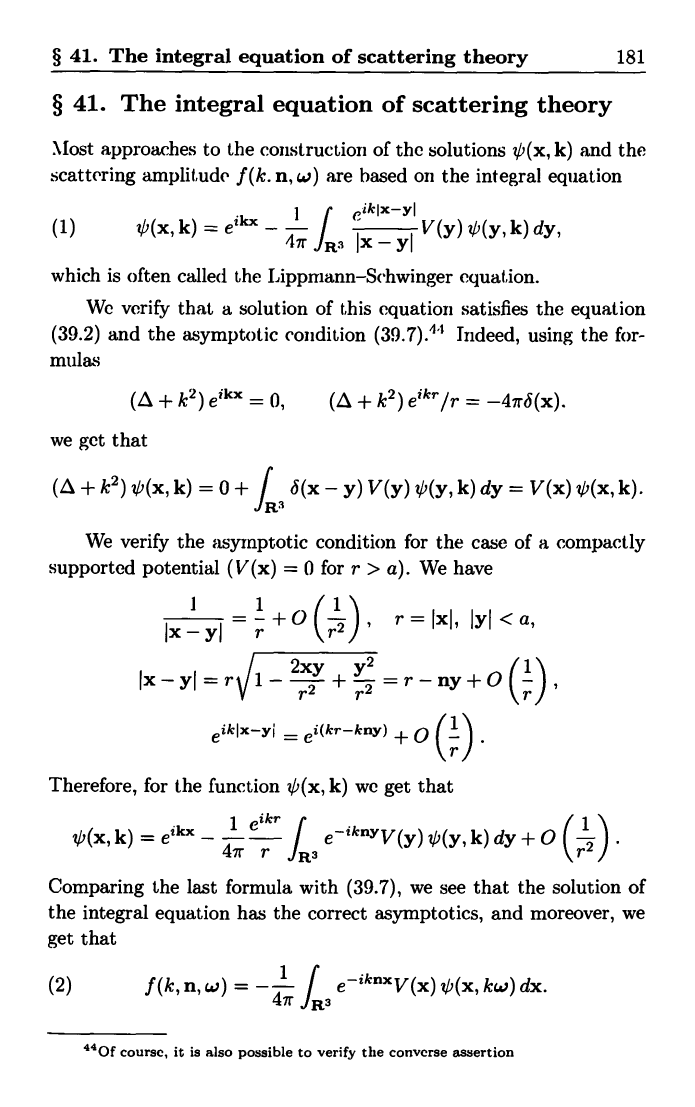
Most approaches to the construction of the solutions L(x, k) and the
scattering amplitude f (k. n, w) are based on the integral equation
ikjx-yj
(1) b(x, k) = euI c
47r
V(y) V) (y, k) dy,
R 3
Ix-yl
which is often called the Lippmann-Schwinger equation.
We verify that a solution of this equation satisfies the equation
(39.2) and the asymptotic condition (39.7).41 Indeed, using the for-
mulas
(O + kz) e:t« = 01
(Q + k 2 )
eikr/r
= -4a8(x)-
we get that
3
a(X - y) V(y) V)(y, k) dy = V(x) Vi(x, k).
(o + k 2) O(X, k) = o + f
R
We verify the asymptotic condition for the case of a compactly
supported potential (V(x) = 0 for r > a). We have
1
1 1
+0
, r = lxl,
13'! < a,
lx - yl
=
r
(r2
s /
Ix -yI=r
1-2xY+Y
=r-ny+Ol
1r)
,
r2 r2
eikIX-YI =
e
i(kr-kny)
+0
r7'1 ,
Therefore, for the function O(x, k) we get that
,O(X, k)
= etc -
c
r
r f
3
0(y, k) dY + 0 (-k)
R
Comparing the last formula with (39.7), we see that the solution of
the integral equation has the correct asymptotics, and moreover, we
get that
V) (x, kw) dx.
(2)
.f (k, n, w) = -4
3
440f course, it is also possible to verify the converse assertion
182
L. D. Faddeev and 0. A. Yakubovskii
The formula (2), in which the scattering amplitude is expressed in
terms of the solution of (1), often turns out to be useful for the
approximate determination of f (k, n, w).
One of the approximation methods of scattering theory is based
on the use of a series of iterations of the equation (42.1).
00
(3)
(x, x) = E V)
(n) (x,
k),
n=0
where
(°) (x, k) = eikx,
eik x-yl
(x, k) = _
V(Y) V)
(n)
(yj k) dy.
47r
frR,,J 1X-Y1
The series (3) is called the Born series, and substitution of (3) in
(2) gives the Born series for the scattering amplitude. The Born
series for the problem of scattering by a potential center has been
thoroughly studied. It is known, for example, that it converges under
the condition that
dy < 47r.
InXXR4 IV(Y)
Ix-yl
It is also known that under this condition on the potential the
operator H does not have a discrete spectrum. If a discrete spectrum
is present, then there are values of k for which the series (3) does not
converge. At the same time, for sufficiently large k it does converge
for a very broad class of potentials.
The simplest approximation for the scattering amplitude is ob-
tained if in place of O(x, k) we substitute 0(°) (x, k) = eikx:
k n, w = - 1
e-iknxv
x
eikwx
dx.
f
3
This approximation is called the Born approximation. The precise
assertion is that for large k
f(k,n,w) - f (k,n,w) = o(1)
uniformly with respect to n and w.
§ 42. Derivation of a formula for the cross-section 183
The integral equation is used for mathematical investigation of
the scattering problem. For a suitable choice of function space, this
equation can be reduced to an equation of the second kind
0
+AV)
with a compact operator. Therefore, the Fredholm theorems hold for
the equation (1). For a broad class of potentials it has been shown
that the corresponding homogeneous equation can have solutions only
for imaginary values of the parameter k (k9, = ix7z, x, > 0). By re-
peating the calculations carried out in the beginning of this section,
it is easy to see that the solution V,, (x) of the homogeneous equation
satisfies the Schrodinger equation [-+V(x)]i/'(x) = -x/'(x) and
has the asymptotic expression 0,, (x) '=-' f (n) e - xn T /r, where f (n) is
a function defined on the unit sphere. This means that the solutions
of the homogeneous equation are eigenfunctions of the discrete spec-
trum of H. The completeness of the collection {fin (x),
(x, k) I of
eigenfunctions of H was proved with the help of the integral equation
(1)
§ 42. Derivation of a formula for the
cross-section
The main characteristic of the process of scattering of a particle by
a potential center is the differential cross-section. In accordance with
the general definition of the cross-section, the differential cross-section
is defined by the formula
1
dor =
dN
where dN is the probability of observing the particle after the scat-
tering (t -+ oo) in the solid angle element do about some direction n,
and I is the probability of a free particle crossing a unit area element
oriented perpendicular to the motion of the particle.
This proba-
bility is defined at the point where the scattering center is located.
We stress that dN is a characteristic of a particle in the field of the
scattering center, while I is a characteristic of a free particle.
Little is known about the state w of a free particle in the beam.
Indeed, it is known that the particle has momentum approximately
1 84
L. D. Faddeev and 0. A. Yakubovskii
equal to ko = kowo, and the variance
(Ak1)avg+(Ok2)avg+
(k3)vg of the momentum is known; moreover, for the scattering
experiments to admit a simple interpretation, one tries to use beams
of particles with a small variance of the. momentum. Very little is
usually known about the coordinates of a particle in the beam. But
nevertheless it is known that at some moment of time (which can be
taken to be t = 0), the particle is in a macroscopic region between the
accelerator and the t arget. The transverse size of this region can be
identified with the diameter of the beam. We remark that according
to the Heisenberg uncertainty relation, the existence of such a region
imposes lower bounds on the variance of t he momentum.
In deriving the formula for the differential cross-section, we make
two assumptions about the smallness of the square root ok of the
variance of the momentum:
1) Ok<<ko,
2) I
- f (k'. n, w') I
< 1f(k.n')1 if Ikw -- k'w'l < Ak.
In principle these requirements can always be satisfied if f (k, n, w)
is a continuous function of k = kw (the continuity of f can be proved
for a broad class of potentials). These conditions usually hold in prac-
tice. However, there are cases when a small change in the variable k
leads to a sharp change in the function f (k, n, w) (the case of narrow
resonance). In the final analysis the quantity ok is determined by the
construction of the accelerator and in practice cannot be made arbi-
trarily small. Therefore, in some experiments the condition 2) may
not hold. In this case one cannot use the formula obtained below for
the cross-section.
We show that under the conditions 1) and 2) the differential cross-
section depends on the state of the impinging particle only in terms
of k0, and that
do- = I
The most general state for a free particle is a mixed state, given by
a density matrix Mo (t) which we represent as a convex combination
of pure states:
Mo(t) = EasPPSt ), Ics = 1.
8
§ 42. Derivation of a formula for the cross-section
185
The pure state Pp, (t) is determined by a wave function Vs (x, t) with
the form
3
X, 0 =
1
(-_)2f
Cs k
ei(x-k2t)
dk.
Ps (
'
27t
3
It can be asserted that an appreciable contribution is given only by
the pure states in which the momentum variance does not exceed the
momentum variance in the state M0 (t) .
Therefore, we assume that
all the functions C., (k) are nonzero only in a small neighborhood of
the point k0 = k0w0, and that the diameter of this neighborhood does
not exceed Ak. We do not have any information about the concrete
form of the function45 Cs (k) nor about the weights as, and we do not
make any assumptions about them.
We first compute the probability I. Let us choose a coordinate
system with origin at the force center and with x3-axis directed along
the vector w0. For a pure state Spa (t) it is easiest to compute the
probability I(s) by using the density vector
j
(.s) (X,
t) = i (;p. O S03
- S0.14 V SPs }
of the probability flow, and then
00
{s}
=
33s)
-
(x,t)
oo
Computing
(s)
ass
J3 (x,t)IX
= i
3
3
x.=0
dt.
1 dk dk/
+
k,
i(k 2 -k2)t
3 3
(k3
3) Cs (k} C's (k) e
R
1!2 s
R
45 Corresponding to different functions C, (k) are both different forms and different
arrangements of wave packets in the configuration space at some moment of time For
example. suppose that some function CY (k) gives a wave packet whose c enter of gravity
(x(t)
moves along the x3-axis directed along the vector w0 and passes through the
scattering center Then corresponding to the function C1 (k) - eik"1 C4 (k) is the packet
shifted by the vector u1 in the configuration space (ezk" is the shift operator, written
in the momentum repres('ntation) As a classical analogue (though not completely
accurate) of the state p. (x, t) we can take the state of a particle moving on a rectilinear
trajectory that passes through the scattering center Then corresponding to the state
SP1(x, t) is a trajectory passing by the scattering center at a distance p equal to the
projection of the vector ul on the plane of the (rocs-section of the beam In classical
scattering theory the distance p by which the particle would go by the center if there
were no interaction is called the aiming parameter
186
L. D. Faddeev and 0. A. Yakubovskil
we get that
ei(
2
-
2)t
I
(v)
= 1
A dk'
°°
dt
C
C (k')
(2ir)3
(k3
3)
s
(k)
s
R3
R3
1-00
(2ir)2
f
3
A JIF3
' (k3 + IC3) Cs(k) CS(k')
k2)
1
(27r)2 fR
A
R3
the 3
Cs(k)
k)
1
(27r)2 f A I A' Cs(k) CY(k') d(k'
- k).
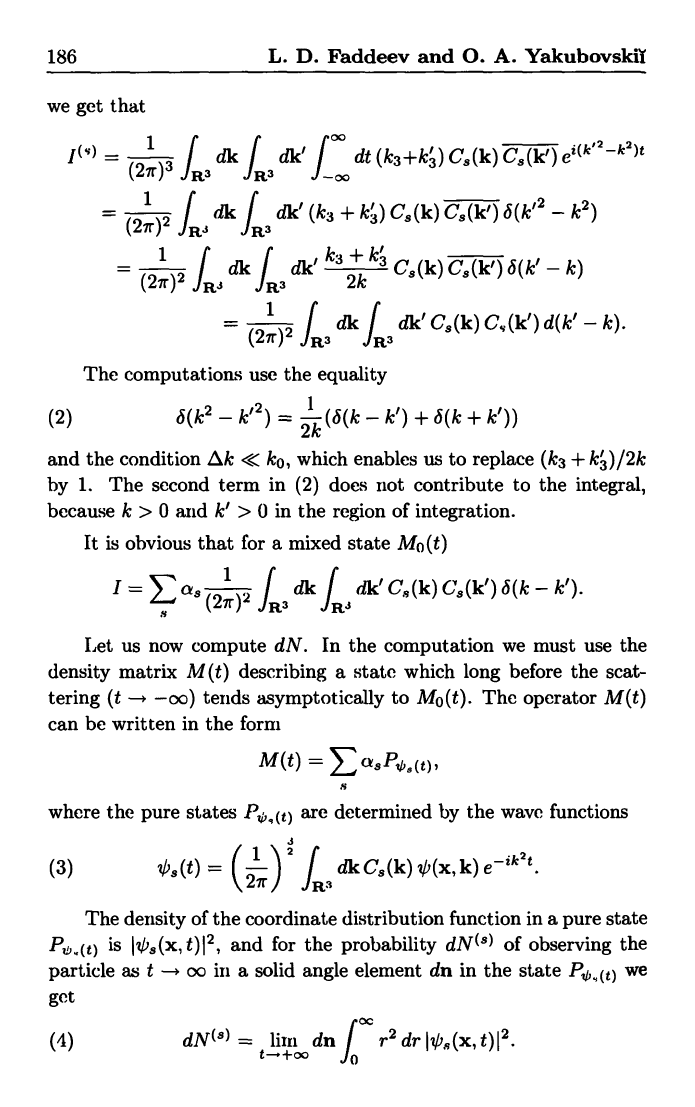
The computations use the equality
(2)
6(k2
-
k'2)
= 2k(6(k -
k') + b(k + k'))
and the condition Ok K ko, which enables us to replace (k3 + k3)/2k
by 1. The second term in (2) dog not contribute to the integral,
because k > 0 and k' > 0 in the region of integration.
It is obvious that for a mixed state Mg(t)
I -
1
as (21r)2
J, A f
,s
dk' C.,(k) Gs(k') 8(k - k').
Let us now compute dN. In the computation we must use the
density matrix M (t) describing a state which long before the scat-
tering (t -+ -oo) tends asymptotically to Mo(t). The operator M(t)
can be written in the form
M(t)
_
as (t),
where the pure states Pw ,(t) are determined by the wave functions
3
- 1
2
-ik2t
(3)
03(t)
21r
3(k),O(x k) e
R3
dk C'
The density of the coordinate distribution function in a pure state
PP,
K
(t) is f'3 (x, t )12 , and for the probability d N(-) of observing the
particle as t --+ oo in a solid angle element do in the state P(t) we
get
(4) dN(3) = lien do r2 dr IV)5(x, t)12.
t-'+00
A
§ 42. Derivation of a formula for the cross-section
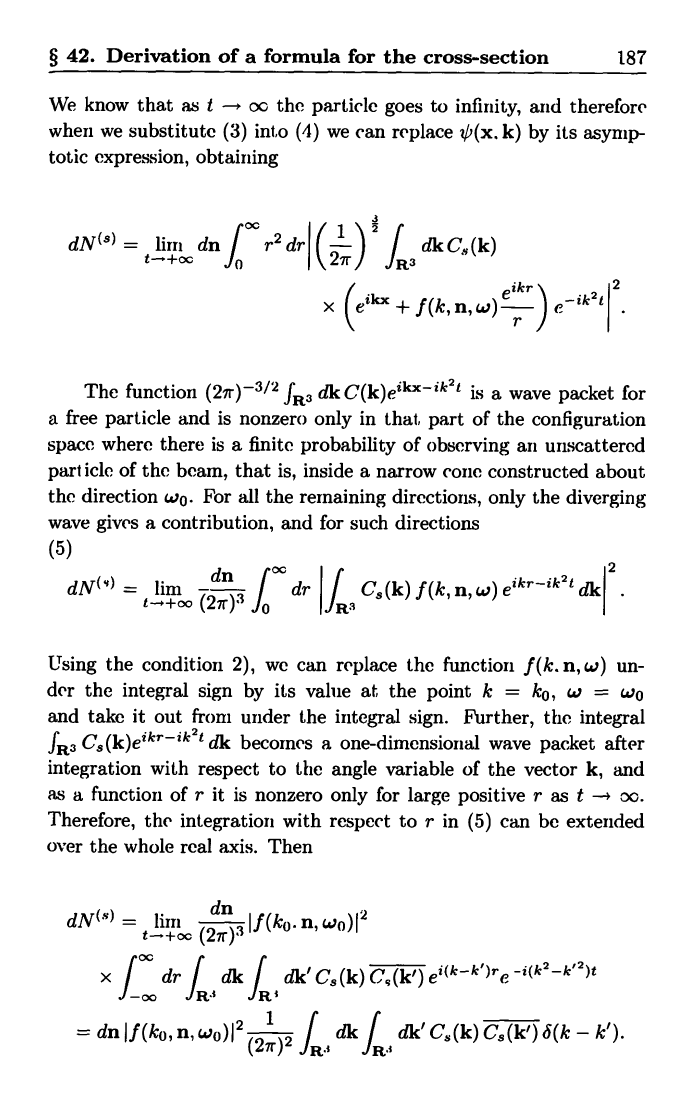
We know that as t --+ oc the. particle goes to infinity, and therefore
when we substitute (3) into (4) we can replace b(x. k) by its asymp-
totic expression, obtaining
x
dN(s) = urn do
r2 dr
t-+oc
e
3
1 2
A
2-7r
3
CK (k)
R
ikr
x
eikx +
f (k, n, w)
a
e-ik2t
r
187
2
The function (2,7r) -312 fR3 dk C(k) eikx-- ik2 t is a wave packet for
a free particle and is nonzero only in that, part of the configuration
space where there is a finite probability of observing an unscattered
particle of the beam, that is, inside a narrow cone constructed about
the direction wo. For all the remaining directions, only the diverging
wave gives a contribution, and for such directions
5)
00
dN(q) = line
-dn
dr
t- (27r) 3
Jo
f Cs (k) f (k, n, w)
eikr-ik2t
dk
R3
2
Using the condition 2), we can replace the function f (k. n, w) un-
der the integral sign by its value at the point k = ko, w = wo
and take it out from under the integral sign. Further, the integral
JR3 Cs
(k)eu1'2t dk becomes
a one-dimensional wave packet after
integration with respect to the angle variable of the vector k, and
as a function of r it is nonzero only for large positive r as t --+ oc.
Therefore, the integration with respect to r in (5) can be extended
over the whole real axis. Then
d N (`s) = limn
do
If
t-y+oc (2ir)3
00
X
- 00
dr
A Al 8(k) C,(k')
ei(k-k')re -i(k2-k'2)t
;
l
R
1
= do If (ko, n, wo)I2
()2JR
C. (k) Cs(k') 6(k - k').