
Faddeev L.D., Yakubovskii O.A. Lectures on Quantum Mechanics for Mathematics Students
Подождите немного. Документ загружается.

198
L. D. Faddeev and 0. A. Yakubovskii
Then
Am iLn cprnn and H AcpM,}, = Am/1n'. From the
completeness of the collection it follows that AB;p = BA'p for any
ypEH.
The assertions proved are valid for an arbitrary number of pair-
wise commuting self-adjoint operators A1,
. . ,
An, ... with pure point
spectrum and with certain stipulations for operators with a continu-
ous spectrum.
We also have the following assertion. If the self-adjoint operators
A1,.
.. ,
An commute, then there is a self-adjoint operator R such that
all the operators Ai, i = 1. 2, ... , n, are
functions Ai = FZ (R) of it.
It is quite easy to construct such an operator R for operators
with pure point spectrum. Let us consider the case of two commuting
operators A and B. They have a common complete system
I of
eigenvectors which satisfy the equations (2). We define the operator
R by the equalities
(In)n
-ryn i mn
where the r(
km
are distinct real numbers. Obviously, R is a self-adjoint
operator with a simple pure point spectrum. We now introduce real
functions F W and G (x) satisfying the conditions Am = F (r ,,7) and
/-In = G (rmn ). For x different from a all the numbers
the values
of F (x) and G (x) are not important.
It follows at once from the
definition of a function of an operator that A = F (R) and B =
G(R). The general theorem for commuting operators A,
.....
An with
arbitrary spectrum was proved by von Neumann.
We now discuss the physical consequences of the assertions for-
mulated for commuting operators. We recall that the Heisenberg
uncertainty relation does not impose any restrictions on the variance
of the commuting observables, and in this sense we have called them
simultaneously measurable observables. The concept of simultane-
ous measurability can now be made more precise. The last assertion
shows that to measure the numerical values of commuting observables
it suffices to measure the single observable R; that is, it is possible
in principle to find out the numerical values of all the observables
A1, ... ,
An with a single measurement. The existence of a system of
common eigenvectors implies the existence of an infinite set of states
in which all these observables have definite numerical values. Finally,
§ 44. Properties of commuting operators 199
it will follow from results in the next section that for any state it is
possible to construct a common distribution function for the numer-
ical values of simultaneously measurable observables.
We shall introduce the concept of a function of commuting oper-
ators A and B. For a real function f (x, y) it is possible to construct
a self-adjoint operator f (A, B) by setting
f(A'B) Vmn -
where the vectors prn n satisfy (2). This definition agrees with the
definition given earlier for a function of simultaneously measurable
observables.
We have the following assertion. If the operator D commutes
with any operator C commuting with all the operators A1, .. , Art
and [Ai, Aj] = 0, then D is a function of these operators.
In the
proof we again confine ourselves to the case of two operators with
pure point spectrum.
Suppose that to each pair Am, An of eigenvalues there corresponds
a single eigenvector:
ASpmn = Am Pmn,
Bcomn = /1 n(pmrzn
In this case it suffices that D commute with just the operators A and
B. Indeed, if [D, A] = 0 and SO E fm, then also Dcp E Wm, since
ADcp = DAcp = Am Dep.
Similarly, from the condition [D, B] = 0,
we get that if Sp E 1l;t, then Dip E H. Therefore, if cp E f mn, then
Dcp E xrrara. By assumption, the spaces flmn are one dimensional,
and DScrnn is only a numerical multiple, which can be different from
Omn; that is, D;p,nn = XrrznjOmn. Choosing the function f (x, y) such
that Xmn = f (Am, Pn), we see that D = f (A, B).
Let us proceed to the more complicated case when the subspaces
xrrtn are not one dimensional
..
A'rrrnn = Am'prnn,
B"pmmn = inSO(k)
7
k = 1121.
We consider the collection of eigenvectors corresponding to the
pair Am, Ian . For brevity we omit the index mn. The operators CU)
200 L. D. Faddeev and 0. A. Yakubovskil
and C(ji) are introduced by specifying that
(k)
_ Sjk(P(k).
CUO
(P
(k)
0
cu)
P =
Cw) O
= 0,
where f
n
is the orthogonal complement of the. subspace H,nn. It is
Irri
easy to verify that all the operators CO) and COO commute with A
and B. From the condition [D, CU)] = 0 we get that
DC(j) p(j) = C{j) AP(j )
from which it follows that D' p(j) is proportional to Sp(j) :
We show that all the numbers x(j) coincide:
X(j)(PU) = DW(j)
=
C(jt)Dcp(d)
= CUO X(0)
0(l)
= X(l) cP(3 }
Thus, the vectors
are
are eigenvectors of D, and the eigenvalues
do not depend on the index k: D'pmn =
Therefore, D -
f (A. B) as in the first case.
We point out that commutativity of D with just A and B would
not be sufficient here. What is more, if the commutativity of D with
A and B implies that D = f (A, B), then we can assert that to each
pair of eigenvalues Am and jn there corresponds a single eigenvector
'P,nn .
Indeed, if there are several such vectors, then we can always
construct an operator that commutes with A and B but is not a
function of them: for example, the operator C(pl).
We can now define the important concept of a complete system of
commuting operators. A system of self-adjoint operators A1, ... , A,,,
is called a complete system of commuting operators if:
1) the operators Ai commute pairwise, that is, [As. A3] = 0 for
i, = 192,...,n;
2) none of the operators Ai is a function of the others;
§ 45. Representation of the state space
201
3) any operator commuting with all the Ai is a function of these
operators.
From the assertions proved above and the conditions 1) and 3) of
the definition of a complete collection A1, ... ,
An, it follows that there
is a common complete system of eigenvectors of all these operators,
A1'Pai
,
.Q n = a1 'Pa i , ass
i=1,2,...,n,
and to each collection of eigenvalues a1,.
.. , an there corresponds a
single eigenvector Vai,
a,,.
The condition 2) implies that the last
property is not enjoyed by a common complete system of eigenvectors
for only a part of the operators A1,.. . ,
An. In fact, 2) means that
there are no "superfluous" operators among A1,
... , An-
If as a result of measurements it is known that the numerical
values of a complete set of observables A1,.. .
, Ay, in some state are
certainly equal to a,, ... , an, then we can assert that this state is
described by the vector 'pai,
an .
In conclusion we note that if a set of pairwise commuting inde-
pendent operators is not complete, then it can be supplemented
in
many ways -to form a complete system.
§ 45. Representation of the state space with
respect to a complete set of observables
Suppose that A1,. .. ,
A,7 is a complete set of operators with pure
point spectrum. These operators have a common complete set of
eigenvectors 'Pal,
an, and
corresponding to each collection of eigen-
values is a single eigenvector Vai ,
an .
An arbitrary vector /' E ?l
can be represented as a series
11 = E VI(al, ... , a,t} (pat,
are ,
2/(al,
... ,
an) = (Z/J, SPai,
an
).
a,,
an
This formula determines a one-to-one correspondence between the
vectors 0 and the functions '(al, ..
,
an) defined on the spectrum of
the operators A1,
... , An:
(ai,...,an).
202 L. D. Faddeev and 0. A. Yakubovskii
Obviously,
(PI,'2) _
ii (a, .
.. , an) 12(a] , . .. I an)Y
al a
Aiy) H aii/J(al,
... ,
an);
that is, the representation constructed is an eigenrepresentation for
all the operators A1, ... , An (the action of these operators reduces to
multiplication by the corresponding variables).
The function ,&(a1,.. . , an) is called a wave function. To clarify
its physical meaning we construct, as in the preceding section, an
operator R such that Ai = F i (R) f o r i = 1, 2, ... , n,
i ,
an. = ra, ,
.a n SPu, ,
,a,:
where ra,,
are distinct real numbers and ai = Fi (ra, ,
We
know that J ,a,,) I2 = l'I'(ai..
. .
,
an) j2 is the probability of ob-
taining the numerical value ra,,
a,z
for the observable R by a mea
surentent. Therefore, liI'(ai,..
.
, an) I2 is the probability of obtaining
the values al
, .
. . , an as a result of simultaneous measurement of the
observables A 1,
. . . ,
Are.
All these results generalize to the case of a complete set of opera-
tors A1, . . .
,
An with arbitrary spectrum. We formulate the theorem
wit hout proof.
Theorem. Let A1,. .. ,
An be a complete set of commuting operators.
Then there exists a representation of the state space such that a vector
b E fl is represented by a function *(a,, ..,an) defined on some set
'A (a = (al, ..,an) E 2). A measure duc(a) is given on the set %.,
and a scalar product is defined by the formula
(11, )2) =
jIPI(a)1k2(a)d/2(a).
In this representation the operators A, , ... , An are the operators of
multiplication by the corresponding variables
AiVY(al,...,an) = ai (ai,...,an), i = 1,2,...,n.
The function I?J(al, ...,an) 12
.. , an
)12 is the density of the common distribu-
tion function for the observables Al, .... An with respect to the mea-
sure dp(a).
§ 46. Spin
203
Above we already had examples of complete sets of commuting
operators and corresponding representations of the state space R.
For a structureless particle the coordinate operators Q1, Q2. Q3
form a complete set. The coordinate representation corresponds to
this set The momentum representation is constructed similarly from
the complete set P1, P2, P3. A complete set is also formed by the oper-
ators H, L2, I,3, where H is the Schrodinger operator for a particle in
a central field. The representation corresponding to this complete set
was described in § 31. For a one-dimensional particle the Schrodinger
operator II for the harmonic oscillator by itself represents a complete
set. The corresponding representation was constructed in § 18.
§ 46. Spin
tip to this time we have assumed that the electron is a material point
with mass ni and charge -e; that is, it is a structureless particle whose
state space H can be realized, for example, as the space L2 (R3) of
square-integrable functions O(x). On the basis of this representation
of the electron, we calculated the energy levels of the hydrogen atom
and obtained results that coincide with experimental results to a high
degree of accuracy. Nevertheless, there are experiments showing that
such a description of the electron is not complete.
We have already mentioned the experiments of Stern and Gerlach.
These experiments showed that the projection on a certain direction
of the magnetic moment of the hydrogen atone in the ground state
can take two values. In § 34 we constructed the quantum observable
"project ion of the magnetic moment" of a structureless charged par-
ticle, and we saw that the third projection of the magnetic moment
is proportional to the projection L3 of the angular momentum. From
the calculation of the hydrogen atone, we know that the numerical
value of L3 is zero for the ground state.
Therefore, the magnetic
moment of the atom in the ground state must also be zero.
This
contradiction can he explained if we assume that the electron itself
has a magnetic moment and a mechanical moment whose projections
on a certain direction can take two values
204 L. D. Faddeev and 0. A. Yakubovskiii
The electron's own angular momentum is called its spin, in con-
tradistinction to the angular momentum associated with its motion
in space, which is usually called its orbital angular momentum.
The existence of an observable, which can take two numerical
values, leads to the necessity of considering that the electron can
be in two different internal states independently of the state of its
notion in space. This in turn leads to a doubling of the total number
of states of the electron. For example, to each state of the electron in
a hydrogen atom (without counting spin) there correspond two states
that, differ by the projection of the spin on some direction.
If we assume that there is no additional interaction connected
with the spin, then the multiplicity of all the energy eigenvalues turns
out to be twice that of a spinless particle. But if there are such inter-
actions, then the degeneracies connected with the spin can disappear,
and there can be a splitting of the energy levels. Experiments show
that such a splitting does indeed take; place.
In § 32 we described a model for an alkali metal atomn, based
on the assumption that the valence electron of the. atom moves in a
central field. This model is not had for describing the configuration
of the energy levels of alkali metal atoms, but neither this model itself
nor any of its refinements can explain the observed splitting of the
levels into two nearby levels when 1 0. The hypothesis of spin
enables us to easily explain this splitting. In atomic physics there are
many other phenomena which can be explained on the basis of this
hypothesis. We shall see later that only the doubling of the number
of electron states that is connected with spin makes it possible to
explain the length of the. periods in the periodic table
We would like. to stress that the hypothesis of spin for the electron
is a hypothesis about the nature of a concrete elementary particle
and does not concern the general principles of quantum mechanics.
The apparatus of quantum mechanics turns out to be suitable for
describing particles with spin.
Let us begin with the construction of the state space for an elec-
tron. Without spin taken into account, L2 (R3) is the state space f
in the coordinate representation. The introduction of spin requires
§ 46. Spin 205
us to extend the state space, since the number of states of a particle
with spin is larger than for a spinless particle.
A doubling of the number of states without changing the phys-
ical content of the theory is easily attained by replacing the state
space 'H = L2 (R3) by HS = L2 (R3) 0 C2 and associating with each
observable A acting in R the observable A 0 I acting in 7-Is.
We explain this in more detail. The elements of the state space
of a particle with spin are pairs of functions
1
01 (X)
()
02
The scalar product in the space 7_Is is given by
(2)
(q, f) =
R3
V)1 (x) W, (x) dx + ?F12 (X) 2 (X) dX.
R
For the observables A 0 I acting in 7-Is we use the same notation
and terminology as for the observables A acting in H. Thus, the
coordinate operators Q1, Q2, Q3, the momentum projection operators
P1, P2. P3, and so on, all act in 7-Is. For example,
P1w=P1
(?P1 (X)
0z(X)
h oiy i (x)
i ax
h
i
Ox,
To each pure state V)(x) in 7-I there now correspond the two orthogonal
stat es
7P(X)
T =
0
0
2
V)(x)
in ?-Is, or any linear combination of them. It is clear that the mean
value of any observable A in a state b will be equal to the mean
value of the observable A 0 I in the states IF1 and ' 2 . Therefore, by
introducing the space 7-Is and confining ourselves to observables of
the form A R I, we have indeed attained a doubling of the number of
states while preserving all the physical consequences of the theory.
However, along with the observables A 0 1 there are also other
observables acting in the space 7Is, for example, of the form 1 0
S, where S is a self-adjoins operator on C2. Of course, there are
observables acting in 7Is that cannot be represented in the form A ® I
or 10 S, for example, sums or products of such observables.
206
L. D. Faddeev and 0. A. Yakubovskii
Let us consider observables of the type I ® S. First of all, it is
clear that any such observable commutes with any observable A 0 1
and is not a function of observables of the latter type. Therefore, on
the space RS the observables Q1, Q2. Q3 do not, form a corriplete bet
of commuting observables, arid we will have to supplement this set to
obtain a complete set.
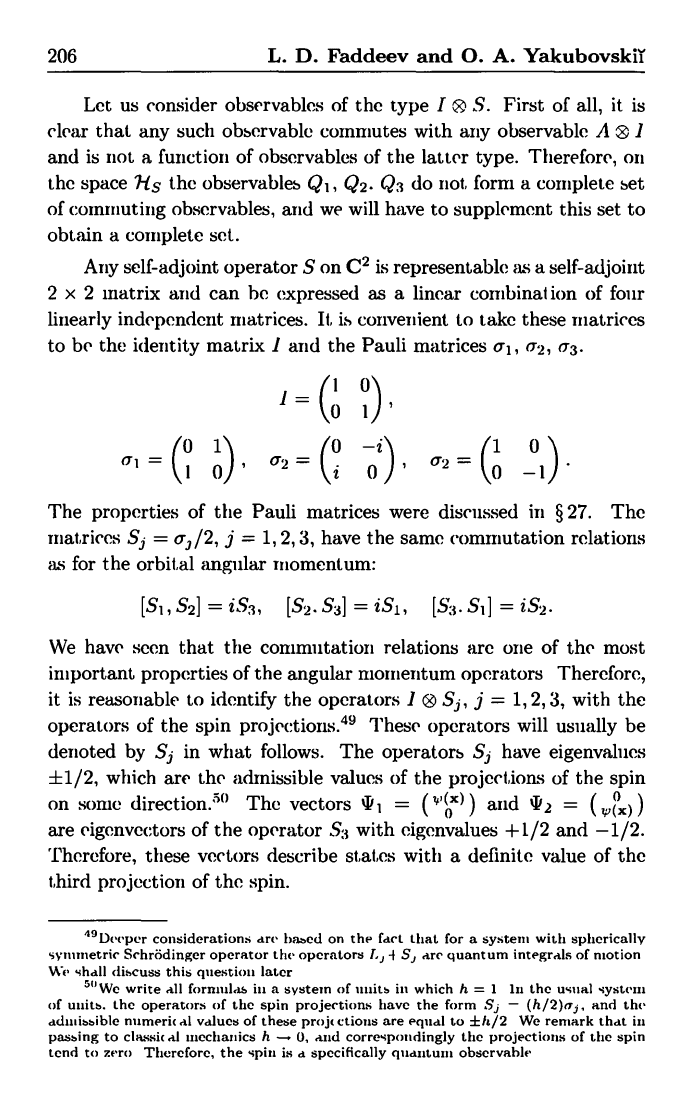
Any self-adjoint operator S on C2 is representable, as a self-adjoint
2 x 2 matrix and can be expressed as a linear cornbinat ion of four
linearly independent matrices. It, is convenient to take these matrices
to be the identity matrix I and the Pauli matrices ar , (72, ar3.
1
0
1=
n
1
,
U
1
0
-i
1
U
a1 = 1 0 ,
a2 = i 0 , a2 = 0 -1
The properties of the Pauli matrices were discussed in § 27. The
matrices S3 = o-3/27 j = 1, 2, 3, have the same commutation relations
as for the orbital angular momentum:
[S1, S2] = iS3,
[S2. S3] = iSl,
[,S3- S1 ] = iS2.
We have seen that the commutation relations are one of the most
important properties of the angular momentum operators Therefore,
it is reasonable to identify the operators 1 ® Sj, j = 1, 2, 3, with the
operators of the spin pro jections.49 These operators will usually be
denoted by S3 in what follows. The operators S j have eigenvalues
±1/2, which are the admissible values of the projections of the spin
on some direction.`} The vectors %P ] _
(lp(x)) and W2
= (V (X) }
are eigenvectors of the operator S3; with eigenvalues + 1 /2 and - 1/2.
Therefore, these vectors describe states with a definite value of the
third projection of the spin.
49 De eper considerations are based on the fact that for a system with spherically
symmetric Schrodinger operator the operators I., 4 S. are quantum integrals of motion
We shall discuss this question later
`"We write all fornnmlas in a system of units in which h = 1 In the usual systemu
of units. the operators of the spin projections have the form SJ - (h/2}a;, and the
admissible numerical values of these projc ctions are equal to ±h/2 We remark that in
passing to classic al muecha,iics h -- 0, and correspondingly the projections of the spin
tend to
zero
Therefore, the spin is a specifically quantum observable
§ 46. Spin
207
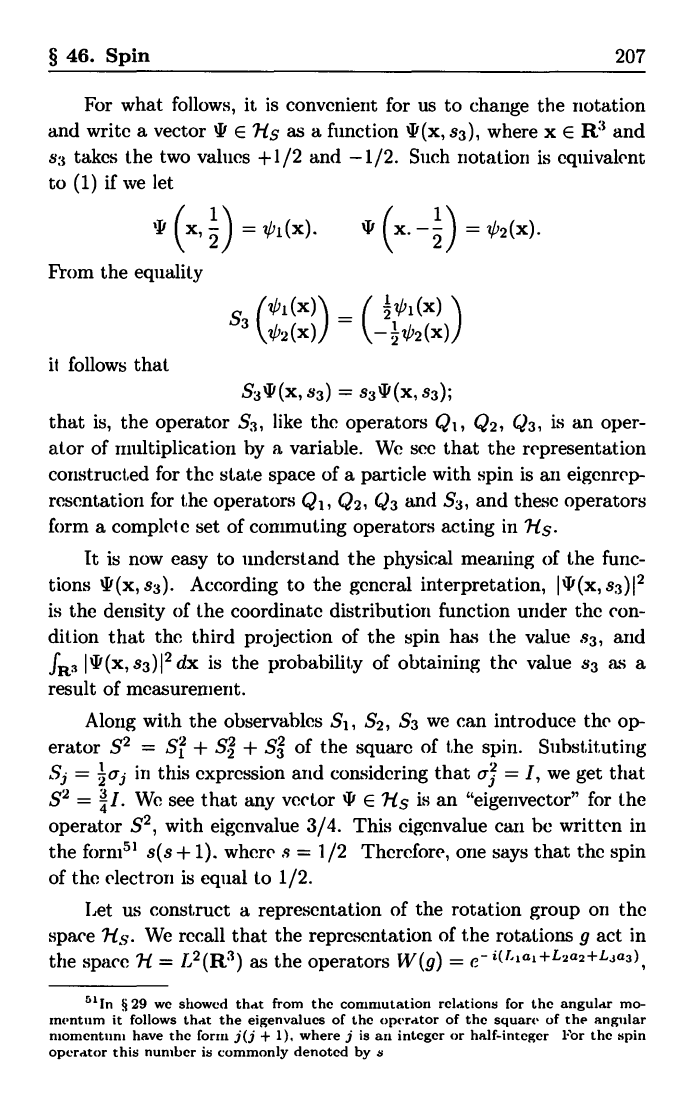
For what follows, it is convenient for us to change the notation
and write a vector 'P E 7s as a function W (x, s3 ), where x E R3 and
83 takes the two values -+-1 /2 and --1 /2. Such notation is equivalent
to (1) if we let
T X1 -
7P, (X). X. - - = '02 (X) -
(
2)
2)
From the equality
S3
it follows that
(Pi(x))
0l(X)-
1101W
\-2VYX))
S3' (X, s3) = S3 %P (X, s3);
that is, the operator S3, like the operators Q,, Q2, Q3, is an oper-
ator of multiplication by a variable. We see that the representation
constructed for the state space of a particle with spin is an eigenrep-
resentation for the operators Q1, Q2, Q3 and S3, and these operators
form a complete set of commuting operators acting in 7is.
It is now easy to understand the physical meaning of the func-
tions T (x, S3). According to the general interpretation, Is3) 12
is the density of the coordinate distribution function under the con-
dition that the third projection of the spin has the value s3, and
R3 W (x, 83) 1 2 dx is the probability of obtaining the value 83 as a
result of measurement.
Along with the observables S1, S2, S3 we can introduce the op-
erator S2 = Sj +S22 +S32 of the square of the spin.
Substituting
Si = o j in this expression and considering that oj = I, we get that
S2 = 4I. We see that any vector
E 7s is an "eigenvector" for the
operator S2, with eigenvalue 3/4. This eigenvalue can be written in
the form51 s (s + 1). where s = 1 /2 Therefore, one says that the spin
of the electron is equal to 1/2.
Let us construct a representation of the rotation group on the
space fs. We recall that the representation of the rotations g act in
the space H = L2(R3) as the operators W (g) = e- i(f,ial+L2a2+L3a3
511n §29 we showed that from the commutation relations for the angular mo-
mentum it follows that the eigenvalues of the operator of the square of the angular
momentum have the form j (j + 1), where j is an integer or half-integer For the spin
operator this number is commonly denoted by s