
Faddeev L.D., Yakubovskii O.A. Lectures on Quantum Mechanics for Mathematics Students
Подождите немного. Документ загружается.

208
L. D. Faddeev and 0. A. YakubovskiI
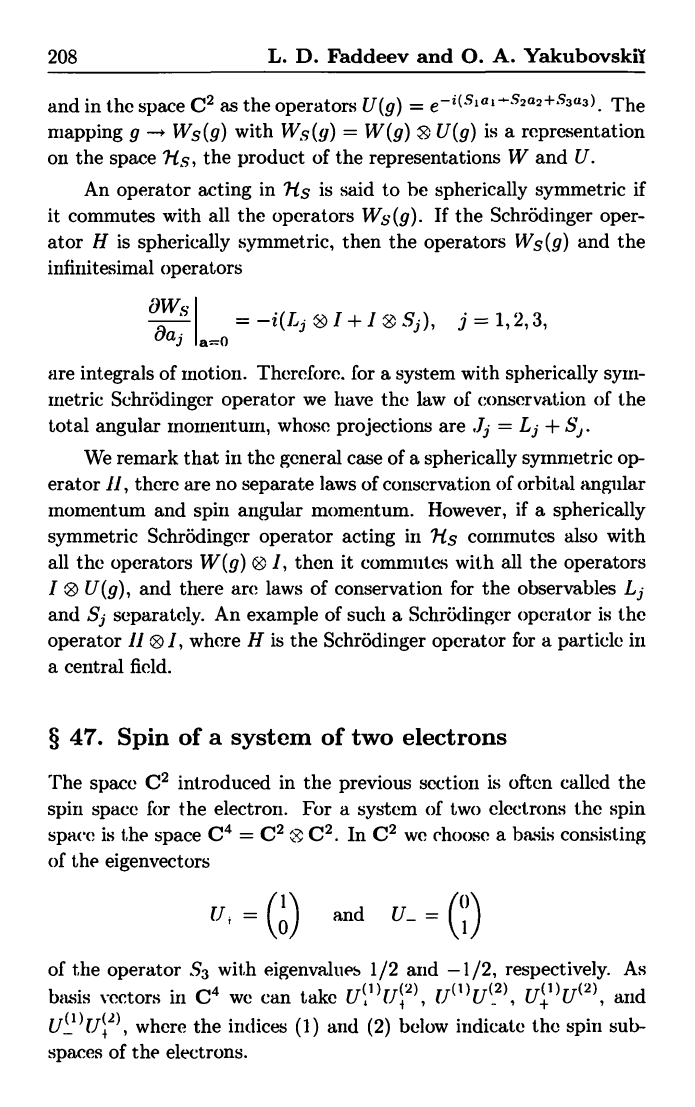
and in the space C2 as the operators U(g) = e-i(s1a1
}.S2a2+.S3a3). The
mapping g ---+ WS (g) with W,5 (g) = W(g)
U (g) is a representation
on the space 1-Is, the product of the representations W and U.
An operator acting in 1-CS is said to he spherically symmetric if
it commutes with all the operators Ws(g). If the Schrodinger oper-
ator H is spherically symmetric, then the operators WS (g) and the
infinitesimal operators
i)wv
as j
a
= -?VLj Z9 1 + I '11)j),
= 11Z151
are integrals of motion. Therefore. for a system with spherically sym-
metric Schrodinger operator we have the law of conservation of the
total angular moment urn, whose projections are Jj = L j + SS.
We remark that in the general case of a spherically symmetric op-
erator 11, there are no separate laws of conservation of orbital angular
momentum and spin angular momentum. However, if a spherically
symmetric Schrodinger operator acting in Ns commutes also with
all the operators W (g) 0 1, then it commutes with all the operators
I 0 U (g), and there are
laws of conservation for the observables L j
and Sj separately. An example of such a Schrodinger operator is the
operator 1101, where H is the Schrodinger operator for a particle in
a central field.
§ 47. Spin of a system of two electrons
The space C2 introduced in the previous section is often called the
spin space for the electron. For a system of two electrons the spin
space is the space C4 = C2 0 C2. In C2 we choose a basis consisting
of the eigenvectors
rl; =
(0I)
and u_
of the operator S3 with eigenvalues 1/2 and -1 /2, respectively. As
basis vectors in C4 we can take U(1)U(2), U(1)U(2),
U+1)U(2),
and
U
(1) U(2)
, where the
indices (1) and (2) below indicate the spin sub-
spaces of the electrons.
§ 47. Spin of a system of two electrons
209
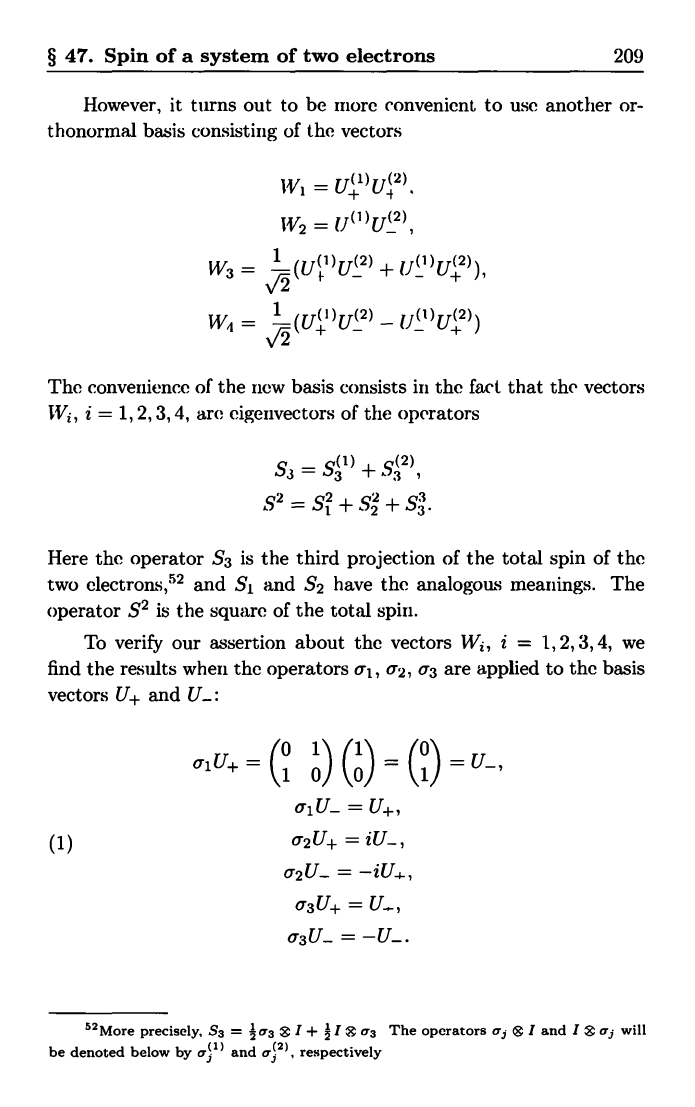
However, it turns out to be more convenient to use another or-
thonormal basis consisting of the vectors
Wi = U+
iV2 = 0)
U(1) U (2)
W3 =
72=
(U
-
+
W4 =
IU(I)U(2) _ U(I)U(2))
(' +
+
The convenience of the new basis consists in the fact that the vectors
Wi, i = 1, 2,3,4, are eigenvectors of the operators
S3 = S31) +
53(2)
S2=S +52+53.
Here the operator S3 is the third projection of the total spin of the
two electrons, 52 and S1 and S2 have the analogous meanings. The
operator S2 is the square of the total spin.
To verify our assertion about the vectors Wi, i = 1,2,3,4, we
find the results when the operators U1, o2, 03 are applied to the basis
vectors U+ and U-:
Ulu+ =
0 1) (1
) -
0
U-I
(1
0) O
(1)
cr1 U_ = U+,
a2 U+ = W-,
U2 U_ _ -- i U4-,
U3U+ = U,,
U3U_ _ -U--
52 More precisely, S3
= z Q3 0 I + 119 03 The operators a j 9 I and 19 oj will
be denoted below by Q 1 and Q 2 ) , respectively
210
L. D. Faddeev and 0. A. Yakubovskii
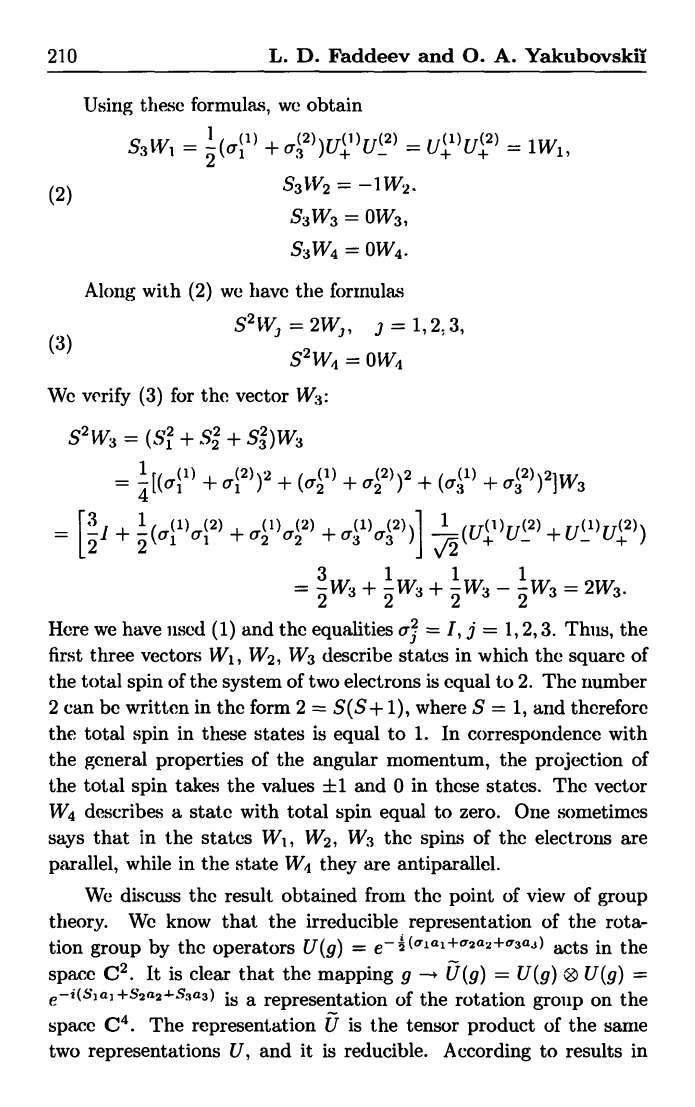
Using these formulas, we obtain
S3W1 =
1 (T(1)
+ Q(2))U(')U(2) = U(1)U(2} = 1W
2(
1 3 + + +
(2)
S3W2 = -1W2.
S3W3 = OW3,
S3W4
= OW4.
Along with (2) we have the formulas
S2 W3 = 2W31
= 1,2;3,
S2W4 = OW4
We verify (3) for the vector W;:
S2W3=(52+
1
S2
-1 "32 + -
S3 W3
=
4Rai1)
(0,0)
+ 022)2 + (o1) +v32))2]Ws
=
3I
+ 1
(011
al + U2
172
+
.(1)x(2)
U(1)U(2) + U(1)U(2)
2 2(1
1
a 2
3 3)
(+ +}
= 3W
+ 1W3 + 1W -1W3=
2W3.
2 3 2 2
'
2
Here we have used (1) and the equalities rrj2= 11 j = 1, 213. Thus, the
first three vectors W1, W2, W3 describe states in which the square of
the total spin of the system of two electrons is equal to 2. The number
2 can be written in the form 2 = S(S + 1), where S = 1, and therefore
the total spin in these states is equal to 1. In correspondence with
the general properties of the angular momentum, the projection of
the total spin takes the values
±1 and 0 in these states. The vector
W4 describes a state with total spin equal to zero. One sometimes
says that in the states W1, W2, W3 the spins of the electrons are
parallel, while in the state W4 they are antiparallel.
We discuss the result obtained from the point of view of group
theory. We know that the irreducible representation of the rota
tion group by the operators U(g) = e 2 (o,,a,+12a2+a3as) acts in the
space C2. It is clear that the mapping g -+ U(g) = U (g) 0 U (g)
=
e -
i (S 1 a 1 + S2 a.2 S3 a3) is
a representation of the rotation group on the
space C4. The representation U is the tensor product of the same
two representations U, and it is reducible. According to results in
§ 47. Spin of a system of two electrons 211
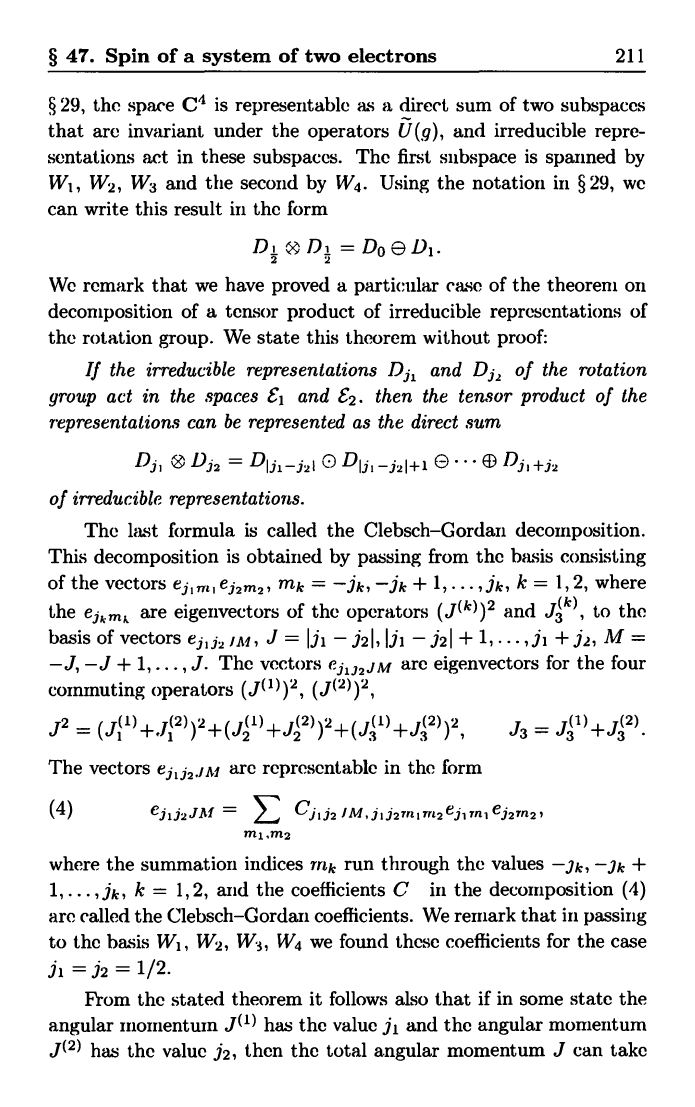
§ 29, the space C4 is representable as a direct sum of two subspaces
that are invariant under the operators U (g), and irreducible repre-
sentations act in these subspaces. The first subspace is spanned by
W1, W2, W3 and the second by W4. Using the notation in § 29, we
can write this result in the form
D2 , x D2 , = Doc3Di.
We remark that we have proved a particular case of the theorem on
decomposition of a tensor product of irreducible representations of
the rotation group. We state this theorem without proof:
If the irreducible representations Dj, and D j, of the rotation
group act in the spaces E1 and £2. then the tensor product of the
representations can be represented as the direct sum
Dj, ®Dj2 = Dlji-j21 0 DIj1
-j2I+1 e ... ®Dj1 +j2
of irreducible representations.
The last formula is called the Clebsch-Gordan decomposition.
This decomposition is obtained by passing from the basis consisting
of the vectors e j
1 nt, ej2m2, mk = -
jk, -- jk + I.... ti,,
k= 1, 2, where
the e jk m k are eigenvectors
of the operators (J(k))2 and J3k) , to the
basis of vectors ej
1 j2 /A17
J = h- j21,
hi - j21 + 1, ... J1 +j2, M
-J, -J + 1, .... J. The vectors f'j1J2JM are eigenvectors for the four
commuting operators (J(1)) 2, (J(2) )2,
J2 =
(j(l)+ 1(2))2+( J21)+ J22)}Z+( J31}+ J22)}Z,
J3
= Al)
3+J32)
The vectors e j1 j 2 , f M are represent
able in the form
(4)
ejlj2JM = E Cjij2 1M,j1j2rra1rn2ejlrn, ej2rn27
m1,m2
where the summation indices Mk run through the values -3k, -3k +
1, ... , j,, k = 1, 2, and the coefficients C in the decomposition (4)
are called the Clebsch-Gordan coefficients. We remark that in passing
to the basis W1, W2, W3, W4 we found these coefficients for the case
j1=j2=1/2.
From the stated theorem it follows also that if in some state the
angular morrienturn J M 1) has the value j, and the angular momentum
j(2) has the value j2, then the total angular momentum J
can take
212 L. D. Faddeev and 0. A. Yakubovskii
the values 131 - j21. hi -- j21 + 1, .... jl + j2. Both the orbital or
spin angular rrlorrlenta for different particles and the orbital and spin
angular momentum for a single particle can combine in this way.
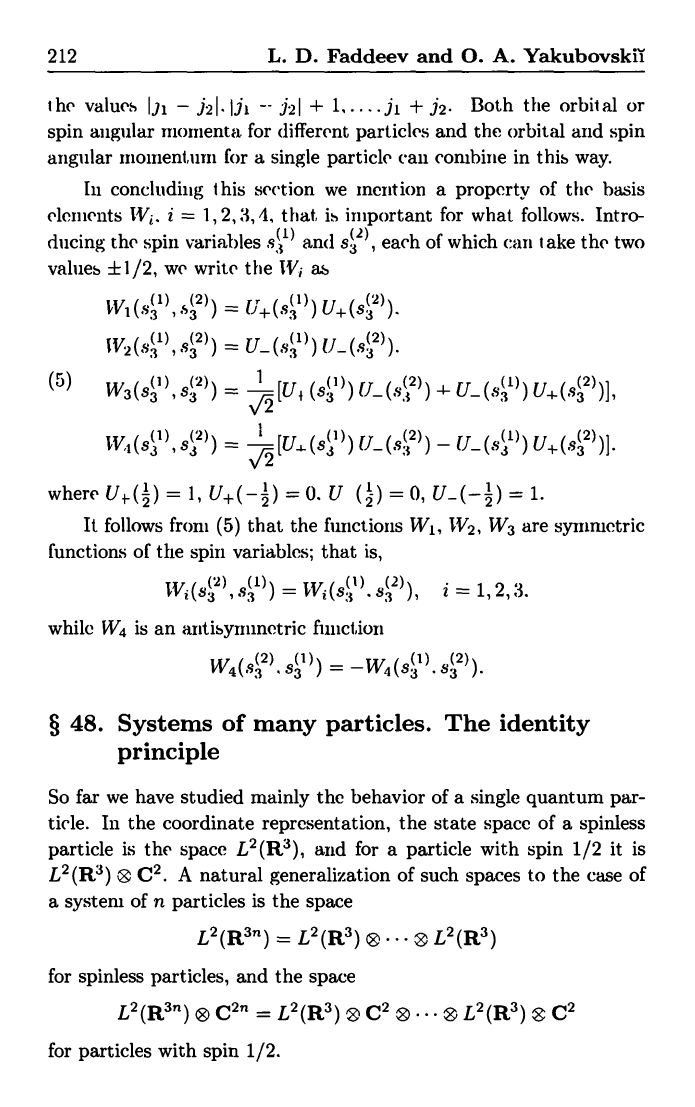
In concluding this section we mention a property of the basis
elements I'V1. i = 1, 2, 3, 4, that, is important for what follows. Intro-
ducing the spin variables s
31)
and s3Z), each of which can take the two
values ±1/2, we write the W as
W'V1(.531), S(2))
U+(3
}3 )).
U'2(eS31},.532})
U_(.5(31)) 1_(8(32)).
(5)
W3
s(2)
=
1
U
U+ U- 91U .S(2(S(1) )
4
(41))
(.3(2))
3
)
+( 3
VL
W, s(1)
s(2)
(2)
1(
3
3
(S3
3 3
U+ (.s3
VG
where U+.(2) = 1, U+(-2) = O. U ()=O,U_(-)=1.
It follows from (5) that the functions W1, ti'V2, W3 are symmetric
functions of the spin variables; that is,
Wi(83l),.531)}
=
tiili(s31), s3Z)},
i = 1, 2, 3.
while W4 is an antisymmetric function
4(eS3 . 831})
-
-W4(s31} 532}
§ 48. Systems of many particles. The identity
principle
So far we have studied mainly the behavior of a single quantum par-
ticle. In the coordinate representation, the state space of a spinless
particle is the space L2 (R3), and for a particle with spin 1/2 it is
L2 (R3) ® C2
.
A natural generalization of such spaces to the case of
a system of n particles is the space
L2 (R3n) = L2 (R3) ,
... ® L2
(R3
)
for spinless particles, and the space
L2(R3n) g C2n
=
L2(R3) o C2 ...
L2(R3) g C2
for particles with spin 1/2.
§ 48. Systems of many particles. The identity principle 213
A comparison of theory with experiment shows, however, that
this assumption about the stat e spaces of systems of rt particles turns
out to be valid only in the case when no two particles in the system
are alike. In the presence of identical particles there are peculiarities
in the behavior of quantum systems that can be explained on the
basis of the so-called identity principle. We note at once that the
identity principle is a new principle of quantum mechanics
It cannot
be derived frorri the other fundamental tenets of quantum mechanics
formulated earlier and must be postulated.
We use the single symbol f to denote the spaces L' (R3,) and
L2 (RU) 0 C2*,, , and we write the elements of these spaces in the form
( , .. , r
}, where z = x(i) for a spinless particle and j = ((), 8(`) )
for a particle with spin, s being the spin variable of the ith particle.
For a particle with spin 1/2, the variables s3(i) take the two values
±1/2.
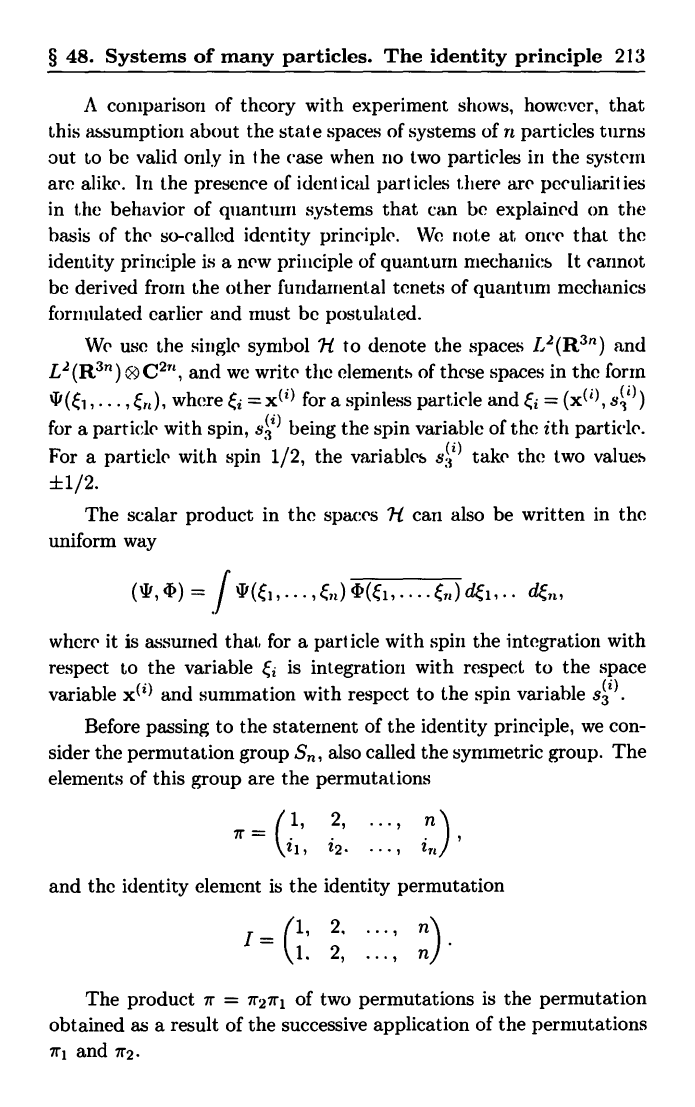
The scalar product in the spaces R can also be written in the
uniform way
(TI D) = f
T( I..
. I jj 0 * .. -rj) 41, * a
where it is assumed that, for a particle with spin the integration with
respect to the variable & is integration with respect to the space
variable x(a) and summation with respect to the spin variable
Before passing to the statement of the identity principle, we con-
sider the permutation group S, also called the symmetric group. The
elements of this group are the permutations
7r
1, 2,
...
=
il,
i2.
...
n
int
and the identity element is the identity permutation
I-
1,
2% ..., n
1.
2, ..., n
The product it = 7r2 7r1 of two permutations is the permutation
obtained as a result of the successive application of the permutations
7r1 and 7r2.
214
L. D. Faddeev and 0. A. Yakubovskii
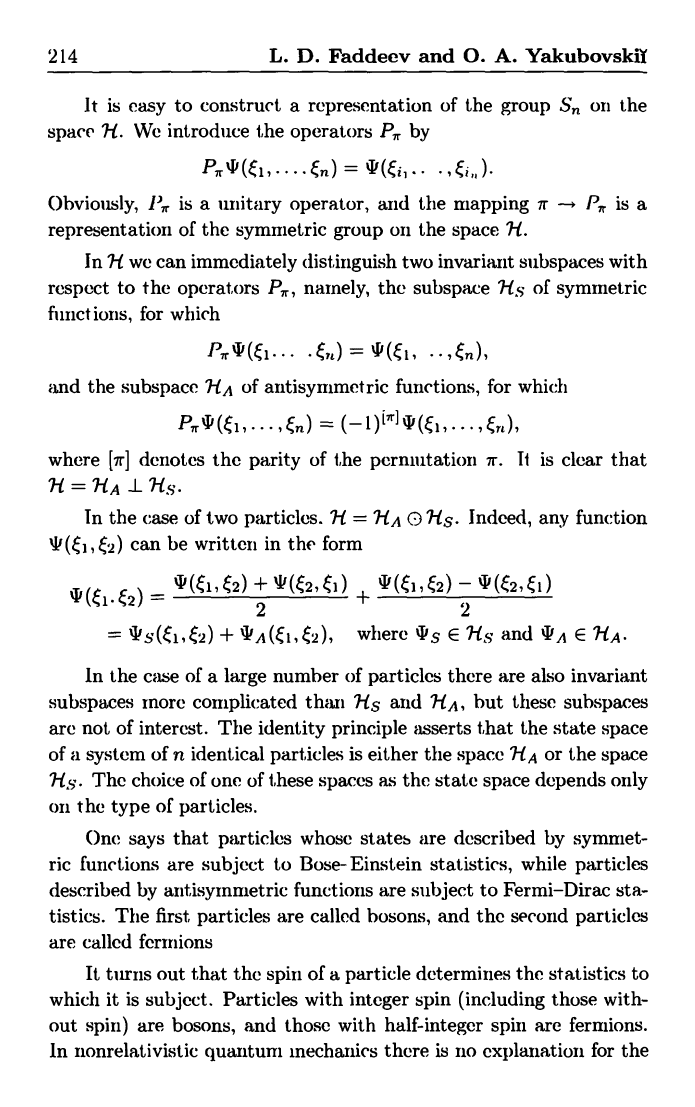
It is easy to construct a representation of the group S" on the
space W. We introduce the operators P, by
P,r'P(fit, .....n) =
Obviously, 7 is a unitary operator, and the mapping 7r --+ P,
is a
representation of the symmetric group on the space W.
In N we can immediately distinguish two invariant subspaces with
respect to the operators P,r, namely, the subspace 7-(s of symmetric
finict ions, for which
Src) ='P(f 1, i
n)i
and the subspace NA of antisynmmet ric functions, for which
P,r"P
i - - - 9 W = (-1)[7r] qP
(f1,...7Wi
where [7r] denotes the parity of the permutation 7r.
It
is clear that
R=NA _-?is.
In the case of two particles. H = 7-HA 0 N. Indeed, any function
T
1, 2) can be written in the form
2) +T( 2, 1) l
1 2} -
`1- 2}
+2 2
A
where %PS E Ns and
%PA E NA.
in the case of a large number of particles there are also invariant
subspaces more complicated than NS and HA, but these subspaces
are not of interest. The identity principle asserts that the state space
of a system of n identical particles is either the space WA or the space
7-Is. The choice of one of these spaces as the state space depends only
on the type of particles.
one says that particles whose states are described by symmet-
ric functions are subject to Bose- Einstein statistics, while particles
described by antisymmetric functions are subject to Fermi-Dirac sta-
tistics. The first particles are called bosons, and the second particles
are called fermions
It turns out that the spin of a particle determines the statistics to
which it is subject. Particles with integer spin (including those with-
out spin) are bosons, and those with half-integer spin are fermions.
in nonrelativistic quantum mechanics there is no explanation for the
§ 49. Symmetry of the coordinate wave functions
215
connection between spin and statistics. This connection is explained
in part in relativistic quantum mechanics. Electrons, protons, and
neutrons are fermions with spin 1/2, photons are bosons with spin
1, and mesons are bosons with spin zero. The statistics of identical
compound particles (for example, atomic nuclei) is determined by the
parity of the fermions in their structure, since a permutation of the
same complex particles is equivalent to a permutation of several pairs
of elementary particles. For example, deuterons, which are composed
of a neutron and a proton, are bosons. We note that a deuteron has
integer spin,53 since the spins of a proton and a neutron are equal to
1 2.
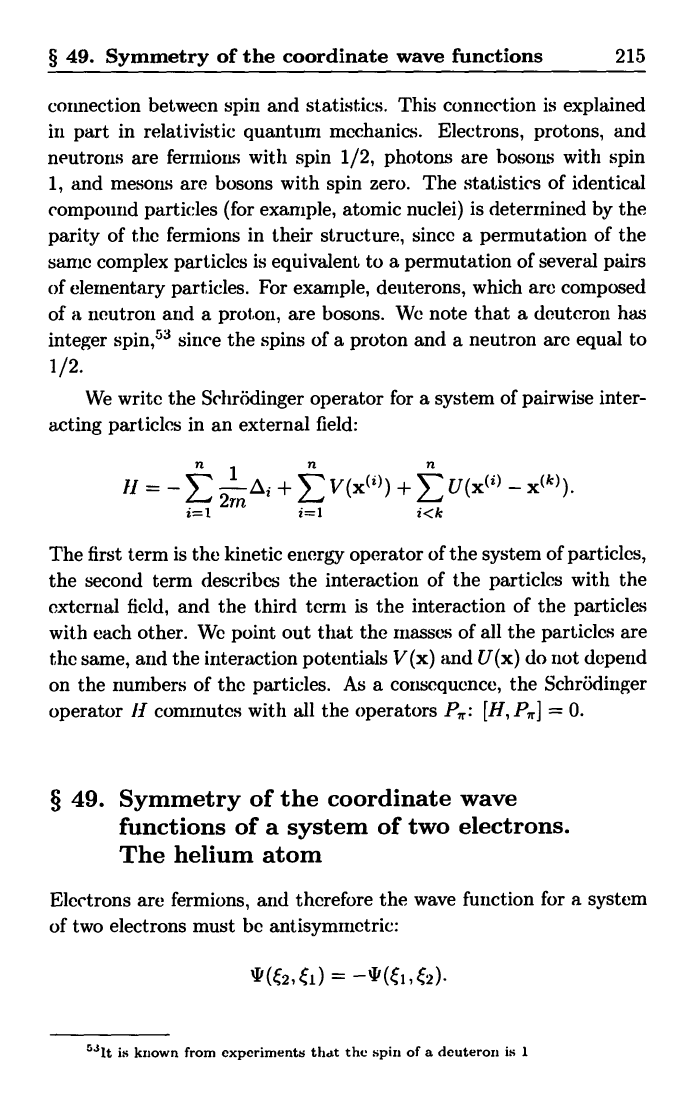
We write the Schrodinger operator for a system of pairwise inter-
acting particles in an external field:
n
1
n
n
1I=
Ai+E V(x{i} ) + 1: U(x(i) - x{k)).
2rn
i^x
i=1
i<k
The first term is the kinetic energy operator of the system of particles,
the second term describes the interaction of the particles with the
external field, and the third term is the interaction of the particles
with each other. We point out that the masses of all the particles are
the same, and the interaction potentials V (x) and U(x) do not depend
on the numbers of the particles. As a consequence, the Schrodinger
operator 11 commutes with all the operators P,.- [H, P,.] = 0.
49. Symmetry of the coordinate wave
functions of a system of two electrons.
The helium atom
Electrons are fermions, and therefore the wave function for a system
of two electrons must be antisymmetric:
T (6 1 W = -'P (6 1 W -
531t is known from experiments that the spin of a deuteron is I
216
L. D. Faddeev and 0. A. Yakubovskii
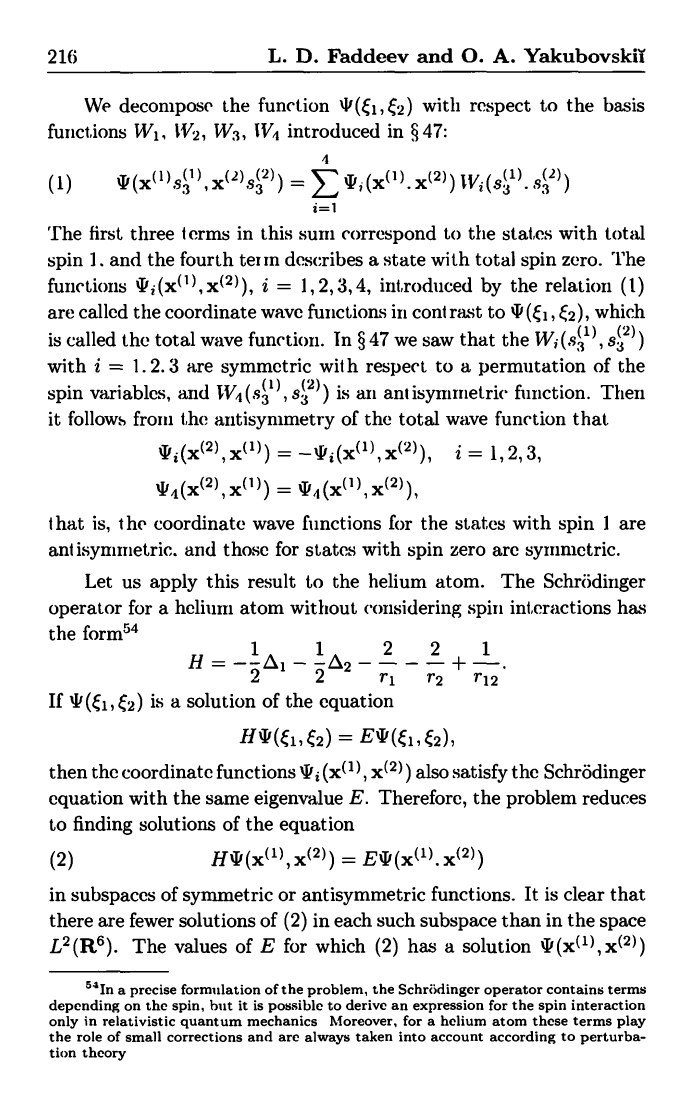
We decompose the function
with respect to the basis
functions W1, W2, W,-3, 1V4 introduced in §47:
4
3 3
), x(2)S(2))
=
qji (X(l). X(2)) IV,. (.531). 832}
(1)
T(X(1 ).s(1
i=1
The first three terms in this sump correspond to the states with total
spin 1. and the fourth tei in describes a state with total spin zero. The
functions T i (x(1) , x(2) ), i = 1,2,3,4, introduced by the relation (1)
are called the coordinate wave functions in coat rast to qP (fl , 2), which
is called the total wave function. In § 47 we saw that the W; (s31),
42))
with i = 1.2.3 are symmetric with respect to a permutation of the
spin variables, and W4 (s31), s32)) is an ant isymurietric function. Then
it follows from the antisymmetry of the total wave function that
i(X21X(l )=-Tj(xl ,X2 ), i=1,2,3,
4(x(2)
, x(1))
= W4 (X(1),
X(2) )j
t hat is, the coordinate wave functions for the states with spin I are
ant isyrmrietric. and those for states with spin zero are symmetric.
Let us apply this result to the helium atom. The Schr{ dinger
operator for a helium atom without considering spin interactions has
the form 54
H _
-1Q - 1Q _
2
_
2 1
2
1
2
2
r1
r2 r12
If is a solution of the equation
W,
then the coordinate functions 'i (x(1) , x(2)) also satisfy the Schrodinger
equation with the same eigenvalue E. Therefore, the problem reduces
to finding solutions of the equation
(2)
Hip (X(1), X(2)) =
Eq'(x(1).
X(2))
in subspaces of symmetric or antisymmetric functions. It is clear that
there are fewer solutions of (2) in each such subspace than in the space
L2 (R6).
The values of E for which (2) has a solution W (x(') , X(2))
54 In a precise formulation of the problem, the Schrodinger operator contains terms
depending on the spin, but it is possible to derive an expression for the spin interaction
only in relativistic quantum mechanics Moreover, for a helium atom these terms play
the role of small corrections and are always taken into account according to perturba-
tion theory
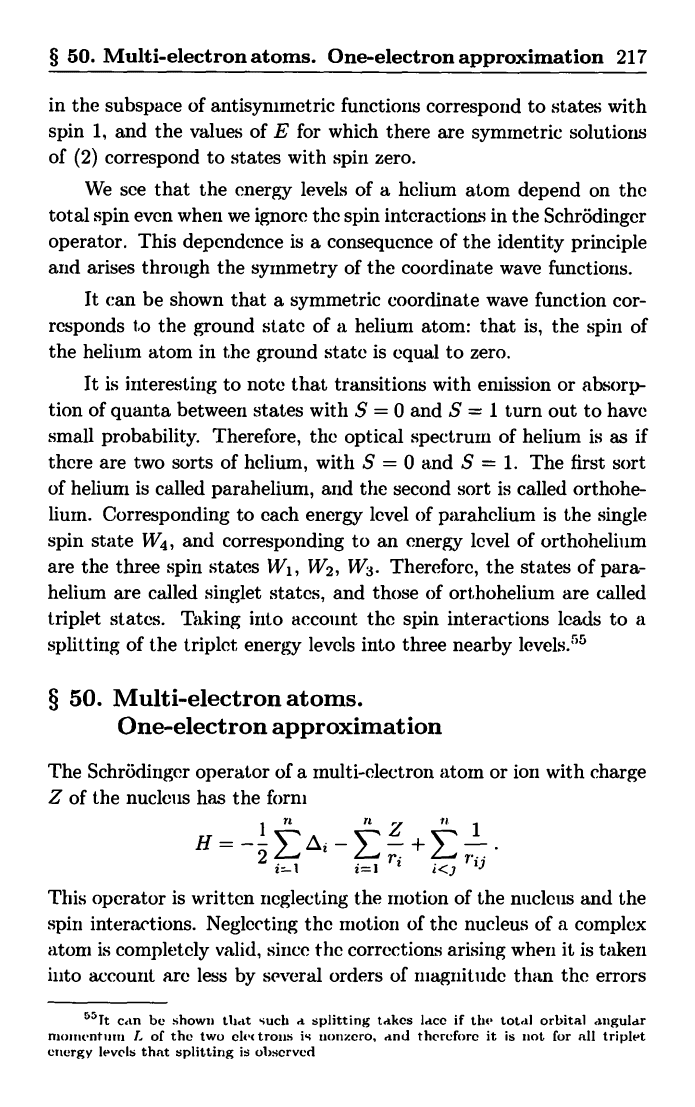
§ 50. Multi-electron atoms. One-electron approximation 217
in the subspace of antisymrnetric functions correspond to states with
spin 1, and the values of E for which there are symmetric solutions
of (2) correspond to states with spin zero.
We see that the energy levels of a helium atom depend on the
total spin even when we ignore the spin interactions in the Schrodinger
operator. This dependence is a consequence of the identity principle
and arises through the symmetry of the coordinate wave functions.
It can be shown that a symmetric coordinate wave function cor-
responds to the ground state of a helium atom: that is, the spin of
the helium atom in the ground state is equal to zero.
It is interesting to note that transitions with emission or absorp-
tion of quanta between states with S = 0 and S = I turn out to have
small probability. Therefore, the optical spectrum of helium is as if
there are two sorts of helium, with S = 0 and S = 1. The first sort
of helium is called parahelium, and the second sort is called orthohe-
lium. Corresponding to each energy level of parahelium is the single
spin state W4, and corresponding to an energy level of orthohelium
are the three spin states W1, W2, W3. Therefore, the states of para-
helium are called ringlet states, and those of orthohelium are called
triplet states. Taking into account the spin interactions leads to a
splitting of the triplet energy levels into three nearby levels. 5'5
§ 50. Multi-electron atoms.
One-electron approximation
The Schrodinger operator of a multi-electron atom or ion with charge
Z of the nucleus has the form
1 rt n Z
Il
1
H = -
+ > - .
2 r
y,
i-1
i=1
i
i<,7
L.-
This operator is written neglecting the motion of the nucleus and the
spin interactions. Neglecting the motion of the nucleus of a complex
atom is completely valid, since the corrections arising when it is taken
into account are less by several orders of magnitude than the errors
55Tt can be shown that such a splitting takes lace if the total orbital angular
rrioinentiirn L of the two clue troiis is tionzero, and therefore it is not for all triplet
energy levels that splitting is observed