
Foster L.V. A Brief History of Mexico
Подождите немного. Документ загружается.


A BRIEF HISTORY OF MEXICO
188
Mexican Art and Society
Even the smallest manifestations of the material or spiritual
vitality of our race spring from our native midst.
1923 Manifesto of the Technical Workers, Painters, and
Sculptors Union (Ashton 1990, 555)
The Revolution of 1910 ushered in dramatic social changes. Contrasting
the simplicity of Cárdenas’s lifestyle with that of Díaz properly empha-
sizes some of the change. Instead of women in their embroidered
Parisian dresses, one thinks of the artist Frida Kahlo dressed in indig-
enous clothing. Instead of champagne parties, one is reminded of uni-
versity students volunteering, as teachers in Zapotec and Maya villages.
Revolutionary Mexico extolled its own traditions, its native peoples,
and pre-Columbian past. Indians no longer were considered inferior
as they had been since the Spanish conquest, rather, the destruction of
their culture and their exploitation became major themes in the arts.
The glories of their ancient history were revived and studied (
see pages
3 and 51). An archaeology institute was established in 1925 to pre-
serve and excavate pre-Columbian ruins. The ruins at Chichén Itzá in
Yucatán, for example, were excavated in conjunction with the Carnegie
Institute from the United States and restored in a manner to attract
tourists to a Mexico now proud of its distinctive heritage. Sophisticates
in the capital collected pre-Columbian artifacts and decorated their
homes with rugs from Oaxaca, tiles from Puebla, and handpainted
gourds from Michoacán. The Teatro de Bellas Artes, begun by Díaz in
the Belle Epoque style, was furnished with art deco native designs.
A national culture was in the making and comprehended both urban
dwellers and rural farmers. Mexicanness, or mexicanidad, encompassed
folk art traditions as well as the paintings of the Mexican mural masters:
Diego Rivera (1885–1957;
see pages 3 and 51), José Clemente Orozco
(1883–1949;
see pages 111 and 173), and David Alfaro Siqueiros
(1896–1974;
see page 150). Encouraged by the public walls given them
by the education minister José Vasconcelos, they created paintings that
enabled all Mexicans, even those who couldn’t read, to understand the
grander themes of their history and culture. They depicted people who
looked like most Mexicans, brown-skinned peasants and bureaucrats,
rather than idealized Greek figures. They painted narratives about
conquistadores and foreign capitalists, about Mexican heroes called
Hidalgo and Zapata. These painters created works that constituted one
189
of the greatest artistic periods in the Americas. The period boasted
more than the paintings of the famous trio: many others contributed
lasting works, such as Rufino Tamayo (1899–1991), whose reputa-
tion belongs a bit later in art history, Fernando Leal (1900–64), Jean
Charlot (1898–1979), and Juan O’Gorman (1905–82). And there were
other fine painters, such as Frida Kahlo (1907–54), Miguel Covarrubias
(1904–57), and Francisco Goitia (1882–1960), who primarily confined
themselves to canvas-size works. All these artists found inspiration in
Mexico’s rich history and artistic traditions, especially those from pre-
Columbian times.
The revolution also inspired great works of music and literature.
Carlos Chávez (1899–1978) was among Mexico’s most distinguished
musicians; he not only conducted the national symphony, but composed
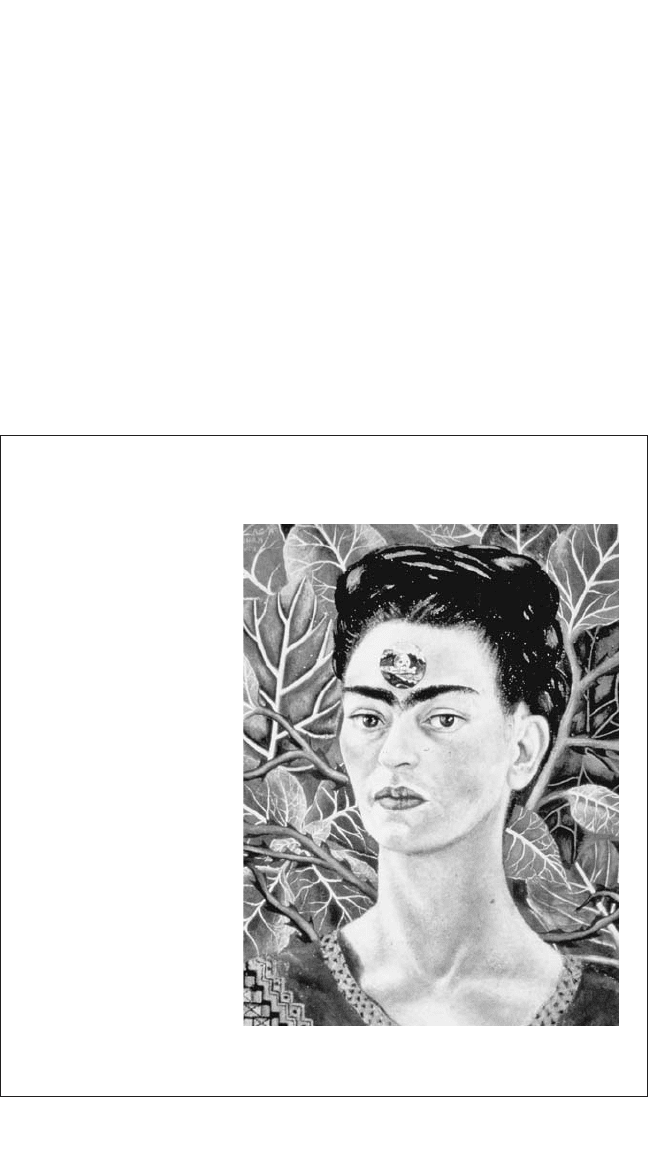
Frida Kahlo
Thinking about Death (1943), a self-portrait by Frida
Kahlo
(Courtesy of the Mexican Ministry of Tourism)
F
rida Kahlo (1907–54)
represents the pro-
gress some women made
in the early 20th cen-
tury. She was educated
at the capital’s highly
respected National
Preparatory School
during Mexico’s most
brilliant artistic period.
Unlike the famous
mu
ralists, she painted
smaller canvases that
nonetheless captured
the epoch’s spirit of
mexicanidad. Her work
was greatly admired by
the French surrealists,
but only recently has it
been fully appreciated in
the United States.
THE REVOLUTION OF 1910

A BRIEF HISTORY OF MEXICO
190
works such as Sinfonía india (1935) to be played with pre-Columbian
instruments or their modern substitutes. And to reach out to the people
he wrote more popular works such as Llamadas (1934). The famous
revolutionary war novel Los de abajo (The Underdogs) was written in
1916 by Mariano Azuela who had traveled as a doctor with Villa’s army.
Martín Luis Guzmán (1887–1976) fictionalized his experiences as a
university student who joined the Villistas in his 1928 El águila y la
serpiente (The Eagle and the Serpent). These and other novels revealed
the dehumanization of the long struggle and the personal corruption
that too frequently accompanied success: as Azuela said, the underdogs
merely replaced the “top dogs” in their violence and demagoguery. In
his second novel, La sombra del caudillo (The Shadow of the Political
Boss; 1929), Guzmán expressed disappointment in the strong-arm
policies of Calles. Another novelist, Gregorio López y Fuentes, viewed
a vaguely incomprehensible Mexico through Indian eyes in his 1935
novel El indio.
Apart from the artistic outpouring, life in Mexico was made easier by
stability and modernization. In education, the rate of illiteracy fell from
the 80 percent of the Porfiriato to 38 percent. Greater opportunities
were offered to women, too; in the cities increasing, if small, numbers
graduated from the universities (500 in 1930) and a league was formed
for achieving the right to vote.
Running water and electricity, radio stations, paved roads for cars,
trucks, and buses became commonplace, uniting city and village.
Mexico remained predominantly rural, however, with 65 percent of its
population living outside urban areas in 1940. Life in the countryside
changed for the better. Village buildings were whitewashed and band-
stands built along with schools. With more clinics and health volun-
teers, life expectancy improved remarkably. Social reforms permitted
former peons to travel freely and work in new locations. Migration to
Infant Mortality Average Life Expectancy
Year Rate Male Female
1910 450 per 1,000 30 years 30 years
1930 222 per 1,000 36.1 years 37.5 years
1940 125 per 1,000 40.4 years 42.5 years
Based on Charles C. Cumberland and Fieldstaff Reports

191
the cities increased markedly: Mexico City’s population jumped from
1910 by more than a million to 1,726,858 in 1940. Problems remained,
including poverty, but the improvements were unmistakable.
The End of the Revolution
Cárdenas’s term ended without a single assassination attempt or rebel-
lion. He resigned from the presidency in accordance with the no
reelection clause of the constitution, just as every president after him
would. He and his predecessors finally had achieved a nation that could
settle its disputes within a legal and political framework. Cárdenas also
reorganized the PNR into the Party of the Mexican Revolution (PRM),
enabling it to officially embrace more diverse interests, including the
new peasant and labor confederations, CNC and CTC. This trend
toward consolidating the political forces under one powerful govern-
mental organization, begun under Calles and continued for decades by
the Institutional Revolutionary Party (PRI), has been called “one party
democracy”—as well as, more recently, “one party dictatorship.”
The church and state had defined their roles and Mexico, remaining
primarily a devout Catholic society, also left its government to control
matters of civic and public concern. The society had been demilitarized
as well. The military absorbed less than 20 percent of expenditures by
1940 and had been professionalized: most of the disruptive caudillos
had been killed in the many skirmishes or absorbed into the new party
structure. Foreign businesses had learned to obey Mexican law. Peasants
and workers had been organized and given a voice in politics.
The progressive restructuring of society had certainly not solved all
the problems of Mexico. Poverty remained a painful reality, and centu-
ries of racism could not be eliminated easily, even in the new mestizo
nation. Yet the period of restructuring was ending. The impetus of the
Mexican Revolution was about to give way to more moderate politi-
cians who would consolidate the gains already made.
THE REVOLUTION OF 1910

193193
10
The Institutionalized
Revolution
(1940–1988)
Mexico . . . is changing at a rate approaching the vertiginous.
Lesley Byrd Simpson (1962, xvii)
B
uilding on the foundations of the revolution, Mexico entered
a period of exceptional political stability and extraordinary
economic growth and industrialization. The nation approached self-
su
fficiency in many important commodities and crops. New oil dis-
coveries in the 1980s gave Mexico reserves comparable to the entire
Persian Gulf; “petrodollars” brought greater economic and political
independence as well as world stature: Mexico became a leader of the
developing nations.
Mexico was transformed. The military and its budget were so reduced
that more money was available for education and health care. Illiteracy
was lowered significantly. Improved health services and the increased
production of subsistence crops contributed to a growth in population
that almost doubled every two decades. The middle class also doubled
in size and, for a while at least, real wages grew. Industry attracted so
many to the cities that by 1960 more people lived in urban areas than
in the countryside for the first time in the nation’s history.
Yet for all the changes in the modern period, Mexico was left with
severe problems to overcome, including ones that were unknown
in 1910 such as environmental pollution and overpopulation, as
well as old ones, such as rural poverty and political corruption. The
gap between the wealthy and poor widened even during periods of
growth in the gross national product. The one-party state ruled by the
A BRIEF HISTORY OF MEXICO
194

195
Institutional Revolutionary Party (PRI) since the time of Calles increas-
ingly failed to respond adequately to demands for greater democra-
tization. Despite the phenomenal gains in Mexico, the old problems
lingered and contributed to an intellectual debate over whether the
ideals of the Revolution of 1910 were furthered or undermined during
the “institutionalized revolution.”
A Conservative Shift: 1940–1958
Following the reforms of Lázaro Cárdenas, the government shifted
course. Cárdenas himself must have thought a period of consolidation
was needed, because he supported the conservative General Manuel
Ávila Camacho as his successor. President Ávila Camacho (1940–46)
believed the revolution had been accomplished: all that was needed was
evolution toward a more industrialized economy.
Ávila Camacho, a fighter in the revolution but not one of its heroes,
was nicknamed “the unknown soldier.” Mexico had achieved enough
stability so that war heroes were not the only presidential candidates.
Ávila Camacho, in fact, would be the last military president in Mexico.
His successors were all civilians with experience in government, not
war. Unlike many Latin American countries, Mexico controlled its
militarism and decreased its military spending to the lowest in the
hemisphere. Military spending dropped from 20 percent of the federal
budget in 1934 to less than 10 percent in 1958.
World War II: Relations with the United States
Because of Mexico’s immediate revolutionary past, it is some-
thing like a school for . . . many other Latin American republics;
its moral leadership is beyond its size. Therefore it has had
an enormous effect on the conduct of the war, for without its
diplomatic work, the line-up of twenty-one American republics
against the Axis could not have been achieved.
Anita Brenner (1943, 105)
Although Mexican nationalism had been fueled by a distrust of the
United States and an antipathy toward Spain and other European med-
dlers, Mexico did not hesitate to support the democratic powers against
fascism. As early as Cárdenas’s presidency, refugees from the Spanish
THE INSTITUTIONALIZED REVOLUTION

A BRIEF HISTORY OF MEXICO
196
civil war and Jews fleeing Nazi persecution were welcomed into the
country. Under Ávila Camacho, Mexico organized Latin American
countries in condemning warmongering among the Axis powers. When
German submarines attacked two Mexican tankers in the Caribbean,
Mexico formally declared war.
Mexico and the United States entered into a mutually support-
ive relationship during the war, encouraged by President Franklin
Roosevelt’s Good Neighbor policy. In 1943, Roosevelt became the first
U.S. president to visit the interior of Mexico. The result was Roosevelt
and Ávila Camacho’s bracero (hired hand) program to provide Mexican
contract labor to make up the labor shortages affecting American farms
and factories. Mexico exported to the United States the zinc, copper,
and other materials necessary for the war effort—without inflating the
prices. And Mexicans fought in the war with the United States: an air
squadron saw active combat in the Philippines, and Mexicans residing
in the United States joined its army. This period of cooperation set a
new tone for the nations’ policies toward each other. When President
Harry Truman visited Mexico City in 1952, he made a conciliatory
gesture to Mexicans by laying a wreath at the monument to the Niños
Héroes, Mexico’s military cadets who had been killed by U.S. troops a
century earlier.
Mexicanization of Industry
World War II certainly gave Mexico’s industrialization effort an early
boost. The war provided a steady demand for Mexican products, and
Mexico was forced to produce substitutes for items that formerly had
been imported but no longer were available. But it was really the gov-
ernment’s policies that created the nation’s economic miracle.
Ávila Camacho’s goal was to make Mexico self-sufficient in all the
most important manufactured goods and, once the domestic goals
were achieved, to export finished products. Mexican capital, Mexican
industry, and Mexican raw materials would be used in this important
endeavor. If foreigners wanted to invest, they were restricted to manu-
facturing industries rather than extractive ones. Even in manufactur-
ing, foreign investments could not control a majority interest in any
company: the so-called 51 percent rule. After World War II, the yields
from Mexican investments were so satisfactory that U.S. and European
investors were not deterred by such restrictions: Coca-Cola and Pepsi,
General Motors and Ford, Dow Chemical, John Deere, Sears, and many
others established themselves in Mexico.

197
Ávila Camacho’s emphasis on industrial development and technologi-
cal solutions would become the template for succeeding administrations.
Not purely capitalist or socialist, the economic program was a uniquely
Mexican mix, just as it had been under Cárdenas and others. The econ-
omy was too important to be left to private ownership, the lawmakers
believed; government leadership was essential. Oil prices were controlled
to fuel the national economy. If new equipment was needed, then govern-
ment loans and tax breaks were made available. Fledgling businesses that
were integral to attaining the goal of national self-sufficiency received
tariff protections. When private enterprise failed to materialize, the gov-
ernment didn’t avoid taking ownership of critical industries, not only oil
and electricity, but also insecticide and fertilizer factories.
Mexico’s industrialization efforts were successful into the 1980s.
In Ávila Camacho’s six-year term, the textile, food-processing, and
chemical industries as well as breweries and cement factories developed
rapidly. Electrical capacity jumped by 20 percent and tripled by 1952.
Steel production increased from less than 100,000 metric tons in 1930
to more than 142,000 in 1946 alone. During President Miguel Alemán’s
term (1946–52), oil production doubled. By 1958 the gross national
product had doubled. And Mexico did finally achieve self-sufficiency
in iron, oil, and steel in 1964.
Throughout the initial phase of industrialization, Mexico’s infra-
structure was improved. Dams were built not just for electricity, but for
land reclamation and irrigation as well. Oil pipelines and refineries were
constructed. Alemán invested in massive public works that resulted in
Agricultural and Industrial Production
Maize* Cotton* Steel** Zinc* Oil***
1930 1,377,000 38,000 102,859 124,084 39,529,901
1940 1,640,000 65,000 149,655 114,955 44,448,191
1950 3,122,000 260,000 332,631 223,510 73,881,472
1960 5,386,000 470,000 1,491,778 262,425 108,771,583
1970 8,997,000 398,000 3,881,201 266,400 177,599,055
1980 11,081,000 340,000 7,300,000 236,050 708,942,000
Based on Robert Ryal Miller (1985, 372–374)
*-metric tons ** tons *** barrels
THE INSTITUTIONALIZED REVOLUTION