
Foster L.V. A Brief History of Mexico
Подождите немного. Документ загружается.


A BRIEF HISTORY OF MEXICO
158
A more serious challenge to the regime came from industrial workers
who went on strike for equal pay with foreigners, thus disrupting the
Pax Porfiriana. Some of the strikes, involving thousands of laborers,
received national attention—and brutal repression. In 1906 striking
textile workers in Veracruz, who had the audacity to request that Díaz
arbitrate, were massacred.
To aggravate matters, the U.S. press called for the annexation of
Mexico, and the U.S. government realized Mexico’s worst fears when
it militarily intervened on behalf of its business interests in Guatemala
and the Caribbean. Mexicans wanted Díaz to reverse his favoritism
of the United States. He tried, but not openly, and thereby gained no
political advantage at home. Meanwhile he offered to Great Britain gov-
ernment oil contracts that formerly went to the United States, thereby
gaining the enmity of his northern neighbor.
Economic Depression: 1907–1908
Material progress had secured support for the dictatorship among the
middle and upper classes. In the last decade of the Porfiriato, however, the
economy faltered. First, inflation became a serious problem when foreign
investment tripled and when Díaz adopted the gold standard for cur-
rency. Real wages fell. And a depression (1907–08), triggered by a slow-
ing U.S. economy, caused layoffs and further reductions in wages. A bad
harvest caused food prices to increase. In Chihuahua, for example, wages
decreased 20 percent as basic living expenses increased 80 percent.
In the midst of its first economic crisis, the laissez-faire policies of
the Porfiriato did little to provide relief. In fact, the government made
matters worse by increasing taxes on the middle class in an effort to
keep its treasury full. The foreign banks made credit tighter: many
of the upper class defaulted on their loans. Everyone was affected by
the catastrophe. For the first time, national (not just local) opposition
groups formed advocating the violent overthrow of the dictator.
“No Reelection” Revisited
In 1910 Díaz was 80 years of age and running for reelection. Foreign
investors and supporters had been uneasy about his successor for
some time. To guarantee a peaceful transition after his death, the
científicos had urged him to run with a vice-presidential candidate as
early as 1904. This time there was discontent among so many sectors
of society that opposition grew to his running for office at all. Three

159
national opposition groups formed; two of them advocated a violent
overthrow of the regime.
Díaz made the mistake of telling a U.S. reporter that Mexico was
ready for democracy and that he would not stand for reelection in
1910. In fact, he had no intention of retiring and was surprised when
the article, “Thrilling Story of President Díaz, the Greatest Man on the
Continent,” reached Mexico. His opponents took Díaz’s remarks to
mean they could support other parties and candidates without fear of
reprisals from the dictator, even if he himself ran.
Díaz maneuvered the most serious contender into a position abroad.
He left the diminutive Francisco Madero from Coahuila alone, how-
ever, thinking that the northerner was a harmless idealist. Madero was
disenchanted with Díaz’s dependence on foreign capital and, like most
wealthy individuals from the border states, he especially disliked the
growing influence of the United States. Nationally known for a book
he had written on presidential succession (which basically flattered
Díaz), Madero argued that Mexico should return to the Constitution
of 1857 with free elections, a free press, and an independent judiciary.
He formed the Anti-Reelectionist Party, but social reforms in land and
working conditions were not part of his platform.
Much to Díaz’s surprise, Madero was enthusiastically received as he
campaigned throughout the country with his call for “No Reelection.”
Even some hacendados in the north, angry that Díaz had supported
calling in their defaulted mortgages during the depression, threw their
support behind Madero. Increasingly concerned by his opponent’s
visible popularity, Díaz trumped up charges against Madero and had
him temporarily imprisoned. The dictator and his vice president were
reelected, of course, and Madero, escaping to Texas, claimed that the
results of the 1910 election were fraudulent.
Centennial Celebration: 1910
I consider general revolution to be out of the question as does
public opinion and the press.
Karl Bunz, German envoy, 1910 (translated by Frederick Katz)
On September 16, 1910, Mexico celebrated the centennial of its inde-
pendence. Emissaries from around the world arrived in Mexico City to
honor the success of the young nation and to pay homage to the dictator
THE PORFIRIATO DICTATORSHIP

A BRIEF HISTORY OF MEXICO
160
on his 80th birthday. Amid the glitter of the month-long celebrations,
Díaz seemed at the apogee of his power. The city was festively hung
with lights, too bright for most to notice what all the poor saw as an
omen in the dark night sky: Halley’s Comet. With the poor rounded-up
so as not to offend visitors’ sensibilities, few could imagine that in seven
months don Porfirio would be forced into exile.
The government spent 20 million pesos, more than the entire edu-
cation budget, on lavish celebrations to impress the world with its
prosperity and cultural sophistication. Operas were performed under
a glass curtain designed by Tiffany. Plays in French were attended by
all. At one ball alone, 20 carloads of imported French champagne were
consumed. With only European waiters (or European look-alikes), no
one would be reminded that Mexico was the land of Moctezuma rather
than Cortés. In what has been called surreal illogic, Díaz arranged for a
costly exhibit of Spanish art in a building especially constructed for the
purpose as part of the independence celebrations. Mexican artists, led
by the painter known as Dr. Atl (1875–1964), scraped together several
hundred pesos to stage their own protest exhibit in the corridors of the
Academy of San Carlos.
A hundred years after independence, Mexico was right to celebrate
its modernization. The railroads and telegraphs, the international com-
merce, did much to unify a nation that had previously been fragmented.
The political peace did permit the nation several decades in which to
grow more confident in itself.
But there were other Díaz legacies: racism, xenophobia, starvation. The
repressive and exploitative manner in which Díaz achieved modernization
was about to exact its toll on Mexico with 20 years of war and even more
of political turmoil. Peace and progress belonged only to the upper classes
and had been achieved at the expense of the masses. The Porfiriato only
too naturally led to revolution. A hundred years after the call for indepen-
dence, Mexico was again at war with itself.

161
9
The Revolution of 1910
(1910–1940)
The Revolution . . . was an explosion of reality.
Octavio Paz, 1961
T
he most devastating civil war in Mexican history produced modern
Mexico. In the 10 years of its military phase, between 1910 and
1920, as many as 2 million people may have been killed, or one out of
every eight Mexicans. Trains were blown up, haciendas were burned, and
corruption prevailed. Yet the Mexican Revolution created new political
structures and produced the Constitution of 1917. It destroyed the privi-
lege of the Creole and gave birth to the mestizo nation. It ended feudal-
ism and peonage and created labor unions and redistributed land. It gave
birth to such Mexican heroes as Emiliano Zapata and Lázaro Cárdenas
and such Mexican artists as Diego Rivera. The revolution gave Mexicans
a sense of national pride and a deeply held appreciation for their own
culture, called mexicanidad.
The Beginning
A century after Hidalgo’s declaration of independence, Francisco Madero
(1873–1913) declared himself provisional president of Mexico from the
safety of San Antonio, Texas. A member of the upper class, Madero
typified his era by having been educated in both Paris and the United
States. His family owned large estates as well as a smelting factory and
mines. Liberal in his thinking and actions, Madero provided school-
ing and medical care for his workers and peons. Much like Hidalgo,
he seemed to have little understanding of the forces he was about
to unleash. Like Hidalgo, he thought political, not social, change

A BRIEF HISTORY OF MEXICO
162
would rectify the nation’s problems. He had previously opposed unseat-
ing Díaz by violence, but now realized that honest elections were impos-
sible under the dictatorship.
In October, Madero issued his Plan de San Luis Potosí calling for
Mexicans to rise against tyranny on November 20, 1910, after 6
p.m. His
call to arms was vague enough to appeal to everyone with a complaint
against the Porfiriato. On the appointed day small guerrilla forces sprung
into action throughout much of Mexico. Like the caudillo revolts of the
Santa Anna epoch, these poorly armed groups were inspired by local
leaders and, except for local members of Madero’s Anti-Reelectionist
Party, were not coordinated with each other. The fighters were teach-
ers, mechanics, merchants, and miners; and they were the unemployed,
the soldiers of fortune, and bandits. They were Creoles who received
too few favors from Díaz and the científicos. They were hacendados like
Madero, who were concerned with electoral reform and foreign influ-
ence. Living off the countryside, the revolutionaries found plenty of
support among the peasants, who quickly swelled their ranks. The radi-
cal and liberal, wealthy and poor, no matter their differences, united
against Díaz.
Díaz tried to defeat them. He sent the army; he sent the rurales. He
did quash the rebellions in most regions. But in the state of Chihuahua,
he had no success. Chihuahua had long been simmering under the des-
potic hand of Luis Terrazas and his family. Terrazas was the richest man
in Mexico, made more rich and powerful by Porfirio Díaz. He person-
ally owned 50 haciendas and ranches that covered 7 million acres; his
son-in-law, Enrique Creel, owned nearly another 2 million by himself.
They owned mines, banks, telephone companies, textile mills, and meat-
p
acking plants. Family members were governors, state legislators, and
senators. Nothing happened in Chihuahua without their permission.
The revolutionary movement in Chihuahua grew under the leader-
ship of a former mule skinner, Pascual Orozco, Jr. Joining him was
the cattle rustler Pancho Villa. Orozco had lost his business because
Terrazas did not favor him. Pancho Villa had escaped from debt peon-
age. Both understood what was at stake in changing the established
order. And there were many others on the outs with the Terrazas clan.
The Chihuahua rebels successfully routed a large contingent of the fed-
eral army and took control of most of the state.
In February 1911 Madero crossed the border into Mexico to join
forces with Orozco and Villa: he would be the political symbol; they
would be his army. It turned out to be a fragile alliance between civil-
ian and military authority, one easily broken by strong personalities and

163
military might. Unfortunately, it would typify the problems of gover-
nance in Mexico for the next decade.
Victories in Chihuahua reignited the rebellion in other states—
Coahuila, Puebla, and Morelos—and soon revolutionaries such as
Emiliano Zapata controlled most of the Mexican countryside. On May
8, Orozco and Villa captured the first large city, Ciudad Juárez. The reb-
els, against Madero’s orders, defeated the army and occupied the city as
their provisional capital. Other cities in the north and central Mexico
were soon in rebel hands.
Federal troops began deserting. Madero’s supporters demonstrated
in the capital. Newspapers attacked Díaz. Businesses faltered. President
Taft stationed U.S. warships off Veracruz to express displeasure at the
continuing civil war. Díaz finally realized his situation was hopeless: an
armistice was negotiated and signed on May 21.
The news spread though the streets of Mexico City. Mobs of people
gathered in front of the National Palace shouting for Díaz to resign. The
dictator responded as he always had—with force. Two hundred demon-
strators were gunned down. He did resign on May 25, 1911, and sur-
reptitiously slipped away to Paris. An interim president was appointed
until an election could be arranged.
President Madero
Madero has unleashed a tiger; let’s see if he can control him.
Porfirio Díaz, 1911 (quoted in Meyer & Sherman)
Madero marched into Mexico City to the joyful cheers of mobs of
Mexicans. In a matter of months, he had swept away the Porfiriato, and
yet he would find it difficult to satisfy the aspirations of most of those
who greeted him in the capital that day.
The most agile and charismatic leader would have stumbled, and
Madero was neither. He appointed family members, some quite conser-
vative, to important posts and left them to undermine the reforms he
advocated. He invited charges of corruption against his government by
giving out contracts to his family businesses. Most important, he did
not fully understand the injustices requiring redress: early in his presi-
dential campaign he had said that Mexico needed liberty, not bread. He
thought the battle was over with a free and open election. He naively
agreed to disband the revolutionary army.
THE REVOLUTION OF 1910

A BRIEF HISTORY OF MEXICO
164
Meanwhile Porfiriato conservatives were still active. Foreign busi-
nesses required profit. Workers demanded better conditions. And
Emiliano Zapata, recognizing that Madero’s victory did nothing for
his cause, never stopped fighting for the return of peasant lands in the
south. Workers struck for better conditions, but despite good inten-
tions, Madero did little more than disperse the strikers. There were
many factions Madero needed to appease, but he satisfied few. When
he announced his support of a tax on idle land, those fighting for land
redistribution were as disappointed as any foreign investor.
Many caudillos declared against him. Unfortunately for Mexico,
they would continue declaring for the next decade, sometimes for
their political principles but just as often out of envy and personal
pique. The factions fought not only the Porfiristas, they fought each
other. Against Madero, the first to proclaim was his former commander
Orozco. Another was President Díaz’s nephew. And there were others.
He put them down with the assistance of Victoriano Huerta, who would
later turn out to be traitorous.
Events overtook Madero and the fledgling democracy he instituted.
Too kind to execute conservatives who had risen in arms against him,
Madero imprisoned most of them in Mexico City where they proceeded
to join forces. On the morning of February 9, 1913, they mysteriously
gained release from prison and led their troops to the National Palace.
Indifferent to the plight of the capital’s residents, they brought their
battle to the heart of the city. Madero responded with General Huerta
in charge. For 10 days, called the Decena Trágica, the city suffered
machine-gun fire and shelling, looting, and panic and hunger. Civilian
casualties were in the thousands.
Madero demanded to know from his general when the fighting would
stop. The next day it did, because Huerta had switched sides. The U.S.
ambassador appointed by President Taft, Henry Lane Wilson, in the
interest of protecting American business investments, had negotiated
the resolution of the battle. Throughout Madero’s term, Wilson had
meddled and even called for Madero’s resignation—especially when
the president decided to tax oil production. In a shameless instance of
dollar diplomacy, Madero was arrested, forced to resign, and murdered.
General Huerta became president.
The Social Revolution
The Mexican Revolution did not truly begin until the Madero regime
ended. Until that point, most political changes had fulfilled the demo-

165
cratic values of the liberal middle class. Fighting had not been so
drastic as to disrupt the economy. Científicos and foreign interests had
influential allies in the Madero government.
With Madero’s death the revolution intensified and swirled through
the country like a tornado touching down to wreak havoc on the
people and the economy while destroying enemies. Then feeding on
its destructiveness, the violent winds would find new enemies—over
and over again. For seven years, the factions would realign themselves,
splinter, and gust ahead. When the dust settled in 1920, Mexico’s insti-
tutional and intellectual underpinnings would be drastically changed
from the preceding centuries. And the people who occupied the posi-
tions of power would be those who had been held in silence so long.
The breakdown of the racist class system that had presided in
Mexico since the conquest can be seen in the personal histories of the
revolutionary leaders, many of whom became presidents of the repub-
lic. Unlike previous Mexican power brokers, most were either mestizos
or Indians from rural areas, and many were poor. Pancho Villa (1877–
1923), the most colorful of the revolutionaries, was uneducated and
was 25 years old before he could sign his name, yet he taught himself to
read during a stint in prison. A bandit by trade, he was called Mexico’s
Robin Hood by the U.S. press. He fought the revolution, he said, for
land reform and “so that every Mexican child could go to school”
(Guzmán 1965, 393). Yet his impetuosity and cruelty—he gave free
rein to Rodolfo Fierro, “the Butcher”—were as legendary as his daring
and brilliance as a cavalry leader.
Emiliano Zapata (1879–1919) was a small landowner and horse
trainer who had battled in court against the injustices of Díaz’s land
reforms to no avail. He was a trusted leader of his Morelos village and
spoke the Nahuatl of his mostly Indian followers as well as the Spanish
of politicians. In his Plan de Ayala, which called for the return of land
illegally seized under Díaz and for the expropriation of lands, woods,
and water from monopolists for the “majority of Mexicans who own
nothing more than the land they walk on” (Meyer & Sherman 1983,
515), he articulated the agrarian issues that would be central to the rev-
olution, issues that he would die fighting for under the banner Tierra y
Libertad (land and liberty).
Although Zapata and Villa forced the basic issues of social reform,
neither would assume political power. Others would, from similar
backgrounds of poverty and political oppression. Victoriano Huerta’s
mother was a Huichol Indian, his father a mestizo. Although he made
his way up through the army ranks by keeping the peace for Díaz
THE REVOLUTION OF 1910
A BRIEF HISTORY OF MEXICO
166
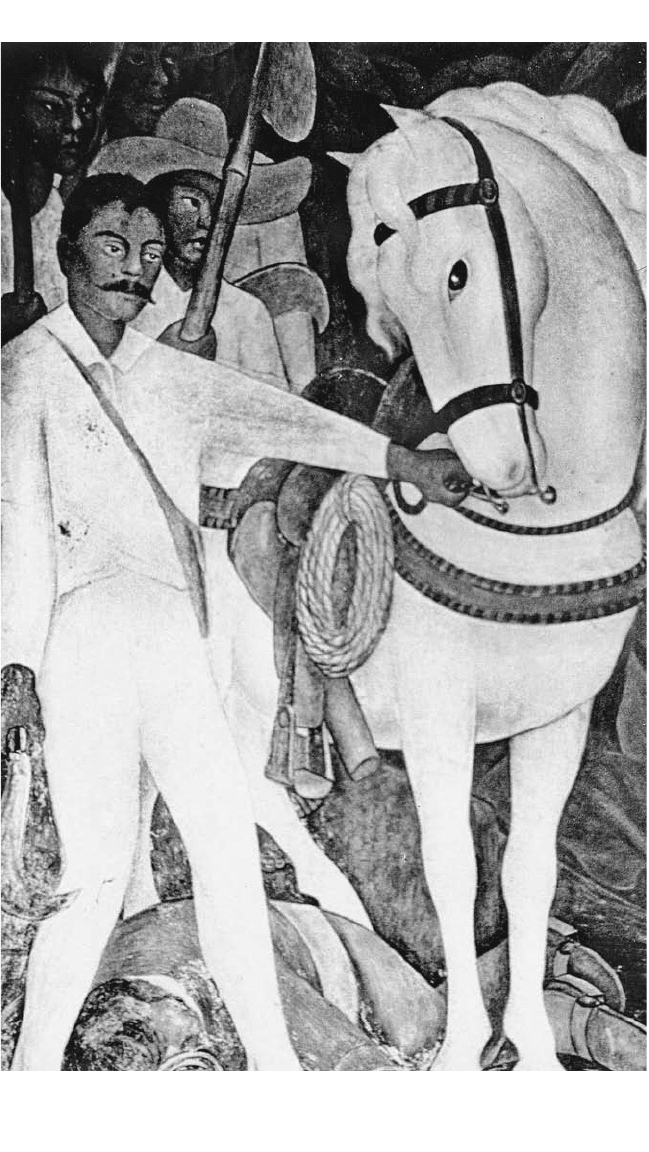
Emiliano Zapata, detail of a mural (1929) by Diego Rivera (Cortés Palace, Cuernavaca)

167
against the Yaqui in the north and the Maya in Yucatán, he was never
truly accepted by the elite society of the Porfiriato. Álvaro Obregón was
a mechanic and small rancher who had witnessed the awful confisca-
tion of Yaqui lands in his home state of Sonora. Plutarco Elías Calles
was an impoverished schoolteacher who did not own a pair of shoes
before he was 16 years old. Lázaro Cárdenas had only three years of
schooling and, at the age of 12, was the sole supporter of his family. He
joined the revolution when he was a teenager.
The Defeat of Huerta
The array of personalities and shifts of power in Mexico is dizzyingly
intricate. Yet the individuals and their causes—or lack of them—are
well known to every Mexican schoolchild. Madero is the symbol of
democracy; Zapata the symbol of peasants’ land rights. Pancho Villa
is the fearless leader of the cavalry charge. Movie stars clamor to play
these war heroes; novelists describe the dehumanization of the long
struggle; artists paint U.S. capitalists meddling in Mexican affairs; war
songs have become Mexican folk songs. The events are integral to con-
temporary Mexican nationalism.
The first political setback of the revolution began with the opportun-
ist Huerta. He defied the constitutional rights the Madero revolution
had fought for and created a dictatorship (1913–14) with Porfirista
support. With surprising shrewdness for a man who was not often
known to be sober, he held on to the presidency for 17 long months—
repeatedly using political assassination against those who criticized
him. Huerta could not assassinate, however, the new president of the
United States, Woodrow Wilson, who refused to recognize his govern-
ment of “usurpers” and who recalled Huerta’s ally, Ambassador Henry
Lane Wilson. But Huerta could use renewed European support to
threaten U.S. business interests.
What would destroy Huerta were the revolutionary armies that sprang
up against him and the support they received from Woodrow Wilson.
Outraged by the murder of a compatriot, Venustiano Carranza, a conser-
vative governor of Madero’s home state, pronounced against Huerta on
a platform similar to Madero’s and formed the Constitutional Army of
the North, declaring himself the “first chief.” Other chiefs in the north,
including Pancho Villa, Álvaro Obregón, and Plutarco Calles, signed on
for the fight even if they were disgruntled by Carranza’s presumptuous-
ness in naming himself their leader. President Wilson permitted arms
to be shipped across the border to them; payment was made with cattle
THE REVOLUTION OF 1910