
Foster L.V. A Brief History of Mexico
Подождите немного. Документ загружается.

A BRIEF HISTORY OF MEXICO
168
stolen from the Terrazas clan. Emiliano Zapata had never stopped fight-
ing and although he remained independent of the Constitutional Army,
he forced Huerta to fight in the south as well as the north.
The revolutionary struggle resulted in the total militarization of
Mexico. Huerta closed all businesses on Sundays so civilians could
receive military training. The trains were preempted for military per-
sonnel, and the federal army grew from 50,000 to a quarter of a million
troops. When the number of volunteers was inadequate, the poor were
rounded up—outside a cantina, inside a jail—and tied up in a wagon
for transport to the field. Huerta’s programs supplied fresh recruits
when they were most needed and were continued by others throughout
the revolution. One-third of the budget went to Huerta’s army.
Initially, Huerta was successful against the revolutionaries. In the
south the Zapatistas were driven into the mountains, and their village
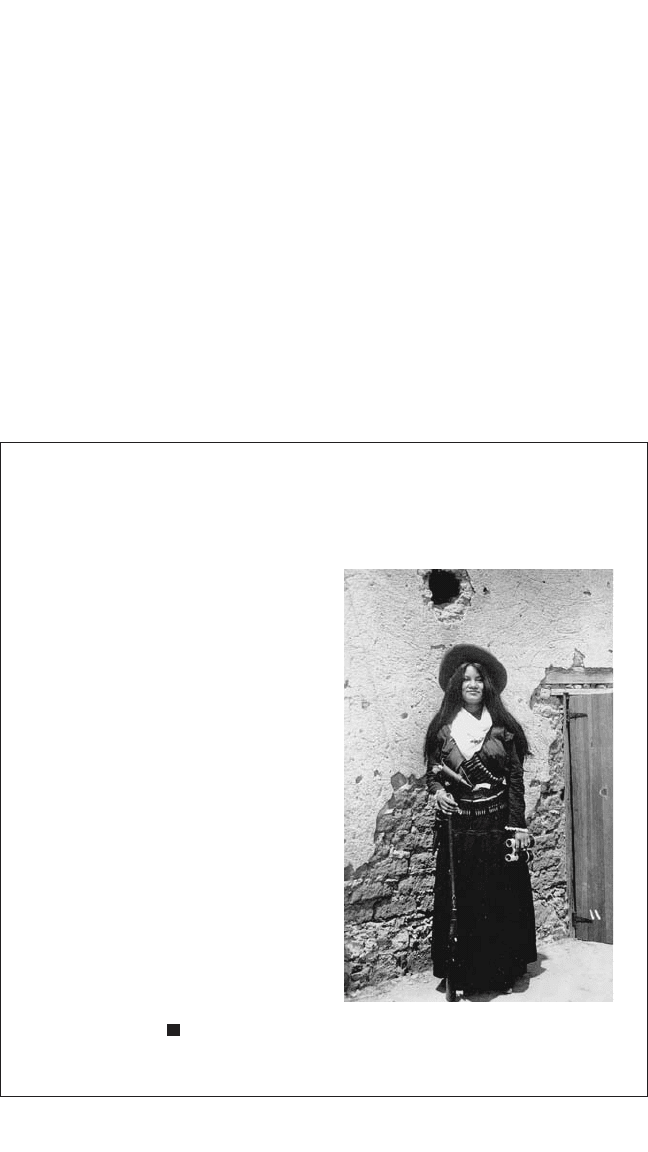
Women in the Army:
Soldaderas
Yaqui Indian soldier of the Mexican
Revolution
(Courtesy of the
Bancroft Library)
T
he army of the north, whether
riding hard on the prairies or
commandeering the trains, was like a
massive migration of people. Women
joined their husbands, often foraging
for food and nursing the wounded,
but also as soldaderas (women sol-
diers), slinging a rifle over one shoul-
der, a child on the other. When the
federal government tried to banish
women from its army, the troops
threatened revolt.
Popular among the troops was
A
delita
The woman the sergeant adored
Because she was as brave as she
was pretty
So even the colonel respected her.
“Adelita,” a revolutionary folk song

169
supporters were placed in concentration camps. In the north Carranza
and Villa were pushed back. By 1914, Huerta controlled two-thirds of
Mexico, the ports, and the vast majority of its population. The war
effort was paid for by forced loans on businesses and taxes on oil—and
church support that revived the old anticlericalism of the Juárez reform
war. Debts were permitted by banks thanks to the financial backing of
Great Britain and Lord Cowdray’s Mexican oil interests.
Huerta’s successes were reversed by the infusion of U.S. military aid
in 1914. The competition over oil between Britain and the United States
combined with the anti-Americanism of Huerta, moved Woodrow
Wilson to openly support Carranza and his Constitutionalists. These
armies of the north began taking cities from Huerta at the same time
Zapata and his bands of guerrillas took over more areas in the south.
The United States then intervened with its warships along the Gulf
coast, attempting to force Huerta to resign.
The U.S. effort backfired when marines landed at Veracruz and
thereby almost united all of Mexico behind Huerta. This insult to
Mexico’s sovereignty forced even Carranza and Zapata to denounce the
invasion. Wilson agreed to permit some South American countries to
mediate while he imposed an arms embargo at the port of Veracruz.
The Constitutionalists, still supplied from the northern border, gained
considerable ground in the fighting. In negotiations, Britain and the
United States resolved their own disputes. The Huerta government was
bankrupted and isolated. Huerta sailed into exile on July 20, 1914. On
August 15, Obregón led the first troops of the Constitutional Army into
the capital and Carranza, as first chief, proclaimed victory for the revo-
lutionaries. The Porfiristas had been defeated once again.
Anarchy
With Carranza’s whiskers
I’m going to weave a hat band
To put on the sombrero
Of his better Pancho Villa
“La Cucaracha,” a revolutionary folk song
Having successfully united against Huerta, the revolutionaries rediscov-
ered their differences. Villa and Zapata had been confiscating and redis-
tributing haciendas during the fighting. Carranza, a political reformer
THE REVOLUTION OF 1910

A BRIEF HISTORY OF MEXICO
170
but not a social activist, disapproved. Too autocratic to listen to the
other side, Carranza could not understand that elections, especially
when they usually were rigged, were not the overwhelming concern
of most of those who had been fighting—a change in the social order
was.
There were personality clashes, but also class differences in the
divide. Mostly Indian peasants had fought with Zapata under the sym-
bol of the Virgin of Guadalupe, soldiers wearing sombreros and white
peasant clothing who had been deprived of both land and water. Villa’s
army, the largest and most professional in the Mexican Revolution,
was more diverse but included many who had gone hungry—peons,
cowboys, and miners. Although these revolutionaries attracted their
share of intellectual supporters, most of the middle class had supported
Carranza. As Villa said to Zapata in their historic meeting in Mexico
City, the Carrancistas “are men who have always slept on soft pillows.
How could they ever be friends of the people, who have spent their
whole lives in nothing but suffering” (Quirk 1963, 135).
In October 1914 the various military factions gathered at the
Convention of Aguascalientes to select a provisional president. Villa
controlled the outcome, which meant that a puppet president, rather
than Carranza, was selected. The result was five more years of war.
Villa? Obregón? Carranza? What’s the difference? I love the
revolution like a volcano in eruption; I love the volcano, because
it’s a volcano; I love the revolution, because it’s a revolution.
The Underdogs, Mariano Azuelo, 1916
Each faction claimed its own capital, provisional president, and
issued its own currency. But Carranza, based in the port of Veracruz and
near the foreign-owned oil fields, was able to get an infusion of muni-
tions and mount the strongest army. Obregón, siding with Carranza,
defeated Villa in 1915 in the famous battle of Celaya with only half the
number of Villa’s 20,000 troops. Of the Villistas 4,000 died, 5,000 more
were wounded, and 6,000 were taken prisoner. Obregón claimed fewer
than 200 dead among his soldiers. By 1916 Villa was forced to retreat
to the Chihuahua hills where he had begun as a cattle rustler. But he
remained a dangerous threat to Carranza, raiding towns and attacking
the army.
As a bizarre aside to the upheaval, Pancho Villa provoked an inter-
vention by the United States in 1916. Having failed to mediate an end

171
to the fighting, President Wilson recognized Carranza’s very successful
forces as the de facto government. Whether this abandonment by his
former supporter drove Villa beyond reason is unclear. Whatever the
cause, Villa’s men stopped a train in Chihuahua and shot 15 Americans.
Then Villa sent troops across the border into Columbus, New Mexico,
to acquire arms. Instead they terrorized the village, shouting “Death to
the gringos!” burning the town, and killing 18 residents.
Some in the U.S. Senate called for the occupation of all of Mexico.
Instead, Wilson sent a punitive expedition under General Pershing
to execute Villa. Violating Mexican sovereignty, Pershing searched for
many months but left without ever setting eyes on Villa. The expedition
cost the United States $130 million and a good deal of Mexican ill will.
Although Villa was somewhat contained in Chihuahua, the Carranza
government had other uprisings to control. The most important was
Zapata’s. Carranza sent an army of 30,000 against Zapata’s 20,000 and
attempted to return confiscated estates to wealthy hacendados. The
army managed to fight Zapata back into the confines of the state of
Morelos, but later Zapata drove out the federal forces and organized an
independent government with its own land commission.
The Constitution of 1917
The first chief controlled much of Mexico, yet the situation was far from
peaceful. Carranza also needed a constitutional convention in order to
bring about a new legal framework to legitimize his government and his
own election as president. Others supported the convention, but from
it they intended to incorporate the goals and aspirations of the many
peoples who had fought in the Revolution.
Hoping to revive the Constitution of 1857 with a few minor changes,
Carranza convened 200 national delegates in Querétaro on December
1, 1916. They were far from representative. Delegate qualifications were
so restrictive that relatives of Madero could not attend. All Zapatistas
and Villistas were barred, and 80 percent of the delegates were from
the middle class and only a third represented the military. Half were
well educated and many were young. Even with a stacked convention,
Carranza suffered a devastating defeat: under the leadership of Obregón,
his minister of war, radical amendments were made to the constitution.
With their nation still suffering from civil war, the delegates strug-
gled for two months to hammer out a constitution that would permit,
and even mandate, fundamental social change. The most astounding
amendment, Article 27, concerned land reform. Twenty-five hundred
THE REVOLUTION OF 1910

A BRIEF HISTORY OF MEXICO
172
words in length, it comprised half the constitution and was an expo-
sition on the relationship between private and public property, on
individual rights versus the public good. In a section that alarmed all
foreign corporations, it eliminated all monopolies on water and mineral
resources and, reverting to the Spanish law that Díaz had repealed, it
gave the nation rights to such natural resources. It made the communal
Indian ejidos inalienable and limited the size of estates. It provided for
land redistribution to be paid for by government bonds. And it restricted
foreign ownership to those who agreed to be treated like Mexicans: no
foreign interventions were to be allowed on their behalf.
Article 123 protected workers and destroyed debt peonage. A mini-
mum wage was mandated, adequate to provide for education, “lawful
pleasures,” and the subsistence needs of workers. Work hours and a
day of rest were also mandated, as was government insurance in times
of unemployment, retirement, sickness, and death. In addition, the
rights to organize, bargain collectively, and strike were granted by this
amendment. It was an amendment that protected Mexican workers to
the same degree as in industrial nations.
Many of the amendments included clauses that limited the role of
the church. Huerta’s considerable support from the church had revived
anticlerical sentiments among the revolutionaries. All church proper-
ties were proclaimed government property, without compensation.
Monastic orders were outlawed. Priests were not permitted to vote.
Important mandates for universal and free primary education stipulated
that only secular schools would be constitutional. Freedom of religion
was granted; the Catholic Church would no longer be the sole religion
permitted in Mexico.
For the first time the social concerns of most Mexicans and most
revolutionaries were formulated. Institutions that had crippled the state
in the past were weakened: the church, foreign interests, and haciendas.
The Constitution of 1917 provided a legal framework for the govern-
ment that, though amended, continues to this day. It would take two
decades to implement.
The Carranza Presidency, 1917–1920
Even Carranza never openly challenged the constitution—perhaps
because the first chief did not wish to acknowledge his humiliating
political defeat at a hand-picked convention. The constitution also
legitimized his election to a four-year term as president in March 1917.
The constitutional president simply ignored the rest of the provisions.
173
Carranza’s election did not usher in the end of the military phase
of the revolution; rather his policies continued the social violence and
fighting. He did nothing to implement change, and he was properly
criticized for his failure to conform to the constitution. Instead of set-
ting up the commissions that would have implemented a minimum
wage, he fought the unions. Strikes, organized by the anarchist Casa del
Obrero Mundial, plagued industry. Because organized labor had sup-
ported Carranza, he had subsidized the various unions and permitted
them to be armed. But with the economy disrupted and foreign pow-
ers complaining, he banished the Casa del Obrero and disbanded their
armies. When the rail workers declared a strike, he conscripted the
workers into the army. Despite his efforts to weaken the unions, how-
ever, in 1918 the first national organization, the Regional Confederation
of Mexican Workers (CROM), was formed.
In regard to land reform his performance was equally regressive. He
actually gave back communal ejido lands to the Porfiristas. Further, he
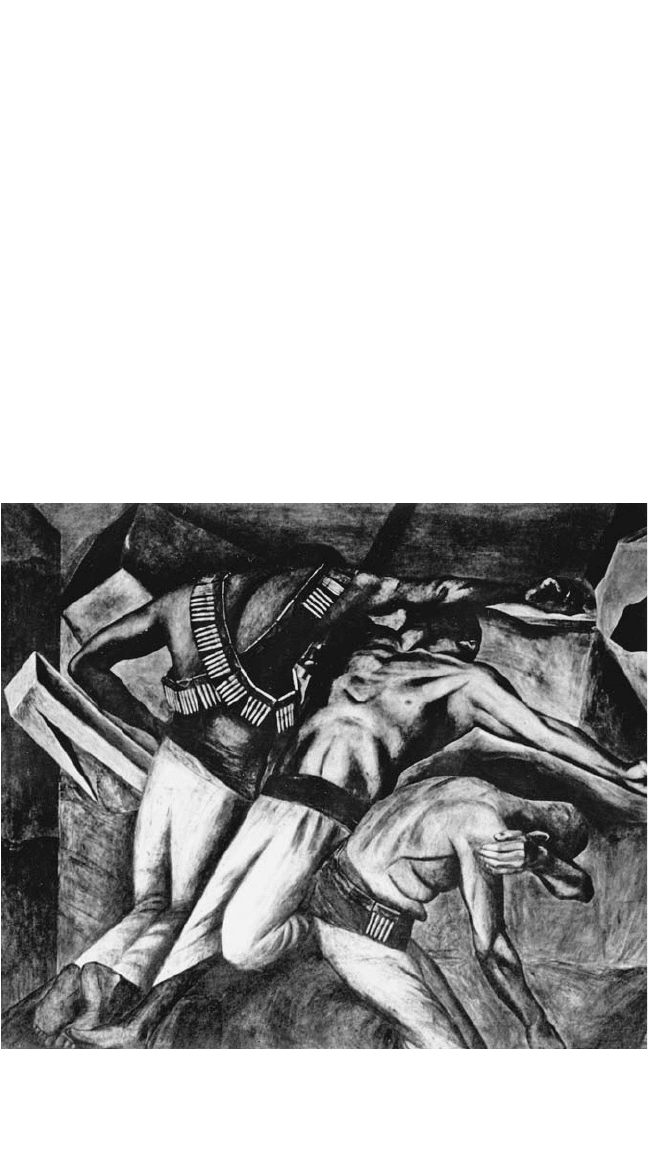
The Trench, mural (c. 1930) by José Clemente Orozco in the National Preparatory School,
Mexico City
THE REVOLUTION OF 1910

A BRIEF HISTORY OF MEXICO
174
was relentless in his pursuit of Zapata. The army killed thousands of
innocent civilians in its search for the rebel leader and burned crops and
killed cattle to starve even more. The Zapatistas responded in kind, blow-
ing up a civilian passenger train. Zapata wrote a letter to Carranza:
It never occurred to you that the Revolution was fought for the
benefit of the great masses . . . you have given or rented our
haciendas to your favorites . . . and the people are mocked in
their hopes.
Emiliano Zapata, 1919 (Meyer & Sherman 1983, 548)
Carranza responded with an elaborate plot to assassinate the revolu-
tionary hero. On April 10, 1919, his plot succeeded: Zapata was shot
point-blank in an ambush. His body was displayed to convince the
Zapatistas and the peasants for whom he had struggled so long that
their leader was, in fact, dead.
The End of Military Revolution: 1920
When Carranza’s presidential term ended, the revolution had ravaged
Mexico without accomplishing its primary social objectives. Carranza had
also undermined its liberal political objectives by instituting martial law
and rigging elections. He didn’t dare openly challenge the no reelection
clause of the constitution; he did try, however, to subvert it by nominating
one of his puppets to run against Álvaro Obregón, the minister of war.
Patience ran out with Carranza. Generals from around the country
declared against him; regions declared independence. It was Obregón
who finally chased him out of office. Carranza’s presidency ended with
the corruption and violence typical of the period: he fled with all the
public treasury he could carry, allegedly 20 train cars’ worth; he was
captured en route to Veracruz and shot.
The Devastation of War
Thinkers . . . prepare the Revolution; bandits carry it out. At the
moment no one can say with any assurance: “So-and-so is a
revolutionary and What’s-his name is a bandit.” Tomorrow per-
haps it will be clearer.
The Flies, Mariano Azuela, 1918

175
A decade of civil war devastated the people, countryside, and economy. As
armies of tens of thousands moved back and forth across the land, they
took with them whatever crops were in the fields and drove the cattle
along as provisions. Revolutionaries burned haciendas and destroyed
mills. Any crops they missed could not be harvested because the able-
bodied were carried off with the armies. In the cities, fires raged, too; in
Mexico City alone more than 50 elementary schools were burned down.
Payment, when it couldn’t be avoided, was in chits or recently
printed paper called “money.” Each army printed currency as needed.
Not only were different currencies used in the various regions, but they
changed with the arrival of each new army, being exchangeable one day,
but not the next—except for Zapata’s coins, that is, which were minted
from the silver of confiscated mines. There was an unending supply
of money for the armies and inflationary prices for everyone else.
Guadalajara reported that the price of corn and beans tripled in 1918.
Mexicans were hungry during the Porfiriato, but they were hungrier
during the revolution. Even when the government attempted to fix
food prices, its efforts were inadequate. Transport systems, especially
the railroads, had been expropriated by the armies or destroyed in the
fighting; slow grain distribution was one result. With the United States
and Europe engaged in World War I, not enough foodstuffs could be
imported to alleviate the problem. The amount of maize available per
capita was the lowest since colonial times. In 1917 the government
officially recognized a corn famine. Malnutrition was common. Food
riots broke out in some towns. Others reported 100 deaths a day due to
starvation. Even in 1918 when there weren’t marching armies sweeping
the land, food production was low.
The War Economy
With the prolonged fighting, Mexico’s economy should have stopped
short. Instead, World War I gave it a boost. Yucatecan henequén was
in high demand for cordage; profits from its trade stabilized the revo-
lutionary government’s finances into the early 1920s. Oil and metals,
too, were in higher demand than ever because of the war. During the
Mexican Revolution, foreign oil companies bribed the armies to protect
their equipment and industry. Oil production boomed, and Mexico
became the fourth largest supplier in the world. Production, often
wasteful and exploitative—gasoline cost more in Mexico than abroad—
increased from almost 4 million barrels in 1910 to almost 200 million in
1921. Although the mines, mostly foreign owned, had suffered during
THE REVOLUTION OF 1910

A BRIEF HISTORY OF MEXICO
176
the Huerta period, silver, zinc, and copper production under Carranza
increased and even surpassed that of the Porfiriato—and prices had
never been higher.
The Mexican government was kept afloat during World War I by its
trade and by the taxes on extracted materials. But when its debts were
reckoned, the nation couldn’t have been in worse shape. Foreign debt
was high even for Mexico: in 1923, it amounted to $750 million, three
times higher than after the first round of fighting when Madero took
office. Then, there was an additional $1 billion of foreign claims against
Mexico for damage done to their companies during the Revolution. The
domestic debt was no less impressive. All those army chits and paper
monies and forced loans on businesses and the church became claims
against the government. And the military was a continuing financial
burden, with many soldiers and officers owed back pay. There were
years in which the cost of the military was 70 percent of expenditures.
Not even a war boom could finance so much debt.
The Revolutionary Reconstruction, 1920–1940
We too could produce a Kant or Hugo. We too could wrest iron
from the bowels of the earth and fashion it . . . We could raise
prodigious cities and create nations, and explore the universe.
Was it not from a mixture of the races that the Titans sprang?
José Clemente Orozco (translated by Ramón Eduardo Ruiz)
Commodity Production, 1910–1920
Year Corn Sisal Copper Oil Silver
1910 3,219,624 94,790 48,160 3,634,080 2,416,669
1912 2,062,971 139,902 57,245 16,558,215 2,526,715
1914 1,961,073 169,286 26,621 26,235,403 810,647
1916 ** 201,990 28,411 40,545,712 925,993
1918 1,899,625 140,001 70,200 63,828,326 1,944,542
1920 ** 160,759 49,192 157,068,678 2,068,938
In metric tons except oil in barrels; from John Womack in Bethell (1991, 133)
**-not available

177
Mexico finally was about to embark on a period of political stability. Its
leadership would be assumed by social revolutionaries such as Álvaro
Obregón, Plutarco Calles, and Lázaro Cárdenas. Each president would
lead Mexico toward social and economic changes as envisioned by the
Constitution of 1917. Only Cárdenas wasn’t from the north, however,
and only he would understand the indigenous communities that domi-
nated central and southern Mexico. With increasing political stability,
Mexico created a national identity as well, one that esteemed its blend-
ing of races into a new culture and a mestizo people. As a new Mexico
took shape, a few violent episodes occurred, but they did not succeed
in ripping the nation apart. Mexico was well on the way to solving its
conflicts without the military.
President Álvaro Obregón, 1920–1924
Obregón (1880–1928) brought political ingenuity, not just military
might, to the Mexican presidency. As one of the great military strategists
of the revolution, Obregón had won many battles, including the decisive
ones against Villa, with his Yaqui Indian soldiers and union supporters.
He was a listener, a general who could sit and discuss strategy with his
troops. He was a keen observer and chose his sides carefully and suc-
cessfully. Although committed to social change and the implementation
of the constitution, he was practical and knew how to compromise.
Knowing peace was imperative, Obregón granted an amnesty to all
factions. He appointed Villistas and Zapatistas to his government. In
exchange for remaining outside of politics, Pancho Villa was given a
ranch and substantial pension. A Zapatista was put in charge of the
Morelos troops that had once been the enemy. Other “generals” were
bought off by well-paid positions in the army, but in an attempt to sepa-
rate the government from the military, Obregón reserved most cabinet
posts for civilians.
Obregón was the first revolutionary president committed to social
reform. He was well aware of the simmering discontent of the peasants
and organized labor who had received nothing after a decade of war.
He had fought alongside them and heard their complaints. As a first
step toward implementing the land reforms mandated in the constitu-
tion, he granted the Indians title to their lands that had been stolen. He
also permitted peasants to keep the land they had occupied during the
Revolution. Worried that agricultural production would be adversely
affected if he moved too quickly on the haciendas before smaller enter-
prises got under way, Obregón’s land redistribution was significant but
THE REVOLUTION OF 1910