
Foster L.V. A Brief History of Mexico
Подождите немного. Документ загружается.


A BRIEF HISTORY OF MEXICO
198
7,500 miles of new highways. The Pan-American Highway linking
the United States with Guatemala was completed along with a road
linking the Pacific and Gulf coasts along the Isthmus of Tehuantepec.
These roads encouraged not only commerce but tourism from the
United States to the improved resort facilities at Acapulco and Puerto
Vallarta. The irrigation and land reclamation works coincided with the
Department of Agriculture’s successful development of new, more fruit-
ful plant varieties that created a “green revolution.” During Alemán’s
term, corn yields increased from 300 kilograms per hectare to 1,300.
The infrastructure laid the foundation for the later, more phenomenal
periods of growth.
Labor Policies
Economic growth led to a burgeoning middle class, and by 1958 there
were 1.5 million industrial workers. The national income almost
tripled: from 1940 to 1946 the per capita income rose from 325 to 838
pesos. These heartening figures, however, did not mean the gains were
spread equitably throughout the population. They especially did not
always work to the advantage of the lower classes.
Ávila Camacho’s first act in regard to labor was to remove the pro-
gressive Lombardo Toledano as the head of CTM and replace him
with the conservative Fidel Velázquez. A firmer hand on labor was
considered necessary to accomplish the economic growth desired.
Throughout the period, Velázquez did the bidding of the presidency
more often than that of his constituents: he signed numerous docu-
ments that declared most strikes illegal. Without government support,
most workers were afraid to strike. In 1958, the situation changed,
however: the railway workers did strike. Initially, the government tried
to co-opt the strike by granting some concessions. When the workers
persevered, the government displayed its ability to bring them under
control. The army was ordered to run the trains, the union leader was
arrested (and replaced by the government), and thousands of strikers
were jailed. The union leader was convicted of sabotage and impris-
oned for 16 years.
Labor peace was achieved not only through coercion, but through per-
suasion as well. The government had become unsympathetic to labor, yet
the ruling party, PRI, recognized the need to provide for workers’ basic
well-being—the devastation of the Revolution remained a vivid memory.
Although labor did not share proportionately in the growing economy,
the minimum wage maintained most of its purchasing power well into

199
the 1970s. Unemployment was a serious problem, however: Population
growth was so stupendous that the government found it impossible to
create enough jobs to absorb the new workers. Alemán attempted to
address the issue by using the healthy government treasury in massive
public works projects.
Another significant labor effort began in 1943. Ávila Camacho cre-
ated the Instituto Mexicano de Seguro Social (IMSS), a social security
system to provide unemployment insurance and pensions, disability
and death assistance, as well as health care benefits to workers and their
families. The program began slowly, with less than 250,000 enrolled.
Under President Adolfo Ruiz Cortines (1952–58), all workers were
insured. The number of clinics increased from 42 to 226 and the num-
ber of hospitals from less than 20 to more than 100.
Agrarian Policy
It is fair to say that during the first years of industrialization the
agrarian revolution was abandoned. The emphasis on technology and
industrialization seemed to exclude more human concerns. The more
conservative presidents were concerned that land be efficiently used
rather than justly distributed. Loans to buy tractors, government con-
struction of dams for irrigation, and factories to produce fertilizer were
the priorities. Whereas Cárdenas had distributed almost 50 million
acres, Ávila Camacho distributed less than 12 million, and every acre
went to small, privately owned farms, not the ejidos.
In the battle for productivity, policymakers showed a preference
for the larger, private commercial farms that could supply the rapidly
growing cities as well as contribute to the export capital of the nation.
These policies favored the north, where the plains were most amenable
to tractors and technology, and the nearby United States border made
exporting more efficient.
In Mexico’s central and southern regions, ejido farming became more
productive by 1960. The government, however, remained dissatisfied:
the ejidos constituted 43 percent of all crop land but produced only 40
percent of the crop value. The private farms were more productive per
acre on a per capita basis.
Some economists have criticized the government assessment of the
ejido program, and various administrations during the modern period
have agreed. They contend that the lower harvest rates for ejidos
resulted from government policies: only one-fifth of all tractors made
their way to ejido land and, with the growing population, the figures per
THE INSTITUTIONALIZED REVOLUTION
A BRIEF HISTORY OF MEXICO
200
capita distorted the output. In addition, the most fertile land remained
in private hands even after Cárdenas’s redistribution because hacen-
dados were permitted to select the plots they wished to retain. Apart
from the issues of productivity, ejido farming guarantees the poor a
subsistence: the basic crops are produced and consumed by peasants
regardless of international market forces. Indeed, in 1960 more corn,
wheat, and beans were produced on the ejidos than on all crop lands in
the non-ejido system of the 1910 Porfiriato.
Education under the Conservatives
Education remained important, but the more socialist, anticlerical cur-
riculums of the revolutionary period were abandoned. The education
Corruption
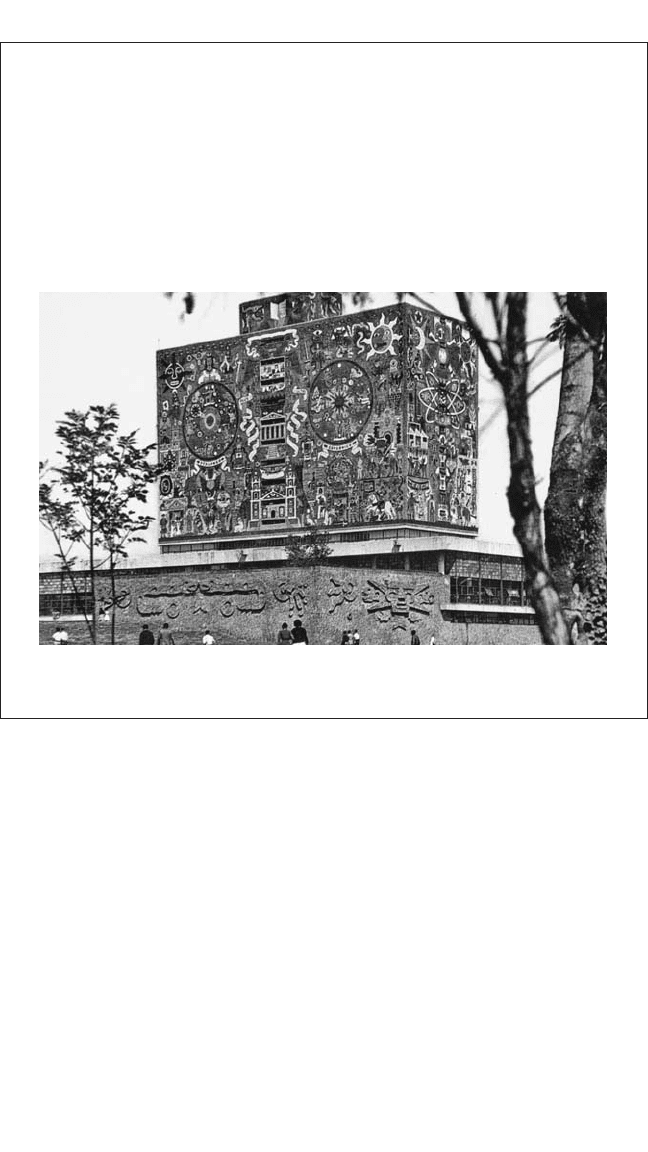
O
ne of the most striking buildings of the new campus built for the
National Autonomous University of Mexico (UNAM) in 1953,
the library was covered with a mosaic mural by artist Juan O’Gorman.
But inside there were only empty shelves: graft, unbridled during Miguel
Alemán’s presidency, had “diverted” the money for books.
The library at the National Autonomous University of Mexico in Mexico
City
(Courtesy of Infotour)

201
minister Jaime Torres Bodet, a poet and scholar, did build more
schools, libraries, and museums. More indicative of the times, how-
ever, was the volunteer program against illiteracy. Rather than paying
more teachers, Ávila Camacho proclaimed the “Each One Teach One”
program and set the proper example himself by setting aside one hour
a day for tutoring. During the 1940s illiteracy was reduced from 58
percent to less than 43 percent, but the “voluntary” program lost its
momentum when disgruntled government employees complained of
being coerced into participating.
President Alemán constructed the impressive three-square-mile
campus of the National Autonomous University of Mexico (UNAM).
Planned by the mural artist Juan O’Gorman, its facades were covered
with works by the great muralists Rivera and Siqueiros. A symbol of
national progress and mexicanidad, the campus lacked basic library
facilities and other educational necessities. It was much like the many
Women Win the Vote
I
n 1954 Mexican women were finally granted the right to vote. The
United Front for Women’s Rights was founded in 1935, not only
demanding the right to vote but organizing women’s hospitals and child
care centers. As the front’s membership swelled to 50,000, it was asked
by Cárdenas to join the official party that became the PRI. The front’s
absorption failed to result in the right to vote, even during the war
years when growing numbers of women joined the workforce to fill the
jobs vacated by men in the bracero program. After almost two decades,
the PRI honored its commitment to universal suffrage, and in 1954
women were granted the right to vote. In 1974 it once again embraced
women’s issues by passing an Equal Rights Amendment to the constitu-
tion. In 1997 women represented a majority of the nation’s registered
voters and held 17 percent of the seats in the Chamber of Deputies and
16 percent in the Senate. By 2000 women held some of the most visible
political offices, among them the mayor of Mexico City, the president
of the Senate, and the head of one of the three major political parties.
One out of three women worked, and some assumed nontraditional
roles, from taxi drivers and bullfighters to movie direction. Also in 2000
women were permitted to volunteer for military service. Despite their
growing presence in politics and the workforce, 26 percent of women
workers earned less than the minimum wage in 2002.
THE INSTITUTIONALIZED REVOLUTION

A BRIEF HISTORY OF MEXICO
202
new elementary schools in 1958 without teachers because salaries were
too low. Less than 1 percent of rural children finished sixth grade.
The Need for Change
As President Ruiz Cortines confessed at the end of his conservative
tenure in 1958, masses of Mexicans had not sufficiently benefited from
the economic miracle. They did receive, however, plenty of revolution-
ary rhetoric—including the change in the party name to Institutional
Revolutionary Party (PRI) in 1946. Yet too much poverty, illiteracy,
and social pain remained. One reason for this was the PRI’s change in
dynamics: the peasant and labor organizations had been supplanted in
influence by business. Intellectuals, too, lost their influence. The party,
less open to reconciling diverse interests, failed to implement policies
that might have better distributed the increasing wealth, and it failed to
even address the frightening population growth that also undermined
any progress.
Public funds, estimated at well in excess of half a billion dollars
under President Alemán, that could have been spent on social programs
and education instead ended up in the foreign bank accounts of high-
ranking members of government. Corruption became so notorious
that the PRI had to bring in as president the colorless, but honest Ruiz
Cortines to enhance its credibility.
A Liberal Correction
In 1958 PRI candidate Adolfo López Mateos was elected over the National
Action Party (PAN) opposition candidate by 90 percent of the vote! If any
proof was necessary that the PRI had preempted democracy and that its
nomination of a candidate was equivalent to election, it was such recur-
ring statistics. Yet the PRI remained in control because it had the good
sense to change course when necessary in order to accommodate a broad
base of interests. In the case of President López Mateos (1958–64), the
party had selected a candidate who would be one of the most popular in
the postrevolutionary era. An energetic 47-year-old, the new president
appealed to both intellectual youths and the masses with his promise to
revive the ideals of the Mexican Revolution. He also promised democratic
reforms that guaranteed at least limited representation by the opposition
parties in Congress based on their percentage of the popular vote.
Declaring himself “on the extreme left within the constitution,” the
new president used his term to prove it. Taking advantage of a strong

203
economy and healthy treasury, he invested in people, not just infra-
structure. He distributed 30 million acres of land (only Cárdenas had
distributed more) to both ejidos and private farmers and cleared new
lands in the south to alleviate population pressures. He expanded the
social security system, IMSS, and conducted successful public health
campaigns against polio, tuberculosis, and malaria. He implemented
a clause of the constitution requiring profit sharing with labor and
thereby increased many workers’ earnings by 5 to 10 percent.
Urbanization: Percentage of Population in Cities
1910 1920 1930 1940 1950 1960
29.3 25 33.5 35 43 50.7
Based on Mexico: Facts, Figures and Trends (1968)
Land Erosion in the Sierra
Mixteca and Migration
T
oo many years of overgrazing by goats and sheep have eroded
the Sierra Mixteca of Oaxaca into red “badlands.” Land that
produced agricultural surpluses in the 16th century now barely yields
enough for subsistence. For decades many have been forced to find
work elsewhere in the dry season in order to survive. As the popu-
lation increased and the land could not yield more food, migration
became wider ranging, with Mexico City the primary destination.
There Mixtecs squatted in new slums or joined family members. The
country was brought with them: roosters perched on roofs, and corn-
stalks grew in front yards. As the poverty and lack of arable land in the
sierra continued, many Mixtecs made their way to the United States,
particularly to California where approximately 100,000 Mixtec farm
laborers constituted the state’s largest Indian group in 2003. As the
Mixtecs migrated, villages were transformed into places for women
and the elderly but few working-age males. The Mixtec migration
was repeated in poor villages throughout Mexico, transforming 20th-
century Mexico from a predominantly rural nation to one in which
just a quarter of the population lived in the countryside by 2006.
THE INSTITUTIONALIZED REVOLUTION

A BRIEF HISTORY OF MEXICO
204
Education again became a priority. New schools were constructed
quickly and in a cost-effective manner: the schools were prefabricated,
the communities provided the land and the labor to assemble them. In
order to attract more teachers to rural areas, their living quarters were
included as part of the school construction. Free federal textbooks
enabled more poor children to remain in school. The rate of illiteracy
was further reduced from 80 percent in 1910 to 38 percent in 1960, but
still the swelling population increased the absolute numbers of those
who could not read or write: from 11,658,000 in 1910 up to 13,200,000
in 1960.
Like his predecessors, the president failed to implement any program
to curb population growth. But he did attempt to rectify some of its worst
impact on the cities. As rural farmers flooded urban areas, the cities could
no longer provide adequate support services such as housing, running
water, and sewerage. Shanty towns appeared on the outskirts of every city.
López Mateos initiated a program of low-cost public housing. A slum in
Mexico City was replaced with new units for 100,000 individuals.
On the international economic front, López Mateos encouraged
French and British investments for the development of the new pet-
rochemical industry, Petróleos Mexicanos (PEMEX). Yet he also pur-
chased foreign interests in essential electric companies and bought out
U.S. control of the burgeoning motion-picture industry, making Mexico
the major distributor of Spanish-language films in the world. In a ges-
ture typical of his presidency, López Mateos also guaranteed that movie
tickets would remain affordable to the poor. Agricultural and indus-
trial production continued to grow strongly and the foreign tourism
industry, supported by luxury hotels in Acapulco and Puerto Vallarta,
brought in almost twice as many travelers as under President Alemán.
Renewed Conservatism: The Tlatelolco Massacre
President Gustavo Díaz Ordaz (1964–70) was probably the worst
choice the PRI could have made for the 1960s. At a time when student
activism led to demonstrations and police confrontations around the
world, the PRI selected one of its most conservative presidents. When
the nation demanded greater openness in the PRI, the new president
annulled not only the victories of opposition parties but also the liberal-
izing reforms of his predecessor, López Mateos. Just when Mexico was
receiving world attention in its preparation for the 1968 Olympics, it
presented a government that would not easily tolerate public criticism
and ruled more by coercion than persuasion.
205
In bidding for the 1968 Summer Olympic Games, the Mexican
government hoped to find a global forum to show off the nation’s
miraculous economic progress. Side by side with the games, a cultural
Olympics showcasing Mexican art and artisanship would add to the
nation’s prestige. The cost of constructing the stadiums and infrastruc-
ture for the games was excessive for a nation with so much poverty, or
so the critics said. The total was estimated at between $150 million and
$200 million, but the government argued that it was not money thrown
away. A modern subway system, new housing, and sports facilities
would remain, as would the money spent by visitors. The government
implemented its plans, and everything was built on time. The games,
too, were successful. The most troublesome events, however, happened
before the Olympics began.
Against the background of the Olympic preparations, a public dis-
pute between two schools in the capital erupted. The mayor responded
by calling in a despised paramilitary police force, the granaderos. They
dispelled the students with the excessive brutality for which they were
known and in so doing politicized most students in Mexico City. When
the granaderos were again called in during a student parade celebrating
the anniversary of the Cuban Revolution, they provoked a riot using
bazookas and barricades.
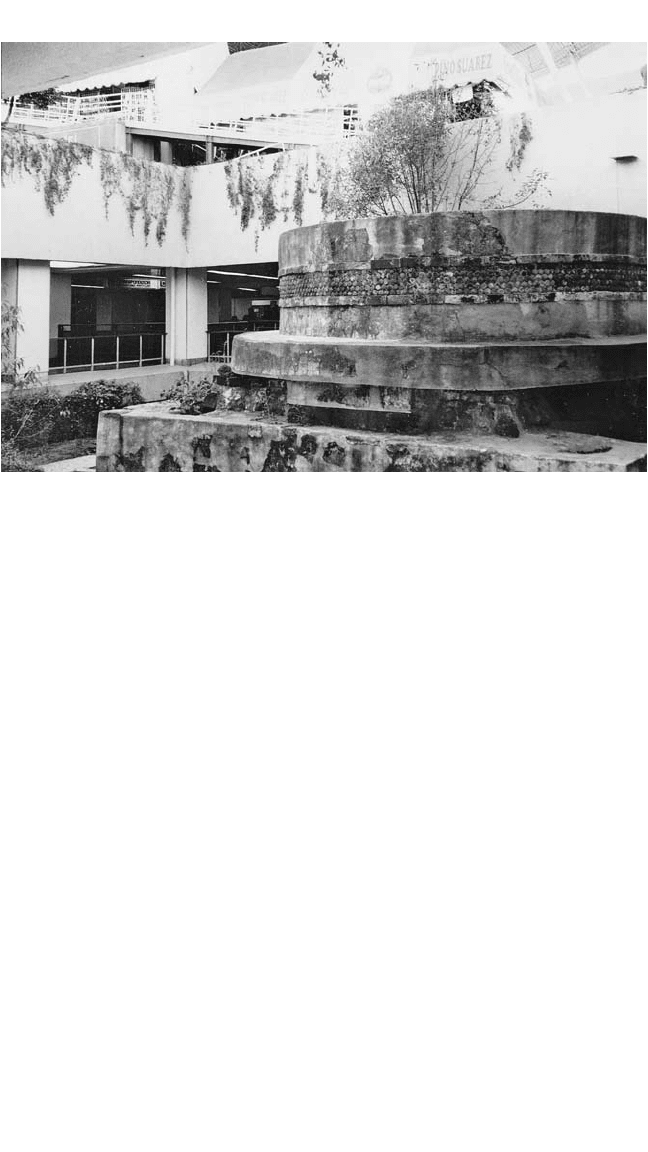
One of the modernization projects for the 1968 Olympic Games, the Mexico City subway
system incorporated an Aztec temple uncovered during construction into one of its stations.
THE INSTITUTIONALIZED REVOLUTION

A BRIEF HISTORY OF MEXICO
206
The situation continued to escalate. Students demanded that the
mayor be removed and the granaderos disbanded. Failed negotiations
led to the largest protest demonstration in Mexico’s history on August
27: Half a million people marched from Chapultepec Castle to the
main square of the government palace. The government, fearful that
the students would attempt to disrupt the upcoming Olympics in
October, greeted them with tanks. Undeterred, the students threatened
further action. Díaz Ordaz ordered 10,000 troops to take over the cam-
pus of the National Autonomous University of Mexico (UNAM); 500
students were imprisoned. On October 2, just days before the games
began, students planned a rally at the city’s Plaza of Three Cultures
in Tlatelolco. It was a peaceful rally, with about 5,000 participants,
including children accompanying their parents. Army tanks arrived.
The granaderos stormed in with tear gas. Someone fired shots from the
rooftops into the crowd and at the army: terrorists, according to the
government; the police, others said. It would take more than 30 years
before the truth was revealed. The president, in fact, had ordered mem-
bers of his secret service to shoot into the crowd in order to discredit
the protesters. The snipers started the massacre, the police finished it
with their machine guns.
Díaz Ordaz said there were only 43 deaths; the New York Times said
several hundred. Two thousand were imprisoned. Mexico was shamed
and Mexicans were stunned.
Crisis with the PRI
The advances made during Díaz Ordaz’s term in economic growth and
education have been completely overshadowed by his repressive handling
of the student demonstrations. The PRI never recovered from the trag-
edy at Tlatelolco. Mexicans were convinced that the party, out of touch
with the nation’s needs, only served the ambitions of its own politicians.
Luminaries such as the poet Octavio Paz and the writer Carlos Fuentes
condemned the government. Intellectuals abandoned the PRI, and dis-
sident youth looked for more progressive parties to support. Others went
underground: in 1969, on the anniversary of Tlatelolco, a terrorist group
bombed government and newspaper buildings.
In the 1970s, many idealists simply dropped out of the political pro-
cess, refusing to vote even though it was required. The abstention rate in
1979 was 50.8 percent. Student demonstrations and guerrilla movements
proliferated. The PRI reaction to these tests of its power was the same
as at Tlatelolco: violent repression, including illegal arrests, torture, and

207
murder. The damage to the PRI was incalculable. Even today, Tlatelolco
and the repression known as the guerra sucia (dirty war) that followed it
inspire angry protests and government investigations.
The call for open elections and a broader-based government became a
major issue in Mexican politics. Making the Mexican government more
democratic was difficult. The government was, in fact, the PRI. The col-
ors of the PRI were the same as the Mexican flag and appeared on elec-
toral ballots. The PRI’s control of the state apparatus was not technically
illegal under the constitution, which permitted exceptionally centralized
power in the office of the presidency. The autocratic party could not eas-
ily be removed either: the election apparatus was under its control, as
was the television news. The newspapers could be influenced, because
the government subsidized the cost of newsprint and hence financially
controlled their ability to survive. There were alternative newspapers,
and brutally critical ones at that, but their circulation was mostly among
intellectuals. And there were opposition parties that gave the appearance
of democracy to the electoral process; they just never were permitted to
win. Congress did not serve as a check on the PRI or on the president,
because the principle of no reelection applied to legislative office as well
as to the presidency: the legislators never served long enough to develop
an independent power base. The PRI president held absolute power for
six years. The struggle for reforms would preoccupy Mexico for the rest
of the century. And Tlatelolco became synonymous with the PRI’s sup-
pression of democracy.
The Miracle Slows
When Luis Echeverría became president (1970–76), he exacerbated the
alienation many already felt from the PRI. As minister of the interior
under Díaz Ordaz, he was believed to be yet another party conserva-
tive and, worse, responsible for the Tlatelolco tragedy. His term was,
in fact, notable for the political repression of guerrilla movements and
the shadowy actions of the secret police. Yet Echeverría was a master of
Presidential Election Results in 1970, by Party
PRI PAN Other parties combined
Percentage 80.0 13.6 6.4
Based on figures from the Federal Election Commission, Mexico City, and Barry (1992, 33)
THE INSTITUTIONALIZED REVOLUTION