
Francoise J.-P., Naber G.L., Tsun T.S. (editors) Encyclopedia of Mathematical Physics
Подождите немного. Документ загружается.

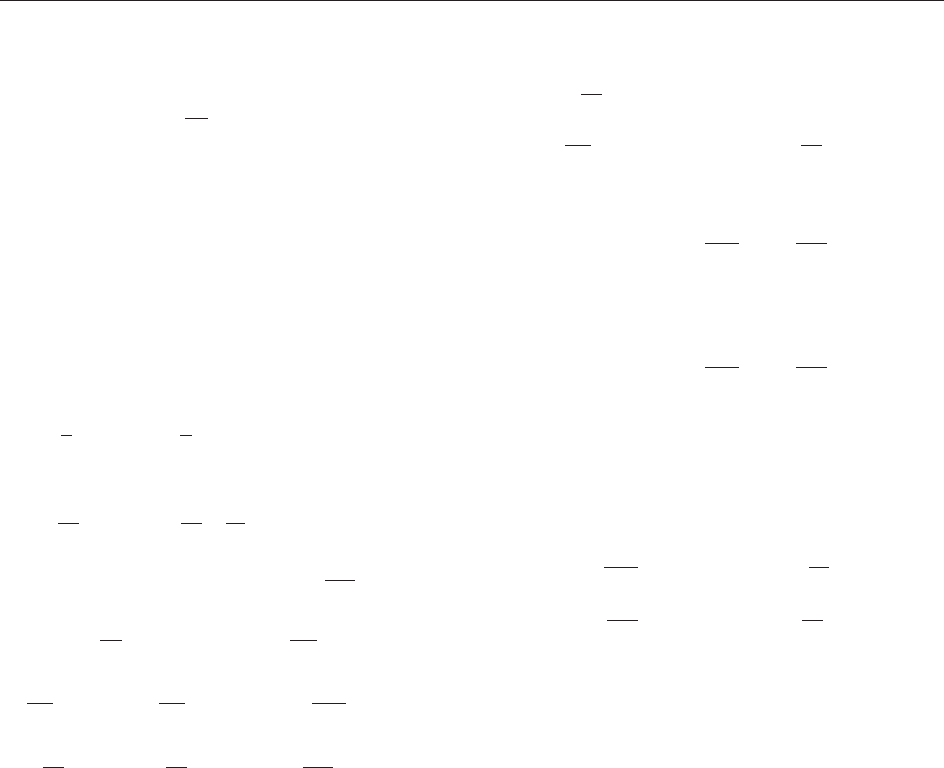
the dominant terms in the vertical-momentum equa-
tion, leading to the hydrostatic approximation
@p
@z
¼g ½9
For mid-latitude regional studies, it is usual to
consider the beta-plane approximation of the equations.
Thus, we assume that the ocean fills a domain M
"
of R
3
.
The top of the ocean is a domain
i
included in the
surface of the earth S
a
(sphere of radius a centered at
0). The bottom
b
of the ocean is defined by (z = x
3
=
r a), z = "h(, ’), where ">0 is a positive para-
meter. It is introduced to take into consideration the
smallness of the vertical scales compared to the
horizontal scales. h is a function of class C
2
at least on
i
; it is assumed also that h is bounded from below, that
is, 0 <
h h(, ’) h,(, ’) 2
i
. The lateral surface
l
consists of the part of cylinder {(, ’) 2 @
i
,
"h(, ’) r 0}.ThePEsoftheoceanaregivenby
@v
@t
þr
v
v þ w
@v
@z
þ
1
0
rp
þ 2 sin k v
v
v
v
@
2
v
@z
2
¼ F
v
½10
@p
@z
¼; div v þ
@w
@z
¼ 0 ½11
@T
@t
þr
v
T þ w
@T
@z
T
T
T
@
2
T
@z
2
¼ F
T
½12
@S
@t
þr
v
S þ w
@S
@z
S
S
S
@
2
S
@z
2
¼ F
S
½13
div
Z
0
h
v dz ¼ 0 ½14
p ¼ p
s
þ P; P ¼ PðT; SÞ¼g
Z
0
z
pdz
0
½15
¼
0
ð1
T
ðT T
r
Þþ
S
ðS S
r
ÞÞ ½16
Z
M
"
S dM
"
¼ 0 ½17
where v is the horizontal velocity of the water, w is the
vertical velocity, and T
r
, S
r
are averaged (or reference)
values of T and S. The diffusion coefficients
v
,
T
,
S
and
v
,
T
,
S
are different in the horizontal and
vertical directions, accounting for some eddy diffu-
sions in the sense of Smagorinsky (1962). Note that
F
v
, F
T
,andF
S
correspond to volumic sources of
horizontal momentum, heat, and salt, respectively.
Boundary conditions
There are several sets of natural boundary condi-
tions that one can associate to the PEs; for instance,
the following:
On the top of the ocean
i
(z = 0)
v
@v
@z
þ
v
ðv v
a
Þ¼
v
; w ¼ 0
T
@T
@z
þ
T
ðT T
a
Þ¼0;
@S
@z
¼ 0
½18
At the bottom of the ocean
b
(z = h(, ’))
v ¼ 0; w ¼ 0;
@T
@n
T
¼ 0;
@S
@n
S
¼ 0 ½19
On the lateral boundary
l
= {h(, ’) < z < 0,
(, ’) 2 @
i
}
v ¼ 0; w ¼ 0;
@T
@n
T
¼ 0;
@S
@n
S
¼ 0 ½20
Here n = (n
H
, n
z
) is the unit outward normal on
@M
"
decomposed into its horizontal and vertical
components; the conormal derivatives @=@n
T
and
@=@n
S
are those associated with the linear (tempera-
ture and salinity) operators,
@
@n
T
¼
T
n
H
rþ
T
n
z
@
@z
@
@n
S
¼
S
n
H
rþ
S
n
z
@
@z
½21
Equations [10]–[17] with boundary conditions
[18]–[20] are supplemented with the initial conditions
vj
t¼0
¼ v
0
; Tj
t¼0
¼ T
0
; Sj
t¼0
¼ S
0
½22
where v
0
, T
0
, S
0
are given initial data.
Following the work of Lions et al. (1992a, b,
1993, 1995)(seealsoTemam and Ziane (2004)),
we introduce the following function spaces V =
V
1
V
2
V
3
, H = H
1
H
2
H
3
,where
V
1
¼
n
v 2 H
1
ðMÞ
2
; div
Z
0
h
vdz ¼ 0;
v ¼ 0on
b
[
l
o
V
2
¼ H
1
ðMÞ
V
3
¼
_
H
1
ðMÞ ¼
n
S 2 H
1
ðMÞ;
Z
M
SdM¼0
o
H
1
¼
n
v 2 L
2
ðMÞ
2
; div
Z
0
h
v dz ¼ 0;
n
H
Z
0
h
v dz ¼ 0on @
i
ði:e:; on
l
Þ
o
H
2
¼ L
2
ðMÞ
H
3
¼
_
L
2
ðMÞ ¼
n
S 2 L
2
ðMÞ;
Z
M
SdM¼0
o
The global existence of weak solutions is estab-
lished in Lions et al. (1992b), using the Galerkin
method and assuming the H
2
-regularity of the GFD–
Stokes problem, which was established in Ziane
536 Geophysical Dynamics
(1995). A more general global existence result based
on the method of finite differences in time and
independent of the H
2
-regularity is established in
Temam and Ziane (2004), which we state here.
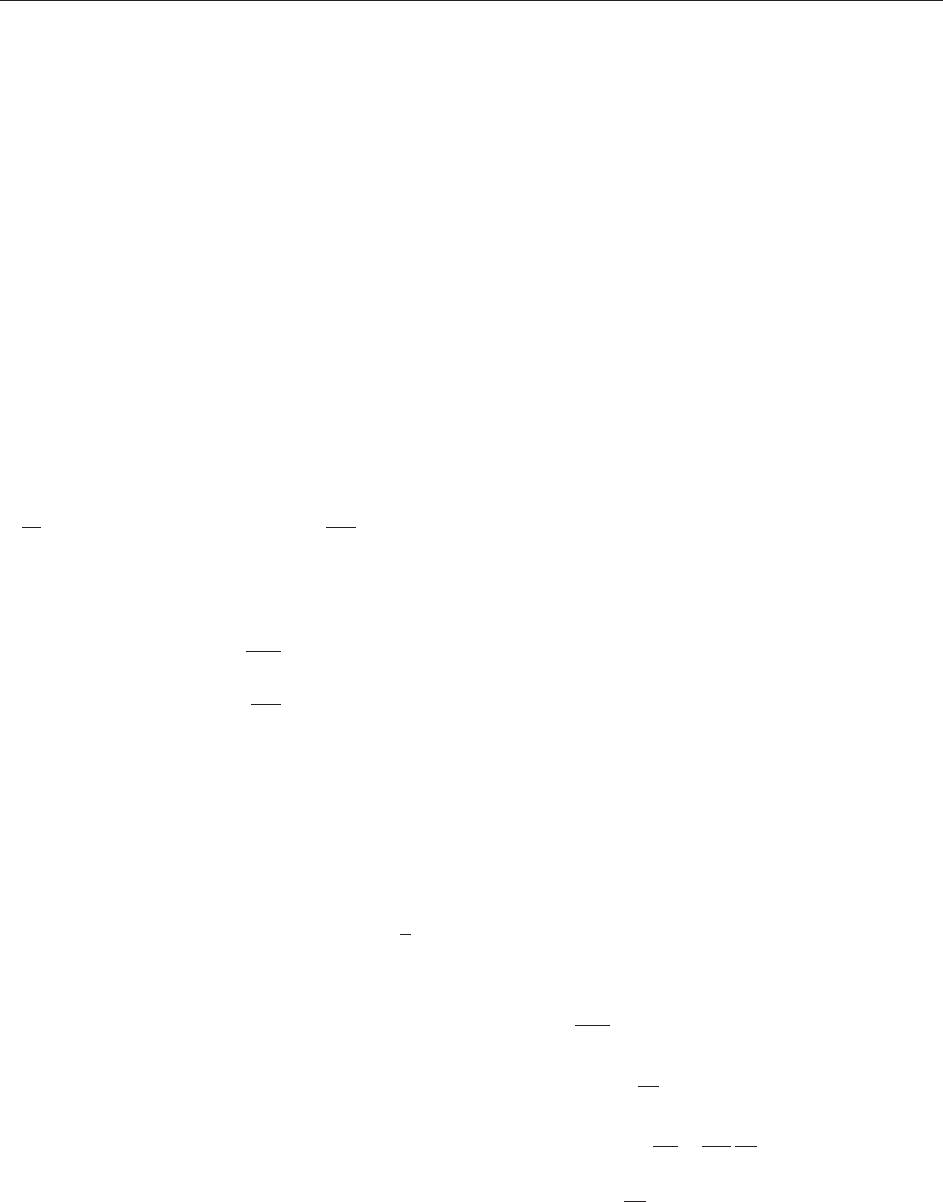
Theorem 2 Given t
1
> 0, U
0
in H, and F = (F
v
,
F
T
, F
S
) in L
2
(0, t
1
; H); g = g
v
, g
T
is given in L
2
(0, t
1
;
(L
2
(
i
)
3
). Then there exists
U 2 L
1
ð0; t
1
; HÞ\L
2
ð0; t
1
; VÞ½23
which is a weak solution of [10]–[17] and [18]–[20],
[22]; furthermore, U is weakly continuous from
[0, t
1
] into H.
Strong Solutions
The local existence and uniqueness of strong
solutions of the primitive equations of the ocean
relies on the H
2
-regularity of the stationary linear
primitive equations associated to [10]–[17]:
1
0
rp þ 2 sin k v
v
v
v
@
2
v
@z
2
¼ F
v
Z
0
h
div v dz ¼ 0
½24
T
T
T
@
2
T
@z
2
¼ F
T
S
S
S
@
2
S
@z
2
¼ F
S
½25
p ¼ p
s
þ P; P ¼ PðT; SÞ¼g
Z
0
z
p dz
0
½26
with boundary conditions [18]–[20]. Here F
v
, F
T
, F
S
are independent of time. We have the following
H
2
-regularity of solutions (Ziane 1995, Hu et al.
2002, Temam and Ziane 2004).
Theorem 3 Assume that h is in C
4
(
i
), h h > 0,
F
v
, F
T
, F
S
2 (L
2
(M
"
))
4
and g
v
=
v
þ
v
v
a
, g
T
=
a
T
a
2 (H
1
0
(
i
))
4
. Let (v, T, S; p) 2 (H
1
(M
"
))
4
L
2
(
i
) be
a weak solution of [24]–[26]. Then
ðv; pÞ2 H
2
ðM
"
Þ
2
H
1
ðM
"
Þ
ðT; SÞ2 H
2
ðM
"
Þ
2
½27
Moreover, the following inequalities hold:
jvj
2
H
2
ðM
"
Þ
þ "jpj
2
H
1
ð
i
Þ
C jF
v
j
2
"
þjg
v
j
2
L
2
ð
i
Þ
þ "jrg
v
j
2
L
2
ð
i
Þ
hi
jTj
2
H
2
ðM
"
Þ
C jF
T
j
2
þjg
T
j
2
L
2
ð
i
Þ
þ "jrg
T
j
2
L
2
ð
i
Þ
hi
jSj
2
H
2
ðM
"
Þ
CjF
S
j
2
where C is a positive constant independent of ".
We now turn our attention to the nonlinear time-
dependent PEs. The local-in-time existence and
uniqueness of strong solutions is obtained in
Temam and Ziane (2004); see also Hu et al.
(2003) and Guille´n-Gonza´lez et al. (2001). The
proof is more involved than that of the three-
dimensional Navier–Stokes equations. It consists of
several steps. In the first step, one proves the global
existence of strong solutions to the linearized time-
dependent problem. In the second step, one uses the
solution of the linearized equation in order to reduce
the PEs to a nonlinear evolution equation with zero
initial data and homogeneous boundary conditions.
Finally, in the last step, one uses nonisotropic
Sobolev inequalities together with Theorem 3. The
local existence result is given by the following:
Theorem 4 Let ">0 be given. We assume that
i
is of class C
3
and that h :
i
!R
þ
is of class C
3
. We
are given U
0
in V, F = (F
v
, F
T
, F
S
) in L
2
(0, t
1
; H) with
@F=@tinL
2
(0, t
1
; L
2
(M
"
)
4
), and g = (g
v
, g
T
) in
L
2
(0, t
1
; H
1
0
(
i
)
3
) with @g=@tinL
2
(0, t
1
; H
1
0
(
i
)
3
).
Then there exists t
> 0, t
= t
(kU
0
k), and there
exists a unique solution U = U(t) = (v(t), T(t), S(t))
of the PEs [10]–[17], [18]–[20], and [22] such that
U 2 Cð½0; t
; VÞ\L
2
ð0; t
; H
2
ðM
"
Þ
4
Þ½28
The PEs of the Atmosphere
In this section we briefly describe the PEs of the
atmosphere, for which all the mathematical results
obtained for the PEs of the ocean are valid. We start
from the conservations equations similar to [1]–[5];in
fact [1] and [2] are the same; the equation of energy
conservation (temperature) is slightly different from
[3] because of the compressibility of air; the state
equation is that of perfect gas instead of [5]; finally,
instead of the concentration of salt in the water, we
consider the amount of water in air, q.Hence,wehave
dV
3
dt
þ 2 W V
3
þr
3
p þ g ¼ D ½29
d
dt
þ div
3
V
3
¼ 0 ½30
hc
p
dT
dt
RT
p
dp
dt
¼ Q
T
dq
dt
¼ 0; p ¼ RpT
½31
Here c
p
> 0 is the specific heat of air at constant
pressure, and R is the specific gas constant for the
air. Proceeding as in the PEs of the ocean, we
decompose V
3
into its horizontal and vertical
components, V
3
= v þ w; then we use the hydro-
static approximation, replacing the equation of
Geophysical Dynamics 537

conservation of vertical momentum by the hydro-
static equation [9]. We find
@v
@t
þr
v
v þ w
@v
@z
þ
1
r
0
p
þ 2 sin v
v
v
v
@
2
v
@z
2
¼ 0 ½32
@p
@z
¼g ½33
@T
@t
þr
v
T þ w
@T
@z
T
T
T
@
2
T
@z
2
RT
p
dp
dt
¼ Q
T
½34
@q
@t
þr
v
q þ w
@q
@z
q
q
q
@
2
q
@z
2
¼ 0 ½35
p ¼ RpT ½36
The right-hand side of [34], represents the solar
heating.
Change of Vertical Coordinate
Since does not vanish, the hydrostatic equation
[33] implies that p is a strictly decreasing function of
z, and we are thus allowed to use p as the vertical
coordinate; hence in spherical geometry the inde-
pendent variables are now ’, , p, and t. By an abuse
of notation, we still denote by v, p, T, q, these
functions expressed in the ’, , p, t variables. We
denote by ! the vertical component of the wind in
the new variables, and one can show that the PEs of
the atmosphere become
@v
@t
þr
v
v þ !
@v
@p
þ 2 sin k v þr L
v
v ¼ F
v
½37
@
@p
þ
R
p
T ¼ 0 ½38
div v þ
@w
@
z ¼ 0 ½39
@T
@t
þr
v
T þ !
@T
@p
RT
p
! L
T
¼ F
T
½40
@q
@t
þr
v
q þ !
@q
@z
L
q
q ¼ F
q
½41
p ¼ RT ½ 42
We have denoted by =gz the geopotential (z is
now function of ’, , p, t); L
v
, L
T
, L
q
are the Laplace
operators, with suitable eddy viscosity coefficients,
expressed in the ’, , p variables. Hence, for example,
L
v
v ¼
v
v þ
v
@
@p
gp
R
T
2
@v
@p
"#
½43
with similar expressions for L
T
and L
q
.Notethat
F
T
corresponds to the heating of the Sun, whereas F
v
and F
q
(which vanish in reality) are added here for
mathematical generality. The change of variable gives,
for @
2
v=@z
2
, a term different from the coefficient of
v
.
The expression above is simplified for of this coeffi-
cient; the simplification is legitimate because
v
is a very
small coefficient (in particular, T has been replaced by
T (known) average value of the temperature).
Pseudogeometrical Domain
For physical and mathematical reasons, we do not allow
the pressure to go to zero, and assume that p p
0
,with
p
0
> 0 ‘‘small.’’ Physically, in the very high atmosphere
(p very small), the air is ionized and the equations above
are not valid anymore. The pressure is then restricted to
an interval p
0
< p < p
1
,wherep
1
is a value of the
pressure smaller in average than the pressure on Earth,
so that the isobar p = p
1
is slightly above the Earth and
the isobar p = p
0
is an isobar high in the sky. We study
the motion of the air between these two isobars.
For the whole atmosphere, the boundary of this
domain
M¼fð’; ; pÞ; p
0
< p < p
1
g
consists first of an upper part
u
, p = p
0
; the lower
part p = p
1
is divided into two parts
i
the part of
p = p
1
at the interface with the ocean, and
e
the
part of p = p
1
above the earth.
Boundary Conditions
Typically, the boundary conditions are as follows:
On the top of the atmosphere
u
(p = p
0
)
@v
@p
¼ 0;!¼ 0;
@T
@p
¼ 0;
@q
@p
¼ 0 ½44
Acknowledgments
This work was partially supported by the
National Science Foundation under the grant NSF-
DMS-0204863.
See also: Boundary Control Method and Inverse
Problems of Wave Propagation; Compressible Flows:
Mathematical Theory; Fluid Mechanics: Numerical
Methods; Turbulence Theories.
538 Geophysical Dynamics

Further Reading
Bresch D, Kazhikov A, and Lemoine J (2004/05) On the two-
dimensional hydrostatic Navier–Stokes equations. SIAM Jour-
nal of Mathematical Analysis 36(3): 796–814.
Constantin P and Foias C (1998) Navier–Stokes Equations.
Chicago: University of Chicago Press.
Guille´n-Gonza´lez F, Masmoudi N, and Rodrı´guez-Bellido MA
(2001) Anisotropic estimates and strong solutions of the
primitive equations. Differential and Integral Equations
14(11): 1381–1408.
Hu C, Temam R, and Ziane M (2002) Regularity results for
linear elliptic problems related to the primitive equations.
Chinese Annals of Mathematics Series B 23(2): 277–292.
Hu C, Temam R, and Ziane M (2003) The primitive equations of
the large scale ocean under the small depth hypothesis.
Discrete and Continuous Dynamical Systems Series A 9(1):
97–131.
Lions JL, Temam R, and Wang S (1992a) New formulations of
the primitive equations of the atmosphere and applications.
Nonlinearity 5: 237–288.
Lions JL, Temam R, and Wang S (1992b) On the equations of the
large-scale ocean. Nonlinearity 5: 1007–1053.
Lions JL, Temam R, and Wang S (1993) Models of the coupled
atmosphere and ocean (CAO I). In: Oden JT (ed.) Computa-
tional Mechanics Advances, vol. 1: 5–54. North-Holland:
Elsevier Science.
Lions JL, Teman R, and Wang S (xxxx) Numerical analysis of the
coupled models of atmosphere and ocean. (CAO II). In: Oden
JT (ed.) Computational Mechanics Advances, vol. 1: 55–119.
North-Holland: Elsevier Science.
Lions JL, Temam R, and Wang S (1995) Mathematical study of
the coupled models of atmosphere and ocean (CAO III).
Journal de Mathe´matiques Pures et Applique´es, Neuvie´me
Se´rie 74: 105–163.
Pedlosky J (1987) Geophysical Fluid Dynamics, 2nd edn. New
York: Springer.
Schlichting H (1979) Boundary Layer Theory, 7th edn. New York:
McGraw-Hill.
Smagorinsky J (1963) General circulation experiments with the
primitive equations, I. The basic experiment. Monthly Weather
Review. 91: 98–164.
Temam R (2001) Navier–Stokes Equations, Studies in Mathe-
matics and Its Applications, AMS-Chelsea Series. Providence:
American Mathematical Society.
Temam R and Ziane M (2004) Some mathematical problems in
geophysical fluid dynamics. In: Friedlander S and Serre D
(eds.) Handbook of Mathematical Fluid Dynamics, vol. III,
pp. 535–657. Amsterdam: North-Holland.
Washington WM and Parkinson CL (1986) An Introduction to
Three Dimensional Climate Modeling.Oxford: Oxford Uni-
versity Press.
Ziane M (1995) Regularity results for Stokes type systems.
Applicable Analysis 58: 263–292.
Gerbes in Quantum Field Theory
J Mickelsson, KTH Physics, Stockholm, Sweden
ª 2006 Elsevier Ltd. All rights reserved.
Definitions and an Example
A gerbe can be viewed as a next step in a ladder of
geometric and topological objects on a manifold
which starts from ordinary complex-valued func-
tions and in the second step of sections of complex
line bundles.
It is useful to recall the construction of complex
line bundles and their connections. Let M be a
smooth manifold and {U
} an of open cover of M
which trivializes a line bundle L over M. Topologi-
cally, up to equivalence, the line bundle is comple-
tely determined by its Chern class, which is a
cohomology class [c] 2 H
2
(M, Z). On each open
set U
we may write 2ic = dA
, where A
is a
1-form. On the overlaps U
= U
\ U
we can write
A
A
¼ f
1
df
½1
at least when U
is contractible, where f
is a
circle-valued complex function on the overlap. The
data {c, A
, f
} define what is known as a (repre-
sentative of a) Deligne cohomology class on the
open cover {U
}. The 1-forms A
are the local
potentials of the curvature form 2ic and the f
’s
are the transition functions of the line bundle L.
Each of these three different data defines separately
the equivalence class of the line bundle but together
they define the line bundle with a connection.
The essential thing here is that there is a bijection
between the second integral cohomology of M and
the set of equivalence classes of complex line bundles
over M. It is natural to ask whether there is a
geometric realization of integral third (or higher)
cohomology. In fact, gerbes provide such a realiza-
tion. Here, we shall restrict to a smooth differential
geometric approach which by no means is the most
general possible, but it is sufficient for most applica-
tions to quantum field theory. However, there are
examples of gerbes over orbifolds that do not need to
come from finite group action on a manifold, which
are not covered by the following definition.
For the examples in this article, it is sufficient to
adapt the following definition. A gerbe over a
manifold M (without geometry) is simply a
principal bundle : P !M with fiber equal to
PU(H), the projective unitary group of a Hilbert
space H. The Hilbert space may be either finite or
infinite dimensional.
The quantum field theory applications discussed
in this article are related to the chiral anomaly for
Gerbes in Quantum Field Theory 539

fermions in external fields. The link comes from
the fact that the chiral symmetry breaking leads in
the generic case to projective representations of the
symmetry groups. For this reason, when modding
out by the gauge or diffeomorphism symmetries,
one is led to study bundles of projective Hilbert
spaces. The anomaly is reflected as a nontrivial
characteristic class of the projective bundle,
known in mathematics literature as the Dixmier–
Douady class.
In a suitable open cover, the bundle P has a family
of local trivializations with transition functions
g
: U
!PU(H), with the usual cocycle property
g
g
g
¼1 ½2
on triple overlaps. Assuming that the overlaps are
contractible, we can choose lifts
^
g
: U
!U(H),
to the unitary group of the Hilbert space. However,
^
g
^
g
^
g
¼ f
½3
where the f ’s are circle-valued functions on triple
overlaps. They satisfy automatically the cocycle
property
f
f
1
f
f
1
¼ 1 ½4
on quadruple overlaps. There is an important differ-
ence between the finite- and infinite-dimensional
cases. In the finite-dimensional case, the circle
bundle U(H) !U(H)=S
1
= PU(H) reduces to a
bundle with fiber Z=NZ = Z
N
, where N = dimH.
This follows from U(N)=S
1
= SU(N)=Z
N
and the fact
that SU(N) is a subgroup of U(N). For this reason
one can choose the lifts
^
g
such that the functions
f
take values in the finite subgroup Z
N
S
1
.
The functions f
define an element a = {a
}in
the C
ˇ
ech cohomology H
3
(U, Z) by a choice of
logarithms,
2ia
¼ log f
log f
þlog f
log f
½5
In the finite-dimensional case, the C
ˇ
ech cocycle is
necessarily torsion, Na = 0, but not so if H is infinite
dimensional. In the finite-dimensional case (by passing
to a good cover and using the C
ˇ
ech – de Rham
equivalence over real or complex numbers), the class is
third de Rham cohomology constructed from the
transition functions is necessarily zero. Thus, in
general one has to work with C
ˇ
ech cohomology to
preserve torsion information. One can prove:
Theorem The construction above is a one-to-one
map between the set of equivalence classes of PU(H)
bundles over M and elements of H
3
(M, Z).
The characteristic class in H
3
(M, Z)ofaPU(H)
bundle is called the Dixmier–Douady class.
First example
Let M be an oriented Riemannian manifold and FM
its bundle of oriented orthonormal frames. The
structure group of FM is the rotation group SO(n)
with n = dimM. The spin bundle (when it exists) is a
double covering Spin(M)ofFM, with structure
group Spin(n), a double cover of SO(n). Even when
the spin bundle does not exist there is always the
bundle Cl(M) of Clifford algebras over M. The fiber
at x 2 M is the Clifford algebra defined by the
metric g
x
, that is, it is the complex 2
n
-dimensional
algebra generated by the tangent vectors v 2 T
x
(m)
with the defining relations
ðuÞðvÞþðvÞðuÞ¼2g
x
ðu; vÞ
The Clifford algebra has a faithful representation in
N = 2
[n=2]
dimensions ([x] is the integral part of x)
such that
ða uÞ¼SðaÞðuÞSðaÞ
1
where S is an unitary representation of Spin(n)in
C
N
. Since Spin(n) is a double cover of SO(n), the
representation S may be viewed as a projective
representation of SO(n). Thus again, if the overlaps
U
are contractible, we may choose a lift of the
frame bundle transition functions g
to unitaries
^
g
in H = C
N
. In this case, the functions f
reduce
to Z
2
-valued functions, and the obstruction to the
lifting problem, which is the same as the obstruction
to the existence of spin structure, is an element of
H
2
(M, Z
2
), known as the second Stiefel–Whitney
class w
2
. The image of w
2
with respect to the
Bockstein map (in this case, given by the formula
[5]) gives a 2-torsion element in H
3
(M, Z), the
Dixmier–Douady class.
Another way to think of a gerbe is the following
(we shall see that this arises in a natural way in
quantum field theory). There is a canonical complex
line bundle L over PU(H), the associated line bundle
to the circle bundle S
1
!U(H) !PU(H). Pulling
back L by the local transition functions
g
!PU(H), we obtain a family of line bundles
L
over the open sets U
. By the cocycle property
[2] we have natural isomorphisms
L
L
¼ L
½6
We can take this as a definition of a gerbe over M:
a collection of line bundles over intersections of
open sets in an open cover of M, satisfying the
cocycle condition [6].By[6] we have a trivialization
L
L
L
¼ f
1 ½7
where the f ’s are circle-valued functions on the
triple overlaps. By the theorem above, we conclude
540 Gerbes in Quantum Field Theory

that indeed the data in [6] define (an equivalence
class of) a principal PU(H) bundle.
If L
and L
0
are two systems of local line
bundles over the same cover, then the gerbes are
equivalent if there is a system of line bundles L
over open sets U
such that
L
0
¼ L
L
L
½8
on each U
.
A gerbe may come equipped with geometry,
encoded in a Deligne cohomology class with respect
to a given open covering of M. The Deligne class is
given by functions f
, 1-forms A
, 2-forms F
,
and a global 3-form (the Dixmier–Douady class of
the gerbe) , subject to the conditions
dF
¼ 2i
F
F
¼ dA
A
A
þ A
¼ f
1
df
½9
Gerbes from Canonical Quantization
Let D
x
be a family of self-adjoint Fredholm operators
in a complex Hilbert space H parametrized by x 2 M.
This situation arises in quantum field theory, for
example, when M is some space of external fields,
coupled to Dirac operator D on a compact manifold.
The space M might consist of gauge potentials
(modulo gauge transformations) or M might be the
moduli space of Riemann metrics. In these examples,
the essential spectrum of D
x
is both positive and
negative and the family D
x
defines an element of
K
1
(M). In fact, one of the definitions of K
1
(M)isthat
its elements are homotopy classes of maps from M to
the space F
of self-adjoint Fredholm operators with
both positive and negative essential spectrum. In
physics applications, one deals most often with
unbounded Hamiltonians, and the operator norm
topology must be replaced by something else; popular
choices are the Riesz topology defined by the map
F 7!F=(jFjþ1) to bounded operators or the gap
topology defined by graph metric.
The space F
is homotopy equivalent to the
group G = U
1
(H) of unitary operators g in H such
that g 1 is a trace-class operator. This space is a
classifying space for principal U
res
bundles, where
U
res
is the group of unitary operators g in a polarized
complex Hilbert space H= H
þ
H
such that the
off-diagonal blocks of g are Hilbert–Schmidt opera-
tors. This is related to Bott periodicity. There is a
natural principal bundle P over G = U
1
(H)withfiber
equal to the group G of based loops in G. The total
space P consists of smooth paths f (t)inG starting
from the neutral element such that f
1
df is smooth
and periodic. The projection P !G is the evaluation
at the end point f(1). The fiber is clearly G.ByBott
periodicity, the homotopy groups of G are shifted
from those of G by one dimension, that is,
n
G ¼
nþ1
G
The latter are zero in even dimensions and equal to Z
in odd dimensions. On the other hand, it is known that
the even homotopy groups of U
res
(H) are equal to Z
and the odd ones vanish. In fact, with a little more
effort, one can show that the embedding of G
to U
res
(H) is a homotopy equivalence, when H=
L
2
(S
1
, H), the polarization being the splitting to non-
negative and negative Fourier modes and the action of
G is the pointwise multiplication on H-valued
functions on the circle S
1
.
Since P is contractible, it is indeed the classifying
bundle for U
res
bundles. Thus, we conclude that
‘‘K
1
(M) = the set of homotopy classes of maps
M !G = the set of equivalence classes of U
res
bundles over M.’’ The relevance of this fact in
quantum field theory follows from the properties of
representations of the algebra of canonical anti-
commutation relations (CAR). For any complex
Hilbert space H, this algebra is the algebra gener-
ated by elements a(v) and a
(v), with v 2 H, subject
to the relations
a
ðuÞaðvÞþaðvÞa
ðuÞ¼2 < v; u >
where the Hilbert space inner product on the right-
hand side is antilinear in the first argument, and all
other anticommutators vanish. In addition, a
(u)is
linear and a(v) antilinear in its argument.
An irreducible Dirac representation of the CAR
algebra is given by a polarization H = H
þ
H
.
The representation is characterized by the existence
of a vacuum vector in the fermionic Fock space F
such that
a
ðuÞ ¼ 0 ¼ aðvÞ for u 2 H
; v 2 H
þ
½10
A theorem of D Shale and W F Stinespring says that
two Dirac representations defined by a pair of
polarizations H
þ
, H
0
þ
are equivalent if and only if
there is g 2 U
res
(H
þ
H
) such that H
0
þ
= g H
þ
.In
addition, in order that a unitary transformation g is
implementable in the Fock space, that is, there is a
unitary operator
^
g in F such that
^
ga
ðvÞ
^
g
1
¼ a
ðgvÞ; 8v 2 H ½11
and similarly for the a(v)’s, one must have g 2 U
res
with respect to the polarization defining the vacuum
vector. This condition is both necessary and sufficient.
Gerbes in Quantum Field Theory 541

The polarization of the one-particle Hilbert space
comes normally from a spectral projection onto the
positive-energy subspace of a Hamilton operator. In
the background field problems one studies families
of Hamilton operators D
x
and then one would like
to construct a family of fermionic Fock spaces
parametrized by x 2 M. If none of the Hamilton
operators has zero modes, this is unproblematic.
However, the presence of zero modes makes it
impossible to define the positive-energy subspace
H
þ
(x) as a continuous function of x. One way out of
this is to weaken the condition for the polarization:
each x 2 M defines a Grassmann manifold Gr
res
(x)
consisting of all subspaces W H such that the
projections onto W and H
þ
(x) differ by Hilbert–
Schmidt operators. The definition of Gr
res
(x)is
stable with respect to finite-rank perturbations of
D
x
=jD
x
j. For example, when D
x
is a Dirac operator
on a compact manifold then (D
x
)=jD
x
j
defines the same Grassmannian for all real numbers
because in each finite interval there are only a
finite number of eigenvalues (with multiplicities) of
D
x
. From this follows that the Grassmannians form
a locally trivial fiber bundle Gr over families of
Dirac operators.
If the bundle Gr has a global section x 7!W
x
then
we can define a bundle of Fock space representa-
tions for the CAR algebra over the parameter space M.
However, there are important situations when no
global sections exist. It is easier to explain the
potential obstruction in terms of a principal U
res
bundle P such that Gr is an associated bundle to P.
The fiber of P at x 2 M is the set of all unitaries g
in H such that g H
þ
2 Gr
x
where H = H
þ
H
is a
fixed reference polarization. Then we have
Gr ¼ P
U
res
Gr
res
;
where the right action of U
res
= U
res
(H
þ
H
)in
the fibers of P is the right multiplication on unitary
operators and the left action on Gr
res
comes from
the observation that Gr
res
= U
res
=(U
þ
U
), where
U
are the diagonal block matrices in U
res
.Bya
result of N Kuiper, the subgroup U
U
is
contractible and so Gr has a global section if and
only if P is trivial.
Thus, when P is trivial we can define the family of
Dirac representations of the CAR algebra parame-
trized by M such that in each of the Fock spaces we
have a Dirac vacuum which, in a precise sense, is close
to the vacuum defined by the energy polarization.
However, the triviality of P is not a necessary
condition. Actually, what is needed is that P has a
prolongation to a bundle
^
P with fiber
^
U
res
. The group
^
U
res
is a central extension of U
res
by the group S
1
.
The Lie algebra
^
u
res
is as a vector space the direct
sum u
res
iR, with commutators
½X þ ; Y þ ¼½X; YþcðX; YÞ½12
where c is the Lie algebra cocycle
cðX; YÞ¼
1
4
tr ½; X½; Y½13
Here is the grading operator with eigenvalues 1
on H
. The trace exists since the off diagonal blocks
of X, Y are Hilbert–Schmidt.
The group
^
U
res
is a circle bundle over U
res
. The
Chern class of the associated complex line bundle is
the generator of H
2
(U
res
, Z) and is given explicitly at
the identity element as the antisymmetric bilinear
form c=2i and at other points on the group
manifold through left-translation of c=2i. If P is
trivial, then it has an obvious prolongation to the
trivial bundle M
^
U
res
. In any case, if the prolonga-
tion exists we can define the bundle of Fock spaces
carrying CAR representations as the associated
bundle
F¼
^
P
^
U
res
F
0
where is F
0
is the fixed Fock space defined by the
same polarization H = H
þ
H
used to define U
res
.
By the Shale–Stinespring theorem, any g 2 U
res
has
an implementation
^
g in F
0
, but
^
g is only defined up
to phase, thus the central S
1
extension.
The action of the CAR algebra in the fibers is
given as follows. For x 2 M choose any
^
g 2
^
P
x
.
Define
a
ðvÞð
^
g; Þ¼ð
^
g; a
ðg
1
vÞ Þ
where 2F
0
and v 2 H; similarly for the operators
a(v). It is easy to check that this definition passes
to the equivalence classes in F. Note that the
representations in different fibers are in general
inequivalent because the tranformation g is not
implementable in the Fock space F
0
.
The potential obstruction to the existence of the
prolongation of P is again a 3-cohomology class on
the base. Choose a good cover of M. On the
intersections U
of the open cover the transition
functions g
of P can be prolonged to functions
^
g
: U
!
^
U
res
. We have
^
g
^
g
^
g
¼ f
1 ½14
for functions f
: U
!S
1
, which by construction
satisfy the cocycle property [4]. Since the cocycle is
defined on a good cover, it defines an integral C
ˇ
ech
cohomology class ! 2 H
3
(M, Z).
Let us return to the universal U
res
bundle P over
G = U
1
(H). In this case the prolongation obstruction
can be computed relatively easily. It turns out that
542 Gerbes in Quantum Field Theory

the 3-cohomology class is represented by the de
Rham class which is the generator of H
3
(G, Z).
Explicitly,
! ¼
1
24
2
tr ðg
1
dgÞ
3
½15
Any principal U
res
bundle over M comes from a
pullback of P with respect to a map f : M !G,so
the Dixmier–Douady class in the general case is the
pullback f
!.
The line bundle construction of the gerbe over
the parameter space M for Dirac operators is given
by the observation that the spectral subspaces
E
0
(x)ofD
x
, corresponding to the open interval
],
0
[ in the real line, form finite-rank vector
bundles over open sets U
0
= U
\ U
0
.HereU
is
the set of points x 2 M such that does not belong
to the spectrum of D
x
. Then we can define, as top
exterior power,
L
0
¼
^
top
ðE
0
Þ
as the complex vector bundle over U
0
. It follows
immediately from the definition that the cocycle
property [6] is satisfied.
Example 1 (Fermions on an interval). Let K be a
compact group and its unitary representation in a
finite-dimensional vector space V.LetH be the
Hilbert space of square-integrable V-valued func-
tions on the interval [0, 2] of the real axis. For
each g 2 K let Dom
g
H be the dense subspace of
smooth functions with the boundary condition
(2) = (g) (0). Denote by D
g
the operator
id=dx on this domain. The spectrum of D
g
is a
function of the eigenvalues
k
of (g), consisting of
real numbers n þ log (
k
)=2iwithn 2 Z. For this
reason the splitting of the one-particle space H to
positive and negative modes of the operator D
g
is
in general not continuous as function of the
parameter g. This leads to the problems described
above. However, the principal U
res
bundle can be
explicitly constructed. It is the pullback of the
universal bundle P with respect to the map f : K !G
defined by the embedding (K ) G as N N block
matrices, N = dim V. Thus, the Dixmier–Douady
classinthisexampleis
! ¼
1
24
2
tr ðð gÞ
1
dðgÞÞ
3
½16
Example 2 (Fermions on a circle). Let H = L
2
(S
1
, V)
and D
A
= i(d=dx þ A) where A is a smooth vector
potential on the circle taking values in the Lie
algebra k of K. In this case, the domain is fixed,
consisting of smooth V-valued functions on the
circle. The k-valued function A is represented as a
multiplication operator through the representation
of K. The parameter space A of smooth vector
potentials is flat; thus, there cannot be any obstruc-
tion to the prolongation problem. However, in
quantum field theory, one wants to pass to the
moduli space A=G of gauge potentials. Here G is the
group of smooth based gauge transformations, that
is, G=K. Now the moduli space is the group of
holonomies around the circle, A=G= K. Thus, we are
in a similar situation as in Example 1. In fact, these
examples are really two different realizations of the
same family of self-adjoint Fredholm operators.
The operator D
A
with k = holonomy(A) has exactly
the same spectrum as D
k
in Example 1. For this
reason, the Dixmier–Douady class on K is the same as
before.
The case of Dirac operators on the circle is simple
because all the energy polarizations for different
vector potentials are elements in a single Hilbert–
Schmidt Grassmannian Gr(H
þ
H
), where we can
take as the reference polarization the splitting to
positive and negative Fourier modes. Using this
polarization, the bundle of fermionic Fock spaces
over A can be trivialized as F = AF
0
. However,
the action of the gauge group G on F acquires a
central extension
^
G
c
LK, where LK is the free loop
group of K. The Lie algebra cocycle determining the
central extension is
cðX; YÞ¼
1
2i
Z
S
1
tr
X dY ½17
where tr
is the trace in the representation of K.
Because of the central extension, the quotient F=
^
G
defines only a projective vector bundle over A=G,
the Dixmier–Douady class being given by [16].
In the Example 1 (and Example 2) above, the
complex line bundles can be constructed quite
explicitly. Let us study the case K = SU(n). Define
U
K as the set of matrices g such that is not an
eigenvalue of g. Select n different points
j
on the
unit circle such that their product is not equal to 1.
We assume that the points are ordered counter-
clockwise on the circle. Then the sets U
j
= U
j
form
an open cover of SU(n). On each U
j
we can choose a
continuous branch of the logarithmic function
log : U
j
!su(n). The spectrum of the Dirac operator
D
g
with the holonomy g consists of the infinite set of
numbers Z þ Spec(i log (g)). In particular, the
numbers Z i log
j
do not belong to the spectrum
of D
g
. Choosing
k
= i log
k
as an increasing
sequence in the interval [0, 2], we can as well
define U
j
= {x 2 Mj
j
=2Spec(D
x
)}. In any case, the
Gerbes in Quantum Field Theory 543

top exterior power of the spectral subspace E
j
,
k
(x)
is given by zero Fourier modes consisting of the
spectral subspace of the holonomy g in the segment
[
j
,
k
] of the unit circle.
Index Theory and Gerbes
Gauge and gravitational anomalies in quantum field
theory can be computed by Atiyah–Singer index
theory. The basic setup is as follows. On a compact
even-dimensional spin manifold S (without bound-
ary) the Dirac operators coupled to vector potentials
and metrics form a family of Fredholm operators.
The parameter space is the set A of smooth vector
potentials (gauge connections) in a vector bundle
over S and the set of smooth Riemann metrics on S.
The family of Dirac operators is covariant with
respect to gauge transformations and diffeomorph-
isms of S; thus, we may view the Dirac operators
parametrized by the moduli space A=G of gauge
connections and the moduli space M=Diff
0
(S)of
Riemann metrics. Again, in order that the moduli
spaces are smooth manifolds, one has to restrict to
the based gauge transformations, that is, those
which are equal to the neutral element in a fixed
base point in each connected component of S.
Similarly, the Jacobian of a diffeomorphism is
required to be equal to the identity matrix at the
base points. Passing to the quotient modulo gauge
transformations and diffeomorphims, we obtain a
vector bundle over the space
S A=GM=Diff
0
ðSÞ½18
Actually, we could as well consider a generalization
in which the base space is a fibering over the moduli
space with model fiber equal to S, but for simplicity
we stick to [18].
According to the Atiyah–Singer index formula for
families, the K-theory class of the family of Dirac
operators acting on the smooth sections of the tensor
product of the spin bundle and the vector bundle V
over [18] is given through the differential forms
^
AðRÞ^chðVÞ
where
^
A(R) is the A-roof genus, a function of the
Riemann curvature tensor R associated with the
Riemann metric,
^
AðRÞ¼det
1=2
R=4i
sinhðR=4iÞ
and ch(V) is the Chern character
chðVÞ¼tr e
F=2i
where F is the curvature tensor of a gauge connec-
tion. Here both R and F are forms on the infinite-
dimensional base space [18]. After integrating over
the fiber S,
Ind ¼
Z
S
^
AðRÞ^chðVÞ½19
we obtain a family of differential forms
2k
, one in
each even dimension, on the moduli space.
The (cohomology classes of) forms
2k
contain
important topological information for the quantized
Yang–Mills theory and for quantum gravity. The
form
2
describes potential chiral anomalies. The
chiral anomaly is a manifestation of gauge or
reparametrization symmetry breaking. If the class
[
2
] is nonzero, the quantum effective action cannot
be viewed as a function on the moduli space.
Instead, it becomes a section of a complex line
bundle DET over the moduli space.
Since the Dirac operators are Fredholm (on
compact manifolds), at a given point in the moduli
space we can define the complex line
DET
x
¼
^
top
ðker D
þ
x
Þ
^
top
ðcoker D
þ
x
Þ½20
for the chiral Dirac operators D
þ
x
. In the even-
dimensional case, the spin bundle is Z
2
graded such
that the grading operator anticommutes with D
x
.
Then D
þ
x
= P
D
x
P
þ
, where P
= (1=2)(1 ) are
the chiral projections. ^
top
means the operation on
finite-dimensional vector spaces W taking the
exterior power of W to dim W.
When the dimensions of the kernel and cokernel
of D
x
are constant, eqn [20] defines a smooth
complex line bundle over the moduli space. In the
case of varying dimensions, a little extra work is
needed to define the smooth structure.
The form
2
is the Chern class of DET. So if DET
is nontrivial, gauge covariant quantization of the
family of Dirac operators is not possible.
One can also give a geometric and topological
meaning to the chiral symmetry breaking in Hamil-
tonian quantization, and this leads us back to gerbes
on the moduli space. Here we have to use an odd
version of the index formula [19]. Assuming that the
physical spacetime is even dimensional, at a fixed
time the space is an odd-dimensional manifold S.
We still assume that S is compact. In this case, the
integration in [19] is over odd-dimensional fibers
and, therefore, the formula produces a sequence of
odd forms on the moduli space.
The first of the odd forms
1
gives the spectral
flow of a one-parameter family of operators D
x(s)
.
Its integral along the path x(t), after a correction by
the difference of the eta invariant at the end points
544 Gerbes in Quantum Field Theory

of the path, in the moduli space, gives twice the
difference of positive eigenvalues crossing over to
the negative side of the spectrum minus the flow of
eigenvalues in the opposite direction. The second
term
3
is the Dixmier–Douady class of the
projective bundle of Fock spaces over the moduli
space. In Examples 1 and 2, the index theory
calculation gives exactly the form [16] on K.
Example Consider Dirac operators on the three-
dimensional sphere S
3
coupled to vector potentials.
Any vector bundle on S
3
is trivial, so let V = S
3
C
N
.
Take SU(N) as the gauge group and let A be the space
of 1-forms on S
3
taking values in the Lie algebra su(N)
of SU(N). Fix a point x
s
on S
3
, the ‘‘south pole,’’ and
let G be the group of gauge transformations based at
x
s
.Thatis,G consists of smooth functions
g : S
3
!SU(N)withg(x
s
) = 1. In this case A=G can
be identified as Map(S
2
,SU(N)) times a contractible
space. This is because any point x on the equator of S
3
determines a unique semicircle from the south pole to
the north pole through x. The parallel transport along
this path with respect to a vector potential A 2A
defines an element g
0
A
(x) 2 SU(N), using the fixed
trivialization of V.Setg
A
(x) = g
0
A
(x)g
0
A
(x
0
)
1
,where
x
0
is a fixed point on the equator. The element g
A
(x)
then depends only on the gauge equivalence class [A] 2
A=G. It is not difficult to show that the map A 7!g
A
is
a homotopy equivalence from the moduli space of
gauge potentials to the group G
2
= Map
x
0
(S
2
,SU(N)),
based at x
0
.WhenN > 2, the cohomology
H
5
(SU(N), Z) = Z transgresses to the cohomology
H
3
(G
2
, Z) = Z. In particular, the generator
!
5
¼
i
2
3
2
5!
trðg
1
dgÞ
5
of H
5
(SU(N), Z) gives the generator of H
3
(G
2
, Z)by
contraction and integration,
¼
Z
S
2
!
5
Gauge Group Extensions
The new feature for gerbes associated with Dirac
operators in higher than one dimension is that the
gauge group, acting on the bundle of Fock spaces
parametrized by vector potentials, is represented
through an abelian extension. On the Lie algebra
level this means that the Lie algebra extension is not
given by a scalar cocycle c as in the one-dimensional
case but by a cocycle taking values in an abelian Lie
algebra. In the case of Dirac operators coupled to
vector potentials, the abelian Lie algebra consists of
a certain class of complex functions on A. The
extension is then defined by the commutators
½ðX;Þ;ðY;Þ¼ð½X; Y; L
X
L
Y
þcðX; YÞÞ ½21
where , are functions on A and L
X
denotes the
Lie derivative of in the direction of the infinitesi-
mal gauge transformation X. The 2-cocycle property
of c is expressed as
cð½X; Y; ZÞþL
X
cðY; ZÞ
þ cyclic permutations of X; Y; Z ¼ 0
In the case of Dirac operators on a 3-manifold S the
form c is the Mickelsson–Faddeev cocycle
cðX; YÞ¼
i
12
2
Z
S
tr
A ^ðdX ^dY dY ^dXÞ½22
The corresponding gauge group extension is an
extension of Map(S, G) by the normal subgroup
Map(A, S
1
). As a topological space, the extension is
the product
MapðA; S
1
Þ
S
1
P
where P is a principal S
1
bundle over Map(S, G).
The Chern class c
1
of the bundle P is again
computed by transgression from !
5
; this time
c
1
¼
Z
S
!
5
In fact, we can think of the cocycle c as a 2-form on
the space of flat vector potentials A = g
1
dg with g 2
Map(S
3
, G). Then one can show that the cohomol-
ogy classes [c] and [c
1
] are equal.
As we have seen, the central extension of a loop
group is the key to understanding the quantum field
theory gerbe. Here is a brief description of it starting
from the 3-form [16] on a compact Lie group G.
First define a central extension Map(D, G) S
1
of
the group of smooth maps from the unit disk D to
G, with pointwise multiplication. The group multi-
plication is given as
ðg;Þðg
0
;
0
Þ¼ðgg
0
;
0
e
2iðg; g
0
Þ
Þ
where
ðg; g
0
Þ¼
1
8
2
Z
D
tr
g
1
dg ^ dg
0
g
0
1
½23
where the trace is computed in a fixed unitary
representation of G. This group contains as a
normal subgroup the group N consisting of pairs
(g,e
2iC(g)
) with
CðgÞ¼
1
24
2
Z
B
tr
ðg
1
dgÞ
3
½24
Gerbes in Quantum Field Theory 545