
Francoise J.-P., Naber G.L., Tsun T.S. (editors) Encyclopedia of Mathematical Physics
Подождите немного. Документ загружается.

W
s
(p,
~
U) denote connected component of W
s
(p)
T
~
U
containing p, and defin e W
u
(p,
~
U) similarly. We may
choose C
r
coordinates (x, y) so that in some small
neighborhood
~
U of p, the point p corresponds to
(0, 0), the set W
u
(p,
~
U) corresponds to (y = 0), and
the set W
s
(p,
~
U) corresponds to (x = 0). We assume
that
~
U is small enough that f in
~
U is closely
approximated by its derivative Df
(0, 0)
. Hence, f
nearly contracts vertical directions and expands
horizontal directions in
~
U.
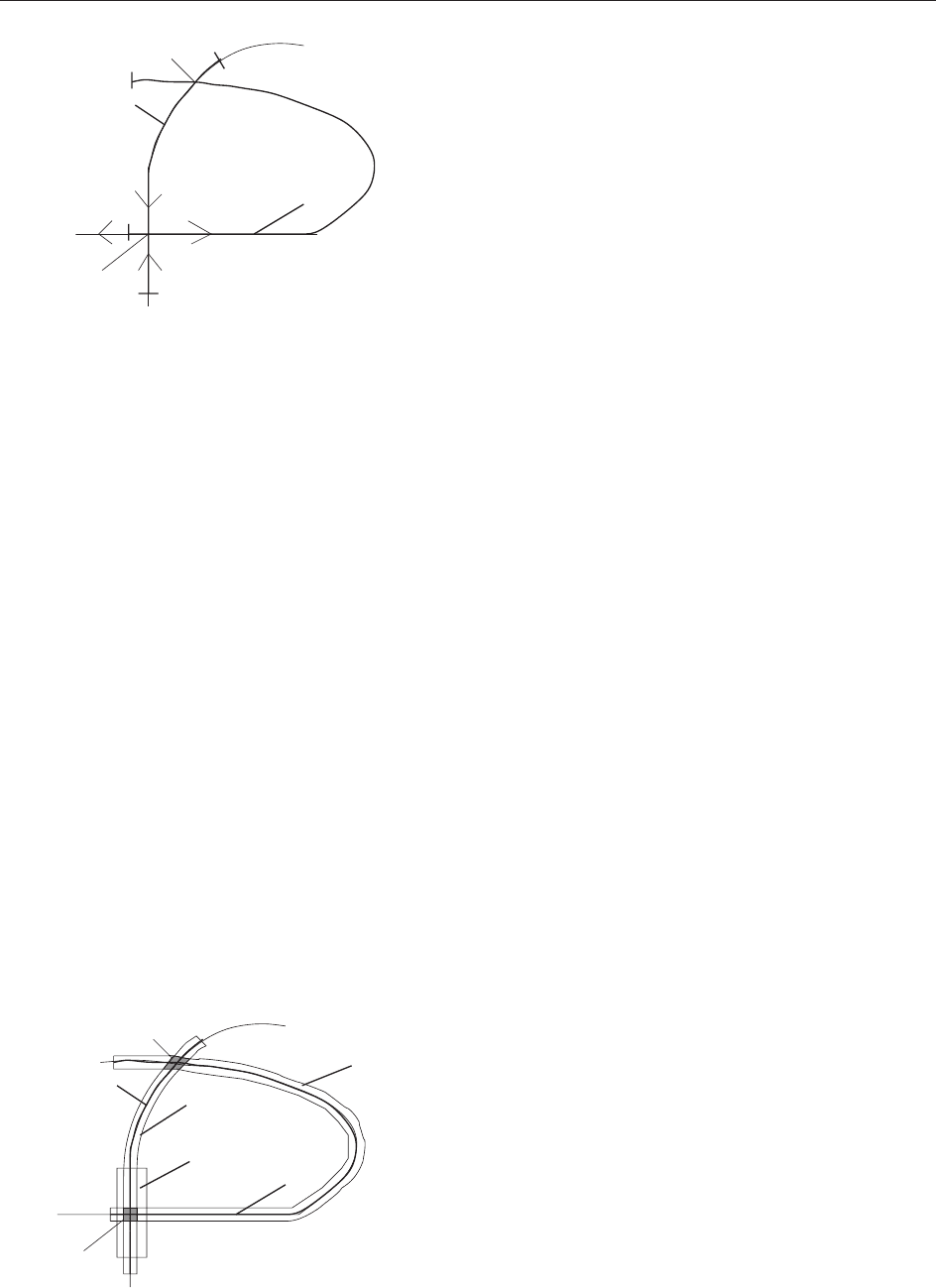
Take compact arcs I
1
W
s
(p) and I
2
W
u
(p)
both containing the points p and q as in Figure 5.
Let D be a curvilinear rectangle which is a slight
thickening of I
1
. The forward iterates f
i
(D) will stay
near I
1
for a while and then start to approach I
2
.
If we choose D appropriately, we can arrange for
some high iterate f
N
(D) to be a slight thickening
of I
2
as in Figure 6. This looks geometrically like the
horseshoe map. Let A
1
be the connected component
of the intersection D
T
f
N
(D) containing p, and let
A
2
be the connected component of the intersection
D
T
f
N
(D) containing q. These sets (which are
shaded in Figure 6) play the role of the rectangles
R
1
and R
2
, respectively, in the horseshoe construc-
tion. We use the set A
1
S
A
2
for U in Theorem 1.
The He´ non Family
To give explicit formulas for the horseshoe map
above is somewhat tedious, and it is of interest to
note that similar properties occur in maps with
simple formulas. Indeed, such properties occur quite
often in a well-known family of maps known as the
‘‘He´non family.’’ As we have mentioned, the map in
Figure 1 provides an example.
One may simply define a He´non map as a
diffeomorphism H = (H
1
(x, y), H
2
(x, y)) with inverse
G(x, y) = (G
1
(x, y), G
2
(x, y)) such that all the maps
F
i
(x, y), G
i
(x, y) are polynomials of degree at most
two. It is known (see, e.g., Friedland and Milnor
(1989)) that such maps H have constant Jacobian
determinant, and, up to affine conjugacy, may be
represented in the form H = H
a, b
(x, y) = (a x
2
by, x)witha, b constants and b 6¼0. This makes
sense when all the terms are real or complex. In the
real case, we speak of the real He´non family and,
in the complex case, we speak of the complex
He´non family.
The real He´non family was first presented by the
physicist M He´non in 1976 as perhaps the simplest
nonlinear diffeomorphism of the plane exhibiting a
so-called ‘‘strange attractor.’’ These mappings in the
real and complex cases have been the focus of much
attention. Our interest here is that, at least for
certain parameters a, b, they provide concrete
globally defined maps whose dynamics are analo-
gous to that of the horseshoe diffeomorphism. In
fact, Devaney and Nitecki (1979) pro ved (in the real
case) that for fixed b 6¼0, there is a constant a
0
> 0
such that if a > a
0
, then the set B
a, b
of bounded
orbits of H
a, b
is a compact zero-dimensional set and
the pair (H
a, b
, B
a, b
) is topologically conjugate to
(,
2
). In addition, it can be shown that the
invariant set B
a, b
is a single hyperbolic h-closure.
Analogous results are true for the complex He´non
family and proofs were originally given in the thesis
of Ralph Oberste–Vorth (unpublished) under the
supervision of John Hubbard at Cornell University.
More recent proofs are in Newhouse (2004) and
Hruska (2004). Many interesting results have been
obtained for the complex He´non map by Bedford
and Smillie and Sibony and Fornaess (see the
references in Hruska (2004).
Homoclinic Points in Systems with
Positive Topological Entropy
There is an invariant of topological conjugacy which is
known as the topological entropy. In a certain sense,
this gives a quantitative measurement of the amount of
complicated or chaotic motion in the system.
p
q
I
1
I
2
Figure 5 The curves I
1
W
s
(p) and I
2
W
u
(p).
D
f
N
(D)
f(D)
A
2
I
1
A
1
I
2
Figure 6 The curvilinear rectangle D and its N th iterate f
N
(D)
are geometrically like the horseshoe map.
676 Homoclinic Phenomena
Let f : X !X be a continuous self-map of the
compact metric space (X, d). For a positive integer
n > 0, we define an n-orbit to be a finite sequence
O(x, n) = {x, f (x), ..., f
n1
(x)}. Given a positive real
number >0, we say that two n-orbits O(x, n) and
O(y, n) are ‘‘-distinguishable’’ if there is a 0 j < n
such that d(f
j
x, f
j
y) >. Another way to look at this
is the following. Define the so-called d
n
-metric on X
by setting d
n
(x, y) = max
0j<n
d( f
j
x, f
j
y). Then, the
two n-orbits O(x, n), O(y, n) are -distinguishable if
and only if d
n
(x, y) >. It follows from compactness
of X and the uniform continuity of each of the
maps f
j
,0 j < n, that the number r(n, , f )of
-distinguishable n-orbits is finite for each given >0
and each positive integer n. We define the number
hðf Þ¼lim
!0
lim sup
n!1
1
n
log rðn;;f Þ
This means that, for some sequence of inte-
gers n
1
< n
2
< ..., the map f has roughly e
n
i
h(f )
-distinguishable n
i
-orbits for i large and small.
The number h(f ) is called the topological entropy
of the map f. It may be infinite for homeomorph-
isms, but it is always finite for smooth maps on
finite-dimensional manifolds. The number h(f ) has
many nice properties. For instance, h(f
N
) = Nh(f )
for every positive integer N, and, if f is a homeo-
morphism, then h(f
1
) = h(f ). Further, if f and g are
topologically conjugate, then h(f ) = h(g). The so-
called ‘‘variational principle for topological
entropy’’ asserts that h(f ) is the supremum of the
measure-theoretic entropies of the invariant prob-
ability measures for f. Our interest in this invariant
here is the following theorem of Katok.
Theorem 2(Katok). Let f be a C
2
diffeomorphism
of a compact two-dimensional manifold M to itself
with positive topological entropy. Then, f has
transverse homoclinic points.
In fact, Katok extended this theorem (see the
supplement in Hasselblatt and Katok (1995)) to
show that, if h(f ) > 0 and >0, then there is a
compact zero-dimensional hyperbolic ba sic set for
h such that h(f , ) > h(f ) . Thus, one can find
nice invariant topologically transitive sets for f (i.e.,
sets with dense orbits) on which the topological
entropies of restriction of f are arbitrarily close to
that of f.
This theorem has the interesting consequence that
the map f !h(f ) is lower-semicontinuous on the
space of C
2
diffeomorphisms of a surface. It was
proved in Newhouse (1989) (and, independently by
Yomdin (1987)) that the map f !h( f ) is upper-
semicontinuous on the space of C
1
diffeomorphisms
of any compact manifold. Combining these results
gives the theorem that the map f !h(f ) is contin-
uous on the space of C
1
diffeomorphisms on a
compact surface, and that positivity of h( f ) implies
the existence of transverse homoclinic points.
It is also worth noting that, for any continuous
self-map f : M !M on a compact manifold M, one
has the inequality h(f ) log jj where is the
eigenvalue of largest norm of the induced map f
?
on the first real homology group (Manning 1975).
Putting this together with Theorem 2 gives the fact
that there are whole homotopy classes of diffeo-
morphisms on surfaces all of whose elements have
transverse homoclinic points. For instance, consider
a2 2 matrix
L ¼
ab
cd
with integer entries, determinant 1, and eigenvalues
1
,
2
with 0 < j
1
j < 1 < j
2
j. Let
~
L : T
2
!T
2
be
the induced diffeomorphism on the two-dimensional
torus T
2
. This is an example of what is called an
‘‘Anosov’’ diffeomorphism. In this case the number
above is simply
2
, and this holds for any
diffeomorphism f of T
2
which can be continuously
deformed into
~
L. Hence, any such f must have
transverse homoclinic points.
Homoclinic Tangencies
Let {f
, 2[0, 1]} be a parametrized family of C
r
diffeomorphisms of the plane with an external
parameter. It frequently occurs that there is a
hyperbolic saddle fixed point p
for each parameter
moving continuously with such that, at some
value
0
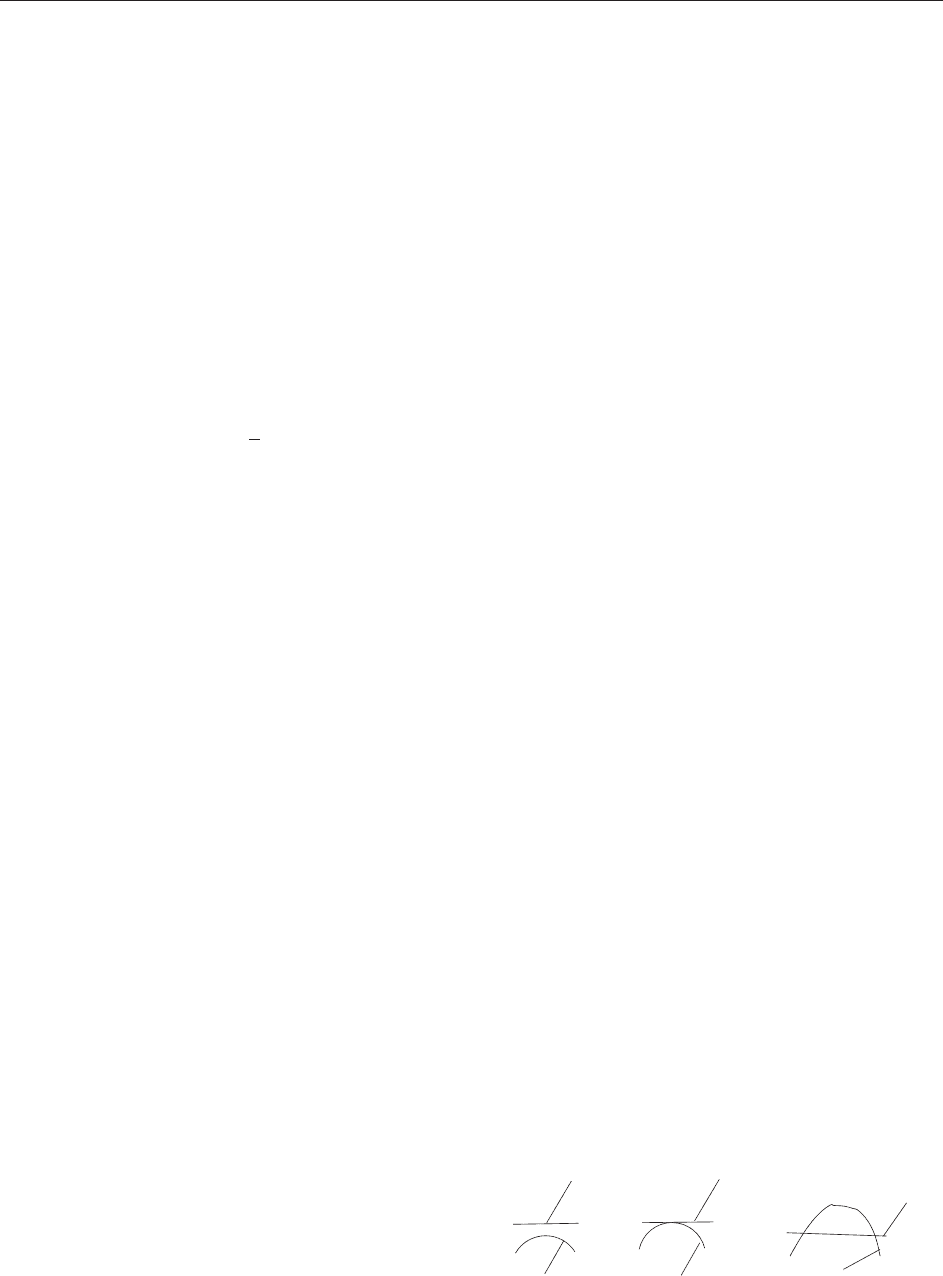
, a homoclinic tangency is created at a point
q
0
. This means that there are an >0, a small
neighborhood U of q
0
, and curves
u
W
u
(p
),
s
W
s
(p
) such that
s
T
u
= ; for
0
<<
0
,
s
0
T
u
0
= {q
0
}, and
s
T
u
consists of two
distinct points for
0
<<þ . In most cases,
the tangency of
u
0
and
s
0
at q
0
will be of the
second order, and we will assume that occurs here.
The geometry is as in Figure 7.
λ < λ
0
γ
u
γ
s
λ = λ
0
γ
s
γ
u
λ > λ
0
γ
s
γ
u
Figure 7 Creation of a homoclinic tangency.
Homoclinic Phenomena 677

The creation of homoclinic tangencies is part of
the general subject of ‘‘homoclinic bifurcations.’’ A
recent survey of this subject is in the book by
Bonatti et al. (2005). Typical results are the
following. If p = p
0
is a saddle fixed point whose
derivative is area-decreasing (i.e., jDet(Df (p))j < 1),
then there are infinitely many parameters near
0
for which each transverse homoclini c point of p
is a
limit of periodic sinks (asymptotically stable peri-
odic orbits) (Newhouse 1979, Robinson 1983). In
addition, so-called strange attractors and SRB
measures appear (Mora and Viana 1993).
Finally, we mention that recently it has been
shown that, generically in the C
r
topology for r 2,
homoclinic closures associated to a homoclinic
tangency (in dimension 2) have maximal Hausdorff
dimension (Theorem 1.6 in Downarowicz and
Newhouse (2005)).
See also: Chaos and Attractors; Fractal Dimensions in
Dynamics; Generic Properties of Dynamical Systems;
Hyperbolic Dynamical Systems; Lyapunov Exponents
and Strange Attractors; Saddle Point Problems;
Singularity and Bifurcation Theory; Solitons and Other
Extended Field Configurations.
Further Reading
Birkhoff GD (1960) Nouvelles recherches sur les syste` mes
dynamiques. In: George David Birkhoff, Collected Mathema-
tical Papers, Vol. II, pp. 620–631. New York: American
Mathematical Society.
Bonatti C, Diaz L, and Viana M (2005) Dynamics Beyond
Uniform Hyperbolicity, Encyclopedia of Mathematical
Sciences, Subseries: Mathematical Physics III, vol. 102,
Berlin–Heidelberg–New York: Springer.
Devaney R and Nitecki Z (1979) Shift automorphism in the
henon mapping. Communications in Mathematical Physics 67:
137–148.
Downarowicz T and Newhouse S (2005) Symbolic extensions in
smooth dynamical systems. Inventiones Mathematicae 160(3):
453–499.
Friedland S and Milnor J (1989) Dynamical properties of plane
polynomial automorphisms. Ergodic Theory and Dynamical
Systems. 9: 67–99.
Guckenheimer J and Holmes P (1983) Nonlinear Oscillations,
Dynamical Systems, and Bifurcation of Vector Fields, Applied
Mathematical Sciences, vol. 42, New York: Springer.
Hasselblatt B and Katok A (1995) Introduction to the Modern
Theory of Dynamical Systems, Encyclopedia of Mathematics
and Its Applications, vol. 54, Cambridge: Cambridge
University Press.
Hruska SL (2004) A numerical method for proving hyperbolicity
in complex he´non mappings (http://arxiv.org).
Manning A (1975) Topological entropy and the first homology
group. In: Manning A (ed.) Dynamical Systems – Warwick
1974, Lecture Notes in Math. vol. 468, pp. 567–573. New
York: Springer.
Moser J (1973) Stable and Random Motions in Dynamical
Systems, Annals of Mathematical Studies, Number 77.
Princeton: Princeton University Press.
Mora L and Viana M (1993) Abundance of strange attractors.
Acta Mathematica 171: 1–71.
Newhouse S (1979) The abundance of wild hyperbolic sets and
non-smooth stable sets for diffeomorphisms. Publications
Mathe´matiques de l’I.H.E.S. 50: 101–151.
Newhouse S (1980) Lectures on dynamical systems. In: Coates J
and Helgason S (eds.) Dynamical Systems, CIME Lectures,
Bressanone, Italy, June 1978, Progress in Mathematics, vol. 8,
pp. 1–114. Cambridge, MA: Birkha¨user.
Newhouse S (1989) Continuity properties of entropy. Annals of
Mathematics 129: 215–235.
Newhouse S (2004) Cone-fields, domination, and hyperbolicity.
In: Brin M, Hasselblatt B, and Pesin Y (eds.) Modern
Dynamical Systems and Applications, pp. 419–432.
Cambridge: Cambridge University Press.
Nusse HE and Yorke JA (1998) Dynamics: Numerical Explora-
tions. Applied Mathematical Sciences, vol. 101, New York:
Springer.
Poincare´ H (1899) Les methodes nouvelles de la Mecanique
Celeste–Tome 3. Guathier-Villars, Original publication (New
Printing: Librairie Scientifique et Technique Albert Blanchard
9, Rue Medecin 75006, Paris, 1987).
Robinson C (1983) Homoclinic bifurcation to infinitely many
sinks. Communications in Mathematical Physics 90: 433–459.
Robinson C (1999) Dynamical Systems, Stability, Symbolic
Dynamics, and Chaos
, Studies in Advanced Mathematics,
2nd edn. New York: CRC Press.
Yomdin Y (1987) Volume growth and entropy. Israel Journal of
Mathematics 57: 285–300.
Hopf Algebra Structure of Renormalizable Quantum Field Theory
D Kreimer, IHES, Bures-sur-Yvette, France
ª 2006 Elsevier Ltd. All rights reserved.
Overview
Renormalization theory is a venerable subject put to
daily use in many branches of physics. Here, we
focus on its applications in quantum field theory,
where a standard perturbative approach is provided
through an expansion in Feynman diagrams. Whilst
the combinatorics of the Bogoliubov recursion,
solved by suitable forest formulas, has been known
for a long time, the subject regained interest on the
conceptual side with the discovery of an underlying
Hopf algebra structure behind these recursions.
Perturbative expansions in quantum field theory
are organized in terms of one-particle irreducible
(1PI) Feynman graphs. The goal is to calculate the
corresponding 1PI Green functions order by order in
the coupling constants of the theory, by applying
Feynman rules to these 1PI graphs of a
678 Hopf Algebra Structure of Renormalizable Quantum Field Theory
renormalizable theory under consi deration. This
allows one to disentangle the problem into an
algebraic part and an analytic part.
For the algebraic part, one studies Feynman graphs
as combinatorial objects which lead to the Lie and
Hopf algebras discussed below. Feynman rules then
assign analytic expressions to these graphs, with the
analytic structure of finite renormalized quantum field
theory largely dictated by the underlying algebra.
The objects of interest in qua ntum field theory are
the 1PI Green functions. They are parametrized by
the quantum numbers – masses, momenta, spin, and
such – of the particles participating in the scattering
process under consideration. We call a set of such
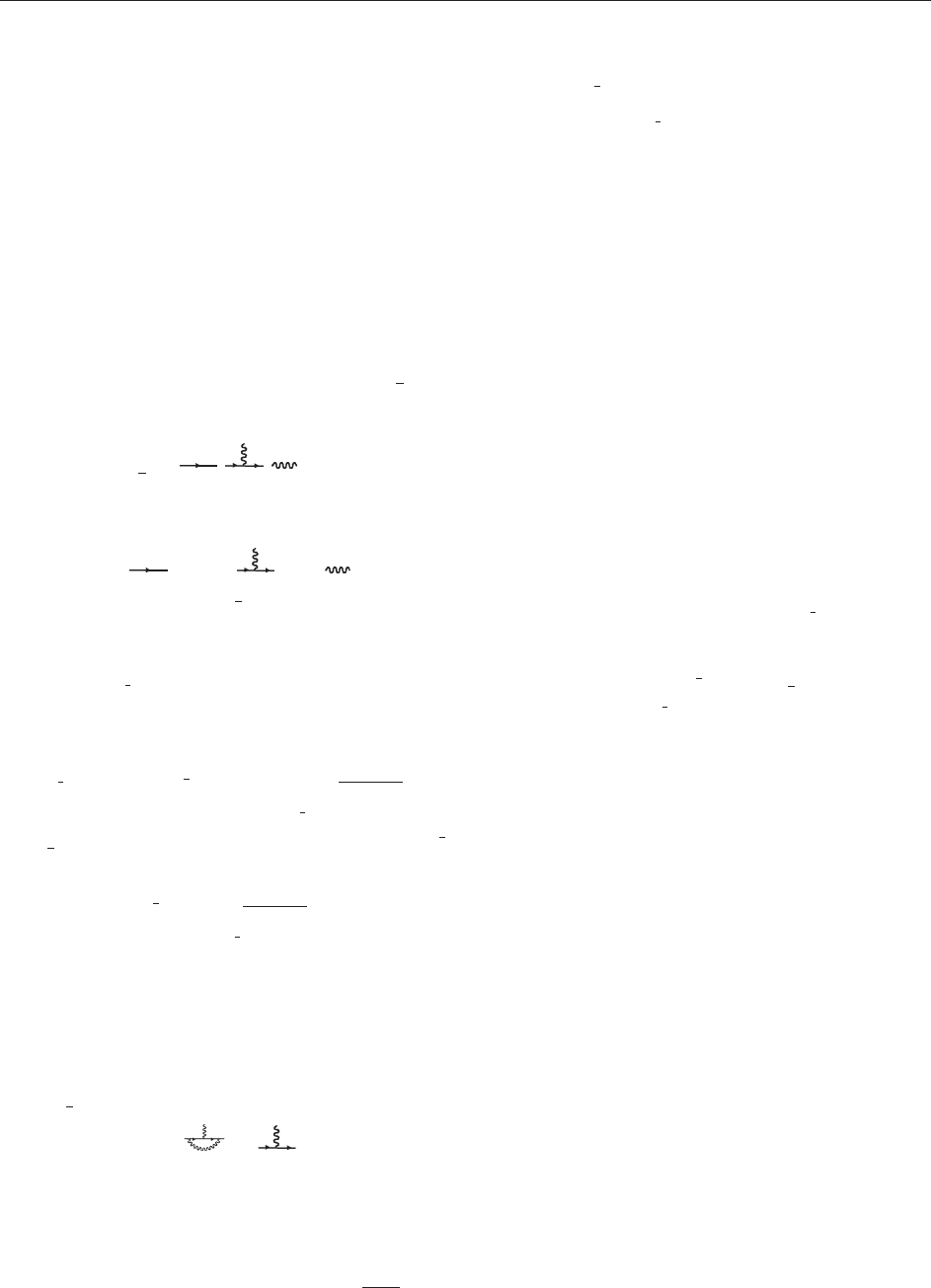
quantum numbers an external leg structure
r. For
example, the three terms in the Lagrangian of
massless quantum electrodynamics correspond to
r 2f ; ; g½1
Note that the Lagrangian L of massless quantum
electrodynamics is obtained accordingly as
L ¼
^
ð
Þ
1
þ
^
ð Þþ
^
ð Þ
1
¼
@ þ
A þ
1
4
F
2
½2
where
ˆ
are coordinate space Feynman ru les.
The renormalized 1PI Green function in momen-
tum space, G
r
R
({g}; {p}, {m}; ), is obtained as the
image under renormalized Feynman rules
R
applied
to a series of graphs:
r
¼ 1 þ
X
1
k¼1
g
k
c
r
k
1 þ
X
resðÞ¼r
g
jj
SymðÞ
½3
Here
r is a given such external leg structure, while c
r
k
is the finite sum of 1PI graphs having k loops,
c
r
k
¼
X
resðÞ¼r
jj¼k
SymðÞ
½4
and 0 < g < 1 is a coupling constant. The general-
ization to the case of several couplings {g} and
masses {m} is stra ightforward. In the above, the sum
is over all 1PI graphs with the same given external
leg structure. We have denoted the map which
assigns
r to a given graph a residue, for example,
resð
Þ¼ ½5
The unrenormalized but regularized Feynman rules
assign to a graph a function
ðÞðfgg; fpg; fmg; ; zÞ
¼
Z
Y
v2
½0
ð4Þ
X
f incident v
k
f
0
@
1
A
Y
e2
½1
int
Propðk
e
Þ
d
4
k
e
4
2
½6
and formally the unrenormalized Green function
G
r
u
ðfgg; fpg; fmg; ; zÞ
¼ ð
r
Þfgg; fpg; fmg; ; zðÞ½7
which is a function of a suitably chosen regulator z.
Note that in [6] the four-dimensional Dirac-
distribution guarantees momentum conservation at
each vertex and restricts the number of four-
dimensional integrations to the number of indepen-
dent cycles in the graph. It is assumed that the
reader is familiar with the readily established fact
that these integrals suffer from UV singularities,
which render the integration over the momenta in
internal cycles ill-defined. We also remind the reader
that the problem persists in coordinate space, where
one confronts the continuation of products of
distributions to regions of coinciding support. We
restrict ourselves here to a discussion of the situation
in momentum space and refer the reader to the
literature for the situation in coordinate space.
Ignoring problems of convergence in the sum over
all graphs, the problem of renormalization is to
make sense of these functions term by term: We
have to determine invertible series Z
r
({g}, z) in the
couplings g such that the modified Lagrangian
~
L ¼
X
r
Z
r
ðfgg; zÞ
^
ðrÞ½8
produces a perturbation series in graphs that allows
for the removal of the regulator z.
This amounts to a transition from unrenorma-
lized to renormalized Feynman rules !
R
.Letus
first describe how this transition is achieved using
the Lie and Hopf algebra struc ture of the per turba-
tive expansion, which is described in detail below:
Decide on the free fields and local interactions of
the theory, appropriately specifying quantum
numbers (spin, mass, flavor, color, and such) of
fields, restricting interactions so as to obtain a
renormalizable theory.
Consider the set of all 1PI graphs with edges
corresponding to free-field propagators. Define
vertices for local interactions. This allows one to
construct a pre-Lie algebra of graph insertions.
Antisymmetrize this pre-Lie product to get a Lie
algebra L of graph insertions and define the Hopf
algebra H which is dual to the enveloping algebra
U(L) of this Lie algebra.
Realize that the coproduct and antipode of this
Hopf algebra give rise to the forest formula,
which generates local counter-terms upon intro-
ducing a Rota–Baxter map, a renormalization
scheme in physicists’ parlance.
Hopf Algebra Structure of Renormalizable Quantum Field Theory 679

Use the Hochschild cohomology of this Hopf
algebra to show that one can absorb singularities
in local counter-terms.
Determine the corepresentations of this Hopf
algebra to identify the sub-Hopf algebras corre-
sponding to time-ordered products in physical
fields. This is most easily achie ved by rewriting
the Dyson–Schwinger equations using Hochschild
1-cocycles.
The last point exhibits close connections, in parti-
cular, between the structure of gauge theories and
the corepresentation theory of their perturbative
Hopf algebras which we discuss below in brief.
This program can be carried out in coordinate
space as well as momentum space renormalization.
It has given a firm mat hematical background to the
process of renormalization, justifying the practice of
quantum field theory. The notion of locality has
achieved a precise formulation in terms of the
Hochschild cohomology of the perturbation expan-
sion. In momentum space, this approach emphasizes
the connections to number theory, which emerge
when one investigates the role of the Hopf algebra
primitives, which in turn furnish the Hochschild
1-cocycles underlying locality.
The next sections describe the above setup in
some detail.
Lie and Hopf Algebras of Graphs
All algebras are supposed to be over some field K of
characteristic zero, associative and unital, and
similarly for coalgebras . The unit (and, by abuse of
notation, also the unit map) will be denoted by I,
the counit map by
e. All algebra homomorphisms
are supposed to be unital. A bialgebra
(A =
L
1
i = 0
A
i
, m, I, ,
e) is called graded connected
if A
i
A
j
A
iþj
and (A
i
)
L
jþk = i
A
j
A
k
, and if
(I) = I I and A
0
= kI,
e(I) = 1 2 K and
e = 0on
L
1
i = 1
A
i
. We call ker
e the augmentation ideal of A
and denote by P the projection A ! ker
e onto the
augmentation ideal, P = id I
e. Furthermore, we
use Sweedler’s notation, (h) =
P
h
0
h
00
, for the
coproduct. We define
Aug
ðkÞ
¼ P P
|fflfflfflfflfflfflfflffl{zfflfflfflfflfflfflfflffl}
k times
0
@
1
A
k1
;
A !fker
eg
k
½9
as a map into the k-fold tensor product of the
augmentation ideal. We let A
(k)
= ker Aug
(kþ1)
=
ker Aug
(k)
, 8 k 1. All bialgebras considered here
are bigraded in the sense that
A ¼
M
1
i¼0
A
ðiÞ
¼
M
1
k¼0
A
ðkÞ
½10
where A
(k)
k
j = 1
A
(j)
for all k 1. A
(0)
’ A
(0)
’ K.
The first construction we ha ve to study is the pre-
Lie algebra structure of 1PI graphs.
The Pre-Lie Structure
For each Feynma n graph we have vertices as well as
internal and external edges. External edges are edges
that have an open end not connect ed to a vertex.
They indicate the particles participating in the
scattering amplitud e under consideration and each
such edge carries the quantum numbers of the
corresponding free field. The internal edges and
vertices form a graph in their own right. For an
internal edge, both ends of the edge are connected to
a vertex.
We consider 1PI Feynman graphs. A graph is
1PI if and only if all graphs, obtained by removal of
any one of its internal edges, are still connected.
Such 1PI graphs are naturally graded by their
number of independent loops, the rank of their
first homology group H
[1]
(, Z). We write jj for
this degree of a graph . Note that jres()j= 0,
where we let res() be the graph obtained when all
edges in
[1]
int
shrink to a point, as before. Note that
the graph obtained in this manner consists of a
single vertex, to which the edges
[1]
ext
are attached.
For a 1PI graph ,
[0]
denotes its set of
vertices and
[1]
=
[1]
int
[
[1]
ext
its set of internal
and external edges. In addition, let !
r
be the
number of spacetime derivatives appearing in the
corresponding monomial in t he Lagrangian.
Having specified free quantum fields and local
interaction terms between them, one im mediately
obtains the set of 1PI graphs. One can then consider
for a given external leg structure
r the set of graphs
with that external leg structure. For a renormaliz-
able theory, we can define a superficial degree of
divergence,
! ¼
X
r2
½1
int
[
½0
!
r
4jH
½1
ð; ZÞj ½11
for each such external leg structure: !() = !(
0
)if
res() = res(
0
); all graphs with the same external leg
structure have the same superficial degree of
divergence, and only for a finite number of distinct
external leg structures
r will this degree indeed
signify a divergence.
This leaves a finite number of external leg structures
to be considered to which we restrict ourselves from
now. Our first observation is that there is a natural
pre-Lie algebra structure on 1PI graphs.
680 Hopf Algebra Structure of Renormalizable Quantum Field Theory
To this end, we define a bilinear operat ion
1
2
¼
X
nð
1
;
2
;Þ ½12
where the sum is over all 1PI graphs .Here,
n(
1
,
2
; ) is a section coefficient which counts
the number of ways in which a subgraph
2
can be
reduced to a point in such that
1
is obtained. The
above sum is evidently finite as long as
1
and
2
are finite graphs, and the graphs which contribute
necessarily fulfill jj= j
1
jþj
2
j and res() = res(
1
).
One then has the following theorem.
Theorem 1 The operation is pre -Lie:
½
1
2
3
1
½
2
3
¼½
1
3
2
1
½
3
2
½13
which is evident when one rewrites the -product in
suitable gluing operations.
To understand this theorem, note that the
equation claims that the lack of associativity in the
bilinear operation is invariant under permutation
of the elements indexed 2, 3. This suffices to show
that the antisymmetrization of this map fulfills a
Jacobi identity. Hence, we get a Lie algebra L by
antisymmetrizing this operation:
½
1
;
2
¼
1
2
2
1
½14
This Lie algebra is graded and of finite dimension in
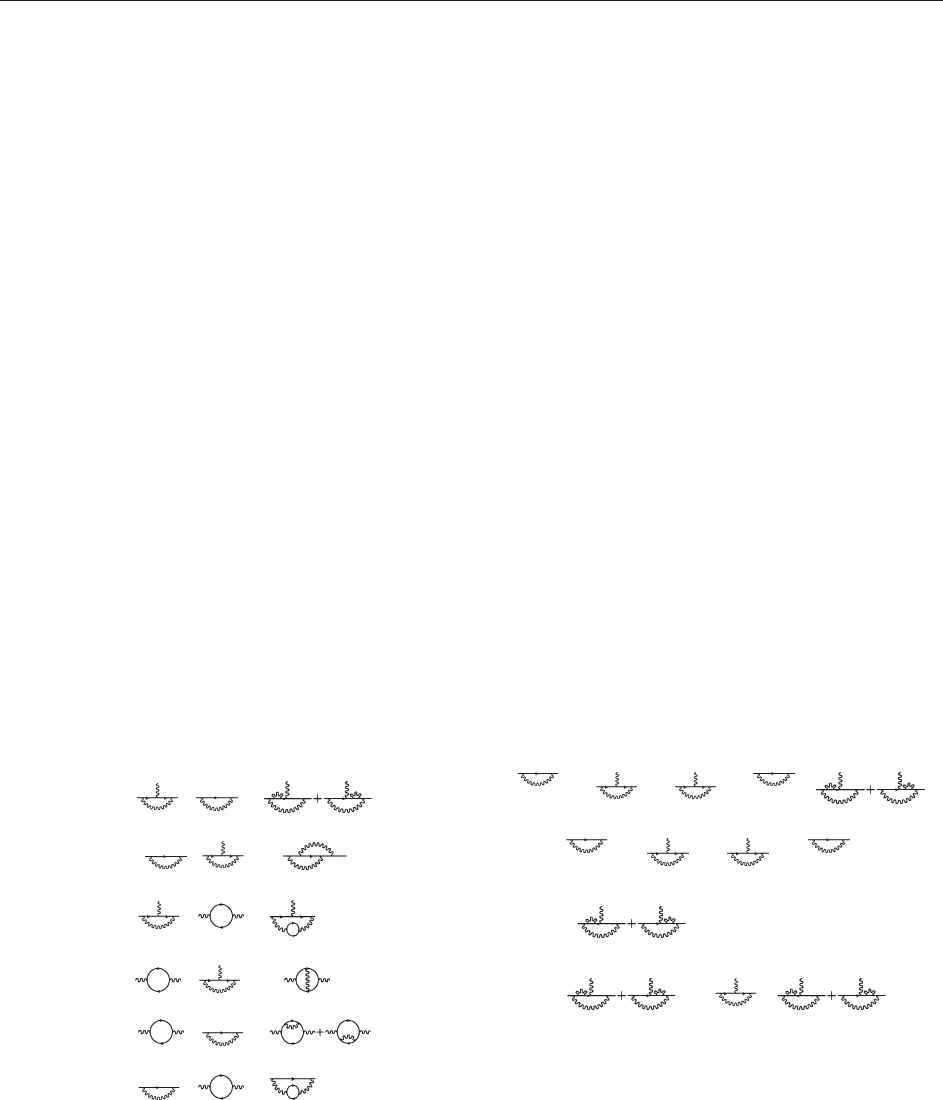
each degree. Let us look at a couple of examples for
pre-Lie products:
¼ ½15
¼2
½16
¼ ½17
¼ 2 ½18
¼ ½19
¼ ½20
Together with L one is led to consider the dual of its
universal enveloping algebra U(L) using the theorem
of Milnor and Moore. For this we use the above
grading by the loop number.
This universal enveloping algebra U(L) is built
from the tensor algebra
T ¼
M
k
T
k
; T
k
¼LL
|fflfflfflfflfflfflfflffl{zfflfflfflfflfflfflfflffl}
k times
½21
by dividing out the ideal generated by the relations
a b b a ¼½a; b2L ½22
Note that in U(L) we have a natural concatenation
product m
. Furthermore, U(L) carries a natural
Hopf algebra structure with this product. For that,
the Lie algebra L furnishes the primitive elements:
ðaÞ¼a 1 þ 1 a; 8 a 2L ½23
It is, by construction, a connected finitely graded
Hopf algebra which is co-commutative but not
commutative. We can then consider its graded
dual, which will be a Hopf algebra H(m, I, ,
e)
that is commutative but not cocommutative. One
finds it upon using a Kronecker pairing
<Z
;
0
> ¼
1; ¼
0
0; else
½24
The space of primitives of U(L) is in one-to-one
correspondence with the set Indec(H) of indecom-
posables of H, which is the linear span of its
generators. One finds the follow ing theorem.
Theorem 2
<Z
1
Z
2
Z
2
Z
1
;
>¼<Z
½
2
;
1
;
> ½25
For example, one finds
Z
Z Z Z ;
*+
¼ Z
Z Z Z ;
!+
¼ Z
Z ;
*+
¼2 ½26
H is a graded commutative Hopf algebra which
suffices to describe renormalization theory, as we
see in the next section. We have formulated it for
the superficially divergent 1PI graphs of the theory
with the understanding that the residues of these
graphs are in one-to-one correspondence with the
terms in the Lagrangian of a given theory. Often,
several terms in a Lagrangian correspond to graphs
with the same number and type of external legs, but
correspond to different form-factor projections of
the graph. In such cases, the above approach can be
easily adopted considering suitably colored or
Hopf Algebra Structure of Renormalizable Quantum Field Theory 681
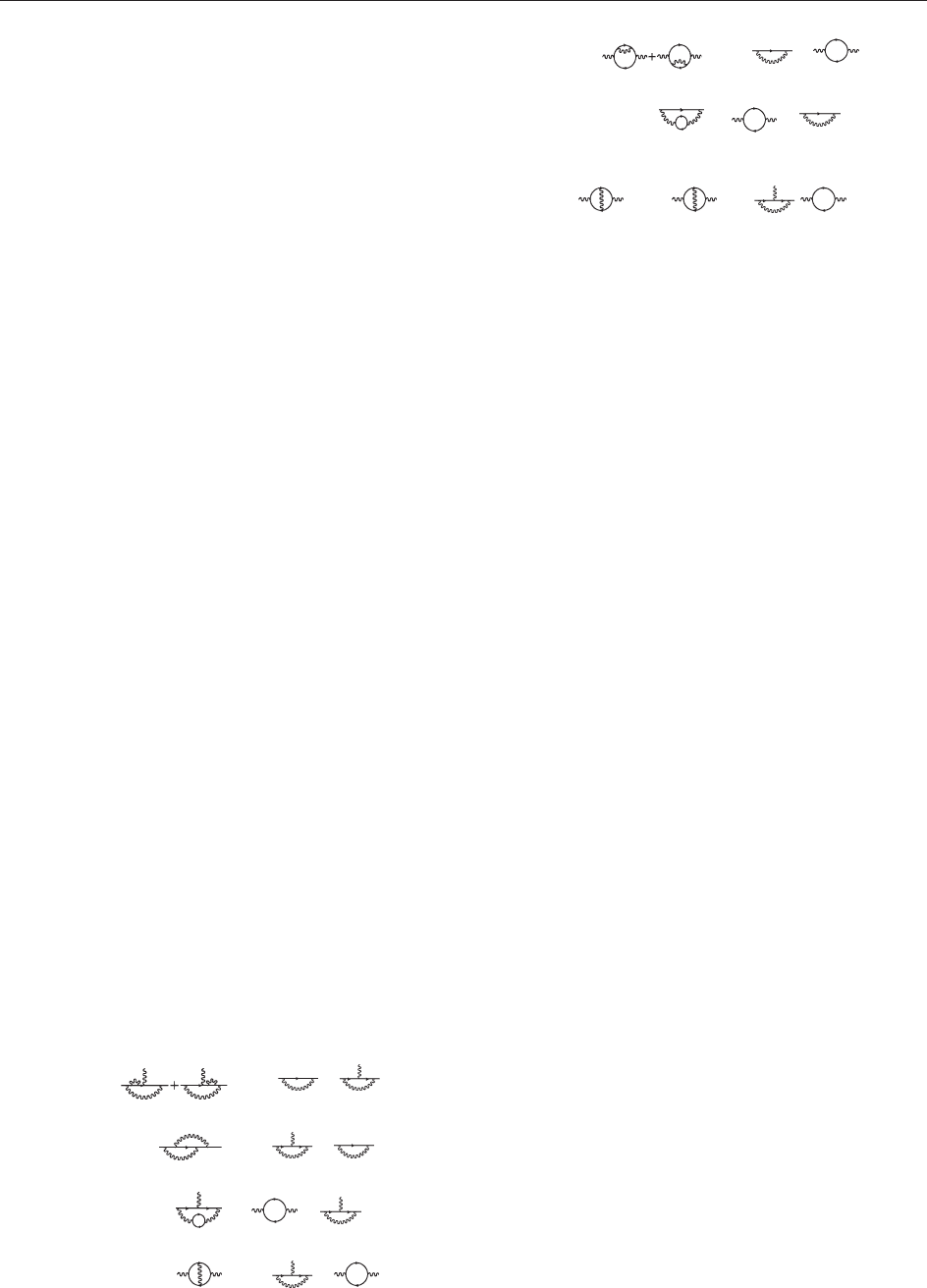
labeled graphs. A similar remark applies if one
desires to incorporate renormalization of super-
ficially convergent Green functions, which requires
nothing more than the consideration of an easily
obtained semidirect product of the Lie algebra of
superficially divergent graphs with the abelian Lie
algebra of superficially convergent graphs.
The Principle of Multiplicative Subtraction
The above algebra structures are available once one
has decided on the set of 1PI graphs of interest. We
now use them toward the renormalization of any
such chosen local quantum field theory.
From the above, 1PI graphs provide the linear
generators
of the Hopf algebra H=
1
i = 0
H
i
,
where H
lin
= span(
) and their disjoint union
provides the commutative product.
Now let be a 1PI graph. We find the Hopf
algebra H as described above to have a coproduct
explicitly given as : H!HH:
ðÞ¼ 1 þ 1 þ
X
= ½27
where the sum is over all unions of 1PI superficially
divergent proper subgraphs, and we extend this
definition to products of graphs so that we get a
bialgebra.
While the Lie bracket inserted graphs into each
other, the coproduct disentangles them. It is th is
latter operation which is needed in renormalization
theory: we have to render each subgraph finite before
we can construct a local counter-term. That is precisely
what the Hopf algebra structure maps do.
Having a coproduct, two further structure maps
of H are immediate: the counit and the antipode.
The counit
e vanishes on any nontrivial Hopf
algebra element,
e(1) = 1,
e(X) = 0. The antipode is
SðÞ¼
X
SðÞ= ½28
We can work out a few coproducts and antipodes as
follows:
Aug
ð2Þ
ð Þ¼2 ½29
Aug
ð2Þ
ð Þ¼2
½30
Aug
ð2Þ
ð Þ¼ ½31
Aug
ð2Þ
ð Þ¼2 ½32
Aug
ð2Þ
ð Þ¼2
½33
Aug
ð2Þ
ð Þ¼ ½34
We give just one example for an antipode:
Sð
Þ¼ þ2 ½35
Note that for each term in the sum
˜
() =
P
i
0
(i)
00
(i)
, we have unique gluing data G
i
such that
¼
00
ðiÞ
G
i
0
ðiÞ
; 8 i ½36
These gluing data describe the necessary bijections
to glue the components
0
(i)
back into
00
(i)
so as to
obtain : using them, we can reassemble the whole
from its parts. Each possible gluing can be inter-
preted as a composition in the insertion operad of
Feynman graphs.
We have by now obtained a Hopf algebra
generated by combinatorial elements, 1PI Feynman
graphs. Its existence is automatic from the above
choices of interactions and free fields. What remains
to be done is a structural analysis of these algebras
for the renormalizable theories we are confronted
with in four spacetime dimensions.
The assertion underlying perturbation theory is
the fact that meaningful approximations to physical
observable quantities can be found by evaluating
these graphs using Feynman rules.
First, as disjoint scattering processes give rise to
independent amplitudes, one is led to the study of
characters of the Hopf algebra, maps : H!V such
that m = m
V
( ).
Such maps assign to any element in the Hopf
algebra an element in a suitable target space V.
The study of tree-level amplitudes in lowest-order
perturbation theory justifies assigning to each edge
a propagator and to each elementary scattering
process a vertex, which define the F eynman rules
(res()) and the underlying Lagrangian, on the
level of residues of these very graphs. Graphs are
constructed from edges and vertices which are
provided precisely by the residues of those diver-
gent graphs, hence one is led to assign to each
Feynman graph an evaluation in terms of an
integral over the continuous quantum numbers
assigned to edges or vertices, which leads to the
familiar integrals over momenta in closed loops
mentioned before.
Then, with the Feynman rules providing a
canonical charac ter , we will have to make one
further choice: a renormalization scheme. The need
for such a choice is no surprise: after all we are
eliminating short-distance singularities in the graphs,
682 Hopf Algebra Structure of Renormalizable Quantum Field Theory
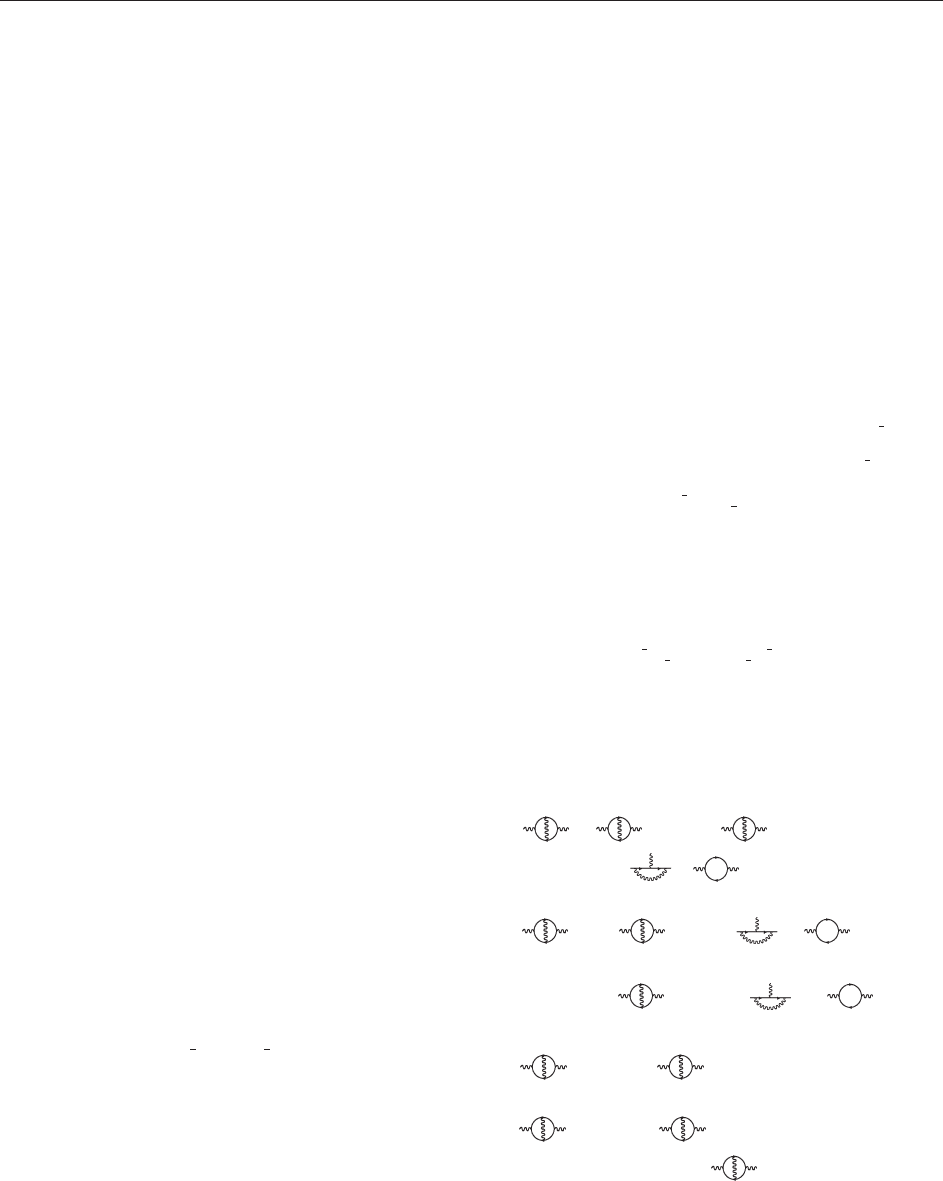
which renders their remaining finite part a mbiguous,
albeit in a most interesting manner.
Hence, we choose a map R : V ! V, from which
we obviously demand that it does not modify the
UV-singular structure, and furthermore that it obeys
RðxyÞþRðxÞRðyÞ¼RðRðxÞyÞþRðxRðyÞÞ ½37
which guarantees the multiplicativity of renormali-
zation and is at the heart of the Birkhoff decom-
position, which emerges below: it tells us that
elements in V split into two parallel subalgebras
given by the image and kernel of R. Algebras for
which such a map exists are known as Rota–Baxter
algebras. The role Rota–Baxter algebras play for
associative algebras is similar to the role Yang–
Baxter algebras play for Lie algebras. The structure
of these algebras allows one to connect renormaliza-
tion theory to integrable systems. In addition, most
of the results obtained initially for a specific
renormalization scheme, such as minimal subtrac-
tion, can also be obtained, in general, upon a
structural analysis of the corresponding Rota–Bax ter
algebras.
To see how all the above comes together in
renormalization theory, we define a further char-
acter S
R
that deforms S slightly and delivers the
counter-term for in the renormalization scheme R:
S
R
ðÞ¼Rm
V
ðS
R
PÞ
¼R½ðÞ R
X
S
R
ðÞð=Þ
"#
½38
which should be compared with the undeformed
S ¼ m
V
ðS PÞ
¼ðÞ
X
SðÞð=Þ½39
The fact that R is a Rota–Baxter map ensures that
S
R
is an element of the charac ter group G of the
Hopf algebra, S
R
2 Spec(G). Note that we have now
determined the modified Lagrangian:
Z
r
¼ S
R
ð
r
Þ½40
The classical results of renormalization theory
follow immediately using this group structure: we
obtain the renormalization of by the application
of a renormalized character
S
R
?ðÞ¼m
V
ðS
R
Þ ½41
and Bogoliubov’s
R operation as
RðÞ¼m
V
ðS
R
Þðid PÞðÞ
¼ ðÞþ
X
S
R
ðÞð=Þ½42
so that
S
R
?ðÞ¼
RðÞþS
R
ðÞ½43
Here, S
R
?is an element in the group of characters
of the Hopf algebra, with the group law given by the
convolution
1
?
2
¼ m
V
ð
1
2
Þ ½44
so that the coproduct, counit, and coinverse (the
antipode) give the product, unit, and inverse of this
group, as befits a Hopf algebra. This Lie group has
the previous Lie algebra L of graph insertions as its
Lie algebra: L exponentiates to G.
What we have achieved above is a local renorma-
lization of quantum field theory. Let M
r
be a
monomial in the Lagrangian L of degree !
r
:
M
r
¼ D
r
fg½45
Then one can prove, using the Hochschild cohomol-
ogy of H:
Theorem 3 (Locality)
Z
r
D
r
fg¼D
r
Z
r
fg½46
that is, renormalization commutes with infinitesimal
spacetime variations of the fields .
We can now work out the renormalization of a
Feynman graph :
ð
Þ¼ I þI
þ2 ½47
ð
Þ¼ð Þþ2S
R
ð Þð Þ½48
¼ ð
Þ2R ð Þ
hi
ð Þ½49
S
R
ð Þ¼R
ð Þ
½50
R
ð ÞS
R
?
¼½id R
ð
Þ
½51
The formulas [47]–[51] are given in their recursive
form. Zimmermann’s original forest formula solving
this recursion is obtain ed when we trace our
considerations back to the fact that the coproduct
can be written in nonrecursive form as a sum over
forests, and similarly for the antipod e.
Hopf Algebra Structure of Renormalizable Quantum Field Theory 683
Diffeomorphisms of Physical Parameters
In the above, we have effectively obtained a Birkhoff
decomposition of the Feynman rules 2 Spec(G)
into two characters –
R
þ
= S
R
?2 Spec(G)and
R
= S
R
2 Spec(G) – for any Rota–Baxter map R.
Thanks to Atkinson’s theorem, this is possible for
any renormalization scheme R. For the minimal
subtraction scheme, it amounts to the decomposi-
tion of the Laurent series ()(), which has poles of
finite order in the regulator , into a part holo-
morphic at the origin and a part holom orphic at
complex infini ty. This has a particularly nice
geometric interpretation upon considering the
Birkhoff decomposition of a loop around the origin,
providing the clutching da ta for the two half-spheres
defined by that very loop.
Whilst in this manner a satisfying understanding
of perturbative renormalization is obtained, the
character group G remains rather poorly under-
stood. On the other hand, renormalization can be
captured by the study of diffeomorphisms of
physical parameters as, by definition, the range of
allowed modification in renormalization theory is
determined by the variation of the coefficients of
monomials
ˆ
(
r) of the underlying Lagrangian
L ¼
X
r
Z
r
^
ð
rÞ½52
Thus, one desires to obtain the whole Birkhoff
decomposition at the level of diffeomorphisms of the
coupling constants.
The crucial step toward that goal is to realize the
role of a standard quantum field-theoretic formula
of the form
g
new
¼ g
old
Z
g
½53
where
Z
g
¼
Z
v
Q
e2resðvÞ
½1
ext
ffiffiffiffiffiffi
Z
e
p
½54
for some vertex v, which obtains the new coupling
in terms of a diffeomorphism of the old. This
formula provides, indeed, a Hopf algebra homo-
morphism from the Hopf algebra of diffeomorph-
isms to the Hopf algebra of Feynman graphs,
regarding Z
g
(a series over counter-terms for all
1PI graphs with the external leg structure corre-
sponding to the coupling g), in two different ways: it
is, at the same time, a formal diffeomorphism in the
coupling constant g
old
and a formal series in Feyn-
man graphs. As a consequence, there are two
competing coproducts acting on Z
g
. That both give
the same result defines the required homomorphism,
which transposes to a homomorphism from the
largely unknown group of characters of H to the
one-dimensional diffeomorphisms of this coupling.
In summary, one finds that a couple of basic
facts enable one to make a transition from the
abstract group of characters of a Hopf algebra of
Feynman graphs (which, incidentally, equals the Lie
group assigned to the Lie algebra with universal
enveloping algebra the dual of this Hopf algebra) to
the rather concrete group of diffeomorphisms of
physical observables. These steps are given as
follows:
Recognize that Z factors are given as cou nter-
terms over a formal series of graphs starting with
1, graded by powers of the coupling, hence
invertible.
Recognize the series Z
g
as a formal diffeomorph-
ism, with Hopf algebra coefficients.
Establish that the two competing Hopf algebra
structures of diffeomorphisms and graphs are
consistent in the sense of a Hopf algebra
homomorphism.
Show that this homomorphism transposes to a Lie
algebra and hence Lie group homom orphism.
The effective coupling g
eff
(") now allows for a
Birkhoff decomposition in the space of formal
diffeomorphisms.
Theorem 4 Let the unrenormalized effective cou-
pling constant g
eff
(") viewed as a formal power
series in g be considered as a loop of formal
diffeomorphisms and let g
eff
(") = (g
eff
)
1
(") g
eff
þ
(")
be its Birkhoff decomposition in the group of formal
diffeomorphisms. Then the loop g
eff
(") is the bare
coupling constant and g
eff
þ
(0) is the renormalized
effective coupling.
The above results hold as they stand for any
massless theory which provides a single coupling
constant. If there are multiple interaction terms
in the Lagrangian, one finds similar results relat-
ing the group of characters of the corresponding
Hopf algebra to the group of formal diffeomorph-
isms in the multidimensional space of coupling
constants.
The Role of Hochschild Cohomology
The Hochs child cohomology of the combinatorial
Hopf algebras which we discuss here plays three
major roles in quantum field theory:
1. it allows one to prove locality from the accom-
panying filtration by the augmentation degree
coming from the kernels ker Aug
(k)
;
684 Hopf Algebra Structure of Renormalizable Quantum Field Theory
2. it allows one to write the quantum equations of
motion in terms of the Hopf algebra primitives,
elements in H
lin
\ { ker Aug
(2)
=ker Aug
(1)
}; and
3. it identifies the relevant sub-Hopf algebras
formed by time-ordered products.
Before we discuss these properties, let us first
introduce the relevant Hochs child cohomology.
Hochschild Cohomology of Bialgebras
Let (A, m, I, , ) be a bialgebra, as before. We
regard linear maps L : A !A
n
as n-cochains and
define a coboundary map b, b
2
= 0by
bL :¼ðid LÞ þ
X
n
i¼1
ð1Þ
i
i
L
þð1Þ
nþ1
L I ½55
where
i
denotes the coproduct applied to the ith
factor in A
n
, which defines the Hochschild coho-
mology of A.
For the case n = 1, for L : A !A, [55] reduces to
bL ¼ðid LÞ L þ L I ½56
The category of objects (A, C), which consists of
a commutative bialgebra A and a Hochschild
1-cocycle C on A, has an initial object (H
rt
, B
þ
),
where H
rt
is the Hopf algebra of (nonplanar) rooted
trees, and the closed but nonexact 1-cocycle B
þ
grafts a product of rooted trees together at a new
root as described below.
The higher (n > 1) Hochschild cohomology of H
rt
vanishes, but in what follows, the closedness of B
þ
will turn out to be crucial.
The Hopf Algebra of Rooted Trees
A rooted tree is a simply connected contractible
compact graph with a distinguished vertex, the root.
A forest is a disjoint union of rooted trees.
Isomorphisms of rooted trees or forests are iso-
morphisms of graphs preserving the distinguished
vertex/vertices. Let t be a rooted tree with root o.
The choice of o determines an orientation of the
edges of t, away from the root, say. Forests are
graded by the number of vertices they contain.
Let H
rt
be the free commutative algebra generated
by rooted trees. The commutative product in H
rt
corresponds to the disjoint union of trees, such
that monomials in H
rt
are scalar multiples of forests.
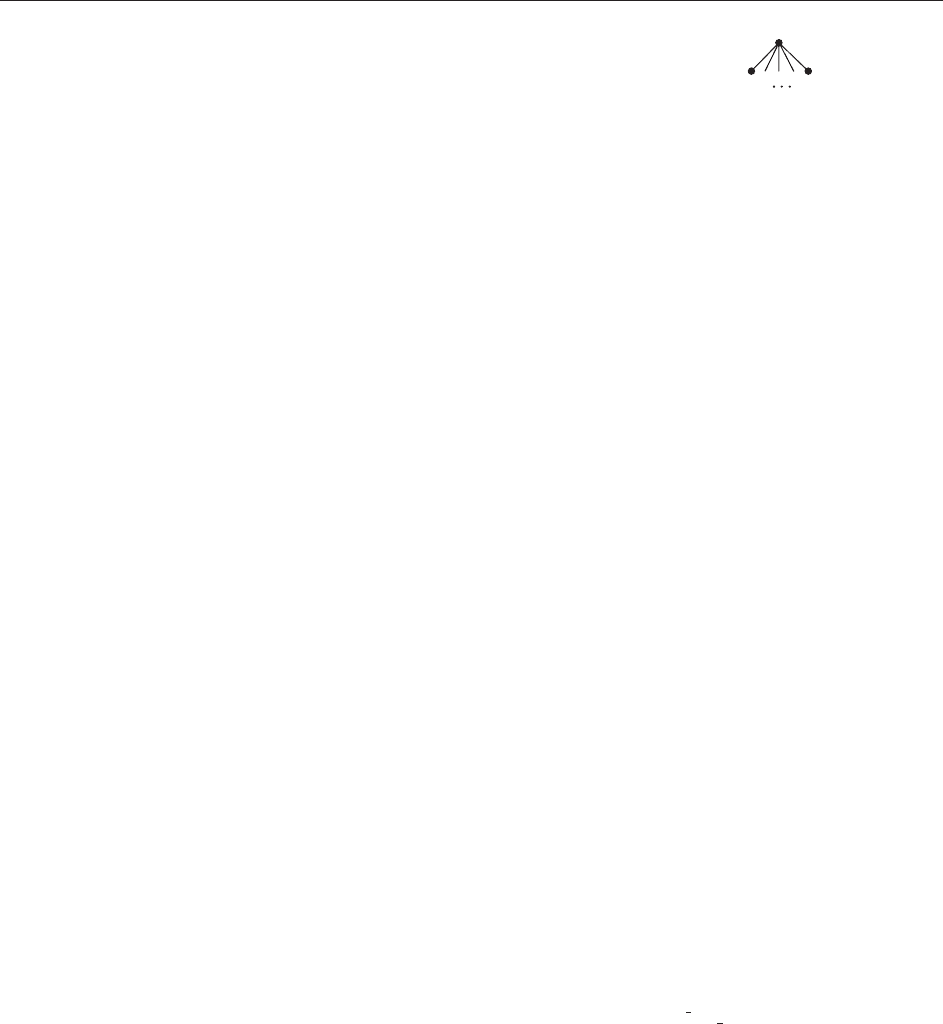
We demand that the linear operator B
þ
on H
rt
,
defined by
B
þ
ðIÞ¼ ½57
B
þ
ðt
1
...t
n
Þ¼
t
n
t
1
½58
is a Hochschild 1-cocycle, which makes H
rt
a Hopf
algebra. The resulting coproduct can be described as
follows:
ðtÞ¼I t þ t I þ
X
adm c
P
c
ðtÞR
c
ðtÞ½59
where the sum goes over all admissible cuts of the
tree t. Such a cut of t is a nonempty set of edges of t
that are to be removed. The forest which is
disconnected from the root upon removal of those
edges is denoted by P
c
(t) and the part which remains
connected to the root is denoted by R
c
(t). A cut c(t)
is admissible if, for each vertex l of t, it contains at
most one edge on the path from l to the root.
This Hopf algebra of nonplanar rooted trees is the
universal object after which all such commutative
Hopf algebras H providing pairs (H, B), for B a
Hochschild 1-cocycle, are formed.
Theorem 5 The pair (H
rt
, B
þ
), unique up to
isomorphism, is universal among all such pairs. In
other words, for any pair (H, B) where H is a
commutative Hopf algebra and B a closed nonexact
1-cocycle, there exists a unique Hopf algebra
morphism H
rt
!
H such that B = B
þ
.
This theorem suggests that we investigate the
Hochschild cohomology of the Hopf algebras of 1PI
Feynman graphs. It clarifies the struc ture of 1PI
Green functions.
The Roles of Hochschild Cohomology
The Hochschild cohomology of the Hopf algebras of
1PI graphs sheds light on the structure of 1PI Green
function in at least four different ways:
it gives a coherent proof of locality of counter-
terms – the very fact that
½Z
r
; D
r
¼0 ½60
means that the coefficients in the Lagrangian
remain independent of momenta, and hence the
Lagrangian remains a polynomial expression in
fields and their derivatives;
the quantum equation of motions takes a very
succinct form, identifying the Dyson kernels with
the primitives of the Hopf algebra;
sub-Hopf algebras emerge from the study of the
Hochschild cohomology, which connects the repre-
sentation theory of these Hopf algebras to the
structure of theories with internal symmetries; and
these Hopf algebras are intimately connected to
the structure of transcendental functions, such as
Hopf Algebra Structure of Renormalizable Quantum Field Theory 685