
Francoise J.-P., Naber G.L., Tsun T.S. (editors) Encyclopedia of Mathematical Physics
Подождите немного. Документ загружается.


the generalized polylogarithms, which play a
prominent role these days ranging from applied
particle physics to recent developments in
mathematics.
To determine the Hochschild 1-cocycles of some
Feynman graph Hopf algeb ra H, one determines
first the primitives graphs of the Hopf algebra,
which, by definition, fulfill the cond ition
ðÞ¼ I þ I ½61
Using the pre-Lie product above, one then deter-
mines the maps
B
þ
: H!H
lin
½62
such that
B
þ
ðhÞ¼B
þ
ðhÞI þ id B
þ
ðÞðhÞ½63
where B
þ
(h) =
P
n(, h, ). The coefficients
n(, h, ) are closely related to the section coeffi-
cients noted earlier.
Using the definition of the Bogoliubov map
, this
immediately shows that
S
R
ðB
þ
ðhÞÞ ¼
Z
D
G
i
R
ðhÞ½64
which proves locality of counter-terms upon recog-
nizing that B
þ
increases the augmentation degree.
Here, the insertion of the functions for the subgraph
is achieved using the relevant gluin g data of [36].
To recover the quantum equation of motions from
the Hochschild cohomology, one proves that
r
¼ 1 þ
X
g
SymðÞ
B
þ
ðX
Þ½65
where
X
¼
Y
e2
½1
int
Y
v2
½0
v
e
½66
has the required solution. Upon application of the
Feynman rules, the maps B
þ
turn into the integral
kernels of the usual Dyson–Schwinger equations.
This allows for new nonpe rturbative approaches
which are a current theme of investigation.
Finally, we note that the 1-cocycles introduced
above allow one to determine sub-Hopf algebras of
the form
ðc
r
n
Þ¼
X
Pðfc
s
j
gÞ c
r
j
½67
where the c
s
j
are defined in eqn [3]. These algebras
do not necessitate the considerations of single
Feynman graphs any longer, but allow one to
establish renormalization directly for the sum of all
graphs at a given loop order. Hence, they establish a
Hopf algebra structure on time-ordered products in
momentum space. For theories with internal sym-
metries, one expects and indeed finds that the
existence of these subalgebras establishes relations
between graphs that are same as the Slavnov–Taylor
identities between the couplings in the Lagrangian.
Outlook
Thanks to the Hopf and Lie algebra structures
described above, quantum field theory has started to
reveal its internal mathematical structure in recent
years, which connects it to a motivic theory and
arithmetic geometry. Conceptually, quantum field
theory has been the most sophisticated means by
which a physicist can describe the character of the
physical law. We have slowly begun to under-
standing that, in its short–distance singularities, it
encapsulates concepts of matching beauty. We can
indeed expect local point-particle quantum field
theory to remain a major topic of mathematical
physics investigations in the foreseeable future.
See also: Bicrossproduct Hopf Algebras and
Noncommutative Spacetime; Exact Renormalization
Group; Hopf Algebras and q-Deformation Quantum
Groups; Number Theory in Physics; Operads;
Perturbation Theory and Its Techniques;
Renormalization: General Theory; von Neumann
Algebras: Introduction, Modular Theory, and
Classification Theory.
Further Reading
Bloch S, Esnault H, and Kreimer D (2005) On Motives associated
to graph polynomials.
Connes A and Kreimer D (1998) Hopf algebras, renormalization
and noncommutative geometry. Communications in Mathe-
matical Physics 199: 203 (arXiv:hep-th/9808042).
Connes A and Kreimer D (2001) Renormalization in quantum
field theory and the Riemann–Hilbert problem. II: The
beta-function, diffeomorphisms and the renormalization
group. Communications in Mathematical Physics 216: 21 5
(arXiv:hep-th/0003188).
Connes A and Marcolli M (2004) From physics to number theory
via noncommutative geometry. II: Renormalization, the
Riemann–Hilbert correspondence, and motivic Galois theory,
arXiv:hep-th/0411114.
Kreimer D (2003) New mathematical structures in renormaliz-
able quantum field theories. Annals of Physics 303: 179
(arXiv:hep-th/0211136).
Kreimer D (2004) The residues of quantum field theory: numbers
we should know, arXiv:hep-th/0404090.
Kreimer D (2005) Anatomy of a gauge theory.
686 Hopf Algebra Structure of Renormalizable Quantum Field Theory

Hopf Algebras and q-Deformation Quantum Groups
S Majid, Queen Mary, University of London,
London, UK
ª 2006 Elsevier Ltd. All rights reserved.
Introduction
Quantum groups are a remarkable generalization of
conventional groups using an algebraic language by
now quite well known to mathematical physicists.
This language is first and foremost the concept of a
‘‘Hopf algebra.’’ In fact, the axioms of a Hopf
algebra are so attractive from a mathematical point
of view that they were proposed in the 1940s long
before the advent of truly representative examples,
which did not come until the 1980s (from mathe-
matical physics). Until then, they were used mainly
by mathematicians as a way for redoing group
theory and Lie algebra theory in a more uniform
way.
It is remarkable that at least three points of view
lead to the same axioms of a Hopf algebra:
1. Generalized symmetry A generalization of a
usual group algebra or enveloping algebra of a
Lie algebra that can nevertheless act on other
algebraic objects. The structure that controls this
is the ‘‘coproduct’’ : H !H H, while the
group or Lie structure is encoded in the algebra
H which is typically not changed up to iso-
morphism. allows H to act on tensor products
and this is needed to define what it means, for
example, for a product A A !A of an algebra
to be an intertwiner. The usual flip map between
two representations V W !W V is not
typically an intertwiner any more, instead that
is provided by an R-matrix solving the Yang–
Baxter equations (YBE).
2. Noncommutative geometry A generalization of
the coordinate algebra of functions on a conven-
tional group to allow noncommutative or ‘‘quan-
tum’’ coordinate algebras. Here the group
structure is encoded in a coproduct : H !H
H in a way which would, in the case of functions
on a group, be defined by the group product. It is
typically not changed, the change being in the
algebra.
3. Duality An object that admits observer–
observed duality or Fourier transform. Such a
duality is known for abelian groups, lost for
nonabelian groups but re-emerges for Hopf
algebras. If there is to be an algebra with product
H H !H, then there should also be a
‘‘coproduct’’ : H !H H to maintain the
duality symmetry. Then a suitable dual space
H
is also a Hopf algebra, with the roles of
product and coproduct interchanged.
In line with these main ideas are three known classes
of true quantum groups, and these remain the main
types of example at the time of writing: the q-deformed
enveloping algebras U
q
(g) of Drinfeld and Jimbo, their
duals as quantizations of the Drinfeld–Sklyanin
Poisson bracket on a simple Lie group (both of these
arising from quantum inverse scattering but also in
the case of C
q
[SU
2
]fromC
-algebras) and the
bicrossproduct quantum groups based on Lie group
factorizations (arising from ideas for Planck-scale
physics and quantum gravity). The latter are self-dual
and hence are both generalized symmetries and
noncommutative or quantum geometries at the same
time. The impact of such quantum groups has been
very far reachi ng from a mathematician’s point
of view, spanning revolutions in the theory of knot
and 3-manifold invariants, Poisson geometry, new
directions in noncommutative geometry, to name
some. In physics they are, at the time of writing,
beginning seriously to be applied in a variety of
contexts beyond the original ones, such as in book-
keeping overlapping divergences in general quantum
field theories, quantum computing, and construction
of anyons. This article will mention some of these, but
just as groups have many different roles in physics,
one can expect that quantum groups and variants of
them can and will have diverse roles as well. What
follows is a short overview.
Hopf Algebras and First Examples
The genera l theory works over any field k but (to be
concrete) we write our examples over C; one can
also have examples over, say, the field Z
2
of two
elements. A Hopf algebra then is:
1. An algebra H with unit which is also a
‘‘coalgebra’’ with counit, that is, there are maps
: H !H H, : H !k obeying:
ð idÞ ¼ðid Þ
ð idÞ ¼ðid Þ ¼ id
2. , should be algeb ra homomorphisms.
3. There should be a map S : H !H called the
antipode or ‘‘linearized inverse’’ obeying
ðid SÞ ¼ðS idÞ ¼ 1
Hopf Algebras and q-Deformation Quantum Groups 687

If the third axiom is not obeyed one has a
‘‘quantum semigroup’’ or ‘‘bialgebra.’’ Note also
that S looks nothing like a usual inverse and it is
not, yet it plays the same role. For example, we can
define conjugation or the ‘‘adjoint action’’ of any
Hopf algebra on itself by
Ad
a
ðbÞ¼
X
a
ð1Þ
bSa
ð2Þ
; a ¼
X
a
ð1Þ
a
ð2Þ
where we use here the ‘‘Sweedler notation’’ for a a
sum of unspecified pieces in H H. Moreover, if it
exists, then S is unique and (it can be shown)
S(ab) = (Sb)S(a) for all a, b 2H, just like an inverse.
The self-duality of these axioms is evident from
the first one: a coalgebra is just an algebra with its
product map H H !H, unit element (viewed as a
map k !H sending 1 to 1) and the associativity and
unity axioms all written backwards. Meanwhile,
the middle axiom means in explicit terms
(ab) = (a)(b), (ab) = (a)(b) for all a, b 2H
and (1) = 1 1, (1) = 1. This may not look self-
dual but it is equivalent to saying that the product
and unit are coalgebra homomorphis ms. Indeed, if
one takes the trouble to write out all the axioms as
commutative diagrams, the set of axioms is invar-
iant under arrow reversal. Such arrow reversal can
also be concretely implemented, for example, by
taking adjoints. Thus, the coproduct dualizes to a
map (H H)
!H
and since H
H
(H H)
we have a product on the dual H
. If the dual space
is defined correctly, one also has a coproduct by
dualizing the product, etc. One says that two Hopf
algebras H, H
0
are ‘‘in duality’’ if their maps are
adjoint to each other in such a way.
The role of quantum groups as generalized
symmetries is typified by the following examples.
Thus, let G be a group; then its group algebra CG
defined as a vector space (written here over C) with
basis identified with G and product given by the
group product extended linearly, is a Hopf algebra
with
g ¼ g g;g ¼ 1; Sg ¼ g
1
; 8g 2G
Likewise, if g is a Lie algebra, then its universal
enveloping algebra U(g) generated by g is a Hopf
algebra with
¼ 1 þ 1 ; ¼ 0; S ¼; 8 2 g
The two examples are related if one informally
allows exponentials, then g = e
has coproduct
e
¼ e
¼ e
1þ1
¼ e
e
using axiom 2 and that 1, 1 commute in the
tensor product algebra.
The coproduct structures are therefore implicit
already in Lie theory and group theory. As for any
Hopf algebra , specifies how the algebra H acts in
a tensor product of two representations. For groups
the tensor product is diagonal (g acts on each copy),
for Lie algebras it is additive (e.g., the addition of
angular momenta). In general, the action of a 2H is
defined as the action of a on the tensor product.
This has far-reaching consequences. For example,
for the product A A !A of an algebra to be
covariant means that H acting before and after the
product map gives the same answer, similarly for the
unit map where k has the trivial representation
afforded by , that is,
h . ðabÞ¼
X
ðh
ð1Þ
. aÞðh
ð2Þ
. bÞ; h . 1 ¼ ðhÞ1
for all a, b 2A and h 2H. What that means in the
case of a group is therefore g . (ab) = (g . a)(g . b)or
G acts by automorphisms. What it means for a Lie
algebra is .(ab) = (.a)b þ a(.b), that is, g acts
by derivations. This is how Hopf algebra theory
unifies group theory and Lie algebra theory and
potentially takes us beyond.
In another, dual, point of view, if G is a group
defined by polynomial equations in C
n
, then the
Hilbert’s ‘‘nullstellensatz’’ in algebraic geometry says
that it corresponds algebraically to a commutative
nilpotent-free algebra with n generators, called its
‘‘coordinate alge bra’’ H = C[G]. The group product
then corresponds to making C[G] into a Hopf
algebra. If one replaces C by any field, one has an
algebraic group over the field. For example, the
group SL
2
(C) C
4
has coordinate algebra gener-
ated by four functions a, b, c, d where a at matrix
g 2SL
2
(C) has value g
11
the 1,1 entry of the matrix,
similarly b(g) = g
12
etc. Then C[SL
2
] is the commu-
tative algebra generated by a, b, c, d with the relation
ad bc = 1. A little thought about matrix multi-
plication should convince the reader that
ab
cb
¼
ab
cd
ab
cd
where we have written the operation on each
generator as an array and where matrix multi-
plication is understood (so a = a a þ b c, etc.).
The counit and antipode are
ab
cd
¼
10
01
S
ab
cd
¼
d b
ca
One could also let G be a finite group, in which case
the algebra C(G) of (say complex-valued) functions
on it is more obviously a Hopf algebra with
ðaÞðg; hÞ¼a ðghÞ;ðaÞ¼að1Þ; ðSaÞðgÞ¼aðg
1
Þ
688 Hopf Algebras and q-Deformation Quantum Groups

for any function a 2C(G). Here we identify C(G)
C(G) = C(G G) or functions in two variables on
the group. These examples are dually paired with
U(g) in the Lie case and CG in the finite case,
respectively.
In such a coordinate algebra point of view, usual
constructions in group theory appear expressed
backwards with arrows reversed. So an action of
the group appears for such a Hopf algebra H as a
‘‘coaction’’
R
: V !V H (here a right coaction,
one can similarly have
L
a left coaction). It obeys
ð
R
idÞ
R
¼ðid Þ
R
; ðid Þ
R
¼ id
which are the axioms of an algebra acting written
backwards for the coalgebra of H ‘‘coacting.’’ An
example is the right action of a group on itself which
in the coordinate ring point of view is
R
=,that
is, the coproduct viewed as a right coaction. It is the
algebra of H that determines the tensor product of
two coactions, so, for example, A is a coaction
algebra in this sense if
R
: A !A H is a coalgebra
and an algebra homomorphism. Similarly, in this
coordinate point of view, an integral on the group
means a map
R
: H !k and right invariance trans-
lates into invariance under the right coaction, or
Z
id
¼ 1
Z
There is a theorem that such an integration, if it
exists, is unique up to scale. In the finite-dimensional
case it always exists, for any field k. At leas t in this
case, let exp =
P
i
e
i
f
i
for a basis {e
i
}ofH and {f
i
}
a dual basis. Then an application of the integral is
Fourier transform H !H
defined by
FðaÞ¼
Z
X
i
e
i
a f
i
with properties that one would expect of Fourier
transform. The inverse is give n similarly the other
way up to a normalization factor and using the
antipode of H. This is one among the many results
from the abstract theory of Hopf algebras, see
Sweedler (1969) and Larson and Radford (1988)
among others.
A given Hopf algebra H does not know which
point of view one is taking on it; the axioms of a
Hopf algebra include and unify both enveloping and
coordinate algebras. So an immediate consequence is
that constructions which are usual in one point of
view give new constructions when the wrong point
of view is taken (put another way, the self-dua lity of
the axioms means that any general theorem has a
second theorem for free, given, if we keep the
interpretation of H fixed, by reversing all arrows in
the original theorem and its proof). Even the
elementary examples above are quite interesting for
physics if taken ‘‘upside down’’ in this way. For
example, if G is nonabelian, then CG is noncom-
mutative, so it cannot be functions on any actual
group. But it is a Hopf algebra, so one could think
of it as being like C(
^
G), where
^
G is not a group but
a quantum group defined as C(
^
G) = CG. The latter
is a well-defined Hopf algebra viewed the wrong
way. So this is an ap plication of noncommutative
geometry to allow nonabelian Fourier transform
F : C(G) !CG. Similarly, U(g) is noncommutative
but one could view it upside down as a quantization
of C[g
] = S(g) (the symmetric alge bra on g). To do
this let us scale the generators of g so that the
relations on U(g) have the form = [, ]
where is a deformation parameter. Then the
Poisson bracket that this algebra quantizes
(deforms) is the Kirillov–Kostant one on g
where
{, } = [, ]. Here , on the left-hand side are
regarded as functions on g
, while on the right-hand
side we take their Lie bracket and then regard
the result as a function on g
. Examples which
have been used successfully in physics include:
½t; x
i
¼ix
i
bicrossproduct model R
1;3
½x
i
; x
j
¼i2
ijk
x
k
spin space model R
3
(summation understood over k). In both cases, we
may develop geometry on these algebras using
quantum group methods as if they were coordinates
on a usual space (see Bicrossproduct Hopf Algebras
and Noncommutative Spacetime). They are versions
of R
n
because the co product which expresses the
addition law on the noncommutative space is the
additive one according to the above. In the second
case, setting the Casimir to the value for a spin j is the
quadratic relation of a ‘‘fuzzy sphere.’’ As algebras,
the latter are just the algebras of (2j þ 1)(2j þ 1)
matrices.
Going the other way, we can take a classical
coordinate ring C[G] and regard it upside down as
some kind of group or enveloping algebra but with
a nonsymmetric . In the finite group case, an
action of C(G) just means a G-grading. Here if an
element v of a vector space has G-valued degree jvj
then a . v = a(jvj)v is the action of a 2 C(G).
Alternatively, this is the same thing as a right
coaction of CG,
R
v = v jvj. Thus, the notion of
group representation and group grading are also
unified. This is familiar in physics for abelian
groups (a U(1) action is the same thing as a
Z-grading) but works fine using Hopf algebra
methods for nonabelian groups and beyond.
Hopf Algebras and q-Deformation Quantum Groups 689

Returning to axioms, if one wants to speak of real
forms and unitary representations, this corresponds,
for Hopf algebras, to H a -algebra over C with
ðÞ¼ð Þ; S ¼ S
1
where (throughout this article) denotes transposi-
tion of tensor factors. This requires in particular that
S in invertible (which is not assumed for a general
Hopf algebra though it does hold in the finite-
dimensional case and in all examples of interest).
Thus, C[SU
2
] denotes the above with a certain
structure whereby the matrix of generators is unitary.
q-Deformation Enveloping Algebras
For a genuinely representative example of a Hopf
algebra, consider, U
q
(sl
2
) defined with noncommu-
tative generators and relations, coproduct etc.,
q
h=2
x
q
h=2
¼ q
1
x
½x
þ
; x
¼
q
h
q
h
q q
1
x
¼ x
q
h=2
þ q
h=2
x
q
h=2
¼ q
h=2
q
h=2
x
¼ 0;q
h=2
¼ 1
Sx
¼q
1
x
; Sq
h=2
¼ q
h=2
The actual generators here are x
, q
h=2
but the
notation is intended to be suggestive: if h existed and
we took the limit q !1, we would have the usual
enveloping algebra of the Lie algebra sl
2
. The
quantum group U
q
(su
2
) is the same with the
-structure h
= h, x
= x
when q is real (there are
other possibilities).
Two words of warning here. Although some
authors write q = e
h=2
, the parameter q here has little
to do with quantization. In fact, the cases of direct
relevance to physics are q
2i=(2þk)
, where k is the level
of the Wess–Zumino–Witten (WZW) model in which
this quantum group appears as a generalized symme-
try. This quantum group also (first) appeared in the
theory of exactly solvable lattice models, namely the
Ising model with an applied exter nal magnetic field:
q 6¼ 1 is a measure of the resulting nonhomogeneity
of the model. Its origins go further back to the
algebraic Bethe ansatz and the emergence of the YBE
in such models (Baxter 1982). The genera l U
q
(g)
emerged from this context in Drinfeld (1987) and
Jimbo (1985) and the same rem ark applies (see Affine
Quantum Groups; Yang–Baxter Equations).
The second warning is that at least informally (if
one works with H and allows formal power series
etc.), the algebra here is isomorphic to usual U(sl
2
),
that is, it looks deformed but the true deformation is
not here but in the coproduct, which enters into the
tensor product of representations. The latter are
labeled as usual because the algebra is not really
changed, for example, the unitary ones of U
q
(su
2
)
are labeled by spin. The spin-
1
2
one even looks the
same with x
, h represented by the standard Pauli
matrices. Tensor products of representations start
to look different but their multiplicities are the same
as classically and if V,W are representations then
V W ffi W V. Because the coproduct above is
not symmetric in its two factors, this isomorphism
V, W
= R
V, W
has R
V, W
nontrivial. From the
formulas given, the reader can compute that
R
1=2;1=2
¼ q
1=2
q 000
01q q
1
0
00 1 0
00 0 q
0
B
B
@
1
C
C
A
in a tensor product basis. For this particular
quantum group, and others like it, one finds that
these ‘‘R-matrices’’ obey the braid relations as a
version of the YBE. As a result, they can and do lead
to knot invariants; the one above leads to the Jones
knot invariant as a polynomial in q. Briefly, one
represents the knot on a plane, assigns R or R
1
to
each braid crossing and takes a suitable trace (see
The Jones Polynomial).
Since such features hold in any representation,
these matrices are in fact representations of an
invertible element R2H H provided one allows h
as a generator and formal power series:
R¼q
ðhhÞ=2
e
ðqq
1
Þef
q
2
; e ¼ x
þ
q
h=2
; f ¼ q
h=2
x
where
e
q
ðxÞ¼
X
1
m¼0
x
m
½m
q
!
; ½m
q
¼
1 q
m
1 q
are the q-exponential and q-intege r, respectively.
Their proper explana tion is in the section ‘‘Braided
group s and qua ntum planes .’’ ThisR is called the
‘‘uni versal R- matrix’’ or quasitrian gular structure
and obeys
¼Rð ÞR
1
ð idÞR ¼ R
13
R
23
; ðid ÞR ¼ R
13
R
12
and from the axioms of a Hopf algebra, one may
deduce that the YBE
R
12
R
13
R
23
¼R
23
R
13
R
12
hold in the algebra. This induces the YBE for
matrices R
V, W
in the representation V W.Sucha
690 Hopf Algebras and q-Deformation Quantum Groups

Hopf algebra is called ‘‘quasitriangular’’ and its
representations form a braided category (see Braided
and Modular Tensor Categories). Even if R for a
quasitriangular Hopf algebra is defined by a power
series, the R
V, W
in finite-dimensional representa-
tions are typically actual matrices.
Of considerable interest is the special case when q
is a primitive nth root of unity. In this case the
quasitriangular Hopf algebra u
q
(sl
2
) has the above
generators but the additional relations
e
n
¼ f
n
¼ 0; g
n
¼ 1; g ¼ q
h
which render the algebra generated by e, f , g as n
3
-
dimensional. The algebra no longer has a matrix
block decomposition (is not semisimple) and not all
representations descend to it. For example, if n is
odd, then only representations of dimension n
descend. Other than this, one has many of the
features of a classical enveloping algebra now for
this finite-dimensional object. There is evidence that
such objects over C are intimately related to
classical Lie algebras but over a finite field.
Finally, there is a similar theory of U
q
(g) for all Lie
algebras determined by symmetrizable Cartan matrices
{a
ij
}, including affine ones. Here i, j 2I an indexing set
and a
ij
= 2i j=i i 2 {0, 1, 2, ...}fori 6¼ j,where
is a symmetric bilinear form on the root lattice Z[I]
generated by I with i i a positive even integer. To be
precise, one should also fix a ‘‘root datum’’ in the form
of an inclusion Z[I] X of the root lattice into a choice
of character lattice X and an inclusion Z[I] Y of the
coroot lattice (also labeled by I) into the cocharacter
lattice Y (the dual of X). Here the evaluation pairing is
required to restrict to hi, ji= a
ij
if i, j 2I and i is i
viewed in the cocharacter lattice Y.Weletq
i
= q
ii=2
and require q
2
i
6¼ 1 for all i (or one may consider q as an
indeterminate). We have generators e
i
, f
i
for i 2I and
invertible g
a
for a each generator of Y, and the relations
g
a
e
i
¼ q
ha;ii
e
i
g
a
; f
i
g
a
¼ q
ha;ii
g
a
f
i
½e
i
; f
j
¼
g
ii=2
i
g
ii=2
i
q
i
q
1
i
j
i
X
1a
ij
r¼0
ð1Þ
r
1 a
ij
r
q
i
ðe
i
Þ
r
e
j
ðe
i
Þ
1a
ij
r
¼ 0
for all i 6¼ j and an identical set for the {f
i
}. The
coalgebra and antipode are
e
i
¼ e
i
g
ii=2
i
þ 1 e
i
f
i
¼ f
i
1 þ g
ii=2
i
f
i
g
a
¼ g
a
g
a
;ðg
a
Þ¼1;ðe
i
Þ¼ðf
i
Þ¼0
Sg
a
¼ g
1
a
; Se
i
¼e
i
g
ii=2
i
; Sf
i
¼g
ii=2
i
f
i
The q-Serre relations are those above involving the
q-binomial coefficients, defined now using the
symmetric q-integers (m)
q
= (q
m
q
m
)=(q q
1
).
They have their true explanation as
Ad
ðe
i
Þ
1a
ij
ðe
j
Þ¼0
where Ad is a braided group adjoint action in the
sense of the sect ion ‘‘Brai ded groups and quantum
planes .’’ Notice that while the roo t genera tors are
modeled on the Lie algebra, the Cartan g enerators
are modeled on the torus of an algebraic group,
which contains global information. Thus, the more
precise form of U
q
(sl
2
) is the e, f, g form with the
generator g = q
h
as above, with Z[I] ( X and
Z[I] = Y. Meanwhile U
q
(psl
2
) has the square root
of this as generator (what we called q
h=2
before)
with Z[I] = X and Z[I] ( Y where the strict inclu-
sion has 1= 2 in the lattice Z. Note that, in the
complex case, SL
2
has compact real form SU
2
while
its quotient, PSL
2
, has compac t real form SO
3
,so
these are distinguished at the Hopf algebra level. In
general, the root datum has an associated reductive
algebraic group which is simply connected when
Y = Z[I] and generated by its adjoint representation
when X = Z[I]. The complexified character lattice is
a sublattice of the more familiar Lie algebra weight
lattice and labels representations that extend to the
(algebraic) group. Langlands duality interchanges
the roles of X, Y. These subtleties are lost when we
work over formal power series with q = e
=2
and
Lie-algebra-like Cartan generators.
These objects are mathematically so interesting
that some authors define ‘‘quantum groups’’ as
nothing more than this pa rticular extension of the
theory of Lie algebras, Cartan matrices and root
systems. Amon g the deepest theorems is the exis-
tence of the Lusztig–Kashiwara canonical basis
which is obtained from q = 0 but valid also at
q = 1 (i.e., for classical enveloping algebras) and
which has the remarkable property of inducing bases
coherently across highest-weight representations.
From a physicist’s point of view, however, there
are many other Hopf algeb ras rather more closely
connected with actual quantization. Most often, the
terms quantum group and Hopf algebra are used
interchangeably.
There is similarly a reduced version u
q
(g). The
simplest of all possible cases, even simpler than
u
q
(sl
2
), is for what one could call u
q
(1) with a single
generator g and
g
n
¼ 1; g ¼ g g;g ¼ 1; Sg ¼ g
1
R
q
¼
1
n
X
n1
a;b¼0
q
ab
g
a
g
b
Hopf Algebras and q-Deformation Quantum Groups 691

where q is a primitive nth root of unity. The Hopf
algebra is the same as the group algebra
CZ
n
= C(
^
Z
n
) but the R is nontrivial. A representa-
tion means a
^
Z
n
-graded space, that is, graded into
degrees 0, 1, ..., n 1. The braiding matrices have
the diagonal form R
V
a
, W
b
= q
ab
on components of
degree a, b, respectively. The braided category
generated in this case is the one where anyons live.
From this point of view, u
q
(g) gen erate the category
where nonabelian anyons live. Here R
q
2 (in place of
q
(hh)=2
) along with an additional e
q
2 factor as
above gives the quasitriangular structure of u
q
(sl
2
).
The physical model here is the rational conformal
field theory mentioned above with these anyons as
particular bound states. There is a proposal to use
them in the construction of quantum computers.
q-Deformation Coordinate Algebras
From the coordinate algebra point of view, the
corresponding deformation to the one in the last
section is the Hopf algebra C
q
[SL
2
] with noncom-
muting generators and relatio ns
ca ¼ qac; ba ¼ qab
db ¼ qbd; dc ¼ qcd
bc ¼ cb; da ad ¼ðq q
1
Þbc
ad q
1
bc ¼ 1
The coalgebra has the same matrix form on the
generators as for C[SL
2
] and the antipode and
-structure (for C
q
[SU
2
]) are
S
ab
cd
¼
d qb
q
1
ca
¼
ac
bd
Its duality pairing with U
q
(sl
2
) is afforded by the
2 2 Pauli-matrix representation of the latter. The
C
q
[SU
2
] Hopf -algebra may be completed to a
C
-algebra.
One similarly has C
q
[G] for all semisimple Lie
groups G and their various real forms. From an
axiomatic point of view, such quantum groups are
‘‘coquasitriangular’’ in the sense that there is a map
R: H H !k such that
X
R
a
ð1Þ
b
ð1Þ
a
ð2Þ
b
ð2Þ
¼
X
b
ð1Þ
a
ð1Þ
R a
ð2Þ
b
ð2Þ
for all a, b 2H and
Rðab cÞ¼
X
R a c
ð1Þ
R b c
ð2Þ
Rða bcÞ¼
X
R a
ð1Þ
c
R a
ð2Þ
b
for all a, b, c 2H. We also require that R is
invertible in a certain sense. These are just the
arrow reversal of the axioms of a quasitriangular
structure. In general, for the deformation of a linear
algebraic group we will have some n
2
generators t
i
j
,
now taken to be noncommutative, and with a
matrix form of coalgebra
t
i
j
¼ t
i
k
t
k
j
;t
i
j
¼
i
j
For the compact real form we will have St
i
j
= t
j
i
.
Moreover, from the first of the above axioms we
will have among the relations
R
i
a
k
b
t
a
j
t
b
l
¼ t
k
b
t
i
a
R
a
j
b
l
where R
i
j
k
l
= R(t
i
j
t
k
l
) is a matrix R 2M
n
M
n
obeying the YBE. If we take only these quadratic
relations, we have the ‘‘Faddier Reshetikhin Takhta-
jan (FRT) bialgebra’’ A(R) and it can be shown (see
Majid 1995) that R extends to a coquasitriangular
structure R on it. However, in our case we also have
R
1i
j
k
l
¼R St
i
j
t
k
l
~
R
i
j
k
l
¼R t
i
j
St
k
l
where
~
R = ((R
t
2
)
1
)
t
2
(t
2
transposition in the second
factor of M
n
) is called the ‘‘second inverse’’ of R.With
these additional matrices, one may define a q-determi-
nant and antipode relations as well (Majid 1995). One
may also generate a rigid braided monoidal category
and reconstruct a Hopf algebra
A(R) from it. In this
way, the R-matrix plays a role similar to that of the
structure constants of a Lie algebra and can in
principle define the quantum group coordinate alge-
bra. Such R-matrices have been classified in low
dimension and include multiparameter and other
deformations of classical group coordinate algebra as
well as other nonstandard quantum groups.
In the C
q
[G] examples it is not the coalgebra which
is essentially deformed but the algebra. We already see
this above on the generators but the coproduct of a
product of generators may look different. Nonetheless,
one can identify the vector space that the products
generate with that of C[G] and at least informally with
respect to a deformation parameter express the
product as a power series in the undeformed product
(a -product deformation). For generic values, one still
has a Peter–Weyl decomposition C
q
[G] = (V V
),
where the sum is over irreducibles corepresentations,
which can be identified with the classical representa-
tions of the algebraic group. One can make the same
decomposition for C[G] and identify the matrix blocks
V V
in order to find this -product. Also, since this
is a flat deformation, it follows that the commutator at
lowest order defines a Poisson bracket on G,givenby
ft
i
j
; t
k
l
g¼t
i
a
t
k
b
r
a
j
b
l
r
i
a
k
b
t
a
j
t
b
l
692 Hopf Algebras and q-Deformation Quantum Groups
and this Poisson bracket is compatible with the group
product G G !G as a Poisson map (because the
Hopf algebra coproduct was an algebra map). Here r
is the first order part in the expansion of the
R-matrix. A Lie group equipped with a Poisson
bracket compatible in this way is called a ‘‘Poisson
Lie group.’’ On general functions its Poisson bivector
is generated by the first order part r 2 g g in the
expansion of R in the q-deformed enveloping
algebra. In place of the YBE obeyed by R,wehave
the ‘‘classical Yang–Baxter equations (CYBE),’’
½r
12
; r
23
þ½r
12
; r
13
þ½r
13
; r
23
¼0
In this way, one may characterize an ‘‘infinitesimal
version’’ of U
q
(g)as(g, r, ) where : g !g g is
the leading part of and makes the triple into
a quasitriangular ‘‘Lie Bialgebra’’ ( see Classical
r-Matrices, Lie Bialgebras, and Poisson Lie Groups).
Finally, returning to our example, when q is an
nth root of unity, one has the q-Frobenius Hopf
algebra homomorphism
C½SL
2
,!C
q
½SL
2
ab
cd
7!
a
n
b
n
c
n
d
n
that is, a classical copy sitting inside the quantum
group. Quotienting by this means adding the
relations
a
n
¼ d
n
¼ 1; b
n
¼ c
n
¼ 0
which gives the finite-dimensional reduced quantum
group C
red
q
[SL
2
]. Similarly for other C
red
q
[G]. These
reduced quantum groups provide finite noncommu-
tative geometries having the geometric flavor of the
classical geometry but where geometry and physics
(such as electromagnetic gauge theory modes) are
fully computable.
Self-Dual Quantum Groups
The arrow-reversibility of the axioms of a quantum
group make it possible to search for self-dual
quantum groups or for quantum groups which, if
not self-dual, have a self-dual form. This leads to the
bicrossproduct quantum groups coming from mod-
els of quantum gravity (Majid 1988)(see Bicross-
product Hopf Algebras and Noncommutative
Spacetime).
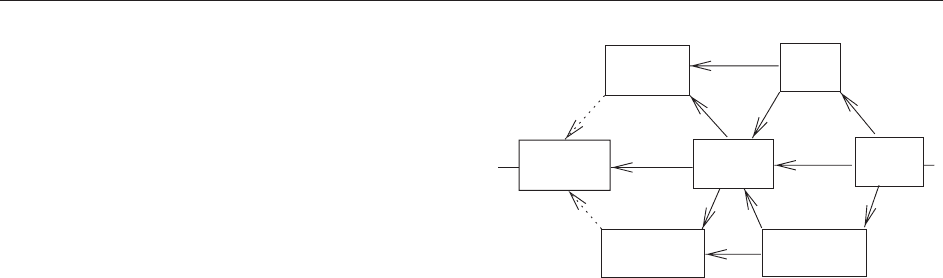
The context here is that of Figure 1 which shows
how Hopf algebras relate to other objects and to
duality in a representation-theoretic sense. Along the
central axis, we have put self-dual categories or in
physical terms categories admitting Fourier trans-
form. This is clear for abelian Groups where the
dual
^
G of an abelian group G is also an abelian
group. Below the axis, we have nonabelian groups
which we view as toy models of geometries with
curvature. Every compact Lie group, for example,
has an associated Killing metric. Above the axis, a
nonabelian group dual
^
G means to construct unitary
representations etc., which we view as toy models of
quantum theory. We have seen that Hopf algebras
are another self-dual category and provide a frame-
work in which both groups and group duals can be
unified (see the section ‘‘Hopf algebras and first
examples’’). Thus, G can be viewed as a coordinate
Hopf algebra C(G)orC[G] in the finite or Lie cases,
and
^
G as the dual Hopf algebra CG or U(g)asa
definition of the coordinate algebra ‘‘C(
^
G).’’ Note that
^
G is not merely the set of representations, as these
alone are not enough to reconstruct the group (e.g.,
both S
1
and SO
3
have the same set). We see that Hopf
algebras are a microcosm for the unification of
quantum theory and gravity. Hopf algebra duality
interchanges the role of position and momentum on
the one hand and of quantum and gravitational effects
on the other. A self-dual Hopf algebra has both aspects
unified and interchanged by the self-duality.
One can also ask what the next most general sel f-
dual category of objects is in which to look for more
general unifications. One answer here is the category
whose objects are themselves categories C equipped
with a tensor product (a ‘‘monoidal category’’) and a
monoidal functor to a fixed monoidal category V.
Motivated by the above, a theorem from the 1980s
is that for any such C there is a dual C
0
of
‘‘representations in V’’ (Majid 1991a). The dotted
arrows in Figure 1 indicate that this may be a setting
for more ambitious models than those achieved by
Hopf algebras alone. In fact, the C
0
construction was
one of the ingredients going into the invention of
2-categories a few years later. See also several
articles on TQFT (such as Topological Quantum
Field Theory: Overview; Axiomatic Approach to
Topological Quantum Field Theory; Duality in
Topological Quantum Field Theory).
Monoidal
categories
Hopf
algebras
Abelian
groups
Nonabelian
groups
Group
duals
Riemannian
geometry
Quantum
theory
Figure 1 Role of Hopf algebras along the self-dual axis.
Hopf Algebras and q-Deformation Quantum Groups 693
The simple st self-dual quantum group is C[x]as
the Hopf algebra of polynomial functions on a line
with additive coproduct. This is dually paired with
itself in the form of the enveloping algebra
U(gl
1
) = C[p] with pairing
hp
m
; x
n
i¼ðiÞ
n
m;n
n!
and similarly for higher-dimensional flat space. In
the case of C[x], a basis is x
n
and from the above the
dual basis is (ip)
n
=n!. Hence the canonical element is
exp = e
ixp
so that Hopf algebra Fourier transform
on a suitable completion of these algebras reduces to
usual Fourier transform.
A more nontrivial example (Majid 1988) is given
by the ‘‘Planck-scale Hopf algebra’’ C[x]
C [p]
which has algebra and coalgebra
½p; x¼ihð1 e
x
Þ; x ¼ x 1 þ 1 x
p ¼ p e
x
þ 1 p;x ¼ p ¼ 0
Sx ¼x; Sp ¼pe
x
The actual generator here should be e
x
rather than
x for an algebraic treatment (otherwise one should
allow power series or use C
-algebras). The dually
paired Hopf algebra has the same form C[p]
C[x],
with new parameters h
0
= 1=h and
0
=h and
quantum group Fourier transform connects the
two. More details and the general construction of
Hopf algebras C[M]
U(g) with dual U(m) C[G]
are in the article on ‘‘bicrossproduct’’ Hopf algebras
(see Bicrossproduct Hopf Algebras and Noncommu-
tative Spacetime). These quantize particles in M
moving under momentum Lie group G with Lie
algebra g and vice versa. The states of one (in a
C
-algebra context) lie in the algebra of observables of
the other (‘‘observable–state duality’’). The data
required are a matched pair of actions of (G, M)
on each other. Such equations correspond locally to
a factorization of a larger group G ffl M but
typically have singularities and other features in
keeping with a toy model of Einstein’s equations.
There are, by the time of writing, many applica-
tions of bicrossproducts beyond the original one,
including a Poincare´ quantum group for the R
1, 3
mentione d in the section ‘‘Hopf algeb ras a nd
first exampl es,’’ with li nks to Planck-sca le physic s.
There is also a bicrossproduct quantum group
C[G
] U(g) canonically associated to any simple
Lie algebra g and related to T-duality. The classi cal
data here are Lie bialgebras and solut ions of the
CYBE as in the section ‘‘q-Deformation coordinate
algebras,’’ however there is no known relation with
the q-deformation Hopf algebras themselves. Finite
group bicrossproducts are also interesting and
examples (but not with both actions nontrivial)
were already in the works of GI Kac in the 1960s.
These constructions also work when the groups
above are themselves Hopf algebras. For example,
any finite-dimensional Hopf algebra H has a
‘‘quantum double’’ D(H) = H ffl H
op
, where the
double cross product ffl is by mutual coadjoint
actions. The cross-relations between the two sub-
Hopf algebras are
X
hh
ð1Þ
; a
ð1Þ
ih
ð2Þ
a
ð2Þ
¼
X
a
ð1Þ
h
ð1Þ
hh
ð2Þ
; a
ð2Þ
i
for h 2H and a 2H
. The construction is due to
Drinfeld (1987) while the ffl form is due to the
author. Moreover, D(H) is quasitriangular with
R= exp , the canonical element used in the Fourier
transform on H. Its represent ations consist of vector
spaces where H acts and at the same time H
op
acts
or (which makes sense when H is infinite dimen-
sional) where H coacts, in a compatible way. Such
objects are called ‘‘crossed modules’’ because when
H = CG, one has exactly a linearization of the
crossed G-sets of JC Whitehead. They are a special
case of the C
0
construction mentioned above.
Finally, one can also view the q-deformed linear
spaces on which quantum groups such as U
q
(g) act
as self-dual Hopf algebras under an additive
coproduct. However, this needs to be as braided
groups or Hopf algebras with braid statistics, see the
next section. The simplest example here is the
‘‘braided line’’ B = C[x] developed not as above but
as a self-dual Hopf algebra with q-statistics. Its
‘‘bosonization’’ gives a self-dual Hopf algebra
U
q
(b
þ
) U
q
(sl
2
), and similarly for other U
q
(b
þ
)
U
q
(g). Perhaps more surprisingly, the quantum
groups U
q
(g)andC
q
[G] also both have canonical
braided group versions (a process called ‘‘transmuta-
tion’’) and as such they too are isomorphic. This
isomorphism extends the linear isomorphism g !g
afforded by the Killing form of any semisimple Lie
algebra. In physical terms, what this means is that
there is in q-deformed geometry just one self-dual
object B
q
(G) with two different scaling limits
UðgÞ B
q
ðGÞ!C½G
as q !1, and the structure of which underlies the
deeper structure of U
q
(g) and C
q
[G] as well.
Braided Groups and Quantum Planes
A super qua ntum group or super-Hopf algebra is
not a quantum group or Hopf algebra since the key
homomorphism pro perty of : H !H H is mod-
ified: one must use in the target H
H the Z
2
-graded
or super tensor product of super algebras. Here,
ða bÞðc dÞ¼ð1Þ
jbjjcj
ac bd
694 Hopf Algebras and q-Deformation Quantum Groups

for elements of degree jbj, jcj. Super quantum groups
U
q
(gl
m jn
) etc., have been constructed and have an
analogous theory to the bosonic versions above.
Super spaces in physics are associated to differential
forms and in the same way a bicovariant exterior
algebra on a quantum group H is generally a super
quantum group. Here the exterior algebra is
generated on by 1-forms and the coproduct on 1-
forms is
¼
L
þ
R
Here
L, R
are the coactions of H on 1-forms
induced by the left and right coaction of H on itself.
For a true understanding of quantum groups one
must, however, go beyond such objects to ‘‘braided
groups’’ or Hopf algebras with braid statistics (see
Majid 1995). This theory was introduced by the
author in the early 1990s as a more systematic
method for q-deformation of structures in physics
based on q-group covariance. We have seen that a
quasitriangular quantum group, or any Hopf alge-
bra through its double, generates a braided category
with the flip map replaced by a braiding
V, W
between any two represent ations. Anything which is
covariant under the quantum group means by
definition that it lives in the braided category.
Working with such ‘‘braided algebras’’ is similar to
working with superalgebras except that one should
use in place of the graded transposition in any
algebraic construction. In particular, two braided
algebras have a natural ‘‘braided tensor product’’
also in the category. In concrete terms,
ða bÞðc dÞ¼aðb cÞd
Then a Hopf algebra in the braided category or
braided group is B, an algeb ra in the category along
with a coalgebra and antipode, where
: B !BB
is an algebra homomorphism (see Braided and
Modular Tensor Categories).
Next, we have mentioned in the section
‘‘ q-Defor mation envelo ping algebras’’ that q-alge-
bras generate topological invariants, but we now
turn this on its head and use braid diagrams to do q-
algebra. We write all operations as flowing down
the page, any transpositions in the algebraic con-
struction are expressed as a braid crossing =
or
its inverse by the reversed braid crossing, and any
other operations as nodes. Thus, a product is
denoted
and a coproduct . Algebraic informa-
tion ‘‘flows’’ along these ‘‘wires’’ much like the way
that information flows along the wiring in a
computer, except that under- and over-crossings
represent distinct nontrivial operators. (In fact, one
may formulate topological quantum computers
exactly in this way.) In this notation, tensor
products are denoted by juxtaposition an d the trivial
object in the category is omitted. In particular, one
has the axioms and all genera l theorems of Hopf
algebras at this diagrammatic level. For example, the
adjoint action of any braided group B on itself is
(see Majid 1995)
Ad =
B
B
B
S
Δ
.
In any concrete example, such diagrams turn into
R-matrix formulas where =R as explained in the
section ‘‘q -Deformat ion envel oping algebras.’’
A basic example of a braided group is the braided
q-pla ne C
2
q
with generators x, y and relations
yx = qxy. Its copro duct is the additive one
x = x
1 þ 1 x (and similarly for y) reflecting addition in
the plane, but this is extended to products as a
braided group with braiding q
1=2
R
1=2, 1=2
in terms of
the R-ma trix in the section ‘‘ q-Defor mation envel-
oping algebras. ’’ The extra factor here means that
C
2
q
lives in the braide d cate gory of representations of
U
q
(gl
2
) =
e
U
q
(sl
2
) (i.e., with an additional central
U
q
(1) generator to provide the q
1=2
). More precisely,
the category is that of corepresentations of
C
q
[GL
2
]=
e
C
q
[SL
2
]. The coaction in this case is
R
ðxyÞ¼ðxyÞ
ab
cd
where the additional central generator is encoded in
the q-determinant (which is no longer set equal to
1). Notice that q
1=2
R
1=2, 1=2
has eigenvalues q, q
1
(one says that it is q-Hecke). Another braided group,
associated now to the second eigenvalue is C
0 j2
q
with generators , and relations = q
1
,
2
=
2
= 0. It is the quadratic algebra dual of C
2
q
(Manin 1988).
One has natural braided linear spaces for the whole
family C
q
[G], on which the latter coact after central
extension. The general construction is as follows. If V
is an object in a braided category (e.g., the funda-
mental representation of a quantum group), let T(V)
be the tensor algebra generated by a basis {e
i
}ofV
with no relations and the additive braided coproduct
as above. Assume that V has a dual V
in the
category, and similarly form T(V
) with dual basis
generators {f
i
}. These two braided groups will be
dually paired by ex tending the evaluation map to
products, which takes the form of ‘‘braided integers’’
(see Majid 1995)
hf
i
m
f
i
1
; e
j
1
e
j
n
i¼
n;m
½n; !
i
1
i
n
j
1
j
n
½n; ¼id þ
12
þ
12
23
þþ
12
n1;n
Hopf Algebras and q-Deformation Quantum Groups 695