
Francoise J.-P., Naber G.L., Tsun T.S. (editors) Encyclopedia of Mathematical Physics
Подождите немного. Документ загружается.

functions in the loop representation are functions of
a clos ed curve (more precisely of families of closed
curves, or spin networks, as we will discuss below).
We still have to deal with the diffeomorphism
and Hamiltonian constraints. The diffeomorphism
constraint when written in the loop representation
implies that the wave functions are not functions of
loops but rather of topologically invariant properties of
the loops under general diffeomorphisms of the spatial
manifold containing the loops. Such functions are
technically known in the mathematical literature as
‘‘knot invariants.’’ This is the first point of connection
between knot invariants and quantum gravity; they
constitute the kinematical arena of the theory. One still
has to deal with the Hamiltonian constraint, which has
to be imposed as an operator equation. We shall see that
knot theory also seems to have a lot to say about
solutions of the Hamiltonian constraint. This is quite
remarkable, since the Hamiltonian constraint embodies
in detail the specific dynamics of Einstein’s theory of
gravitation, and to our knowledge this is an input that
has never gone into the ideas of knot theory.
In terms of the Ashtekar variables, the Hamiltonian
constraint takes the form
H ¼ E
a
E
b
B
c
þ E
c
ðÞ
abc
½1
where we have used a conventional vector notation
for the frame indices and kept explicit the spatial
indices.
abc
is the Levi-Civita totally antisymmetric
tensor. We have included a possible cosmological
constant . The Ashtekar formulation can be
constructed in different ways. In the original
formulation, the connection A
i
a
was a complex
variable and the Hamiltonian took the form we
listed above. However, the resulting theory was only
equivalent to real general relativity if the variables
satisfied certain reality conditions. One can choose
to use a real connection instead, but then the
Hamiltonian constraint has additional terms. At
the moment, we will concentrate on the constraint
as listed above. The constraint has to be implemen-
ted as a quantum operator acting on wave functions.
Since it involves the product of operators, it needs to
be regularized. Most regularization methods are
problematic in this context, since they use a metric,
and here the metric is a quantum operator, not an
external fixed quantity. If we ignore these difficul-
ties, one observes that, if one were to choose a
quantum state, for instance in the connection
representation, for which ,
^
E
a
i
½A¼
^
B
a
i
½A½2
the state would be annihilated by the Hamiltonian
constraint, and this would be true no matter what
regularization was chosen. Classically, the condition
E
a
i
B
a
i
is satisfied for the de Sitter geometry, so one
could envision the state as a quantum state
associated with such geometry. The exact solution
of the above equation is given by a state that is the
exponential of the integral on the spatial slice of the
Chern–Simons form built from the connection
CS
½A¼exp k
Z
d
3
x tr A ^ dAð
þ
2
3
A ^ A ^ A
½3
and the constant k needs to be chosen as k = 6= for
the state to be a solution.
One can ask, ‘‘what is the expression of this state
in the loop representation?’’ To answer this, one
needs to compute the coefficients of its expansion in
the basis of Wilson loops W
[A], where as we stated
earlier, should be a collection of (intersecting)
loops (later we will discuss the genera lization to spin
networks). The expression for the coefficients will
be a function only of the loops and is given by
CS
½¼
Z
DAW
½A
CS
½A½4
This expression is invariant under diffeomorph-
isms of the manifold or, equivalently, under smooth
deformations of the curve . That is, it is what in the
mathematical literature is called ‘‘knot invariant.’’ In
fact, this integral has been studied by Witten in the
context of Chern–Simons theory and has been
shown to be related to the Kauffman bracket knot
polynomial, which in turn is related to the cele-
brated Jones polynomial. Therefore, the implication
of these results is that the Kauffman bracket knot
polynomial appears to be the representation in the
loop representation of a state of quantum gravity
that solves the quantum Einstein equations (with a
cosmological constant). The reader may be intrigued
by the word ‘‘polynomial’’ in this context. It should
be noted that the Cher n–Simons state
CS
[A]
depended on a param eter k, which had to take a
certain value for it to solve the quantum Einstein
equations. The resulting knot invariant is a poly-
nomial in exp (k). If one expands out the result, an
infinite power series in k results. There will be
infinite coefficients in the series, but they are just
combination of the finite number of coefficients of
the polynomial. Knot polynomials are a powerful
tool for analyzing and distinguishing knots. The
coefficients of the polynomials are all knot invari-
ants. Typically, for ‘‘simple’’ knots, the first few
coefficients of the knot polyn omial are nonzero. As
one considers more complicated knottings, higher
Knot Invariants and Quantum Gravity 217

coefficients become nonvanishing. The ultimate goal
of knot theory is to be able to consider two arbitrary
knots and to unambiguously determine if the two
knots are related by a smooth transformati on. The
knot polynomials appear as promising tools for
achieving this task that has remaine d elusive up
to now.
Returning to quantum gravity, to have a well-known
knot polynomial as a solution of the quantum Einstein
equations is a remarkable fact. The first connection we
outlined between knot theory and quantum gravity was
less unexpected: if one describes a theory that is
diffeomorphism invariant in terms of loops, the
appearance of knots is inevitable. But we are now
finding that knot invariants from the mathematical
literature, which were constructed without any knowl-
edge of the details of the dynamics of the Einstein
equations, seem to manage to solve such equations. This
is either a big coincidence or a pointer to some
unexplained deep connection yet to be understood.
Notice, for instance, that other theories of gravity would
not have the Kauffman bracket as a quantum state.
There is a certain technicality about the Kauffman
bracket that makes it diffic ult to argue with precision
that it is a state of quantum gravity. To underst and
this technicality better, it is perhaps best to concen-
trate on the form of the quantum state written above
if the connection is an abelian connection. In that
case, the integral in question,
CS abelian
½¼
Z
DA
I
dy
a
exp iA
a
ðÞ
exp
Z
d
3
x
abc
A
a
@
b
A
c
½5
by turning it into a Gaussian integral. The result is
CS abelian
½¼
I
dx
a
I
dy
b
abc
ðx yÞ
c
jx yj
½6
This integral has problems, since the integrand is
ill-defined when x = y. Notice that the integral
would be well defined if the two contour integrals
were evaluated on different, nonintersecting curves.
The result would be the well-known formula for
the Gauss linking number of the curves, yielding
zero if they are not linked and and integer multiple
of 4 if they were. So the integral we were trying to
compute was actually the Gauss linking number of
the curve with itself. Such a quantity is not well
defined for ordinary curves. To deal with this
problem, mathematicians introduced the con cept of
framed knots. A framed knot is a curve with a
prescription to determine a second curve from it.
One way to see it is to construct another curve that
is ‘‘infinitesimally close’’ in space to the original
one. It is clear that there is no canonical way to
compute such a second curve. Then, when one
considers quantities like the self-linking number,
one makes them well defined by evaluating the two
integrals on the two curves, the original one and
the one yielded by the prescription. In reality, the
notion of framing is a bit more elaborate than what
we hint at here, since one could consider invariants
constructed with more than two integrals and could
still be ill-defined if one only considers two curves.
The notion has to be extended as well to handle
intersections in the curves. We will ignore these
subtleties in this discussion.
The Kauffman bracket knot invariant is an
invariant of framed knots, just like the self-linking
number. It is not well defined for a single curve. It
requires a framing of the knot. In quantum gravity,
there is no compelling reason to consider framed
curves. It is true that framed curves arise naturally in
q-deformed field theories and perhaps a q-deformed
version of quantum gravity is what needs to be
considered to accommodate the Chern–Simons state,
but at the moment there are no proposals along
these lines that have widespread consensus.
So, it appears the Kauffman bracket does not have
a natural role to play as a state of quantum gravity.
However, it is known that the frame dependence of
the Kauffman bracket knot polynomial can be
captured in an overall factor that depends on the
self-linking number. If one strips the polynomial of
this factor, one gets the Jones polynomial, which is a
knot invariant of single curves. Could it be that this
polynomial has a chance of being a solution of the
quantum Einstein equations?
To determine this, the analogy with Chern–
Simons theory is no longer useful, sinc e there is no
straightforward way to transform the relation
between the Kauffman and Jones polynomials into
relations between states in the connection represen-
tation. To analyze if the Jones polynomial could be
a solution of the quantum Einstein equations, one
needs to write the quantum Einstein equations
directly in terms of loops.
There have been several attempts to rewrite the
quantum Einstein equations directly in the loop
representation. In one of these attempts, the curva-
ture that appears in the Hamiltonian constraint was
represented by the ‘‘loop derivative.’’ This is a
differential operator that can be introduced in the
space of loops by considering that two loops that
differ by a small element of area are ‘‘close.’’ One
can build an attractive differential calculus in loop
space that actually encodes many of the kinematical
properties that are useful to formulate Yang–Mills
theory.
218 Knot Invariants and Quantum Gravity

The Hamiltonian constraint in terms of the loop
derivative is an operator that has an explicit form.
The coefficients of the Jones polynomial can also be
given an explicit form by computing perturbatively
the integral in the Chern–Simons theory. The results
are generalizations of the types of integrals that arise
in the self-linking number, but involving a larger
number of integrals. One can therefore envisage
carrying out an explicit computation in which one
checks if the coefficients of the Jones polynom ial are
annihilated or not by the Hamiltonian co nstraint of
quantum gravity in the loop representa tion. Such a
calculation has been carried out for the first few
coefficients. It turns out that the second coefficient
(the first coefficient is normalized to unity, so it
trivially satisfies the constraint) is indeed annihilated
by the Hamiltonian constraint of vacuum quantum
gravity (with zero cosmological constant). It has
been shown that the third coefficient is not, and
there are good arguments to indicate that other
coefficients will not be states of quan tum gravity.
So, a remarkable result has been found in that one
of the coefficients of the Jones polynomial (related
to the Arf and Casson invariants) is annihilated by a
version of the quantum Hamiltonian constraint of
general relativity. The result is quite nontrivial; it
requires a fair amount of calculation to actually
show that the coefficient is annihilated. The mean-
ing of this quantum state and the deep reason why it
is annihilated remain at present a mystery.
The quantum Hamiltonian constraint based on the
loop derivative makes certain assumptions about the
space of functions one is using to quantize the theory.
In quantum field theory, not all classical operators
have a well -defined quantum counterpart. The choice
being made is to assume that the curvature F
ab
is a
well-defined quantum operator defined by the loop
derivative. Differentiability of knot polynomials is
not a new idea. It is the core idea of the Vassiliev knot
invariants, which are defined by a set of identities,
one of them acting as a ‘‘derivative in knot space.’’ It
can be shown that the loop derivative is a concrete
implementation of the Vassiliev derivative and, there-
fore, Vassiliev invariants are the ‘‘arena’’ in which this
version of quantum gravity takes place.
The Hamiltonian based on the loop derivative has
problems, in the sense that it is obtained by a
regularization procedure that requires extra external
geometric structures. This is common practice in
Yang–Mills theory, where one has at hand a fixed
external background metric. However, in gravity the
geometry is a dynamical object and, if one con-
structs expressions that resort to some fixed external
geometry, one gets inconsistencies. In particular, it is
expected that the Hamiltonian based on the loop
derivative will not reproduce the correct Poisson
algebra of canonical general relativity. This sort of
problem plagued early attempts to construct a
quantum version of the Hamiltonian constraint in
the early 1990s.
A point that we mentioned earlier but did not
elaborate upon, is that the Wilson loops constitute an
overcomplete basis of states. Therefore, if one takes a
quantum state and expands it on such a basis, one gets
that the coefficients of the expansion satisfy certain
identities, called the Mandelstam identities. These are
nonlinear identities that states in the loop representa-
tion have to satisfy. These identities are very incon-
venient at the time of constructing quantum states. The
identities stem from the fact that if one chooses a
matrix representation of the group of interest, the fact
that one is in a given representation is indicated by
certain identities the matrices satisfy. To break free
from these constraints, one possibility is to consider
multiple representations when constructing Wilson
loops. To do this, one considers piecewise-continuous
graphs with intersections (the nonintersecting case is
a trivial subcase). Along the lines connecting the
intersections one considers holonomies in a given
representation for a given line. In the case of the group
SU(2), which is the one of interest in quantum gravity,
such representations are labeled by a (half-) integer.
One then considers invariant tensors in the group to
‘‘tie the holonomies together’’ at intersections. The
resulting object is a gauge-invariant object for a given
connection based on a ‘‘spin network.’’ The latter
is an embedded piecewise-continuous graph with an
assignment of integers to each of its lines and an
assignment of ‘‘intertwiners’’ at each intersection (if
the intersections are trivalent or lower, one can choose
canonical intertwiners and forget about them).
One can then consider the ‘‘spin network represen-
tation’’ in which one expands gauge-invariant states
in terms of the basis of Wilson nets. Knot polynomials
for these types of graphs have been considered in the
mathematical literature (‘‘polynomials of colored
graphs’’). The construction with the Chern–Simons
state can be repeated, and there exist suitable general-
izations of the Kauffman bracket and Jones polyno-
mials. The Hamiltonian based on the loop derivative
can also be introduced in this context; again, its action
is well defined on suitable generalizations of Vassiliev
invariants for these kinds of graphs. This opens the
possibility of encoding the quantum dynamics of
general relativity as a combinatorial action in the
space of Vassiliev invariants.
An alternative Hamiltonian based on assuming that
the holonomies and the volume operators are well
defined quantum mechanically (but not the curvature)
has been introduced that has the advantage of not
Knot Invariants and Quantum Gravity 219

requiring external structures for its regularization. In
fact, it can be explicitly checked that it satisfies the
correct Poisson algebra without anomalies at the
quantum level. The exploration of the action of this
Hamiltonian constraint on knot polynomials has not
been carried out as systematically as for the one based
on the loop derivative, but it has been explicitly shown
that the first coefficient in the expansion of the Jones
polynomial is annihilated by this Hamiltonian con-
straint. The first coefficient, written in terms of loops,
was simply the numeral 1 and was automatically
annihilated. In terms of spin network states, the first
coefficient is the ‘‘chromatic evaluation’’ of the net-
work (the result of computing the Wilson loop on a
connection that is pure gauge). It is somewhat
nontrivial to show that this quantity is actually
annihilated by the Hamiltonian constraint in question.
At the moment, the issue of what the correct
Hamiltonian constraint is that describes a realistic
and physically correct theory of quantum gravity is
still open to debate. There are certain concerns that
the action of the operators considered up to now is
too simple to encompass the true dynamics of
general relativity. Constructing a semiclassical the-
ory that could confirm or deny the viability of the
proposals is a complicated task, since one has to
make contact with physics that is not diffeomor-
phism invariant in the context of a theory that is.
Moreover, in canonical quantum gravity, there
exists the ‘‘problem of time.’’ Since the Hamiltonian
vanishes, the dy namics implied by it is trivial, and
one has to disentangle the true dynamics by
relational constructions among the variables of the
theory. One then needs to compare the resulting
predictions with classical general relativity.
Whether the current proposals are viable and
whether knot theory will play a role at a ‘‘kinematical
level’’ or it will actually play a key role in the detailed
dynamics of quantum general relativity is yet to be
seen. It is reassuring that in partial constructions,
celebrated knot polynomials have appeared to have
some knowledge of the dynamics of the Einstein
equations.
Quantum gravity being an unfinished symphony,
we cannot entirely conclude how great an impact
knot theory will have on it in the end. One can only
note that beautiful mathematical results seem to tie
in naturally with the partial constructions that have
been carried out thus far.
See also: BF Theories; Braided and Modular Tensor
Categories; Finite-Type Invariants; Finite-type invariants
of 3-Manifolds; The Jones Polynomial; Knot Theory and
Physics; Loop Quantum Gravity; Mathematical Knot
Theory; Quantum Dynamics in Loop Quantum Gravity;
Quantum Geometry and its Applications; Yang–Baxter
Equations.
Further Reading
Ashtekar A (2005) Gravity and the quantum. New Journal of
Physics 7: 200.
Gambini R and Pullin J (1996) Loops, Knots, Gauge Theories
and Quantum Gravity. C ambridge: Cambridge University
Press.
Rovelli C (2001) Notes for a brief history of quantum gravity. In:
Ruffini R (ed.) Rome 2000, Recent Developments in Theo-
retical and Experimental General Relativity, Gravitation, and
Relativistic Field Theories, p. 742. Singapore: World Scientific.
Rovelli C (2004) Quantum Gravity. Cambridge: Cambridge
University Press.
Smolin L (2001) Three Roads to Quantum Gravity. New York:
Basic Books.
Thiemann T, Introduction to Modern Canonical General Rela-
tivity. Cambridge University Press (arXiv.org:gr-qc/0110034)
(to appear).
Knot Theory and Physics
L H Kauffman, University of Illinois at Chicago,
Chicago, IL, USA
ª 2006 Elsevier Ltd. All rights reserved.
Introduction
This article is an introduction to some of the relation-
ships between knot theory and theoretical physics.
Knots themselves are macroscopic physical phenomena
in three-dimensional space, occurring in rope, vines,
telephone cords, polymer chains, DNA, certain species
of eel, and many other places in the natural and man-
made world. The study of topological invariants of
knots leads to relationships with statistical mechanics
and quantum physics. This is a remarkable and deep
situation where the study of a certain (topological)
aspects of the macroscopic world is entwined with
theories developed for the subtleties of the microscopic
world. The present article is an introduction to the
mathematical side of these connections, with some
hints and references to the related physics.
We begin with a short introduction to knots,
links, braids, and the bracket polynomial invariant
of knots and links. The article then discusses
Vassiliev invariants of knots and links, and how
these invariants are naturally related to Lie algebras
and to Witten’s gauge-theoretic approach. This part
220 Knot Theory and Physics
of the article is an introduction to how Vassiliev
invariants in knot theory arise naturally in the
context of Witten’s functional integral.
The article is divided into several sections beyond
the introduction . Section two is a quick introduction
to the topology of knots and links. The third one
discusses Vassiliev invariants and invariants of rigid
vertex graphs. The fourth section introduces the
basic formalism and shows how Witten’s funct ional
integral is related directly to Vassiliev invariants.
The fifth section discusses the loop transform and
loop quantum gravity in this context. The final
section is an introduction to topological quantum
field theory, and to the use of these techniques in
producing unitary representations of the braid
group, a topic of intense interest in quantum
information theory.
Knots, Braids, and Bracket Polynomial
The purpose of this section is to give a quick
introduction to the diagrammatic theory of knots,
links, and braids. A knot is an embedding of a circle in
three-dimensional space, taken up to ambient isotopy.
That is, two knots are regarded as equivalent if one
embedding can be obtained from the other through a
continuous family of embeddings of circles in 3-space.
A link is an embedding of a disjoint collection of
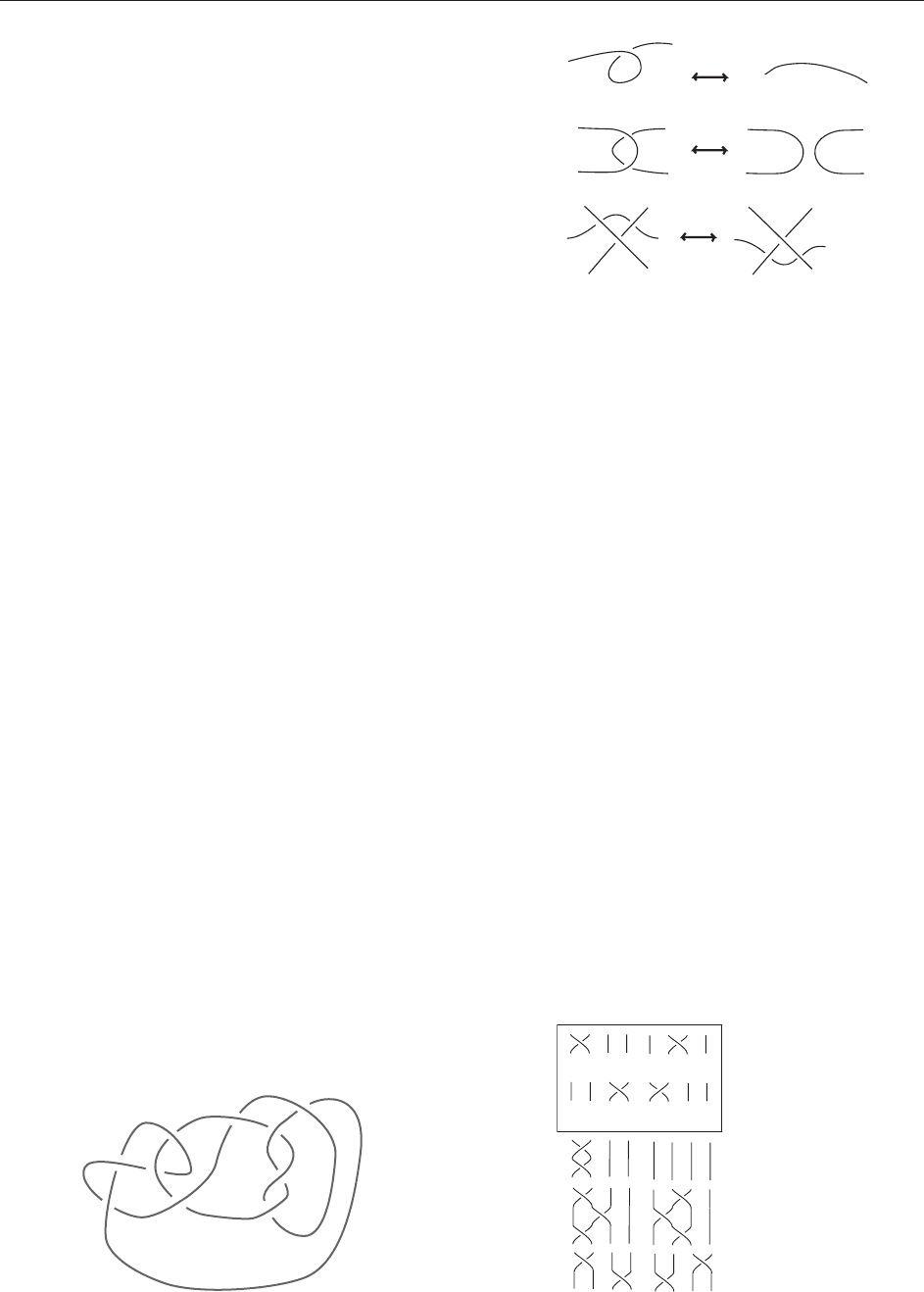
circles, taken up to ambient isotopy. Figure 1 illus-
trates a diagram for a knot. The diagram is regarded
both as a schematic picture of the knot, and as a plane
graph with extra structure at the nodes (indicating
how the curve of the knot passes over or under itself
by standard pictorial conventions).
Ambient isotopy is mathematic ally the same as
the equivalence relation generated on diagrams by
the Reidemeister moves. These moves are illustrated
in Figure 2. Each move is performed on a local part
of the diagram that is topologically identical to the
part of the diagram illustrated in this figure (these
figures are representative examples of the types of
Reidemeister moves) without changing the rest of
the diagram. The Reidemeister moves are useful in
doing combin atorial topology with knots and links,
notably in working out the behavior of knot
invariants. A knot invariant is a function defined
from knots and links to some other mathematical
object (such as groups or polynomials or numbers)
such that equivalent diagrams are mapped to
equivalent objects (isomorphic groups, identical
polynomials, identical number s).
Another significant structure related to knots and
links is the Artin braid group. A braid is an
embedding of a collection of strands that have
their ends in two rows of points that are set one
above the other with respect to a choice of vertical.
The strands are not individually knotted and they
are disjoint from one another . S ee Figures 3–5 for
illustrations of braids and moves on braids. Braids
can be multiplied by attaching the bottom row of
one braid to the top row of the other braid. Taken
up to ambient isotopy, fixing the endpoints, the
braids form a group under this notion of multi-
plication. In Figure 3 we illustrate the form of the
basic generators of the braid group, and the form of
the relations amon g these generators. Figure 4
illustrates how to close a braid by attaching the
top strands to the bottom strands by a collection of
parallel arcs. A key theorem of Alexander states that
every knot or link can be represented as a closed
braid. Thus, the theory of braids is critical to the
Figure 1 A knot diagram.
I
II
III
Figure 2 The Reidemeister moves.
=
=
=
s
1
s
2
s
3
Braid generators
s
1
s
2
s
1
= s
2
s
1
s
2
s
1
s
3
= s
3
s
1
s
–1
1
s
–1
s
1
= 1
1
Figure 3 Braid generators.
Knot Theory and Physics 221
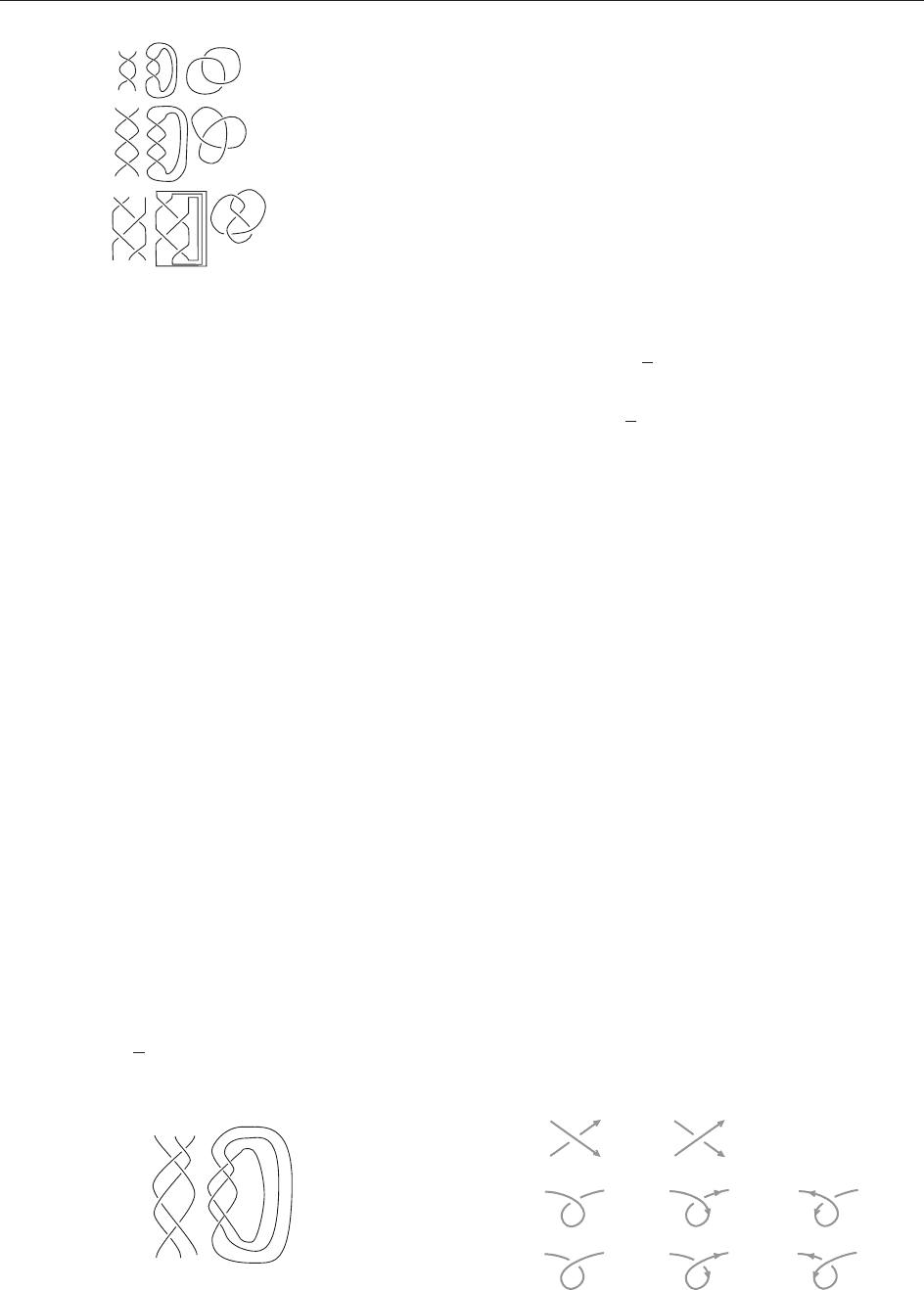
theory of knots and links. Figure 5 illustrates the
famous Borrowmean rings (a link of three unknotted
loops such that any two of the loops are unlinked)
as the closure of a braid.
We now discuss a significant example of an
invariant of knots and links, the bracket polynomial.
The bracket polynomial can be normalized to
produce an invariant of all the Reidemeister moves.
This normalized invariant is known as the Jones
(1985) polynomial. The Jones polynomial was
originally discovered by a different method than
the one given here.
The bracket polynomial, hKi= hKi (A), assigns to
each unoriented link diagram K a Laurent poly-
nomial in the variable A, such that
1. If K and K
0
are regularly isotopic diagrams, then
hKi= hK
0
i.
2. If K q O denotes the disjoint union of K with an
extra unknotted and unlinked component O (also
called ‘‘loop’’ or ‘‘simple closed curve’’ or
‘‘Jordan curve’’), then
hK q Oi¼hKi
where
¼A
2
A
2
3. hKi satisfies the following formulas:
hi¼AhiþA
1
hÞði
h
i¼A
1
hiþAhÞði
where the small diagrams represent parts of
larger diagrams that are identical except at the
site indicated in the bracket. We take the
convention that the letter chi, , denotes a
crossing where the curved line is crossing over
the straight segment. The barred letter denotes
the switch of this crossing, where the curved line
is undercrossing the straight segment.
In computing the bracket, one finds the following
behavior under Reidemeister move I:
hi¼A
3
h^i
and
h
i¼A
3
h^i
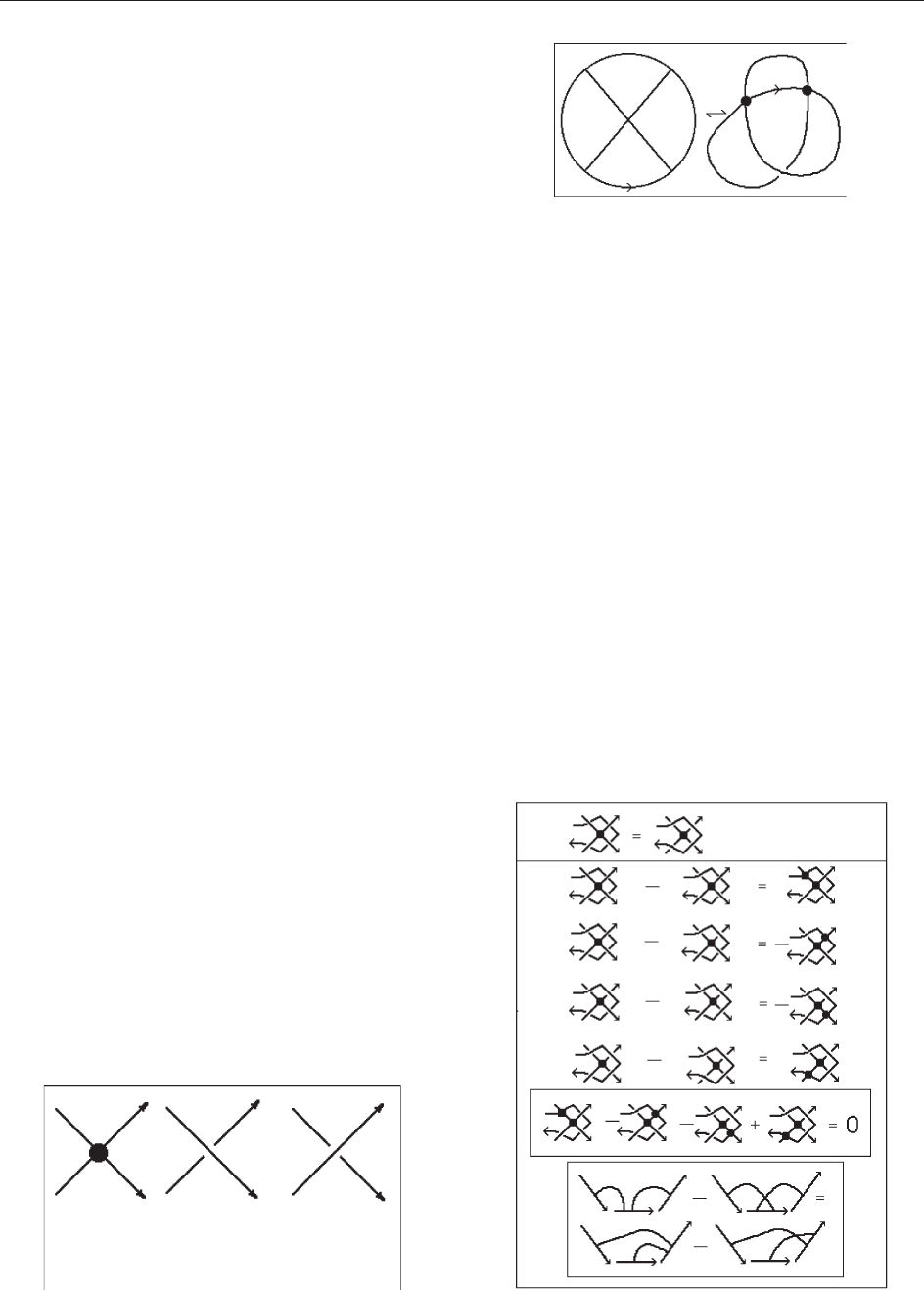
where denotes a curl of positive type as indicated
in Figure 6,and
indicates a curl of negative type,
as also seen in this figure. The type of a curl is the
sign of the crossing when we orient it locally. Our
convention of signs is also given in Figure 6. Note
that the type of a curl does not depend on the
orientation we choose. The small arcs on the right-
hand side of these formulas indicate the removal of
the curl from the corresponding diagram.
The bracket is invariant under regular isotopy and
can be normal ized to an invariant of ambient
isotopy by the definition
f
K
ðAÞ¼ðA
3
Þ
wðKÞ
hKiðAÞ
where we chose an orientation for K, and where
w(K) is the sum of the crossing signs of the oriented
link K. w(K) is called the writhe of K. The
convention for crossing signs is shown in Figure 6.
The State Summation
In order to obtain a closed formula for the bracket,
we now describe it as a state summation. Let K be
any unoriented link diagram. Define a state, S,ofK
to be a choice of smoothing for each crossing of K.
There are two choices for smoothing a given
crossing, and thus there are 2
N
states of a diagram
with N crossings. In a state we label each smoothing
with A or A
1
as in the expansion formula for the
bracket. The label is called a vertex weight of the
:
or
: or
+
–
++
–
–
Figure 6 Crossing signs and curls.
Hopf link
Figure-8 knot
Trefoil knot
Figure 4 Closing braids to form knots and links.
b CL(b)
Figure 5 Borromean rings as a braid closure.
222 Knot Theory and Physics

state. There are two evaluations related to a state.
The first one is the product of the vertex weights,
denoted hKjSi. The second evaluation is the number
of loops in the state S, denoted kSk.
Define the state summation, hK i, by the formula
hKi¼
X
S
hKjSi
kSk1
It follows from this definition that hKi satisfies the
equations
hi¼AhiþA
1
hÞði
hK q Oi¼hKi
hOi¼1
The first equation expresses the fact that the entire
set of states of a given diagram is the union, with
respect to a given crossing, of those states with an
A-type smoothing and those with an A
1
-type
smoothing at that crossing. The second and the
third equation are clear from the formula defining
the state summation. Hence, this state summation
produces the bracket polynom ial as we have
described it at the beginning of the section.
Remark By a change of variables one obtains the
original Jones polynomial, V
K
(t), for oriented knots
and links from the normalized bracket:
V
K
ðtÞ¼f
K
ðt
1=4
Þ
Remark The bracket polynomial provides a con-
nection between knot theory and physics, in that the
state summation expression for it exhibits it as a
generalized partition function defined on the knot
diagram. Partition functions are ubiquitous in
statistical mechanics, where they express the sum-
mation over all states of the physical system of
probability weighting functions for the individual
states. Such physical partition functions contain
large amounts of information about the correspond-
ing physical system. Some of this information is
directly present in the properties of the function,
such as the location of critical points and phase
transition. Some of the information can be obtained
by differentiating the partition funct ion, or perform-
ing other mathematical operations on it.
In fact, by defining a genera lization of the bracket
polynomial, defined on knot diagrams but not
invariant under the Reidemeister moves, we can
capture significant partition functions that are
physically meaningful. There is no room in this
survey to detail how this generalization can be used
to express the Potts model for planar graphical
configurations, and how it expresses the relationship
between the Potts model and the Temperley–Lieb
algebra in diagrammatic form. There is much more
in this connection with statistical mechanics in that
the local weights in a partition function are often
expressed in terms of solutions to a matrix equation
called the Yang–Baxter equation, that turns out to
fit perfectly invariance under the third Reidemeister
move. As a result, there are many ways to define
partition functions of knot diagrams that give rise to
invariants of knots and links. The subject is
intertwined with the algebraic structure of Hopf
algebras and qua ntum groups, useful for producing
systematic solutions to the Yang–Baxter equation.
In fact, Hopf algebras are deeply connected with
the problem of constructing invariants of three-
dimensional manifolds in relation to invariants of
knots. We have chosen, in this survey article, not to
discuss the details of these approaches, but rather to
proceed to Vassiliev invariants and the relationships
with Witten’s functional integral. The reader is
referred to Kauffman (1987, 1994, 2002), Jones
(1985),andReshetikhin and Turaev (1991) for
more information about relationships of knot theory
with stat istical mechanics, Hopf algebras, and
quantum groups. For topology, the key point is
that Lie algebras can be used to construct invariants
of knots and links. This is shown nowhere more
clearly than in the theory of Vassiliev invariants that
we take up in the next section.
Vassiliev Invariants and Invariants
of Rigid Vertex Graphs
In this section we study the combinatorial topology
of Vassiliev invariants. As we shall see, by the end of
this section, Vassiliev invariants are directly con-
nected with Lie algebras, and representations of Lie
algebras can be used to construct them. This aspect
of link invariants is one of the most fundamental for
connections with physics. Just as symmetry con-
siderations in physics lead to a fundamental rela-
tionship with Lie algebras, topological invariance
leads to a fundamental relationship of the theory of
knots and links with Lie algebras.
If V(K) is a (Laurent polynomial valued or, more
generally, commutative ring valued) invariant of
knots, then it can be naturally extended to an
invariant of rigid vert ex graphs by defining the
invariant of graphs in terms of the knot invariant via
an ‘‘unfolding of the vertex.’’ That is, we can regard
the vertex as a ‘‘black box’’ and replace it by any
tangle of our choice. Rigid vertex motions of the
graph prese rve the contents of the black box, and
hence implicate ambient isotopies of the link
obtained by replacing the black box by its contents.
Knot Theory and Physics 223
Invariants of knots and links that are evaluated on
these replacements are then automatically rigid vertex
invariants of the corresponding graphs. If we set up a
collection of multiple replacements at the vertices
with standard conventions for the insertions of the
tangles, then a summation over all possible replace-
ments can lead to a graph invariant with new
coefficients corresponding to the different replace-
ments. In this way, each invariant of knots and links
implicates a large collection of graph invariants.
The simplest tangle replacements for a 4-valent
vertex are the two crossings, positive and negative, and
the oriented smoothing. Let V(K) be any invariant of
knots and links. Extend V to the category of rigid
vertex embeddings of 4-valent graphs by the formula
VðK
Þ¼aVðK
þ
ÞþbVðK
ÞþcVðK
0
Þ
where K
þ
denotes a knot diagram K with a specific
choice of positive crossing, K
denotes a diagram
identical to the first with the positive crossing
replaced by a negative crossing and K
denotes a
diagram identical to the first with the positive
crossing replaced by a graphical node.
There is a rich class of graph invariants that can
be studied in this manner. The Vassiliev invariants
(Bar-Natan 1995) constitute the important special
case of these graph invariants where a = þ1, b = 1
and c = 0. Thus, V(G) is a Vassiliev invariant if
VðK
Þ¼VðK
þ
ÞVðK
Þ
Call this formula the exchange identity for the
Vassiliev invariant V. See Figure 7.
V is said to be of finite type k if V(G) = 0
whenever jGj > k, where jGj denotes the number of
(4-valent) nodes in the graph G. The notion of finite
type is of extraordinary significance in studying
these invariants. One reason for this is the following
basic lemma.
Lemma If a graph G has exactly k nodes, then the
value of a Vassiliev invariant v
k
of type k on G,
v
k
(G), is independent of the embedding of G.
Proof Omitted.
&
The upshot of this lemma is that Vassiliev
invariants of type k are intimately involved with
certain abstract evaluations of graphs with k nodes.
In fact, there are restrictions (the four-term relations)
on these evaluations demanded by the topology and
it follows from results of Kontsevich (see Bar-Natan
(1995) that such abstract evaluations actually deter-
mine the invariants. The knot invariants derived from
classical Lie algebras are all built from Vassiliev
invariants of finite type. All of this is directly related
to Witten’s functional integral (Witten 1989).
In the next few figures we illustrate some of these
main points. In Figure 8 we show how one
associates a so-called chord diagram to represent
the abstract graph associated with an embedded
graph. The chord diagram is a circle with arcs
connecting those points on the circle that are welded
to form the corresponding graph. In Figure 9 we
illustrate how the four-term relati on is a conse-
quence of topological invarianc e.
In Figure 10 we show how the four-term relation is a
consequence of the abstract pattern of the commutator
(K
*
)
V(K
*
) = V(K
+
) – V(K
–
)
⏐
⏐⏐⏐
(K
+
)
⏐
(K
–
)
⏐
Figure 7 Exchange identity for Vassiliev invariants.
2
1
1
2
2
1
Figure 8 Chord diagrams.
Figure 9 The four-term relation from topology.
224 Knot Theory and Physics
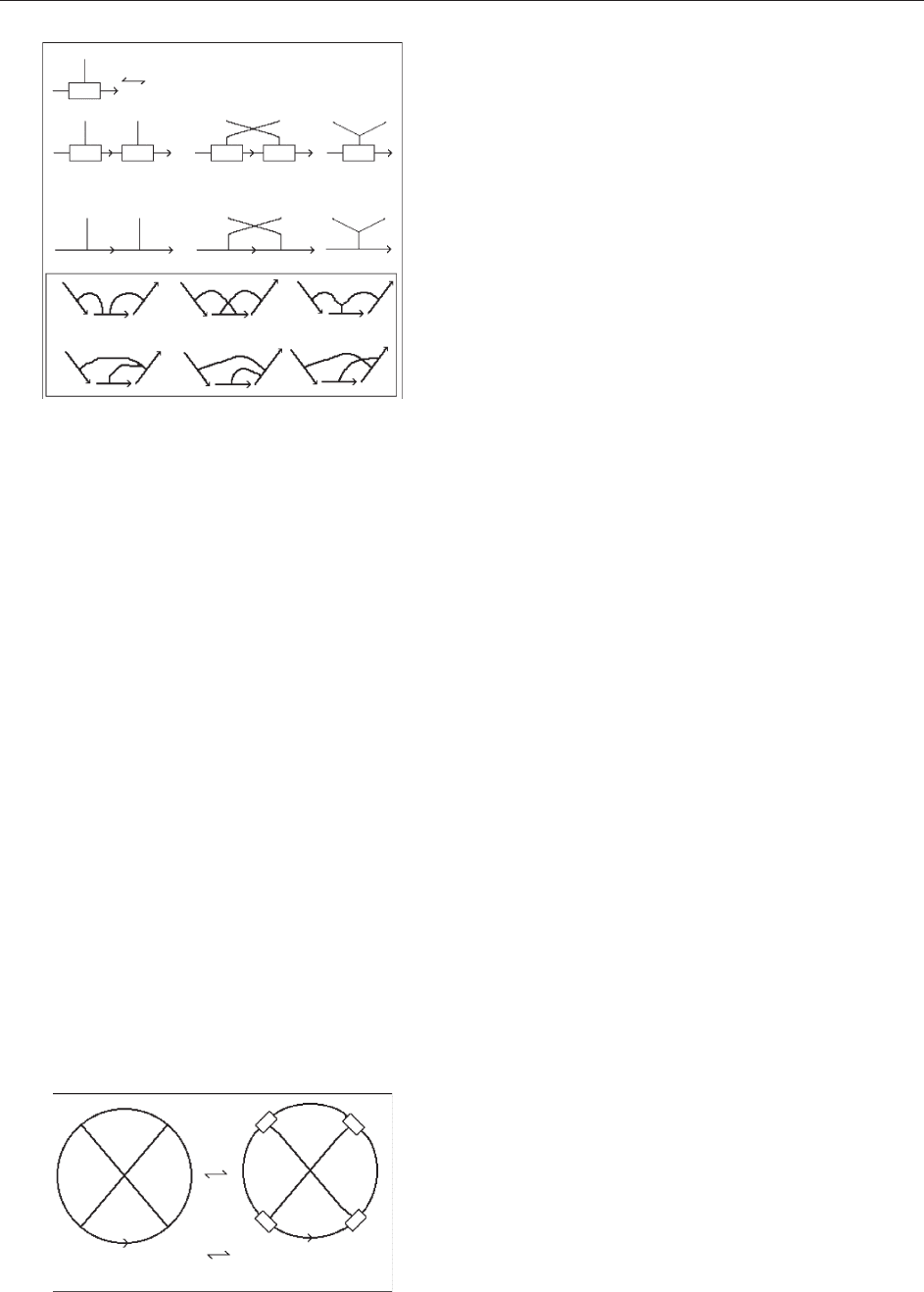
identity for a matrix Lie algebra. That is, we show how
a diagrammatic version of the formula
T
a
T
b
T
b
T
a
¼ f
ab
c
T
c
fits directly with the four-term relation. The formula
we have quoted here states that the commutator of
the matrices T
a
and T
b
is equal to a sum of the
matrices T
c
with coefficients (the structure coeffi-
cients of the Lie algebra) f
ab
c
. Such a relation is the
most concrete way to define a matrix Lie algebra.
There are other levels of abstraction that can be
employed here. The same diagrammatic can be
interpreted directly in terms of the Jacobi identity
that defines a Lie algebra. We shall con tent
ourselves with this matrix point of view here, and
add that it is assumed here that the structure
coefficients are invariant under cyclic permutation,
an assumption that is not needed in the general case.
The four-term relation is directly related to a
categorical generalization of Lie algebras.
Figure 11 illustrates how the weights are assigned
to the chord diagrams in the Lie algebra case – by
inserting Lie algebra matrices into the circle and
taking a trace of a sum of matrix products. The
relationship between Vassiliev invariants and Lie
algebras has been known since Bar-Natan’s thesis
(see also Kauffman (1995).InBar-Natan (1995) the
reader will find a good account of Kontsevich’s
theorem, showing how Lie algebra weight systems,
and in fact any weight system satisf ying the four-
term relation, can be used to construct knot
invariants. Conceptually, the ideas behind the
Kontsevich theorem are directly related to Witten’s
approach to knot invariants via quantum field
theory. We give an exposition of this approach in
the next section of this article.
Example Let P
K
(t) = f
K
(e
t
)(A = e
t
)wheref
K
(A)is
the normalized bracket polynomial invariant dis-
cussed in the last section. Then P
K
(t) is e xpressed as
a power series in t with coefficients v
n
(K),
n = 0, 1, 2, ..., that are invariants of the knot or
link K. It is not hard to show that these coefficient
invariants (extended to graphs so that the Vassiliev
exchange identity is satisfied) are Vassiliev invar-
iants of finite type. In fact, most of the so-called
polynomial invariants of knots and links (relatives
of the bracket and Jones polynomials) give rise to
Vassiliev invariants in just this way. T hus, Vassiliev
invariants of finite type are ubiquitous in this area
of knot theory. One can think of Vassiliev
invariants as building blocks for the other invar-
iants, or that these invariants are sources of
Vassiliev invariants.
Vassiliev Invariants and Witten’s
Functional Integral
Edward Witten (1989) proposed a formulation
of a clas s of 3-manifold invariants as generalized
Feynman integrals taking the form Z(M), where
ZðMÞ¼
Z
DAe
ðik=4ÞSðM;AÞ
Here M denotes a 3-manifold without boundary and
A is a gauge field (also called a gauge potential or
gauge connection) defined on M. The gauge field is a
1-form on a trivial G-bundle over M with values in a
representation of the Lie algebra of G. The group G
corresponding to this Lie algebra is said to be the
gauge group. In this integral, the action S(M, A)is
taken to be the integral over M of the trace of the
Chern–Simons 3-form A ^ dA þ (2=3)A ^ A ^ A.
(The product is the wedge product of differential
forms.) Z(M) integrates over all gauge fields modulo
gauge equivalence.
The formalism and internal logic of Witten’s
integral supports the existence of a large class of
topological invariants of 3-manifolds and associated
invariants of knots and links in these manifolds.
T
a
T
b
–
T
b
T
a
=
f
ab
T
c
c
T
a
–=
–=
–=
–==
a
Figure 10 The four-term relation from categorical Lie algebra.
tr( Σ T
a
T
b
T
a
T
b
)
ab
a
b
Figure 11 Calculating Lie algebra weights.
Knot Theory and Physics 225

The invariants associated with this integral have
been given rigorous combinatorial descriptions but
questions and conjectures arising from the integral
formulation are still outstanding. Specific conjec-
tures about this integral take the form of just how it
implicates invariants of links and 3-manifolds, and
how these invariants behave in certain limits of the
coupling constant k in the integral. Many conjec-
tures of this sort can be verified through the
combinatorial model s. On the other hand, the really
outstanding conjecture about the integral is that it
exists! At the present time there is no measure
theory or generalization of measure theory that
supports it in full generality. Here is a formal
structure of great beauty. It is also a structure
whose consequences can be verified by a remarkable
variety of alternative means.
The formalism of the Witten integral implicates
invariants of knots and links corresponding to each
classical Lie algebra. In order to see this, we need to
introduce the Wilson loop. The Wilson loop is an
exponentiated version of integrating the gauge field
along a loop K in three space that we take to be an
embedding (knot) or a curve with transversal self-
intersections. For this discussion, the Wilson loop
will be denoted by the notation
W
K
ðAÞ
to denote the dependence on the loop K and the
field A. It is usually indicated by the symbolism
tr(Pe
H
K
A
). Thus,
W
K
ðAÞ¼tr
Pe
H
K
A
Here the P denotes path ordered integration – we
are integrating and exponentiating matrix valued
functions, and so must keep track of the order of the
operations. The symbol tr denotes the trace of the
resulting matrix. This Wilson loop integration exists
by normal means and does not require functional
integration.
With the help of the Wilson loop functional on
knots and links, Witten writes down a functional
integral for link invariants in a 3-manifold M:
ZðM; KÞ¼
Z
DAe
ðik=4ÞSðM;AÞ
tr Pe
H
K
A
¼
Z
DAe
ðik=4ÞS
W
K
ðAÞ
Here S(M, A) is the Chern–Simons Lagrangian, as in
the previous discussion. We abbreviate S(M, A)asS
and write W
K
(A) for the Wilson loop. Unless
otherwise mentioned, the manifold M will be the
three-dimensional sphere S
3
.
An analysis of the formalism of this functional
integral reveals quite a bit abou t its role in knot
theory. One can determine how the Witten integral
behaves under a small deformation of the loop K.
Theorem
(i) Let Z(K) = Z(S
3
, K) and let Z(K) denote the
change of Z(K) under an infinitesimal change in
the loop K. Then
ZðKÞ¼ð4i=kÞ
Z
dAe
ðik=4ÞS
½VolT
a
T
a
W
K
ðAÞ
where Vol =
rst
dx
r
dx
s
dx
t
.
The sum is taken over repeated indices, and
the insertion is taken of the matrices T
a
T
a
at the
chosen point x on the loop K that is regarded
as the center of the deformation. The volume
element Vol =
rst
dx
r
dx
s
dx
t
is taken with regard
to the infinitesimal directions of the loop
deformation from this point on the original
loop.
(ii) The same formula applies, with a different
interpretation, to the case where x is a double
point of transversal self-intersection of a loop K,
and the deformation consists in shifting one of
the crossing segments perpendicularly to the
plane of intersection so that the self-intersection
point disappears. In this case, one T
a
is inserted
into each of the transversal crossing segments so
that T
a
T
a
W
K
(A) denotes a Wilson loop with
a self-intersection at x and insertions of T
a
at
x þ
1
and x þ
2
, where
1
and
2
denote small
displacements along the two arcs of K that
intersect at x. In this case, the vo lume form is
nonzero, with two directions coming from the
plane of movement of one arc, and the perpen-
dicular direction is the direction of the other arc.
Remark One shows that the result of a topological
variation has an analytic expression that is zero if
the topological variation does not create a local
volume. Thus, we have shown that the integral of
e
(ik=4)S(A)
W
K
(A) is topologically invariant as long as
the curve K is moved by the local equivalent of
regular isotopy.
In the case of switching a crossing, the key point is
to write the crossing switch as a composition of first
moving a segment to obtain a transversal intersec-
tion of the diagram with itself, and then to continue
the motion to complete the switch. Up to the choice
of our conventions for constants, the switching
formula is, as shown below (see Figure 12).
226 Knot Theory and Physics