
Francoise J.-P., Naber G.L., Tsun T.S. (editors) Encyclopedia of Mathematical Physics
Подождите немного. Документ загружается.


ZðK
þ
ÞZðK
Þ
¼ð4i=kÞ
Z
DAe
ðik=4ÞS
T
a
T
a
hK
jAi
¼ð4i=kÞZðT
a
T
a
K
Þ
where K
denotes the result of replacing the
crossing by a self-touching crossing. We distinguish
this from adding a graphical node at this crossing by
using the double-star notation.
A key point is to notice that the Lie algebra
insertion for this difference is exactly what is done
(in chord diagrams) to make the weight systems for
Vassiliev invariants (without the framing compensa-
tion). Thus, the formalism of the Witten functional
integral takes one directly to these weight systems in
the case of the classical Lie algebras. In this way, the
functional integral is central to the structure of the
Vassiliev invariants.
The Loop Transform and Quantum
Gravity
Suppose that (A) is a (complex-valued) function
defined on gauge fields. Then we define formally the
loop transform
b
(K), a function on embedd ed loops
in three-dimensional space, by the formula
b
ðKÞ¼
Z
DA ðAÞW
K
ðAÞ
If is a differential operator defined on (A), then
we can use this integral transform to shift the effect
of to an operator on loops via integration by
parts:
d
ðKÞ¼
Z
DA ðAÞW
K
ðAÞ
¼
Z
DA ðAÞW
K
ðAÞ
When is applied to the Wilson loop, the result can
be an understandable geometric or topological
operation. One can illustrate this situation with
operators G and H:
G ¼F
a
ij
dx
i
=A
a
j
ðxÞ
H ¼
ars
F
a
ij
=A
s
i
=A
r
j
with summation over the repeated indices. Each of
these operators has the property that its action on
the Wilson loop has a geometric or topological
interpretation. One has
d
G ðKÞ¼
b
ðKÞ
where this variation refers to the effect of varying K.
As we saw in the previous section, this means that if
b
(K) is a topological invariant of knots and link s,
then
d
G (K) = 0 for all embedded loops K. This
condition is a transform analog of the equation
G (A) = 0. This equation is the differential analog
of an invariant of knots and links. It may happen
that
b
(K) is not strictly zero, as in the case of our
framed knot invariants. For example, with
ðAÞ¼exp ðik=4Þ
Z
trðA ^dA þð2=3ÞA ^A ^AÞ
we conclude that
d
G (K) is zero for flat deformations
(in the sense of the previous section) of the loop K,
but can be nonzero in the presence of a twist or curl.
In this sense, the loop transform provides a subtle
variation on the strict condition G (A) = 0.
In Ashtekar
et al. (1992) and other publications by
Ashtekar, Rovelli, Smolin, and their colleagues, the
loop transform is used to study a reformulation and
quantization of Einstein gravity. The differential-
geometric gravity theory of Einstein is reformulated
in terms of a background gauge connection and in the
quantization, the Hilbert space consists in functions
(A) that are required to satisfy the constraints
G = 0andH = 0. Thus, we see that
b
G(K)canbe
partially zero in the sense of producing a framed knot
invariant, and that
b
H(K)iszerofornon-self-
intersecting loops. This means that the loop trans-
forms of G and H can be used to investigate a subtle
variation of the original scheme for the quantization
of gravity. This program is being actively pursued by
a number of researchers. The Vassiliev invariants
arising from a topologically invariant loop transform
are of significance to this theory.
Braiding, Topological Quantum Field
Theory, and Quantum Computing
The purpose of this section is to discuss in a very
general way how braiding is related to topological
quantum field theory and to the enterprise
(Freedman et al. 2002) of using this sort of theory
as a model for anyonic quantum computation. The
ideas in the subject of topological quantum field
theory are well expressed by Michael Atiyah (1990)
z = z
= (c/k)z
+ O
(1/k
2
)
– z
Figure 12 The difference formula.
Knot Theory and Physics 227
and Edward Witten (1989). The simplest case of this
idea is C N Yang’s original interpretation of the
Yang–Baxter equation. Yang articulated a quantum
field theory in one dimension of space and one
dimension of time, in whi ch the R-matrix giving the
scattering amplitudes for an interaction of two
particles whose (let us say) spins corresponded to
the matrix indices so that R
cd
ab
is the amplitude for
particles of spin a and spin b to interact and produce
particles of spin c and d. Since these interactions are
between particles in a line, one takes the convention
that the particle with spin a is to the left of the
particle with spin b, and the particle with spin c is to
the left of the particle with spin d. If one follow s the
concatenation of such interactions, then there is an
underlying permutation that is obtained by follow-
ing strands from the bottom to the top of the
diagram (thinking of time as moving up the page).
Yang designed the Yang–Baxter equation for R so
that the amplitudes for a composite process depend
only on the underlying permutation corresponding
to the process and not on the individual sequences of
interactions.
In taking over the Yang–Baxter equation for
topological purposes, we can use the same inter-
pretation, but think of the diagrams with their
under- and over-crossings as modeling events in a
spacetime with two dimensions of space and one
dimension of time. The extra spatial dimension is
taken in displacing the woven strands perpendicular
to the page, and allows the use of braiding operators
R and R
1
as scattering matrices. Taking this picture
to heart, one can add other particle properties to the
idealized theory. In particular, one can add fusion
and creation vertices where, in fusion, two particles
interact to become a single particle and, in creation,
one particle changes (deca ys) into two particles.
Matrix elements corresponding to trivalent vertices
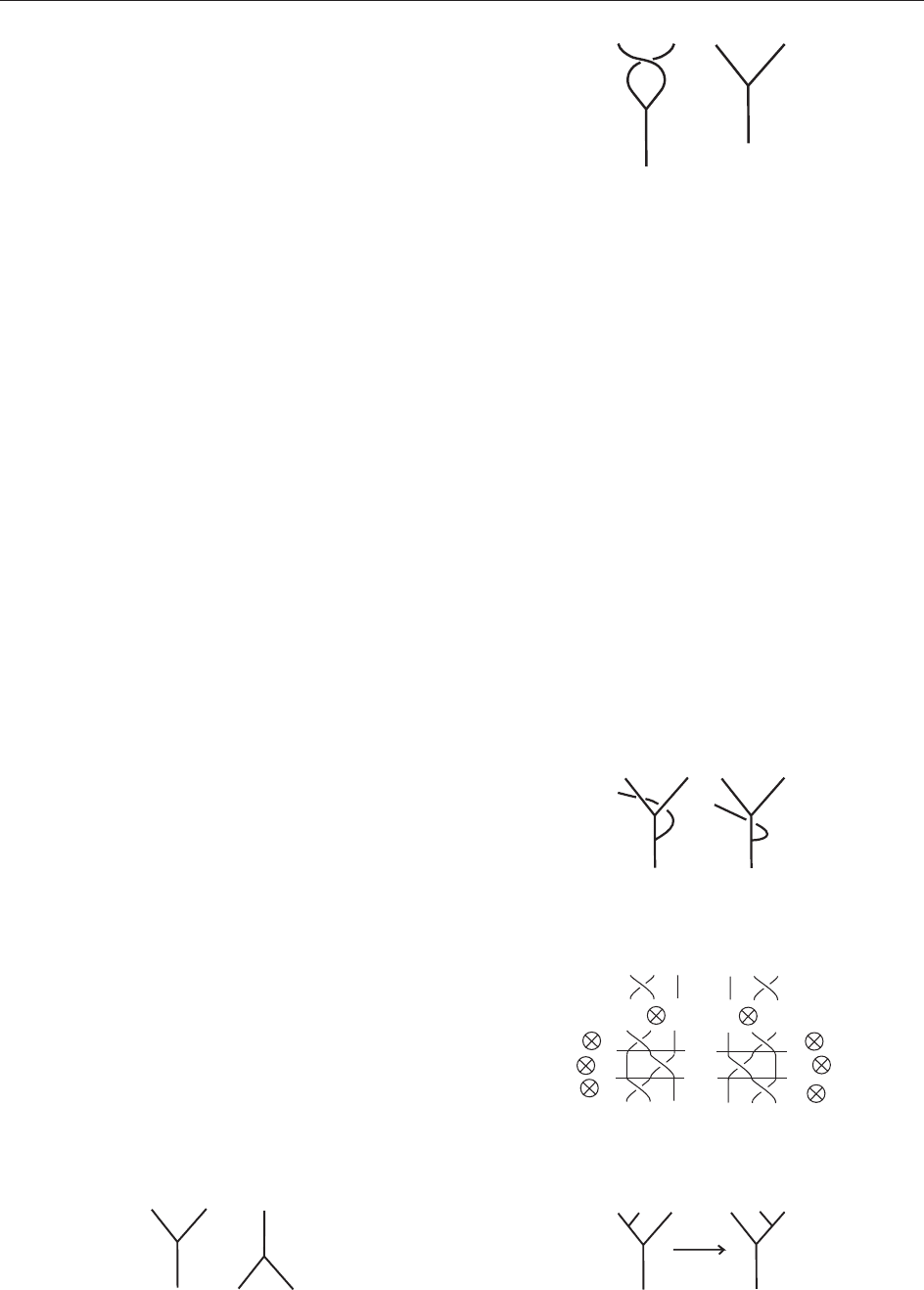
can represent these interactions (see Figure 13).
Once one introduces trivalent vertices for fusion
and creation, there is the question how these
interactions will behave in respe ct to the braiding
operators. There will be a matrix expression for the
compositions of braiding and fusion or creation as
indicated in Figure 14. Here we will restrict
ourselves to showing the diagrammatics with the
intent of giving the reader a flavor of these
structures. It is natural to assume that braiding
intertwines with creation as shown in Figure 15
(similarly with fusion). This intertwining identity is
clearly the sort of thing that a topologist will love,
since it indicates that the diagrams can be inter-
preted as embeddings of graphs in three-dimensional
space. Figure 16 illustrates the Yang–Baxter equa-
tion. The intertwining identity is an assumption like
the Yang–Baxter equation itself, which simplifies the
mathematical structure of the model.
It is to be expected that there will be an operator
that expresses the recoupling of vertex interactions
as shown in Figure 17 and labeled by Q. The actual
formalism of such an operator will parallel the
mathematics of recoupling for angular momentum
(see, e.g., Kauffman (1994)). If one just considers
the abstract structure of recoupling then one sees
that for trees with four branches (each with a single
root) there is a cycle of length 5, as shown in
Figure 13 Creation and fusion.
= R
Figure 14 Braiding.
Q
Figure 17 Recoupling.
=
RIRI
RI
R
I
RI
RI
RI
RI
Figure 16 Yang–Baxter equation.
=
Figure 15 Intertwining.
228 Knot Theory and Physics
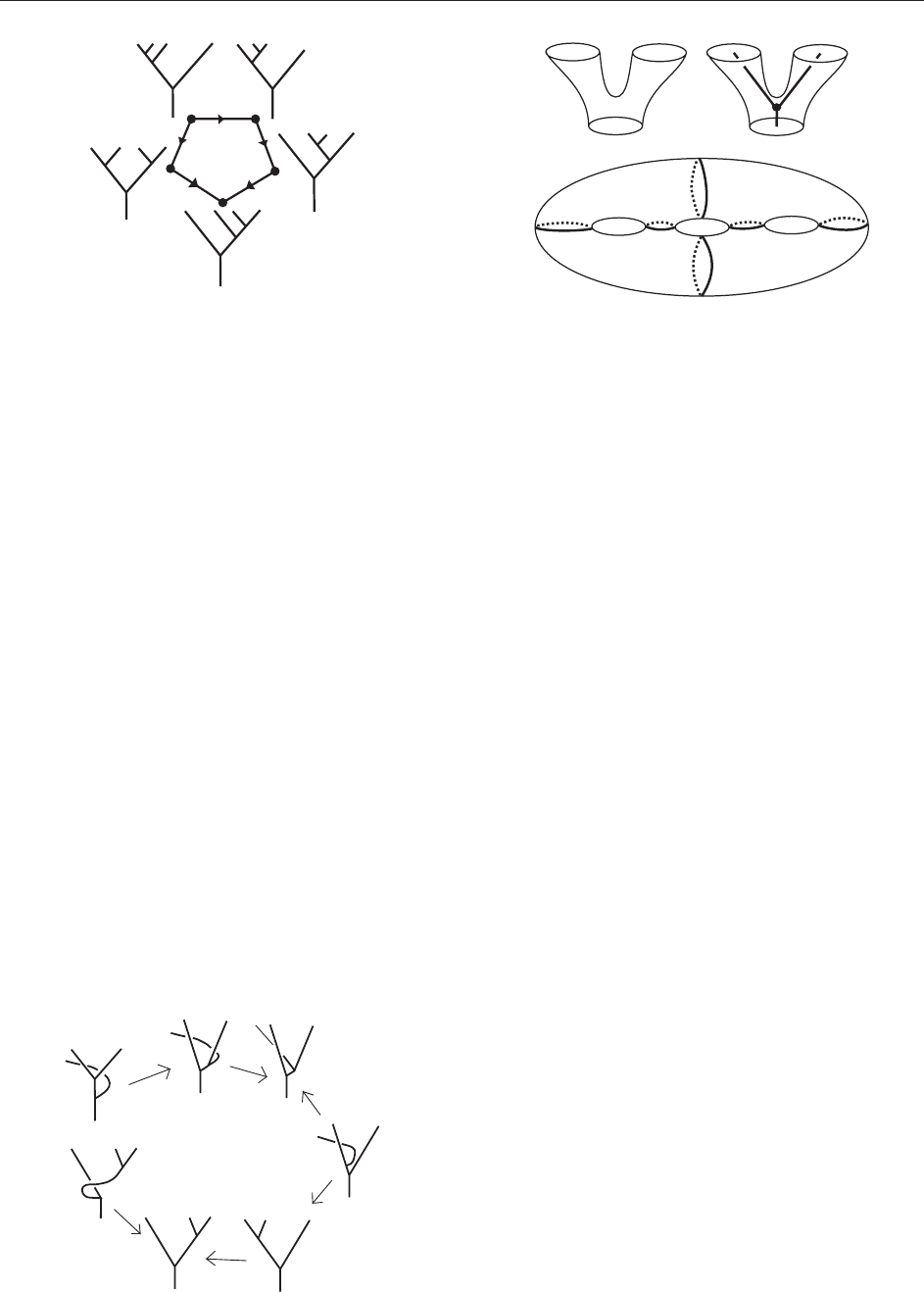
Figure 17. One can start with any pattern of three
vertex interactions and go through a sequence of five
recouplings that bring one back to the same tree
from which one started. It is a natural simplifying
axiom to assume that this composition is the identity
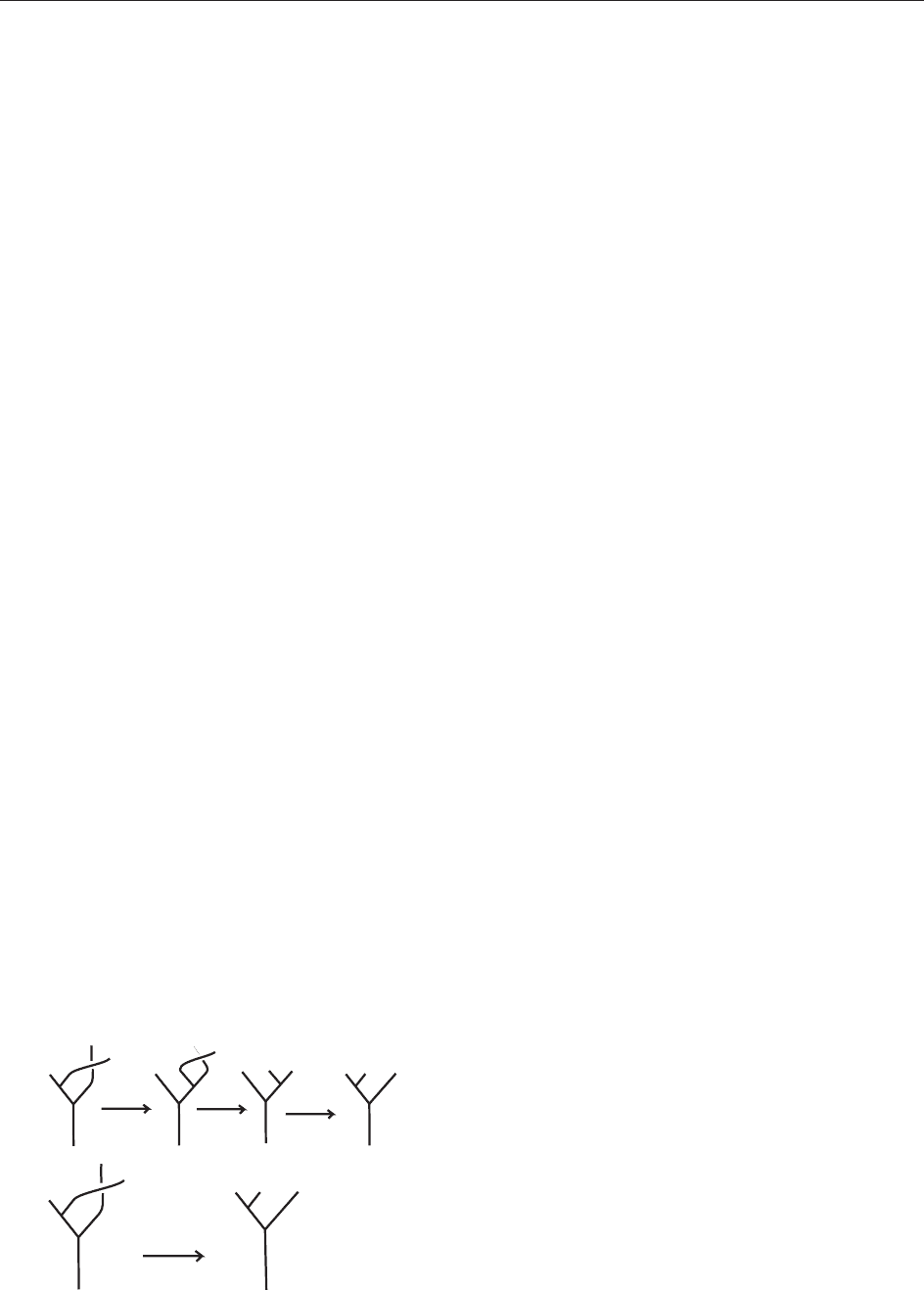
mapping. This axiom is called the pentagon identity
(Figure 18).
Finally, there is a hexagonal cycle of interactions
between braiding, recoupling and the intertwining
identity as shown in Figure 19. One says that the
interactions satisfy the hexagon identity if this
composition is the identity.
A three-dimensional topological quantum field
theory is an algebra of interactions that satisfies the
Yang–Baxter equation, the intertwining identity, the
pentagon identity and the hexagon identity. There is
no room in this summary to detail the way that
these properties fit into the topology of knots and
three-dimensional manifolds, but a sketch is in
order. For the case of topological quantum field
theory related to the group SU(2) there is a
construction based entirely on the combinatorial
topology of the bracket polynomial (see the section
‘‘Kno ts, braids , and bracket polynom ial’’). For more
information on this approach, the reader is referred
to Kauffman (1994, 2002).
It turns out that the algebraic properties of a
topological quantum field theory give it enough
power to rigourously model three manifold invar-
iants described by the Witten integral. This is done
by regarding the 3-manifold as a union of two
handlebodies with boundary an orientable surface
S
g
of genus g. The surface is divided up into
trinions as illustrated in Figure 20.Atrinionisa
surface with boundary that is topologically equiva-
lent to a sphere with three punctures. In Figure 20
we illustrate two trinions, the second shown as a
neighborhood of a trivalent vertex, and a surface
of genus 3 that is decomposed into three t rinions.
It turns out that there is a way to associate a
vector space V(S
g
)toasurfacewithatrinion
decomposition, defined in terms of the associated
topological quantum field t heory, such that the
isomorphism class of the vector space V(S
g
) does
not depend upon the choice of decomposition.
This independence is guaranteed by the braiding,
hexagon, and pentagon identities in such a way
that one can associate a well-de fined vector jM
i in
V(S
g
)wheneverM is a 3-manifold whose boundary is
S
g
. Furthermore, if a closed 3-manifold M
3
is decom-
posed along a surface S
g
into the union of M
and M
þ
,
where these parts are otherwise disjoint 3-manifolds
with boundary S
g
, then the inner product I(M) =
hM
jM
þ
i is, up to normalization, an invariant of the
3-manifold M
3
. With the definition of topological
quantum field theory given above, knots and links can
be incorporated as well, so that one obtains a source of
invariants I (M
3
, K) of knots and links in orientable
3-manifolds.
The invariant I(M
3
, K) can be formally compared
with the Witten integral
ZðM
3
; KÞ¼
Z
DAe
ðik=4ÞSðM;AÞ
W
K
ðAÞ
Q
Q
Q
Q
Q
Figure 18 Pentagon identity.
=
Q
Q
Q
R
R
R
Figure 19 Hexagon identity.
Figure 20 Decomposition of a surface into trinions.
Knot Theory and Physics 229
It can be shown that up to limits of the heuristics,
Z(M, K) and I(M
3
, K) are essentially equivalent for
appropriate choice of gauge grou ps.
This point of view leads to more abstract
formulations of topological quantum field theories
as ways to associate vector spaces and linear
transformations to manifolds and cobordisms of
manifolds. (A cobordism of surfaces is a 3-manifold
whose boundary consists of these surfaces.)
As the reader can see, a three-dimensional TQFT is,
at base, a highly simplified theory of point-particle
interactions in (2 þ 1)-dimensional spacetime. It can be
used to articulate invariants of knots and links and
invariants of 3-manifolds. The reader interested in the
SU(2) case of this structure and its implications for
invariants of knots and 3-manifolds can consult
Kauffman (1994, 2002)andCrane (1991). One expects
that physical situations involving 2 þ 1 spacetime will
be approximated by such an idealized theory. It is
thought, for example, that aspects of the quantum Hall
effect will be related to topological quantum field
theory (Wilczek 1990). One can imagine a physics
where the geometrical space is two dimensional and the
braiding of particles corresponds to their interactions
through circulating around one another in the plane.
Anyons are particles that do not just change their wave
functions by a sign under interchange, but rather by a
complex phase or even a linear combination of states. It
is hoped that TQFT models will describe applicable
physics. One can think about the possible applications
of anyons to quantum computing. The TQFTs then
provide a class of anyonic models where the braiding is
essential to the physics and to the quantum
computation.
The key point in the application and relationship
of TQFT and quantum information theory is, in our
opinion, contained in the structure illustrated in
Figure 21. There we show a more complex braiding
operator, based on the composition of recoupling
with the elementary braiding at a vertex. (This
structure is implicit in the hexagon identity of
Figure 19.) The new braiding operator is a source of
unitary representations of braid group in situations
(which exist mathematically) where the recoupling
transformations are themselves unitary. This kind of
pattern is utilized in the work of Freedman et al.
(2002) and in the case of classical angular momentum
formalism has been dubbed a ‘‘spin-network quantum
simulator’’ by Rasetti and collaborators (see, e.g.,
Marzuoli and Rasetti (2002). Kauffman and Lomo-
naco (2006) show how certain natural deformations
(Kauffman 1994)ofPenrose (1969) spin networks can
be used to produce such the Freedman–Kitaev model
for anyonic topological quantum computation. It is
legitimate to speculate that networks of this kind are
present in physical reality.
Quantum computing can be regarded as a study of
the structure of the preparation, evolution, and
measurement of quantum systems. In the quantum
computation model, an evolution is a composition of
unitary transformations (usually finite-dimensional
over the complex numbers). The unitary transforma-
tions are applied to an initial state vector that has been
prepared prior to this process. Measurements are
projections to elements of an orthonormal basis of
the space upon which the evolution is applied. The
result of measuring a state j i, written in the given
basis, is probabilistic. The probability of obtaining a
given basis element from the measurement is equal to
the absolute square of the coefficient of that basis
element in the state being measured.
It is remarkable that the above lines constitute an
essential summary of quantum theory. All applications
of quantum theory involve filling in details of unitary
evolutions and specifics of preparations and measure-
ments. Such unitary evolutions can be seen as approxi-
mated arbitrarily closely by representations of the Artin
braid group. The key to the anyonic models of quantum
computation via topological quantum field theory, or
via deformed spin networks, is that all unitary evolu-
tions can be approximated by a single coherent method
for producing representations of the braid group. This
beautiful mathematical fact points to a deep role for
topology in the structure of quantum physics.
The future of knots, links, and braids in relation
to physics will be very exciting. There is no question
that unitary representations of the braid group and
quantum invariants of knots and links play a
fundamental role in the mathematical structure of
quantum mechanics, and we hope that time will
show us the full meaning of this relationship.
Acknowledgments
It gives the author pleasure to thank the National
Science Foundation for support of this research
Q
Q
–1
R
B
= Q
–1
RQ
Figure 21 A more complex braiding operator.
230 Knot Theory and Physics
under NSF Grant DMS-0245588. Much of this
effort was sponsored by the Defense Advanced
Research Projects Agency (DARPA) and Air Force
Research Laboratory, Air Force Materiel Command,
USAF, under agreement F30602-01-2-05022. The
views and conclusions contained herein are those of
the authors and should not be interpreted as
necessarily representing the official policies or
endorsements, either expressed or implied, of the
Defense Advanced Research Projects Agency, the Air
Force Research Laboratory, or the US Government.
See also: Chern–Simons Models: Rigorous Results;
Functional Integration in Quantum Physics; Knot
Homologies; Knot Invariants and Quantum Gravity;
Large-N and Topological Strings; Loop Quantum Gravity;
Mathematical Knot Theory; Schwarz-Type Topological
Quantum Field Theory; The Jones Polynomial;
Topological Knot Theory and Macroscopic Physics;
Topological Quantum Field Theory: Overview;
Two-Dimensional Conformal Field Theory and Vertex
Operator Algebras; von Neumann Algebras: Introduction,
Modular Theory, and Classification Theory; Yang–Baxter
Equations.
Further Reading
Alexander JW (1923) Topological invariants of knots and links.
Transactions of the American Mathematical Society 20: 275–306.
Atiyah MF (1990) The Geometry and Physics of Knots.
Cambridge: Cambridge University Press.
Ashtekar A, Rovelli C, and Smolin L (1992) Weaving a classical
geometry with quantum threads. Physical Review Letters 69: 237.
Bar-Natan D (1995) On the Vassiliev knot invariants. Topology
34: 423–472.
Crane L (1991) 2-d physics and 3-d topology. Communications
Mathematical Physics 135(3): 615–640.
Freedman MH, Kitaev A, and Wang Z (2002) Simulation of
topological field theories by quantum computers. Communica-
tions in Mathematical Physics 227: 587–603 (quant-ph/0001071).
Jones VFR (1985) A polynomial invariant for links via von
Neumann algebras. Bulletin of the American Mathematical
Society 129: 103–112.
Kauffman LH (1987) State models and the Jones polynomial.
Topology 26: 395–407.
Kauffman LH (1994) Temperley–Lieb Recoupling Theory and
Invariants of Three-Manifolds, Annals Studies, vol. 114.
Princeton: Princeton University Press.
Kauffman LH (1991) Knots and Physics (2nd edn., 1993, 3rd
edn., 2002). Singapore: World Scientific Publishers.
Kauffman LH (1995) Functional integration and the theory of
knots. Journal of Mathematical Physics 36(5): 2402–2429.
Kauffman LH (2002) Quantum computation and the Jones
polynomial. In: Lomonaco S, Jr. (ed.) Quantum Computation
and Information, AMS CONM/305. Providence, RI: American
Mathematical Society pp. 101–137.
Kauffman LH and Lo monaco SJ, Jr. (2002) Q uantum entangle-
ment and topological entanglement. New Journal of Physics
4: 73.1–73.18 (http://www.njp.org).
Kauffman LH and Lomonaco SJ, Jr. (2006) Spin networks and
anyonic topological quantum computing (in preparation).
Marzuoli A and Rasetti M (2002) Spin network quantum
simulator. Physics Letters A 306: 79–87.
Penrose R (1969) Angular momentum: an approach to combina-
torial spacetime. In: Bastin T (ed.) Quantum Theory and
Beyond. Cambridge: Cambridge University Press.
Reshetikhin NY and Turaev V (1991) Invariants of three
manifolds via link polynomials and quantum groups. Inven-
tiones Mathematicae 103: 547–597.
Wilczek F (1990) Fractional Statistics and Anyon Superconduc-
tivity. Berlin–Heidelberg–New York: Springer-Verlag.
Witten E (1989) Quantum field Theory and the Jones Polynomial.
Communications in Mathematical Physics 121: 351–399.
Kontsevich Integral
S Chmutov and S Duzhin, Petersburg Department
of Steklov Institute of Mathematics, St. Petersburg,
Russia
ª 2006 Elsevier Ltd. All rights reserved.
Introduction
The Kontsevich integral was invented by Kontsevich
(1993) as a tool to prove the fundamental theorem of
the theory of finite-type (Vassiliev) invariants (see Bar-
Natan (1995a)). It provides an invariant exactly as
strong as the totality of all Vassiliev knot invariants.
The Kontsevich integral is defined for oriented
tangles (either framed or unframed) in R
3
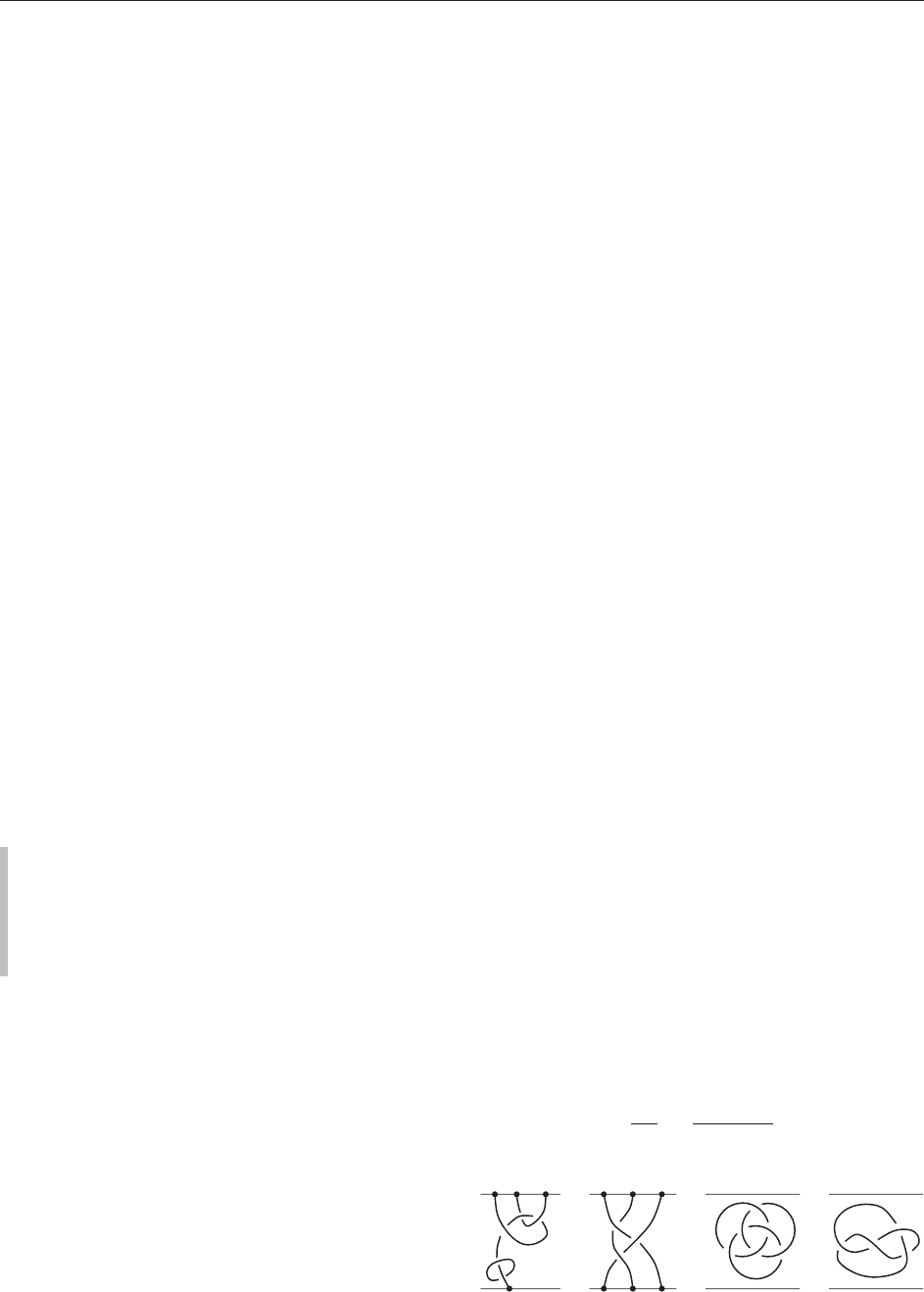
; therefore,
it is also defined in the particular cases of knots,
links, and braids (see Figure 1).
As a starter, we give two examples where simple
versions of the Kontsevich integral have a
straightforward geometrical meaning. In these
examples, as well as in the general construction of
the Kontsevich integral, we represent 3-space R
3
as
the product of a real line R with coordinate t and a
complex plane C with complex coo rdinate z.
Example 1 The number of twists in a braid with
two strings z
1
(t) and z
2
(t) placed in the slice 0 t 1
(see Figure 2) is equal to
1
2i
Z
1
0
dz
1
dz
2
z
1
z
2
Figure 1 A tangle, a braid, a link, and a knot.
Kontsevich Integral 231
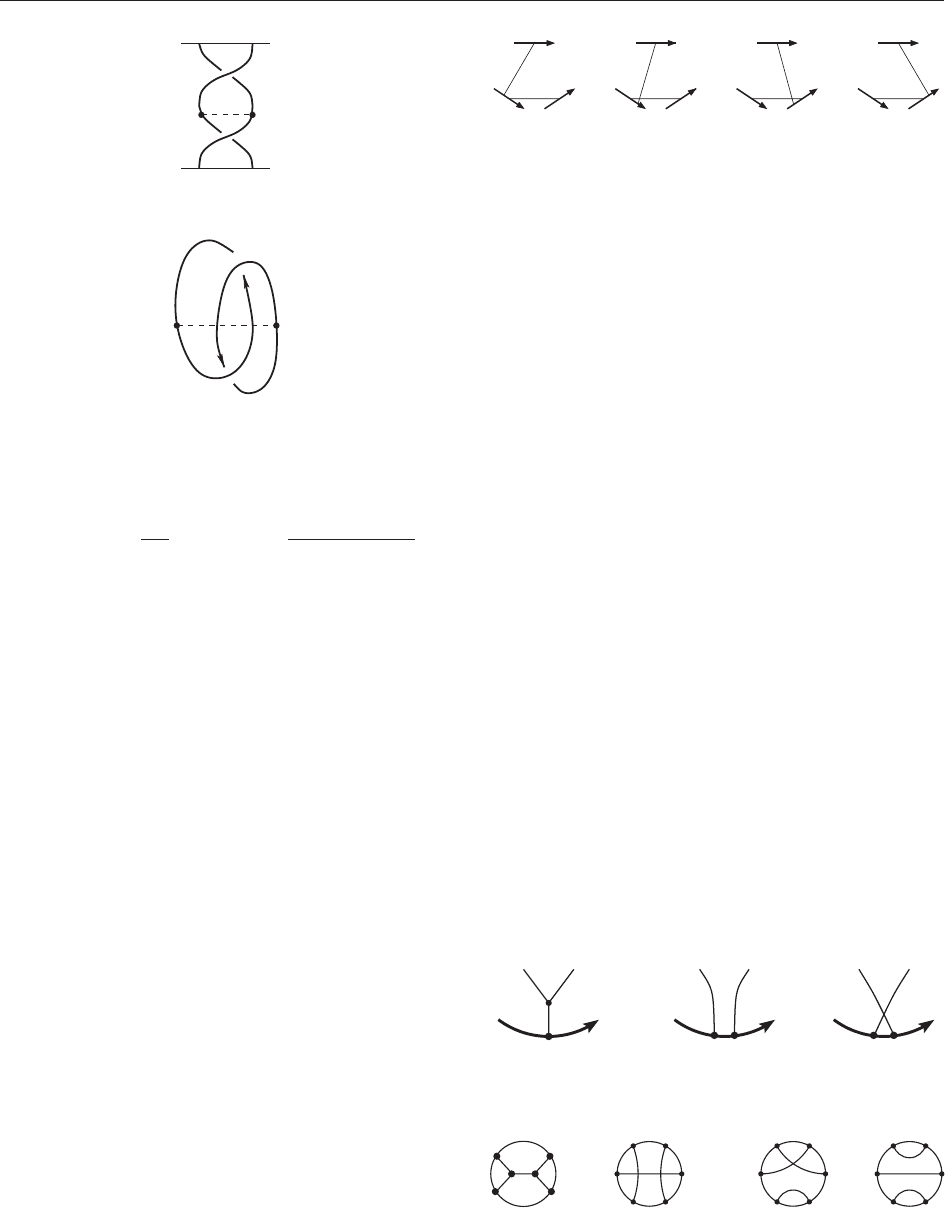
Example 2 The linking number of two spatial
curves K and K
0
(see Figure 3) can be computed as
lkðK; K
0
Þ¼
1
2i
Z
m<t<M
X
j
"
j
dðz
j
ðtÞz
0
j
ðtÞÞ
z
j
ðtÞz
0
j
ðtÞ
where m and M are the minimum and the maximum
values of t on the link K [ K
0
, j is the index that
enumerates all possible choices of a pair of strands
of the link as functions z
j
(t), z
0
j
(t) corresponding to K
and K
0
, respectively, and "
j
= 1 according to the
parity of the number of chosen strands that are
oriented downwards.
The Kontsevich integral can be regarded as a far-
going generalization of these formulas. It aims at
encoding all information about how the horizontal
chords on the knot (or tangle) rotate when moved in
the vertical direction. From a more general view-
point, the Kontsevich integral represents the mono-
dromy of the Knizhnik–Zamolodchikov connection
in the complement to the union of diagonals in C
n
(see Bar-Natan (1995a) and Ohtsuki (2002)).
Chord Diagrams and Weight Systems
Algebras A(p)
The Kontsevich integral of a tangle T takes values in
the space of chord diagrams supported on T.
Let X be an oriented one-dimensional manifold,
that is, a collection of p numbered oriented lines and
q numbered oriented circles. A chord diagram of
order n supported on X is a collection of n pairs
of unordered points in X, considered up to an
orientation- and component-preserving diffeo-
morphism. In the vector space formally generated
by all chord diagrams of order n, we distinguish the
subspace spanned by all four-term relations
–
+–
where thin lines designate chords, while thick lines are
pieces of the manifold X. Apart from the fragments
shown, all the four diagrams are identical. The
quotient space over all such combinations is denoted
by A
n
(X) = A
n
(p, q). Let A(p, q) =
1
n = 0
A
n
(p, q)
and let
^
A(p, q) be the graded completion of A(p, q)
(i.e., the space of formal infinite series
P
1
i = 0
a
i
with
a
i
2A
i
(p, q)). If, moreover, we divide A(p, q)byall
‘ ‘framing independence’ ’ relations (any diagram with
an isolated chord, i.e., a chord joining two adjacent
points of the same connected component of X,issetto
0), then the resulting space is denoted by A
0
(p, q), and
its graded completion by
^
A
0
(p, q).
The spaces A(p,0)= A(p) have the structure of an
algebra (the product of chord diagrams is defined by
concatenation of underlying manifolds in agreement
with the orientation). Closing a line component into a
circle, we get a linear map A(p , q) !A(p 1, q þ 1)
whichisanisomorphismwhenp = 1. In particular,
A(S
1
) ffiA(R
1
) has the structure of an algebra; this
algebra is denoted simply by A; the Kontsevich integral
of knots takes its values in its graded completion
^
A. Another algebra of special importance is
^
A(3) =
^
A(3, 0), because it is where the Drinfeld
associators live.
Hopf Algebra Structure
The algebra A(p) has a natural structure of a Hopf
algebra with the coproduct defined by all ways to
split the set of chords into two disjoint parts. To give
a convenient description of its primitive space, one
can use generalized chord diagrams. We now allow
trivalent vertices not belonging to the supporting
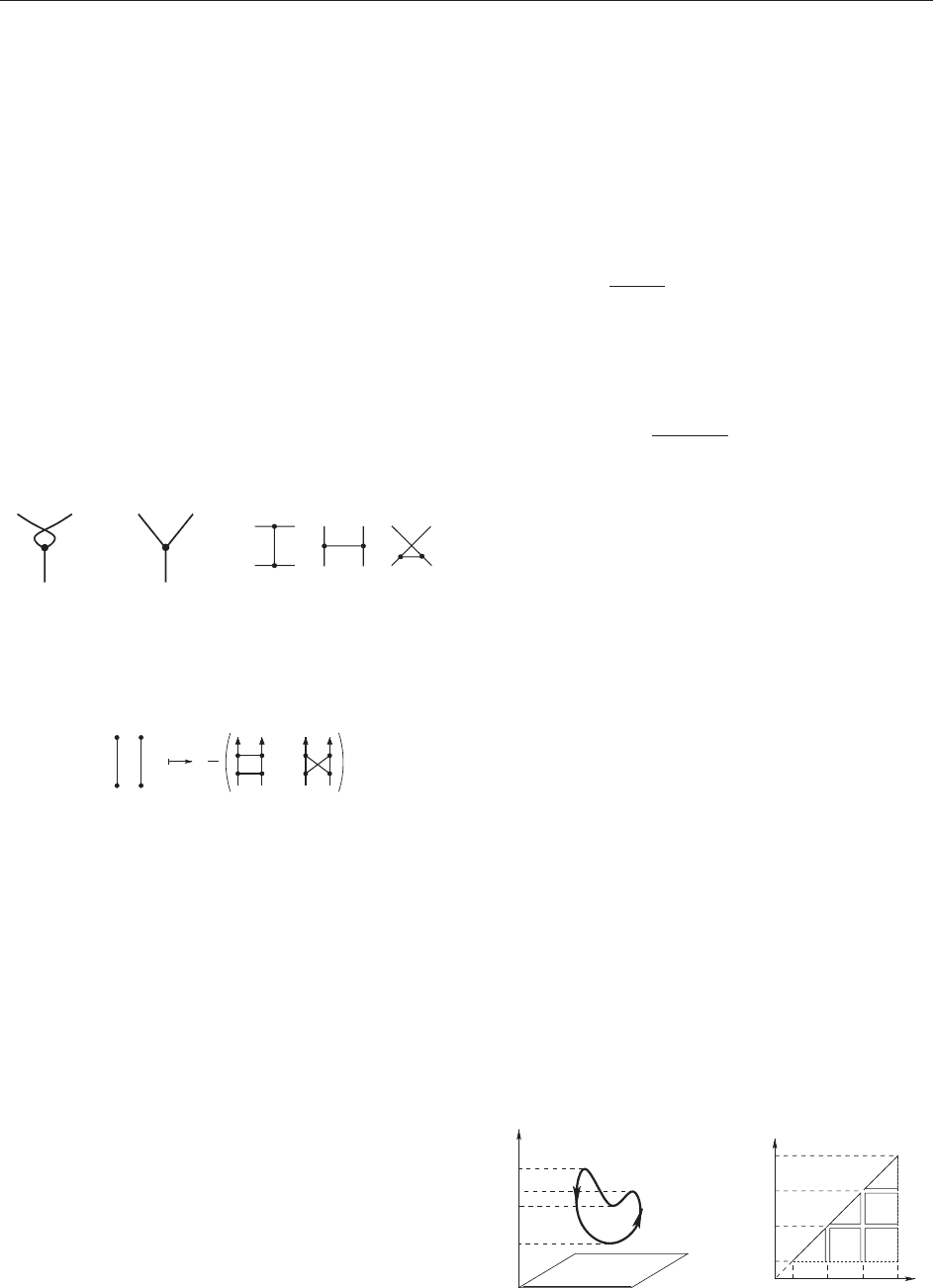
manifold and use STU relations (Bar-Natan 1995a)
=–
to express the generalized diagrams as linear combi-
nations of conventional chord diagrams, for example,
=–
+
2
Then the primitive space coincides with the sub-
space of A(p) spanned by all connected generalized
chord diagrams (‘‘connected’’ means that they remain
connected when the supporting manifold X is
disregarded).
z
1
(t )
z
2
(t )
Figure 2 Counting the number of twists.
z
j
(t )
z
j
(t )
′
Figure 3 Counting the linking number.
232 Kontsevich Integral
Weight Systems
A ‘‘weight system’’ of degree n is a linear function
on the space A
n
. Every Vassiliev invariant v of
degree n defines a weight system symb(v)ofthe
same degree called its ‘‘symbol.’’
Algebras B(p)
Apart from the spaces of chord diagrams modulo four-
term relations, there are closely related spaces of Jacobi
diagrams. A Jacobi diagram is defined as a unitrivalent
graph, possibly disconnected, having at least one
vertex of valency 1 in each connected component and
supplied with two additional structures: a cyclic order
of edges in each trivalent vertex and a labeling of
univalent vertices taking values in the set {1, 2, ..., p}.
The space B(p) is defined as the quotient of the vector
space formally generated by all p-colored Jacobi
diagrams modulo the two types of relations:
Antisymmetry: IHX:
=
=
–
–
The disjoint union of Jacobi diagrams makes the
space B(p)intoanalgebra.
The symmetrization map
p
: B(p) !A(p), defined
as the average over all ways to attach the legs of color i
to ith connected component of the underlying manifold
1
2
11
2
1
1
2
2
2
+
is an isomorphism of vector s paces (the formal
PBW isomorphi sm ( Bar-Natan 1995a, Le and
Murakami 1995) which is not compatible with
the multiplication. The relation between A(p)and
B(p) very much resembles the relation between
the universal enveloping algebra and the sym-
metric algebra of a Lie algebra. The algebra
B= B(1) is used to write out the explicit formula
for the Kontsevich integral of the unknot (see
Bar-Natan et al. (2003) and below).
The Construction
Kontsevich’s Formula
We will explain the construction of the Kontsevich
integral in the classical case of (closed) oriented
knots; for an arbitrary tangle T, the formula is the
same; only the result is interpreted as an element of
^
A(T). As above, represent three-dimensional space
R
3
as a direct product of a complex line C with
coordinate z and a real line R with coordinate t.
The integral is defined for Morse knots, that is,
knots K embedded in R
3
= C
z
R
t
in such a way
that the coordinate t restricted to K has only
nondegenerate (quadratic) critical points. (In fact,
this condition can be weakened, but the class of
Morse knots is bro ad enough and convenient to
work with.)
The Kontsevich integral Z(K) of the knot K is the
following element of the complet ed algebra
^
A
0
:
ZðKÞ¼
X
1
m¼0
1
ð2iÞ
m
Z
t
min
< t
m
< < t
1
<t
max
t
j
are noncritical
X
P¼fðz
j
;z
0
j
Þg
ð1Þ
#
P
D
P
^
m
j¼1
dz
j
dz
0
j
z
j
z
0
j
Explanation of the Constituents
The real numbers t
min
and t
max
are the minimum and
the maximum of the function t on K.
The integration domain is the m-dimensional
simplex t
min
< t
m
< < t
1
< t
max
divided by the
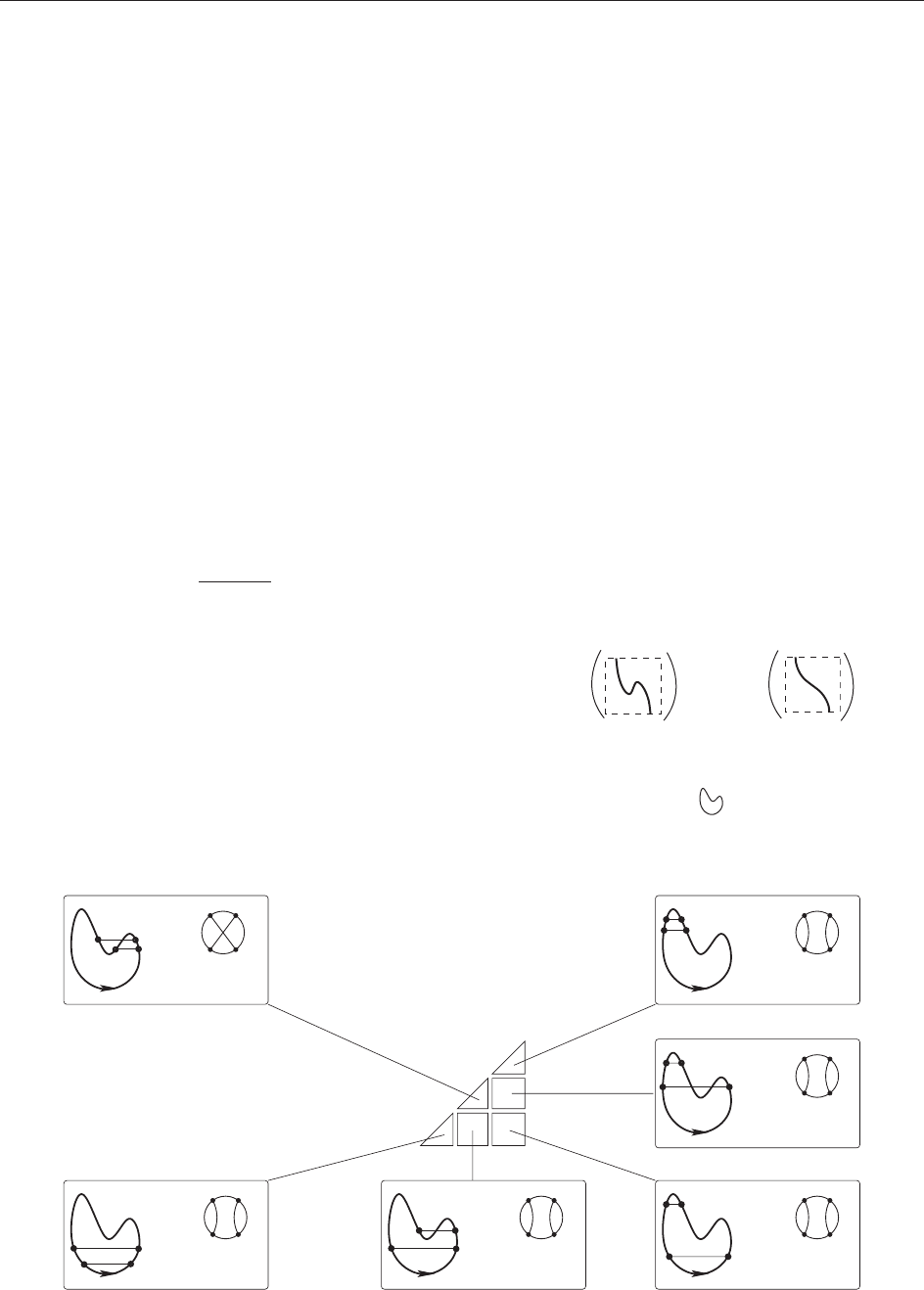
critical values into a certain number of ‘‘connected
components.’’ For example, Figure 4 shows an
embedding of the unknot where, for m = 2, the
integration domain has six connected components.
The number of summands in the integrand is
constant in each connected component of the
integration domain, but can be different for different
components. In each plane {t = t
j
} R
3
choose an
unordered pair of distinct points (z
j
, t
j
) and (z
0
j
, t
j
)on
K, so that z
j
(t
j
) and z
0
j
(t
j
) are continuous branches of
the knot. We denote by P = {(z
j
, z
0
j
)} the collection of
such pairs for j = 1, ..., m. The integrand is the sum
over all choices of the pairing P. In the example
above for the component {t
min
< t
1
< c
1
, c
2
< t
2
<
t
max
}, we have only one possible pair of poin ts on
the levels {t = t
1
} and {t = t
2
}. Therefore, the sum
over P for this component consists of only one
summand. Unlike this, in the component {t
min
<
t
1
< c
1
, c
1
< t
2
< c
2
}, we still have only one
t
max
c
2
c
1
t
min
c
2
t
max
c
1
t
min
c
1
c
2
t
max
t
min
t
z
t
2
t
1
Figure 4 Connected components.
Kontsevich Integral 233
possibility for the level {t = t
1
}, but the plane {t = t
2
}
intersects our knot K in four points. So we have
4
2
= 6 possible pairs (z
2
, z
0
2
), and the total number
of summands is six (see Figure 5).
For a pairing P, the symbol ‘‘#
P
’’ denotes the
number of points (z
j
, t
j
)or(z
0
j
, t
j
)inP, where the
coordinate t decreases along the orientation of K.
Fix a pairing P.ConsidertheknotK as an oriented
circle and connect the points (z
j
, t
j
)and(z
0
j
, t
j
)bya
chord. Up to a diffeomorphism, this chord does not
depend on the value of t
j
within a connected
component. We obtain a chord diagram with m
chords. The corresponding element of the algebra A
0
is denoted by D
P
. Figure 5, for each connected
component in our example, shows one of the possible
pairings, the corresponding chord diagram with
the sign (1)
#
P
and the number of summands of the
integrand (some of which are equal to zero in A
0
due
to the framing independence relation).
Over each connected component, z
j
and z
0
j
are
smooth functions of t
j
.
By
^
m
j¼1
dz
j
dz
0
j
z
j
z
0
j
we mean the pullback of this form to the integration
domain of variables t
1
, ..., t
m
. The integration
domain is considered with the orientation of the
space R
m
defined by the natural order of the
coordinates t
1
, ..., t
m
.
By convention, the term in the Kontsevich integral
corresponding to m = 0 is the (only) chord diagram
of order 0 with coefficient 1. It represents the unit of
the algebra A
0
.
Framed Version of the Kontsevich Integral
Let K be a framed oriented Morse knot with writhe
number w(K). Denote the corresponding knot
without fram ing by
K. The framed version of the
Kontsevich integral can be defined by the formula
Z
fr
ðKÞ¼e
ðwðKÞ=2Þ
Zð
KÞ2
^
A
where is the chord diagram with one chord and the
integral Z(
K) 2
^
A
0
is understood as an element of the
completed algebra
^
A (without one-term relations) by
virtue of a natural inclusion A
0
!Adefined as identity
on the primitive subspace of A
0
(see Goryunov
(1999) and Le and Murakami (1996)).
Basic Properties
Constructing the Universal Vassiliev Invariant
The Kontsevich integral Z(K)
1. converges for any Morse knot K,
2. is invar iant under deformations of the knot in the
class of Morse knots, and
3. behaves in a predictable way under the deforma-
tion that adds a pair of new critical points to a
Morse knot:
Z
= Z(H
)
.
Z
Here the first and the third pictures depict two
embeddings of an arbitrary knot, differing only in
the shown fragment, H =
is the ‘‘hump’’ (unknot
embedded in R
3
in the specified way), and the
product is the product in the completed algebra
^
A
0
6 summands
(–1)
2
1 summand
(–1)
1
36 summands
(–1)
1
1 summand
(–1)
2
6 summands
(–1)
2
1 summand
(–1)
2
Figure 5 Pairings and chord diagrams.
234 Kontsevich Integral
of chord diagrams. The last equality allows one to
define a genuine knot invariant by the formula
IðKÞ¼ZðKÞ=ZðHÞ
c=2
where c denotes the number of critical points of K and
the ratio means the division in the algebra
^
A
0
according
to the rule (1 þ a)
1
= 1 a þ a
2
a
3
þ .
The expression I(K) is sometimes referred to as
the ‘‘final’’ Kontsevich integral as opposed to the
‘‘preliminary’’ Kontsevich integral Z(K). It repre-
sents a universal Vassiliev invariant in the following
sense: Let w be a weight system, that is, a linear
functional on the algebra
^
A
0
. Then the composition
w(I(K)) is a numerical Vassiliev invariant, and any
Vassiliev invariant can be obtained in this way.
The final Kontsevich integral for framed knots is
defined in the same way, using the hump H with
zero writhe number.
Is Universal Vassiliev Invariant Universal?
At present, it is not known whether the Kontsevich
integral separates knots, or even if it can tell the
orientation of a knot. However, the corresponding
problem is solved, in the affirmative, in the case of
braids and string links (theorem of Kohno–
Bar-Natan (Bar-Natan 1995b , Kohno 1987).
Omitting Long Chords
We will state a technical lemma which is highly
important in the study of the Kontsevich integral. It
is used in the proof of the multiplicativity, in the
combinatorial construction, etc.
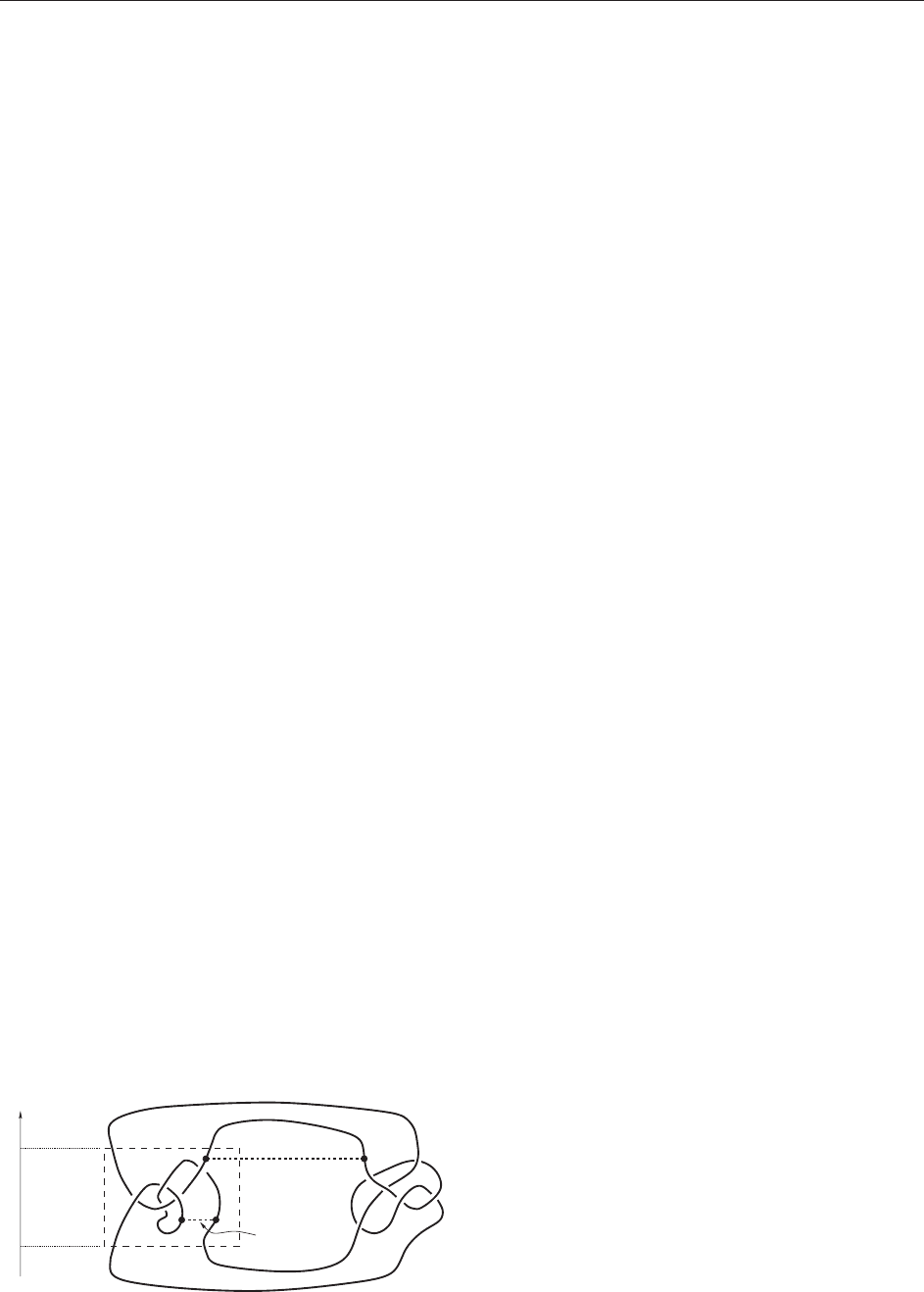
Suppose we have a Morse knot K with a
distinguished tangle T ( Figure 6). Let m and M be
the maximal and minimal values of t on the tangle T.
In the horizontal planes between the levels m and M,
we can distinguish two kinds of chords: ‘ ‘short’’
chords that lie either inside T or inside K nT,and
‘ ‘long’’ chords that connect a point in T with a point
in K nT.DenotebyZ
T
(K) the expression defined by
thesameformulaastheKontsevichintegralZ(K)
where only short chords are taken into consideration.
More exactly, if C is a connected component of the
integration domain whose projection on the coordi-
nate axis t
j
is entirely contained in the segment [m, M],
then in the sum over the pairings P we include only
those pairings that include short chords.
Lemma ‘‘Long’’ chords can be omitted when
computing the Kontsevich integral: Z
T
(K) = Z(K).
Kontsevich’s Integral and Operations on Knots
The Kontsevich integral behaves in a nice way with
respect to the natural operations on knots, such as
mirror reflection, changing the orientation of the
knot, mutation of knots (see Chmutov and Duzhin
(2001)), cabling (see Willerton (2002)). We give
some details regarding the first two items.
Fact 1 Let R be the operation that sends a knot
to its mirror image. Define the corresponding
operation R on chord diagrams as multiplication
by (1)
n
, where n is the order of the diagram. Then
the Kontsevich integral commutes with the opera-
tion R: Z(R(K)) = R(Z(K)), where by R(Z(K)) we
mean simultaneous application of R to all the chord
diagrams participating in Z(K).
Corollary The Kontsevich integral Z(K) and the
universal Vassiliev invariant I(K) of an amphicheiral
knot K consist only of even order terms. (A knot K is
called ‘‘amphicheiral,’’ if it is equivalent to its mirror
image: K = R(K).)
Fact 2 Let S be the operation on knots which
inverts their orientation. The same letter will also
denote the analogous operat ion on chord diagrams
(inverting the orientation of the outer circle or,
which is the same thing, axial symmetry of the
diagram). Then the Kontsevich integral commutes
with the operation S of inverting the orientation:
Z(S(K)) = S(Z(K)).
Corollary The following two assertions are
equivalent:
(i) Vassiliev invariants do not distinguish the
orientation of knots and
(ii) all chord diagrams are symmetric: D = S(D)
modulo four-term relations
.
The calculations of Kneissler (1997) show that up
to order 12 all chord diagrams are symmetric. For
bigger orders, the problem is still open.
Multiplicative Properties
The Kontsevich integral for tangles is multiplicative:
ZðT
1
ÞZðT
2
Þ¼ZðT
1
T
2
Þ
whenever the product T
1
T
2
, defined by vertical
concatenation of tangles, exists. Here, the product
m
M
t
T
short
long
Figure 6 Short and long chords.
Kontsevich Integral 235
on the left-hand side is understood as the image of
the element Z(T
1
) Z(T
2
) under the natural map
A(T
1
) A( T
2
) !A(T
1
T
2
).
This simple fact has two important corollaries:
1. For any knot K, the Kontsevich integral Z(K)is
a group-like element of the Hopf algebra
^
A
0
,
that is,
ðZðK ÞÞ ¼ ZðKÞZðKÞ
where is the comultiplication in A defined
above.
2. The final Kontsevich integral, taken in a different
normalization
I
0
ðKÞ¼ZðHÞIðKÞ¼
ZðKÞ
ZðHÞ
c=21
is multiplicative with respect to the connected
sum of knots:
I
0
ðK
1
#K
2
Þ¼I
0
ðK
1
ÞI
0
ðK
2
Þ
Arithmetical Properties
For any knot K the coefficients in the expansion of
Z(K) over an arbitrary basis consisting of chord
diagrams are rational (see Kontsevich (1993), Le
and Murakami (1996), and below).
Combinatorial Construction of the
Kontsevich Integral
Sliced Presentation of Knots
The idea i s to cut the knot into a number of
standard simple tangles, compute the Kontsevich
integralforeachofthem,andthenrecoverthe
integral of the whole knot from these simple
pieces.
More exactly, we represent t he knot by a family
of plane diagrams continuously depending on a
parameter "2(0, "
0
) and cut by horizontal planes
into a number of slices with the following
properties.
1. At every boundary level of a slice (dashed lines
in the pictures below), the dist ances betwee n
various strings are asymptotically pro-
portional to d ifferent whole powers of th e
parameter ".
2. Every slice contains exactly one special event
and several strictly vertical strings which
are farther away (at lower powers of ")from
any string participating in the e vent than its
width.
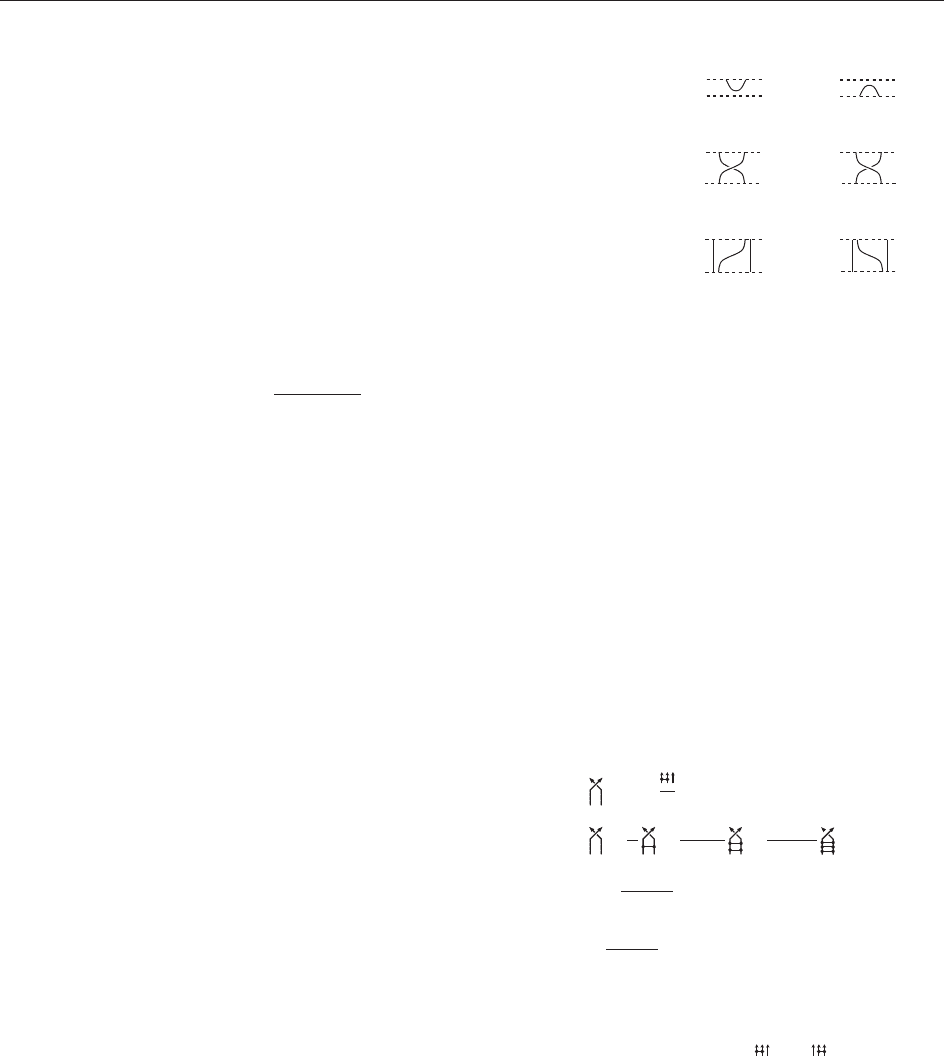
3. There are three types of special events:
associativity:
A
+
= A
–
=
braiding:
B
+
=
B
–
=
min/max:
m =
M =
where, in the two last cases , the strings may be
replaced by bunches of parallel strings which
are closer to each other than the width of this
event.
Recipe of Computation of the Kontsevich Integral
Given such a sliced representation of a knot, the
combinatorial algorithm to compute its Kontsevich
integral consists in the following:
1. Replace each special event by a series of chord
diagrams supported on the correspond ing tangle
according to the rule
m; M 7!1
B
þ
7!R; B
þ
7!R
1
A
þ
7!; A
7!
1
where
R ¼
exp
2
¼
þ
1
2
þ
1
2 2
2
þ
1
3! 2
3
þ
¼ 1
ð2Þ
ð2iÞ
2
½a; b
ð3 Þ
ð2iÞ
3
ð½a; ½a; b þ ½b; ½a; bÞ þ
( 2
^
A(3) is the Knizhnik–Zamolodchikov
Drinfeld associator defined be low; it is an infinite
series in two variables a =
, b = ).
2. Compute the product of all these series from
top to bottom taking into account the connec-
tion of the strands of different tangles, thus
obtaining an element of the algebra
^
A
0
.
To accomplish the algorithm, we need two
auxiliary operations on chord diagrams:
1. S
i
: A(p)!A(p) defined as multiplication by
(1)
k
on a chord diagram containing k end-
points of chords on the string number i.Thisis
the correction term in the computation of R
and in the case when the tangle contains
236 Kontsevich Integral