
Francoise J.-P., Naber G.L., Tsun T.S. (editors) Encyclopedia of Mathematical Physics
Подождите немного. Документ загружается.

some strings oriented downwards (the upwards
orientation is considered a s positive).
2.
i
: A(p) !A(p þ 1) acts on a chord diagram D
by doubling the ith string of D and taking the
sum over all possible lifts of the endpoints of
chords of D from the ith string to one of the two
new strings. The strings are counted by their
bottom points from left to right. This operation can
be used to express the combinatorial Kontsevich
integral of a generalized associativity tangle
(with strings replaced by bunches of strings) in
terms of the combinatorial Kontsevich integral
of a simple associativity tangle.
Example
Using the combinatorial algorithm, we compute the
Kontsevich integral of the trefoil knot 3
1
to the
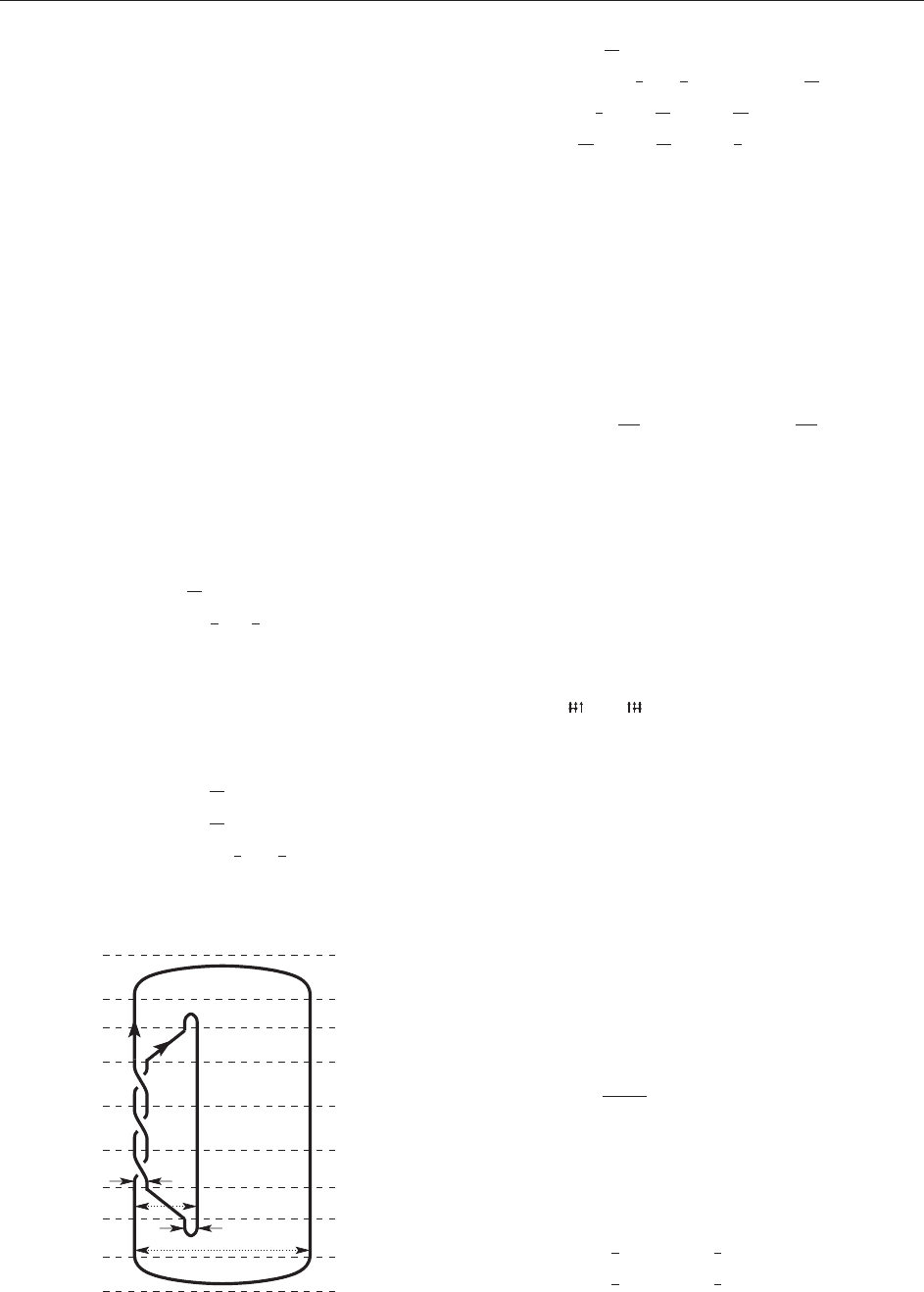
terms of degree 2. A sliced presentation for this knot
shown in Figure 7 implies that Z(3
1
) = S
3
()
R
3
S
3
(
1
) (here the product from left to right
corresponds to the multiplication of tangles from
top to bottom). Up to degree 2, we have
¼ 1 þ
1
24
½a; bþ
R ¼ X 1 þ
1
2
a þ
1
8
a
2
þ
where X means that the two strands in each term of
the series must be crossed over at the top. The
operation S
3
changes the orientation of the third
strand, which means that S
3
(a) = a and S
3
(b) = b.
Therefore,
S
3
ðÞ¼1
1
24
½a; bþ
S
3
ð
1
Þ¼1 þ
1
24
½a; bþ
R
3
¼ X 1
3
2
a þ
9
8
a
2
þ
and
Zð3
1
Þ¼ 1
1
24
½a; bþ
Xð1
3
2
a þ
9
8
a
2
þ
1 þ
1
24
½a; bþ
¼ 1
3
2
Xa
1
24
abX þ
1
24
baX
þ
1
24
Xab
1
24
Xba þ
9
8
Xa
2
þ
Closing these diagrams into the circle, we see that in
the algeb ra A we have Xa = 0 (by the framing
independence relation), then baX = Xab = 0 (by the
same relation, because these diagrams consist of two
parallel chords) and abX = Xba = Xa
2
=
N
. The
result is Z(3
1
) = 1 þ (25/24)
N
þ. The final
Kontsevich integral of the trefoil (in the multi-
plicative normalization) is thus equal to
I
0
ð3
1
Þ¼Zð3
1
Þ=ZðHÞ
¼ 1 þ
25
24
O
þ
1 þ
1
24
O
þ
¼1 þ
O
þ
Drinfeld Associator and Rationality
The Drinfeld associator used as a building block in
the combinatorial construction of the Kontsevich
integral can be defined as the limit
KZ
¼ lim
"!0
"
b
ZðAT
"
Þ"
a
where a = , b = , and AT
"
is the positive associa-
tivity tangle (special event A
þ
shown above) with
the distance between the vertical strands constant 1
and the distance between the close endpoints equal
to ". An explicit formula for
KZ
was found by Le
and Murakami (1996); it is written as a nested
summation over four variable multi-indices and
therefore does not provide an immediate insight
into the structure of the whole series; we confine
ourselves by quoting the beginning of the series
(note that
KZ
is a group-like element in the free
associative algebra with two generators; hence, its
logarithm belongs to the corresponding free Lie
algebra):
logð
KZ
Þ¼ð2Þ½x; yð3Þð½x; ½x; yþ½y; ½x; yÞ
ð2Þ
2
10
ð4½x; ½x; ½x; yþ½y; ½x; ½x; y
þ4½y; ½y; ½x; yÞ
ð5Þð½x; ½x; ½x; ½x; yþ½y; ½y; ½y; ½x; yÞ
þðð2Þð3Þ2ð5ÞÞð½y; ½x; ½x; ½x; y
þ½y; ½y;
½x; ½x; yÞ
þ
1
2
ð2Þð3Þ
1
2
ð5Þ
½½x; y; ½x; ½x; y
þ
1
2
ð2Þð3Þ
3
2
ð5Þ
½½x; y; ½y; ½ x; y
þ
~ε
2
~ε
2
ε
~1
~
Figure 7 A sliced presentation of the trefoil.
Kontsevich Integral 237
where x = (1=2 i)a and y = (1=2 i)b. In general,
KZ
is an infinite series whose coefficients are ‘‘multiple
zeta values’’ (Le and Murakami 1996, Zagier 1994)
ða
1
; ...; a
n
Þ¼
X
0<k
1
<k
2
<<k
n
k
a
1
1
...k
a
n
n
There are other equivalent de finitions of
KZ
,in
particular one in terms of the asymptotical behavior
of solutions of the simplest Knizhnik–Zamolodchikov
equation
dG
dz
¼
a
z
þ
b
z 1
G
where G is a function of a complex variable taking
values in the algebra of series in two noncommuting
variables a and b (see Drinfeld (1991)).
It turns out (theorem of Le and Murakami (1996))
that the combinatorial Kontsevich integral does not
change if
KZ
is replaced by another series in
^
A(3)
provided it satisfies certain axioms (among which
the pentagon and hexagon relations are the most
important, see Drinfeld (1991) and Le and
Murakami (1996)).
Drinfeld (1991) proved the ex istence of an
associator
Q
with rational coefficients. Using it
instead of
KZ
in the combinatorial constr uction, we
obtain the following:
Theorem (Le and Murakami 1996). The coeffi-
cients of the Kontsevich integral of any knot (tangle)
are rational when Z(K) is expanded over an
arbitrary basis consisting of chord diagrams.
Explicit Formulas for the Kontsevich
Integral
The Wheels Formula
Let O be the unknot; the expression I(O) = Z(H)
1
is referred to as the ‘‘Kontsevich integral of the
unknot.’’ A closed form formula for I(O) was
proved in Bar-Natan et al. (2003):
Theorem
IðOÞ¼exp
X
1
n¼1
b
2n
w
2n
¼ 1 þ
X
1
n¼1
b
2n
w
2n
!
þ
1
2
X
1
n¼1
b
2n
w
2n
!
2
þ
Here b
2n
are modified Bernoulli numbers, that is,
the coefficients of the Taylor series
X
1
n¼1
b
2n
x
2n
¼
1
2
ln
e
x=2
e
x=2
x
(b
2
= 1=48, b
4
= 1=5760, b
6
= 1=362 880, ...), and
w
2n
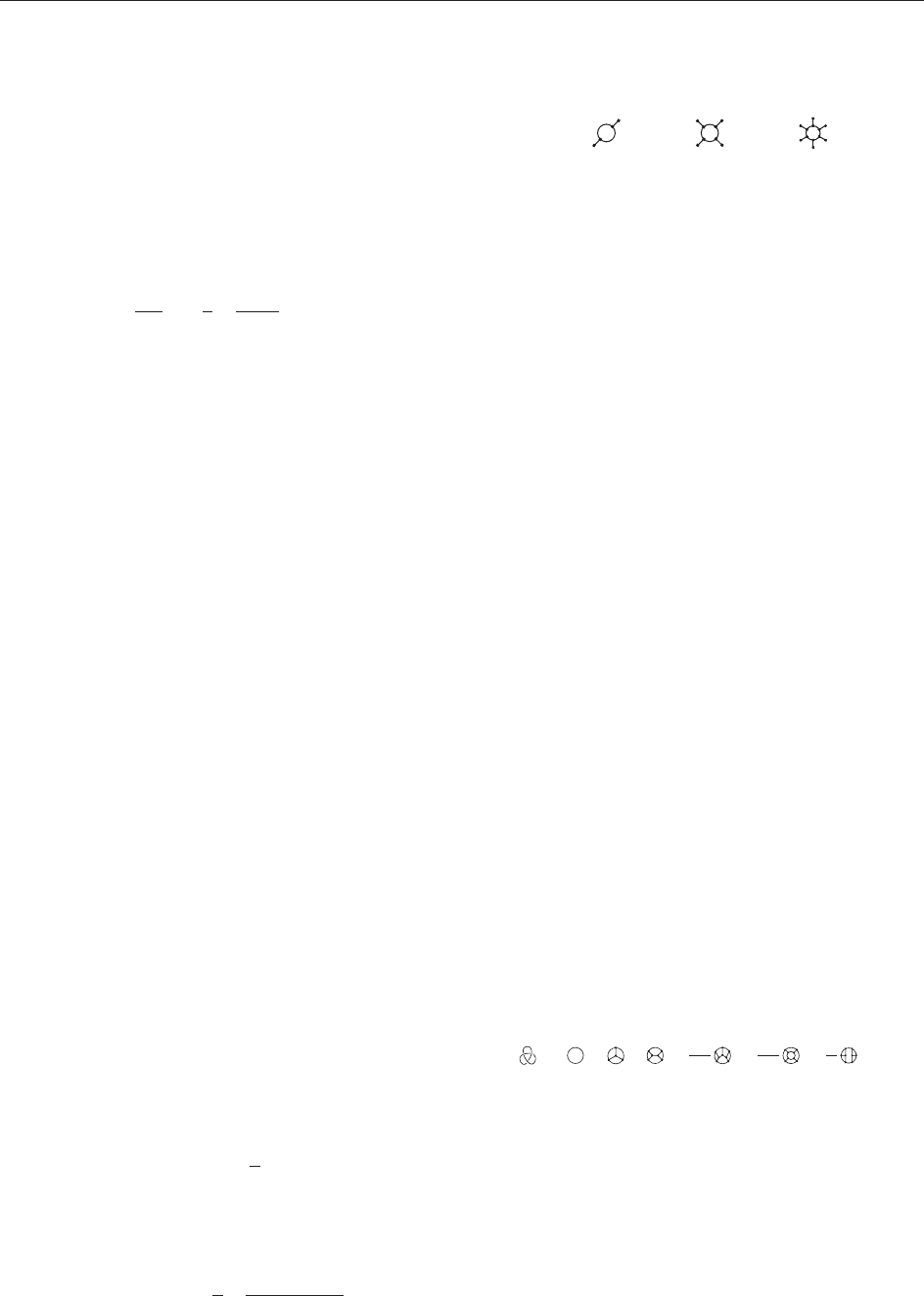
are the ‘‘wheels,’’ that is, Jacobi diagrams of the
form
w
2
¼ ; w
4
¼ ; w
6
¼ ; ...
The sums and products are understood as operations
in the algebra of Jacobi diagrams B, and the result is
then carried over to the algebra of chord diagrams A
along the isomorphism .
Generalizations
There are several generalizations of the wheels
formula.
1. Rozansky’s rationality conjecture (Rozansky
2003) proved by Kricker (2000) affirms that the
Kontsevich integral of any (framed) knot can be
written in a form resembling the wheels formula.
Let us call the ‘‘skeleton’’ of a Jacobi diagram the
regular 3-valent graph obtained by ‘‘shaving off’’
all univalent vertices. Then the wheels formula
says that all diagrams in the expansion of I(O)
have one and the same skeleton (circle), and the
generating function for the coefficients of dia-
grams with n legs is a certain analytic function,
more or less rational in e
x
. In the same way, the
theorem of Rozansky and Kricker states that the
terms in I(K) 2
^
B, when arranged by their
skeleta, have the generating functions of the
form p(e
x
)=A
K
(e
x
), where A
K
is the Alexander
polynomial of K and p is some polynomial
function. Although this theorem does not give
an explicit formula for I(K), it provides a lot of
information about the structure of this series.
2. Marche´ gives a closed form formula for the
Kontsevich integral of torus knot s T(p, q).
The formula of Marche´, although explicit, is
rather intricate, and here, by way of example, we
only write out the first several terms of the final
Kontsevich integral I
0
for the trefoil (torus knot of
type (2,3)), following Willerton (2002):
I
0
ð Þ¼ þ
31
24
þ
5
24
þ
1
2
þ
First Terms of the Kontsevich Integral
A Vassiliev invariant v of degree n is called
‘‘canonical’’ if it can be recovered from the
Kontsevich integral by applying a homogeneous
weight system, that is, if v = symb(v) I. Canonical
invariants define a grading in the filtered space of
Vassiliev invariants which is consistent with the
filtration. If the Kontsevich integral is expanded
238 Kontsevich Integral
over a fixed basis in the space of chord diagrams
^
A
0
,
then the coefficient of every diagram is a canonical
invariant. According to Stanford (2001) and Willerton
(2002), the expansion of the final Kontsevich integral
up to degree 4 can be written as follows:
I
0
ðKÞ¼ c
2
ðKÞ
1
6
j
3
ðKÞ
þ
1
48
4j
4
ðKÞþ36c
4
ðKÞ36c
2
2
ðKÞþ3c
2
ðKÞ
þ
1
24
12c
4
ðKÞþ6c
2
2
ðKÞc
2
ðKÞ
þ
1
2
c
2
2
ðKÞ þ
where c
n
are coefficients of the Conway polynomial
r
K
(t) =
P
c
n
(K)t
n
and j
n
are modified coefficients of
the Jones polynomial J
K
(e
t
) =
P
j
n
(K)t
n
.Therefore,up
to degree 4, the basic canonical Vassiliev invariants of
unframed knots are c
2
, j
3
, j
4
, c
4
þ (1=12)c
2
,andc
2
2
.
Acknowledgments
S Duzhin was partially supported by presidential
grant NSh-1972.2003.1.
See also: Finite-Type Invariants; Mathematical Knot
Theory.
Further Reading
Bar-Natan D (1995a) On the Vassiliev knot invariants. Topology
34: 423–472.
Bar-Natan D (1995b) Vassiliev homotopy string link invariants.
Journal of Knot Theory and Its Ramifications 4-1: 13–32.
Bar-Natan D, Le TQT, and Thurston DP (2003) Two applications of
elementary knot theory to Lie algebras and Vassiliev invariants.
Geometry and Topology 7(1): 1–31 (arXiv:math. QA/0204311).
Cartier P (1993) Construction combinatoire des invariants
de Vassiliev–Kontsevich des nœuds. Comptes Rendus de
l’Acade´mie des Sciences, Se´rie Mathe´matique Paris 316(I):
1205–1210.
Chmutov S and Duzhin S (2001) The Kontsevich integral. Acta
Applicandae Mathematicae 66: 155–190.
Drinfeld VG (1991) On quasi-triangular quasi-Hopf algebras and
a group closely connected with Gal(
Q=Q ). Leningrad Mathe-
matical Journal 2: 829–860.
Goryunov V (1999) Vassiliev invariants of knots in R
3
and in a
solid torus. American Mathematical Society Translations
190(2): 37–59.
Kneissler J (1997) The number of primitive Vassiliev invariants up
to degree twelve, arXiv:math.QA/9706022, June 1997.
Kohno T (1987) Monodromy representations of braid groups and
Yang–Baxter equations. Annales de l’Institut Fourier 37:
139–160.
Kontsevich M (1993) Vassiliev’s knot invariants. Advances in
Soviet Mathematics 16(2): 137–150.
Kricker A (2000) The lines of the Kontsevich integral and
Rozansky’s rationality conjecture. Preprint arXiv:math.GT/
0005284.
Le TQT and Murakami J (1995) Kontsevich’s integral for the
Homfly polynomial and relations between values of multiple
zeta functions. Topology and Its Applications 62: 193–206.
Le TQT and Murakami J (1996) The universal Vassiliev–
Kontsevich invariant for framed oriented links. Compositio
Mathematica 102: 41–64.
Lescop C (1999) Introduction to the Kontsevich integral of
framed tangles. Preprint in CNRS Institut Fourier (PostScript
file available online at http://www-fourier.ujf-gren oble.fr/
lescop/
publi.html).
Marche´ J (2004) A computation of Kontsevich integral of torus
knots, arXiv:math.GT/0404264.
Ohtsuki T (2002) Quantum Invariants. A Study of Knots,
3-Manifolds and their Sets. Series on Knots and Everything,
vol. 29. Singapore: World Scientific.
Rozansky L (2003) A rationality conjecture about Kontsevich
integral of knots and its implications to the structure of the
colored Jones polynomial. Topology and Its Applications 127:
47–76. Preprint arXiv:math.GT/0106097.
Stanford T Some computational results on mod 2 finite-type
invariants of knots and string links. In: Invariants of Knots
and 3-Manifolds (Kyoto 2001), pp. 363–376.
Willerton S (2002) An almost integral universal Vassiliev
invariant of knots. In: Algebraic and Geometric Topology,
vol. 2, pp. 649–664. Preprint arXiv:math.GT/0105190.
Zagier D (1994) Values of Zeta Functions and their Applications.
First European Congress of Mathematics Progress in Mathe-
matics vol. 120, pp. 497–512. Basel: Birkhauser.
Korteweg–de Vries Equation and Other Modulation Equations
G Schneider, Universita
¨
t Karlsruhe, Karlsruhe,
Germany
E Wayne, Boston University, Boston, MA, USA
ª 2006 Elsevier Ltd. All rights reserved.
Modulation equations are simplified equations
used to model complicated physical s ystems. Typi-
cally they are derived from the fundamental partial
differential equations that describe the system via
asymptotic analysis. Furthermore, the modulation
equations are in a sense ‘‘universal’’ in that many
different physical systems are described by the same
modulation equation. This comes a bout because
the form of t he modulation equation depends on
only a very few, qualitative features of the original
partial differential equation. Thus, they serve a sort
of ‘‘normal form’’ for these partial differential
equations and as such justify greater study than
their apparently special character might otherwise
merit.
The Korteweg–de Vries (K dV) equation
@
t
u ¼ @
3
x
u þ 6u@
x
u; u ¼ uðx; tÞ; x 2 R; t 0 ½1
Korteweg–de Vries Equation and Other Modulation Equations 239

was one of the earliest modulation equations to be
intensively studied. It was derived in an attempt to
understand the propagation of solitary waves on the
surface of water in a channel of finite depth. The
KdV equation was first derived by Bous sinesq but
then independen tly rederived and studied in detail
by Korteweg and de Vries. (For an interesting
discussion of the early history of the KdV equation
see Pego and Weinstein (1997).)
Derivation of the KdV Equation
As mentioned above, the KdV equatio n is a sort of
normal form describing the propagation of small-
amplitude, long-wavelength disturbances in a variety
of different physical systems. In this section we
describe in detail how it arises as an approximation
to the Fermi–Pasta–Ulam (FPU) model of coupled,
nonlinear oscillators. Although the KdV equation is
most commonly encountered as an approximation
to water waves, its study as an approximation to the
FPU model was extremely important historically
because it was in this context that its complete
integrability was discovered by Miura (1968) and
Gardner et al. (1974).
Consider an infinite set of particles of mass
m = 1 at positions q
j
(t), j 2 Z , interacting with
their nearest neighbors via a potential V(q).
Newton’s equations for the motion of such
particles are:
d
2
q
j
dt
2
¼V
0
ðq
jþ1
ðtÞq
j
ðtÞÞ
V
0
ðq
j
ðtÞq
j1
ðtÞÞ ; j 2 Z ½2
If we rewrite these equations in terms of the
difference variables r(j, t) = q
jþ1
(t) q
j
(t), then [2]
becomes
d
2
r
dt
2
ðj; tÞ¼V
0
ðrðj þ 1; tÞÞ
þV
0
ðrðj 1; tÞÞ 2V
0
ðrðj; tÞÞ; j 2 Z ½3
We are interested in small-amplitude, long-
wavelength, solutions of [3]. One way of studying
such motio ns is to change the lattice spacing in [3]
from 1 to h and then let h tend to zero. A nice
derivation of the KdV equation from that point of
view is contained in Ablowitz and Segur (1981).
Here, following Schneider and Wayne (1999),we
will keep the lattice spacing fixed at 1 and rescale
the spatial variable in the KdV equation. This is
closer to the approximation method used in the
water wave problem.
Since we want to focus on small-amplitude, long-
wavelength solutions of [3], we begin by making the
hypothesis that there exists some real-valued func-
tion R(x, t) such that the solution of [3] can be
written as
rðj; tÞ¼"
2
Rð"j; tÞ½4
The prefactor "
2
insures that the solution is of small
amplitude while rescaling j ! "j means that phe-
nomena that occur on length scales of O(1) in the
equation for R will occur on length scales of O(1=")
in the original equation – that is, they will be long-
wavelength solutions. The differing powers of "
chosen for rescaling the amplitude and the spatial
scale are chosen so that the dispersive and nonlinear
effects will balance each other. Inserting [4] into [3]
and expanding to lowest order in " we find that the
nonvanishing terms of lowest order in " are
@
2
R
@t
2
¼ "
2
V
00
ð0Þ
@
2
R
@x
2
½5
This is just the wave equation and thus to leading
order we expect solutions of [3] to split into a left-
and right-moving waves, each moving with speed
c
"
= "
ffiffiffiffiffiffiffiffiffiffiffiffi
V
00
(0)
p
. (We assume that c
2
V
00
(0) > 0.)
Thus, we make a refinement of the hypothesized
form of the solution and replace [4] by
rðj; tÞ¼"
2
Uð"ðj þ ctÞ;"
3
t Þ
þ "
2
Vð"ðj ctÞ;"
3
t Þþ"
4
’ð"j;"tÞ½6
The presence of the term "
4
’ may be somewhat
surprising. We will discuss the reason for its
appearance in more detail below, but for the
moment we mention merely that its presence does
not affect the fact that to leading order the solution
is approximated by the left- and right-moving waves
represented by the "
2
U and "
2
V terms, respectively.
We also note that the additional time dependence
"
3
t in U and V is chosen, as is typical in the
multiscale method to incorporate the higher-order
terms omitted in [5] into the evolution.
Substituting [6] into [3] and expanding the
resulting equation in " we find that the lowest
order in " that occurs is O("
4
) and these terms all
cancel exactly because of the form of our hypothe-
sized solution. The terms of O("
6
) are:
f2c@
X
@
T
U 2c@
X
@
T
V þ @
2
’g
¼ c
2
1
12
@
4
X
U þ
1
12
@
4
X
V þ @
2
’
þ
1
2
V
000
ð0Þf@
2
X
ðU
2
þ V
2
þ 2UVÞg ½7
Here, X, T, , and represent the rescaled indepen-
dent variables, that is, U = U(X, T), V = V(X, T),
and ’ = ’(, ).
240 Korteweg–de Vries Equation and Other Modulation Equations

Note that if it were not for the presence of the term
2UV on the right-hand side of this last equation the
equations for U and V would completely decouple,
that is, there would be no interaction between the
left- and right-moving parts of the solution to this
order. At this point, we can take advantage of the
(heretofore) arbitrary function ’.IfweassumethatU
and V are given, we can choose ’ to satisfy the
inhomogeneous wave equation:
@
2
’ ¼ c
2
@
2
’ þV
000
ð0Þ@
2
X
ðUVÞ½8
Then, provided ’ remains of O(1) over the time-
scales of interest (which one can verify a posteriori),
we see that all terms of O("
6
) in the expansion of [3]
will vanish provided
2@
T
U ¼
c
12
@
3
X
U þ
1
2c
V
000
ð0Þ@
X
ðU
2
Þ
2@
T
V ¼
c
12
@
3
X
V þ
1
2c
V
000
ð0Þ@
X
ðV
2
Þ
½9
This means that the left- and right-moving parts of the
solution satisfy a pair of uncoupled KdV equations.
Remark 1 To rewrite [9] in the standard form [1]
one can make a simple rescaling – for instance,
choose X = x, T = t and u(x, t) = U(x, t), with
= (c=24)
(1=3)
and = V
000
(0)=(12c).
We can now comment on the reasons we chose
the particular scalings of the amplitude and of the
independent variables used in [6]. The terms @
2
X
U
2
and @
2
X
V
2
are the lowest-order contributions from
the nonlinear part of [3] , while the terms @
4
X
U and
@
4
X
V represent the lowest-order contributions from
the linear part of the equation, except for the
‘‘trivial’’ translation that comes for [5]. In particular,
in the absence of nonlinear effects the terms @
4
X
U
and @
4
X
V (or equivalently, the terms @
3
X
U and @
3
X
V in
[9]) would cause traveling waves to ‘‘disperse’’ and
thus, the KdV equation represents a balance
between nonlinear and dispersive effects. It is this
balance between dispersion and nonlinearity which
permits traveling-wave solutions to propagate with-
out chang e of form (see the section ‘‘Integr ability of
the KdV equati on’’).
More generally, we expect the KdV equation to
arise as a modulation equation whenever a small-
amplitude, long-wavelength linear wave is simulta-
neously perturbed by dispersive and nonlinear
effects of the same order of magnitude. This is, of
course, oversimplified. For instance, the original
equation may have no quadratic terms in the
nonlinearity, for instance, which means that the
term @
X
U
2
in the modulation equation will be
replaced by a term like @
X
U
p
, for p > 2 – this
leads to the modified KdV equation as the appro-
priate modulation equation. Or, for certain para-
meter values in the original equation the coefficient
in front of the leading-order dispersive term may
vanish, in which case a fifth-order modulation
equation known as the Kawahara equation is more
appropriate. However, both of these cases are in
some sense nongeneric and the relativel y weak
hypotheses needed to obtain the KdV equation as
the appropriate modulation equation indicate why it
is encountered in so many diverse circumstances. We
note, however, that the multiscale method used
above to derive the KdV equation does not give a
unique choice for the appropriate modulation
equation at any given order of approximation and
we discuss in a later section some other equations
that could be used as models in the situation above.
Validity of the KdV Approximation
While the above derivation of the KdV equation is
simple and intuitive one may wonder how accurate
an approximation it actually provides to the true
solutions of [3] (or to the evolution of water waves,
probably the most important physical situation in
which the KdV approximation is used). In particu-
lar, note that in the notation of [9] the phenomena
intrinsic to the KdV equation occur on timescales
T = O(1). However, this corresponds to a very
long tim escale t = O(1="
3
) in the original FPU
model and it could easily be the case that although
theerrormadeinderivationoftheKdVapprox-
imation at any given time is quite small, over these
very long timescales t he errors c ould accumulate
in such a way as to destroy the accurac y of the
approximation.
The KdV and other modulation equations have
been used since the nineteenth century but only
relatively recently have rigorous estimates of the
accuracy of this approximation been proved. In
fact, the first estimates demonstrating that the
KdV equation actually provided an accurate
approximation to the true motion of water
waves over the timescales expected from the
heuristic derivation were not proved until Craig
(1985). More re cently, powerful general methods
have been developed to justify not just the KdV
equation but other modulation equations like the
nonlinear Schro¨ dinger equation and Ginzburg–
Landau equation as well.
For instance, the following method, introduced
in Kirrmann et al. (1992), has been used to justify
the use of modulation equations in the water-wave
problem, the evolution of Taylor–Couette patterns
in viscous fluids, and a number of other
Korteweg–de Vries Equation and Other Modulation Equations 241

circumstances. We will explain it in the context of
a general, abstract evolution equation to indicate
its generality. Suppose t hat one wishes to approx-
imate the small-amplitude solutions of a general
evolution equation (or system of such equations) of
the form
@
t
u ¼ Lu þNðuÞ½10
where L is a linear operator and N represents the
nonlinear terms. Suppose that via some formal
analysis like that in the previous section we have
derived a function "
2
that is believed to be a good
approximation to a true solution of [10]. In that
example, for instance, "
2
would be the sum of the
solutions of the two KdV equations in [9] , and in
general it will be given by the solution of the
modulation equation that is expected to approxi-
mate [10]. We must show that the difference
between "
2
and a true solution of [10] remains
small over the timescales of interest. We write this
difference as u "
2
= "
R so that if >2, and if
R = O(1), "
2
does provide the leading-order
approximation to the true solution. We can make
Rj
t = 0
small by choosing the initial conditions of
our modulation equation appropriately and thus
we need to follow how R evolves in time. If we use
the equation satisfied by u we see that R evolv es as
@
t
R ¼LR þ "
Nð"
2
þ "
RÞ
Nð"
2
Þ
þ "
Resð"
2
Þ½11
where Res( "
2
) = L("
2
) þN("
2
) @
t
("
2
), the
‘‘residual’’ of our approximation is simply the
amount by which the approximation fai ls to satisfy
the original equation at any given time. In the
example in the previous section the residual would
include the terms O("
8
) that we ignored in our
expansion.
One must now, in any given example consider
three points:
1. The linear evolution of R:
@
t
R ¼ LR þ DNð"
2
ÞR ½12
Controlling the solutions of this linear, but
nonconstant coefficient partial differential equa-
tion is often the most difficult step in proving
that solutions of the modulation equation give
accurate approximations to the true solution.
One can frequently find norms that are preserved
by solutions of the leading-order equati on
@
t
R = LR. However, the term DN("
2
) = O("
2
)
if N is a quadratic nonlinearity. Over the very
long timescales (i.e., O("
3
)) of interest in these
approximation problems this O("
2
) term can
cause uncontrolled growth of R, leading to a
breakdown in the approximation. In order to
control [12] one must typically make use of some
special features of the problem under consid er-
ation. For instance, it is sometimes possible to
make a coordinate transformation which elim-
inates the terms of O("
2
) on the right-hand side
of [12], after which relati vely standard methods
suffice to control the solutions of [12].
2. The nonlinear terms in [11]: these terms are of the
form "
[N("
2
þ "
R) N("
2
)] DN( "
2
)R.
From Taylor’s theorem we see that, if the non-
linear term is reasonably smooth, these terms are
of O("
). If >3, these terms are small and can
be controlled over the timescales of interest by a
straightforward application of Gronwall’s inequal-
ity or standard ‘‘energy estimates.’’
3. Finally, one must consider the influence of the
inhomogeneous terms "
Res("
2
). Note that if
this term is small enough, say O("
), with 3
this term can also be controlled over the relevant
timescales by an application of the Gronwall
inequality. In order to make this term small, we
need to be sure that our approximation "
2
fails
to solve the true equation at any given time by a
small amount. In doing so, we can exploit the
fact that we can add to our leading-order
approximation terms of higher order without
affecting the fact that to leading order the true
solution is still approximated by the solution of the
modulation equation. This is the role of the term
"
4
’ in the approximation [6] in the previous
section. The leading-order approximation is given
by the functions U and V which solve the KdV
equations but by adding the additional term "
4
’ to
the approximation we cancel the remaining terms of
O("
6
)in[7], thereby reducing the size of the residue
in that example to O("
8
). This method works in
other examples as well so that the inhomogeneous
term in [11] can usually be treated by this means.
However, in each case, we must prove that the
additional terms one adds to the approximation
remain bounded over the timescales of interest and
demonstrating this fact may not be as easy as it was
in the case of the FPU model where the additional
term satisfied a simple wave equation.
Using this approach one can show that the
approximation derived heuristically in the previous
section does accurately model the behavior of
solutions of the FPU model over the expected
timescales. More precisely, if r(j, t) is the solution
of [3] and if U and V are the solutions of the
modulation equations [9] (with appropriately
chosen, small-amplitude, long-wavelength initial
242 Korteweg–de Vries Equation and Other Modulation Equations

conditions), one can prove (see Schneider and
Wayne (1999)) that for any T
0
> 0 there is an "
0
>
0 and C > 0 such that for all 0 <"<"
0
,
sup
t2½0;T
0
="
3
krð; tÞð"
2
Uð"ðþ ctÞ;"
3
t Þ
þð"
2
Vð"ð ct Þ;"
3
tÞÞk
‘
1
C"
7=2
One can also use this method to show that the
solution of the water-wave problem with general
small-amplitude, long-wavelength, initial data can
be approximated by the sum of the solutions of a
pair of uncoupled KdV equations (Schneider and
Wayne 2000), one representing the left-moving part
of the solution and one representing the right-
moving part of the solution, though in this context
the technical difficulties associated with the exis-
tence theory for the water-wave problem mean the
details are quite a lot more complicated.
Integrability of the KdV Equation
One reason that normal forms for systems of
ordinary differential equations are so useful is that
they are frequently integrable – that is, they possess
sufficiently many integrals, or constants of motion,
that essentially explicit formulas for their solutions
can be obtained. Remarkably, the same is true for
the KdV equation and for many other modulation
equations. An argument for why this is so has been put
forth by Calogero and Eckhaus based on the univer-
sality of these equations – see Calogero and Eckhaus
(1987) and references therein, as well as the article
Integrable Systems: Overview for more on this point.
Recall that Boussinesq and Korteweg and de Vries
introduced the KdV equation to study solitary
traveling waves on a fluid surface. For [1], one has
an explicit family of such solutions given by:
uðx; tÞ¼2A
2
sech
2
ðA½x þ 4A
2
tÞ; A 0
Note that from this formula one sees that waves of
large amplitude are narrower and travel faster than
waves of small amplitude.
In a famous numerical study, Zabusky and
Kruskal made a remarkable discovery. They con-
sidered solutions of the KdV equation in which a
solitary wave of large amplitude overtook one of
smaller amplitude. They found that after a highly
nonlinear interaction the two solitary waves re-
emerged with their original amplitudes and speeds
and the only reminder of their interaction was a
phase shift in their relative positions. Their discov-
ery began a search for a mathematical explanation
of this remarkable ‘‘nonlinear superposition princi-
ple’’ which culminated with the solution of the KdV
equation via the method of inverse scattering and
the identification of the KdV equation as an infini te-
dimensional, completely integrable Hamiltonian
system.
We begin by describing how a transformation
discovered by Miura (1968) and then generalized by
Gardner et al. (1974) leads very easily to the
conclusion that there are infinitely many conserved
quantities for the KdV equation. The basic idea is
that given a transformation which maps solutions of
one equation to solutions of a second, the existence
of simple or ‘‘obvious’’ conserved quantities for the
first equation may lead, via the transformation, to
more complicated conserved quantities for the
second.
Given u = u( x, t), define w(x, t ) implicitly via the
formula
uðx; tÞ¼wðx; tÞþi"@
x
wðx; yÞþ"
2
ðwðx; tÞÞ
2
½13
Note that if w is smooth enough and " is small, we
can invert this relation recursively to obtain w in
terms of u via the formula
w ¼u i"@
x
u "
2
ðu
2
þ @
2
x
uÞ
þ i"
3
ð@
3
x
u þ 4u@
2
x
uÞþ"
4
ð2u
3
þ 5ð@
x
uÞ
2
þ 6u@
2
x
u þ @
4
x
uÞþOð"
5
Þ½14
Now compute
@
t
u @
3
x
u 6u@
x
u
¼f@
t
w 6w@
x
w 6"
2
w
2
@
x
w @
3
x
wg
þ2"
2
wf@
t
w 6w@
x
w 6"
2
w
2
@
x
w @
3
x
wg
þi"@
x
f@
t
w 6w@
x
w 6"
2
w
2
@
x
w @
3
x
wg½15
From this we see immediat ely that if w satisfies the
modified KdV equation
@
t
w ¼ 6ðw@
x
w þ "
2
w
2
@
x
wÞþ@
3
x
w ½16
then u, defined by [13] satisfies the KdV equation.
However, one also sees immediately that the integral
of w is a conserved quantity of [16] for all values of
", that is, if we define I
"
(t) =
R
w(x, t)dx, then I
"
is a
constant for all values of ". (We will assume here
that w is defined on the real line, and that w and its
derivatives go to zero as jxj tends to infinity. Similar
results hold for x running over a finite interval with
periodic bounda ry conditions.) But this in turn
immediately implies that if we use [14] to expand
I
"
in powers of " the coefficients in this expansion
must also be constants in time. Since these coeffi-
cients will be expressed as integrals of u and its
derivatives, they will give us (infinitely many)
Korteweg–de Vries Equation and Other Modulation Equations 243

conserved quantities for the KdV equation! Looking
at the first few of these we find:
1. K
0
=
R
u(x, t)dx. The conservation of this quan-
tity follows immediately from the form of the
KdV equation.
2. K
1
=
R
@
x
u(x, t)dx = 0, if we assume that u and
its derivatives tend to zero as jxj tends to infinity.
Thus, we gain no new information from this
quantity and in fact, all the integral s coming
from the odd powers of " turn out to be ‘‘trivial’’
so we ignore them and focus just on the even
powers of ".
3. K
2
=
R
(u
2
þ @
2
x
u)dx =
R
u
2
dx. That this is a con-
served quantity is again easy to see directly from
the KdV equation, just by multiplying the
equation by u and integrating with respect to x.
4. K
4
=
R
(3u
2
þ5(@
x
u)
2
þ6u@
2
x
u þ@
4
x
u)dx=
R
(3u
2
(@
x
u)
2
)dx. The origin of this integral is not so obvious
and we comment further on its meaning below.
Clearly by continuing this procedure we can generate
an infinite number of conserved quantities for the KdV
equation. Indeed, if one chose another conserved
quantity for the modified KdV equation, [16],say
R
w
2
(x, t)dx one could generate another sequence of
conserved quantities via this same procedure. How-
ever, Kruskal, Miura, Gardner, and Zabusky proved
that in fact, all of the conserved quantities that can be
written as polynomials in u and its derivatives are
already obtained by the procedure above.
The constant of the motion K
4
found above is of
particular interest because one can write the KdV
equation as
u
t
¼ @
x
K
4
u
½17
where =u denotes the variational derivative of K
4
with respect to u(x). One can interpret this equation
as a Hamiltonian system where @
x
defines the
(nonstandard) symplectic structure and remarkably,
Zhakarov and Faddeev (1971) proved that the KdV
equation is actuall y a completely integrable Hamil-
tonian system. In particular, there exists a canonical
transformation such that with respect to the new
coordinates the Hamiltonian is a function only of
the action variables (and hence in particular, the
action variables remain constant in time). The
transform which brings the Hamiltonian into its
action-angle form is known as the inverse spectral
transform and its details would take us beyond the
limits of this article. However, very briefly, by
observing that the Miura transformation [13]
defines a Ricatti differential equation, and using
the trans formation that converts the Ricatti
equation to a linear ordinary differential equation
one can relate the solution of the KdV equation to
an eigenvalue problem for a linear Schro¨ dinger
operator. The potential term in the Schro¨ dinger
operator is given by the solution u(x, t) of the KdV
equation. Remarkably, it turns out that the eigen-
values of this Schro¨ dinger operator are constants of
the motion if u is a solution of the KdV equation
and are very closely related to the action variables
for the Hamiltonian system. For more details on the
inverse-scattering method and its use in solving the
KdV equation we refer the reader to the mono-
graphs of Ablowitz and Segur (1981), Newell
(1985), or the recent book by Kappeler and Po¨ schel
(2003) which develops the theory for the KdV
equation on a finite interval with periodic boundary
conditions in a particularly elegant fashion.
Other Mathematical Aspects of the
KdV Equation
In addition to the inverse-scattering transform
approach, more traditional approaches to the exis-
tence and uniqueness of solutions have also been
studied, starting with Temam’s proof of the well-
posedness of solutions of the KdV equation with
periodic boundary conditions in the Sobolev space
H
2
. Noting that the Hamiltonian for the
KdV equation described in the preceding section
is closely related to the H
1
norm, this might seem a
natural space in which to study well-posedness, but
surprisingly Kenig, Ponce, and Vega, and Bourgain
showed that the equation is also well posed in
Sobolev spaces H
s
,withs < 1 and more recent
work has extended the global well-posedness results
to Sobolev spaces of small negative order. Aside from
their intrinsic interest, these results have other
physical implications. If one wishes to study statis-
tical aspects of the behavior of ensembles of solutions
of these equations, statistical mechanics suggests that
the natural invariant measure for these equations is
given by the Gibbs’ measure. However, the Gibbs’
measure is typically supported on functions less
regular than H
1
, so that in order to define and
study this measure one needs to know that solutions
of the equation are well behaved in such spaces.
Another natural mathematical question arises
from the fact that the KdV equation is only an
approximation to the original physical equation.
Viewed from another perspective, the original
system can be seen as a perturbation of the KdV
equation. It then becomes natural to ask whether the
special features of the KdV equation are preserved
under perturbation. Viewing the KdV equation as a
completely integrable Hamiltonian system this is
244 Korteweg–de Vries Equation and Other Modulation Equations

very analogous to the que stions studied by the
Kolmogorov–Arnol’d–Moser (KAM) theory and
has led to a development of KAM-like results for a
number of different partial differential equations
like the KdV equation. The results are somewhat
technical in nature but roughly speaking they say
that if one considers the KdV equation with periodic
boundary conditions, temporally periodic or quasi-
periodic solutions will persist under small perturba-
tions. The situation is more complicated and less
well understood for the equation on the whole line
due to the presence of a continuum of scattering
states. For a very thorough review of the problem
with periodic boundary conditions see Kappeler and
Po¨ schel (2003).
Other Modulation Equations
As we stressed in its derivation, the KdV equation is
an appropriate modulation equation for small-
amplitude, long-wavelength solutions in dispersive
nonlinear partial differential equations. However, as
mentioned in the section ‘‘Derivation of the KdV
equation’’ the method of multiple scales does not give
auniquemodulationequationeveninthisspecific
physical regime. Already in his original studies
Boussinesq derived at least three different model
equations for small-amplitude, long-wavelength
water waves and a variety of such models continue
to be studied today. For instance, an easy variation in
the derivation of the KdV equation leads to the
regularized long wave, or Benjamin–Bona–Mahoney
equation in which the @
3
x
u term in the KdV equation
is replaced by the term @
2
x
@
t
u. The validity of these
alternatives to the KdV equation can also be studied
with the aid of the methods described in the section
‘‘Validity of the Kdv approximation.’’
There have been many discussions of which of these
modulation equations is the ‘‘correct’’ one. while they
may all yield equivalent approximations to the original
physical problem the KdV equation has at least two
advantages: it is independent of the expansion para-
meter ", and it is completely integrable. None of the
other equations that have been proposed as approx-
imations to these small-amplitude, long-wavelength
phenomena share both of these properties.
If we think in terms of the Fourier transforms of
the long-wavelength functions studied above they
are solutions whose Fourier transform is concen-
trated near zero. One can also ask about modulation
equations for solutions whose Fourier transform is
concentrated about nonzero wave numbers. Such
solutions represent a wave train with some fixed
underlying wavelength,
c
, modulated on a much
longer length scale,
c
=".
If we make the ansatz that the solution has the
form
uðx; tÞ"Að"ðx c
g
t Þ;"
2
tÞe
i2ðxc
p
tÞ=
c
þ complex conjugate ½18
and insert this hypothesized form of the solution into
the original equati on, then under mild assumptions
on the form and properties of the original equation,
similar to those under which we derived the KdV
equation in an earlier section we find that to the
lowest, nontrivial order in ", the amplitude A evolves
according to the nonlinear Schro¨ dinger equation
i@
T
A ¼ c
1
@
2
X
A þ c
2
AjAj
2
½19
If c
1
and c
2
are both real, the nonlinear Schro¨ dinger
equation can also be solved via the inverse-scattering
method and it represents another completely integr-
able modulation equation.
In this article, we have discussed modulation
equations only for Hamiltonian, or conservative
systems. However, similar equations have also played
an important role in the study of dissipative
equations like the Navier–Stokes equation. The
most common modulation context in that setting is
the Ginzburg–Landau equation, which can be derived
as a modulation equation for Taylor–Couette rolls or
for the convection rolls in the Rayleigh–Be´nard
problem. Like the nonlinear Schro¨ dinger equation,
the Ginzburg–Landau equation describes how slow
variations of the amplitude of an underlying periodic
pattern evolve and as such it arises in a host of other
situations in addition to the fluid dynamics examples
mentioned above. For an extensive review of the
applications of the Ginzburg–Landau equation, as
well as its mathematical properties and some special
solutions, see the recent article of Mielke (2002).
See also: Bi-Hamiltonian Methods in Soliton Theory;
Central Manifolds, Normal Forms; Hamiltonian Fluid
Dynamics; Infinite-Dimensional Hamiltonian Systems;
Integrable Systems and the Inverse Scattering Method;
Integrable Systems: Overview; KAM Theory and
Celestial Mechanics; Multiscale Approaches; Partial
Differential Equations: Some Examples; WDVV
Equations and Frobenius manifolds.
Further Reading
Ablowitz MJ and Segur H (1981) Solitons and the Inverse
Scattering Transform. SIAM Studies in Applied Mathematics
vol. 4. Philadelphia: Society for Industrial and Applied
Mathematics (SIAM).
Calogero F and Eckhaus W (1987) Nonlinear evolutions
equations, rescalings, model PDE’s and their integrability, i.
Inverse Problems 3: 229–262.
Korteweg–de Vries Equation and Other Modulation Equations 245

Craig W (1985) An existence theory for water waves and the
Boussinesq and Korteweg–de Vries scaling limits. Commu-
nications in Partial Differential Equations 10(8): 787–1003.
Gardner CS, Greene JM, Kruskal MD, and Miura RM (1974)
Korteweg–deVries equation and generalization, VI. Methods
for exact solution. Communications on Pure and Applied
Mathematics 27: 97–133.
Kappeler T and Po¨ schel J (2003) KdV and KAM, Ergebnisse der
Mathematik und ihrer Grenzgebiete. 3. Folge, A Series of
Modern Surveys in Mathematics. vol. 45 (Results in Mathe-
matics and Related Areas. 3rd Series, A Series of Modern
Surveys in Mathematics). Berlin: Springer.
Kirrmann P, Schneider G, and Mielke A (1992) The validity of
modulation equations for extended systems with cubic
nonlinearities. Proceedings of the Royal Society of Edinburgh
Sect. A 122(1–2): 85–91.
Mielke A (2002) The Ginzburg–Landau equation in its role as a
modulation equation. In: Handbook of Dynamical Systems,
vol. 2. pp. 759–834. Amsterdam: North-Holland.
Miura RM (1968) Korteweg–de Vries equation and general-
izations. I. A remarkable explicit nonlinear transformation.
Journal of Mathematical Physics 9: 1202–1204.
Newell AC (1985) Solitons in Mathematics and Physics. CBMS-
NSF Regional Conference Series in Applied Mathematics,
vol. 48. Philadelphia: Society for Industrial and Applied
Mathematics (SIAM).
Pego RL and Weinstein MI (1997) Convective linear stability of
solitary waves for Boussinesq equations. Studies in Applied
Mathematics 99(4): 311–375.
Schneider G and Wayne CE (1999) Counter-propagating waves
on fluid surfaces and the continuum limit of the Fermi–Pasta–
Ulam model. In: Fiedler B, Gro¨ger K, and Sprekels J (eds.)
International Conference on Differential Equations, (Berlin,
1999) vols. 1, 2, pp. 390–404. River Edge, NJ: World
Scientific.
Schneider G and Wayne CE (2000) The long-wave limit for the
water wave problem. I. The case of zero surface tension.
Communications on Pure and Applied Mathematics 53(12):
1475–1535.
Zakharov VE and Faddeev LD (1971) The Korteweg–de Vries
equation is a fully integrable Hamiltonian system. Functional
Analysis and its Applications 5: 280–287.
K-Theory
V Mathai, University of Adelaide, Adelaide, SA,
Australia
ª 2006 Elsevier Ltd. All rights reserved.
K-theory was invented in the category of algebraic
vector bundles over algebraic varieties by
A Grothendieck, who was directly motivated by
the Hirzebruch–Riemann–Roch theorem which he
subsequently greatly generalized. He also defined
K-homology in terms of coherent sheaves and
established the basic properties of K-theory
and K-homology including Poincare´ duality for
nonsingular varieties. The origin for the choice of
the letter K in K-theory was apparently the German
word ‘‘Klasse.’’
Using the formalism of Grothendieck, M F Atiyah
and F Hirzebruch (cf. Karoubi 1978), developed
topological K-theory in the category of topological
(complex) vector bundles over topological spaces. It
is this theory that will be the first principal focus of
this article. A topological (complex) vector bundle
over a compact topological space X is a topological
space E together with a continuous map p : E ! X
that is onto, such that p
1
(x) is a vector space that is
isomorphic to C
n
for all x 2 X, and there is an open
cover {U}ofX together with homeomorphisms
h
U
: p
1
(U) ! U C
n
called ‘‘local trivializations’’
with the property that h
V
h
1
U
: U \V C
n
! U \V
C
n
is of the form (Id, g
UV
), where g
UV
: U \V !
GL(n, C) are continuous maps satisfying the
following cocycle condition on triple overlaps,
g
UV
g
VW
g
WU
= 1. X C
n
is called the trivial vector
bundle. Two vector bundles p : E ! X and q : F ! X
over X are said to be isomorphic if there is a
homeomorphism : E ! F with the property that
p = q , and which is a linear isomorphism when
restricted to each fiber. The direct sum and tensor
product of vector spaces carries over to vector
bundles. There are canonical isomorphisms E F ffi
F E and E F ffi F E, making the set Vect(X)of
isomorphism classes of complex vector bundles over
X into a commutative semiring. Vect(X) can be
made into the commutative ring K
0
(X) as follows.
K
0
(X) is generated by pairs ([E], [F]), together with
the relation ([E], [F]) = ([E
0
], [F
0
]) if E F
0
G ffi
E
0
F G for some [G] 2 Vect(X). Also K
1
(X)is
defined to be the group of homotopy classes of
continuous maps from X to the infinite unitary
group. Around the same time, R Bott proved his
celebrated periodicity theorem, which says that the
odd homotopy group of the (infinite) unitary group
is the integers, whereas the even homotopy groups
are all trivial. Incorporating Bott’s periodicity
theorem for the unitary group into K-theory, Atiyah
and Hirzebruch proved that topological K-theory
K
(X) = K
0
(X) K
1
(X) is a periodic generalized
cohomology theory, and in what follows, the
notation K
n
(X) means n modulo 2. If M is not
compact, then we can compactify M by adding to it
a point þ ‘‘at infinity,’’ and denote it by M
þ
. Let
: þ!M
þ
be the inclusion, inducing the pull back
246 K-Theory