
Francoise J.-P., Naber G.L., Tsun T.S. (editors) Encyclopedia of Mathematical Physics
Подождите немного. Документ загружается.


map
!
: K
(M
þ
) ! K
(þ) ffi Z. Then K
(M) is defined
to be ker(
!
), also called the reduced K-theory. If X
1
is a closed subset of X, the K-theory of the pair
(X, X
1
) is defined as the reduced K-theory of the
quotient space X= X
1
. A fundamental computation
of Bott is the computation of the K -theory of
Euclidean space, K
n
(R
n
) ffi Z with canonical gen-
erator called the Bott class b 2 K
n
(R
n
), and
K
n1
(R
n
) = {0}.
Some of the basic properties of K-theory are listed
as follows. Details can be found in Karoubi (1978).
1. Pullback If f : N ! M is a continuous map, then
given a vector bundle : E ! M over M,the
pullback vector bundle is defined as f
(E) = {(x, v) 2
N E : f (x) = (v)} over N. This induces a pullback
homomorphism, f
!
: K
(M) ! K
(N).
2. Push-forwa rd Let f : N !M be a smooth proper
map between compact manifolds which is
K-oriented, that is, TN f
TM is a spin
C
vector
bundle over N. Then there is a pushforward
homomorphism, also called a Gysin map,
f
!
: K
(N) !K
þd
(M). where d = dim M dim N,
whose construction will be explained in the next
section.
3. Homotopy If f : N ! M and g : N ! M are
homotopic maps, then the pullback maps f
!
= g
!
are equal. If in addition, f and g are K-oriented,
proper maps which are homotopic via proper
maps, then the Gysin maps f
!
= g
!
are equal.
4. Excision Let M
1
be a closed subset of M and U
be an open subset of M such that U is contained
in the interior of M
1
. Then the inclusion of pairs
(MnU, M
1
nU) ,!(M, M
1
) induces an isomorph-
ism in K-theory, K
(M, M
1
) ffi K
(MnU, M
1
nU).
5. Exactness Let M
1
be a closed subset of M. Then
there is a six-term exact sequence in K-theory,
K
0
ðM; M
1
Þ!K
0
ðMÞ! K
0
ðM
1
Þ
"#
K
1
ðM
1
Þ K
1
ðMÞ K
1
ðM; M
1
Þ
6. Cup product There is a canonical map given by
external tensor prod uct, K
i
(M) K
j
(N) !
K
iþj
(M N). When N = M, one can compose this
with the homomorphism induced by the diagonal
map M ! M M given by x ! (x, x), to get a cup
product, K
p
(M) K
q
(M) ! K
pþq
(M).
7. Bott periodicity This is arguably the most impor-
tant property of K-theory. It says that the zero-
section embedding
M
: M ,!M R
n
induces a
Gysin isomorphism,
M
!
: K
(M)!
ffi
K
þn
(M R
n
),
which is given as follows. Let
M
: M R
n
! M
and
R
n
: M R
n
! R
n
denote the projections
onto the factors, and b =
!
1 2 K
n
(R
n
) the Bott
element, where : {0} ,!R
n
is the inclusion of the
origin. Then the Bott periodicity isomorphism is
given by
M
!
(x) =
!
M
(x) [
!
R
n
(b) 2 K
þn
(M R
n
)
for all x 2 K
(M).
Using the fact that any v ector bundle over a
contractible space is trivial, together with Bott’s
periodicity theorem, one deduces the calculation
of the K-theory of spheres. The calculation for the
odd-dimensional spheres given, K
0
(S
2n1
) ffi Z ffi
K
1
(S
2n1
), and for the even-dimensional spheres
K
0
(S
2n1
) ffi Z
2
and K
1
(S
2n
) ffi {0}, for all n 1.
There is a natural homomorphism of rings called
the Chern character, Ch : K
(X) ! H
(X, Q) which
is characterized by the following axioms:
1. Naturality If f : N ! M is a smooth map, and if
E is a vector bundle over M, then Ch(f
!
(E)) =
f
(Ch(E)).
2. Additivity Ch(E F) = Ch(E) þ Ch(F).
3. Normalization If L is the canonical line bundle
over CP
n
which restricts to the Hopf line bundle
over CP
1
, then Ch(L) = exp (x), where x is the
generator of H
2
(CP
n
, Z) ffi Z.
Atiyah and Hirzebruch, cf. Karoubi (1978), also
proved that the Chern character induces an iso-
morphism of the rings K
(X) Q and H
(X, Q). The
Chern–Weil representative of the Chern character is
tr(exp((i=2)
E
)), where
E
is the curvature of a
Hermitian connection on E.
There are many variants of K-theor y, such as
KO-theory, where the unitary group is replaced
by the orthogonal group, which is periodic of
order eight, and G-equivariant K-theory, where G
is a compact Lie group. K-theory and its variants
have many interesting applications such as deter-
mining the maximum number of linearly inde-
pendent vector fields on spheres, which is due to
Adams, cf. Karoubi (1978). We will content
ourselves with the description of two important
applications.
Grothendieck–Riemann–Roch Theorem
for Smooth Manifolds
Recall that an oriented real vector bundle E over M is
said to be a spin
C
vector bundle if the bundle of
oriented frames on E, SO(E) has a circle bundle
Spin
C
(E) such that the restriction to each fiber yields
the central extension 0 ! U(1) ! Spin
C
(n) !
SO(n) ! 0 that defines the group Spin
C
(n), where n
is the rank of E. It turns out that the obstruction to the
existence of a spin
C
structure on E is the third integral
Stieffel–Whitney class of E, W
3
(E) 2 H
3
(M, Z).
K-Theory 247

A generalization of Bott periodicity is the Thom
isomorphism in K-theory. It says that if : E ! M is
arank-n spin
C
vector bundle over M, then the zero-
section embedding
M
: M ,!E induces a Gysin iso-
morphism,
M
!
: K
(M) ffi K
þn
(E), which is given as
follows. There is a canonical element
M
!
1 2 K
n
(E)
called the Thom class in K-theory, which is character-
ized by the property that
!
1 restricts to give the Bott
class on each fiber. Then the Thom isomorphism in K-
theory is given by
M
!
(x) =
!
(x) [
M
!
1 2 K
þn
(E)for
all x 2 K
(M). For canonical representatives of the
Thom class, cf. Mathai–Quillen Formalism, or Mathai
and Quillen (1986).
Recall the definition of the Gysin map for smooth
embeddings. Let X be a smooth, compact manifold,
and Y a smooth manifold. Let h : X ! Y be a smooth
embedding that is K-oriented. Since TX TX has a
canonical almost-complex structure, it follows that
the normal bundle N
Y
X = h
(TY)=TX is a spinC
vector bundle. If
X
: X ,!N
Y
X is the zero-section
embedding, then we have the Thom isomorphism
X
!
: K
(X) !
ffi
K
þn
(N
Y
X), where n = dim(Y) dim(X)
is the codimension of the embedding. Upon choosing a
Riemannian metric on Y, there is a diffeomorphism
from a tubular neighborhood U of h(X)ontoa
neighborhood of the zero section in the normal bundle
(X). That is,
!
: K
(N
Y
X) !
ffi
K
(U). For any open
subset j : U ,!Y, the extension by zero defines a
homomorphism j : K
(U) ! K
(Y). Then the Gysin
map of the embedding h is defined as h
!
= j
!
X
!
: K
(X) ! K
þn
(Y), which turns out to be inde-
pendent of the choices made.
Next recall the definition of the Gysin map for
smooth submersions. Let : Y ! Z be a smooth
submersion of smooth manifolds, which is K-
oriented and a proper map. Since every smooth
compact manifold can be smoothly embedded in
R
2q
for q sufficiently large, a parametrized version
yields an embedding : Y ,!Z R
2q
that is spinC.
Therefore the Gysin map is a homomorphism
!
:K
(Y) !K
þa
(Z R
2q
), where a= dim(Z) þ2q
dim(Y). Let
Z
:Z ,!Z R
2q
denote the zero-section
embedding. Then we have the Thom isomo rphism
Z
!
:K
(Z) !
ffi
K
þ2q
(Z R
2q
). Then the Gysin map
of the submersion is defined as
!
=
!
(
Z
!
)
1
:
K
(Y) ! K
þb
(Z), where b = dim( Y) dim(Z), and
turns out to be independent of the choices made.
Let f : N ! M be a smooth proper map that is
K-oriented. Then f can be canonically factored, first
into the smooth embedding gr(f ):N ,!N M,
which is the graph of the function, that is,
gr(f )(x ) = (x, f (x)), and which is K-oriented. The
Gysin map is gr(f )
!
: K
(N) ! K
þdim(M)
(N M).
Second, the projection p
M
: N M ! M is a
K-oriented proper submersion, when restricted to
the image of gr(f). The Gys in map is p
M
!
: K
(M
N) ! K
þb
(M), where b = dim(N). The Gysin map
of f is defined as f
!
= p
M
!
gr(f )
!
: K
(N) ! K
þd
(M),
where d = dim(M) þ dim(N).
Given such a smooth proper map f : N ! M that
is K-oriented. Then there are Gysin maps in
cohomology, f
: H
(N, Q) ! H
þd
(M, Q) (where
we consider the Z
2
-grading given by even and odd
degree), and in K-theory, f
!
: K
(N) ! K
þd
(M)
which increases the degree by d = dim(M) þ
dim(N). The Groth endieck–Riemann–Roch theorem
due to Atiyah and Hirzebruch, cf. Karoubi 1978,in
the smooth category can be phrased as the commu-
tativity of the diagram,
K
ðNÞ !
f
!
K
þd
ðMÞ
ToddðTNÞ[Ch
#
ToddðTMÞ[Ch
#
H
ðN; QÞ !
f
H
þd
ðM; QÞ
That is,
Chðf
!
ðÞÞ [ ToddðTMÞ¼f
ðChð Þ[ToddðTNÞÞ
for all 2 K
(N), where Todd(E) is the Todd genus
characteristic class of a Hermitian vector bundle E
over M. The Chern–Weil representative of the Todd
genus is
ffiffiffiffiffiffiffiffiffiffiffiffiffiffiffiffiffiffiffiffiffiffiffiffiffiffiffiffiffiffiffiffiffiffiffiffiffiffiffiffiffiffiffiffiffiffi
det
ði=2Þ
E
tanh ði=2Þ
E
ðÞ
s
where
E
is the curvature of a Hermitian connection
on E. There are many useful vari ants of this
beautiful formula.
The Atiyah–Singer Index Theorem
The 2004 Abel Prize citation mentions the Atiyah–
Singer (1971) index theore m as being one of the
greatest achievements of twentieth-century mathe-
matics. It has stimulated considerable interaction
between mathematicians and mathematical physi-
cists. We content ourselves here with a rudimentary
description of the results.
Let F be the space of all Fredholm operators on
an infinite-dimensional complex Hilbert space H.
Recall that an operator A is said to be Fredholm if
both the kernel and cokernel of A are finite
dimensional. The index of such a Fredholm operator
is index(A) = dim(ker(A)) dim(coker(A)) 2 Z. The
index map is continuous, so it induces a map on the
connected components of F, which turns out to be
an isomorphism.
248 K-Theory

K-theory is naturally related to the space of all
Fredholm operators F endowed with the norm
topology. Any continuous map A : X !F from a
compact space to F has an index in K
0
(X), which
is given by index(A) = ker (A) coker(A) in the
special case when dim(ker(A))(x) is constant in x 2
X. In general, one uses the fact that the index is
stable under compact perturbation, and shows that
one can always achieve the special case after a
compact perturbation. It is again the case that the
index map is continuous, and so induces a map,
index : [X, F] ! K
0
(X), which turns out to be an
isomorphism, thanks to a fundamental theorem
of Kuiper which proves that the group of all
invertible operators on an infini te-dimensional
complex Hilbert space is con tractible in the norm
topology.
Now let : N ! Z be a fiber bundle with typical
fiber a smooth compact manifold M, where N and Z
are also smooth compac t manifolds. Consider a
smooth family of elliptic operators D = { D
z
}
z2Z
along the fibers of , parametrized by Z, where
D
z
: C
1
(
1
(z), E j
1
(z)
) ! C
1
(
1
(z), F j
1
(z)
) and
E, F are vector bundles over N. Such a family of
elliptic operators has a symbol
ðDÞ :
ðEÞ!
ðFÞ
where : T
(N=Z) ! N is the projection and
T
(N=Z) is the vertical cotangent bundle. Ellipticity
for the family is the condition that (D)isan
isomorphism outside the zero section, so that the
triple (
(E),
(F), (D)) determines an element in
K
0
(T
(N=Z)) denoted by (D).
The analytic index of the family D is index(D) 2
K
0
(Z), and it turns out that it only depends on the
class of the symbol (D) 2 K
0
(T
(N=Z)), so the
analytic index can be viewed as a homomorphism,
index : K
0
ðT
ðN=ZÞÞ ! K
0
ðZÞ
Consider an embedding : N ,!Z R
n
that is
compatible with the projection : N ! Z. The
fiberwise differential is an embedding d : T(N=Z) !
Z R
2n
, which induces a Gysin map
d
!
: K
0
ðTðN=ZÞÞ ! K
0
ðZ R
2n
Þ
upon identifying T
(N=Z)withT(N=Z). Let
j : Z ! Z R
2n
be the inclusion j(z) = (z, 0). It
induces the Bott isomorphism j
!
: K
0
(Z) ffi K
0
(Z
R
2n
). The topological index of the family D is, by
definition,
index
t
¼ j
1
!
d
!
: K
0
ðT
ðN=ZÞÞ ! K
0
ðZÞ
The Atiyah–Singer (1971) index theorem
for families of elliptic operators D asserts the
equality of the analytic index and the topological
index,
indexðDÞ¼index
t
ððDÞÞ 2 K
0
ðZÞ
Combined with the Grothendieck–Riemann–Roch
theorem, one has the following exquisite formula in
H
(Z, Q):
ChðindexðDÞÞ ¼
fToddðT
C
ðN=ZÞÞ [ ChððDÞÞg
where : T
C
(N=Z) ! N is the projection.
The map sending a complex vector bundle E over
Z to its determinant line bundle det(E) =
max
E
induces a homomorphism, det : K
0
(Z) !
0
(Pic(Z)),
where
0
(Pic(Z)) denotes the isomorphism classes of
complex line bundles over Z. Then
c
1
ðdetðindexðDÞÞÞ
¼
fToddðT
C
ðN=ZÞÞ [ ChððDÞÞg
½2
where
[2]
denotes the degree-2 component, and the
left-hand side denotes the first Chern class of the
determinant line bundle of the index class. This
formula is often used in the study of anomalies in
physics.
K-Theory of C
-Algebras
The Gelfand–Naimark theorem asser ts that unital
abelian C
-algebras A can be identified with the
space of continuous functions C(X), where X is the
compact Hausdorff space known as the spectrum of
A, consisting of characters of A. Conve rsely, given a
compact Hausdorff space X, the characters of C(X)
consist of the evaluation maps at points of X.
Let E be a vector bundle over X. Then there is a
vector bundle F over X such that E F ffi X C
n
.
Setting A = C(X ), M= C(X, E), N = C(X, F), we
see that MN ffiA
n
, showing that each vector
bundle E over X determines a canonical finite
projective module M over A. The converse is also
true and is a result of Serre and Swan, cf. Blackadar
(1986), which asserts that every finite projective
module M over A is the space of all continuous
sections of a vector bundle over X. So we have an
equivalence of the category of vector bundles over X
and the category of finite projective modules over A.
This motivates the following generalization of
topological K-theory for a general unital C
-algebra
A. Let Proj(A) denote the isomorphism classes of
finite projective modules over A. It is a commutative
semigroup under the ope ration of direct sum, which
can be made into the commutative group K
0
(A)as
follows: K
0
(A) is generated by pairs ([M], [N]),
together with the relation ([M], [N]) = ([M
0
], [N
0
])
if MN
0
GffiM
0
NG for some [G] 2 Proj
K-Theory 249

(A). Also K
1
(A) =
0
(GL(1, A)) where GL(1, A)
denotes the direct limit of GL(n, A) where
ðGLðn; AÞ embeds in GLðn þ 1; AÞ as 1 GLðn; AÞ:
Then, defining K
j
(A) =
j1
(GL(1, A)) for j 1,
together with generalized Bott periodicity which
asserts that there is a canonical isomorphism
j1
(GL(1, A)) ffi
jþ1
(GL (1, A)), we see that
K
(A) = K
0
(A) K
1
(A) is a generalized periodic
cohomology theory. If A is a C
-algebra without
unit, then consider A
þ
= A C, with product given
by (a, )(b, ) = (ab þ a þ b, ) with unit (0, 1).
The projection p : A
þ
!C defined as p(a, ) =
induces a map p
!
: K
(A
þ
) ! K
(C). In the nonunital
case, K
(A) is defined as ker(p
!
). Observe that
K
1
(A) = K
1
(A
þ
), but this is often not the case with
K
0
. It is easy to see that when A has a unit, then the
two definitions of K
0
agree. An important caveat in
the case of noncommutative C
-algebras is that the
K-theory is often not a ring as there is no analog of
the tensor product operation.
Some of the basic properties of K-theory are listed
as follows. Details can be found in Blackadar
(1986).
1. Cup product A continuous bilinear map of
C
-algebras, A B ! C, induces a cup product,
K
i
(A) K
j
(B) ! K
iþj
(C).
In particular, the continuous product A A !A
induces a cup product homomorphis m,
K
i
(A) K
j
(A) ! K
iþj
(A).
2. Induced homomorphism If f : A ! B is a homo-
morphism of C
-algebras, then there is an
induced homomorphism, f
!
: K
(A) ! K
(B).
3. Homotopy If f : A ! B and g : A ! B are
homomorphisms of C
-algebras that are homo-
topic, the induced homomorphisms on K-theory
f
= g
are equal.
4. Excision If I is a closed two-sided ideal in A,
then there is a six- term exact sequence in
K-theory,
K
0
ðIÞ!K
0
ðAÞ!K
0
ðA=IÞ
"#
K
1
ðA=IÞ K
1
ðAÞ K
1
ðIÞ
5. Morita invariance The inclusion homomorph-
ism of A into the top left of the diagonal in
M
n
(A) induces an isomorphism in K-theory,
K
(A) ffi K
(M
n
(A)).
6. Continuity Let A = lim
n !1
A
n
be a C
-direct
limit. Then, K
(A) = lim
n !1
K
(A
n
).
7. Stability Let K be a C
-algebra of all compact
operators on an infinite-dimensional complex
Hilbert space. Then since K= lim
n !1
M
n
(C)is
a C
-direct limit, we see that K
(A K) =
lim
n !1
K
(A M
n
(C)) = K
(A).
8. Bott periodicity The continuous product A
C !A induces the cup product K
i
(A) K
j
(C) !
K
iþj
(A). The computation by Bott asserts
that there is a canonical element b 2K
2
(C) that
gives an isomorphism K
2
(C) ffiZ,and
Bott periodicity asserts that the cup product
with b gives rise to an isom orphism K
i
(A) ffi
K
iþ2j
(A).
We mention in passing that Connes has defined a
Chern character homomorphism, Ch : K
(A) !
HE
(A), mapping into the entire cyclic homology
of A, having similar properties as the ordinary
Chern character. Due to space constraints, it will
not be defined here.
A C
-Algebra Generalization of the
Atiyah–Singer Index Theorem and
the Baum–Connes Conjecture
We content ourselves here with a rudimentary
account of the C
-algebra generalization of the
Atiyah–Singer index theorem and the Baum–Connes
conjecture, and its relevance to the quantum Hall
effect and strict deformation quantization. Let A be
a C
-algebra.
Let H
A
= A H, which is the analog of a Hilbert
space. Let F
A
be the space of all A-Fredh olm
operators on H
A
. Recall that an operator T is said to
be A-Fredholm if both the kernel and cokernel of T þ
K are closed and finitely generated projective modules,
where K is an A-compact operator. The space of
A-compact operators is by definition the closure of
the A-finite rank operators. The index of T is
indexðTÞ¼½kerðT þ KÞ ½cokerðT þ KÞ 2 K
0
ðAÞ
The index map turns out to be well defined and
independent of the choice of A-compact perturba-
tion K. It is continuous, so it induces a map on the
connected components of F
A
, which turns out to
be an isomorphism, by a theorem of Mingo
(cf. Rosenberg (1983, 1989)).
Now let M be a smooth compact manifold. An
A-vector bundle over M is a locally trivial Banach
vector bundle E over M whose fibers have the
structure of finitely generated left A-modules, with
morphisms respecting the A-module structure. The
isomorphism classes of A-vector bundles over M
form a commutative semigroup under direct sums,
and the associated commutative group is easily
identified with K
0
(C(M) A). Let D : C
1
(M, E) !
C
1
(M, F) be an elliptic A-operator acting between
smooth sections of A-vector bundles E, F over M.It
250 K-Theory

turns out that by elliptic regularity, such an operator
is A-Fredholm, and has an analytic index,
indexðDÞ2K
0
ðAÞ
Associated to each such operat or is a symbol
ðDÞ :
ðEÞ!
ðFÞ
where : T
M ! M is the projection. Ellipticity is
the condition that (D) is an isomorphism outside
the zero section, so that the triple (
(E),
(F ), (D))
determines an element in K
0
(C
0
(T
M) A) denoted
by (D). It turns out that the analytic index of D
depends only on the class (D) 2 K
0
(C
0
(T
M) A).
Therefore, the analytic index can be viewed as a
homomorphism,
index : K
0
ðC
0
ðT
MÞAÞ!K
0
ðAÞ
Consider an embedding : M ,!R
n
, which induces
an embedding d : TM ! R
2n
. The associated Gysin
map is d
!
: K
0
(C
0
(T
M) A) ! K
0
(C
0
(R
2n
) A).
Let j : {0} ! R
2n
denote inclusion of the origin in R
2n
.
It induces a Gysin map j
!
: K
0
(A) ! K
0
(C
0
(R
2n
) A)
which is the Bott periodicity isomorphism. Then the
topological index is the homomorphism
index
t
¼ j
1
!
d
!
: K
0
ðC
0
ðT
MÞAÞ!K
0
ðAÞ
The C
-generalization of the Atiyah–Singer
index theorem due to Mishchenko–Formenko, cf.
Kasparov (1988), asserts the equality of the
analytic index and the topological index,
indexðDÞ¼index
t
ððDÞÞ 2 K
0
ðAÞ
Now let M be a compact even-dimensional
spin
C
manifold. Then there is a spin
C
Dirac
operator D : C
1
(M, S
þ
) ! C
1
(M, S
), where S
is
the bundle of half-spinors on T
M L,whereL is
a line bundle over M with the property that the
first Chern class of L modulo 2, c
1
(L)mo d 2 is
equal to the second Stieffel–Whitney class of M,
w
2
(M). Let be a torsion-free discrete group, and
B be its c lassifying space. It is a paracom pact
space with the property that it is the quotient of
acting freely on a contractible space E.LetC
r
()
denote the reduced group C
-algebra, and consider
the canonical flat C
r
() bundle V over B defined
as follows:
V¼fE C
r
ðÞg=
where acts on the left on C
r
() and on the right on
E. Let f : M ! B be a contin uous map. Then f
V
is a flat C
r
()-bundle over M. Upon choosing a flat
connection on f
V, we can couple the spin
C
Dirac
operator D
V
to act on sections of S
f
V. The
ellipticity of D
V
ensures that it is a C
r
()-Fredholm
operator, so it has an an alytic index, index(D
V
) 2
K
0
(C
r
()) by the earlier discussion, which is
also equal to the topological index index
t
((D
V
)) 2
K
0
(C
r
()).
By Ba um, Connes, and Douglas, the K-homology
of B, K
0
(B), is generated by the triples (M, E, f )as
described above, modulo relations that we will not
present here because of space constraints. The
assembly map
: K
0
ðBÞ!K
0
ðC
r
ðÞÞ
is a homom orphism given by ([(M, E, f )]) =
index(D
V
). The Baum–Connes conjecture asserts
that is an isomorphism. There are variants of
this conjecture when has torsion. The Baum–
Connes conjecture has been verified when is an
amenable group or, for instance, a word hyperbolic
group. There are also variants of this conjecture for
certain foliations and groupoids, and is an extremely
active area of research. The injectivity of the
assembly map is related to the Novikov conjecture
on the homotopy invariance of the higher signatures
(Kasparov 1988), and the obstructions to the
existence of Riemannian metrics of positive scalar
curvature on compact spin manifolds (Rosenberg
1983, 1989). A variant of the Baum–Connes
conjecture, where the reduced group C
-algebra is
replaced by the twisted reduced group C
-algebra, is
used in the analysis of the noncommutative geome-
try approach to the integer and fractional quantum
Hall effect, and also the gaps in the spectrum of
magnetic Schro¨ dinger operators (Bellissard et al.
1994, Marcolli and Mathai 2001).
Twisted K-theory and the Chern
Character
We begin by reviewing some results due to Dixmier
and Douady (1963).LetM be a smooth manifold, let
H denote an infinite-dimensional, separable, Hilbert
space and let K be the C
-algebra of compact
operators on H.LetU(H) denote the group of
unitary operators on H endowed with the strong
operator topology and let PU(H) = U(H)=U(1) be the
projective unitary group with the quotient space
topology, where U(1) consists of scalar multiples of
the identity operator on H of norm equal to 1. Since
U(H) is contractible in the operator norm topology, it
follows that PU(H) = BU(1) is an Eilenberg–MacLane
space K(Z , 2). Therefore, BPU(H) is an Eilenberg–
MacLane space K(Z, 3). That is, principal PU(H)
bundles P over X are classified up to isomorphism by
K-Theory 251

the Dixmier–Douady class DD(P)inH
3
(X, Z)and
conversely.
For g 2 U(H), let Ad(g) deno te the automorphism
T !gTg
1
of K. As is well known, Ad is a
continuous homomorphism of U(H), given the
strong operator topology, onto Aut(K) with kernel
the circle of scalar multiples of the identity where
Aut(K) is given the point-norm topology. Under this
homomorphism we may identify PU(H) with
Aut(K). Define an Azumaya bundle to be a locally
trivial bundle E over X with fiber K and structure
group Aut(K). They are of the form K
P
= {P K}=
PU(H) and isomorphism classes of Azumaya bundles
are also parametrized by their Dixmier–Douady
class DD(P)inH
3
(X, Z) and conversely.
Since KKffiK, the isomorphism classes of
locally trivial bundles over X with fiber K and
structure group Aut(K) form a group under the
tensor product, where the inverse of such a bundle
is the conjugate bundle. This group is known as
the infinite Brauer group and is denoted by Br
1
(X).
So, a restatement of the Dixmier–Douady theorem
is that Br
1
(X) ffi H
3
(X, Z).H
3
(X, Z) can also
be described in terms of bundle gerbes (Murray
1996).
The twisted K-theory, K
(X, P ), is defined as the
K-theory of the C
-algebra of continuous sections of
the Azumaya bundle K
P
, K
(C(X, K
P
)). It was
studied in the torsion case by Donovan and Karoubi,
where one can replace the compact operators K by
finite-dimensional matrices, and was studied in the
general case by Rosenb erg (1983, 1989). Let F be
the space of all Fredholm operators endowed with
the norm topology. Then, one can form the bundle
of Fredholm operators F
P
= {P F}=PU(H), where
PU(H) acts on F via the a djoint action. Consider the
fibration K
P
!F
P
! GL(C
P
), where C
P
= {P C}=
PU(H) and C= B(H)=K is the Calkin algebra. Since
0
(C(X, K
P
)) = {0}, we see that
0
(C(X, F
P
)) =
0
(C(X, GL(C
P
))). Consider the short exact sequence
of C
-algebras,
0 ! CðX; K
P
Þ!CðX; B
P
Þ!CðX; C
P
Þ!0
where B
P
= {P B(H)}=PU(H) and where PU(H)
acts on B(H) via the adjoint action. It gives rise to
a six-term exact sequence
K
0
ðCðX;K
P
ÞÞ ! K
0
ðCðX;B
P
ÞÞ ! K
0
ðCðX;C
P
ÞÞ
index"#
K
1
ðCðX;C
P
ÞÞ K
1
ðCðX;B
P
ÞÞ K
1
ðCðX;K
P
ÞÞ
By definition, K
1
(C(X,C
P
)) ffi
0
(C(X,GL(1,C
P
)))
and a standard argument shows that this is also
equal to
0
(C(X,GL(C
P
))). By Kuiper’s theorem, it is
not difficult to see that K
(C(X,B
P
))={0}.
Therefore,
index:
0
ðCðX; F
P
ÞÞ ! K
0
ðX; PÞ
is an isomorphism. Let X
1
be a closed subset of X,
and I
X
1
be the closed ideal of sections of K
P
that
vanish on X
1
. Then K
(X, X
1
, P) is by definition
K
(I
X
1
). A geometric description of twisted K-the ory
in terms of modules for bundle gerbes is described in
Bouwknegt et al. (2002).
Some of the basic propert ies of twisted K-theory
are listed as follows. Many of these properties
follow from the corresponding properties for the
K-theory of C
-algebras. See Atiyah and Segal and
Bouwknegt et al. (2002).
1. Normalization If P is trivial, then K
(M, P) =
K
(M).
2. Module property K
(M, P) is a module over
K
0
(M).
3. Pullback If f : N ! M is a continuous map,
and P a principal PU(H) bundle over M, then
there is a pullback homomorphism f : K
(M, P) !
K
(N, f(P)).
4. Push-forwa rd Let f : N !M be a smooth proper
map between compact manifolds which is K-
oriented, that is, TN f
TM is a spin
C
vector
bundle over N.LetP be a principal PU(H) bundle
over M. Then there is a pushforward homomorph-
ism, also called a Gysin map, f : K
(N, f
!
(P)) !
K
þd
(M, P), where d = dim M dim N.
5. Homotopy If f : N ! M and g : N ! M are
homotopic maps, then the pullback maps f
!
= g
!
are equal. If in addition, f and g are K-oriented,
then the pushforward maps f
!
= g
!
are equal.
6. Excision Let M
1
be a closed subset of M and U
be an open subset of M such that U is contained
in the interior of M
1
. Then the inclusion of
pairs (MnU, M
1
nU) ,!(M, M
1
) induces an iso-
morphism in K-theory, K
(M, M
1
, P) ffi
K
(MnU, M
1
nU, P j
MnU
).
7. Exactness Let M
1
be a closed subset of M and
: M
1
! M be the inclusion. Let P be a principal
PU(H) bundle over M. Then the short exact
sequence
0 ! I
M
1
! CðM; K
P
Þ!CM
1
; K
Pj
M
1
! 0
gives rise to the six-term exact sequence in K-theory,
K
0
ðM; M
1
; PÞ!K
0
ðM; PÞ!K
0
ðM
1
;
!
ðPÞÞ
"#
K
1
ðM
1
;
!
ðPÞÞ K
1
ðM; PÞ K
1
ðM; M
1
; PÞ
252 K-Theory
8. Cup product Let P be a principal PU(H) bundle
over M and Q be a principal PU(H) bundle over N.
An identification HHffiHgives rise to a principal
PU(H) bundle P Q over M N whose Dixmier–
Douady invariant is DD(P Q) = p
1
(DD(P)) þ
p
2
(DD(Q)), where p
j
denote projections onto the
jth factor, j = 1, 2. Then there is a canonical map
given by external tensor product,
K
i
ðM; PÞK
j
ðN; QÞ!K
iþj
ðM N; P QÞ
called the cup product.
9. Bott periodicity Let P be a principal PU(H)
bundle over M. Bott periodicity says that there is
a canonical isomorphism
K
ðM; PÞffiK
þn
ðM R
n
;ðPÞÞ
where : M R
n
! M is the projection onto the
first factor. Let b 2 K
n
(R
n
) be the Bott element.
Then the isomorphism above is given by
!
(x) [
b 2 K
þn
(M R
n
,
!
(P)) for all x 2 K
(M, P).
There is a natural homomorphism of rings called the
twisted Chern character, which depends both on a
choice of P and a de Rham representative H of DD(P),
Ch
P
: K
ðM; PÞ!H
ðM; HÞ
Here H
(M, H) denotes the twisted cohomology,
which is by definition the cohomology of the
complex (
(M), d H^). The twisted Chern char-
acter is characterized by the following axioms:
1. Naturality If f : N ! M is a smooth map, and if
x 2 K
(M, P), then Ch
f(P)
(f
!
(x)) = f
(Ch
P
(x)).
2. Additivity If x, y 2 K
(M, P), then Ch
P
(x y) =
Ch
P
(x) þ Ch
P
(y).
3. Ch
P
respects the K
0
(M)-module structure of
K
0
(M, P).
4. Normalization If P is trivial, then Ch
P
reduces
to the ordinary Chern character Ch.
It turns out that the twisted Chern character
induces an isomorphism of the rings K
(M, P) Q
and H
(M, H). The Chern–Weil representative of the
twisted Chern character is derived in Bouwknegt
et al. (2002).
Twisted K-Theory and Duality in Type II
String Theories
Let E be an oriented S
1
-bundle over M,
S
1
! E
#
M
characterized by its first Chern class c
1
(E) 2
H
2
(M, Z), in the presence of (possibly nontrivial)
H-flux H 2 H
3
(E, Z). We will argue that the T-dual
of E is again an oriented S
1
-bundle over M, denoted
by
^
E,
^
S
1
!
^
E
^
#
M
supporting H-flux
^
H 2 H
3
(
^
E, Z), such that
c
1
ð
^
EÞ¼
H; c
1
ðEÞ¼^
^
H
where
: H
k
(E, Z) !H
k1
(M, Z) and, similarly,
denote the pushforward maps. Then we can form
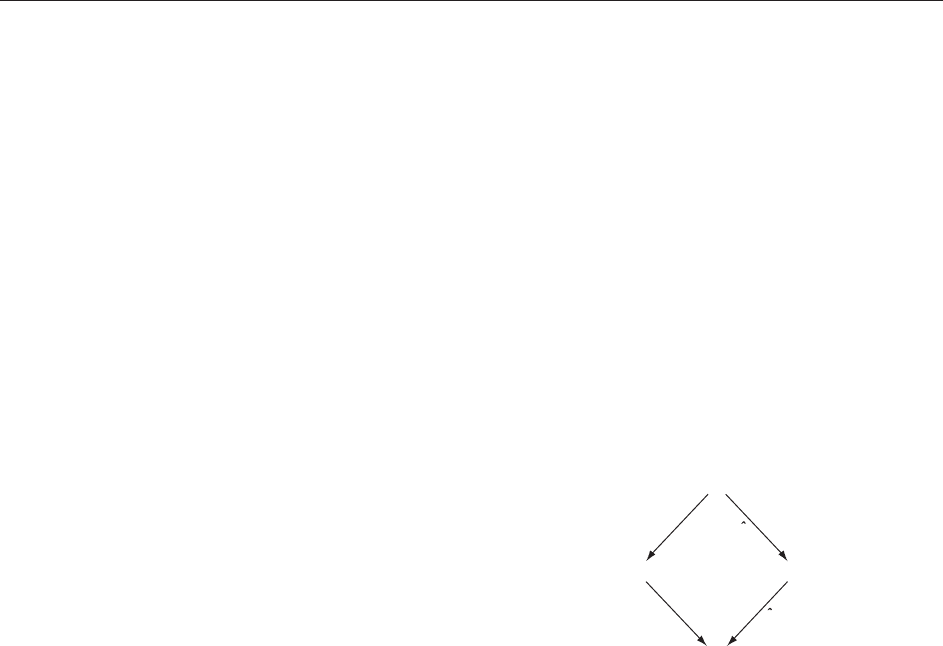
the following commutative diagr am:
The correspondence space E
M
^
E is a circle bundle
over E with first Chern class
(c
1
(
^
E)), and it is also
a circle bundle over
^
E with first Chern class
(c
1
(E)), by the commutativity of the diagram
above. If
^
E = E or if
^
E = M S
1
, then the correspon-
dence space E
M
^
E is diffeomorphic to E S
1
.
T-duality gives an isomorphism of the twisted
K-theories of E and
^
E as well as an isomorphism
between the twisted cohomologies of E and
^
E, and
can be expressed in the following commutative
diagram:
K
ðE; P Þ!
T
K
þ1
ð
^
E;
^
PÞ
Ch
P
##Ch
^
P
H
ðE; HÞ!
T
H
þ1
ð
^
E;
^
HÞ
where the horizontal arrows are isomorphisms. Here
P is a principal PU(H) bundle over E such that
DD(P) = H and
^
P is a principal PU(H) bundle over
^
E such that DD(
^
P) = H. We refer to Bouwknegt
et al. (2004) for details. The T-duality isomorphism
above gives compelling evidence that a type IIA
string theory A on a circle bundle of radius R in the
presence of a background H -flux, and a type IIB
string theory B on a ‘‘T-dual’’ circle bundle of radius
E ×
M
Ê
E
Ê
M
p
p
π
π
K-Theory 253

1/R in the presence of a ‘‘T-dual’’ background H-flux,
are equivalent in the sense that the string states of
string theory A are in canonical one-to-one correspon-
dence with the string states of string theory B.
We briefly m ention two other applications of
twisted K-theory. Consider the adjoint action of a
compact connected simple Lie group G on itself,
and the corresponding twisted G-equivariant
K-theory, twisted by a multiple of the generator
of H
3
(G, Z). The relevance of the equivariant case
to conformal field theory was highlighted by the
result of Freed, Hopkins and Teleman (see Freed
(2002)) that it is graded isomorphic to the
Verlinde algebra of G, with a shift given by the
dual Coxeter number. Here the Verlinde algebra
consists of equivalence classes of positive-energy
representations of the l oop group of G which was
originally shown to be a ring in a rather nontrivial
way. On the other hand, the ring structure of the
twisted G-equivariant K-theory of G is ju st
induced by the product on G, which makes this
result all the more remarkable.
Fractional analytic index theory, developed in
Mathai et al. is a generalization of Atiyah–Singer
index theory, assigning a fractional-valued analytic
index to each projective elliptic operator on a compact
manifold, where the fraction need not be an integer.
These projective elliptic operators act on projective
vector bundles, where the usual compatibility condi-
tion on triple overlaps to give a global vector bundle,
may fail by a scalar factor. These are the geometric
objects in twisted K-theory, when the twist is torsion.
In Mathai et al., a fractional index theorem is
proved, computing the fractional-valued analytic
index of projective elliptic operators essentially in
terms of topological data. The Dirac operator in
the absence of a spin structure is also defined there
for the first time resolving a long standing mystery,
and its index is computed.
Some topics not covered in this brief account of
K-theory include: KK-theory, cf. Blackadar (1986)
and Kasparov (1988), which is natural setting for
the Atiyah–Singer index theorem and its general-
izations, as well as higher algebraic K-theory.
See also: C*-Algebras and Their Classification;
Characteristic Classes; Cohomology Theories;
Equivariant Cohomology and the Cartan Model; Gerbes
in Quantum Field Theory; Index Theorems; Intersection
Theory; Mathai–Quillen Formalism; Spectral Sequences.
Further Reading
Atiyah MF and Segal G Twisted K-theory, math.KT/0407054.
Atiyah MF and Singer IM (1971) The index of elliptic operators,
IV. Annals of Mathematics 93: 119–138.
Bellissard J, van Elst A, and Schulz-Baldes H (1994) The
noncommutative geometry of the quantum Hall effect. Journal
of Mathematical Physics 35: 5373–5451.
Blackadar B (1986) K-Theory for Operator Algebras. In:
Mathematical Sciences Research Institute Publications,
vol. 5, viiiþ338 pp. New York: Springer.
Bouwknegt P, Carey A, Mathai V, Murray MK, and Stevenson D
(2002) Twisted K -theory and the K-theory of bundle gerbes.
Communications in Mathematical Physics 228(1): 17–49.
Bouwknegt P, Evslin J, and Mathai V (2004) T-duality: topology
change from H-flux. Communications in Mathematical Phy-
sics 249: 383 (hep-th/0306062).
Bouwknegt P, Evslin J, and Mathai V (2004b) On the topology and
flux of T-dual manifolds. Physical Review Letters 92: 181601.
Dixmier J and Douady A (1963) Champs continues d’espaces
hilbertiens at de C
-alge`bres.Bull.Soc.Math.France91: 227–284.
Freed DS (2002) Twisted K-theory and loop groups. Proceedings
of the International Congress of Mathematicians (Beijing,
2002) vol. III pp. 419–430.
Karoubi M (1978) K-theory. An Introduction Grundlehren der
Mathematischen Wissenschaften, Band 226, xviiiþ308 pp.
Berlin: Springer.
Kasparov GG (1988) Equivariant KK-theory and the Novikov
conjecture. Invent. Math. 91(1): 147–201.
Marcolli M and Mathai V (2001) Twisted index theory on good
orbifolds, II: fractional quantum numbers. Communications in
Mathematical Physics 217(1): 55–87.
Mathai V, Melrose RB, and Singer IM, The fractional analytic
index, math.DG/0402329.
Mathai V and Quillen DG (1986) Superconnections, Thom classes
and equivariant differential forms. Topology 26: 85–110.
Murray MK (1996) Bundle gerbes. J. London Math. Soc. 54:
403–416.
Rosenberg J (1983) C
-algebras, positive scalar curvature, and the
Novikov conjecture. Inst. Hautes tudes Sci. Publ. Math 58:
197–212.
Rosenberg J (1989) Continuous-trace algebras from the bundle
theoretic point of view. J. Austral. Math. Soc. Ser. A 47(3):
368–381.
254 K-Theory

L
Lagrangian Dispersion (Passive Scalar)
G Falkovich, Weizmann Institute of Science, Rehovot,
Israel
ª 2006 Elsevier Ltd. All rights reserved.
Introduction
To describe transport by a random flow, one needs
to apply the statistical methods to the motion of
fluid particles, that is, to the Lagrangian dynamics.
We first present the propagators describing evolving
probability distributions of different configurations
of fluid particles. We then use those propagators to
describe decay and steady states of a passive scalar
field transported by random flows.
Consider an evolut ion of a passive scalar tracer
(r, t) in a random flow. The mean value of the
scalar tracer at a given point is an average over
values brought by different trajectories:
ðr; sÞ
hi
¼
Z
Pðr; s; R; 0ÞðR; 0ÞdR ½1
Here, P(r, s; R, t) is the probability density function
(PDF) to find the particle at time t at position R
given its position r at time s. That PDF is called the
propagator or the Green function. Multipoint
correlation functions of the tracer
C
N
ðr;sÞ ðr
1
;s Þ...ðr
N
;sÞ
hi
¼
Z
P
N
ðr;s; R; 0ÞðR
1
;0Þ...ðR
N
;0ÞdR ½2
are expressed via the multiparticle Green functions
P
N
which are the joint PDFs of the equal-time
positions
R= (R
1
,...,R
N
)ofN fluid trajectories.
The trajectory of the fluid particle that passes at
time s through the point r is described by the vector
R(t; r, s) which satisfies R(t; r, t) = r and the stochas-
tic equation
_
R ¼ vðR; tÞþuðtÞ½3
Here, u(t) describes the molecular Brownian motion
with zero average and covariance hu
i
(t) u
j
(t
0
)i
= 2
ij
(t t
0
). We also consider macroscopic
velocity v as random with various statistical properties
in space and time. There is a clear scale separation
between macroscopic velocity v and molecular
diffusion u that allows one to treat them separately.
Using [3], one can write the Green’s function as
an integral over paths that satisfy q(s) = r an d
q(t) = R:
Pðr; s; R; tÞ¼
Z
DpDq exp
Z
t
s
{pðÞ½
_
qðÞ
vðqðÞ;ÞuðÞd
v;u
½4
¼
Z
DpDq exp
Z
t
s
½{pðÞð
_
qðÞ
vðqðÞ;ÞÞ þ p
2
ðÞd
v
½5
¼
Z
Dq exp
1
4
Z
t
s
½
_
qðÞ
vðqðÞ;Þ
2
d
v
¼ Pðr; s; R; tjvÞ
hi
v
½6
The integration over the auxiliary field p in [4]
enforces the delta function of [3]. One passes from
[4] to [5] by averaging over the Gaussian Brownian
noise, and from [5] to [6] by calcu lating Gaussian
integral over p.
Generally, exact calculations are only possible for
Gaussian random proces ses short-correlated in time-
like in [5]. The simplest case is the Brownian motion
when the advect ion is absent. One then obtains from
[6] the Gaussian PDF of the displacement:
PðR; tÞ¼ð4tÞ
d=2
e
R
2
=ð4tÞ
½7
which satisfies the heat equation (@
t
r
2
) P(r, t) = 0.
The short-correlated case is far from being an exotic
exception but rather presents a long-time limit of an
integral of any finite-correlated random function.
Indeed, such an integral can be presented as a sum of
many independent equally distributed random numbers,

the statistics of such sums is a subject of the central limit
theorem. One can move beyond the central limit
theorem considering the correlation time finite (yet
small comparing to the time of evolution). Such
generalization is the subject of the large deviation
theory. Consider some quantity X whichisanintegral
of some random function over time t much larger than
the correlation time .Att , X behaves as a sum of
many independent identically distributed random
numbers y
i
: X =
P
N
1
y
i
with N / t=. The generating
function he
zX
i of the moments of X is the product,
he
zX
i= e
NS(z)
, where we have denoted he
zy
ie
S(z)
(assuming that the generatin g function he
zy
i exists for
all complex z). The PDF P(X) is given by the inverse
Laplace transform (2i)
1
R
e
zXþNS(z)
dz with the
integral over any axis parallel to the imaginary one.
For X / N, the integral is dominated by the saddle point
z
0
such that S
0
(z
0
) = X=N and
PðXÞ/e
NHðX=NhyiÞ
½8
Here H = S(z
0
) þ z
0
S
0
(z
0
) is the function of the
variable X=N hyi; it is called entropy function as it
appears also in the thermodynamic limit in statis-
tical physics. A few important properties of H (also
called rate or Crame´r function) may be established
independently of the distribution P(y). It is a convex
function which takes its minimum at zero, that is,
for X equal to the mean value hXi= NS
0
(0). The
minimal value of H vanishes since S(0) = 0. The
entropy is quadratic around its minimum with
H
00
(0) =
1
, where =S
00
(0) is the variance of y.
We thus see that the mean value hXi= Nhyi grows
linearly with N. The fluctuations X hXi on the
scale O(N
1=2
) are governed by the central limit
theorem that states that (X hXi)=N
1=2
becomes for
large N a Gaussian random variable with variance
hy
2
ihyi
2
as in [7]. Finally, its fluctuations on
the larger scale O(N) are governed by the large
deviation form [8]. The possible non-Gaussianity of
the y’s leads to a nonquadratic behavior of H
for (large) deviations from the mean, starting from
X hXi=N ’ =S
000
(0). Note that if y is Gaussian,
then X is Gaussian too for any t, but the universal
formula [8] with H = (X Nhyi)
2
=2N is valid
only for t .
Single-Particle Diffusion
For the pure advection without noise, the dis-
placement of the single Lagrangian trajectory is
R(t) R(0) =
R
t
0
V(s)ds, with V(t ) = v(R(t), t) being
the Lagrangian velocity. One can show that V(t)is
statistically stationary in the frame of reference with
no mean flow and under statistical hom ogeneity and
stationarity of the incompressible Eulerian velocities.
For = 0, the mean square displacement satisfies the
equation
d
dt
h½RðtÞRð0Þ
2
i¼2
Z
t
0
hVð0ÞVðsÞids ½9
The behavior of the displacement is crucially
dependent on the Lagrangian correlation time of
V(t) defined by
Z
1
0
hVð0ÞVðsÞids ¼hv
2
i ½10
No general relation between the Eulerian and
the Lagrangian correlation times has been estab-
lished, except for the case of short-correlated
velocities. For times t , the two-point function
in [9] is approximately equal to hV(0)
2
i= hv
2
i.
The fluid particle transport is then ballistic with
h[R(t) R(0)]
2
i’hv
2
it
2
and the PDF P(R, t)is
determined by the whole single-time velocity PDF.
When the correlation time of V(t) is finite (a generic
situation in a turbulent flow where is of order of a
large-scale turnover time), an effective diffusive regime
is expected to arise for t with h(R(t) R(0))
2
i’
2hv
2
it. Indeed, the particle displacements over time
segments much larger than are almost independent.
At long times, the displacement R(t) behaves then as a
sum of many independent variables and falls into the
class of stationary processes treated in the previous
section. In other words, R(t)fort becomes
a Brownian motion in d dimensions, normally
distributed with hR
i
(t)R
j
(t)i’D
ij
e
t, where the
so-called eddy diffusivity tensor is as follows:
D
ij
e
¼
1
2
Z
1
0
hV
i
ð0ÞV
j
ðsÞþV
j
ð0ÞV
i
ðsÞids ½11
The symm etric second-order tensor D
ij
e
is the only
characteristics of the velocity which matter s in this
limit of t . The trac e of the tensor is equal to
hv
2
i, that is, equal to the large-time value of the
integral in [9], while its tensor ial pro perties reflect
the rotational symmetries of the advecting velocity
field. If the latter is isotropic, the tensor reduces to a
diagonal form characterized by a single scalar value
D
e
. The main problem of turbulent diffusion is to
obtain the effective diffusivity tensor given the
velocity field v and the value of the molecular
diffusivity .
Two-Particle Dispersion in Smooth
Flows
Even when velocity v(R, t) is a smooth function of
the coordinates, Lagrangian dynamics can be quite
256 Lagrangian Dispersion (Passive Scalar)