
Francoise J.-P., Naber G.L., Tsun T.S. (editors) Encyclopedia of Mathematical Physics
Подождите немного. Документ загружается.


complicated. Indeed, d ordinary differential equations
_
R = v(R, t) generally produce chaotic dynamics (for
d 3 already for steady flows and for d = 2 for time-
dependent flows). The tools for the description of what
is called chaotic advection are similar to those of the
theory of dynamical chaos. The description consistently
exploits two simple ideas: to single out the variables
that can be represented by the sum of a large number of
independent random quantities and to separate vari-
ables that fluctuate on different timescales.
The distance, R
12
= R
1
R
2
, between two fluid
particles with trajectories R
i
(t) = R(t; r
i
) passing at
t = 0 through points r
i
satisfies the equation
_
R
12
¼ vðR
1
; tÞvðR
2
; tÞ½12
If the velocity field can be considered smooth on
the scale R
12
, then one expands v(R
1
, t) v(R
2
, t) =
(t, R
1
)R
12
, introducing the strain matrix which
can be treated as independent of R
12
. The distance
thus satisfies locally a linear system of ordinary
differential equ ations (we omit subscripts replacing
R
12
by R)
_
RðtÞ¼ðtÞRðtÞ½13
This equation, with the strain treated as given and
R(0) = r, may be explicitly solved for arbitrar y (t)
only in the 1D case
ln½RðtÞ=r¼ln WðtÞ¼
Z
t
0
ðsÞds X ½14
When t is much larger than the correlation time of
the strain, the variable X is a sum of N independent
equally distributed random numbers with N = t=
and one can apply [8]. In the multidimensi onal case,
to use the large deviation theory, one introduces the
evolution matrix W such that R(t) = W(t)R (0). The
modulus R is expressed via the positive symmet ric
matrix W
T
W. In almost every realization of the
strain, the matrix t
1
ln W
T
W stabilizes at t !1,
that is, its eigenvectors tend to d-fixed orthonormal
eigenvectors f
i
. To understand that intuitively,
consider some fluid volume, say a sphere, which
evolves into an elongated ellipsoid at later times. As
time increases, the ellipsoid is more and more
elongated and it is less and less likely that the
hierarchy of the ellipsoid axes will change. The
limiting eigenvalues
i
¼ lim
t!1
t
1
ln jWf
i
j½15
are called Lyapunov exponents. The major property
of the Lyapunov exponents is that they are realiza-
tion independent if the flow is ergodic (i.e., spatial
and temporal averages coincide). The relation [15]
states that two fluid particles separated initially by r
pointing into the direction f
i
will separate (or
converge) asymptotically as exp (
i
t). The incom-
pressibility constraints det (W) = 1 and
P
i
= 0
imply that a positive Lyapunov exponent will exist
whenever at least one of the exponents is nonzero.
Consider indeed
EðnÞ¼lim
t!1
t
1
lnh½RðtÞ=r
n
i½16
whose derivative at the origin gives the largest
Lyapunov exponent
1
. The function E(n) obviously
vanishes at the origin. Furthermore, E(d) = 0, that
is, incompressibility and isotropy make that hR
d
i is
time independent as t !1. Apart from n = 0, d,
the convex function E(n) cann ot have other zeroes if
it does not vanish identically. It follows that dE=dn
at n = 0, and thus
1
, is positive. A simple way to
appreciate intuitively the existence of a positive
Lyapunov exponent is to consider the saddle-point
2D flow v
x
= x, v
y
= y with the axes randomly
rotating after time interval T. A vector initially at
the angle with the x-axis will be stretched after
time T if cos [1 þ exp (2T)]
1=2
, that is, the
measure of the stretching dire ctions is larger
than 1=2.
A major consequence of the existence of a positive
Lyapunov exponent for any random incompressible
flow is the exponential growth of the interparticle
distance R(t). In a smooth flow, it is also possible to
analyze the statistics of the set of vectors R(t)andto
establish a multidimensional analog of [8].Theideais
to reduce the d-dimensional problem to a set of d
scalar problems for slowly fluctuating stretching
variables excluding the fast fluctuating angular degrees
of freedom. Consider the matrix I(t) = W(t)W
T
(t),
representing the tensor of inertia of a fluid element
such as the above-mentioned ellipsoid. The matrix is
obtained by averaging R
i
(t) R
j
(t)d=‘
2
over the initial
vectors of length ‘ and I(0) = 1. Introducing the
variables that describe stretching as the lengths of the
ellipsoid axis e
2
1
, ..., e
2
d
, one can deduce similarly to
[8] the asymptotic PDF:
Pð
1
; ...;
d
; tÞ
/ exp tHð
1
=t
1
; ...;
d1
=t
d1
Þ½
ð
1
2
Þ...ð
d1
d
Þ
ð
1
þþ
d
Þ½17
The entropy function H depends on the statistics
of . In the -correlated case, H is everywhere
quadratic:
HðxÞ/d
1
X
d
i¼1
x
2
i
;
i
/ dðd 2i þ 1Þ½18
Lagrangian Dispersion (Passive Scalar) 257

Two-Particle Dispersion in Nonsmooth
Flows
To consider dispersion in the inertial interval of
turbulence, one should assume v(r, t)j/r
, where
generally <1. Rewriting then eqn [12] for the
distance between two particles as
_
R = v (R, t), we
infer that dR
2
=dt = 2R v(R, t) / R
1þ
. It suggests
RðtÞ
1
Rð0Þ
1
/ t ½19
For large t, R(t) / t
1=(1)
, with the dependence of
the initial separation quickly forgotten. Of course,
for the random process R(t), relation [19] is of the
mean-field type and should pertain (if true) to the
large-time behavior of the averages ðhR(t)
p
i/
t
p=(1)
, for p > 0Þ implying their super-diffusive
growth, faster than the diffusive one / t
p=2
. The
power-law scaling may be amplified to the scaling
behavior of the PDF of the interparticle distance,
P(R, t) = P(R,
1
t). The power-law growth of
the second moment, hR(t)
2
i/t
3
, is the celebrated
Richardson dispersion relation, which was the first
quantitative pheno menological prediction in devel-
oped turbulence. It seems to be confirm ed by
experimental data and the numer ical simulations. It
is important to remark that, even assuming the
validity of the Richardson relation, it is impossible
to establish general large-time properties of the PDF
P(R; t) such as those for the single-particle PDF of
the distance between two particles. This is because
the correlation time of the Lagrangian velocity
difference, R=v(R) /hR
2
i
1=3
/ t, is comparable
with the total time of the process.
It is instructive to contrast the exponential growth
[16] of the distance between the trajectories with the
power-law growth [19]. In a smooth flow, the closer
two trajectories are initially, the more time is needed
to effectively separate them. In a nonsmooth
turbulent flow, the trajectori es separate in a finite
time independent of their initial distance R(0),
provided that the latter is also in the inertial range.
This explosive separation of trajectories results in a
breakdown of the deterministic Lagran gian flow
since the trajectories cannot be labeled by the
initial conditions. That agrees with the fundamental
theorem stating that the ordinary differential equa-
tion
_
R = v(R, t) does not have unique solution
if v(r, t) is non-Lipschitz. As shown by the
example of the equation
_
x = jxj
with two solutions
x = [(1 )t]
1=(1)
and x = 0 both starting at zero,
one should expect multiple Lagrangian trajectories
starting or ending at the same point for velocity
fields with <1. Even though the deterministic
Lagrangian description breaks down, the statistical
description is still possible and one can make
sense of propagators like P(r, s; R, tjv). They are
expected to be weak solutions of the equation
[@
t
rv(R, t)]P(r, s; R, tjv) = 0 in the nonsmooth
case. According to this assumption, the Lagrangian
trajectories behave stochastically already in a
given velocity field and for negligible molecular
diffusivity – and not only due to a random noise or
to random fluctuations of the velocities.
The general conjecture about the existence and
diffuse na ture of propagators is known to be true for
the Gaussian ensemble of velocities decorrelated in
time (Kraichnan 1968):
hv
i
ðr; tÞv
j
ðr
0
; t
0
Þi ¼ 2ðt t
0
ÞD
ij
ðr r
0
Þ½20
Here the Lagrangian velocity v(R, t) has the same
white noise temporal statistics as the Eulerian
velocity v(r, t) for fixed r and the displacement
along a Lagrangian trajectory R(t) R(0) is a
Brownian motion for all times. To model non-
smooth velocity field of turbulence, we choose
D
ij
(r) = D
0
ij
(1=2)d
ij
(r) and
d
ij
ðrÞ¼D
1
½ðd 1 þ Þ
ij
r
r
i
r
j
r
2
½21
Here D
0
gives the eddy diffusivity of a single fluid
particle (discussed earlier), wher eas d
ij
(r) describes
the statistics of the velocity differences. For 0 <<2,
the Kraichnan ensemble is supported on the velo-
cities that are Ho¨ lder continuous in space with a
fixed exponent arbitrarily close to =2. It mimics
this way the main property of turbulent velocities.
The rough (distributional) behavior of Kraichnan
velocities in time, although not very physical, is not
expected to modify essentially the qualitative prop-
erties of propagators (it is the spatial regularity, not
the temporal one, of a vector field that is crucial for
the uniqueness of its trajectories).
In ex actly the same way as one derives [6] and [7]
from [4], one gets P(R, t) = j
^
j
1=2
(4t)
d=2
e
ij
R
i
R
j
=4t
,
where (
^
1
)
ij
= D
ij
(0) þ
ij
. In much the same way
one can examine the two-particle PDF. The PDF
P
2
(r, s; R, t) of the distance R between two particles
satisfies the equation
ð@
t
M
2
ÞP
2
ðr; s; R; tÞ¼ðt sÞðr RÞ½22
where M
2
= D
1
(d 1)r
1d
@
r
r
d1þ
@
r
and [22] can
be readily solved:
lim
r!0
P
2
ðr; s; R; tÞ/
R
d1
jt sj
d=ð2Þ
exp const:
R
2
jt sj
½23
258 Lagrangian Dispersion (Passive Scalar)
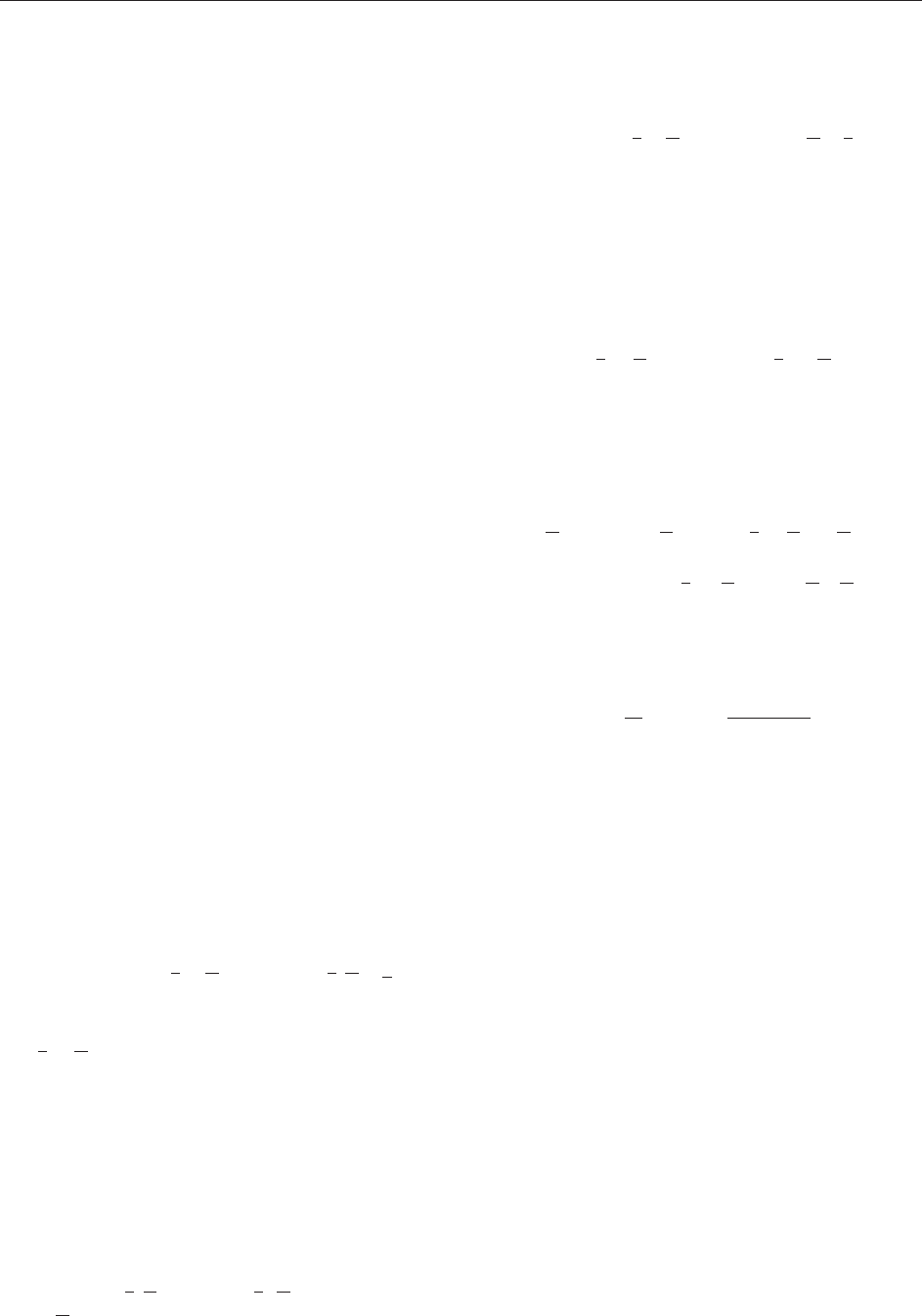
That confirms the diffusive character of the limiting
process describing the Lagrangian trajectories in
fixed non-Lipschitz velocities: the endpoints of the
process stay at finite distance when the initial points
converge. The PDF [23] changes from Gaussian to
log–normal when changes from 0 to 2. The
Richardson dispersion hR
2
(t) i/t
3
is reproduced
for = 4=3.
Multiparticle Propagators
In studying multiparticle statistics, an important
question is what memory of the initial configuration
remains when final distances far exceed initial
ones. To answer this question, one must analyze
the conservation laws of turbulent diffusion.
Many-particle evolution in nonsmooth velocities
exhibits nontrivial statistical integrals of motion
(martingales) that are proportional to the positive
powers of the distances. The integrals involve
geometry in such a way that the distance growth is
balanced by the decrease of the shape fluctuations.
The existence of multiparticle conservation laws
indicates the presence of a long-time memory and is
a reflection of the coupling among the particles due
to the simple fact that they are all in the same
velocity field. The conserved quantities may be easily
built for the limiting cases. Already for a smooth
velocity, the d-volume
i
1
i
2
...i
d
R
i
1
12
...R
i
d
1d
is indeed
preserved for ðd þ 1Þ Lagrangian trajectories. In the
opposite case of a very irregular velocity, the fluid
particles undergo a Brownian motion. The distances
between the Brownian particles grow according to
hR
2
nm
(t) i= R
2
nm
(0) þ Dt. The statistical integrals
of motion are hR
2
nm
R
2
pr
i, h2(d þ 2)R
2
nm
R
2
pr
d(R
4
nm
þ R
4
pr
)i, and an infinity of similarly built
harmonic polynomials (zero modes of Laplacian).
The statistics of the relative motion of N particles
is described by the joint PDF averaged over rigid
translations: P
rel
N
(r, s ; R, t) =
R
P
N
(s, r; R þ , t)d.
For smooth velocities,
P
rel
N
ðr;0; R;tÞ¼
Z
D
Y
N
n¼1
ðR
n
þ WðtÞr
n
Þ
E
d ½ 24
Such PDF depends only on the statistics of the
evolution matrix W(t) discussed earlier. Under the
evolution governed by W(t), all distances between
points grow exponentially for large times while their
ratios R
nm
=R
kl
tend to a constant. For whatever initial
positions, asymptotically in time, the points tend to be
situated on the line. Note that the existence of
deterministic trajectories leads to the collapse property
lim
r
N
!r
N1
P
rel
N
(r; R; t ) = P
rel
N1
(r
0
; R
0
; t) (R
N1
R
N
),
where
R
0
= (R
1
, ..., R
N1
).
The long-time asymptotics of the propagators in
the nonsmooth case can be found explicitly for the
Kraichnan ensemble of velocities:
ð@
t
þ M
N
ÞP
rel
N
ðr; s; R; t Þ¼ðt sÞðR rÞ½25
M
N
¼
X
n<m
d
ij
ðr
nm
Þr
r
i
n
r
r
j
m
½26
When initial points get close or final points far
apart and time gets large, the multiparticle PDF is
factorized:
lim
!0
P
rel
N
ðr; 0; R; tÞ¼
X
f
ðrÞg
ðR; tÞ½27
where f
must be taken as zero modes of M
y
N
and its
powers while @
t
g
= M
N
g
. The remarkable fea-
ture of the zero modes of M
y
N
is that they are
conserved in mean by the Lagrangian evolution:
@
t
f ðRðtÞÞ
hi
¼
Z
f ðRÞM
N
P
rel
N
ðr; 0; R; tÞdR
0
¼
Z
P
rel
N
ðr; 0; R; tÞM
y
N
f ðRÞdR
0
¼ 0
The scaling exponents of the zero modes depend, in
a nontrivial way, on the number of particles N. For
1 and d 1, one finds
N
¼
N
2
ð2 Þ
NðN 2Þ
2ðd þ 2Þ
½28
Passive Scalar
For practical applications, for example, in the
diffusion of pollution, the most relevant quantity is
the average h(r, t)i which can be expressed via the
single-particle propagator. As discussed earlier, for
times longer than the Lagrangian correlation time,
the particle diffuses and hi obeys the effective heat
equation
@
t
ðr; tÞ
hi
¼ D
ij
e
þ
ij
r
i
r
j
ðr; tÞ
hi
½29
with the eddy diffusivity D
ij
e
given by [11]. The
simplest decay problem is that of a uniform scalar
spot of size L release d in the fluid. Its averaged
spatial distribution at later times is given by the
solution of [11] with the appropriate initial condi-
tion. On the other hand, the decay of the scalar in
the spot is governed by the multipoint Lagrangian
propagators. Taking the point of measurement
inside the spot, consider the single-point moment
h
N
i(t) described by [2]. If there is no molecular
diffusion and the trajectories are unique (spatially
smooth velocity), particles that end at the same
Lagrangian Dispersion (Passive Scalar) 259
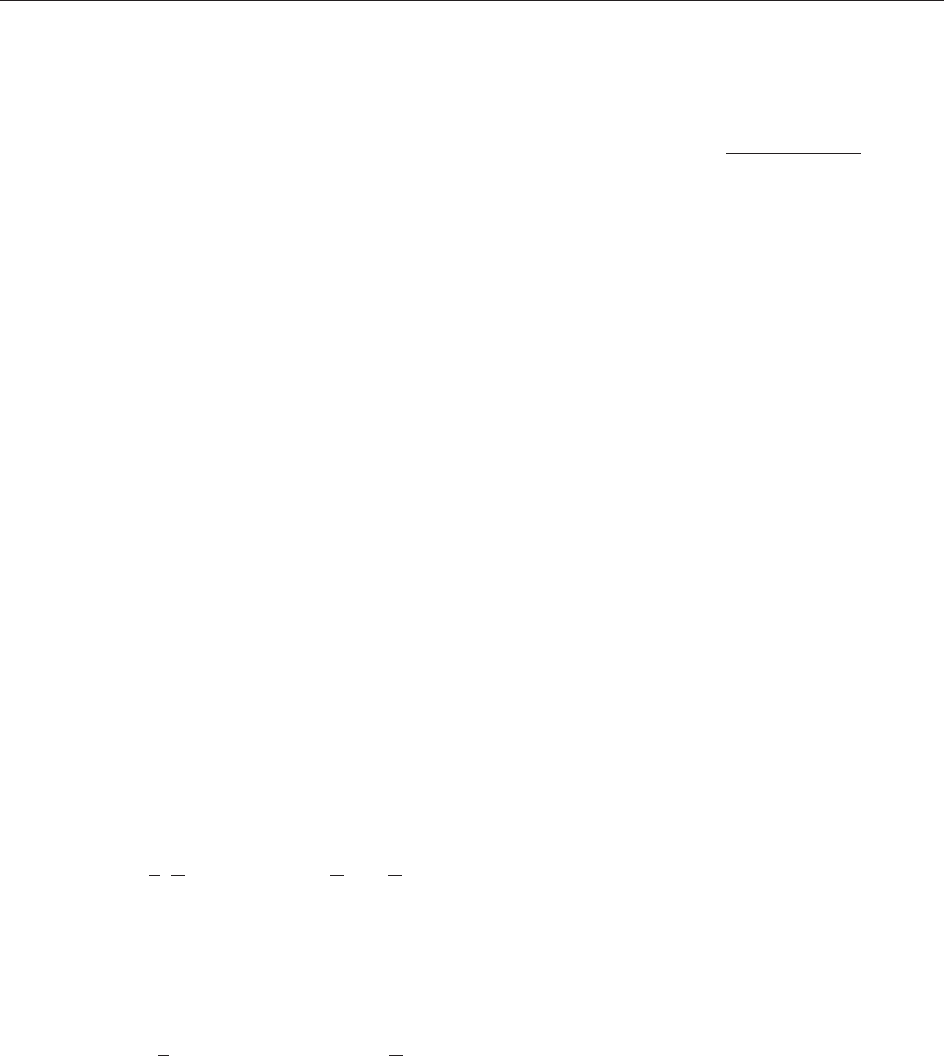
point remained together throughout the evolution
and all the moments are preserved. On the contrary,
when velocity is nonsmooth and the propagator is
diffusive, we expect the decay even at the limit ! 0.
This is an example of the so-called dissipative
anomaly: the symmetry t !t remains broken
even when the symmetry-breaking factor goes
to zero. Consider a spherical spot of released in
a spatially smooth incompressible 3D flow with
1
>
2
> 0 >
3
. During the time less than
t
d
= j
3
j
1
ln (L=r
d
), diffusion is unimportant and
inside the spot does not change. At larger time, the
dimensions of the spot with negative Lyapunov
exponents are frozen at r
d
, while the rest keep
growing exponentially, resulting in an exponential
growth of the total volume exp (
1
þ
2
). That leads
to an ex ponential decay of scalar moments averag ed
over velocity statistics: h[(t)]
N
i/exp (
N
t ). The
decay rates
N
can be expressed via the PDF [18] of
stretching variables
i
. Since decays as the inverse
volume,
h½ðt Þ
N
i/
Z
d
1
d
2
exp tHð
1
=t
1
;
2
=t
2
Þ½
Nð
1
þ
2
Þ ½30
At large t, the integral is determined by the saddle
point. At small N, the saddle point lies within the
parabolic domain of H so
N
increases with N
quadratically. At large N, the main contribution is
due to the realization with smallest possible spot of
size L so
N
saturates.
For the decay in incompressible nonsmooth flow,
using the Kraichnan model one gets
h
2n
ðtÞi ¼
Z
P
2n
0; R; 1ðÞC
2n
t
1=ð2Þ
R;0
dR ½31
When J
0
=
R
C
2
(r, t)dr 6¼ 0, the function t
d=(2)
C
2
(t
1=(2)
r, 0) tends to J
0
(r) in the long-time limit
and [31] is reduced to
h
2n
ðtÞi ð2n 1Þ!! J
n
0
t
nd=ð2Þ
Z
P
2n
0; R
1
; R
1
; ...; R
n
; R
n
; 1ðÞdR ½32
The decay is self-similar: P(t, ) = t
d=2(2)
Q(t
d=2(2)
). That means that the PDF of =
ffiffi
p
is asymptotically time indepe ndent, with
(t ) =
h(r)
2
i being time-dependent (decreasing) dissipa-
tion rate. This should be contrasted with the lack of
self-similarity for the smooth case.
One can also consider steady state of pumped by
a source (r, t ):
@
t
þðv rÞ þ ¼ ½33
Assuming that pumping is white Gaussian with a
zero mean and variance
(r
1
, t
1
)(r
2
, t
2
) = (r
12
)
(t
2
t
1
), r
ij
= r
i
r
j
, one can express the correlation
functions via the multiparticle propagators. For
example, assuming zero conditions at the distant
past and space homogeneity, one gets
C
2
ðr; tÞ¼
Z
t
1
dt
0
Z
PðR; r; t
0
ÞðRÞdR ½34
The function (R) is nonz ero within the correlation
scale L of the pumping which restricts integration to
R(t) < L. For smooth velocity, this gives
F
2
(r) = j
3
j
1
(0) ln (L=r)atr < L. For nonsmooth
velocity, the statistics of scalar fluctuations at
small scales is described by the set of structure
functions S
N
(r) h[(r) (0)]
N
i/r
N
with the
scaling exponents determined by the zero
modes (see Falkovich et al. (2001)). Therefore,
existence of Lagrangian statistical invariants
explains the anomalous scaling of passive scalar
(here, anomaly means that scale invariance broken
by pumping is not restored even when the pumping
scale goes to infinity).
See also: Anomalies; Intermittency in Turbulence; Large
Deviations in Equilibrium Statistical Mechanics; Lyapunov
Exponents and Strange Attractors; Random Walks in
Random Environments; Stochastic Differential Equations;
Turbulence Theories.
Further Reading
Ellis R (1995) Entropy, Large Deviations, and Statistical
Mechanics. Berlin: Springer.
Falkovich G, Gawedzki K, and Vergassola M (2001) Particles and
fields in fluid turbulence. Reviews of Modern Physics 73:
913–975.
Kraichnan RH (1968) Small-scale structure of a scalar field
convected by turbulence. Physics of Fluids 11: 945–963.
Majda A and Kramer PR (1999) Simplified models for turbulent
diffusion: theory, numerical modelling, and physical phenom-
ena. Physics Reports 314: 237–574.
Monin A and Yaglom A (1979) Statistical Fluid Mechanics.
Boston: MIT Press.
Pope SB (1994) Lagrangian PDF methods for turbulent flows.
Annual Review of Fluid Mechanics 26: 23–63.
Zinn-Justin J (1989) Quantum Field Theory and Critical
Phenomena. Oxford: Science Publishing.
260 Lagrangian Dispersion (Passive Scalar)

Large Deviations in Equilibrium Statistical Mechanics
S Shlosman, Universite
´
de Marseille, Marseille,
France
ª 2006 Elsevier Ltd. All rights reserved.
Introduction
Large deviation theory (LDT) deals with the study
of probabilities of extremely rare events. As an
example, consider the case of independent identi-
cally distributed random variables
1
, ...,
N
with
the mean value E(
i
) = m. Then the typical devia-
tions of the sum M
N
=
1
þþ
N
from its mean
value Nm are of the order of
ffiffiffiffiffi
N
p
, while in LDT we
study the probabilities of the deviations which are
linear in N. In ‘‘good’’ cases we know that for b > 0
PrfM
N
Nm bNgexpfIðbÞNg
as N !1
½1
where I() > 0 is the ‘‘rate’’ function.
Questions of LDT are very natural in statistical
mechanics, and they have deep physical meaning,
notwithstanding the fact that the corresponding
events are rare. One reason is that (some) rare
events in the grand canonical ensemble become
typical events in the canonical ensemble.
An interesting feature of LDT in statistical
mechanics is that the behavior [1] of LD is not
universal, and sometimes is replaced by a nonclassi-
cal one:
PrfM
N
Nm bNgexp
~
IðbÞN
½2
with <1. That usually happens in the ‘‘phase
transition’’ regime, and then the quantity
~
I(b), as
well as the exponent , have very much to do with
the geometry of a droplet of one phase formed inside
the other.
Below, we will illustrate all these features on the
example of the Ising model.
The Ising Model in the Finite Box
Our random variables
x
will take values 1, with
x 2 Z
d
. They are called spins . For every finite box
Z
d
, we will define Gibbs states in . To do this
we need the Hamiltonians
H
;
ðÞ¼
X
x;y n:n:
x;y2
x
y
X
x;y n:n:
x2;y62
x
y
Here, is some spin configuration on Z
d
, which is
called ‘‘boundary condition,’’ while 2
is any
spin configuration in .
The ‘‘grand canonical Gibbs measure’’
, , T
in
with boundary condition at inverse temperature
= T
1
is given by
;;T
ðÞ¼Z
1
;;T
expðH
;
ðÞÞ ½3
where
Z
;;T
¼
X
2
expðH
;
ðÞÞ
is called ‘‘partition function’’; it makes the measure
[3] to be a probability distribution.
The boundary condition þ1(1) will be
denoted by þ(). For every value of T, the Gibbs
measures
(l),, T
with ()-boundary condition in
the cubic box (l) of size l converge, as l !1,to
the probability measures that we will denote by
, T
. If the two happen to be different, then
þ, T
is
called the (þ)-phase, and
, T
the ()-phase. That
happens to be the case iff the temperature T is lower
than the critical temperature T
c
= T
c
(d ). The critical
temperature depends on dimension; T
c
(1) = 0, while
T
c
(d ) > 0 for d 2. The expect ation
E
þ;T
ð
0
ÞmðÞ
is called spontaneous magnetization; m() > 0 iff
>T
1
c
.
LD Properties of the Gibbs States
(l), , T
In what follows, we will discuss the LD properties of
the sum M
=
1
þþ
jj
, where the spins
x
, x 2 , are distributed according to the Gibbs
state
, , T
. Note that E
, T
(
0
) = m().
Classical Case
If we look on the LDs of the sum M
when the
temperature T is high enough (in which case the
limiting states
þ, T
and
, T
coincide), or else if the
temperature is low, and the deviations are negative –
that is, we consider the events M
þ jjm(T
1
) b jj
with b < 0 – then their probabilities behave classically:
There exists a (high) temperature T
0
such that if
T > T
0
, then
lim
!Z
d
1
jj
Pr M
þ
jj
mT
1
b
jj
¼I
T
ðbÞ for b 0 ½4
lim
!Z
d
1
jj
Pr M
þ
jj
mT
1
b
jj
¼I
T
ðbÞ for b 0 ½5
Large Deviations in Equilibrium Statistical Mechanics 261

where the function I
T
(b) 0 is strictly concave on
the segment (m(T
1
) 1, m(T
1
) þ 1). It vanishes
at only one point b = 0.
There exists a (low) temperat ure T
1
such that if
T < T
1
, then the relation [4] holds with the function
I
T
(b) > 0 strictly concave on the segment (m(T
1
)
1, 0). The limit [5] also does exist, but it can vanish
once we are in the phase transition region. In order
to see some nontrivia l behavior, we have to change
the normalization 1=
jj
in [5].
Nonclassical Case
The proper normalization happens to be the surface
term, 1=
jj
(d1)=d
:
There exists a temperature T
1
such that if T < T
1
,
then
lim
!Z
d
1
jj
ðd1Þ=d
Pr M
þ
jj
mT
1
b
jj
¼W
T
bðÞ for b > 0 ½6
The function W
T
(b) obeys W
T
(b) = b
(d1)=d
w
T
, with
w
T
> 0, provided the value b > 0 is not too large:
b b(d), where b(d) is some constant, depending on
the dimension and temperature; one can show that
b(d ) 1=2
d
. For larger b’s the dependence is more
complex.
The key object here is the constant w
T
. To obtain
it, one has to solve the following variational
problem. Let
T
(), 2 S
d1
be the surface tension
between the (þ)-phase and the ()-phase of the Ising
model at the temperature T. Then, for every closed
compact (hyper)surface M
d1
R
d
, we define its
surface energy as
W
T
MðÞ¼
Z
M
T
s
ðÞds
where
s
is the normal vector to M at s 2 M. The
functional W
T
(M) has the meaning of the energy of
the M-shaped droplet of the (þ)-phase floating in the
()-phase. It is called the ‘‘Wulff functional.’’ Let
W
T
be the surface which minimizes W
T
() over all
the surfaces enclosing the unit volume. Such a
minimizer does exist and is unique up to translation.
It is called the ‘‘Wulff shape.’’ The value w
T
is just
the surface energy of the Wulff shape:
w
T
¼W
T
W
T
ðÞ
The value b(d) is defined as the maximal value of
b’s, for which the dilatation b
1=d
W
T
can fit into the
unit cube. For higher values of b, the shape of the
(þ)-phase droplet in the cube with ()-boundary
condition is deformed by its walls, so its surface
energy is given by a more complicated variational
problem.
Moderate Deviations and the Droplet
Condensation
The reason behind the different order of the
probabilities of the events M
þ
jj
m(T
1
)
b
jj
, b < 0, and M
þ
jj
m(T
1
) b
jj
, b > 0, at
low temperatures is the following. A typical config-
uration contributing to the first event contains many
small droplets of ()-spins, of size ln
jj
, floating
in the sea of (þ)-spins. On the contrary, in the case
of the second event a typical configuration con-
tains, in addition to small droplets, one large
droplet of the size of . It ha s a random shape,
but in the limit ! Z
d
that shape converges to a
nonrandom one, which happens to be the Wulff
shape W
T
. (The precise meaning of that statement
depends on dimension; in case d = 2 the conver-
gence holds in the Hausdorff metrics, while in
higher dimensions it is known only in L
1
sense.)
That statement makes the following question
natural: consider the event
M
E M
ðÞ
jj
; 0 <<1
For which should we expect, in addition to
microscopic (þ)-droplets of size ln
jj
, the forma-
tion of a large droplet, of volume
jj
,ina
corresponding typical configuration? In other
words, how many extra (þ)-spins should we pump
into our systems in order for the microscopic
droplets to condense into a macroscopic one? (In
the formulation of this question, we have to use the
expectation E(M
) instead of the asymptotically
equivalent quantity
jj
m(T
1
). The difference,
E(M
) þ
jj
m(T
1
) O( @
jj
), being irrelevant in
the LD case, becomes significant here.)
The answer is the following:
if <d=(d þ 1), then a typical configuration
contains only microscopic droplets;
if >d=(d þ 1), then any typical configuration
contains, in addition to microscopic droplets, one
large droplet of volume
jj
.
Therefore, the condensation happens at the value
= d=(d þ 1). This picture has its counterpart in the
behavior of the probabilities of ‘ ‘moderate deviations’ ’
(MD), that is, events when M
þ
jj
m(T
1
)
jj
:
if <d=ðd þ 1Þ, then the deviation is due to
independent fluctuations of sizes of many small
droplets, and the usual Gaussian behavior holds:
Pr M
E M
ðÞ
jj
fg
exp
jj
ðÞ
2
2Var M
ðÞ
()
¼ exp c
jj
21
no
262 Large Deviations in Equilibrium Statistical Mechanics

if >d=ðd þ 1Þ, then the deviation is due to the
formation of a large droplet, and so
Pr M
E M
ðÞ
jj
fg
exp c
0
jj
ððd1Þ/dÞ
no
Note that the two estimates match at = d=(d þ 1).
Other Questions
There are many related questions; some are partially
solved, others are widely open, if considered on a
rigorous mathematical level.
One can ask about the asymptotic behavior of
probabilities of the events like
M
E M
ðÞ¼b
where the values b
lie in the LD or MD region. The
difference between such questions and those treated
above is of the same nature as the difference between
the integral and the local limit theorems. Partial answers
to them are given in Dobrushin and Shlosman (1994).
Many results about the Wulff shape and its
relation to the Ising model are known, starting by
Dobrushin et al. (1992). Some are still challenging.
One such question concerns the so-called roughening
phase transition. It is known rigorously that the
Wulff shape W
T
in the d 3 Ising model has flat
facets at low temperatures T.Itisbelievedthatsucha
feature holds true only for T < T
R
, where the
roughening temperature T
R
is strictly less than the
critical temperature T
c
(d)ford = 3. At the tempera-
tures T 2 (T
R
, T
c
(3)), the Wulff shape W
T
does not
have facets. This conjecture seems to be very difficult.
The question about the typical behavior of
the MD of the Ising model at the threshold
value M
E(M
)
jj
d=(dþ1)
was recently
answered in Biscup et al. (2003).
Further Reading
Biscup M, Chayes L, and Kotecky R (2003) Critical region for
droplet formation in the two-dimensional Ising model.
Communications in Mathematical Physics 242: 137–183.
Dobrushin RL and Shlosman SB (1994) Large and moderate
deviations in the Ising model. In: Dobrushin RL (ed.)
Probability Contributions to Statistical Mechanics, Advances
in Soviet Mathematics, vol. 18, pp. 91–220. Providence, RI:
American Mathematical Society.
Dobrushin RL, Kotecky R, and Shlosman SB (1992) Wulff
Construction: A Global Shape from Local Interaction. AMS
Translations Series. Providence, RI: American Mathematical
Society.
Large-N and Topological Strings
R Gopakumar, Harish-Chandra Research Institute,
Allahabad, India
ª 2006 Elsevier Ltd. All rights reserved.
Introduction
Topological strings have been well studied since
they were introduced in the early 1990s. Essen-
tially, they are simplified string theories that
capture the information about a sector of the full
(or ‘‘physical’’) string theory. Thus, while sharing
many of the structural features of usual string
theory, they hold out the possibility of being
amenable to explicit calculations. This is especially
true with regard to stringy quantum corrections
(the higher genus contributions from the point of
view of the string world sheet), which are normally
rather intractable in the full physical string theory.
This has allowed them to play a useful role in
enhancing the understanding of string theory and
many of its mysterious quantum properties, such as
the various dualities.
In particular, in the last several years, topological
strings have served as an important laboratory for
testing and understanding the connection between the
large-N expansion of gauge theories and closed-
string theories. In this article we will sketch how
this connection is illustrated in a duality between
large-N Chern–Simons gauge theory and closed
topological string theories. We will survey the origin
and current status of these developments and
indicated some of its remarkable mathematical
ramifications.
Background
In order to appreciate the conjecture relating the
Chern–Simons theory and topological string the-
ories, we need to go back to the seminal work of
’t Hooft, who pointed to the connection between the
large-N expansion of gauge field theories and string
theories.
The starting point is a gauge field theory (with,
say, gauge group U(N)), where we take the limit of
the rank N of the gauge group to infinity (see Brezin
Large-N and Topological Strings 263

and Wadia (1993) for a collection of papers on the
topic). The idea is then to make an expansion in
inverse powers of N for various observables such as
the free energy and correlation functions. For
definiteness, let us take a gauge theory containing
only gauge fields A in the adjoint representation of
U(N). The quantum theory is (schematically) defined
by the path integral
Z ¼
Z
½DAe
iSðAÞ
½1
For now, the action S(A) for the gauge fields is left
unspecified. It could be either the usual Yang–Mills
functional or of the Chern–Simons form which we
describe below. S(A) is normalized in such a
way that the gauge coupling constant, denoted
by , only appears via an overall multiplicative
factor of 1=.
Then the expression, for instance, for the free
energy F = ln Z has an expansion in a power series
in , whose individual terms are given by the usual
Feynman diagrammatic r ules. Namely, we have is
a sum over connected vacuum diagrams (those
without any external legs) formed from the
vertices determined by the action S(A). Even
without going into the details of the action, we
can write down the dependence on N and
comingfromadiagramwithh faces, V vertices,
and E edges. Every edge is associated with a
propagator (arising from the inverse of the quad-
ratic term in S(A)) and thus comes with a weight
of . Every vertex, coming f rom the cubic and
higher-order terms in S(A), comes with a factor of
1
.ThereisafactorofN coming from summing
over the color indices that circulate in every loop
(face). We thus get a weight of N
h
EV
and so the
total contribution t o the free energy can be
organized as
F ¼
X
1
g¼0;h¼1
C
g;h
N
h
2g2þh
¼
X
1
g¼0;h¼1
C
g;h
N
22g
2g2þh
½2
Here we have defined N , the ’t Hooft
coupling, as the combination that will be kept
fixed when taking the limit of large N.Wehave
also used the fact that V E þ h = 2 2g,whereg
is the number of handles of the closed two-
dimensional surface one can associate with the
Feynman diagram. (It is bes t to visualize the
Feynman diagram as a ‘‘fatgraph’’ which forms
the s keleton of a closed Riemann surface.) The
coefficients C
g,h
represent the sum of the
contributions from all genus g diagrams with h
boundaries and depend on the details of the
theory.
We note that the reorganization of the contribu-
tions to the free energy is reminiscent of the genus
expansion in a string theory. In fact, eqn [2] as it
stands looks like an open-string expansion on world
sheets with g handles and h boundaries. Indeed, in
many cases the gauge theory arises as a limit of an
open-string theory. (Recall that a massless nonabe-
lian gauge boson is one of the low-lying excitations
of an open-string theory.) So the double expansion
in terms of g and h is not too surprising.
However, the interesting conjecture of ’t Hooft
is in the relation to closed-string theory. Note
that the expansion in inverse powers of N depends
only on the number of handles g.Infact,1=N
seems t o play the role of closed-string coupling in
that it suppresses higher genus diagrams. The total
contribution to a given genus g comes from
summing over all the holes h in eqn [2],for
example,
F ¼
X
1
g¼0
N
22g
F
g
ðÞ½3
The conjecture is to identify this with a closed-string
expansion in which F
g
() is a closed-string ampli-
tude on a genus g Riemann surface. (In carrying out
the sum over the holes, we have assumed the
existence of a radius of convergence. This is
plausible since the number of planar diagrams
(g = 0), for instance, grows only exponentially with
the number of holes.) The question, since ’t Hooft,
has been: what is this closed-string theory? In other
words, what is the background on which the closed
string propagates?
A breakthrough came from Maldacena’s identi-
fication of the background for the particular case of
U(N) N = 4 supersymmetric Yang–Mills theory.
His conjecture was that t his theory is dual to type
IIB closed-string theory on AdS
5
S
5
with a
curvature scale set by and w ith closed-string
coupling / = N. This proposal passed a number of
nontrivial checks and is widely held to be true. It
also stimulated the search for closed-string duals to
other large-N gauge theories.
In what follows, we explain how the conjecture of
’t Hooft has a nice realization in the case of three-
dimensional U(N) Chern–Simons gauge theory on
S
3
. The dual closed-string theory, obtai ned by
summing ov er the holes , turns out to be the
A-model topological string on the (six-dimensional)
resolved conifold background . The parameter
maps into a Kahler parameter in the closed-string
264 Large-N and Topological Strings

geometry and once again the closed-string coupling
is /=N.
The Large-N Expansion of Chern–Simons
Theory
Nonabelian Chern–Simons theory is based on the
following action functional for the U(N) gauge
connection A:
S
CS
ðAÞ¼
k
4
Z
M
tr A ^ dA þ
2
3
A ^ A ^ A
½4
Here M is a three-dimensional manifold. k is called the
level and is integer quantized for the path-integral
equation [1] to be single valued. Note that, classically,
as defined earlier is proportional to 1=k. One of the
nice properties of S
CS
(A) is that it is independent of the
metric on M, unlike the Yang–Mills functional. Thus,
it is a prototype of a topological field theory. In fact,
the observables in this theory capture topological
information about the 3-manifold M.
Witten succeeded in quantizing the Chern–
Simons theory by relating its Hilbert space to the
space of conformal blocks in the two-dimensional
U(N) WZW theory. (for more details on the
quantization, see Chern-Simons Models: Rigorous
Results). Here, merely the answers for various
observables in the theory will be quoted. In
particular, the free energy for the theory on S
3
can be written in a completely explicit form:
ZðS
3
; N; kÞ¼exp FðS
3
; N; kÞ
¼
1
ðN þ kÞ
N=2
Y
N 1
j¼1
2 sin
j
N þ k
Nj
½5
One of the features one observes in the quantization
is the shift (‘‘finite renormalization’’) of the effective
level from k to k þ N. This can also be seen in
perturbation theory. Consequently, while taking the
large-N limit, the natural quantity to be held fixed
as the ’t Hooft coupling is = 2N=(k þ N).
We can then carry out the ’t Hooft expansion in
powers of and 1=N, of expressions, for example,
for the free energy in eqn [5]:
F ¼
N
2
2
log
3
2
1
12
log N þ
0
ð1Þ
þ
X
1
g¼2
1
N
2g2
B
2g
2gð2g 2Þ
þ
X
1
g¼0
X
1
h¼2
F
g;h
2g2þh
½6
The coefficents F
g,h
are nonzero only for even h and
are given by
F
0;h
¼
2ð h 2Þ
ð2Þ
h2
ðh 2Þhðh 1Þ
F
1;h
¼
ðhÞ
6ð2Þ
h
h
F
g;h
¼
2ð2g 2 þ hÞ
ð2Þ
2g2þh
2g 3 þ h
h
B
2g
2gð2g 2Þ
½7
where the last line is for g > 1. B
2g
are the Bernoulli
numbers. The first few terms in eqn [6] are
nonperturbative contributions which do not have a
Feynman-diagram interpretation. The power series in
is, on the other hand, of the same form as eqn [2].
In fact, there is an open-string interpretation for these
terms which will be considered later.
Given the explicit form of the answer, we can
carry out the summation over the holes h. Using
some resummation techniques, we find
F ¼
X
1
g¼0
i
t
N
2g2
F
g
ðtÞ½8
with t i and
F
g
ðtÞ¼
ð1Þ
g
jB
2g
B
2g2
j
2gð2g 2Þð2g 2Þ !
þ
jB
2g
j
2gð2g 2Þ!
X
1
n¼1
n
2g3
e
nt
½9
(This expression is for g > 1. There are very similar
expressions for genus 0 and 1 as well.) With the
identification of the string coupling g
s
= it=N, the
F
g
(t) actually turn out to be the genus g amplitudes
of a closed topological string, in line with the
general expectation of the previous section. This is
explained in the following.
Topological Strings
Physical strings are defined in terms of a two-
dimensional sigma model (the theory on the world
sheet) made reparametrization invariant by coupling
to two-dimensional gravity. Topological strings are
simpler versions of this, where the world-sheet
theory is a two-dimensional topological sigma
model. The latter is defined in terms of a sigma
model (usually with N = 2 superconformal symme-
try) with an additional twist which drastically cuts
down the physical states to a subset of the low-lying
modes. There are actually two inequivalent twists
Large-N and Topological Strings 265

denoted by A and B, respectively, but we will
restrict to the A twist in this article. One of the
simplifications of the A twisted sigma model is that
the path integral localizes to contributions from only
holomorphic maps from the world sheet to the
target spa ce (which will be taken to be a Calabi–Yau
3-fold). Also, all the observables in the theory
depend only on the Kahler parameters of the target
space and not the complex structure parameters (see
Topological Sigma Models as well as the book by
Hori et al. (2003) for more details).
The topological string theory is defined by an
appropriate integration of the observa bles of the
topological sigma model over the moduli space of
the world-sheet Riemann surface. For instance, the
free energy of the string theory at genus g is given by
F
top
g
ðtÞ¼
Z
M
g
<
Y
6g6
i¼1
ðb;
i
Þ >
X
½10
Here b is one of the reparametrization ghost fields
on the world sheet and
i
are Beltrami differentials.
The averaging is with respect to the world-sheet
sigma model for the Calabi–Yau target X, as the
subscript indicates. We have also shown the depen-
dence of F
g
on the Kahler parameters of X,
collectively denoted by t. The localization to the
holomorphic maps in the path integral implies that
F
top
g
(t) takes the generic form
F
top
g
ðtÞ¼
X
N
g;
q
q
Y
i
q
n
i
i
½11
Here q
i
= e
t
i
and n
i
are the integer coefficents
labeling the element 2 H
2
(X). This is in the same
basis of two cycles of H
2
(X) in terms of which the
complex Kahler parameters t
i
are expressed. (Recall
that in string theory the Kahler parameters are
complexified because of the presence of an addi-
tional 2-form field.) The N
g,
are the Gromov–
Witten invariants for X and are in general rational
numbers. For nonzero , the corresponding terms
are often called world-sheet instanton contributions
since they correspond to topologically nontrivial
maps from the world sheet to 2-cycles in the target
space. The all-genus free energy of the topological
string is also defined to be
F
top
ðt; g
s
Þ¼
X
1
g¼0
g
2g2
s
F
top
g
ðtÞ½12
with g
s
being the string coupling.
Since topological strings are related to physical
strings by a twist on the world sheet, it is natural
that topological string computations are related to
computations in the physical string theory. In fact,
as shown by Antoniadis, Gava , Narain, and Taylor
as well as Bershadsky, Cecotti, Ooguri, and Vafa,
observables such as F
top
g
(t) are related to special
superpotential terms in the type II string compacti-
fication on the Calabi–Yau X. Using duality to
M-theory, these answers were reinterpreted by
Gopakumar and Vafa in terms of contributions
coming from BPS states of wrapped D-branes. This
gives a completely different perspective on topolog-
ical strings. For instance, the all-genus free energy
can naturally be reorganized as
F
top
ðt; g
s
Þ
¼
X
1
g¼0
X
X
1
d¼1
n
g
1
d
2 sin
dg
s
2
2g2
q
d
½13
where the n
g
are integer invariants (Gopakumar–
Vafa) since they count the number of BPS states.
This will prove to be useful in extracting all-genus
answers for topological string amplitudes, which is
normally quite difficult using the perturbative
definition given earlier.
The Large-N Dual to Chern–Simons
Theory
We are now in a position to state the duality
(Gopakumar and Vafa 1999) between large-N
Chern–Simons theory and topological strings in a
precise way. The conjecture is that the closed
topological string theory on the S
2
resolved conifold
geometry is exactly dual to the U( N) Chern–Simons
theory on S
3
. The resolved conifold geometry is a
noncompact Calabi–Yau 3-fold described by the
equation
xy zw ¼ 0 ½14
where the singularity is resolved by a 2-sphere
x = z, w = y. The resulting space can thus be
characterized as an O(1) þ O(1) bundle over P
1
.
It has a single Kahler param eter t for the nontrivial
2-cycle of the S
2
. In addition, the string theory is
characterized by the string coupling g
s
. These
parameters map on the gauge theory side to the
’t Hooft parameter and N via the dictionary
t ¼ i; g
s
¼
N
½15
This conjecture can be checked by comparing
various exact calculations in the Chern–Simons
theory with corresponding calculations in the topo-
logical string on this conifold background. The use
of the duality to M-theory enables us to make exact
computations on this side as well. One of the
266 Large-N and Topological Strings