
Francoise J.-P., Naber G.L., Tsun T.S. (editors) Encyclopedia of Mathematical Physics
Подождите немного. Документ загружается.


nontrivial checks of this duality comes from a
comparison of the free energies. In eqns [8] and
[9], we already have carried out the sum over the
holes in the Chern–Simons theory and organized it
as a closed-string genus expansion. Note that these
expressions are already of the form [11] expected of
a closed topological string. One simply has to check
that it is indeed that on the S
2
resolved conifold.
In the language of the integer invariants n
g
, the S
2
resolved conifold is particularly simple. The only
nonzero invariant is n
0
1
= 1. Physically, this corre-
sponds to a single brane wrap ped on the genus-zero
S
2
. Putting this into eqn [13], and making the
expansion in powers of g
s
, we find exactly eqn [9]
for the genus-g contribution to the free energy. This
is quite a remarkable agreement and represents a
triumph for the ideas of large-N duality.
Geometric Transitions and Large-N
Duality
To understand the reason for this duality a bit
better, we utilize an old observation of Witten that
Chern–Simons theory is an open topological string
theory. As mentioned earlier, the expansion [2] (or
[6]) is suggestive of an open-string expansion in
terms of handles and holes. Witten observed that
open topological strings on the noncompact 3-fold
T
M (with Dirichlet boundary conditions on M for
the end points of the string) is Chern–Simons theory
on M. In fact, in the modern language of D-b ranes,
we would say that U(N) Chern–Simons theory is the
world-volume theory of N D-branes wrapped on M,
for the topological A-model on T
M.
In particular, Chern–Simons theory on S
3
is the
theory of branes wrapped on S
3
inside T
S
3
. The
latter is the conifold geometry but now deformed by
a nonzero size S
3
. It is described by the equation
xy zw ¼ ½16
where is the deformation which parametrizes the
size of the S
3
.
The above large-N duality can be considered as an
open–closed string duality. Namely , that the theory
of open A-model topological strings on the S
3
resolved conifold (with N D-branes) is dual to closed
A-model topological strings on the S
2
resolved
conifold. Cast in this way, we see that the duality
involves a transition in the background g eometry in
going from the open-string to the closed-string
description. The sum over the holes changes the
background. The S
3
, as it were, shrinks to zero size
and a transverse S
2
opens up. This geometric
transition makes the connection between the
Chern–Simons theory and the closed topological string
somewhat less mysterious. Maldacena’s conjecture for
super Yang–Mills involves a similar passage from
D-branes in flat space to a closed-string theory on
anti-de Sitter space. In fact, it appears as if the best way
to understand ’t Hooft’s idea in generality is to think of
it as an open–closed string duality.
Further Checks and Consequences
The free energy is not the only gauge-invariant
observable in Chern–Simons theory. One important
class of observables, which played an important role
in the connection with knot invariants, are the
Wilson loop expectation values. Given a knot K in
S
3
, we can defin e, in terms of an arbitrary
representation R of U(N), the trace of the holonomy
around the knot averaged with respect to the Chern–
Simons path-integral measure:
W
R
ðKÞ ¼< tr
R
P exp i
I
K
A
> ½17
P denotes path ordering. Similarly, we can also
define the expectation values of links: products of
traces of holonomies around various interlinked
paths. The nonpe rturbative solution of Chern–
Simons theory gives exact answers for the expecta-
tion values of these Wilson loops. The discussion
below is, however, confined to knots.
Since the trace of holonomies is being considered
in different representations, it makes sense to study
the generating functional
ZðU; VÞ¼
X
R
tr
R
ðUÞ tr
R
ðVÞ
¼ exp
X
1
n¼1
1
n
tr U
n
trV
n
"#
½18
The source V here is a U(M) matrix, unrelated to the
U(N) holonomy U around K. The second equality in
[18] follows from use of the Frobenius formula. It
was shown by Ooguri and Vafa that this generating
functional is the natural objec t from the point of
view of the open–closed string duality.
We have already mentioned that the U(N) Cher n–
Simons theory can be thought of as the theory of N
topological D-branes wrapped on the Lagrangian S
3
cycle inside T
S
3
. For a knot K in the S
3
, we consider
another Lagrangian 3-cycle
ˆ
C
K
in T
S
3
which
intersects the S
3
exactly in K. A canonical construc-
tion for
ˆ
C
K
is
^
C
K
¼
n
ðqðsÞ; p Þ2T
S
3
j
X
i
p
i
_
q
i
¼ 0
o
½19
Large-N and Topological Strings 267
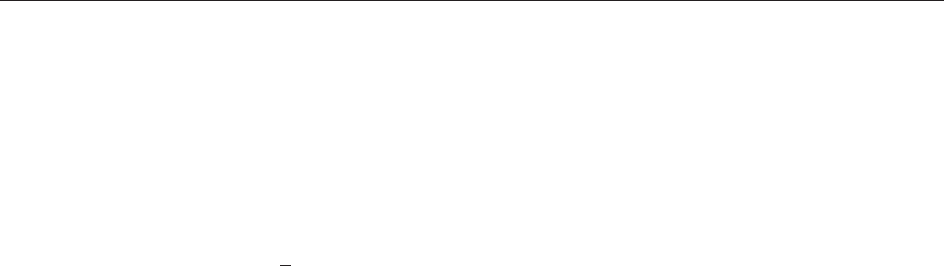
where the knot K is parametrized by the closed curve
q(s). By construction,
ˆ
C
K
intersects the S
3
in K.
Now consider M D-branes wrapped on
ˆ
C
K
. One now
has to consider the fields coming from the strings
stretching between the two sets of branes. One can
show that integrating out these fields (which are in the
bifundamental of the product group U(N) U(M))
modifies the original Chern–Simons action to
S
eff
ðAÞ¼S
CS
ðAÞþ
X
1
n¼1
1
n
trU
n
trV
n
½20
Here V is the holonomy around K of the U(M)
gauge field
˜
A. Thus, this configuration of M probe
branes gives rise exactly to the generating function
eqn [18] for Wilson loops of K.
The geometric transition which relates the Chern–
Simons theory to the closed-string theory now
suggests what one needs to do to compute this
generating function on the closed-string side. We
have to follow the configuration of the M probe
branes on
ˆ
C
K
through the conifold transition in
which the S
3
shrinks and one blows up the S
2
.Itis
not easy in general to figure out the Lagrangian
cycle C
K
which results from following
ˆ
C
K
through
the transition. It has only been done in a class of
knots including the simple unknot. But assuming we
know C
K
, the generating function for Wilson loops
is given by the free energy on the S
2
resolved
conifold in the presence of M probe branes on C
K
.
This requires one to know more than the closed-
string partition function computed earlier. We now
also need to compute amplitudes for world sheets
with boundary on C
K
. These are called open-string
Gromov–Witten invariants and the study of this
subject is in its infancy. For simple knots such as the
unknot, for which C
K
is known, these can be
computed. One finds again a remarkable agreement
with the nonperturbative answers of Chern–Simons
theory. Thus, the computation of knot invariants
gets related to open-string Gromov–Witten invar-
iants. There have been a number of other tests
involving more general knots and links. One also
has to be careful of subtleties such as in the choice
of framing. The reader is referred to the articles
by Marino (2002, 2004) for these topics.
Conclusions
The large-N duality of ’t Hooft is realized in Chern–
Simons theory in a very explicit way. Thanks to the
analytic control we have over both Chern–Simons
theory as well as clos ed topological strings, the
conjecture pa sses very nontrivial checks that extend
to all-genus case. This is more than we can do in the
AdS/CFT conjecture where most computations are
at tree level in the supergravity limit. In contrast,
here we see the essential stringiness of the closed-
string dual to Chern–Simons theory.
Also, by viewing it as an open –closed string
duality, many aspects of the correspondence were
clarified. It, therefore, provides a useful toy model
for a general understanding of open–closed string
duality. Indeed, a proof of this duality using world
sheet techniques has been proposed by Ooguri and
Vafa. One would like to carry over some of the
intuition that operates in this duality to the case of
other physically interesting gauge theories.
From the mathematical point of view, as already
indicated, this duality leads to previously unsuspected
relations between Gromov–Witten invariants and
invariants of 3-manifolds, including those of knots.
In fact, by considering more general geometric
transitions and using this duality locally, one can
learn about all-genus topological string amplitudes
for a wide class of noncompact toric geometries. This
line of development culminated in the formulation of
the topological vertex by Aganagic, Klemm, Marino,
and Vafa, which captures the essence of the
topological closed-string amplitudes for noncompact
toric geometries. As in the case of the general
correspondence between the gauge theory and grav-
ity, this duality sheds new light on both sides of the
equation. We learn to see new integrality properties
in knot and 3-manifold invariants which have an
interpretation in terms of enumerative problems in
3-folds. The surprises that such a deep connection
presages have not yet been exhausted.
See also: AdS/CFT Correspondence; Chern–Simons
Models: Rigorous Results; Duality in Topological
Quantum Field Theory; Free Probability Theory; The
Jones Polynomial; Knot Theory and Physics; Large-N
Dualities; Quantum 3-Manifold Invariants; Schwarz-Type
Topological Quantum Field Theory; String Field Theory;
Topological Gravity, Two-Dimensional; Topological
Quantum Field Theory: Overview.
Further Reading
Brezin E and Wadia SR (eds.) (1993) The Large N Expansion in
Quantum Field Theory and Statistical Physics. Singapore:
World Scientific.
Gopakumar R and Vafa C (1999) On the gauge theory/geometry
correspondence. Advances in Theoretical and Mathematical
Physics 3: 1415 (arXiv:hep-th/9811131).
Hori K, Katz S, Klemm A, Pandharipande R, and Thomas R
(2003) Mirror Symmetry. New York: AMS Publishing.
Marino M (2002) Enumerative geometry and knot invariants
(arXiv:hep-th/0210145).
Marino M (2004) Chern–Simons theory and topological strings
(arXiv:hep-th/0406005).
268 Large-N and Topological Strings

Large-N Dualities
A Grassi, University of Pennsylvania, Philadelphia,
PA, USA
ª 2006 Elsevier Ltd. All rights reserved.
Introduction
Gopakumar and Vafa (1999) conjectured that U(N)
Chern–Simons gauge theory on S
3
is dual, for large
values of N, to a closed topological string theory
on a suitable Calabi–Yau 3-fol d X. They suggested
that this duality is realized by a geometric ‘‘transi-
tion,’’ a topological surgery which can be realized by
birational contractions follo wed by the complex
deformations of Calabi–Yau varieties. Here we will
give some general comments on the history of this
conjecture and then present some of its mathema-
tical implications; we will focus on the geometric
transition and the novel mathematics that it has
generated.
A duality relating gauge theories and string
theories (with gravity) was first conjectured by
’t Hooft (1974). In 1998 Maldacena conjectured a
duality between Yang–Mills gauge theory with
N = 4 SUSY on a four-dimensional manifold M
and IIB type closed string on the anti-de Sitter space
AdS
5
S
5
. Chern–Simons string theory is a three-
dimensional theory and purely topological, hence it
is in principle simpler than four-dimensional Yang–
Mills theory, which also involves a metric.
In this survey, we discuss the IIA open/closed
dualities: we will mostly be concerned with the partition
function, that is we will be working in the context of
‘ ‘top ological strings.’’ The duality has been extended to
a duality of strings, adding fluxes on the closed sector
and branes on the open sector. There is much
mathematical evidence supporting the conjecture.
Overview
The conjecture says that U(N) Chern–Simons gauge
theory on S
3
is dual, for large values of N, to type
IIA closed topological string theory on a suitable
Calabi–Yau manifold X. A starting point for the
geometry, and its mathematical implications, is that
S
3
can be thought of as a vanishing cycle in a local
Calabi–Yau manifold Y = T
S
3
, which deforms to a
singular Calabi–Yau Y
0
; X is a Calabi–Yau bira-
tional resolution of Y
0
. X are Y are related by a
geometric transition. In fact, Witten showed that
quantum Chern–Simons theory on S
3
can be thought
of as open IIA (with U(N) branes) on Y = T
S
3
; thus,
a more general conjecture says, loosely speaking,
that open IIA theory on a Calabi–Yau manifold Y is
dual, for large N, to closed IIA on a Calabi–Yau X
which is related to Y via a geometric transition. A
consequence of a physics ‘‘duality’’ is a matching of
the free energies of the dual theories. In this
particular case, if the conjecture is true, the Chern–
Simons free energy Z(S
3
,U(N)) should determine,
and be determined by, the closed prepotential
F
cl
(X, t). Note that Z(S
3
,U(N)) is purely topologi-
cal, and that F
cl
(X, t) includes all genera, as we will
discuss later. A mathematical application is comput-
ing Gromov–Witten invar iants for higher genus via
large-N dualities (Marin˜ o 2004). Another con se-
quence involves the matching of the observable in S
3
and X.
This conjecture is now supported by a vast
amount of evidence. Vafa, Gopakumar and Ooguri
noted, via a string-theory analysis, that topological
and knot invariants of S
3
(computed through U(N)
Chern–Simons theory on S
3
) determine and are
determined by , for large N, the Gromov–Witten
invariants of X in a neighborhood of the exceptional
locus of the birational contraction X !Y
0
.
The extension to the full string theory would say
that open string of type IIA compacti fied on a
Calabi–Yau manifold Y with branes is conjectured
to be dual to closed string of type IIA compactified
on a Calabi–Yau manifold X with fluxes, if X and Y
are related by a geometric transition.
A mathematical consequence of this stat ement
is that the closed Gromov–Witten invariants of X
agree, with a suitable identification of the para-
meters, with combinations of open Gromov–Witten
invariants and knot invariants of Y. This has been
shown to hold for some classes of examples .
This circle of ideas has stimulated much work in
physics and mathematics on the nature of the
mathematical correspondence behind this duality, as
well as the property of the enumerative and topo-
logical invariants involved. The ‘‘mirrors’’ of the above
transitions have been studied in a series of papers,
starting with the work of Dijkgraaf and Vafa (2002).
The mathematics behind the open/closed dualities
is still not understood: it is reasonable to speculate
that the natural setup is a framework of symplectic
field theory.
We shall start by discussing the principal topics
of this large-N duality: Chern–Simons quantum field
theory, IIA closed prepotential (and Gromov–Witten
invariants), and Chern–Simons as open string (and
IIA open prepotential). Next we shall study the
geometric transitions and conclude with some
mathematical predictions of the duality.
Large-N Dualities 269
We shall not discuss some other interesting
implications of this duality. For example, we shall
not discuss its mirror IIB duality: it is known that
the part of the closed prepotential in IIA correspond-
ing to rational curves can be expressed as its IIB
mirror dual with periods over certain suitable cycles;
the IIA open contribution corresponding to open
discs is expressed in terms of integrals over chains
and the Abel–Jacobi map. We only remark that this
large-N duality has also been interpreted as a duality
between seven-dimensional manifolds with G
2
holonomy.
History
The chronology of various important contributions
in the field of large-N duality is as follows:
1976: ’t Hooft’s conjecture
1988: Clemens introduces transitions
1988: Witten introduces quantum Chern–Simons
theory on 3-manifolds
1992: Witten discusses Chern–Simons theory as
open string
1998: Gopakumar–Vafa–Ooguri
2001: Verification for unknot, Katz–Liu, Li, and
Song
2001: Lift to manifolds with G
2
holonomy
2002: The conjecture verified for many examples
of conifold transitions, including compact case;
the topological vertex is introduced
2003: Relations with Donaldson–Thomas invariants
Background
The varieties of interest in the physical theory
must satisfy certain ‘‘supersymmetry’’ conditions; in
particular, a complex algebraic manifold is required
to be Calabi–Yau, a real seven-dimensional Rieman-
nian manifold is required to have G
2
holonomy
group. Also of particular interest are the Lagrangian
real submanifolds of the Cal abi–Yau 3-folds. By a
Calabi–Yau manifold X we mean a manifold with
c
1
(X) = 0, h
0
(
k
) = 0, where
k
is the sheaf of
holomorphic k-forms, and 0 < k < dim (X). If
dim X 2, we also assume that X is simply
connected, but not necessarily compact. For exam-
ple, if dim (X) = 1, X is a torus, if dim (X) = 2, X is
a K 3 surface, if dim (X) 3, X is simply called a
Calabi–Yau manifold. A compact Ka¨ hler manifold
(M, g, J) of complex dimension m 3 is a Calabi–
Yau variety if and only if its holonomy is SU(m). A
subvariety L of a symplectic manifold (X, !)is
Lagrangian if !
jL
= 0 and dim L = (1=2) dim X.
Sometimes we consider noncompact manifolds,
thought of as neighborhoods of a compact projective
Calabi–Yau manifold. Typically, our symplectic
manifold is a Calabi–Yau 3-fold (X, !) together
with its Ka¨hler form !. If there exists an antiholo-
morphic involuti on, then the fixed locus is a
Lagrangian submanifold.
The Dualities
We will take the point of view that dualities in
physics imply relations between geometric invari-
ants, without dwelling on the physics of the dualities
themselves. A consequence of a physics ‘‘duality’’ is
the matching of the prepotential of two dual string
theories.
A Few Comments on Chern–Simons Theory: Free
Energy (Partition Function)
Let L be a closed oriented manifold together with a
principal G-bundle. The classical Chern–Simons
action is defined as S(L, A) =
R
L
(A), where is a
3-form on L which dep ends on a connection A and a
suitable bilinear invariant form on the Lie algebra g.
It is well defined under gauge transformations
modulo the integers; e
2iS(L, A)
is well defined. In
the large-N dualities consi dered here, the groups of
interests are SU(N) and U(N). The first check of the
duality was found with G = SU(N) and M = S
3
; later
it was discovered that the correct group for the
matching of the observables must be U(N), while
both can be used for the free energies. We shall
consider G = SU(N)andM = S
3
. Without loss of
generality, the bundle can be taken to be the product
U(N) S
3
; any bilinear invariant form on the Lie
algebra su(N) is necessarily an integer multiple k of
the Cartan–Killing form on the Lie algebra. Then
S = S(k, A) and
Sðk; AÞ¼
k
8
2
Z
S
3
tr A ^ dA þ
2
3
A ^ A ^ A
where k is the ‘‘level’’ of the theory. Witten defines
the quantum Chern–Simons theory by taking the
integral of the Chern–Simo ns action over all possible
connections A modulo gauge equ ivalence G:
ZðS
3
;SUðNÞÞ
¼
Z
A=G
ðDAÞe
2iSðAÞ
¼
Z
A=G
ðDAÞexp
ki
4
Z
S
3
tr A^dA þ
2
3
A^A^A
Witten shows how to calculate the free energy
Z(S
3
,SU(N)) through topological surgery, assuming
Z(S
2
S
1
)=1. Witten also defines the partition
270 Large-N Dualities
function of knots and links in L (the ‘‘expectation
values’’), which are knot and link invariants. The
expectation values are computed by evaluating the
trace of the holonomy transformation of a U(N)
connection around the knot, and then taking a
suitable average of the U(N) connections. These
invariants depend on a choice of the framing of the
knot (or link).
The explicit computations involve physics, repre-
sentation theory, and topology. If L = S
3
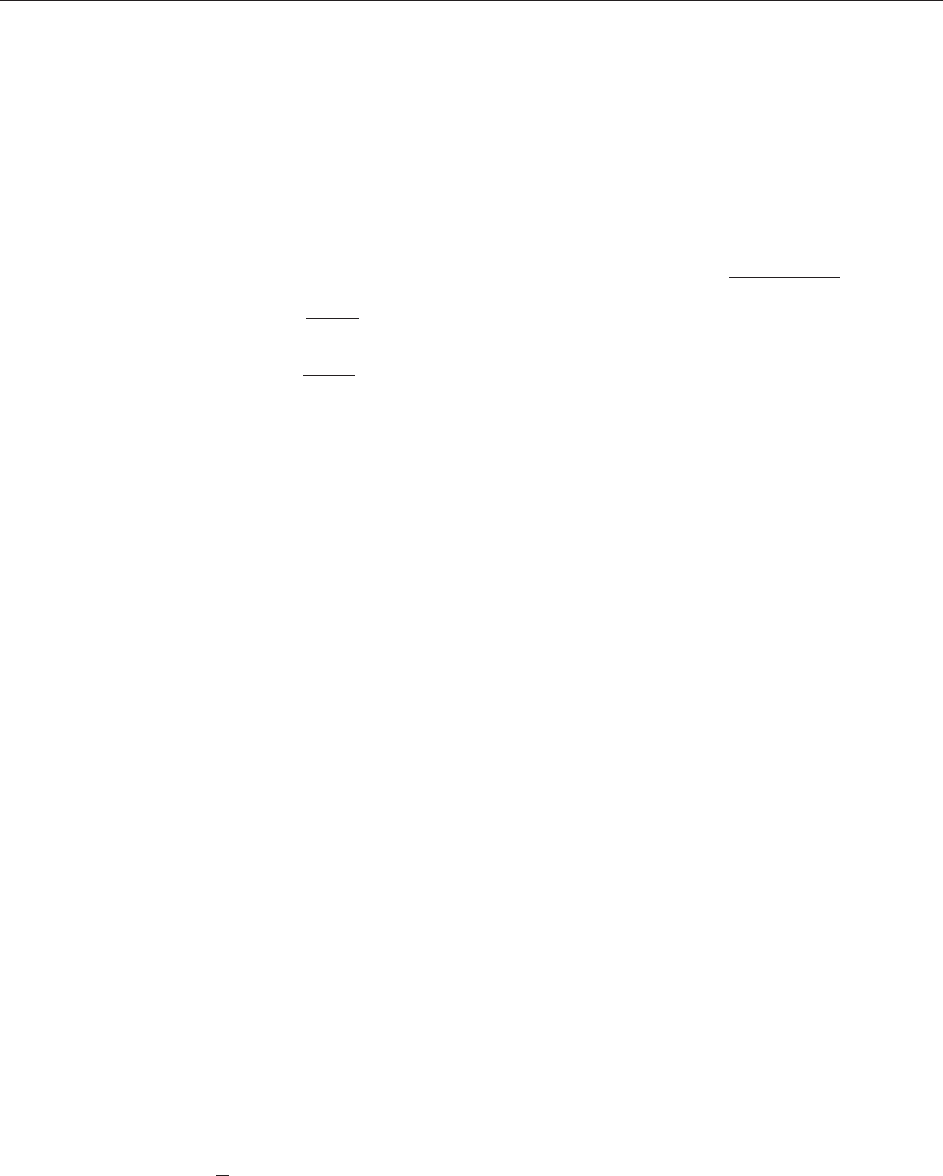
, then:
ZS
3
; SUðNÞ
¼ðk þ NÞ
N=2
ffiffiffiffiffiffiffiffiffiffiffiffiffi
k þ N
N
r
Y
N 1
j¼1
2 sin
j
k þ N
Nj
Reshetikin and Turaev, among others, described
mathematically the Chern–Simons free energy and
the expectation values.
A Few Comments on Closed-String Theory: Free
Energy (Prepotential)
In IIA closed-string theory on X, a Calabi–Yau
manifold, one considers holomorphic stable maps
of closed Riemann surfaces of genus g, :
g
!X,
with
(
g
) = [] 2H
2
(X, Z), for all genera g and
homology classes 2H
2
(X, Z).
Then one forms the closed prepotential F
cl
(X, t),
which encodes the enumerative invariants of
such maps to X, and which depends on the
Ka¨ hler parameters t of X. Sometimes the prepoten-
tial is also called ‘‘free energy’’ in the physics
literature or Gromov–Witten prepotential, as it
contains the Gromov–Witten invariants of X.
Setting F
g
(q) =
P
2H
2
(X, Z)
C
g,
q
, the closed pre-
potential is defined as
F
cl
ðX; qÞ¼
X
1
g>0
g
2g2
s
F
g
ðqÞ
Here q is a formal variable such that q
1
þ
2
= q
1
q
2
(for
1
,
2
2H
2
(X, Z)) and g
s
is the string coupling
constant. C
g,
are the genus g Gromov–Witten
invariants of X, corresp onding to the class and
they have been defined as
C
g;
¼
Z
½M
g;0
ðX;Þ
virt
1
It is difficult to explicitly compute the invariants
C
g,
; in particular, there is no known general
method for calculating these invariants. They are
computed most ly via ‘‘localization’’ methods, in the
presence of a suitable torus action. In the case of
g = 0 the invariants are often computed via IIA–IIB
duality, calculating certain periods in the mirror
manifold W.
Example (Faber–Pandharipande). Let X ffiO
P1
(1)
O
P1
(1); X is a neighborhood of a rigid
rational curve, which can be thought of as a local
Calabi–Yau manifold; then all the effective curves
2H
2
(X,Z) must be of the form = d[P
1
], 8d2N.
Faber and Pandharipande showe d that
F
cl
ðX; qÞ¼
X
1
d¼1
q
d
2 sinðdg
s
=2Þ
2
½1
This formula was proved with localization methods
after it was conjectured by Gopakumar and Vafa using
large-N dualities. In fact, a consequence of a duality
between two theories is the matching of the free energies
of two dual string theories. In this particular case, the
conjectures imply that Chern–Simons free energy
determines, and is determined by, the all-genus closed
prepotential of a suitable Calabi–Yau manifold X:
ZðS
3
; UðNÞÞ ¸ F
cl
ðX; tÞ
Note that the left-hand side is purely topological,
as we saw in the previous section, while the right-
hand side is holomorphic.
The trait d’union between the two prepotentials is
given by the interpretation of Chern–Simons theory
on S
3
as open-string theory on T
S
3
and the
geometric transition.
A Few Comments on Open-String Theory
with Branes: Open Prepotential
Let Y be a Calabi–Yau manifold together with {[L
i
},
Lagrangian submani folds; to each submanifold
L
i
is assig ned a gauge group G
i
: L
i
is wrapped
with G
i
-branes. Here we shall focus on the case
G
i
= U( N
i
) and we will write (Y; L
i
,U(N
i
)).
Witten shows that the open prepotential
F
op
(Y, , t
op
, g
s
) depends on ’t Hooft’s coupling con-
stants
i
associated to Chern–Simons theory on the
Lagrangian submanifolds (L
i
,U(N
i
)), together with
the open Ka¨ hler parameters t
op
2H
2
(X; [ L
i
, Z), and
the string coupling constant g
s
. To describe the open
prepotential, Witten argues, we consider all maps
of Riemann surfaces with boundary to Y,with
the condition that the boundaries are mapped to the
Lagrangian submanifolds L
i
; one should also include
all the ‘‘highly degenerate holomorphic maps,’’ in
particular those which contract
g, h
to a ‘‘ribbon
graph’ ’ on the Lagrangian [L
i
. The contribution of
these highly degenerate maps is captured by the
quantum Chern–Simons theory of the Lagrangians
{L
i
,U(N
i
)}.
Large-N Dualities 271
Application 1 (Chern–Simons free energy as open
prepotential). Let us consider open IIA on
Y = T
S
3
with U(N)-branes wrapped on L = S
3
:
L is a Lagrangian submanifold with the standard
symplectic structure ; note that in T
L there are no
nontrivial homology curves. Then, according to
Witten, the corresponding open prepotential
F
op
(Y, [ L
i
) must only depend on the ‘‘highly
degenerate’’ maps and must consist of the Chern–
Simons term F
CS
on L = S
3
. In particular,
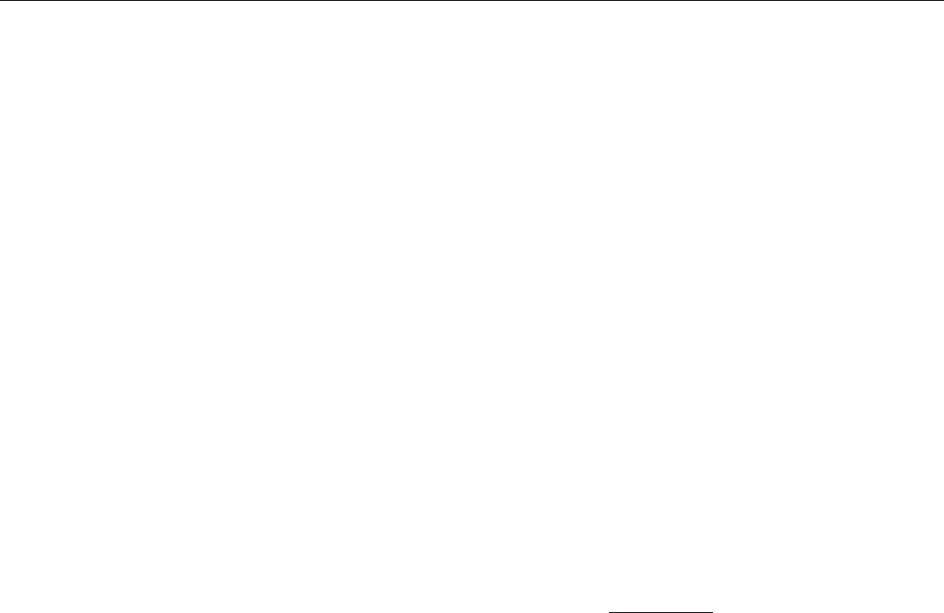
F
CS
¼ log ZðS
3
Þ¼F
op
ðY;;g
s
Þ
where = 2N=(k þ N) is the ’t Hooft coupling
constant. Periwal (1993) showed that, for large N,
log Z(S
3
) could be expanded as a closed-string
expansion:
F
CS
ðÞ¼
X
g0
F
g
ðÞg
22g
s
where g
s
=:2=(k þ N) is the Chern–Simons cou-
pling constant. In 1998 Gopakumar and Vafa, using
physics arguments, deduced that the expansion
would have the closed form [1], which was later
proved by Faber and Pandharipande.
The explicit description of the open prepotential
in the presence of homology classes is not known;
one woul d need to combine the enumerative
invariants of open maps toget her with the quantum
Chern–Simons factor. We shall discuss an approach
at the end of this note, but consider first the
geometric transition.
The Transition
The conjecture says that U(N) Chern–Simons gauge
theory on S
3
is dua l, for large values of N, to IIA
closed topological string theory on a suitable
Calabi–Yau manifold X. A starting point to find
such X is that S
3
is a Lagrangian 3-cycle in the
manifold Y = T
S
3
; performing a topological surgery
by replacing S
3
with S
2
one obtains a (local) Calabi–
Yau manifold X, on whi ch the dual IIA theory is
compactified. The key observation is that Y can be
identified with the algebraic variety of equation
{xy zw = t} C
4
and that this is a complex
smoothing (in fact the Milnor fiber) of Y
0
with
equation {xy zw = 0} C
4
. On the other hand, X
is a small resolution of this singularity, where P
1
is
the exceptional locus of the birational contraction.
The origin is an ‘‘ordinary double point’’ singularity
and the nontrivial sphere S
3
Y is the vanishing
cycle of the degeneration. The manifolds involved
are noncompact: the exceptional curve [P
1
] = t is
the only nontrivial homology class in X, and the
enumerative invariants in X can be thought as the
contribution of the exceptional curve in a neighbor-
hood of a Calabi–Yau manifold. We shall present
the steps leading to this construction and the
evidence for the conjecture.
The Local Construction of X
Let Y
= f(w
1
, ..., w
4
) 2C
4
such that
P
4
j = 1
w
2
j
= g.
Proposition 1 Let be a nonzero real positive
parameter; then:
L = S
3
T
S
3
is a Lagrangian submanifold of
T
S
3
with its standard symplectic structure;
T
S
3
ffi Y
and L ffi L
def
=
fRe(
P
4
j = 1
w
2
j
= ) g .
In fact, we can embed T
S
3
in R
8
as
X
4
j¼1
q
2
j
¼ 1;
X
4
j¼1
q
j
p
j
¼ 0
where S
3
= {p
i
= 0}; consider then the morphism
C
4
!R
8
defined by setting
q
j
¼
Reðw
j
Þ
ffiffiffiffiffiffiffiffiffiffiffiffiffiffiffiffiffiffiffiffiffi
þ
P
i
v
2
i
q
; p
j
¼ Imðw
j
Þ
which induces the diffeomorphism Y
ffi T
S
3
of the
statement.
Remark 1 Let Y
0
= f
P
4
j = 1
w
2
j
= 0gC
4
; then:
Y
0
is singular at the origin,
Y
is a complex deformation of Y
0
, and
L
is called a ‘‘vanishing cycle.’’
With a change of coordinates we can write the
equation of Y
as {xy zw = 0}; the singularity is
still at the origin. This singularity is an ordinary
double point, which is often referred in physics
literature as ‘‘the conifold singularity.’’ Let
X C
4
P
1
be defined:
z þ y ¼ 0;x þ w ¼ 0
[, ] 2P
1
.
Remark 2 X is smooth and the morphism
: X ! Y
0
; ððx; y; z; wÞ; ½; Þ7!ðx; y; z; wÞ
is an isomorphism
j
XnP
1
:(XnP
1
) ’ (Y
0
n{0}) and
P
1
7!(0, 0, 0, 0, ) C
4
. is a small (nondivisorial)
birational resolution of the singularity at the origin.
Y
is a deformation (smoothing) of Y
0
. Note that
topologically S
3
ffi L
Y
has been replaced by
P
1
ffi S
2
X. The algebraic properties of the topo-
logical surgery between Y
and X were first studied
by Clemens in 1988.
272 Large-N Dualities

Transitions in Geometry
A transition between X and Y is a birational
contraction from a smooth Calabi–Yau X to a
singular variety Y
0
followed by a complex deforma-
tion to another smooth Calabi–Yau manifold Y:
X
#
Y
?
Y
0
The vanishing cycles of the complex deformation
[L
i
are always Lagrangian submanifolds of Y. The
transition makes sense if dim (X) = dim (Y) 2 and
it is nontrivial if dim (X) = dim (Y) 3, when the
topology of X is different from the topology of Y.
The possible transitions among Calabi–Yau 3-folds
have been classified.
Conjecture 1 Let X and Y be Calabi–Yau mani-
folds related by a geometric transition: then IIA
open theory with U(U) branes compactified on
(Y, [L
i
) is dual to IIA closed theory compactified
on X (with fluxes).
As a consequence:
Conjecture 2 Let X and Y be Calabi–Yau mani-
folds related by a geometric transition: then
F
op
(Y, , g
s
, t
op
) = F
cl
(X, q, g
s
) for a suitable identi-
fication of the parameters.
The results stated in the previous section can be
summarized in the the following statement, which is
the proof of the above con jecture for the special case
of a local conifold transition:
Theorem 1 Let X ffiO
P1
(1) O
P1
(1) and
Y = T
S
3
with U(N) branes wrapped on L = S
3
.
Then X and Y are related by a conifold transition
and log F
CS
(S
3
) = F
op
(Y, ) = F
cl
(X, q), with the
identification
¼
2N
k þ N
¼ q; g
s
¼
2
k þ N
This matching of the free energies is supporting
evidence for the large-N conjecture. At this moment,
we still do not know if Conjectures 1 and 2 hold for
more general transitions.
A Few Comments on Knots and Links
Later, Ooguri and Vafa extended the conjecture to
the observables, that is, by adding knots and links in
S
3
; the guiding principle is that a knot (or link) CS
3
should determine a noncompact Lagrangian sub-
manifold L
C
X; it is conjectured that the knot
(and link) invariants, expressed as expectation
values, should determine and be determined by the
enumerative invariants of morphisms of bounded
Riemann surfaces, with boundaries mapped onto
L
C
. We refer to these invariants as open Gromov–
Witten invariants. While both statements have been
verified with mathematical techniques only when C
is the unknot, there is much supporting evidence for
the conjecture in general. We will not describe these
aspects here but only make a few remarks.
The expectation values of a knot C are computed
by taking first the trace of a holonomy matrix of a
U(N) connection A along C and then integrating over
all connections (modulo gauge equivalence). As for
the case of the Chern–Simons free energy, the
definition of expectation values has been worked
out both in the realm of physics and of mathematics.
The expectation values are knot and link invariants,
and depend on a choice of the framing of the knot (or
link). The open Gromov–Witten invariants have not
yet been constructed, as we shall discuss in the
following section; however, starting with the work of
Katz and Liu, Li and Song open invariants have been
successfully calculated in the presence of a torus
action. The resulting invariants do depend on the
choice of the torus action, which has been shown to
match the choice of the framing of the knot (or link).
More on the Open Prepotential
The open Gromov–Witten invariants, in analogy with
the closed case, should ‘‘count’’ in an appropriate sense
open morphisms; at this point, it is not known how to
define this quantity. To proceed in analogy with the
closed case, one would need to define the appropriate
moduli space of open maps and its virtual fundamental
class. On the other hand, open invariants have been
successfully calculated in the presence of a torus
action, assuming the existence of the moduli and
virtual fundamental class and that the Atiyah–Bott
localization theorems can be applied. We shall follow
this approach in sketching how the IIA prepotential
has been computed in many examples.
Open Invariants
Let [] 2H
2
(Y; [L
i
, Z) be the relative homology
class of Riem ann surfa ces in Y with boundary on the
union of the Lagrangian 3-cycles [
i
L
i
and a class
[] 2H
1
([L
i
).
If
g, h
is a Riemann surface of genus g and h
boundary components, let :
g, h
!Y be a morph-
ism with
ð
g;h
Þ¼½2H
2
ðY; [L
i
; ZÞ
Large-N Dualities 273
The open generating function is
F
o
ðY; [L
i
; t
op
; g
s
Þ¼
X
1
g;h0
g
2g2þh
s
F
g;h
ðt
op
Þ
with
F
g;h
ðt
op
Þ¼
X
;
C
g;h;;
q
y
Here q and y are formal variables such that
q
1
þ
2
= q
1
q
2
and y
h
1
þh
2
= y
h
1
y
h
2
, for
1
,
2
2
H
2
(Y; [L
i
, Z),
1
,
2
2H
1
([L
i
, Z); t
op
is the open
Ka¨ hler parameter, g
s
is the string coupling constant
and C
g, h, ,
should ‘‘count’’ in an appropriate sense
the maps .
Example (Ooguri–Vafa; Katz–Liu; Li–Song). If
Y = O
P
1
(1) O
P
1
(1), then t is the class of the P
1
ffi
S
2
, t=2 represents the class of the lower hemisphere in
S
2
. The Lagrangian L is the Lagrangian L in the
previous sections, which corresponds to the unknot in
S
3
Y; it is the fixed locus of an antiholomorphic
involution on X and it intersects S
2
in an equator.
Then, for a suitable choice of the torus action:
F
o
ðY; [L
i
; t
op
; g
s
Þ¼
X
d
y
d
2d sin d=2ðÞ
e
dt=2
There is a complete form for more general torus
actions. The above formula was first computed by
Ooguri and Vafa, using string-theory arguments,
and then computed by the mathematicians, Katz and
Liu, and Li and Song.
More on the Open IIA Prepotential
If there is only one rigid open curve in Y, say a disk
C, with boundary on L Y, then, as Witten
showed, the open prepotential is a combination of
the open enumerative invariant s as described above
with = d[C]and = @C and the expectation v alues
of the unknot @C. The variable Y is changed in the
trace of the holonomy of a connection.
In the presence of a torus action, one can treat the
fixed locus as if it were rigid and proceed accordingly.
With these techniques, Conjecture 2 has been
verified for many cases of conifold transitions, with
t
op
nontrivial, for a suitable identifications of the
parameters, including when both X and Y are
compact manifolds (Diacon escu–Florea 2003).
See also: AdS/CFT Correspondence; Chern–Simons
Models: Rigorous Results; Large-N and Topological
Strings; Mirror Symmetry: A Geometric Survey; String
Field Theory.
Further Reading
Clemens CH (1983) Double solids. Advances in Mathematics 47:
107–230.
Diaconescu D-E, Florea B (2003) Large N duality of compact
Calabi–Yau three-folds, hep-th/0302076.
Dijkgraaf R and Vafa C (2002) Matrix models, topological strings
and supersymmetric gauge theories. Nuclear Physics B 644(3):
3–20 (hep-th/0206255).
Faber C and Pandharipande R (2000) Hodge integrals and
Gromov–Witten theory. Inventiones Mathematicae 139:
173–199 (math.AG/9810173).
Freed DS (1995) Classical Chern–Simons theory, Part 1. Advances
in Mathematics 113: 237–303.
Gopakumar R and Vafa C (1999) On the gauge theory/geometry
correspondence. Advances in Theoretical and Mathematical
Physics 3: 1415–1443.
Katz S and Liu CCM (2002) Enumerative geometry of stable
maps with Lagrangian boundary conditions and multiple
covers of the disk. Advances in Theoretical and Mathematical
Physics 5: 1–49.
Li J and Song YS (2001) Open string instantons and relative
stable morphisms, hep-th/0103100.
Marin˜ o M (2004) Chern–Simons theory and topological strings,
hep-th/0406005.
Ooguri HH and Vafa C (2000) Knot invariants and topological
strings. Nuclear Physics B 577: 419–438.
Periwal V (1993) Topological closed-string interpretation of
Chern–Simons theory. Physical Review Letters 71:
1295–1298.
’t Hooft G (1974) A planar diagram theory for strong interac-
tions. Nuclear Physics B 72: 461–473.
Witten E (1989) Quantum field theory and the Jones polynomial.
Communications in Mathematical Physics 121: 351–399.
Witten E (1995) Chern–Simons gauge theory as a string
theory. In: The Floer Memorial Volume,Progressin
Mathematics, vol. 133, pp. 637–678. Basel: B irkha¨user
(hep-th/9207094).
274 Large-N Dualities

Lattice Gauge Theory
A Di Giacomo, Universita
`
di Pisa, Pisa, Italy
ª 2006 Elsevier Ltd. All rights reserved.
Introduction
As a prototype of lat tice gauge theory, quantum
chromodynamics (QCD) will be considered in this
article. All statements about QCD can easily be
extended to other theories, with different gauge
group and different content of particles.
QCD is a gauge theory with gauge group SU(3)
(color group), coupled to spin-1/2 particles (quarks)
belonging to the fundamental representation of the
color group. There exist in Nature six different
species (flavors) of quarks, with masses ranging
from m
up
5 MeV to m
top
180 GeV: the values of
these masses are determined by other interactions
and can be treated as input parameters of the theory
as well as the number of quark flavors. In standard
notation, the Lagrangian reads
L ¼
1
2
trðG
G
Þþ
X
f
f
ði6D m
f
Þ
f
½1
The sum runs over the six quark flavors f.
G
= @
A
@
A
þ ig[A
, A
] is the field strength
tensor, A
=
P
T
a
A
a
the (gluon) gauge field,
T
a
(a = 1,...,8) are the eight generators of the
gauge group in the fundamental representation,
normalized as tr(T
a
T
b
) = (1=2)
ab
.
f
is a color
triplet of fields. Under a gauge transformation U(x),
f
ðxÞ!
0
f
ðxÞ¼UðxÞ
f
ðxÞ½2
A
ðxÞ!A
0
ðxÞ
¼ UðxÞA
U
y
ðxÞþiUð xÞ@
U
y
ðxÞ½3
D
is the covariant derivative of
D
f
¼ð@
igA
Þ
f
½4
and transforms like
f
by construction.
L is invariant under the gauge transformation
equations [2] and [3]. As a consequence of gauge
invariance, the theory has one single coupling
constant g.
To make connection with the observations, one
has to solve the theory, that is, one has to construct
a H ilbert space on which the fields act as operators
obeying the equations of motion and the canonical
commutation relations. In textbook field theory,
this is done by splitting the Lagrangian L into two
parts:
L ¼ L
0
þ L
I
½5
with L
0
the part of L which is bilinear in the fields
and L
I
the rest. L
0
can be solved exactly since it
describes free particles and the corresponding
equations of motion are linear. The resulting Hilbert
space is the Fock space of free particles. L
I
is treated
as a perturbation producing scattering between the
fundamental particles. This approach works well
in quantum electrodynamics, where the observed
particles (electrons and photons) coincide with the
excitations of the fundamental fields of the
Lagrangian.
In QCD, the fundamental excitations (the quarks
and the gluons) are observed as particles neither in
Nature nor as a product of high-energy collisions
between elementary particles. This feature is known
as confinement of color. The conjecture is that
excitations with nontrivial color are forbi dden to
propagate as free particles. However, if hadrons are
probed at short distances by photons or by leptons,
everything works as if they were composite states of
quarks. The accepted explanation relies on asymp-
totic freedom: the effective coupling constant
becomes small at short distances (high momentum
transfers) and the constituents behave as free
particles.
At large distances, the fundamental excitations are
not observed, the interaction is strong and the
perturbative picture describing scattering between
quarks and gluons is not adequate for the real
world.
An alternative quantization procedure is needed
which does not rely on perturbation theory. A
formally exact quantization procedure is the Feynman
path integral. The solution of the theory is given in
terms of a functional integral Z[J], which generates
the correlators of the fields in the ground state
(vacuum). Indicating symbolically the Lagrangian
coordinates, namely the fields, by a single symbol ,
one has
Z½J ¼
Z
Y
x
dðxÞexp S ½
Z
JðxÞðxÞdx
½6
The connected Euclidean vacuum correlators are
given in terms of functional derivati ves of Z[J]
< 0jTððx
1
Þðx
2
Þðx
n
ÞÞj0 >
conn
¼
1
Z½0
n
Z½J
Jðx
1
ÞJðx
2
ÞJðx
n
Þ
JðxÞ¼0
½7
Lattice Gauge Theory 275
‘‘Euclidean’’ means that they are analytic con-
tinuations to imaginary times. Going to Euclidean
system is necessary to isolate the vacuum state. The
amplitudes can be analytically continued back to
Minkowski space. The Hilbert space and all the
physical observables can be constructed in terms of
the corre lators, a property known as reconstruction
theorem. Formally (i.e., assuming that everything
makes sense only if the functional integral exists),
< 0jTððx
1
Þðx
2
Þðx
n
ÞÞj0 >
conn
¼
1
Z
Z
Y
x
dðxÞ
expðS½Þðx
1
Þðx
2
Þðx
n
Þ½8
The continuation to imaginary time changes sign to
the kinetic energy, and Z formally becomes the partition
function of a four-dimensionalstatisticalmodelwith
Hamiltonian S
E
[], a general fact in Feynman integrals.
By definition of functional integral, Z is defined
by discretizing a finite volume V of spacetime to a
finite set of points and then sending their number to
infinity, making a set dense in V. If the limit exists, a
Z
V
is obtained. The volume V is then sent to infinity,
to cover the whole spacetime (thermodynamical
limit) and Z
V
eventually converges to Z. A rigorous
proof of the existence of these limits does not exist
for QCD, but there are qualitative arguments that
this is the case, which will be presented below.
In the lattice formulation of field theory, a regular
lattice, usually cubic, is taken as a discretization of
spacetime.
From the very definition of Feynman integral, it
follows that the formulation of field theory on the
lattice is nothing but an approximation to the limit
which defines Z. It will provide a good approxima-
tion if the lattice spacing is small enough with
respect to the physical lengths involved and if the
lattice is large compared to them.
Perturbation theory amounts to split the action
into a bilinear term S
0
and an interaction term S
I
containing the higher powers of the fields. The Z
integral is then computed by exp anding the weight
in a power series of S
I
:
Z
Y
x
dðxÞexpðS
0
S
I
Þ
¼
Z
Y
x
dðxÞexp ðS
0
Þ
X
n
ðS
I
Þ
n
n!
½9
The Feynman integral thus becomes Gaussian, can
be computed, and gives the usual perturbative
expansion. The two limits (integral and series
expansion) do not commute in general. For QCD,
there are indeed arguments that the renormalized
perturbative expansion does not converg e and is
plagued by singularities known as renormalons.
Wilson’s Formulation
For field theories of scalar particles, the lattice
discretization is performed by assigning a value of
the field to each site of the lattice. The Wilson
formulation for gauge theories is not made in terms of
the fields A
, which are defined in the Lie algebra of
the gauge group, but in terms of parallel transports,
which are elements of the group itself. The building
blocks are parallel transports along links parallel to
spacetime axes connecting neighboring sites
U
ðxÞ
P exp
ig
Z
xþ
^
x
A
dx
expðigaA
ðxÞÞ ½10
where
ˆ
indicates the vector of length a in the
direction and P the ordered product. The last
approximate equality is valid in the limit of small
lattice spacing a. g is the coupling constant.
Under a gauge transformation V(x);
U
ðxÞ!VðxÞU
ðxÞV
y
ðx þ
^
Þ½11
It follows from eqn [11] that the parallel transport
along a closed path is gauge invariant. The density
of action can be written in terms of the parallel
transport along the elementary square of links in the
hyperplanes
, known as plaquette:
Y
¼ tr½U
ðxÞU
ðx þ
^
ÞU
y
ðx þ
^
ÞU
y
ðxÞ ½12
By expanding in powers of a, one easily finds
Y
¼ N
c
1
2
a
4
tr½G
G
þOða
6
Þ½13
with N
c
the number of colors, 3 for QCD. The
lattice action can be defined as
S ¼
X
x
1
1
N
c
½14
with = 2N
c
=g
2
, and tends to the continuum action
as a ! 0, O(a
2
). An infinite number of higher-orde r
terms in a exist, which come from the expansion of
the links, but they are expected to be irrelevant in
the continuum limit a ! 0.
The measure of the Feynman integral is assumed
to be the Haar measure of the gauge group for each
link, which again can be shown to tend to the
continuum measure in the continuum limit.
276 Lattice Gauge Theory