
Francoise J.-P., Naber G.L., Tsun T.S. (editors) Encyclopedia of Mathematical Physics
Подождите немного. Документ загружается.

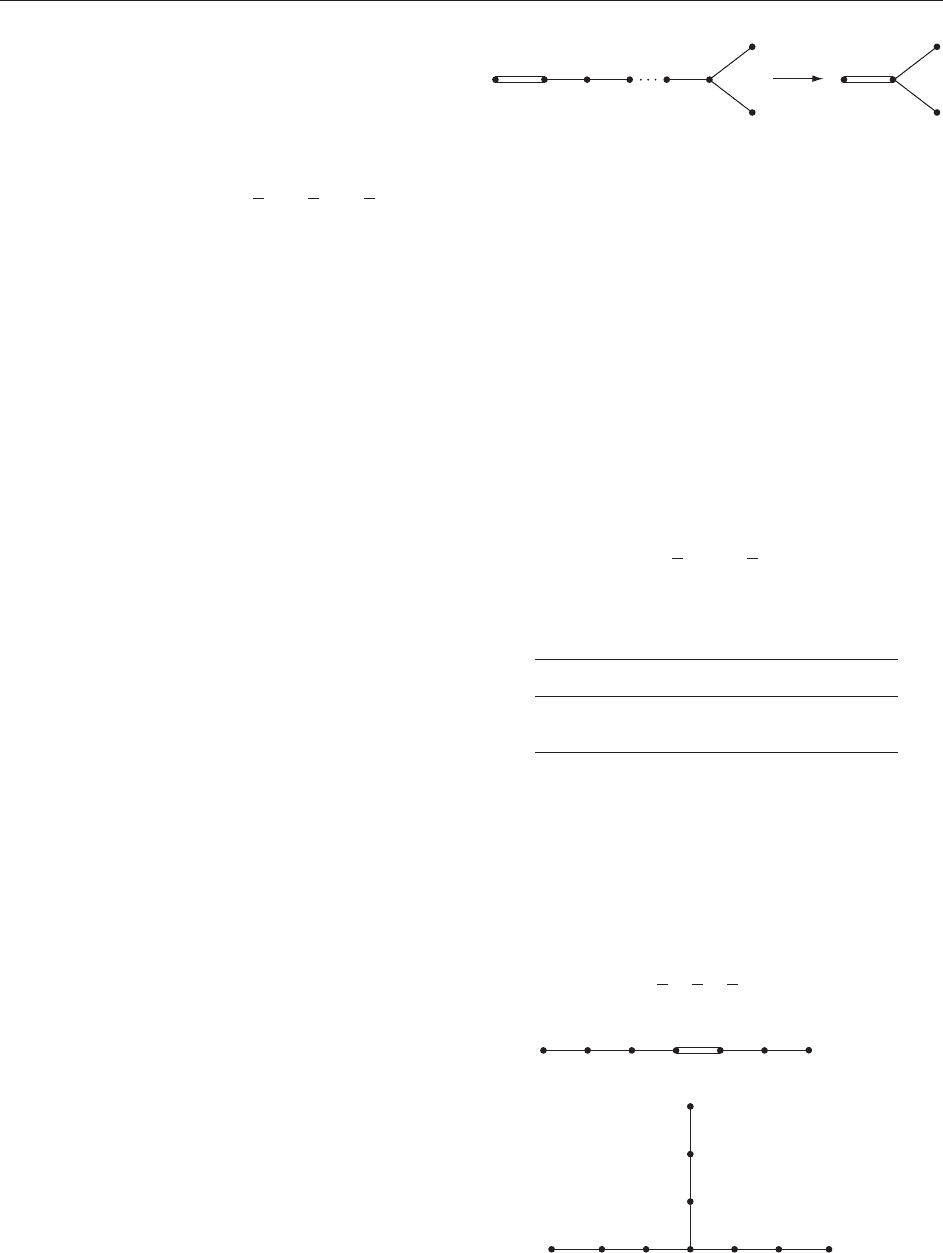
All roots in the rank-2 root spaces have been
expressed in terms of both two orthogonal vectors
and two fundamental roots in Figure 3.
If a
i
and a
j
are fundamental roots, their inner
product is zero or negative
cos a
i
; a
j
¼ 0;
ffiffiffi
1
4
r
;
ffiffiffi
2
4
r
;
ffiffiffi
3
4
r
This information has been used to classify the root
spaces of the inequivalent simple Lie algebras (over
C). The procedure is as follows. Each of the l
fundamental roots in a rank-l root space is repre-
sented by a dot in a plane. Dots representing roots
a
i
and a
j
are connected by n
ij
lines, where
cos (a
i
, a
j
) =
ffiffiffiffiffiffiffiffiffiffi
n
ij
=4
p
. Orthogonal roots are not
connected by any lines. Such diagrams are called
Dynkin diagrams. Disconnected Dynkin diagrams
describe semisimple Lie algebras. Connected Dynkin
diagrams classify simple Lie algebras.
The properties of Dynkin diagrams arise from two
simple observations:
O1: The root space is positive definit e.
O2:Ifu is a unit vector and v
i
are an orthonormal
set of vectors,
X
ðu v
i
Þ
2
1
These two observations lead to three important
properties of Dynkin diagrams .
D1: There are no loops. If a
i
(i = 1, 2, ..., k) are in a
loop, then there are at least as many lines as
vertices. With u
i
= a
i
=ja
i
j,
X
k
i¼1
u
i
;
X
k
j¼1
u
j
!
¼ k þ 2
X
k
i<j
u
i
u
j
> 0
Since 2u
i
u
j
1ifu
i
u
j
6¼ 0, there cannot be
as many lines as vertices.
D2: The number of lines connected to any node is
<4. If a
i
are connected to v, then with
u
i
= a
i
=ja
i
j,
X
v u
i
ðÞ
2
¼
X
n
i
=4 < 1
since v is linearly independent of the a
i
.
D3: A simple chain connecting any two nodes can be
shrunk. If the original diagram is allowed, the
shrunk diagram is also allowed, and conversely.
Since the shrunk diagram in Figure 6 violates D2,
the original is not an allowed Dynkin diagram.
According to these results, the maximum number
of lines that can be attached to a vertex is three. If a
vertex is attached to three lines, it can be connected
to three (one line each) other vertices, two (two plus
one) other vertices, or only one other vertex (all
three lines). This last case descr ibes Dynkin diagram
G
2
(cf. Figures 3 and 5).
The only remaining possibilities are shown in
Figure 7.
For diagrams of type (B, C, F) we define vect ors
u ¼
X
p
i¼1
iu
i
v ¼
X
q
j¼1
jv
j
where as usual u
i
, v
j
are unit vectors a
k
=ja
k
j. The
Schwartz inequality applied to u and v leads to the
inequality
1 þ
1
p
1 þ
1
q
> 2
The solutions with p q are
For diagrams of type (D, E), we define vectors
u ¼
X
p1
i¼1
iu
i
; v ¼
X
q1
j¼1
jv
j
; w ¼
X
r1
k¼1
kw
k
where as usual u
i
, v
j
, w
k
are unit vectors a
m
=ja
m
j.
With similar arguments, we obtai n the inequality
1
p
þ
1
q
þ
1
r
> 2
Shrink
Figure 6 A chain with single links can be removed from a
diagram. If the original is an allowed Dynkin diagram, the shrunk
diagram is also allowed, and conversely.
u
1
v
1
u
p
v
q
w
1
u
1
w
r – 1
v
1
u
p – 1
v
q – 1
(D, E )
(B, C, F )
x
Figure 7 The only remaining candidate Dynkin diagrams have
either two vertices (B , C, F ) or one vertex (D, E ) connected to
three lines.
p q Root space Constraint
arbitrary 1 B
l
,C
l
i ¼ p þ 1
22F
4
Lie Groups: General Theory 297
The solutions with p q r are
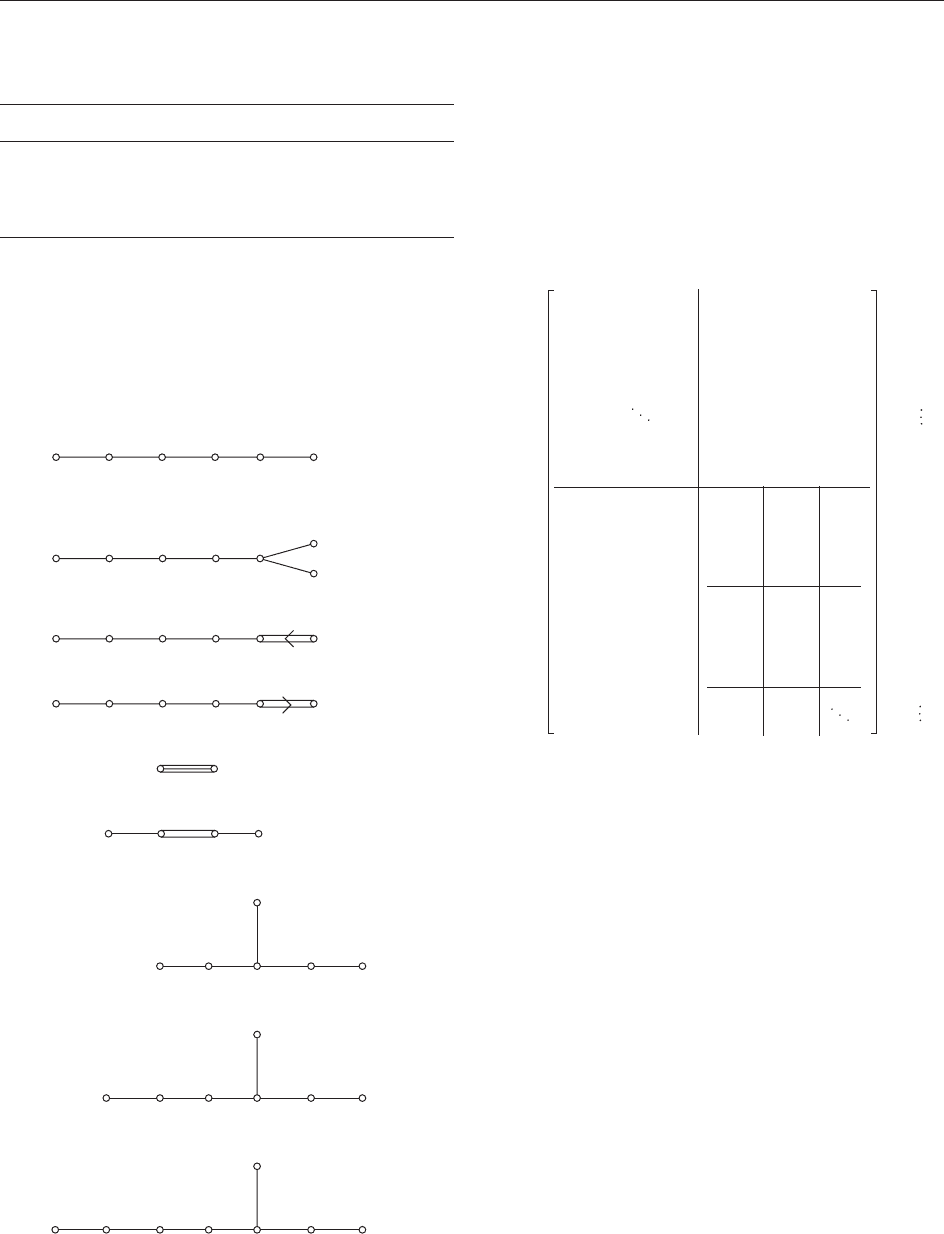
All allowed Dynkin diagrams are shown in Figure 8.
In these diagrams roots making an angle of 120
with each other (joined by single lines) have equal
length. Roots joined by double lines or triple lines
have different lengths. The arrows on double lines
indicated the shorter and longer roots. Arrows point to
longer roots. The root space G
2
and F
4
are self-dual, so
it does not matter which way the arrow points.
Coxeter–Dynkin diagrams also appear in classical
geometry and catastrophe theory.
Real Forms
The metric tensor g
for a simple Lie algebra (over C)
in the canonical basis H, E
a
is
1
1
1
1
1
0
0
1
1
0
0
g
←
H
1
H
2
H
l
E
+α
E
–α
E
+β
E
–β
½2
In this basis, the Lie algebra decomposes into
positive- and negative-definite subspaces according to
g ¼ g
þ
þ g
g
þ
spanned by H
i
; E
þa
þ E
a
ðÞ=
ffiffiffi
2
p
g
spanned by E
þa
E
a
ðÞ=
ffiffiffi
2
p
The choic e of basis sugges ted above diagonalizes the
Cartan–Killing form in eqn [2]: g ! I
p, q
, with
p = l þ (1=2)(n l) positive values þ1 on the diag-
onal and q = (1=2)(n l) values 1 on the diagonal.
The trace of this matrix is the trace of g: þl.
An arbitrary element in this (complex) Lie algebra
is a linear superposition of the form
X ¼
X
i
h
i
H
i
þ
X
a6¼0
e
a
E
a
½3
where all n coefficients h
i
,e
a
are complex. If all
these coefficients are taken real, the resulting Lie
algebra closes under commutation and describes a
noncompact Lie group. The subalgebra describing
the maximal compact subgroup is spanned by the
α
1
α
2
α
l – 1
α
l
A
l
α
l – 1
α
l – 2
α
1
α
2
α
l
D
l
α
1
α
2
α
l –1
α
l
B
l
α
1
α
2
α
l –1
α
l
C
l
α
1
α
2
G
2
α
1
α
2
α
3
α
4
F
4
α
1
α
2
α
3
α
4
α
5
α
6
E
6
α
1
α
2
α
3
α
4
α
5
α
6
α
7
E
7
α
1
α
2
α
3
α
4
α
5
α
6
α
8
α
7
E
8
Figure 8 Four infinite series (A
l
, D
l
, B
l
, C
l
) of Dynkin diagrams
exist and correspond to the classical simple Lie groups (SU
(l þ 1), SO(2l), SO(2l þ 1), USp(2l)). The five exceptional Dynkin
diagrams include a short finite series (E
l
, l = 6, 7, 8), F
4
, and G
2
.
p q r Root space Regular Euclidean solid
arbitrary 2 2 D
p
þ 2
332E
6
Tetrahedron
432E
7
Cube–octahedron
532E
8
Icosahedron–dodecahedron
298 Lie Groups: General Theory

linear combinations (E
þa
E
a
)=
ffiffiffi
2
p
. The remain-
ing operators exponentiate to a noncompact coset
EXP h
i
H
i
þ e
a
þ
E
þa
þ E
a
ðÞ=
ffiffiffi
2
p
no
which is topologically equivalent to R
K
, K = l þ
(1=2)(n l) = (1=2)(n þ l). Of all the real forms of
the complex Lie algeb ra described by this set of
canonical commutation relations (or root space, or
Dynkin diagram), this is the least compact real form.
The compact real form is obtained from [3] by
taking linear combinations
X ¼
X
i
ih
i
H
i
þ
X
a6¼0
ie
a
þ
E
þa
þ E
a
ðÞ=
ffiffiffi
2
p
þ
X
a6¼0
e
a
E
þa
E
a
ðÞ=
ffiffiffi
2
p
where h
i
,e
a
þ
,e
a
are real. The compact real forms of
the simple Lie algebras are:
If the imaginary factor i is absorbed into the
Cartan–Killing metric, this metric is diagonal, all
matrix elements are 1, the trace of this form is n,
and the linear combinations for X are real.
Every complex simple Lie algebra (i.e., simple Lie
algebra over C) has a spectrum of inequivalent real
forms. These can all be obtained from the compact
real form by an analog of Minkowski’s ‘‘rotation
trick,’’ derived by Cartan. Cartan introduced a
metric-preserving linear mapping (‘‘involutive auto-
morphism’’) T : g ! g with the property T
2
= I and
(TX, TY) = (X, Y), with X, Y 2 g. The operator T
has eigenvalues 1 and induces a decomposition
(‘‘Cartan decomposition’’) in g as follows:
g ¼ k þ p
TðgÞ¼TðkÞþTðpÞ
##
k p
As a result, the subspaces k and p are orthogonal.
The subspaces obey the following commutation and
inner-product properties:
k; k½k;
k; p½p;
p; p½k;
k; kðÞ< 0
k; pðÞ¼0
p; pðÞ< 0
Under the analytic continuation p ! ip, the com-
pact Lie algebra g is rotated to a noncompact Lie
algebra g
0
whose commutation relations and inner-
product properties are
g ¼ k þ p ! g
0
¼ k þ p
0
k; k½k; ðk; kÞ < 0
k; p
0
½p
0
; k; p
0
ðÞ¼0
p
0
; p
0
½k; p
0
; p
0
ðÞ> 0
The maximal compact subalgebra of g
0
is k.The
subspace p
0
exponentiates to a simply connected
submanifold on which the Cartan–Killing metric is
positive definite. This manifold is topologically
equivalent to R
K
, K = dim p. It is not geometrically
equivalent to R
K
once an invariant metric is placed
on it.
Three linear mappings that satisfy T
2
= I suffice
to generate all real forms of all the simple classical
Lie algebras.
Block Matrix Decomposition
The compact Lie algebra u(n; F) has a block
submatrix decomposition (n = p þ q):
uðn; FÞ¼
A
p
0
0 A
q
þ
0 þB
B
y
0
where A
y
p
= A
p
, A
y
q
= A
q
and B is an arbitrary
p q matrix over F. Under the map
TðgÞ¼I
p;q
gI
p;q
; I
p;q
¼
I
p
0
0 I
q
the diagonal subspace
A
p
0
0 A
q
has eigenvalue þ1 and the off-diagonal subspace
0 þB
B
y
0
has eigenvalue 1. Under the Cartan rotation
uðn; FÞ!uðp; q; FÞ¼
A
p
0
0 A
q
þ
0 þB
þB
y
0
Root space Group
A
l
1 SU(l)
D
l
SO(2l)
B
l
SO(2l þ 1)
C
l
USp(2l) ¼ Sp(l)
Lie Groups: General Theory 299

The real forms of the classical Lie groups obtained
in this way are
D
n
; B
n
SOð2nÞ
! SOðp; qÞ
SOð2n þ 1Þ
A
n1
SUðnÞ!SUðp; qÞ
C
n
SpðnÞ!Spðp; qÞ
USpð2nÞ!USpð2p; 2qÞ
Subfield Restriction
The Lie algebra su(n) of complex traceless anti-
Hermitian matrices has a subalgebra so(n) of real
antisymmetric matrices. The algebra su(n) can be
expressed in terms of real n n antisymmetric
matrices A
n
and traceless symmetric matrices S
n
:
suðnÞ¼soðnÞþ suðnÞsoðnÞ½¼A
n
þ iS
n
The Cartan rotation is
suðnÞ!slðn; RÞ¼soðnÞþi suðnÞsoðnÞ½
¼ A
n
þ S
n
The classical Lie group generated by this transfor-
mation is SL(n; R).
A similar rotation can be carried out on unitary
matrices over the quaternion field, u(n; Q) = sp(n).
This algebra contains the subalgebra u(n) in which
quaternions q = q
0
þIq
1
þJq
2
þKq
3
are restricted
to complex numbers q = q
0
þ iq
1
. There is a natural
decomposition
spðnÞ¼uðnÞþ spðnÞuðnÞ½
It is useful at this point to replace each quaternion
matrix element by a 2 2 complex matrix: sp(n) !
usp(2n). This is a unitary representation of the
symplectic algebra. Replacing the complex matrix
elements in u(n)by22 real matrices simultaneously
generates a real matrix representation of u(n) named
ou(2n). This is an orthogonal representation of the
unitary algebra. The decomposition above is
spðnÞ!uðnÞþ spðnÞuðnÞ½
! ouð2nÞþ uspð2nÞouð2nÞ½¼A
2n
þ iS
2n
where as before A
2n
and S
2n
are 2n 2n antisym-
metric and symmetric matrices. The Cartan rotation
maps this to sp(2n; R),
uspð2nÞ!spð2n; RÞ¼A
2n
þ S
2n
The classical Lie group gener ated in this way is
Sp(2n; R). Matrices in this group satisfy the quadratic
constraint M
t
GM =G, G
t
= G,det(G) 6¼0. The real
symplectic groups leave invariant Hamilton’s equations
of motion: dp
i
=dt= @H=@q
i
,dq
i
=dt= þ@H=@p
i
.
Field Embeddings
The image of u(n) ! ou(2n) consists of a set of
2n 2n antisymmetric matrices of dimension n
2
.
These matrices form a subset of so(2n), which
consists of 2n 2n antisymmetric matrices of
dimension 2n(2n 1)=2. As a result, ou(2n)isa
subalgebra in so(2n). Thus, ou(2n) k and
so(2n) g and we have a Cartan decomposition
soð2nÞ¼ouð2nÞþ soð2nÞouð2nÞ½
##
ouð2nÞþi soð2nÞouð2nÞ½¼so
ð2nÞ
In the same way, the image of sp(2n) ! usp(2n)
consists of an n(2n þ 1)-dimensional set of 2n 2n
anti-Hermitian matrices. This is a subset of su(2n),
which has dimension (2n)
2
1. It is also a sub-
algebra of su(2 n). Thus, usp(2n) k and su(2n) g,
so we have a Cartan decomposition
suð2nÞ¼uspð2nÞþ suð2nÞusp ð2nÞ½
##
uspð2nÞþi suð2nÞuspð2nÞ½¼su
ð2nÞ
These real forms are summarized in Table 3.
Table 3 Real forms of the simple classical Lie algebras
Mapping Real form Maximal compact subalgebra Root space Condition
Block submatrix so(p, q) so(p) þ so(q) D
n
p þ q = 2n
so(p, q) so(p) þ so(q) B
n
p þ q = 2n þ 1
su(p, q) u(1) þ su(p) þ su(q) A
n1
p þ q = n
sp(p, q) = usp(2p,2q) usp(2p) þ usp(2p) C
n
p þ q = n
Subfield restriction sl(n; R) so(n) A
n1
sp(2n; R) u(n) C
n
Field embedding so
(2n) u(n) D
n
su
(2n) sp(n) = usp(2n) A
2n1
300 Lie Groups: General Theory
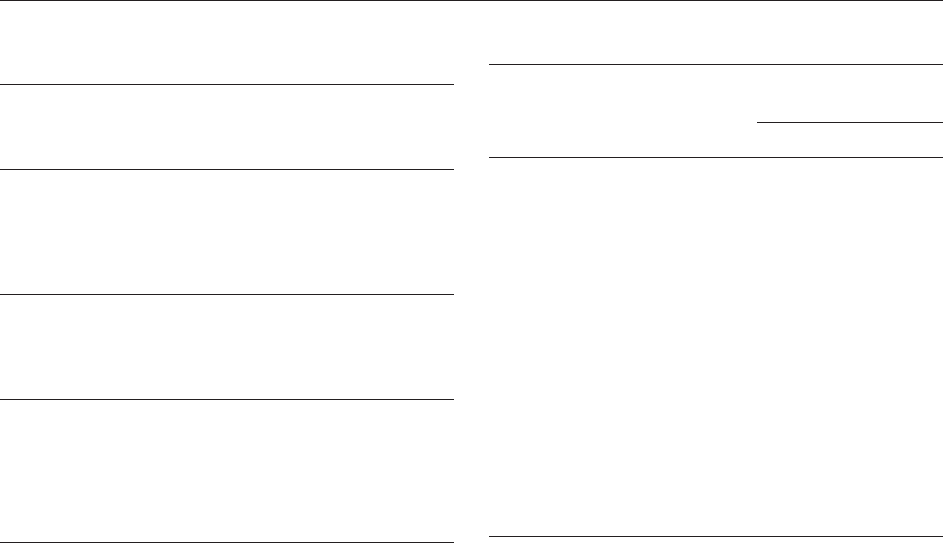
The root spaces A
1
[SU(2)], B
1
[SO(3)], and
C
1
[U(1; Q) ’ USp(2; C)] are equivalent. As a result,
the different real forms of their complex extensions
are related to each other. Similar remarks hold for
the real forms of B
2
= C
2
, D
2
= A
1
þ A
1
,and
D
3
= A
3
. The relations among these real forms are
summarized in Table 4. This table is useful in
inferring ‘‘spinor representations’’ among classical
groups. Thus, SO(3) has spinor representations
based on SU(2) and Sp(1); SO( 4) has spinor
representations based on SU(2) SU(2); SO(5) has
spinor representations based on USp(4); and SO(6)
has spinor representations ba sed on SU(4).
For completeness, the real forms for the excep-
tional Lie algebras are collected in Table 5.
Real form s of the complex extension of a simple
Lie algebra are alm ost uniquely distinguished by an
index. This is the trace of the Cartan–Killing form
[2], once the appropriate factors of i have been
absorbed into it. If n
c
is the dimension of the
maximal compact subgroup, = tr(g) = þ1(n n
c
)
1(n
c
) = n 2n
c
. The index ranges from n for the
compact real form (for which n
c
= n)toþl for the
least compact real form.
Riemannian Symmetric Spaces
Exponentiation lifts Lie algebras to Lie groups and
subspaces in Lie algebras into submanifolds in Lie
groups. In particular, exponentiation of a Cartan
decomposition
g ¼ k þ p
## #
G ¼ K ðP ¼ G=K Þ
lifts the subspace p to the quotient (P = G=K).
A metric may be defined on the Lie group G as
follows. Define the distance between the identity
and some nearby point g() = EXP(X) =
EXP(x
i
X
i
)by
ds
2
ð0Þ¼G
rs
x
r
x
s
Move I and g() to the neighborhood of any point
g(x) 2 G by left multiplication: g(x)I ! g(x),
g(x)g(x
i
X
i
) ! g((x þ dx)
i
X
i
). The infinitesimals
dx
i
(x)atx (defined by g(x)) and x
i
= dx
i
(0) at I
are linearly related,
x
i
¼ M
i
j
ðxÞdx
j
ðxÞ
By requiring that the distance ds between I and
g(x
i
X
i
) at the identity be the same as the
distance between g(x
i
X
i
)I and g(x
i
X
i
)g(x
i
X
i
) =
g((x þ dx)
i
X
i
)atg(x
i
X
i
) leads to the condition
ds
2
¼ G
rs
ð0Þx
r
x
s
¼ G
rs
ð0ÞM
r
i
ðxÞM
s
j
ðxÞdx
i
ðxÞdx
j
ðxÞ
¼ G
ij
ðxÞdx
i
ðxÞdx
j
ðxÞ
An invariant metric G(x) over the Lie group G is
defined by
G
ij
ðxÞ¼G
rs
ð0ÞM
r
i
ðxÞM
s
j
ðxÞ
GðxÞ¼M
t
ðxÞGð0ÞMðxÞ
Table 5 Real forms of the exceptional Lie algebras
Maximal compact
subgroup
Root space Class
Rank(Character )
Root space Dimension
G
2
G
2(14)
G
2
14
G
2(þ2)
A
1
þ A
1
6
F
4
F
4(52)
F
4
52
F
4(20)
B
4
36
F
4(þ4)
C
3
þ A
1
24
E
6
E
6(78)
E
6
78
E
6(26)
F
4
52
E
6(14)
D
5
þ D
1
46
E
6(þ2)
A
5
þ A
1
38
E
6(þ6)
C
4
36
E
7
E
7(133)
E
7
133
E
7(25)
E
6
þ D
1
79
E
7(5)
D
6
þ A
1
69
E
7(þ7)
A
7
63
E
8
E
8(248)
E
8
248
E
8(24)
E
7
þ A
1
136
E
8(þ8)
D
8
120
Table 4 Equivalence among real forms of the simple classical
Lie algebras
A
1
= B
1
= C
1
su(2) = so(3) = sp(1) = usp(2) 3
su(1, 1) = sl(2; R) = so(2, 1) = sp(2; R) þ1
D
2
= A
1
þ A
1
so(4) = so(3) þ so(3) 6
so
(4) = so(3) þ so(2, 1) 2
so(3, 1) = sl(2; C)0
so(2, 2) = so(2, 1) þ so(2, 1) þ2
B
2
= C
2
so(5) = sp(2) = usp(4) 10
so(4, 1) = sp(1, 1) = usp(2, 2) 2
so(3, 2) = sp(4; R) þ2
D
3
= A
3
so(6) = su(4) 15
so(5, 1) = su
(4) 5
so
(6) = su(3, 1) 3
so(4, 2) = su(2, 2) þ1
so(3, 3) = sl(4; R) þ3
Lie Groups: General Theory 301
It is useful to identify G(0) with the Cartan–Killing
inner product on g. Since M(x) is nonsingular, the
signature of G(x) is invariant over the group.
The invariant metric on G can be restricted to
subspaces K G and P = G=K G. The signature
on these subspaces is the same as the signature on
the subspaces k and p in g. Thus, if G is compac t,
the invariant metric is negative definite on K and on
P = G=K and positive definite on the analytically
continued space P
0
= G
0
=K. In short, it is definite
(negative, positive) on P, P
0
. These spaces are
Riemannian spaces and they are globally symmetric.
They have been investigated by studying the proper-
ties of the secular equation of the Lie algebra g,
restricted to the subspace p:
det Rðp
i
P
i
ÞI
¼
X
j
ðÞ
nj
^
j
ðpÞ¼0 ½4
where the P
i
are basis vectors that span p. The
coefficients
^
j
(p) in the secular equation [4] for
Riemannian symmetric spaces are related to the
coefficients
j
(x) in the secular equation [1] for Lie
algebras. A rank for the Riemannian symmetric
space P = EXP(p) can be defined from the secular
equation following exactly the prescription followed
for the Lie algebra g. The rank of the Riemannian
symmetric space P = EXP(p)is
1. the number of functionally independen t coeffi-
cients
^
j
(p) in the secular equation;
2. the number of independent roots of the secular
equation;
3. the dimensi on of the maximal Euclidean sub-
space in P; and
4. the number of independent (Laplace–Beltrami)
operators that commute with all displacement
operators P
i
:
j
(P) =
^
j
(p
i
! P
i
).
Rank-1 Riemannian symmetric spaces are isotropic
as well as homogeneous.
Tables 3 and 5 contain all the information required
to enumerate all the classical and exceptional Rieman-
nian symmetric spaces. All the classical Riemannian
symmetric spaces are tabulated in Table 6.The
exceptional Riemannian symmetric spaces can be
constructed from the information in Table 5 following
the procedure used to construct Table 6 from Table 3.
As particular examples of Riemannian symmetric
spaces we consider the compact spaces SO( p þ q)=
[SO(p) SO(q)] and their noncompact counterpa rts
SO(p, q)=[SO(p) SO(q)]. These spaces have rank
min(p, q), dimension pq, and can be represented
explicitly in matrix form as
0
X
X
t
0
! EXP
0
X
X
t
0
¼
D
p
Y
Y
t
D
q
"#
Here X is a p q matrix and = þ1 for the
noncompact case and 1 for the compact case. The
block diagonal matrices D
p
and D
q
are defined from
the metric-preserving conditions (M
t
I
pþq
M = I
pþq
,
M
t
I
p, q
M = I
p, q
)
D
2
p
¼ I
p
þ YY
t
; D
2
q
¼ I
q
þ Y
t
Y
The pq coordinates in the Riemannian symmetric
spaces can be taken as the pq elements of the
submatrix Y.
These Riemannian symmetric spaces can be
treated as algebraic submanifolds in R
K
, K = pq þ
(1=2)q(q þ 1). The K coordinates on R
K
can be
identified with the pq matrix elements of Y and the
(1=2)q(q þ 1) matrix elements of the real symmetric
matrix D
q
. These coordinates obey the (1=2)q(q þ 1)
algebraic constraints defined by
D
2
q
Y
t
Y ¼ I
q
For SO(3)/SO(2) and SO(2,1)/SO(2), this condition
is determined from the matrix
I
2
þ x yðÞ
x
y
hihi
1=2
x
y
x y
z
2
6
4
3
7
5
to be
z
2
ðx
2
þ y
2
Þ¼1
Table 6 All classical Riemannian symmetric spaces
Root space Quotient Dimension Rank
A
pþq1
SU(p, q)=S[U(p) U(q)] 2pq min(p, q)1 (p q)
2
A
n1
SL(n; R)=SO(n)
1
2
(n þ 2)(n 1) n 1 n 1
A
2n1
SU
(2n)=USp(2n)(2n þ 1)(n 1) n 1 2n 1
B
pþq
SO(p, q)=SO(p) SO(q) pq min(p, q) pq
1
2
p(p 1)
1
2
q(q 1)
D
pþq
SO(p, q)=SO(p) SO(q) pq min(p, q) pq
1
2
p(p 1)
1
2
q(q 1)
D
n
SO
(2n)=U(n) n(n 1) n/2 n
C
pþq
USp(2p,2q)=USp(2p) USp(2q)4pq min(p, q) 2(p q)
2
( p þ q)
C
n
Sp(2n; R)=U(n) n(n þ 1) n þn
302 Lie Groups: General Theory
For = 1, the space is the sphere S
2
defined by z
2
þ
(x
2
þ y
2
) = 1. For = þ1, the space is the two-sheeted
hyperboloid H
2
2
defined by z
2
(x
2
þ y
2
) = 1. More
specifically, it is the upper sheet containing (0, 0, 1) of
the two-sheeted hyperboloid. The second sheet occurs
in the coset O(2,1)=SO(2). The symmetric spaces
SO(n þ 1)=SO(n) and SO(n,1)=SO(n) are the sphere
S
n
and the upper sheet of the two-sheeted hyperboloid
H
n
2þ
. Both have dimension n and rank 1. The spaces
are simply connected, homogeneous, and isotropic.
For SO(4, 2)=SO(4) SO(2), the eight-dimensional
algebraic manifold is defined by the three con-
straints in R
11
:
y
9
y
10
y
10
y
11
2
y
1
y
2
y
3
y
4
y
5
y
6
y
7
y
8
y
1
y
5
y
2
y
6
y
3
y
7
y
4
y
8
2
6
6
6
4
3
7
7
7
5
¼
10
01
The compact analytically continued space
SO(6)=SO(4) SO(2) is obtained by setting = 1.
These spaces have dimension 8 and rank 2. They are
homogeneous but not isotropic. For each, there are
‘‘two inequivalent directions.’’ There are two inde-
pendent Laplace–Beltrami operators on these spaces,
one quadratic and one quartic.
The complete list of globally symmetric pseudo-
Riemannian symmetric spaces can be constructed
almost as easily. Two linear operators, T
1
and T
2
,
are introduced that obey T
2
1
= I, T
2
2
= I, T
1
T
2
=
T
2
T
1
6¼ I. The two are used to split g into
subspaces
T
1
g
¼ g
; T
2
g
¼ g
where = 1, = 1. The decomposition and
double rotation
g ¼ g
þþ
þ g
þ
þ g
þ
þ g
#T
1
g
0
¼ g
þþ
þ g
þ
þ iðg
þ
þ g
Þ
#T
2
g
00
¼ g
þþ
þ ig
þ
þ iðg
þ
þ ig
Þ
generates a noncompact subgroup K
00
as well as a
pseudo-Riemannian symmetric space P
00
:
K
00
¼ EXP g
þþ
þ ig
þ
ðÞ; P
00
¼ EXP ig
þ
þ g
ðÞ
These have also been classified.
The simplest example of a pseudo-Riemannian
symmetric space is SO(2,1)=SO(1,1):
soð2; 1Þ!
0
3
2
3
0
1
2
1
0
2
6
4
3
7
5
!
00 0
00
1
0
1
0
2
6
4
3
7
5
þ
0
3
2
3
0 0
2
0 0
2
6
4
3
7
5
! M ¼
zx
y
x
y
2
6
4
3
7
5
The metric-preserving condition M
t
I
2, 1
M = I
2, 1
leads to the constraint equation z
2
þ x
2
y
2
= 1.
This space is the single-sheeted hyperboloid H
2
1
.Itis
two dimensional and has rank 1, but it is not
isotropic. Intersections with the plane x = 0 are
hyperbolas and with the planes y = const. are circles.
This space is not simply connected.
Summary
Lie groups are among the most powerful mathema-
tical tools available to physicists. They play a major
role in physics because they occur as transformation
groups from coordinate system to coordinate system
in real space (rotation group SO(3), Lorentz group
O(3,1), Galilei group, Poincar e´ group ISO(3,1)) or
in spaces describing internal degrees of freedom
(SU(2) for spin or isospin, SU(3) for quarks and
color, SU(4) for spin–isospin, etc.).
It is remarkable that a beautiful classification
theory for simple (the building blocks) Lie groups
exists, because of the rather amorphous nature of the
definition of a Lie group. In a search for structure,
the first step in the analysis of Lie groups is
linearization of the group multiplication law in the
neighborhood of the identity to a linear vector space
on which there is a Lie algebra structure. This in itself
is sufficient to create a strong connection to quantum
mechanics. Although there is not a 1:1 correspon-
dence between Lie groups and their Lie algebras,
there is a very beautiful connection between them.
This relates algebra (discrete invariant subgroups)
and topology (homotopy groups) in an elegant way.
The structure of Lie algebras is described using
tools from linear algebra: secular equations and
inner products. Together, these tools are used to
reduce Lie algebras to their basic units: nilpotent
and solvable invariant subalgebras, and semisimple
and simple Lie algebras. The commutation relations
for simple Lie alge bras can be put into a canonical
form using another miracle of this theory: a positive-
definite root space that summarizes the properties of
the secular equation and the Cartan–Killing inner
Lie Groups: General Theory 303

product. As the secular equation can only be solved
exactly over an algebraically closed field, the
classification of simple Lie algebras covers complex
Lie algebras. Each complex extension has several
real forms, which are easily classified.
Even more remarkable is the connection between
simple Lie groups and Riemannian spaces that ‘‘look
the same everywhere.’’ All Riemannian symmetric
spaces are quotients of a simple Lie group by a
subgroup that is maximal in some precise sense
(Cartan decomposition sense). Cartan was able to
classify all Riemannian symmetric spaces as a
consequence of his classification of all the real
forms of all the simple Lie groups. The algebraic
tools used to classify Lie algebras (secular equations,
Dynkin diagrams) were used again to classify these
spaces (Dynkin diagrams ! Araki–Satake diagrams).
These spaces are classified by a root space, group–
subgroup pair, dimension, rank, and character.
Construction of invariant operators (Casimir invar-
iants, Laplace–Beltrami operators) is algorithmic.
Nonsemisimple Lie groups/algebras can be con-
structed from simple Lie algebras by caref ully
introducing singular change of basis transforma-
tions. This leads to ‘‘group contraction,’’ not
discussed above. In this way, the Poincare´ group
can be constructed systematically from the groups
SO(3, 2) or SO(4, 1): SO(3, 2) ! ISO(3, 1), SO(4, 1) !
ISO(3, 1) in the limit of ‘‘large R.’’ Here, R is the
‘‘radius’’ of some universe of hyperbolic nature, with
signature (3, 2) or (4, 1). The Galilei group can be
constructed by contraction from the Poincare´groupin
the limit c = 3 10
10
cms
1
!1.
We have not discussed here the theory of the
representations of Lie groups. A beautiful theorem by
Wigner and Stone guarantees that the tensor represen-
tations of a compact group are complete. Gel’fand has
given expressions for the complete set of tensor
representations of the classical compact Lie groups.
They are expressed by ‘‘dressing’’ the appropriate
Dynkin diagrams or else in terms of irreducible
representations of the symmetric group S
n
. Gel’fand
has also given explicit, analytic, closed-form expres-
sions for the matrix elements of any of the shift
operators in any of these representations. For the
noncompact real forms, most of the unitary irreducible
representations can be obtained from these expressions
for matrix elements (‘‘master analytic representation’’)
by appropriate analytic continuation.
Since Lie groups exis t at the interface of algebra
and topology, it is to be expected that there is a very
close relation with the theory of special functions. In
fact, the theory of special functions forms an
important chapter in the theory of Lie groups. On
the top ological side, the shift operators E
a
(think J
)
have coordinate representations hx
0
jE
a
jxi involving
first-order differential operators. On the algeb raic
side, the matrix elements hn
0
jE
a
jni are square roots
of products of integers (divided by products of
integers). These topological and algebraic expres-
sions are related to each other in a myriad of ways.
All of the standard properties of special functions
(Rodriguez formulas, recursion relations in coordi-
nates and indices, differential equations, generating
functions, etc.) occur in a systematic way in a Lie-
theoretic formulation of this subject.
Finally, no review or even book could do justice
to the applications that Lie group theory finds in
physics.
The rich interplay that exists between freedom
and rigidity of structure found in Lie group theory
can be found in only the purest works of art – for
example, the fugues of Bach.
See also: Classical Groups and Homogeneous Spaces;
Compact Groups and their Representations; Cosmology:
Mathematical Aspects; Equivariant Cohomology and the
Cartan Model; Finite-Type Invariants of 3-Manifolds;
Functional Equations and Integrable Systems; Lie
Superalgebras and Their Representations; Lie,
Symplectic, and Poisson Groupoids and Their Lie
Algebroids; Measure on Loop Spaces; Quasiperiodic
Systems; Symmetry and Symplectic Reduction;
Symmetry Classes in Random Matrix Theory; Toda
Lattices.
Further Reading
Barut AO and Raczka (1986) Theory of Group Representations
and Applications. Singapore: World Scientific.
Gilmore R (1974) LieGroups,LieAlgebras,andSomeofTheir
Applications. New York: Wiley (republished (2005); New York:
Dover).
Helgason S (1962) Differential Geometry and Symmetric Spaces.
New York: Academic Press.
Helgason S (1978) Differential Geometry, Lie Groups, and
Symmetric Spaces. New York: Academic Press.
Talman JD (1968) Special Functions, a Group Theoretical
Approach, Based on Lectures by Eugene P. Wigner. New York:
Benjamin.
304 Lie Groups: General Theory
Lie Superalgebras and Their Representations
L Frappat, Universite
´
de Savoie, Chambery-Annecy,
France
ª 2006 Elsevier Ltd. All rights reserved.
Basic Definitions
Let A be an algebra over a field K of characteristic
zero (usually K = R or C)withinternallawsþ and .
One sets Z
2
= Z=2Z = {0, 1}. A is called a super-
algebra or Z
2
-graded algebra if it can be written into
a direct sum of two spaces A= A
0
A
1
,suchthat
A
0
A
0
A
0
; A
0
A
1
A
1
; A
1
A
1
A
0
Elements of A
0
are called even or of degree 0 while
elements of A
1
are called odd or of degree 1.
A superalgebra A is called associative if (X Y)
Z = X (Y Z) for all X, Y, Z 2A. It is called
commutative if X Y = (1)
degX.degY
Y X for all
X, Y 2A, where deg X is the degree of the element X.
A homomorphism from a superalgebra A into a
superalgebra A
0
is a linear application from A into
A
0
which respects the Z
2
-gradation, that is, (A
0
)
A
0
0
and (A
1
) A
0
1
.
A Lie superalgebra G over a field K of character-
istic zero (usually K = R or C) is a superalgebra in
which the product, denoted [ , ], satisfies the
following properties:
Z
2
-gradation
[G
i
; G
j
] G
iþj
ði; j 2 Z
2
Þ
Graded-antisymmetry
[X
i
; X
j
] ¼ ð1Þ
degX
i
:degX
j
[X
j
; X
i
]
Generalized Jacobi ident ity
ð1Þ
degX
i
:degX
k
[X
i
; [X
j
; X
k
]]
þð1Þ
degX
j
:degX
i
[X
j
; [X
k
; X
i
]]
þð1Þ
degX
k
:degX
j
[X
k
; [X
i
; X
j
]] ¼ 0
Note that G
0
is a Lie algebra, called the even or
bosonic part of G, while G
1
, called the odd or
fermionic part of G, is not an algebra.
An associative superalgebra G= G
0
G
1
over the
field K acquires the structure of a Lie superalgebra by
taking for the product [ , ] of two elements X, Y 2G
the Lie superbracket (also called supercommutator or
graded commutator)
[X; Y] ¼ X Y ð1Þ
degX:degY
Y X
The notation [ , ] for the supercommutator is used to
avoid confusion with the usual commutator [X, Y] =
X Y Y X.
A Lie superalgebra G is Z-graded if it can be
written as a direct sum of finite-dimensional Z
2
-
graded subspaces G
i
such that
G¼
M
i2Z
G
i
; where [G
i
; G
j
] G
iþj
The Z-gradation is said to be consistent with the Z
2
-
gradation if
G
0
¼
X
i2Z
G
2i
and G
1
¼
X
i2Z
G
2iþ1
It follows that G
0
is a Lie subalgebra and that each
G
i
(i 6¼ 0) is a G
0
-module.
A subalgebra K= K
0
K
1
of a Lie superalgebra G
isasubsetofelementsofG which forms a vector
subspace of G that is closed with respect to the Lie
product of G such that K
0
G
0
and K
1
G
1
.
AsubalgebraK of G is called a proper subalgebra of
G if K 6¼G.AnidealI of G is a subalgebra of G such
that [G, I] I,thatis,X 2G, Y 2I)[X, Y] 2I.
An ideal I of G is called a proper ideal of G if I 6¼G.
If I and I
0
are two ideals of G, [I, I
0
] is an ideal of G.
The definitions of the centralizer, the center, and
the normalizer of a Lie superalgebra follow those of
a Lie algebra. Let S be a subset of elements in the
Lie superalgebra G. The centralizer C
G
(S) is the
subset of G given by
C
G
ðSÞ ¼ fX 2Gj[X; Y] ¼ 0; 8Y 2Sg
The center Z(G)ofG is the set of elements of G
which commute with any element of G (in other
words, it is the centralizer of G in G):
ZðGÞ ¼ fX 2Gj[X; Y] ¼ 0; 8Y 2Gg
The normalizer N
G
(S) is the subset of G given by
N
G
ðSÞ ¼ fX 2Gj[X; Y] 2S; 8Y 2Sg
The Lie superalgebra G is said to be nilpotent if
considering the series [G, G
[i1]
] = G
[i]
with G
[0]
= G,
then there exists an integer n such that G
[n]
= {0}.
The Lie superalgebra G is said to be solvable if
considering the series [G
(i1)
, G
(i1)
] = G
(i)
with G
(0]
= G,
then there exists an integer n such that G
(n)
= {0}. A
Lie superalgebra G is solvable if and only if G
0
is
solvable.
Let G be a noncommutative Lie superalgebra.
The Lie superalgebra G is called simple if it does
not contain any nontrivial ideal. The Lie super-
algebra G is called semisimple if it does not
Lie Superalgebras and Their Representations 305
contain any nontrivial solvable ideal. Let us
recall that if A is a semisimple Lie algebra, it
can be written as the direct sum of simple Lie
algebras A
i
: A=
i
A
i
. This is not the case for
superalgebras.
Let G= G
0
G
1
be a Lie superalgebra and V =
V
0
V
1
be a Z
2
-graded vector space. Consider
the algebra End V of endomorphisms of V,
which naturally acquires a superalgebra structure
by End V = End
0
VEnd
1
V, where End
i
V = { 2
End Vj(V
j
) V
iþj
}. A linear representation of G
is a homomorphism of G into End V, that is,
ðX þ YÞ¼ðXÞþðYÞ
ð[X; Y]Þ¼[ðXÞ;ðYÞ]
ðG
0
ÞEnd
0
V and ðG
1
ÞEnd
1
V
for all X, Y 2Gand , 2 C. The vector space V is the
representation space. The vector space V has the
structure of a G-module by X(v) = (X)v for X 2G
and v 2V. The dimension (resp. superdimension) of the
representation is the dimension (resp. graded dimen-
sion) of the vector space V :dim = dim V
0
þ dim V
1
and sdim = dim V
0
dim V
1
. In particular, the repre-
sentation ad : G!End G (G being considered as a
Z
2
-graded vector space) such that ad(X)Y = [X, Y]
is called the adjoint representation of G.
In the basis (e
1
, ..., e
m
, e
mþ1
, ..., e
mþn
)ofV =
V
0
V
1
(called homogeneous basis), where dim V
0
= m
and dim V
1
= n,anelementofG is represented by the
matrix
M ¼
AB
CD
where A, B, C, and D are m m, m n, n m, and
n n matrices, respectively. Even elements corre-
spond to block diagonal matrices (i.e., B = C = 0),
odd elements to block antidiagonal matrices (i.e.,
A = D = 0). One defines the supertrace function
denoted by str:
strðMÞ¼trðA ÞtrðDÞ
To a given representation of G, one can associate a
bilinear form B
on G as
B
ðX; YÞ¼strððXÞð YÞÞ; 8X; Y 2G
(X) are the matrices of the generators X in the
representation and str denotes the supertrace. A
bilinear form B on G is called
1. consistent if B(X, Y) = 0 for all X 2G
0
and all
Y 2G
1
,
2. supersymmetric if, for all X, Y 2G,
BðX; YÞ¼ð1Þ
degX:degY
BðY; XÞ
3. invariant if, for all X, Y, Z 2G,
Bð[X; Y]; ZÞ¼BðX; [Y; Z]Þ
The bilinear form associated to the adjoint repre-
sentation of G is called the Killing form on
G: K(X, Y) = str(ad(X)ad(Y)). It is consistent, super-
symmetric, and invariant.
Classification of Simple Lie
Superalgebras
The simple Lie superalgebras have been classified by
V G Kac. One distinguishes two general families: the
classical Lie superalgebras and the Cartan type
superalgebras.
Classical Lie Superalgebras
A simple Lie superalgebra G= G
0
G
1
is called
classical if the representation of the even subalgebra
G
0
on the odd part G
1
is completely reducible. The
superalgebra is said to be of type I if the representa-
tion of G
0
on G
1
is the direct sum of two irreducible
representations of G
0
. In that case, one has G
1
=
G
1
G
1
with
[G
1
; G
1
] ¼G
0
and [G
1
; G
1
] ¼ 0
The superalgebra is said to be of type II if the
representation of G
0
on G
1
is irreducible.
A classical Lie superalgebra G is called basic if
there exists a nondegenerate invariant bilinear form
on G. The basic Lie superalgebras split into four
infinite families: A(m, n) or sl(m þ 1jn þ 1) for m 6¼ n
and A(n, n) or sl(n þ 1jn þ 1)=Z = psl(n þ 1jn þ 1),
where Z is a one-dimensional center for m = n
(unitary series), B(m, n) or osp(2m þ 1j2n), C(n)or
osp(2j2n), D(m, n) or osp(2m j2n) (orthosymplectic
series); and three exceptional superalgebras F(4),
G(3), and D(2, 1; ), the last one being actually a
one-parameter family of superalgebras. The classical
Lie superalgebras which are not basic are called
strange, and correspond to two infinite families
denoted by P(
n)andQ(n).
A basic Lie superalgebra G= G
0
G
1
admits a
consistent Z-gradation G=
i2Z
G
i
(called distin-
guished), such that (see Tables 1 and 2)
for superalgebras of type I, G
i
= 0 for jij > 1 and
G
0
= G
0
, G
1
= G
1
G
1
and
for superalgebras of type II, G
i
= 0 for jij > 2 and
G
0
= G
2
G
0
G
2
, G
1
= G
1
G
1
.
Cartan Type Superalgebras
The Cartan type Lie superalgebras are the simple Lie
superalgebras in which the representation of the
even subalgebra on the odd part is not completely
306 Lie Superalgebras and Their Representations