
Francoise J.-P., Naber G.L., Tsun T.S. (editors) Encyclopedia of Mathematical Physics
Подождите немного. Документ загружается.

reducible. They are classified into four infinite
families called W(n) with n 2, S(n) with n 3,
e
S(n), and H(n)withn 4. S(n) and
e
S(n) are called
special Cartan type Lie superalgebras and H(n)
Hamiltonian Cartan type Lie superalgebras.
Classical Lie Superalgebras
The classical Lie superalgebras are described as matrix
superalgebras as follows. Let V = V
0
V
1
be a Z
2
-
graded vector space, with dim V
0
= m,dimV
1
= n.
The Lie superalgebra gl(mjn) is defined as the super-
algebra End V = End
0
VEnd
1
V supplied with the
Lie superbracket.
The unitary superalgebra A(m 1, n 1) = sl(m jn)
is defined as the superalgebra of matrices M 2 gl(mjn)
satisfying the supertrace condition str(M) = 0. In the
case m = n,sl(njn) contains a one-dimensional ideal I
generated by I
2n
and one sets A(n 1, n 1) =
sl(n jn)=Ipsl(n jn).
The orthosymplectic superalgebra osp(m j2n)is
defined as the superalgebra of matrices M 2 gl(m jn)
satisfying the conditions
A
t
¼A; D
t
G ¼GD; B ¼ C
t
G
where t denotes the usual transposition and the
matrix G is given by
G ¼
0 I
n
I
n
0
The strange superalgebra P(n) is defined as the
superalgebra of matrices M 2 gl(n jn) satisfying the
conditions
A
t
¼D; B
t
¼ B; C
t
¼C; trðAÞ¼0
The strange superalgebra
e
Q(n) is defined as the
superalgebra of matrices M 2 gl(n jn) satisfying the
conditions
A ¼ D; B ¼ C; trðBÞ¼0
The superalgebra
e
Q(n) has a one-dimensional center
Z. The simple superalgebra Q(n) is given by
Q(n) =
e
Q(n)=Z.
Structure of the Classical Lie
Superalgebras
Let G= G
0
G
1
be a classical Lie superalgebra. A
Cartan subalgebra H of G is defined as a Cartan
subalgebra of G
0
, that is, the maximal nilpotent
subalgebra of G
0
coinciding with its own normal-
izer: H= {X 2G
0
j[X, H] H}. It follows that the
Cartan subalgebras of a Lie superalgebra are
conjugate since the Cartan subalgebras of a Lie
algebra are conjugate and any inner automorphism
of the even part G
0
can be extended to an inner
automorphism of G; hence, they all have the
same dimension. By definition, the dimension of
a Cartan subalgebra H is the rank of G:rankG=
dim H.
A classical Lie superalgebra G with Cartan
subalgebra H can be decomposed as G=
L
2H
G
(H
is the dual of H), where
G
¼fx 2Gj[h; x ] ¼ ðhÞx; h 2Hg
The set H
¼f 2H
jG
6¼ 0g
is by definition the root system of G. A root is
called even (resp. odd) if G
\G
0
6¼; (resp.
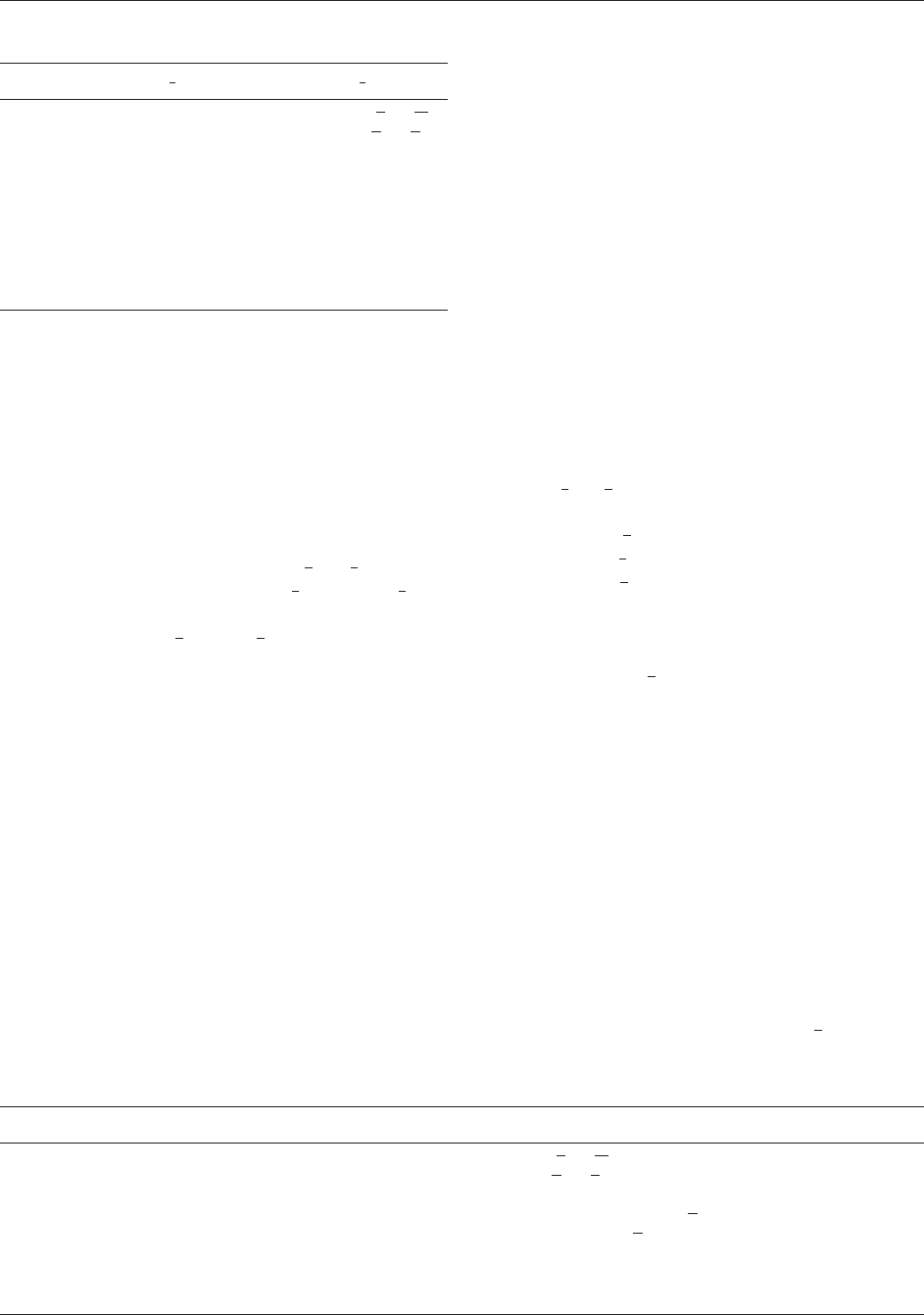
Table 1 Z
2
-gradation of the classical Lie superalgebras
Superalgebra GG
0
G
1
A(m 1, n 1) A
m1
A
n1
U(1) (m, n) (m,n)
A(n 1, n 1) A
n1
A
n1
(n, n) (n, n)
C(n þ 1) C
n
U(1) (2n) (2n)
B(m, n) B
m
C
n
(2m þ 1, 2n)
D(m, n) D
m
C
n
(2m,2n)
F(4) A
1
B
3
(2, 8)
G(3) A
1
G
2
(2,7)
D(2, 1; ) A
1
A
1
A
1
(2, 2, 2)
P(n) A
n
½2½1
n1
Q(n) A
n
ad(A
n
)
Table 2 Z-gradation of the classical basic Lie superalgebras
Superalgebra GG
0
G
1
G
1
G
2
G
2
A(m 1,n 1) A
m1
A
n1
U(1) (m, n) (m, n)
A(n 1, n 1) A
n1
A
n1
(n, n) (n, n)
C(n þ 1) C
n
U(1) (2n)
þ
(2n)
B(m,n) B
m
A
n1
U(1) (2m þ 1, n) (2m þ 1, n) [2] [2
n1
]
D(m,n) D
m
A
n1
U(1) (2m, n) (2m, n) [2] [2
n1
]
F(4) B
3
U(1) 8
þ
8
1
þ
1
G(3) G
2
U(1) 7
þ
7
1
þ
1
D(2, 1; ) A
1
A
1
U(1) (2, 2)
þ
(2, 2)
1
þ
1
Lie Superalgebras and Their Representations 307

G
\G
1
6¼;). The set of even roots
0
is the root
system of the even part G
0
of G. The set of odd root
1
is the weight system of the representation of G
0
in G
1
. One has =
0
[
1
. A root can be both
even and odd (however this only occurs in the case
of the superalgebra Q(n)). The vector space spanned
by all the possible roots is called the root space. It is
the dual H
of the Cartan subalgebra H as vector
space.
Except for A(1, 1), P(n), and Q(n), using a non-
degenerate invariant bilinear form B on the super-
algebra G, one can define a bilinear form ( , )
on the root space H
by (
i
,
j
) = B(H
i
, H
j
), where
the H
i
form a basis of H. The following properties
hold:
1. G
( = 0)
= H except for Q(n).
2. dim G
= 1 when 6¼ 0 except for A(1, 1), P(2),
P(3), and Q(n).
3. Except for A(1, 1), P(n), Q(n), one has
(a) [G
, G
] 6¼ 0 if and only if , , þ 2 ,
(b) (G
, G
) = 0 for þ 6¼ 0,
(c) if 2 (resp.
0
,
1
), then 2 (resp.
0
,
1
), and
(d) 2 ) 2 2 if and only if 2
1
and
(, ) 6¼ 0.
In the rest of this section, we restrict to the case
of a basic Lie superalgebra G of rank r,withCartan
subalgebra H and root system =
0
[
1
.ThenG
admits a Borel decomposition G= N
þ
HN
,
where N
are subalgebras such that [H, N
] N
with dim N
þ
= dim N
.IfG= H
L
G
is the root
decomposition of G, a root is called positive if
G
\N
þ
6¼;and negative if G
\N
6¼;. A root is
called simple if it cannot be decomposed into a sum
of positive roots. The set of all simple roots is
called a simple root system of G and is denoted here
by
0
.ThesetB= HN
þ
is called a Borel
subalgebra of G. Such a Borel subalgebra is solvable
but not maximal solvable. Indeed, adding to B a
negative simple isotropic root generator (i.e., a
generator associated to an odd root of zero length),
the obtained subalgebra is still solvable since the
superalgebra sl(1j1) is solvable. However, B con-
tains a maximal solvable subalgebra B
0
of the even
part G
0
.
In general, for a basic Lie superalgebra G, there
are many inequivalent classes of conjugacy of Borel
subalgebras (while for the simple Lie algebras, all
Borel subalgebras are conjugate).
To each class of conjugacy of Borel subalgebras of
G is associated a simple root system
0
. Hence,
contrary to the Lie algebra case, to a given basic
Lie superalgebra G will be associated in general
many inequivalent simple root systems, up to a
transformation of the Weyl group W(G)ofG (the
Weyl group of a basic Lie superalgebra being
generated by the Weyl reflections with respect to
the even roots; under a transformation of W(G), a
simple root system will be transformed into an
equivalent one with the same Dynkin diagram). The
generalization of the Weyl group for a basic Lie
superalgebra G gives a method for constructing all
the simple root systems of G and hence all the
inequivalent Dynkin diagrams of G. For 2
1
, one
defines
w
ðÞ¼ 2
ð; Þ
ð; Þ
if ð; Þ 6¼ 0
w
ðÞ¼ þ if ð; Þ¼0; ð; Þ 6¼ 0
w
ðÞ¼ if ð; Þ¼ð; Þ¼0
w
ðÞ¼
Note that the transformation associated to an odd
root of zero length cannot be lifted to an
automorphism of the superalgebra since w
trans-
forms even roots into odd ones, and vice versa, and
the Z
2
-gradation would not be respected. A simple
root system
0
being given, from any root 2
0
such that (, ) = 0, one constructs the simple root
system w
(
0
), where w
is the generalized Weyl
reflection with respect to and one repeats the
procedure on the obtained system until no new basis
arises.
In the set of all inequivalent simple root
systems of a basic Lie superalgebra, there is one
simple root system that plays a particular role,
the distinguished simple root system, for which
the number of odd roots is equal to one,
constructed as follows. Consider the distinguished
Z-gradation of G, G=
i2Z
G
i
. The even simple
roots are given by the simple root system of the
Lie subalgebra G
0
and the odd simple root is the
lowest weight of the representation G
1
of G
0
.See
Table 3 for the root systems and Table 4 for the
distinguished simple root systems of the basic Lie
superalgebras.
Let
0
= (
1
, ...,
r
) be a simple root system
of G, such that (
i
,
j
) 2 Z and jmin (
i
,
j
)j= 1if
(
i
,
j
) 6¼ 0. Then one defines the symmetric Cartan
matrix a with integer entries as a
ij
= (
i
,
j
). One
associates to
0
a Dynkin diagram according to the
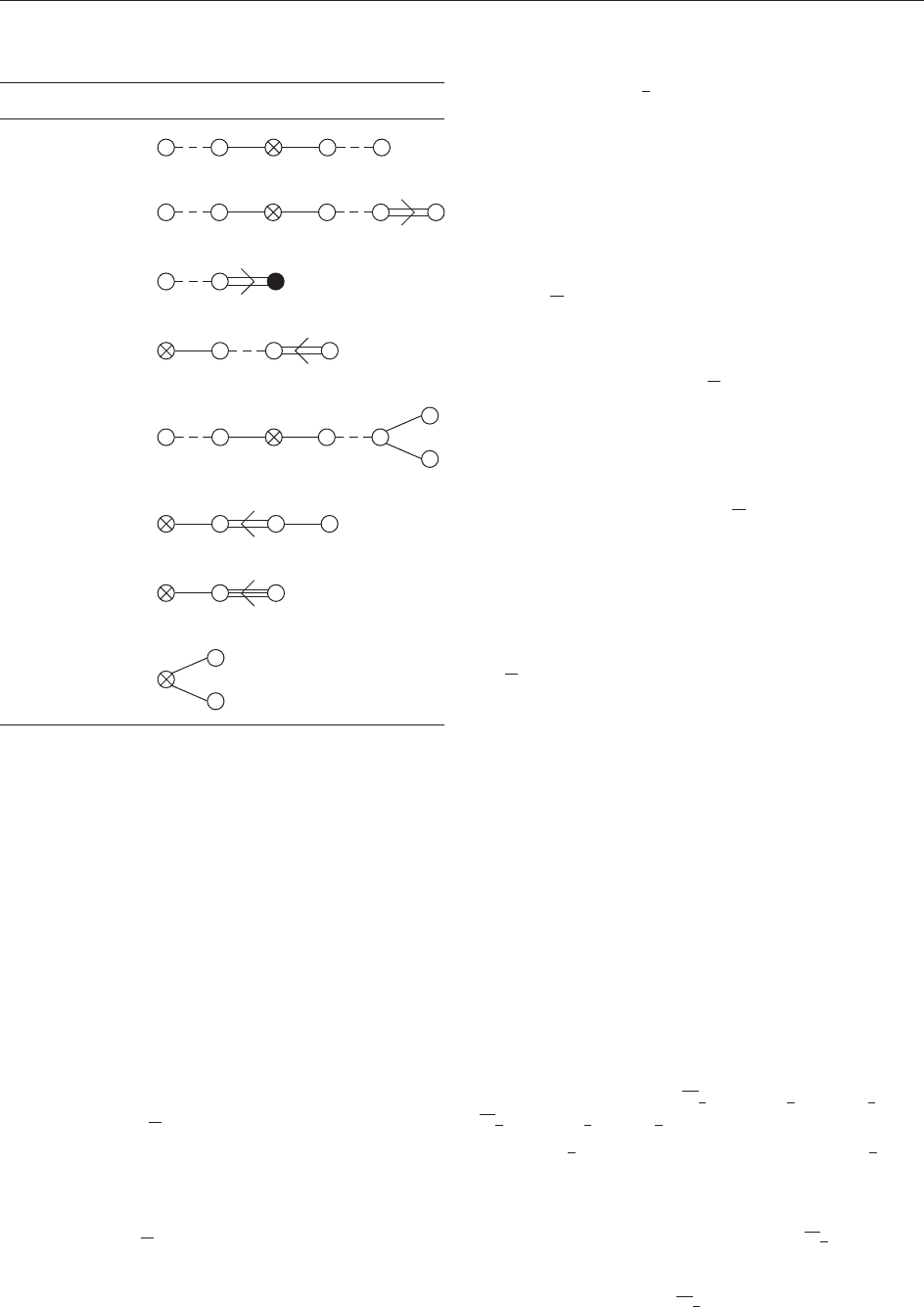
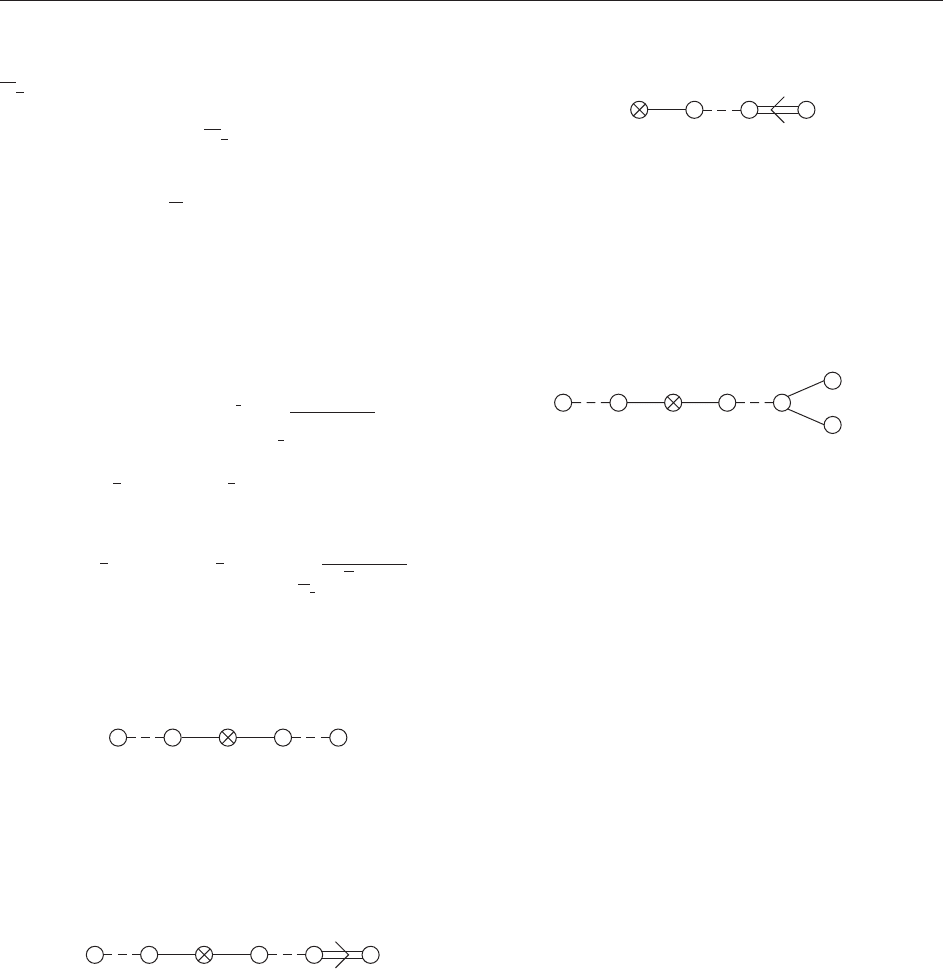
following rules:
1. One associates to each simple even root a white
dot, to each simple odd root of nonzero length
(a
ii
6¼ 0) a black dot, and to each simple odd root
of zero length (a
ii
= 0) a gray dot.
308 Lie Superalgebras and Their Representations
2. The ith and jth dots are joined by
ij
lines where
ij
¼
2ja
ij
j
minðja
ii
j; ja
jj
jÞ
if a
ii
:a
jj
6¼ 0
ij
¼
2ja
ij
j
minðja
ii
j; 2Þ
if a
ii
6¼ 0anda
jj
¼ 0
ij
¼ja
ij
j if a
ii
¼ a
jj
¼ 0
3. We add an arrow on the lines connecting the ith
and jth dots when
ij
> 1, pointing from i to j if
a
ii
.a
jj
6¼ 0 and ja
ii
j > ja
jj
j or if a
ii
= 0, a
jj
6¼ 0,
ja
jj
j < 2, and pointing from j to i if a
ii
= 0,
a
jj
6¼ 0, ja
jj
j > 2.
4. For D(2, 1; ),
ij
= 1ifa
ij
6¼ 0 and
ij
= 0if
a
ij
= 0. No arrow is put on the Dynkin diagram.
The distinguished Dynkin diagrams of the basic Lie
superalgebras are listed in Table 5.
Representation Theory of Basic Lie
Superalgebras
We restrict in the following to the basic Lie
superalgebras. We assume that G 6¼ psl(n, n) but the
following results still hold for sl(n jn). Let G= N
þ
HN
be a Borel decomposition of G where N
þ
(resp. N
) is spanned by the positive (resp. negative)
root generators of G, H is a Cartan subalgebra, and
H
is the dual of H. A representation : G!End V
with representation space V is called a highest-
weight representation with highest weight 2H
if
there exists a nonzero vector v
2Vsuch that
N
þ
v
¼ 0
hðv
Þ¼ðhÞv
ðh 2HÞ
The G-module V is called a highest-weight module,
denoted by V(), and the vector v
2V a highest-
weight vector. From now on, H is the distinguished
Cartan subalgebra of G with basis of generators
(H
1
, ..., H
r
) where r = rank G and H
s
denotes the
Cartan generator associated to the odd simple root.
The Kac–Dynkin labels are defined by
a
i
¼ 2
ð;
i
Þ
ð
i
;
i
Þ
for i 6¼ s and a
s
¼ð;
s
Þ
A weight 2H
is called a dominant weight if a
i
0
for all i 6¼ s,integralifa
i
2 Z for all i 6¼ s,andintegral
dominant if a
i
2 Z
0
for all i 6¼ s. A necessary
condition for the highest-weight representation of G
with highest weight to be finite dimensional is that
be an integral dominant weight.
One then defines the Kac module. Consider
G=
i2Z
G
i
the distinguished Z -gradation of G and
let K= G
0
N
þ
, where N
þ
=
i>0
G
i
, be a sub-
algebra of G. Denote by U(G) and U(K) the
corresponding universal enveloping superalgebras.
Let 2H
be an integral dominant weight and
V
0
() be the G
0
-module with highest weight ,
which is extended to a K-module by setting
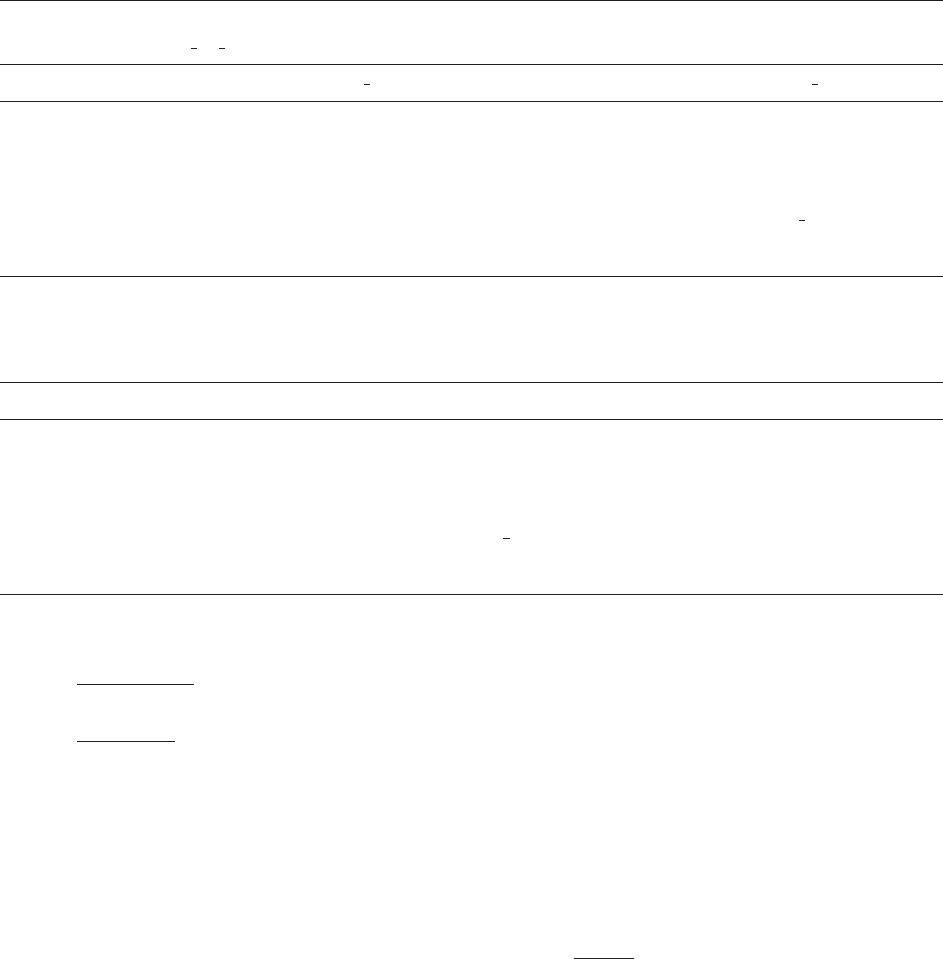
Table 3 Root systems
0
,
1
of the basic Lie superalgebras
Superalgebra G
0
1
A(m 1, n 1) "
i
"
j
,
k
l
("
i
k
)
B(m,n) "
i
"
j
, "
i
,
k
l
, 2
k
"
i
k
,
k
B(0, n)
k
l
, 2
k
k
C(n þ 1)
k
l
, 2
k
"
k
D(m,n) "
i
"
j
,
k
l
, 2
k
"
i
k
F(4) , "
i
"
j
, "
i
1
2
( "
1
"
2
"
3
)
G(3) 2, "
i
, "
i
"
j
, "
i
D(2, 1; ) 2"
i
"
1
"
2
"
3
1 i, j m,1 k , l n for A(m 1, n 1), B(m, n), C(n þ 1), D(m, n). 1 i, j 3 for F (4), G(3), D(2, 1; ), with "
1
þ "
2
þ "
3
= 0in
the case of G(3). For A(n 1, n 1), one has to add the condition "
1
þþ"
n
=
1
þþ
n
.
Table 4 Distinguished simple root systems of the basic Lie superalgebras
Superalgebra G Distinguished simple root system
0
A(m 1, n 1)
1
2
, ...,
n1
n
,
n
"
1
,"
1
"
2
, ..., "
m1
"
m
B(m, n)
1
2
, ...,
n1
n
,
n
"
1
, "
1
"
2
, ..., "
m1
"
m
, "
m
B(0, n)
1
2
, ...,
n1
n
,
n
C(n) "
1
,
1
2
, ...,
n1
n
,2
n
D(m, n)
1
2
, ...,
n1
n
,
n
"
1
, "
1
"
2
, ..., "
m1
"
m
, "
m1
þ "
m
F(4)
1
2
( "
1
"
2
"
3
), "
3
, "
2
"
3
, "
1
"
2
G(3) þ "
3
, "
1
, "
2
"
1
D(2, 1; ) "
1
"
2
"
3
,2"
2
,2"
3
Lie Superalgebras and Their Representations 309
N
þ
V
0
() = 0. From this K-module, it is possible to
construct a G-module in the following way. One
considers the factor space U(G)
U(K)
V
0
() consist-
ing of elements of U(G) V
0
() such that the
elements h v and 1 h(v) have been identified
for h 2K and v 2V
0
(). This space acquires the
structure of a G-module by setting g(u v) = gu v
for u 2U(G), g 2G, and v 2V
0
(). This G-module is
called the induced module from the K-module V
0
()
and denoted by Ind
G
K
V
0
(). For example, in the case
of type I basic Lie superalgebras, if {f
1
, ..., f
d
}
denotes a basis of odd generators of G=K, then
Ind
G
K
V
0
ðÞ¼
M
1i
1
<<i
k
d
f
i
1
...f
i
k
V
0
ðÞ
The Kac module
V() is defined as follows:
1. For a superalgebra G of type I (the odd part is the
direct sum of two irreducible representations of the
even part), the Kac module is the induced module
VðÞ¼Ind
G
K
V
0
ðÞ
2. For a superalgebra G of type II (the odd part is an
irreducible representation of the even part), the
induced module Ind
G
K
V
0
() contains a submodule
M() = U(G)G
bþ1
V
0
(), where is the longest
simple root of G
0
which is hidden behind the odd
simple root – that is, the longest simple root of
sp(2n) in the case of osp(m j2n) and the simple
root of sl(2) in the case of F(4), G(3), and
D(2, 1; ) – and b = 2(, )=( , ) is the compo-
nent of with respect to . The Kac module is
defined as the quotient of the induced module
Ind
G
K
V
0
() by the submodule M():
VðÞ¼Ind
G
K
V
0
ðÞ=UðGÞG
bþ1
V
0
ðÞ
In the case where the Kac module is not simple, it
contains a maximal submodule I() and the
quotient module V() =
V()=I() is a simple
module.
The fundamental result concerning the representa-
tions of basic Lie superalgebras is the following:
1. Any finite dimensional irreducible representation
of G is of the form V() =
V()=I(), where is
an integral dominant weight.
2. Any finite-dimensional simple G-module is
uniquely characterized by its integral dominant
weight : two G-modules V() and V(
0
) are
isomorphic if and only if =
0
.
3. The finite-dimensional simple G-module V() =
V()=I() has the weight decomposition
VðÞ¼
M
V
with
V
¼fv 2VjhðvÞ¼ðhÞv; h 2Hg
The presence of odd roots will have another
important consequence in the representation theory
of superalgebras. Indeed, one might find that in certain
representations, weight vectors, different from the
highest one specifying the representation, are annihi-
lated by all the generators corresponding to positive
roots. Such vector have, of course, to be decoupled
from the representation. Representations of this kind
are called atypical, while the other irreducible repre-
sentations not suffering this pathology are called
typical. For a basic Lie superalgebra G with root
system , one defines
0
= { 2
0
j=2 =2
1
}and
1
= { 2
1
j2=2
0
}. Let
0
be the half-sum of the
roots of
þ
0
,
1
the half-sum of the roots of
þ
1
,and
=
0
1
. The representation with highest
weight is called typical if
ð þ ; Þ 6¼ 0 for all 2
þ
1
The highest weight is then called typical. If
there exists some 2
þ
1
such that ( þ , ) = 0,
Table 5 Distinguished Dynkin diagrams of the basic Lie
superalgebras
Superalgebra G Distinguished Dynkin diagram
A(m 1, n 1)
B(m, n)
B(0, n)
C(n þ 1)
D(m, n)
F(4)
G(3)
D(2, 1; )
310 Lie Superalgebras and Their Representations
the representation and the highest weight are
called atypical. The number of distinct elements 2
þ
1
for which is atypical is the degree of
atypicality of the representation . If there exists
one and only one 2
þ
1
such that ( þ , ) = 0,
the representation and the highest weight are
called singly atypical.
The Kac module
V() is a simple G-module if and
only if the highest weight is typical. All the finite-
dimensional representations of B(0, n) are typical. All
the finite-dimensional representations of C(n þ 1) are
either typical or singly atypical.
The dimension of a typical finite-dimensional
representation V of G is given by
dim VðÞ¼2
dim
þ
1
Y
2
þ
0
ð þ ; Þ
ð
0
;Þ
where dim V
0
() = dim V
1
()ifG 6¼ B(0, n), and if
G= B(0, n),
dim V
0
ðÞdim V
1
ðÞ¼
Y
2
þ
0
ð þ ; Þ
ð
0
;Þ
The atypicality conditions are the following:
For A(m, n ) with =(a
1
, ..., a
mþn1
)
a
1
a
n – 1
a
n
a
n + 1
a
m + n – 1
X
n1
k¼i
a
k
X
j
k¼nþ1
a
k
þ a
n
¼ i þ j 2n
where 1 i n j m þ n 1.
B(m, n) with =(a
1
, ..., a
mþn
)(m 6¼ 0)
a
1
a
n – 1
a
n
a
n + 1
a
m + n – 1
a
m + n
X
n
q¼i
a
q
X
j
q¼nþ1
a
q
¼ i þ j 2n
X
n
q¼i
a
q
X
j
q¼nþ1
a
q
2
X
mþn1
q¼jþ1
a
q
a
mþn
¼ 2m þ i j 1 ¼ 0
where 1 i n j m þ n 1.
C(n þ 1) with =(a
1
, ..., a
nþ1
)
a
1
a
2
a
n
a
n + 1
a
1
X
i
q¼2
a
q
i þ 1 ¼ 0
a
1
X
i
q¼2
a
q
2
X
nþ1
q¼iþ1
a
q
2n þ i 1 ¼ 0
where 1 i n.
D(m jn) with =(a
1
, ..., a
mþn
)
a
1
a
n – 1
a
n
a
n + 1
a
m + n – 2
a
n + m – 1
a
n + m
X
n
q¼i
a
q
X
j
q¼nþ1
a
q
¼ i þ j 2n
where 1 i n j m þ n 1
X
n
q¼i
a
q
X
mþn2
q¼nþ1
a
q
a
mþn
¼ m n þ i 1
where 1 i n
X
n
q¼i
a
q
X
j
q¼nþ1
a
q
2
X
mþn2
q¼jþ1
a
q
¼ a
mþn1
þ a
mþn
þ 2m þ i j 2
where 1 i n j m þ n 2
See also: Lie Groups: General Theory; Lie, Symplectic,
and Poisson Groupoids and Their Lie Algebroids.
Further Reading
Frappat L, Sciarrino A, and Sorba P (2000) Dictionary on Lie
Algebras and Superalgebras. London: Academic Press.
Kac VG (1977a) Lie superalgebras. Advances in Mathematics 26: 8.
Kac VG (1977b) A sketch of Lie superalgebra theory. Commu-
nications in Mathematical Physics 53: 31.
Kac VG (1978) Representations of Classical Lie Superalgebras,
Lecture Notes in Mathematics, vol. 676. Berlin: Springer.
Lie Superalgebras and Their Representations 311
Lie, Symplectic, and Poisson Groupoids and Their Lie Algebroids
C-M Marle, Universite
´
P.-M. Curie, Paris VI, Paris,
France
ª 2006 Elsevier Ltd. All rights reserved.
Introduction
Groupoids are mathematical structures able to describe
symmetry properties more general than those described
by groups. They were introduced (and named) by
H Brandt in 1926. Around 1950, Charles Ehresmann
used groupoids with additional structures (topological
and differentiable) as essential tools in topology and
differential geometry. In recent years, Mickael Karasev,
Alan Weinstein, and Stanisław Zakrzewski indepen-
dently discovered that symplectic groupoids can be used
for the construction of noncommutative deformations
of the algebra of smooth functions on a manifold, with
potential applications to quantization. Poisson group-
oids were introduced by Alan Weinstein as general-
izations of both Poisson Lie groups and symplectic
groupoids.
We present here the main definitions and first
properties relative to groupoids, Lie groupoids, Lie
algebroids, symplectic and Poisson groupoids and
their Lie algebroids.
Groupoids
What is a Groupoid?
Before stating the formal definition of a groupoid, let us
explain, in an informal way, why it is a very natural
concept. The easiest way to understand that concept is
to think of two sets, and
0
. The first one, , is called
the ‘‘set of arrows’’ or ‘‘total space’’ of the groupoid,
and the other one,
0
,the‘‘setofobjects’’or‘‘setof
units’’ of the groupoid. One may consider an element
x 2 as an arrow going from an object (a point in
0
)
to another object (another point in
0
). The word
‘‘arrow’’ is used here in a very general sense: it means a
way for going from a point in
0
to another in
0
.One
should not consider an arrow as a line drawn in the set
0
joining the starting point of the arrow to its
endpoint: this happens only for some special groupoids.
Rather, one should think of an arrow as living outside
0
, with only its starting point and its endpoint in
0
,as
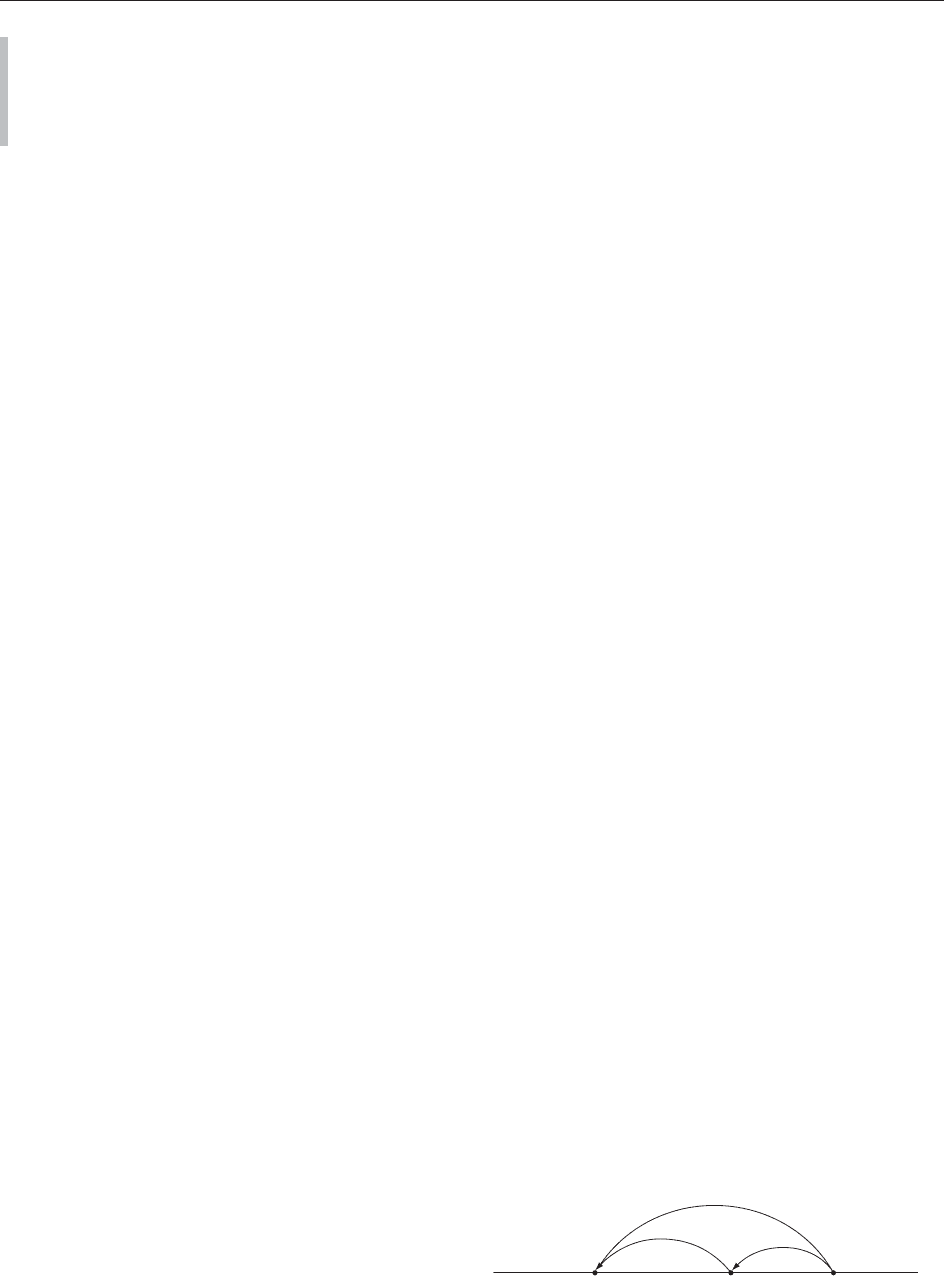
shown in Figure 1.
The following ingredients enter the definition of a
groupoid.
1. Two maps : !
0
and : !
0
, called the
‘‘target map’’ and the ‘‘source map’’ of the
groupoid. If x 2 is an arrow, (x) 2
0
is its
endpoint and (x) 2
0
its starting point.
2. A ‘‘composition law’’ on the set of arrows; we can
compose an arrow y with another arrow x,andget
an arrow m (x, y), by following first the arrow y,
then the arrow x. Of course, m(x, y) is defined if and
only if the target of y is equal to the source of x.The
source of m(x, y ) is equal to the source of y,andits
target is equal to the target of x, as illustrated in
Figure 1. It is only by convention that we write
m(x, y) rather than m(y, x): the arrow which is
followed first is on the right, by analogy with the
usual notation f g for the composition of two
maps g and f. When there is no risk of confusion, we
write x y,orx . y, or even simply xy for m(x, y).
The composition of arrows is associative.
3. An ‘‘embedding’’ " of the set
0
into the set ,which
associates a unit arrow "(u)witheachu 2
0
.
That unit arrow is such that both its source and its
target are u, and it plays the role of a unit when
composed with another arrow, either on the right or
on the left: for any arrow x, m("((x)), x) = x,and
m(x, "((x))) = x.
4. Finally, an ‘‘inverse map’’ from the set of
arrows onto itself. If x 2 is an arrow, one may
think of (x) as the arrow x followed in the
reverse sense. We often write x
1
for (x).
Now we are ready to state the formal definition of
a groupoid.
Definition 1 A groupoid is a pair of sets (,
0
)
equipped with the structure defined by the following
data:
(i) an injective map " :
0
!, called the unit
section of the groupoid;
(ii) two maps : !
0
and : !
0
, called,
respectively, the target map and the source
map; they satisfy
" ¼ " ¼ id
0
½1
(iii) a composition law m :
2
!, called the pro-
duct, defined on the subset
2
of , called
the set of composable elements,
2
¼fðx; yÞ2 ; ðxÞ¼ðyÞg ½2
m(x,y)
x
y
α
(m(x,y)) = α(x) β(x) = α (y) β(y) = β(m(x,y))
Γ
Γ
0
Figure 1 Two arrows x and y 2 , with the target of y, (y) 2
0
,
equal to the source of x, (x) 2
0
, and the composed arrow m(x, y ).
312 Lie, Symplectic, and Poisson Groupoids and Their Lie Algebroids
which is associative, in the sense that whenever
one side of the equality
mðx; mðy; zÞÞ ¼ mðmðx; yÞ; zÞ½3
is defined, the other side is defined too, and the
equality holds; moreover, the composition law
m is such that for each x 2 ,
m "ðxÞðÞ; xðÞ¼mx;" ðxÞðÞðÞ¼x ½4
(iv) a map : ! , called the inverse, such that, for
every x 2 ,(x, (x)) 2
2
and ((x), x) 2
2
,and
mðx;ðxÞÞ¼ "ððxÞÞ; mððxÞ; xÞ¼"ððxÞÞ ½5
The sets and
0
are called, respectively, the
total space and the set of units of the groupoid,
which is itself denoted by
ƒ
0
.
Identification and Notations
In what follows, by means of the injective map ",we
will identify the set of units
0
with the subset "(
0
)
of . Therefore, " will be the canonical injection in
of its subset
0
.
For x and y 2 , we will sometimes write x . y,or
even simply xy for m(x, y), and x
1
for (x). In
addition, we will write ‘‘the groupoid ’’ for ‘‘the
groupoid
ƒ
0
.’’
Properties and Comments
The above definitions have the following consequences.
Involutivity of the inverse map The inverse map
is involutive:
¼ id
½6
We have indeed, for any x 2 ,
ðxÞ¼mð ðxÞ;ð ðxÞÞÞ
¼mð ðxÞ;ðxÞÞ ¼ mð ðxÞ; mððxÞ; xÞÞ
¼mðmð ðxÞ;ðxÞÞ; xÞ¼mððxÞ; xÞ¼x
Unicity of the inverse Let x and y 2 be such that
mðx;
yÞ¼ðxÞ and mðy; xÞ¼ðxÞ
Then we have
y ¼my;ðyÞðÞ¼my;ðxÞðÞ
¼my; mx;ðxÞðÞðÞ¼mmðy; xÞ;ðxÞðÞ
¼m ðxÞ;ðxÞðÞ¼m ðxÞðÞ;ðxÞðÞ¼ðxÞ
Therefore for any x 2 , the unique y 2 such that
m(y, x) = (x) and m(
x, y) = (x)is(x).
The fibers of and and the isotropy groups The
target map (resp. the source map ) of a groupoid
ƒ
0
determines an equivalence relation on :
two elements x and y 2 are said to be -equivalent
(resp. -equivalent) if (x) = (y) (resp. if
(x) = (y)). The corresponding equivalence classes
are called the -fibers (resp. the -fibers) of the
groupoid. They are of the form
1
(u) (resp.
1
(u)),
with u 2
0
.
For each unit u 2
0
, the subset
u
¼
1
ðuÞ\
1
ðuÞ
¼fx 2 ; ðxÞ¼ðxÞ¼ug½7
is called the ‘‘isotropy group’’ of u. It is indeed a
group, with the restrictions of m and as composi-
tion law and inverse map.
A way to visualize groupoids We have seen
(Figure 1) a way in which groupoids may be
visualized, by using arrows for elements in and
points for elements in
0
. There is another very
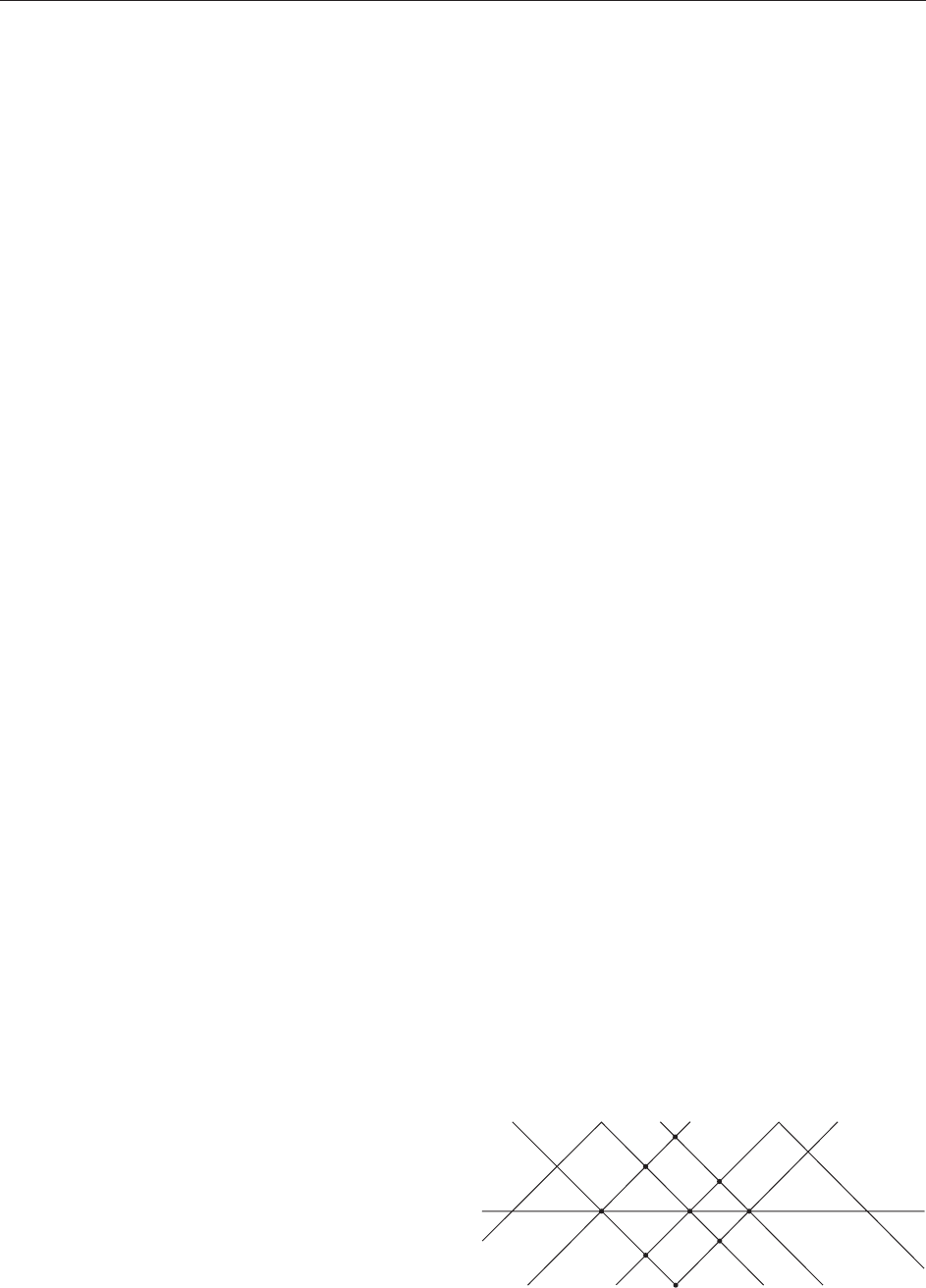
useful way to visualize groupoids, shown in
Figure 2.
The total space of the groupoid is represented as
a plane, and the set
0
of units as a straight line in that
plane. The -fibers (resp. the -fibers) are represented
as parallel straight lines, transverse to
0
.
Examples of Groupoids
The groupoid of pairs Let E be a set. The ‘‘group-
oid of pairs’’ of elements in E has, as its total
space, the product space E E. The diagonal
E
= {(x, x); x 2 E} is its set of units, and the target
and source maps are
: ðx; yÞ7!ðx; xÞ;: ðx; yÞ7!ðy; yÞ
Its composition law m and inverse map are
mððx; y Þ; ðy; zÞÞ ¼ ðx; zÞ
ððx; yÞÞ ¼ ðx; yÞ
1
¼ðy; xÞ
Groups A group G is a groupoid with set of units
{e}, with only one element e, the unit element of the
m(x,y)
α(x)
β(y)
β(x)
= α(y)
x
y
Γ
0
ι(x)
ι(y)
ι(m(x,y))
α-fiber
β-fiber
Figure 2 A way to visualize groupoids.
Lie, Symplectic, and Poisson Groupoids and Their Lie Algebroids 313

group. The target and source maps are both equal to
the constant map x 7!e.
Definition 2 A topological groupoid is a groupoid
ƒ
0
for which is a (maybe non-Hausdorff)
topological space,
0
a Hausdorff topological subspace
of , and surjective continuous maps, m :
2
! a
continuous map, and : ! a homeomorphism.
A Lie groupoid is a groupoid
ƒ
0
for which
is a smooth (maybe non-Hausdorff) manifold,
0
a
smooth Hausdorff submanifold of , and smooth
surjective submersions (which implies that
2
is a
smooth submanifold of ), m :
2
! a smooth
map, and : ! a smooth diffeomorphism.
Properties of Lie Groupoids
Dimensions Let
ƒ
0
be a Lie groupoid. Since
and are submersions, for any x 2 , the -fiber
1
((x)) and the -fiber
1
((x)) are submanifolds
of , both of dimension dim dim
0
. The inverse
map , restricted to the -fiber through x (resp. the
-fiber through x), is a diffeomorphism of that fiber
onto the -fiber through (x) (resp. the -fiber
through (x)). The dimension of the submanifold
2
of composable pairs in is 2 dim dim
0
.
The tangent bundle of a Lie groupoid Let
ƒ
0
be
a Lie groupoid. Its tangent bundle T is a Lie
groupoid, with T
0
as set of units, T : T !T
0
and T : T ! T
0
as target and source maps. Let us
denote by
2
the set of composable pairs in ,by
m :
2
! the composition law, and by : ! the
inverse. Then the set of composable pairs in T T
is simply T
2
, the composition law on T is
Tm : T
2
! T, and the inverse is T : T ! T.
When the groupoid is a Lie group G, the Lie
groupoid TG is a Lie group too. We will see that
the cotangent bundle of a Lie groupoid is a Lie
groupoid, and more precisely a symplectic groupoid.
Isotropy grou ps For each unit u 2
0
of a Lie
groupoid, the isotropy group
u
(defined earlier) is a
Lie group.
Examples of Topological and Lie Groupoids
Topological groups and Lie groups A topological
group (resp. a Lie group) is a topological groupoid
(resp. a Lie groupoid) whose set of units has only
one element e.
Vector bundles A smooth vector bundle : E ! M
on a smooth manifold M is a Lie groupoid, with the
base M as set of units (identified with the image of
the zero section); the source and target maps both
coincide with the projection ; the product and the
inverse maps are the addition (x, y) 7!x þ y and the
opposite map x 7!x in the fibers.
The fundamental groupoid of a topological space Let
M be a topological space. A ‘‘path’’ in M is a
continuous map : [0, 1] ! M. We denote by [] the
homotopy class of a path and by (M) the set of
homotopy classes of paths in M (with fixed end-
points). For [] 2 (M), we set ([]) = (1),
([]) = (0), where is any representative of the
class []. The concatenation of paths determines a
well-defined composition law on (M), for which
(M)
ƒ
M is a topological groupoid, called the
‘‘fundamental groupoid’’ of M. The inverse map is
[] 7![
1
], where is any representative of [] and
1
is the path t 7!(1 t). The set of units is M,if
we identify a point in M with the homotopy class of
the constant path equal to that point.
When M is a smooth manifold, the same
construction can be made with piecewise smooth
paths, and the fundamental groupoid (M)
ƒ
M is a
Lie groupoid.
Symplectic and Poisson Groupoids
Symplectic and Poisson Geometry
Let us recall some definitions and results in
symplectic and Poisson geometry, used in the next
sections.
Symplectic manifolds A ‘‘symplectic form’’ on a
smooth manifold M is a differential 2-form !, which
is closed, that is, which satisfies
d! ¼ 0 ½8
and nondegenerate, that is, such that for each point
x 2 M and each nonzero vector v 2 T
x
M, there
exists a vector w 2 T
x
M such that !(v, w) 6¼ 0.
Equipped with the symplectic form !, a smooth
manifold M is called a ‘‘symplectic manifold’’ and
denoted by (M, !).
The dimension of a symplectic manifold is always
even.
The Liouville form on a cotangent bundle Let N
be a smooth manifold, and T
N be its cotangent
bundle. The Liouville form on T
N is the 1-form
such that, for any 2 T
N and v 2 T
(T
N),
ðvÞ¼ ; T
N
ðvÞ
hi
½9
where
N
: T
N ! N is the canonical projection.
The 2-form ! = d is symplectic, and is called the
‘‘canonical symplectic form’’ on the cotangent
bundle T
N.
314 Lie, Symplectic, and Poisson Groupoids and Their Lie Algebroids

Poisson manifolds A Poisson manifold is a smooth
manifold P equipped with a bivector field (i.e., a
smooth section of ^
2
TP) which satisfies
½; ¼0 ½10
the bracket on the left-hand side being the Schouten
bracket. The bivector field will be called the
Poisson structure on P. It allows us to define a
composition law on the space C
1
(P, R) of smooth
functions on P, called the Poisson bracket and
denoted by (f , g) 7!{f , g}, by setting, for all f and
g 2 C
1
(P, R) and x 2 P,
ff ; ggðxÞ¼ df ðxÞ; dgð xÞðÞ½11
That composition law is skew-symmetric and satis-
fies the Jacobi identity, therefore turns C
1
(P, R) into
a Lie algebra.
Hamiltonian vector fields Let (P, ) be a Poisson
manifold. We denote by
]
: T
P ! TP the vector
bundle map defined by
;
]
ðÞ
¼ ð; Þ½12
where and are two elements in the same fiber of
T
P. Let f : P ! R be a smooth function on P. The
vector field X
f
=
]
(df ) is called the Hamiltonian
vector field associated to f.Ifg : P ! R is another
smooth function on P, the Poisson bracket {f , g} can
be written as
ff ; gg¼ dg ;
]
ðdf Þ
¼df ;
]
ðdgÞ
½13
The canonical Poisson structure on a symplectic
manifold Every symplectic manifold (M, !) has a
Poisson structure, associated to its symplectic
structure, for which the vector bundle map
]
: T
M ! M is the inverse of the vector bundle
isomorphism v 7!i(v)!. We will always consider
that a symplectic manifold is equipped with that
Poisson structure, unless otherwise specified.
The KKS Poisson structure Let G be a finite-
dimensional Lie algebra. Its dual space G
has a
natural Poisson structure, for which the bracket of
two smooth functions f and g is
ff ; ggðÞ¼ ; df ðÞ; dgðÞ½
hi
½14
with 2G
, the differentials df ()anddg() being
considered as elements in G, identified with its
bidual G
. It is called the Kirillov, Kostant, and
Souriau (KKS) Poisson structure on G
.
Poisson maps Let (P
1
,
1
)and(P
2
,
2
) be two
Poisson manifolds. A smooth map ’ : P
1
! P
2
is
called a Poisson map if, for every pair (f , g)of
smooth functions on P
2
,
f’
f ;’
gg
1
¼ ’
ff ; gg
2
½15
Product Poisson structures The product P
1
P
2
of two Poisson manifolds (P
1
,
1
) and (P
2
,
2
) has
a natural Poisson structure: it is the unique
Poisson structure for which the bracket of
functions of the form (x
1
, x
2
) 7!f
1
(x
1
)f
2
(x
2
)and
(x
1
, x
2
) 7!g
1
(x
1
)g
2
(x
2
) (where f
1
and g
1
2 C
1
(P
1
, R), f
2
and g
2
2 C
1
(P
2
, R)) is
ðx
1
; x
2
Þ7!ff
1
; g
1
g
1
ðx
1
Þff
2
; g
2
g
2
ðx
2
Þ
The same property holds for the product of any
finite number of Poisson manifolds.
Symplectic orthogonality Let (V, !) be a symplectic
vector space, that means a real, finite-dimensional
vector space V with a skew-symmetric nondegenerate
bilinear form !.LetW be a vector subspace of V.
The ‘‘symplectic orthogonal’’ of W is
orth W ¼ v 2 V; !ðv; wÞ¼0 for all w 2 Wfg½16
It is a vector subspace of V, which satisfies
dim W þdimðorth WÞ¼dim V; orthðorth WÞ¼W
The vector subspace W is said to be isotropic if
W orth W, coisotropic if orthW W, and
Lagrangian if W = orthW. In any symplectic vector
space, there are many Lagrangian subspaces; there-
fore, the dimension of a symplectic vector space is
always even; if dim V =2n, the dimension of an
isotropic (resp. coisotropic, resp. Lagrangian) vector
subspace is n (resp. n, resp. = n).
Coisotropic and Lagrangian submanifolds A sub-
manifold N
of a Poisson manifold (P, ) is said to be
coisotropic if the bracket of two smooth functions,
defined on an open subset of P and which vanish on
N, vanishes on N too. A submanifold N of a
symplectic manifold (M, !) is coisotropic if and only
if for each point x 2 N, the vector subspace T
x
N of
the symplectic vector space (T
x
M, !(x)) is coisotro-
pic. Therefore, the dimension of a coisotropic
submanifold in a 2n-dimensional symplectic mani-
fold is n; when it is equal to n, the submanifold N
is said to be Lagrangian.
Poisson quotients Let ’ : M ! P be a surjective
submersion of a symplectic manifold (M, !) onto a
Lie, Symplectic, and Poisson Groupoids and Their Lie Algebroids 315

manifold P. The manifold P has a Poisson structure
for which ’ is a Poisson map if and only if
orth( ker T’) is integrable. When that condition is
satisfied, that Poisson structure on P is unique.
Poisson Lie groups A Poisson Lie group is a Lie
group G with a Poisson structure , such that the
product (x, y) 7!xy is a Poisson map from G G,
endowed with the product Poisson structure, into
(G, ). The Poisson structure of a Poisson Lie group
(G, ) always vanishes at the unit element e of G.
Therefore, the Poisson structure of a Poisson Lie
group never comes from a symplectic structure on
that group.
Definition 3 A symplectic groupoid (resp. a Pois-
son groupoid) is a Lie groupoid
ƒ
0
with a
symplectic form ! on (resp. with a Poisson
structure on ) such that the graph of the
composition law m
ðx; y; zÞ2 ; ðx; yÞ2
2
and z ¼ mðx; yÞ
fg
is a Lagrangian submanifold (resp. a coisotropic
submanifold) of
with the product
symplectic form (resp. the product Poisson structure),
the first two factors being endowed with the
symplectic form ! (resp. with the Poisson structure ),
andthethirdfactor
being with the symplectic form
! (resp. with the Poisson structure ).
The next theorem states important properties of
symplectic and Poisson groupoids.
Theorem 4 Let
ƒ
0
be a symplectic groupoid
with symplec tic 2-form ! (resp. a Poisson groupoid
with Poisson structure ). We have the following
properties.
(i) For a symplectic groupoid, given any point
c 2 , each one of the two vector subspaces of
thesymplecticvectorspace(T
c
, !(c)),
T
c
ð
1
ððcÞÞÞ and T
c
ð
1
ððcÞÞÞ
is the symplectic orthogonal of the other one.
For a symplectic or Poisson groupoid, if f is
a smooth function whose restriction to each
-fiber is constant, and g a smooth funct ion
whose restriction to each -fiber is constant,
then the Poisson bracket {f , g} vanishes
identically.
(ii) The submanifold of units
0
is a Lagrangian
submanifold of the symplectic manifold (, !)
(resp. a coisotropic submanifold of the Poisson
manifold (, )).
(iii) The inverse map : ! is an antisymplecto-
morphism of (, !), that is, it satisfies
! = !
(resp. an anti-Poisson diffeomorphism of (, ),
i.e., it satisfies
=).
Corollary 5 Let
ƒ
0
be a symplectic groupoid
with symp lectic 2-form ! (resp. a Poisson group-
oid with Poisson structure ). There exists on
0
a
unique Poisson structure
0
for whi ch : !
0
is a Poisson map, and : !
0
an anti-Poisson
map (i.e., is a Poisson map when
0
is equipped
with the Poisson structure
0
).
Examples of Symplectic and Poisson Groupoids
The cotangent bundle of a Lie groupoid Let
ƒ
0
be a Lie groupoid.
We have seen above that its tangent bundle T
has a Lie groupoid structure, determined by that of
. Similarly (but much less obviously), the cotan-
gent bundle T
has a Lie groupoid structure
determined by that of . The set of units is the
conormal bundle to the submanifold
0
of ,
denoted by N
0
.WerecallthatN
0
is the vector
sub-bundle of T
0
(the restriction to
0
of the
cotangent bundle T
), whose fiber N
p
0
at a
point p 2
0
is
N
p
0
¼ 2 T
p
; ; v
hi
¼ 0 for all v 2 T
p
0
no
To define the target and source maps of the
Lie algebroid T
, we introduce the notion of
‘‘bisection’’ through a point x 2 . A bisection
through x is a submanifold A of , with x 2 A,
transverse both to the -fibers and to the -fibers,
such that the maps and , when restricted to A,
are diffeomorphisms of A onto open subsets (A)
and (A)of
0
, respectively. For any point x 2 M,
there exist bisections through x. A bisection A
allows us to define two smooth diffeomorphisms
between open subsets of , denoted by L
A
and R
A
and called the left and right translations by A,
respectively. They are defined by
L
A
:
1
ðAÞðÞ!
1
ðAÞðÞ
L
A
ðyÞ¼m j
1
A
ðyÞ; y
and
R
A
:
1
ðAÞðÞ!
1
ðAÞðÞ
R
A
ðyÞ¼my;j
1
A
ðyÞ
The definitions of the target and source maps for
T
rest on the following properties. Let x be a
point in and A be a bisection through x. The two
vector subspaces, T
(x)
0
and ker T
(x)
, are com-
plementary in T
(x)
. For any v 2 T
(x)
, v T(v)
is in ker T
(x)
. Moreover, R
A
maps the fiber
316 Lie, Symplectic, and Poisson Groupoids and Their Lie Algebroids