
Francoise J.-P., Naber G.L., Tsun T.S. (editors) Encyclopedia of Mathematical Physics
Подождите немного. Документ загружается.


Quantum Statistical Mechanics: Overview
L Triolo, Universita
`
di Roma ‘‘Tor Vergata’’,
Rome, Italy
ª 2006 Elsevier Ltd. All rights reserved.
Introduction
Quantum theory actually started at the beginning of
the twentieth century as a many-body theory,
attempting to solve problems to which classical
physics gave unsatisfactory answers.
This article aims to follow the developments of
quantum statistical mechanics, hereafter called
QSM, staying close to the underlying physics and
sketching its methods and perspectives. The next
section outlines the historical path, and the first
achievements by Planck (1900) and Debye (1913);
the subsequent free quantum gas theory will be
recalled in the first original insights due to Fermi,
Dirac (1926) and Bose, Einstein (1924–25), when
many open problems began to find a coherent
treatment.
In this framework, an interesting new idea
appeared: the elementary units of the systems could
be ‘‘particles’’, in the usual or in a broad meaning, a
notion which includes photons, phonons, and
quasiparticles of current use in condensed matter
physics. The description of a classical harmonic
system through independent normal modes is an
example of a very fruitful use of collective variable s.
The subsequent section will deal with more recent
achievements, related to the properties of quantum
N-body systems, which are fundamental for the
derivation of their macroscopic behavior. In parti-
cular, the works by Dyson–Lenard and Lieb–
Lebowitz on the stability of matter have to be
recalled: a system made of electrons and ions has a
thermodynamic behavior, thanks to the quantum
nature of its constituents, where the Pauli exclusion
principle plays an essential role .
We will then present relations that arise in
quantum field theory, that is, from the second
quantization methods; related technical and concep-
tual problems will also be presented briefly.
This is necessary for taking into account the
recent works and perspectives, which will be
considered in the last section. Here the new inputs
and challenges from outstanding achievemen ts in
physics laboratories will be taken into account,
referring to some exactly solvable models which
help in understanding and in fixing the boundaries
of approximate methods.
The Crisis of Classical Physics:
The Quantum Free Gas
Let us briefly recall some of what Lord Kelvin called
the ‘‘nineteenth century clouds’’ over the physics
of that time (1884), and the subsequent new ideas,
(Gallavotti 1999).
It is well known that the classical Dulong–Petit law
of specific heat of solid crystals may be derived from
the model of point particles interacting through
harmonic forces; the equipartition of the mean energy
among the degrees of freedom implies, for N
particles, the linear dependence of the internal energy
U
N
on absolute temperat ure T, hence a constant heat
capacity C
N
(k
B
is the Boltzmann’s consta nt)
U
N
¼ 6
1
2
Nk
B
T; C
N
:¼
@U
N
@T
¼ 3Nk
B
½1
Experimentally this is relatively well satisfied at high
temperatures but it is violated for low T: one
observes that U
N
vanishes faster than linearly as T
goes to zero, so that C
N
vanishes. Moreover, the
contributions to the heat capacity from the internal
degrees of freedom of the molecular gases or from
the free electrons in conducting solids are negligible,
at room temperature: these degrees of freedom, in
spite of the equipartition principle, seem frozen.
The analysis of the blackbody radiation problem
from the classical point of view, that is, using
equipartition among the normal modes of the
electromagnetic field in the ‘‘black’’ cavity at
temperature T , gives the following dependence,
Rayleigh–Jeans law (1900), of the spectral energy
density u(, T), on frequency and temperature T
(c is the speed of light in vacuum):
uð;TÞ¼
8
2
c
3
k
B
T ½2
The experimental curves for any positive T show a
maximum for a frequency
max
(T) which increases
linearly with T according to Wien’s displacement
law (1893). The spectral energy density decreases
fast enough to zero as !1 in such a way that the
overall (integrated) energy is (finite and) propor-
tional to T
4
, according to Stefan’s law (1879); the
agreement with the classical form holds for low
frequencies. The analytic form of the classical
u(, T)in[2] does not present maxima and the
overall radiated energy is clearly divergent (this bad
behavior for large , present in many formulas for
other models, sometimes in the corresponding
‘‘short-distance’’ form, is called an ‘‘ultraviolet
catastrophe’’).
302 Quantum Statistical Mechanics: Overview
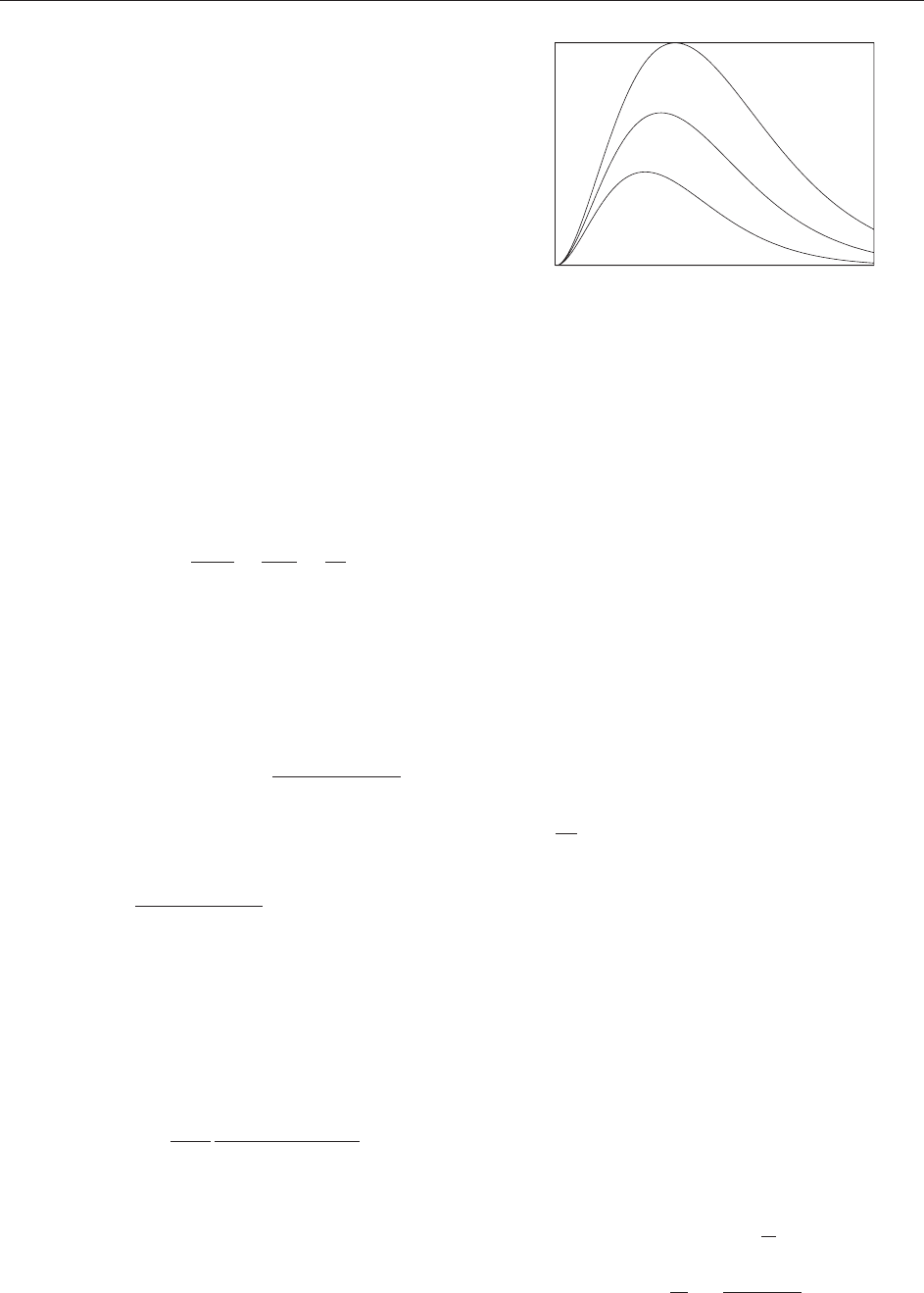
The effort by M Planck (1900) to understand the
right dependence of u from and T was based on a
thermodynamic argument about the possible
energy–entropy relation, and on an assumption
similar to the discretization rules on which the
‘‘old quantum theory’’ for the atomic structure is
based. The electromagnetic field is represented, via
Fourier analysis, as a set of infinitely many
independent harmonic oscillators, two for every
wave vector k, to take into account the polarization.
The frequency depends linearly on the wave number
k = jkj (linear dispersion law), and the spacing
becomes negligible for macroscopic dimensions of
the cavity. The key idea for computing the partition
function is the discretization of the phase space of
each oscillator (of frequency = !=2). Putting
there the adimensionalized Lebesgue measure
dp dq=h, where h is a constant with physical
dimensions of an action, we consider the regions
R
E
bounded by the constant-energy ellipses and
their areas jR
E
j, and find
jR
E
j¼
Z
R
E
dpdq
h
¼
2E
h!
¼
E
h
If these adimensional areas have integer values, that
is, E = nh, n = 0, 1, 2, ..., the annular region (‘‘cell’’
C
n
) between R
E
n
and R
E
nþ1
has unit area and so we
approximate the partition function with the series
( = 1=(k
B
T), the ubiquitous parameter in statisti cal
mechanics, often called ‘‘inverse temperature’’)
Z
discr
¼
X
n
expðnhÞ¼
1
1 expðhÞ
In this way, the probabilistic weight given to this
cell is
pðC
n
Þ¼
expðnhÞ
P
j
expðjhÞ
¼ expðnhÞð1 expðhÞÞ ½3
A well-defined value for the constant h (i.e., h =
6.626 ... 10
27
erg s, the Planck constant), com-
bined with the usual computation for the density of
states, gives a formula which quantitatively agrees
with experimental data (see Figure 1)
uð;TÞ¼
8
2
c
3
h
expðh=k
B
TÞ1
½4
Moreover, for a certain range of parameters, that
is, such that h 1, there is agreement with the
classical law.
The ‘‘quantum of light,’’ introduced by Einstein in
1905 in his work on photoelectric effect, was later
(1926) called photon by G N Lewis. The picture for
representing the radiating system was one of a gas
of noninteracting photons, carrying energy and
momentum, and being continuously created and
absorbed.
A sligh tly different approach was used about the
same time, for the proble m of specific heat of
crystalline solids.
The simpler model considers N points on the
nodes of the lattice Z
3
, in a cubic box of side L, and
interacting through harmonic forces; similarly to the
radiation problem, the system is represented by a
collection of independent harmonic oscillators (nor-
mal modes), which are ‘‘quantized’’ as before: the
corresponding quanta were called phonons (by
Fraenkel, in 1932) for the role of the acoustic band
of frequencies. In this simplified approach (by
Debye, in 1913) the different phonons are deter-
mined by a finite set of wave vectors
k ¼
2
L
n; n
i
integer; i ¼ 1; 2; 3; jkjk
M
where the maximal modulus k
M
is such that the
total number of different k’s is 3N (degrees of
freedom).
Moreover, the frequency–wave number relation is
simplified too, extrapolating the low-frequency
(acoustic) linear relation = jkjv
0
(v
0
is the sound
speed). In this way, the density of states which is
quadratic in the frequency, has a cutoff to zero at
the maximal frequen cy,
D
, corresponding to
jk
M
j, with an associate temperature
D
= h
D
=k
B
(Debye’s temperature). The expected energy U
N
in
the canonical ensemble, after the computation of the
canonical partition function, is given in term of the
Debye function D():
U
N
¼ 3Nk
B
TD
T
DðyÞ:¼
3
y
3
Z
y
0
x
3
dx
exp x 1
½5
u (ν,T
i
)
T
1
T
2
T
3
ν
Figure 1 Dependence of the electromagnetic energy density
on , for T
1
< T
2
< T
3
.
Quantum Statistical Mechanics: Overview 303
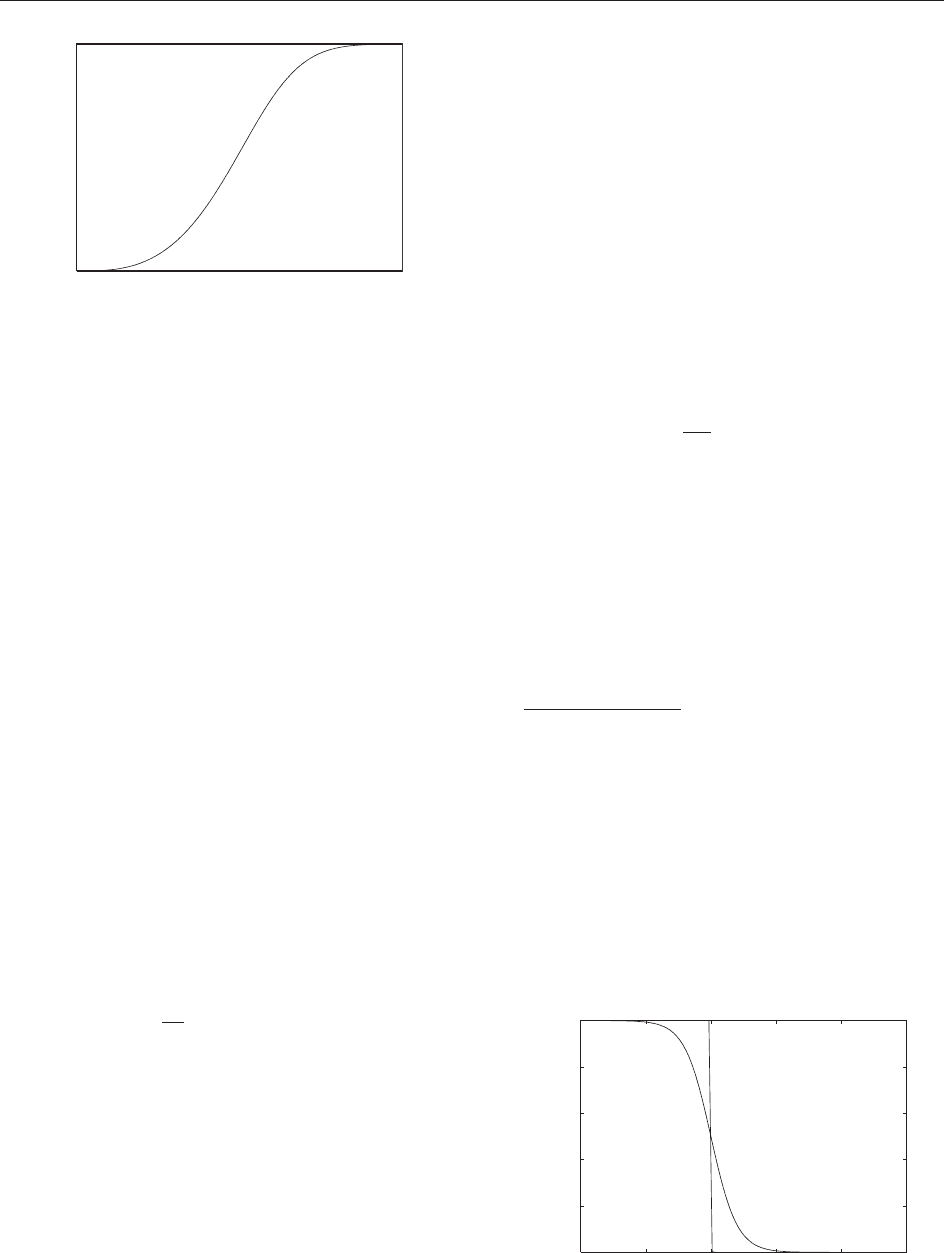
The agreement with experimental data, for the
specific heat of different materials (i.e., different
D
), at low and high temperatures, is rather good.
At low temperatures, one recovers the empirical T
3
behavior (see Figure 2). More careful measurements
at low T put into evidence, for metallic solids, the
role of the conduction electrons: their contribution
to the heat capacity turns out to be linear in T, with
a coefficient such that at room temperature it is
much smaller than the lattice contribution, so that a
satisfactory agreement with the classical law is
found.
Soon after the beginning of qua ntum mechanics in
its modern form (1925–26), physicists considered
many-particle systems, dealing initially with the
simplest situations, with a relatively easy formal
apparatus, yet sufficient enough to understand in the
main lines the ‘‘anomalous,’’ that is, nonclassical,
behavior.
For a system of N free particles in a cubic box of
side L, quantum theory brings the labeling of the
one-particle states with the wave vectors k, recalling
the de Broglie relation for the momentum p =hk,
with a possible additional spin (intrinsic angu lar
moment) label
k ¼
2
L
n; n 2 Z
3
nf0g
and the statistics of the particles: because of
indistinguishability, the wave function of several
identical particles has to be symmetric (B–E, Bose–
Einstein statistics) or antisymmetric (F–D, Fermi–
Dirac statistics) in the exchange of the particl es. This
has the deep im plication that no more than one
fermion shares the same quantum state.
We may here recall the spin–statistics connection,
which, in the framework of a local relativistic
theory, states that integer spin particles are bosons,
while particles with half-odd-integer spin are
fermions.
As the state is completely defined by the knowl-
edge of occupation numbers n
k,
, we have the
simple and relevant statement on the ground states
for the N spinless bosons and N spin-1/2 fermion
systems are described by the statement:
BE system : n
k
¼ N
k;k
0
FD system : n
k;
¼ 1ðjkjk
F
Þ8
½6
The constant k
F
(Fermi wave number), or the
equivalent p
F
=hk
F
and "
F
= p
F
2
=2m (Fermi momen-
tum and energy, respectively) denotes the higher
occupied level. In the continuum approximation,
this implies the following relation between Fermi
energy "
F
and density = N=L
3
:
"
F
¼
h
2
2m
ð3
2
Þ
2=3
½7
Going to the positive-temperature case, the grand
canonical partition function is computed by con-
sidering that occupation numbers are non-negative
integers for the B–E case and just 0 or 1 for the F–D
case. This implies the simple formulas, with obvious
meaning of symbols and leaving more details to the
vast literature (see Figure 3):
<n
k;
>
;
¼
1
expðð"
k
ÞÞ1
; þfor FD; for BE ½8
It is useful to introduce the Fermi temperature
T
F
="
F
=k
B
; using some realistic data, that is, for
common metals like copper, T
F
ranges roughly
between 10
4
–10
5
K, that is, well above the ‘‘nor-
mal,’’ room temperatures: the quantum nature (i.e.,
quantum degeneracy) of the conduction electrons,
modeled as free electrons, is macroscopically visible
in normal conditions.
c (T )
T
Figure 2 The specific heat of crystal solids according to
Debye.
0
0.2
0.4
0.6
0.8
1
0 1 2 3
4
5
n(ε)
T > 0
T
= 0
ε
s
Figure 3 Expected fermionic occupation number, for T = 0,
T > 0, and = 2.
304 Quantum Statistical Mechanics: Overview

The presence of an external field, like the periodic
one given by the ionic lattice of a crystal, changes
the situation in a relevant way, as the one-particle
spectrum generally gets a band structure, and the
allowed momenta are described in the reciprocal
lattice: the Fermi sphere becomes a surface, and its
structure is central for further developments.
For massive bosons, the strange superfluid fea-
tures of liquid
4
He at low temperature, that is,
below the critical value 2.17 K, led F London, just
after Kapitza’s discovery in 1937, to speculate that
these were related to a macroscopic occupation of
the ground state (B–E condensation). A more
realistic model has to take into account interaction
between bosons (see last section) as the microscopic
interactions in superfluid liquid
4
He are not
negligible.
Quantum N -Body Properties:
Second Quantization
The main step in analyzing a quantum N-body
system is its energy spectrum, and in particular its
ground state, as it may represent a good approxima-
tion of the low-tempe rature states: its structure , the
relations with possible symmetries of the Hamilto-
nian, its degeneracy, the dependence of its energy on
the number of pa rticles, are further relevant ques-
tions. The last one is related to the possibility of
defining a thermodynamics for the system (Ruelle
1969). As a physically very interesting example,
consider a system of electrically charged particles, N
electrons with negative unit charge, and K atoms
with positive charge z, say, interacting through
electrostatic forces; the classical Coulomb potential
as a function of distance behaves badly, as it
diverges at zero and decreases slowly at infinity.
The first questio n is about the stability: thanks to
the exclusion principle, for the ground-state energy
E
0
N , K
an extensive estimate from below is valid:
E
0
N;K
c
0
ðN þ KzÞ
so that a finite-volume grand partition function
exists, while for the thermodynamic limit, which
involves large distances, we need more, that is,
charge neutrality, which allows for screening, and a
fast-decreasing effective interaction.
Let us see an example (quantum spin, Heisenberg
model) belonging to the class of lattice models,
where the identical microscopic elements are distin-
guishable by their fixed positions, that is, the nodes
of a lattice like Z
d
. To any site x 2 Z
d
is associated
acopyH
x
of a (2s þ 1)-dimensional Hilbert space
H, where an irreducible unitary representation of
SU(2) is given, so that the nonzero values for s are
1=2, 1, 3=2, .... For any x, the generators
S
(x), ( = 1, 2, 3) satisfy the well-known commuta-
tion relations of the angular momentum; moreover,
P
S
2
(x) = s(s þ 1)1, and operators related to
different sites commute. The ferromagnetic, iso-
tropic, next-neighbors, magnetic field Hamiltonian
for the finite system is
H
¼J
X
<x;y>
SðxÞSðyÞh
X
x
S
3
ðxÞ½9
where J is the positive strength of the next-neighbors
coupling (< x, y> means that x and y are next
neighbors); h is the intensity of the magnetic field
oriented along the third axis. This model is consider-
ably studied even now with several variants regarding
possible anisotropies of the interaction, the possibly
infinite range of the interaction, and the sign of J, for
other (e.g., antiferromagnetic) couplings. Among the
relevant results, the Mermin–Wagner theorem, at
variance with the analogous classical spin model,
states the absence of spontaneous magnetization in
this zero-field model for d = 2 for any positive
temperature; this can also be formulated as absence
of symmetry breaking for this model (Fro¨ hlich and
Pfister in 1981 shed more light on this point).
As mentioned earlier, a useful mathematical tool
for dealing with quantum systems of many particles
or quasiparticles, is the occupation-number repre-
sentation for the state of the system. The vector
space for a system with an indefinite number of
particles is the Fock space: it is the direct sum of all
spaces with any number of particles, starting with
the zero-particle, vacuum state. The operators which
connect these subspaces are the creation and
annihilation operators, very similar to the raising
and lowering operators introduced by Dirac for the
spectral analysis of the harmonic-oscillator Hamil-
tonian and the angular momentum, in the context of
one-particle quantum theory.
It is perhaps worth sketching the action of these
operators on the Fock space.
We consider spinless bosons first, as spin might
easily be taken into account, if necessary. We
suppose that a one-particle Hamiltonian has eigen-
functions labeled by a set of quantum numbers k,
say, as the wave vector for the purely kinetic one-
particle Ham iltonian. Let jn
k
1
, n
k
2
, ..., n
k
p
> denote
a vector state with
P
i = 1,..., p
n
k
i
particles, where n
k
i
denotes the number of particles with wave vector
k
i
, i = 1, ..., p; j0 > denotes the no-particle, vacuum
state. We defin e the creation operators a
k
as follows:
a
k
j...n
k
; ...i¼
ffiffiffiffiffiffiffiffiffiffiffiffiffiffi
n
k
þ 1
p
j...; n
k
þ 1; ...i½10
Quantum Statistical Mechanics: Overview 305
Its adjoint a
k
is called the annihilation operator,
for its action on the vectors
a
k
j...n
k
; ...i¼
ffiffiffiffiffi
n
k
p
j...; n
k
1; ...i½11
The operator a
k
creates a new particle with that
momentum: for any k
a
k
a
k
j...n
k
; ...i¼n
k
j...n
k
; ...i
a
k
a
k
:¼
^
n
k
(the occupation-number operator)
The vacuum state belongs to Ker a
k
for any k , and
the whole space is generated by application of
creation operators on the vacuu m state.
The following basic commutation relations, for
any k, k
0
, are valid:
½a
k
; a
k
0
¼ðk; k
0
Þ; ½a
k
; a
k
0
¼½a
k
; a
k
0
¼0 ½12
For fermions, multiple occupancy is forbidden, so
that the analogous annihilation (
k
) and creation
(
k
) operators satisfy anticommutation relations:
½
k
;
k
0
þ
¼ ðk; k
0
Þ; ½
k
;
k
0
þ
¼½
k
;
k
0
þ
¼ 0 ½13
The presence of spin is dealt by an addit ional spin
label to these symbols, and a (,
0
), where
necessary.
The Hamiltonian for a system of particles, say
spinless bosons, in a box , made of its kinetic part
together with a two-body (v(x y)) interaction, is
written in terms of the ‘‘field operators’’; if {
k
(x)}
are the one-particle eigenfunctions of the single-
particle purely kinetic Hamiltonian for the spinless
case, and their complex conjugates are {
k
(x)}, we
define the fields
ðxÞ¼
X
k
k
ðxÞa
k
;
ðxÞ¼
X
k
k
ðxÞa
k
½14
So that the full Hamiltonian is given by
H
¼
Z
dx
ðxÞ
h
2
2m
!
ðxÞ
þ
Z
dx
Z
dyvðx yÞ
ðxÞðxÞ
ðyÞðyÞ
½15
We mention that a theoretical breakthrough in the
analysis of superfluidity was made by Bogoliubov
(1946), who, starting from the Hamiltoni an in [15],
introduced the following Hamiltonian in the
momentum representation:
H
¼
X
k
"
k
a
k
a
k
þ
1
2
X
k;k
0
;q
^
v
q
a
kq
a
k
0
þq
a
k
a
k
0
½16
where "
k
is the one-particle kinetic energy and
^
v
q
is
the Fourier transform of the two-body potential.
To study the excitation spectrum above the ground
state, he introduced an approximation about the
persistency of a macroscopic occupation of the
ground state and a diagonalization procedure
leading to new quasiparticles with a characteristic
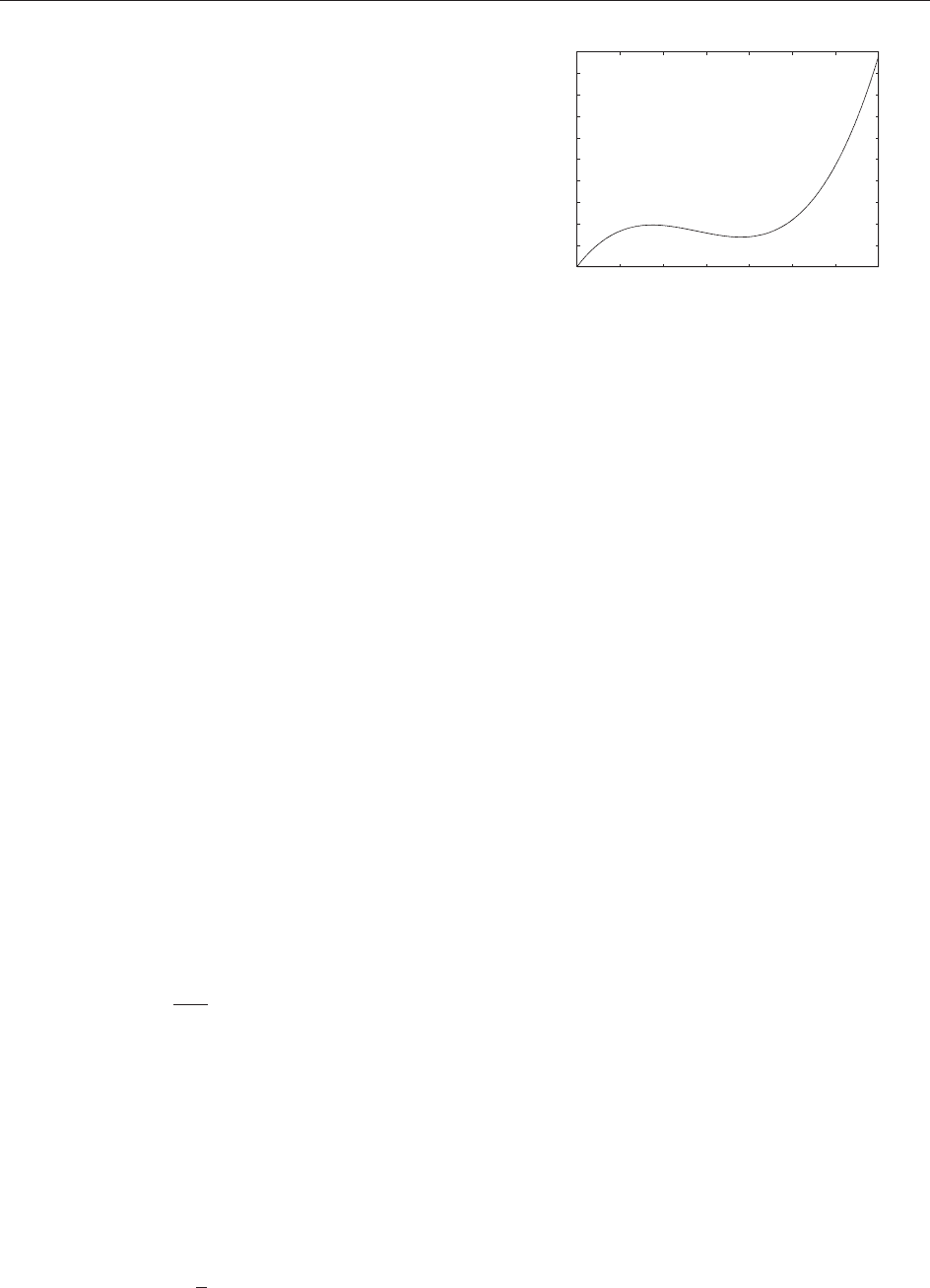
energy spectrum, linearly incr easing near jkj= 0,
then presenting a positive minimum before the
subsequent increase (see Figure 4).
Some Mathematical Tools for
Macroscopic Quantum Systems
The formal apparatus of second quantization, born
in the context of the quantum field theory, brought
to statistical mechanics new ideas and techniques
and related difficulties. For instance, the renormali-
zation group was conceived in the 1970s to deal
both with critical phenomena (i.e., power singula-
rities of thermodynamic quantities around the
critical point) and with divergences in quantum
field theory. This subject is currently being devel-
oped and applied in models of quantum statistical
mechanics (QSM) (Benfatto and Gallavotti, 1995).
Another issue, which has again strong relations
with quantum field theory, is the algebraic formula-
tion of QSM. This point of view, which is well
suited for the analysis of infinitely extended quan-
tum systems, uses a unified, synthetic, and rigorous
language. The procedure for passing from a finite
quantum system to its infinitely extended version
deserves some attention.
It is well known that, for finite quantum systems,
say N particles in a box , an observable is represented
by a self-adjoint operator A on a Hilbert space H
,and
the normalized elements {j >}ofthisspacearethe
pure states
which define the expectations
ðAÞ:¼ < jA >
0
10
20
30
40
50
60
70
80
90
100
0.5 1 1.5 2 2.5 3 3.5
(ε /k
B
)
k
0
Figure 4 Excitation spectrum for superfluids.
306 Quantum Statistical Mechanics: Overview

The mixed states (mixtures) are defined by convex
combinations of pure states, the coefficients having
an obvious statistical meaning.
Among the observables, the Hamiltonian plays a
special role, as it generates the dynamics of the
system, which evolves the pure states through the
unitary group (Schro¨ dinger picture)
ðt Þexp
itH
h
>
To the notion of equilibrium probability measure on
the phase space of a classical system, corresponds
the mixed state
H
,
such that
H
;
ðAÞ:¼Z
;
1
trðexpðH
ÞAÞ½17
The normalization factor Z
,
= tr( exp ( H
)) is
the canonical partition function.
Consider now the algebra A() of local observa -
bles; sending to infini ty, by induction, it is possible
to define the algebra A of quasilocal observables.
The main point is a set of algebraic relations like the
canonical commutation relations (CCRs) and the
canonical anticommutation relation s (CARs) for
the creation/annihilation operators: the observables
of A, through the GNS (Gel’fand, Naimark, and
Segal) construction may be represented as operators
on the appropriate Hilbert spaces, depending on the
chosen state; the representations, at variance with
the finite case, might be inequivalent. It is possible to
define the equilibrium state for the infinite system
and how to insert in a natural way the possible
group invariance of the system (R
d
or Z
d
, typically),
ending with characterization of the pure phases of
the system as the ergodic components in the
decomposition of an equilibrium state. These states
have the property that coarse-grained observables
have sharp values (Ruelle 1969, Sewell 2002): if
Av
l
(A) is the space average on scale l, that is, over
boxes of side l, for an ergodic state ,
lim
l!1
ð½Av
l
ðAÞðAÞ
2
Þ¼0
Another issue which is worth mentioning is the
characterization of equilibrium states through
the KMS (Kubo–Martin–Schwinger) condition. The
strong formal similarity between the finite-volume
quantum evolution operator
t
:= exp(itH
=h)
and the statistical equilibrium density operator
exp(H
), leads to the identity, valid for any
couple of bounded observables A and B, using the
short symbol < >
,
for the expectations with
respect to the statistical operator:
<A
t
B>
;
¼<BA
tþih
>
;
½18
This relation is suitably extended for infinite size,
and therefore defines a KMS state; it implies some
physically relevant properties like stability with
respect to local disturbances and dissipativity
(Sewell 2002).
A final issue in this section concerns another
formalism stemming from the Feynman path-integral
formulation of quantum mechanics: here a functional
integral represents the statistical equilibrium density
operator W
= exp(H). For a d-dimensional sys-
tem of N particles in a potential field (X 2 R
dN
)
V = V(X) =
P
i<j
(x
i
x
j
) and Hamiltonian H =
(1=2) þ V the Feynman–Kac formula which, for
a test function , may be written as follows:
ðW
ÞðXÞ¼
Z
P
X;Y
ðd!Þexp
Z
0
dsVð!ðsÞÞðYÞdY
where P
X, Y
(d!) is the Wiener measure on the space
of paths {!(s), s 2 [0, ]}. For details on the con-
struction and several other related features on the
treatment of the different statistics, see Glimm and
Jaffe (1981).
New Problems and Challenges
In this final section, we recall some phenomena
which have been observed recently in physics
laboratories, and which presumably deserve con-
siderable efforts to overcome the heuristic level of
explanation. About this last point, it is worth
quoting a method that has been used to get results
even without clear justifications of the underlying
hypotheses, that is, the mean-field procedure. It
started with the Curie–Weiss theory of magnetism
and is based on the following drastic simplification:
the microscopic element of the system feels an
average interaction field due to other elements,
indipendently of the positions of the latter. This
method might provide relatively good results if the
range of the interaction is very large, and in fact, a
clear version with due limiting procedure was
introduced by Kac, and applied by Lebowitz and
Penrose in the 1960s for a microscopic derivation of
van der Waals equation, and soon extended by Lieb
to quantum systems.
We will briefly outline some aspects of three
recent achievements of condensed matter physics for
which modeling is still on the way of further
progress: the B–E condensation, the high-T
c
super-
conductivity, and the fractional quantum Hall effect.
The first consists in trapping an ultracold (at less
than 50 mK) dilute bosonic gas, for example,
10
4
–10
7
atoms of
87
Rb, finding experimental evi-
dence for Bos e condensation. To understand the
Quantum Statistical Mechanics: Overview 307

properties of this system, an important tool is the
Gross–Pitaevskii energy functional for the conden-
sate wave function ,
E½¼
Z
dx
h
2
2m
jrj
2
þ V
ext
ðxÞjj
2
þ
g
2
jj
4
"#
where the quartic term represents the reduced
(mean-field) interaction among particles.
The second issue, that is, the high-temperature
superconductivity, certainly deserves much atten-
tion. It has been observed recen tly in some ceramic
materials well above 100 K, and a clear model which
takes into account the formation of pairs and the
peculiar isotropy–anisotropy aspects of the normal
conductivity and superconductivity is still lacking
(Mattis 2003).
Finally, let us consider the fractional quantum
Hall effect; recall that the integer version, that is, a
discretization of the Hall resistivity R
H
by multiples
of h=(e
2
), finds an explanation in terms of band
spectra, formation of magnetic Landau levels, and
localization from surface impurities, that is, without
taking into account dire ct interactions among
electrons.
The fractional discretization of R
H
(Sto¨ rmer 1999)
has a theoretical interpretation, in terms of subtle
collective behavior of the two-dimensional semicon-
ductor electron system: the quasiparticles which
represent the excitations may behave as composite
fermions or bosons, or exhibit a fractional statistics
(see Fractional Quantum Hall Effect).
This brief excursion through these new fascinating
phenomena shows the rich interplay between theory
and experiments: these phenomena are a source of
new ideas and suggest new models for further
progress.
See also: Bose–Einstein Condensates; Dynamical
Systems and Thermodynamics; Exact Renormalization
Group; Falicov–Kimball Model; Fermionic Systems;
Finitely Correlated States; Fractional Quantum Hall
Effect; High T
c
Superconductor Theory; Hubbard Model;
Quantum Phase Transitions; Quantum Spin Systems;
Stability of Matter.
Further Reading
Benfatto G and Gallavotti G (1995) Renormalization Group.
Princeton: Princeton University Press.
Gallavotti G (1999) Statistical Mechanics: A Short Treatise.
Berlin: Springer.
Glimm J and Jaffe A (1981) Quantum Physics. A Functional
Integral Point of View. New York: Springer.
Landau LD and Lifschitz EN (2000) Statistical Physics, Course of
Theoretical Physics, 3rd edn., vol 5. Parts I and II. Oxford:
Butterworth-Heinemann.
Mattis DC (2003) Statistical Mechanics Made Simple. NJ: World
Scientific.
Ruelle D (1969) Statistical Mechanics. Rigorous Results. New
York: Benjamin.
Sewell GL (2002) Quantum Mechanics and Its Emergent
Macrophysics. Princeton: Princeton University Press.
Sinai YaG (1982) Theory of Phase Transitions: Rigorous Results.
Budapest: Akade´miai Kiado´.
Sto¨ rmer HL (1999) Nobel lecture: the quantum Hall effect.
Reviews of Modern Physics 71: 875–889.
Taylor PL and Heinonen O (2002) A Quantum Approach to
Condensed Matter Physics. Cambridge: Cambridge University
Press.
Quasiperiodic Systems
P Kramer, Universita
¨
tTu
¨
bingen, Tu
¨
bingen, Germany
ª 2006 Elsevier Ltd. All rights reserved.
Introduction: From Periodic
to Quasiperiodic Systems
Periodic systems occur in many branches of physics.
Their mathematical analysis was stimulated in
particular by the analysis of the periodic transla-
tional symmetry of crystals. The systematic study of
the compatibility between translational and crystal-
lographic point or reflection symmetry leads to the
concept of space group symmetry. Mathematical
crystallography in three dimensions (3D) culminated
in 1892 in the complete classification of the 230
space groups due to Fedorov and Schoenflies
(see Schwarzenberger (1980, pp. 132–135). One
characteristic property of periodic systems is that
their Fourier transform has a pure point spectrum.
Since the Fourier spectrum is experimentally acces-
sible through diffraction experiments, it provides
a main tool for the structure determination of
crystals.
With quantum mechanics in the twentieth cen-
tury, it became possible to describe crystal structures
quantitatively as ordered systems of atomic nuclei
and electrons with electromagnetic interactions.
The representation theory of crystallographic
space groups now opened the way to verify the
308 Quasiperiodic Systems

space group symmetry of atomic systems for
example from the band structure of crystals. It
was then believe d that in physics atomic long-
range order is linked to periodicity and hence to
the paradigm of the 230 space groups in 3D.
Mathematical analysis beyond this paradigm
started independently in various directions. Bohr
(1925) studied qua siperiodic functions and their
Fourier transform. He interpreted them as restric-
tions of periodic functions in nD to their value s on a
linear subspace of orientation irrational with respect
to a lattice. Mathematical crystallography in general
dimension n > 3, including point group symmetry,
was started around 1949 in work by Hermann and
by Zassenhaus (see Schwarzenberger (1980)), and
completed in 1978 for n = 4inBrown et al. (1978).
A different route was taken by Penrose (1974).He
constructed an aperiodic tiling (covering without
gaps or overlaps) of the plane. Its tiles in two
rhombus shapes provide global 5-fold point symme-
try and make the tiling incompatible with any
periodic lattice in 2D. The connection between
Penrose’s aperiodic tiling and irrational subspaces
in periodic structures was made by de Bruijn (1981).
He interpre ted the Penrose rhombus tiling as the
intersection of geometric objects from cells of a
hypercubic lattice in 5D with a 2D sub space,
irrational and invariant under 5-fold noncrystallo-
graphic point symmetry. Kramer and Neri (1984)
embedded the icosahedral group as a point group
into the hypercubic lattice in 6D and constructed a
3D irrational subspace invariant under the noncrys-
tallographic icosahedral point group. From intersec-
tions of boundaries of the hypercubic lattice cells
with this subspace, they constructed a 3D tiling of
global icosahedral point symmetry with two rhom-
bohedral tiles.
Shechtman et al. (1984) disco vered in the system
AlMn diffraction patterns of icosahedral point
symmetry. Since icosahedral symmetry is incompa-
tible with a lattice in 3D, they concluded that there
exists atomic long-range order without a lattice. The
new paradigm of quasiperiodic long-range order in
quasicrystals was established and since then stimu-
lated a broad range of theoretical and experimental
research.
The interplay between the notions – (1) of
crystallographic symmetry in nD, n > 3, (2) of
subspaces invariant under a point group but
irrational and hence incompatible with a lattice,
and (3) of discrete geometric periodic objec ts in nD
providing quasiperiodic tilings on these subspaces –
forms the mathematical basis for a new quasiper-
iodic long-range order found in quasicrystals. The
present-day theory of quasicrystals offers the most
elaborate study of quasiperiodic systems. Therefore,
we shall focus in what follows on the concepts
developed in this theory.
In the following section, we briefly review basic
concepts of periodic systems and lat tices in nD, their
classification in terms of point symmetry and space
groups, and their cell structure. In a section on
quasipe riodic point sets and funct ions, a quasiper-
iodic system is taken as a geometric object on an
irrational mD subspace in an n-dimensional space
and lattice. Noncrystallographic point symmetry is
shown to select the irrational subspace. Next,
scaling symmet ry in quasiperiodic systems is demon-
strated. Then, examples of quasiperiodic systems
with point and scaling symmetry are given. The
penultimate section disc usses quasiperiodic tilings
and their windows. Finally, the notion of a funda-
mental domain for quasiperiodic functions compa-
tible with a tiling is illustrated.
Concepts from Periodic Systems
A distribution f
p
(x) of geometric objects on Eucli-
dean space E
n
(a real linear space equipped with
standard Euclidean scalar product h, i and metric)
with coordinates x 2 E
n
is called ‘‘periodic’’ if it is
invariant under translations b
i
in n linearly indepen-
dent directions,
ðpÞ : f
p
: f
p
ðx þb
i
Þ¼f
p
ðxÞ; i ¼1; ...; n ½1
The set of all translations on E
n
forms the discrete
additive abelian translation group
T ¼ b 2 E
n
: b ¼
X
n
i
m
i
b
i
; ðm
1
; ...; m
n
Þ2Z
n
()
½2
Any orbit (set of all images of an initial point) under
the action T E
n
! E
n
yields a lattice on E
n
.
Since T acts fixpoint-free, there is a one-to-one
correspondence $ T. A fundamental domain on
E
n
is defined as a subset of points x 2 E
n
which
contains a representative point from any orbit under
T. Such a fundamental domain can be chosen, for
example, as the unit cell of the lattice or as the
Voronoi cell (eqn [5]). By eqn [1], the functional
values on E
n
of a periodic function f
p
(x) are
completely determined from its values on a funda-
mental domain of E
n
.
Given the lattice basis (b
1
, ..., b
n
)ofeqn [2]
in E
n
, the vector components of the basis form the
n n basis mat rix B of . The most general change
of the basis preserving the lattice is given by acting
with any element h of the general linear group
Quasiperiodic Systems 309

Gl(n, Z), with integral matrix entries and determi-
nant 1, on the lattice basis,
Glðn; ZÞ3h : B !B
0
¼Bh ½3
The crystallographic classification of inequivalent
lattices in E
n
starts from Gl(n, Z). In addit ion to
translations, it employs cryst allographic point sym-
metry operations, (Brown et al. 1978, p. 9). A
crystallographic point group operation of a lattice
is a Euclidean isometry g which belongs to a group
G 3 g with representations D : G ! O(n, R) and
D: G ! Gl(n, Z) such that
G ¼fg : DðgÞB ¼B DðgÞg ½4
The maximal crystallographic point group for given
lattice is the holohedry of . The group generated
by T, G is a space group which classifies the lattice.
For finer details in the classification of space groups,
we refer to Brown et al. (1978). For crystallography
in E
3
, t his classification yields 230 space groups.
Crystallography in E
n
is described in Schwarzenberger
(1980) and in Brown et al. (1978) where it is
elaborated for E
4
.
From a lattice 2 E
n
and from the Euclidean metric,
one constructs a cell structure as follows: the Voronoi
cell V(b), centered at a lattice point b 2 ,knownin
physics as the Wigner–Seitz cell, is the set of points
VðbÞ¼fx 2 E
n
: jx bjjx b
0
j; b
0
2g½5
Any Voronoi cell has a hierarchy of boundaries X
p
of dimension p,0 p n which we denote as
p-boundaries.
The set of Voronoi cells at all lattice points form
the -periodic Voronoi complex of 2 E
n
. The
Voronoi cells and complexes associated with a
lattice admit a notion of geometric duality. We
denote dual objects by a star,
. They are built from
convex hulls of sets of lattice points (Kramer and
Schlottmann 1989) as follows. A Voronoi p-boundary
X
p
is shared by several Voronoi cells V(b)and
determines a set of lattice points
SðX
p
Þ: fb 2 :X
p
2 VðbÞg ½6
The boundary dual to X
p
is defined as the convex
hull X
(np)
:= conv{b : b 2 S(X
p
)}. X
(np)
can be
shown to be an (n p)-boundary of a dual
Delone cell. A Delone cell D is defined as the
convex hull of all lattice points whose Voronoi cells
share a single vertex, called a hole of the lattice.
Since these vertices fall into classes of orbits under
translations, they determine translationally inequi-
valent classes of Delone cells D
, D
, ....
Fourier analysis applied to a periodic function f
p
(x)
on E
n
reduces to an n-fold Fourier series. The Fourier
spectrum is a pure point spectrum and the Fourier
coefficients can be referred to the points of a reciprocal
lattice
(eqn [7]) in Fourier space E
n
.Wedenote
objects belonging to this Fourier space by the index
.
The basis matrix B
of the reciprocal lattice
2 E
n
is obtained from B as the inverse transpose,
hb
i
; b
j
i¼
ij
$B
¼ðB
1
Þ
T
½7
The values of the Fourier coefficients of f
p
(x) reduce
to integrals over the fundamental domain of the
lattice . From eqns [4] and [7] it follows that the
orthogonal representation of a point group G in
coordinate and in Fourier space coincides. The
Fourier spectrum and its point symmetry in crystals
are observed in diffraction experiments.
Quasiperiodic Point Sets and Functions
Quasiperiodic functions are characterized from their
Fourier spectrum (Bohr 1925)by
(qp
) The Fourier point spectrum of a quasiper-
iodic function forms a Z-module M
of rank
n, n > m on Fourier space E
m
.
A Z-module of rank n, n > m on E
m
is defined as a set
M
¼ b
: b
¼
X
n
j
m
j
b
i
; ðm
1
; ...; m
n
Þ2Z
n
()
½8
with the Z-module basis (b
1
, ..., b
n
) linearly
independent with respect to integral linear combina-
tions. The step from a lattice
to a module M
is
nontrivial since the set of all module points becomes
dense on E
m
. The Fourier coefficients of a
quasiperiodic function are assigned to the discrete
set of module points (eqn [8]).
Bohr in his analysis of quasiperiodic functions
(Bohr 1925, II, pp. 111–125) shows that a general
Z-module M
of rank n can be taken as the
projection to a subspace E
m
of dimension m of a
(nonunique) lattice
2 E
n
, n > m. It is convenient
to consider in Fourier space E
n
an orthogonal
splitting which we denote as
E
n
¼E
m
k
þE
ðnmÞ
?
; E
m
k
? E
ðnmÞ
?
½9
A characterization of a quasiperiodic function
f
qp
(x) on coordinate space is obtained as follows.
From
one can construct with the help of eqn [7]
the lattice := (
)
reciprocal to
on a coordi-
nate space E
n
and associate to it via the Fourier
series a quasiperiodic function on a coordinate
subspace E
m
k
of E
n
= E
m
k
þ E
(nm)
?
, equipped with a
Z-module M (eqn [11]). As a result one finds a
310 Quasiperiodic Systems

characterization of a quasiperiodic function in
coordinate space:
(qp) A quasiperiodic function f
qp
(x
k
), x
k
2 E
m
k
can
always be interpreted as the restriction to a
subspace E
m
k
of a -periodic function f
p
(x)
on E
n
,
E
n
¼E
m
k
þE
ðnmÞ
?
; x ¼x
k
þ x
?
f
p
ðx
k
þc
?
Þ¼: f
qp
ðx
k
Þ
½10
In the interpretation (qp)(eqn [10]), the Z-modules
in Fourier space (eqn [8]) and in coordinate space
E
m
k
become projections of reciprocal lattices,
M
¼
k
ð
Þ; M ¼
k
ðÞ½11
The linear independence of the module basis
enforces a splitting (eqn [9]), irrational with respect
to the lattice
2 E
n
.
As in the classification of crystal lattices, point
symmetry plays a crucial role in the classification of
Z-modules for quasiperiodic systems like quasicrys-
tals. Noncrystallographic point groups G (with a
representation incompatible with any lattice) give
rise to quasiperiodic systems as follows:
(qp) Given a point group G with orthogonal
representations D
k
: G !O(m, R), D
?
:G !O
(n m, R) such that D
k
is incompatible with
any lattice in E
m
k
, we now require in E
n
instead
of eqn [10] a lattice with basis B and a
representation D: G !Gl(n, Z) such that
D
k
ðGÞ 0
0 D
?
ðGÞ
B ¼B DðGÞ½12
Equation [12] requires that the matrix B provides an
irrational reduction of the representation D(G) into
the two representations D
k
(G), D
?
(G). Periodic
functions restricted as in the second line of eqn
[10] are quasiperiodic.
For any finite group G, a representation D(G)
allowing for lattice embedding can always be
constructed by the technique of induced representa-
tions. Its reduction into representations D
k
(G),
D
?
(G) contained in this induced representation is
obtained by standard techniques. If D
k
(G) is non-
crystallographic and inequivalent to D
?
(G), the
subspace decomposition (eqn [12]) is unique.
Quasiperiodic functions compatible with tilings
and their windows can be constructed from the dual
cell structure (eqns [5] and [6]) of the embedding
lattice (Kramer and Schlottmann 1989). Examples
are given in the sections ‘‘Point symm etry in
quasipe riodic syst ems’’ an d ‘‘Qu asiperi odic tilings
and their windows ’’.
Scaling and Quasiperiodicity
Quasiperiodic systems lack periodicity but can have
scaling symmetries originating from a non-Euclidean
extension of eqn [12].
Example 1: Scaling in the Square Lattice Z
2
We begin with the Fibonacci scaling on the square
lattice Z
2
of E
2
. The symmetric matrix
h ¼
11
10
2Glð2; ZÞ½13
has eigenvalues
1
¼
1
¼ þ1;
2
¼ :¼ð1þ
ffiffiffi
5
p
Þ=2 ½14
Evaluation of the orthogonal eigenvectors allows us
to define a lattice basis B = (b
1
, b
2
) and rewrite the
eigenvalue equation similar to eqn [12] as
1
0
0
"#
B ¼B
11
10
B ¼
ffiffiffiffiffiffiffiffiffi
þ3
5
q ffiffiffiffiffiffiffi
þ2
5
q
ffiffiffiffiffiffiffi
þ2
5
q ffiffiffiffiffiffiffiffiffi
þ3
5
q
2
6
4
3
7
5
½15
This relation shows that h with respect to the basis
B acts as a non-Euclidean point symmetry of the
square lattice and generates an infinite discrete
group. Equation [15] provides an orthogonal
splitting E
2
= E
k
þ E
?
. The element h acts on the
two subspaces as a discrete linear scaling by
1
, , r espectively. It maps points of Z
2
in E
2
,
hence also their projections to E
k
, into one
another.
Figure 1 shows the lattice basis from eqn [15].
We choose as fundamental domain of Z
2
two
squares A, B whose boundaries are parallel or
perpendicular to E
k
. A horizontal line E
k
intersects
these two squares at vertical distances varying with
respect to their horizontal boundaries. The quasi-
periodic restriction f
qp
(x
k
) = f
p
(x
k
þ c
?
)ofa
Z
2
-periodic function f
p
(x)toalinex = x
k
þ c
?
picks up varying functional values on these sec-
tions. Clearly, one needs all the values of f
p
on its
fundamental domain i n E
2
to obtain all the values
taken by f
qp
.
Scaling symmetry appears in conjunction with
noncrystallographic point symmetry (cf . the follow-
ing section). Combined with quasiperiodic tilings, it
gives rise to a hier archy of self-similar tilings whose
tiles scale with .
Quasiperiodic Systems 311