
Francoise J.-P., Naber G.L., Tsun T.S. (editors) Encyclopedia of Mathematical Physics
Подождите немного. Документ загружается.

SFT Diagrams and Minimal Area Metrics
Imposing the Siegel gauge condition b
0
=0, one
finds the gauge-fixed action
S
gf
¼
1
g
2
o
1
2
hjc
0
L
0
jiþ
1
3
hj i
þhjb
0
ji
½32
where is a Lagrangian mul tiplier. The propagator
reads
b
0
L
0
¼ b
0
Z
1
0
dT e
TL
0
½33
Since L
0
is the first-quantized open-string Hamilto-
nian, e
TL
0
is the operator that evolves the open-
string wave functions [X()] by Euclidean world
sheet time T. It can be visualized as a flat
rectangular strip of ‘‘horizontal’’ width and
‘‘vertical’’ height T. Each pro pagator comes with
an antighost insertion
b
0
¼
Z
0
bðÞ½34
integrated on a horizontal trajectory.
The only elementary interaction vertex is the mid-
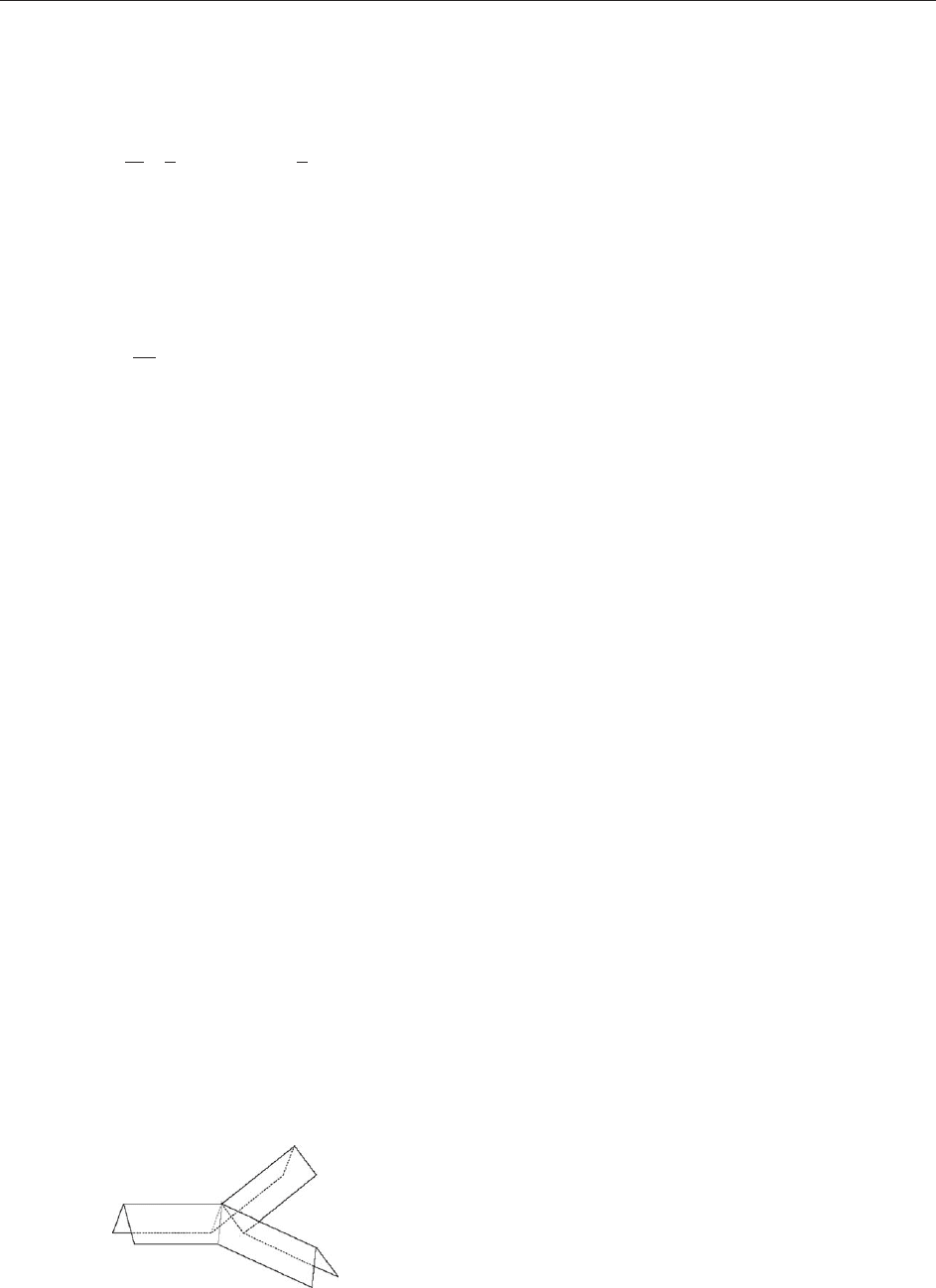
point three-string overlap, visualized in Figure 3.We
are instructed to draw all possible diagrams with
given external legs (represented as semi-infinite
strips), and to integrate over all Schwinger para-
meters T
i
2 [0, 1) associated with the internal
propagators. The claim is that this prescription
reproduce precisely the first-quantized result [1].
This follows if we can show that (1) the OSFT
Feynman rules give a unique cover of the moduli
space of open Riemann surfaces; (2) the integration
measure agrees with the measure [d
]in[1]. The
latter property holds because the antighost insertion
[34] is precisely the one prescribed by the Polyakov
formalism for integrating over the moduli T
i
.To
show point (1), we introduce the concept of
minimal-area metrics, which has proved very
fruitful. (Here and below, our discussion of
minimal-area metrics will summarize ideas devel-
oped mainly by Zwiebach.) Quite generally, the
Feynman rules of an SFT provide us with a cell
decomposition of the appropriate moduli space of
Riemann surfaces, a way to construct surfaces in
terms of vertices and propagators. Given a Riemann
surface (for fixed values of its complex moduli), the
SFT must associate with it one and only one string
diagram. The diagram has more structure than the
Riemann surface: it defines a metric on it. In all
known covariant SFTs, this is the met ric of minimal
area obeying suitable length conditions. Consider
the following:
Minimal-area problem for open SFT Let R
o
be a
Riemann surface with at least one boundary
component and possibly punctures on the boundary.
Find the (conformal) metric of minimal area on R
o
such that all nontrivial Jordan open curves have
length greater than or equal to . (A curve is said to
be nontrivial if it cannot be continuously shrunk to a
point without crossing a puncture.)
An OSFT diagram (for fixed values of its T
i
),
defines a Riemann surface R
o
endowed with a
metric solving this minimal-area problem. This is the
metric implicit in its picture: fla t everywhere except
at the conical singularities of defect angle (n 2)
when n propagators meet symmetrically. (For n = 3,
these are the elementary cubic vertices; for n > 3,
they are effective vertices, obtained when propaga-
tors joining cubic vertices collapse to zero length.) It
is not difficult to see both that the length conditions
are obeyed, and that the metric cannot be made
smaller without violating a length condition. Con-
versely, any surface R
o
endowed with a minimal-
area metric, corresponds to an OSFT diagr am. The
idea is that the minimal-are a metric must have open
geodesics (‘‘horizontal trajectories’’) of length
foliating the surface. The geodesics intersect on a
set of measure zero – the ‘‘critical graph’’ where the
propagators are glued. Bands of open geodesics of
infinite height are the external legs of the diagram,
while bands of finite height are the internal
propagators.
The single cover of moduli space is then ensured
by an existence and uniqueness theorem for metrics
solving the minimal-area problem for OSFT. These
metrics are seen to arise from Jenkins–Strebel
quadratic differentials. Existence shows that the
Feynman rules of OSFT generate each Riemann
surface R
o
at least once. Uniqueness shows that
there is no overcounting: since different diagrams
correspond to different metrics (by inspection of
their picture), no Riemann surface can be generated
twice.
Figure 3 The cubic vertex represented as the mid-point gluing
of three strips.
String Field Theory 99

Closed Strings in OSFT
As is familiar, the open-string S-ma trix con tains
poles due to the exchange of on-shell open and
closed strings. The closed-string poles are present in
nonplanar loop amplitudes. We have seen that
OSFT reproduces the standard S-matrix. Factoriza-
tion over the open-string poles is manifest, it
corresponds to propagator lengths T
i
going to
infinity. Su rprisingly, the closed-string poles are
also correctly reproduced, despite the fact that
OSFT treats only the open strings as fundamental
dynamical variables. In some sense, closed strings
must be considered as derived objects in OSFT.
Factorizing the amplitudes over the closed-string
poles, one finds that on-shell closed-string states can
be represented, at least formally, as certain singular
open-string fields with G = þ2, closely related to the
(formal) identity string field. The picture is that of a
folded open string, whose left and right halves
precisely overlap, with an extra closed-string vertex
operator inserted at the mid-point. The correspond-
ing open/closed vertex is given by
h
phys
ji
OC
h
phys
ð0ÞI ð0Þi
D
I¼
1 þ iz
1 iz
2
½35
and describes the coupling to the open-string field of
a nondynamical, on-shell closed string j
phys
i.Itis
possible to add this open/closed vertex to the OSFT
action. Remarkably, the resulting Feynman rules
give a single cover of the moduli space of Riemann
surfaces with at least one boundary, with open and
closed punctures. This is shown using the same
minimal-area problem as above, but now allowing
for surfaces with closed punctures as well.
We should finally mention that the structure of
OSFT emerges frequently in topological string
theory, in contexts where open/closed duality plays
a central role. Two examples are the interpretation
of Chern–Simons theory as the OSFT for the
A-model on the conifold, and the intepretation of
the Kontsevich matrix integral for topological
gravity as the OSFT on FZZT branes in (2, 1)
minimal string theory.
Closed Bosonic SFT
The generalization to covariant closed SFT is
nontrivial, essentially because the requisite closed-
string decomposition of moduli space is much more
complicated.
The free theory parallels the open case, with a
minor complication in the treatment of the CFT zero
modes. The closed-string field is taken to live in a
subspace of the matter þ ghost state space, j i2
~
H
CFT
0
, where the tilde means that we impose the
subsidiary conditions
b
0
ji¼L
0
ji¼0; b
0
b
0
b
0
;
L
0
L
0
L
0
½36
In the classical theory, the string field carries ghost
number G = þ2, since it is the off-shell extension of
the familiar closed-string physical states, and the
quadratic action reads
S h; Q
c
i½37
Here Q
c
is the usual closed BRST operator. The inner
product h, i is defined in terms of the BPZ inner
product, with an extra insertion of c
0
c
0
c
0
,
hA; BihAjc
0
jBi½38
In [37] G
top
= þ6, as it should be. Without the
extra ghost insertion and the subsidiary conditions
[36] it would not be possible to write a quadratic
action. The linearized equations of motion and
gauge invariance,
Q
c
ji¼0; jijiþQ
c
ji; ji2
~
H
ð1Þ
CFT
0
½39
give the expected cohomological problem. The fact
that the cohomology is computed in the semirelative
complex, b
0
ji= b
0
ji= 0, well known from the
operator formalism of the first-quantized theory, is
recovered naturally in the second-quantized treatment.
The interacting action is constructed iteratively,
by demanding that the resulting Feynman rules give
a (unique) cover of moduli space. This requires the
introduction of infinitely many elementary string
vertices V
g, n
, where n is the number of closed-string
punctures and g the genus. This decomposition of
moduli space is more intricate than the decomposi-
tion that arises in OSFT, but is in fact analogous to
it, when characterized in terms of the following.
Minimal-area problem for closed SFT Let R
c
be a
closed Riemann surface, possibly with punctures.
Find the (conformal) metric of minimal area on R
such that all nontrivial Jordan closed curves have
length greater than or equal to 2.
The minimal-area metric induces a foliation of
R
c
by closed geodesics of length 2. In the classical
theory (g = 0), the minimal-area metrics arise from
Jenkins–Strebel quadratic differentials (as in the open
case), and geodesics intersect on a measure-zero set.
For g > 0, however, there can be foliation bands of
geodesics that cross. By staring at the foliation, we can
break up the surface into vertices and propagators. In
correspondence with each puncture, there is a band of
100 String Field Theory

infinite height, a flat semi-infinite cylinder of circum-
ference 2, which we identify as an external leg of the
diagram. We mark a closed geodesic on each semi-
infinite cylinder, at a distance from its boundary.
Bands of finite height (internal bands not associated to
punctures) correspond to propagators if their height is
greater than 2, otherwise they are considered part of
an elementary vertex. Along any internal cylinder of
height greater than 2, we mark two closed geodesics,
at a distance from the boundary of the cylinder. If we
now cut open all the marked curves, the surface
decomposes into a number of semi-infinite cylinders
(external legs), finite cylinders (internal propagators)
and surfaces with boundaries (elementary interac-
tions). Each elementary interaction of genus g and
with n boundaries is an element of V
g, n
.Acrucialpoint
of this construction is that we took care of leaving a
‘‘stub’’ of length attached to each boundary. Stubs
ensure that sewing of surfaces preserves the length
condition on the metric (no closed curve shorter
than 2).
These geometric data can be translated into an
iterative algebraic construction of the full quantum
action S[]. The V
g, n
satisfy geometric recursion
relations whose algebraic counterpart is the quan-
tum BV master equation for S[]. Remarkably, the
singularities of the operator encountered in OSFT
are absent here, precisely because of the prese nce of
the stubs. We refer to Zwiebach (1993) for a
complete discussion of closed SFT.
Open/Closed SFT
There is also a covariant SFT that includes both open
and closed strings as fundamental variables. The
Feynman rules arise from the following problem.
Minimal-area problem for open/closed SFT Let
R
oc
be a Riemann surface, with or without
boundaries, possibly with open and closed punctu-
res. Find the (conformal) metric of minimal area on
R
oc
such that all nontrivial Jordan open curves have
length greater than or equal to l
o
= , and all
nontrivial Jordan closed curves have length greater
than or equal to l
c
= 2.
The surface R
oc
is decomposed in terms of
elementary vertices V
g, n
b, m
(of genus g, b boundary
components, n closed-string punctures and m open-
string punctures) joined by open and closed propa-
gators. Degenerations of the surface correspond
always to propagators becoming of infinite lengt h –
factorization is manifest both in the open and in the
closed channel.
The S FT descr ibed in the section ‘‘Clos ed strings
in OSFT’’ (Witten OSFT au gmented with the single
open/closed vertex [35]) corresponds to taking l
o
=
and l
c
= 0. Varying l
c
2 [0, 2], we find a whole
family of interpolating SFTs. This construction
clarifies the special status of the Witten theory:
moduli space is covered by a single cubic open
overlap vertex, with no need to introduce dynamical
closed strings, but at the price of a somewhat
singular formulation.
Classical Solutions in Open SFT
In the present formulation of SFT, a background (a
classical solution of string theory) must be chosen from
the outset. The very definition of the string field
requires to specify a (B)CFT
0
. Intuitively, the string
field lives in the ‘‘tangent’’ to the ‘‘theory space’’ at a
specific point – where ‘‘theory space’’ is some notion of
a ‘‘space of 2D (boundary) quantum field theories,’’
not necessarily conformal. In the early 1990s indepen-
dence from the choice of background was demon-
strated for infinitesimal deformations: the SFT actions
written using neighboring (B)CFTs are indeed related
by a field redefinition. In recent years, it has become
apparent that at least the open-string field reaches out
to open-string backgrounds a finite distance away –
possibly covering the whole of theory space. (Classical
solutions of closed SFT are beginning to be investi-
gated at the time of this writing (2005)).
The OSFT action written using BCFT
0
data is just
the full world volume action of the D-brane with
BCFT
0
boundary conditions. Which classical solu-
tions should we expect in this OSFT? In the bosonic
string, Dp branes carry no conserved charge and are
unstable. This instability is reflected in the presence
of a mode with m
2
= 1=
0
, the open-string
tachyon T(x
), = 0, ..., p. From this physical pic-
ture, Sen argued that:
1. the tachyon potential, obtained by eliminating
the higher modes of the string field by their
equations of motion, must admit a local mini-
mum corresponding to the vacuum with no
D-brane at all (henceforth, the tachyon vacuum,
T(x
) = T
0
);
2. the value of the potential at T
0
(measured with
respect to the BCFT
0
point T = 0) must be
exactly equal to minus the tension of the brane
with BCFT
0
boundary conditions;
3. there must be no perturbative open-string excita-
tions around the tachyon vacuum; and
4. there must be space-dependent ‘‘lump’’ solutions
corresponding to lower- dimensional branes. For
example, a lump localized along one world
volume direction, say x
1
, such that T(x
1
) !T
0
as x
1
!1, is identified with a D(p 1) brane.
String Field Theory 101

Sen’s conjectures have all been verified in OSFT.
(See Sen (2004) and Taylor and Zwiebach (2003)
for reviews). The deceptively simple-looking equa-
tions of motion (in Siegel gauge)
L
0
jiþb
0
ðjijiÞ ¼ 0 ½40
are really an infinite system of coupled equations,
and no analytic solutions are known. Turning on a
vacuum expectation value (VEV) for the tachyon
drives into condensation an infinite tower of modes.
Fortunately, the approximation technique of ‘‘level
truncation’’ is surprisingly effective. The string field
is restricted to modes with an L
0
eigenvalue smaller
than a prescribed maximal level L. For any finite L,
the truncated OSFT contains a finite number of
fields and numerical computations are possible.
Numerical results for various classical solutions
converge quite rapidly as the level L is increased.
The most important solution is the string field jT i
that corresponds to the tachyon vacuum. A remark-
able feature of jT i is universality: it can be written
as a linear combi nation of modes obtained by acting
on the tachyon c
1
j0i with ghost oscillators and
matter Virasoro operators,
jT i ¼ T
0
c
1
j0iþuL
m
2
c
1
j0iþvc
1
j0iþ
This implies that the properties of jT i are indepen-
dent of any detail of BCFT
0
, since all computations
involving jT i can be reduced to purely combinator-
ial manipulations involving the ghosts and the
Virasoro algebra. The numerical results strongly
confirm Sen’s conjectures, and indicate that the
tachyon vacuum is located at a non-singular point in
configuration space. Numerical solutions describing
lower-dimensional branes and exactly marginal
deformations are also available. For example, the
full family of solutions interpolating between a
D1 and a D0 brane at the self-dual radius has
been found. There is increasing evidence that the
open-string field provides a faithful map of the
open-string landscape.
Vacuum SFT: D-branes as Projectors
In the absence of a closed-form expression for jT i,
we are led to guesswork. When expanded around
jT i, the OSFT is still cubic, only with a different
kinetic term Q,
S ¼
0
1
2
hjQjiþ
1
3
hj i
½41
The operator Q must obey all the formal properties
[17], must be universal (constructed from gh osts and
matter Virasoro operators), and must have trivial
cohomology at G = þ1. Another constraint comes
from requiring that [41] admits classical solutions in
Siegel gauge. The choice
Q¼
1
2i
ðcðiÞ
cðiÞÞ
¼ c
0
ðc
2
þ c
2
Þþðc
4
þ c
4
Þ ½42
satisfies all these requirements. The conjecture
(Rastelli et al. 2001) is that, by a field redefinition,
the kinetic term around the tachyon vacuum can be
cast into this form. This ‘‘purely ghost’’ Q is
somewhat singular (it acts at the delicate string
mid-point), an d presumably should be regarded as
the leading term of a more complicated operator
that includes matter pieces as well. The normal-
ization constant
0
is formally infinite. Nevertheless,
a regulator (e.g., level truncation) can be introduced,
and physical observables are finite and independent
of the regulator. The vacuum SFT ([41]–[42] )
appears to capture the correct physics, at least at
the classical leve l. Taking a matter/ghost factorized
ansatz
j
g
ij
m
i½43
and assuming that the ghost part is universal for all
D-branes solutions, the equations of motion reduce
to following equations for the matter part:
j
m
ij
m
i¼j
m
i½44
A solution j
m
i can be regarded as a projector
acting in ‘‘half-string space.’’ Recall that the
-product looks formally like a matrix multiplica-
tion [19]: the matrices are the string fields, whose
‘‘indices’’ run over the half-string curves. These
projector equations have been exactly solved by
many different techniques (see Rastelli (2004) for a
review). In particular, there is a general BCFT
construction that shows that one can obtain solu-
tions corresponding to any D-b rane configuration,
including multiple branes – the rank of the projector
is the number of branes. A rank-one projector
corresponds to an open-string functional which is
left/right split, [X( )] = F
L
(X
L
)F
R
(X
R
). There is
also clear analogy between these solutions and the
soliton solutions of noncommutative field theory.
The analogy can be made sharper using a formalism
that rewri tes the open-string -product as the tensor
product of infinitely many Moyal products. (See
Bars (2002) and references therein).
It is unclear whether or not multiple-brane
solutions (should) exist in the or iginal OSFT – they
are yet to be found in level truncation. Under-
standing this and other issues, like the precise role of
closed strings in the quantum theory seems to
require a precise characterization of the allowed
102 String Field Theory

space of open-string functionals. In principle, the
path integral over such functionals would define the
theory at the full nonperturbative level. This remains
a challenge for the future.
Note Added in Proof Very recently, M Schnabl,
building on previous work on star algebra projectors
and related surface states (Rastelli L (2004) and
references therein) was able to find the exact
solution for the universal tachyon condensate in
OSFT. This breakthrough is likely to lead to rapid
new developments in SFT.
See also: Boundary Conformal Field Theory; BRST
Quantization; Chern–Simons Models: Rigorous Results;
Fedosov Quantization; The Jones Polynomial; Large-N
and Topological Strings; Large-N Dualities;
Noncommutative Geometry from Strings;
Noncommutative Tori, Yang–Mills, and String Theory;
Operads; Superstring Theories; Topological Quantum
Field Theory: Overview; Two-Dimensional Conformal
Field Theory and Vertex Operator Algebras.
Further Reading
Bars I (2002) MSFT: Moyal Star Formulation of String Field Theory.
Proceedings of 3rd International Sakharov Conference on
Physics, Moscow, Russia, 24–29 Jun, arXiv:hep-th/0211238.
Berkovits N (2001) Review of open superstring field theory,
arXiv:hep-th/0105230.
Berkovits N, Okawa Y, and Zwiebach B (2004) WZW-like action
for heterotic string field theory. Journal of High Energy
Physics 0411: 038 (arXiv:hep-th/0409018).
Bordes J, Chan HM, Nellen L, and Tsou ST (1991) Half string
oscillator approach to string field theory. Nuclear Physics B
351: 441.
Erler TG and Gross DJ (2004) Locality, causality, and an initial
value formulation for open string field theory, arXiv:hep-th/
0406199.
Ohmori K (2001) A Review on Tachyon Condensation in Open
String Field Theories. Master’s thesis, University of Tokyo
(arXiv:hep-th/0102085).
Okawa Y (2002) Open string states and D-brane tension from
vacuum string field theory. Journal of High Energy Physics
0207: 003 (arXiv:hep-th/0204012).
Rastelli L (2004) Open string fields and D-branes. Fortschritte der
Physics. 52: 302.
Rastelli L, Sen A, and Zwiebach B Vacuum String Field Theory,
Proceedings of the Strings 2001 Conference, TIFR, Mumbai,
India, arXiv:hep-th/0106010.
Schnabl M (2005) Analytic solution for tachyon condensation in
open string theory. arXiv:hep-th/0511286.
Sen A (2004) Tachyon dynamics in open string theory, arXiv:hep-
th/0410103.
Shatashvili SL On Field Theory of Open Strings, Tachyon
Condensation and Closed Strings, Proceedings of the Strings
2001 Conference, TIFR, Mumbai, India, arXiv:hep-th/
0105076.
Siegel W (1988) Introduction To String Field Theory. Advanced
Series in Mathematical Physics 8: 1–244 (arXiv:hep-th/
0107094).
Taylor W and Zwiebach B (2001) D-branes, tachyons, and string
field theory. In: Gubser SS and Lykken JD (eds.) Boulder
2001, Strings, Branes and Extra Dimensions, TASI 2001
Lectures, pp. 641–759. Singapore: World Scientific.
Thorn CB (1989) String field theory. Physics Report 175: 1.
Witten E (1986) Noncommutative geometry and string field
theory. Nuclear Physics B 268: 253.
Zwiebach B (1993) Closed string field theory: quantum action
and the B-V master equation. Nuclear Physics B 390: 33
(arXiv:hep-th/9206084).
Zwiebach B (1998) Oriented open–closed string theory revisited.
Annals of Physics 267: 193 (arXiv:hep-th/9705241).
String Theory: Phenomenology
A M Uranga, Consejo Superior de Investigaciones
Cientificas, Madrid, Spain
ª 2006 Elsevier Ltd. All rights reserved.
String Theory and Compactification
The string theory provides a setup in which gauge
and gravitational interactions can be described in a
unified framework consistently at the quantum level.
As such, it provides a candidate theory in which to
describe the standard model of particle physics
(describing quarks and leptons and their strong and
electroweak interactions) and gravity within the
same quantum theory.
The string theory has a unique fundamental scale
M
s
, fixed by the string tension, often encoded in the
parameter
0
of dimension (length)
2
. All other
scales are derived from this one and are background
dependent.
Most of the string theory phenomenological
model building has centered on the critical super-
strings, which are ten dimensional (10D) and
involve spacetime (as well as world-sheet) super-
symmetry. There are five such different 10D
theories: type IIA, type IIB, type I, and the E
8
E
8
and SO(32) heterotic theories. The heterotic theories
include nonabelian gauge fields and charged fer-
mions in ten dimensions; hence, they constitute a
promising setup to embed the standard model. On
the other hand, the possibility of including D-branes
String Theory: Phenomenology 103

(which carry nonabelian gauge symmetries and
charged matter) in compactifications of type II
theories (and orientifolds thereof, like the type I
theory itself) makes the latter reasonable alternative
setups to embed the standard model as a brane
world. The different 10D theories (as well as the
11D M-theory) are related by diverse dualities, also
upon compactification. This suggests that they are
just different limits of a unique underlying theory.
For 4D models, this implies that the different classes
of constructions are ultimately related by dualities,
and that often a given model may be realized using
different string theory constructions as starting
points.
In order to recover 4D physics at low energies,
compactification of the theory is required. In
geometrical terms, the theory is required to propa-
gate on a spacetime with geometry M
4
X
6
, where
M
4
is a 4D Minkowski space, and X
6
is a compact
manifold. This description is valid in the regime of a
large compactification volume,
0
=R
2
1 (where R
is the overall scale of the compact manifold), where
0
string theory corrections are negligible. Other 4D
string models may be constructed using abstract
conformal field theories. They may often be
regarded as extrapolations of geometric compactifi-
cations to the regime of sizes comparable with the
string length, where string theory corrections are
relevant and the classical geometric picture does not
hold.
In the simplest situation of geometrical compacti-
fication, not including additional backgrounds
beyond the metric, the requirement of 4D spacetime
supersymmetry (useful for the stability of the model,
as well as of phenomenological interest) implies that
the space X
6
is endowed with an SU(3) holonomy
metric. Existence of such metrics is guaranteed for
Calabi–Yau spaces, namely Ka¨ hler manifolds with
vanishing first Chern class.
There are a very large number of 4D super-
symmetric string models that can be constructed
using different starting string theories and different
compactification manifolds. They lead to different
4D spectra, often including nonabelian gauge sym-
metries and charged chiral fermions (but only rarely
resembling the actual standard model). In addition,
for each given model, there exist, in general, a large
number of massless 4D scalars, known as moduli,
whose vacuum expectation values are not fixed.
They parametrize different choices of the compacti-
fication data in a given topological sector (e.g.,
Ka¨ hler and complex structure moduli of the internal
Calabi–Yau space). All physical parameters of the
4D theory vary continuously with the vacuum
expectation values of these scalars.
All such models are on equal footing from the
point of view of the theory. Hence, 4D string models
suffer from a large arbitrariness. Although the
breaking of supersymmetry clearly changes the
picture qualitatively (e.g., flat directions associated
to moduli are lifted by radiative corrections), it is
difficult to evaluate this impact.
In this situation, most of the research in string
theory phenomenology has centered on the study of
generic properties of certain classes of compactifica-
tions, with the potential to lead to realistic struc-
tures (such as N = 1 or no supersymmetry,
nonabelian gauge symmetries with replicated sets
of charged chiral fermions). Within each class,
explicit models (as close as possible to the standard
model) have also been constructed. Generic predic-
tions or expectations for phenomenology can be
obtained within each setup, but quantitative results,
even for explicit models, are always functions of
undetermined moduli vacuum expectation values.
Tractable mechanisms for moduli stabilization are
under active research, although only preliminary
results are available presently.
The better-studied classes of models are compac-
tifications of heterotic theories on Calabi–Yau
spaces, and compactifications of type II theories (or
orientifolds thereof) with D-branes. Other possibi-
lities include the heterotic M-theory, the M-theory
on G
2
holonomy varieties, the F-theory on Calabi–
Yau 4-folds, etc. As already mentioned, different
classes (or even explicit models) are often related by
string duality.
Heterotic String Phenomenology
A large class of phenomenologically interesting
string vacua, which has been explored in depth, is
provided by 4D compactifications of (any of the
two) perturbative heterotic string theories. Compac-
tification on large volume manifolds can be
described in the supergravity approximation. As
described by Candelas, Horowitz, Strominger, and
Witten, the requirement of 4D N = 1 supersymmetry
requires the internal manifold to be of SU(3)
holonomy, a condition which is satisfied by
Calabi–Yau manifolds. In the presence of a curva-
ture, the Bianchi identity for the Kalb–Ramond
2-form B is modified, so that, in general, it reads
dH ¼ tr R
2
1
30
tr F
2
½1
where H is the field strength 3-form, R is the Ricci
2-form, and F is the field strength, in the adjoint
representation, of the 10D gauge fields. Regarding
the above equation in cohomology leads to a
104 String Theory: Phenomenology

consistency condition, forcing the background gauge
bundle V to be topologically nontrivial, with
c
2
ðVÞ¼c
2
ðTX
6
Þ½2
where c
2
denotes the second Chern class, and TX
6
is
the compactification tangent space.
The condition of supersymmetry implies that the
gauge fields must be solutions of the Donaldson–
Uhlenbeck–Yau equations. Existence of such a solu-
tion is guaranteed for holomorphic and stable gauge
bundles. The simplest solution to these conditions is
the so-called standard embedding, where the gauge
connection is locally identical to the spin connection,
but more general solutions exist and have been
characterized for particular classes of Calabi–Yau
manifolds (e.g., when they are elliptically fibered).
The gauge background bundle V,withstructure
group H, breaks the 10D gauge symmetry G to its
commutant subgroup G
4D
. The latter corresponds to
the 4D gauge symmetry. Moreover, the background
bundle modifies the Kaluza–Klein reduction of the
10D charged fermions, leading to a nonzero number
of replicated 4D chiral fermions. Decomposing the
adjoint representation of G (in which 10D fermions
transform) with respect to G
4D
H,
Adj G ¼
i
ðR
G
4D
;i
; R
H;i
Þ½3
the net number of 4D chiral fermions in the
representation R
G
4D
is given by the index of the
Dirac operator coupled to V in the representation
R
H, i
. Condition [1] implies proper cancellation of
chiral anomalies in the resulting theory. A simple
and well-studied class is provided by standard
embedding compactifications of the E
8
E
8
hetero-
tic string theory, whose unbroken 4D gauge group is
E
6
E
8
. The number of families (i.e., chiral multi-
plets in the representation 27 of E
6
) and conjugate
families (in the
27) are given by the Hodge numbers
n
27
¼ h
1;1
ðX
6
Þ; n
27
¼ h
2;1
ðX
6
Þ½4
More specifically, the harmonic representatives in
each cohomology class represent the internal profile
of the corresponding 4D fields. The net number of
families is thus determined by the Euler character-
istic (X
6
)
n
fam
¼jh
1;1
h
2;1
j¼
1
2
jðX
6
Þj ½5
Recently, much progress in heterotic model building
has been achieved in nonstandard embedding com-
pactifications by the detailed construction of holo-
morphic stable bundles and the computation of the
diverse indexes. In particular, explicit models with
just the minimal supersymmetric standard model
spectrum have been constructed.
The above geometric approach has several limita-
tions. On the technical side, the construction of
explicit holomorphic and stable gauge bundles is
nontrivial from the mathematical viewpoint. On the
more fundamental side, it allows one to explore only
the large volume limit of heterotic compactifications.
Further insight into the latter aspect can be
obtained via constructions based on exactly solvable
conformal field theories (CFTs), which describe the
world-sheet string dynamics in compactifications,
including all
0
corrections, and, therefore, allowing
one to enter the small volume regime. The simplest
such compactifications are provided by toroidal
orbifolds, which describe string propagation in
quotients of toroidal compactifications by a discrete
group . From the world-sheet viewpoint, they are
described by 2D free CFT, but which include sectors
of closed strings with boundary conditions twisted
by elements of . The resulting 4D theory contains
chiral fermions, arising from the untwisted and
twisted sectors. In the former, the nonchiral spec-
trum of toroidal compactification suffers a projec-
tion onto the -invariant states and leads to
chirality. Twisted sectors are localized at the fixed
points of the orbifold action, where the local
supersymmetry is reduced, leading naturally to
chiral fermions.
Many of these models can be regarded as limits of
compactifications on Calabi–Yau spaces in the limit
in which they become locally flat and develop
conical singularities (and similarly, their gauge
bundles become locally flat and with curvature
localized near the singular points). Indeed, flat
directions involving moduli fields in the twisted
sector often exist, which correspond to geometric
blow-ups of the singular point that resolve the
conical singularities to yield a smooth Calabi–Yau.
The theories remain simple and solvable for any
value of the untwisted moduli (namely moduli of the
underlying toroidal compactification). This allows
the discussion of their low-energy effective action
including the explicit dependence on the untwisted
moduli, while only partial results for the dependence
on twisted moduli are known.
Other approaches, such as free fermion construc-
tions or Gepner models, also provide exact descrip-
tions of compactifications, although only at a point
of the moduli space, deep inside the small volume
regime.
Exact CFT constructions provide a small volume
description of Calabi–Yau compactifications, at
least for particular models. Moreover, their consis-
tency conditions (modular invariance of the parti-
tion function) provide a stringy version of the large
volume geometric condition implied by eqn [2]. The
String Theory: Phenomenology 105

constructions also show the existence of full-fledged
string theory constructions with properties similar to
geometric compactifications, but incorporating all
0
corrections.
Within the general class of perturbative heterotic
string models, a certain number of phenomenologi-
cally interesting statements are quite generic.
The 4D Planck scale M
P
and gauge couplings g
YM
(at the string scale) are related to the fundamental
string scale by
M
s
¼ M
P
g
YM
½6
This implies that the string scale is close to the 4D
Planck scale. In this situation, supersymmetry can
stabilize the electroweak scale against radiative
corrections.
4D heterotic models contain certain U(1) symme-
tries, whose gauge bosons actually get Stuckelberg
masses due to B ^ F couplings to components of
the 2-form. Such U(1)’s would correspond to
global symmetries, but are violated at tree level by
0
nonperturbative effects, namely world-sheet
instantons. Hence, no continuous global symme-
tries exist, even perturbatively, in these models.
Proton decay might, however, be avoided by
discrete global symmetries. In any event, even
without such symmetries, the large fundamental
scale suppresses the processes mediating proton
decay. Thus, the proton lifetime is naturally larger
than present experimental bounds.
Gauge coupling constants for the different gauge
factors in the standard model unify at the string
scale. This agrees with extrapolation from their
electroweak values, assuming the minimal super-
symmetric standard model content between the
electroweak and string scale, up to a mismatch of
scales (by a factor of 20). The latter may be
addressed in diverse ways, such as threshold
corrections, intermediate scales, or in the heterotic
M-theory.
Yukawa couplings are, in principle, computable.
Explicit computations have been carried out in
standard embedding geometric compactifications
(where they amount to the overlap integral of the
internal profiles of the 4D fields, namely a
topological intersection number), and in orbifold
models. They are in general moduli dependent, so
their quantitative analysis is involved. Qualita-
tively, however, interesting patterns, such as
hierarchical structures, are possible, for example,
in specific orbifold models.
Heterotic models have been studied beyond the
perturbative regime. For instance, the construction
of compactifications including nonperturbative
objects, namely 5-branes, has been pursued; so has
been the strong coupling limit of the E
8
E
8
heterotic, described by compactifications of the
M-theory on an interval (the so-called heterotic
M-theory or Horava–Witten theory). The strong
coupling phenomena of the SO(32) heterotic theory
can be addressed using dual type I (or other type II
orientifold) constructions.
D-Brane Phenomenology
A different setup for realistic string theory compac-
tifications, within the so-called brane-world con-
structions, is provided by compactifications of type II
string theories containing D-branes, or quotients
thereof. A particularly relevant class of quotients
involves quotienting out by world-sheet parity,
accompanied by some Z
2
geometric action. The
resulting theories are denoted type II orientifolds, and
contain orientifold planes, subspaces fixed under the
geometric action, corresponding to regions where the
orientation of a string can flip. Type II compactifica-
tions with D-branes filling the noncompact dimen-
sions must satisfy a set of consistency conditions,
known as RR tadpole cancellation. This is the
condition that, in the compact space, the charge of
D-branes and orientifold planes under the different
RR forms must cancel. For the Z-valued charges, the
conditions read
X
a
N
a
Q
a
þ Q
Op
¼ 0 ½7
where N
a
denotes the multiplicity of D-branes with
charge vector and Q
a
under the RR fields, Q
Op
is the
charge vector of the orientifold planes. Additional
discrete conditions may be present if the relevant
K-theory group (classifying D-brane charges in the
corresponding background) contains torsion pieces.
The most familiar example of these constructions
is provided by the type I string theory, which is an
orientifold quotient of the type IIB theory by world-
sheet parity (with no geometric action). The model
can be regarded as containing one orientifold
9-plane and 32 D9 branes (all filling out 10D
spacetime), such that their RR charges with respect
to the (nondynamical) RR 10-form cancel.
Supersymmetric geometric compactifications of
type II theories and orientifolds must correspond to
compactification on Calabi–Yau spaces in order to
have a preserved spinor. Models with D-branes
filling the noncompact dimensions may be broadly
classified into two classes: type IIB compactifications
with D(3 þ 2p)-branes, wrapped on holomorphic
2p-cycles, and carrying holomorphic and stable
106 String Theory: Phenomenology

world-volume gauge bundles, and type IIA compac-
tifications with D6 branes wrapped on special
Lagrangian 3-cycles (in general, models with D4
and D8 branes are not allowed since Calabi–Yau
spaces do not have nontrivial 1- or 5-cycles on
which to wrap the branes). This classification is a
large volume realization of the general classification
of supersymmetric configurations of D-branes into
two classes, denoted A and B.
Intersecting Brane Worlds
Type IIA compactifications with A-branes corre-
spond to compactifications of type IIA theory (or
orientifolds thereof) with D6 branes wrapped on
3-cycles of the internal Calabi–Yau space. In these
models, each stack of N D6 branes generically leads
to a U(N) gauge factor. Chirality arises from open
strings stretched between pairs of branes at the
corresponding intersections. The chiral fermions
from an open string stretched between branes a
and b transform in the bifundamental representation
(&
a
, &
b
) of the gauge factors U(N
a
) U(N
b
) of the
intersecting D6 brane stacks. In general, two
3-cycles in a 6D manifold intersect at points of the
internal space. Hence, such fermions arise in several
families, whose (net) number is given by the (net)
number of intersections of the corresponding
3-cycles
a
,
b
, namely the topological invariant
intersection number of their homology classes
I
ab
¼½
a
½
b
½8
Simple modifications of the above rules arise in
some sectors in the presence of orientifold planes
(e.g., the reduction of the gauge symmetry from
unitary to orthogonal or symplectic factors for
branes on top of orientifold planes).
The RR tadpole cancellation conditions specify
that the total homological charge carried by the D6
branes (and the orientifold 6-planes) cancel. They
imply automatic cancellation of cubic nonabelian
anomalies, and the cancellation of mixed U(1)
anomalies by a Green–Schwarz mechanism mediated
by 4D scalars from the RR closed-string sector.
Explicit models with SM spectrum have been
constructed in orientifolds of toroidal compactifica-
tions in the nonsupersymmetric case, and in orbi-
folds thereof in supersymmetric cases. The
generalization of the above construction beyond
toroidal situations is, in principle, possible, but
difficult, due to the mathematically challenging
task of constructing special Lagrangian submani-
folds for general Calabi–Yau manifolds.
Certain phenomenologically interesting quantities,
such as gauge couplings and their threshold
corrections, Yukawa couplings, and other diverse
correlation functions have been computed in toroi-
dal cases, where the corresponding correlators are
computable exactly in
0
. Particularly interesting is
the computation of Yukawa couplings, or, in
general, of couplings involving only fields at inter-
sections. These couplings arise from open-string
world-sheet instantons, namely disks with bound-
aries on the D-branes corresponding to those
intersections.
Type IIB Orientifolds
Type IIB compactifications with B-type branes
contain several familiar classes of 4D models, for
instance, compactifications of type I string theory on
smooth Calabi–Yau spaces (whose description may
be carried out using the effective supergravity
action, in close analogy with the heterotic compac-
tifications). Compactifications of type I string theory
on orbifolds can be regarded as a particular
realization of this, easily described using exact
CFTs (although from the viewpoint of the general
description as B-branes, the appearance of lower-
dimensional branes requires their mathematical
description to involve coherent sheaves). Since
open strings at orbifolds do not have twisted
boundary conditions, chirality arises from the orbi-
fold projection of the toroidally compactified theory
on the spectrum.
Another example within this kind is provided by
the so-called magnetized D-brane models. These
correspond to toroidal compactifications of type I
theory, with D9 branes carrying constant magnetic
backgrounds for the internal components of the
world-volume gauge fields. In this kind of model,
although the closed-string sector is highly super-
symmetric, the open-string spectrum has reduced
supersymmetry, or no supersymmetry (if the bundle
stability condition is relaxed). Chirality arises from
the nontrivial index of the Dirac operator for open
strings ending on D-branes with different world-
volume magnetic fields. Explicit models have mainly
centered on nonsupersymmetric models from orien-
tifolds of T
6
, and on supersymmetric models from
orientifolds of the T
6
=(Z
2
Z
2
) orbifold. In both
contexts, models with semirealistic spectra have
been obtained: concretely nonsupersymmetric mod-
els with just the standard model spectrum, or
supersymmetric models with the minimal super-
symmetric standard model spectrum, plus nonchiral
matter. Further, properties of the gauge coupling
constants and the computation of the Yukawa
couplings have been studied as functions of unde-
termined moduli.
String Theory: Phenomenology 107

Finally, a second large class of models constructed
using B-type branes are given by lower-dimensional
D-branes, for example, D3 branes, located at singular
points in the internal compactification space. Since the
massless sector of open strings is determined only in
terms of the local structure of the singularity, these
models have been mostly studied in noncompact
setups. Resulting spectra can be encoded in quiver
diagrams, related to those in the mathematical litera-
ture on the McKay correspondence. Semirealistic three-
family models have been constructed based on systems
ofD3andD7branesattheC
3
=Z
3
orbifold singularity.
Type IIB orientifold compactifications are also
intimately related to F-theory compactifications on
Calabi–Yau 4-folds, which provide a nonperturba-
tive completion for such models.
Mirror symmetry exchanges type IIB and IIA
compactifications with B- and A-type branes. Hence,
it provides a map between the above two kinds of
compactifications. This shows that type IIB orienti-
fold models lead to spectra with structure similar to
that of intersecting-branes worlds, and that they
share many of their general properties.
As a particular example, toroidal models of
intersecting D6 branes are mapped under mirror
symmetry to models of magnetized D9 branes. This
mirror map has been exploited to construct the same
theories from both starting points and to recover
certain quantities, such as the
0
-exact Yukawa
couplings in the IIA picture from a purely classical
(no
0
corrections) computation in the mirror IIB
model. This is a particular application of the general
proposal of homological mirror symmetry in com-
pactifications with branes.
Type II orientifold compactifications with
D-branes have also been explored beyond the
geometric regime, using exact CFTs to describe the
(analog of the) internal space, and crosscap and
boundary states to describe (the analogs of) orienti-
fold planes and D-branes. Formal developments in
the construction of the latter in Gepner models have
been successfully applied to obtain large classes of
semirealistic 4D string models in this setup.
As compared with heterotic compactifications, the
setup of D-brane models leads to several generic
features:
Since gauge sectors are localized on D-branes, and
have a dilaton dependence different from gravita-
tional interactions, the relation between the
fundamental string scale and the 4D Planck scale
and gauge coupling reads
M
2
P
g
2
YM
¼
M
11p
s
V
T
g
s
½9
where V
T
is a measure of the volume in the
directions transverse to the brane, and g
s
is the
10D string coupling. The above relation shows that
it is possible to achieve large 4D Planck mass with
a lower fundamental string scale by adjusting the
transverse volume and the string coupling. This has
been proposed by Antoniadis, Arkani-Hamed,
Dimopoulos, and Dvali as an alternative to explain
the Planck/weak hierarchy without supersymmetry.
The compactifications contain several U(1) gauge
symmetries. For some of the corresponding gauge
bosons, the 4D effective theory contains Stuckel-
berg masses of order M
s
, due to B ^ F couplings
to fields in the RR sector. These couplings make
the U(1) gauge bosons massive; hence, they are
absent from the low-energy physics. Nevertheless,
the U(1)’s remain as global symmetries exact in
0
and to all orders in the perturbation theory in g
s
.
They are violated by D-brane instantons, which
are nonperturbative in g
s
. In many realistic
models, the baryon number is one such global
symmetry, and it prevents proton decay, even if
the string scale is not large.
In general, each gauge factor in the standard
model arises from a different brane stack, and
their gauge couplings at the string scale are
controlled by different moduli. This implies that,
generically, it is not natural to have gauge
coupling unification in D-brane models. Particular
models may enjoy enhanced discrete global
symmetries at special points in moduli space
where unification is achieved, thus making uni-
fication appear more natural in such examples.
Similar statements apply for constructions which
realize complete or partial unification of gauge
groups at large scales (like string models of grand
unification or of Pati–Salam type).
As already mentioned, important quantities such
as Yukawa couplings are, in principle, computa-
ble, although quantitative expressions have been
derived only in a few examples, mostly in toroidal
compactifications or quotients thereof. The results
are moduli dependent, making it difficult to
derive model-independent patterns.
M-Theory Phenomenology
Most of the phenomenological models from the
M-theory have been constructed using the Horava–
Witten theory (compactification of M-theory on
S
1
=Z
2
) as starting point. This theory provides a
description of the strong coupling regime of the
E
8
E
8
heterotic theory, and many of its basic
features are similar to those in the perturbative
regime. In particular, the techniques used in model
108 String Theory: Phenomenology