
Gates A.E., Ritchie D. Encyclopedia of Earthquakes and Volcanoes
Подождите немного. Документ загружается.

because the area is so remote and contains a relatively small
population, records are poor, and hazards to human life are
minimal.
Kangra earthquake, India The first major natural disaster
of the 20th century was an earthquake that struck the north-
west Indian Himalayas, with its epicenter near the city of
Kangra. The main shock struck at 6:19 a.m. on April 4,
1905, and lasted for two to three minutes. The estimated
Richter magnitude was 7.8, although some placed it as high
as 8.0 The source of the earthquake appeared to have been
one of the low-angle thrust faults that accommodates
shortening of the crust through the continuing Himalayan
orogeny. The focus of the event was estimated at a lower
crustal depth of 20 to 39 miles (34 to 64 km).
The death toll from this earthquake was a stagger-
ing 20,000 people. Over 100,000 buildings were destroyed,
and the estimated cost of destruction was 2.5 million, in
1905 rupees. Because the area is in the mountains, much
of the destruction was caused by severe rockfalls, debris
avalanches, and landslides. One rockfall in the town
of Bawar even created a new lake. slumping was also a
problem, creating large fissures on the tops of slopes. An
unusual and detrimental aspect in this event was that vir-
tually all government officials were killed. Lengthy delays
therefore surrounded coordinated rescue and relief efforts,
and many people died in the rubble who normally could
have been saved.
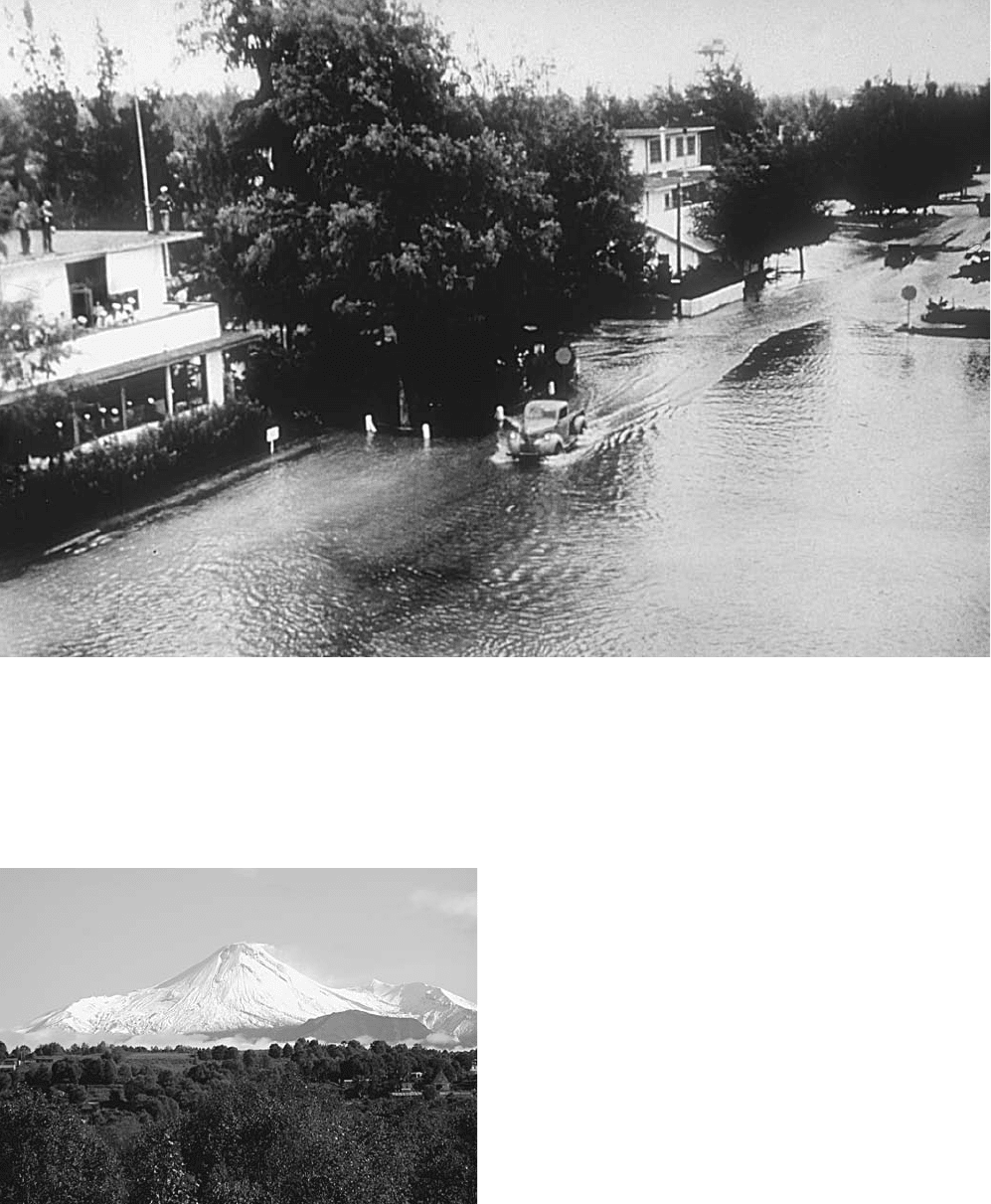
An earthquake of magnitude 9.0 struck the Kamchatka Peninsula in 1952 and generated a tsunami that flooded this area of Hawaii. (Courtesy of the USGS)
Even though the lowlands may be green for part of the year, the
stratovolcanoes of Kamchatka are invariably snow- and ice-covered
throughout the year. (Courtesy of NOAA)
132 Kangra
Kansas United States Kansas does not have a history of
frequent and destructive seismic activity but has undergone
strong earthquakes from time to time. The Lawrenceville
earthquake of April 24, 1867, was characterized by strong
shocks and a wave some two feet (0.61 m) high reported on
the Kansas River. The earthquake caused some damage to
buildings and was felt widely through the Midwest.
Kanto earthquake, Tokyo, Japan The “great Kanto earth-
quake” on September 1, 1923, destroyed much of Tokyo
and the neighboring city of Yokohama. The earthquake, esti-
mated at between magnitudes 7.9 and 8.3 on the Richter
scale, struck one minute before noon and had its epicenter 57
miles (98 km) southeast of Tokyo in Sagami Bay. The earth-
quake and subsequent tsunamis (as high as 30 feet [9 m])
and widespread fires are believed to have killed 140,000 peo-
ple. The 1923 earthquake was one in a series of major earth-
quakes that have struck Tokyo at intervals of approximately
70 to 75 years in the past several centuries: in 1633, 1703,
1782, 1853, and 1923.
Edward Seidensticker, in his story of Tokyo, Low City,
High City, reports that the initial shocks of the 1923 earth-
quake knocked out seismographs at the central weather
bureau office in Tokyo. The seismograph at Tokyo Imperial
University made the only record of the series of more than
1,700 earthquakes that struck the Tokyo area during the fol-
lowing three days, some 237 to which were strong enough to
be felt. He adds that the earthquake damaged or destroyed
almost 75% of buildings in Tokyo, whereas the fire affected
almost 67%. Firefighting equipment was destroyed by the
earthquake, and so fires burned out of control. The cities were
built largely of wood, and oil stored in aboveground tanks
added to the conflagration. The fire reportedly generated a
curious phenomenon called fire tornadoes. These were blaz-
ing storms with winds strong enough to lift a person off the
ground. More than 35,000 people reportedly were killed at a
single location, a park on the east bank of the Sumida River,
when a storm of fire descended upon refugees who had gath-
ered there. In all, some 100,000 people were killed, 40,000
were injured, and 400,000 houses were totally destroyed.
Destruction was most widespread in the Low City,
the eastern and generally lower-class portion of Tokyo,
built on flat ground consisting largely of unconsoli-
dated and liquefaction-prone sediment and landfill. The
comparatively affluent High City built on hilly and more
stable ground in the western half of Tokyo came through
the earthquake and fire with less damage. The Low City
had also suffered extensive damage in another earthquake
in 1855, but because of the magnitude of this damage, the
1923 earthquake marked a sharp decline in the influence of
Low City culture and hence a change in Tokyo’s social his-
tory as well.
Persecution of the unpopular Korean minority in Japan is
said to have accounted for several hundred additional deaths
following the 1923 earthquake. The traditional Japanese
prejudice against Koreans made them a convenient target for
public anger. Koreans were accused of arson and of poison-
ing wells and were sentenced to death, but the government
reportedly took a dim view of the persecution and killings
because of possible effects on international opinion.
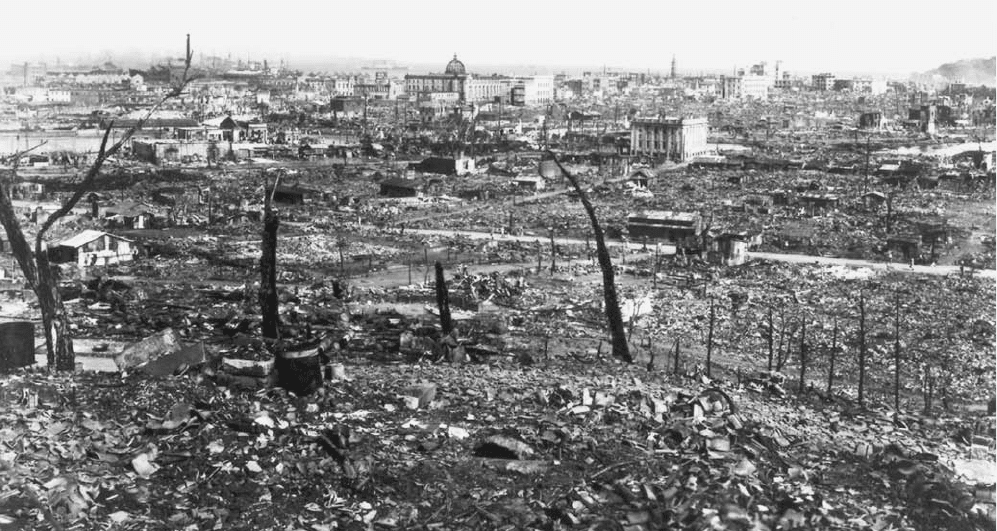
Only the sturdier buildings of downtown Tokyo, Japan, such as the Imperial Hotel (closest building, to right), survived the massive 1923 Kanto earthquake
and resulting fires. (Courtesy of the USGS)
Kanto 133
Subsidence and uplift in Sagami Bay was described as
dramatic. In the center of the bay, subsidence of 300 to 600
feet (91 to 183 m) was reported. North of the bay, uplift of
some 750 feet (229 m) was reported. However, the preearth-
quake bathymetry to which the subsidence and uplift was
compared may not have been accurate.
Yokohama is about 40 miles (64 km) from the epicen-
ter of the earthquake. About 20% of its buildings collapsed
during the earthquake. Some 208 fires broke out within min-
utes and spread throughout the city. Because the earthquake
broke all of the water mains and wrecked the firefighting
equipment, the fire spread unchecked. When the disaster was
over, nearly 27,000 people were dead, 40,000 were injured,
and some 70,000 houses were destroyed.
Karangetang, Mount Indonesia This stratovolcano is
very active. Its last eruption was in 1997 and included lava
flows and
NUÉE ARDENTEs. Not many people were killed
(three), but the slopes had to be evacuated. During the 1974
eruption, the entire population of the island had to be evacu-
ated. It also erupted in 1992.
Karkar volcanic island, near Papua New Guinea Located
in the western portion of the Bismarck volcanic arc, the stra-
tovolcano Karkar exhibits a double, nested caldera. It has
erupted on approximately 10 occasions since the mid-17th
century. An eruption involving an impressive “flame” from
the volcano summit was reported in 1643. In 1885, smoke
and ash reportedly issued from Karkar. Numerous earth-
quakes on June 17, 1895, were followed by an eruption that
continued on an intermittent basis through August. A moder-
ately strong earthquake occurred under the northern coast of
the island in 1930. An explosive eruption may have occurred
in 1962, but this information is uncertain.
No further eruptions were reported until 1974 and 1975,
when great amounts of lava emanated from the volcano.
Earthquake activity started to intensify in 1976, and in 1978
a periodic variety of earthquake, called a banded tremor
because of its “banded” appearance on seismograph records,
began occurring at Karkar. Also in 1978, ground tempera-
tures increased dramatically and reached the level of incan-
descence in some areas. fumaroles also became more active
during this time. phreatic eruptions started in 1979 and
included an eruption in March of that year that killed two
volcanologists. It has been suggested that banded tremors
precede, and may provide early warning of, phreatic erup-
tions because the tremors may result from processes similar
to geysers underground.
Karymsky volcano, Kamchatka, Russia Karymsky is a
stratovolcano that has erupted 29 times since 1771. Most
eruptions are moderate (VEI = 2), but recent eruptions in
1960–64, 1965–67, and 1970–82 were larger (VEI = 3). One
eruption shot ash to an altitude of 33,000 feet (10,000 m).
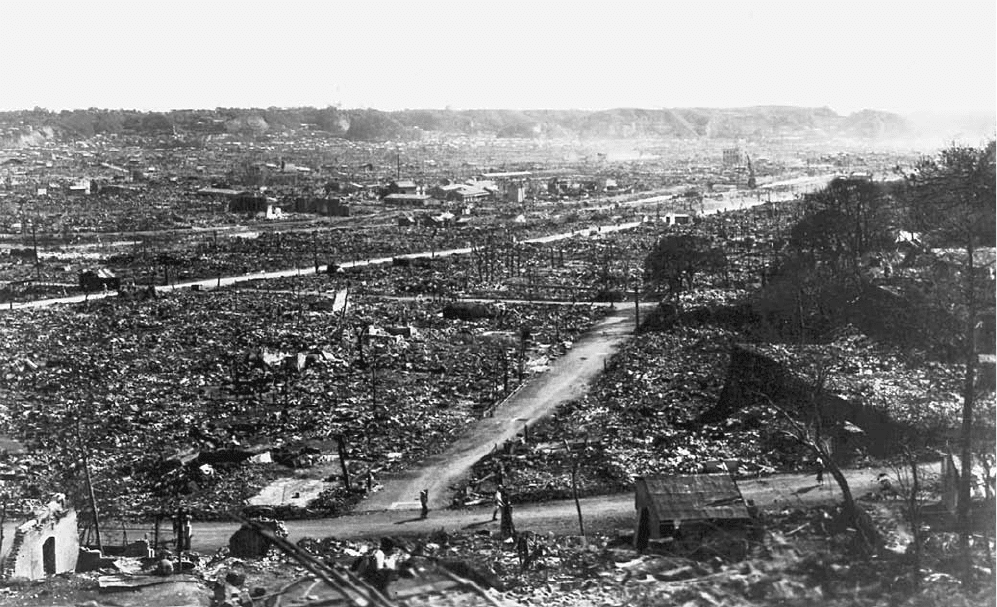
An atomic bomb blast could not have inflicted more damage to the cities of Tokyo and Yokohama, Japan, than the great Kanto earthquake of
1923. (Courtesy of the USGS)
134 Karangetang, Mount
Karymsky is located in a remote part of the Kamchatka Pen-
insula, so no villages or towns are directly threatened by it.
Kashmir earthquake, India A tremendous earthquake was
said to have struck the Kashmir region in September of 1555.
Based upon the damage reported, the event was estimated to
have had an intensity of XII, the maximum number on the
modified Mercalli scale. A huge catastrophic landslide
was blamed for most of the death and destruction. Reports of
huge fissures that swallowed houses were also reported, and
the Earth’s surface was said to have rippled like ocean waves.
Lateral translation of areas was described in whole villages
exchanging places and fields winding up on opposite sides
of houses from their pre-quake position. If these accounts
were accurate, there must have been a phenomenal amount
of strike-slip movement. The death toll for this event
was also a matter of debate. One account put the number at
600, which seems low for the event, whereas another account
claimed 60,000 death, which appears high. If the 60,000 fig-
ure is accurate, this was one of the deadliest earthquakes in
the region.
Katla volcano, Iceland A subglacial volcano, Katla has
a history of eruptions dating back to the 10th century and
has erupted on the average every 42 years since the late 16th
century. A tremendous eruption from the Eldgja fissure was
reported in a.d. 934. It lasted three to eight years and pro-
duced an estimated 4.8 cubic miles (19.6 km
3
) of basaltic
lava making it the largest flood basalt in historical times.
The amount of sulfuric acid aerosol delivered into the atmo-
sphere by this eruption produced a tremendous environmen-
tal impact. These fissures are adjacent to the Laki fissures.
Minor earthquakes preceded another eruption in 1625.
Earthquakes occurred again near Katla before eruptions in
1660, 1721, 1755, 1823, 1860, and 1918. The 1918 eruption
produced a water flow of about 12 million feet (3,660,000 m)
per second for two days. Another eruption has been expected
in recent years but has not occurred. It has been suggested
that the eruptions of Surtsey from 1963–67 and Heimaey
in 1973 may have relieved pressure at great depth and thus
delayed the anticipated eruption of Katla.
Katmai, Mount Alaska, United States The eruption of
Katmai on June 6, 1912, is one of the most famous events in
volcanology. The eruption was the largest in North America
in the 20th century, with a VEI = 6. In the week before the
eruption, earthquakes shook the area around the volcano.
Early on the afternoon of June 6, the mountain emitted a
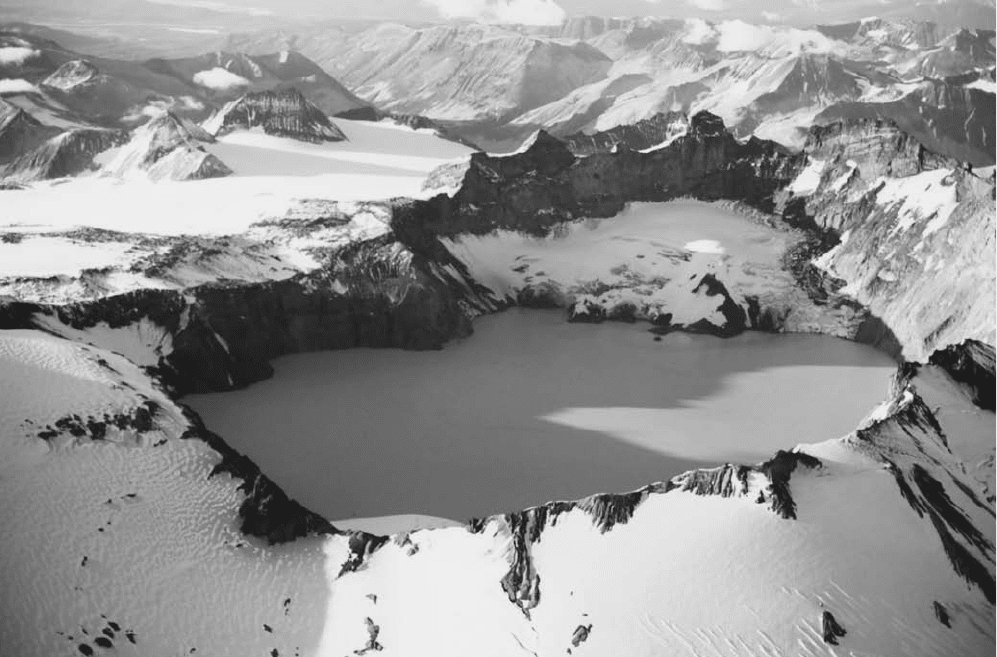
The flooded caldera of the great Katmai volcano, Alaska (Courtesy of NOAA)
Katmai, Mount 135
thick cloud of ash that cast the land around the volcano into
darkness. Great explosions could be heard at a distance of as
much as 800 miles (1,300 km) from Katmai. Ash began to
fall and accumulated to such depths on the ocean that rafts
of pumice were capable of bearing a man’s weight. Visibility
was reduced to less than 100 feet (30 m). On one ship caught
in the ashfall, the air was so murky that the helmsman had
difficulty seeing the compass in front of him. Ashfalls reached
Juneau, 750 miles (1,200 km) southeast of the volcano, and
the Yukon Valley, some 1,000 miles (1,600 km) north of
Katmai.
The volcano emitted large quantities of sulfur oxides,
which, when dissolved in moisture in the air, produced a
solution of sulfuric acid that burned eyes in the vicinity of
the volcano and ruined clothes hanging on lines to dry in
Vancouver, British Columbia, some 1,500 miles (2,400 km)
southeast of Katmai. After the eruption, Katmai was found
to have collapsed. The summit had lost its inner supports
and fallen inward, creating a caldera about three miles (4.8
km) wide and a half-mile (0.8 km) deep. magma had been
diverted from Katmai through another volcano called Novar-
upta. Novarupta put out enough incandescent vapor and ash
to cover more than 40 square miles (104 km
2
) of land to a
depth of hundreds of feet. Huge pyroclastic flows from
Katmai’s eruption created the Valley of Ten Thousand
Smokes, a plain of tephra from which hot gases and water
vapor arose for years afterwards. The 1912 eruption removed
approximately 1.5 cubic miles (6.25 km
3
) of rock from Kat-
mai. It produced more than 7.2. cubic miles (30 km
3
) of ash
in only 60 hours. It covered more than 46,332 square miles
(120,000 km
2
). Comparatively minor eruptions of Katmai
occurred in the 1920s, the 1950s, and 1968.
Kawah Baru See Sunda.
Kawah Batu See Sunda.
Kawah Ijen See Ijen.
Kawah Ratu See Sunda.
Kawah Upas See Sunda.
Kelud (or Kelut) volcano, Java, Indonesia Also known as
Gunung Kelud, this volcano has erupted on at least 15 occa-
sions during the last two centuries, but Chinese residents
recorded five eruptions in the 14th century, so the history
of eruption is long. Kelud is known for its highly dangerous
lahars (volcanic landslides or mudflows). Kelud is an
outstanding case study in using engineering to reduce hazards
from volcanoes, lahars specifically. Because the volcano cra-
ter lake was involved in generating lahars, a plan was devised
for draining the lake through a tunnel. This plan was carried
out in the 1920s, and a tunnel drainage system was finished
in 1928. This system worked so effectively that an eruption
in 1951 generated no lahars. Other attempts to counteract
lahars included a wall that was built in 1905 to direct mud-
flows away from settled areas, but the wall was destroyed in
the 1919 eruption.
The most recent eruption was in 1990. It was explosive
(VEI = 4) with a heavy tephra fall. pyroclastic flows trav-
eled some four to five miles (6.4–8 m) from the volcano, and
small bombs were shot some 35 miles (56 km) away in the
explosion. The weight of the tephra destroyed more than 500
houses and 50 schools. Some 32 people were killed, and sev-
eral tens of thousands of residents were evacuated.
Kentucky United States Kentucky is not a very seismi-
cally active state but does have a history of occasional strong
earthquakes. One such earthquake occurred near Hillman
on December 27, 1841, and was accompanied by a rumbling
noise and a great disturbance on a river.
Kerinici volcano, Sumatra, Indonesia The andesitic stra-
tovolcano has erupted at least 20 times between 1838 and
1970. The eruptions are small (VEI = 1–2), explosive, and
typically phreatic. They commonly involve the crater lake
on Kerinici.
Kern County earthquake, California The Kern County
earthquake of July 21, 1952, was one of the most powerful
and destructive in the history of California and the strongest
in the United States since the great San Francisco earthquake
of 1906. Estimated at Richter magnitude 7.7, the earthquake
generated effects of up to Mercalli intensity XI and caused
an estimated $50 million in property damage. The earthquake
did its most serious damage to Arvin and Tehachapi and sig-
nificant amounts to Bakersfield. It resulted in extensive dam-
age along the Southern Pacific Railroad near Bealville where
tunnels built of reinforced concrete with walls 1.5 feet (0.5
m) thick were twisted and cracked and even caved in. At one
facility alone, the earthquake caused several million dollars in
damage from fire. Twelve people died in this earthquake, nine
of them in a single incident involving the fall of a brick wall
at Tehachapi; 18 people required hospitalization, and injuries
numbered in the hundreds. The shock was felt in Nevada and
Arizona as well as in California. In Los Angeles and Long
Beach, up to 100 miles (161 km) away, tall buildings swayed
into each other causing walls to collapse from the collision.
The earthquake focus was on the White Wolf fault, which
lies perpendicular to the San Andreas Fault but which is
produced from deformation related to movement on it.
More than 100 aftershocks of magnitude 4 or greater were
recorded, 47 of those on July 21 alone. Extensive slumping of
the land surface, landslides, mud volcanoes, and rapid and
extreme fluctuations of water levels in wells were some of the
observed geologic effects.
K-feldspar A common mineral in felsic igneous rocks.
K-feldspar is a silicate with a framework-type atomic struc-
ture. It is light-colored and commonly pink or white, but it
can be green in some areas. It crystallizes at relatively low
temperatures for an igneous rock. feldspar is the most
common mineral group on Earth.
Khorasan earthquakes, Iran The area of Khorasan, Iran,
has experienced numerous devastating earthquakes through-
out its history. One such earthquake struck on June 16, 1653.
136 Kawah Baru
It had an estimated Richter magnitude of 6.5 and an inten-
sity of IX on the modified Mercalli scale. aftershocks
continued at regular intervals and moderate-to-strong inten-
sities through August of that year. The most damage was in
the towns of Mashad and Nishabur, where more than 5,600
people were killed.
The most destructive earthquake reported for Khorasan
occurred in 1101. It was estimated to have had a Richter
magnitude of 6.5 and an intensity of X on the modified
Mercalli scale. It was reported to have killed 60,000 people,
but few details exist on this event.
The most recent devastating earthquake in Khorasan (in
the town of Dasht-e Bayaz) occurred on August 31, 1968,
at 10:47 a.m. The recorded magnitude was 7.3, and the
intensity reached X in the most affected areas. The focus of
this event was estimated at eight to 15 miles (13 to 25 km)
in depth. More than 100 villages were said to have reduced
to rubble, causing upward of $35 million in damages.
The death toll for this event was estimated at 12,000 to
15,000, though some sources claimed 20,000. Many tens of
thousands were injured in the event, and more than 100,000
people were left homeless.
Kii Peninsula Japan The Kii Peninsula is located south-
west of the Izu Peninsula and has been the site of several
powerful earthquakes in the late 19th and 20th centuries:
Very strong earthquakes occurred here in 1899, 1948, and
1952. Other powerful earthquakes have occurred imme-
diately off the coast of the Kii Peninsula in 1944 and 1946.
Swarms of earthquakes were observed along the west side
of the Kii Peninsula before the Kanto earthquake of 1923.
Other earthquake swarms occurred on the Kii Peninsula in
the early l950s, again just before a powerful earthquake, this
one some 150 miles (240 km) southeast of Tokyo in 1953.
Earthquakes on the peninsula are believed to be tectonic in
origin.
Kikai caldera, Japan The largely submerged Kikai caldera
lies at the south tip of the island of Kyu¯shu¯. The caldera
occupies part of a large graben that also includes the Aira,
Aso, Ata, and Kakuto calderas. Parts of the rim of which
forms three small islands, Tokara-Iwo-Jima, Take-Sime, and
Syowa-Iwo-Jima. The caldera is thought to have formed in
three cycles of eruptions, the most recent of which is consid-
ered one of the great eruptions in recent geologic history. This
eruption was about 6,300 years ago and was one of the larg-
est eruptions on Earth in the past 10,000 years. It had an esti-
mated VEI of 7 and emitted more than 36 cubic miles (150
km
3
) of ash. It sent pyroclastic flows 62 miles (100 km)
across the sea. Kikai has been comparatively quiet in the 20th
century, but an eruption that lasted for several months in late
1934 produced a small island. The eruption on September 20,
1934, was said to have been especially dramatic, occurring as
it did during the passage of a typhoon. Pressure associated
with a surge of water accompanying the tropical storm may
have hastened this eruption, although the connection has not
been proven. Eruptive activity continued through late 1936.
Strong earthquakes accompanied the eruptions between 1934
and 1936. The latest eruption was in 1988, and it was minor.
Kilauea volcano, Hawaii, United States Located on the
island of Hawaii, the largest island in the Hawaiian chain,
Kilauea is perhaps the most intensively studied volcano in
the world. Because eruptions here are gentle compared to the
explosive eruptions of many other volcanoes, such as Mount
Saint Helens, scientists have been able to study Kilauea at
close range and at great length. magma here is low in dis-
solved gases and flows freely, almost like water, on occasions
when the lava spills out of the crater and engulfs the sur-
rounding land.
Kilauea is one of five volcanoes on the island of Hawaii;
the others are Mauna Loa, Mauna Kea, Kohala, and Hual-
alai. Kilauea has erupted on dozens of occasions within the
past several centuries. In 1866 the crater of Kilauea surprised
observers when the lava lake drained away and disappeared.
Kilimanjaro, Mount Tanzania The giant stratovol-
cano is the highest mountain in Africa reaching 19,335 feet
(5,893 m). Kibo is the youngest and highest cone. Kiliman-
jaro is located at the south end of the Great Rift Valley of
Africa. Its foundation is a basaltic shield volcano, but the
cone is basalt and andesite. It has not been active in histor-
ical times but steam and sulfur are still frequently emitted.
Killari earthquake, India In the predawn of September 29,
1993, at 3:56 a.m., a devastating earthquake struck the area
around Killari in the Maharashta region of India. The mag-
nitude of the quake was 6.3 and yielded a local intensity
that was IX but more commonly VIII. The duration of shak-
ing was 30 to 40 seconds, and ground acceleration was
estimated at 0.2 g. The source of the tremor was a thrust
fault that crossed the area in a northwest-southeast line.
The rupture zone was 3.3 miles (5.5 km) long and produced
a small scarp of 32 inches (0.8 m) in height. The focus was
a shallow 4.2 miles (7 km) in depth. This was the deadliest
intraplate earthquake in India up to that point. Some 25 vil-
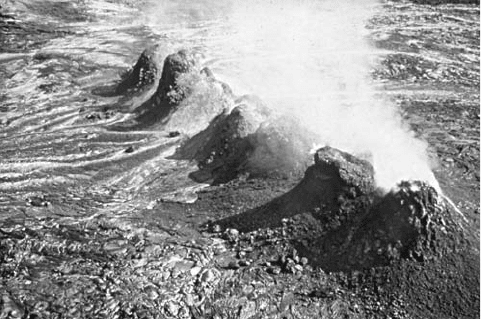
A line of spatter cones at Kilauea volcano, Hawaii, on February 25,
1983. The alignment of cones reflects that they are being fed by a planar
fracture conduit from below the surface. This planar conduit will become
a dike when the magma solidifies within. (Courtesy of NOAA)
Killari 137
lages around the epicenter were completely flattened, caus-
ing a staggering $1.3 billion in damage. The death toll
was 9,782 people, with more than 30,000 injured. The rea-
son that the death toll was so high for a relatively moderate
earthquake was that the area was considered essentially aseis-
mic prior to this event. There were some 125 foreshocks for
years before the main shock, but not even historical records
gave any indication of what was to come. Later, archae-
ologists found that a thriving early city at Killari had been
destroyed by an earthquake at least 1,500 years earlier.
kimberlite Explosive plutonic igneous rock that can
contain diamonds. Kimberlites originate in the mantle.
They are gas- and water-charged. Besides ferromagnesian
minerals, they can contain carbon in the form of diamonds.
At lower pressures, the carbon would be graphite, but the
extreme pressure packs the molecules tightly together making
them diamond. A fracture must open in the crust for this
mass to be able to reach the surface. It travels up the crack
and is emplaced at the surface in a funnel-shaped body of
broken material called a diatreme. The reason the kimber-
lite is broken up is because the gas and water charge make
it travel at speeds up to mach 2 (twice the speed of sound).
These absurd speeds ensure that the diamonds will remain
intact along the journey. Otherwise, if it went slowly, they
would convert to graphite. Kimberlites are named for Kim-
berly, South Africa, where there are large diamond-bearing
kimberlites.
kinematics Kinematics describes the general movement
patterns and directions of faults and plates at a given time
or over a period of time. It is an interpretation or determina-
tion of sense or direction. For example, the kinematics of a
given fault may be that it is dextral strike-slip.
Kirishima Kyu¯shu¯, Japan A shield volcano with at least
69 eruptions between a.d. 742 and 1992. It erupted 19 times
since 1700, making it one of Japan’s most active volcanoes.
The eruptions are purely pyroclastic and emerge from
20 distinct eruptive centers. The 1992 eruption came from
Shinmoe-dake, which is the most active vent. Five of the
eruptions caused fatalities. Kirishima is part of the Kakuto
caldera. It is the site of Japan’s first national park.
Kliuchevskoi volcano, Kamchatka, Russia One of the
most active volcanoes on the Kamchatka Peninsula and
part a group of a dozen closely spaced volcanoes, this stra-
tovolcano has had at least 80 eruptions since its discovery
in 1697. Eruptive activity between 1937 and 1939 involved
several locations on the volcano, including the summit and
vents along the mountain flanks. Bezymianny is included in
this cluster of volcanoes. The previously dormant volcano
erupted in 1955 in a Peléan-type event. The volcano has
erupted 34 times since then. It erupted in 1994, 1997, and
1999–2000. Typical VEI for Kliuchevskoi eruptions is 4,
which is moderate to strong.
In the 1994 eruption, an ash column was shot nine to 12
miles (15–20 km) into the air and then swept 350 miles (565
km) to the southeast at 85 miles (140 km) per hour. Very few
people live even near Kliuchevskoi, so it is not a direct threat
to people and documentation of the eruptions is sparse. How-
ever, by virtue of the enormous amount of ash it erupts, it is
a hazard to aircraft. It is the culprit in several cases of clogged
jet engines, and in general, they try to avoid it.
Kobe earthquake, Japan On January 16, 1995, a devas-
tating earthquake of magnitude 6.8 occurred in the Kobe
area. More than 5,502 people were killed, and 36,896 were
injured. As the result of the destruction or damage of more
than 200,000 buildings, about 310,000 people were evacu-
ated to temporary shelters. There were numerous fires as
well as disruption of water, power, and gas service. lique-
faction and landslides were also common. Surface fault-
ing of up to five feet (1.5 m) right-lateral strike-slip offset
was observed along a 5.6 miles (9 km) fault length. Because
Kobe is a large manufacturing area for computer chips, this
earthquake caused a temporary shortage and prices doubled
in places. This earthquake was well reported by the news
media.
Komaga-take volcano, Japan Komaga-take is an andes-
ite stratovolcano 18 miles (29 km) north of Hakodate City.
It was formed 30,000–40,000 years ago and has produced
several large pumice-flow eruptions in historical times.
These eruptions were in 1640, 1856, and 1929. As a result
of the 1640 eruption, a debris avalanche fell into the sea
and formed a large tsunami that killed 700 people. Because
Hakodate City has a population of more than 320,000, Kom-
aga-take is considered a dangerous volcano.
komatiite There are no ultramafic lavas produced today.
There were ultramafic lavas in the distant past. In 3-billion-
year-old crust in Australia, there are komatiites that are
ultramafic volcanic deposits. These rocks have a distinctive
“spinafex” texture, which is a type of grass. The olivine forms
long blades that looks like grass. The minerals in ultramafic
rocks form at very high temperatures, higher than in any other
type of rocks. The existence of ultramafic lava means that Earth
was much hotter at the time of eruption of the komatiites. The
overall temperature of Earth must have cooled during the past
3 billion years.
K’one caldera, Ethiopia Also known as Garibaldi, the K’one
caldera complex is located east of Addis Ababa, in the Main
Ethiopian Rift. lava flows are thought to have occurred here
around 1820 in a caldera collapse, and fumaroles and hot
springs exist in the K’one area today.
Koryaksky volcano, Kamchatka, Russia The andesitic
stratovolcano is one of the more active on the Kam-
chatka Peninsula. It erupted in 1895, 1926, and 1956 with
moderate explosions (VEI = 3) and pyroclastic flows. Its
remote location results in very little information on these
eruptions.
Kotlugja volcano, Iceland An 1860 eruption of Kotlugja
was reportedly visible 180 miles (290 km) away at night and
audible at a distance of 100 miles (161 km). During one erup-
138 kimberlite
tion, lightning from the cloud is said to have killed two men
and 11 horses.
Krafla volcano, Iceland Krafla underwent a series of erup-
tions in the 1720s but was less active thereafter until erup-
tions began again in 1975. In total, it has had 29 historic
eruptions, the last one in 1985. In one eruption in 1977,
lava emerged from a steam well at a geothermal facility.
Krafla is not a lofty, majestic volcano. Subsidence has been
an important factor in its formation. According to one model
of activity at Krafla, the flow of magma into the area of the
volcano is pulled apart by the divergent boundary so that
large volcanoes like those of Japan or the Cascade Moun-
tains do not have an opportunity to form. The Krafla vol-
cano is stretched out, so to speak, approximately as fast as
it is built up by eruptions. Activity at Krafla has been inter-
preted as the result of magma flowing from great depths into
a central reservoir or reservoirs and from there into rifts. It is
one of 35 rifts in a chain.
The eruptive history of Krafla has been documented for
almost three centuries. In May 1724, powerful earthquakes
in the Krafla caldera were followed by a phreato-magmatic
eruption that expelled pumice and scoria. Earthquakes also
preceded volcanism at Krafla in January and April 1725.
Strong earthquakes and changes in the level of nearby Lake
Myvatn were reported in September 1875, and these signs are
thought to have indicated an intrusion of magma to the south
of Krafla. Lava erupted from the caldera in August 1727, and
the flows extended to the north and south. Another erup-
tion of lava, following hours of seismic activity, took place
in April 1728, followed several hours later by yet another
eruption a couple of miles to the south. A lava eruption in
December 1728 was followed by a much more powerful
eruption of lava in January 1729. More than one lava flow
was reported during the next several months, but it is not
known whether the eruption was intermittent or continuous.
After the eruptive activity in 1729, Krafla appears to have
remained quiet until 1746, when earthquakes and changes in
lake level at Myvatn accompanied some kind of volcanism in
the caldera.
Krakatoa (Krakatau) volcano, Sunda Strait, Indonesia The
catastrophic 1883 eruption of Krakatoa is one of the most
famous volcanic events in history. An island in the Sunda
Strait between Java and Sumatra, Krakatoa began building up
to an eruption in May 1883. An earthquake on May 20 was
followed by a venting of steam and ash from the volcano.
As the eruption continued, it became clear that the activ-
ity did not center on Rakata, the tallest peak on the island
at slightly more than 2,600 feet (792 m) but rather on com-
paratively tiny Perboewatan, a 300-foot (91-m) cone at the
opposite side of the island (north end). An exploration party
from nearby Batavia arrived at Krakatoa on May 27 and
found the eruption had enlarged the caldera to a diameter
of more than a half-mile (0.8 km); the floor was flat, some
500 feet (152 m) across, and covered by a crust of solidified
lava. Steam emerged with a loud noise from a hole about
150 feet (46 m) wide in the middle of the floor. The erup-
tion continued through July and August, accompanied by
loud explosions and mild earthquakes. pumice accumulated
on the waters around Krakatoa and is mentioned in the log-
books of vessels that passed near the island during the erup-
tion. The captain of the ship Idomêne noted on August 11
passing through great fields of pumice, and several days later
the captain of the bark West Australia mentioned in his log
that the ship had encountered large amounts of “lava,” by
which he appears to have meant floating pumice. He added
that some pieces of rock were several feet in diameter.
After the island destroyed itself, a postmortem on the
eruption reached the conclusion that pressure had built up
inside the volcano from gas escaping from magma. The
gases inside Krakatoa are believed to have had no ade-
quate outlet because already viscous magma came in con-
tact with seawater at the surface, cooled and solidified and
thus blocked the vent. Gases from the interior could not
escape and the pressure increased. The situation, Professor
J. W. Judd of the British Royal Society’s committee on the
Krakatoa eruption suggested in a report on the event, was
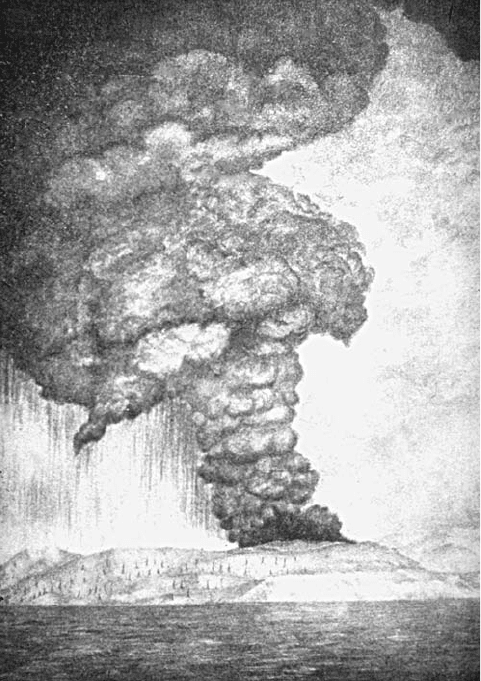
This classic drawing shows the eruption of Krakatoa, in the Sunda
Strait, Indonesia, in 1883. It was one of the largest volcanic explosions in
history. The explosion was heard 3,000 miles (5,000 km) away. The shock
waves were so strong that every barometer on Earth registered them.
It generated 120-foot (37-m)-high tsunamis that killed more than 36,000
people. (Courtesy of NOAA)
Krakatoa 139
comparable to closing the safety valve on a steam boiler
while the boiler continued to build up pressure inside.
Eventually, the “boiler” in this case, the volcano had to
give way and explode. The explosion began with a series
of powerful blasts on August 26–27.
Loud explosions were heard at Batavia and Butzenbourg,
about 100 miles (161 km) from Krakatoa, early on the after-
noon of August 26. A few minutes later, the captain of the
ship Medea about 75 miles (121 km) from the island, saw
smoke and vapor rise from the volcano to an estimated alti-
tude of more than 15 miles (24 km). At about 5 p.m., some
four hours after the final series of explosions began, the noise
of Krakatoa’s destruction was audible all over the island of
Java. Around sunset, the captain of the ship Charles Bal,
some 10 miles (16 km) south of Krakatoa, was so intimi-
dated by the eruption that he ordered the ship to retreat east-
ward. About this time, large chunks of pumice began landing
on the decks of the Charles Bal. Meanwhile, the captain of
the ship Sir Robert Sale, also in the vicinity of Krakatoa, wit-
nessed spectacular displays of lightning in the eruption cloud
and detected an odor of sulfur in the air. The sulfur odor
became intense during the night, as bright flashes of light
from the volcano lit up the surrounding area in the manner
of a giant strobe light. A thick cloud from Krakatoa cov-
ered Batavia soon after dawn on August 27, and a muddy
rain began to fall, followed by a fall of small clumps of dust
held together by moisture. This strange precipitation ended
in midafternoon. Although atmospheric effects hid Krakatoa
from view during this period, the sound of its final destruc-
tion was apparent. Four great explosions, starting at 5:30
a.m. on August 27 and ending shortly before 11:00 a.m., sent
pieces of rock showering down on ships in the vicinity and
were heard as far away as Rodrigues, an island in the Indian
Ocean some 3,000 miles (4,800 km) away from Krakatoa.
Heat and hot gases emitted from ejecta allowed them to
glide on a cushion of air across the surface of the water like a
hovercraft for as many as 60 miles (97 km) where they came
ashore on islands and started fires. The explosions destroyed
the north half of Krakatoa and cut Rakata in two vertically
from base to summit. The shock waves were registered by
every barometer on Earth.
The explosive destruction of Krakatoa generated tsuna-
mis that caused extensive destruction and loss of life along
shores in the region. In some places, the waves are estimated
to have come ashore at heights of 120 feet (37 m). The
men of the ship Loudon turned their ship’s bow toward the
approaching tsunami and rode out the wave’s passage and
then watched as the tsunami engulfed and destroyed a town.
Similar scenes occurred along the coasts of Sumatra and Java
near Krakatoa. In one location, a town some 10 miles (16
km) from the water was submerged by the wave. Some 3,000
residents of Karang Antoe were killed by the tsunami, as were
more than 2,000 at Anjer and Batavia and 1,500 at Bantan.
The total loss of life from the tsunami that followed Kraka-
toa’s explosion is uncertain, but estimates range in the tens of
thousands (most recently 36,000). The tsunami from Kraka-
toa was strong enough to twirl ships around their anchors
at the harbor in Colombo, Ceylon (now Sri Lanka). Some
deaths from this eruption were unrelated to the tsunami.
In 1990, more than a century after the eruption, an
expedition to Krakatoa, including a team from the Univer-
sity of Rhode Island Graduate School of Oceanography,
examined the role of pyroclastic flows in generating the
tsunamis that originated from Krakatoa during the 1883
eruption. This expedition took samples of clastic material
from the ocean floor around Krakatoa. Sediment cores taken
in this way showed evidence of a large, poorly sorted main
deposit, overlain by another deposit of volcanic gravel and
sand. Pieces of pumice large enough to impede the action of
the sediment-coring mechanism were reported, and the inves-
tigators noted, in addition to the chunks of pumice, pieces
of rock more than 12 inches (31 cm) across in some cases.
These large fragments of rock are contained in a matrix with
a silty and sandy character, the same as deposits on land.
The similarity between the submarine and terrestrial depos-
its indicated that the underwater deposits originated as pyro-
clastic flows. The expedition also determined that submarine
mounds near the Steers and Calmeyer island platforms just
north of Krakatoa were made up of pyroclastics from the
eruption in 1883. On the Calmeyer island platform, the
investigators noticed signs of turbidity currents that may
have resulted when pyroclastic material at high temperature
came in contact with seawater, causing steam explosions
that gave rise to ash-filled turbidity currents. At one point on
the seafloor west of Krakatoa, the expedition found a pyro-
clastic flow deposit some 300 feet (91 m) thick laid down by
the eruption, including fragments of pumice several feet in
diameter.
The 1990 expedition found evidence that one or more
pyroclastic surges preceded the tsunami from Krakatoa, and
two or more additional pyroclastic surges came after the tsu-
nami. Deposits included pieces of coral that appear to have
been torn from the seafloor and deposited with the pyroclas-
tic material by the tsunami. The investigators concluded that
deposits on land from Krakatoa’s 1883 eruption are made up
largely of material from pyroclastic flows as are underwater
deposits from that eruption. The pattern of these deposits
shows they were laid down in all directions around the island,
not principally to the north, as had been presumed before.
Accumulations are greatest to the west of Krakatoa. Deposi-
tion of pyroclastic material on the west side of the volcano is
thought to have generated powerful tsunamis.
That the meeting between ocean and pyroclastic flows
was not gentle is indicated by the small amount of mixing
between seawater and pyroclastics. The pyroclastic materi-
als show poor sorting, evidence that there was little mixing
between them and the water. Had mixing occurred on a
significant scale, water action would have resulted in more
effective sorting of material. This pattern of poor sorting
persuaded the scientists on the 1990 expedition that masses
of pyroclastic material from the volcano in 1883 displaced
water in such amounts as to cause the destructive tsunamis
associated with the eruption of Krakatoa. Apparently, five
or more units of pyroclastic flow occurred in the eruption.
The results of the 1990 expedition indicate that one particu-
lar tsunami, at approximately 10 a.m. on August 27, 1883,
was linked with the formation of the caldera at Krakatoa
during an especially violent portion of the eruption, possi-
140 Krakatoa
bly caused when large amounts of magma came into contact
with seawater.
The 1883 eruption of Krakatoa, specifically the fine ash
cast into the upper atmosphere by the eruption, has been
implicated in the cooler-than-usual winter that followed
the destruction. Mean annual global temperature dropped
by one-half to one degree Fahrenheit in 1884, and this cool
period is believed to have continued through the 1880s and
part of the 1890s. The high-altitude ash cloud from Krakatoa
is suspected of having intercepted enough incoming sunlight
to lower temperatures on a worldwide scale.
Atmospheric phenomena attributed to dust from Kraka-
toa included vivid sunsets and a blue tinge to the Sun. Even a
“green sun” was reported in India.
The 1883 eruption of Krakatoa is especially notable for
the distances at which noises from the eruption were heard.
The captain of a ship 500 miles (805 km) away from the
eruption, at Surabaya, heard the explosions clearly. At Sin-
gapore, more than 500 miles (805 km) from Krakatoa, noises
from the eruption were interpreted as the sound of a ship fir-
ing its guns as a call of distress, and two rescue ships were
sent out to see what the problem was. Similar circumstances
convinced officials at Macassar and Timor in Indonesia,
approximately 1,000 and 1,350 miles (1,600 and 2,173 km)
respectively from Krakatoa, to send out ships to rescue what
they thought was a vessel in distress. Tribes-people in Borneo
thought the noise from Krakatoa’s eruption was the sound of
a Dutch attack on them. On the island of Rodrigues, about
3,000 miles (4,830 km) from Krakatoa, the noise of the erup-
tion was clearly audible and resembled the firing of heavy
guns.
An eruption in 1927 generated a new island, called Anak
Krakatoa, or “child of Krakatoa,” in the midst of the three
islands Rakata, Panjang, and Sertung that occupy what once
was the site of the original island of Krakatoa. That volcano
has had several periods of activity since 1927. Its latest activ-
ity began in 1994 and was still going in 1999. It is still a very
dangerous volcano.
Krasheninnikov caldera, Kamchatka, Russia Several great
flows of lava are believed to have emanated from this cal-
dera in the past 3,000 years: the Vodopadny flow (about
3,000 years ago), the Ozerny flow (1,500 years ago), the
Yuzhny flow (less than 700 years ago), and the Molodny flow
(less than 500 years ago). The area is seismically active, and a
fumarole was observed in 1963.
Krozontzky volcano, Kamchatka, Russia An especially
beautiful and symmetrical volcano, Krozontzky erupted
in 1922 and 1923. Other than that, it was considered an
extinct volcano.
Kuma-dake See Daisetsu-Tokachi.
Kurikoma See Onikobe.
Kuril Islands Russia The Kuril Island chain extends more
than 700 miles (1,130 km), from northern Japan to the Kam-
chatka Peninsula. The island arc occupies the bound-
ary between the Sea of Okhotsk and the Pacific Ocean and
consists of two chains of islands, the Greater Kurils and the
Lesser Kurils. The island arc is formed by a subduction
zone in which the Pacific crustal plate is being subducted
beneath the Eurasian plate. There is significant volcanic
and seismic activity as a result. Recently active calderas
in the Kurils include Chirpoi, Golovnin, Ketoi, L’Vinaya
Past, Medvezhii, Mendeleev, Nemo Peak, Rasshua, Tao-
Rusyr, Uratman, and Zavaritsky.
Kuril Lake caldera, Kamchatka, Russia The Kuril Lake
caldera occupies part of the larger Pauzhetka caldera. The
stratovolcano Illinsky is located on the northeastern rim
of the Kuril Lake caldera. Other, nearby volcanoes are Iavin-
sky, Kambalny, and Zheltovsky. geothermal energy has
been exploited in this region.
Kuro-dake See Daisetu-Tokachi.
Kusatsu-Shirane Honshu
¯
, Japan A stratovolcano that
has erupted at least 17 times from 1805 to 1989. The volcano
has many summit craters that contain lakes. Nearly all of the
eruptions were phreatic, many involving the crater lakes.
Most of the eruptions were small to medium (VEI = 1–2) in
size, at best, except for an eruption in 1932 that generated a
lahar that caused two deaths.
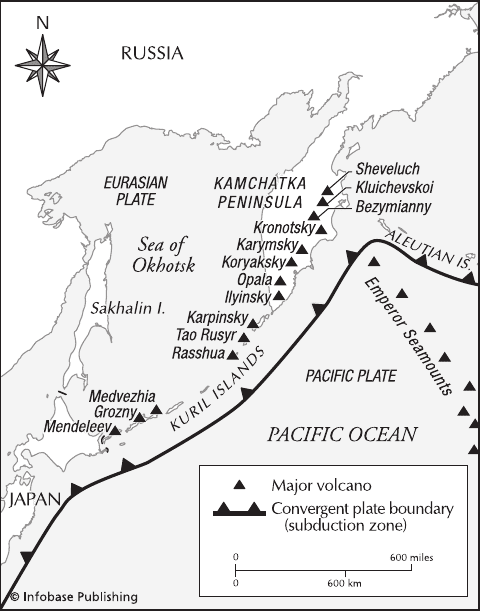
Map of the Kamchatka Peninsula and Kuril Islands showing the plate
relations and several of the major volcanoes in the area
Kusatsu-Shirane 141