
Gates A.E., Ritchie D. Encyclopedia of Earthquakes and Volcanoes
Подождите немного. Документ загружается.

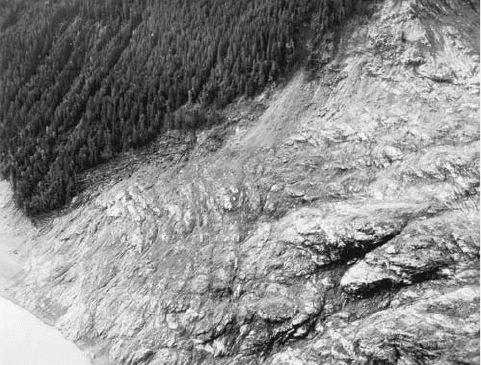
Lituya Bay Alaska, United States Located on the south-
eastern coast of Alaska, Lituya Bay is famous for the
destruction caused by a wave that resulted from a landslide
associated with a powerful earthquake in 1958. A rockslide
along the shore of the bay set off a wave that destroyed tim-
ber as high as 1,720 feet (524 m). At various other locations
along the shore of the bay, the wave swept away forest at
elevations of 600 (183 m), 160 (49 m), 130 (40 m), and 90
feet (27.4 m). An island in the bay was denuded of timber up
to an elevation of 80 feet (24.4 m). Three boats were in the
bay at the time of the incident. One was destroyed, the wave
carried the second across a spit at the mouth of the bay and
into the ocean, and the third boat survived the wave in the
shelter of the island mentioned earlier. Return waves in the
bay formed a small seiche.
Liwa earthquake, southern Sumatra, Indonesia On Febru-
ary 15, 1994, an earthquake of magnitude 6.6 occurred. At
least 207 people were killed, and 2,000 were injured. Between
direct damage, mudslides, and landslides, more than 6,000
homes and buildings and 75,000 people were left homeless.
Damage is estimated at $169 million.
local magnitude The recorded magnitude of an earth-
quake less than 62 miles (100 km) from epicenter. Because
seismic waves move away from the earthquake in a spheri-
cal front, they quickly lose their destructive power. It is
like the rings that form on a lake when a rock is thrown in.
The height of the wave is high when the ring is small near
the source. As the ring grows larger, the height of the wave
becomes progressively smaller very quickly. The reason is
that all of the energy must be spread over a rapidly increasing
circle. At any place, energy reflected in amplitude of the wave
must be small. Seismic waves do the same thing. The local
magnitude really monitors the area around an earthquake
where the greatest destruction occurs because that is where
the waves have the greatest magnitude.
locked fault A fault may be locked if the frictional strength
exceeds the applied stress for a long period of time. Typically,
something prevents an active fault from slipping in a seg-
ment, and there are no earthquakes for a much longer than
usual period of time. An asperity, an intrusion or other rock
body, or intersecting faults are the most common culprits. In
some cases, a bulge or elevated area may develop over the
locked segment. This is the suspected case in the Palmdale
bulge along the San Andreas Fault in California. The prob-
lem is that when the stress finally overcomes the obstruction
to movement, the resulting earthquake is much stronger than
usual.
loess Loess is windblown dust from deserts or other arid
regions that accumulates on downwind slopes in non-arid
areas. This fine dust is eroded by wind and carried in suspen-
sion until it encounters an area of lower wind velocity. Large
hills and mountains can create enough of a wind shadow to
allow deposition locally. Otherwise, the dust remains aloft
and can circulate in the atmosphere for a long period of time.
Where it accumulates as loess, typically on slopes, it can be
quite thick but not particularly stable as the result of the fine
size. China has particularly thick loess deposits. It is depos-
its that have failed in strong earthquakes, destroying both the
communities that inhabited them as well as those in the val-
leys below. Some of the largest death tolls from earthquakes
occurred in the Gansu province from this process.
Loihi Seamount Hawaiian island chain, United States The
Loihi Seamount is located southeast of the island of Hawaii
and is some 3,000 feet (914 m) below sea level. It is the
youngest volcano in the Hawaiian chain. The seamount
appears to have undergone recent volcanic activity and has
two craters on its summit. Earthquake activity under Loihi
in the 1970s may have been linked with eruptions. It is esti-
mated that Loihi will reach the surface of the Pacific Ocean
in a few tens of thousands of years.
Lokon volcano, Sulawesi (Celebes), Indonesia An andes-
ite stratovolcano with at least 21 historic eruptions. The
most recent eruption was in 1992. Most eruptions are small
to moderate (VEI = 2) and involve pyroclastic emissions.
Loma Prieta earthquake, California Almost equal in fame
to the 1906 catastrophe was the less powerful but nonetheless
highly destructive earthquake that struck the San Francisco
Bay area on October 17, 1989. This earthquake was the larg-
est in northern California since the San Francisco earth-
quake 83 years earlier. In terms of damage, the earthquake is
thought to have been the single most expensive natural disas-
ter in U.S. history up to that time. Estimates of damage are
as high as $10 billion. Known as the Loma Prieta earthquake
after a mountain near its epicenter, the 1989 disturbance was
centered just south of San Jose, in the vicinity of Gilroy, Wat-
sonville, and Santa Cruz, and was caused by movement along
the San Andreas Fault at a depth of more than 11 miles
The bare area on the right side of the photo was once as forested as
the left side of the photo before the immense 1957 seiche stripped away
the trees 1,700 feet (524 m) up the hillslope facing onto Lituya Bay,
Alaska. (Courtesy of the USGS)
152 Lituya Bay
(18 km). The rock along the western side of the fault moved
northward several feet. The earthquake occurred at 5:04 p.m.,
measured 7.1 on the Richter scale, lasted some 15 seconds,
and is thought to have been the most powerful earthquake in
California since the Kern County earthquake in 1952.
Although media coverage concentrated on destruction
in San Francisco, where structures built on unconsolidated
material suffered serious damage, destruction from the Loma
Prieta earthquake was greatest within a radius of about 20
miles (32 km) from the epicenter. Buildings collapsed in
Hollister, Gilroy, and Santa Cruz, and major damage was
reported in Watsonville as well. A portion of Highway 101
collapsed over a slough near Watsonville. The earthquake
reportedly shifted hundreds of frame homes in Santa Cruz
County from their foundations and blocked highway access
to the community of Santa Cruz, which was cut off by rock-
falls and damaged bridges. Collapsing walls of aged build-
ings allegedly killed three people in Santa Cruz. Damage was
light at the University of California at Santa Cruz but rela-
tively heavy at nearby Stanford University, where destruction
was estimated at $165 million. The ground cracked in many
locations near the epicenter in the Santa Cruz Mountains, but
no signs of surface rupture along the fault itself were found,
although one estimate put the length of the underground
rupture from this earthquake at about 30 miles (48 km).
One crack near Highway 17 measured more than 600 yards
(550 m) long and several feet wide. Sixty-seven people were
reported killed by the Loma Prieta earthquake.
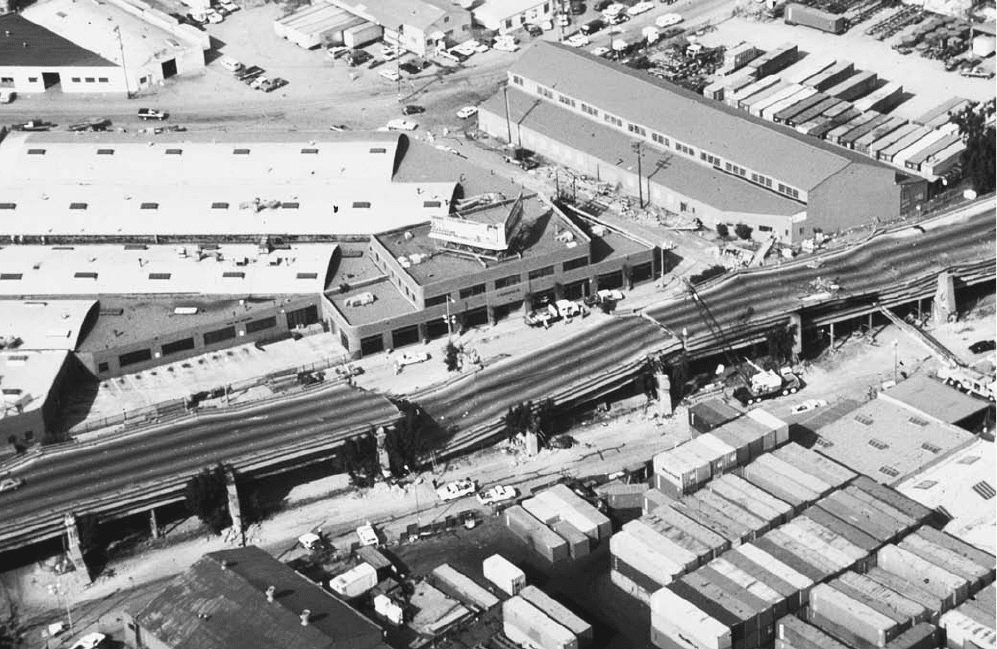
Loss of human life was concentrated in western Oakland,
on the east side of the bay, where a portion of Interstate 880,
some 1.5 miles (2.4 km) long and called the Cypress Viaduct,
collapsed and crushed dozens of vehicles and their occu-
pants as the upper level of the two-level highway fell on the
lower level. Survivors on the lower level were few; although
one man was found alive 89 hours after the collapse, he died
soon afterward. Another collapse occurred on the Bay Bridge
between San Francisco and Oakland, where a 50-foot (15-m)-
long segment of the bridge’s upper deck fell onto the lower.
Heavy damage was also reported to the Embarcadero Free-
way in downtown San Francisco, and damage including land-
slides and harm to bridges forced the closing of Highways 1
and 101 south of San Francisco.
The earthquake interrupted the third game of the World
Series at Candlestick Park. Fires from a ruptured gas main
consumed portions of the Marina district, but the fires were
brought under control within hours. The Marina district also
exhibited widespread damage from liquefaction because the
district was built on fill laid down early in the century. Other
Aerial photograph of the collapsed Cypress viaduct of route I-880 in Oakland, California, as a result of the 1989 Loma Prieta earthquake. This collapse
caused most of the casualties suffered during this event. (Courtesy of the USGS)
Loma Prieta 153
areas of heavy damage included portions of the Mission dis-
trict and the area south of Market Street. Significant damage
also occurred in the Mission, Haight, Sunset, and Tenderloin
neighborhoods.
Lomo Poisentepe See Apoyo.
Long Beach See California.
Long Island caldera, Papua New Guinea The Long Island
volcanic complex is located on the northern coast of Papua
New Guinea and includes two stratovolcanoes, Cerisy
Peak and Mount Reaumur, on opposite sides of Lake Wis-
dom, a caldera lake some six miles (9.5 km) wide. Motmot
Island, a small island within the lake, was built by volcanic
activity within historical times. Powerful seismic and volca-
nic events appear to have occurred at the caldera some 300
years ago, but records were not kept on a scientific basis. An
eruption in 1660 is believed to have been as powerful as the
Krakatoa eruption of 1883. Eruptions occurred in 1933,
1938, 1943, 1953, and 1955 from a vent or vents under
the lake and built up Motmot Island. Discolored water in
the lake, accompanied other volcanic activity in 1968, 1974,
1976, and 1993.
long-period wave A seismic wave with a period of six sec-
onds or greater. The period of a wave is the time it takes for
an entire wave to pass a point. If you were standing in the
ocean, it would be the time it takes between the wave crests
that hit you. Long-period waves mean a slow rise and fall as
they pass. These waves tend to be less damaging.
Long Valley caldera, California, United States This cal-
dera near Mammoth Lakes appears to have undergone a
series of eruptions 500 to 600 years ago that produced rhyo-
lite domes in and near the caldera. It is perhaps the largest
modern rhyolitic centers in North America. A much earlier
eruption (about 3.6 million years ago) is thought to have
been so powerful that it sent a pyroclastic flow rushing up
the flank of the Sierra Nevada and over the mountains. The
output from this eruption is believed to have flowed down
Owens Valley for some 40 miles (64 km) and to have covered
almost 600 square miles (1,554 km
2
) of land in the present
states of California and Nevada with thick Ash layers. A
famous deposit called the Bishop Tuff appears to date from
this eruption. The Ashfall from this eruption has been
traced into what is now Nebraska. The eruption is thought
to have forced some 150 cubic miles (615 km
3
) of magma to
the surface in the form of Plinian eruptions. This volume of
ash makes the Long Valley eruption among the largest docu-
mented.
Eruptions in the area continued at Mono-Inyo Craters
volcanic field. The most recent eruption was at Mono Lake in
1720 and 1850. Earthquake activity and uplift in the caldera
during the 1980s provided evidence that magma was moving
underground at that time. In 1994, dying forests were found
to be attributed to carbon dioxide concentrations of 30% to
96% within the soil.
Los Alamos New Mexico, United States Los Alamos is
built on a volcanic plateau made of ashflow deposits laid
down in an eruption that is believed to have resulted in the
collapse of the volcano summit and the formation of a cal-
dera, now called Valle Grande.
Los Angeles earthquakes, California, United States The
Los Angeles area has been the location of numerous earth-
quakes, some of which in historical times have been powerful
and destructive. One of the first earthquakes experienced by
European-descended Americans in this part of California
occurred during a visit by Captain Gaspar de Portola, gover-
nor of Mexico, in July 1769. Another series of earthquakes
in 1812 caused such widespread damage to Spanish missions
in southern California that 1812 came to be known as “el
año de los temblores,” or “the year of the earthquakes.”
Other notable earthquakes in southern California history
include the Fort Tejon earthquake of 1857; the San Jacinto
earthquake of 1899; the Imperial Valley earthquakes of
1915 and 1979; the San Jacinto earthquake of 1918; the
Santa Barbara earthquake of 1925; the Long Beach 1933
earthquake; the Terminal Island earthquakes of 1949, 1951,
1955, and 1961; the Kern County earthquake of 1952; the
San Fernando earthquake of 1971; the Santa Barbara
earthquake of 1978; and North Ridge earthquake of 1994.
It is widely assumed that an earthquake of unprecedented
destructive potential is possible in the greater Los Angeles
area, although it is difficult to predict when and where it may
occur. Projected casualty figures from the Federal Emergency
Management Agency (FEMA), in the case of a postulated
earthquake of magnitude 8.3 on the San Andreas Fault, put
deaths at 3,000 to 12,500 and hospitalized injured at 12,000
to 50,000, with 52,000 long-term homeless. The same agency
projected figures for another postulated earthquake, of mag-
nitude 7.5 on the Newport-Inglewood Fault Zone, at 4,400
to 21,000 killed and 17,600 to 84,000 hospitalized injured,
with 192,000 long-term homeless.
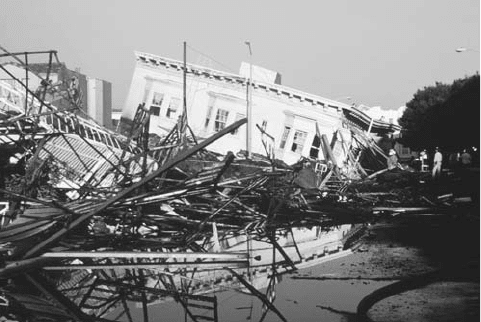
The Marina district of San Francisco, California, suffered much worse
destruction than the rest of the city during the 1989 Loma Prieta
earthquake. The destruction shown here at Beach and Divisadero Streets
is a good example. (Courtesy of the USGS)
154 Lomo Poisentepe
The greater Los Angeles area is highly susceptible to
earthquakes because of a complex and unstable geology
generated by the collision between northward-moving Baja
California and the deeply rooted Sierra Nevada range. This
collision has produced Southern California’s Transverse
Ranges and a network of active faults, some of which have
the potential to generate highly destructive earthquakes.
Prominent fault zones in the Los Angeles area include the
following:
• The Elsinore Fault Zone extends almost 120 miles (192
km) northwest from the Mexican border to the northern
boundary of the Santa Ana Mountains.
• The Newport-Inglewood Fault Zone is actually a collection
of small faults along a line extending past Newport Beach
and Santa Monica all the way into Baja California. The
powerful Long Beach Earthquake of 1933 occurred along
this fault zone.
• The Palos Verdes Hills Fault lies about five miles (8 km)
west of Long Beach.
• The San Andreas Fault Zone is the most famous fault
affecting the Los Angeles area and extends approximately
along a line connecting Palmdale, San Bernardino, and
Banning and then along the southern boundary of the Little
San Bernardino Mountains. The San Andreas Fault Zone
was the site of the Fort Tejon earthquake of 1857.
• The San Pedro Basin Fault Zone extends approximately
from Point Dune down the San Pedro Channel to the east
of Catalina Island.
• The small but nonetheless dangerous San Fernando Fault,
about 20 miles (32 km) south of the San Andreas Fault,
was responsible for the destructive San Fernando earth-
quake of 1971.
Louisiana earthquakes, United States Destructive earth-
quakes originating within Louisiana itself appear to be
infrequent, although the state occupies the lower end of the
seismically active Mississippi Valley. A strong earthquake on
October 19, 1930, damaged buildings at Napoleonville, and
another earthquake on November 19, 1958, caused alarm in
Baton Rouge.
Love wave Named after the British physicist A. E. H. Love
(1853–1940), Love waves are earthquake waves that are
restricted to shallow depths near ground surface. The motion
is horizontal and perpendicular to the direction of travel,
with no vertical motion involved. They are very destructive
waves that cause structures to fall over sideways as the result
of their side-to-side movement.
low velocity zone At 37–155 miles (60–250 km) depth
beneath Earth’s surface, seismic velocities decrease abruptly.
At both shallower and deeper levels, velocities increase con-
sistently. The reason that the velocity drops at this depth is
because the rocks behave in a ductile manner there. Above
it rocks are brittle. Considering that seismic waves are
elastic, ductile deformation is not conducive to high speeds.
The response of the gum-like material is much slower than
the rubber bandlike response of the brittle rocks. In terms
of plate tectonics, the low velocity zone corresponds to the
asthenosphere. Lithospheric plates float on this layer.
Luzon earthquake, Philippines At 7:26 a.m. on July 16,
1990, one of the most infamous earthquakes in the history
of the Philippines struck the city of Luzon. The main shock
had a magnitude of 7.8 and was followed by numerous
aftershocks for many months. The death toll was 1,621,
with more than 3,100 injuries reported. It could have been
far more devastating if it had occurred later in the day. land-
slides, liquefaction, and abrupt subsidence caused exten-
sive damage to buildings, roads, and utility services. Total
damage was estimated at $2 billion.
Luzon 155
maar Also known as a tuff cone, a maar is a shallow, flat-
floored crater that is believed to have formed above diatremes
as the result of a violent explosion of gas or steam. Maars
are typically 200–6,500 feet (60–1,950 m) across and 30–650
feet (9–195 m) deep. The craters are commonly filled with
water, forming lakes. The rims of maars are low and consist
of a mixture of fragments of volcanic rock and rocks from
the walls of the diatreme.
Macdonald Seamount Tubuai Islands and Seamounts,
South Pacific Ocean This seamount reaches to within about
100 feet (30 m) of the surface. Its activity was discovered in
1967 when undersea hydrophones picked up noise from it.
Bubbles of gas and fragments of basalt were seen issuing
from the seamount in 1987.
mafic A compositional term for magma and lava, meaning
that they are rich in iron and magnesium. The word derives
from ma for magnesium and f for Fe (iron). Mafic rocks
include basalt for volcanic rocks and gabbro for plutonic
rocks. These rocks are composed of pyroxene and calcium-
rich plagioclase but commonly include olivine as well.
They are very dark in color. Rocks of this type are formed at
very high temperatures relative to other igneous rocks.
magma Molten rock underground is generally known as
magma, as distinct from lava, which is molten rock that has
emerged onto the surface from a volcanic vent. Magma dif-
fers greatly in composition and behavior. Some magmas are
high in dissolved gases and, when they reach Earth’s surface
and the high subsurface pressures on them are removed,
they form the frothy rocks pumice and scoria as dissolved
gases bubble out of solution as the rock hardens. Such gas-
rich magma tends to produce explosive eruptions because of
its high gas content. Alternatively, magma that is relatively
low in dissolved gases may emerge from vents as streams or
floods of highly fluid lava that may flow across the land for
many miles before solidifying and halting. Rocks produced
by such eruptions include basalt. Great flows of basalt from
eruptions of this kind may be found in the Pacific Northwest
of the United States, especially the Columbia Plateau and
Snake River Plain. When magma solidifies underground, it
may form plutons such as dikes (vertical walls of igneous
rock created when magma enters a vertical crack in subter-
ranean rock and solidifies there) or sills (shelves of igne-
ous rock that form in similar fashion but along strata of
country rock). Masses of magma that solidify at depth are
known generally as plutons. When magma in the chimney of
a volcano solidifies and remains standing after the external
layers of the volcano have been eroded away by wind and
water, the resulting columnar structure is known as a vol-
canic neck. Where magma reservoirs near the surface heat
groundwater, the result may be an area suitable for geo-
thermal energy production. Movement of magma under-
ground is thought to be responsible for minor earthquakes
that may signal the imminent eruption of a volcano.
magma chamber The store of magma beneath a volcano
that provides the molten rock for lava and ejecta during an
eruption. Magma is ever-present in these large chambers up to a
kilometer beneath the surface. It can remain there for long peri-
ods of time without an eruption taking place. However, if it is
charged with additional magma or volatiles (especially water)
from deeper or even laterally within the earth or it is squeezed
by local stress, the magma may ascend to the volcano. This
process produces an eruption. Pulses of magma may feed the
chamber periodically and drive the eruptions. Movement of
the magma in the chamber is accompanied by an earthquake
swarm as the magma opens fractures. If all the magma is
drained from the chamber, the volcano may undergo caldera
collapse in which massive subsidence of the complex occurs. If
the magma crystallizes underground, it forms a pluton.
magmatic arc In a convergent boundary between oce-
anic crust and continental crust, an igneous belt devel-
ops over a subduction zone. This igneous belt is analogous
M
157
to an island arc on ocean crust, except that a magmatic arc
is on continental crust. These arcs exhibit extensive volca-
nic activity like island arcs but much more plutonic activity.
The prime example of a magmatic arc is the Andes Moun-
tains of South America. The volcanic rocks are andesites
but dominantly dacites and even rhyodacites in some cases.
The plutonic rocks are primarily granodiorites but gran-
ites are not uncommon. These extensive plutons coalesce to
form huge batholiths exemplified by the Sierra Nevada
of California.
magnitude A measure of the energy released in an earth-
quake.
See also seismology.
Maine United States The northernmost state of New En-
gland is known for frequent minor seismic activity but also
experiences an occasional strong earthquake originating on or
near its borders. Maine is located along the highly earthquake-
prone Saint Lawrence Valley and is sometimes affected by
shocks that originate there.
One of the strongest earthquakes in Maine’s history
occurred on March 21, 1904, and was felt over much of New
England and the Canadian provinces of Nova Scotia and New
Brunswick. The earthquake apparently was most powerful
near Eastport and Calais in Maine but also was felt strongly
near the community of Saint Stephen in New Brunswick. The
shock was felt in Montreal, 300 miles (483 km) distant, and
at points 380 miles (612 km) away in Connecticut. This
shock was followed by several minor shocks hours later. An
earthquake almost as strong occurred on July 15, 1905, and
was felt in central Maine and New Hampshire, a distance
of some 100 miles (161 km) westward from the shore. This
earthquake, however, affected a much smaller area altogether
than the earthquake of 1904.
main shock The main earthquake in a group of earth-
quakes is considered the main shock. Designation of main
shock from foreshock or aftershock usually must be
done in hindsight. If there is an earthquake of magnitude 5,
and the next earthquake is a magnitude 3, then the 5 was the
main shock. If the next earthquake is a magnitude 7, then the
5 was a foreshock.
Maipo See Diamante.
major earthquake An earthquake with a magnitude
greater than 7 on the Richter scale. Major earthquakes are
typically restricted to the tectonically active areas of Earth. In
the United States, California and Alaska commonly expe-
rience major earthquakes, and yet throughout the entire rest
of the country, they are so rare that historical ones can be
counted on one hand. A designation of a major earthquake
tells nothing about the damage it causes. For example, the
Hector Mine earthquake in California was a 7.1 on the
Richter scale. It was a major earthquake but in a remote area
and therefore there were no casualties. On the other hand,
the Armenian earthquake was a 6.9 on the Richter scale, just
below major earthquake status, and yet killed more than
25,000 people. It is important to understand that there are
strong and major earthquakes all over the world, all of the
time. Only when they are in populated areas and cause major
destruction do we hear about them. The press does not report
on all of the earthquakes in remote areas.
Makalia, Mount See Dakataua.
Makian volcano, Halmahera, Indonesia Makian is a
stratovolcano that has had eight historic eruptions. Five
of them were large (VEI = 3–4) most of which produced
fatalities. The 1646 eruption devastated villages, but records
are poor. The 1760 eruption killed some 2,000 people
largely from lahars. The 1861 eruption caused 326 fatali-
ties from
NUÉE ARDENTEs and people drowning while trying
to escape. The most recent eruption was in 1988. There have
been some large tectonic earthquakes in the area, notably
in 1972.
Makran coast earthquake, Iran-Pakistan At 3:26 a.m. on
November 27, 1945, a large earthquake swept the Makran
coast on the Iran-Pakistan border. The quake was an impres-
sive 8.0 on the Richter scale, lasting more than 30 seconds.
The shaking was felt strongly throughout the region and
caused a lot of damage. liquefaction produced several
mud volcanoes off the coast that wound up as islands. One
emitted large amounts of natural gas that caught fire, sending
flames hundreds of feet into the sky. The real shock of this
earthquake, however, was the series of tsunamis that it pro-
duced. The typically gentle waves of the area were replaced
by tsunamis up to 40 feet (12 m) in height and stretched all
of the way to India. Several coastal villages were washed out
to sea as a result. The death toll from this event was hard
to estimate because it involved a tsunami, several countries,
and numerous coastal towns and boats. The best estimate
was about 4,000 people.
Mammoth Hot Springs Wyoming, United States A ter-
raced natural structure at Yellowstone National Park,
Mammoth Hot Springs is a famous example of a formation
generated by geothermal activity.
Managua earthquake, Nicaragua The Managua earth-
quake of December 23, 1972, reportedly killed some 11,000
people and injured approximately 20,000 others. About
three-fourths of residences in the city were destroyed, and
approximately a quarter of a million people were left with-
out homes. Property damage was reported at more than
$500 million. This earthquake is believed to have had a
minor foreshock approximately two hours before the main
shock, with more than 100 aftershocks during the follow-
ing weeks.
Manam volcanic island, near Papua New Guinea A
small island off the north coast of Papua New Guinea. The
first recorded eruption of Manam was in 1616, and it has
erupted at least 30 times since then. Twenty-three of these
eruptions were in the 20th century. It has been in constant
eruption since 1974 with small, frequent explosions of the
158 magnitude
Strombolian type. It had a major eruption in 1994 when a
plume shot six miles (10 km) in the air and projectiles 0.62–
1.2 miles (1–2 km) above the vent.
Maninjau caldera, Indonesia Maninjau caldera is located
on the island of Sumatra, along the Semangko Fault, which
lies along the southwest shore of the island parallel to the off-
shore Java Trench. Volcanoes in the vicinity of the caldera
have undergone explosive eruptions on numerous occasions
since the late 18th century.
mantle The intermediate layer of Earth’s internal structure,
between the thin crust and the dense core. The mantle in
recent years has undergone intensive study that has revealed
many details of its structure. Once presumed to be homoge-
neous, the mantle now is known to have considerable het-
erogeneity. There is an upper mantle that has several layers.
The top layer is rigid mantle that is adhered to the base of
the crust. The boundary between the crust and the mantle is
called the Mohorovicic discontinuity. Below the rigid
mantle is the asthenosphere or plastic mantle. The asthe-
nosphere gets stiffer with depth and undergoes several transi-
tions through the lower mantle. These transitions involve the
collapsing of the mineral structures to denser atomic configu-
rations as a result of the extreme pressures.
See also Earth, internal structure of.
mare On Earth’s Moon, a plain of igneous rock pro-
duced by lava flows following a major meteorite impact is
known as a mare (plural, maria), from the Latin word for sea.
Viewed from Earth, the lunar maria resemble seas, although
the effective lack of atmosphere on the moon prevents liquid
water from existing there. The lunar maria are thought to be
relatively recent additions to the lunar surface because they
exhibit few impact structures (craters), a sign that their sur-
face is younger than other, more heavily cratered areas. None-
theless, these seas of basalt are more than 3 billion years old.
Earth may have had a similar history in its early development.
Mars Although little is known about the geology of Mars
compared to that of Earth, volcanism is known to have
played a large part in shaping the surface of the red planet.
Unmanned probes to Mars have revealed the existence of
large volcanoes, such as Olympus Mons and the volcanoes
along nearby Tharsis Ridge in the northern hemisphere.
Olympus Mons is the largest volcano in the solar system to
the best of our knowledge. Although volcanic mountains
are evident on its surface, Mars appears to lack the pattern
of shifting and colliding crustal plates that characterizes tec-
tonic and volcanic activity on Earth.
It has been suggested that material expelled through the
volcanoes of Tharsis Ridge came from magma underlying
Valles Marinensis, a great valley thought to have been formed
by subsidence as molten material underground was removed
through eruptions. Volcanism evidently has given the north-
ern hemisphere a geomorphology differing from that of
the southern hemisphere in ways besides the mere existence
of volcanic mountains. Impact cratering is much more visible
in the southern hemisphere, whereas in the northern hemi-
sphere, tephra from eruptions apparently has covered many
impact craters and other such features. The Martian volca-
noes affect the planet’s meteorology on a small but interest-
ing scale; clouds form in the lee of Olympus Mons and are
thought to have been observed through telescopes on Earth
at various times before probes reached Mars. Mars, like the
moon, appears to be much quieter than Earth from a seismic
viewpoint. Evidence of erosive activity on the Martian sur-
face indicates that Mars once possessed substantial amounts
of liquid water and a denser atmosphere than at present.
Although the Martian atmosphere is only a fraction as dense
as that of Earth, occasional dust storms on Mars are capable
of transporting large quantities of sediment aerially. These
storms are capable of hiding even the giant Martian volca-
noes from view.
marsh gas See methane.
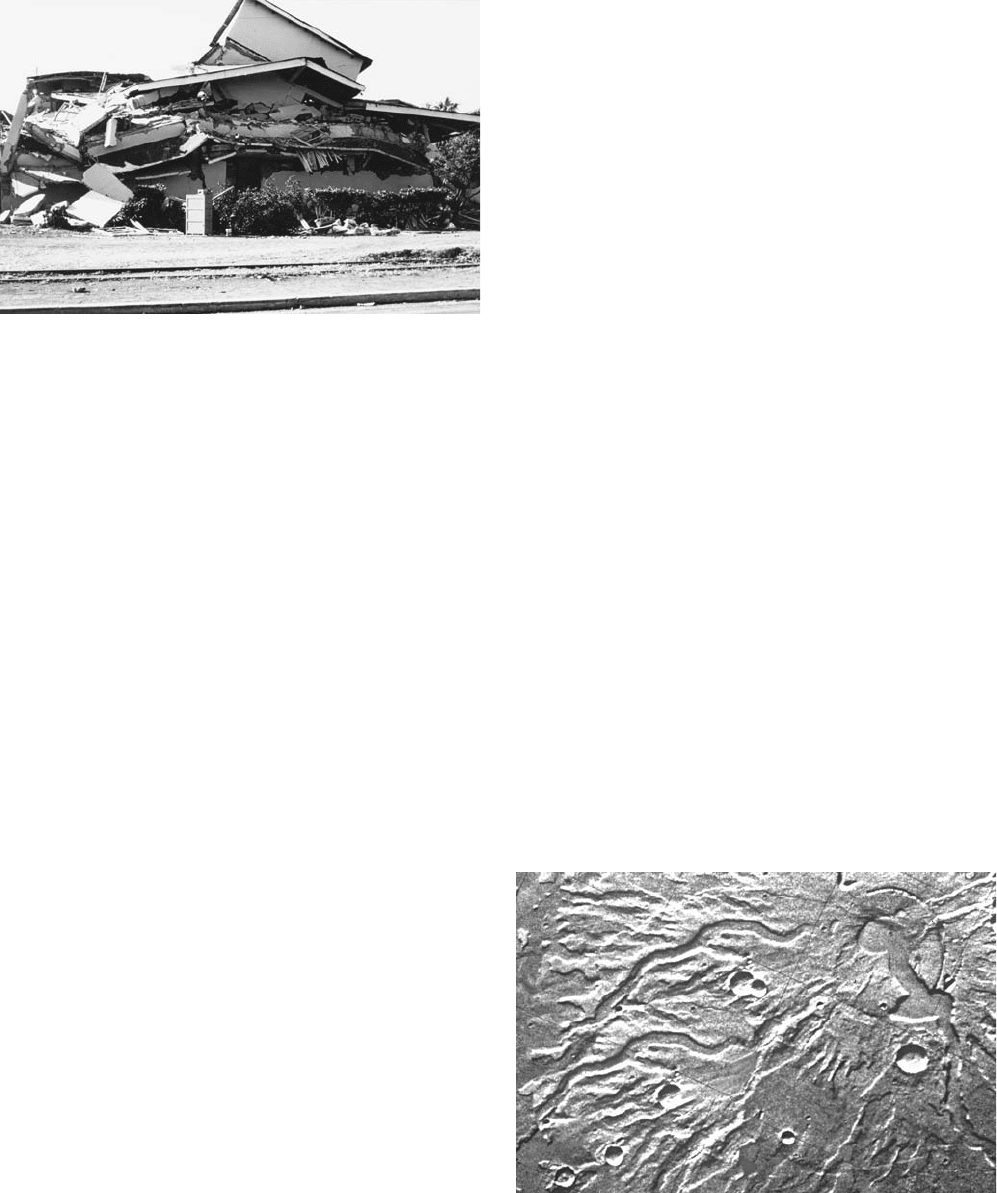
The 1972 Managua earthquake caused the collapse and complete
destruction of this three-story, reinforced concrete Customs House office
building. (Courtesy of the USGS)
Tyrrhena Patera is an example of a Martian volcano with large valleys
on the sides. The valleys are interpreted to have formed as the result of
water rather than lava flow. There must have been more water on Mars at
one time. (Courtesy of NASA)
marsh gas 159
Marum, Mount See Ambrim.
Maryland United States The state of Maryland is not espe-
cially noted for earthquake activity, but the state has experi-
enced substantial earthquakes on occasion. The eastern portion
of the state has a considerable potential for damage from liq-
uefaction in any future major earthquakes because much of
the urbanized area of eastern Maryland is built atop moist,
unconsolidated soil that might be expected to lose coherence
in a strong earthquake. Maryland sometimes has felt shocks
that originated in adjacent Virginia. On April 24, 1758,
Annapolis experienced an earthquake (also felt in Pennsylva-
nia) that lasted about a half-minute and followed noises from
underground. Shocks in Harford County, Maryland, on March
11–12, 1883, made clocks stop. On January 2, 1885, Frederick
County was shaken by an earthquake that also was felt in Vir-
ginia and knocked small objects off of shelves and furniture;
this earthquake was reportedly silent except for rattling noises
from windows. There is a likely impact structure in Chesa-
peake Bay that may localize some of the activity.
Masaya volcanic complex, Nicaragua The Masaya com-
plex, a caldera with three small stratovolcanoes in its
center (Masaya, Nindiri, and Santiago), has been reported
active since the 16th century. It is the most active volcano
in the region with at least 19 eruptive periods since 1524.
The most recent eruption was in 1999. Although most
Nicaraguan volcanoes have the steep sides characteristic of
pyroclastic cones, Masaya has a wide, low configuration
(shield volcano), having been built up from basaltic lava
flows without a great amount of explosive eruptions. A lava
lake like that of Kilauea in Hawaii formed in Masaya in the
15th century and again from 1965–1979. Masaya’s activity
has also included lava flows and explosions. It also has a
history of sulfur dioxide emissions.
Masaya, however, is most famous for a huge eruption in
4,550 b.c. It had a VEI of 5 and was one of the largest erup-
tions in the last 10,000 years.
Mascara earthquake, northern Algeria On September 18,
1994, an earthquake of magnitude 5.9 occurred. At least
159 people were killed, 289 were injured, and more than
10,000 were left homeless.
Mashu¯ See Kutcharo.
Massachusetts United States The state of Massachusetts
is located in New England, one of the most seismically active
regions of the United States, and has a history of strong
earthquakes dating back to colonial times. Some of the most
powerful earthquakes in United States history have occurred
in Massachusetts. Eastern Massachusetts in particular has a
history of strong earthquakes, often accompanied by remark-
able acoustical effects, such as rumbling noises. In addition
to earthquakes that originate within Massachusetts, the state
sometimes undergoes earthquakes originating in other areas
of New England and also along the Saint Lawrence Valley
between the United States and Canada. Portions of Massa-
chusetts, especially in the east, appear highly susceptible to
damage in any future major earthquake because parts of the
large urban area in and around Boston are built on moist,
unconsolidated soil that would be vulnerable to liquefac-
tion as earthquake waves passed through it.
Possibly the greatest earthquake in the history of Mas-
sachusetts occurred on November 18, 1755. This earthquake
is thought to have had an epicenter east of Cape Ann and
a Mercalli intensity of approximately VIII. The earthquake
was felt over an area of some 300,000 square miles (776,996
km
2
), from Nova Scotia to Chesapeake Bay, and some 200
miles (322 km) at sea, where a ship in deep water experienced
a shock that made it feel as if the vessel had run aground.
(Vessels in harbors along the shore had much the same
experience.) Starting with a sound like thunder, the earth-
quake made it difficult to keep one’s footing so that people
caught in the earthquake had to hold on to nearby objects
to keep from being thrown down. In Boston, chimneys fell,
and the ground motion reportedly resembled that of waves
at sea. Treetops swayed vigorously, weather vanes fell from
buildings, and stone walls were knocked over. In parts of
Massachusetts, cracks formed in the earth, and sand moved
upward through the cracks to the surface. One curious effect
of this earthquake was that it appears to have killed fish in
great numbers along the seacoast. Another powerful shock
occurred on November 22, 1755, and still more shocks barely
a month later on December 19.
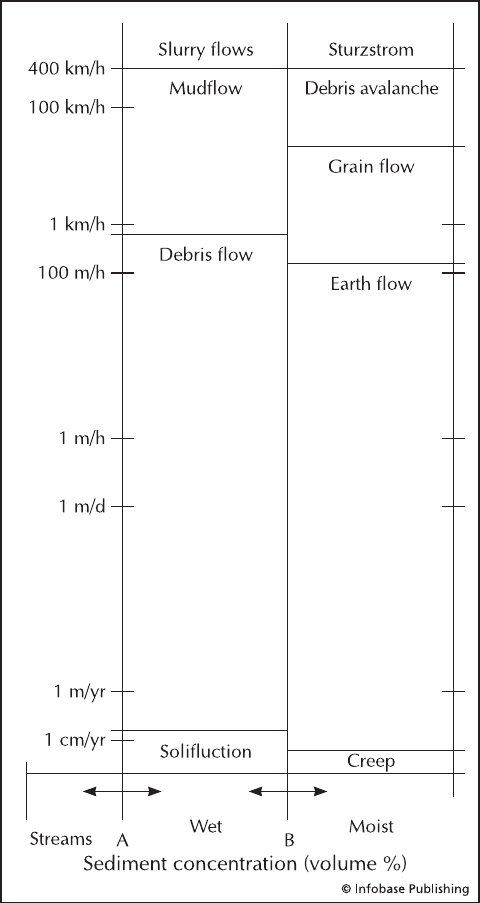
mass wasting Mass wasting encompasses all downhill
movement of mass, including soil and rock, in response
to gravity. These movements are generally classified based
upon composition and velocity. If the dominant material is
rock, the movement may either be a rockfall or a rock-
slide, depending upon the mode of movement. Otherwise,
mass wasting of debris and soil is generally divided by type of
movement, whether fluid-saturated (fluid-type flow) or fluid-
bearing (coherent or debris-type movement). The categories
of mass movement in each of these types are subdivided by
velocity. The slowest coherent movement is creep, transition-
ing to slump, debris slide, debris avalanche, and stur-
zstrom with increasing velocity. Water-saturated flows are
solifluction at its slowest, transitioning to earthflow and
mudflow with increasing velocity.
LANDSLIDE is the general
term for several of these mass movements.
Matsushiro caldera, Japan The Matsushiro caldera
is located on the island of Honshu¯ and has not experienced
any eruptions within historical times, but earthquake activ-
ity is frequent in the vicinity of the caldera and has received
extensive study. There are various opinions on what may be
happening under the caldera. One view is that intrusion of
magma may be involved. Other processes, including hydro-
thermal activity, have been suggested to account for unrest
at Matsushiro.
Mauna Kea volcano, Hawaii, United States Mauna Kea is
located on the island of Hawaii and is the tallest mountain
on Earth, more than 30,000 feet (9,144 m) from its base on
the seafloor to the summit. Unlike Mauna Loa and Kilauea,
also on Hawaii, Mauna Kea is not active.
160 Marum, Mount
Mauna Loa volcano, Hawaii, United States Mauna Loa,
a basaltic shield volcano located on the island of Hawaii,
is one of the most active volcanoes on Earth but also one of
the least dangerous because its lava is low in dissolved gases.
Therefore, it is not given to producing violent, explosive
eruptions. lava flows from Mauna Loa occur every several
years on the average, tend to last only a few days, and have
amounted to more than 3 billion cubic yards (2.4 billion m
3
)
in the past century. Lava emerges from the summit crater
(called Mokuaweoweo), from rift zones that extend from
that crater, and from two pit craters, South Pit and North
Bay, adjacent to the main caldera that was produced by
subsidence. One of five shield volcanoes that make up the
island of Hawaii, the largest island in the Hawaiian chain,
Mauna Loa has erupted on numerous occasions since records
of eruptions began to be kept in the early 19th century. An
impressive caldera on the summit of Mauna Loa is approxi-
mately two to three miles (3.2 to 4.8 km) in diameter and
formed several hundred years ago when collapse accompa-
nied the withdrawal of magma from an underground cham-
ber. The caldera walls stand about 600 feet (183 m) high in
some places.
In the late 1800s and the first half of the 20th century,
Mauna Loa was very active. The volcano fell quiet in 1950
but became active again in 1975. An eruption in 1984 was
associated with precursory earthquakes. Relatively little
is known about activity at Mauna Loa compared with the
nearby Kilauea volcano because Mauna Loa was quiet
from 1950 to 1975 when methods for studying volcanic
activity were advancing. Earthquake activity and other evi-
dence usually provide abundant warning that an eruption is
forthcoming, and geologists have had considerable success
in predicting the volcanic eruptions. Eruptions of Mauna
Loa are notable for “curtains of fire,” fountainlike erup-
tions of extremely fluid lava that may last a day or so before
subsiding.
On occasion, lava flows from Mauna Loa have threat-
ened the nearby city of Hilo. One flow in 1881 stopped only
at the edge of town, and another lava flow approaching Hilo
in 1935 made history because of an attempt to divert the lava
by aerial bombardment. The U.S. Army Air Corps, on the
advice of the director of the Hawaiian Volcano Observatory,
bombed the lava flow at selected points in hopes of changing
its direction. The theory behind this tactic was that bombing
might release gas and molten rock beneath the “crust” of the
lava flow and thus stop its advance. The bombing appeared
to succeed, for the lava flow halted soon after the bombard-
ment. There is disagreement, however, about whether the
bombing actually stopped the lava or whether the lava flow
was about to cease anyway.
Mayon volcano, Philippine Islands The beautiful strato-
volcano Mayon has a long history of destructive eruptions.
It has erupted 47 times since 1616. Of these, 18 produced
NUÉE ARDENTEs and 12 resulted in fatalities. The 1616 erup-
tion was extremely violent and is said to have destroyed doz-
ens of villages near the volcano. In 1766, another eruption,
characterized by flows of hot mud down the volcano flanks,
killed some 2,000 people. The 1814 eruption of Mayon
caused at least another 2,000 deaths. Major eruptions took
place in 1886, 1888, and 1897. In the 1897 eruption, approx-
imately 400 people are believed to have died. Eruptions in
1914 and 1928 were less costly in terms of lives lost. The pre-
vious eruption was in 1993. It killed 68 people and prompted
the evacuation of 60,000 others. The latest eruption lasted
from 1999 to March 2000 and resulted in an evacuation of
more than 10,000 but no deaths.
Mayon is steeped in legend. Magayon was the jealous
uncle of a beautiful princess. As she escaped with a lover,
Magayon chased her. The gods sent a landslide that buried
Magayon. His anger now wells up as eruptions from Mayon.
Chart showing the types of mass movements and their conditions of
velocity and water content
Mayon 161