
Gates A.E., Ritchie D. Encyclopedia of Earthquakes and Volcanoes
Подождите немного. Документ загружается.

Mazama volcano, Oregon, United States Mazama is the
name given to the volcano that collapsed and thus created the
basal wreck occupied by Crater Lake today.
Mazar-e Sharif earthquake, Afghanistan On September
18, 1994, an earthquake of magnitude 6.5 occurred. More
than 4,000 people were killed, and many thousands were
injured.
McDonald Island volcano, Australia McDonald Island
is a new volcano that was discovered in March 1997. It is
believed to have begun erupting in December 1996. It is the
first active volcano to be discovered in the Southern Hemi-
sphere in more than 50 years. It is also Australia’s second
active volcano. It is considered very dangerous for anyone on
the new island.
Me-Akan See Akan.
Medicine Lake volcano, California, United States Lo-
cated in northern California near Tule Lake, just south of
the Oregon border, Medicine Lake volcano has an area of
some 900 square miles (2,331 km
2
) and rises approximately
4,000 feet (1,219 m) above the surrounding land. Although
basaltic lava from comparatively quiet eruptions is found
on the flanks of the volcano, the mountain also has a his-
tory of violent eruption from its summit. One of these vio-
lent eruptions, believed to have occurred about 1,000 years
ago, deposited pumice on Mount Shasta, more than 30
miles (48 km) away. rhyolitic lava flowing from Medi-
cine Lake volcano formed Glass Mountain, and a separate
flow on the west rim of the caldera formed Little Glass
Mountain. The volcano has been generally quiet since then,
although strong seismic activity in 1910 fractured the sur-
face of the ground and was accompanied by a minor erup-
tion of ash. Earthquake activity around the volcano in 1988
indicated possible movement of magma underground. Lava
Beds National Monument occupies a portion of the Medi-
cine Lake volcano.
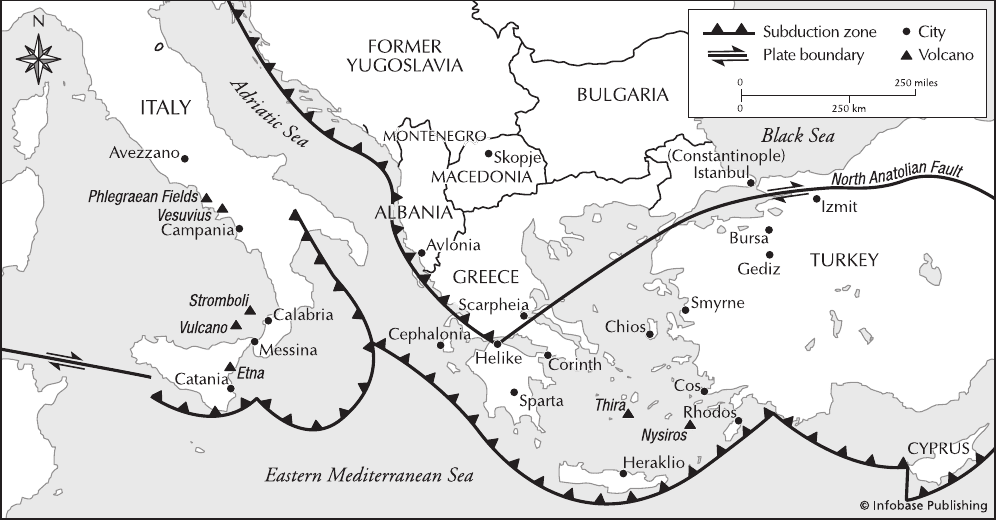
Mediterranean Sea The Mediterranean basin is the location
of numerous powerful earthquakes and volcanic eruptions and
has a complex geology involving both the northward move-
ment of Africa toward Europe and the interaction of numer-
ous smaller plates. Volcanoes in the Mediterranean include
Vesuvius, Etna, and Stromboli. The catastrophic eruption
of Thira, comparable in destruction to that resulting from the
1883 eruption of Krakatoa, is believed to have wiped out the
Minoan civilization in 1470 b.c. The Italian Peninsula espe-
cially is known for intense seismic activity as well as volca-
nism, and the presence of magma near the surface in portions
of Italy has enabled that country to satisfy part of its energy
needs by drawing on geothermal sources.
medium-rate ridge A mid-ocean ridge with an interme-
diate two to four inches (5–10 cm) per year rate of spreading.
The Juan de Fuca Ridge, 200 miles (322 km) west of Wash-
ington State, is the most studied medium-rate ridge in the
world. This ridge contributes to the formation of the Pacific
crustal plate. It has a small axial rift and is crossed by a
Map of the eastern Mediterranean Sea showing the plate boundaries and locations of volcanoes and several of the epicentral cities for major historical
earthquakes. Lines with triangles represent subduction zones, with triangles on the overriding plate.
162 Mazama
linear chain of hot spots. There is an axial volcano atop the
ridge where the two intersect.
Medvezhii caldera, Kuril Islands, Russia Explosive erup-
tions at the somma volcano Medvezhii are recorded in 1778
or 1779 and in 1883. The 1883 eruption reportedly involved
lava flows. phreatic activity was recorded in 1946, and
activity of undetermined nature was recorded in 1958. Erup-
tions are relatively small (VEI = 1–2).
megathrust A thrust fault is sometimes simply referred
to as a thrust. A megathrust is not simply a large thrust but
a thrust associated with the main motion on a subduction
zone. As such, these faults are capable of massive amounts of
movement in a single event in terms of length of the rupture,
amount of movement, and magnitude of the earthquake.
The Banda Aceh earthquake was the latest megathrust-type
event, though Kamchatca, Chile, and Alaska had such events
in 1952, 1960, and 1964, respectively, and Cascadia off the
northwest coast of the United States produced a megathrust-
type event (estimated at 9.0 on the Richter scale) in 1700.
Because these events are submarine and thrust in nature, there
is a strong potential for them to produce teletsunamis.
megatsunami A megatsunami is a grandiose description of
an excessively large tsunami. Sensationalistic television docu-
mentaries have cited the huge wave generated in Lituya Bay,
Alaska, in 1957 as evidence for a megatsunami. This wave,
which sloshed some 1,700 feet (510 m) up a slope was not a
tsunami but a seiche. There is no record of a wave even close
to this size having existed in a large ocean basin (such waves
tend to be restricted to small basins). An asteroid impact in
the open ocean might produce such a wave, but such large
impacts are extremely unlikely. Large marine volcanic erup-
tions in subduction zones could also generate a huge wave.
There is evidence that Thira generated a more than 200-foot
(60-m) wave and that Krakatoa generated a 135-foot (40-
m) wave. Although not as impressive as a seiche, these are
still very destructive waves.
meizoseismal region This is the area of particularly strong
shaking and significant damage in an earthquake. It is typi-
cally located near the epicenter. These regions are best dis-
played in a ShakeMap analysis.
Mendeleev caldera, Kuril Islands, Russia Mendeleev is
thought to have erupted in or around 1880, killing some trees
on the island through solfataric activity. phreatic activity
may have occurred in 1900, although this appears uncertain.
Some earthquakes in recent years may have been associated
with a geothermal energy facility on the island.
Merapi volcano, Java, Indonesia The stratovolcano
Merapi (Mountain of Fire) has a lava dome on its summit
and is believed to have erupted on more than 68 occasions
since a.d. 1548. It has produced more
NUÉE ARDENTEs than
any volcano on Earth (32 of the 68 eruptions). Merapi is
located just 15 miles (24 km) north of the city of Yogyakarta
with a population of 3 million, making it a very dangerous
volcano. The eruptions are very destructive (VEI = 3). One
eruption in 1006 was so destructive that the Hindu rajah of
the island moved to nearby Bali and Java fell under Islamic
influence. Other large eruptions occurred in 1786, 1822,
1872, and 1930.
The current eruptive phase began in 1987. At one point,
it was generating 40 nuée ardentes per day. In late 2006, the
lava dome collapsed sending pyroclastic flows some five
miles (8 km) from the volcano. This event killed 43 people
and forced the evacuation of 6,000. In 1998, evacuations of
many thousands of people was still a common occurrence.
See also Ijen.
Mercalli, Giuseppe (1815–1914) Italian scientist who
made a study of Italian earthquake areas. Mercalli is best
known for the Mercalli scale, used to rank earthquakes on
the basis of their destructiveness. The Mercalli scale uses
Roman numerals, starting with I for the mildest earthquakes
and ranging upward to XII for the most destructive. The
advantage of the Mercalli scale over the more widely known
Richter scale of earthquake magnitude is that the Mercalli
scale requires no special instrumentation for the user to apply
it. The Mercalli scale is based on visual and other noninstru-
mental observations of the earthquake’s effects.
See also seismology.
mesa A flat-crowned hill that is slightly broader than a
butte but smaller than a plateau. Mesas are formed in areas
with flat-lying sedimentary or volcanic and sedimentary
strata. Erosion proceeds through these layers rapidly until
it encounters a resistant layer. Erosion eventually breaks
through the resistant layer locally and quickly cuts through
the underlying layers. The area still containing the remaining
resistant layer remains elevated relative to the eroding sur-
roundings. It is a flat-topped, table-like feature because the
strata are flat. Mesas are common geomorphic features in the
western United States, where erosion is more physical than
in the wet and temperate east, where chemical weathering
dominates.
Mesa de los Hornitos volcanic formation, Mexico As-
sociated with the volcano Paricutín, Mesa de los Hornitos
(hornitos means “little ovens,” or spatter cones) was the
site of major lava flows from 1944 to 1947. One flow in
1944 overwhelmed the village of San Juan Parangaricutiro
but allowed enough time to evacuate the community.
Messina earthquake, Italy The most destructive earth-
quake in modern European history struck the port city of
Messina in Sicily, Italy, at 5:25 a.m. on December 28, 1908.
The earthquake was estimated to have been 7.5 on the Rich-
ter scale and came in a series of shocks ranging from 10 to
45 seconds in duration—the main shock lasting for about
30 seconds. The strong surface waves flattened everything
in a 120-mile (192-km) radius. Strong aftershocks continued
for well over one month.
Immediately following this tragic earthquake, a 40–50-
foot (12–15-m) tsunami roared across the Messina Straits,
destroying many coastal towns and cities. The loss of life
Messina 163
from this combined onslaught was staggering. The official
death toll was 160,000, but other estimates placed it as high
as 250,000. Messina began with a population of 150,000 and
was reduced by well over half, with more than 90% of the
city flattened. Beautiful architectural treasures, such as the
Norman Cathedral of the Annunziata dei Catalani (Annun-
ciation of the Catalans) and the Munizone and Vittorio
Emmanuele theaters, were lost. There were so many bodies
in the rubble that Messina was dubbed “Citta di Morte” (city
of the dead). In the nearby province of Reggio di Calabria, up
to 50,000 people were also killed. Although there had been
many devastating earthquakes in southern Italy, it was the
Messina earthquake that finally spurred the government to
institute strict seismic construction codes. Messina was recon-
structed under these regulations. Hopefully, they will prevent
another tragedy.
metamorphic rock Rock that has been physically and/or
chemically changed through recrystallization under the influ-
ence of changes in temperature, fluid content, and chemistry
and/or pressure. The changes are mostly mineralogical and tex-
tural, but chemical changes are possible as well. There are sev-
eral types of metamorphism, the most common being regional,
contact, and dynamic. contact metamorphism and a subset
called pyrometamorphism are most related to igneous activity.
The metamorphic rock is the result of contact with hot magma
or lava which bakes the country rock. The rocks produced
by this process include hornfels and granofels with minerals
formed by high temperature processes.
See also igneous rock; sedimentary rock.
methane A simple hydrocarbon molecule consisting
of a carbon atom with four hydrogen atoms attached to it
(CH
4
), methane is the centerpiece of a hypothesis by physicist
Thomas Gold (one of the contributors to the “Steady State”
model of the universe) that presents release of methane from
underground as an explanation for many curious phenom-
ena associated with earthquakes. Gold’s theory, known as
the “deep gas” hypothesis, suggests that large quantities of
methane (also known as marsh gas), left over from the for-
mation of the planet, still exist inside Earth and are vented
to the surface from time to time in outgassing phenomena.
The methane alternatively could be from petroleum sources.
The aforementioned phenomena, coinciding with earth-
quakes, might account, for example, for the fish kills and
incidents of “boiling” water that have been seen to accom-
pany earthquakes along the shore. Release of methane into
the water would give the sea the appearance of boiling, and
a sufficient quantity of the gas could asphyxiate fish, espe-
cially if the methane contained other gases such as hydrogen
sulfide. (Analysis of gas bubbles rising from the ocean floor
off Malibu Point following the San Fernando earthquake of
1971 showed the gas to be 93% methane, with small percent-
ages of nitrogen, carbon dioxide, oxygen, and argon.) Meth-
ane outbursts accompanying earthquakes also might account
for the strange phenomenon of earthquake light, a glow
that has been seen in the night sky during and near the time
of earthquakes. Methane gas escaping from the earth and
igniting near the surface could burn with enough luminosity
to explain earthquake light, although there appears to be no
proof that earthquake light originates in this manner. Meth-
ane eruptions from the seabed have even been suggested as a
possible mechanism for generating tsunamis. A large emis-
sion of methane gas from the seabed, approaching the sur-
face, might lift water above it into a dome, which then would
collapse and generate a major disturbance in the sea, with a
consequent tsunami.
Metis Shoal volcano, Tonga Islands In June 1995, this
normally submerged volcano produced a small island. This
is not the first time an island was produced by this volcano.
In 1851, it produced another island, but ocean waves quickly
eroded it back below the surface. In 1969, another vent pro-
duced an island nearby, but it met with the same fate. This
volcano produces huge amounts of pumice that form rafts
hundreds of kilometers across. People traveling in ships are
sometimes awakened by a squealing sound, only to come on
deck to see pumice as far as the eye can see. It feels as if the
ship is on land. The sound comes from the pumice scraping
along the sides of the ship.
Mexico As part of the westward-moving landmass of
North America, Mexico collides with the oceanic crust of
the Pacific crustal plate to the west of the continent. This
collision generates numerous earthquakes along the west coast
of Mexico, especially in Baja California, which is part of
a northward-moving block of crust that is grinding against
California and generating numerous earthquakes there. A
special set of geological conditions in the Mexico City area
has made that metropolis highly vulnerable to damage from
earthquakes, even those originating along the coastline far
to the west. Mexico City’s vulnerability to earthquake dam-
age was demonstrated clearly in the great earthquake of Sep-
tember 19, 1985, when an earthquake originating along the
Mexican Pacific shore struck Mexico City during rush hour
and caused numerous fatalities and extensive property dam-
age. The capital has been constructed atop unconsolidated
sediment that once formed a lake bed. Buildings atop this
kind of soil are especially susceptible to damage from sur-
face waves in earthquakes. Moreover, buildings in Mexico
City were designed and built largely without consideration
for earthquakes and consequently experienced more damage
than newer, quake-resistant buildings such as those required
in California. Severe damage and fatalities were reported in
four states of Mexico: Colima, Jalisco, Guerrero, and Michoa-
can. Several vessels at sea were reported missing following the
earthquake, and the crew of a trawler reportedly witnessed
waves some 100 feet (30 m) high rising from the sea.
Mexico also has some very active volcanoes. The erup-
tion of El Chichón in 1982 had a VEI of 5 and produced
beautiful sunsets worldwide for the next year. It is also said
to have been responsible for the unusual weather patterns.
An eruptive period of Paracutín from 1943 to 1952 also
produced some spectacular events and features. Colima is
another active volcano that produced explosive eruptions
in the 1980s and 1990s as is Popocatépetl. Other volca-
noes and volcanic features include Iztaccíhuatl, Jorullo, La
Reforma, and Pínacaté.
164 metamorphic rock
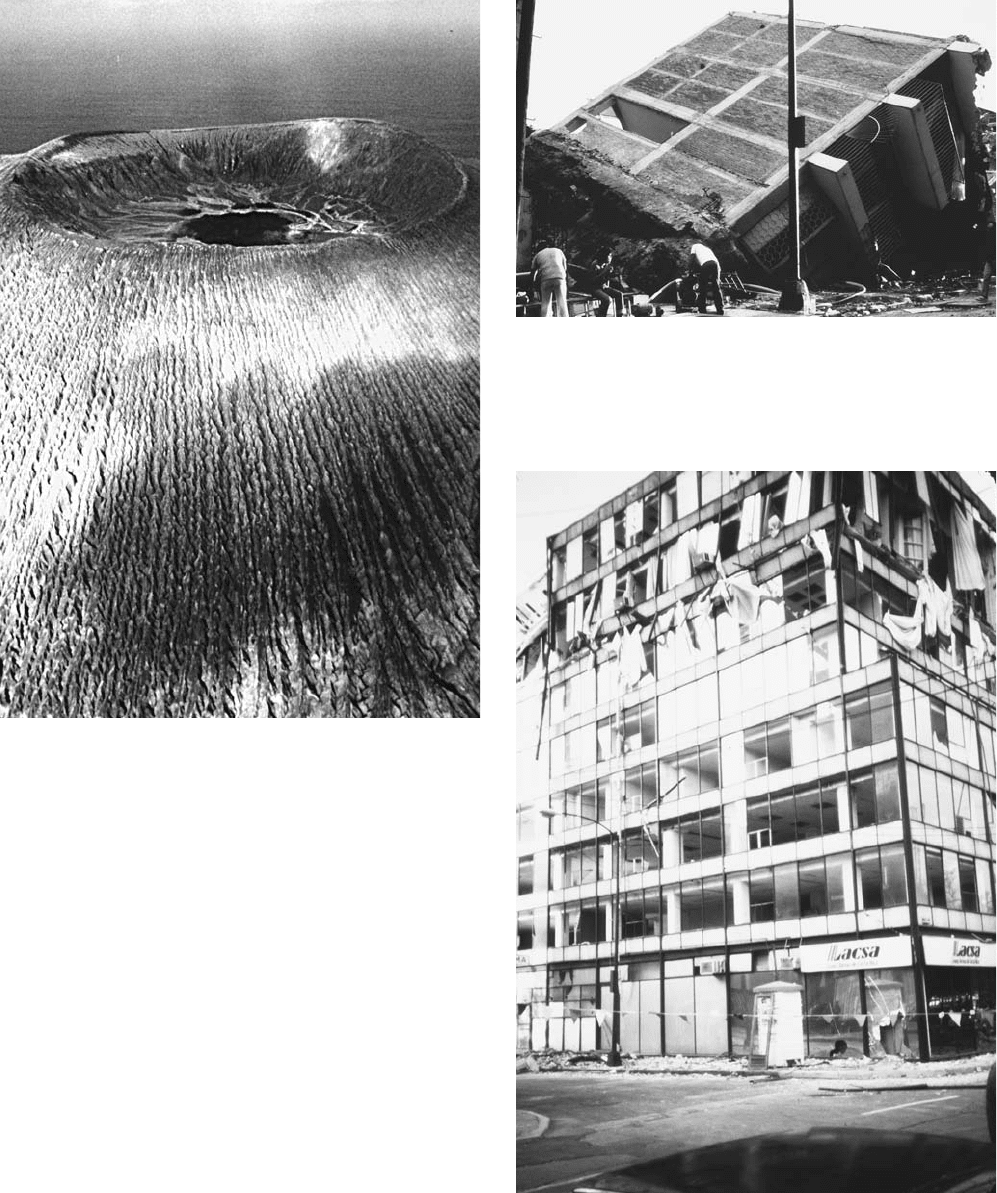
Mexico City earthquake, Mexico One of the most famous
earthquakes of the 20th century, the Mexico City earth-
quake had an estimated Richter magnitude of 8.1, making it
approximately as powerful as the San Francisco earthquake
of 1906. The earthquake occurred early on the morning of
September 19, 1985, and originated along the Pacific coast of
Mexico. This timing helped reduce the number of deaths from
the earthquake, which killed more than 8,000 people and
injured some 30,000. Had the earthquake occurred later in
the day, the number of deaths might have been much higher
because many public buildings vulnerable to damage would
have been occupied. Approximately 500 buildings in Mexico
City were destroyed or experienced heavy damage. Damage
was estimated at about $4 billion, but serious damage was
confined to a small total portion of the city. The character of
underlying material did much to determine how much damage
buildings in the city experienced from the earthquake. Damage
was worst in areas underlain by moist, unconsolidated mate-
rial deposited in the bed of what once was Lake Texcoco. The
lake was drained by Spanish settlers after the conquest of the
indigenous Aztec civilization. Construction began afterward
The volcanic crater and slopes of San Benedicto Island along the
northern Pacific coast of Mexico. (Courtesy of the USGS)
An eight-story frame structure with brick walls was broken away from
its foundation and broken in half during the 1985 Mexico City earthquake.
(Courtesy of the USGS)
Rayleigh waves caused the crush and collapse of the upper floors of
the Lasca Building during the 1985 Mexico City earthquake. Most of the
windows were popped out and turned into missiles. (Courtesy of the
USGS)
Mexico City 165
atop the sediments of the lake bed. This kind of soil is espe-
cially susceptible to ground motion in a strong earthquake,
and any structure built atop such soil is vulnerable to damage
from the ground motion. The earthquake’s destructive poten-
tial was reduced by the distance (some 200 miles [320 km])
between Mexico City and the earthquake’s point of origin. An
earlier earthquake in Mexico City, in 1957, produced a pat-
tern of damage similar to that from the 1985 earthquake.
mica A mineral group of sheetlike, smooth, and shiny
layers that are adhered together in a stack. The stacks are
referred to as books. They include white mica, muscovite,
black mica, biotite, as the main varieties. Biotite can occur in
andesite, dacite, latite, and rhyolite and their plutonic
counterparts. Muscovite is mostly restricted to rhyolite, and
even there it is rare. It is more common in granite, the plu-
tonic counterpart. Even if present, mica constitutes a minor
component in igneous rocks.
Michigan United States Although it generally lies within a
zone of minor seismic risk, the state of Michigan is subjected
from time to time to strong earthquakes originating in the
Saint Lawrence Valley. An earthquake at Calumet on July
26, 1905, is thought to have been induced by conditions asso-
ciated with mining operations. There was reportedly a great
explosion. Chimneys toppled, and windows were broken.
The earthquake was felt throughout Michigan’s Keweenaw
Peninsula. On May 26, 1906, some kind of seismic event at
a mine on the Keweenaw Peninsula affected an area as wide
as 40 miles (64 km) and resembled in its effects a powerful
earthquake; subsidence was reported, and rails were twisted.
microearthquake An earthquake with a magnitude less
than 2 on the Richter scale. Microearthquakes are com-
mon on all active faults and can number in the hundreds
to thousands per year without foreshadowing any major
activity. They are even common in areas of low seismic risk.
A radical increase in the number of microearthquakes in an
area, however, is commonly considered a warning signal that
increased major seismic activity is possible. Microearthquakes
also may foretell of volcanic eruptions. As magma forces its
way upwards through the crust to the volcano, it does so by
cracking the rock in its way. This cracking yields an earth-
quake. There are swarms of earthquakes present in advance
of an eruption in most volcanoes. These earthquakes usually
start out as microearthquakes but as the eruption nears, they
can be much larger.
microzonation The practice by which a town or county is
subdivided into smaller subareas according to the variation
in seismic hazards. Depending upon physical features as well
as underlying geology, different seismic hazards will be domi-
nant. For example, hills are prone to landslides, whereas
water may yield tsunamis or seiches.
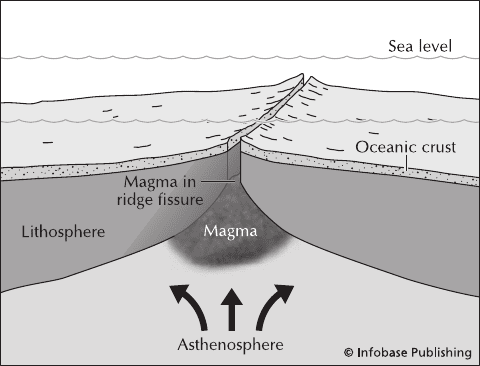
mid-ocean ridge These structures are undersea moun-
tain chains that mark zones where magma rises from the
mantle and solidifies, generating new ocean crust. This
newly formed rock moves laterally outward from fracture
down the middle of the ridge. Midocean ridges are part of
a worldwide system of divergent boundaries that is not
confined to oceans but may extend into continents as well.
Mid-ocean ridges are sites of extensive earthquake and volca-
nic activity. Not only are there numerous normal faults form-
ing grabens along the peak of the ridge, but there are also
regularly spaced transform faults that break the ridge into
offset segments. These transform faults are seismically active
and spread several hundred kilometers across the ocean basin
thus extending earthquake activity to a much larger area.
Large transform faults are fracture zones. The rocks pro-
duced at mid-ocean ridges are the key evidence that geolo-
gists used to prove the existence of plate tectonics. New
ocean crust is constantly being formed at the center of the
mid-ocean ridge and moving away toward the edges of the
basin like a conveyor belt. The igneous rock that solidifies
along mid-ocean ridges preserves a record of the orientation
of Earth’s magnetic field at the time the rock was formed.
Because Earth’s magnetic field changes radically on a regular
basis, the ocean crust acts like a piece of magnetic recording
tape and preserves a history of the magnetic field. The mag-
netic signatures (patterns) of the ocean crust are exact mirror
images across the mid-ocean ridge as are the ages, elevations,
and sediment thickness. The theory of how plates are formed
and moved are based on this important discovery.
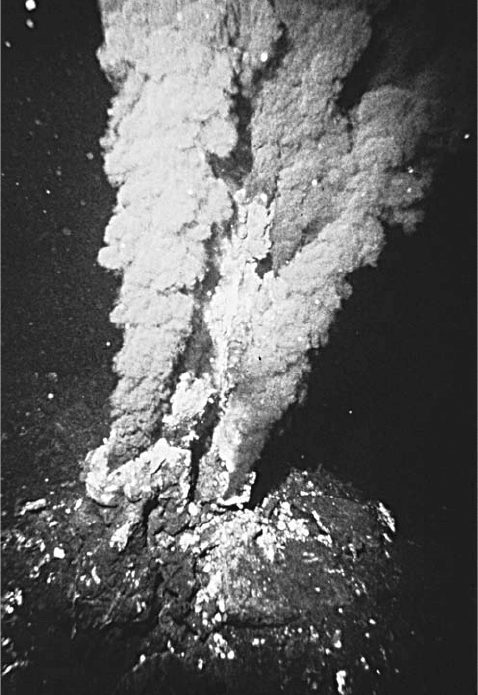
A black smoker at a mid-ocean ridge hydrothermal vent from the Atlantic
Ocean. (Courtesy of NOAA)
166 mica
Exotic chemical and biological environments are found at
certain points along mid-ocean ridges. For example, explorers
from the Scripps Institute of Oceanography and the Woods
Hole Oceanographic Institution examined the mid-ocean
ridge near the Galápagos Islands in 1977 and discovered
a dense concentration of undersea life around volcanic vents
on the seabed at depths of about 9,000 feet (2,743 m). Fauna
found at this site included giant clams more than a foot long,
and huge polychaete worms that lived in tubes. At another
site along the mid-ocean ridge off the western coast of Mex-
ico, mineral-laden hot water rising from vents in the seabed
has produced peculiar “chimneys” made of minerals precipi-
tated from the heated water. This process of precipitation may
have created extensive deposits of rich metal ores on the sea-
bed along certain portions of the mid-ocean ridges, but such
deposits do not appear to be commercially exploitable.
Mihara-yama See Izu-O
¯
shima.
Minnesota United States Minnesota does not have a
long history of strong earthquake activity because the state
occupies a zone of minor seismic risk. A strong earthquake
reportedly occurred in Minnesota in 1860, but details are
unavailable. Another strong earthquake may have occurred
in Minnesota between 1860 and 1865, but this is not cer-
tain. On September 3, 1917, an earthquake at Staples caused
considerable damage to buildings and knocked objects off
shelves. Other, minor earthquakes were recorded in 1909,
1925, 1935, and 1968.
Mino-Owari (Nobi) earthquake, Japan The greatest inland
earthquake experienced in Japan occurred in the provinces of
Mino and Owari on October 28, 1891, at 9:38 p.m. The esti-
mated Richter magnitude for this event was 8.4. The area of
damage was over 4,300 square miles (11,150 km
2
). The epi-
center was on the island of Honshu, on one of a series of
northwest-to-southeast faults (now called the Mino-Owari
Fault Zone) that crosses the area, and the focus was less than
9.5 miles (15 km). It was therefore not one of the more com-
mon subduction zone–related earthquakes, which are much
deeper. The sense of movement on these faults was a combina-
tion of left-lateral strike-slip and reverse. The surface rup-
tures from this event were extraordinary. They could be traced
on land continuously for 40–70 miles (24–42 km). They exhib-
ited horizontal offsets up to 13 feet (4 m) and vertical offset up
to 20 feet (6 m), producing spectacular scarps. Later geodetic
surveys showed widespread uplift of some 28 inches (70 cm) in
some areas and subsidence of 12–16 inches (30–40 cm) in oth-
ers. Over the two years following the main shock, there were
some 3,365 aftershocks—10 of which were classified as violent
and 97 of which were classified as strong.
In all, some 7,273 people lost their lives in this event,
and more than 17,000 were injured. Officially, 142,177
houses were destroyed. In addition to destruction by shaking,
some 10,000 landslides occurred throughout the area. One
blocked a river, causing a flood and producing an earthquake
lake. There were also reports of tsunamis along the coast.
The 1891 earthquake spurred the government to change
building codes to more earthquake-resistant designs.
Mississippi United States The state of Mississippi is not
known for frequent and strong earthquake activity and lies
largely within an area of modest seismic risk. Nonetheless,
strong earthquakes have occurred in Mississippi. One of these
took place on December 16, 1931, in the northern portion of
the state. Walls and foundations were damaged and some chim-
neys destroyed at Charleston, South Carolina. Damage
also was reported at Belzoni, Water Valley, and Tillatoba. This
earthquake was felt over an area of about 65,000 square miles
(168,349 km
2
) and was rated at Mercalli intensity VI–VII.
Missoula, Lake northwest United States The landscape
of northwest United States was reshaped extensively by the
floods that resulted from the draining of Lake Missoula, which
apparently occupied much of western Montana 15,000 to
20,000 years ago. Glacial in origin, Lake Missoula is thought
to have begun draining in catastrophic fashion when a dam of
ice in the Clark Fork Valley in Idaho gave way and let several
hundred cubic miles of water flow westward, carrying away
soil and even eroding the underlying bedrock. One result
of this assault by water is the Channeled Scabland of Wash-
ington, an area of some 2,000 square miles (5,180 km
2
)
partly denuded by the flood. This same flood is believed to
have invaded Oregon’s Willamette Valley and reached south-
ward to the location of present-day Eugene. Other floods also
originated from Lake Missoula. The floods made the walls of
the Columbia River gorge steeper and thus contributed to
the conditions that are thought to have resulted in the great
landslides along that gorge, notably the Bonneville Slide,
which may have been set off by a powerful earthquake.
Missouri United States Missouri and its neighboring states
have undergone some of the most powerful earthquakes in
Diagram of a mid-ocean ridge showing newly formed ocean crust moving
away from the axis in both directions at the same speed. Circulation of
the mantle is shown by the arrows and generates magma beneath the
ridge. The magma fills the fissures left as the two plates are pulled apart.
The ridge is higher than the surrounding ocean floor both because the
mantle is pushing it up and because the new crust is hot and therefore
less dense and more buoyant. A mid-ocean ridge is an example of a
divergent margin.
Missouri 167
the history of the United States. Strong seismic activity in the
Mississippi Valley region combines with large areas of uncon-
solidated, moist soil to produce conditions that are highly
favorable for liquefaction. The most famous earthquakes
in Missouri history are thought to have been also the most
powerful recorded in North America since European settle-
ment began. These earthquakes occurred between December
1811 and February 1812 in the New Madrid area along the
Mississippi River and are thought to have affected an area
estimated at a minimum of 2 million square miles (5,179,976
km
2
). The earthquakes are believed to have altered topogra-
phy over an area of as many as 50,000 square miles (129,499
km
2
). Although the earthquakes have been estimated at Mer-
calli intensity XI, casualties were few because the area was
settled sparsely at the time.
The first earthquake in this series began in the early
morning of December 16, 1811, shaking houses and knock-
ing down chimneys. This earthquake had dramatic effects on
the landscape: It caused landslides, generated waves in the
river, and made entire islands vanish. Lesser shocks occurred
over the following days. Another shock, comparable in many
ways to the initial earthquake, occurred on January 23, 1812.
A third great shock, apparently even more powerful than the
first two, took place on February 7, 1812, and was followed
by occasional aftershocks during the next two years or
longer. Considerable uplift and subsidence occurred in these
earthquakes. Some areas were uplifted 15 feet (5 m) or more;
one such area, the Tiptonville Dome, is some 15 miles (24
km) long and as much as eight miles (13 km) wide. Submer-
gence at Reelfoot Lake in Tennessee occurred to depths of
some 20 feet (6 m) or even greater.
“Moho” See Mohorovicic discontinuity.
Mohorovicic discontinuity A thin transition zone
between Earth’s crust and uppermost mantle constitutes the
“Moho” for short. The Moho was first identified by a rapid
change in the velocity of seismic waves at a depth ranging
from about 22 to 50 miles (35 to 80 km), depending on the
elevation of the land. It was later determined that this transi-
tion marked the top of the mantle. The Moho occurs midway
through the lithosphere and marks the boundary with the
rigid mantle. In continent-continent collisions, sometimes the
rigid mantle is stripped off of the crust approximately along
the Moho in a process called delamination.
moment magnitude The moment magnitude, Mw, is the
measured magnitude of an earthquake using seismic moment.
The seismic moment is a measure of earthquakes based on
the leverage of forces across the area of rupture on the fault
plane. In mathematical terms, it is equal to the rigidity of the
rock times the area of faulting times the amount of slip on
the fault.
Momotombo volcano, Nicaragua A stratovolcano
in western Nicaragua. Momotombo has erupted at least
15 times since 1524. Its last major eruption was in 1905. Its
most famous eruption was in 1605–06, when it destroyed the
city of Léon, the former capital of Nicaragua.
Mono Lake California, United States Located in Cali-
fornia near the Nevada border and immediately north of
the Long Valley caldera, Mono Lake is considered one of
the most likely sites for future volcanic activity in the United
States and has undergone moderate earthquake activity in
recent years. Extending approximately north-south between
Mono Lake and Long Valley caldera is a set of volcanic land-
forms known as the Mono Craters. vents in the vicinity of
Mono Lake appear to have been active within the past two
millennia and to have become active as a series of vents along
a zone several miles in length, rather than erupted at a single
point, as is the case with many volcanoes. Two major series
of eruptions at Mono Lake are thought to have occurred in
the 14th century. This activity is believed to have begun when
molten rock moved along a fracture to the surface, came
in contact with groundwater there, and generated steam
that caused a powerful explosion. A string of new vents some
four miles (6.4 km) long formed during this eruption, which
expelled large amounts of ash over what now is central Cali-
fornia and western Nevada. pyroclastic flows followed
this initial eruptive activity but affected only the area imme-
diately around Mono Lake. Next highly viscous lava emerged
from the ground and formed domes and coulees, including
Panum Dome. Soon after these eruptive events, another series
of explosions commenced at Inyo Craters, immediately to the
south of Mono Lake, under circumstances apparently simi-
lar to those which led to the first eruptive cycle. (These two
outbursts may have been separated by only a few weeks.)
This eruption also produced large quantities of ash and steam
explosions, followed by formation of domes and flows of
obsidian. A series of earthquakes estimated up to 6.0 on the
Richter scale of magnitude occurred in 1980, and earth-
quakes of comparable magnitude happened again in 1986
along the nearby White Mountain fault, reminding observers
that the area around Mono Lake maintains a considerable
potential for seismic and volcanic activity. Depending on the
intensity of a future eruption at Mono Lake, as well as other
factors including wind direction and velocity, ashfalls might
affect areas hundreds of miles downwind.
Monowai Seamount Kermadec Islands, Pacific Ocean It
is a submarine volcano that is located about 932 miles
(1,500 km) northeast of the north island of New Zealand. It
has erupted at least eight times in the past 20 years including
a 1977 eruption that lasted for 18 months.
Montana United States The state of Montana is mod-
erately active from a seismic standpoint, with much of the
earthquake activity concentrated in the southwestern portion
of the state. Earthquakes centered in Montana have affected
vast areas of the western United States.
One of the greatest earthquakes in Montana’s history,
estimated at Mercalli intensity VII and Richter magnitude
6.75, occurred on June 27, 1925, east of Helena. This earth-
quake was felt very strongly over an area of some 600 square
miles (1,554 km
2
), and the total area affected was more than
300,000 square miles (776,996 km
2
). On an east-west axis,
the earthquake was felt from the border of North Dakota
to Washington State, and on a north-south axis from the
168 “Moho”
border of Canada to the central portion of Wyoming. after-
shocks continued for months following the earthquake. Dam-
age was concentrated at Logan, Lombard, Manhattan, and
Three Forks. A large school building at Manhattan was demol-
ished. Chimneys were seen to fall, not in one prevailing direction
but rather in many different directions; this phenomenon led one
observer to speculate that some kind of “twist” was involved in
this particular earthquake. Railroad tracks shifted, and rockfalls
interfered with service on the Northern Pacific Railroad and the
Chicago, Milwaukee, and St. Paul. A powerful roar accompa-
nied the earthquake at Bozeman. A church and a schoolhouse
were damaged at Three Forks.
The earthquake of August 17, 1959, near Hebgen Lake,
Montana, was of Mercalli intensity X and was estimated at
7.1 on the Richter scale. This earthquake affected an area of
some 600,000 square miles (1.535 million km
2
) and was felt
at locations as distant as Seattle on the west, North Dakota
on the east, Utah in the south, and Banff, Alberta, Canada
to the north. Twenty-eight people were killed, most of them
in landslides. One spectacular landslide occurred along the
south wall of Madison River Canyon, where a huge mass of
earth, rock, and trees fell and blocked the Madison River.
Within several weeks, this landslide had created a lake with a
depth of almost 175 feet (53 m).
Monte Negro earthquake, Croatia At 7:00 a.m. on April
6, 1667, the Monte Negro area of Croatia along the Adriatic
coast was rocked by a powerful earthquake. The estimated
magnitude of the quake was 7.2, and the intensity was
estimated as high as IX in the town of Budva. It was reported
that the shock was accompanied by strong winds in the same
east-west direction. The sea withdrew four times that day,
and tsunamis struck in many areas. It was said that the town
of Ragusa (Dubrovnik) lost 5,000 people, but there was also
near–total destruction on the island of Mozzo as well as in
the towns of Kastel Novo, Budva, and Kataro. The death
toll for the event was likely much higher.
Monte Pelato See Campo Bianco.
Montserrat volcanic island, Caribbean Until recently, there
had been no eruptions at Montserrat within historical times.
However, the recent and current eruption of Soufrière Hills
changed that. Previously, the island exhibited considerable
earthquake and solfataric activity related to intrusions of
magma under the Soufrière Hills at the southern end of the
island.
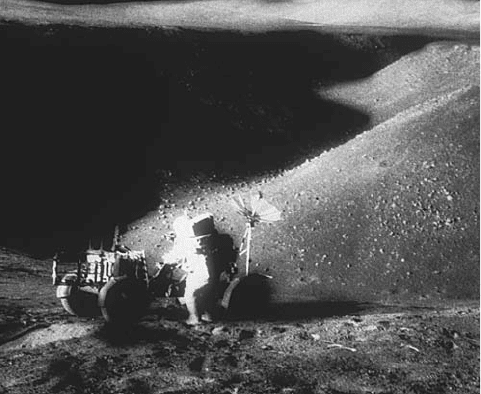
Moon Instruments placed on the Moon have reported large
numbers of seismic events, but the pattern of lunar seismicity
differs from that of Earth in important ways. Although sev-
eral thousand moonquakes are believed to occur each year,
the Moon appears to release much less energy in such quakes
annually than Earth does. Total energy released in terres-
trial quakes each year is thought to be more than 1 billion
times greater than on the Moon. Some evidence of moon-
quakes is visible to the unaided eye, as where seismic events
have dislodged boulders from positions on slopes and caused
the rocks to roll downhill. Lunar quakes also are believed to
occur at greater depths than similar events on Earth. These
differences reflect the fact that Earth is more active geologi-
cally than the Moon, both on the surface and at depth. The
ever-changing pattern of plate tectonic activity, with its
characteristic distribution of earthquake foci and volcanic
eruptions, is absent from the Moon. The character of lunar
rock also reflects the difference between processes at work
on the moon and on Earth. Lunar rock is igneous (basalts
in the maria, or “seas,” and a gabbro-like igneous rock
called anorthosite in the highlands), whereas terrestrial rock
may be igneous, sedimentary, or metamorphic, as a result
of erosion, sedimentation, and other processes related to
the action of wind and water on Earth. impact structures
are prominent on the lunar surface. The maria are believed
to have formed when large meteorites struck the Moon and
caused great flows of molten rock. Some of the rills, chan-
nel-like features on the lunar landscape, are thought to have
formed through flows of lava.
See also mare.
Moro Gulf earthquake, Philippines On August 17, 1976,
at a few minutes after midnight, a strong earthquake struck
the island of Mindanao in the Philippines, producing a great
tsunami and destroyed 438 miles (700 km) of coastline
along the Moro Gulf in the North Celebes Sea. The Richter
magnitude of this event was 7.9. aftershocks were reported
to have occurred at the rate of 140 per day over the next
few days. The source of the earthquake was the Cotabato
Trench, part of the subduction zone system in the Philip-
pines. Within minutes after the main shock, the sea began
receding from the shore for about 1.8 miles (3 km) in typical
pre-tsunami fashion, 10 minutes later, it came roaring back
with waves up to 50-feet (15-m) high at speeds approaching
40 miles (64 km) per hour.
Hadly Rille, a sinuous channel that was probably formed from flowing
lava. Astronaut James Irwin from Apollo 15, 1971, with the lunar rover,
samples the rock in the area. (Courtesy of NASA)
Moro Gulf 169
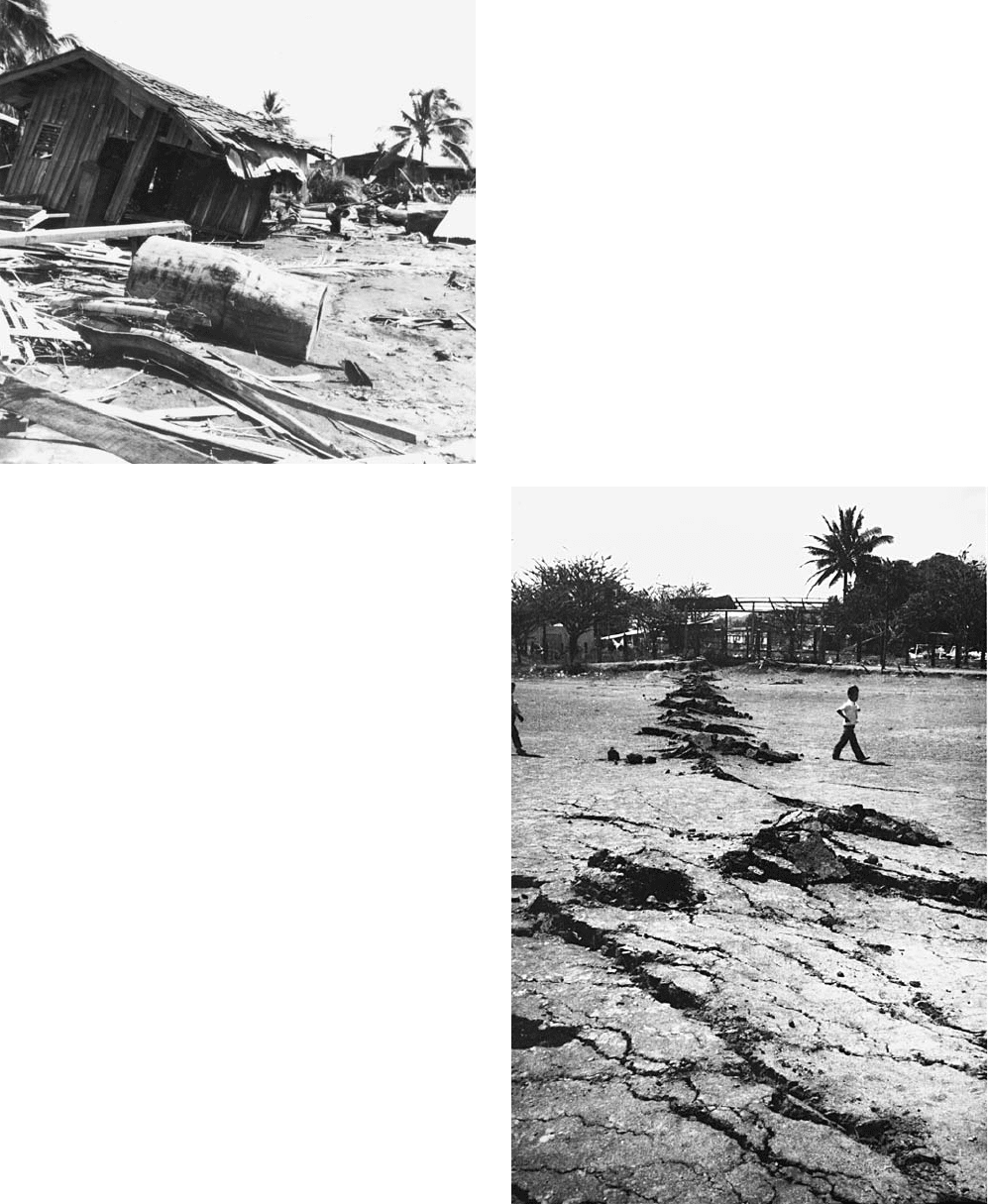
The tsunami wreaked havoc, especially in Padigan City
and Cotabato City. Total deaths were 4,791, with 2,288 miss-
ing and presumed dead. There were 9,930 injured, and over
93,000 left homeless. More than 85% of all deaths were the
result of the tsunami. Properties along the coast were washed
away, and bodies were left scattered all along the shore.
Motagua Fault earthquake, Guatemala The Motagua
Fault is a very active transform fault that separates the
Caribbean Sea plate from the North American crustal
plate. It also connects the Central American subduction
zone to the Caribbean subduction zone and has a left-
lateral offset of 0.9 inch (2.2 cm) per year. On February
4, 1976, the Motagua Fault produced its latest major earth-
quake. The quake measured 7.5 on the Richter scale. It killed
more than 23,000 people and caused $1.1 billion in property
damage. It was felt over 38,610 square miles (100,000 km
2
).
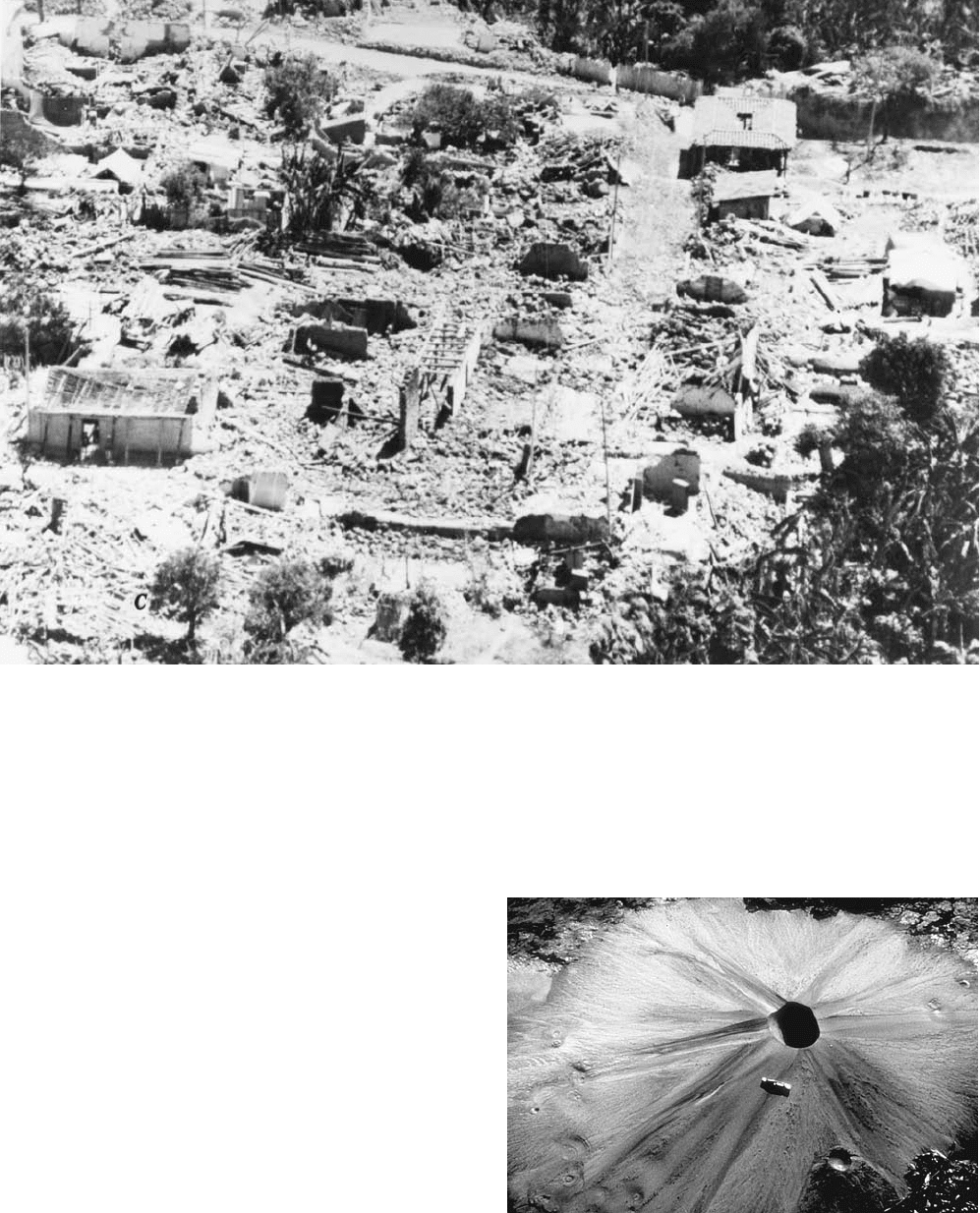
Extensive liquefaction and landslides accompanied the
earthquake. The observed surface rupture showed up to 11.5
feet (3.4 m) left-lateral strike-slip displacement along 199
miles (320 km) of the fault. This earthquake was the largest
strike-slip event since the 1906 San Francisco earthquake in
North America.
mudflow This is one type of mass wasting, with high flu-
idity and very high flow velocity. Mudflows are fast-moving
rivers of watery mud that can inundate whole towns, causing
widespread death and destruction. Mudflows are reported in
the news on a regular basis because they occur in many areas
as the result of heavy rain. Mudflows are also common with
volcanic eruptions. A lahar is a volcanic mudflow composed
of hot ash and melted alpine glacial ice. The fine size of ash
makes it susceptible to forming a mudflow with heavy rains
as well.
mud volcano A mud volcano is not, strictly speaking, a
volcano at all but rather a hot spring whose waters mix with
sediment to form mud, which behaves in a manner roughly
comparable to that of lava. Mud volcanoes look like spat-
ter cones and tend to be only a few feet high. They are com-
monly the products of liquefaction during seismic events.
They can also be called sand volcanoes, depending on the
sediment in the shallow subsurface. They form from sand or
mud “blows” in which a slurry of sand or mud is shot out of
the ground up to tens of feet high.
See also sand boil.
Muradiye earthquake, Turkey On November 24, 1976,
at 12:22 p.m., a strong earthquake struck Turkey. The epi-
center was located in the town of Muradiye on Mount Ara-
rat, and the focus was at 21.5 miles (36 km) in depth. The
The resulting tsunami from the 1976 Moro Gulf earthquake produced
extensive damage such as this at Lebak, Mindanao. (Courtesy of the
USGS)
En echelon cracks, or "mole tracks," in a soccer field at Gualan,
Guatemala, showing the trace of the strike-slip Motagua Fault that
produced a devastating earthquake in 1976. (Courtesy of the USGS)
170 Motagua Fault
magnitude of the event was 7.3–7.9 on the Richter scale
and its intensity was X on the modified Mercalli scale. The
area was inhabited by Kurdish peasants who were embroiled
in conflict with the Turkish government. They resisted the
efforts of relief workers and refused to be relocated. Numer-
ous aftershocks and blizzards exacerbated the situation. In
all, some 5,000 people perished, and the cost of the damage
was estimated at nearly $60 million.
muscovite A mineral otherwise known as white mica.
Muscovite occurs as if it were clear shiny stacked sheets of
paper. These sheets are flexible like plastic and can be peeled
away from the rock. Muscovite can be found in granite and
its volcanic counterpart, rhyolite.
Muzaffarabad earthquake, Pakistan The third devastat-
ing earthquake in consecutive years (Bam, Iran, in 2003, and
Banda Aceh, Indonesia, in 2004) struck the Kashmir-Pir
Panjal Mountains near the city of Muzaffarabad, Pakistan, in
2005. On October 8, 2005, at 9:20 a.m., an earthquake of
magnitude 7.6 rocked the Indian subcontinent. The focus
of the tremor was a shallow six miles (10 km) on a thrust
fault caused by the collision of India with Asia. The dura-
tion was approximately two minutes, but that was all it took
to become the deadliest event in this earthquake-prone region.
The strong surface waves not only destroyed 90% of build-
ings in an 8,000-square-mile (20,720-km
3
) area around the
epicenter, but they also released landslides and rockfalls
Sand boil or sand volcano produced by liquefaction during the El Centro
earthquake, California, on October 15, 1979. (Courtesy of NOAA)
The town of Tecpan, Guatemala, was totally destroyed during the 1976 Motagua earthquake. (Courtesy of the USGS)
Muzaffarabad 171