
Gates A.E., Ritchie D. Encyclopedia of Earthquakes and Volcanoes
Подождите немного. Документ загружается.

throughout the region, cutting all utilities and blocking roads.
aftershocks continue with 22 in the first 24 hours—includ-
ing a magnitude 6.4 at 4:16 p.m. that afternoon—and at least
12 events greater than 5.5 in the first three weeks.
The current death toll is approximately 86,000 peo-
ple. At least 40,000 perished in the area around the epicenter,
and upward of 38,000 died in the North West Frontier Prov-
ince of Pakistan. Some 1,360 died in India, and a few died
in Afghanistan. Children were especially vulnerable, as many
were in poorly constructed schools that collapsed during the
event. At least 2.5 million people were left homeless by the
event—a problem exacerbated by the severe winter typical of
the Kashmir Mountains. Despite a tremendous international
outpouring of support, the destruction of the roads hindered
rescue and relief efforts from reaching hard-hit areas.
This event illustrated that the ever-increasing population
densities throughout the world will only increase the impact
of such natural disasters.
mylonite fault rocks from deeper than where earthquakes
are produced. Earthquakes are produced by brittle deforma-
tion of rocks in fault zones; in other words, rocks break like
breaking a glass bottle. The cracking sound is equivalent to
an earthquake. It too sends shock waves throughout the bot-
tle. They are just too small to observe. However, rocks below
about six to nine miles (10 to 15 km) in depth are ductile;
in other words, they do not crack, but they stretch like silly
putty. The fault rocks are not like broken glass but instead are
stretched, flattened out, and fine-grained. These are mylonites.
Myozin-Syo volcano, Bonin Islands, Pacific Ocean
Myozin-Syo volcano, about 300 miles (483 km) south of
Japan, emerged from the Pacific in a 1952 eruption. Two
ships arrived at the site to watch the eruption, but one ship
was destroyed, with no survivors, when it strayed over the
top of a vent.
See also Bayonnaise.
172 mylonite
Nakadake See Aso.
Nakajima See Kutcharo.
Napier earthquake, New Zealand A large earthquake
struck the Hawke’s Bay area of New Zealand of February 3,
1931, at 10:46 a.m. and devastated the city of Napier. The
epicenter was located nine to 12 miles (15–20 km) north
of Napier, and the focus was interpreted to have been on a
blind thrust fault. The focus was shallow in contrast to the
typical New Zealand earthquakes, which are deep and related
to the subduction zone. The Richter magnitude was 7.8,
and the duration was two and one-half minutes, with a 30-
second lull in the middle. Some believed that it was actually
two closely spaced temblors. The Napier area was uplifted up
to seven feet (2 m), creating 5,575 acres of new coastal land.
Similarly, the Ahuriri Lagoon was raised and emptied by the
earthquake, creating 9,000 acres of dry land.
The earthquake caused 258 deaths, primarily in Napier.
Fires raged out of control and spread to the neighboring city
of Hastings. Some 525 aftershocks were felt in the region
over the next two weeks. Napier was rebuilt using newly insti-
tuted earthquake-resistant design standards that persist today.
Naples earthquake and volcano, Italy The area around
Naples is noted for earthquake and volcanic activity. Located
near Naples is the famous volcano Vesuvius, whose erup-
tions have caused repeated and extensive damage within
historical times, notably the destruction of Pompeii and
Herculaneum in a.d. 79. Major earthquakes have occurred
in the vicinity of Naples, notably in a.d. 63 and 1456.
Nasu volcanic group, Honshu¯, Japan A group of overlap-
ping stratovolcanoes that have produced nine eruptions
between 1397 and 1963 from the Chausu-dake vent. A 1410
eruption killed 180 people. The recent eruptions (1953, 1960,
and 1963) were small (VEI = 1) and phreatic.
natural frequency Objects will vibrate at a specific fre-
quency if they are struck by a single force or impulse and not
damped. If a string on a guitar is plucked or a tuning fork
struck, the noise that is produced is the natural frequency, A
problem arises if the interaction of the natural frequency of
a building constructively interacts with the frequency of the
N
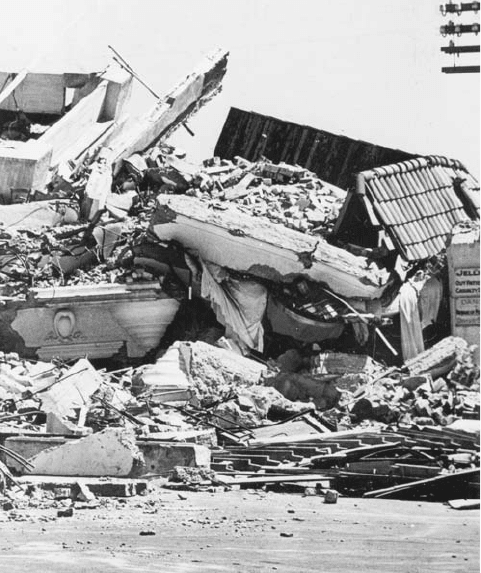
The nurses’ home at Napier Hospital was a pile of rubble after the 1931
Napier (Hawke’s Bay) earthquake. (Courtesy of the USGS)
173
waves of an earthquake. A series of vibration nodes will form,
which can cause the building to literally shake itself apart.
Navajo Volcanic Field See Ship Rock.
Nazca crustal plate The Nazca crustal plate is one of the
smaller major plates of Earth’s crust and is located under the
Pacific Ocean immediately to the west of South America.
It is composed completely of oceanic crust. The ongoing
collision between the South American plate and the Nazca
plate is believed to account for much of the belt of strong
seismic and volcanic activity along the Andes Mountains of
western South America, through Bolivia, Chile, Ecuador,
and Peru. The Nazca plate is bounded on the north by the
smaller Cocos plate, on the west by a mid-ocean ridge,
and on the south by the Antarctic plate.
See also plate tectonics; “Ring of Fire.”
Nebraska United States Earthquake activity in Nebraska
appears to have been minor since the territory was settled by
Americans of European descent. A strong earthquake was
reported in eastern Nebraska on November 15, 1877, and
was felt over a wide area of Minnesota. Two shocks 45
minutes apart were reported. Some damage occurred to prop-
erty, and the earthquake was felt over an area of about 300
by 600 miles (483 by 966 km).
neck The remnants of a volcanic pipe after erosion has
removed the volcanic cone. It is an erosional remnant. Dev-
ils Tower is an example of a volcanic neck.
neotectonics Current seismic and tectonic activity in
a region. Neotectonics includes earthquakes, uplift and/or
subsidence, and active faulting and/or folding. This current
activity typically results in landslides and strongly altered
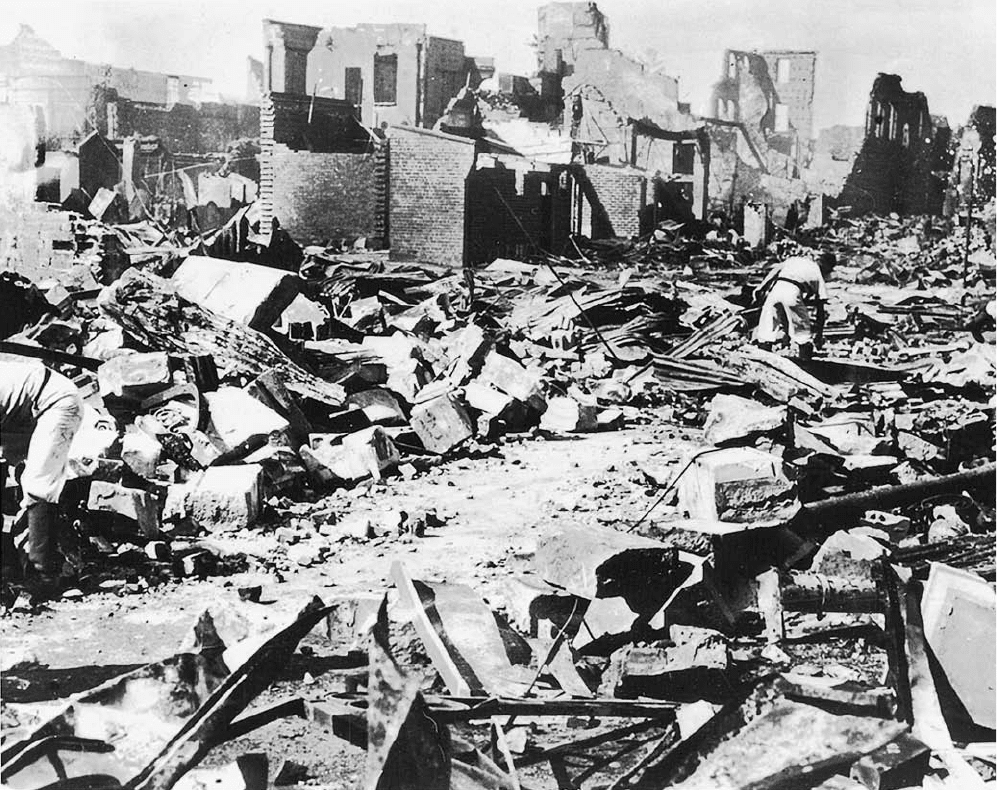
Sailors were brought in to search the ruins of Napier for victims and survivors of New Zealand’s worst earthquake, the 1931 Hawke’s Bay event.
(Courtesy of the USGS)
174 Navajo Volcanic Field
drainage patterns. Rivers can shift their course and lakes may
appear in the areas of subsidence. Neotectonism only occurs
in active areas.
Nepal The small, landlocked country of Nepal sits high
in the Himalayas within the zone of the most intense con-
tinental collision on Earth—India with southern Asia. India
is attempting to dive beneath Asia, but because the crust
is so buoyant, the collision is more like a car accident, with
both continents crumpling. There are no active volcanoes in
this area, and there have not been any for tens of millions
of years, but there are numerous instances of earthquakes.
The first reliable report of an earthquake was from a.d.
1255. It had an estimated modified Mercalli intensity of X,
and it killed one-third to one-fourth of the population of
the Katmandu Valley. Other catastrophic earthquakes in
Nepal were reported in 1408, 1681, and 1810. In 1833, the
Paphlu earthquake, with a magnitude of 7.8, devastated
the Katmandu Valley. It produced a surface rupture more
than 42 miles (70 km) long that is located about 30 miles
(50 km) north Katmandu. Two large foreshocks warned
the residents, and many evacuated their homes before the
main shock struck. As a result, there were only 500 casual-
ties. The most devastating earthquake to have stuck Nepal in
modern times was the 1934 Bihar event, which killed more
than 10,000 Nepalese and produced a surface rupture some
120 miles (200 km) long.
Nevada United States The state of Nevada is located in
a seismically active region of the country and has been the
site of several notable earthquakes in the 20th century. The
earthquake of October 2, 1915, had an estimated Richter
magnitude of 7.7 and generated effects of Mercalli inten-
sity X at its epicenter in Pleasant Valley near Winnemucca.
This earthquake was felt over a vast area of the western
United States, from San Diego, California, to Oregon but
did little damage because the affected area was settled so
lightly. The earthquake wrecked adobe houses, tossed per-
sons from bed, and caused mine tunnels to collapse. A fault
with a new vertical scarp 22 miles (35 km) long and up to
15 feet (5 m) high appeared along the base of the Sonoma
Mountains. Western Nevada experienced another strong
earthquake, this one of magnitude 7.3 with effects of Mer-
calli intensity X, on December 20, 1932; again, there was
little damage because the region affected was so under-
populated. Considerable faulting occurred in a valley near
Mina between the Pilot and Cedar Mountain ranges; several
dozen fissures, with lengths up to four miles (6.4 km), were
reported. The shock was felt over much of California, from
San Francisco to San Diego. The Dixie Valley earthquake
on December 16, 1954, affected an area of some 200,000
square miles (517,998 km
2
), had a Richter magnitude of 7.1,
and produced effects of Mercalli intensity X.
Nevado del Ruiz volcano, Colombia Nevado del Ruiz
was the site of a deadly lahar in 1985. An eruption of VEI
= 3 produced mudflows that traveled from the volcano
down the Lagunillas River and killed approximately 23,000
people in the town of Armero. Mudflows are common during
eruptions of Nevado del Ruiz. The reason is that it is a high
mountain 17,453 feet (5,320 m) and therefore covered with
ice and snow. During eruptions, the snow and ice is melted
and mixes with ash to form mudflows that can travel 10
miles (16 km) from the mountain. Similar eruptions occurred
in 1595 and 1845, but the lahars did not hit inhabited areas.
Nevados de Chilian caldera, Chile Located in southern
central Chile, Nevados de Chilian has a history of explo-
sive eruptions dating back to the 17th century. Although
the nearby city of Chilian stands some 60 miles (97 km)
from the shore, saltwater and mud erupted in large quanti-
ties after a strong earthquake in 1835. Numerous new hot
springs formed at this time. (It is not certain whether this
activity occurred at Chilian itself or at Nevados de Chilian.)
There may have been a minor eruption at Nevados de Chil-
ian in 1906, several days before a powerful earthquake that
wrecked Valparaiso. A new volcano, Volcan Nuevo, formed
in this eruption. Activity, including an incident of dome for-
mation, continued in the 1970s and 1980s.
Nevados Huascarán earthquake, Peru On May 31, 1970,
an earthquake of Richter magnitude 7.7 occurred beneath
the Pacific Ocean some 84 miles (135 km) away from
Nevados Huascarán. Shaking lasted 45 seconds and loosed a
giant part of west-facing slope of the north peak of Nevados
Huascarán. When it failed, there was a loud explosion and a
cloud of dust obscured the mountain. The side of the moun-
tain between elevations 18,000 and 21,000 feet (5,486 and
6,401 m) including a 100-feet (330-m)-thick glacier fell away
and down the mountain. The mass was about 100 million
square meters (258,998,810 km
2
) of rock, ice, and water. It
started as a free fall for some 1,300 to 3,000 feet (400–914
m) before landing and scooping up more rock and ice. It then
moved down the Rio Santa Valley as a debris flow or ava-
lanche for 30 miles (48 km). It moved at speeds of 175 to
210 miles (282 to 338 km) per hour and destroyed the towns
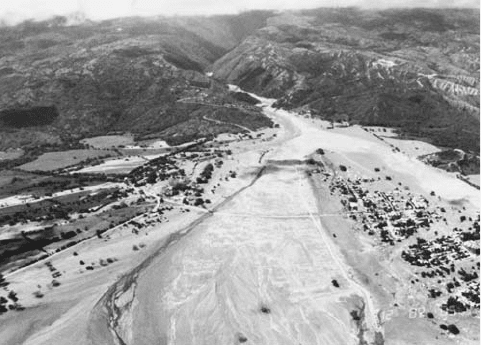
The path of lahar leading down the valley from its origin at the eruption of
Nevado del Ruiz, Colombia, in 1985. More than 23,000 people died in this
disaster. (Courtesy of the USGS)
Nevados Huascarán 175
of Yungay and Matacoto. More than 18,000 people were
killed, and Yungay was buried 100 feet (30 m) deep in debris.
The boulders were up to several tons apiece. They left bomb-
like craters along their path, and houses literally exploded
when hit by them.
New Britain Island See Papua New Guinea.
New Hampshire United States New Hampshire is located
in one of the most seismically active areas of the United
States, in northern New England along the Saint Lawrence
Valley. Earthquakes, some of them powerful, have shaken
the state frequently within historical times. The earthquake
of November 29, 1783, was felt from New Hampshire to
Pennsylvania. On November 9, 1810, an earthquake at
Exeter, New Hampshire, involved a peculiar noise like that
of a strong explosion underfoot. The earthquake lasted a
minute at Portsmouth, New Hampshire, and was strongest
between Portsmouth and Haverhill, Massachusetts. A ship
in Portsmouth Harbor appeared to hit the bottom, and the
earthquake broke windows in Portsmouth. The earthquake
was felt also in Maine.
Ancient volcanism in the White Mountains of New
Hampshire created a curious set of circular and nearly cir-
cular structures called ring dikes that formed when molten
rock oozed up around the edges of cylindrical masses of rock
overlying volcanic chambers far underground. These circular
structures can be found at the Ossipee Mountains, Mount
Lafayette, the Pliny Range, and the Crescent Range.
New Jersey United States New Jersey is located in a region
of generally minor seismic risk but has experienced strong
earthquakes from time to time. In 1884, an earthquake of an
estimated 5.2 on the Richter scale occurred. Church bells
rang in Connecticut as a result. Faults in the area have his-
torically produced such earthquakes on a 140-year recurrence
interval. The Ramapo Fault is likely the most dangerous seis-
mic risk in the New York metropolitan area. On September
1, 1895, an earthquake in Hunterdon County, estimated
at Mercalli intensity VI, affected an area of some 35,000
square miles (90,650 km
2
); this earthquake knocked articles
off shelves in Hunterdon County and was felt throughout the
city of Newark. Strong shocks were reported also at Burling-
ton and Camden, and windows were broken in Philadelphia.
A rumbling sound accompanied an earthquake on January
26, 1921, in Moorestown and Riverton. The coast of New
Jersey between Toms River and Sandy Hook experienced
three shocks on June 1, 1927; between Long Branch and
Asbury Park, chimneys and plaster walls were damaged, and
objects were knocked off shelves. On December 19, 1933, an
earthquake near Trenton was felt sharply and knocked pic-
tures off walls in Lakehurst.
The Salem County earthquake of November 14, 1939,
was estimated at Mercalli intensity V and was felt over an
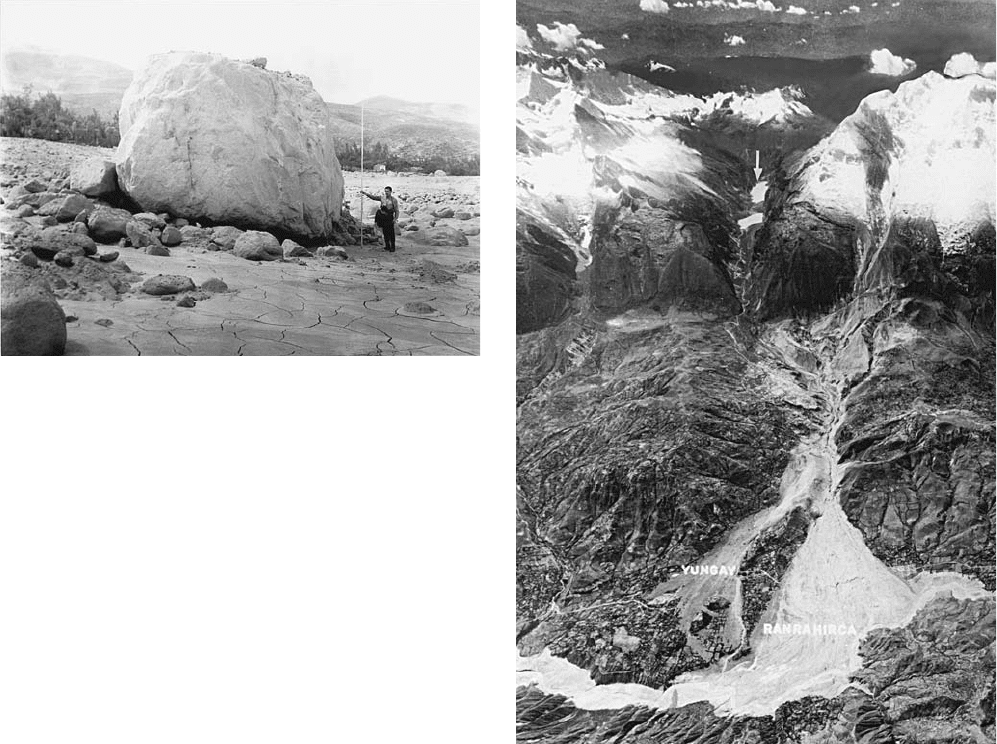
Blocks such as this 700-ton example came hurtling down the mountain at
speeds of up to 210 miles (350 km) per hour in Nevados Huascarán, Peru,
in 1970. Houses literally exploded into toothpick-size fragments upon
impact. More than 18,000 people were killed. (Courtesy of the USGS)
Aerial view of the Andes mountain range, including the highest peak
in Peru, Nevados Huascarán. The arrow shows where the 3,000-foot
(1,000-m)-wide mass of glacial ice and rock broke loose during the 1970
earthquake. The 22-mile (37-km) travel path extends to the white deposits
at Yungay and Ranrahirca. (Courtesy of the USGS)
176 New Britain Island
area of some 6,000 square miles (15,540 km
2
), from Trenton
to Baltimore, Maryland, and from the Philadelphia area to
Cape May. Western central New Jersey experienced an earth-
quake on March 23, 1957, that caused considerable damage
and alarm in the area of Hamden, Lebanon, and Long Val-
ley. An earthquake on December 27, 1961, along the border
of New Jersey and Pennsylvania was estimated at Mercalli
intensity V and caused much fright in the affected area, which
included Bristol and the northeast Philadelphia area, as well
as Langhorne and Levittown. The December 10, 1968, earth-
quake in southern New Jersey broke windows and caused
considerable alarm and was felt also in portions of Pennsyl-
vania and Delaware; this earthquake was estimated at Rich-
ter magnitude 2.5, and effects of Mercalli intensity V were
reported at some locations. Small earthquakes occur at the
rate of several per year in New Jersey, mostly in the New Jer-
sey Highlands and near the shore.
New Madrid Fault Zone Missouri, United States The
New Madrid Fault Zone along the Mississippi River was the
center of what are believed to be among the most powerful
earthquakes in the history of the United States, in the winter
of 1811–12. These earthquakes are believed to have had mag-
nitudes between 8.4 and 8.8 on the Richter scale and were
felt from New Orleans to Canada and all along the Eastern
Seaboard. Strongly affected were areas in the states of Illi-
nois, Missouri, Arkansas, Tennessee, and Kentucky. It
was so powerful that pedestrians in Richmond, Virginia,
allegedly had trouble standing on their feet as the vibrations
from the earthquake passed, and in Kentucky the earthquake
was felt so strongly as to leave people feeling dizzy and dis-
oriented. The New Madrid area was sparsely settled at the
time, and casualties were few, compared with other, similar
earthquakes in urban communities; only 11 men, women,
and children were formally reported as lost in the New
Madrid earthquakes, although the total is thought to have
been greater.
The earthquakes laid waste to some 3,000 to 5,000
square miles (7,770 to 12,950 km
2
) of land. The most spec-
tacular effects were to the Mississippi River and its tributar-
ies. landslides fell from the bluffs and banks all along the
river, ruining channels and producing large and damaging
waves. The course of the river was so shifted in areas that
swamps and lakes were formed in areas that were formerly
forests. One hundred years later, these shifts and floodings
were still plainly visible. liquefaction in the unconsolidated
bank sediments formed mud volcanoes in which the water
was reportedly shot some 10–15 feet (3–5 m) in the air.
Detailed records of the earthquakes and their effects have
been compiled from personal journals, letters, and newspa-
per accounts. The earthquakes caused the banks of the river
to collapse into the water, carrying anglers with them. Sub-
merged trees were dislodged from the riverbed and floated to
the surface, and one report said the current in the river was
actually reversed briefly because of elevation of the riverbed.
There were numerous observations of strange behavior on the
part of animals (both wild and domestic) before and during
the earthquakes. Naturalist John James Audubon noted that
the horse he was riding stopped and began to groan at the
time of the earthquake. A naturalist visiting the New Madrid
area indicated later that birds behaved abnormally. Water-
fowl congregated on boats, and on land small birds settled
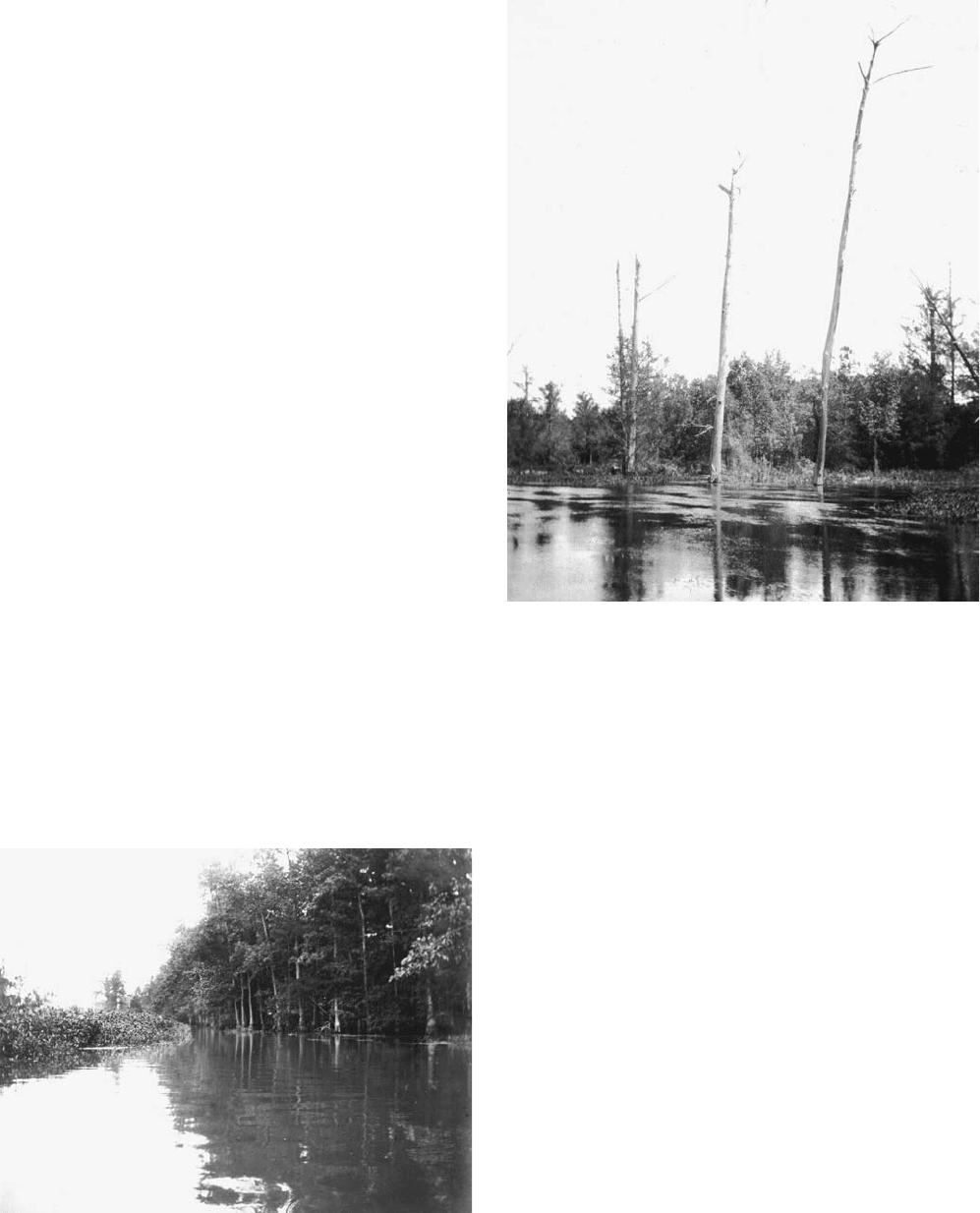
Even in 1904, lakes formed by the 1811–12 New Madrid earthquake could
be seen flooding forests in Varney River, Missouri. (Courtesy of the USGS)
Skeletons of cypress trees killed by submergence in Lake St.
Francis, Arkansas, in 1904 resulting from the 1811–12 New Madrid
earthquakes. (Courtesy of the USGS)
New Madrid Fault Zone 177
on houses. In some cases, birds were even seen to alight on
humans. Panthers, foxes, and wolves were said to have been
seen next to wild deer.
Peculiar atmospheric phenomena appear to have accom-
panied the New Madrid earthquakes. One correspondent for
the Louisiana Gazette mentioned that fog obscured the sky
at the time of one shock and that as another shock occurred,
observers noticed what looked like frost covering houses and
fences. On close examination, however, the “frost” turned
out to be a vapor that lacked the chill of frost. Another inter-
esting phenomenon reported during the New Madrid earth-
quakes was earthquake light in the form of either bright
flashes of light or a dull glow in the sky.
The sociological and psychological effects of the New
Madrid earthquakes have been reported in detail, specifically
a religious revival that occurred among settlers in the area.
Church membership increased dramatically in the weeks and
months following the earthquakes, but apparently the revival
was short-lived.
Another strong earthquake struck the New Madrid area
again in January 1843. A report from Little Rock, Arkansas,
indicates the shaking lasted for about one minute and caused
windows and cupboards to rattle. Hundreds of residents of
Memphis, Tennessee, ran into the streets when they felt the
earthquake, and some deaths allegedly occurred at auction
houses where people were crushed and trampled by crowds
struggling to escape the buildings. The noise of the earth-
quake was compared to that of hundreds of heavily laden
wagons moving down a street. In 1895, another earthquake
centered near New Madrid was felt strongly in a zone about
100 miles (161 km) long and was felt as far away as Georgia
and West Virginia. The shocks lasted almost one minute,
cracked walls, and shook down brick chimneys. As in 1811–
12, a strange phenomenon resembling earthquake light was
reported as a luminous “streak” that appeared in the sky just
prior to the shock. Yet another earthquake, in 1968, startled
residents but caused little damage.
If and when another earthquake comparable in magni-
tude to those of 1811–12 strikes the New Madrid Fault Zone,
the results may well be disastrous for metropolitan areas in
the Mississippi Valley, notably St. Louis, Missouri, and Mem-
phis, Tennessee. Located on the edge of the New Madrid
Fault Zone, Memphis may expect severe ground motion, and
large areas of the city stand to suffer greatly from liquefac-
tion, which also poses a threat to St. Louis in the event of a
major earthquake there. As one U.S. Geological Survey report
describes the situation in St. Louis: “Much of the old part of
the city of St. Louis, and particularly the modern highway
network, is built on uncontrolled fill. This fill is generally
[found] in stream valleys, but there are many rubbish-filled
pits in the old portion of the city. All this rubbish and fill is
prone to large differential settlements in an earthquake.”
The report adds that “parts of the downtown area are
underlain by open, underground mines, where clay was
mined long ago for making tile. Their locations are generally
. . . not known.”
Landslides are another danger facing St. Louis, the report
points out: “Landslides [in the St. Louis region] are likely to
be commonplace on many natural and highway slopes. The
natural slopes most prone to landslides in uplands are thick,
silt-rich bess [soils] on steep slopes. . . . Many highway cuts
[will] fail and cause very serious problems to highway traf-
fic.” Even today, there are significant landslides in the cuts
along Interstate Highways I–44, I–244, I–270, and U.S. 67.
Some highway fills [material in the roadbed underlying the
asphalt] would probably fail, especially on the lake sediments
near the airport and on flood plains of the major rivers. The
following is an eyewitness account of the event, reported by
F. A. Sampson:
Accompanying the noise, the whole land was moved
and waved like waves of the sea, violently enough
to throw persons off their feet, the waves attaining a
height of several feet, and at the highest point would
burst, throwing up large volumes of sand, water and
in some cases a black bituminous shale, these being
thrown to a considerable height, the extreme state-
ments being forty feet, and to the tops of trees.
With the explosions and bursting of the ground
there were flashes, such as the result from the explo-
sion of gas, or from the passage of the electric fluid
from one cloud to another, but no burning flames;
there were also sulphuretted gasses, which made the
water unfit for use, and darkened the heavens, giv-
ing some the impression of its being steam, and so
dense that no sunbeam could find its way through.
With the bursting of the waves, large fissures were
formed, some of which closed again immediately,
while others were of various widths, as much as
thirty feet, and of various lengths. These fissures
were generally parallel to each other, nearly north
and south but not all.
In some cases instead of fissures extending
for a considerable distance there were cir cular
chasms, from five to thirty feet in diameter, around
which were left sand and bituminous shale, which
latter would burn with a disagreeable sulphurous
smell. . . .
No more startling change of scenery could well
be imagined than that at old man Culberson’s, who
lived with his family in a bend of the Pemiscot River,
ten miles below Little Prairie. There was about “an
acre of ground” between his house and the river,
and on it was his smoke-house and well. On the
morning of the 16th, Mrs. Culberson went out to
get some meat from the smoke-house, but no well
or smoke-house was to be seen. Upon search, they
were both found on the other side of the river. A fis-
sure across the bend had been so large that the river
flowed through it, and the great pressure on the iso-
lated spot forced it to the opposite side of the river
when the next earthwave occurred. . . .
The persons who experienced the shocks gen-
erally did not theorize as to the cause, but Brad-
bury found a man near the Lower Chicksaw Bluffs
who gave his theory. It was that a comet, which
had appeared a few months before, had two horns,
over one of which the earth had rolled, and was
178 New Madrid Fault Zone
then lodged between them. The shocks were occa-
sioned by the attempts to surmount the other
horn. If this should be accomplished all would be
well; otherwise inevitable destruction of the world
would follow.
New Mexico United States Central New Mexico has
a long history of earthquakes, mostly localized but strong.
Earthquakes in July and November 1906 affected an area
of about 100,000 square miles (259,000 km
2
). New Mexico
also has numerous volcanic landforms.
See also Bandelier Tuff; Rio Grande Rift; Valles.
Newport-Inglewood Fault Zone California, United States
A fault zone that directly underlies the Los Angeles, Cali-
fornia, area, the Newport-Inglewood Fault Zone appears to
pose a serious threat to the city in the event of any major seis-
mic events along the fault zone in the future.
New York United States New York State borders on
the seismically active Saint Lawrence Valley between the
United States and Canada, and earthquake activity is com-
monplace in upstate New York, including occasional pow-
erful shocks. Even the New York City area, ordinarily not
known for seismic activity, has undergone strong earth-
quakes over the past three centuries; on December 18, 1737,
for example, an earthquake estimated at magnitude VII on
the Mercalli scale struck the New York City area. Other
substantial earthquakes to hit the vicinity of New York
City within historical times include: December 10, 1874
(Westchester and Rockland counties, New York, and Ber-
gen County, New Jersey; Mercalli intensity VI); August 10,
1884 (Bergen County, intensity VII); March 9, 1893 (magni-
tude V); June 8, 1916 (intensity IV–V); May 11, 1926 (New
Rochelle; intensity V), and November 22, 1967 (Westchester
County; intensity V). The 1884 earthquake was especially
strong and affected a broad area of the northeastern United
States, from Portsmouth, New Hampshire, and Burlington,
Vermont, to points as far south as Baltimore, Maryland,
and Atlantic City, New Jersey. Maximum damage occurred
in Amityville and Jamaica, New York, where large cracks
formed in walls. The 1893 earthquake had dramatic effects
on New York City itself; the epicenter was located between
10th and 8th streets, and the earthquake distressed animals at
the city zoo and interfered with the playing of billiards.
The frequency of small to moderate earthquakes in New
York State has made it a convenient natural laboratory for
studying techniques of earthquake prediction, and some suc-
cess has been reported in predicting seismic activity there.
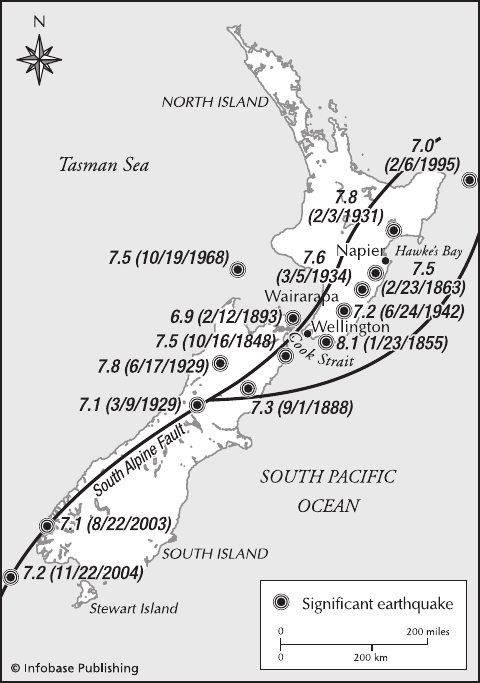
New Zealand New Zealand has a complex geology and
a long history of strong volcanic and earthquake activity.
New Zealand and the Macquarie Islands to the southwest are
believed to account for more than 1% of the seismic activity
on Earth. One area of intense seismic activity is Fiordland on
South Island.
Notable earthquakes in New Zealand’s history have
occurred in 1848 at Awatere, 1855 at Wellington, 1881
at Amuri, 1901 at Cheviot, 1929 at Murchison, 1931 at
Hawke’s Bay, 1932 at Wairoa, 1942 at Wairarapa, and
1953 at Bay of Plenty. The Awatere earthquake in 1848
was felt over much of New Zealand and caused serious
damage on both islands, although damage reportedly was
worst around Cook Strait, notably in Wellington. The
1931 Hawke’s Bay earthquake was even more severe and
is thought to have had a Richter magnitude of 7.8. This
earthquake stands out in the history of seismology because
data from it indicates to geologists that Earth has an inner
core. North Island exhibits extensive volcanic activity. Its
volcanoes include Ngauruhoe, Ruapehu, Tarawera, and
White Island. White Terrace and Pink Terrace, two beau-
tiful formations deposited by hydrothermal activity,
were destroyed by a volcanic eruption in the 19th century.
New Zealand has geothermal energy facilities developed
after World War II on North Island in a thermal area near
Ngauruhoe and Ruapehu. This area features many manifes-
tations of geothermal activity, including, but not limited to,
geysers, hot springs, and fumaroles.
Map of New Zealand showing the locations of the major faults and the
epicenters of the major historical earthquakes, including the magnitude
and the date (in parentheses) of the event
New Zealand 179
Ngaurahoe volcano, North Island, New Zealand The
beautiful stratovolcano Ngauruhoe is New Zealand’s
most active volcano. It has erupted at least 61 times since
1839 and has produced lava fountains, and minor
NUÉE
ARDENTEs on some occasions. The most recent eruption was
in 1977. Ngauruhoe is adjacent to two other volcanoes, Ton-
gariro and Ruapehu.
Ngorongoro volcano, Tanzania Ngorongoro is part of
a set of several large volcanoes in the Land of the Giant
Craters, along Africa’s Great Rift Valley. The subsidence
crater in the extinct Ngorongoro volcano is some 35 miles
(56 km) in circumference and once was home to large herds
of wild animals, including wildebeest, hippopotamus, rhinoc-
eros, giraffe, impala, and elephant. Hunting reduced the wild-
life population of Ngorongoro, but in 1959 a conservation
area was established.
Nicaragua Nicaragua has a history of highly destructive
earthquakes, notably one that destroyed much of Managua
on December 23, 1972. That earthquake was associated with
Nicaragua’s Tiscapa Fault.
Nicaragua is also noted for having active volcanoes. The
eruption of Cosigüina in 1835 was one of the most violent
of the 19th century. A powerful volcanic eruption occurred
in Nicaragua on November 14, 1867, when a mountain east
of the city of Lion erupted for more than two weeks and cast
out great amounts of black sand, which was carried as far
as the Pacific shore some 50 miles (80 km) away. incandes-
cent rocks were reportedly ejected from the crater to a height
estimated at 3,000 feet (914 m). The city of Léon, the former
capital of Nicaragua was earlier destroyed by the 1605–06
eruption of Momotombo. An eruption of yet another dan-
gerous volcano, Masaya in 4550 b.c. was one of the larg-
est on Earth in the last 10,000 years. Other volcanoes include
Concepción, the spectacular Cerro Negro, La Madera,
Las Pilas, San Cristobal, and Telica.
Seismic and volcanic activity in Nicaragua played an
important part in formulating plans to build a canal through
Central America to connect the Atlantic and Pacific Oceans.
Historian Charles Morris explained in The Volcano’s Deadly
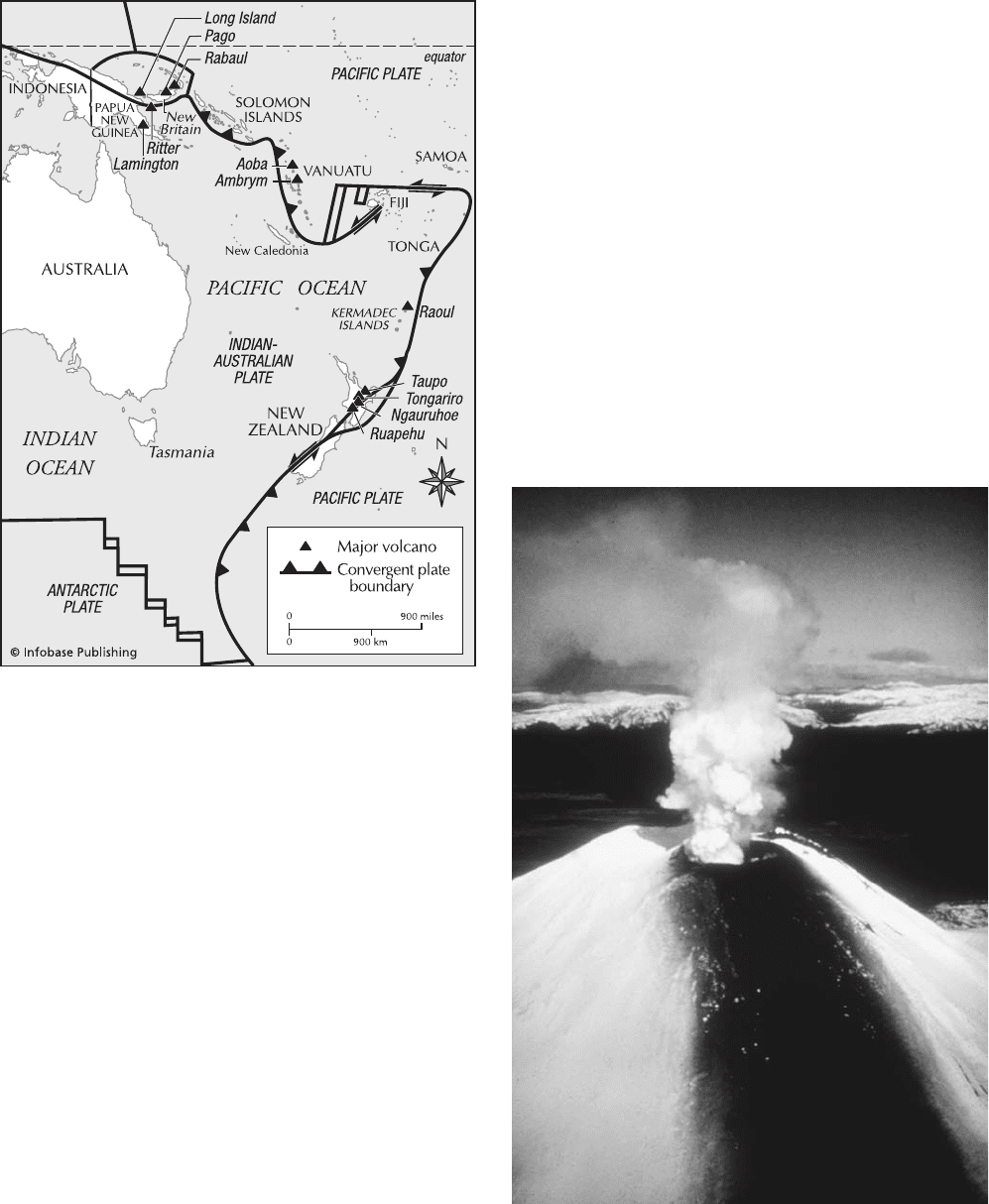
Map of the New Zealand–Australia area showing the plate tectonic
relations and several of the major volcanoes
The near-perfect stratovolcano of Ngauruhoe is one of the most active in
New Zealand, with 61 eruptions since its discovery in 1839. (Courtesy of
NOAA)
180 Ngaurahoe
Work, published in 1902, when deliberation on the route of
the canal was continuing:
There are three volcanoes in Lake Nicaragua itself,
which body of water it was proposed to make the
summit level of the projected canal on this line.
Indeed, the evidence of geology is that Lake Nica-
ragua was once an arm of the Pacific, and that the
central plateau of Nicaragua was formerly much
nearer to the Caribbean coast than at present. The
forces which effected so vast a change in the config-
uration of the land are still active. The eruption in
1835 of Cosigüina, which lies but sixty miles from
the proposed Nicaragua canal route, was of extraor-
dinary violence, So tremendous was this explosion,
and so great was the storm of dust and ashes, that
absolute darkness prevailed for thirty-five miles
in every direction. . . . Cosigüina could have filled
up ten times in one hour a canal prism which the
contractors, with all their . . . labor-saving devices
and the employment of tens of thousands of hands,
would require eight years to excavate. . . .
The danger of such convulsions at Panama is
far less. We are told . . . that in Panama there is,
within a distance of one hundred and eighty miles
from the canal, no volcano. The Isthmus there . . .
lies in an “angle of stability,” so called by seismog-
raphers. Except for rare and not very violent seis-
mic vibrations, originating at distant centers, the
Isthmus of Panama has never been affected by vol-
canic disturbances. One earthquake of some vio-
lence, indeed, has occurred there during the historic
period, in 1621, when the greater part of Panama
City was shaken down. Aside from this the most
destructive earthquake known in the history of Pan-
ama was that of September 7, 1882. It lasted only a
minute, but in that time shook down the courthouse
and ruined the front of the old cathedral. Yet it may
be affirmed that no paroxysmal convulsions have
remodeled the geographical features of the Isthmus,
as is the case with Nicaragua, and that its hills are
nearly if not quite as stable as those of the Appala-
chian system. . . .
The canal route eventually was decided in favor of Panama.
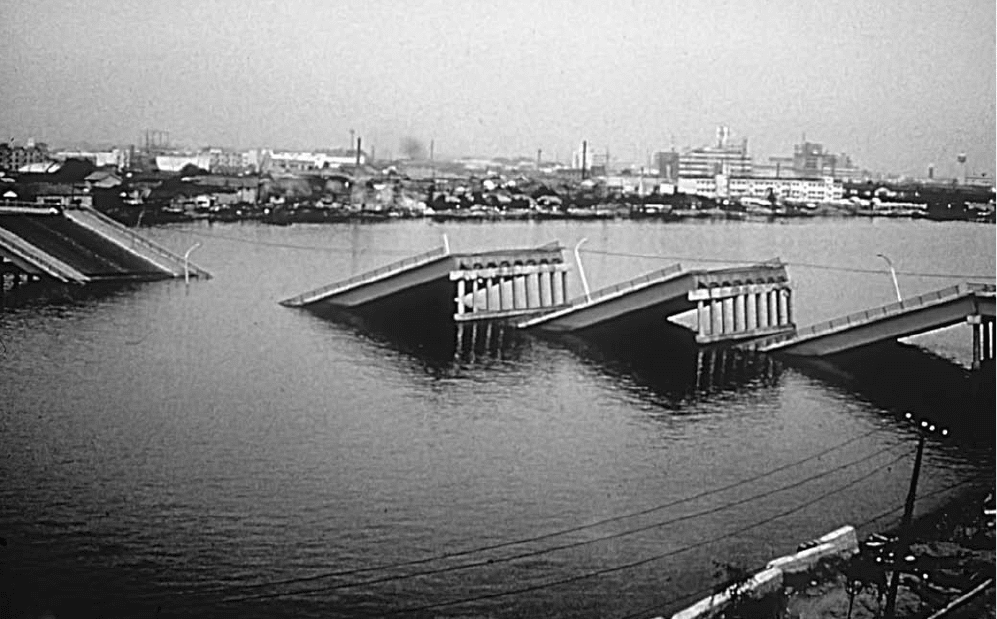
Niigata earthquake, Japan On June 16, 1964, an earth-
quake of magnitude 7.4 occurred. It killed 26 people and
moderately to severely damaged more than 9,750 houses.
The Niigata is one of the best examples of liquefaction and
A collapsed bridge after the June 16, 1964, earthquake in Niigata, Japan. The earthquake of magnitude 7.4 killed 26, injured 447, and damaged 9,750
structures in Niigata. Two piers on this bridge collapsed, and successive spans were pulled away from piers as the bridge was pulled apart. (Courtesy of
NOAA)
Niigata 181