
Gates A.E., Ritchie D. Encyclopedia of Earthquakes and Volcanoes
Подождите немного. Документ загружается.

resulting slumping and unequal settling. About one-third of
the city subsided some seven feet (2 m) as the result of com-
paction. The earthquake is famous for a group of apartment
buildings that were built to be earthquake-proof. They with-
stood the severe shaking by the seismic waves, but the foot-
ings around their foundations could not withstand the severe
liquefaction, and they fell over on their sides, still completely
intact.
Nisyros See Nysiros.
Niuafo’ou Island Tonga Niuafo’ou Island is also known
as Tin Can Island because of the way in which mail used to
be delivered to the island. Because the island had no harbor,
mail would be sealed in a metal container and dropped over
the side of a ship. A swimmer then would carry the can of
mail to shore. This method is said to have been discontin-
ued after a shark attacked a swimmer who was retrieving
the mail. The island is located in the northern portion of the
Tonga Archipelago and consists of a lava shield surmounted
by a composite volcanic cone. A large lake, called simply Big
Lake, occupies much of a caldera on the summit. A second,
smaller lake known as Little Lake is also located in the cal-
dera. Eruptions within historical times are recorded as early
as 1814, when an explosive eruption apparently was accom-
panied by phreatic activity and lava flows. This eruption
occurred in the caldera itself. Details of a reported eruption in
1840 are unavailable. Eruptions in 1853 and 1867 involved
fissures on the flanks of the volcano.
Observers of an eruption in 1886 left detailed accounts
of the event, which was heralded by earthquakes and an
apparent dramatic uplift in the seabed. The captain of a ship
anchored at Niuafo’ou discovered, after an earthquake on
August 12, that his ship was floating in only 48 feet (8 fath-
oms) of water, compared to some 120 feet (20 fathoms) the
previous day. A very loud noise was heard (compared after-
ward to the sound of a heavy gun), and some kind of dis-
charge occurred in the lake. Earthquakes stopped at this time.
Some subsidence appears to have occurred around the caldera
during this eruption.
A curious detail was noted in eruptions in 1919 and
1929: Coral was expelled along with lava, even though there
appeared to be no recently formed coral on the island. Very
little seismic activity was reported before the 1929 eruption.
An eruption in 1943 required the evacuation of the island,
and the inhabitants did not return for more than a decade.
Another eruption in 1946 was preceded by a very strong
earthquake just more than an hour before the eruption
began. Considerable uplift was reported in this eruption. One
account says that a reef on the northern side of the island was
raised 30 to 40 feet (9 to 12 m) out of the water in places.
Moderately strong earthquakes occurred in 1985.
normal fault See fault.
North America The North American continent is charac-
terized by localized earthquake activity and active volcanism.
According to the plate tectonic model and its dynamics,
North America occupies a plate of Earth’s crust that is mov-
ing slowly westward as new crust is formed along the mid-
ocean ridge that lies in the middle of the Atlantic Ocean.
The ongoing collision between the North American mainland
and the oceanic crust underlying the Pacific Ocean has
generated a complex geology along the Pacific coast of the
continent. It is marked by major and minor faults with asso-
ciated seismic activity, although there are other earthquake-
prone areas in North America. Much of North America’s
seismic activity is concentrated in the state of California,
where the San Andreas Fault, which lies along the coast,
has been associated with numerous strong earthquakes, such
as Fort Tejon in 1857, that which destroyed much of San
Francisco in 1906, and the less powerful but also highly
destructive San Fernando earthquake of 1971, the Loma
Prieta earthquake of 1989, and North Ridge earthquake
of 1994.
In both northern and southern California, but especially
in the Los Angeles area, urban development has created a
tremendous potential for destruction in the event of another
major earthquake comparable to that of 1906. Similar dan-
gers exist in other parts of the continent, such as the cities
surrounding Puget Sound. Other areas of North America
with a history of strong earthquake activity in the continen-
tal United States include New England, where earthquakes
have caused widespread damage to Boston, Massachusetts,
within historical times. In addition, Louisiana’s Gulf coastal
plain; upstate New York along the Saint Lawrence Val-
ley; the Appalachian Mountains, especially the southern por-
tion of the chain, from Virginia through Alabama; Utah,
which occupies part of a belt of pronounced earthquake
activity extending northward from Arizona to the Cana-
dian border; coastal South Carolina, site of the devastating
Charleston earthquake of 1886; and the Mississippi River
valley in the vicinity of New Madrid, Missouri, where the
most powerful earthquakes in the history of the continental
United States are believed to have occurred during the win-
ter of 1811–12. Virtually every part of the United States has
experienced seismic activity at one time or another since
settlement by Europeans began, although certain portions
of North America, such as the stable rocks of the Canadian
Shield, are all but free of substantial earthquakes.
The earthquake potential of western North America is
generally better understood than that of the eastern portion
of the continent, partly because earthquakes occur more often
in the west and partly because active faults in the east tend to
lie under thick layers of sediment that have hindered efforts
to study the seismology. Earthquake activity is also intense in
Alaska, the site of one of the greatest earthquakes of modern
times, the Good Friday earthquake of 1964, which was
accompanied by a powerful tsunami that caused great dam-
age as far away as Crescent City, California. Earthquake
activity in Alaska concentrates along the Aleutian Islands
and extends into the central portion of the state.
Mexico, too, has a long history of strong seismic activ-
ity. Earthquakes have caused widespread destruction in
Mexico over the centuries, notably in the Mexico City
earthquake of 1985. Western Mexico shares with the west-
ern United States and Canada
a potential for devastating
earthquakes, as smaller blocks of crust along the coast are
182 Nisyros
squeezed between the westward-moving continent and the
oceanic crust to the west. Especially susceptible to earth-
quakes are the northwest corner of Mexico, which is sub-
jected to the same set of geological conditions that make
southern California susceptible to major earthquakes, and
the extreme southern Pacific shores of Mexico, where earth-
quake epicenters are clustered almost as densely as in Cali-
fornia. The depth of earthquake foci differs greatly from one
portion of North America to another. Earthquakes in Alaska,
for example, extend much more deeply than those in south-
ern California and Nevada.
Volcanism has done much to shape the landforms of North
America. The western states of the United States exhibit numer-
ous signs of past and current volcanic activity. Great flows of
basalt in the northwestern states of the United States testify to
past volcanism in the Columbia plateau. A subduction zone
off the coast of the Pacific Northwest of the United States and
the Canadian province of British Columbia has given rise to
the volcanoes of the Cascade Mountains, including Mount
Hood, Mount Baker, Mount Rainier, Lassen Peak, and the
recently active Mount Saint Helens, as well as the photogenic
caldera of Crater Lake (Mazama) in Oregon. Volcanism
in Mexico has a long and colorful history; numerous volcanic
mountains stand near Mexico City and southward along the
Central American arc. The volcano Paricutín formed in a
spectacular eruption in a Mexican farmer’s field earlier in this
century. Others include El Chichón, whose massive eruption
in the early 1980s affected the weather patterns, Jorullo, and
Colima. Alaskan volcanoes have erupted on many occasions
in this century, sometimes with great violence, as in the Mount
Katmai-Novarupta eruption of 1912, which laid down a plain
of fumaroles, the Valley of Ten Thousand Smokes. Alas-
kan volcanism is tied to a subduction zone along the Aleutian
Island arc and includes many active volcanoes.
North American volcanism sometimes is extended to
cover that of the Hawaiian Islands because of their inclusion
in the United States but only for political reasons. Hawaiian
volcanoes include Kilauea and Mauna Loa, known for their
frequent but generally nonviolent and harmless eruptions.
Tsunamis pose a particular threat to the Hawaiian Islands
because of their position in mid-Pacific; the tsunami that
struck Hilo in 1946, for example, caused extensive damage
and loss of life.
The presence of large amounts of still-hot magma near
the surface in western North America has given rise to abun-
dant geothermal activity and hydrothermal activity in
certain locations, such as Yellowstone National Park,
where geysers have become tourist attractions. geothermal
energy has been exploited to generate electricity on a large
scale in northern California. There is also much evidence of
past volcanism like that which resulted from the separation
of North America and Africa. The Watchung Basalts of
New Jersey and Palisades Sill are a record of it.
North American crustal plate The North American
crustal plate generally underlies the continent of North
America and includes Canada and the 48 contiguous
United States in addition to Alaska and Mexico. The
North American plate is thought to be moving westward
relative to the Pacific crustal plate, with which it shares
a boundary along the western shore of North America. This
boundary between the North American and Pacific plate has
been the location of some of the most famous and destructive
earthquakes and volcanic eruptions in history. The Pacific
and North American plates are not the only ones involved in
generating seismic and volcanic activity there. The subduction
of the oceanic Juan de Fuca crustal plate, for example,
is the source for earthquakes and volcanism along the Cas-
cade Mountains of British Columbia and the northwest
United States, including portions of the states of California,
Oregon, and Washington. On the east, the North Ameri-
can plate is bounded by the mid-ocean ridge that traverses
the middle of the Atlantic Ocean. Here, new crust for the
North American plate is created as molten rock rises from
beneath and solidifies. To the southeast, the North American
crustal plate adjoins the plate underlying the Caribbean Sea,
along the borders of which have occurred some of the most
destructive eruptions and earthquakes in the recent history of
the Western Hemisphere. The Caribbean plate is bounded to
the north by a transform fault and to the east by a sub-
duction zone. The small Cocos plate, off the Pacific coast
of Central America, also shares a boundary with the North
American crustal plate. The boundary is a subduction zone
that yields the Central American arc.
See also plate tectonics.
North Carolina United States North Carolina is located
in a region of moderate seismic activity in the southeastern
United States. Although severe earthquakes have been rare
in North Carolina’s history, the state has a record of mild
seismic activity extending back into colonial times. An earth-
quake on March 9, 1828, probably centered in Virginia, was
felt as a severe shock at Raleigh, North Carolina, and was
associated with noises like thunder at Hillsborough. Another
earthquake on April 29, 1852, again probably centered in
Virginia, was felt in Raleigh, Greensboro, Hillsborough, and
Milton, North Carolina.
A notable series of earthquakes occurred between Feb-
ruary 10 and April 17, 1874, in McDowell County. Strong
shocks were followed by a curious rumbling sound. The
earthquakes shook buildings vigorously. Between 50 and 75
shocks are thought to have occurred altogether, each one
associated with rumbling. On some occasions, a noise like
artillery fire was also reported. The earthquakes affected an
area approximately 25 miles (40 km) wide.
North Dakota United States Although characterized by
low seismic activity, North Dakota is affected from time to
time by earthquakes in nearby states. Notable effects were
reported in North Dakota, for example, from the Montana
earthquake of 1959.
North Pagan caldera, Mariana Islands Located on Pagan
Island, North Pagan has erupted on several occasions since
the late 17th century. Details of eruptions are few, but a
large eruption appears to have occurred in 1872, and earth-
quakes reportedly accompanied other eruptions in 1917 and
1923. A huge eruption occurred in 1981 (VEI = 4) in which
North Pagan 183
the eruptive column was 11 to 12 miles (18 to 20 km) high.
The caldera appears to have been quiet until 1984, when a
small eruption followed an earthquake. Another minor erup-
tion occurred in 1987, and there is evidence of further erup-
tive activity in 1988.
North Ridge earthquake, southern California On January
17, 1994, an earthquake of magnitude 6.7 occurred. Some
60 people were killed, more than 7,000 people were injured,
and 20,000 were left homeless. More than 40,000 buildings
were damaged or destroyed in Los Angeles, Orange, Ven-
tura, and San Bernadino Counties. Services were disrupted
in many areas, and collapsed overpasses closed several major
freeways in the area. Total damage is estimated at $20 billion
dollars. rockfalls and liquefaction occurred throughout
the affected area. The fault that is responsible for the earth-
quake is a blind fault that was previously undetected.
Major aftershocks continued for nearly one year in the Los
Angeles area.
The famous points of destruction in this earthquake
included the Northridge Fashion Mall, which was essentially
destroyed. Many homes and apartment buildings had first-
floor carports and garages; during the earthquake, these bot-
tom floors collapsed and the buildings crushed down onto
the cars underneath. The California State University parking
structure was another spectacular sight as it bent over and
collapsed in on itself. The I–10 and I–5 Freeway collapses
and damage to the famous Fillmore Theater were also spec-
tacular.
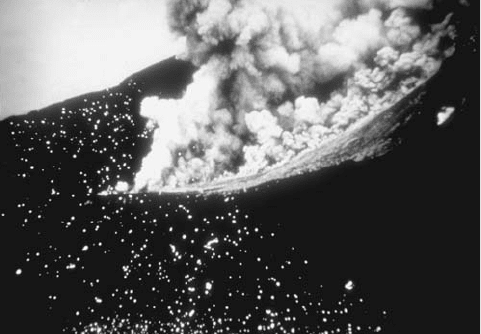
nuée ardente A term from the French meaning “fiery
cloud,” nuée ardente refers to a violent and potentially highly
destructive phenomenon that occurs when a volcanic dome
collapses or a lateral blast occurs. A pyroclastic flow
emanates from the volcano along with an overlying cloud
of ash. The resulting cloud of ash, rock, and superheated
gas (800°C) flows along the ground at high velocity 40 to
70 miles per hour (64 to 113 km) and incinerates or melts
virtually anything in its path. A nuée ardente can devastate
the area around a volcano almost as effectively as a nuclear
explosion. Perhaps the most dramatic example of a nuée
ardente in the 20th century is the one that accompanied the
eruption of Mount Pelée in the Caribbean Sea. Mount
Saint Helens also produced a spectacular nuée ardente.
Nyamuragira volcano, Zaire Nyamuragira is a shield
volcano and has erupted frequently in the 20th century.
Since 1882, it has erupted 34 times. Only an eruption in
1912–13 caused fatalities. The latest eruption was in 1994–
95. A lava lake was active in the 1920s and 1930s.
Nyiragongo volcano, Zaire A stratovolcano, Nyiragongo
has erupted often in the late 19th and the 20th centuries. Some
100 people were killed by fast-moving 40 miles (64 km) per
hour lava flows from the volcano in 1977. In 1958, an expe-
dition to the volcano succeeded in measuring surface tempera-
tures within the lava lake of Nyiragongo. Measurements at the
surface indicated temperatures between 1,000° and 1,200°C.
The volcano was active in 1982 and again in 1994. Both pro-
duced fire fountains and phreatic eruptions.
Nyos toxic gas, Cameroon The village of Lower Nyos
was overwhelmed on August 21, 1986, by a cloud of toxic
gas that erupted from the bed of Lake Nyos and asphyxiated
some 1,200 people in that community, plus some 500 others
in the vicinity. Some 3,000 domestic animals also died. The
cloud consisted largely of carbon dioxide that had accumu-
lated at or near the bottom of the lake. This phenomenon
is thought to be common in volcanic lakes, although most
of those lakes undergo sufficient mixing (that is, overturn of
warmer upper waters with colder, gas-laden bottom waters)
that prevents excessive buildup of toxic gas in deep waters.
It is not known exactly what caused the gases to rise from
the bottom of Lake Nyos. According to one explanation,
the lake had gone so long without overturning that toxic
gas had built up to tremendous concentrations in bottom
waters; then, when something finally initiated mixing, the
asphyxiating gases rose to the surface and were released. An
earthquake has been suggested as the possible agent of this
overturn; and indeed, a rumbling noise reportedly was heard
from the vicinity of Lake Nyos just before the catastrophe. It
also seems possible that a minor volcanic eruption expelled
the gas from the lake bed, but this hypothesis has not been
confirmed.
Nysiros caldera, Greece The volcanic island Nysiros lies in
the Aegean Sea near Turkey. The caldera of Nysiros is about
2.5 miles (4 km) wide and occupies what was the summit of
an andesitic stratovolcano. The date of collapse is related
to one of two explosive phases that occurred about 25,000
years ago. Several rhyolitic domes have formed inside the
caldera. Unrest has been reported at the caldera on several
occasions since the early 15th century. In 1422 there was a
report of an eruption. Detonations and roaring noises, along
with emissions of vapor and hot water, reportedly occurred
A nuée ardente was suddenly produced from a lateral blast in the
previously dormant Lamington volcano, Papua New Guinea in 1951. The
hot gas cloud sped down the mountain at 65 miles (100 km) per hour, and
killed some 3,000 people. (Courtesy of NOAA)
184 North Ridge
at the caldera in 1830. In 1871 earthquakes were reported,
accompanied by “flames” and detonations; ash and lapilli
from this eruption are said to have wiped out gardens of fruit
on the floor of the caldera. A crater some 20 feet (6 m) wide
formed in 1873 following an earthquake; again on this occa-
sion, lapilli and ash were cast out from the volcano. A lake
formed in the caldera from hot, salty water, and eruptions of
dark mud lasted for several days. Also in 1873, the caldera
ejected lapilli on many occasions, along with saltwater and
mud. Eruptive activity had formed a crater approximately 75
feet (23 m) wide by the autumn of 1888. solfataric activity
was reported in 1956.
Nysiros 185
O-Akan See Akan.
oblique slip fault See fault.
obsidian A dark, glassy volcanic rock, obsidian is really a
supercooled liquid with no crystalline structure. Although it
is commonly black, obsidian is commonly of rhyolitic com-
position. If the quickly cooling lava gets drops of water in it,
small alteration spots formed by the devitrification process,
form white spots in the obsidian. This texture is called snow-
flake obsidian because the white spots look like snowflakes.
Obsidian was used as material for arrowheads by Native
Americans because it can hold a very sharp edge.
oceanic crust The crust that makes up the ocean floor.
Oceanic crust has a distinct three-layer pattern. The bottom
layer is composed of peridotite, which is really uppermost
mantle rather than crust. The next layer is dominated by
closely spaced sheeted gabbro dikes that acted as feed-
ers to the volcanoes. The top layer is composed of pillow
basalts overlain by deep-sea sediments. They are mostly
mud and chert but closer to the continents other sediments
are possible. The three-layered sequence is called Steinman’s
Trinity and coined for pieces of ocean crust that had been
broken and lifted onto continental crust through plate
tectonic collisions. Ocean crust on continental crust is
called an ophiolite.
Ocean crust is produced at the mid-ocean ridge. The
splitting apart of the ocean ridge is filled in with mafic
magma from the mantle. That forms the sheeted dikes. The
dikes feed underwater volcanoes that produce the top layer.
Therefore, new crust is constantly being formed at the mid-
ocean ridge. As the newly formed crust is in turn split, it is
pulled in both directions away from the ridge. Therefore, the
youngest oceanic crust is at the ridge, and it becomes pro-
gressively older as it is pulled away. It is like a conveyor belt.
Because the ocean crust is eventually destroyed at a subduc-
tion zone, it is all relatively young. The oldest ocean crust is
200 million years and the vast majority is much younger. In
contrast, continental crust can be 3.4 billion years old.
offset The amount of movement on a fault. Offset is a
quantitative measure of how far a fault has moved. It is used
for all fault types. There can be total offset for how much a
fault has ever moved or offset for the amount of movement
during a single earthquake. Offset can be both in the verti-
cal and horizontal sense. On a dip-slip fault, the vertical
offset is called the throw, and the horizontal offset is called
the heave.
Ohio United States Ohio undergoes significant earthquakes
on occasion. Several examples are listed here. The June 18,
1875, earthquake was felt strongly in Chicago, Illinois,
Columbus, and Cincinnati and was strongest at Urbana and
Sicily, Illinois. On September 19, 1884, an earthquake near
Columbus caused slight damage. This earthquake was felt
at the top of the then unfinished Washington Monument in
Washington, D.C. A September 20, 1931, earthquake at Anna
caused minor damage but was felt at great distances, in Ala-
bama, Arkansas, and Tennessee. In March 1937, a series of
strong earthquakes was reported. An earthquake on March 2
near Anna and Sidney caused alarm and slight damage. On
March 3, minor damage was reported from an earthquake
that was felt at Anna, Botkins, Jackson Center, and Sidney.
The March 8 earthquake in western Ohio caused minor dam-
age and was felt on upper stories of high buildings in Chicago,
Illinois; Milwaukee, Wisconsin; and Toronto, Canada.
Oklahoma United States Oklahoma is not one of the more
seismically active states of the United States, but strong
earthquakes do affect the state on occasion. A strong shock
on April 9, 1952, at El Reno, for example, was felt over an
area of 140,000 square miles (362,598 km
2
).
Okmok caldera, Aleutian Islands, Alaska, United States
The Okmok caldera is located on Umnak Island and has
O
187
two summit calderas overlapping each other. The Tulik vol-
cano is located several miles from the caldera. Eruptions have
been reported here since the early 19th century. A major
explosive eruption in 1817 deposited several inches of ash
over the surrounding area, and large rocks were cast out,
some landing more than 30 miles (48 km) away. Earthquake
activity and a tsunami were reported in 1878, although it
is not certain how this activity may have been related to the
Okmok caldera. Tulik emitted black smoke in 1931, and an
eruption took place on the island several weeks later. The
island was relatively quiet until 1944, when activity resumed.
In 1945 an earthquake was felt at the army base on the
island, and several days later pilots reported seeing an erup-
tive column. Later investigations showed that ash and a lava
flow had emanated from a cinder cone in the caldera. Air-
borne observations revealed another lava flow in 1958. From
1960 to 1961, explosive eruptions occurred, and a minor ash
eruption was observed in 1983. Several small eruptions of ash
took place between 1986 and 1988.
Okushiri earthquake, Japan On July 12, 1993, an earth-
quake of magnitude 7.8 occurred in the Sea of Japan just to
the north of the small island of Okushiri. A mere two to five
minutes after the earthquake, a tsunami with vertical run-up
of 50 to 100 feet (15 to 30 m) struck the island. The coastal
areas were devastated by these enormous waves. The epicen-
ter was too close for warnings and evacuations, so people
were taken completely off guard. Some 120 people were
killed, and there was more than $600 million in property
damage.
Old Faithful geyser, Yellowstone National Park, United
States The geyser Old Faithful has erupted approximately
once every 40 to 80 minutes since the 19th century. Water
from the geyser reaches a height up to 150 feet (46 m). Each
eruption is thought to release some 100,000 pounds of water.
olivine A common mineral in mafic and ultramafic igne-
ous rocks. Olivine is a glassy green to brown mineral that
in gem form is called peridot. It is a silicate mineral that is
formed at very high temperatures (1,400°C). It is commonly
found as crystals in basalt. On one beach in Hawaii, the
olivine has been preferentially weathered out of the basalt
and makes up the sand on the beach. It is bright green. There
are impressive olivine-rich layers in the Palisades Sill along
the Hudson River in New Jersey.
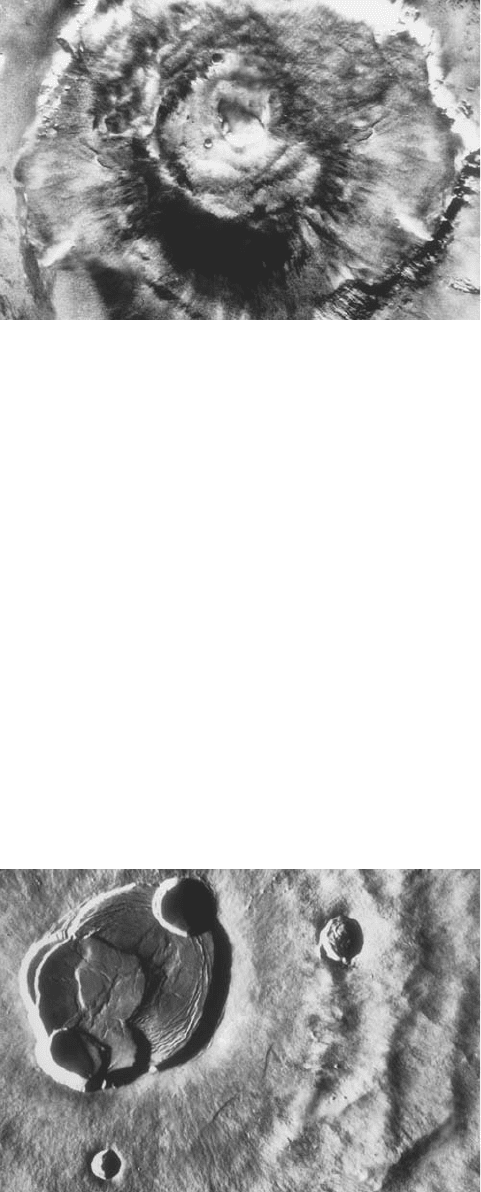
Olympus Mons volcano, Mars The largest-known shield
volcano in the solar system, Mars’s Olympus Mons stands
some 75,000 feet (22,860 m) high. Olympus Mons is one of
several large volcanoes in the Tharsis region of the northern
hemisphere. The Martian volcanoes appear to have played a
major role in shaping the topography of that hemisphere in
relatively recent times, although the existence of older vol-
canoes elsewhere on Mars indicates that volcanism has been
active on Mars for much of the planet history. The major
Martian volcanoes are larger by far than any on Earth. The
evident absence of plate tectonics on Mars may account
for the impressive size of its volcanoes. Unlike Earth, where
horizontal motion of crustal plates can prevent a volcano
from growing past a certain height because the volcano can
move out from its source, Mars appears to have a fixed, com-
paratively immobile crust. This lack of movement gives a vol-
cano time to reach tremendous size by terrestrial standards.
Because the processes that create volcanoes along crustal
plate margins on Earth are apparently lacking on Mars, it is
believed that radionuclides underground may supply the heat
required for volcanism there.
Onikobe caldera, Japan The Onikobe volcanic center is
located in the northern portion of the island of Honshu¯. The
volcano Kurikoma stands several miles northeast of the rim
of the caldera. The Narugo caldera and a group of vol-
canic domes are situated just southeast of the Onikobe cal-
The Martian volcano Olympus Mons is one of the largest in the solar
system. The volcano is more than 360 miles (600 km) across and 16 miles
(27 km) high. (Courtesy of NASA)
The summit of the Olympus Mons, Mars. It is composed of several
large collapse features that indicate a long period of activity. There
are also wrinkle ridges, and grabens suggest a complex tectonic
history. (Courtesy of NASA)
188 Okushiri
dera. Although the Onikobe caldera itself appears to have
been quiet in historical times, eruptions of Kurikoma were
recorded in 1946 and 1950. These eruptions do not appear
to have released large amounts of material, although a mud-
flow was associated with the 1950 eruption. Some unrest
was reported at the volcano in 1957, but there is no indica-
tion of an actual eruption.
On-Take volcano, Japan The On-Take volcano is located
on the island of Honshu¯, some 50 miles (80 km) northeast of
Nagoya. The volcano rests within a caldera and has a sum-
mit caldera more than one mile (1.6 km) wide. The volcano’s
first eruption within historical times occurred in 1979 follow-
ing several hours of seismic activity in the vicinity. A strong
earthquake in 1984 caused extensive landslides. fuma-
roles in the area of the 1979 vent appeared unaffected by
the earthquake, but changes were noted in a fumarole on the
summit of the volcano. Although it is not one of the more
active volcanoes in Japan, On-Take has received particu-
lar attention because of its eruption in 1979. The eruption
occurred after many hundreds of years of quiescence, and
the eruption is thought to be associated with earthquake
swarms in the area between 1976 and 1984 and with the
strong earthquake near the volcano in 1984.
Opala volcano, Kamchatka, Russia The Opala volcano
has been generally quiet over the last few centuries, although
an explosive eruption is reported for the year 1776. The
caldera was formed between 31,000 and 39,000 years
ago. About 1,500 years ago, explosions are believed to have
formed a crater about one mile (1.6 km) wide on the aver-
age within the Opala caldera, on the northern rim of which
the Opala volcano is located. Intense solfataric activity was
reported in 1827, 1854, and 1984 but no actual eruptions.
Öræfajökull volcano, Iceland Although not one of Ice-
land’s more active volcanoes, Öræfajökull has erupted on
two notable occasions within historical times. The first was
in 1362, when tephra and jökulhlaups caused considerable
damage in the vicinity of the volcano. Powerful earthquakes
are thought to have occurred just before this eruption. The
next eruption occurred in 1727 and was apparently similar to
the eruption of 1362.
Oran earthquake, Algeria On October 9, 1790, at 1:15
a.m., a major earthquake struck the northern part of Alge-
ria. The epicenter was in the town of Oran, which was com-
pletely destroyed. The intensity was estimated at X on the
modified Mercalli scale, and the maximum ground accel-
eration was calculated to have been 0.42 g. The recurrence
interval for earthquakes of this size is estimated at 500 years.
The source of the earthquake was the Oran Fault, which lies
east-west across the area with thrust and strike-slip move-
ment. The death toll for this earthquake was estimated at
3,000 people.
Oregon United States Located in the seismically active
Pacific Northwest of the United States, Oregon nonetheless
has not had a major earthquake since the territory was settled
by Americans of European descent in the 19th century. This
historical lack of seismicity does not mean that a powerful
earthquake in Oregon is impossible. However, parts of Ore-
gon would stand in risk of severe damage in any such event,
especially where numerous buildings are constructed of unre-
inforced masonry, a kind of construction that is extremely
vulnerable to damage from seismic events. Some notable
earthquakes in Oregon history are listed below.
On February 3, 1892, a strong shock caused buildings
to sway in Portland, and frightened residents of the city ran
into the streets. The earthquake was also felt strongly at
other locations, including Salem and Astoria. An earthquake
at McMinnville on April 2, 1896, involved three shocks and
awakened sleepers. The principal shock was felt also in Port-
land and in Salem. The earthquake of January 10, 1923, was
felt in Lakeview and Klamath Falls and probably was very
strong in an underpopulated area; minor damage occurred in
California.
Oregon shows abundant evidence of volcanic activity in
the recent geologic past, notably the peaks of several volca-
noes in the Cascade Mountains, which extend north-south
through the western and central portions of the state. Vol-
canism in Oregon is thought to be the result of the gradual
and ongoing destruction of the Juan de Fuca crustal plate
in the Cascadia Subduction Zone beneath the Pacific
Ocean immediately to the west of Oregon. As molten rock
from the fusion of the descending crustal plate rises back to
the surface along the Cascade range, the rising magma carries
with it a heavy load of dissolved gases thought to be derived
from ocean water carried downward into Earth’s mantle
with sediments from the seafloor. As the magma approaches
the surface and pressure on the molten rock is relieved, the
gases pass out of solution and into gaseous form, thus giv-
ing the Cascade volcanoes the potential for highly explosive
eruptions similar to that of Mount Saint Helens in Wash-
ington in 1980. Volcanoes in Oregon include Mount Hood,
Three Sisters and Crater Lake, the water-filled caldera left
from the collapse of Mount Mazama in prehistoric times.
origin time This is the exact time that seismic waves are
initiated at a seismic source. This time is calculated from the
arrival times of p-waves and s-waves at a seismograph.
Knowing the velocities of these two waves, seismologists
backtrack the waves to their focus to determine the exact
second that the rupture occurred. This origin time is most
commonly reported in universal time (UTC) rather than local
time.
Osaka earthquake, Japan Two closely spaced submarine
earthquakes struck Japan and caused great destruction in
December 1854. The epicenter of the first tremor was off
Totomi Sea, and the second was off Shikoku. The first of the
earthquakes struck Osaka at 8:00 a.m. on December 23, 1854,
and was felt strongly but produced only a moderate tsunami.
People were nonetheless nervous, and many decided to spend
the night outside their homes or on boats. The second event
struck at 5:00 p.m. on December 24, 1854, but the tsunami
did not arrive for two hours. It arrived in the outer harbor at a
height of 10 feet (3 m) but was 20 feet (6 m) high by the time
Osaka 189
it reached the port. It damaged or completely wrecked upward
of 1,500 boats, some of which were swept along by the wave
for a great distance, damaging at least 25 bridges. Between the
surface wave damage and the tsunamis, 60,000 houses were
destroyed as well. It was fortunate that only about 3,000 peo-
ple lost their lives because it could have been far worse. The
first moderate event likely forewarned people sufficiently that
they were better prepared for the second.
See also Ansei Tokai.
Öskjuvatn See Askja.
outer core Earth’s core is composite. It contains a solid
iron-nickel inner core and a liquid iron-nickel outer core.
We can tell that the outer core is liquid because s-waves will
not pass through it. S-waves will not pass through a liquid.
There is a shadow zone on the opposite side of Earth from the
earthquake where no S-waves arrive. Only p-waves arrive. By
comparing the records from many earthquakes, we can tell the
exact size of the liquid core. The interaction of the liquid core
with the solid core is the reason for our strong magnetic field.
Owens Valley earthquake, California, United States The
Owens Valley earthquake on March 26, 1872, is believed to
have been about 8.0 on the Richter scale and to have killed
from 50 to 60 people. The Owens Valley Fault along the
eastern face of the Sierra Nevada exhibited surface rupture
for more than 100 miles (161 km). Vertical displacement in
this earthquake was dramatic, especially near Independence
and Lone Pine; total relative displacement along the fault
exceeded 20 feet (6 m). The community of Lone Pine was
virtually leveled, and 23 of its inhabitants were killed. The
initial shock of the earthquake is said to have been the most
powerful. It is said to have created a large wave in Owens
Lake and dried up the Owens River for hours. Observers at
one bridge saw fish thrown out of the water and onto the
riverbank by the earthquake. Earthquakes continued for
eight weeks. Witnesses to the earthquake included naturalist
John Muir, who was asleep in his cabin near Sentinel Rock
when the earthquake occurred. He ran outside to see what
was happening and was forced to take shelter behind a tree
as boulders dislodged by the shock rolled downhill to the
floor of the valley. Muir improvised a primitive earthquake
detector (a bucket of water set on a table) to indicate when
shocks were occurring. The Owens Valley earthquake pro-
vided dramatic proof of how poorly adobe structures with-
stood earthquakes, notably in the devastated community of
Lone Pine.
190 Öskjuvatn
191
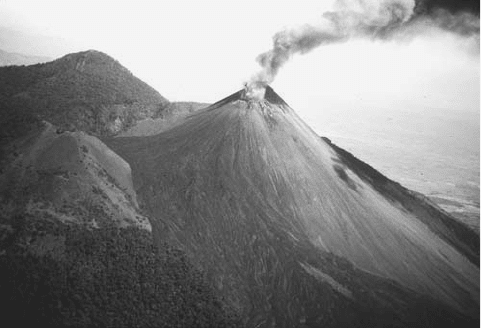
Pacaya volcano, Guatemala A volcanic complex with an
older andesitic and younger basaltic stratovolcano.
The complex appears to have formed in the last 23,000
years. It lies within the Cerro Grande–Pacaya–Cerro Chino
volcanic complex. Pacaya has erupted 23 times since it was
discovered in 1565. There is little information about early
eruptions because of its remote location. Its current phase
of activity began in 1965. Eruptions are highly variable and
include Strombolian and Vulcanian explosions, minor
summit flows from the crater, and larger flows from flank
eruptions. It is rarely quiet and as a result has become a
tourist attraction.
See also Amatitlán.
Pacific crustal plate The biggest plate of Earth’s crust in
terms of area, the Pacific plate underlies much of the Pacific
Ocean and is colliding with the Americas on the east and
with the Asian landmass on the west. The boundaries of
the Pacific crustal plate include much of the so-called Ring
of Fire, a belt of intense earthquake and volcanic activ-
ity surrounding the Pacific basin. Numerous subduction
zones, associated with volcanic activity, are found along the
boundaries of the Pacific crustal plate, such as the subduc-
tion zone found along the Aleutian Islands arc in Alaska.
It is also bounded by several mid-ocean ridges especially
to the east where it bounds the Nazca, Cocos, and Juan
de Fuca crustal plates. There are also many small plates
in the western Pacific. Although the Pacific plate is almost
entirely oceanic, it contains one notable piece of continental
crust. The Baja California and all areas west of the San
Andreas Fault, including Los Angeles, California are
actually not part of North America but instead part of the
Pacific plate. The direction of movement of the Pacific plate
can be seen in the track of volcanoes produced by a hot
spot over which it passed. Currently, the hot spot underlies
the Hawaiian Islands, which show the plate to be moving
northwest. However, the Hawaiian chain connects to the
Emperor Seamounts, which show that the Pacific plate was
moving nearly due north until it shifted abruptly to its new
course about 42 million years ago.
See also plate tectonics.
Pacific Ocean The Pacific Ocean basin is surrounded by
a ring of intense earthquake and volcanic activity known as
the “Ring of Fire,” produced by ongoing collisions between
the Pacific and related oceanic crustal plates and adjacent
plates of Earth’s crust. Other, smaller plates of crustal rock
are also involved. hot spots of volcanic activity within the
Pacific plate have produced some large volcanic islands, of
which the Hawaiian Islands are familiar examples.
See also plate tectonics.
Pacific Tsunami Warning System (PTWS) The rim of
the Pacific Ocean is by far the most seismically and volcani-
cally active zone on Earth. It is called the “Ring of Fire”
because of the huge number of volcanoes and earthquakes.
Small ash eruption from the volcano Pacaya in the Central American arc
in Guatemala (Courtesy of the CVO-USGS)
P