
Gates A.E., Ritchie D. Encyclopedia of Earthquakes and Volcanoes
Подождите немного. Документ загружается.

This activity has also made it more prone to tsunamis than
anywhere else on Earth. Over the millennia, residents of
the Pacific rim have lived with constant threats and regu-
lar devastation. After the great Chilean
1960 earthquake
and the Good Friday earthquake of 1964, both of which
produced killer tsunamis, an international group decided
to take action. Thus was born the idea for an early warn-
ing system for the Pacific. Over the next few years, not
only would the technology be perfected to sense tsunamis,
but also coordination centers and a system of warning and
evacuation would be established. The technology is the
DART system of sensors, buoys, and transmitters as well
as the Advanced National Seismic System (ANSS), National
Earthquake Information Center (NEIC), and other seismic
networks. There are automatic alerts issued to the centers
for all seismic events with magnitudes greater than 6.5 and
warning bulletins issued for all events greater than 7.5 (7.0
for Alaska). Local authorities are also notified in this latter
case. The DART system is monitored closely at this point,
and public warnings on radio and television are issued upon
sighting of a tsunami. Evacuation routes are well marked
and known by residents if necessary. The United States
has three centers, the Pacific Tsunami Warning Center in
Hawaii, the Alaska Tsunami Warning Center, and the West
Coast Tsunami Warning Center in California. After the
Banda Aceh disaster, plans were made for an Indian Ocean
Tsunami Warning System.
Pagan volcano, Mariana Islands The stratovolcano
Pagan has erupted 19 times in history, on several occasions
in the 20th century. Four minor eruptions occurred between
1909 and 1925. A powerful explosive eruption in 1981 pro-
duced a cloud of ash that rose some 12 miles (19 km) above
the volcano. Lesser eruptions have taken place since then in
1987, 1988, 1992, and 1993–94.
Pago See Witori.
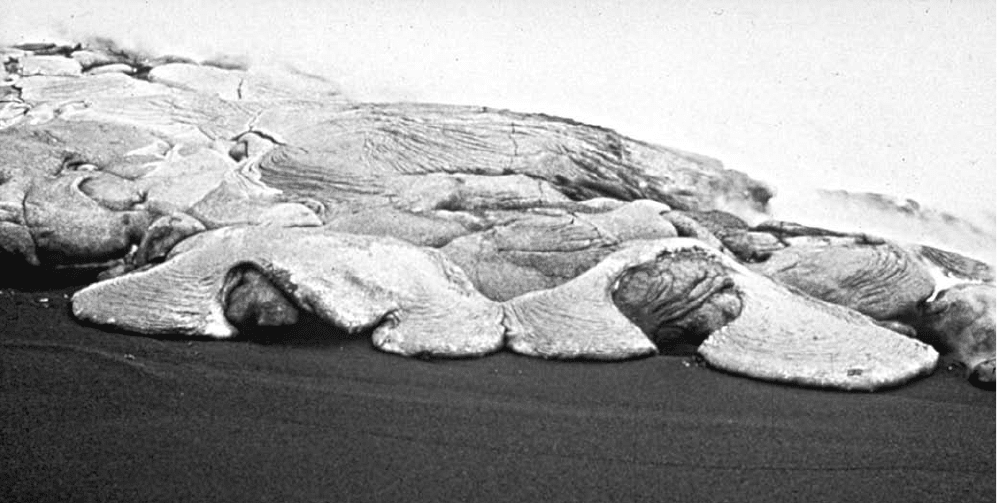
pahoehoe lava having a “ropy” surface, as distinct from
the broken, blocky surface of aa lava. Pahoehoe is a Hawai-
ian word named for the lava that is very fluid and flows at
high speeds. The ropy texture of the surface results from sur-
face flow deformation coupled with surface tension.
paleoseismicity Evidence of past earthquakes. Because
seismic waves are elastic, there is no direct record of them.
Therefore, only the damage is left. Surface damage like fallen
trees and broken buildings is typically not preserved in the
geologic record. Preserved evidence might include land-
slide deposits or intrusions of sand and mud into soil and
sediments. The intrusions are from liquefaction and are
distinctive. The landslides must be more carefully evaluated
because there can be many reasons for them.
paleovolcanic Evidence for past volcanoes. Old blast
zones, lahars, and landslides can indicate prior eruptions
in addition to the physical evidence of volcanic flows and
related deposits. However, as the volcano ages, discerning
even that there was volcanic activity becomes more difficult.
Much volcanic material is chemically unstable and weathers
away quickly. ash and pumice are so permeable that ground-
water can flow through them unhindered. They are quickly
The toe of an advancing pahoehoe flow on the black sand at Kaena Point, Hawaii, on October 11, 1972. The sand is composed of particles of basalt. The
toe of the flow advances by solidifying the tip, and the lava spills over from the back. (Courtesy of NOAA)
192 Pagan
altered to clays and mud and washed away. volcanic cones
are thereby destroyed and removed. The volcanic necks like
that at Ship Rock remain behind for a while. The old lava
flows and feeder dikes can last for millions to billions of
years below ground. Therefore, depending on the age of the
volcano, different features must be sought.
Paleozoic A geologic age ranging from about 540 to 245
million years ago. Paleozoic means “old life,” so it covers
the time when there was only primitive life on the planet. It
begins with the first hard-shelled invertebrate animals in his-
tory. Through the Paleozoic Age, vertebrate fish and later
amphibians also evolved. Plants and animals moved from
ocean to land, and the barren soil and rock landscape was
transformed to one of vegetation and activity. However, very
few of the species that existed then are still around today. The
supercontinent Pangaea was built during this time through
a series of continental collisions. These collisions produced
vast volcanic provinces and faults that record heavy earth-
quake activity. plate tectonic activity was intense during
this time. The mid-ocean ridges were spreading so fast that
they inflated and expanded. They displaced so much ocean
water that it flooded the continents. Most of the continen-
tal United States was covered with a shallow sea throughout
most of Paleozoic Age.
palisade A palisade is any clifflike, fencelike formation of
rocks, of which there are many (Pacific Palisades in Cali-
fornia, for example). The cliffs along the Hudson River
facing New York City are probably the most famous pali-
sades for their great height and prominent columnar struc-
ture. They are the edge of a huge sill of diabase (a type of
gabbro) that was formed 200 million years ago during the
opening of the Atlantic Ocean and breakup of the super-
continent of Pangaea.
Palmdale uplift, California, United States Located approx-
imately where the Garlock Fault and the San Andreas
Fault meet, Palmdale was the site of an uplift called the
Palmdale bulge in the 1970s. The Palmdale bulge drew con-
siderable attention as a potential generator of destructive
earthquakes.
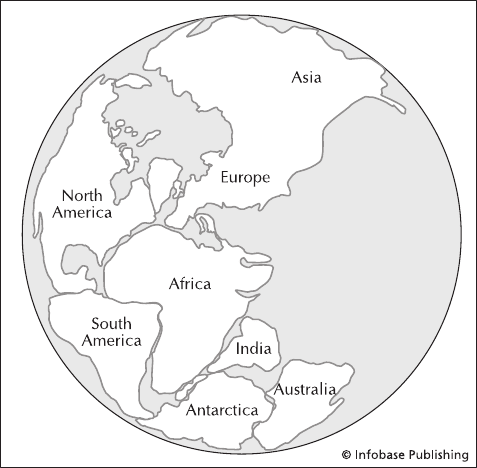
Pangaea A supercontinent that existed about 250 million
years ago. Pangaea was constructed throughout the Paleo-
zoic Age by colliding continents to build a single huge mass.
In the Appalachians, there were at least three separate col-
lisions known as the Taconian, Acadian, and Alleghanian
Orogenies. There was the Ouachita Orogeny in the south
and the Antler Orogeny in the southwest United States.
Worldwide, the Scandian Orogeny in Scandinavia, Cale-
donian in England, Hercynian and Variscan Orogenies in
Europe, and Uralian Orogeny in Russia are examples of
other Pangaean events. One continent meant one ocean, and
it was called Panthalassa. Pangaea broke apart in the conti-
nents we see today beginning about 200 million years ago. If
you notice how some continents appear to fit together like
puzzle pieces, it is because they were once together when
they were in Pangaea.
Papandayan (Papandajan) volcano, Java, Indonesia Also
known as Papandayang, and located in western Java, Papan-
dayan is a stratovolcano. A 1772 eruption killed some
3,000 people and destroyed several dozen villages through
explosions and landslides. An eruption in 1883 accompa-
nied the destruction of nearby Krakatoa. Another eruption
occurred in 1925 and again in 1942.
Paphlu earthquake, Nepal A major earthquake struck
eastern Nepal at the town of Paphlu on August 26, 1833, at
11:56 p.m. The estimated Richter magnitude for the quake
was between 7.5 and 7.9. The entire area of eastern Nepal
and surrounding India was destroyed by this massive event.
There were landslides throughout the area and lique-
faction, causing sand boils and foundation failures. This
earthquake has been compared to the Bihar earthquake of
1934, which killed about 11,000 people. The Paphlu earth-
quake took the lives of less than 500 people. The reason for
the relatively low death toll was that there were two strong
foreshocks several hours before the main shock. After the
second event, the vast majority of the population decided
to heed these warnings and evacuate their homes. The main
shock devastated the region and would have cause the deaths
of many thousands of people had it not been for these precur-
sors and the quick thinking of the people.
Papua New Guinea The plate tectonics of Papua New
Guinea are complex with a small mid-ocean ridge, a major
transform fault, and the large and several smaller sub-
duction zones that dominate area. The result is a highly
active area with both seismic and volcanic activity on several
islands of various sizes, including New Britain.
The Earth about 250 million years ago when all of the continents were
joined forming the supercontinent Pangaea
Papua New Guinea 193
Some of the most famous volcanic activity in history has
occurred in Papua New Guinea. The most notable eruption
was from Mount Lamington in 1951 which had a VEI of
4 and killed some 3,000 people. The eruption of Rabaul in
1937 caused 441 fatalities from pyroclastic flows. Ritter
Island produced an avalanche during its 1888 eruption that
spawned a 39–49-foot (12–15-m)-high tsunami that killed
more than 3,000 people. The eruption of Long Island in
1660 was comparable in intensity to the eruption of Kraka-
toa in 1883. Karkar, Pago, and Manam, among others,
have also been active in historical times.
parasitic cone A conical buildup of material around a
vent that erupts near the base or on the flank of an existing
volcano. A parasitic cone may grow to become a large vol-
cano itself.
parental magma magma that chemically and isotopically
reflects its source in the mantle. It is uncontaminated by
melted crustal rock that it encountered during ascent to the
surface or a magma chamber. Typically, the earliest lava
from a volcanic vent is the parental magma. In Island Arcs,
early lava is typically mafic (basalt) with a distinctive com-
position. Later lavas are intermediate, starting with andes-
ite and finally dacite as the amount of crustal contamination
increases with time. In the Andes, some lavas are so contami-
nated that they produce primary metamorphic minerals (anda-
lusite). Generally, the thicker the crust that the magma must
pass through, the more contaminated the lava. The speed of
ascent, however, is also an important factor.
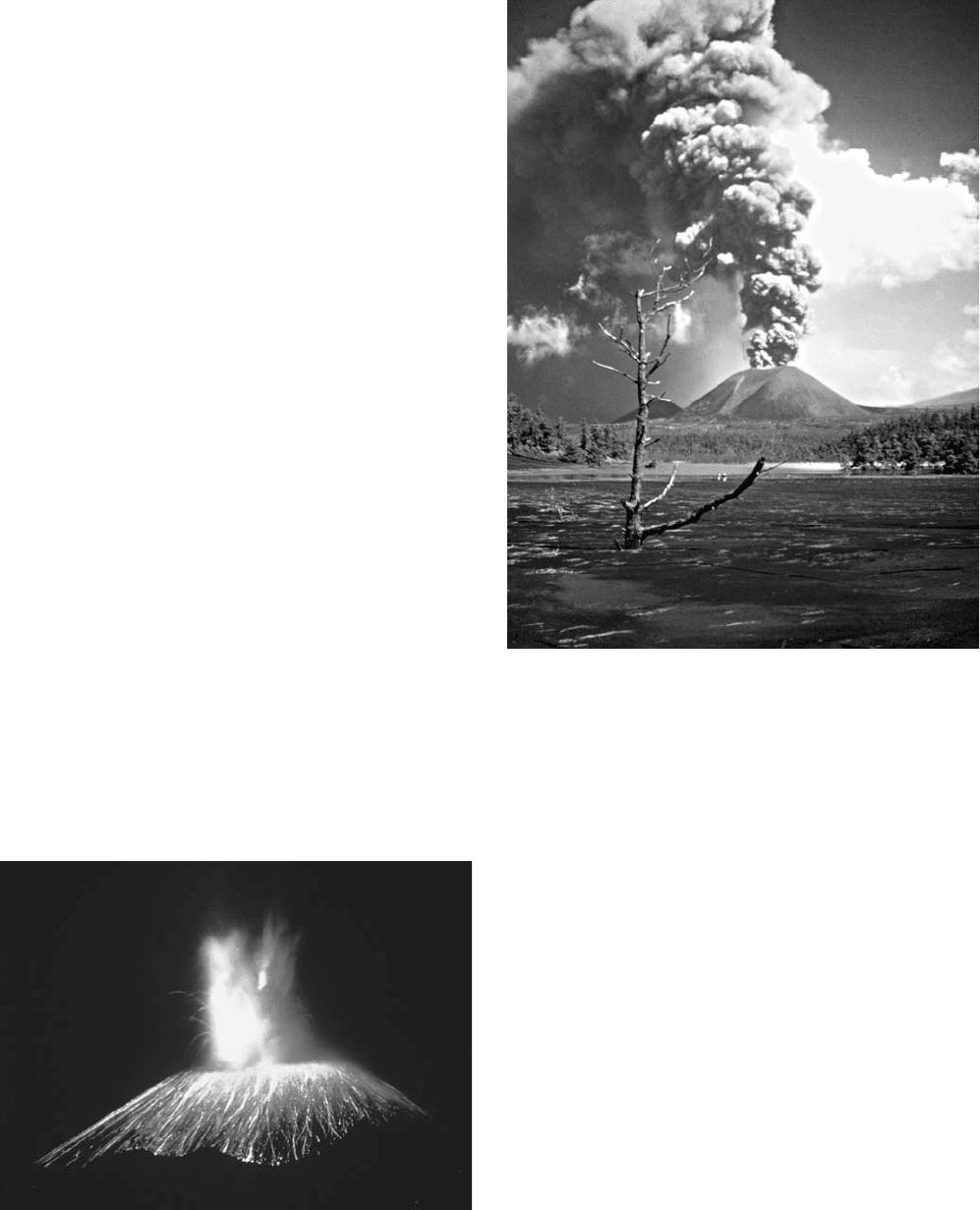
Paricutín volcano, Mexico In one of the most spectacular
eruptions of the 20th century, the volcano Paricutín arose
beginning in February 1943 from a farmer’s field in Michoa-
can, Mexico, in the Sierra Occidental on the western edge
of the Central Plateau. There are stories of the farmer plow-
ing his field when the eruption began and his hat, which had
been on the ground, being shot up into the air. The volcano
attained a height of about 1,200–1,300 feet (366–396 m)
before the eruptions ceased in 1952. It has been quiet ever
since. There was a particularly violent eruption on June 10,
1944.
passive margin In contrast to an active margin, where vol-
canoes and earthquakes are commonplace, a passive margin
is quiet and relatively safe. The term active margin refers to
a plate tectonic setting of active convergence (subduction
zone) or divergence. A passive margin is not a plate mar-
gin but an ocean margin (coast) in which the plate margin
is somewhere else. An example is the Atlantic margin of the
United States. The plate margin is more than 1,000 miles
(1,610 km) to the east at the Mid-Atlantic Ridge. There are
no volcanoes and few damaging earthquakes along the east
coast, thus it is passive.
Patan earthquake, Pakistan Pakistan has a long history
of devastating earthquakes. One such event struck a 70-mile
(112-km) stretch of the Indus Valley and especially the town
of Patan (epicenter) on December 28, 1974, at 12:12 in the
early afternoon. The quake had a Richter magnitude of 6.3
Summit eruption and eruption column of Paricutín from Tipacua, Mexico,
October 30, 1947. The lake in the foreground was formed because a lava
flow from the eruption crossed a river and dammed it. The tree shows that
the flooding was recent. (Courtesy of the USGS)
A spectacular nighttime eruption of Paricutín volcano in
Mexico. (Courtesy of the USGS)
194 parasitic cone
and a modified Mercalli damage of VII. The focus was at
a depth of 12 miles (20 km). Although this was not a ter-
ribly strong earthquake, it struck a region that had used very
poor construction methods. Mud and brick houses collapsed,
crushing inhabitants, and rockfalls after the earthquake
crushed many houses that remained. The death toll was nearly
5,300, with more than 15,000 injuries. Helicopters were used
to evacuate survivors and air-drop supplies to towns that were
otherwise cut off. Those who could not be brought to safety
were forced to sleep outside in subzero temperatures. The
total cost of the event was estimated at $3.25 million.
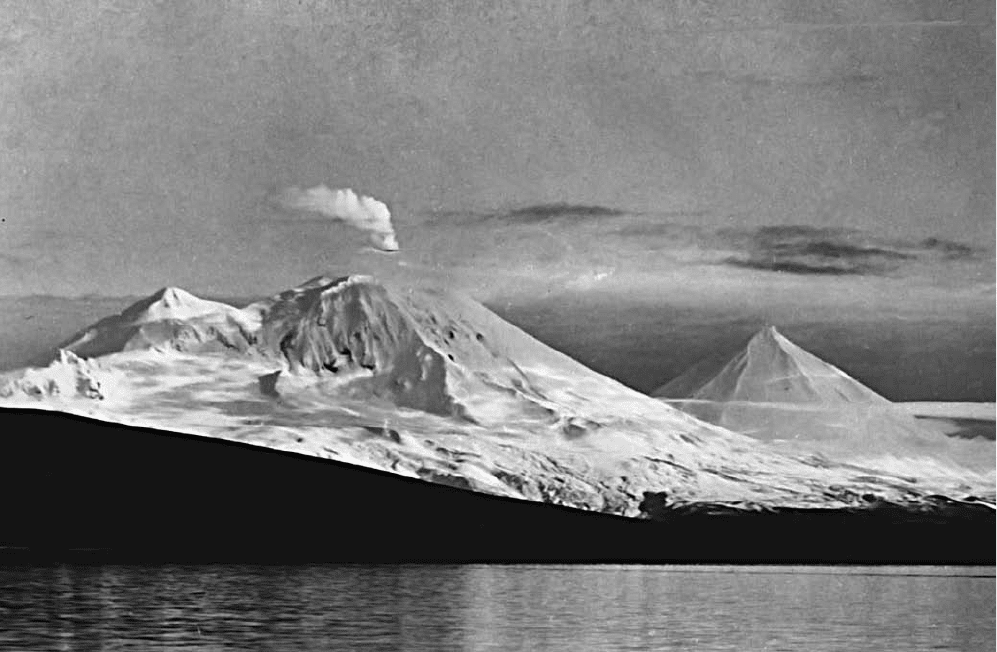
Pavlof volcano, Alaska, United States The strato-
volcano Pavlof is located on the Alaskan Peninsula, next
to the volcano Pavlof’s Sister. Pavlof is probably the most
consistently active volcano in the Aleutian Islands. It has
undergone at least 40 eruptions since 1790. Most of the
eruptions are Strombolian in nature. There is evidence
that one of the two volcanoes (probably Pavlof’s Sister) was
active between 1762–86. A very strong earthquake occurred
at about the time of an eruption in 1844, although it is not
known what precise relationship the earthquake may have
had to the eruption. A fissure on the side of Pavlof erupted
for a single day in 1846. An unusually strong earthquake
struck the area again in 1866, several months after an erup-
tion in March 1866. Pavlof’s biggest eruption in historical
times occurred in December 1911. Earthquakes accompa-
nied this eruption. lava flowed from a fissure on the north
flank, and large blocks were cast out of the volcano. Earth-
quakes attributed to explosions became more numerous at
Pavlof in July 1983. An eruption preceded by several weeks
of earthquakes may have occurred on November 14, 1983,
when an aircraft pilot reported sighting a plume, and a glow
was seen. Earthquake activity declined after this event and
remained at a generally low level. In 1986 Pavlof entered a
new period of eruption. lava flows have occurred in 1846,
1958, 1960–63, 1966, and during the l970s and 1980s.
Lava may also have flowed from the volcano between 1936
and 1948. Pavlof was active in 1996–97 and produced
25,000-foot (7,620-m) plumes and lava flows. It is con-
stantly monitored.
pegmatite A very coarse-grained plutonic rock that is
most commonly felsic in composition. Pegmatite is really
a textural term meaning very coarse-grained. However,
pegmatites never form large plutons and by far most com-
monly form dikes. Pegmatites form from water-rich melts.
The water is so abundant that it inhibits nucleation of new
The snow-covered volcano Mount Pavlov at the western end of the Alaskan Peninsula (Courtesy of NOAA)
pegmatite 195
crystal grains. Therefore, the grains that do form have a huge
space to grow without bumping into other grains. Grains are
typically six inches (15 cm) long or more, but there are peg-
matites where the grains are up to 39 feet (12 m) long. Water-
rich melts are typically the last liquid left over in a plutonic
event. The water concentrates because there is no place for it
in the minerals as they crystallize. Many other elements also
fall into this category and are termed incompatible elements
because they don’t readily combine with the common ele-
ments in minerals. They can therefore be found in high con-
centrations in pegmatites. Elements such as lithium, boron,
gold, and uranium are concentrated in pegmatites. Some of
them can combine with regular elements to form odd miner-
als. Such minerals include beryl, garnet, emerald, tourmaline,
indicolite, and other gem stones. That is why pegmatites are
common exploration targets.
Pelée, Mount volcano, Martinique The volcano Pelée’s
eruption on May 8, 1902, was one of the most destructive
in the history of the Caribbean Sea. The eruption produced
a
NUÉE ARDENTE that wiped out the city of Saint Pierre and
is thought to have killed more than 29,000 people; only six
individuals from the city survived. The first signs of eruption
occurred late in April. A cloud of smoke began to rise from
the volcano on April 23, accompanied by occasional emis-
sions of ash. On May 5, the eruption intensified and sent
lava and mud spilling over the rim of the crater and down
the valley of the River Blanche; a sugar mill was destroyed,
and more than 20 people were killed.
Many firsthand accounts of the destruction of Saint
Pierre and vicinity were recorded, despite the virtually com-
plete loss of life on shore. Some of those reports are worth
quoting at length, for they convey perhaps more clearly than
any other documentation of volcanic eruptions the power
and destructive effect of such events. One of the most com-
prehensive and vivid accounts of the catastrophe comes from
Comte de Fitz-James, a French traveler, who with his com-
panion Baron Fontenilliat witnessed the destruction of Saint
Pierre from the relative safety of a boat in the harbor. He
is quoted in Charles Morris’s 1902 book, The Volcano’s
Deadly Work:
From the depths of the earth came rumblings, an
awful music which cannot be described. I called my
companion’s name, and my voice echoed back at me
from a score of angles. All the air was filled with the
acrid vapors that had belched from the mouth of the
volcano
From a boat in the roadstead . . . I witnessed
the cataclysm that came upon the city. We saw the
shipping destroyed by a breath of fire. We saw the
cable ship Grappler keel over under the whirlwind,
and sink as though drawn down into the waters of
the harbor by some force from below. The Roraima
was overcome and burned at anchor. The Roddam
. . . was able to escape like a stricken moth which
crawls from a flame that has burned its wings
When we got ashore we called aloud, and only
the echo of our voices answered us. Our fear was
great, but we did not know which way to turn, and
had it been our one thought to escape we would not
have known how to do so. It was about one o’clock
in the afternoon when we reached shore. Our wea-
riness was beyond description. Sleep was the one
thing that I wanted, but I overcame the desire and,
with Baron de Fontenilliat, set off to make our way
to St. Pierre, hoping that we might still render some
assistance to the injured. . . .
We saw great stones that seemed to be mar-
vels of strength, but when touched with the toe of
a boot they crumbled into impalpable dust. I picked
up a bar of iron. It was about an inch and a half
thick and three feet long. It had been manufactured
square and then twisted so as to give it greater
strength. The fire that came down from Mont Pelée
had taken from the iron all of its strength and had
left it so that when I twisted it, it fell into filaments,
like so much broom straw. . . .
I know that the explosion of Mont Pelée was
not accompanied by anything like an earthquake,
for . . . when we entered St. Pierre we found the
fountains all flowing, just as though nothing had
happened. They continued to flow, and are flowing
still, unless destroyed by the later explosions.
There was no flow of lava. It was all ashes,
dust, gas and mud.
The sole survivor of the catastrophe at Saint Pierre was
a murderer named Joseph Surtout. He survived because he
was locked in a cell so far underground that it protected him
from the worst effects of the explosion. He was trapped in his
cell for four days after the eruption without food and water,
though somehow he got enough air to survive. Because his
cell was windowless, he had no way of knowing exactly what
had happened. He called for help and eventually was res-
cued. Workers disposing of bodies found many curious sights
among the devastation left by the catastrophe. The charred
body of a woman was found holding a silk handkerchief
unburned to her mouth. Carbonized bodies were found with
their shoes undamaged. Severely burned bodies lay adjacent
to others that the fire appeared to have touched only slightly.
Articles such as purses were discovered virtually intact. The
May eruption of Pelée destroyed approximately eight square
miles (21 km
2
). The area of destruction was enlarged slightly
by another eruption on August 30. Yet another eruption
occurred in December.
In October, a lava dome, or great mass of solidified
lava, arose in the caldera and grew to a height of some 800
feet (244 m) by the December 1. This formation was called
the Tower of Pelée and stood more than 1,000 feet (305
m) tall at its maximum height. Later activity at the volcano
shook down the Tower of Pelée, however, and only a small
portion of the dome remained by the end of 1903. Mount
Pelée became active again in 1929; this eruption was less
intense than that of 1902 but lasted more than three years.
On this occasion, Saint Pierre and other communities on the
island were evacuated. The eruption lasted until 1932.
196 Pelée, Mount
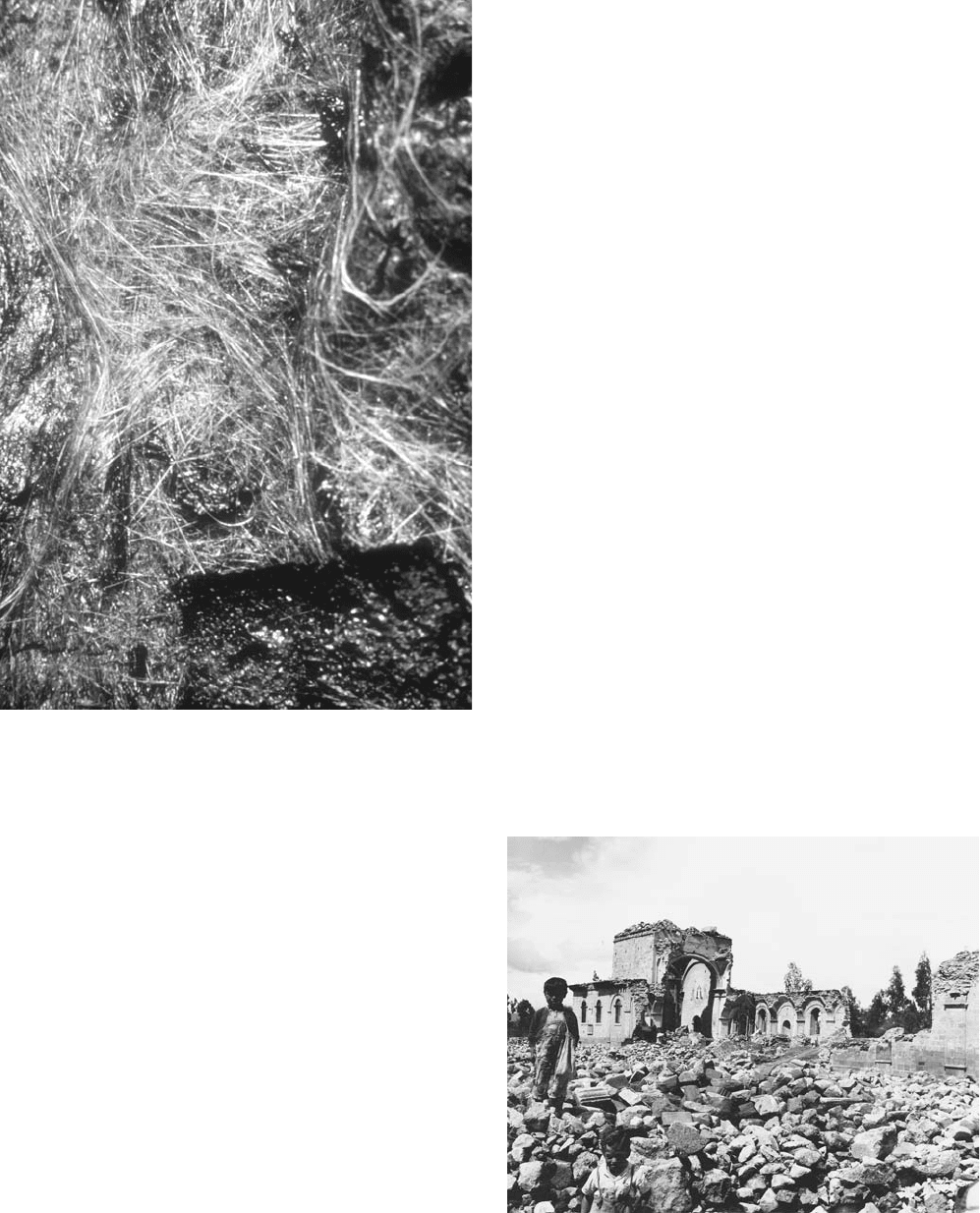
Pele’s hair See Pele’s tears.
Pele’s tears Specific shapes of lapilli from Hawaiian vol-
canoes. As pure molten rock is shot to great heights above
an active volcano, it forms droplets. These droplets fall back
to the earth like rain. However, they are very hot molten.
They form raindrop shapes, but because the air is so cool,
they solidify into volcanic glass. While still molten they fall
through the air dragging tails of glass strands that lag behind
the drops. The drops are called Pele’s tears because they look
like teardrops, and the strands are called Pele’s hair. Pele is
the Hawaiian goddess of the volcano.
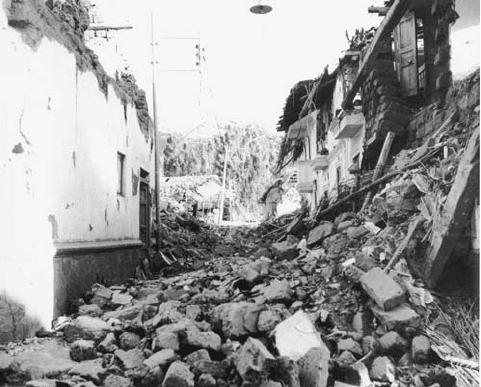
Pelileo earthquake, Ecuador An earthquake on August 5,
1949, was among the deadliest in the history of Ecuador.
The epicenter of the quake was located in the village of
Pelileo, and the focus was at a depth of 25 miles (40 km).
The earthquake was caused by subduction of the Nazca
crustal plate beneath South America. The Richter mag-
nitude of the earthquake was 7.5. The quake affected an area
of over 1,500 square miles (3,900 km
2
).
The death toll from this earthquake was over 6,000
people, with more than 20,000 injured. Besides Pelileo, five
towns virtually disappeared. A huge fissure about one mile
long swallowed the community of La Libertad. During res-
cue and relief operations, Ecuador had to divert some of
its troops to protect the impacted area from Salasaca Indi-
ans, who attacked relief columns and looted villages. Some
100,000 people were left homeless, and damage to the Ecua-
dorian infrastructure was over $66 million. The enormous
price tag destabilized the Ecuadorian economy.
Pennsylvania United States Pennsylvania is located in
a region of minor seismic risk but has undergone strong
earthquakes on occasion. Very strong shocks were reported
at Philadelphia on March 17 and November 29, 1800, and
again on November 11 and 14, 1840; this latter earthquake
was accompanied by a large swell on the Delaware River.
There was a sizeable earthquake in Delaware in 1974 that
affected Pennsylvania. There is also a region where regular
small earthquakes occur called the Lancaster seismic zone.
peridotite A plutonic ultramafic rock, peridotite is a
general name for a whole group of ultramafic rocks. They
are exceedingly high in iron and magnesium. These rocks are
composed only of ferromagnesian minerals such as pyrox-
ene, olivine, and, less common, hornblende. The group
includes rocks such as dunite, lherzolite, websterite, and
wehrlite. Locally, these rocks can contain significant quanti-
ties of chromite and platinum, in addition to other strategic
minerals.
period oscillations There is a natural period of a building
based on its dimensions and characteristics. There is also a
natural period of earthquake waves. If the two match, build-
As fluid lava is shot out of a volcano, it is stretched and strung out. The
drops leading the stretched out lava are Pele’s tears and the threads of
stretched lava that trail behind are called Pele’s hair. (Courtesy of the
USGS)
Ruins of a church at Santa Rosa as the result of the Pelileo, Ecuador,
earthquake of 1949 (Courtesy of the USGS)
period oscillations 197
ings can swing wildly or oscillate. This swinging can cause
severe structural damage to the building. The real problem
happens when two adjacent buildings undergo period oscil-
lations. They can swing into or “hammer” each other repeat-
edly, thereby destroying both buildings. Several famous
examples of these occurred during the 1985 Mexico City
earthquake.
Peru Located on the Pacific shore of South America, Peru
suffers from earthquakes as a result of the ongoing collision
of the South American crustal plate with the Nazca crustal
plate to its west. Earthquakes in Peru and Ecuador on
August 13–15, 1863, are believed to have killed some 25,000
people. Another major earthquake in Peru in 1892 killed an
estimated 25,000. The Lima earthquake on May 25, 1940,
is believed to have killed 200 to 300 and caused some 5,000
injuries in the port of Callao. The Ancash earthquake of
November 10–13, 1946, caused some 700 fatalities. More
than 100 were reported killed in the Cuzco earthquake on
May 21, 1950. Strong earthquakes in Peru, Bolivia, and
Chile on January 13, 1960, killed more than 2,000 people
and caused hundreds of millions of dollars in damage. An
earthquake on May 30, 1970, at Yungay killed more than
66,000 and left more than a half-million homeless after the
inundation of a resort. It was the most devastating earth-
quake in South America. On May 31, 1970, in Nevados
Huascarán, Peru, a tremendous landslide killed 18,000
people. An unusual case of a landslide apparently causing
an earthquake, rather than vice versa, was observed on April
25, 1974, along the Mantaro River in Peru. A great landslide
there produced seismic effects comparable to those of an
earthquake of about 4.5 on the Richter scale of magnitude.
The stratovolcano El Misti is located in Peru near
the city of Arequipa. The volcano is famed for its beauty
more than for its eruptions; in historical times, El Misti has
been characterized by mere steaming and occasional minor
explosive eruptions. A new volcano, Sabancaya, formed in
1986–88.
petrology The study of rocks. Subdivisions of petrology
deal with igneous, sedimentary, and metamorphic rocks.
Petrology deals with the full classification of rocks, including
texture and chemical composition. It also deals with the pro-
cesses of formation.
phaneritic A term describing igneous rocks whose indi-
vidual minerals are large enough to see with the naked eye.
Basically, these are rocks that were formed in plutons,
where they cooled slowly and had enough time to form large
crystals. Contrast this texture with the small grains found in
volcanic rocks making up an aphanitic texture.
Philippine Islands Volcanic activity has been frequent
and destructive in the Philippine Islands within historical
times. The stratovolcano Mayon has undergone explosive
eruptions on more than 40 occasions since 1616 and has
generated both lava flows and
NUÉE ARDENTEs. The vol-
cano Taal, located in the central Philippines, has erupted
on more than 30 occasions since 1572, and its eruptions are
sometimes accompanied by tsunamis in the lake from which
the volcano rises. The island of Luzon has many volcanic
mountains including Bulusan, which has erupted 13 times
between 1886 and 1988. The volcano Malaspina is located
on the island of Negros, and the volcano Camaguin erupted
on an island approximately 90 miles (145 km) southeast of
Negros in 1876. Nuée ardentes from an eruption of Hibok-
hibok in 1861 killed 326 people there. In 1831, Babuyon
Claro volcano produced a large eruption (VEI = 4). Volca-
noes on the island of Mindanao include Ragang, Apo, and
Cottobato. Hot springs and sulfur deposits in the Philip-
pines are further evidence of volcanic and hydrothermal
activity there. The 1991 eruption of Mount Pinatubo was
one of the most powerful eruptions of the 20th century and
forced the United States to abandon an air base near the
volcano. The eruption was well covered by scientists and
the media. The impact on human life was minimized by this
coverage because evacuations were timely. Unfortunately,
a typhoon swept in right after the eruption and turned the
fresh ash into raging torrents of boiling mud, causing many
fatalities.
The Philippine Islands are also vulnerable to earth-
quakes, of which perhaps the most famous occurred on July
3, 1863, in Manila. The earthquake destroyed many gov-
ernment buildings, hospitals, and churches and is thought
to have killed some 1,000 persons. Damage to the tobacco
industry was estimated at more than $2 million. Another
earthquake in Manila in 1880 caused widespread destruction
but reportedly no loss of life. More recent eruptions at Luzon
and Moro Gulf were also destructive.
Phlegraean Fields volcanic area, Italy This volcanic area,
several miles west of Naples and Vesuvius, has a high con-
centration of fumaroles and solfataras. Indeed, Solfa-
tara, one of the volcanoes located in the Phlegraean Fields,
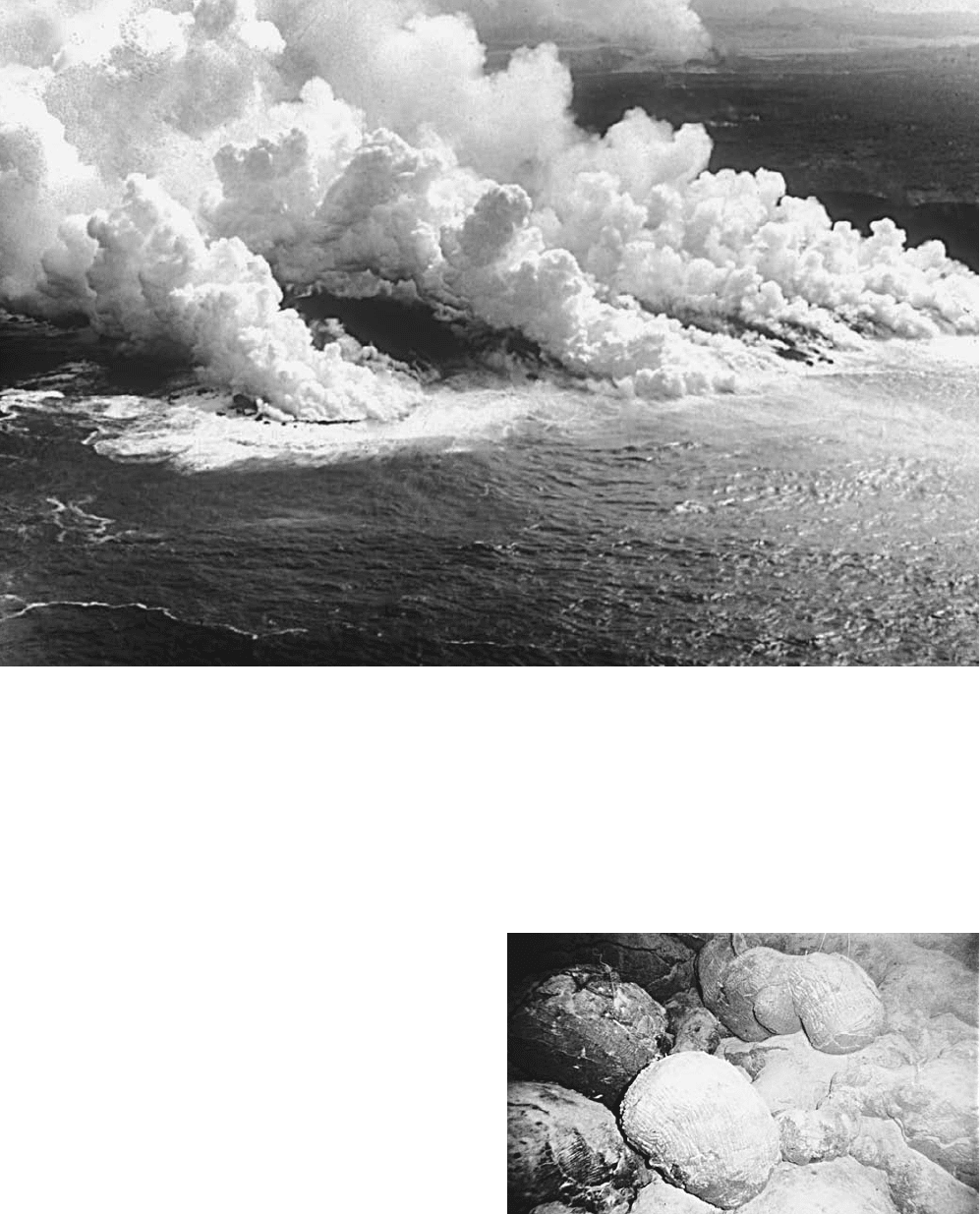
Massive destruction of adobe houses in the town of Huarez during the
1970 earthquake, by far Peru’s worst natural disaster (Courtesy of the
USGS)
198 Peru
provided the name for that phenomenon. Nineteen craters
occur within an area of about 25 square miles (65 km
2
) here.
Classical literature is full of references to the Phlegraean
Fields, including a mention in Virgil’s Aeneid and they are
said to have provided imagery for the Inferno of Dante.
The field is made up of explosion craters from phre-
atic eruptions, and cinder cones inside a collapsed cal-
dera some eight miles (13 km) wide. The caldera is thought
to have formed in prehistoric times either in or following the
eruption of vast volumes of tuff. A large portion of the vol-
canism at the Phlegraean Fields is thought to have occurred
between 3,000 and 5,000 years ago.
The migration of vents at the volcanic field has fol-
lowed a pattern: Vents have tended to migrate from the rim
of the caldera toward the center and to diminish in the vol-
umes of their eruptions. Another interesting pattern is that
early activity at the Phlegraean Fields appears to have taken
place underwater, whereas later activity moved onto the land.
The patterns of activity at the Phlegraean Fields indicate that
a reservoir of magma near the surface is crystallizing slowly
and causing activity at the surface to move inward toward the
center of the caldera as crystallization proceeds underground.
The magma reservoir is believed to be within two–four miles
(3–6 km) of the surface. The boundaries of the volcanic field,
however, are indistinct. The Phlegraean Fields are noted for
their history of dramatic uplift and subsidence. The motions
may be slow by everyday human standards, but on the geo-
logical time scale they are swift.
A case in point is the marketplace at Pozzuoli, which
once was underwater, as shown by the borings of mollusks
in the ancient columns. The marketplace sank by perhaps
30 feet (9 m) or more by the year a.d. 1000 and then rose
again by about six feet (1.8 m) between 1000 and 1198 when
the volcano Solfatara erupted. (Outstanding examples of
uplift and subsidence are also recorded at other points in the
vicinity. One pier built in the second century a.d. reportedly
dropped almost 20 feet (6 m) by the 18th century.) Following
the eruption in 1198, uplift continued. The uplift was accom-
panied by earthquakes, including a strong tectonic earth-
quake under the Campanian Apennines that occurred in 1456
and apparently caused severe damage to Pozzuoli. Other
powerful local earthquakes shook the area around Pozzuoli
in 1488. The rate of uplift increased around 1500. A consid-
erable amount of new shoreline had emerged from the waters
by 1503 and was taken over by a local school. Between 1000
and 1503, the rate of uplift was perhaps an inch per year
on the average, for a total of approximately 36 feet (11 m).
Most of that uplift took place after 1500, as the rate of uplift
increased to about seven inches per year.
Earthquakes occurred frequently in 1534 and between
1536 and 1538 and apparently originated along the southern
and eastern edge of the caldera. (A colorful story is associ-
ated with one of these earthquakes, in 1534. The earthquake
occurred during a worship service just before Easter, as the
gospel account was read of the earthquake that took place
at the resurrection of Christ. This coincidence made a tre-
mendous impression on the churchgoers.) Fumaroles became
more active between 1536 and 1538 in the vicinity of Suda-
toio, slightly to the west of Pozzuoli.
In this area, a new volcano, Monte Nuovo, was about to
appear. Numerous earthquakes preceded this eruption, as did
a spectacular display of uplift. On September 26–27, 1538,
the ground at Pozzuoli rose perhaps 15 feet (5 m), and the
shoreline retreated some 1,200 feet (366 m). Water started
to gush from fissures on September 28, and subsidence
lowered ground level by approximately 12 feet (3.7 m) the
following day. On September 29, uplift resumed near what
would be the site of the Monte Nuovo eruption. The erup-
tion began in the evening with great noise, and great quanti-
ties of ash and pumice mixed with water emerged from the
ground. Evidently uplift had caused a considerable retreat of
the shoreline because one account of the eruption mentions
townspeople carrying fish that they had picked up along the
shore. New springs of water, one hot and the other cold, also
reportedly appeared at this time. Fire was reported from this
eruption and is thought to have been burning gas from fuma-
roles. An explosive eruption near the community of Treper-
gule cast out pumice. Eruptive activity lasted five days. On
October 6, 24 persons who had climbed the cone of the vol-
cano were killed in an explosion and in pyroclastic surges.
This outburst knocked down trees three miles (4.8 km) from
the volcano. After the 1538 eruption, subsidence proceeded
at an average rate of less than an inch per year, with only a
short period of uplift between 1951 and 1952.
Several earthquakes in the late 16th century took place
around Pozzuoli. Another strong earthquake occurred in
1832 and appears to have been centered near Monte Nuovo.
Later though weaker earthquakes occurred between 1887
and 1892. Several earthquakes in the early 20th century are
thought to have occurred around the borders of the caldera.
A mud volcano at Solfatara erupted with great energy after
an earthquake about 30 miles (48 km) east of the Phlegraean
Fields in 1930. In 1969, uplift resumed in the caldera, with
accompanying mild earthquake activity. Seismic activity
and uplift diminished in 1972. A strong earthquake about
60 miles (97 km) southeast of the Phlegraean Fields in 1980
preceded a renewal of uplift. Earthquake activity started to
increase in 1983. A measuring device at Pozzuoli showed
uplift of approximately four feet (1.2 m) between mid-1982
and late 1984 and approximately 10 feet (3 m) between 1969
and 1985. Earthquakes released much more energy dur-
ing this later period of uplift than in 1969 to 1972. During
the 1982–84 episode, much of the earthquake activity was
focused around the Solfatara volcano and around a location
immediately north of Pozzuoli. Uplift had ceased by the end
of 1984, and a very gradual deflation began in January 1985.
Uplift, volcanism, and earthquake activity at the
Phlegraean Fields are thought to reflect the presence of a
small, shallow magma chamber a couple of miles below the
surface. The on-and-off pattern of uplift at the Phlegraean
Fields, along with the history of phreatic activity there, also
indicates that groundwater heated by a subterranean body of
magma plays an important role there.
phreatic eruption Generally speaking, a nonincandescent
explosive volcanic eruption. A phreatic eruption involves
mud, steam, or other nonincandescent material and results
from rapid heating of groundwater by igneous material
phreatic eruption 199
underground to the flash point. The rapid expansion of water
from liquid to gaseous state fuels the explosion.
pillow lava A distinctive form of lava flow in which the
solidified rock forms rounded masses with a glassy exterior.
Pillow lava is found where lava flows into the ocean or a
lake and quickly cools. The liquid lava forms a sphere when it
enters the cold water as a result of surface tension. Drop hot
wax into water and the same phenomena will occur. These hot
balls of quickly solidifying lava settle to the ground quickly.
As they settle, they flatten and become pillowlike in form. As
more and more pillows settle to the seafloor, the weight flat-
tens them even more. Pillow lavas therefore form piles around
the vent or entry point of a lava flow. They make up much of
the oceanic crust. Pillow lava also is found in table moun-
tains, curious volcanic formations that originated in Iceland
where eruptions occurred beneath thick layers of glacial ice.
Herdubreid is an example of such a mountain.
Pinatubo, Mount Philippine Islands The June 1991 erup-
tion of Mount Pinatubo, after more than 600 years of dor-
mancy, killed at least 847 people (mostly as the result of the
typhoon that closely followed) and forced the abandonment
of the United States’s Clark Air Force base in the Philip-
pines. More than 1 million people were left homeless, and
damage was estimated at several hundred million dollars. The
eruption was closely monitored by scientists, who evacuated
Hydra explosion clouds are emitted from a phreatic explosion on Hawaii on June 15, 1960. The clouds are pure white because they are completely steam
(water) and devoid of ash. (Courtesy of the USGS)
Pillow lavas on the slope of Hawaii from a submarine eruption (Courtesy
of NOAA)
200 pillow lava
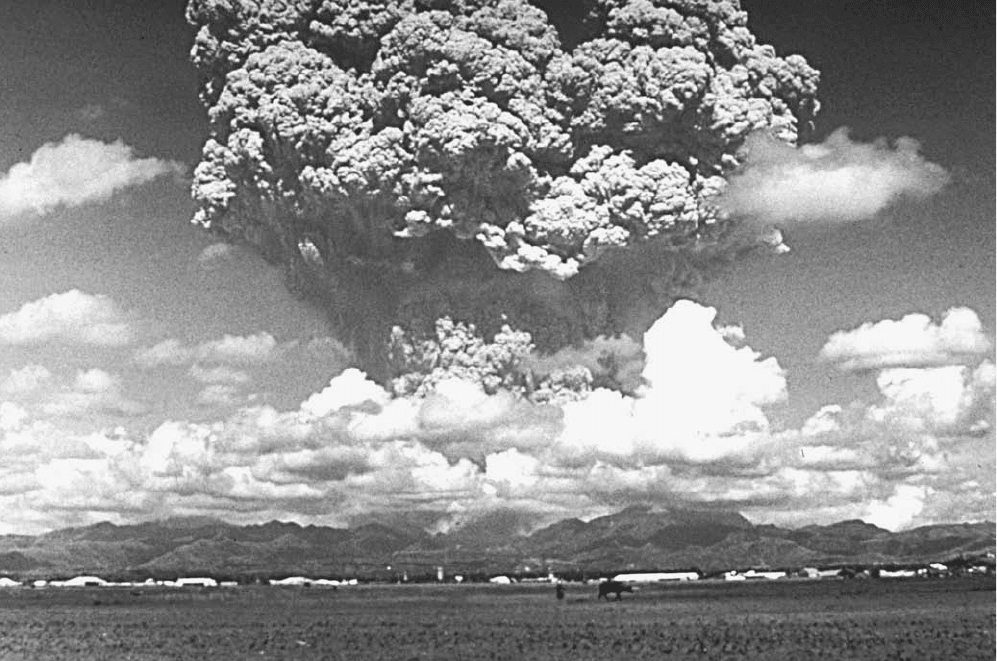
most areas prior to the main eruption or the death toll
would have been much higher. Working from Clark, the team
watched as the eruption grew; they barely escaped with their
lives as the peak of eruption overwhelmed the base. The erup-
tion column was more than 19 miles (30 km) high and some
11 miles (18 km) wide at its base. More than 172 billion
cubic feet (5 billion m
3
) of ash and ejecta were shot into the
atmosphere. pyroclastic flows and lahars devastated the
agricultural heartland of Central Luzon. In the hardest hit
provinces, more than 212,500 acres (86,000 ha) of farmland
and fish farms were destroyed, forcing more than 650,000
people out of business. The devastation of the eruption was
severely compounded by a major typhoon that struck the
island just days after the peak of the eruption. Heavy rains
mobilized the newly fallen and unconsolidated and very hot
ash into rivers of mud. Much of the death and destruction
was caused by the added effects of the typhoon. Even today,
the thick layers of ash blanket and consequently conserve the
heat at depth. Any particularly heavy erosional event, such
as another typhoon, will excavate this hot material and again
produce a boiling mudflow even after all of these years.
The eruption cast between 15 million and 20 million
tons of sulfur dioxide into the atmosphere, where the sulfur
dioxide combined with water to form an estimated 30 mil-
lion to 40 million tons of sulfuric acid particles. The climatic
effects of the Mount Pinatubo eruption, combined with those
of a lesser eruption of Chile’s Mount Hudson volcano, are
believed to have contributed to global cooling the following
year. In the lower and middle atmosphere, temperature mea-
surements reportedly showed a change of almost 1°F between
1991 and 1992. The cooling effect might have been greater
but for the warming effect of El Niño, a periodic increase in
temperature in the Pacific Ocean that influences weather.
Mount Pinatubo experienced a minor eruption again in
1994 for about four hours, but other than that, it has been
quiet ever since.
pipe A volcanic pipe is a conduit for magma to produce
summit eruptions in a volcano. When the pipe is clear, large
summit eruptions occur. If the pipe is clogged with sticky
magma or hardened lava, lateral eruptions are possible. The
magma in the pipe hardens and forms a volcanic neck. It
remains behind after the volcano is eroded away. Devils
Tower is such a feature.
Piton de la Fournaise volcano, Réunion Island An active
shield volcano, Piton de la Fournaise has a summit cal-
dera surrounded by a set of curving faults. As a rule, Piton
de la Fournaise does not exhibit dramatic precursory phenom-
ena such as strong earthquakes before eruptions. Nonetheless,
The eruption column from the 1991 Mount Pinatubo eruption as seen from the Clark Air Force Base (Courtesy of the USGS)
Piton de la Fournaise 201