
Gates A.E., Ritchie D. Encyclopedia of Earthquakes and Volcanoes
Подождите немного. Документ загружается.

eruptions do tend to follow minor but notable changes, such
as small earthquakes and the formation of fissures in the
caldera. Eruptions were recorded in 1708 and 1800 and every
several years thereafter up to the late 1980s. Most eruptions
have been explosive with associated lava flows. Piton de la
Fournaise is thought to be fed by basaltic magma. Geolo-
gists believe that the magma is stored in a central reservoir
near the surface before erupting through the summit and
through rifts on the volcano’s flanks. Apparently, inflation
occurs at the summit for some weeks or months before an
eruption. Reinflation, however, does not appear to start soon
after each new eruption. Piton de la Fournaise is presumed to
be a hot spot volcano like Hawaii. A volcanic observatory
has been set up there.
plagioclase Probably the most common igneous mineral,
plagioclase is a type of feldspar, a silicate with a frame-
work structure. At high temperature, plagioclase is calcium
rich. It is common in basalt and gabbro. At low temper-
atures, plagioclase is sodium-rich. it occurs in granite and
rhyolite. In intermediate rocks, the plagioclase is half-
calcium and half-sodium. It is most common in intermediate
rocks.
plastic deformation See ductile.
plateau basalt See flood basalts.
plate tectonics One of the foundations of modern geology,
the theory of plate tectonics has been described as “the glue
that holds geology together.” It describes the interactions
among several large, and a number of smaller, rigid plates of
Earth’s lithosphere. The lithosphere is composed of Earth’s
crust, which forms the top layer adhered to a bottom layer
of rigid mantle rock. The interactions among the plates
are complex, but for the purpose of understanding earth-
quakes and volcanic eruptions, plate tectonic theory may be
described as follows. Lithospheric plates float, so to speak,
atop the denser rocks of the asthenosphere (soft upper
mantle) by a process known as isostasy. These plates are not
stable but instead move around the planet. Thermally induced
convection current in the mantle drive this motion or con-
tinental drift.
The plates interact with each other along their margins.
There are three different types of margins: convergent
where plates are pushed together, divergent where plates are
pulled apart, and transform where plates slide laterally past
each other. There are three different kinds of convergent mar-
gins, depending upon the types of crust involved. They are
ocean-ocean, ocean-continent, and continent-continent colli-
sions. The ocean-ocean and ocean-continent collisions form
subduction zones in which the downgoing ocean crust is
consumed in the mantle. In ocean-continent collisions, also
called Andean margins after the type example, the ocean crust
is subducted and melted to form a magmatic arc. Magmatic
arcs are seismically and volcanically active and very danger-
ous. Ocean-ocean collisions form island arcs, where ocean
crust is subducted beneath other ocean crust in a deep ocean
trench. Examples such as the Aleutian Islands are equally
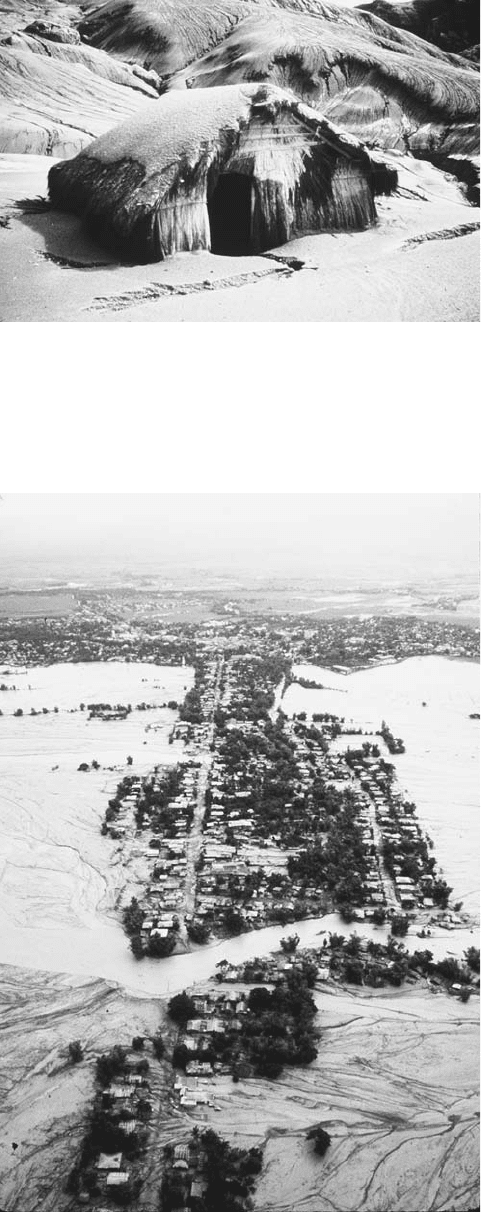
Ashfall deposits buried this straw hut at the base of Mount Pinatubo after
the 1991 eruption. Note the odd landscape in the background resulting
from erosion caused by the typhoon the following day. (Courtesy of the
CVO-USGS)
The mudflow generated by the typhoon that struck the Philippines the day
after the eruption of Mount Pinatubo was far more disastrous than the
eruption itself. (Courtesy of the USGS)
202 plagioclase
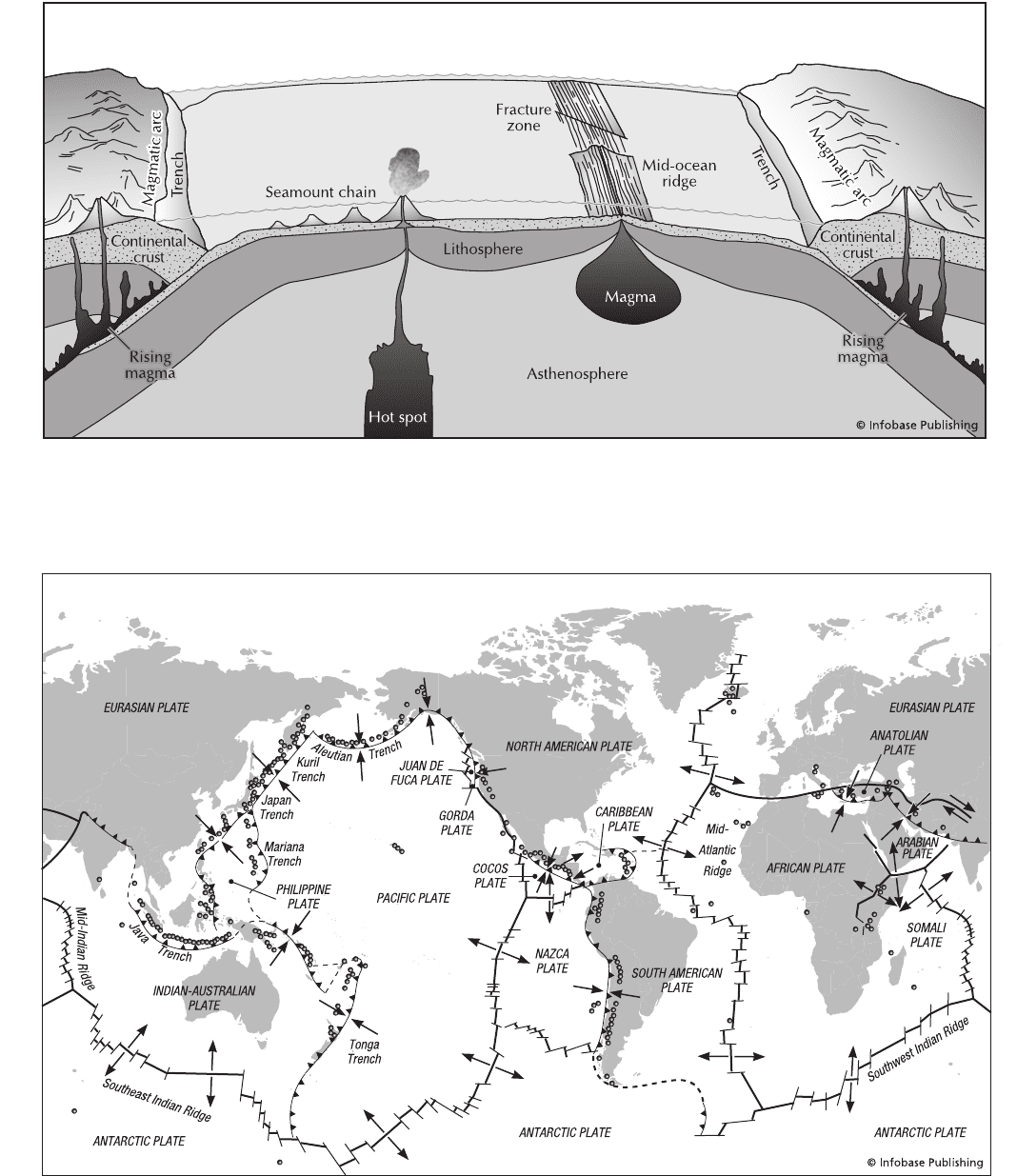
Diagram of plate boundary types, magmatic arcs above subduction zones (convergent boundary), and a mid-ocean ridge comprising a divergent boundary.
Fracture zones form transform boundaries. A hot spot is also shown.
Tectonic map of the Earth showing the major tectonic plates. There are three different types of boundaries: the dark lines with triangles are convergent
boundaries (subduction zones), the double lines are mid-ocean ridges, and the single lines are transform faults. (Courtesy of the USGS)
plate tectonics 203
active and dangerous. Continent-continent collisions are
more like car accidents: One plate plows under the other, but
most of the deformation is taken up in crushing and elevating
the rock. This scenario is called a Himalaya margin after the
type example. There is intense seismic activity at the margins
but no volcanic activity.
divergent boundaries form more in stages. On con-
tinental crust, the margin begins with uplift followed by
normal faulting and graben formation. Seismic activity
is common in this phase. Next, extensive volcanic activity
occurs including flood basalts and possible rhyolite vol-
canoes as in the Basin and Range Province. The crust is
then pulled apart, and ocean crust forms between, making
a narrow ocean basin like the Red Sea. Finally, a full ocean
basin with a mid-ocean ridge forms including extensive
seismicity and volcanism.
Transform margins are large strike-slip faults that
separate lithospheric plates. Transform margins must con-
nect other types of plate margins. Therefore, there are
divergent-divergent, divergent-convergent, and convergent-
convergent transform margins. About 99% of transform
margins are the divergent-divergent type. They form small
offsets all along every mid-ocean ridge of various sizes and
are almost exclusively on ocean crust. A major exception to
this rule is the San Andreas Fault of California, which is
on continental crust. Like the San Andreas Fault, these other
transform faults are also highly seismically active. Regard-
less of the type of transform margin, they are all similar in
their seismic activity and general lack of volcanic activity.
Larger transform faults are called fracture zones. Other
examples of transform faults include the South Alpine Fault
in New Zealand and the Motagua Fault in Guatemala,
both of which have produced devastating earthquakes.
New ocean crust is formed along mid-ocean ridges,
where molten rock rising from the asthenosphere solidifies.
The newly formed rock moves outward to either side of the
ridge in a pattern much like that of objects on a moving con-
veyer belt. Volcanic activity is therefore commonplace along
the ridges and may build up whole islands, of which Iceland
is a spectacular example. As much ocean crust is destroyed in
subduction zones as is produced at the mid-ocean ridges to
preserve the size of Earth. As the subducted plate descends
into the asthenosphere, the plate melts, and its lighter compo-
nents rise back toward the surface as molten rock, or magma.
This magma finds its way to the surface through openings in
the crust and produces volcanoes. (Not all volcanic activity
is linked to subduction zones; hot spots, or points where
ascending plumes of molten rock are thought to approach
Earth’s surface, may be responsible for volcanic activity, as in
the case of the Hawaiian Islands.)
The source of energy for the movement of crustal plates
has been a subject of debate since plate tectonics was devel-
oped from the earlier theory of continental drift. In recent
years, it has been widely believed that much of the energy
behind the motions of crustal plates is derived from convec-
tion cells, or circulation patterns produced within the mantle
by convective activity.
See also convection current; Earth, internal
structure of; Wegener, Alfred.
Plinian eruption A type of volcanic eruption character-
ized by incredible vertical explosions that shoot gas, ash, and
ejecta many miles into the atmosphere. These eruptions are
the most violent of the Vesuvian events. They are commonly
the final phase in an eruptive cycle after the pipe has been
cleared by earlier eruptive types. They have VEIs of 3–8.
plug A volcanic neck.
pluton A body of intrusive, typically coarse-grained igneous
rock. Plutons intrude forcibly or passively into the preexist-
ing country rock of an area and cool underground. Through
slow cooling, the minerals grow large and form a crystal-
line, phaneritic texture. Tabular dikes and sills are less circu-
lar than stocks and batholiths. Laccoliths and lopoliths are
subvolcanic intrusions. They are typically forcible intrusions in
contrast to tabular intrusions which are typically passive.
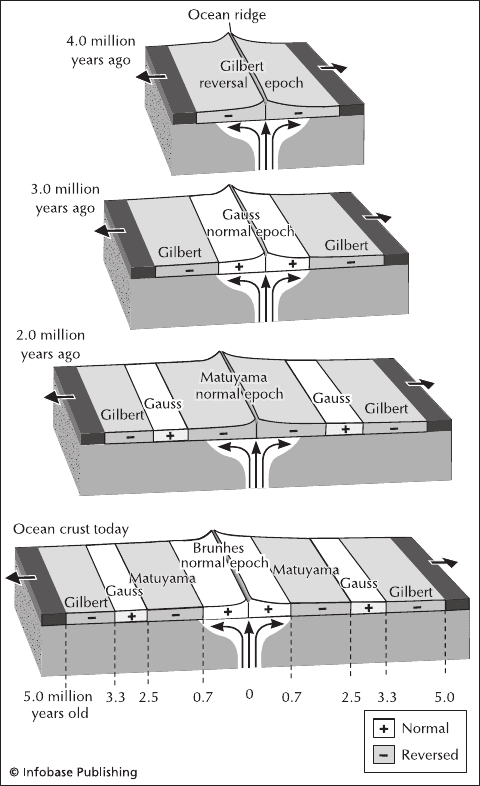
Production of new ocean crust at a mid-ocean ridge during a reversing
magnetic field of the Earth. The stripes on the ocean floor show normal
and reversed magnetic polarity over the past 5 million years.
204 Plinian eruption
plutonism The formation of plutons and related processes.
Poás volcano, Costa Rica Located northeast of the com-
munities of Naranjo, Grecia, and San Pedro, Poás volcano has
arisen within a pair of nested calderas and is suspected of
having a lake rich in sulfur, underlain by a layer of molten
sulfur, in its main crater. Molten sulfur has sometimes been
expelled in eruptions of Poás. Most of its eruptions, which
have been recorded on numerous occasions in the 19th and
20th centuries, have been small and either magmatic or phre-
atic in character. It has erupted at least 39 times since 1828,
but the activity has been nearly continuous. Notable eruptions
in 1828, 1834, and 1880 deposited ash on nearby communi-
ties. Other significant eruptions occurred in 1910 and 1953.
The 1910 event began with the eruption of a geyser, and a
plume rose to an altitude of more than four miles (6.4 km).
Mud covered the whole top portion of the volcano. Numer-
ous strong earthquakes occurred later that year, including one
especially powerful earthquake that caused widespread dam-
age in nearby communities. A 1953 eruption eliminated a
crater lake and dropped ash 30 miles (48 km) or more away
from the volcano. An eruption column rose about two miles
(3 km) over the volcano in 1976, and geysers erupted in 1979,
1980, and 1988. The crater lake gradually drained in 1989
and was replaced by a six-foot (1.8-m)-deep pool of liquid
sulfur. This was the first observation of a sulfur lake on Earth,
although liquid sulfur is common on Io, Jupiter’s nearest
moon. Summit fumarole activity continued through 1995.
Pompeii and Herculaneum volcanoes, Italy Two of the
most famous cities in the history of volcanology, the Roman
communities of Pompeii and Herculaneum were destroyed
in the eruption of Vesuvius in a.d. 79. The destruction of
the two cities has provided a popular theme for authors,
notably Edward Bulwer-Lytton in his novel The Last Days
of Pompeii. Bulwer-Lytton was apparently influenced by the
historian Dion Cassius, who reported that the fallout from
Vesuvius buried the people of Pompeii as they sat in the the-
ater. This melodramatic scenario appears to have little basis
in fact, and it is thought that Dion Cassius was merely draw-
ing on traditional (and exaggerated) accounts of the catastro-
phe. Other of Dion Cassius’s statements sound improbable,
to say the least, especially his report that a great number of
giants appeared in the vicinity of the volcano during the erup-
tion. An eyewitness account of the event was made by Pliny
the Younger (see Appendix B).
Excavations at Pompeii have revealed much about life in
that coastal city some 2,000 years ago. One visitor, quoted in
Charles Morris’s study of volcanoes, The Volcano’s Deadly
Work, commented on “the weirdness of the scene” at Pom-
peii and the remarkable preservation of details of life there:
We have before us the narrow lanes, paved with
tufa, in which Roman wagon wheels have worn deep
ruts. We cross streets on stepping-stones which san-
daled feet long ago polished. We see the wine shops
with empty jars, counters stained with liquor, stone
mills where the wheat was ground, and the very
ovens in which bread was baked more than eigh-
teen centuries ago. “Welcome” is offered us at one
silent, broken doorway; at another we are warned
to “Beware of the dog!” The painted figures, some
of them so artistic and rich in colors that pictures
of them are disbelieved, the mosaic pavements, the
empty fountains . . . the marble pillars and the small
gardens are there just as the owners left them. Some
of the walls are scribbled over by the small boys of
Pompeii in strange characters which mock modern
erudition. In places we read the advertisements of
gladiatorial shows, never to come off, the names of
candidates for legislative office who were never to
sit. There is nothing like this elsewhere.
The streets of Pompeii must have had a charm
unapproached by those of any city now in existence.
The stores, indeed, were wretched little dens. Two
or three of them commonly occupied the front of
a house on either side of the entrance, the ostium;
but when the door lay open, as was usually the
case, a passerby could look into the atrium, prettily
decorated and hung with rich stuffs. The sunshine
entered through an aperture in the roof.
As the life of the Pompeiians was all outdoors,
their pretty homes stood open always. There was
indeed a curtain betwixt the atrium and the pen-
style, but it was drawn only when the master gave
a banquet. Thus a wayfarer in the street could see,
beyond the hall described and its busy servants,
the white columns of the peristyle, with creepers
trained around them, flowers all around, and jets of
water playing through pipes which are still in place.
In many cases the garden itself could be observed
between the pillars of the further gallery, and rich
paintings on the wall beyond that.
But how far removed those little palaces of Pom-
peii were from our notion of well-being is scarcely to
be understood by one who has not seen them. It is a
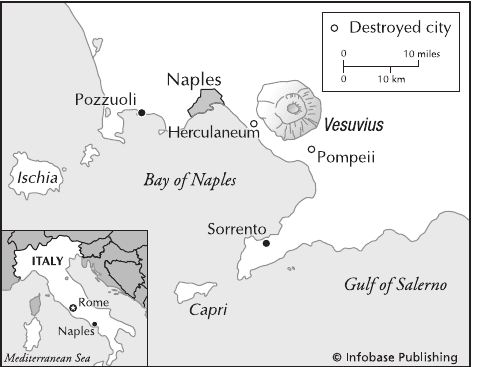
Map of the Mount Vesuvius (Naples) area of Italy showing the relation of
the volcano to the two destroyed cities of Pompeii and Herculaneum.
Pompeii and Herculaneum 205
question strange in all points of view where the fam-
ily slept in the houses, nearly all of which had no sec-
ond story. In the most graceful villas the three to five
sleeping chambers round the atrium and four round
the peristyle were rather ornamental cupboards than
aught else. One did not differ from another, and if
these were devoted to the household the slaves,
male and female, must have slept on the floor out-
side. The master, his family and his guest used these
small, dark rooms which were apparently without
such common luxuries as we expect in the humblest
home. All their furniture could hardly have been
more than a bed and a footstool . . . The kitchen of
each villa certainly was not furnished with such inge-
nuity, expense or thought as the stories of Roman
gourmandising would have led us to expect. In [one]
house . . . the cook seems to have been employed in
frying eggs at the moment when increasing danger
put him to flight. His range, four partitions of brick,
was very small; a knife, a strainer, a pan lay by the
fire just as they fell from the slave’s hand. Pompeii
was buried by falling tephra, whereas Herculaneum
was covered by mudflows.
Popocatépetl volcano, Mexico The word Popocatépetl
means “smoking mountain” and was given to the volcano by
the Aztec. The stratovolcano stands south of Mexico City
and has undergone explosive eruptions, most of them small,
on more than 36 occasions in recorded history, 15 since the
arrival of the Spanish in 1519. There was a major eruption in
1720. Popocatépetl was one of the first volcanoes into which
European explorers actually made a descent, to collect sulfur
for gunpowder. The most recent eruption was from 1995 to
1999 and forced the evacuation of 75,000 people. It started to
erupt again in the spring of 2000. Some 20 million people live
close enough to the volcano to be threatened by eruptions.
porphyritic A textural term for volcanic rocks meaning that
there are two grain-size populations. Large grains (usually one-
eighth to one-half inch [2 mm–1 cm]) of a mineral form perfect
crystals floating in a fine-grained matrix. This texture reflects
a two-stage history. The large crystals were formed while the
magma was cooling in the magma chamber. Because they
were surrounded by pure liquid, they could grow without
bumping into other grains. That is why they form crystals. The
minerals are varieties that form at higher temperatures than
the rest of the rock. Otherwise, they would also be crystallizing
as well. Later, the crystals and liquid are erupted from a vol-
cano during an active phase. The liquid cools quickly during
the eruption producing very small mineral grains and/or glass
to fill between the crystals. In basalt, the large crystals could
be olivine or plagioclase and the matrix is pyroxene and
plagioclase. In andesites and dacites, the large crystals are
plagioclase and possibly hornblende, pyroxene, or biotite.
The fine minerals are quartz and plagioclase. In rhyolite,
the large grains are k-feldspar and possibly quartz or biotite.
The matrix is quartz, K-feldspar, and plagioclase. These rela-
tions are determined by the crystallization sequence as shown
by Bowens Reaction Series.
Port Royal earthquake, Jamaica The earthquake that
hit Port Royal on June 7, 1692, struck about 11:43 a.m. (In
1959, divers brought up the remains of a watch that appar-
ently stopped at that moment.) The earthquake caused the
waterfront built on sandy soil to fall into the sea. A tavern,
a warehouse, and other buildings slid seaward and crumbled
into the waters. Approximately half the town was wiped out.
Precambrian All time from the beginning of Earth 4.6
billion years ago until the beginning of the Paleozoic Age
about 535 million years ago. The Precambrian can be sub-
divided into the early Archean and the later Proterozoic.
The division between the two was 2.5 billion years ago. Bil-
lion years is written Ga in scientific terminology and it means
“giga annum,” where annum means “years.”
precursor Any number of changes in the geological con-
ditions that foreshadows the coming of an earthquake on a
fault. These changes can include several small earthquakes,
local uplift or subsidence along a fault, changes in water levels
in wells, and increased radon emissions, among others. Most
times it is difficult to recognize and properly evaluate these
precursors otherwise earthquakes would not be as deadly.
pressure ridge Common topographic ridges resulting both
in earthquakes and volcanoes. The ridges are formed through
lateral transverse shortening of the land surface. In volcanic
flows, the crust on the top of the flow can fold into a ridge as
the result of pressure generated from flowing subsurface lava.
primary effects The direct hazards from a volcanic erup-
tion. These include lava flows,
NUÉE ARDENTEs, lahars,
explosions, ash fallout, and any other direct effects. In con-
trast, secondary effects might include flooding from dammed
rivers from lava flows, polluted water, ruined crops and fam-
ine, disease-resulting pollution, interrupted transportation
routes and services, and any other hazard that is not directly
caused by the eruption.
Proterozoic The later part of Precambrian.
pseudotachylite Rock within a fault that is melted by
movement during an earthquake. It is then hardened in the
fault. In shallow rocks near the surface, there is a lot of fric-
tion on a fault during an earthquake. The friction can heat up
the rock and melt it. The newly formed liquid fills in the fault
plane or cracks around the fault. The solidified melt is pseudo-
tachylite. Tachylite is volcanic glass and pseudo means “false.”
Puerto Rico Puerto Rico experiences numerous earth-
quakes, but highly destructive ones are rare. However, the
Caribbean Sea, in which Puerto Rico is located, is an area of
high-intensity seismic and volcanic activity.
On October 11, 1918, an earthquake of Richter mag-
nitude 7.5, with Mercalli intensities in the range of VIII–IX,
caused property damage estimated at about $4 million and
killed more than 100 people. The earthquake was centered in
the northwestern Mona Passage and was accompanied by a
tsunami that caused widespread destruction and loss of life.
206 Popocatépetl
The sea withdrew before the tsunami’s arrival, then returned,
and reached heights possibly greater than 19 feet (5.8 m). A
church in Aguada was destroyed, and all brick buildings were
ruined in Anasco. Structures of wood or reinforced concrete
reportedly came through the earthquake with little damage
where building materials were sound. At Aguadilla, the earth-
quake caused serious damage to buildings constructed on
alluvium. The collapse of a factory at Mayagüez killed several
people. Damage to railways, bridges, pipelines, and chimneys
was widespread, and two cable links in the Mona Passage
were broken. Strong aftershocks followed the October 11
earthquake on October 24 and November 12.
Puget Sound Washington, United States An inlet of the
Pacific Ocean between the Olympic Peninsula to the west
and the mainland to the east, Puget Sound is an area of
intense seismic activity.
See also Cascadia Subduction Zone; Cascade Moun-
tains; Washington.
pumice An extremely lightweight, “foamy” volcanic rock,
pumice forms when magma bearing a high concentration of
dissolved gases solidifies as glass just as the gases are bub-
bling out of solution. It forms on top of a magma or lava
pool just as foams such as whipped cream would. Pumice is
cast out in large quantities during the eruptions of some vol-
canoes and is so lightweight that it may float on water. In
eruptions of certain volcanoes on islands or near seacoasts,
pumice may accumulate on the water and form great float-
ing “rafts” capable of supporting a man’s weight. Such rafts
of pumice may impede navigation. They are also the vehicle
by which certain species of plants and animals migrate from
island to island across the Pacific Ocean.
Puracé volcano, Colombia The dacitic shield volcano
capped by an andesitic stratovolcano Puracé has undergone
explosive eruptions on more than two dozen occasions since
1827, 12 of which were in the 20th century. Two of these
eruptions caused fatalities.
Puu Oo volcanic cone, Hawaii, United States This cone,
whose name means “hill of the Oo Bird,” was produced by
an eruption of Kilauea that began in 1983 and came to be
known as the Puu Oo eruption. Puu Oo underwent several
episodes of eruption in the 1980s and reached a height of
more than 750 feet (229 m). Although episodes of eruption
became generally shorter, the extrusion rate of lava increased,
and fire fountains rose higher. Some fire fountains rose
approximately 1,200 feet (366 m) into the air, approaching
the height of the Empire State Building in New York City.
P-waves See seismology.
pyroclastic Made up of fragmented pieces of rock that
were produced in an explosive volcanic eruption. The ejecta
are transported, deposited, and lithified just as a clastic rock.
The pyro part of the word means “fire,” so it is a clastic rock
produced by fire. An ignimbrite, for example, is composed of
pyroclastic material.
pyroclastic flow More commonly known as an ash flow,
a pyroclastic flow is made up of clastic material included and
carried along in a flow of ash. The pyroclastic flow behaves
as a fluid, hence its name. An ignimbrite is an example of
a pyroclastic flow. Such a flow may extend outward many
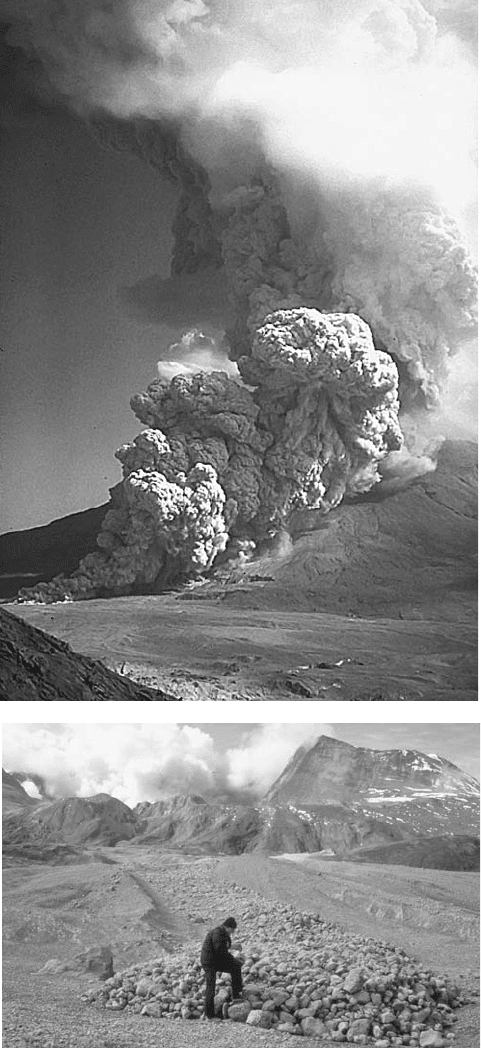
This pyroclastic flow of hot ash and debris is moving down the slopes of
Mount Saint Helens. In the second photo, a geologist studies the larger
material deposited by the flow. (Courtesy of the CVO-USGS)
pyroclastic flow 207
miles from the volcano that produced it. A NUÉE ARDENTE is
a fast-moving cloud of gas released in a volcanic eruption and
containing pyroclastic material.
pyrometamorphism Rock that has undergone extreme
metamorphism in lava or magma. As magma intrudes into
preexisting rock, pieces of the cool rock are broken off into
the extremely hot liquid. The broken rock is immediately
cooked at very high temperatures. The minerals and tex-
ture change accordingly. The same process happens when
extremely hot lava runs over the ground surface. The soil
beneath is immediately cooked and new minerals and tex-
tures are produced. Pyro means “fire.”
pyroxene A common igneous mineral in mafic, ultra-
mafic, and, less commonly, intermediate rocks. It includes
clinopyroxene and orthopyroxene. Pyroxene is a ferromag-
nesian mineral. It is a silicate with a chain structure.
208 pyrometamorphism
quake See earthquake.
quartz The most common mineral in Earth’s crust, quartz
is found in many felsic and intermediate igneous rocks.
It is especially common in granite and pegmatite, where it
can make up 25% or more of the rock. It can also be com-
mon in rhyolite, but quartz takes on two different struc-
tures at high temperatures that are called cristobalite and
tridymite. Because the grain size is so small in rhyolite,
commonly the quartz grains cannot be seen. Quartz is nearly
pure silicon dioxide (SiO
2
) and has a framework type sili-
cate structure. Impurities give quartz colors forming smokey
quartz (gray), rose quartz (pink), amethyst (purple), or any of
the hydrated (water-bearing) family such as agates and opal.
Quartz can also be a replacement mineral in any volcanic
rock and commonly fills amygdules and cavities.
See also amygdaloidal.
quartz diorite A plutonic rock of intermediate composi-
tion. It contains plagioclase and typically contains pyrox-
ene, hornblende, and minor amounts of quartz. The
volcanic equivalents of quartz diorite are andesites and tra-
chytes. It is therefore a common rock in magmatic arcs and
even island arcs.
Quchan earthquake, Iran Quchan has had more than its
share of historical seismicity. A more recent event occurred
on January 17, 1895, just before noon. The event lasted for
about one minute, but strong aftershocks lasted for several
months. Buildings were leveled throughout the city by the
main shock, and the few that remained were rendered unsafe
because of the aftershocks. Survivors were forced to live out-
side in tents or in makeshift shelters. The problem was that
it was an intensely cold winter, and exposure caused great
suffering and death. It also prevented the arrival of medical
and relief staff. It is unclear whether the earthquake or the
weather caused the greater death toll. In all, some 11,000
people were said to have perished, although some estimates
put the number closer to 8,000. As a result of this earth-
quake, Quchan was relocated some 7.8 miles (13 km) east of
the former location. Other modern destructive earthquakes
in Quchan include a magnitude 5.6 event on December 23,
1871, that killed 2,000 people; a magnitude 7.0 event on
January 6, 1872, that killed over 4,000 people, and a major
event on November 17, 1898, of magnitude 6.6 that had a
6.6-mile (11-km) focal depth and a death toll of 18,000.
Quetta earthquake, Pakistan A devastating earthquake
struck the town of Quetta and surrounding area of Baloch-
istan, Pakistan, on May 31, 1935, at 2:33 a.m. The main
shock had a Richter magnitude of 7.7 and a duration of
three minutes. The shaking was felt as far away as 600 miles
(1,000 km) to the east and 360 miles (600 km) to the south.
aftershocks were reported to have continued until October,
with the strongest (magnitude 6.0) on June 2, 1935. The
apparent source for this event was the north-south-oriented
Ghazaband Fault Zone, which underwent left-lateral
strike-slip movement.
Approximately 35,000 people were killed in this event.
Over 26,000 of the casualties were from Quetta alone,
which had a total population of 40,000 at the time. earth-
quake light was reported to the west of Quetta during the
event. Ground liquefaction followed the earthquake and
included the reactivation of a mud volcano for a reported
nine hours. landslides and rockfalls accompanied both
the main shock and main aftershock, which reportedly raised
a cloud of dust to a height of 1,650 feet (500 m). The area
was under British control at this time. After the event, 12,000
troops stationed in the area participated in rescue and relief
operations. They sealed the town to prevent looting and set
up refugee camps to care for the survivors.
Quito earthquake, Ecuador On February 4, 1797, most of
the population of Quito, Ecuador died in a massive earth-
quake. The earthquake was generated by stress from the
underlying Andean subduction zone. Quito sits on a plateau
Q
209
at an elevation of 10,000 feet (6,000 m) in the Andes Moun-
tains. The earthquake dislodged rock, soil, and ice, causing
massive avalanches, rockfalls, and landslides. Imme-
diately after the earthquake, the volcanoes Cotopaxi and
Chimborazo reactivated and showered the town of Ambato
with volcanic bombs and debris, wreaking widespread dam-
age there. The combined death toll for this tragedy was
estimated at 40,000 people, making it one of the largest in
South American history.
Another tragic earthquake struck the unfortunate city on
March 22, 1859, at about 8:30 a.m. The tremors lasted for
six minutes and destroyed the city. The death toll from this
event was estimated at 5,000 people.
Q-wave See Love wave.
210 Q-wave
Rabaul volcanic cluster, Papua New Guinea Located at
the end of the Bismarck volcanic arc, Rabaul is thought to lie
near the meeting point of three plates of Earth’s crust: the
Bismarck, Solomon Sea, and Pacific crustal plates. Two
collapse events are thought to have occurred at Rabaul within
the last 3,500 years. Earthquakes occur often in the vicinity
of Rabaul, and the caldera has a history of eruptive activ-
ity starting in the 18th century. An eruption was recorded in
approximately 1767, probably either at Tavurvur on the east
side of the harbor or at Rabalankaia, about two miles (3.2
km) north of Tavurvur. Another eruption in 1791 occurred at
Tavurvur. In 1850, an eruption at Sulfur Creek at the north
end of the harbor followed a time of powerful earthquakes
and extensive uplift. During the next 28 years, uplift in the
vicinity of Vulcan on the western side of the harbor raised
reefs out of the water. This period of uplift preceded a series
of powerful earthquakes that started early in 1878 and were
accompanied by tsunamis (on February 4) and dramatic
uplift. Along the coast near Tavurvur, the ground reportedly
was elevated by about 20 feet (6 m) in some places. At the
same time, subsidence occurred at Davapia Rocks north of
Vulcan and put some homes underwater. Steam and pumice
rose to the surface of the harbor near Vulcan at a spot that
soon would become the site of Vulcan Island. Several hours
after this eruption of pumice and steam, Tavurvur underwent
a phreato-magmatic eruption. Rabaul remained quiet for the
next several years, but unrest resumed in 1910 when a strong
earthquake shook the area and was accompanied by a smell
of sulfur. In 1916, another powerful earthquake occurred,
along with considerable subsidence. Uplift during an earth-
quake in 1919 again raised some of the land that had sub-
sided in 1916, and in 1919 fumaroles became highly active
at Tavurvur and at Matupit Island, about two miles from
Tavurvur.
After this eruption, a causeway connected Matupit
Island with the mainland. Earthquakes resumed in 1937,
including one strong event on May 28 that destroyed at least
two buildings and set off landslides and possibly a tsunami as
well. Dramatic uplift was observed at this time. Earthquakes
continued, especially near Vulcan, on the following day. In
between the stronger earthquakes, a steady vibration, pos-
sibly volcanic rather than tectonic in origin, was felt. On
May 29, an eruption began. Vulcan Island was uplifted about
six feet (1.8 m), and cracks appeared on Matupit Island. Just
prior to the eruption, rumbling sounds were heard, and gas
was seen rising to the surface of the waters. An area at the
south end of Matupit Island was uplifted several feet, expos-
ing a reef. Another reef near Vulcan Island was lifted out of
the water, submerged again and reexposed within 10 min-
utes. Some 500 people were killed by pyroclastic flows
from this eruption. Another, less powerful eruption occurred
at Tavurvur. This eruption was phreatic and generated
destructive rains of mud. Great amounts of carbon dioxide
emanated from vents along the east side of the caldera and
killed animals there for months after the eruption. Earth-
quakes stopped with the onset of the eruption.
In 1938 emissions of sulfur dioxide and hydrogen chlo-
ride increased at Tavurvur and then increased again in 1940.
Minor steam explosions occurred at Tavurvur in 1940, and
a powerful tectonic earthquake shook Rabaul that same
year. Late in 1940, fumaroles at Tavurvur showed a marked
increase in temperature, and in January 1941, a major earth-
quake occurred in the vicinity of the caldera. Fumarole tem-
peratures increased sharply just before the earthquake and
continued rising afterward. Meanwhile, hydrogen chloride
and sulfur dioxide output also increased. These changes
apparently were restricted to Tavurvur because fumaroles
on the opposite side of the harbor at Matupit Harbor were
reportedly unaffected. Earthquakes occurred often at Rabaul
in the latter half of 1941, early in 1942, and again in late
1943. Strong tectonic earthquakes occurred east of Rabaul
again in 1967, but no changes were observed in local volca-
noes. In 1971, earthquake swarms resumed, and the caldera
floor started to rise. Earthquakes became more frequent
(increasing from approximately two per day to 10 per day in
some periods) between 1971 and 1983. After a strong tectonic
R
211