
Givan A.L. Flow Cytometry. First Principles
Подождите немного. Документ загружается.


TABLE 5.2. Absorption and Emission Wavelength Maxima
of Some Useful Fluorochromesa
Fluorochrome Absorption (nm) Emission (nm)
Covalent labeling of proteins
Fluorescein (FITC) 492 520±530
R-phycoerythrin (PE) 480±565 575±585
PerCP 490 677
Alexa 488 494 519
PE±Texas Red tandem 480±565 620
PE±Cy5 tandem 480±565 670
PE±Cy7 tandem 480±565 755
Tetramethylrhodamine (TRITC) 540 570
Cy3 540 567
Alexa 568 578 603
Texas Red 595 620
Cy5 648 670
Allophycocyanin 650 660
Nucleic acids
Hoechst 33342 or 33258 346 460
DAPI 359 461
Chromomycin A3 445 575
Propidium iodide 480±580 (also UV) 623
Acridine orange
DNA 480 520
RNA 440±470 650
Thiazole orange 509 525
7-aminoactinomycin D (7-AAD) 555 655
TO-PRO 3 642 661
Membrane potential
diOC
n
(3) oxacarbocyanines 485 505
Rhodamine 123 511 546
pH
Carboxy¯uorescein
High pH 495 520 (brt)
Low pH 450 520 (wk)
BCECF
High pH 508 531 (brt)
Low pH 460±490 531 (wk)
Calcium
Indo-1
Low calcium 361 485
High calcium 330 405
(continued on next page)
Lasers, Fluorochromes, and Filters 69

used together for analyzing nucleic acid content in ¯uorescein-labeled
cells. Propidium iodide, however, is not ¯uorescent unless bound to
double-stranded nucleic acid and therefore is not usefully conjugated
to antibodies for the staining of cell surfaces. Flow cytometrists were
therefore spurred to hunt for appropriate pigments (absorbing 488 nm
light, ¯uorescing at a wavelength di¨erent from 530 nm, and capable
of chemical conjugation to proteins). The humble seaweeds provided
some of the answers.
Algae need to absorb light for photosynthetic metabolism, but
many of them live in dimly lit regions beneath the surface of the
ocean. In this inhospitable marine environment, they have evolved
a rich assortment of pigments to help them capture light e½ciently.
Surveying this array of algal pigments, we can ®nd compounds that
absorb light and ¯uoresce at a range of di¨erent wavelengths. A
quick inspection of the absorption and ¯uorescence emission spectra
(Fig. 5.6) indicates that, with a light source of 488 nm, phycoerythrin
TABLE 5.2 (continued )
Fluorochrome Absorption (nm) Emission (nm)
Fluo-3
High calcium 490 530 (brt)
Low calcium 490 530 (wk)
Reporter molecules
E (enhanced) GFP 489 508
EBFP 380 440
ECFP 434 477
EYFP 514 527
DsRed 558 583
FDG ( b-galactosidase substrate) 490 525
Cell tracking dyes
CFSE 495 519
PKH 67 485 500
PKH 26 510 and 551 567
a The absorption and emission maxima from this table will provide clues to the spectral ranges
that are useful for excitation and for ¯uorescence detection with a particular ¯uorochrome.
However, the absorption and emission spectra have breadth, with slopes and shoulders and
secondary peaks (see Fig. 5.6). With e½cient ¯uorochromes, excitation and ¯uorescence detec-
tion at wavelengths distant from the maxima may be possible. Therefore, inspection of the full,
detailed spectra is necessary to get the full story. In addition, spectra may shift in di¨erent
chemical environments (this will explain why maxima vary in di¨erent reference tables from
di¨erent sources). Values in this table are derived primarily from the Molecular Probes Hand-
book and the article by Alan Waggoner (Chapter 12) in Melamed et al.
Flow Cytometry70
will absorb light fairly e½ciently. With its longish Stokes shift, it
¯uoresces around 578 nm (orange). In addition, phycoerythrin was
found to be almost as suitable as ¯uorescein for conjugating to anti-
bodies or other proteins. For these reasons, ¯uorescein and phyco-
erythrin (PE) have become the ¯uorochromes of choice for dual color
¯ow cytometry. They can both be conjugated to antibodies to pro-
vide speci®c reagents that ¯uoresce with di¨erent colors.
More recently, other algal pigments have been developed for
¯ow cytometry. The dino¯agellate Peridinium has a photosynthetic
apparatus that includes complexes of eight carotenoid (``peridinin'')
molecules surrounding two chlorophyll molecules. This carotenoid:
chlorophyll complex is called peridinin chlorophyll protein (marketed
as PerCP by Becton Dickinson). The carotenoid molecules absorb
blue-green light, and, because of the proximity of the chlorophyll
molecules, the carotenoids will pass the absorbed energy (by a pro-
cess called nonradiative or resonance energy transfer, i.e., no light is
emitted) on to the adjacent chlorophylls. The chlorophylls, now with
electrons in an excited state, can use this energy either for photosyn-
thesis (in the alga) or for ¯uorescence (in the ¯ow cytometer). In this
way, the complex couples the absorption properties of one molecule
with the emission properties of another molecule, shifting the wave-
length of ¯uorescence from that of the primary ¯uorochrome to that
of the secondary ¯uorochromeÐthus e¨ectively increasing the Stokes
shift. PerCP can thus be used as a third color in conjunction with
¯uorescein and phycoerythrin.
In imitation of nature, organic chemists have engineered ``tandem''
¯uorochromes that mimic the light-harvesting complexes of the algae.
These synthetic pigments consist of two di¨erent ¯uorochromes
bound together on a single backbone so that the ®rst ¯uorochrome
absorbs light from the laser and passes the energy on to the second
¯uorochrome, which emits the light at a relatively long wavelength.
A common example of a synthetic tandem ¯uorochrome consists of a
phycoerythrin molecule covalently linked to a Texas Red molecule or
to a Cy5 molecule. In the presence of 488 nm light, the phycoerythrin
moiety will absorb light, but, rather than ¯uorescing itself, will pass
the absorbed energy on to the closely linked Texas Red or Cy5 mol-
ecule, which will then ¯uoresce at its own wavelength beyond 600
nm. These tandem molecules (whether natural or synthetic) provide
an ideal way to increase the multicolor staining options when only a
single 488 nm laser is available. The synthetic tandems, in particular,
Lasers, Fluorochromes, and Filters 71
do have certain intrinsic problems: The e½ciency of light transfer
between the primary and secondary ¯uorochromes of the tandem can
vary depending on manufacturing procedures and on storage. This
means that both the intensity and the color of its ¯uorescence can
vary from one batch to another and over time. Although a common
combination of ¯uorochromes for three-color analysis using 488 nm
excitation is ¯uorescein, phycoerythrin, and a tandem of PE with
Cy5, the use of these tandem ¯uorochromes can be avoided if more
than one laser is available for excitation.
To increase options further within the limitations of the available
¯uorochromes, cytometrists are forced to purchase additional lasers.
An additional laser will be focused to strike the stream at a secondary
analysis point, usually downstream from the 488 nm illumination
spot. By the use of a helium-neon or red diode laser, emitting light at
633±635 nm, ¯uorochromes such as allophycocyanin or Cy5 can be
used. Allophycocyanin (APC) is a natural algal pigment that is a
single molecule, not a tandem complex. Cy5 is a synthetic cyanine
dye that can be modi®ed to alter its absorption and emission charac-
teristics (see Cy3 and Cy7). In addition, Molecular Probes (Eugene,
OR) have developed an attractive set of ¯uorochromes (the Alexa
dyes) that span the range of spectral properties suitable for various
lasers. A cytometer with two argon ion lasers or with an argon ion
and a helium-cadmium (He-Cd) laser can provide the option of using
ultraviolet light at the same time as 488 nm light. This also increases
the range of ¯uorochromes that can be analyzed. Research cytometers
now are usually adapted for the implementation of two- or three-laser
illumination. Increasingly, routine clinical cytometers have also begun
to contain a second laser on their optical benches.
PARTITIONING THE SIGNAL WITH LENSES, FILTERS,
AND MIRRORS
We have now described a system in which one or more narrow beams
of laser light of well-de®ned wavelength are used to illuminate a cell,
and the light scattered by the cell and emitted by various ¯uoro-
chromes in or on that cell provide signals that are registered on a
group of photodetectors. From our description of the optical bench
in Chapter 3 (refer back to Fig. 3.7), we should recall that there are
Flow Cytometry72
three, four, or more detectors whose job it is to measure the intensity
of the light coming out at right angles from the cells in the illumi-
nating beam. The light coming out at right angles will be a mixture of
colors, depending on the ¯uorochromes with which the cell has been
stained. Because photodetectors are placed at di¨erent spatial posi-
tions in the cytometer, we need to use a combination of mirrors to
direct light of a speci®c color toward its intended photodetector and
not to any other (Fig. 5.7). Recalling that photodetectors are rela-
tively color blind, it is these mirrors combined with colored ®lters
that give each photodetector its own spectral speci®city.
An optical mirror is vacuum coated precisely with thin layers of
metal so that it will split a light beam by re¯ecting some of the light
shining onto its surface while transmitting the rest. Mirrors that split
a light beam according to color are called dichroic mirrors. A 640 nm
short-pass dichroic mirror (640 SP), for example, if placed at a 45
angle in a light path, will transmit light of all wavelengths less than
640 nm and re¯ect all wavelengths greater than 640 nm to the side. In
contrast, a 500 nm long-pass dichroic mirror (500 LP) will transmit
all light of wavelengths greater than 500 nm, but re¯ect to the side
all light less than 500 nm. (These dichroic mirrors are angle sensi-
tive; they are usually used at 45
to the light path. If the angle is
changed, the wavelengths of the transmitted and re¯ected light will
also change.)
By following the light path in Figure 5.7, we can see the way di-
chroic mirrors (in an example of a typical two-scatter parameter plus
three-¯uorescence parameter system) can be used to partition multi-
color light. The ®rst dichroic mirror (a 500 nm LP) re¯ects all light
less than 500 nm to the side toward one photomultiplier tube (PMT);
all light with wavelengths greater than 500 nm is transmitted straight
ahead. At the next dichroic mirror, a further partition takes place: All
light with wavelengths greater than 640 nm is re¯ected to the side
from this 640 nm SP mirror, and light less than 640 nm is transmit-
ted. Because light less than 500 nm has already been removed from
this beam, the transmitted light at this stage will be of wavelengths
between 500 and 640 nm. At the ®nal dichroic mirror in this system,
light greater than 560 nm will be re¯ected out of the beam (because
of the previous step, this light will be between 560 and 640 nm), and
all light shorter than 560 nm will continue straight ahead (being be-
tween 500 and 560 nm because of previous partition steps). By use of
a system such as this:
Lasers, Fluorochromes, and Filters 73
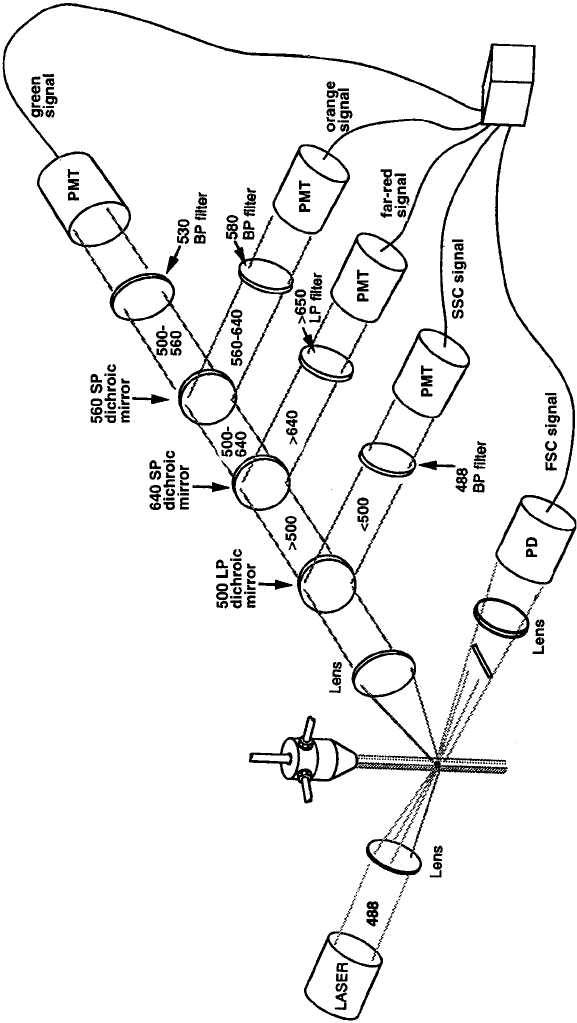
Fig. 5.7. A ®lter and mirror con®guration for making ®ve photodetectors speci®c for registering forward scatter, side scatter, green,
orange, and far-red signals.
Flow Cytometry74
.
Side scatter light (488 nm) will be re¯ected out of the beam path
toward the ®rst PMT by the 500 LP mirror
.
Far-red ¯uorescence will be re¯ected out of the beam path toward
the second PMT by the 640 SP mirror
.
Orange ¯uorescence will be re¯ected out of the beam path toward
the third PMT by the ®nal 560 SP mirror
.
Green ¯uorescence will be transmitted straight ahead through
that ®nal mirror toward the last PMT in the optical system
By the use of ®lters with particular color speci®cations immediately
in front of the photodetectors, we have our last chance for making
sure that the only light registered on a given photodetector has been
derived from a speci®c ¯uorescence color. Filters are similar to di-
chroic mirrors, but are meant to be used at 90
to the light path; they
transmit light according to its color. Filters come in three basic types:
A short-pass ®lter will transmit all light of a wavelength less than the
speci®ed value; a long-pass ®lter will transmit all light of a wave-
length greater than the speci®ed value; and a band-pass ®lter will
transmit only light in a narrow wavelength band around the speci®ed
value. Band-pass ®lters are of most use in ¯ow systems because they
are most speci®c in their transmission characteristics. These charac-
teristics are usually described according to the peak transmission wave-
length and the width of the wavelength band at 50% of that peak
transmission. For example, if a ®lter transmits 90% of the 570 nm
light falling onto its surface, and if this percentage of transmission
drops to 45% when the wavelength changes by 15 nm in either direc-
tion, then the ®lter will be described as a 570/30 nm band-pass ®lter.
Di¨erent ®lter and mirror combinations will be required for ex-
periments using di¨erent combinations of stains. By looking at the
detailed ¯uorescence emission spectra of the ¯uorochromes in use, we
can plan a strategy for selecting the ®lter and mirror sets that will
allow us to correlate the signal from a given photodetector with the
¯uorescence from a given ¯uorochrome. Figure 5.8 shows the ¯uo-
rescence emission spectra from ¯uorescein and phycoerythrin drawn
on the same axes. (These two ¯uorochromes are the most useful ex-
ample for our purposes here, but the same principles and ®lter strat-
egy would apply to any group of two or more ¯uorochromes used
simultaneously.) By inspection of these spectra, we can see that the
best dichroic mirror to use for splitting ¯uorescein ¯uorescence from
phycoerythrin ¯uorescence is a 560 nm mirror. This will send most of
Lasers, Fluorochromes, and Filters 75
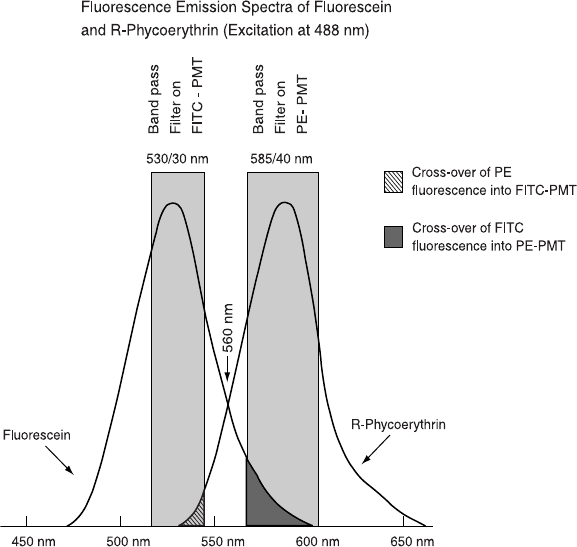
the ¯uorescein ¯uorescence straight through to one photodetector
and re¯ect most of the phycoerythrin ¯uorescence toward a di¨erent
photodetector. By ®tting the green detector with a 530/30 nm ®lter
and the orange detector with a 585/40 nm ®lter, we have constructed
a system that will register ¯uorescein ¯uorescence and phycoerythrin
¯uorescence mainly on di¨erent photodetectors. We might be entitled
now to call one photodetector the ``¯uorescein detector'' and the
other one the ``phycoerythrin detector''; but that qualifying word
mainly lies at the root of our next problem.
SPECTRAL COMPENSATION
With the ®lter and mirror combinations just described, a cell stained
only with ¯uorescein will emit ¯uorescence that will register strongly
on the green-speci®c photodetector (and this is ®ne if we are using
Fig. 5.8. The cross-over of ¯uorescein and phycoerythrin ¯uorescence through the
®lters on the ``wrong'' photodetectors.
Flow Cytometry76
only ¯uorescein as the stain in our system). However, inspection of
the ¯uorescence emission spectrum of ¯uorescein (Fig. 5.8) indicates
that some of the light emitted by a cell or other particle stained only
with ¯uorescein will manage to evade our strategic obstacles (mirrors
and ®lters); some of the light emitted by ¯uorescein is of a wavelength
long enough to register on the orange photodetector. This is another
way of saying that the light emitted by ¯uorescein is ``orange-ish
green.'' No matter how tightly we restrict the ®lter and mirror speci-
®cations, we cannot get round the fact that there is a signi®cant
degree of overlap between the ¯uorescence emission of ¯uorescein
and that of phycoerythrin. Therefore, there is no way to keep all the
¯uorescein-derived light from the orange detector without losing
most of the phycoerythrin ¯uorescence as well. If we want to measure
PE ¯uorescence with reasonable sensitivity, then the orange photo-
detector will also respond to a limited extent to ¯uorescein ¯uores-
cence. Our use of ®lters and mirrors must, for these reasons, be a
compromise.
What this compromise means, in practice, is that a cell stained
only with ¯uorescein will register a signal brightly on the green-
speci®c photodetector but also signi®cantly on the orange-speci®c
photodetector. Similarly, a cell stained only with phycoerythrin will
register a signal brightly on the orange detector, but also slightly
on the green detector. The left panel of Figure 5.9 shows how these
pure signals look on dot plots giving the relative intensities for the
signals on the orange and green PMTs. Clearly, we would have been
incorrect in calling the detectors ¯uorescein or phycoerythrin speci®c;
the ®lters and mirrors in front of our photodetectors cannot make
them as speci®c as we would like them to be. The correct terminology
should, therefore, simply identify a photodetector by the speci®ca-
tions of its ®lter (that is, a ``530/30 nm detector'' or a ``585/40 nm
detector''). When ¯ow cytometrists, being as lazy as everyone else,
talk about a ``¯uorescein photodetector,'' you now have enough
knowledge to understand the imprecision of this phrase. In many
cytometers, the ¯uorescence detectors are simply given numbers (e.g.,
FL1, FL2, FL3). If the ®lters are ®xed (as in some benchtop instru-
ments), the user needs to refer to the technical manual to know which
®lters are in front of which detectors. In a research cytometer, the
®lters can be changed to adapt to the use of di¨erent combinations of
¯uorochromes; knowledge of the exact optical pathway in place at
any one time becomes correspondingly much more important.
Lasers, Fluorochromes, and Filters 77
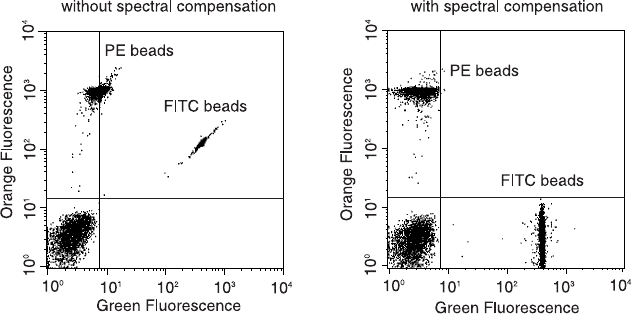
Having understood why there is cross-over or overlap between
¯uorochromes, each registering to a certain extent on the ``wrong''
photodetector, we now must decide what to do about it. What we do
about it is called compensation. Cytometers are provided with an elec-
tronic circuit, a compensation network, that measures the intensity
of the signal on one photodetector and subtracts a certain percentage
of that signal from the signal on another photodetector (because a
certain ®xed percentage of any ¯uorescein signal will always cross
over and register on the 585/40 nm phototube, and a certain ®xed
percentage of any phycoerythrin signal will always cross over and
register on the 530/30 nm phototube).
Those percentages are routinely determined empirically. Cells
brightly stained with only ¯uorescein are run through the cytometer;
their signals on both the green and orange photodetectors are re-
corded; and the percentage subtraction (percentage of the signal on
the green detector to be subtracted from any signal on the orange
detector) is varied until no signal above background is registered on
the orange photodetector. Technically, we want to make sure that
the median orange channel of ¯uorescein-stained cells is identical
to the median orange channel of unstained cells. We then go through
the same procedure with cells that have been brightly stained only
with phycoerythrin in order to determine what percentage subtraction
Fig. 5.9. The ¯uorescence from phycoerythrin beads registers a bit on the green
photodetector; and the ¯uorescence from ¯uorescein beads registers considerably
on the orange photodetector. Compensation (right) allows us to correct for this
cross-over.
Flow Cytometry78