
Givan A.L. Flow Cytometry. First Principles
Подождите немного. Документ загружается.

is required to compensate the green photodetector for cross-over
from the phycoerythrin ¯uorescence. When both photodetectors have
been correctly compensated for cross-over from the wrong ¯uoro-
chromes, our signals, plotted as two-dimensional dot plots, should
look like those in the right panel of Figure 5.9.
If more than two ¯uorochromes have been used for simultaneous
multiparameter analysis, then the signals from all PMTs need to be
compensated individually in the same way with respect to each
¯uorochrome (i.e., in a three-color example, the green PMT needs to
be compensated for cross-over ¯uorescence from both the red and
orange ¯uorochromes; the orange PMT for cross-over ¯uorescence
from the green and red ¯uorochromes; and the red PMT for cross-
over ¯uorescence from the green and orange ¯uorochromes). In
practice, this involves staining cells separately and brightly with each
of the three ¯uorochromes. The separately stained cells can then each
be mixed with unstained cells; the three mixtures can be run through
the cytometer and examined with respect to three di¨erent dot plots
(red vs. green; green vs. orange; and red vs. orange) to make sure that
the compensation network gives square patterns (as in Fig. 5.9, right
panel) for the cells in all three plots.
As a general comment, compensation is one of the more di½cult
areas in ¯ow cytometry and gets more di½cult as more colors are
involved. For this reason, there is software available that permits
postexperiment compensation: Samples can be run through the cy-
tometer without any or with minimal electronic compensation, and
the compensation subtraction can be applied or adjusted afterward
during data analysis. There are great advantages to software com-
pensation because, especially in multicolor experiments, it is often
di½cult to ``get it right'' while under the pressure of acquiring data at
the cytometer bench. Of course, even postexperiment compensation
still requires that ®les from single-stained samples be stored so that
the software compensation subtraction can be evaluated.
It remains to be said (unfortunately) that the compensation values
are valid only for a particular pair of ¯uorochromes with a particular
set of ®lters and mirrors and with particular voltages applied to a
particular set of PMTs. If any one of those elements is altered, the
required compensation values will alter as well. In general, once
compensation has been set using single-stained particles with a given
experimental protocol (PMT voltages, ®lters, and so forth), compen-
sation values between a given pair of ¯uorochromes should remain
Lasers, Fluorochromes, and Filters 79
constant within that protocol from day to day. However, because
compensation can a¨ect the way two-color plots are evaluated, cor-
rect compensation can be of critical importance in the interpretation
of data from samples that are brightly stained with one ¯uorochrome
but weakly stained with another. For this reason, single-stained con-
trols should always be run within each experimental group in appli-
cations where this type of interpretation is required.
Through the chapters so far, a basic cytometric system has been
described. We have generated an illuminating beam, followed the
¯uid controls that send cells through the center of that beam, and
registered the light signals emerging from those cells as speci®cally as
possible on individual photodetectors, according to their color. We
have also compensated for any lack of speci®city in our photo-
detectors that might result from spectral cross-over between ¯uoro-
chromes. Finally, we have stored the information from the light
signals from each cell in a computer storage system so that they can
be analyzed in relation to each other through computer software. We
are now in a position to begin to look at ways in which such a ¯ow
system might be used. In the following chapters, applications will be
described to give some indication of the common, the varied, and the
imaginative practices of ¯ow cytometry. My choice of speci®c exam-
ples is intended to illustrate points that may be of general importance
and also to illustrate a range of applications that might stimulate
interest in readers who are new to the ®eld. It is not meant, nor in a
short book could it hope, to be exhaustive.
FURTHER READING
Chapter 2 in Ormerod is a good, gentle discussion of ¯uorescence technol-
ogy and light detection. Chapter 4 in Shapiro is slightly more detailed, and
Chapter 2 in Van Dilla et al. follows well from there. The Melles-Griot cat-
alog is a valuable (and free) source of information about lasers and ®lters.
Chapter 12 in Melamed et al., Section 4 in Current Protocols in Cytometry,
and Chapter 7 in Shapiro discuss the uses of di¨erent ¯uorochromes. With
respect to the physical characteristics of these ¯uorochromes, the Molecular
Probes Handbook is a valuable (and free) source of information. Chapter
1.14 in Current Protocols in Cytometry is a detailed discussion by Mario
Roederer of compensation.
Flow Cytometry80

6
Cells from Without:
Leukocytes, Surface Proteins,
and the Strategy of Gating
In this chapter, the analysis of leukocytes, one of the more important
applications of ¯ow cytometry, is discussed. It is an important appli-
cation not because leukocytes are intrinsically more important than
other types of cells but because they constitute a class of particles
that, for several reasons, are ideally suited for analysis by ¯ow cy-
tometry and thus make very good use of the capabilities of the tech-
nique. Leukocytes therefore account for a large proportion of the
material analyzed by ¯ow cytometry in both hospital and research
laboratories. They also serve as good examples for describing here
some of the general procedures of cytometric protocol, particularly
the art of gating and the requirements for controls.
Leukocytes are well suited to ¯ow analysis for three reasons. First,
they occur in vivo as single cells in suspension; they can therefore be
analyzed without disaggregation from a tissue mass (and no spatial
information is lost in the course of preparation). Second, the nor-
mal suspension of leukocytes (i.e., blood) contains a mixture of cell
types that happen to give o¨ forward (FSC) and side (SSC) light
scatter signals of di¨erent intensities, thereby allowing them to be
distinguished from each other by ¯ow cytometric light scatter param-
eters. Third, with monoclonal antibody technology, a vast array of
speci®c stains for probing leukocyte surface proteins has been devel-
oped; these stains have allowed the classi®cation of microscopically
identical cells into various subpopulations according to staining char-
acteristics that are distinguishable by means of ¯ow analysis.
81
Flow Cytometry: First Principles, Second Edition. Alice Longobardi Givan
Copyright
2001 by Wiley-Liss, Inc.
ISBNs 0-471-38224-8 (Paper); 0-471-22394-8 (Electronic)
I will ®rst describe leukocytes in a general way for those not
familiar with this family of particles. We will then proceed to a
description of general staining techniques for surface markers, with
attention to the need for controls. At this point I will digress slightly
and discuss the way cytometry results can (and cannot) be quanti®ed
and the way sensitivity can a¨ect these results. Finally, I will discuss
gating strategies, in both philosophy and practice.
CELLS FROM BLOOD
Whole blood consists of cells in suspension (Fig. 6.1). In a ``normal''
milliliter (cm
3
) of blood, there are about 5 10
9
erythrocytes (red
blood cells), which are shaped like ¯at disks (about 8 mm in diameter)
and are responsible for oxygen transport around the body. In addi-
tion, per cm
3
there are about 7 10
6
white cells (leukocytes) that
collectively are involved in immune responses in the organism. The
leukocytes appear to be heterogeneous under the microscope and can
be divided according to their anatomy into several classes. There are
cells that are called monocytes, which are of a concentration of about
0:5 10
6
per cm
3
; these appear on slides as round cells (about 12
mm) with horseshoe-shaped nuclei and are responsible for phag-
ocytosis of invading organisms and for presenting antigens in a way
that can initiate the immune response.
There are also cells that appear as 10 mm circles with large round
nuclei and a narrow rim of cytoplasm; these are the lymphocytes,
present in a concentration of about 2 10
6
per cm
3
. Lymphocytes
(including both B lymphocytes and T lymphocytes) are responsible
for a great variety of the functions that are known as cellular and
antibody (humoral) immunity, as well as for the regulation of those
functions. The third (and most frequent) group of leukocytes occurs
ÐÐÐÐÐÐÐÐÐÐÐÐÐÐÐÐÐÐÐÐÐÐÐÐÐÐÐÐÐÐÐÐÐÐÐÐ
f
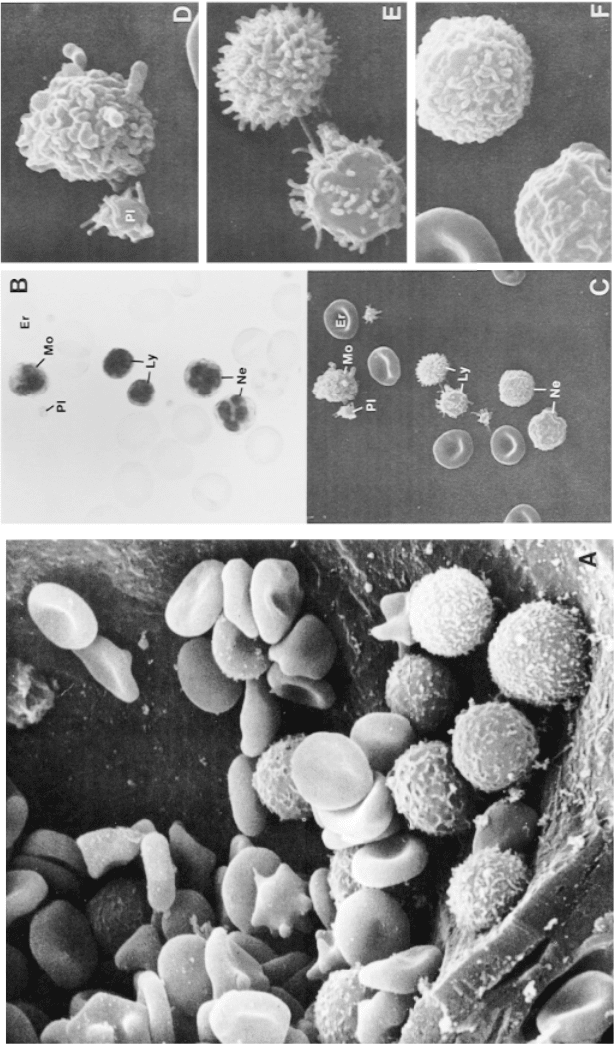
Fig. 6.1. Scanning electron micrographs showing the di¨erent surface textures of red
(Er) and white blood cells. A: Cells within a blood vessel. B,C: A comparison of
scanning electron micrographs with conventional light microscope images of the
same ®eld of stained cells. Enlarged pictures at the right emphasize the di¨erent
surface textures of monocytes (Mo) and platelets (Pl) in D, lymphocytes (Ly) in E,
and neutrophils (Ne) in F. From Kessel RG and Kardon RH (1979). Tissues and
Organs: A Text Atlas of Scanning Electron Microscopy, WH Freeman, NY.
Flow Cytometry82

in a concentration of about 5 10
6
per cm
3
. They are distinguished
under the microscope by lobular nuclei and an array of cytoplasmic
granules, are therefore called polymorphonuclear cells or granulocytes
(including basophils and eosinophils, but mainly neutrophils), and
are collectively responsible for phagocytic as well as other immune-
related activities. In addition, there are small, cell-derived particles
called platelets (about 2 mm in size), in a concentration of about
2 10
8
per cm
3
. The platelets are involved in mechanisms for blood
coagulation (Table 6.1).
Although the blood is an easily accessible tissue to study, because
red blood cells outnumber leukocytes by about 1000 to 1 in the
peripheral circulation, the analysis of leukocytes by any technique is
di½cult unless the red cells can be removed. Techniques for removing
red cells usually involve either density gradient centrifugation (pellet-
ing red cells and neutrophils, leaving lymphocytes and monocytes
behind to be collected from a layer as a peripheral blood mono-
nuclear cell preparation [ PBMC]) or di¨erential lysis of red blood
cells, leaving intact the more robust lymphocytes, monocytes, and
neutrophils.
The light scatter signals (FSC and SSC) resulting from ¯ow cyto-
metric analysis of whole blood, lysed whole blood, and a mono-
nuclear cell preparation after the density gradient separation of whole
blood are compared in Figure 6.2. Each dot plot shows 2000 cells;
TABLE 6.1. Cells in Normal Human Adult Peripheral Blood
Cells
No. per cm
3
(95% range) Percent of WBC Diameter (mm)
Platelets (thrombocytes) 1±3 10
8
2±3
Erythrocytes (RBC) 4±6 10
9
6±8
Leukocytes (WBC) 3±10 10
6
[100]
Granulocytes
Neutrophils 2±7 10
6
50±70 10±12
Eosinophils 0.01±0.5 10
6
1±3 10±12
Basophils 0±0.1 10
6
0±1 8±10
Lymphocytes 1±4 10
6
20±40 6±12
Monocytes 0.2±1.0 10
6
1±6 12±15
Values are from Lentner C, ed. (1984). Geigy Scienti®c Tables, 8th edition. CIBA-Geigy, Basle;
and from Diggs LW, et al. (1970). The Morphology of Human Blood Cells, 5th edition. Abbott
Laboratories, Abbott Park, IL.
Flow Cytometry84
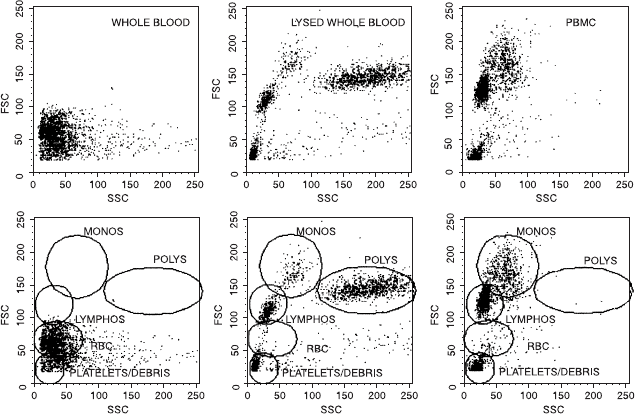
each cell is represented by a dot and plotted on the two axes accord-
ing to the intensity of its FSC and SSC signals. The resulting clusters
of particles consist of
1. A group of particles with low SSC intensity and low FSC in-
tensity (and usually ignored because they fall below the useful
FSC threshold)
2. A group of particles with low SSC intensity but somewhat
higher FSC intensity
3. A group of particles, still with low SSC intensity but with
moderately high FSC intensity
4. A group of particles with somewhat higher FSC but also with
moderate SSC intensity
5. A group of cells possessing moderate FSC but much higher
SSC.
Fig. 6.2. The FSC and SSC signals resulting from the cells in di¨erent blood prep-
arations (whole peripheral blood; whole peripheral blood after erythrocyte lysis; and
peripheral blood mononuclear cells [PBMCs] with granulocytes removed by density
gradient centrifugation). The bottom panels indicate the ®ve clusters into which the
scatter signals fall.
Leukocytes, Surface Proteins, and the Strategy of Gating 85
The most obvious way to determine the identity of these particles,
with distinctive scatter characteristics, is to sort them with a sorting
¯ow cytometer (see Chapter 9). The ¯ow sorting of blood prepara-
tions according to FSC and SSC parameters has brought the realiza-
tion that the clusters of particles with de®ned ¯ow cytometric scatter
characteristics belong to the groups of cells as distinguished, tradi-
tionally, by microscopic anatomy. The anatomical di¨erences that
we see under the microscope result from di¨erent patterns of light
bouncing o¨ the cells on the slide and being registered by our eyes.
Therefore, it should not be entirely surprising that a ¯ow cytometer,
with its photodetectors measuring light bouncing o¨ cells, often clus-
ters cells into groups that are familiar to microscopists. In addition,
however, the human eye registers many more than two parameters
when it looks at a cell (think of shape, texture, movement, color).
Speci®cally, the eye registers something we might call pattern very
sensitively; a ¯ow cytometer registers pattern not at all. So, in some
ways, it is perhaps just good luck that the two parameters of FSC
and SSC light do allow cytometrists to distinguish some of the classes
of white cells almost as e¨ectively as a trained microscopist with a
good microscope.
We should, however, always be aware of situations in which mi-
croscopists are better than cytometristsÐcertain types of classi®ca-
tion are easy by eye but not at all easy by cytometer. For example, a
microscopist would never confuse a dead lymphocyte with an eryth-
rocyte, nor a chunk of debris with a viable cell; such mistakes are all
too frequent in cytometry. Furthermore, microscopists, if they were
not so polite, would ®nd it laughable that cytometrists have a great
deal of di½culty in distinguishing clumps of small cells from single
large cells. However, if we think back to the discussion in Chapter 3
about the origin of the FSC signal, we can see why these problems
occur and why we need to be aware of the limits of ¯ow cytometry
(and why a microscope is an essential piece of equipment in a ¯ow
cytometry lab).
The patterns of light scatter distribution illustrated in Figure 6.2
result from analysis of blood from a normal individual. With patterns
like this, a ¯ow cytometrist can, with some practice, set a so-called
lymphocyte region around a group of particles that are mainly lym-
phocytes. This lymphocyte region will then, using FSC and SSC char-
Flow Cytometry86
acteristics, de®ne the cells that are to be selected (gated) for analysis of
¯uorescence staining. Such lymphocyte gating is the direct equivalent
of a skilled microscopist's decision, based on size and nuclear shape,
about which cells to include as lymphocytes in a count on a slide. A
detailed discussion of gating is given at the end of this chapter. Be-
cause staining can provide us with some help in our gating decisions,
we need ®rst to discuss some of the staining techniques that can help
us to describe cell populations.
STAINING FOR SURFACE MARKERS
Monoclonal antibody technology has provided ¯ow cytometrists with
a large array of antibodies that are speci®c for various proteins on
the leukocyte surface membrane. The proteins (antigens), de®ned by
these antibodies, have been given so-called CD numbers; ``CD'' stands
for ``cluster of di¨erentiation'' and refers to the group or cluster of
antibodies all of which de®ne a particular protein that di¨erentiates
cells of one type. More and more antigens are de®ned each year,
and the CD numbers now range from CD1 on up through CD170
or greater. Antibodies against these antigens (called anti-CDx anti-
bodies) have allowed immunologists to de®ne taxonomic subgroups
of leukocytes that are microscopically indistinguishable from each
other but whose concentrations vary in ways that are related to an
individual's immune status. For example, B lymphocytes and T lym-
phocytes look identical under the microscope and have similar FSC
and SSC characteristics on the ¯ow cytometer, but they possess
membrane proteins that allow them to be distinguished by antibody
staining (for example, B lymphocytes have CD20 on their surface; T
lymphocytes have CD3). Some of the membrane antigens on leuko-
cytes de®ne function, some de®ne lineage, some de®ne developmental
stage, and some de®ne aspects of cell membrane structure whose sig-
ni®cance is not yet understood. Although in this chapter I discuss the
staining of leukocyte surface antigens with monoclonal antibodies,
the principles apply equally well to the use of antibodies for staining
any surface antigens on any type of cell.
An antibody will form a strong bond to its corresponding antigen.
Leukocytes, Surface Proteins, and the Strategy of Gating 87
To be of use in microscopy or ¯ow cytometry, this bond needs to be
``visualized'' (to the eye or to the photodetector) by the addition
of a ¯uorescent tag. Visualization can be accomplished by one of
two di¨erent methods. With direct staining, cells are incubated with
a monoclonal antibody that has been previously conjugated to a
¯uorochrome (for example, ¯uorescein or phycoerythrin or any
¯uorochrome with appropriate absorption and emission spectra). This
procedure is quick and direct; it merely involves a half-hour incuba-
tion of cells with antibody (at 4
C), followed by several washes to
remove weakly or nonspeci®cally bound antibodies. Cells thus treated
are ready for ¯ow analysis (although ®nal ®xation with 1% electron
microscopic±grade formaldehyde will provide a measure of biological
safety and long-term stability).
The second method (indirect staining) is more time consuming, less
expensive, and either more or less adaptable depending on the appli-
cation. Indirect staining involves incubation of cells with a non-
¯uorescent monoclonal antibody, washing to remove weakly bound
antibody, and then a second incubation with a ¯uorescent antibody
(the so-called second layer) that will react with the general class
of monoclonal antibody used in the ®rst layer. For example, if the
primary monoclonal antibody happens to be an antibody that was
raised in a mouse hybridoma line, it will have the general character-
istics of mouse immunoglobulin; the second layer antibody can then
be a ¯uoresceinated (¯uorescein-conjugated) antibody that will react
with any mouse immunoglobulin. The advantages of this two-layer
technique are that, ®rst, monoclonal (primary layer) antibodies are
cheaper if they are unconjugated; second, a given second layer re-
agent can be used to visualize any monoclonal antibody of a given
class (e.g., any mouse immunoglobulin, in our example here); third,
comparison of antigen density according to ¯uorescence intensity is
easier if common second layer reagents are used; and fourth, each
step in the staining procedure results in ampli®cation of the ¯uores-
cence intensity of the staining reaction. (With regard to this signal
ampli®cation that occurs with indirect staining, I might also add
parenthetically that further ampli®cation of weak signals is possible
by using third and fourth layer reagents of appropriate speci®city. All
that is required is an interest in zoology. For example, if the primary
monoclonal antibody is a mouse monoclonal, the second layer re-
agent could be a ¯uorescein-conjugated antibody raised in a goat and
Flow Cytometry88