
Givan A.L. Flow Cytometry. First Principles
Подождите немного. Документ загружается.


speci®c for mouse Ig [known as a goat anti-mouse reagent]. An ap-
propriate third layer reagent might then be a ¯uorescein-conjugated
antibody raised in a sheep and speci®c for goat Ig [sheep anti-goat],
and so on [elephant anti-sheep, armadillo anti-elephant, unicorn anti-
armadillo] until the zoologists run out of immunologically competent
animals [Fig. 6.3]. Because each antibody molecule is linked to many
¯uorochrome molecules and because many antibodies will bind to
each antigen, this is a way to increase the intensity of signals from
sparsely expressed membrane proteins.)
The disadvantages of indirect staining are that it is more time-
consuming and it involves a second step that doubles the opportunity
for nonspeci®c binding. Indirect staining also greatly limits the op-
portunity for simultaneous double and triple staining of cells with
two and three di¨erent ¯uorochromes because of the problems of
Fig. 6.3. Ampli®cation of staining by the use of multiple antibody reagents. Drawing
by Ian Brotherick.
Leukocytes, Surface Proteins, and the Strategy of Gating 89
cross-reactivity between primary antigens and the conjugated second
layer reagents that may display broad speci®city. Nevertheless, with
appropriate choice of monoclonal antibodies of speci®c immuno-
globulin subclass and/or animal derivation and with second layer
reagents appropriate and speci®c to these particular characteristics,
two-color staining with indirect reagents is sometimes possibleÐbut
it is not easy. In general, with the increasing availability of multilaser
systems and the concurrent realization by scientists of the informative
power of multicolor staining, most workers have adopted direct
staining procedures.
CONTROLS
As emphasized in the section in Chapter 3 on electronics, the inten-
sity ``read out'' in ¯ow cytometry is relative and user-adjustable. By
changing electronic settings, cells of a given intensity can receive
either high or low ``intensity'' values from the ADC (and can be
placed at high or low positions on the ¯uorescence scale). Therefore,
in order to know whether cells that have been exposed to a stain have
actually bound any of that stain, we need to compare the stained cells
with an unstained control. One of the general laws of science that
applies particularly to ¯ow cytometry is that no matter how many
controls you have used in an experiment, when you come to analyze
your results you always wish you had used one more. There are three
reasons that this problem is acute in ¯ow analysis. One has to do with
the background ¯uorescence of unstained cells; the second has to do
with the nature of antibody±antigen interactions; and the third has to
do with the problem of compensation between overlapping ¯uores-
cence spectra from di¨erent ¯uorochromes.
The ®rst problem that needs to be controlled is that of back-
ground ¯uorescence (called auto¯uorescence). All unstained cells give
o¨ some ¯uorescence (that is, all cells emit some light that gets
through one or another of the ®lters in front of a cytometer's photo-
detectors). This auto¯uorescence may not be recognized by micro-
scopists either because it is very dim or because experienced micro-
scopists have acquired a mental threshold in the course of their
training. But our cytometer's photodetectors are both very sensitive
and completely untrainable. Therefore the auto¯uorescence of cells,
Flow Cytometry90
resulting from intracellular constituents such as ¯avins and pyridine
nucleotides, is bright enough to be detected. It can, in some cells,
be so bright as to limit our ability to detect positive staining over
and above this bright background. Whatever the level of this auto-
¯uorescence, we need to de®ne it carefully by analyzing unstained
cells (auto¯uorescence controls) if we are going to be able to conclude
that cells treated with a reagent have actually become stained (that is,
are now brighter than their endogenous background).
Beyond the problem of auto¯uorescence, there is a second problem.
As discussed above, much of the staining of cells for ¯ow analysis
makes use of antibody±antigen speci®city. Although the speci®city
between an antibody's binding site (the key) and the corresponding
epitope on an antigen (the lock) is indeed exquisite, the beauty of the
system can be confounded by a long ¯oppy arm on the back (Fc) end
of the antibody. These Fc ends stick with wild abandon to so-called
Fc receptors that occur on the surface of many types of cells (notori-
ously monocytes). While I have worked in a department with scien-
tists who study the speci®city and importance of this Fc binding for
too long to consider these reactions to be nonspeci®c and only a
nuisance, it is true that these Fc receptors on many types of cells
can confound the nominal speci®city of an antibody's binding to
its reciprocal antigen. What this means is that cells may stain with
a particular monoclonal antibody because they possess a particular
antigen on their surface membrane that locks neatly with the key on
the monoclonal antibody binding site. They may also, however, stain
with that particular monoclonal antibody because they possess Fc
receptors that promiscuously cling to antibodies with all antigenic
speci®cities. In addition, it is often true that dead cells (with perfo-
rated outer membranes) can soak up antibodies and then hang on to
them tenaciously. The way to know if staining of cells is speci®c to a
speci®c antigen is to use the correct control.
The correct control is always an antibody of exactly the same
properties as the monoclonal antibody used in the experiment, but
with an irrelevant speci®city. If we are staining cells with a mono-
clonal antibody having a speci®city for the CD3 protein occurring on
the surface of T lymphocytes (and that monoclonal antibody happens
to be a mouse immunoglobulin of the IgG
2a
subclass, conjugated
with six ¯uorescein molecules per molecule of protein and used to
stain the cells at a concentration of 10 mg per ml), then an appropri-
Leukocytes, Surface Proteins, and the Strategy of Gating 91
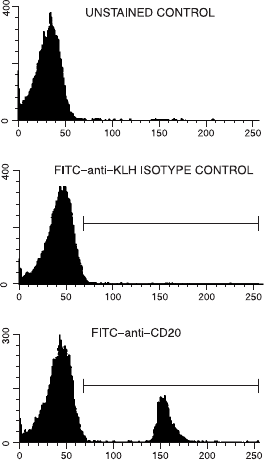
ate control would be a mouse monoclonal antibody of the same sub-
class, with the same ¯uorescein conjugation ratio, and at the same
protein concentration, but with a speci®city for something like key-
hole limpet hemocyanin or anything else that is unlikely to be found
on a human blood cell (Fig. 6.4).
Such a control antibody is known as an isotype control because it is
of the same immunoglobulin isotype (subclass) as the staining anti-
body used in the experiment. It will allow you to determine how
much background stain is due to irrelevant stickiness (dead cells, Fc
receptors, and so forth). The only trouble with this scenario is that
exactly correct isotype controls are not usually available. Various
manufacturers of monoclonal antibodies will sell so-called isotype
controls and will certainly recommend that they be used. These are,
however, general purpose isotype controls that will be of an average
Fig. 6.4. The ¯uorescence histogram of an isotype control sample is used to decide
on the ¯uorescence intensity that indicates positive staining.
Flow Cytometry92
¯uorochrome conjugation ratio and of a protein concentration that
may or may not be similar to that used for most staining procedures.
Whether an average isotype control is better than no isotype control
at all is a matter of opinion and will depend on the kinds of answers
that you demand from your experiments. For most routine immuno-
phenotyping, where the staining of positive cells is strong and bright,
isotype controls have been falling out of favor. Unstained (auto-
¯uorescence) controls may be good enough.
The third problem that needs to be controlled is that of spectral
cross-over and the possibility of incorrect instrument compensation.
As an example of a case in which controls for nonspeci®c staining,
auto¯uorescence, and compensation are all critical, let us look at the
staining of B lymphocytes for the CD5 marker present with only low
density on their surface. As well as the problems created by non-
speci®c staining and by auto¯uorescence, the problem of spectral
cross-over between ¯uorescein and phycoerythrin can particularly
confuse the interpretation of results from this kind of experiment.
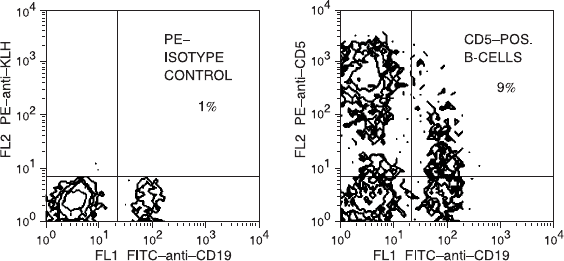
Look at Figure 6.5. What we are interested in is the number of B
lymphocytes that possess the CD5 surface antigen. These cells will
appear in quadrant 2 of a contour plot of ¯uorescein ¯uorescence
Fig. 6.5. The use of a phycoerythrin (PE) isotype control to help in deciding where,
in a dual-color plot, to draw the horizontal line between ¯uorescein±stained cells to
be considered positive and those to be considered negative for the PE stain. Mis-
placing of the horizontal line will a¨ect the number of CD19 cells determined to
express the CD5 antigen in the stained sample. Data courtesy of Jane Calvert.
Leukocytes, Surface Proteins, and the Strategy of Gating 93
(a B-lymphocyte stain) on the horizontal axis against phycoerythrin
(PE) ¯uorescence (the CD5 stain) on the vertical axis. But B cells will
also appear in this quadrant if they have orange auto¯uorescence or
if they are nonspeci®cally sticky for the anti-CD5 antibody (in this
case a mouse monoclonal immunoglobulin of the IgG
2a
isotype). In
addition, they will appear in this quadrant if the cytometer's orange
photodetector has not been properly compensated for cross-over
from the ¯uorescein signal. The way around all these problems is to
stain cells with a ¯uorescein stain for B cells in conjunction with an
isotype control (a mouse IgG
2a
antibody conjugated with PE but
speci®c for an irrelevant antigen, say, keyhole limpet hemocyanin).
The intensity of stain shown by these control cells on the PE photo-
detector will mark the limit of intensity expected from all nonspeci®c
causes. Any further PE intensity shown by cells stained with the B-cell
stain and the anti-CD5 PE stain will now clearly be the result of speci®c
CD5 proteins on the cell surface. In this way, by use of the correct
isotype control, we can rule out any problems in interpretation that
may result from incorrect instrument compensation or nonspeci®c or
background ¯uorescence.
In general, all these problems and their appropriate controls are
particularly important when, as with the CD5 antigen on B cells, the
staining density on the cells in question is low and there is consider-
able overlap between positive and negative populations. They become
less critical for the evaluation of results when dull negative cells are
being compared with a bright positive population. In any case, the
general procedure for analyzing ¯ow data is to look at the level of
background staining (resulting from both auto¯uorescence and non-
speci®c staining) and then, having de®ned this intensity, to analyze
the change in intensity that occurs after the cells have been stained.
As discussed in Chapter 4, this change may consist of the bright
staining of a small subpopulation within the total population; in this
situation, the relevant result may be given as the percentage of the
total number of cells that are positively stained. Alternatively, the
change may involve the shift of the entire population to a somewhat
brighter ¯uorescence intensity; here the relevant result may be ex-
pressed as the change in brightness (mode, mean, or median of the
distribution). This leads us to the problem of quanti®cation of inten-
sity by ¯ow cytometry.
Flow Cytometry94
QUANTITATION
One of the proclaimed advantages of ¯ow cytometry, compared with
eyeball microscopy, is its quantitative nature. Flow cytometry is
indeed impressively quantitative when it comes to counting cells and
compiling statistics about large numbers of cells in a short period of
time. Users are, however, subjected to a rude shock when they ®rst
attempt to quantify the ¯uorescence intensity of their cells. Whereas a
¯ow cytometer can be very quantitative about comparing the ¯uores-
cence intensity of particles (assuming that the photodetectors and
ampli®ers are working well), it is unfortunately true that a ¯ow cy-
tometer is very bad at providing an absolute value for the light in-
tensity it measures. Therefore, any experimental protocol that needs
to measure the intensity of the staining of cells (as opposed to a yes or
no answer about whether and what percentage of cells are stained or
not) is up against certain intrinsic di½culties.
If you really do need some measure of the intensity of cells, the
way around these di½culties is to accept the limitations of the system,
work within the constraints, and use some kind of standard to cali-
brate the intensity scale. The easiest standard for any cell is its own
unstained control. An arbitrary position on the scale can be assigned to
the ¯uorescence of the control (by changing the voltage on the photo-
multiplier tube during instrument set-up), and the stained sample can
be compared with this. The disadvantage in this measure of relative
¯uorescence compared with the control is that cells with high auto-
¯uorescence will require a greater density of positively stained recep-
tors to give the same ``relative intensity'' value as cells with low
auto¯uorescence. In other words, if intensity is expressed by a ratio of
the brightness of stained cells relative to that of the unstained cells, a
given ratio will represent more positive stain (in terms of ¯uoro-
chrome molecules) on highly auto¯uorescent cells than on cells with
low background.
One way around this problem is to compare cell ¯uorescence not
with unstained cells but with the ¯uorescence of an external standard.
This can be done by the use of ¯uorescent beads. In brief (this is an
insiders' joke; you would be amazed at how much has been written
about the use of beads in ¯ow cytometry), there are commercially
available polystyrene beads (``microspheres'') that have standardized
Leukocytes, Surface Proteins, and the Strategy of Gating 95
¯uorescence intensities. Some of these beads have ¯uorescein or PE
bound to their surface. Others have a selection of hydrophobic ¯uoro-
chromes incorporated throughout the bead. The latter are more stable
in intensity, but, because the ¯uorochromes are not the usual ¯ow
cytometric ¯uorochromes, they may give di¨erent relative values on
the di¨erent photodetectors of di¨erent cytometers. In either case, by
running a sample of standard beads through the cytometer, all data
can be reported as a value relative to the intensity of the standard beads.
One further step toward calibration has been taken with the use of
a calibration curve made with sets of beads with known numbers of
¯uorochromes on their surface. Such calibrated beads are available
with known numbers of PE molecules. Similar, but less direct, beads
are available with ¯uorochrome molecules that have been calibrated in
units equivalent to the intensity of ¯uorochrome molecules in solution
(``MESF'' units ``molecular equivalents of soluble ¯uorochrome'').
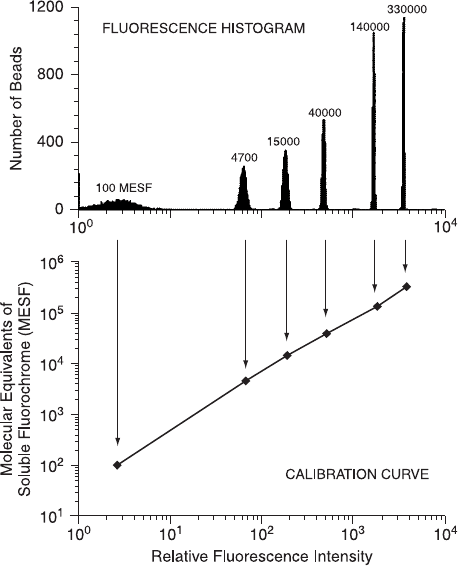
With these beads, a curve can be obtained (Fig. 6.6), giving each
channel on the ADC a calibration in number of ¯uorochrome mole-
cules (for PE) or MESF values (for ¯uorescein). In this way, the
background ¯uorescence of a control sample can be expressed as an
equivalent number of ¯uorochrome (or MESF) molecules and can be
subtracted from the number of ¯uorochrome molecules of a stained
sample. The ¯uorescence of the stained sample can then be expressed
as, for example, PE molecules over and above the background level.
Having now determined a value that might, with luck, quantify the
brightness of a particle in terms of ¯uorochrome molecules or soluble
equivalents, one may wonder how best to convert that value into the
number of receptors or antigens on the surface of the cell. At ®rst
thought, calculation of this value might be determined if values are
known for the number of ¯uorochrome molecules per antibody (the
F/P ratio) used in the staining procedure. Unfortunately, even if this
value has been determined chemically, it will not apply within a
system in which there is quenching of the ¯uorescence from ¯uoro-
chromes in closely packed regions on a cell surface (causing a
bound ¯uorochrome to ¯uoresce considerably less brightly than in its
soluble form). Moreover, the F/P value will almost certainly not be
known in a system with indirect staining and undetermined ampli®-
cation. At the present time, this F/P value can only be used with
con®dence in certain staining systems where antibodies have been
certi®ed to contain a single PE molecule per antibody and are used in
Flow Cytometry96
conjunction with standard beads with known numbers of PE mole-
cules. Even in this case, the ®nal value will be in terms of the number
of antibodies bound to a cell, and this may not be easily related to the
number of receptors per cell (because antibody binding to receptors
may be monovalent or bivalent).
Other types of calibration help may be available in the form of a
di¨erent type of calibrated microsphere. Beads can be obtained that
possess a known number of binding sites for immunoglobulin mole-
cules. They can be treated as if they were cells and stained in the
routine way with the antibody stain (direct or indirect) in question.
The intensity of the beads with known numbers of antibody binding
sites can be used to calibrate the scale, converting ADC channels to
Fig. 6.6. The ¯uorescence histogram of a mixture of ¯uorochrome-conjugated cali-
bration beads and the calibration line for channel numbers and their equivalence in
soluble ¯uorescein molecules derived from that histogram. From Givan (2001).
Leukocytes, Surface Proteins, and the Strategy of Gating 97
antibody binding sites per cell. Problems with quanti®cation using
these beads derive from the fact that the avidity of the beads for
antibodies can di¨er from the avidity of cells for antibodies so that
receptors on beads and on cells may not saturate at equivalent con-
centrations. In addition, as above, antibodies have the possibility of
binding either monovalently or bivalently under di¨erent conditions.
SENSITIVITY
Light detection sensitivity for stained cells is determined by two fac-
tors: the amount of background signal from the cells and the breadth
of the population distributions of the background and of the positive
signals that you are trying to detect over background. In other words,
you can detect staining on cells that is just slightly brighter than
background if none of the stained cells overlaps with the brightest
cells in the unstained (control) population. However, if the control
and ¯uorescent populations have very broad distributions (that is, the
range of values is great), their averages have to be well separated
from each other if you are going to be able to say that a particular
cell belongs to a stained population rather than a background popu-
lation (Fig. 6.7). This is, in concept, no di¨erent from the require-
ment in statistics for a narrow standard deviation to conclude that
two populations with closely similar means are signi®cantly di¨erent
from each other, but a less stringent requirement for narrow standard
deviation if the two population means are well separated.
As a practical matter, the way to make a ¯ow cytometer more
sensitive in detecting weak light signals is to lower the noise in the
background by using good optical, ¯uidic, and electronic components
and to align the instrument well so that ¯uorescence detection e½-
ciency is high and ¯uorescence distributions are as narrow as pos-
sible. The result of these considerations leads, however, to the
unavoidable conclusion that cells with intrinsically high background
make it more di½cult to detect low numbers of ¯uorochromes de-
rived from the staining procedure. Think of trying to see the stars in
the daytime. Certain classes of cells have greater auto¯uorescence
than others as a result of their metabolic activity. All other things
being equal, large cells have more auto¯uorescence than small cells,
simply because they are larger and have more auto¯uorescent mole-
cules associated with each cell.
Flow Cytometry98